
- Laying
- Filtering and storage wells
- Option 1. With drainage wells
- Prices for popular models of drainage wells
- Option 2. With storage
- Drainage around the house
- Device principles
- Constituent elements
- Rain shower as an addition
- Classical drainage scheme around the house
- The main types of drainage design
- wall construction
- Ring or trench design
- Why is drainage around the house necessary?
- When is drainage required?
- Types of drainage systems
- How to do it right?
- For strip foundation
- For a monolithic base
Laying
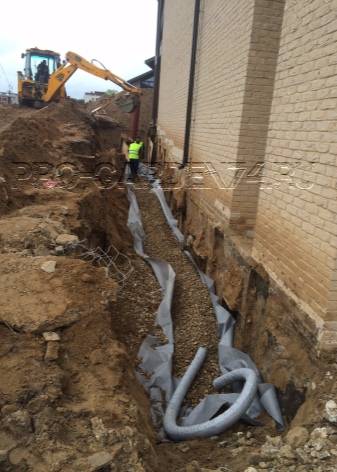
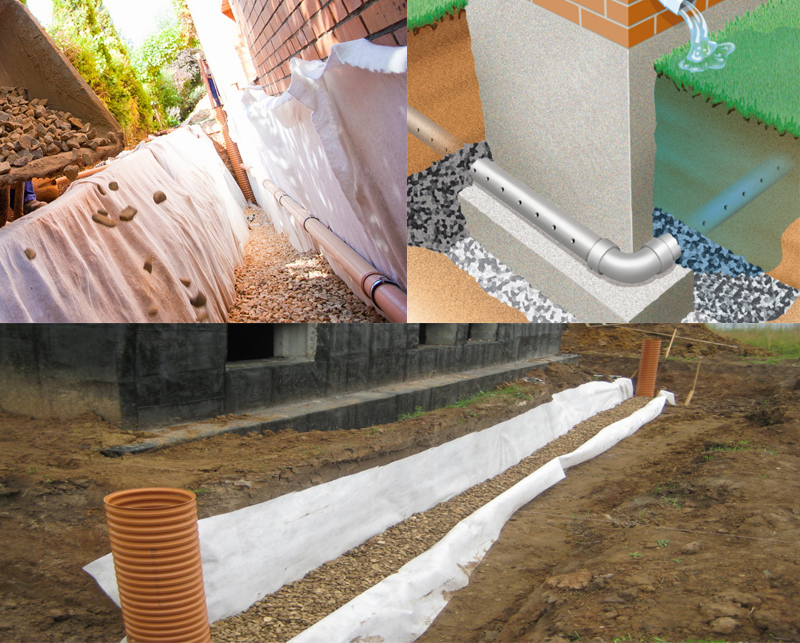
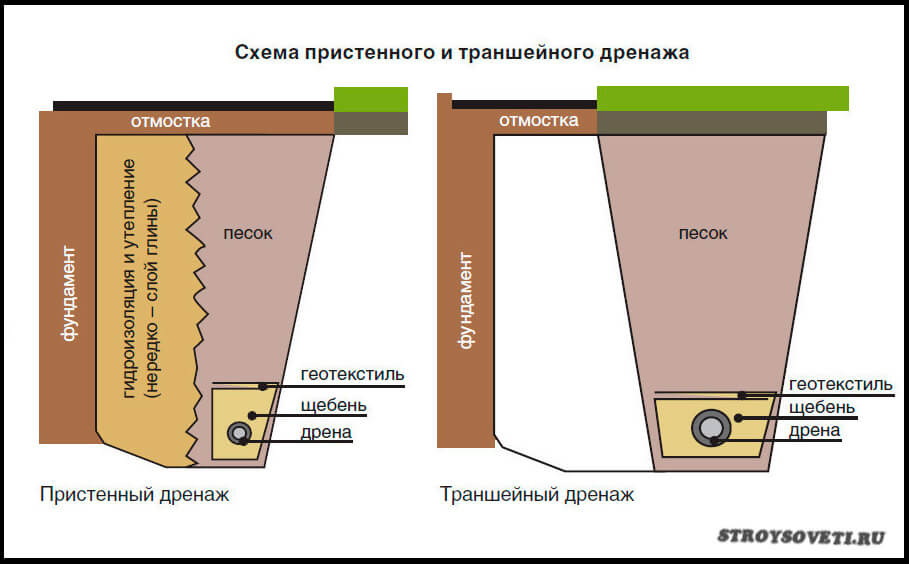
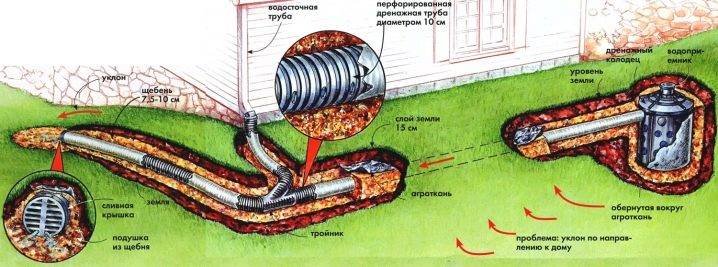
Consider wall deep drainage. This is a complex and troublesome design, but it will ideally protect the house from any moisture. Usually it is built if the house has basements and semi-basements, even during the construction of the foundation, around the base of the house, half a meter deeper than the foundation.
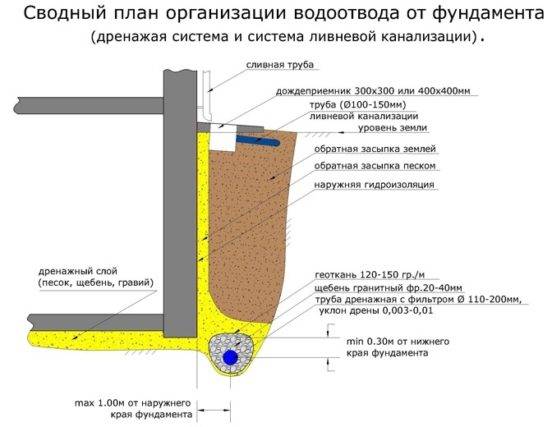
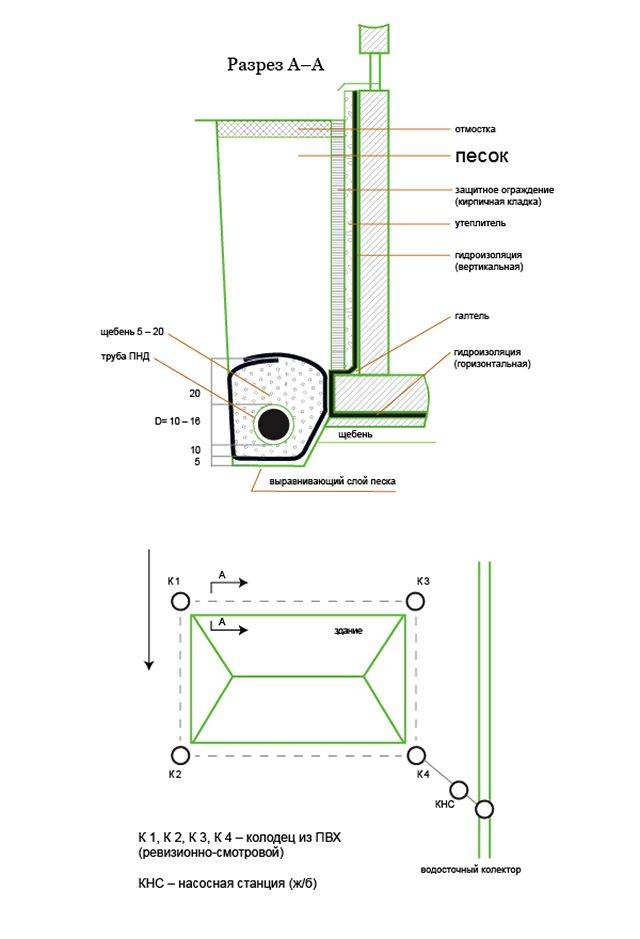
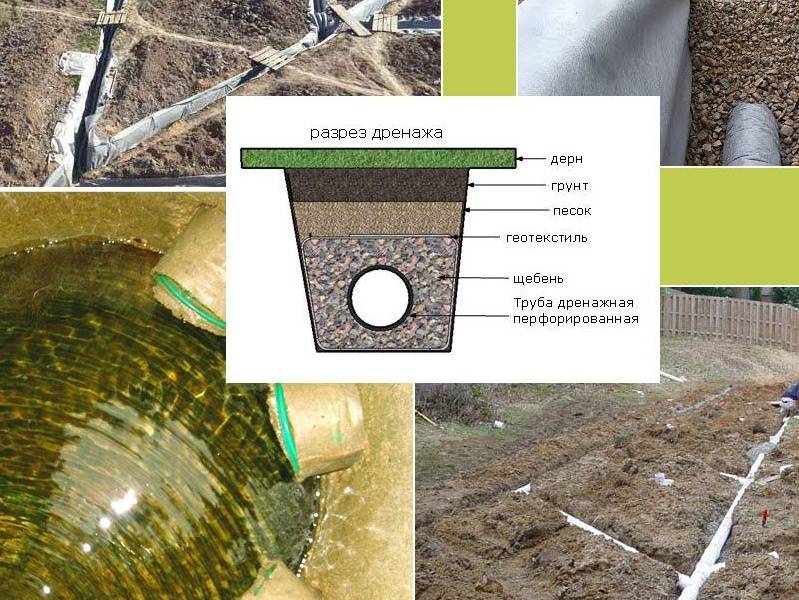
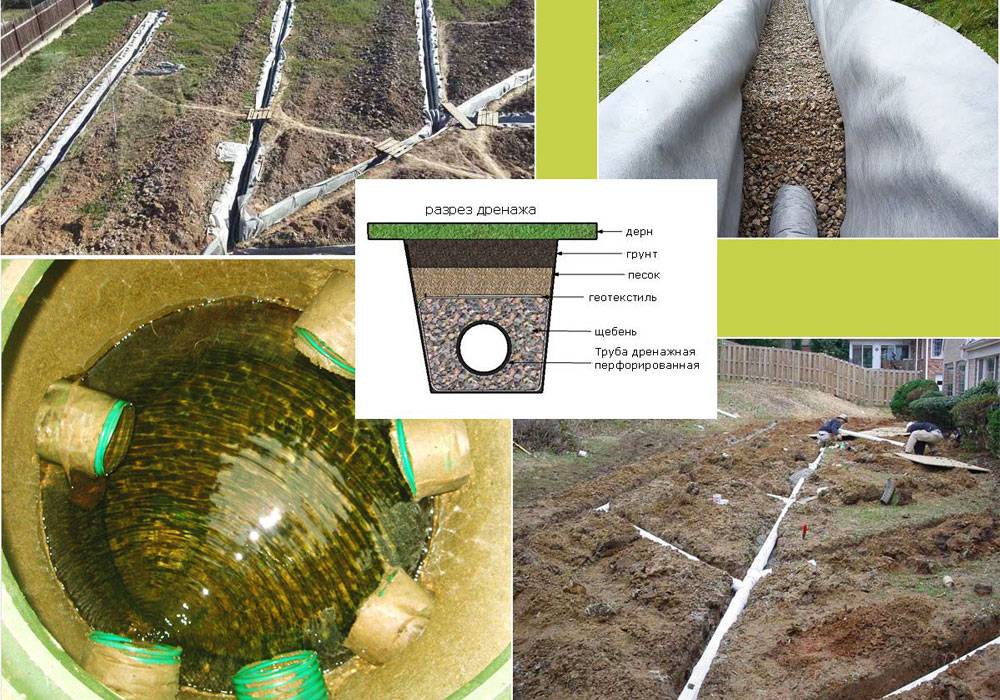
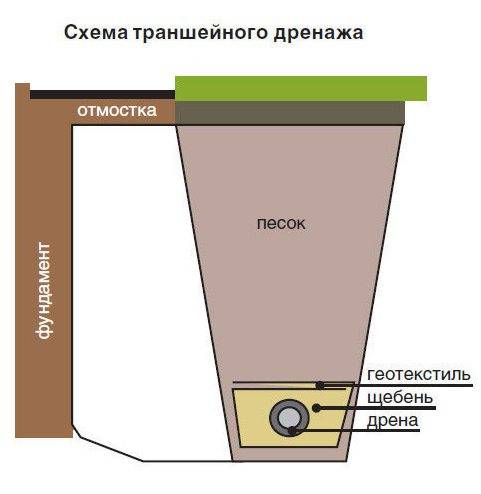
The sectional diagram of the wall foundation clearly demonstrates all stages of its construction.
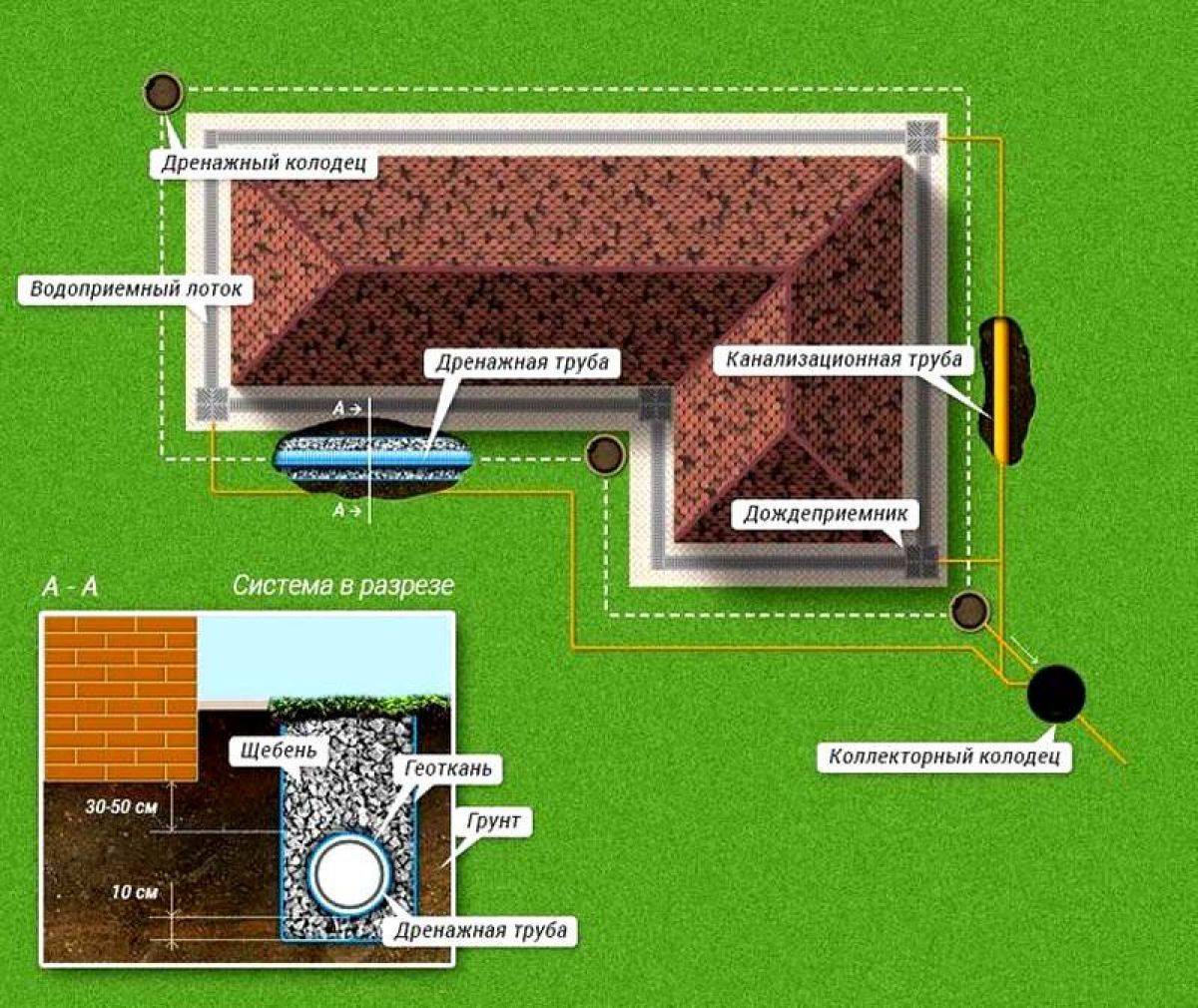
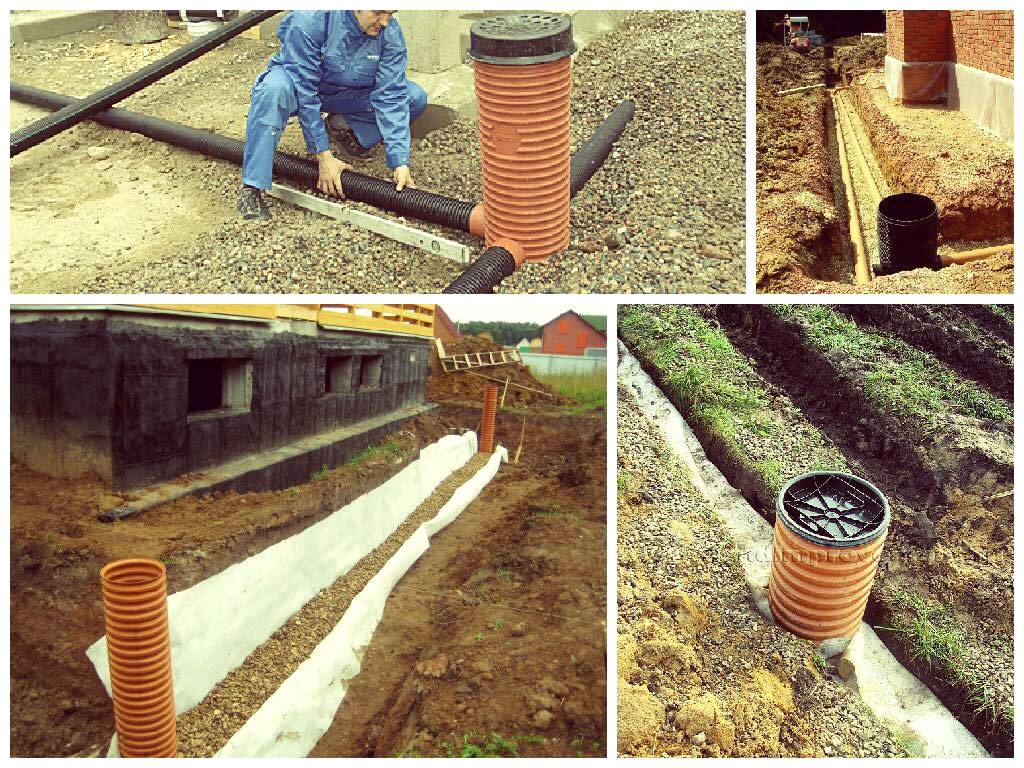
At the corners of the pipe, they approach manholes.
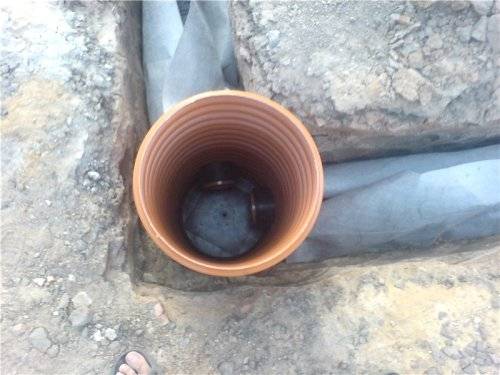
Manholes are located at the corners of the wall drainage system
The collector diverting water outside the site is dug in the deepest place.
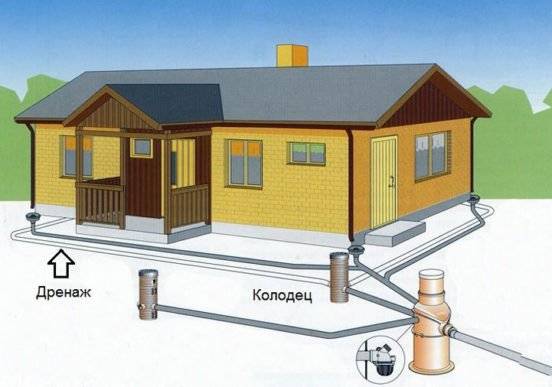
The layout of the collector in relation to the pipes of the annular and storm drainage
-
Sand is poured into dug deep trenches, a layer 15 centimeters thick.
-
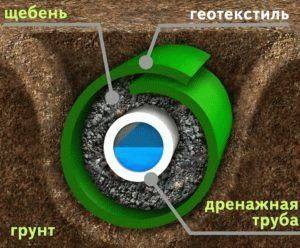
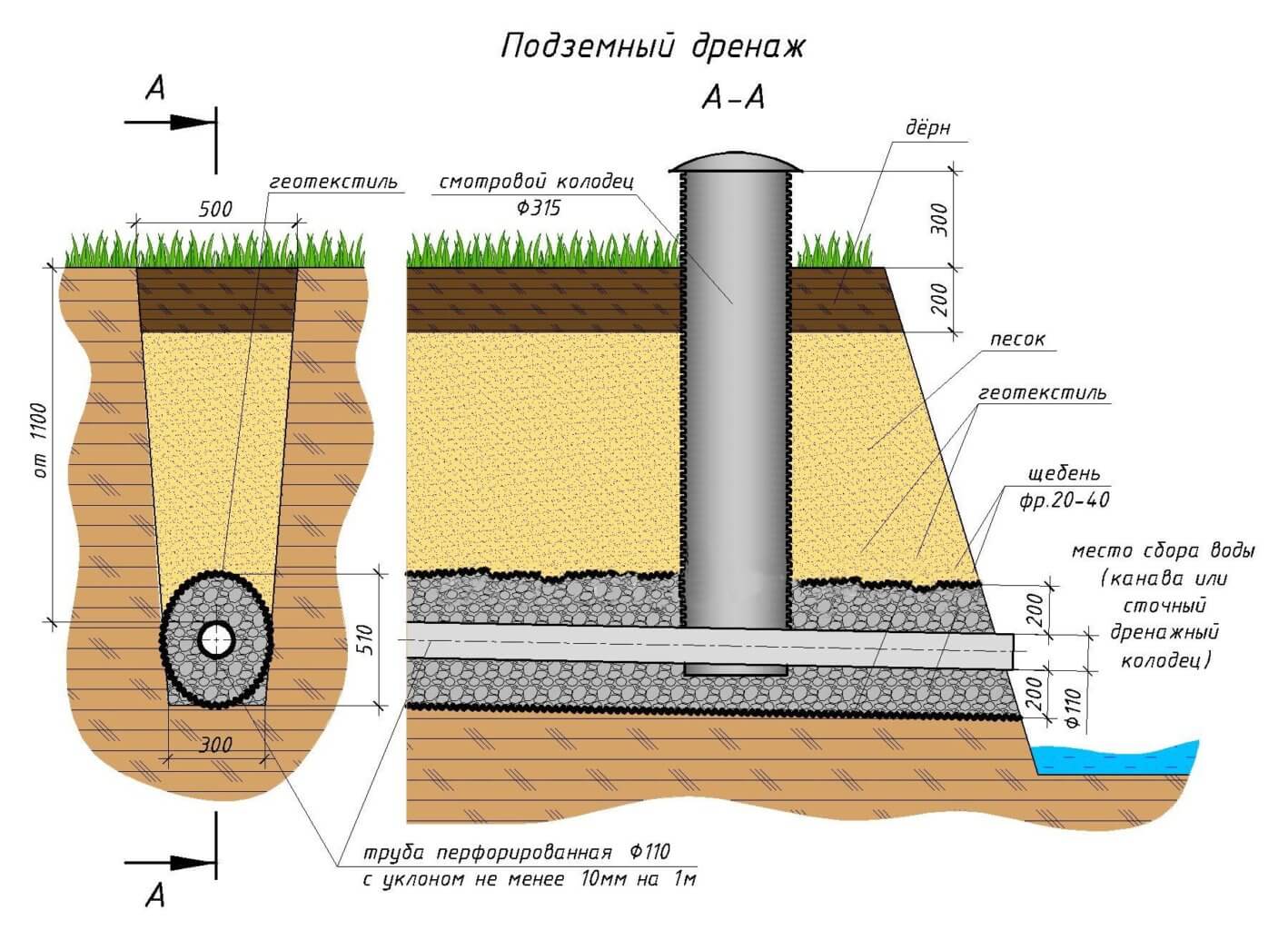
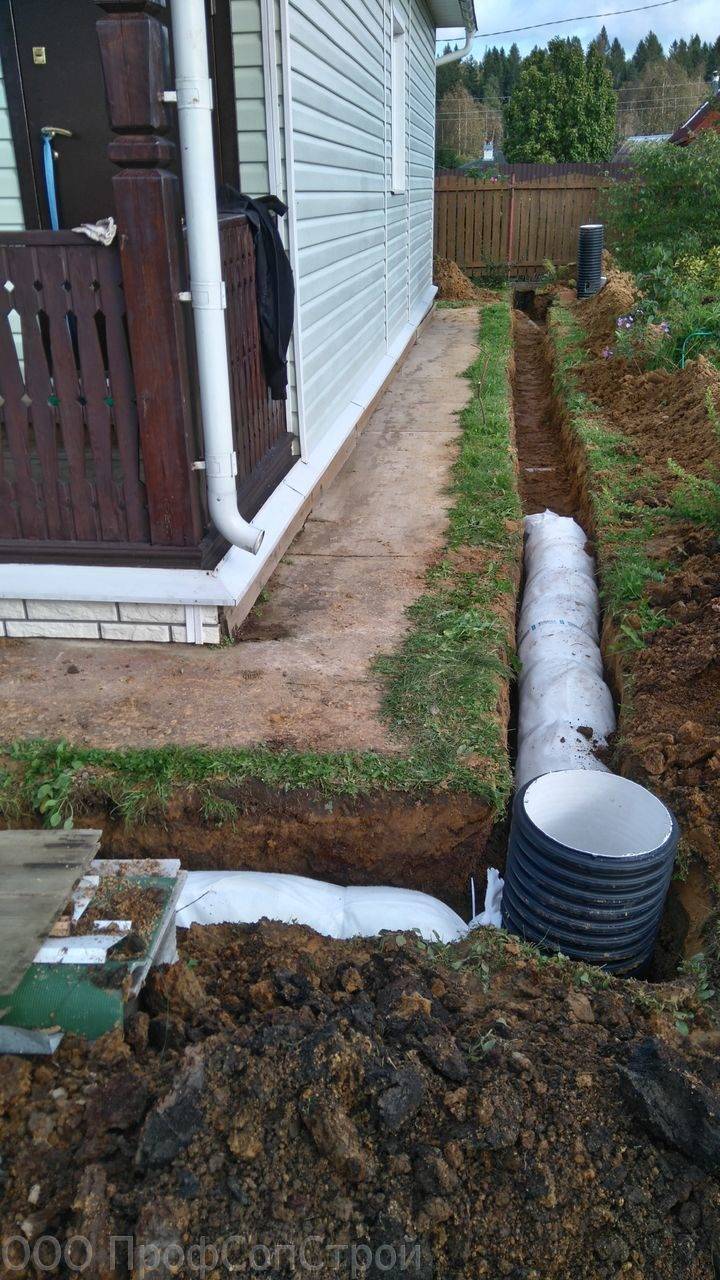
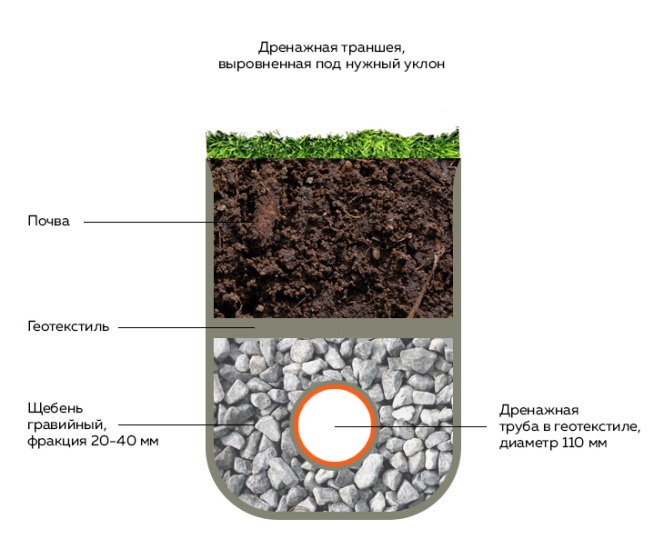
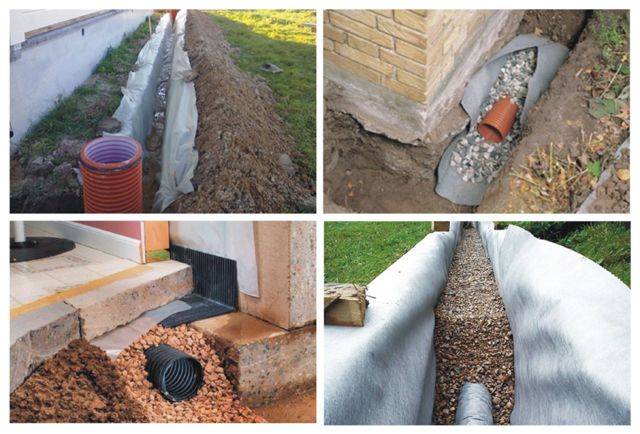
Then the geotextile is inserted and straightened, then 10 centimeters of clean crushed stone are poured. Pipes with holes are laid on gravel in ditches.
-
Pipes using a variety of fittings - tees, corners, and so on, are mounted between themselves, wells and a collecting manifold.
-
Then they are carefully covered with washed gravel (10 centimeters), the edges of the geotextile are released, stretched, overlapped around the drains and fixed with wire or tape. A layer of sand or gravel will serve as a filter to trap dirt. From above, the entire structure is covered with loose soil or paved.
- When soil water rises, it soaks the soil around the drains and seeps into the drains. There, the current speed is high, and the water is instantly carried away into the well. Therefore, the water will never reach the foundation.
Filtering and storage wells
In the absence of the possibility of discharging water into natural water collectors: ditches, rivers, ponds, there is nothing left but to equip a well. There are two options: a well with a draining bottom and a storage tank.

Option 1. With drainage wells
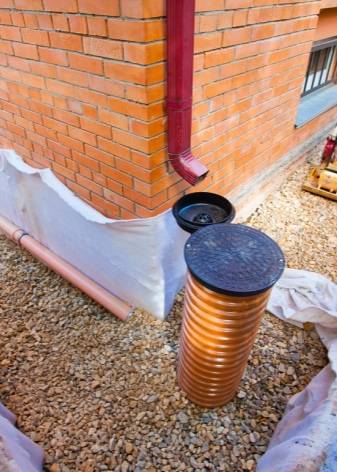
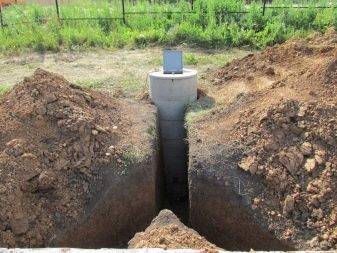
The essence of the device of the drainage well is that the water that enters it is filtered and seeps into deeper soil layers. There may be several of them in the pipe drainage system. They are located at the beginning of the line, at the places of turns, intersections, changes in the slope or diameter of the pipes.


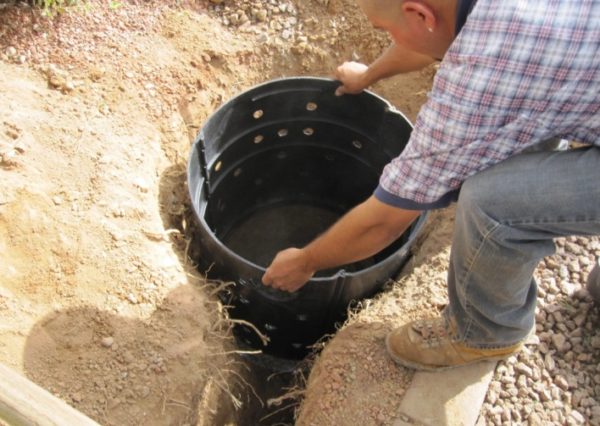
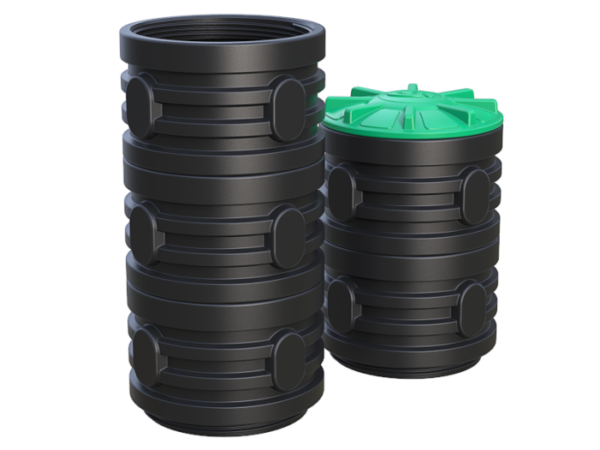
The well can be built from factory-made concrete rings with perforation, purchased a finished plastic product, or cut off a piece of a large-diameter pipe, make holes in its walls and install it in a cylindrical pit 1.8-2 m deep on a prepared crushed stone base.
Prices for popular models of drainage wells
Drainage well
Option 2. With storage
The water that is collected from the site can be used in some way on the farm: for washing cars, breeding fish or crayfish, watering greenhouse crops. In any case, if groundwater already reaches a high level on the site, it is irrational to add surface runoff to them.
- Water can be drained into a street storm collector, a ditch, or simply into a forest or a river. For this purpose, not a drainage, but a storage well is introduced into the system. The difference between them is that the first one has permeable walls and bottom, while the second must be airtight.
- A pump with a float sensor is installed in it. As soon as the container is filled above a predetermined level, it starts to work, discharging excess water into the drainage channel or a drainage well located farther from the site. The rest is always in stock, and if necessary, you can use the accumulated water.
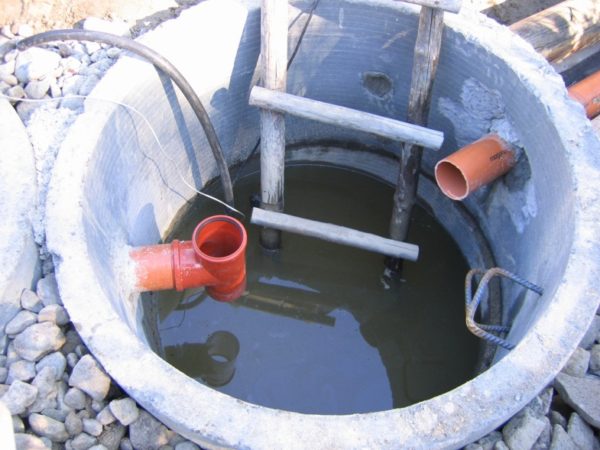
- It can be very helpful in case of fire extinguishing. Or when you start some kind of building in the yard that will require water - for example, to moisten a compacted sand cushion.
- During the summer drought, the water supply, for which you do not have to pay a penny, is also useful for watering beds that suffer from excessive moisture in other seasons. After all, in dachas there is often no water other than what its inhabitants bring for themselves to drink.
Electric submersible pumps
Drainage around the house
In areas with a predominance of clay soils, water is very slowly absorbed or stands still.Even if the builders tried to reliably waterproof the foundation, there is a possibility that in some places the seams are poorly processed or the layer of mastic is too thin. In addition, over time, waterproofing loses its properties and becomes unusable. Therefore, one waterproofing to protect the foundation will not be enough.
Device principles
- The composition of the soil (what soils prevail - clay or sandy);
- The landscape of the site (is there a slope, lowlands or the area is relatively flat);
- Groundwater levels and their fluctuations throughout the year;
- The position of the site relative to water bodies, is there a threat of spring floods;
- The average amount of precipitation for the year, as well as the maximum possible level of precipitation in a particular area;
- Building density of the site, depth of adjacent foundations;
- The presence and area of asphalt and concrete pavements that make it difficult for precipitation to soak into the ground.
Only after evaluating all of the above factors can the correct choice of the type of drainage system be made.
Constituent elements
For a proper drainage device, you need to take into account all the necessary technical parameters, as well as follow the installation rules:
When digging ditches for pipes, it is worth using a laser level to make the desired slope. The degree of slope depends on the diameter of the pipe - the larger the diameter, the smaller the slope:
| Pipe diameter, mm | Slope, cm/m |
|---|---|
| 40-50 | 3 |
| 85-100 | 2 |
| 150 | 0,8 |
- The use of geotextiles is necessary to filter water from small impurities that can clog pipe holes or gravel. Geotextiles vary in density and throughput - the denser the material, the lower the throughput;
- When choosing pipes, polymer corrugated pipes are most often preferred, but ceramic, asbestos-cement and porous pipes can be used. Steel pipes are categorically not suitable, as they are subject to corrosion;
- It is necessary to apply perforation to the pipes (this can be either a finished pipe with holes or a modified one with your own hands). In this case, the diameter of the hole is made smaller than the size of the gravel used;
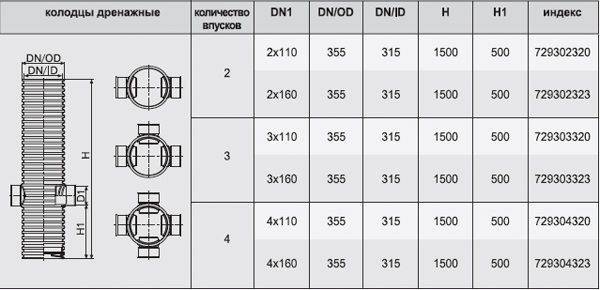
- To monitor the state of the system and clean it, it is necessary to use manholes (from rings or ready-made ones). Place them at a distance of no more than 12 m from each other. The well itself is made accumulative (with a solid bottom - additional water drainage will be required here) or absorbing (there is no bottom - water goes into the ground through gravel).
Pricing
The cost of a drainage system primarily depends on its footage. The type of system also significantly affects the cost - the surface system does not require large expenses, while the deep laying of the system is more laborious and financially costly. With ring drainage, savings can be achieved by reducing the number of manholes, while in the wall version, several wells will be required.



The price will also be affected by the type of pipes chosen, as well as the brand of geotextile.
Rain shower as an addition
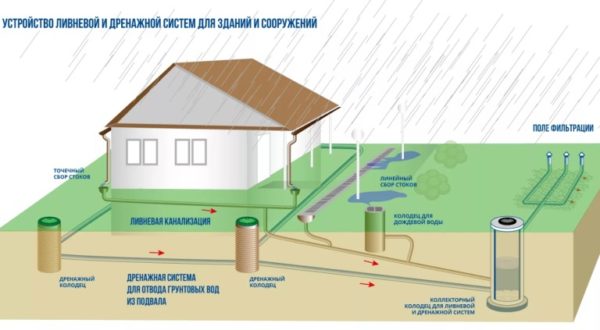
A storm drain or storm sewer will be a useful addition to the drainage system. It allows you to remove from the site the water that falls on it in the form of precipitation. Through the storm drain, the water moves either to the well-water collector, or to the collector well, from which there is an outlet to the gutter or sewer network.For a well-collector, it is best to choose the most remote place from the building. You can also organize the drainage of water using a storm drain to the nearest body of water.
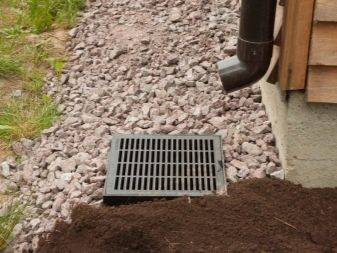
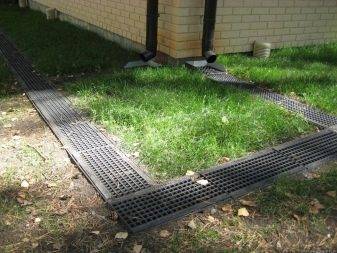
Storm sewer is also called surface drainage. Its main advantage lies in the fact that it is very easy to settle on the site. However, it should be borne in mind that stormwater can only handle melt and rainwater.
The stormwater is divided into three types:
- Linear allows you to divert melt and rainwater not only from the house, but also from the entire site. This type is a channel that breaks out in the ground and a drainage well. Often the channels are made in the form of straight lines, which are covered with bars for safety.
- Spot allows you to divert water from individual sources, for example, from watering taps or roof drains. In order to prevent debris from getting into this storm drain, it is covered with metal gratings. The organization of the linear view is that pipes are laid from each point, which are connected to the main pipe going to the drainage well.
- Combined stormwater drainage involves the use of both linear and point types.
Classical drainage scheme around the house
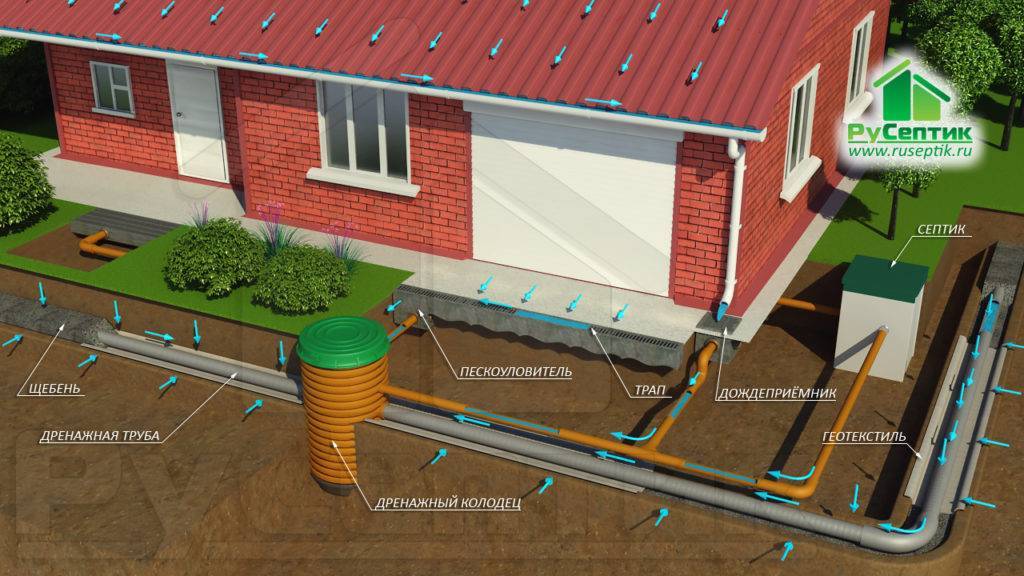
Consider how the drainage system is arranged according to the classical scheme:
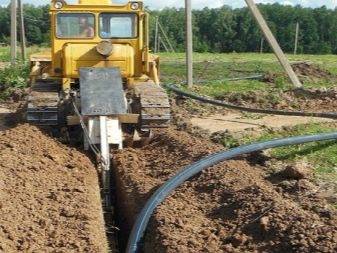
- Trenches for laying drains are dug along the perimeter of the building, while a slope of 0.7-1% must be maintained in them. The depth of the trenches depends on the degree of deepening of the foundation, the pipes should be located half a meter below the foundation slabs.
- In the lower part of the system, a receiving chamber must be installed - a collector well, that is, a discharge point is organized.
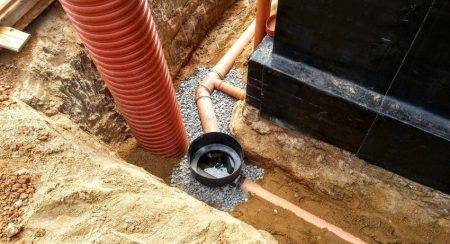
- In cases where the required slope cannot be maintained, a drainage pump is included in the circuit.
- When arranging drainage, as a rule, perforated pipes made of polymeric materials are used.
- Revision wells are an obligatory element of the scheme; they are installed at the corners of the building.
The main types of drainage design
In total, there are several varieties of the drainage system. Let's consider each type separately.
wall construction
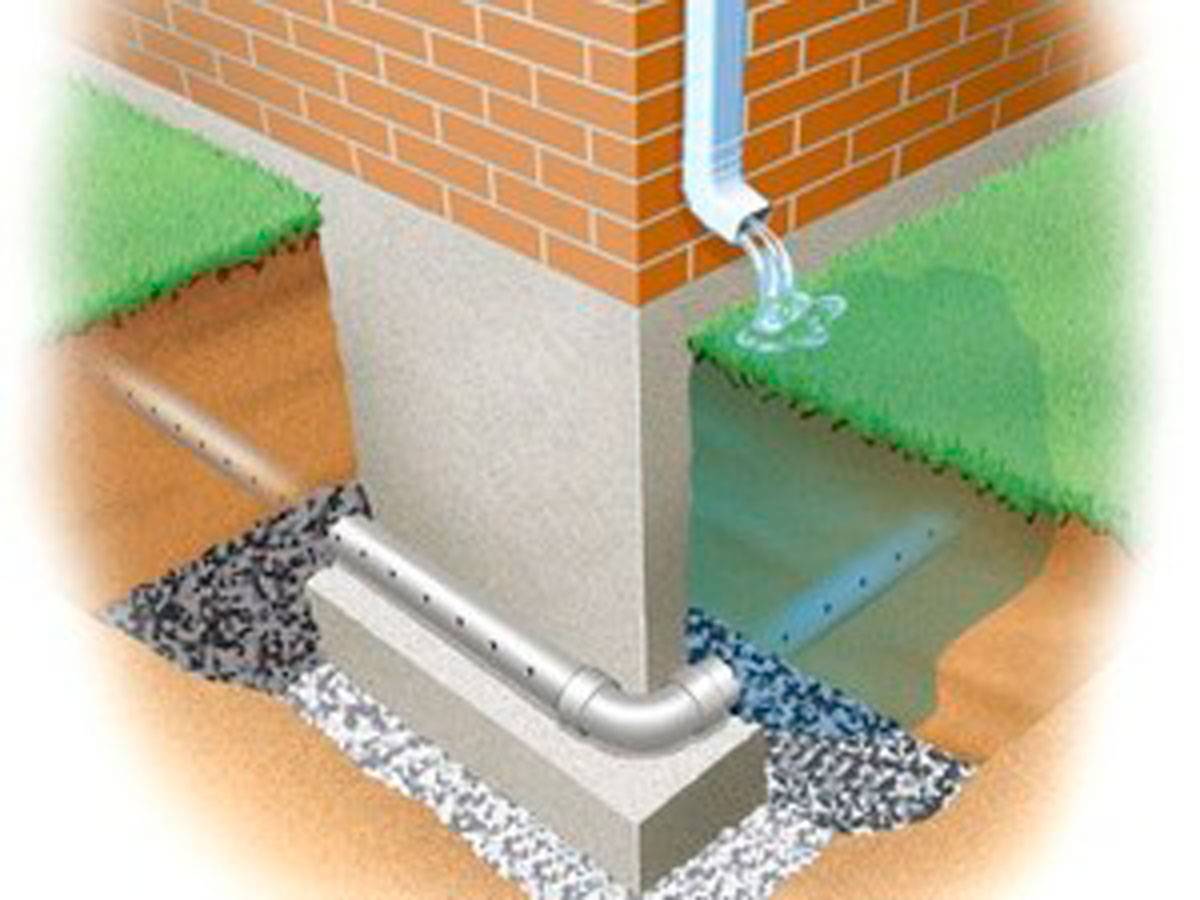
The system is created around the base of the structure (foundation). Wall drainage must be installed if the building has a basement or basement. It is necessary to carry out the installation of the wall structure during the arrangement of the foundation of the building, when the foundation pit has not yet been filled up. If the mounting is carried out later, then you will have to perform additional work, which you need to spend time, effort and money.
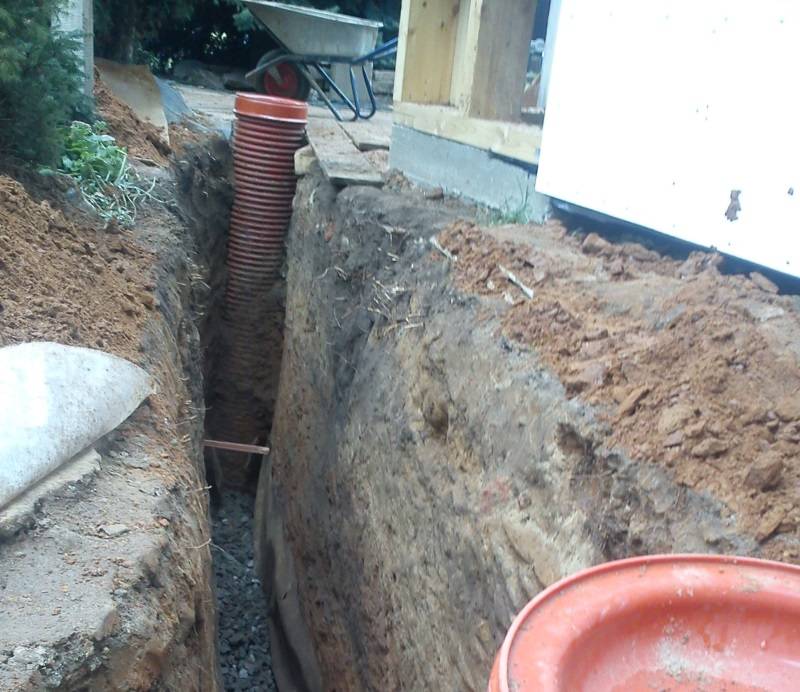
The laying of the system is carried out along the foundation. Pipes must be removed from the corners of the building to manholes. At the point of the system, which is the lowest, a well is created for the output. In this well, water will be diverted outside the boundaries of the site.



Ring or trench design
This design is installed at a distance of two or three meters from the base of the structure. This type of drainage system is used for buildings that do not have basements or basements. Or the building should be located on a clay soil layer.
Also, a clay castle is created between the base of the structure and the drainage structure for additional protection.It is necessary to lay drainage at a depth of 50 centimeters from the foundation point, which is the lowest. Drains should be laid on large gravel.
Why is drainage around the house necessary?
Drainage is a system of interconnected hydraulic devices for removing moisture from the soil near the base of the structure. In most cases, this is a set of pipes connected to a receiving well.
All of them are at a slight slope and have special holes for collecting moisture from the soil layers adjacent to them. As they seep and accumulate, water flows down them into a catchment collector located at the lowest point of the catchment area.
The drainage system around the house eliminates the following number of negative factors:
- Stagnation of water in the layers of soil in contact with the foundation.
- Moisture impregnation of the base material and walls and their subsequent destruction.
- Damp seepage through cracks into the underground.
- Creating a favorable environment for the development of fungi, mold and other harmful microorganisms.
Seasonal flooding due to snow melting leads to extremely unfavorable consequences for the foundation - cyclic freezing and thawing of its material. As a result, microcracks are formed in its mass, which in the future, under the influence of the same factor, only increase and inevitably lead to the destruction of the foundation of the house.
When is drainage required?
You can install drainage around the foundation of the house at any stage of construction and even when it has been in operation for many years.
Its installation is necessary especially if one or more of the following factors are present:
- The site is located in an area with a low relief.As a result, all sewage and groundwater from the hills will constantly saturate the soil near the foundation.
- The natural properties of the soil, which do not allow water to be quickly absorbed. Soil with a high content of clay and loam retains moisture for a long time.
- High average monthly precipitation. Even with good water permeability, the soil with the base will be constantly moist.
- Shallow occurrence of groundwater.
- The presence of nearby structures with a low-buried foundation. A natural obstacle will be created for water, delaying it and preventing it from going lower.
- Surfaces located near the house that do not allow water to pass through - asphalt paths, concrete pads, tiled areas.
Types of drainage systems
There are three types of drainage systems:
- Open. It is formed in the form of an open shallow trench with a base width and a wall height of about 50 cm. It is made without pipes and any special devices. It is the cheapest drainage modification available to any home owner. However, it has significant drawbacks - without fortifications it constantly crumbles, does not differ in external attractiveness and poses a threat to others - you can simply fall into a ditch.
- Closed. It is made using special pipes with moisture-absorbing small holes over the entire surface. A special technology is used in the installation - a pillow of crushed stone or sand is laid on the bottom of the trench, then a special fabric in which the pipe is wrapped, after which it is laid with crushed stone, sand and turf.It is characterized by maximum efficiency and durability, but at the same time it is quite expensive and requires strict adherence to installation rules.
- Zasypnaya. It is an improved version of the first system of the first variety. However, unlike it, large crushed stone, gravel, broken bricks are laid at the bottom of the trench, and then covered with soil. To increase the service life, the backfill material can be wrapped in geotextiles. The method is more budgetary compared to the 2nd option, but does not have a high throughput.
How to do it right?
Properly arranging a drainage system with your own hands is not difficult at all. It is best to start with preparatory work. To do this, the terrain is first studied, the composition of the soil is determined, and the level of groundwater is assessed. After that, work is carried out to prepare the foundation of the structure. To do this, trenches are dug around the perimeter of the base. Then dirt is removed from them, as well as layers of heat and waterproofing.
The cleaned foundation is subject to mandatory drying. By itself, the foundation will dry out in 5-7 days, and in good warm weather it can be faster. Also, for drying, you can use mechanical means such as a heat gun. Such tools allow you to speed up the process up to one day.



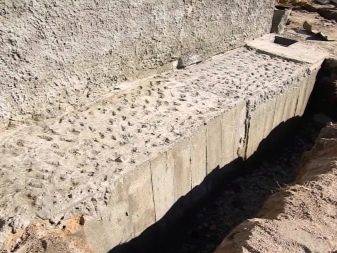
For strip foundation
To properly equip the drainage for the strip foundation, you must follow a number of rules. Then the installation of the drainage system will not be difficult, and the result will be amazing.
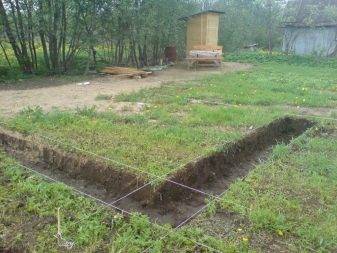
- You need to start by digging a trench around the perimeter of the building. The depth of the trench must be greater than the depth at which the foundation lies. At the bottom of this trench, the so-called drainage cushion with a height of 30 centimeters necessarily lies.The pillow should consist of 15 centimeters of coarse river sand and 15 centimeters of fine-grained gravel. It must be tamped and well spilled with water.
- The piping system is laid directly. Drainage pipes must be covered with a layer of waterproofing, such as bitumen or polyethylene. In order for the accumulated moisture to have a place to drain, a well is installed with drainage outside the boundaries of the site.
For a monolithic base
Making a drainage system for a monolithic base is more complicated. The main feature is that the drainage system is laid even before the foundation is erected. This allows you to protect the base of the building in case the ground shifts. Particular emphasis should be placed on the quality of drainage construction work. After all, this affects how strong and durable the building as a whole will be. First you need to prepare a special pit in which the drainage system will be installed. The depth of the pit is calculated based on the location and height of the foundation.
A layer of brick battle is poured to the bottom of the foundation, and then a layer of sand and small gravel. After that, the entire pillow is carefully compacted. Drainage pipes must be reinforced using special ceilings. Geotextiles are used to seal the surface of pipes. In order for the accumulation and removal of water to occur, it is necessary to dig a well from which the pipe will extend beyond the site.
Also see in the video how to properly make drainage around the house with your own hands:



