- Rules for installing a surface option
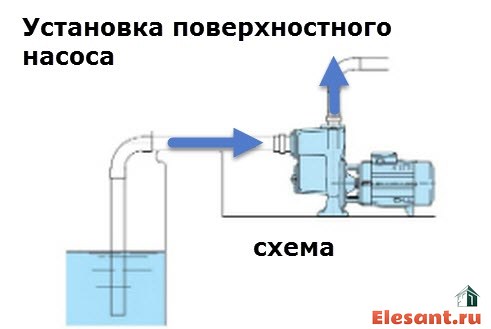
- The nuances of installing a surface pump
- Well types and pump selection
- Types of pumps
- Use of pumping systems
- How to properly install a pump in a well
- Basic parameters for pump selection
- Complete wiring diagrams
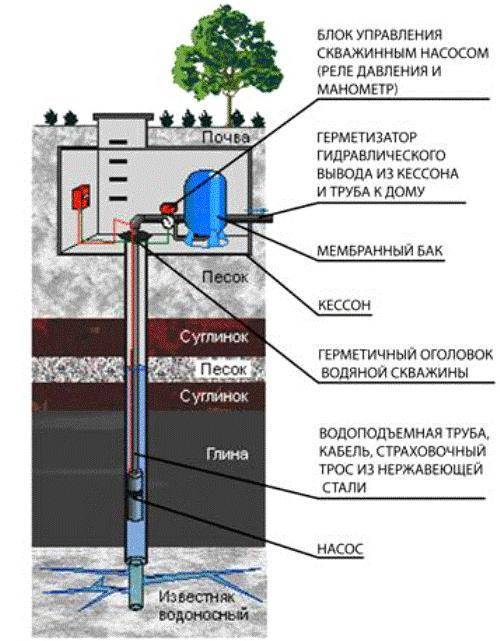
- Connection using a caisson chamber
- Connection with emphasis on the accumulator
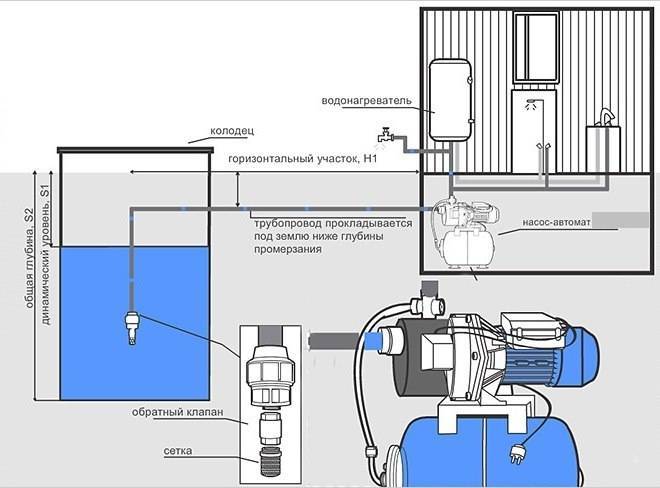
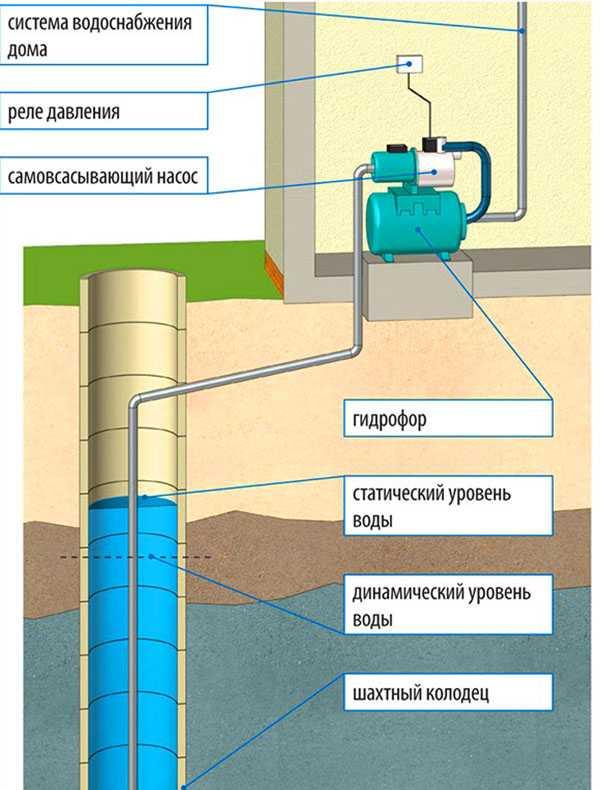
- Surface pump connection
- Connection order: step by step instructions
- Types of pumps for wells and their functions
- Types of household pumps
- How to choose
- Gilex Drainage
- GRUNDFOS
- Types of submersible pumps for a well
- Vibrating
- Centrifugal
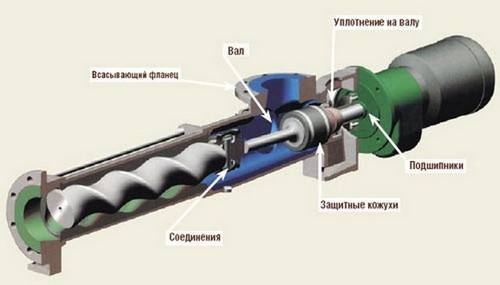
- Auger
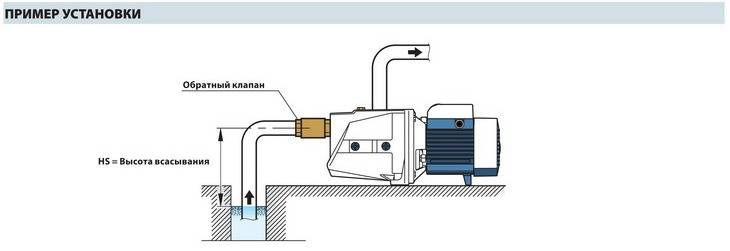
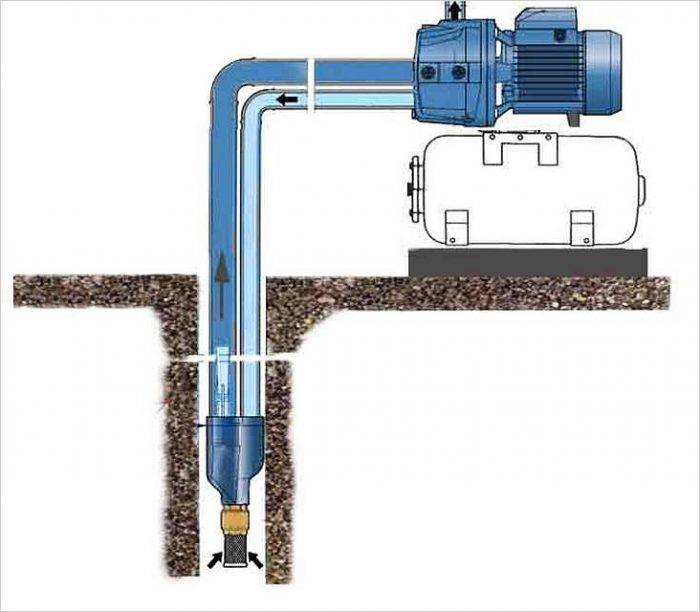
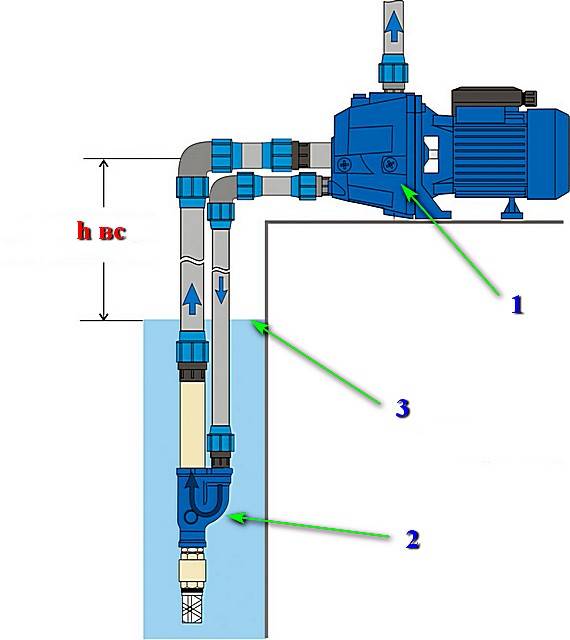
Rules for installing a surface option

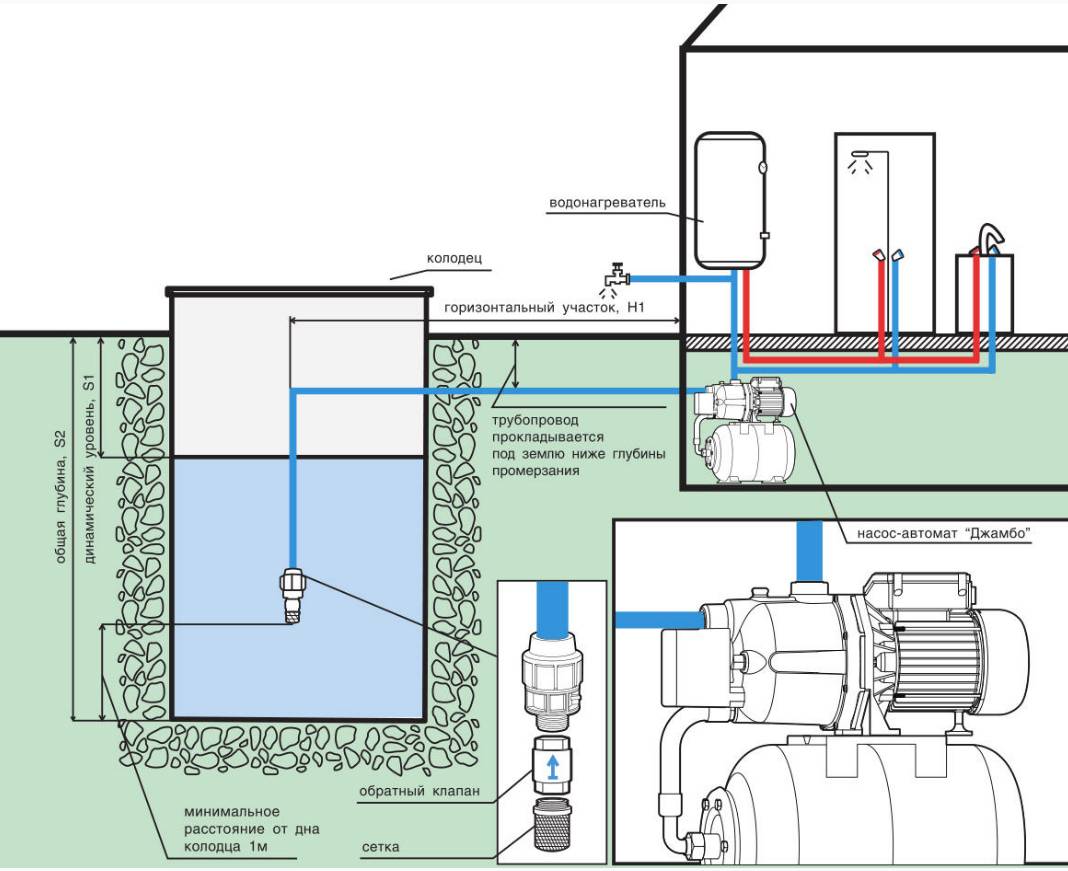
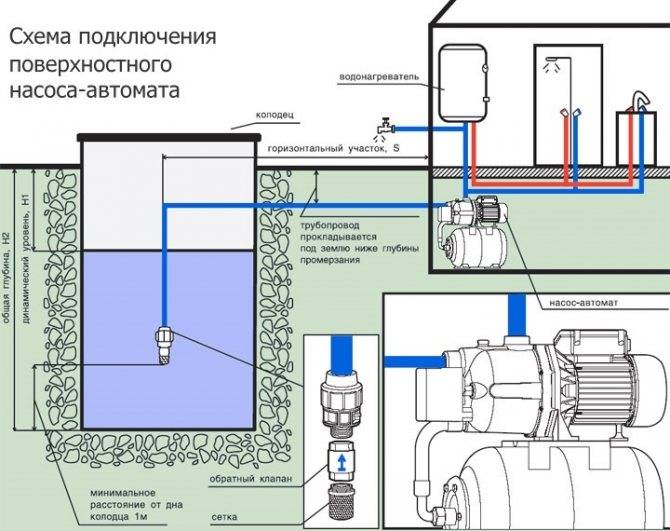
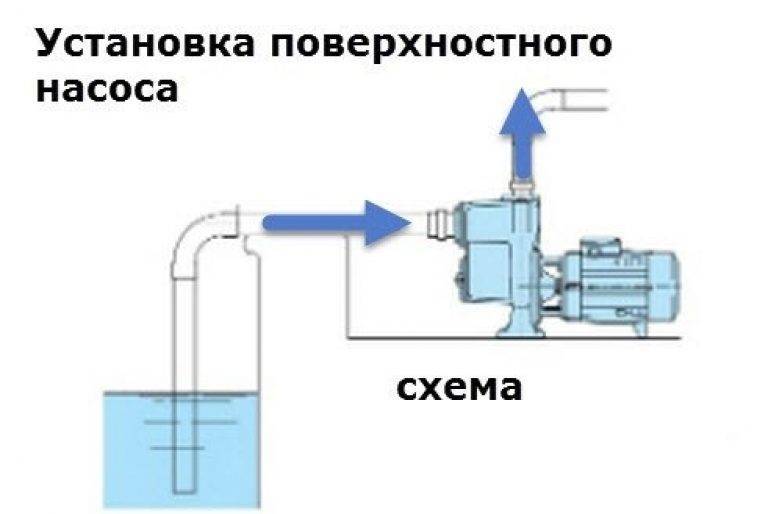
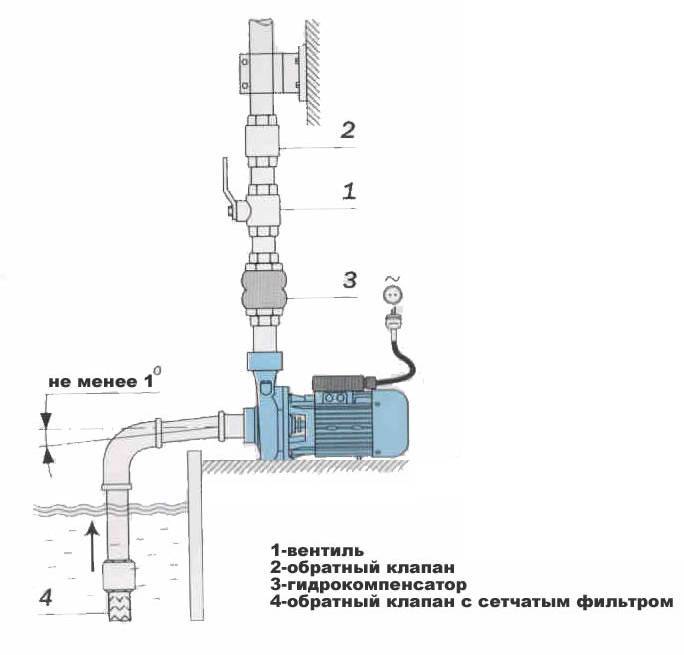
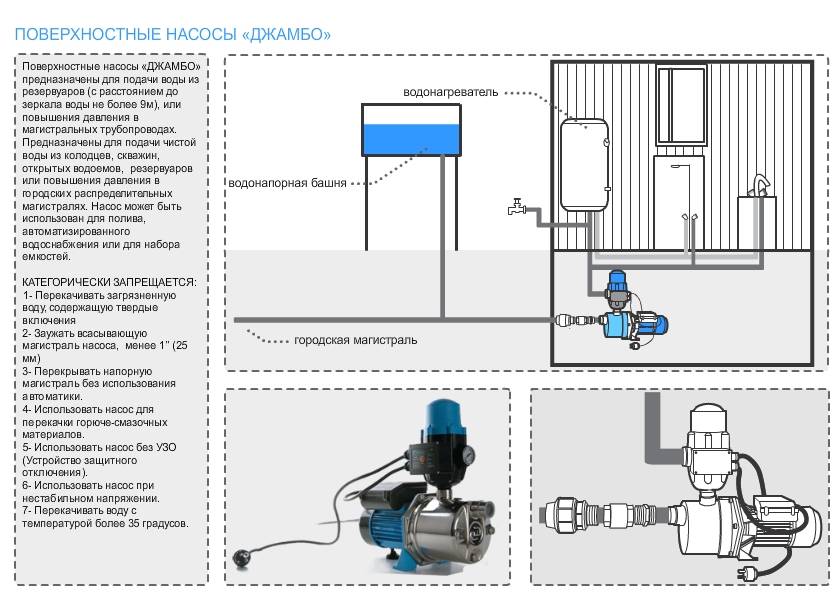
It is not advisable to install surface pumps on deep hydraulic structures. When immersed below 8 m, such devices fail. In shallow wells, their installation is justified due to the lower price than the submersible options.
The installation procedure consists of the following sequential steps:
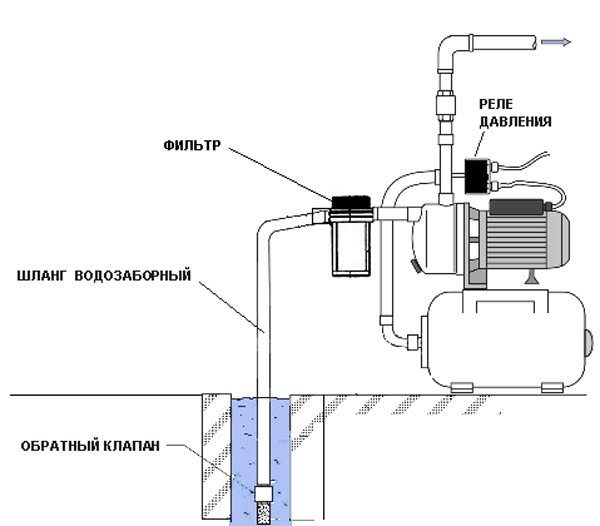
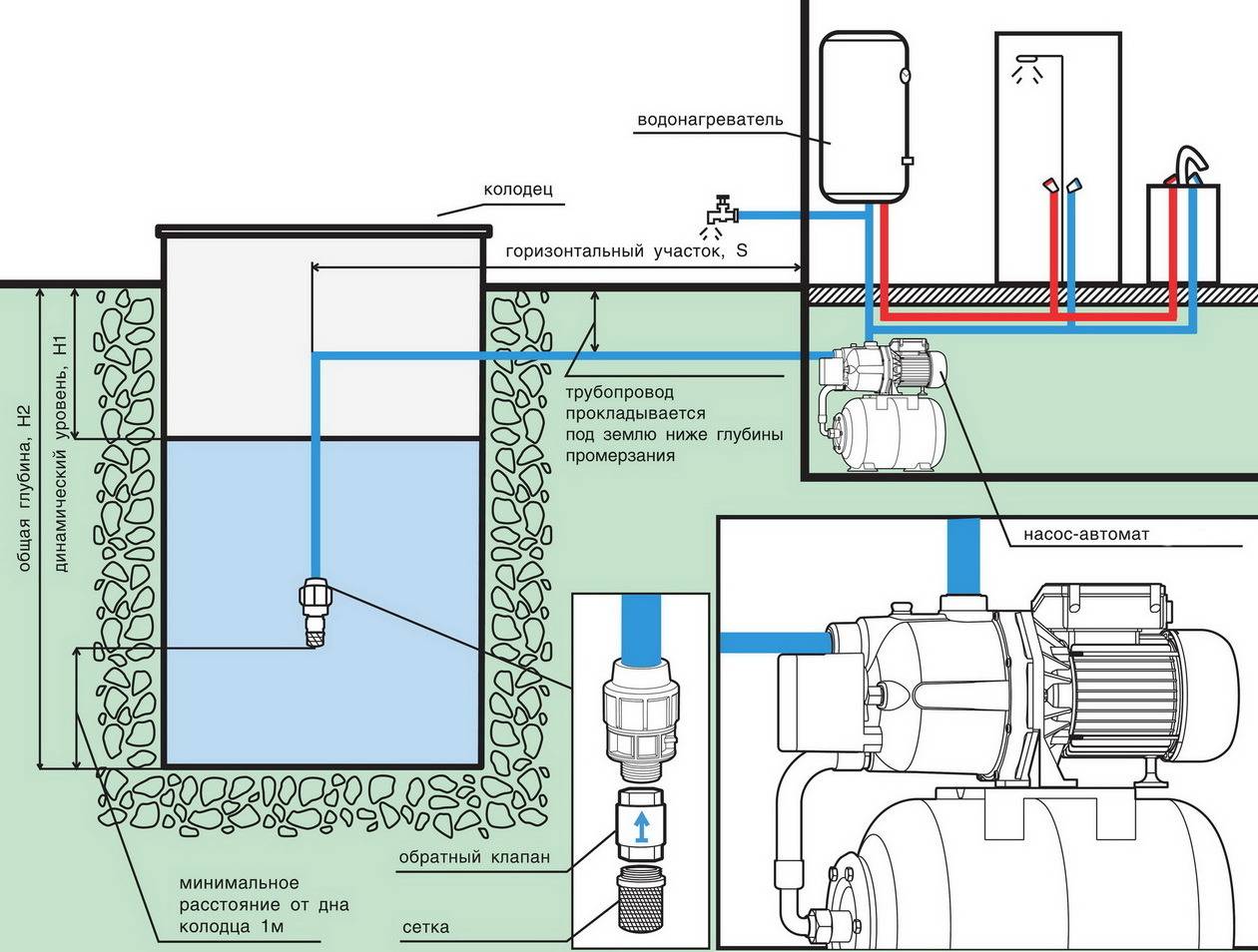
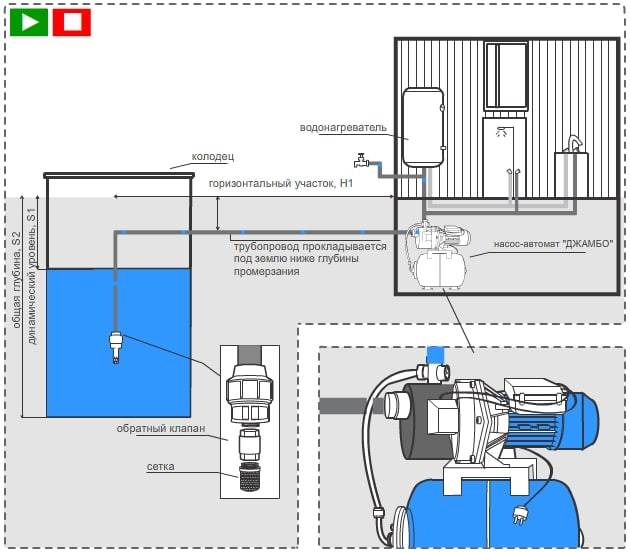
- A separate room is being prepared to accommodate the equipment. It is possible to allocate a place in the caisson for a surface pump.
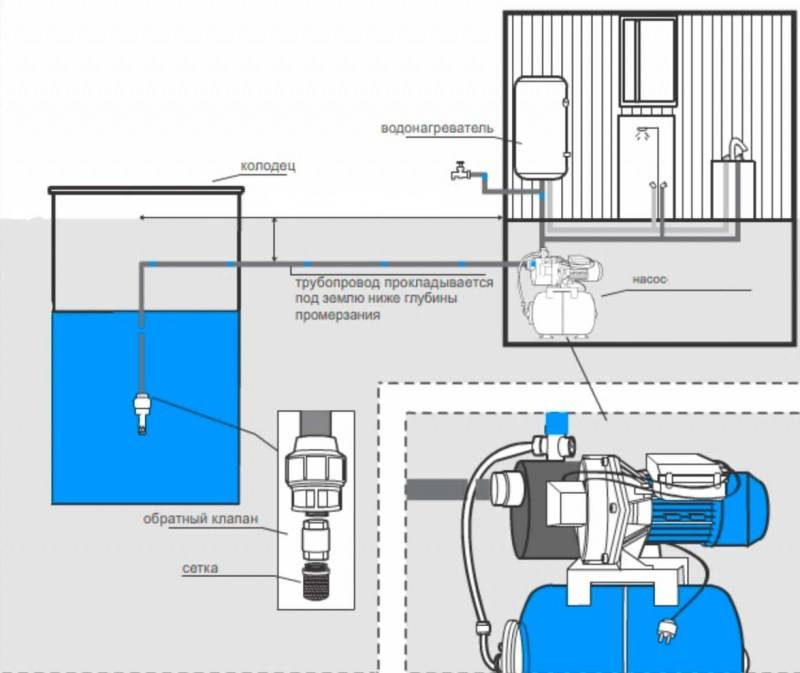
- A rubber sleeve is put on the suction pipe. Its length should be enough to connect with the aquifer.
- A non-return valve is fixed on the opposite side of the hose. It performs the function of stopping the drain of the liquid when the mechanism is turned off.
- A mesh filter is mounted on top of the valve device. It sifts out fragments of silt and sand granules.
- The end of the elastic sleeve is lowered into the water.
The process ends with a trial run.
The nuances of installing a surface pump
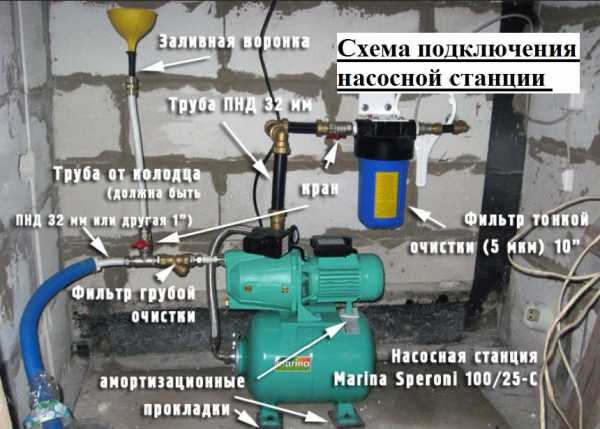
The priority condition for placing a surface water pump is the right choice of location for it. If the device will be used only in the "country" season and stored in the back room in the winter, then there are no special problems with the place of its installation. It is enough to put the pump closer to the wellbore and higher so that the water does not flood it when pumping.

If the surface pump requires year-round use, then the choice of its location should be taken more carefully:
- distance from the well. The power of external pumps is low, so they must be placed as close as possible to the water intake point;
- All-weather protection. It is required to protect the device from atmospheric phenomena by marking it in a room, a bunker or inside a borehole tip;
- Frost protection. During frosts, the surface pump needs insulation, it should not freeze through;
- Ventilation of the installation site. Placing the device in a room (shelter) with insufficient ventilation sharply accelerates the corrosive wear of the unit;
- Sufficient accommodation space. The water pump will require periodic maintenance. Therefore, the place of its stationary placement should be spacious, allowing for repair work;
- Soundproofing of the installation site. The operation of a surface pump is noisy, so the room for its installation will require full sound insulation. Or you should choose the installation position of the device at a distance from living rooms.
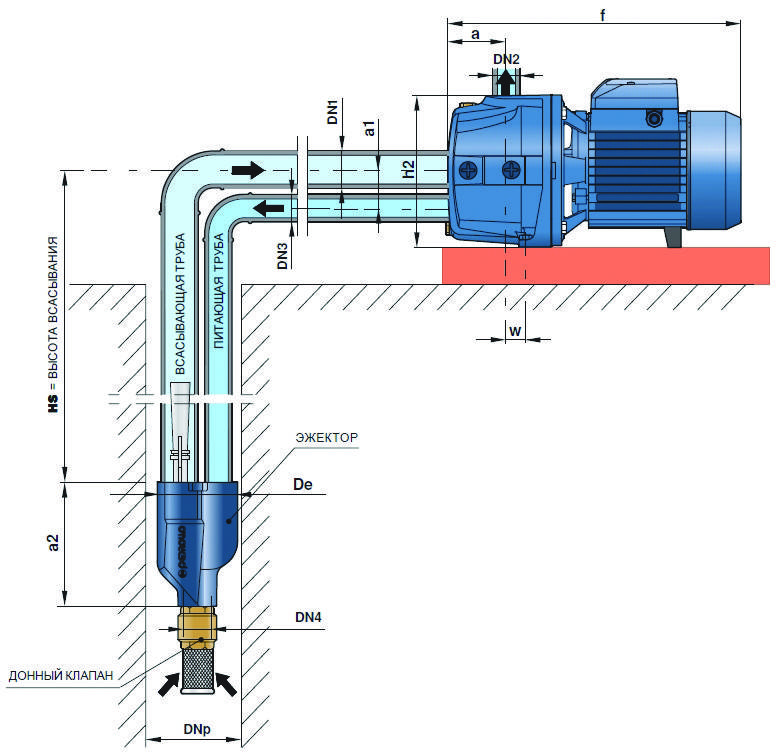
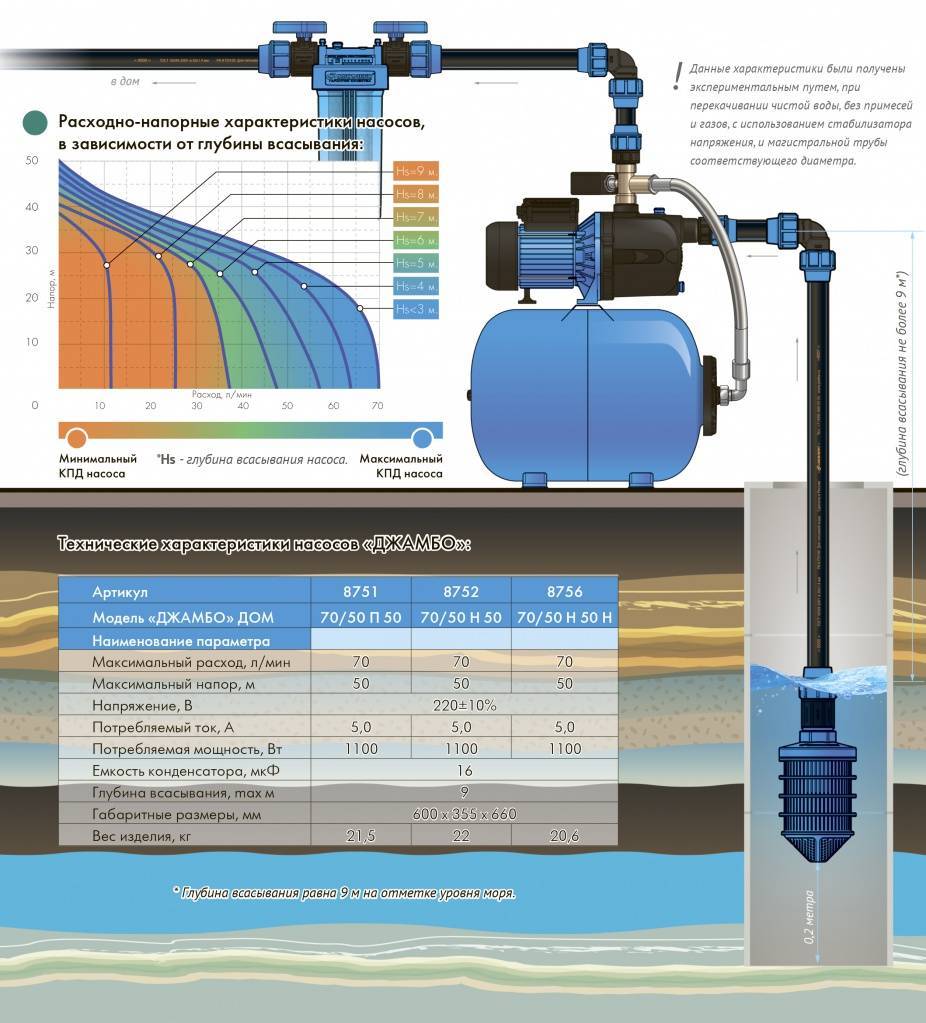
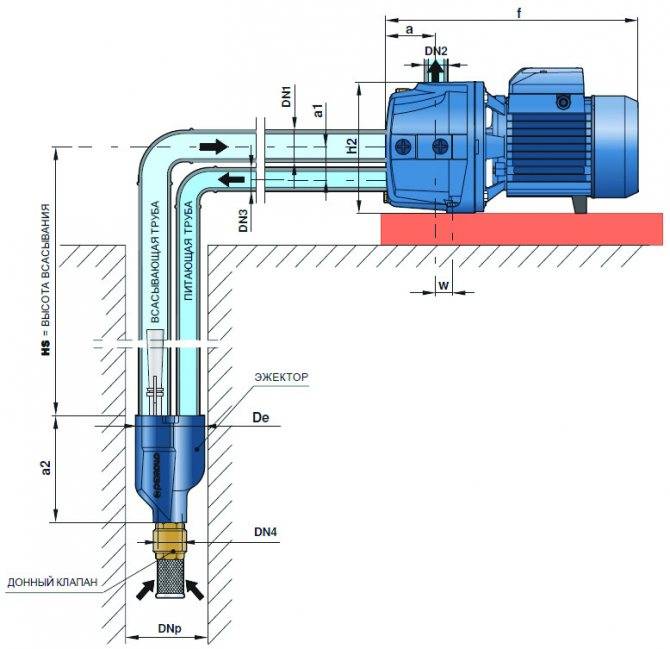
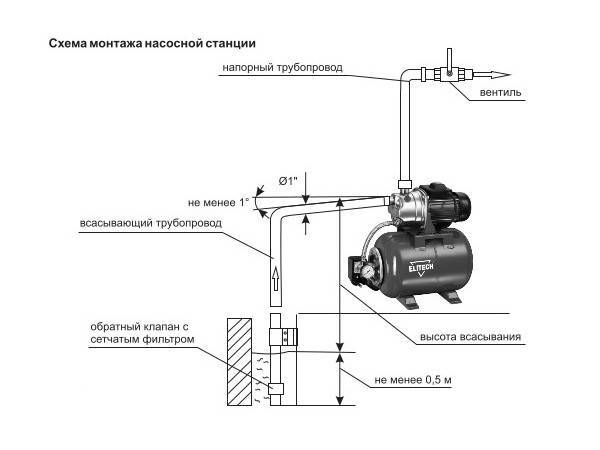
Note that the power of surface pumps is limited by the maximum suction depth of up to 8-9 meters.Moreover, the “vertical-horizontal” suction ratio corresponds to 1:4, which, with a vertical suction power limit of 8 m, corresponds to 32 m of horizontal suction. Those. if water is taken by an external pump from a depth of 6 m, then the maximum distance from the well to the location of the unit is calculated as follows: 32 - 6∙4 = 8 m.
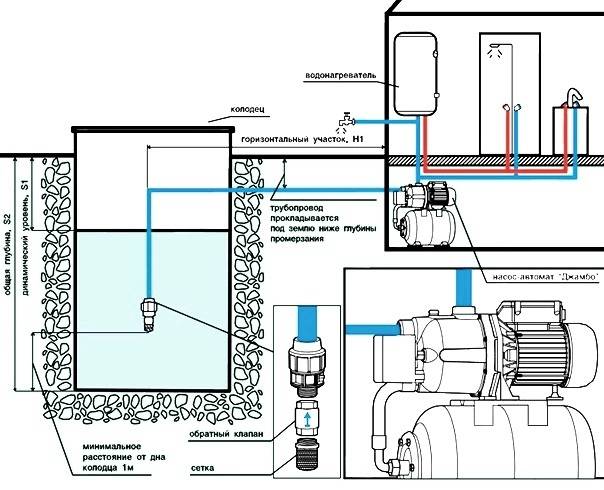
However, resistance in pipe adapters and uneven mains voltage, which cause a pressure drop, must also be taken into account. Therefore, the horizontal distance from the wellbore to the surface pump should be as short as possible, even less than the calculated one.
As for the permissible length of the pipeline at the outlet of the pump, here the vertical-horizontal ratio will be 1:10, which corresponds to 10 m of horizontal water supply per 1 m of vertical.
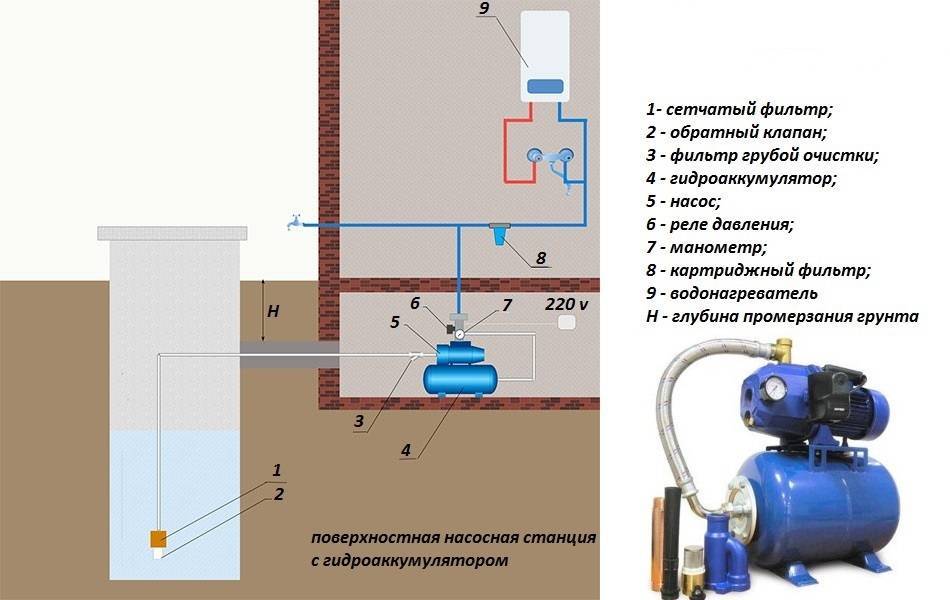
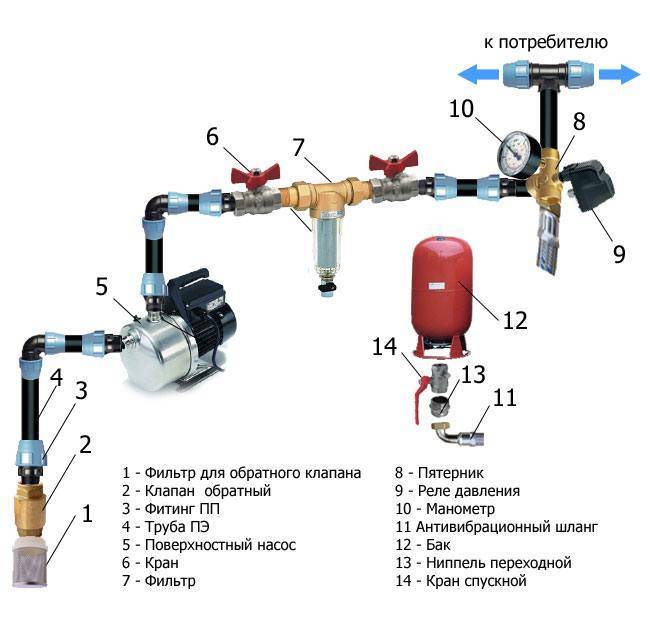
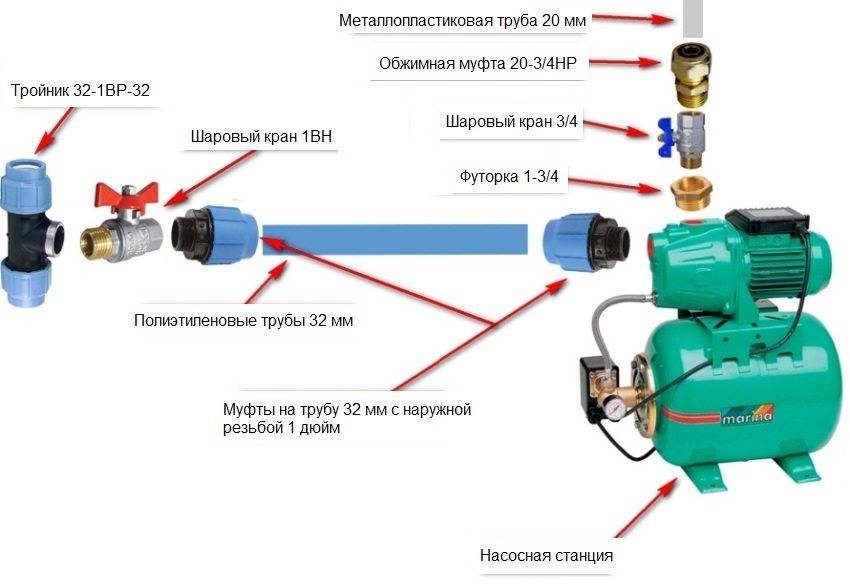
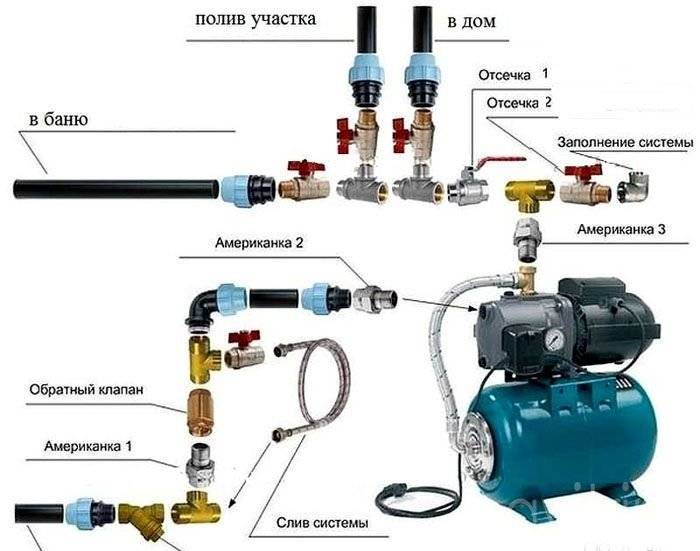
Additional equipment for an external water pump, required when organizing water supply from a well, includes:
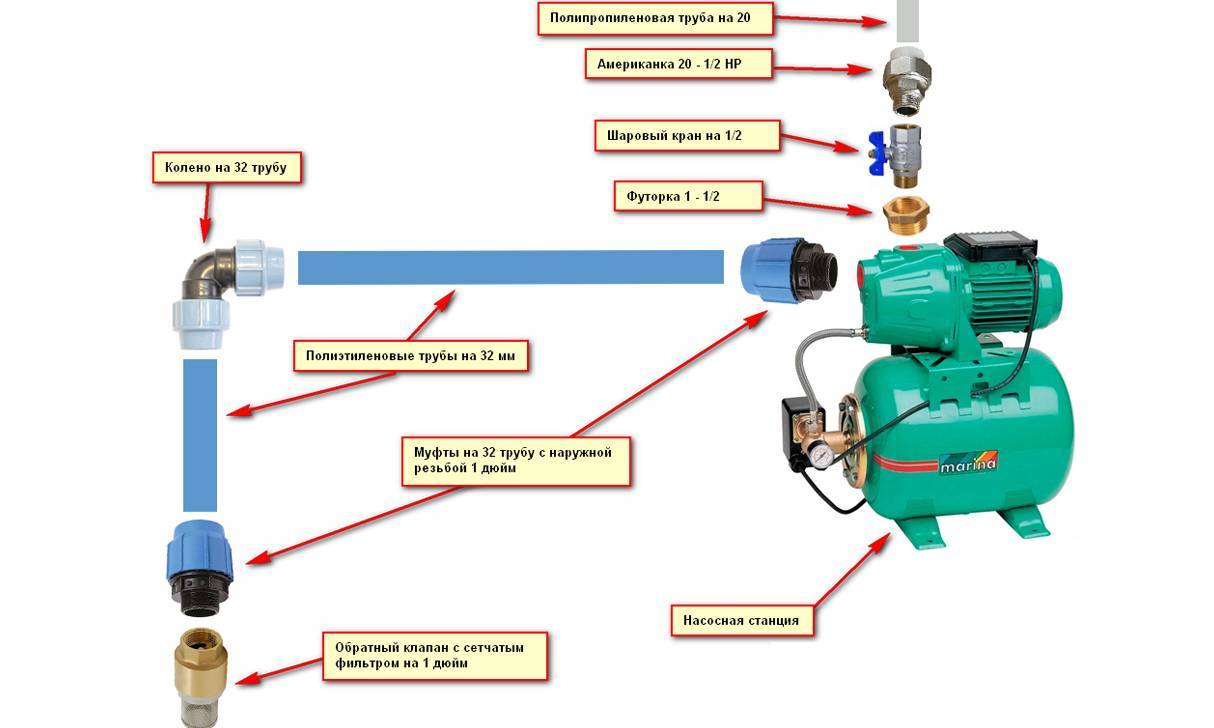
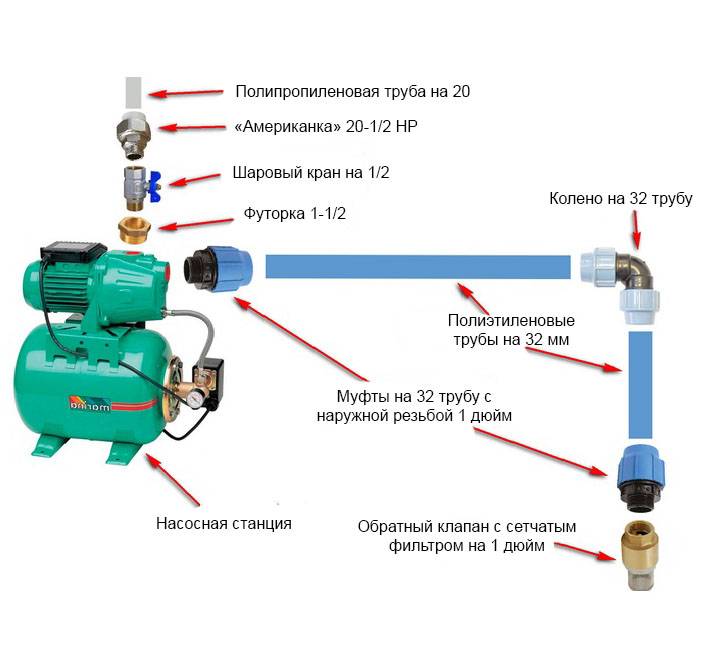
Fittings. Necessary for connecting a pipe or hose to the device;
Hoses (pipes). They are needed for lifting water from a well and for supplying household consumers. The usual cross section for an external pump is 32 mm;
Couplings (fittings) with external thread. Required for attaching functional elements to hoses (filters, check valves, etc.);
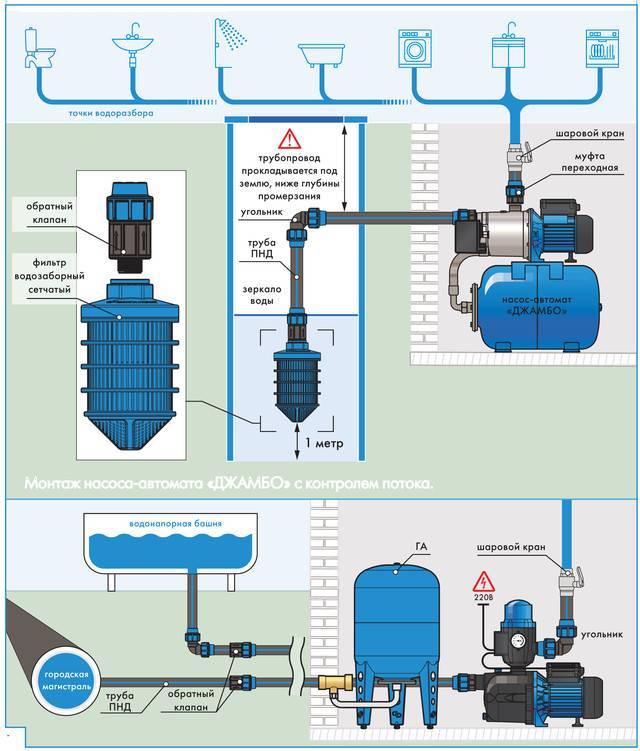
Check valve. A valve attached to the end of the supply hose blocks the flow of water back into the well
An important addition to the water supply system, since the pump should run dry as little as possible;
Mesh filter. It is mounted to the non-return valve (in front of it), prevents mechanical particles (for example, sand) from entering the pumping unit.
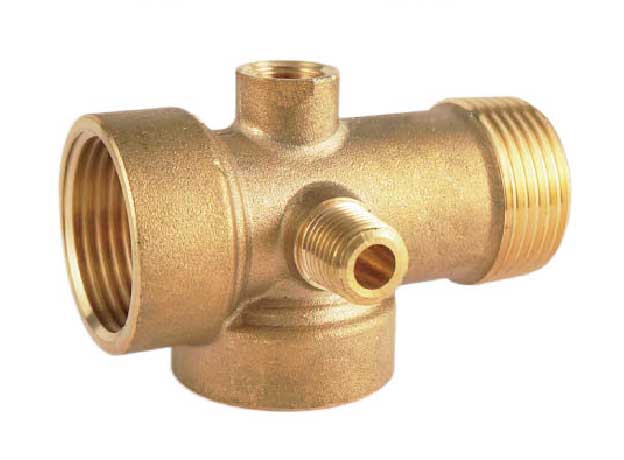
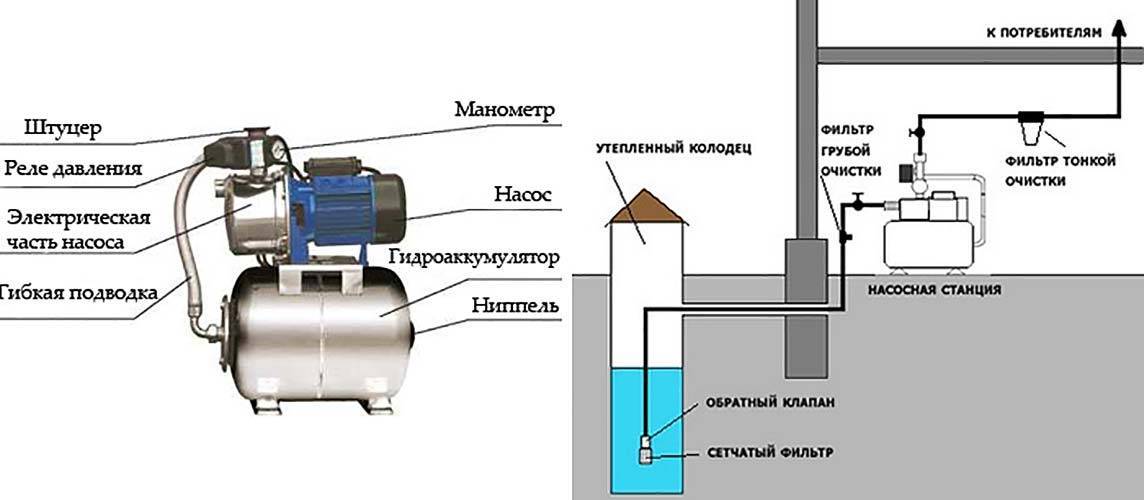
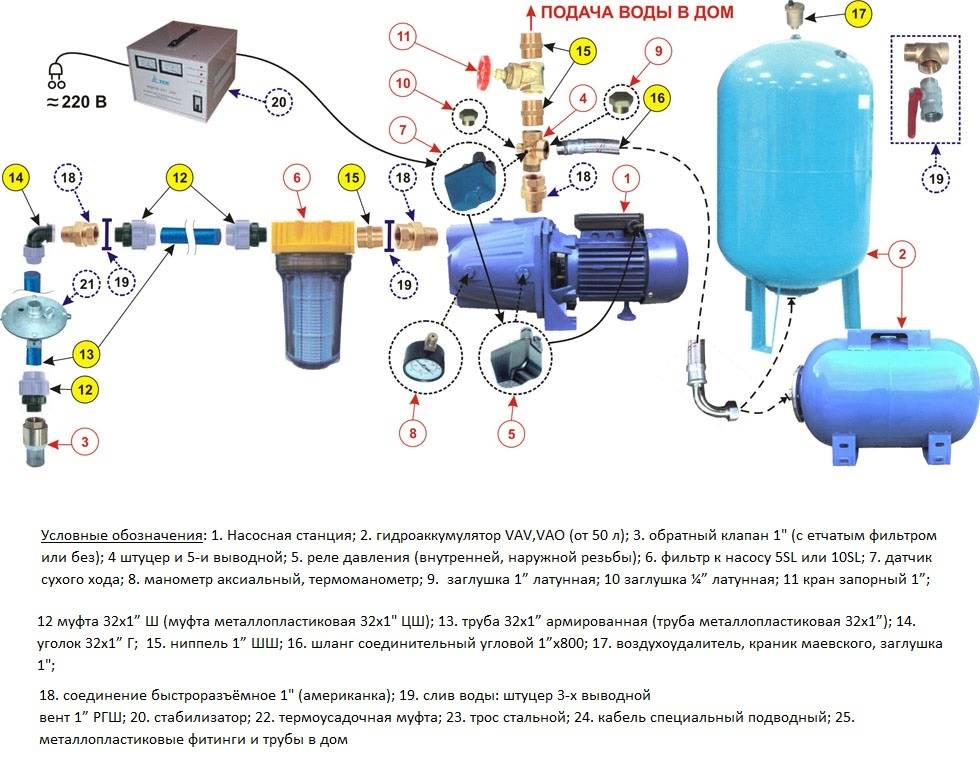
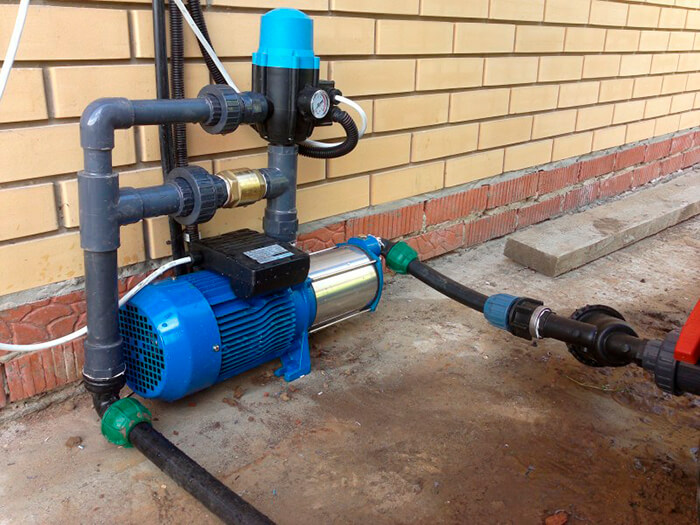
In addition to the above-mentioned elements of the pumping system, it is possible to equip the surface pump at the outlet with a special five-pin adapter, which allows you to add a pumping complex with a pressure gauge and a pressure switch that controls the cycles of the pump. Also, a five-pin adapter will allow you to connect a hydraulic accumulator tank to the water supply device, which completes the construction of a full-fledged pumping station.
Well types and pump selection
For autonomous water supply, two types of wells are used: “for sand” and “for lime”. In the first case, drilling is carried out to an aquifer of coarse sand, in the second case, to aquiferous porous limestone formations. Each locality has its own characteristics in terms of the occurrence of such layers, but the common thing is that the depth of drilling into sand is much smaller and is usually in the range of 15–35 m.
1. Well for limestone. 2. Well on the sand. 3. Abyssinian well
It is easier to drill sand wells, but they have low productivity, and during long breaks in work (for example, seasonal residence), there is a threat of silting of the galloon filter.
The "heart" of any autonomous water supply system is the pump. Both the sand well and the lime well operate with submersible pumps. The pump is selected depending on the depth of the well and the required performance of the system, and this directly affects its price.
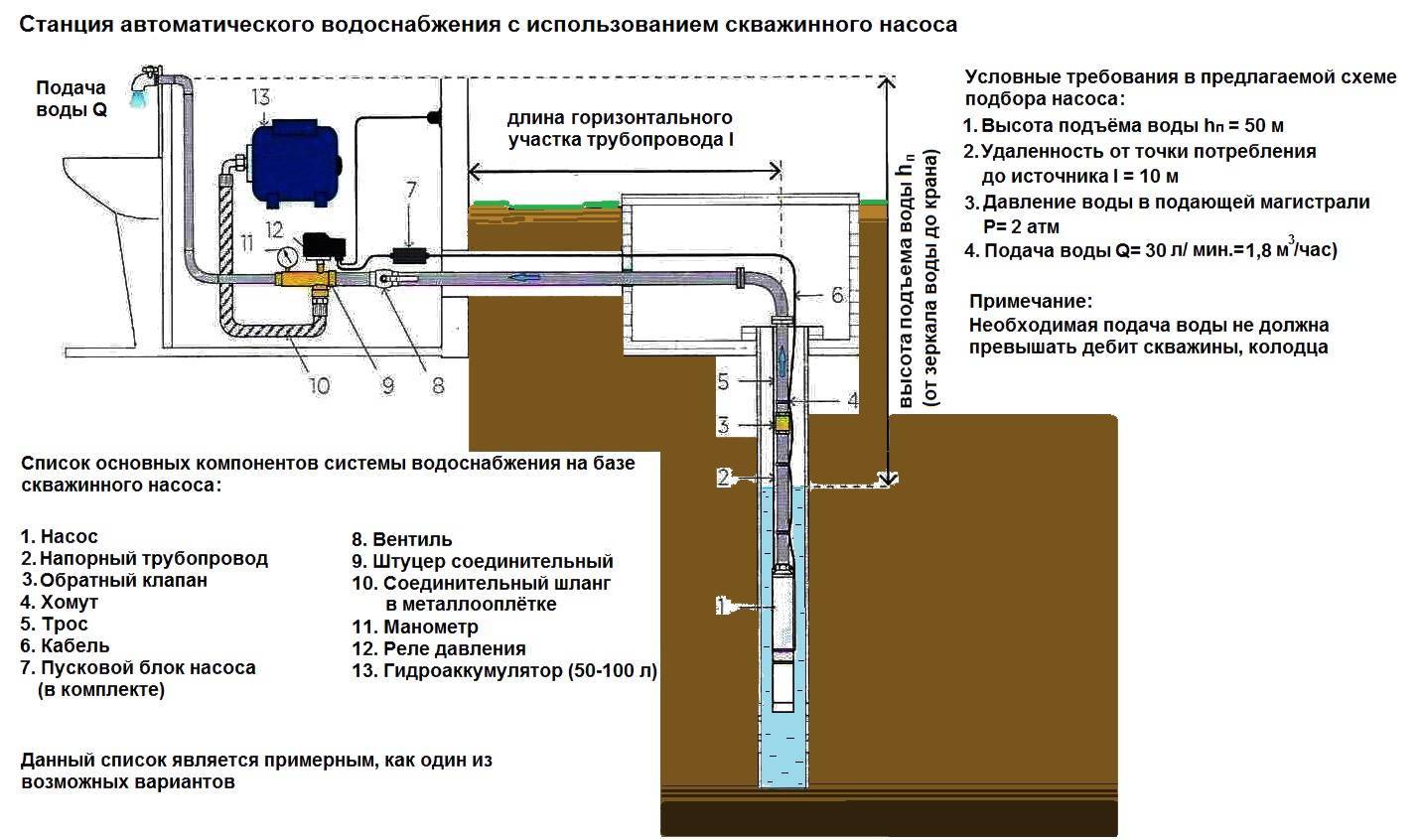
Many different models of borehole pumps are produced and among them it is necessary to choose the best option in terms of technical characteristics and dimensions.
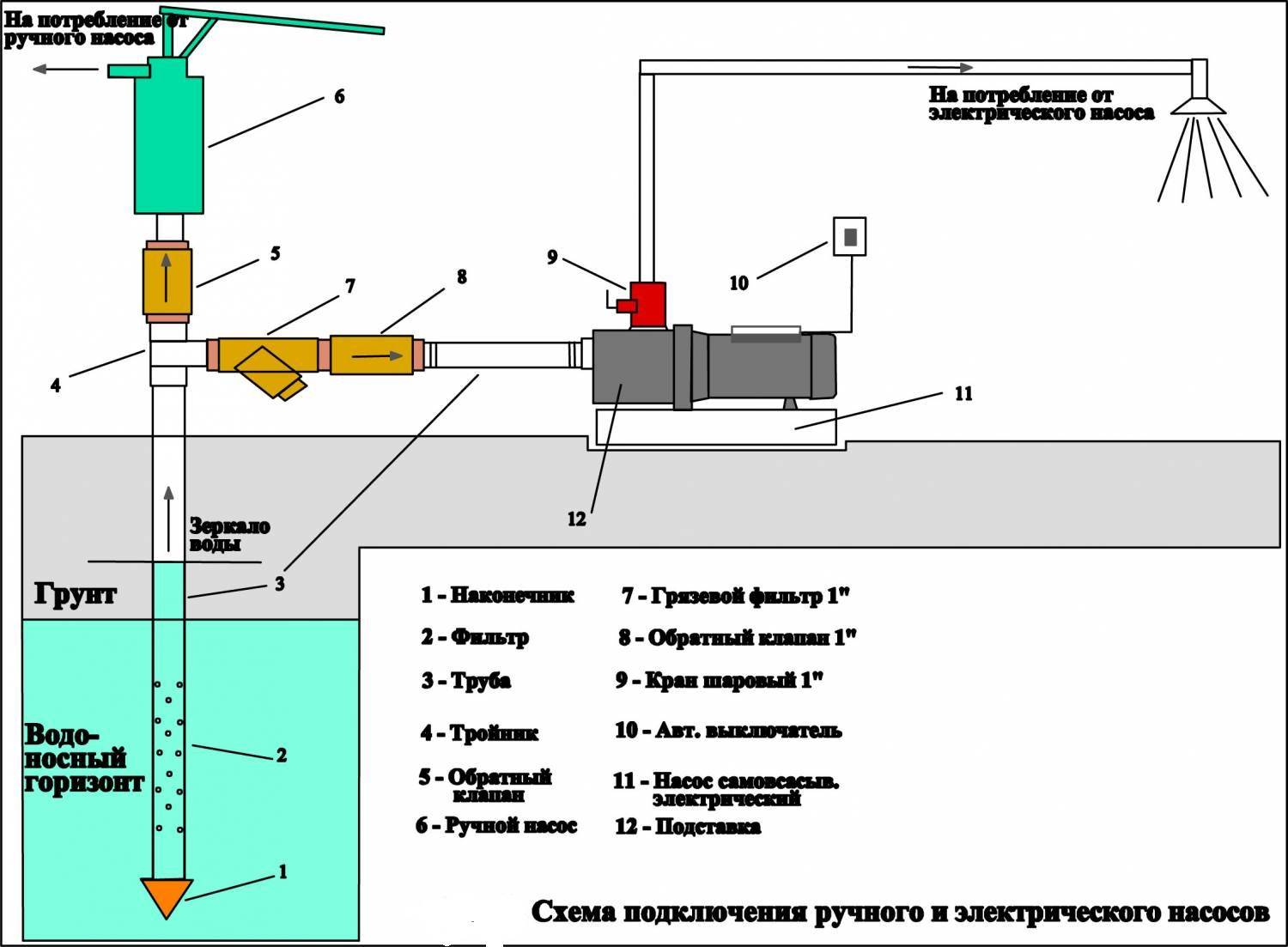
There is another type of well - the Abyssinian well. The difference is that the well is not drilled, but pierced. The “working” lower section of the pipe has a pointed tip, which literally breaks through the soil to the aquifer.As well as for a sand well, this pipe section has a perforation closed with a galloon mesh filter, and in order to keep the filter in place during the puncture, the diameter at the tip is larger than that of the pipe. The pipe itself performs two functions at the same time - casing and transporting water.
Initially, the Abyssinian well was conceived to work with a hand pump. Now, for the water supply of private houses from the Abyssinian well, surface pumps are used, which, taking into account the depth of the caisson, can work with wells up to 10 meters (and even then, provided that the pipe diameter is not more than 1.5 inches). The advantages of this type of well include:
- ease of manufacture (provided that there is no outcrop of rock on the site);
- the possibility of arranging the head not in the caisson, but in the basement (under the house, garage, outbuilding);
- low cost pumps.
Flaws:
- short service life;
- poor performance;
- unsatisfactory water quality in regions with poor ecology.
Types of pumps
If groundwater is deeper than eight meters, it is better to purchase more efficient submersible pumps designed to draw water from wells or wells.
Use of pumping systems
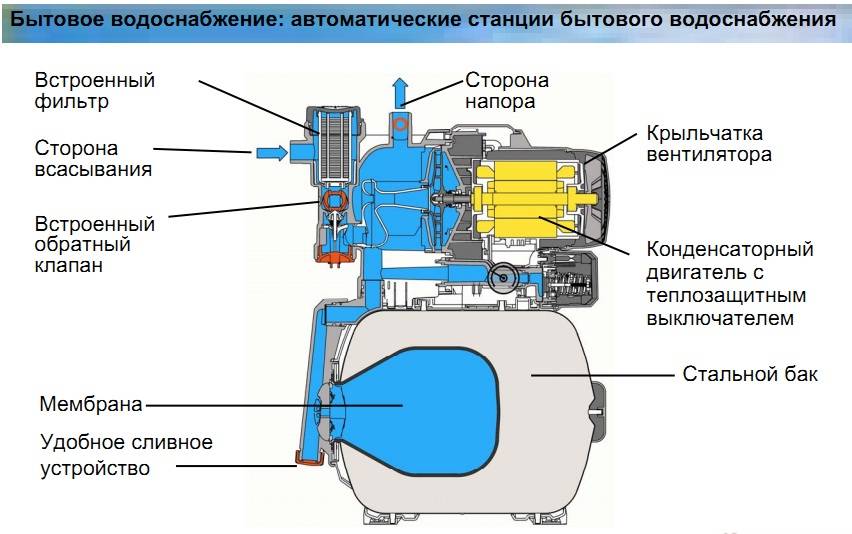
For comfortable water supply of a country house and a garden plot, pumping stations are used. This equipment, in addition to the pump, includes a storage tank and an automatic switch-on system when using water. The water tank is filled to the required level, when water is consumed for domestic needs, the automation turns on the pump and replenishes the water in the tank. The cost of pumping stations starts from 5 thousand rubles.
How to properly install a pump in a well
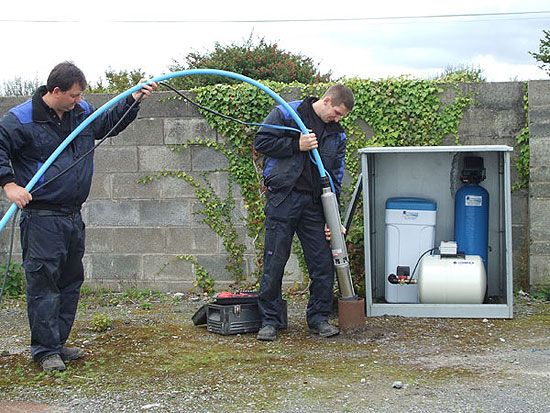
The preparatory stage can be considered fully completed after all the components are connected into one whole structure. First of all, an elastic gasket and a head are pulled onto the casing pipe. A pump is placed in the hole of the fixed head, and then slowly plunges into the well. It is not recommended to make any sudden movements.
The immersion depth of the pump is determined according to this principle:
- First of all, the distance from the water surface to the ground level is determined.
- The motor is turned on, water must be pumped out of the well until the jet in the pipe stops. The dynamic level indicator is determined by the distance from the bottom to the surface of the water.
- When the dynamic level has been determined, the pump must be lowered by 2 meters. In such a situation, the pump must be located a meter from the very bottom of the well, so the quality of the motor cooling will be optimal.
It takes at least three people to do this job. One gently lowers the cable down, and two hold the submersible pump firmly in suspension. In this case, it is not recommended to pull the pump itself, the power cable, or the pipe. If any obstacles arise during the dive of the device, they must be removed with special care. The process of lowering the pump down must be suspended, after which you need to carefully turn it first in one direction, then in the other. Thus, it is often possible to bypass the problem area of the well. If this method was not effective, the pump will have to be pulled out and once again check the condition of the well.
It is advisable to check the pipe before installing the submersible pump. During installation, it is necessary to prevent any foreign objects from entering the well, they can cause difficulties when submerging the pump. A lot of inconvenience can arise even due to the ingress of an ordinary nut into the system.
Basic parameters for pump selection
So, about the height to which you need to raise water, we already wrote
What else should you pay attention to when choosing? We need to know exactly the distance of the well from the house, and the volume of pumped liquid, which will depend on the total volume of the water supply network and the maximum possible water consumption at any given moment. A banal example: we open the tap closest to the entry point to the building - we get good pressure, we open the second one - the pressure drops, and at the remote point the water flow will be the smallest
The calculations here, in principle, are not complicated, you can do them yourself using an online calculator, or simply by studying the instructions from the manufacturer.
What determines the pressure in the system? From the power of the pump and the volume of the accumulator - the larger it is, the more stable the average pressure in the water supply system. The fact is that when turned on, the pump does not work constantly, since it needs cooling, and when the operating pressure is reached, it should not continue to increase it. The system is designed in such a way that it pumps water into the accumulator, in which a check valve is installed that prevents water from flowing back when the pump is turned off. When the pressure in the tank reaches the set threshold, the pump stops. If at the same time the water intake continues, it will gradually fall, reaching the minimum mark, which is a signal to turn on the pump again.
That is, the smaller the accumulator, the more often the pump is forced to turn on and off, the more often the pressure will either rise or fall. This leads to accelerated wear of the engine starting equipment - in this mode, the pumps do not last long. Therefore, if you plan to use water from the well all the time, buy a tank with a larger capacity for the pumping station.
When arranging a well, a casing pipe is installed in it, through which water rises up. This pipe can be of different diameters, that is, it may have a different throughput. According to the cross section of the casing, you can also choose the right equipment for your home.
All the necessary information will be in the instructions for the purchased pump. You can also get recommendations from specialists who drill your well. They will know exactly the optimal operating parameters. It will not be superfluous to also make some reserve in terms of the power of the unit, so that the pressure in the system rises faster to a comfortable threshold, otherwise the water will constantly flow sluggishly from the tap.
Complete wiring diagrams
There are several connection systems. We present some of them, the most typical.
Connection using a caisson chamber
If you decide to make a caisson chamber, then proceed to this at the very last stage of well equipment.
In this case, the complete connection will look like this:
- A - caisson chamber;
- B - constant water level;
- C - safety cable;
- D - pump;
- E - dry running sensors - pay attention to these very useful auxiliary elements of the system, they are not installed often, but sometimes they are indispensable when analyzing the progress of work;
- F - well casing;
- G - electric cable of the control system;
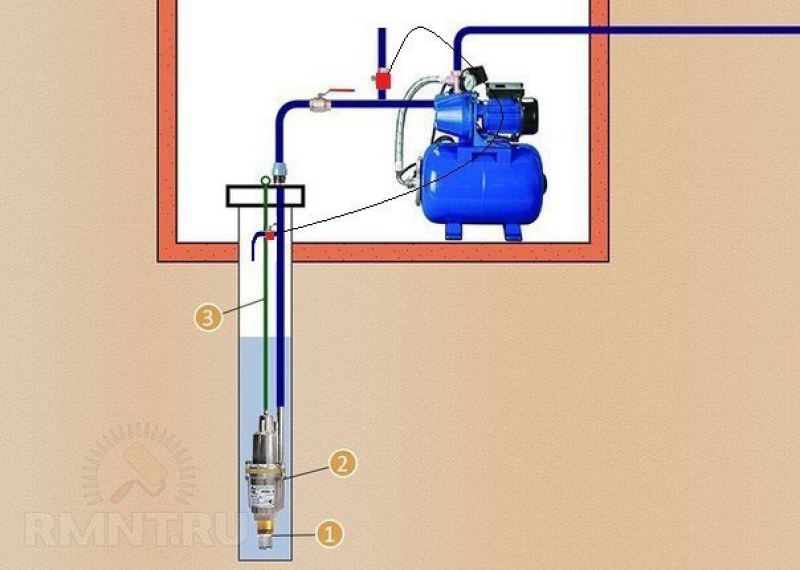
The first of the possible connection options is with a caisson (see description in the text)
H - control panel;
I - pressure switch - another important element that controls the system;
J - fitting for five inputs;
K - pipe head - we advise you to pay special attention to the careful layout and condition of the head;
L - water drain valve, as an element of the protective system;
M - hydraulic accumulator;
N - pressure gauge - it is necessary to know the pressure in the system constantly;
P - downhole filter - a feature of this scheme - the filter is already at the outlet of the system;
Q - check valve.
Connection with emphasis on the accumulator
Please note that in the following figure, the filter is installed in the middle and you are using water freeze protection:
- 1 – well head;
- 2 - electric cable;
- 3 - galvanized pipe - corrosion protection is very important for devices of this kind;
- 4 - safety cable;
- 5 - sealed cable box;
- 6 - adapter;
- 7 - pipe;
- 8 - cable ties;
- 9 - check valve;
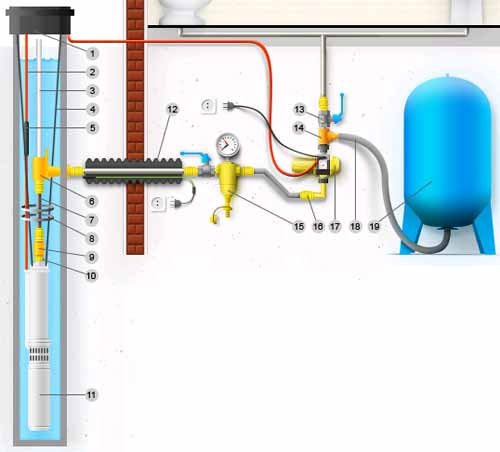
Connection diagram with hydraulic accumulator (see description in text)
- 10 - nipple;
- 11 - downhole pump;
- 12 - protection against freezing;
- 13 - stopcock;
- 14 - tee;
- 15 - main filter;
- 16 - adapter;
- 17 - block of electronic automation;
- 18 - wiring;
- 19 - hydraulic accumulator.
Ultimate focus on fittings
Another option demonstrates the most careful attitude to the entire connecting system, recalling that pipelines are also the science of contacts.
Pay attention to the used sensor in working and “dry” condition:
- A - position of the sensor in the operating position of the pump, when there is enough water in the channel;
- B – well head;
- C - horizontal of the upper level of the soil;
- D - water heater;
- E - hydraulic accumulator;
- F - total depth;
- G - dynamic, constantly changing level;
- H is the minimum distance from the edge of the device to the bottom of the well;
Detailed analysis of the most loaded fitting zones (see description in the text)
I – position of the sensor when an emergency shutdown occurs due to lack of water, “dry” mode;
J - position of the check valve, pay attention to the fitting system;
K - submersible pump with a float;
L - coupling;
M - fitting for 5 outlets;
N - manometer;
P - pressure switch;
Q - ball valve;
R - pre-filter.
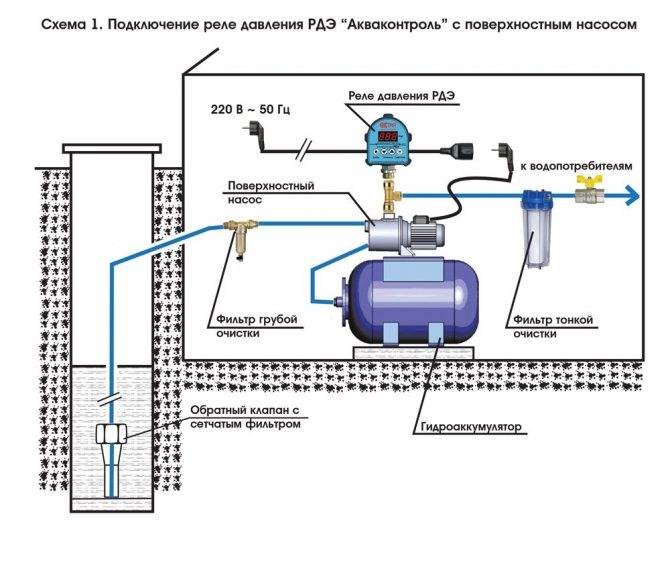
Surface pump connection
Introducing and connecting a surface pump:
- 1 - control system;
- 2 - power cord and plug;
- 3 - power cord and socket;
- 4 - automatic switch - a mandatory element for protection against overloads and maintaining, nevertheless, the system in working order;
- 5 - mains socket, the proposed circuit operates from a standard network of 220 V and 50 Hz;
- 6 - well;
- 7 - input strainer;
- 8 - check valve;
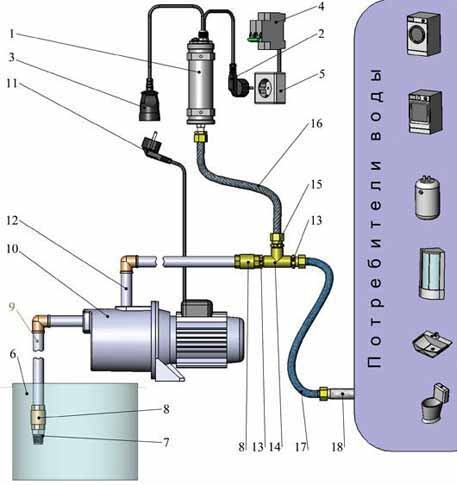
Scheme of connecting a surface pump to a well (see description in the text)
- 9 - suction pipeline;
- 10 - surface pump;
- 11 - pump power cord and plug;
- 12 - injection pipeline;
- 13 - nipple;
- 14 - tee;
- 15 - adapter nipple;
- 16 - flexible eyeliner;
- 17 - eyeliner;
- 18 - pipeline to consumers.
Connection order: step by step instructions
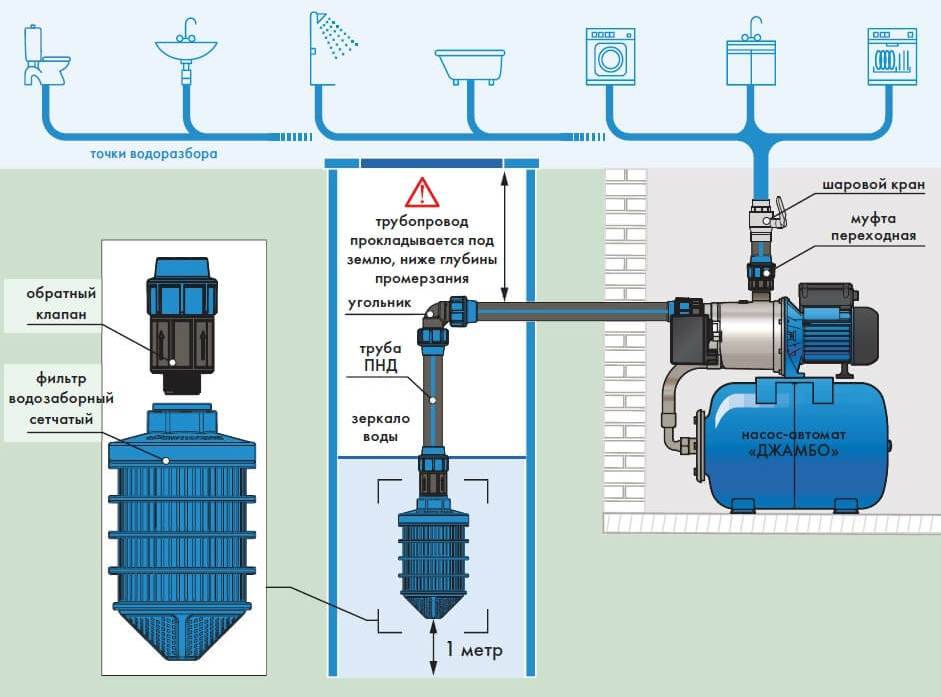
Not everyone knows how to properly connect a pumping station. When installing block equipment, the assembly implies the combination of pressure and suction pipelines. A filter with valves is connected to the pipe immersed in the well, it is brought out through an adapter or head.
The suction line is carefully sealed. Otherwise, air will enter the water supply system, which will disable the pump. The pressure part is supplied with a valve.
12 steps to connect a pumping station:
It is worth considering how the pumping station is connected to the well when choosing modular equipment. Connecting a well to a pumping station includes the following steps:
- Hydraulic accumulator harness. First of all, a fitting with 5 nozzles is mounted. It is connected directly. After that, they set up and install a protective relay, a pressure gauge and a water inlet. The remaining outlet is used to connect the pressure pipe. Submersible pumps are installed in wells with a depth of more than 10 m. This avoids the problems caused by the need to install an ejector and a suction part.
- Pipeline outlet. Produced through the head of the source. Pressure pipes are laid in a trench leading to the house. Elements should be located below the freezing depth of the soil.
- Connection to the electrical network. During the installation process, the starting block of the station is installed, the output is connected to it with copper wires. The pump must be powered by a separate automatic switch.
After the assembly process is completed, the tightness of the joints is evaluated. For the first time, the accumulator is filled slowly so as not to violate the integrity of the membrane.
Types of pumps for wells and their functions
Well water pumps can be submerged into narrow wells to great depths or mounted on the surface. The principle of operation of the device and its installation is as follows:
- Its main elements are impellers mounted on a single shaft.
- Their rotation occurs in diffusers, which ensures the movement of liquid.
- After passing the liquid through all the wheels, it exits the device through a special discharge valve.
- The movement of the liquid occurs due to pressure drops, which are summed up on all impellers.
There are several types of such equipment:
- Centrifugal. Such a pump allows the supply of clean water to be provided without major contaminants.
- Screw. This is the most common device, capable of pumping liquid with an admixture of particles per cubic meter no more than 300 grams.
- Vortex. Transfers only purified water.
Despite the differences, all types of pumps serve to perform similar functions:
- Supply groundwater to private houses and cottages.
- Participate in the organization of irrigation systems.
- Pump liquid into tanks and containers.
- Provide comprehensive water supply in automatic mode.
When choosing a pump for a site, the following criteria are taken into account:
- The original dimensions of the equipment. They must be taken into account to ensure certain technological tolerances when placing the pump in the well.
- Power source of electricity. Borehole pumps are made single- and three-phase.
- Device power. This parameter must be determined in advance based on the calculated pressure and water consumption.
- Pump cost. In this case, it is necessary that the price-quality ratio of the equipment is chosen correctly.
Types of household pumps
Pumps for wells are divided into submersible and surface. Such units have some advantages over the rest:
- Large water intake depth, which is not available for pumps of any other type.
- Ease of installation.
- No moving parts.
- Low noise level.
- Long service life.
The photo shows the types of submersible borehole pumps.
Submersible borehole pumps
Tip: It is very important to follow the competent and proper arrangement of equipment, use only high-quality materials. Violation of installation technology or the use of poor materials can lead to:. Violation of installation technology or the use of poor materials can lead to:
Violation of installation technology or the use of poor materials can lead to:
- Breakage of the pump.
- its premature failure.
- When dismantling, the impossibility of lifting the pump.
How to choose
To choose the right model, you need to answer a few questions.
- How much liquid should be pumped out at a time?
- From what depth do you need to excavate?
- How often will it work?
- What is the level of water pollution and what is the maximum size of solid particles in it?
- Acceptable price.
On the video - how to choose a drainage pump for a well:
Below are the main models of drainage submersible and surface pumps that have gained popularity in the Russian market.
Gilex Drainage
Fecal submersible with a grinder dzhileks is used for cleaning septic tanks, country sewerage, drainage wells. Power - 400 W, productivity - 9 cubic meters. per hour, the maximum allowable size of solid particles is 35 mm. Price - 3,400 rubles.
Power - 900 W, productivity - 16 cubic meters. in hour. Price - 4,000 rubles.
GRUNDFOS
The company produces various models of submersible drainage and fecal pumps.The average price for models with a power of 300-500 W and a capacity of 5-10 cubic meters. per hour starts from 10 thousand rubles. The pumps are equipped with a built-in float switch and dry running protection.
Types of submersible pumps for a well
Most often, owners of private houses for pumping drinking water from a well give preference to submersible pumps. Compared to surface counterparts, they are less noisy, more durable, more compact and not so strongly affected by fluctuations in outdoor air temperatures. Plus, the unit on the surface is not always able to raise water from a great depth.
All models of submersible borehole pumps are divided into two categories:
- Vibrating.
- Centrifugal.
In the first case, water is pumped due to vibrations of a special membrane, and in the second, thanks to a rotating disk with blades.
Vibrating
When choosing a vibratory type pump, it is important to understand that they all have a negative impact on the integrity of the well. The vibration created by such aggregates, albeit slowly, but inexorably destroys it. Plus, the soil at the bottom and around the lower end of the well structure also gradually changes its structure during the operation of the downhole pump.
As a result, the silting process in many cases is sharply accelerated.
Plus, the soil at the bottom and around the lower end of the borehole structure also gradually changes its structure during the operation of the downhole pump. As a result, the silting process in many cases is sharply accelerated.
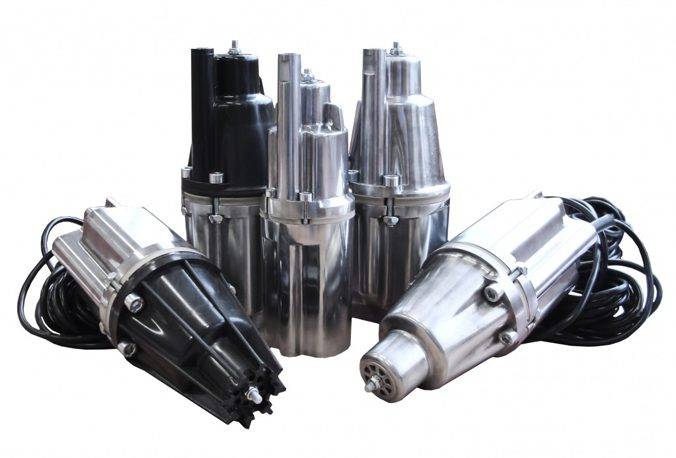
Examples of vibration models
However, vibration pumps have many advantages, among which are:
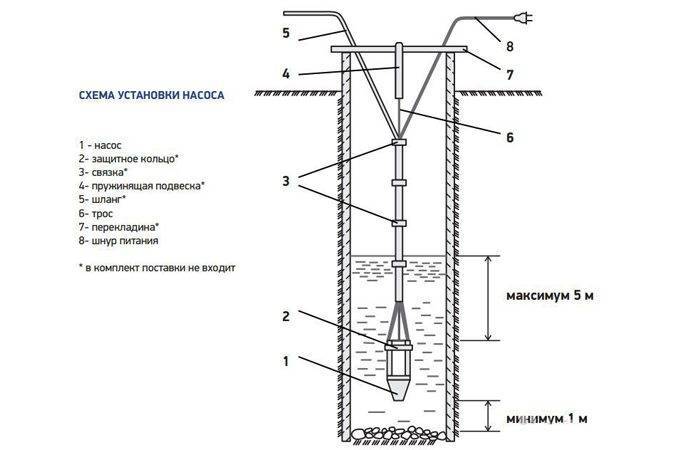
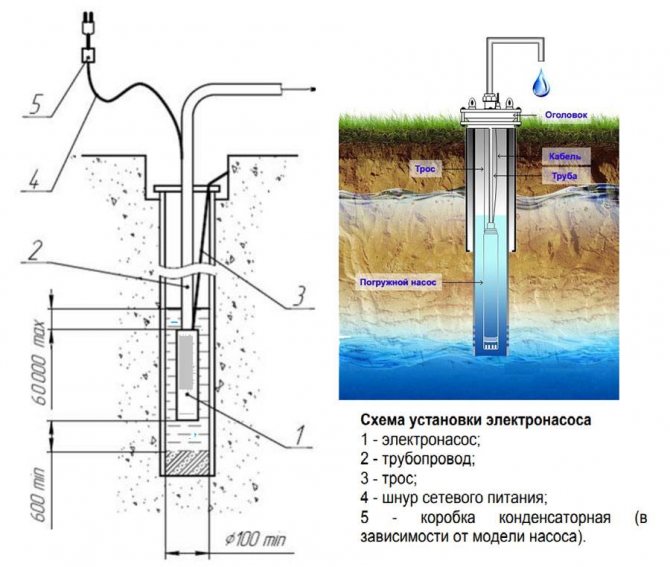
Vibration Pump Installation Diagram
A vibrating pump is the ideal choice when pumping or cleaning out a well.He, along with water, raises all the silt from the bottom. This is both an advantage and a disadvantage of these models. Such a liquid is not suitable for drinking without additional filtration. However, to flush out the strainer at the end of the casing, a vibrating well pump is the best choice.
Centrifugal
The centrifugal pump for the well has a higher performance. Inside it, one or more impellers with blades rotate, which create a vacuum in the center of the unit, where water is drawn in from below. Centrifugal-type borehole pumps are practically silent and are able to lift liquid from very great depths.
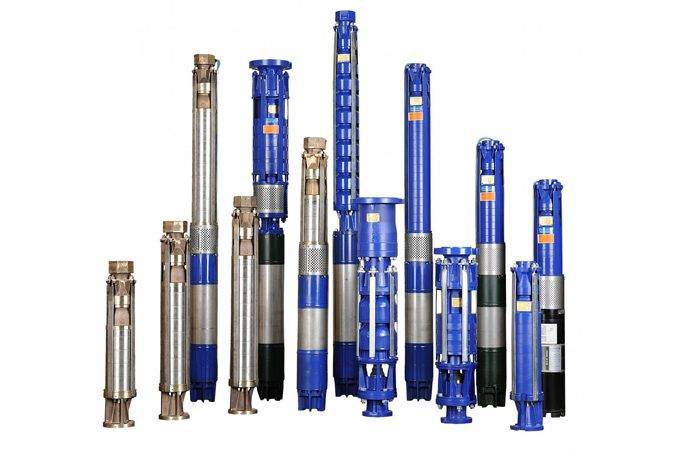
Centrifugal models
Their only significant drawback is their sensitivity to impurities. The purity of the water flow entering them must be high. Otherwise, the working elements of the hydraulic pump will begin to wear out and fail. Before choosing a pump of this class for your home, you need to analyze the water in the well. If mechanical impurities are more than 100 g / cubic meter, then you will have to install a vibration analogue.
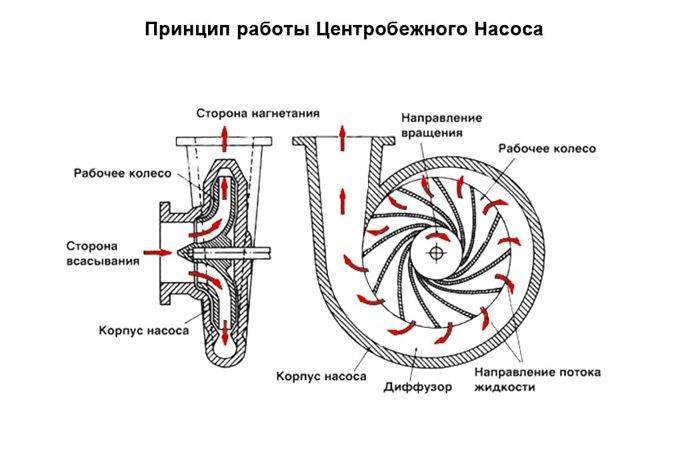
The principle of operation of centrifugal pumps
Auger
One type of deep-well pump uses a broaching screw or auger as a working mechanism. The elongated shape of the device is optimal for narrow wells. The unit can pump water with sand impurities. It creates a powerful and even pressure.