
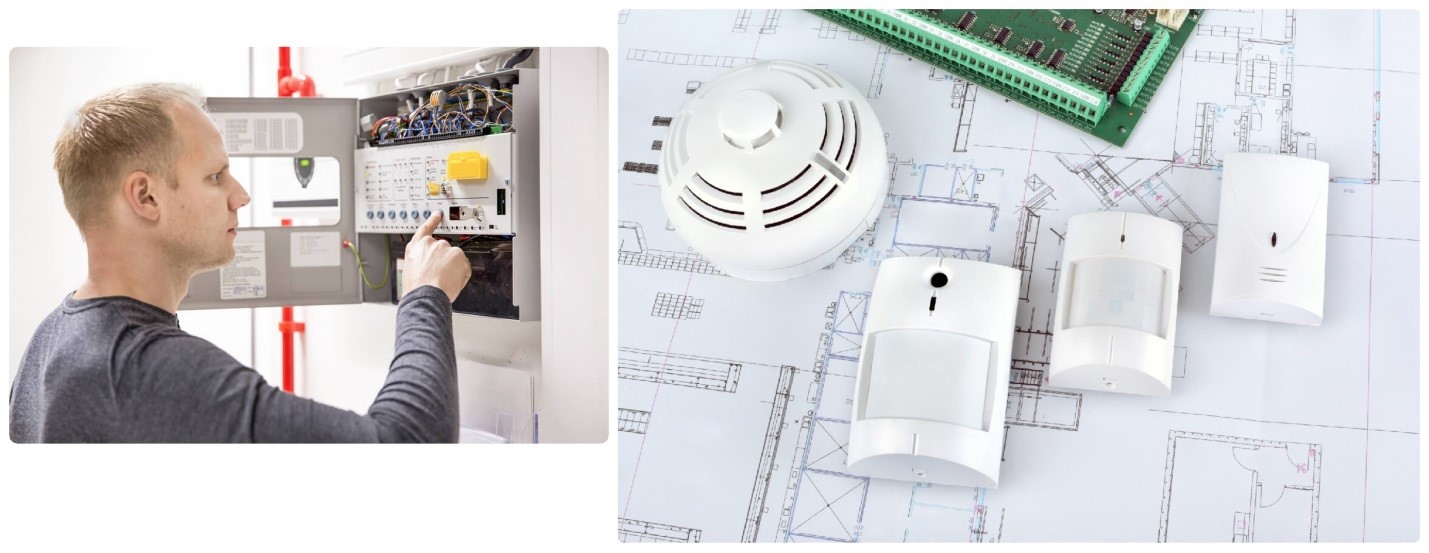
- Normative base
- Installation components
- Detectors
- fire appliance
- Security and fire alarm - composition and characteristics of devices
- Announcers (sensors, detectors)
- PKP - control panel
- Fire-resistant cable for fire alarm loops
- How does a fire alarm system work?
- Training in fire-technical minimum in the organization under the PTM programs
- Types of detectors PS
- Wired
- Autonomous
- Types of fire alarm
- Threshold
- Address-threshold
- Addressable analog
- smoke appliances
- Thermal alarm
- Flame sensors
- Manual fire call points
- System design and implementation
- What affects the cost of installing equipment?
- Firm staff
- Maintenance work
- Organizational matters
- Things to consider before installation
- Types of security alarms
- What does the alarm kit consist of?
- The procedure for developing a project for a fire alarm and warning system
- Obtaining initial data and documents
- The main stage of project development
- Paperwork
- Fire alarm design stages
Normative base
Fire protection complexes for high-rise buildings are installed in accordance with a number of industrial safety requirements.
These requirements are contained in regulatory documents, among which we highlight the main ones.
- Federal Law of the Russian Federation No. 123-FZ (technical regulation outlining the requirements of the PB) dated July 22, 2008.
- - Single-family residential buildings. SP 55.13330.2016
- - Residential multi-apartment buildings. SP 54.13330.2011
- – Fire protection systems. SP 5.13130.2009
- – Systems of fire protection, evacuation, smoke removal, etc. SP 3.13130.2009
- – Protection complexes, electrical equipment. SP 6.13130.2013
- – Noise protection. SP 51.13330.2011
- - Fire safety of buildings. SP 112.13330.2011
- Federal Law No. 384-FZ dated December 30, 2009 - tech. building safety regulations.
Installation components
The technological complex, which allows in a few seconds to determine the occurrence of a fire and find the place of ignition, contains a variety of devices and devices.
Detectors
These are peculiar fire alarm sensors (detectors), which are produced in various types, the choice of a certain type depends on the degree of complexity of the security fire system in the house or at another object:
- thermal fire detectors that respond to the appearance of accompanying signs of a fire are a device for determining the source of fire and transmitting a signal;
- Smoke detectors are automatic devices that react to aerosol products released during combustion. The triggering factors are heat (a temperature sensor is used), smoke, fire (a light sensor is installed);
- manual type fire detectors are installed to signal a fire manually, in their design there is a button for turning on the fire alarm.
Sound, light or combined annunciators work in the local version when a fire and burglar alarm is triggered.People hear a siren or see a flashing light (usually red).
Beginners, and not only, will need an article on the rules for using fluxes for soldering microcircuits.
fire appliance
The receiving and controlling device is part of the fire installation for receiving information from the detectors, studying the fire signal and generating certain commands for the following devices. The control device can receive not only a fire notification, but also information about a malfunction of one of the fire situation determinants or about a change in its mode.
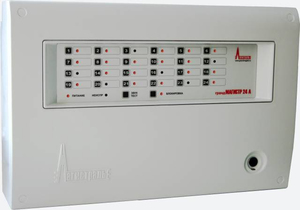 The security receiving device controls not only the room in which it is installed, but also determines the number of the sensor in the entire system of the house. Having received the signal, having studied it, the device gives a command to the working additional warning devices (sirens, light indicators, luminous signs with evacuation arrows). In addition to sounding an alarm signal, the device is programmed to work with the fire department and broadcasts a message there in the selected form.
Security and fire alarm - composition and characteristics of devices
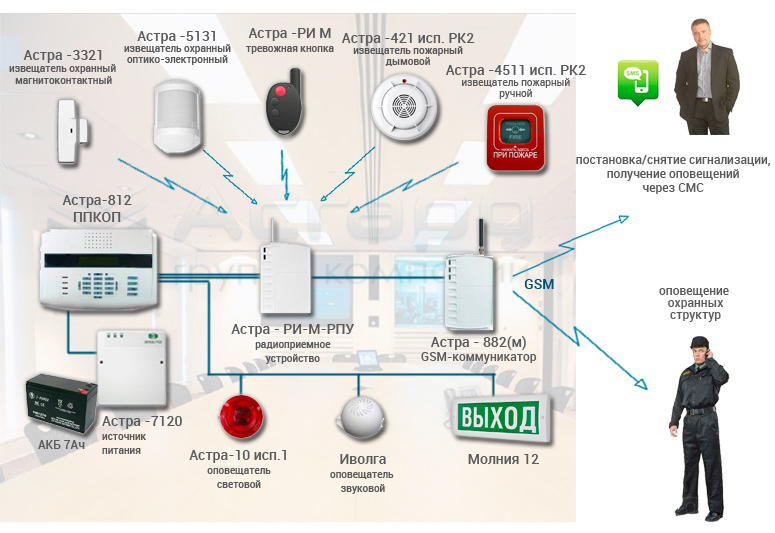
OPS is a set of hardware and software, the main functions of which are:
- Detection of alarm events by one or more scanned factors - unauthorized entry into the territory of a protected facility or detection of fires.
- Data transmission to the control panel (PKP), which generates appropriate alerts for the owner and (or) the centralized dispatching console.
- Activation of certain functions of slave systems: activation of a siren or an automatic fire extinguishing system.
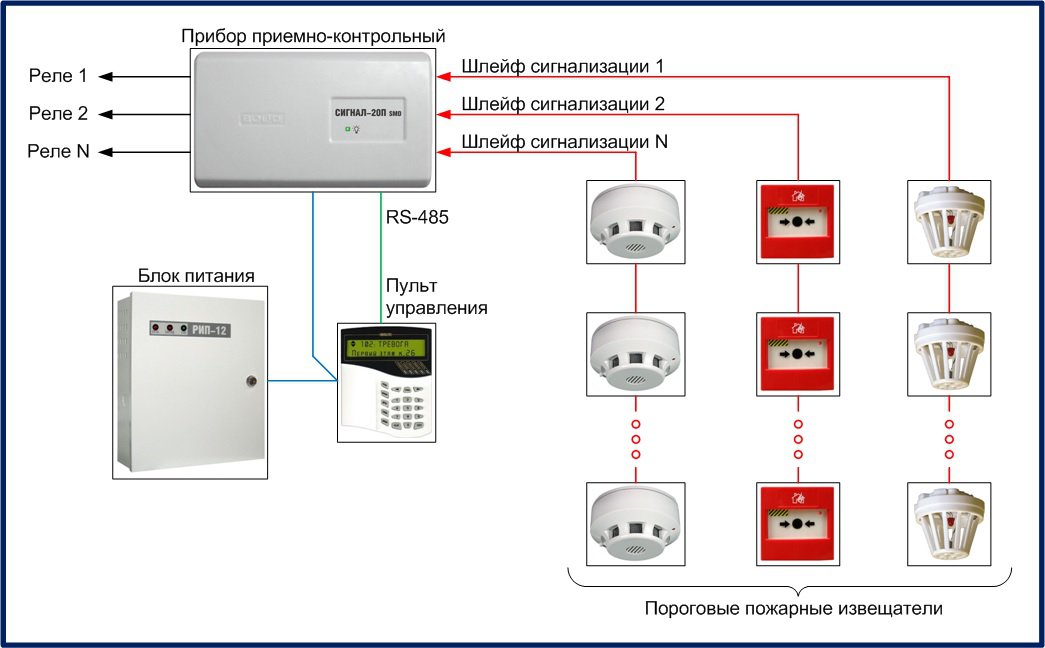
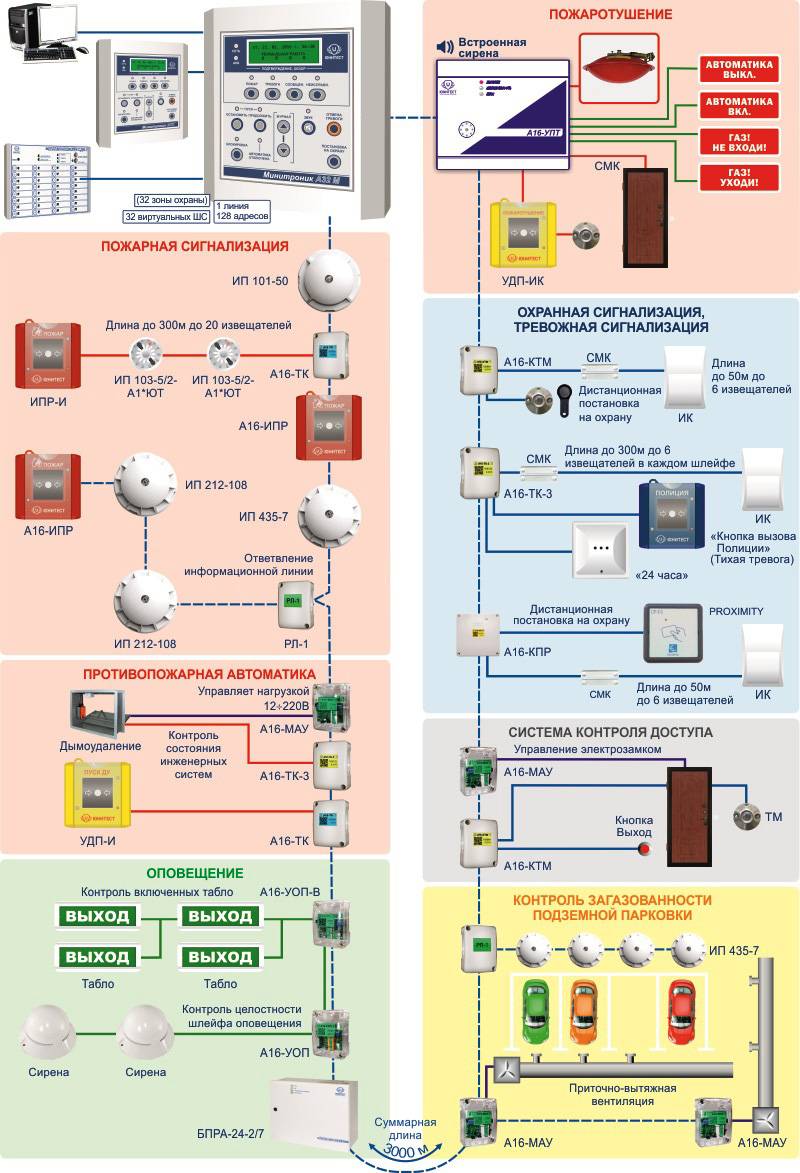 Schematic diagram of a security and fire alarm system with the maximum configuration for a residential complex with underground parking
Announcers (sensors, detectors)
An alarm event is detected by detectors. They have different principles of operation depending on the type of parameter being scanned: temperature, movement, smoke, sound, vibration, etc.
In alarm systems, depending on the type of signaling, various types of sensors are used.
The following sensors are used for alarm (security) alarms:
- magnetic contact (reed switch) - control the opening of doors and windows;
- acoustic - react to the sound of broken glass;
- vibration - control the mechanical impact on building structures;
- movements - infrared, ultrasonic, microwave.
Fire alarm systems use:
- smoke;
- thermal;
- flame.
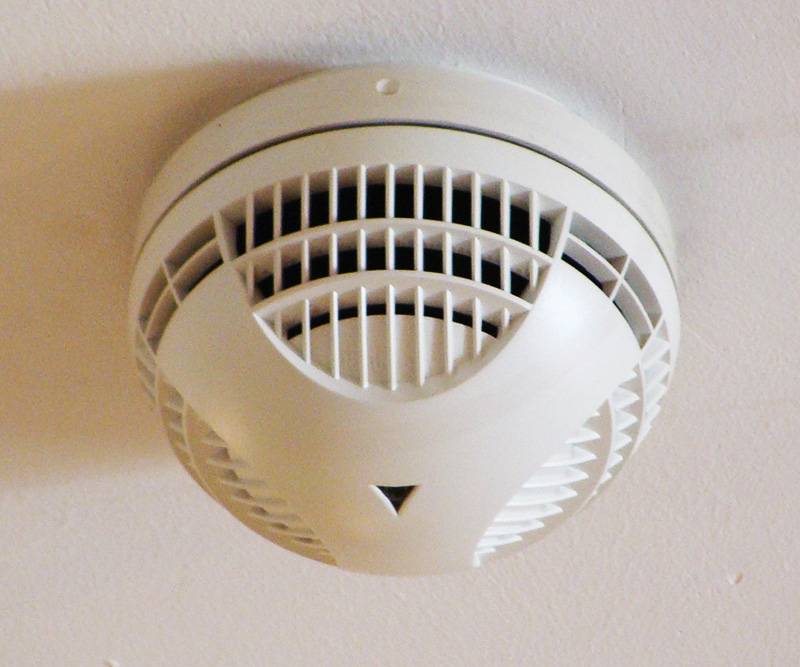
The signal transmission from the detector to the control panel is always carried out in the form of an electrical impulse. The simplest analog devices use a threshold type of signal - there is or is not a contact. More modern, electronic detectors transmit information in digital form. Cables (loops) or radio frequencies can be used as switching channels.
PKP - control panel
The classification of control panels is carried out according to many parameters, the main of which are the following:
- information capacity;
- informative.
Information capacity — the maximum number of devices (individual addressable detectors or common loops in threshold systems) from which information can be processed by the control panel.
Informativeness — the amount and type of information signal that the control panel can display on its indicator or LCD panel. The simplest devices have only two of them: "Norma" and "Alarm". More complex devices show the trigger zone, determine the performance of sensors, etc.
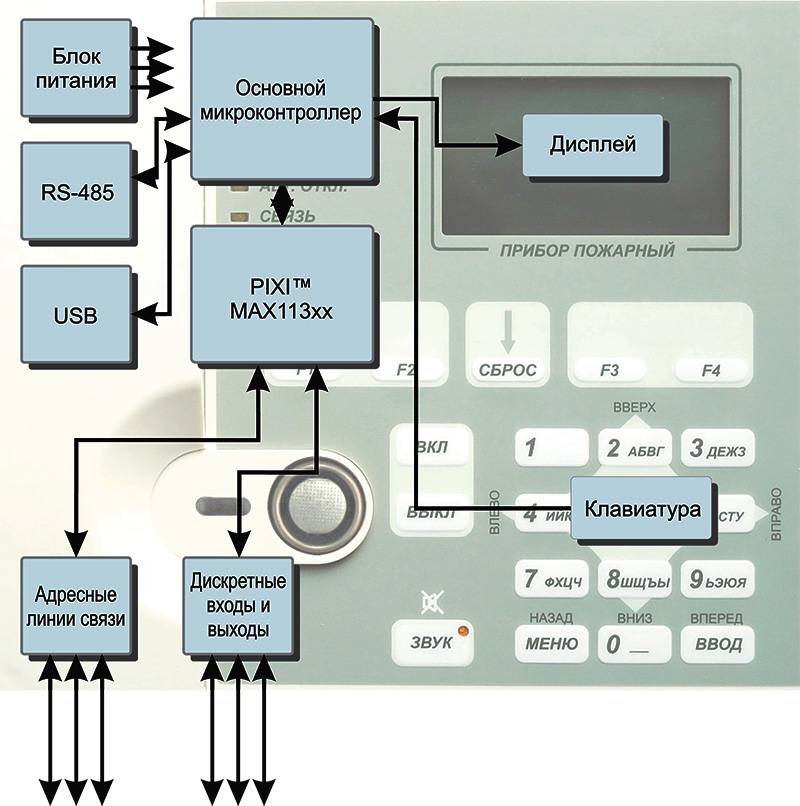 Schematic diagram of the fire alarm control panel
Fire-resistant cable for fire alarm loops
According to regulatory requirements, namely GOST R 53315-2009, the cables used in fire alarm systems must ensure the equipment's performance at elevated temperatures and exposure to an open flame for at least 180 minutes from the moment a fire is detected. This will make it possible to carry out prompt and safe evacuation, as well as localize the location of the flame.
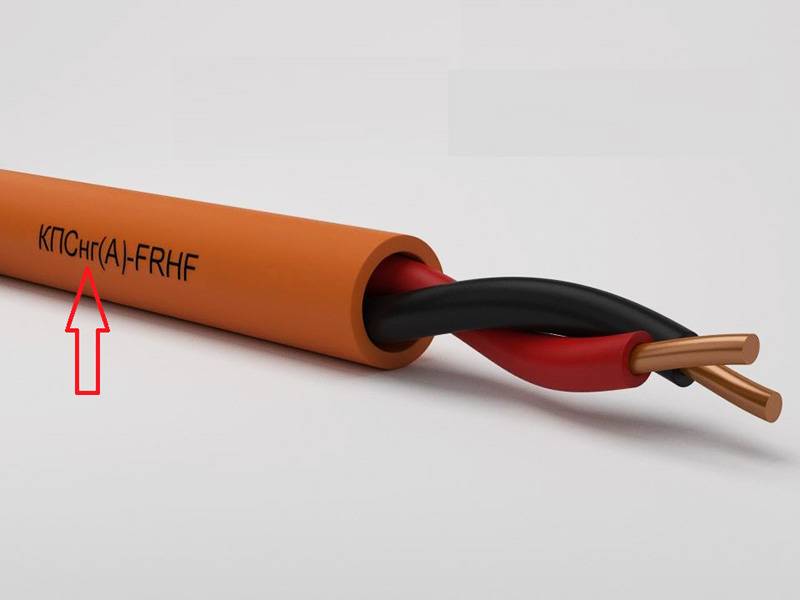 Marking indicating the degree of flammability of the cable
Cable selection is carried out according to a number of parameters described below.
Fire resistance limit - the ability to transmit an electrical impulse when exposed to an open flame on a cable. For fire alarms and automatic fire extinguishing systems, this criterion should be 1-3 hours.


Degree of flammability - this parameter refers more to the insulation of the wire, which must be non-combustible and marked with the letters NG. In some cases, it must be not only non-combustible, but also self-extinguishing, self-stopping combustion after the elimination of an open flame.
Toxicity - shows the percentage of carcinogenic and toxic substances that the wiring releases during combustion. This indicator is especially tightly controlled in fire alarm systems installed in medical and school institutions.
How does a fire alarm system work?
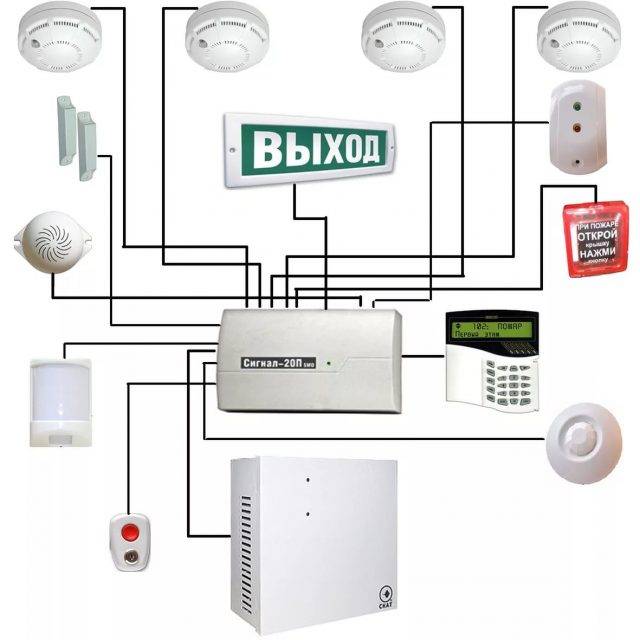 Scheme of the OPS device
Due to the fact that the software and hardware dispatcher was installed, you will always see the source of ignition on the site plan. If the semi-automatic mode was set on the alarm, then after an alarm signal is received from it, the security service must turn on the fire warning system for personnel and at the same time activate visual, voice, and voice messages.
When the fire alarm in the building is confirmed, the main signal will be transmitted to the ACS - the “message” system and thereby put all alarm elements into the emergency evacuation mode. Also, the signal will be sent to the control system of various engineering networks of the building, after which they will switch to the fire hazard operation mode.
The automatic fire device performs the following functions:
- Identification of the fire zone;
- Detection of the focus after 2-time confirmation from the moment of registration;
- Control of network failures for short circuits, as well as breakage with reference to the building plan;
- Detection of the focus at the initial stage;
- Management of different blocks with displaying the results obtained on the dispatcher workstation;
- Viewing the fire-prevention status of building areas on a detailed as well as a general plan, which are displayed on the dispatcher's console in text and graphic format.
Training in fire-technical minimum in the organization under the PTM programs
- rules for the operation of technical means of security systems;
- rules for handling technical equipment;
- rules of conduct in an emergency.
This measure is also a means of maintaining the equipment in working order, since the equipment is used by a person. Inept operation can disable it, and at a crucial moment - if intruders enter the building or a fire breaks out, the equipment will not be able to warn of an emergency in a timely manner
So, monthly briefing will support the attention of employees to this issue at the proper level. Information about staff training should also be recorded in the accounting journal.
Types of detectors PS
We can divide all fire alarm detectors into two main types.
Wired
They are connected to the control device using a PS loop.
They can be placed in the hallway (front) room of the dwelling, the garbage collection chamber, in the house corridor, the elevator shaft, the switchboard room, general purpose places.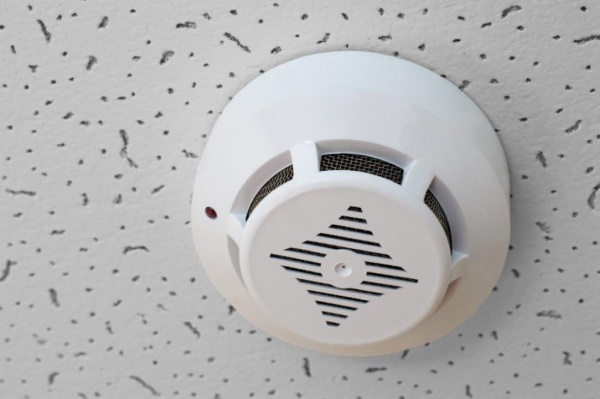
Management is carried out from the central security console, concierge room or control room.
Autonomous
Such sensors do not need a cable.
They are mounted in each apartment to determine the source of fire by each of the detectors.
They can be installed in the bedroom, children's room, living room, hallway, etc.
Optoelectronic smoke detectors can be provided with an audible signal when a fire is detected.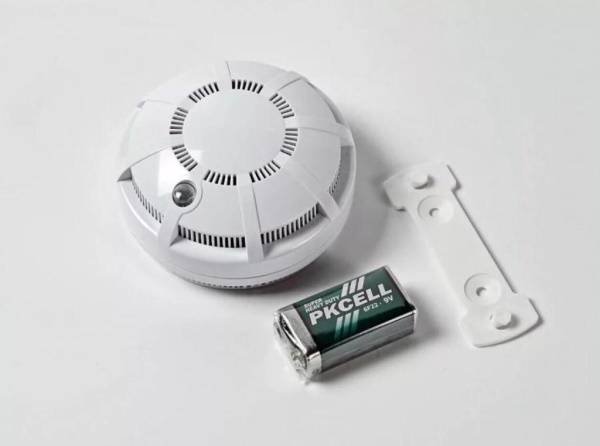
These two types of detectors form two different PS systems.
Depending on the purpose of the object, it is advisable to use one or both types of system.
Types of fire alarm
For the productive operation of the fire alarm system, you must first develop an appropriate algorithm of actions. It is better to do this in detail in order to know exactly what to do during a panic. It depends on how critical the consequences will be.In addition, it must also convey information about the composition of the system and the scheme of work. It is usually attached to the maintenance manual. Below is an overview of the most popular types of fire alarms.
Threshold
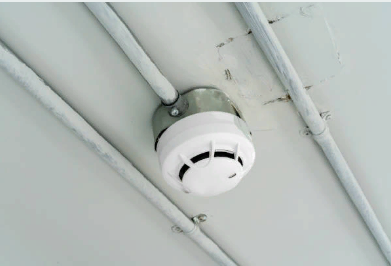
The device consists of point fire detectors, which are non-addressable. They are endowed with a certain level of sensitivity. The general line consists of a set of individual elements. When a danger occurs, the device transmits an alarm signal. The system remote does not respond to the address in any way. The lines that are connected to the signal sensor are reflected there. The threshold view is used in small rooms.


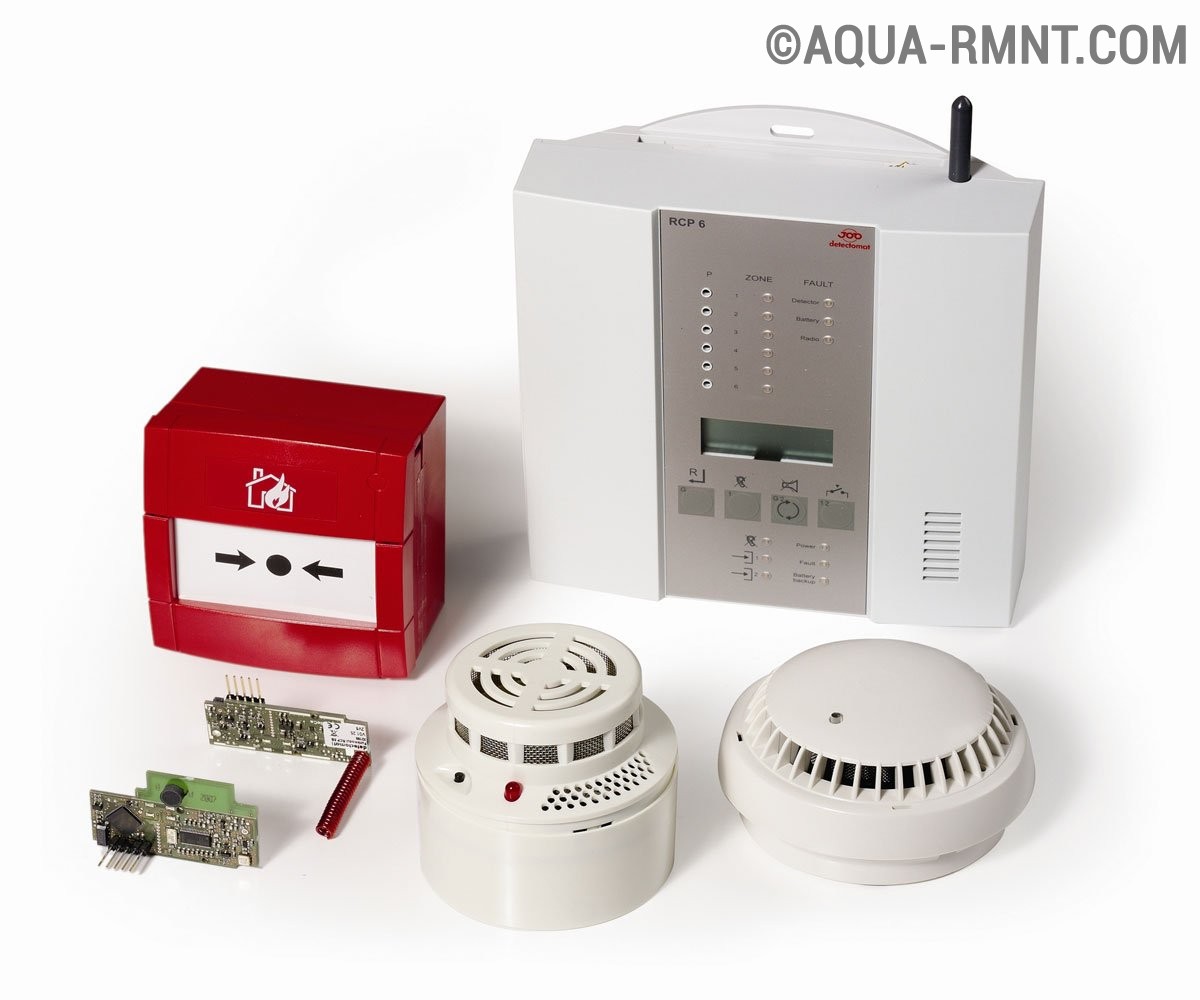


Address-threshold
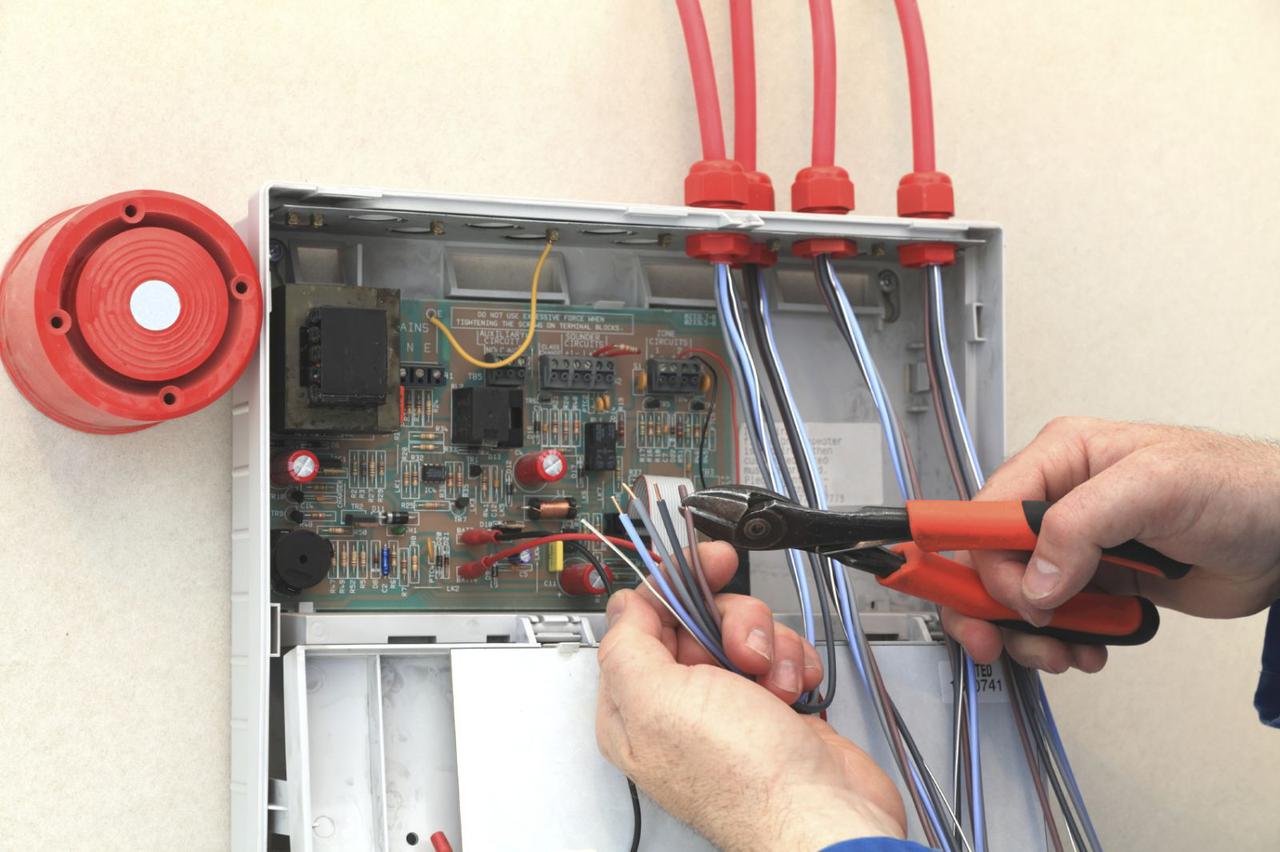
This system also includes warning devices. They work in the presence of factors. The signal is transmitted by signal transmission to the loop. Through the data exchange process, the remote control performs the implementation of the action algorithm and indicates the specific location that gave the alarm.
Addressable analog
This method is considered the most effective. It has the advantages of several types of contours. The decision about the occurrence of danger is carried out by means of the remote control.
smoke appliances
The sensors are placed on the ceiling. This is done because the smoke rises and concentrates there. smoke usually consists from the following components:
- Optical system.
- Electronic board.
- Detachable body.
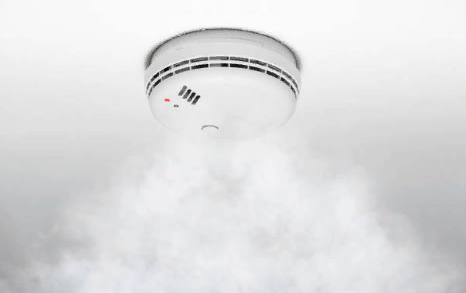 smoke detector
The operation of fire alarms is based on detecting the appearance of smoke in the housing through an optical system. When smoke occurs, the device begins to reflect the light rays falling on the photocell, which is activated. This is controlled by an electronic circuit. In case of penetration steam or gas, is also triggered. That is why the flue is not installed in the kitchen or in the shower. Installing a fire alarm in the smoking area provokes a false alarm.
Thermal alarm
Fire alarm equipment on the ceiling. There is heat that is given off by fire. It works for the following reasons:
- An increase in temperatures.
- Increasing heating.
Flame sensors
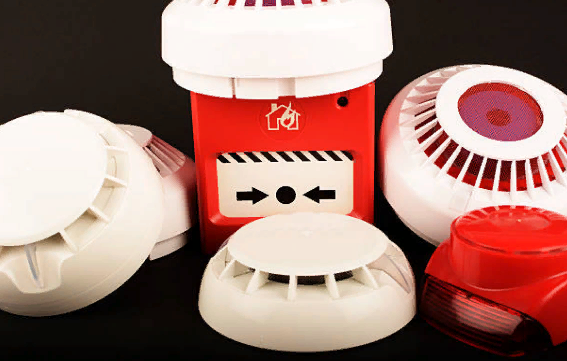
The housing contains contacts that are separated from each other by means of mechanical tension. Fire alarms are triggered when the temperature rises to 70 degrees. As devices improve.
Manual fire call points
The principle of operation of the fire alarm system is to ensure round-the-clock continuous operation. During the manifestation of the initial signs of a fire, the two-wire loop is torn off manually. This is due to manual activation. There must be good lighting at the installation site.
System design and implementation
Design is considered a necessary stage from which the installation of fire alarm systems begins. It is better to involve professionals at the same time, because it is very difficult to draw up a project on your own, and then implement it on the site. It is known that competent design is considered the key to the correct operation of the alarm system.
Since a fire is an extreme situation, it is very important that the device clearly and quickly notifies the source of ignition.
Fire alarm installation also includes the installation of an active fire detection system. Qualitatively performed work affects the functioning of the entire system without failures.
When fire protection systems are installed, communications are laid, an alarm system is connected. Separately, you can connect the alarm to a specialized automatic fire extinguishing system.
What affects the cost of installing equipment?
It is known that installation prices vary greatly. The cost of work depends on several factors:
- Equipment used for installation;
- The complexity of the installation work.
The cost of installing systems is determined at the very first stage, when a specialist travels to assess the facility.
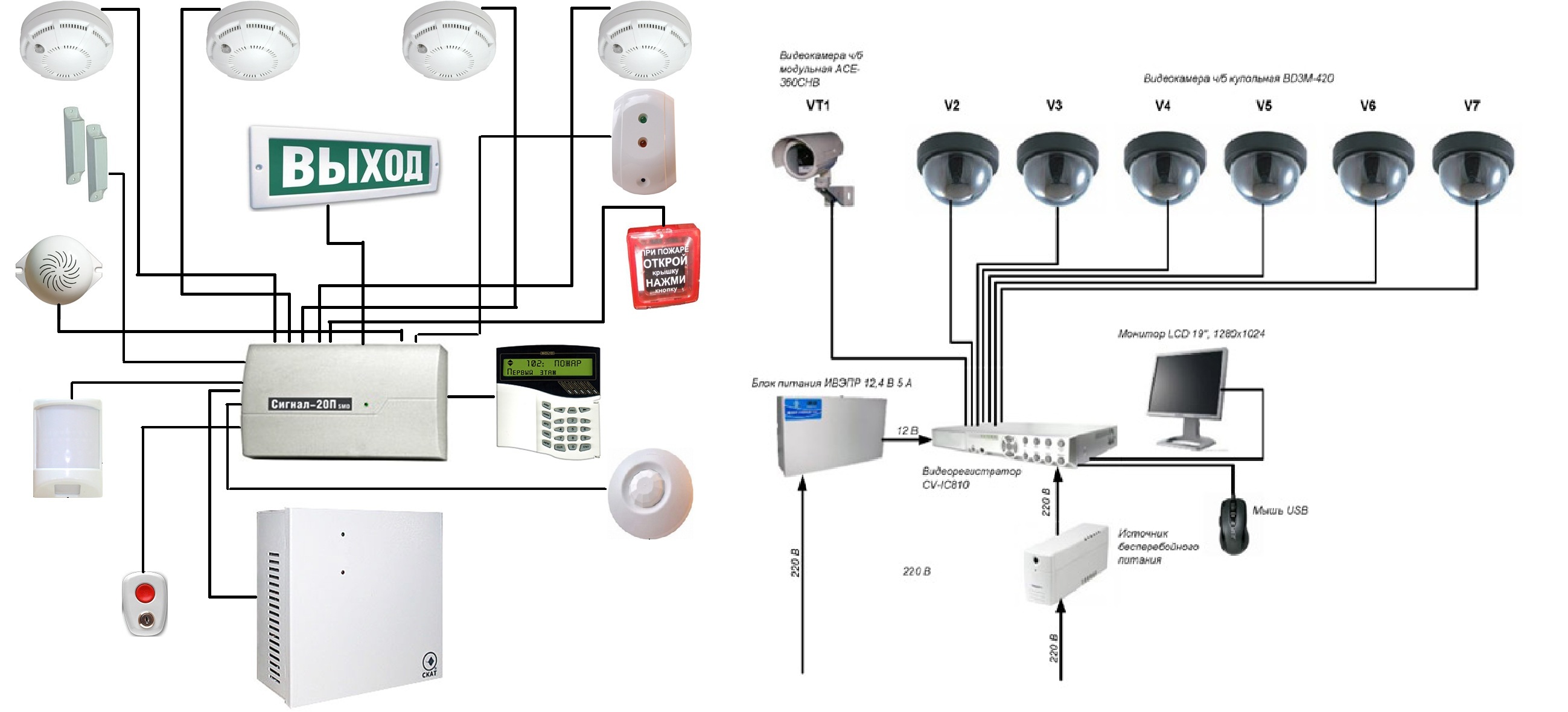
For video surveillance systems, it is very important that the video cameras that are installed on the street are sufficiently well protected from snow, rain, and temperature extremes.
| Title of works | Price in rubles |
| Installation of a stationary antenna with radio channels | 1000 and more (depending on complexity) |
| Installation of junction boxes | 100 |
| Mounting BNC, RCA connectors | 255 |
| IP Server Programming | 3000 and more |
| DVR setup | 2000 and up |
| Control panel programming | 1500 and more |
| Control panel mounting | 600 |
| Connecting an OPS outdoor sensor | 850 |
| Installing an internal OPS sensor | 650 |
| Wall chasing (one meter) | 150-400 (depending on wall material) |
| Mounting an audio channel in a concrete wall | 1000 |
| Connecting an outdoor camera | 2000-5000 (depending on season and installation height) |
| Installation of an office camera | 2000 |
| Installing a video peephole in the door leaf | 1500-1800 |
Firm staff
Installation and configuration of fire alarm systems can only be entrusted to true professionals. And these are electricians, installers, programmers, a fire safety specialist (he is also a foreman), electrical and radio engineers.It can take a lot of time to select such a team (this is where the main organizational skills of an entrepreneur should work). Professionals will require an appropriate salary and a percentage of the work performed. That is why the installation of OPS is so expensive. Saving money on hiring low-skilled personnel is not worth it: the price of a mistake is too high. After all, the constant refinement of the system will lead to additional costs. And this company will not earn a good reputation
The process of installing and configuring the OPS must be approached very responsibly. First, employees of the company carefully inspect the object. They study everything to the smallest detail: the size of the room, the peculiarity of the layout, the number of employees, the location of windows and doors, the presence of additional exits, the location of communications, the features of the functioning of the electrical system and appliances, etc. Then, taking into account the wishes of the customer, a security system project is developed. It indicates the installation locations of information reading devices and annunciators, the places for laying cables and the location of the receiving and control panel. Here, the ways of connecting the fire alarm system to the power supply and fire extinguishing systems are also discussed, a plan for evacuation and rescue in case of fire is being developed, in accordance with the norms of the law.
After agreeing and stipulating all the technical issues, the immediate process of installing the fire alarm system takes place. This takes place taking into account the layout and design of the room, so that the components of the system do not harm the appearance of the room and are minimally noticeable.Often a fire alarm is combined with a security alarm and a fire alarm is obtained. At the end, commissioning and testing of the system takes place.




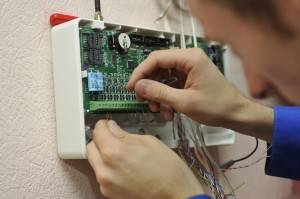
This is just the beginning of the work with the client. Legislation is constantly making adjustments to the fire safety requirements of buildings and structures. In addition, it is necessary to regularly inspect the object for the serviceability of a functioning fire alarm system. Therefore, the customer, in addition to the installation of fire alarm systems, often concludes a contract for its maintenance. Therefore, you can receive a constant passive income even when new customers do not appear.
Maintenance work
If we talk about an integrated approach that includes all types, stages of work on the design, installation, technical service of APS installations, which in the end is much cheaper than working with several subcontractors; then you should choose one of the leading companies in the field of creating security systems in your city, district or region, depending on the significance of the protected object.
Choosing the right installer for all phases, from design to installation, as well as further maintenance, is very important.
Such enterprises, a kind of flagship of the type of activity, usually exist for more than 20 years, it is easy to find out about them, both general information and customer reviews; see a sample of the design and installation of fire alarms at existing facilities that are similar in function, building volume, occupied areas, number of storeys; talk to their management to form your own opinion.
Since such an enterprise is usually not one and there are several competitors, it is possible to choose a contractor according to their commercial proposals, in accordance with the criteria for price and quality of work.
For example:
We recommend that you familiarize yourself with an example of a project for an automatic fire alarm system and warning people in case of fire, completed by this organization by clicking the “Download” button.
For those managers of enterprises who do not have enough time to conduct such preparatory work, there are no qualified technical employees in subordination who could be entrusted with this activity; it may be advisable to conclude an agreement with a specialized company that performs outsourcing of fire safety, which will take care of such problems.
As an advertisement
The material was prepared jointly with Pozhbezopasnost LLC
Organizational matters
The organizational and legal form of an enterprise providing installation services for fire alarm systems can be either an ordinary individual entrepreneurship or a legal entity (LLC). As a taxation system for such firms, they most often choose simplified taxation (STS), 6% of revenue or 15% of profit. Corporate income tax and VAT under this taxation regime are not paid.
The direct head of the company must have an appropriate education in this field and work experience of at least 5 years. He can be an employee. The organizer of the case or the person to whom the business is registered can have any education.
There is an option to work without a license. To do this, you can negotiate with any company that already owns a license. There is something like an agency agreement.Then all subsequent applications will be accepted as if from this company. For this, the company will receive a percentage of the money received for the services rendered (about 10%).
Things to consider before installation
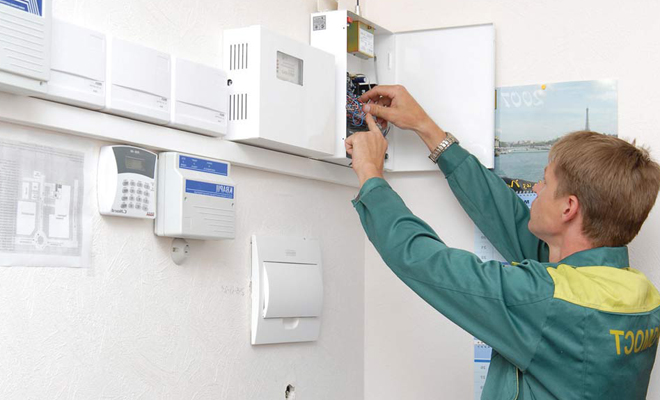
 Perhaps the most banal, but from this, no less significant rule is the correct choice of LICENSED equipment. Do not forget that your guarantee of safety lies, first of all, in high-quality equipment. You should not save on yourself. It is also worth thinking three times whether you will install the alarm yourself or turn to professionals.
Before installation, you need to make sure that your equipment matches your property. If you put a garage alarm in the apartment, there will be no sense from it.
Check the suitability of the sensors for your specific needs: range, response speed, power supply (for homes where power outages are not uncommon, alarms with a built-in power supply are better suited).
Often, in cheap systems, by default, penetration sensors are included. for wooden doors.
It is necessary to install the central unit in a dry and difficult-to-reach place for a robber. At the same time, the block must be easily accessible to the owners and the master. The control unit should not be installed in a wall, bathroom or similar rooms, as during contact with wireless sensors there will be frequent cases of false alarms due to poor and intermittent radio signal. There should be a mains power supply nearby, this will save you energy during installation.
Types of security alarms
Before you purchase and install a burglar alarm, it is important to understand what types of them are and how they differ from each other. Autonomous alarm
Autonomous alarm
Security alarm systems of this type provide for equipping the protected object with special sensors, sound detectors, light elements, strobe flashes, etc. All of the above elements are connected to a common electronic unit that continuously polls control sensors. When one of them is triggered, a corresponding signal is sent to the control panel, which activates the existing warning systems and devices (siren, light detectors, strobe flashes, etc.). Disabling and activating such alarms is carried out using special key fobs or from the control panel.


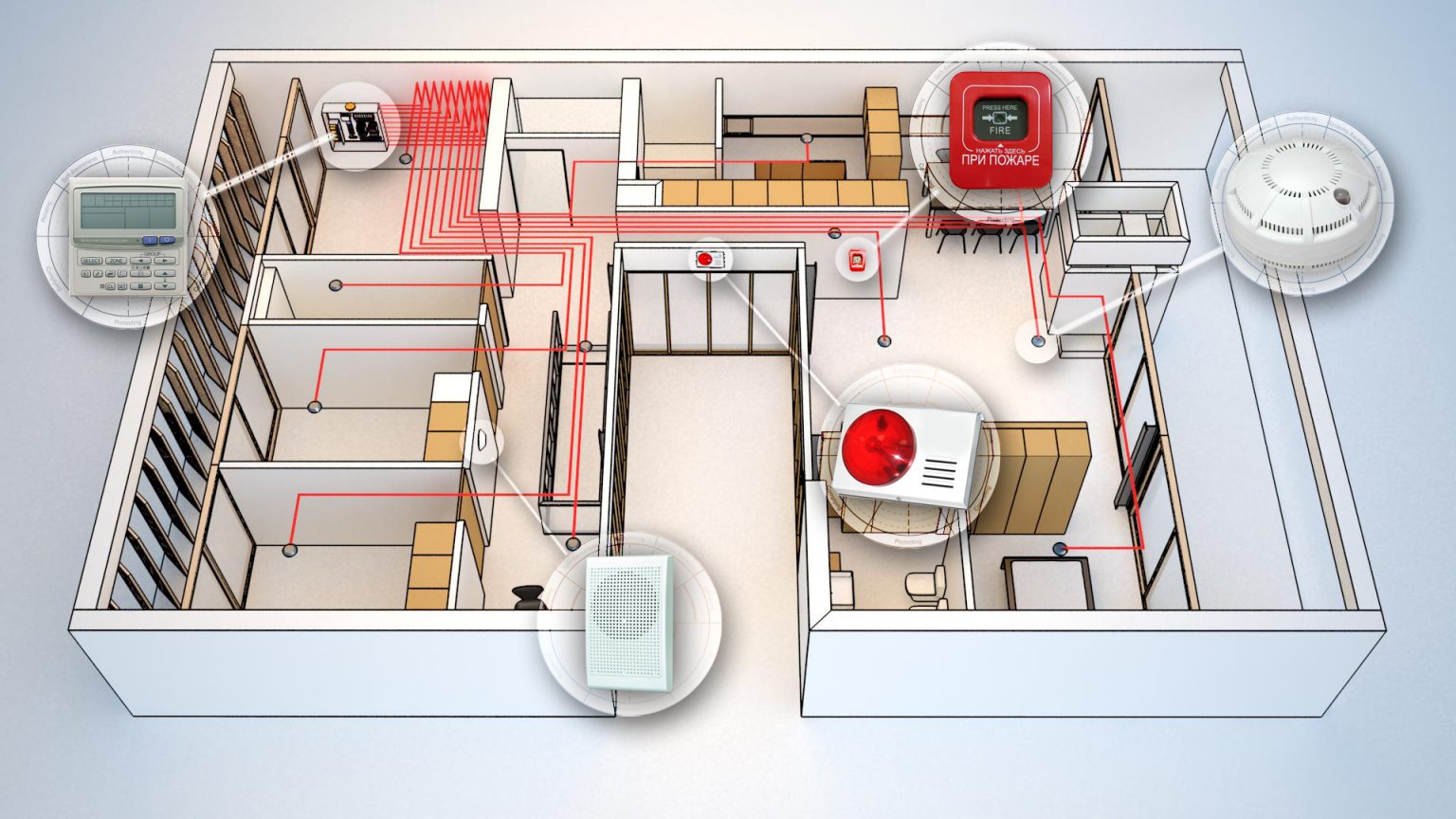



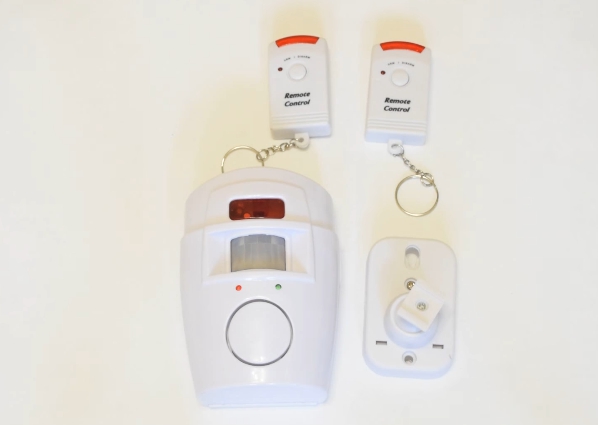 Autonomous burglar alarm
GSM alarms
Such a security system provides for the installation at the facility of special sensors associated with an electronic module, which has a GSM adapter in its design. When the sensor is triggered, this module generates an alarm signal, which is transmitted using the cellular network of one of the mobile providers (depending on the SIM card of which operator is used). Signals are sent in the form of messages (SMS or MMS) or automatic dialing is carried out to a programmed mobile or landline number. In parallel with sending an alarm to the owner or security service, various warning devices can also be activated, similar to those used in autonomous alarm systems.Such equipment is activated and deactivated using a key fob, an electronic unit or a mobile device (phone, tablet, smartphone, etc.).
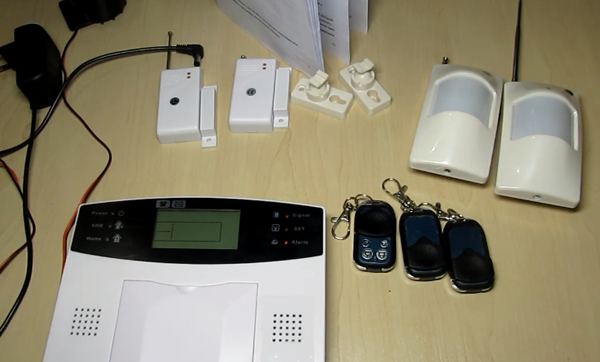 GSM alarm
Phone line alarms
This type of security system is almost similar to GSM security. She also owns a set of appropriate sensors that monitor the penetration of the object. When one of them is triggered, notification is made via a fixed telephone line to the numbers programmed in the electronic module of the control panel.
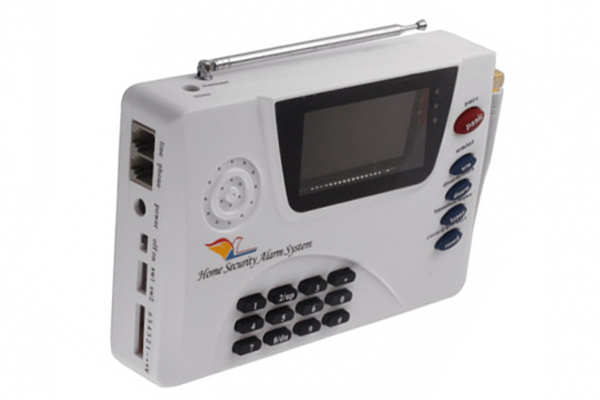 Phone line alarms
Alarm with output to the security console
Such security complexes provide for the location of special sensors and a switching module at the controlled object, which, when one of them is triggered, will transmit an alarm signal to the central control panel of the security service. Communication with the dispatcher's console is carried out using cellular communication lines, fixed telephone lines or radio frequency channels. To improve the reliability of such systems, several communication channels with the dispatcher can be used. Arming or disarming is carried out autonomously from the central control unit with confirmation of its action to the operator of the security service.
The listed security systems can be both wired and wireless. In the first case, the installation of security systems provides that the sensors are connected to the central module using a cable, and in the second case, using a high-frequency radio channel.
 Scheme of the alarm system with output to the security console
What does the alarm kit consist of?
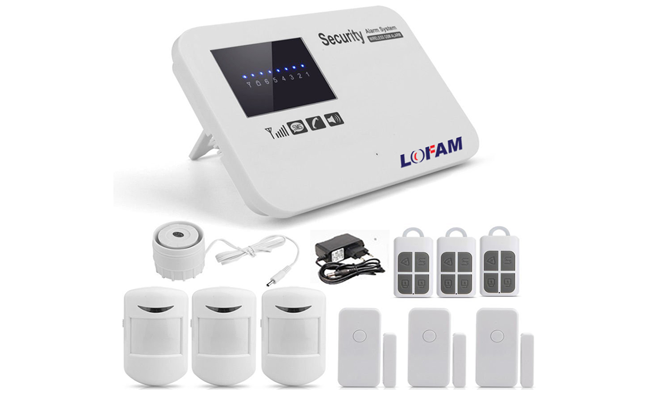
For a country house or apartment, a standard alarm kit includes a small number of components. But they are enough to protect your property. Fortunately, you can always buy the missing modules. It won't take long to install them. The standard alarm system package includes:
- The control block is the heart and brain of the entire system. All other components are connected to it: transmitters, controllers, sensors.
- Motion Sensor. It is divided into two types: wired and wireless. The former are bundled with cheaper systems, the latter with those that are more expensive.
- Window/door opening sensor. With rare exceptions, almost all systems of this type are wireless. Such sensors can be designed for metal and wood surfaces. When buying, check with the seller for their specification.
- The control element comes in several formats: in the form of a remote control (key fob), keyboard, card, or smartphone application (usually comes as an additional option). Each of these controls has its own advantages and disadvantages.
- External sound siren. Connected to the control unit, in case of penetration, it starts signaling an incident at a certain frequency (standard is 150 dB).
- Power Supply. Needed to power the central unit. We add that high-quality control units have a battery "on board". This allows them to work for a while, in case the power goes out.
- User manual. In the event of an unexpected malfunction in the system, it will become your best friend.
If you are missing any components, they can always be purchased separately.
The procedure for developing a project for a fire alarm and warning system
The owner of the building or the head of the enterprise can order a separate project for a fire alarm, or the development will be carried out as part of the overall design of the construction or reconstruction. If the facility already has an alarm system, you can prepare documents for its modernization, replacement of devices and equipment. All these works will be performed by Smart Way specialists.
Obtaining initial data and documents
Before proceeding with the development of a project for a fire alarm, it is necessary to obtain and analyze the initial data for the facility, the characteristics of the premises, and fire risks. For this, an examination of the existing building, an assessment of solutions in the project being developed can be carried out. Calculations of fire hazard, fire risks for the building are also carried out.
To prepare a project for a fire alarm, the following data will be needed:
- characteristics of the building and its premises;
- information about the types of structures and materials, their indicators of fire protection, fire resistance and combustibility;
- data on the types of combustible materials and substances for which the premises are intended;
- normative or actual indicators of the number of personnel, visitors to the building;
- information from fire risk calculations, categorization of premises.
From the documents that developers will need, one can single out technical and operational documentation for an existing facility, materials from inspections of the Ministry of Emergencies. Documents for equipment, electrical installations, building engineering systems are also being studied.If the development is carried out when designing a new building, the initial data are taken from the architectural, planning, engineering and other solutions of other sections.

The specialist conducts a survey of the existing alarm system for project development, equipment modernization.
The main stage of project development
Solutions for a fire alarm and warning system project are selected according to the characteristics of a particular building or enterprise. They should be enough to quickly detect a fire or smoke, send a signal to the control system, turn on warning sensors throughout the facility. The work of the designer includes the following activities:
- development of a general concept and layout of sensors, devices, detectors and technical means;
- selection of solutions for signaling and warning systems, taking into account the location of building communications, the layout of the premises, the estimated number of people in different parts of the building;
- description of solutions in written and graphic form, preparation of drawings, diagrams, plans;
- description of the categories and parameters of the equipment to be installed in the premises of the building;
- description of the control system for signaling, warning and evacuation of people;
- preparation of specifications for materials and equipment, working documentation for installation and commissioning;
- preparation of calculations and estimates for future work.
During the development of the fire protection system, materials and equipment with special protective characteristics are selected. The alarm and warning system must remain operational at the initial stage of a fire in order to ensure the complete evacuation of people.Cables, wires, channels are selected in a similar way, the places of their laying in the building and premises are determined.


All equipment, devices and technical devices must have permits, including fire certificates. In Government Decree No. 241, which lists products for fire certification, products for signaling, warning and fire extinguishing in buildings are singled out as a separate group.
Paperwork
The development of alarm and warning systems is completed with the execution of documents. This may be a section in the general project documentation for construction or reconstruction, or a separate project for repair work. The set of documents for approval includes working documentation with diagrams, drawings and plans. All documents are approved by the customer - the owner of the facility or the head of the organization. After that, the documentation is submitted for approval to the authorized bodies, or organizations with licenses for installation and commissioning.

The specialists of the Ministry of Emergency Situations will check the operability of the alarm system during scheduled or extraordinary audits.
Fire alarm design stages
To design an automatic fire alarm for objects under construction, buildings and structures after reconstruction and overhaul, a special permit is required from a self-regulating construction organization. The exception is residential private houses and block-type structures not exceeding three floors in height.
Project development includes a number of stages.
Pre-project. All the necessary information is collected, including the visit of a specialist to the facility. A preliminary selection of the structure, equipment and other technical solutions is carried out.At the same time, it is recommended to give preference to standard projects, as the most effective and detailed ones. Based on them, a further calculation of the number of elements and their layout will be made, taking into account the specifics of the use of the structure, the performance of building structures and the purpose of the premises. Also at this stage, a decision is made on the type of control and management: external dispatching, internal fire station, a single automatic control panel, etc.
 signaling for a summer residence
Preparation of terms of reference (TOR). Based on the information collected, the contractor (design organization) and the customer jointly draw up, agree and approve the terms of reference. ToR is a legal document that regulates the design. It indicates the type of fire alarm and its main technical characteristics, including operating modes, operating features and the possibility of integration with other engineering communications of the facility.
Design. When developing project documentation, two main sections are created:
- Text - design and estimate documentation, where the calculation of the number of elements, the cost of equipment and work, etc. is carried out.
- Graphic - floor-by-floor layout of components: fire detectors and annunciators, cable power lines and information loops, control panel.
Compilation and issuance of wiring diagrams, in accordance with which installation and commissioning work will be carried out. Working documentation should contain:
- drawings of all devices with connection diagrams;
- cable magazine indicating the location and length of all loops;
- layout of detectors in each room.
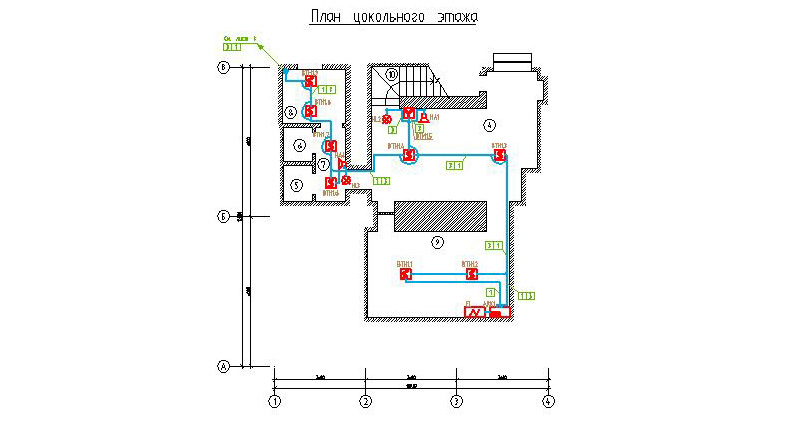 Working diagram of the installation of fire detectors



