
- Outdoor unit installation
- Typical mistakes when installing air conditioners
- Network connection
- Air conditioners for the apartment
- Calculation of the cooling capacity of the air conditioner
- Air conditioner indoor unit type
- Household cassette air conditioner device
- The structure of the external module
- Features of the indoor unit
- Benefits of a Cassette Air Conditioner
- features and principle of operation
- Benefits of a Cassette Air Conditioner
- Where to install the air conditioner
- Air conditioner installation rules
Outdoor unit installation
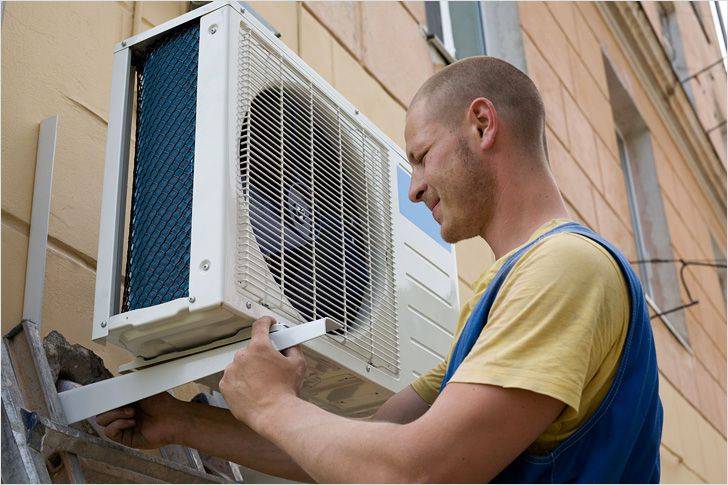 Outdoor unit installation
Before installing the outdoor unit, carefully check the maximum difference allowed. For some air conditioners, it should not exceed 20 m.
- The outdoor unit must be well fixed so as not to vibrate when the engine and compressor are running.
-
Connection ports
It is desirable to leave a space of 30 cm to the side faces if the design does not imply a block diagram. Nothing should restrict the blowing of air by the fan, otherwise the efficiency is reduced. - Do not move the outdoor unit by holding the decorative grille, you will definitely damage it.
- The center of gravity may not coincide with the geometric center, so calculate the forces correctly.
- When transporting, do not lay the module on its side or bend it more than 45˚.
- If it is planned to install on the ground, then it is necessary to prepare a foundation, the size of which in length and width will exceed the dimensions of the block by several centimeters.
- With frequent strong winds in the area, it is better not to mount perpendicular to the wall. If this condition is not met, then due to the strong windage, the unit can simply rip off.
- First, holes are made for the paws. Stands are fixed with anchor bolts. After that, the compressor unit is installed on them and screwed with bolts.
- Make a hole in the wall using a puncher. Its diameter must be such that the pipeline and electrical wiring fit freely into it. Extend communications to the block.
- Flare and strip the pipes in the same way as when installing the indoor unit.
- The valve of the outdoor unit must be closed. Unscrew the nut and connect without delay so that dust and dirt do not get inside. Tighten with two wrenches.
Typical mistakes when installing air conditioners
Incorrect installation of the air conditioner is a common thing. It also happens that a mistake leads to the fall of the structure. The reason for this is the high cost of installation services provided by special firms, as well as the presence of non-professionals in this field. For example, skilled workers provided by the firm will charge almost half the cost of the air conditioner itself for their 2-3 hour installation of an air conditioner. Therefore, in order to save money, the owners prefer to hire an unskilled worker.The result of such an installation is different: for some, the air conditioner lasts for years, while for others it does not.
Note! Often, non-professionals do not pay attention to the material from which the facade is made, what load it will withstand, etc. Here is a list of the most typical and common mistakes that are made when installing air conditioners:
Here is a list of the most typical and common mistakes that are made when installing air conditioners:
- Freon tubes are too often and excessively bent. Then the load on the compressor increases, and it fails faster.
- Installation of a condenser unit on a glazed loggia. As a result, air circulation deteriorates.
- Installing an air conditioner in a room with appliances that emit high-frequency electromagnetic waves. These include: lathe or drilling machine, welding equipment.
- Installing the evaporator unit in a skewed fashion: condensate flows out onto the floor.
- Installing an air conditioner above a heat source.
When these errors are already made during the installation process, you will have to fix them. To do this, you need to understand the meaning of the error and the reason:
- If, after installation, the air conditioner creates a draft, it is enough to change the direction of the air flow, which is changed by the position of the damper on the device.
- When heating indoors, the outdoor unit is covered with ice. In this case, the product does not have an automatic defrosting system. It is enough to turn on the air conditioner in the cooling mode, after which the plaque will gradually melt.
- During the hot period, fresh air does not come from the installed air conditioner, there is no cooling effect.It is necessary to check the filters, close the windows in the room, turn on the heating device, replace the air conditioner with a more powerful one.
- If the air flow is weak, the filters are cleaned.
- If water is flowing from the air conditioner, the drain channel is blocked. It could be an ice block. You will have to call the master, who will warm up the unit.
- When a line noise is heard during the operation of the installed air conditioner, the bearings may be worn out or the fan may be out of balance. A master is hired to diagnose and repair the product.
- The compressor gets very hot - a sign of low freon pressure. It is enough to refuel the air conditioner with freon and check everything for leaks.
If you follow all these steps, you can be sure that the installed air conditioner will last for many more years.
Network connection
The final part of the installation work is the connection of the installed system to the power supply. An autonomous power supply system is organized for the air conditioner, which will not depend on the wiring of the whole house. The best option is a stabilizer that will not allow voltage drops to affect the operation of the device. This option will help in cases where there is no separate wiring for the air conditioner.
If the installation of air conditioners included grounding, then it unites both the outdoor and indoor units. To extend the cord, use a cable with the same specifications.
A test run will show whether the wiring from the outdoor unit to the indoor unit is correct. After connecting the unit to the mains, you need to look at its operation - what noise the device makes, how the visible part of the air conditioner functions.Any extraneous noise is a signal that the wiring is not working properly. The air conditioner should not tremble or crackle. After installation work, if there are no problems with the parts and details of the unit, a technical check is necessary - it is carried out at least once every six months.
Air conditioners for the apartment
How to choose an air conditioner for an apartment, and is it needed there at all? The second part of the question is always decided based on personal preferences and living conditions. When housing is located on the shady side and can be regularly ventilated, then there is no need to install an air conditioner in the apartment. The sunny side, the close proximity of the roof, panoramic glazing that transmits heat more than a conventional double-glazed window, noisy highways under the windows - all these factors make residents think about the need for air conditioning in the apartment, especially when there are small children and the elderly.
When housing is located on the south side, the sun shines from morning to evening, so in the summer it is impossible to cool off only by airing, and if a road passes under the windows, along which cars constantly drive, then the smell of exhaust gases is added.
Calculation of the cooling capacity of the air conditioner
When the decision on whether an air conditioner is needed in the apartment is made, it remains to choose a split system, calculate its power, and find a place to hang it.
First, the required cooling capacity is determined, which should not be confused with the energy consumption from the mains.
The cooling capacity is the amount of cold produced by the appliance in a certain time at a certain energy consumption and is expressed in kW.
If a person does not know how to calculate an air conditioner for an apartment, you can contact the company where you plan to install it, or use the online calculator service.
This gives an estimate for a room with an average heat gain. When calculating an air conditioner for an apartment on the south side, under a roof, with a large glazing area or a huge amount of constantly working equipment, from 10 to 30% is added to the result obtained, which should cover the excess of incoming heat.




Air conditioner indoor unit type
Now, having the necessary technical indicators, they are thinking about which air conditioner to choose for the apartment. In all simple cases, wall models are purchased, as they will cost the buyer quite cheaply. Housing in typical houses of Khrushchev, Brezhnev and modern buildings are ideal options for them.
Floor-to-ceiling air conditioning is needed if:
- more power is required with medium areas, but there are no false ceilings and false walls for installing a channel or cassette unit;
- the room has oval or elongated shapes;
- there is a panoramic glazing;
- the air distribution should go up, not in a horizontal direction.
You will have to install an air conditioner in an apartment with a cassette-type indoor unit if:
- increased capacity of the refrigeration machine is required;
- there are ceilings above 3 meters;
- the design project does not provide for the presence of extra units in the space of the room;
- it is necessary to distribute air in several streams so as not to create "dead zones" in the room.
A ducted air conditioner is purchased in the following cases:
- concealed installation required;
- the area of the room is large, and the ceilings have a height of more than 3 m;
- air conditioning of several rooms at the same time is required;
- full supply ventilation with humidification and cooling or heating of air is necessary.
When buying a ducted air conditioner, consider what is needed: recirculation or ventilation. Recycling can be partial and 100%. When partial recirculation is combined with the admixture of outdoor air, we will already talk about the year-round use of a split system.
In the latter option, it is necessary to install a mixing chamber at the inlet to the indoor unit for mixing the intake (recirculated) and fresh air in the required proportions, as well as an air heater to expand the temperature range of action in the winter cold.
Household cassette air conditioner device
Cassette-type cooling equipment is a two-module system, thanks to which the function of cooling the air to a predetermined temperature is carried out.
The set of cassette split system consists of modules:
- External (street).
- Internal (apartment, office).
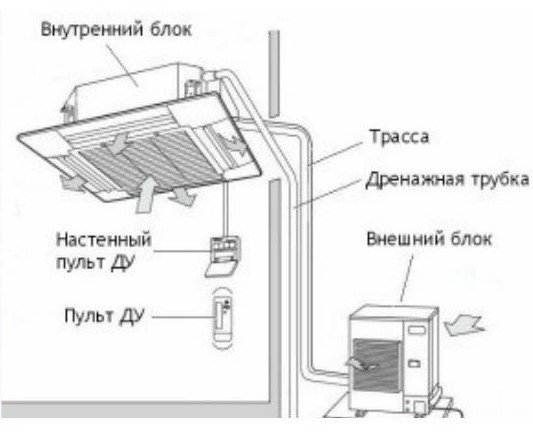
Both modules of the kit are individual blocks, which, when the system is put into operation, are connected by technological pipelines and electrical connections.
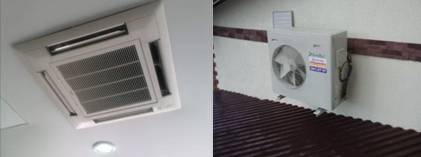
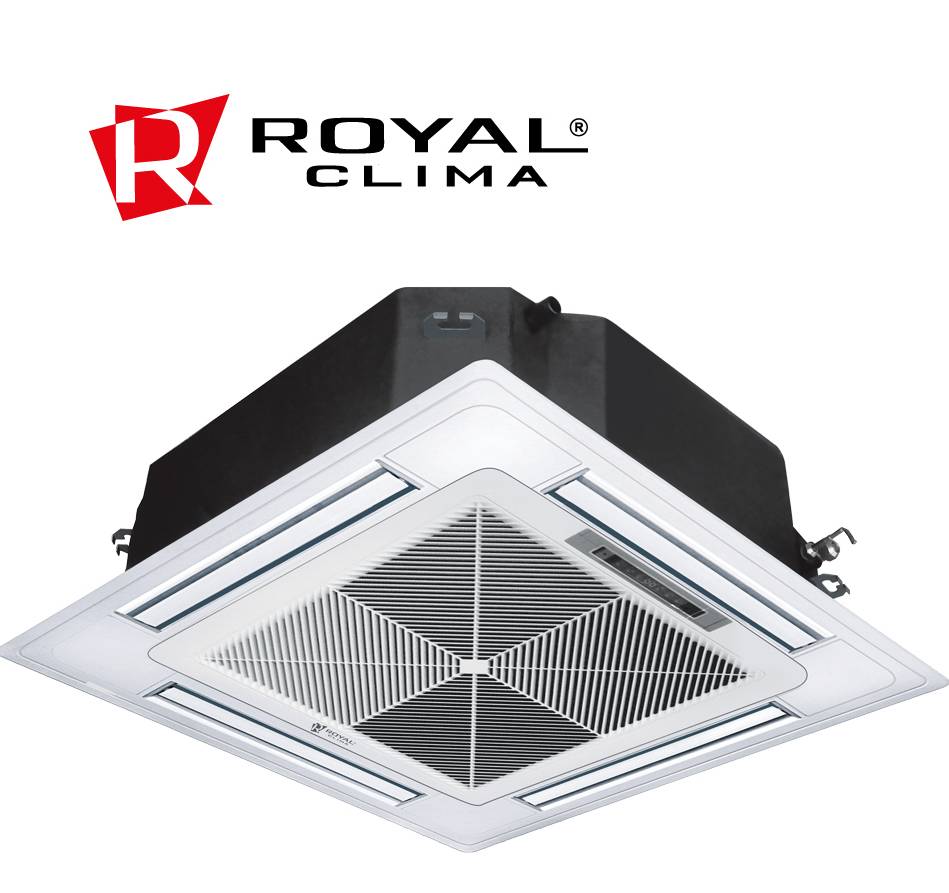
The main parts (modules) of a cassette split system that make up a complete set of air conditioning systems. As you can see from the picture, the outdoor unit is not much different from those used in classic wall-mounted air conditioners.
It should be noted: cassette-type split systems are more often used as office equipment, installed at small businesses and inside administrative buildings.
Application in apartments or houses is a rather rare phenomenon. The main reason for this situation is the need for a device on a false ceiling, because the indoor module has the purpose of mounting under the ceiling.
The structure of the external module
This part of the design of the cassette air conditioner is fully consistent with the classic design of domestic air conditioning systems.
The block street module contains the following components inside:
- compressor;
- capacitor;
- fan;
- automation elements;
- electrical parts.
The compressor and condenser are connected by a refrigeration circuit filled with freon, from which contact points are made through a pair of linear shut-off valves for connection to the indoor unit.
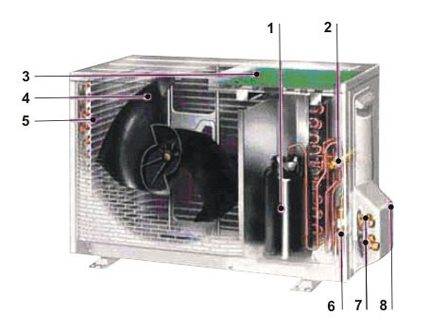
Execution of the external module: 1 – refrigerating compressor; 2 - four-way valve; 3 - electronic and electrical board; 4 - condenser fan; 5 - finned tubes of the condenser; 6 - filter-drier; 7 - block of stopcocks; 8 - cover
Electrical connections for automatic control and power supply of the compressor of the external module are also brought to the contact panel of the internal module, where they are switched accordingly (according to the diagram) and brought to the general power supply.
Features of the indoor unit
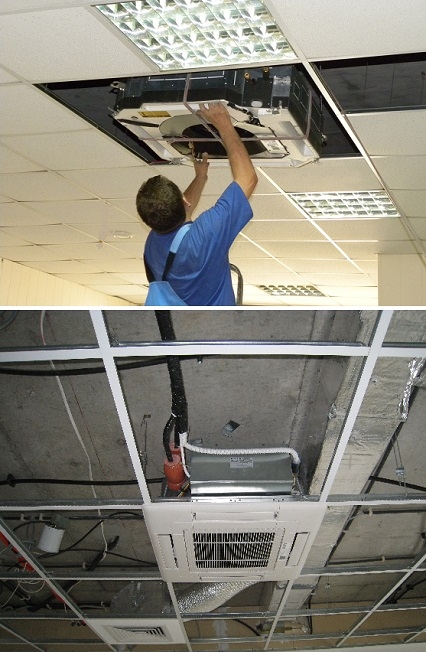
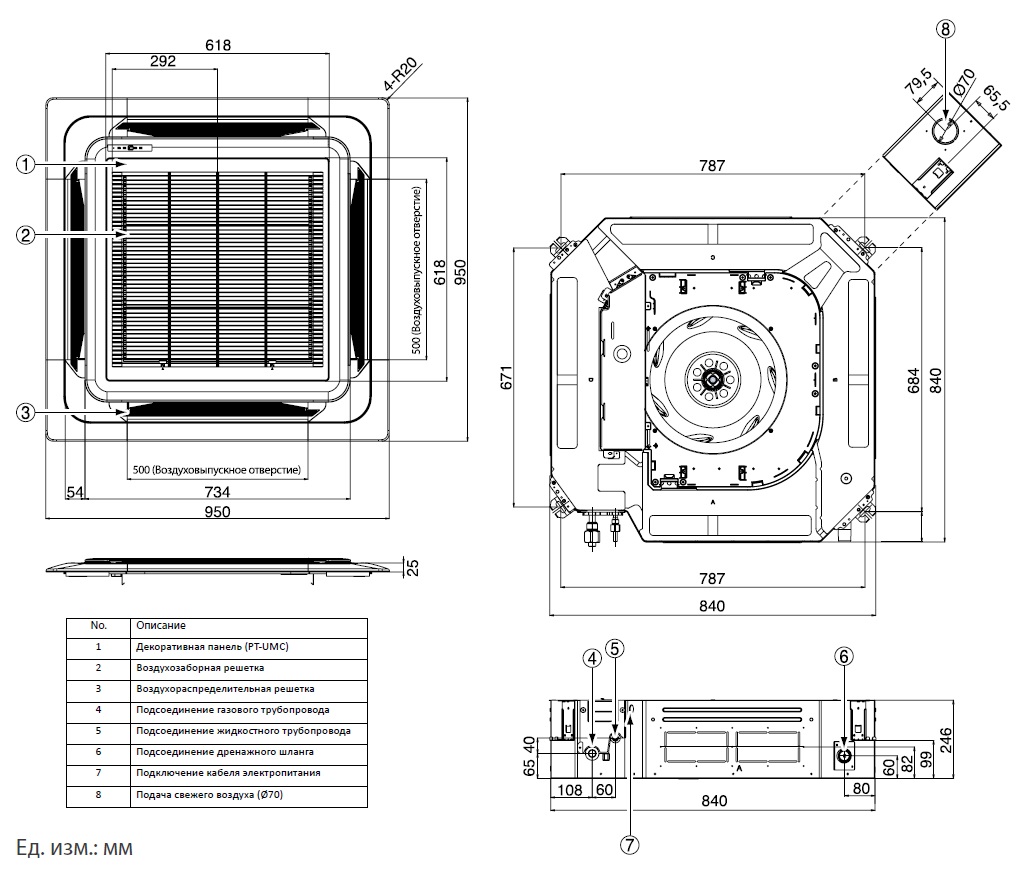
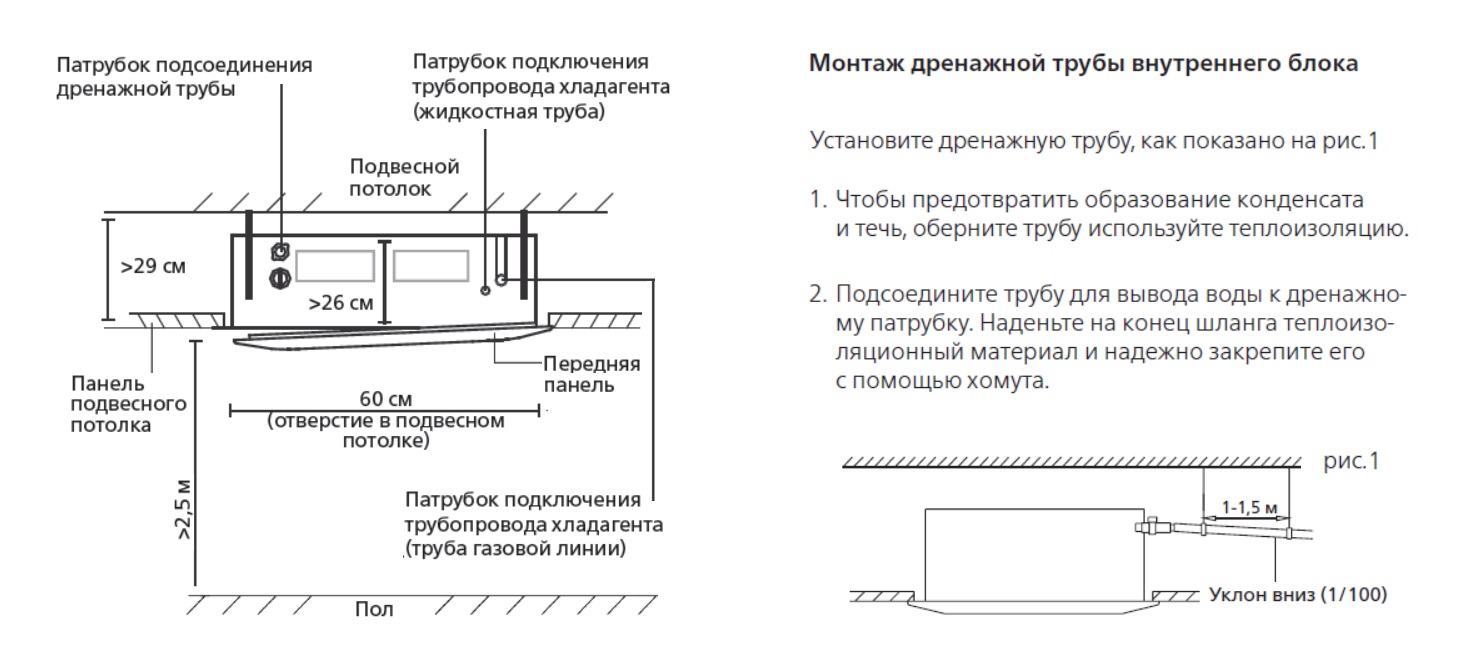
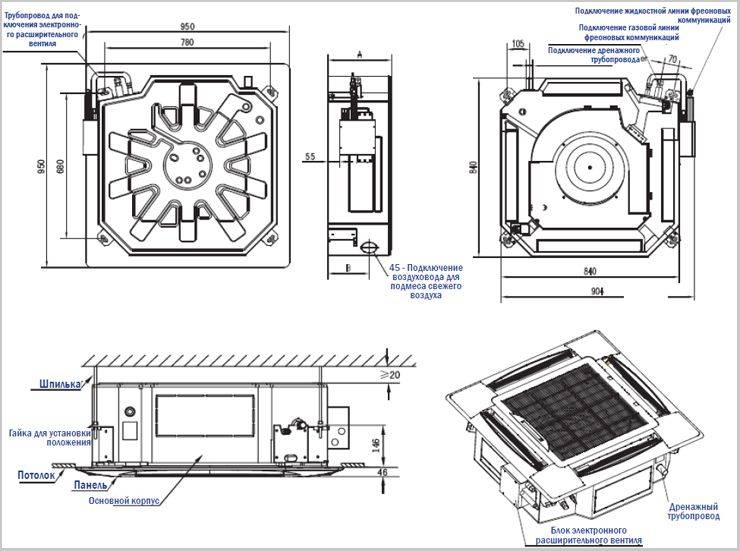
This part of the air conditioner is made in the form of a working block cassette with a panel designed to be built into the ceiling structure. Moreover, the ceiling structure should have a so-called false ceiling.


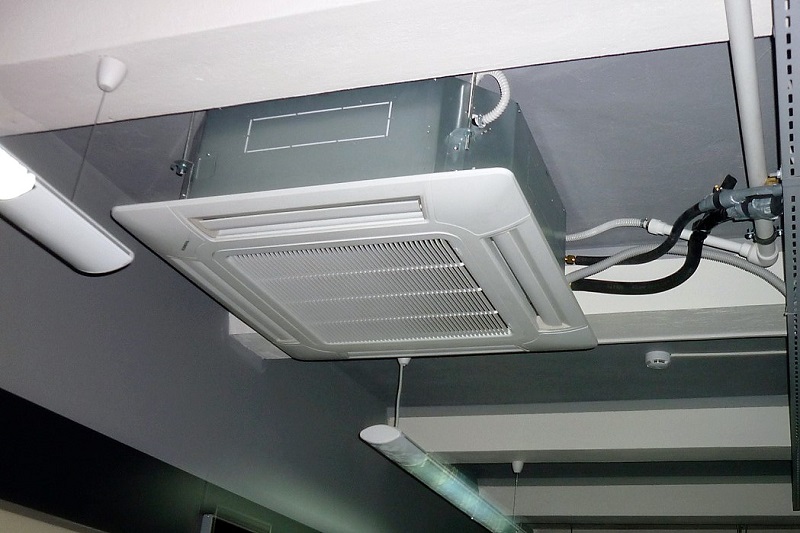

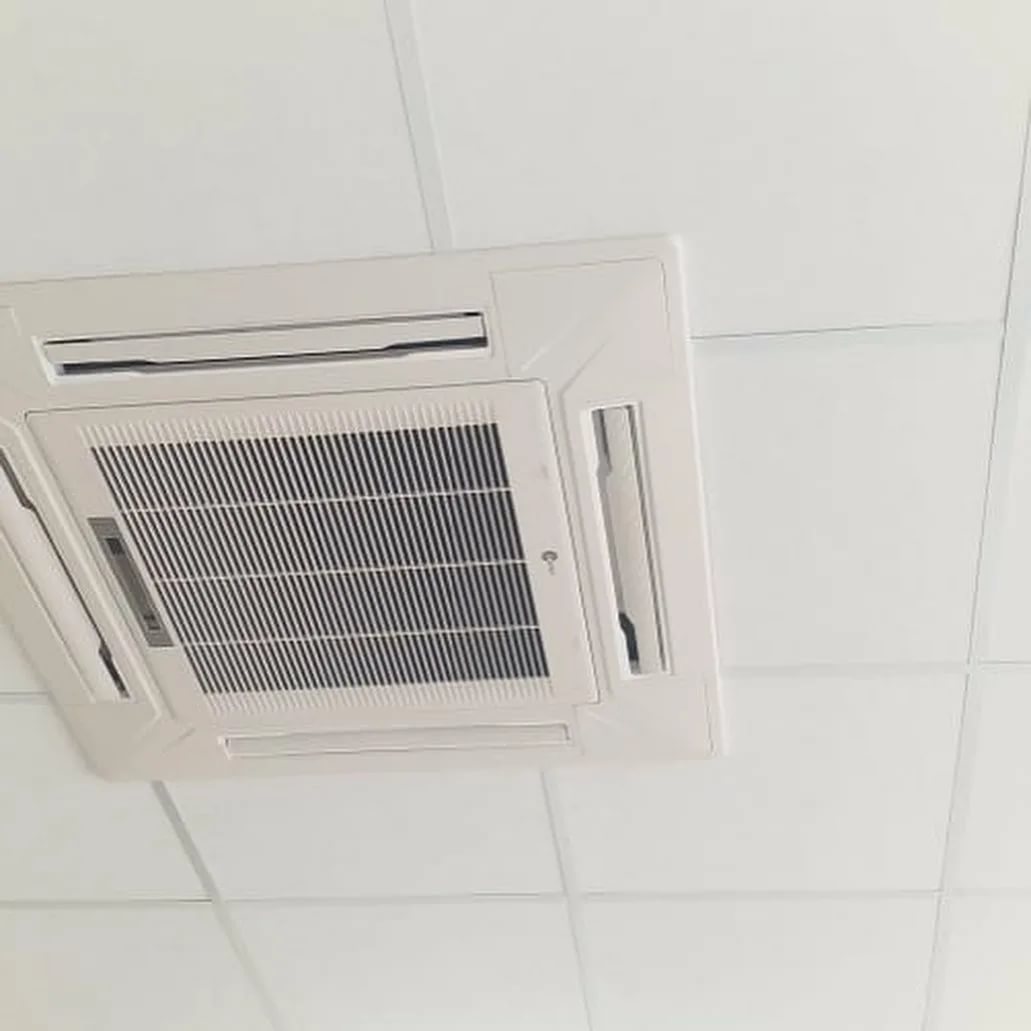

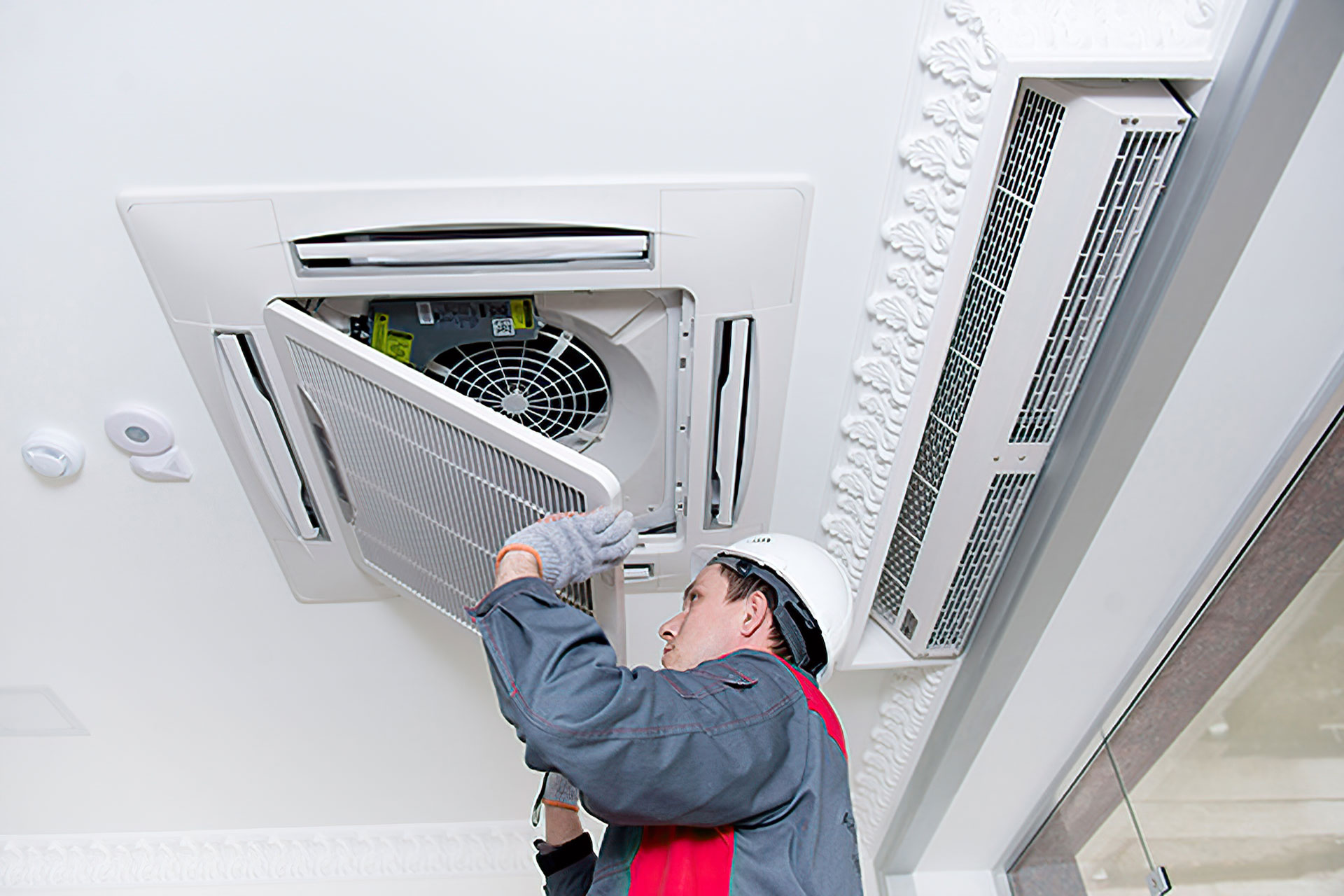
The working (system) unit is “hidden” under the false coating, and the distribution panel remains on the same plane with the false coating.
Cassette design: 1 – lightweight cassette body; 2 – additional air interface; 3 – channel for outside air intake; 4 - evaporator with bio-coating; 5 - fan; 6 - distribution panel; 7 - filter-ionizer; 8 - air intake grille
The distribution panel of the indoor cassette unit as a whole contains several elements:
- Air grille.
- Coarse filter.
- Filter ionizer.
- Rigid frame.
- Face pad.
- Distribution shutters.
The air intake grille with ionization filters, coarse filters and a rigid frame is located in the central area of the distribution panel.
Along the perimeter - on the sides of the same distribution panel - there are channels for the exit of cooled air, supplemented by shutters with automatic cyclic flow control.
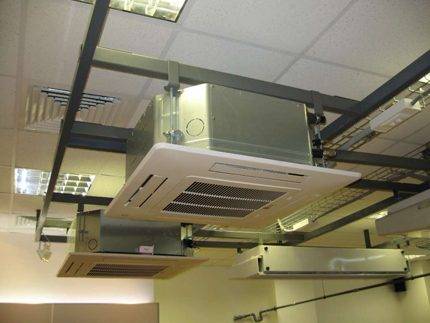
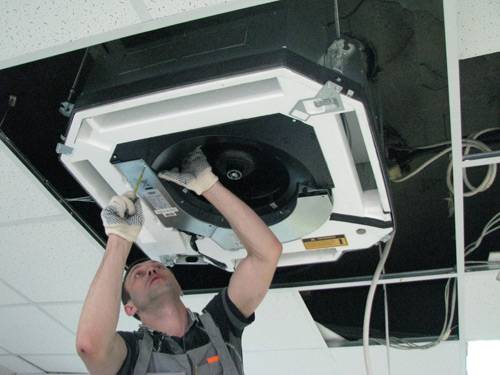
Internal modules of a cassette split system mounted in an office. In this case, an open suspension structure on the frame is used, made of rectangular metal profiles.
The faceplate of the cassette distribution panel, among other things, contains a light indication and remote control board. There is a model version equipped with a wired control panel.
The operating unit of the cassette, "hidden" under the false ceiling, is a part of the refrigeration structure, including: an evaporator, a fan, a condensate drain, line connections from the outdoor module, and an electrical connection board.
Benefits of a Cassette Air Conditioner
Structurally, the "cassette" is designed so that the cooled air is blown out in 4 directions.While a wall-mounted air conditioner cools relatively small rooms, a cassette air conditioner can cover a fairly large area.
In addition to a large coverage area, this practical technique has a number of other advantages:
- Aesthetics. The indoor units remain invisible because they are located behind the false ceiling. Concealed installation does not change the interior of the room, which allows the use of such climate control equipment in representative premises, offices.
- Almost complete absence of noise during operation. The fan built into the unit creates a natural circulation of air masses, does not cause turbulence, and efficiently pumps air.
- Maximum room coverage. Since warm air accumulates in the area where the air conditioner is located, the room temperature will decrease gradually from top to bottom.
- Convenient airflow control. With the help of swivel bars, you can direct the air jets at your discretion.
Cassette air conditioning systems of large premises are controlled not only by portable remote controls, but also by installing stationary shields connected to the building's electrical network.
Many cassette systems have additional features. They can carry out space heating, ionization and air humidification. To be able to fully coordinate the operation of air conditioners, you can install a single climate control system.
features and principle of operation
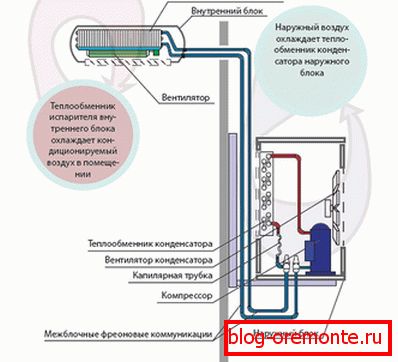
A cassette air conditioner is a classic representative of a split system. This indicates that it, like the simple version, consists of two blocks. The outer part contains the compressor and condenser, and the inner part contains the drainage system and the evaporator.When the heating mode is activated, the functionality of the blocks is reversed. But it has its undeniable advantages:
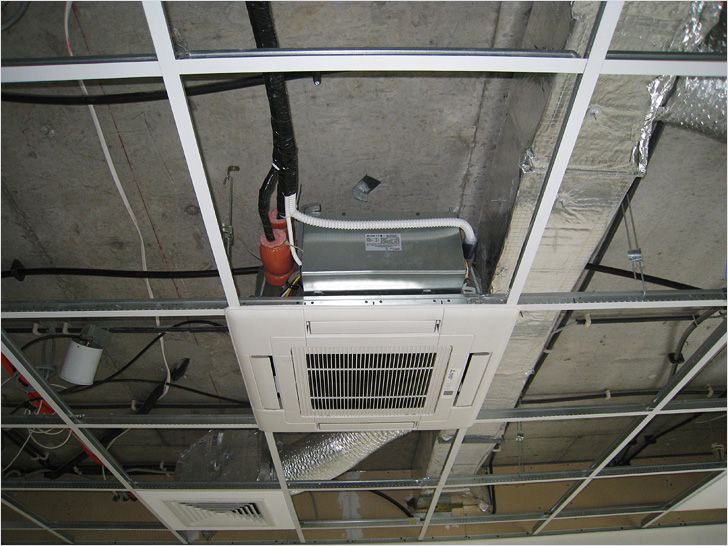


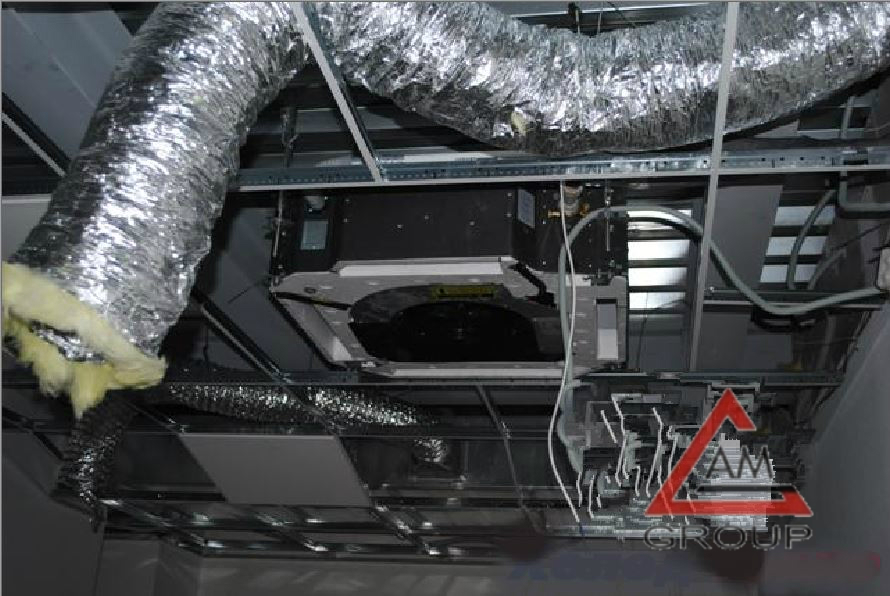


- Location. The indoor module of this type of air conditioner is placed in the false ceiling. This allows you to hide the bulky design and fit it perfectly into the interior.
- Uniform sizes. The dimensions are calculated so that, as a rule, no modification of the armstrong ceiling is required.
- Hidden freon system. All pipes, as well as drainage, are hidden under a false ceiling. For them, you do not need to make strobes, and later close them with putty and plaster.
- Minimum noise emission. Here a fan of a special shape is used, which does not create turbulences, which are the cause of noise, and more effectively creates air intake.
- Large area coverage. It is more reasonable to create cooling, starting from the ceiling. This is where warm air accumulates. If you lower its temperature, it will go down and cool everything that is in the room.
- Comfortable blow. Thanks to the swivel slats, it is possible to adjust the distribution of the air flow so that it does not directly fall on the people who are present in the room.
- The possibility of drying the air allows it to be used in wet and warehouse areas.
- In some models, fresh air intake from the street is available.
- Flexible setting. Remote control.
Benefits of a Cassette Air Conditioner
Structurally, the "cassette" is designed so that the cooled air is blown out in 4 directions.While a wall-mounted air conditioner cools relatively small rooms, a cassette air conditioner can cover a fairly large area.
In addition to a large coverage area, this practical technique has a number of other advantages:
- Aesthetics. The indoor units remain invisible because they are located behind the false ceiling. Concealed installation does not change the interior of the room, which allows the use of such climate control equipment in representative premises, offices.
- Almost complete absence of noise during operation. The fan built into the unit creates a natural circulation of air masses, does not cause turbulence, and efficiently pumps air.
- Maximum room coverage. Since warm air accumulates in the area where the air conditioner is located, the room temperature will decrease gradually from top to bottom.
- Convenient airflow control. With the help of swivel bars, you can direct the air jets at your discretion.
Cassette air conditioning systems of large premises are controlled not only by portable remote controls, but also by installing stationary shields connected to the building's electrical network.
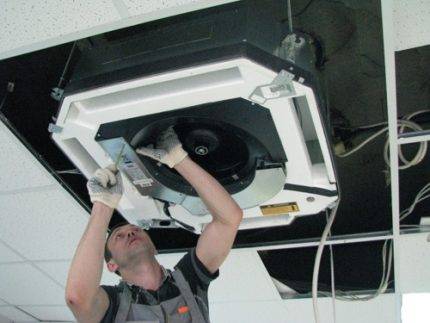 The installation of a cassette air conditioner should be planned before repairs are made to the room. In this case, the presence of a tension structure with an interceiling space of 15-30 cm is necessary.
Many cassette systems have additional features. They can carry out space heating, ionization and air humidification. To be able to fully coordinate the operation of air conditioners, you can install a single climate control system.
Where to install the air conditioner
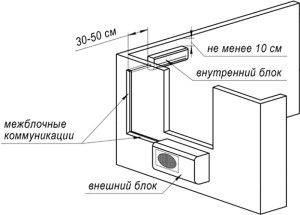
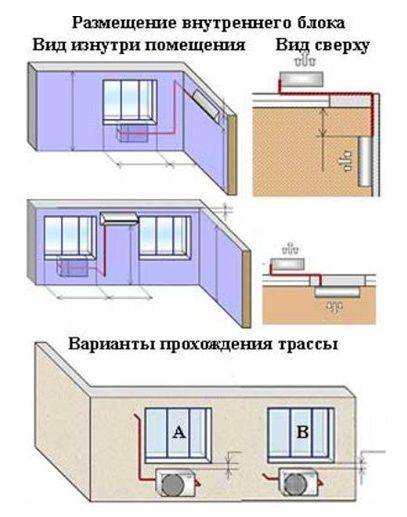
There are many schemes for the location of the air conditioner in the apartment, which are shown in the examples below.
Most often, installers try to place both blocks as in the first picture. This option satisfies many rules for installing an air conditioner in an apartment: the recommended length of the route is taken into account, cooled air cuts off heat from the window, the external unit does not interfere with neighbors, cold air flows are unlikely to affect the main places of people's recreation.
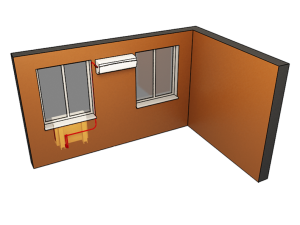
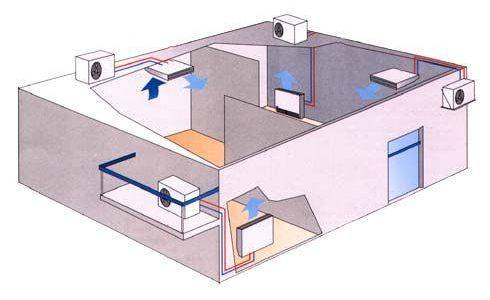
If the room has a balcony, then the layout of the air conditioner in the apartment may look like in the second picture. The outdoor unit is hung on the facade of the balcony, and the indoor unit on the nearest wall suitable for installation.
When there are two windows in the room, the indoor unit can be fixed between them, and the outdoor unit can be installed as standard under one of them.
It was not mentioned above that not only ducted air conditioners are installed in a multi-room apartment, but also multi-split systems with one outdoor unit and several indoor ones. Room modules can be either one type, for example, only wall-mounted, or several: wall-mounted + cassette + floor-ceiling.
The figure below shows two multi-split systems, each consisting of one outdoor and two indoor units.
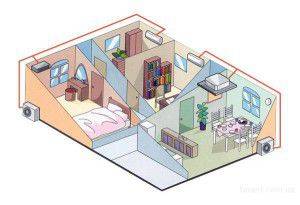
It is quite realistic to choose a multi-zone air conditioner with a large number of indoor units. Their maximum number per one outdoor reaches 9.


The outdoor unit can be placed on the balcony if it is not glazed or there are windows that are constantly open to ensure air circulation
This is important for blowing the condenser, which can overheat in a confined space, and the device will turn off. When the apartment is located on the top floor, it is quite possible to place an air conditioner on the roof, as shown schematically in the picture
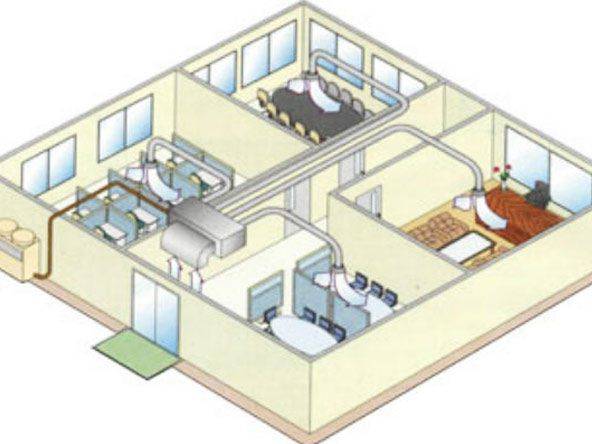
A ducted air conditioner with recirculation and ventilation for several rooms looks like this.
The location of the track may also look different.
Air conditioner installation rules
To determine where to hang the air conditioner in the apartment, you need to know the rules for its installation:
- The flow of cooled air should not be directed towards people or places of their permanent residence;
- There should be no obstacles in the area of 1.5 meters in front of the block;
- Do not hang the split system near an open fire or heating appliances;
- For a wall-mounted air conditioner, a minimum distance of 15 cm from the ceiling is provided;
- It is desirable to provide direct cutoff of the sun's rays with cooled air.
These are the basic rules for installing an air conditioner in an apartment, based on which it is easy to choose where to hang it.



