
- fireplace insert
- Installation requirements and types of fireplaces
- By location
- By type of fuel
- According to the material used in the manufacture
- Mounting
- Room preparation
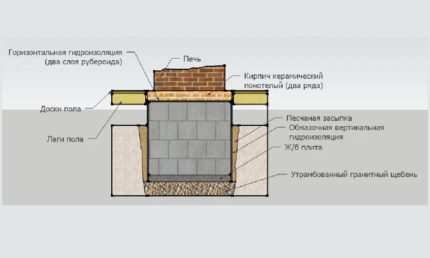
- Varieties of foundations for the furnace
- Furnace piping
- How to install a fireplace in a wooden house the correct installation process and video
- Heat-resistant base and installation of the firebox
- Facing and installation of the chimney system
- Rules for arranging a fireplace with your own hands
- Installing a wood burning fireplace in an apartment
- Types of fireplaces: what models can be installed in wooden houses
- Advantages and disadvantages
- About the outlet of the chimney and chimneys
fireplace insert
It is very important during the construction of the firebox to achieve its ideal horizontal position. The firebox at open fireplaces is placed using refractory bricks, and at closed fireplaces - from metal
The firebox at open fireplaces is placed using refractory bricks, and at closed fireplaces - from metal.
For metal fire chambers the window from fire-resistant glass is provided. Fireplaces with closed fireboxes are more efficient and convenient to use, they allow you to control the combustion process.
This affects not only the efficiency of the heating structure, but also its safety.
Masonry must be carried out at positive temperatures to ensure the reliability and strength of the structure.
The first row should be perfectly straight. The outcome of the work directly depends on this.
Installation requirements and types of fireplaces
As a result of the fact that wooden buildings are at risk of fires, fireplaces and stoves are subject to special safety requirements. However, this does not limit the list of models that can be used.
Installation of a fireplace in a wooden house at each stage is accompanied by a reconciliation of the work performed with the rules of PB and SNiP. To give a complete picture of the models suitable for wooden houses, it is necessary to distribute the permitted fireplaces and stoves according to several criteria.
By location
In a log house, it is allowed, subject to the insulation of combustible materials, to install and orient the fireplace in an almost arbitrary way. The ban is introduced solely for reasons of rational use of space.
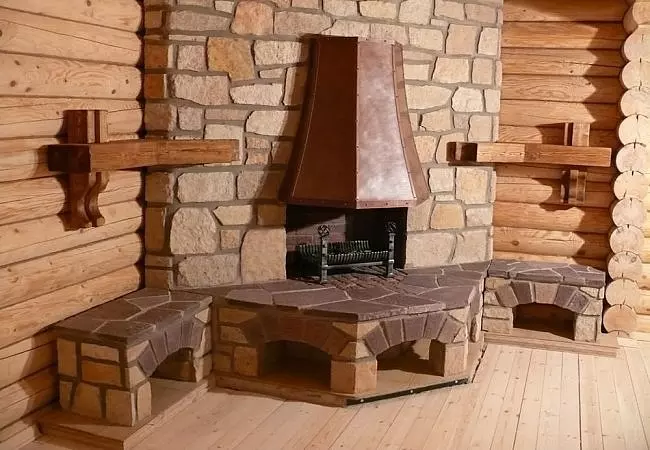 massive building
- Corner models of fireplaces have the property of saving space. They are installed at the junction of two walls, hiding the line of demarcation. That is why there is a visual effect of increasing space.
- Built-in fireplaces, oddly enough, are often used in wooden buildings. For partial zoning of the room, a brick wall with a niche for a fireplace is being erected. The thickness of the wall is comparable to the size of the firebox. A chimney channel is made inside this wall. As can be seen from the description, the fireplace walls and combustible materials do not have common elements.
- Wall models necessarily imply the presence of a portal. It is made of various materials, depending on what functions the future fireplace combines. If this is a purely decorative device, then a drywall portal is made.If a fireplace in a wooden house is installed for heating, then the portal is laid out from refractory bricks.
Wall option with a beautiful portal
Island or isolated models are distinguished by the fact that they do not have common borders with the walls of the house. The only difficulty in the arrangement is a suspended chimney, which is not so easy to mount in a safe manner.
By type of fuel
This section is very important for those who decide to design a stove in a wooden house. After all, many tend to think that some types of fuel are strictly prohibited for use. Note that these thoughts have a foundation in the case of a design with an open firebox. However, modern models with a hermetically closing door provide the consumer with many options that will be safe in terms of fire.
- Provided that the wooden house is correctly insulated, a proper foundation is provided for the fireplace, a chimney is erected and all installation rules are met in general, you can use classic fireplaces made of brick and designed for the use of firewood or other types of solid fuel (briquettes, coal).
- Electric fireplaces have earned the right to bear the title of the safest devices. In buildings made of wood, they can be used without restrictions, because instead of a living flame there is a well-designed imitation system. However, do not forget about the rules for the operation of heating elements.
Complete home electric hearth
- Another option that is not subject to strict rules is a biofireplace. These models are characterized by the absence of a chimney, although the flame in the firebox is natural. Alcohol or compositions based on it were used as fuel.That is why this type of device got its name.
- Gas fireplaces are simple to install, as they have only a few structural elements. The requirements for such fireplaces would coincide with the requirements for solid fuel models, if it were not for the danger in the operation of any gas equipment. Thus, the gas fireplace leads in terms of the number of restrictive installation conditions in log houses.
According to the material used in the manufacture
Solid fuel fireplaces can be completely lined with refractory bricks. The word "completely" means that even the firebox in which the combustion of fuel takes place is made of fireclay bricks. Laying is carried out by ordering. This method assumes a certain algorithm for the formation of each row. The chimney for such a stove is necessarily made of brick, which is dictated by safety considerations.


Cassette type fireplace
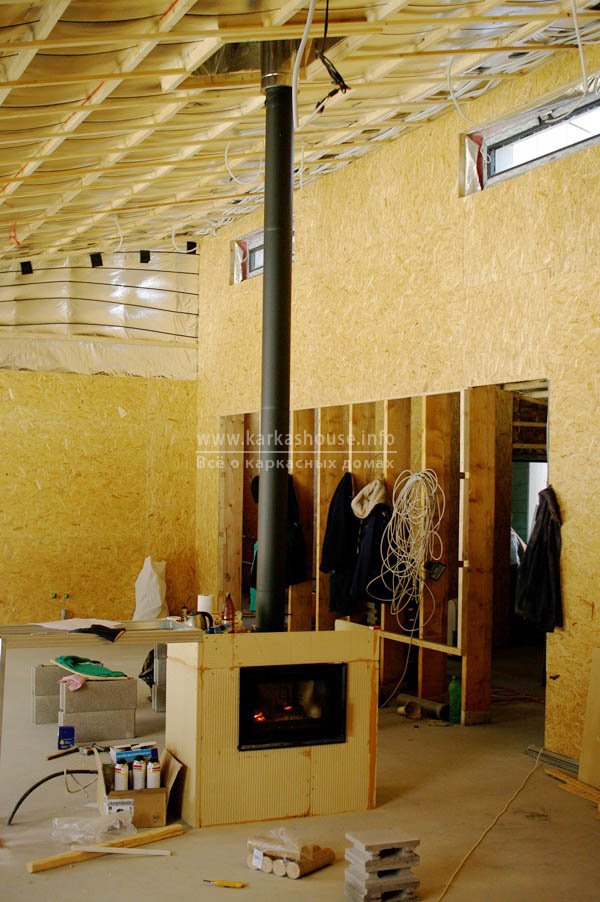
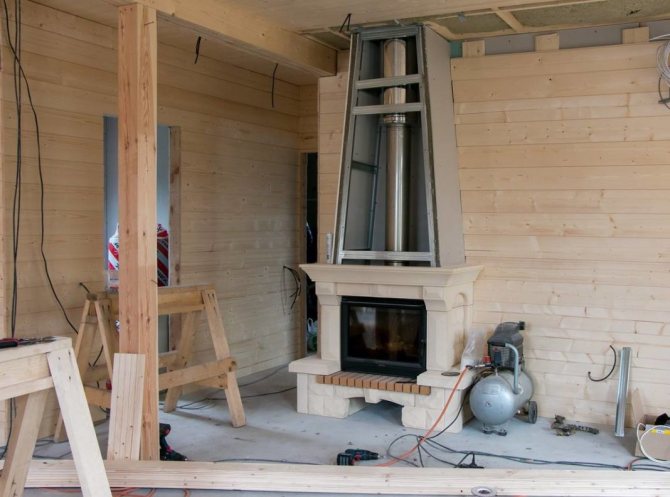
There are ready-made metal or cast-iron fireboxes that need to be built into a specially prepared niche. Portals for finished fireboxes can be built with your own hands from brick, drywall, stone, wood. Such a fireplace device does not impose requirements on the material of the chimney, but if it is made of a metal pipe, then they try to veil it under a decorative frame.
Mounting
If the house is gasified, as a rule, a branching of the pipe is made for the stove and other devices.
In most houses, additional ventilation ducts are provided in the kitchen. If any devices are not connected to them, for example, an exhaust hood, you can completely connect the fireplace.
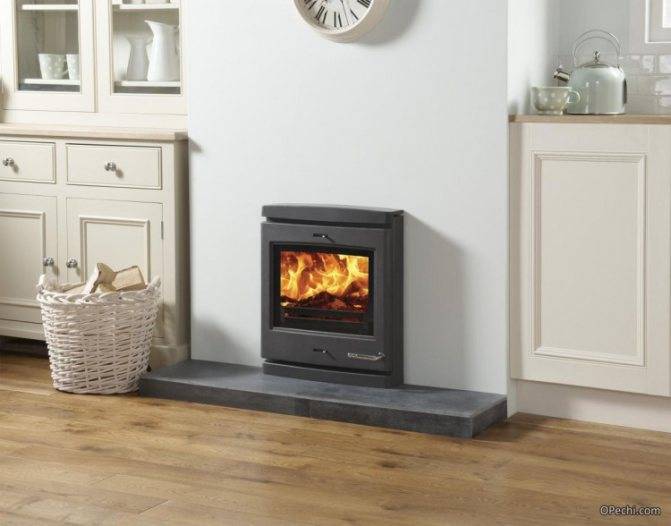
Fireplace in the kitchen
It is important to understand that any operations that involve a centralized gas supply are carried out either in the presence of employees of the city (district) gas service or by themselves. It is imperative that when calling masters from other organizations, it is necessary to notify the gas service about upcoming work
Only with authorized installation can you be sure of safety.
Room preparation
The most important stage in the installation of a metal furnace is the preparation of a place for its placement. There are several reasons for this. First, you need to take into account the location of windows and doors so that the heat radiation emitted by the walls of the furnace is correctly distributed throughout the room. Secondly, it is necessary to provide a place for fuel storage. It should be located so that it is easy for you to deliver it to its destination.
Thirdly, it is extremely important to ensure fire safety. This is perhaps the most basic thing to do, so let's dwell on this in more detail.
Protection of the premises from fire is provided in several stages:
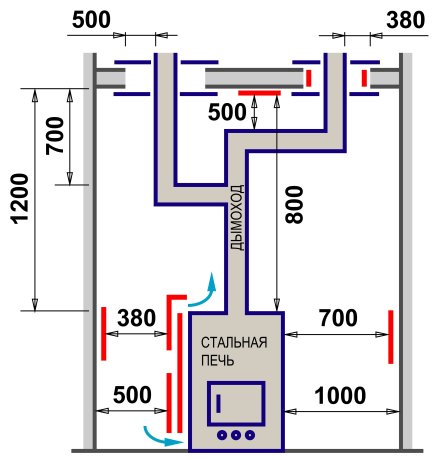
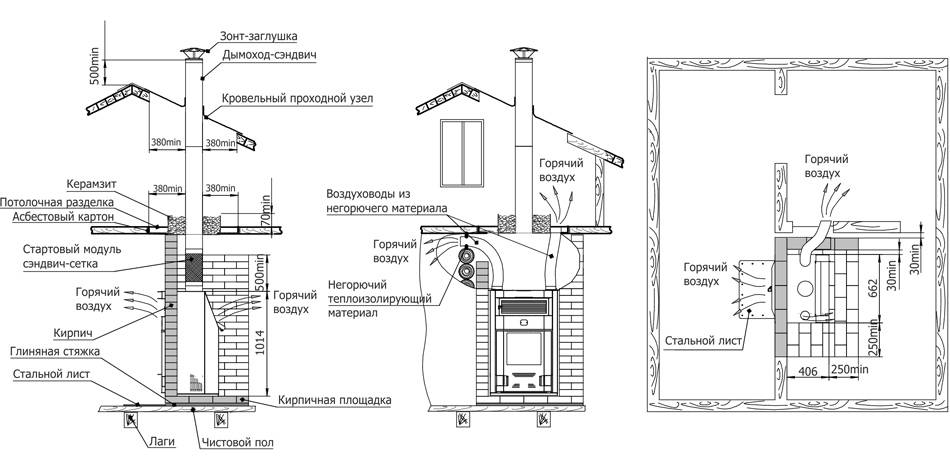
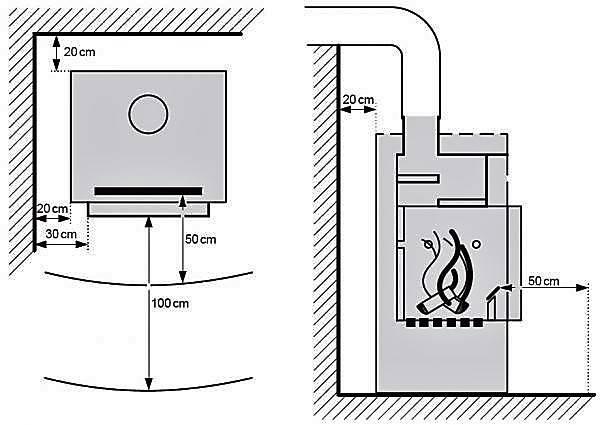
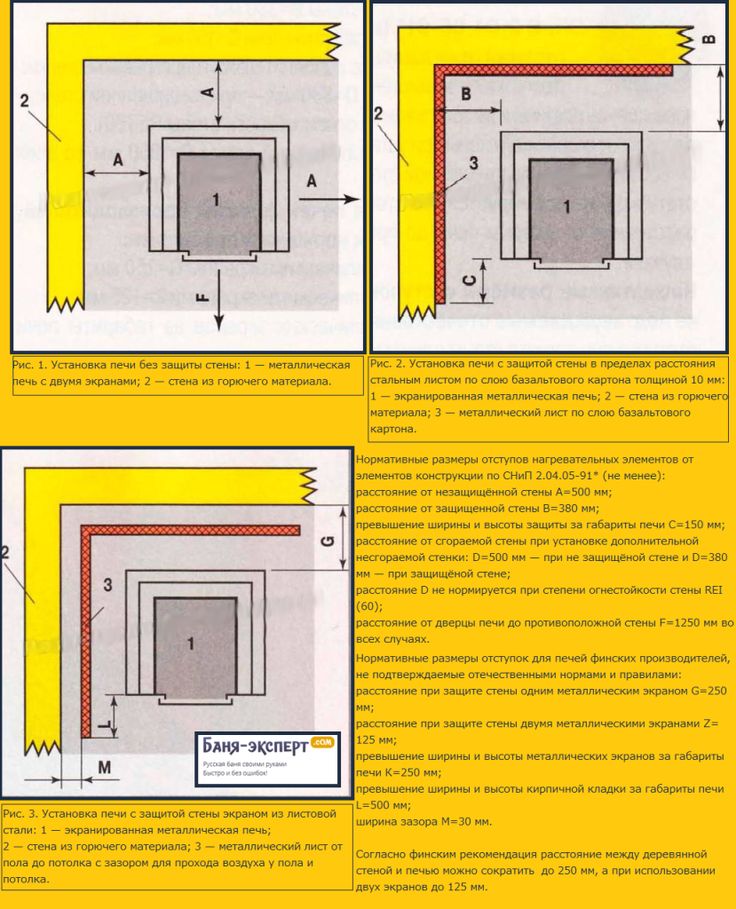
- it is necessary to observe the minimum distance from the stove to walls and furnishings. It must be at least 50 centimeters. Remember that a metal case gives off rather hard and powerful thermal radiation, and wooden walls easily catch fire even with the protection that will be discussed below. Also provide free access to the combustion chamber - keep in mind that you will need a place where you can safely move, bending over, when laying firewood or other fuel. According to the standard, 130 centimeters are enough for this;
- the surface of the floor and walls that are in the immediate vicinity of the stove must be insulated with fire-resistant materials. In the first case, a concrete screed, ceramic tile or metal sheet can successfully play the role of such. The floor should be protected not only under the stove, but also around it at a distance of 50 to 70 cm. As for the walls, they can be covered with asbestos sheets. Superizol is also good. If you arrange such high-quality protection, then the distance from the stove to the wall can be made less than indicated above - 20 centimeters will be enough. If the stove is placed in such a way that the furnishings are too close to it, then it is necessary to protect them with the same asbestos sheets;
- the distance to the ceiling should also be maintained taking into account safety requirements. it must be at least 120 centimeters;
- the design of some furnaces provides for the installation of not only a chimney, but also special channels passing inside the walls. This is done to heat neighboring rooms. The walls of these channels must also be made of high-quality materials that are resistant to high temperatures;
- the last point concerns general safety not related to fire. During the operation of the furnace, its walls are heated, their temperature ranges from 500 to 600 degrees. Touching them at this moment is fraught with very serious burns. Therefore, if there are animals or small children in the house, it is necessary to fence the structure with some kind of fence. Naturally, it is absolutely impossible to put such a stove in a children's room.
As for the process of laying tiles, there are also a few rules here:
if the floor is made of concrete, then you can put ceramics directly on it. If it is wooden, then between the surface and the tile it is necessary to make a lining of plywood or drywall. A glass-magnesite sheet is also suitable for this purpose. The layer must be firmly fixed on the floor with self-tapping screws, primed and wait for the composition to dry completely. Only after that you can proceed to further work;
for laying you will need a tile adhesive, as well as a building level. The level must be used in order to achieve the perfect appearance of the finish. This moment is especially important when laying the first row of tiles - if an unevenness occurs at this stage, this will lead to a distortion of the entire coating
Tile adhesive must be applied with a notched trowel - it will give the necessary evenness to the adhesive layer, which is also important for laying;
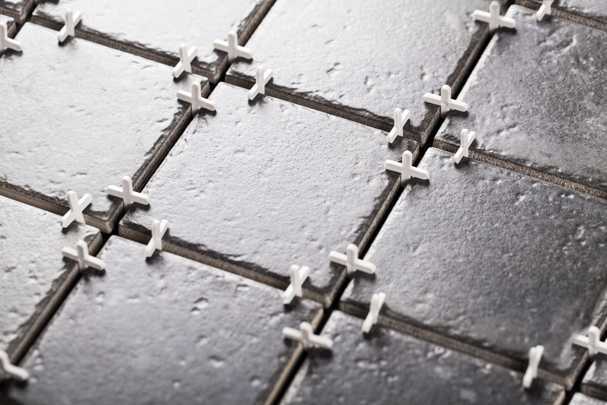
do not be too lazy to use special crosses that are placed at the joints of the tiles. This will help keep the seams straight.
The crosses are removed two days after the installation is completed. Then the seams are filled with decorative grout. However, the last stage is optional;
the tile is attached to the wall using a special heat-resistant mastic. As with flooring, remember to use a spirit level during installation to check for evenness.
Varieties of foundations for the furnace
The choice of the type of foundation for the further installation of an iron furnace is carried out taking into account its characteristics and installation features.
Choice factors:
- Estimated construction work - the price of materials and prices of performers.
- Features of the soil and foundation - the total weight of the structure and the type of soil matter.
- The area of \u200b\u200bthe foundation for the furnace - it affects the type and total mass of the structure.
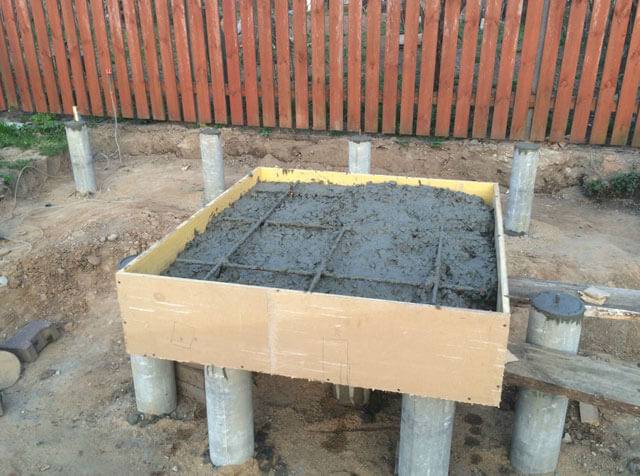
All types of foundations are classified into two large groups:
- On poles and piles.
- Concrete bases.
In some cases, furnace equipment can be mounted directly on the floor, without forgetting about safety rules.
Furnace piping
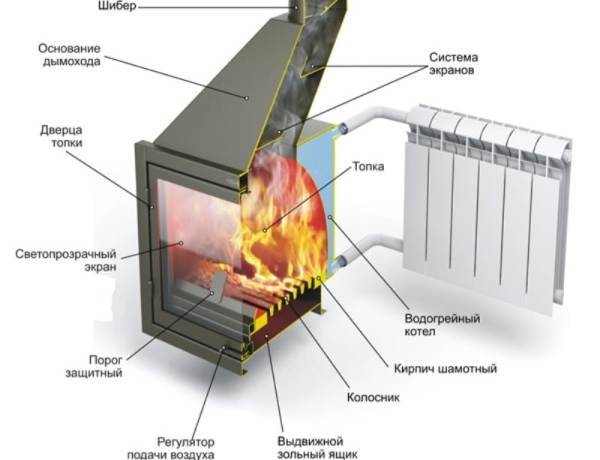
In rare cases, heating a room with a stove occurs due to convection currents. The very status of the device implies the most efficient use of the released energy. Therefore, the heating system is supplied with a heat carrier, which can be water circulating through pipes, or air moving under the influence of forced convection. Connecting the coolant channels to the furnace is called piping.


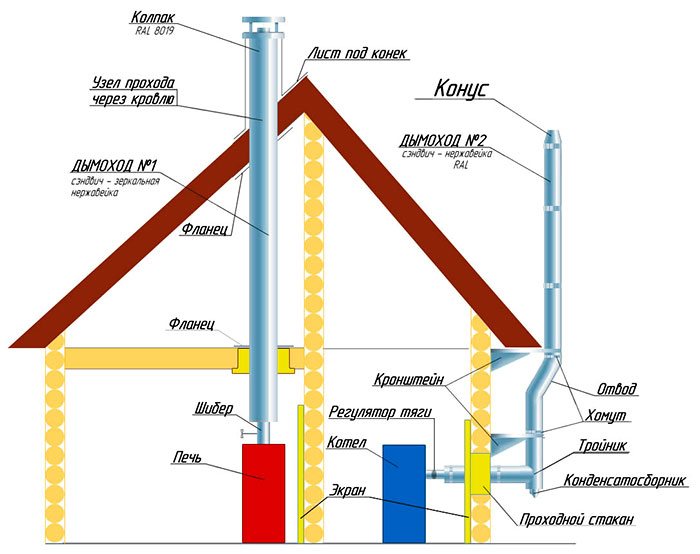


Some of the problems associated with installing a fireplace stove are concentrated precisely in the incorrect installation of the line. With water heating, circulation is provided by a pump or it is carried out due to natural convection
In the second case, it is important to observe a certain slope of the line, since a reverse slope will lead to fluid stagnation. In a closed heating system (1st case), the slope does not matter, but the system imposes strict requirements for tightness
Even a small amount of trapped air will stop circulation.
Heating circuit connection diagram
Tying the duct is not difficult, but laying the line under the panels or lining with drywall is a laborious process. The furnace, which uses air as a heat carrier, is equipped with a fan system that drives air along the line. By adjusting the supply with dampers, heat can be directed selectively to different rooms.
How to install a fireplace in a wooden house the correct installation process and video
Many people ask how to install stove fireplace in wood home. To do this, it is worth considering and correctly performing each of the stages of these works.
Fireplace in a wooden house
Conditionally, the stages can be divided into:
- preparatory (planning the location of the fireplace);
- installation of a heat-resistant base under the fireplace;
- installation of a fire chamber of a chimney design;
- facing works;
- installation of the chimney system with the implementation of all safety measures.
If you do not know how to properly install a fireplace in a wooden house, follow the step-by-step implementation of all the above fireplace installation work and then you will be able to achieve the desired result.
And for those who want to learn in more detail how to install a fireplace in a wooden house, a video review of this procedure is available below.
Note! The performance of all these types of work requires compliance with all safety requirements, as well as the possession of special knowledge and professional skills. It is best to invite a specialist, but if you still decide to do the installation yourself, read the basic recommendations before installing a fireplace in a wooden house. It is best to invite a specialist, but if you still decide to do the installation yourself, before installing a fireplace in a wooden house, read the basic recommendations
It is best to invite a specialist, but if you still decide to do the installation yourself, read the basic recommendations before installing a fireplace in a wooden house.
The layout of the fireplace in the room
Be sure to consider the fact that the fireplace should not be placed in line with door or window openings. It is also forbidden to install a fireplace in rooms whose size is less than 20 m2.
Heat-resistant base and installation of the firebox
In order to prepare the room for the installation of a fireplace, it is necessary to remove the floor covering in the place you have chosen for installation and make a concrete screed there.
Concrete base scheme
Note! If you have taken up the construction of a wall-mounted fireplace, then the wall itself must be secured by lining it using non-combustible material. The best option for this may be a brick. If it is not possible to get rid of the floor covering, then a non-combustible base is installed on top of the floor
If it is not possible to get rid of the floor covering, then a non-combustible base is installed on top of the floor.
The surface of the base must be perfectly flat so that the firebox can be installed in a horizontal position. To fix it, you can use heat-resistant glue or mastic.


All walls adjacent to the fireplace must be replaced with aerated concrete or brick.
Before installing the firebox, fireclay bricks or a sheet of steel should be laid under it, and it is recommended to place basalt wool between the ceiling and the floor.
Brick laying under the firebox
In the installation work on installing the firebox you will need:
- drills for metal;
- drill;
- sealant gun;
- grinder with a disk for metal.
To perform correctly, you will need the appropriate skills.
Facing and installation of the chimney system
Facing installation has its own requirements
It is very important that it does not come into contact with the fireplace insert.If you are using flammable materials for finishing, it is imperative to create a kind of protective belt from reinforced concrete. Cladding materials:
Cladding materials:
The most common option is to perform plastering. To do this, the surface must be applied with a double layer of mortar for plaster. As a result, the resulting layer should be about five centimeters thick. After it dries, the surface can be painted.
Chimney system installation
Heat-resistant mastic is used to fix ceramic tiles. You should monitor the location of the cladding and align it with a wooden bar by tapping it on the tile. The result obtained is kept for a day before the tiles can be washed and cleaned.
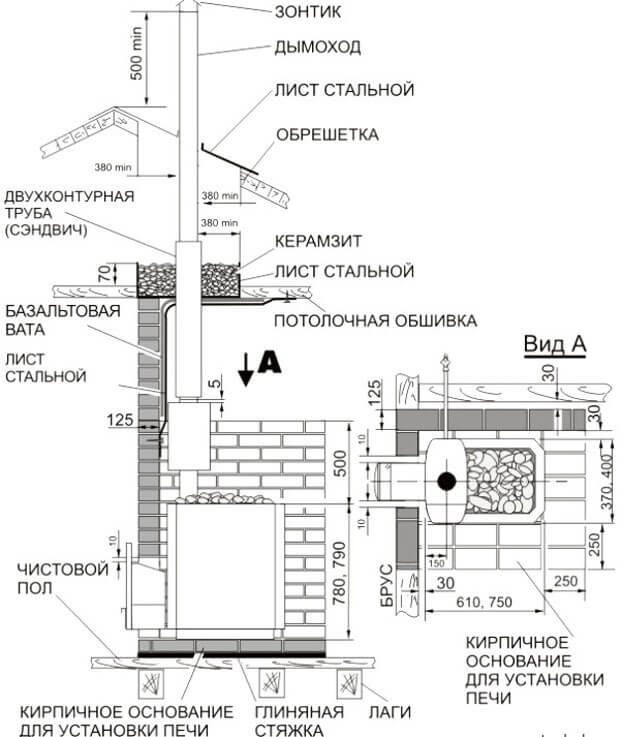
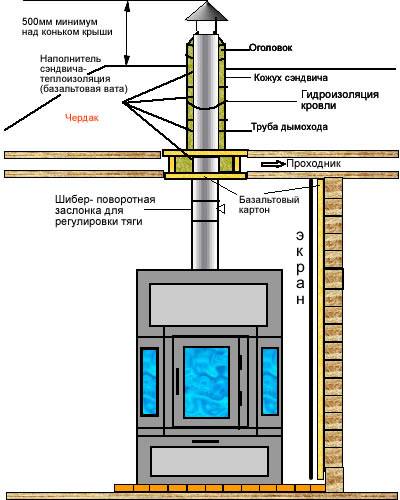
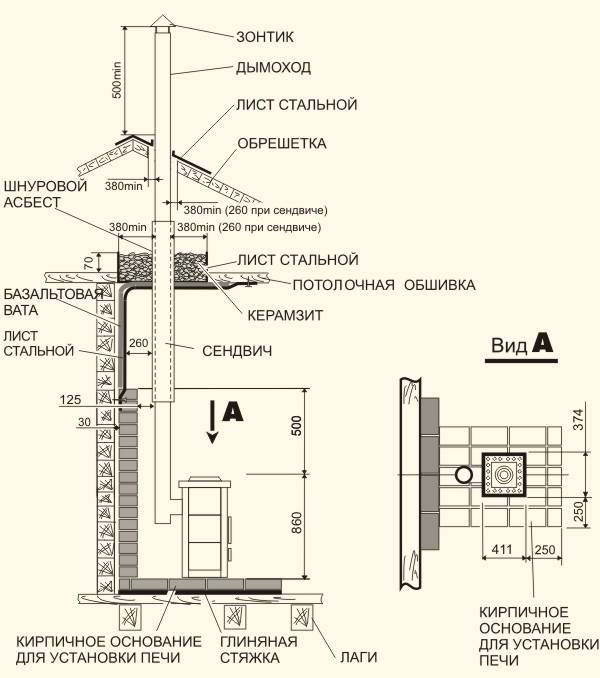
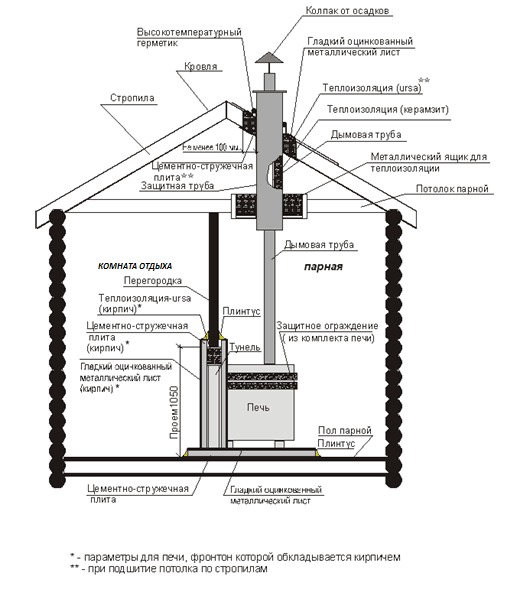
The chimney system is made of non-combustible materials. On the inside, you can cover with foil wool. The wooden ceiling must be secured by installing a protective cover over the fireplace. The distance between the casing and the chimney must be at least 30 cm.
Rules for arranging a fireplace with your own hands
Before you assemble the fireplace correctly so that it is as reliable and durable as possible, you need to consider a number of rules aimed at achieving these goals:
- When arranging a brick fireplace, you need to create a separate foundation for it;
- The working part of the furnace can only be lined with fireclay bricks, which should not come into contact with ordinary ones;
- When mounting the door and ash pan, it is necessary to lay an asbestos cord and leave a small gap necessary for the thermal expansion of metal elements;
- The inside of the firebox does not require plastering;
- The back wall of the firebox should preferably be placed at a slight angle.
A separate item is the fire safety rules, the observance of which minimizes the risk of a fire:
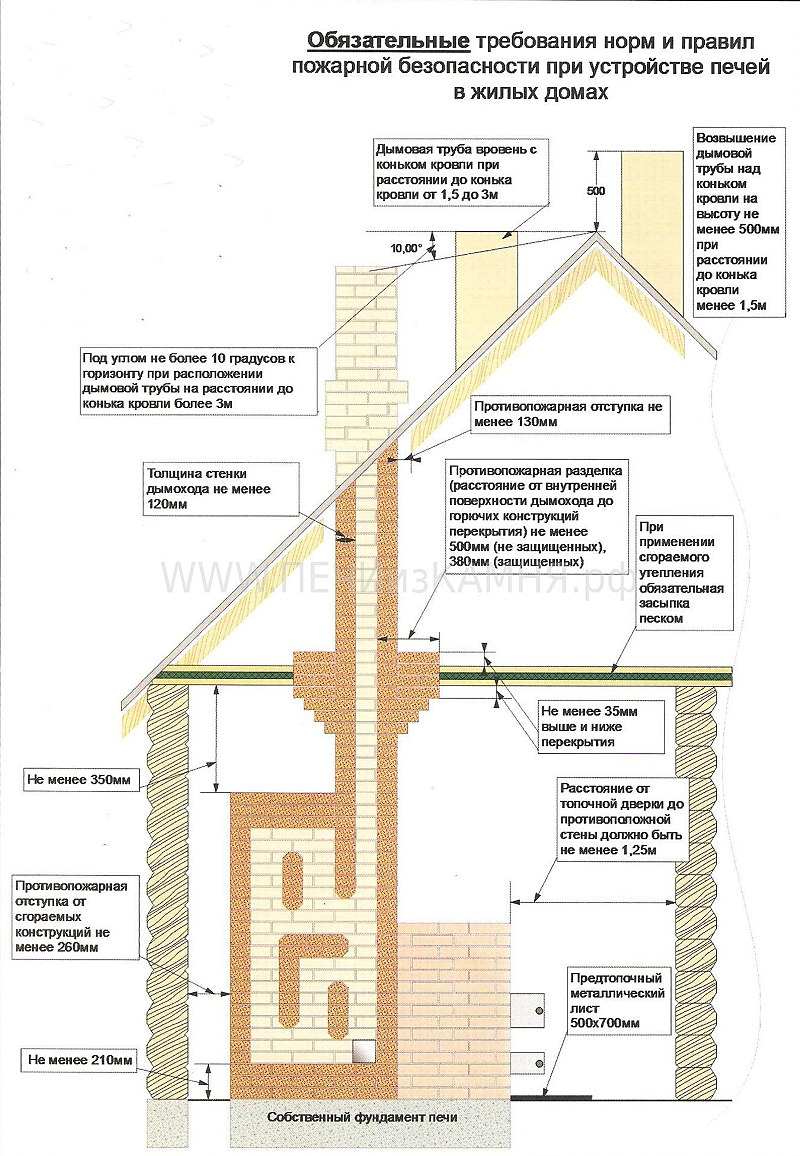
- Throughout the chimney channel, special cuttings should be installed that increase the degree of fire safety;
- When placing the fireplace in close proximity to the wall, it is imperative to lay a layer of refractory material between them with a thickness of at least 20-25 mm;
- When installing a fireplace on a wooden floor, it is necessary to lay a metal sheet or ceramic coating under the structure so that they protrude beyond the perimeter of the fireplace by at least 30-35 mm;
- At the point where the pipe passes through the floor or ceiling, a 15 cm layer of heat-insulating heat-resistant material must be installed;
- Only one chimney can be used for the fireplace.
The operation of the fireplace is also carried out according to certain rules:
- It is strongly not recommended to heat the fireplace to the maximum temperature;
- For normal functioning, the fireplace must be regularly cleaned of soot deposits and ash;
- All flammable objects must be removed from the fireplace at a distance of at least 70 cm;
- Only the type of fuel for which the design was designed can be used in the fireplace.
Installing a wood burning fireplace in an apartment
Installing a fireplace in an apartment is more difficult (and sometimes completely impossible) than in an individual house. The reason is that many apartment buildings are built without considering the installation of chimneys.
There are only three exceptions:
- top floor of a high-rise building;
- any of the floors of a two-story house (in this case, as in the previous one, it is possible to make an internal chimney yourself);
- high-rise building, which provides a collective chimney, allowing the installation of a fireplace in each of the apartments.
In all three cases, before starting work, you must obtain permission to install a fireplace. First, contact the fire department. A specialist of the organization will go to the place to check the condition of the chimney, how it meets the fire safety requirements. The cost of the examination is from 1000 rubles.




Then contact the building expertise, which will issue a conclusion whether the ceilings can withstand the weight of the fireplace. The expertise will also develop a project for installing a fireplace (cost - from 6,000 rubles). The prepared project, technical passport and title document must be submitted to the housing and communal services department of the district administration, whose non-departmental commission will issue permission to install a fireplace.
In an apartment of a multi-storey building, you can install a fireplace weighing up to 700 kg and only with a closed firebox. At the same time, the area of \u200b\u200bthe room must be at least 20 square meters in order to ensure proper air exchange.
Fireplace installation should be left to a fireplace specialist. They will be able to take into account a lot of specific moments
In particular, during installation it is important to ensure air flow by providing a technological gap in the design of the fireplace. It is necessary to observe the distance between the furnace and the wall so that it does not overheat during operation and does not burst
In case of incorrect installation, the guarantee for the firebox is not valid.It must be remembered that any chimney, regardless of the material, needs regular maintenance. A specialist must be invited 2 times a year: at the beginning and at the end of the heating season. The soot accumulated on the walls of the chimney impairs draft and eventually destroys the material, since it is an aggressive substance.
Types of fireplaces: what models can be installed in wooden houses
If we take the basic material as a basis, such housing can be equipped with the following types of fireplaces:
- from kiln brick
. The structures are characterized by large dimensions and significant mass; they require the laying of a separate foundation that is not combined with the base of the walls. Brick exhibits high heat capacity, it is able to heat the room for a long time and evenly. The thickness of the masonry closest to the wall should exceed 25 cm, it is isolated from the tree with a layer of basalt wool, vermiculite or perlite;
- with metal hearth
- steel or cast iron. Often structures include a glass door, resulting in something between a functional stove and a fireplace. The efficiency of modern variations can reach 80%, the advantages of the solution are compactness, accessibility, and installation speed. Metal fireboxes are introduced into decorative fireplaces made of artificial or natural stone, wood, brick, chimneys are masked with plasterboard lining;
- stone
. It is less common due to the complexity of the arrangement and the need for a foundation; it is installed in spacious rooms.
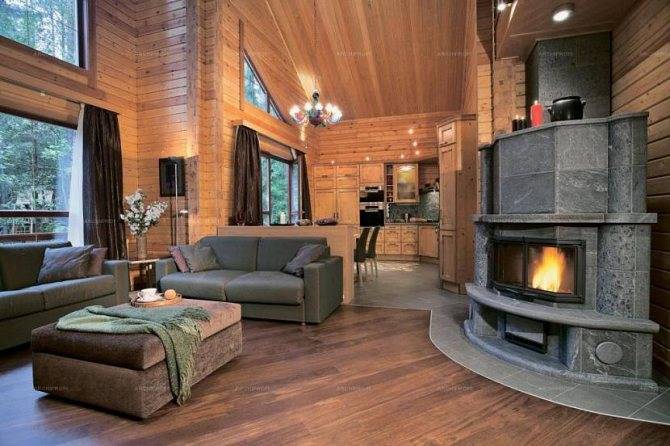
An urban metal solution embodied in a spacious country house. The criteria for shape and location allow us to distinguish several groups:
- corner
. Differ in compactness, they are optimal for small houses;
- isolated
. Usually they have a free-standing design, they are made in a square, round, rectangular shape, the firebox can be open or closed. Products require free space, they often order their placement in the center of the living room;
- straight
. They are divided into wall and built-in, the first are mounted against the wall, the second is usually used to serve two rooms.
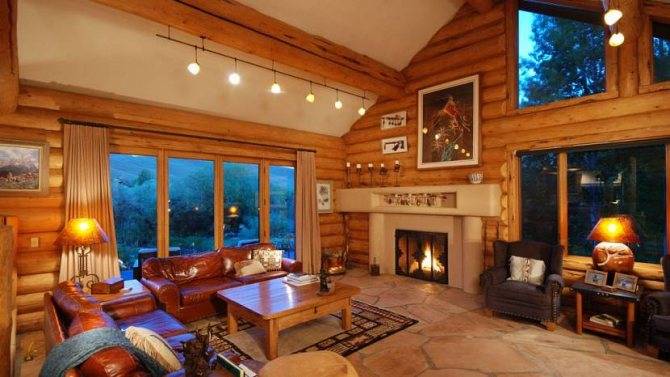
A neat built-in fireplace with a glass screen in a spacious living room
- classic solid fuel
. They use coal, firewood, they are usually designed together with a woodshed. Structures need to isolate all floors and adjacent surfaces;
- electrical
complemented by imitation of live fire. Attics of wooden houses, upper floors are equipped with fireproof fireplaces; products do not need a chimney and their own foundation;
- biofireplaces
operate on ethanol, perform only aesthetic tasks;
- gas fireplaces
, like the classic ones, involve the installation of a full-fledged firebox and chimney system.
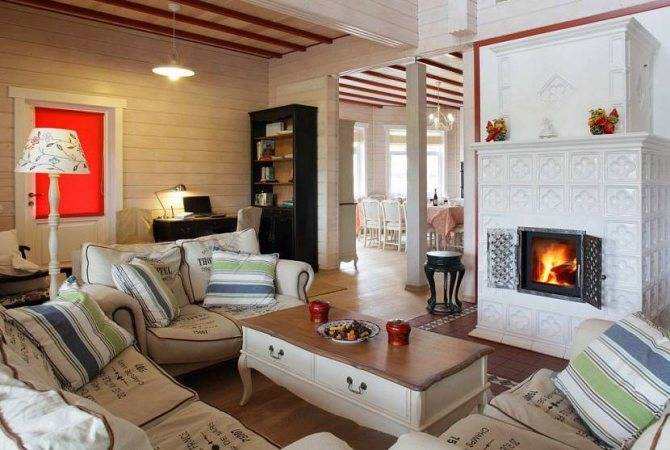
The light design, which is not typical for the interior decoration of wooden houses, echoes the lining of a solid fuel fireplace. Electric variations are able to heat the room, while alternative bio-fireplaces are not.


Advantages and disadvantages
A fireplace in a country house is an element of decor that creates a unique design of the room and an attractive design. Another advantage is that it provides an additional source of heating for the house. The disadvantages, as a rule, are due to the arrangement of the furnace:
- Difficulties associated with the installation and arrangement of the fireplace area.The construction of an open fireplace is possible only if this possibility was provided for at the initial stage of building the house and a separate foundation was poured under the structure. It is necessary to observe the sequence of installation, including the phased delivery of the structure for acceptance by the registration authorities.
- Checking the combustion chamber and chimney channel by an employee of the Ministry of Emergency Situations, carried out before connecting the chimney. Work with the execution of all papers may be delayed for more than one year.
- Features of wooden structures - complete shrinkage of the house can occur no earlier than after 6-7 years. The construction of the fireplace can be made only after the end of this time.
- Restrictions that are associated with the size of the room. The dimensions of the portal increase according to the selected material. A hearth can be built in a room no smaller than 25 m².
About the outlet of the chimney and chimneys
If possible, it is better to make a brick chimney for steel furnaces. In this case, by overlaying the steel pipe with bricks, an additional surface for heating the room is obtained. The brick will heat up from the temperature of the outgoing gases and gradually give off heat to the room. This design will protect the owners from burns when touching the pipe. The inner surface of the steel pipe is smooth, so the risk of rapid deposition of a thick layer of soot and frequent cleaning of the channels is reduced.
Near the floor slab, you can switch to sandwich pipes or simple steel ones. A hole is made in the floor slab, a section of the chimney is drawn into it. Then this place is wrapped with a layer of mineral wool or other heat-insulating material and closed with a layer of decorative trim.
All parts after a certain distance are fixed to the wall using clamps with self-tapping screws.To exit through the roof, you will need to make a hole in it and install a special coupling or wrap it with a layer of thermal insulation. From the inside, the hole is sealed with mounting foam or heat-resistant sealants. From the outside, a layer of sealant and the main roof coating is used.



