- Exploitation
- Installation of a well with a filtration bottom
- Connection Methods
- Do-it-yourself arrangement of autonomous sewage in a private house: videos and recommendations
- How much will it cost to build a sewer in a private house: turnkey price
- Tips for installing an autonomous sewer at their summer cottage
- What is the diameter of the sewer pipes for the house
- Construction stages
- Story
- Possible problems
- Sewer system installation
- Literature
- Site selection and installation
- List of documents
- The main stages of connecting a residential building to the central sewer system
- Connection to sewerage networks, what documents are required
- Causes of clogging and solutions
- Types of sewer systems
Exploitation
After successfully resolving the issue of how to connect a private house to the central network, many take a breath and for some reason believe that now everything will work like clockwork. However, it is necessary to monitor such sewerage. So that its service life does not decrease, you need to follow simple rules, the main of which are:
- Try to prevent large and durable debris from entering the drain, such as solid kitchen waste, personal hygiene items, hair, paper, etc.
- Flush kitchen siphons regularly.
- Use a plunger to clean the toilet.
Related video:
Installation of a well with a filtration bottom
A feature of the filtration well is the ability to purify effluents due to the activity of soil microorganisms. At the same time, the volumes of effluents are limited (1 m3 per day), the well itself is placed no closer than 5 m to a residential building.
filtration well
Step 1. They dig a pit with a size of 2x2 m and a depth of 2.5 m. Its walls are covered with geotextiles, and 0.5 m of coarse-grained sand is poured onto the bottom.
Pit for a well with a filtration bottom
Step 2. A layer of crushed stone 0.5 m is poured onto the sand, a plastic filtration well is leveled and installed with perforation of the walls in the lower third of its height. The walls of the well are also wrapped with geotextiles.
Backfilling crushed stone at the bottom of the pit
Step 3. The walls of the pit prepared for the drainage well are wrapped with geotextile. A layer of sand 0.4-0.5 m thick is poured onto the bottom, then a layer of crushed stone of the same thickness. A drainage well is installed from perforated concrete rings. A pipe Ø50 mm is inserted into the filtration well, providing a slope of 3 cm per 1 meter of pipe length. Backfilling is carried out first with crushed stone, and the upper 0.3-0.4 m with soil excavated during the preparation of the pit. Equip the well with a lid with a hatch and a ventilation pipe.
Installation of a filtration well
Connection Methods
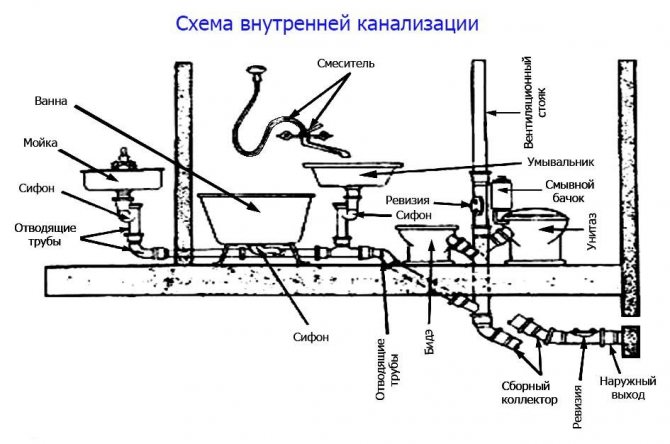
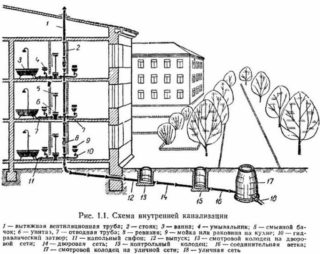 Depending on the type of centralized network, they are connected to it in a separate or mixed way. The first is used if there is a need for separate connection of domestic and storm sewers. In the second option, it is not required to tie in two separate highways.
Permission to lay sewer pipes to the city system is issued only if an inspection or overflow well is installed nearby.It must be connected to the pipeline from the building
Take into account that the pipe section extending from a private house must enter the well at an angle above the drain level
The laying of the highway is carried out to the required depth. The depth is determined depending on the freezing point of the soil: from 1.25 in the south to 3.5 m in the north. The average value is 2 m.
Lay the pipeline as follows:
- The bottom of the dug ditch is leveled and carefully rammed.
- A sand-gravel cushion is poured with a layer of about 15 cm. Compaction along the entire length of the trench is not required. Only near the entrance of the highway and at a distance of two meters from the well, it is necessary to compact the layer.
- Pipes are laid in a trench from the house under a slope with a bell down. The joints of the pipe elements are cleaned of dirt.
- The smooth edge of the pipe section and the socket ring are lubricated with silicone.
- Measure the length for which you want to insert the pipe section into the socket, apply a mark.
- The pipe is inserted into the socket until it stops.
A similar method is used to lay the entire pipeline. After assembly, it is imperative to check the angle of inclination, only after that you can fill up the trench. First, a layer of sand and gravel is poured. The pillow should be 5–10 cm higher than the pipeline. Then the gravel-sand layer is abundantly watered with water for good shrinkage. The settled material will protect the pipes from the pressure of soil and stones and will not allow them to damage the pipeline. This will increase the life of the sewer line. After the sand layer, the rest of the ditch is covered with soil.


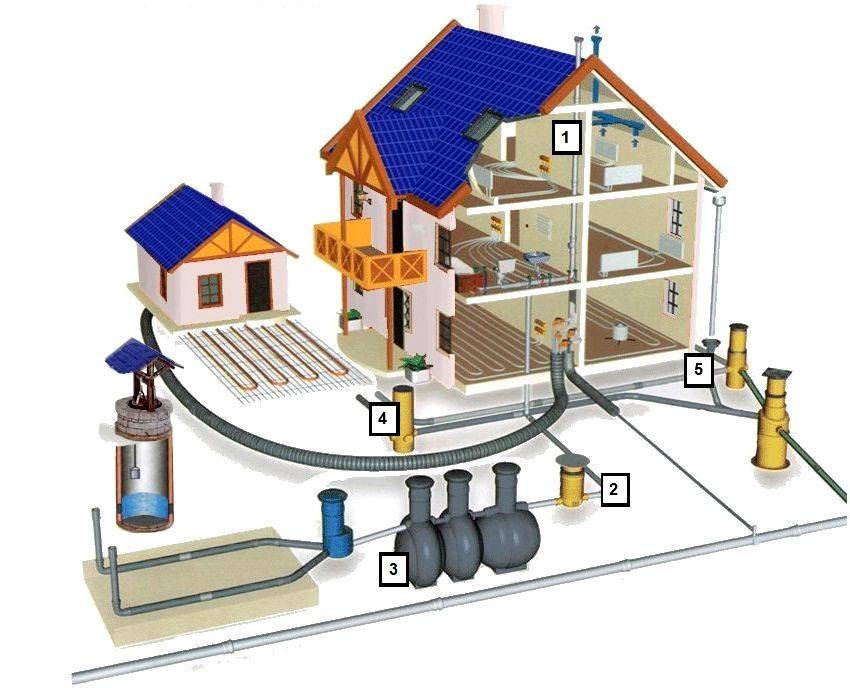

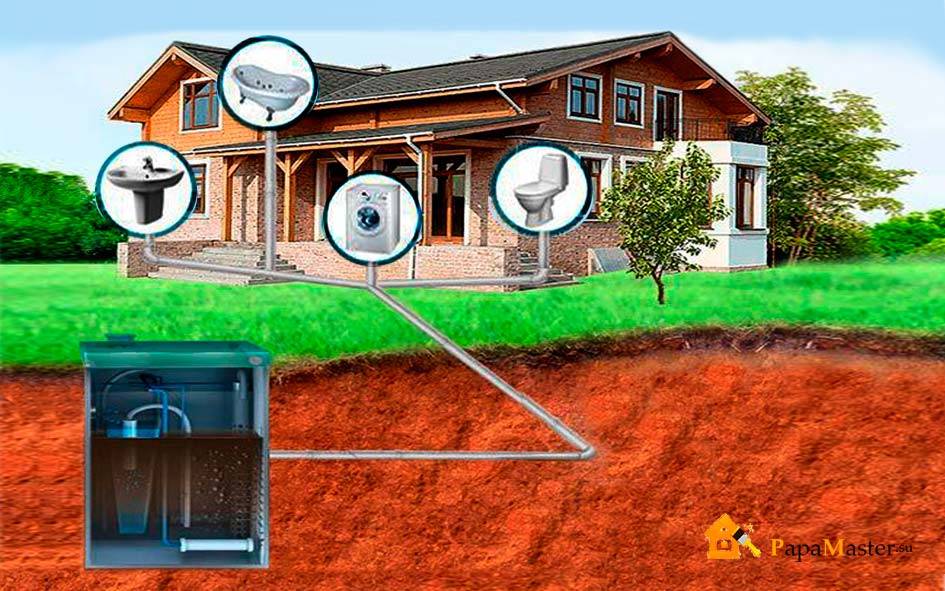

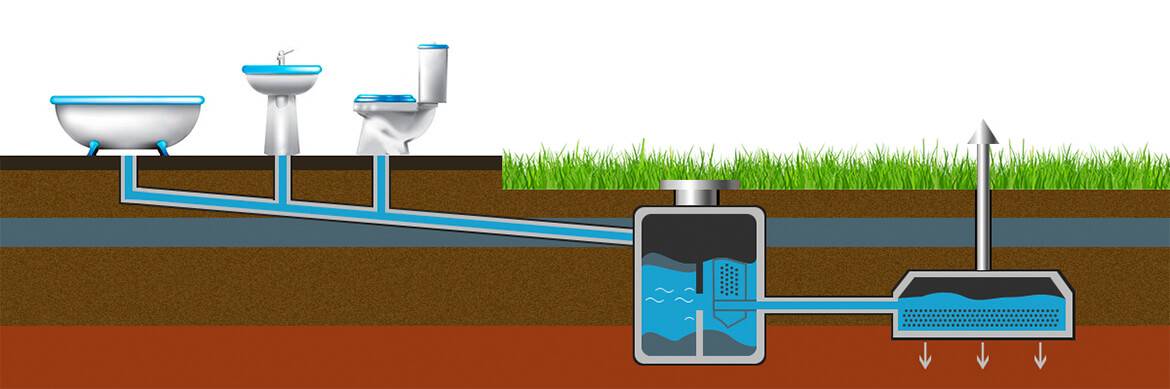

Do-it-yourself arrangement of autonomous sewage in a private house: videos and recommendations
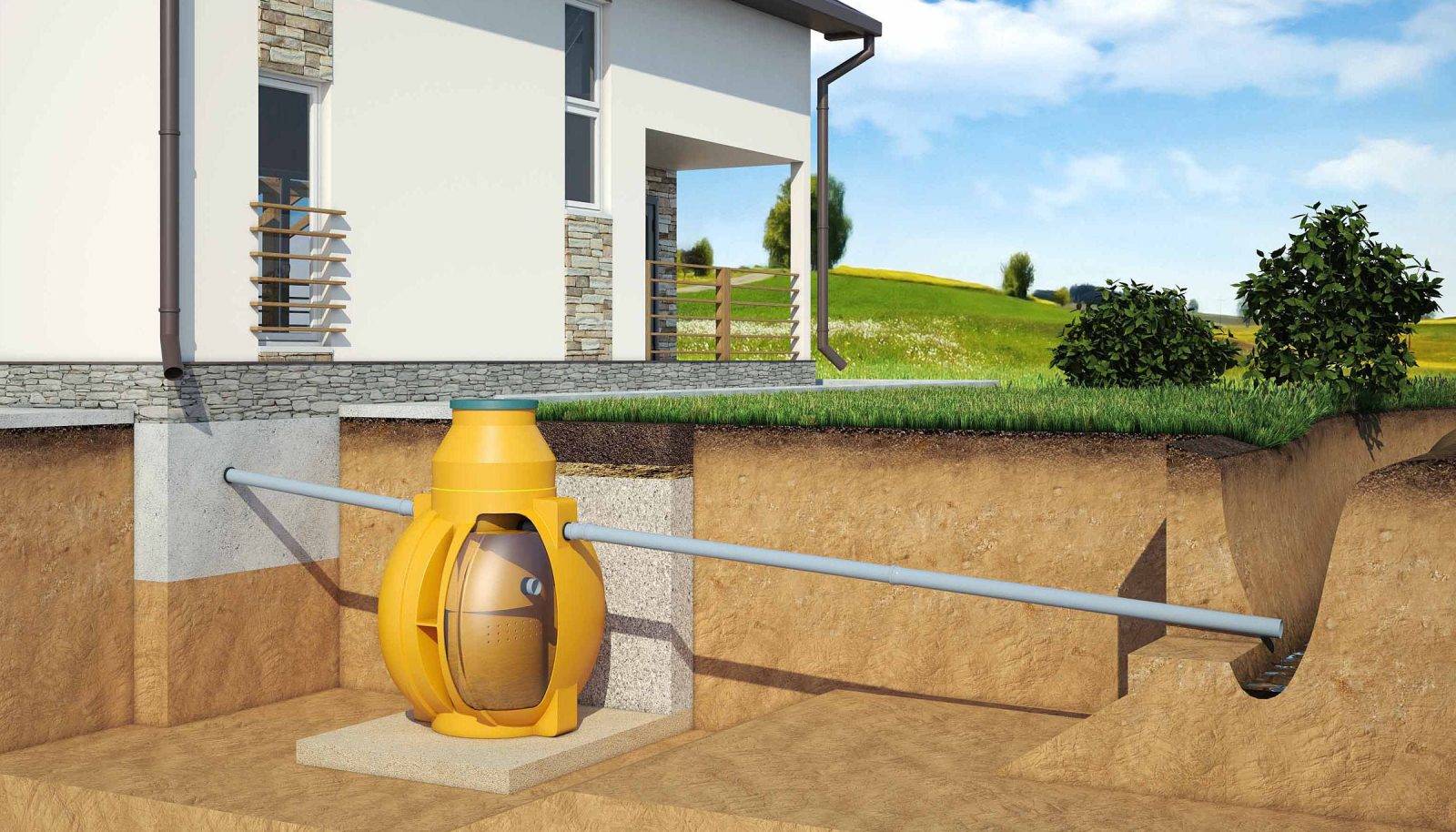
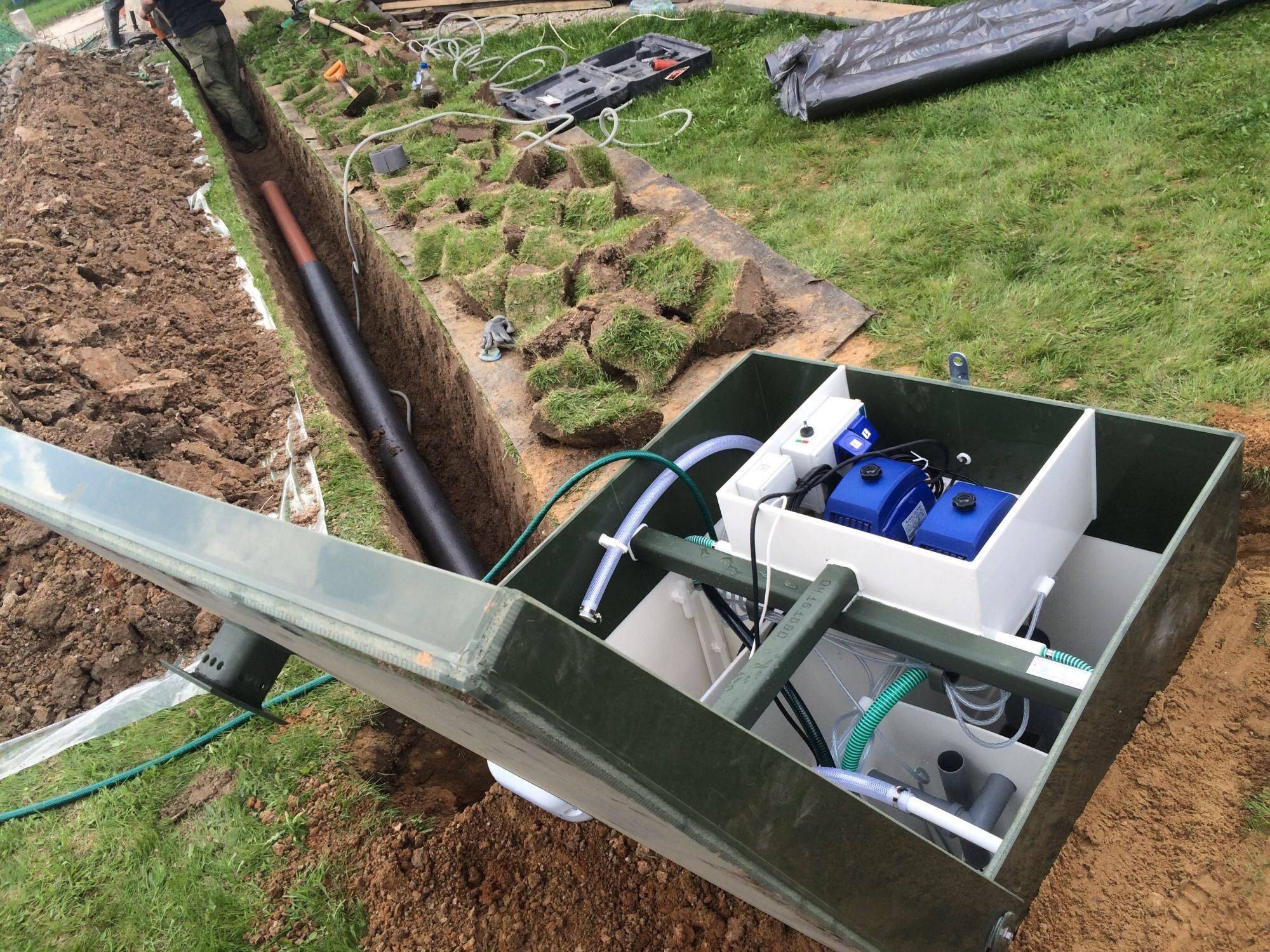
As a material for the manufacture of autonomous sewers, polypropylene is used, which is characterized by low weight, environmental friendliness, strength and high thermal conductivity. Wastewater treatment is carried out by certain types of bacteria that feed on organic waste. Access to oxygen is a prerequisite for the life of these microorganisms. The price of an autonomous sewage system in a private house is much higher than the cost of arranging a conventional septic tank.
The constituent elements of the autonomous sewage system
This is due to the numerous advantages of autonomous type systems:
- high level of wastewater treatment;
- unique aeration cleaning system;
- no maintenance costs;
- no need for additional acquisition of microorganisms;
- compact dimensions;
- no need to call a sewage truck;
- the possibility of installation at a high level of groundwater;
- lack of odors;
- long service life (up to 50 cm).
How much will it cost to build a sewer in a private house: turnkey price
The possibilities of autonomous sewers Unilos Astra 5 and Topas 5 are considered the most optimal for summer cottages. These designs are reliable, they are able to provide comfortable living and the necessary amenities for residents of a country house. These manufacturers offer other equally effective models.
The average price of autonomous sewers Topas:
| Name | price, rub. |
| Topas 4 | 77310 |
| Topas-S 5 | 80730 |
| Topas 5 | 89010 |
| Topas-S 8 | 98730 |
| Topas-S 9 | 103050 |
| Topas 8 | 107750 |
| Topas 15 | 165510 |
| Topaero 3 | 212300 |
| Topaero 6 | 341700 |
| Topaero 7 | 410300 |
The average price of autonomous sewers Unilos:
| Name | price, rub. |
| Astra 3 | 66300 |
| Astra 4 | 69700 |
| Astra 5 | 76670 |
| Astra 8 | 94350 |
| Astra 10 | 115950 |
| Scarab 3 | 190000 |
| Scarab 5 | 253000 |
| Scarab 8 | 308800 |
| Scarab 10 | 573000 |
| Scarab 30 | 771100 |
The tables show the standard cost of the system. The final price for the installation of an autonomous sewage system on a turnkey basis is formed taking into account the prices for laying an external pipeline and other points affecting earthworks and installation work in general.
The average price of autonomous tank type sewers:
| Name | price, rub. |
| Biotank 3 | 40000 |
| Biotank 4 | 48500 |
| Biotank 5 | 56000 |
| Biotank 6 | 62800 |
| Biotank 8 | 70150 |
Tips for installing an autonomous sewer at their summer cottage
As in any other system, it is recommended to install the pipeline at an angle from the house towards the purification tank. The optimal angle is between 2 and 5° per meter. If you do not adhere to this requirement, the full discharge of wastewater by an autonomous sewer for a summer residence will become impossible.
During the laying of the highway, care should be taken to securely fix its elements. To eliminate the risk of pipe deformation and displacement during soil subsidence, the soil at the bottom of the trenches must be carefully compacted. If you fill the bottom with concrete, you get a more reliable fixed base. During the installation of pipes, it is desirable to adhere to a straight path.
Be sure to check the joints for tightness. Liquid clay is usually used for docking. It is allowed to use specialized products recommended by the pipe manufacturer. If a line is being installed on the basis of elements with a diameter of 50 mm, the maximum allowable length of the straight sections of the system is 5 m. When using products with a diameter of 100 mm, this figure is 8 m maximum.
When choosing a place for a septic tank on the site, it must be taken into account that at least five meters must remain before the fence
What is the diameter of the sewer pipes for the house
Building codes allow to arrange a main sewage system from cast-iron, asbestos-cement, ceramic, plastic pipes. The latter variety is the most popular due to its inert qualities and strength. Pipe dimensions are calculated at the planning stage. Their diameter does not depend on the material of manufacture.
In the house, pipes with a minimum cross section of 50 millimeters are used to ensure optimal fluid velocity. In this case, the movement of the masses can be by gravity, vacuum or forced way. The same products are suitable for connecting to sink siphons. In risers, fan pipes and in places of connection to toilet bowls, sewer pipes with a diameter of 110 mm are used.

When determining the size of the pipes for the section connecting the internal riser to the treatment device, the terrain conditions are assessed: topography, groundwater level. The existing pipelines also have an impact. To draw a gravity line for one building with a slope of 3 degrees, a pipe of 110 mm is left. For a cottage village, the common pipeline must have a diameter of 150 mm.

Construction stages
Installation of the complex depends on several factors:
- type of sewer system;
- composition of waste liquids;
- number of stocks.
Based on these factors, design work is carried out. Produced:
- calculation of complex parameters;
- choice of liquid treatment method;
- equipment selection.
Installation work determines the arrangement of treatment facilities
sewerage.Depending on the chosen technology, equipment is installed.
The kit includes tanks of a certain size, open tanks or
aerotanks. There are systems that simultaneously process storm and household
drains. They are able to perform different cleaning methods in parallel.


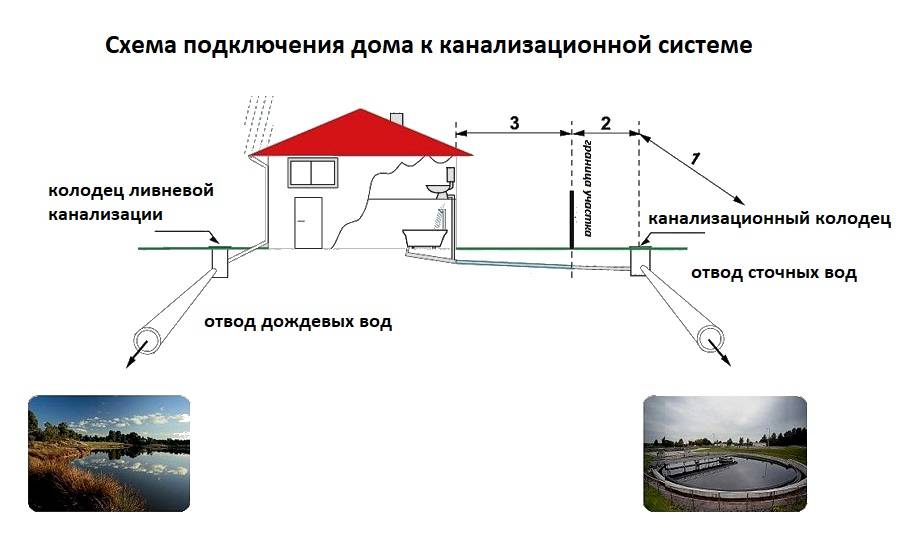
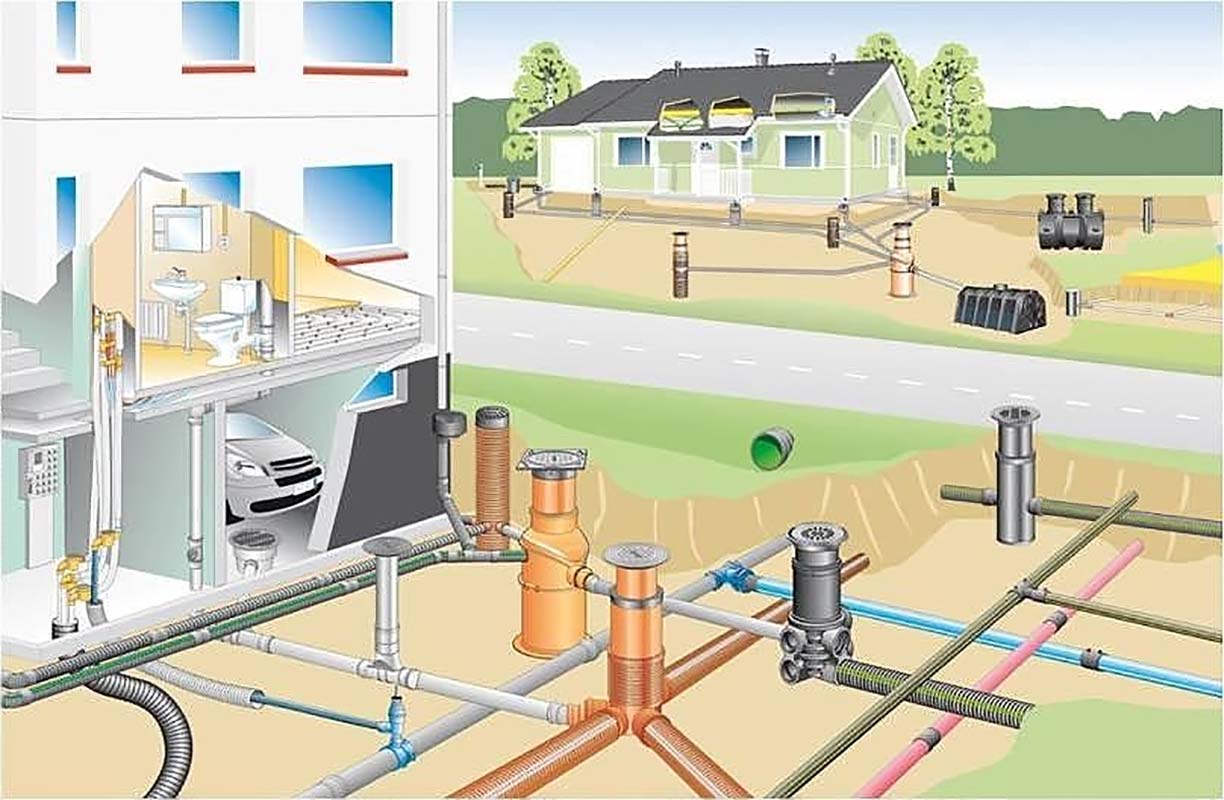

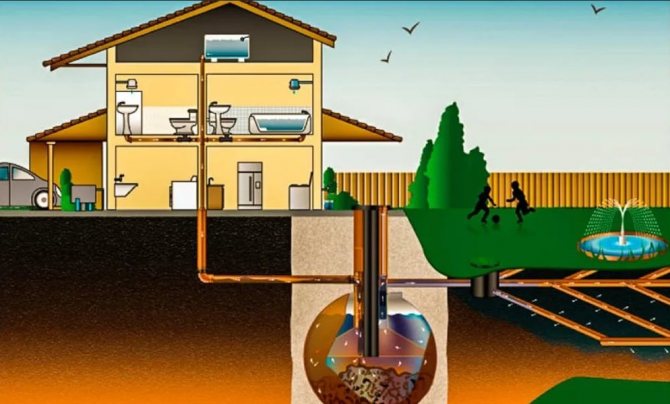
Sewerage OS Assembly Diagram
includes the following works:
- preparation;
- marking, preparation of the pit;
- assembly and installation of containers;
- connection of branches among themselves by pipelines;
- installation of pumps, aeration plants and other equipment;
- commissioning works.
The procedure is sometimes supplemented
or expand, but do not make fundamental changes.
The construction of VOC is carried out for
maintenance of a small system of a private house or cottage. Waste volumes in
such cases are much less. However, the procedure is practically
differs from the construction scheme of large, urban stations. The same
design, excavation and installation works. The difference is in the total
labor costs. It is necessary to install the container at a given depth and insulate it. Then
it is necessary to connect the tank with pipes and connect the power supply.
To set up the operation of the LOS, it is necessary to coordinate the supply of fresh air, check the tightness of all connections, and organize automatic control of the operating mode. In addition, they perform all the necessary procedures specified by the station manufacturer.
It is important to constantly check your actions with the instructions, or invite to launch authorized technicians from the service center
Story
Paris sewer
The earliest structures that served as sewers were found in the cities of the Indus civilization: in Mohenjo-Daro, which arose around 2598 BC.e., almost the first public toilets known to archaeologists, as well as the city sewerage system, were discovered.
Sewer structures have also been found in ancient Babylon, the second oldest.
In ancient Rome, a grandiose sewage engineering project - the Great Cloaca - was created under the fifth king of Ancient Rome, Lucius Tarquinius Priscus.
In ancient China, sewers existed in several cities, for example, in Linzi.
Possible problems
Difficulties in connection may arise due to the location of other communication networks at the sewerage site: a heat pipeline, an electrical network, a gas pipeline.
It is not possible to connect to the city network under the following circumstances:
- in the presence of several communication threads on the site;
- the unsuitability of the public sewerage caused by its old age;
- high price for a tie-in private network located underground on the site.
In this case, the option of installing an autonomous sewer remains. Septic tanks are an element of the waste and utility water treatment system. This type of drainage system has a number of advantages:
- the plastic used for them is not subject to corrosion and deformation;
- the term of use reaches 50 years;
- does not require special procedures during operation;
- The design is easy to install and requires little space.
Instructions for installing a septic tank
The disadvantage of autonomous stations for the removal of waste water is the dependence on the power grid. Before installing a septic tank, you need to calculate its required volume, depending on the number of people living in the house.
Sewer system installation
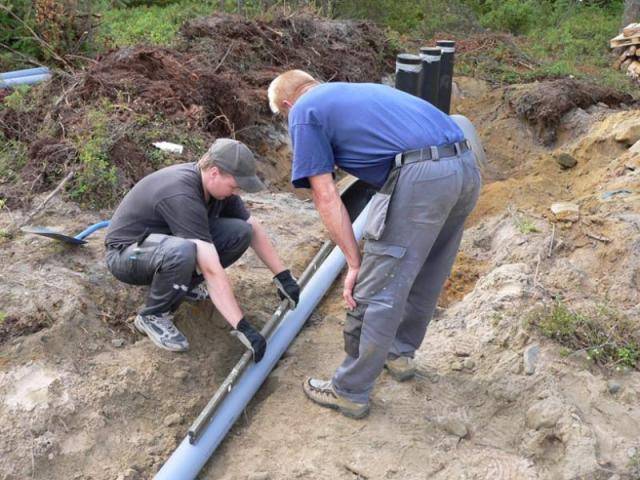
Sewer system installation
And now we will answer the question of how to install a sewer in the country.
First of all, we will determine the place for placing the collection tank
And it doesn’t matter what it will be - a pit, a well or a plastic container. The optimal location is at the lowest point on the site. But keep in mind that if you have chosen the first two options and plan to clean the collection tank using a sewage truck, then you will have to take care of the access road
But keep in mind that if you have chosen the first two options and you plan to clean the collection tank using a sewage truck, then you will have to take care of the access road.
After the place is established, we begin earthworks. Sometimes their volume is so large that you have to use an excavator. If you decide to do everything manually, then it is better to dig a hole under the tank and trenches at the same time.


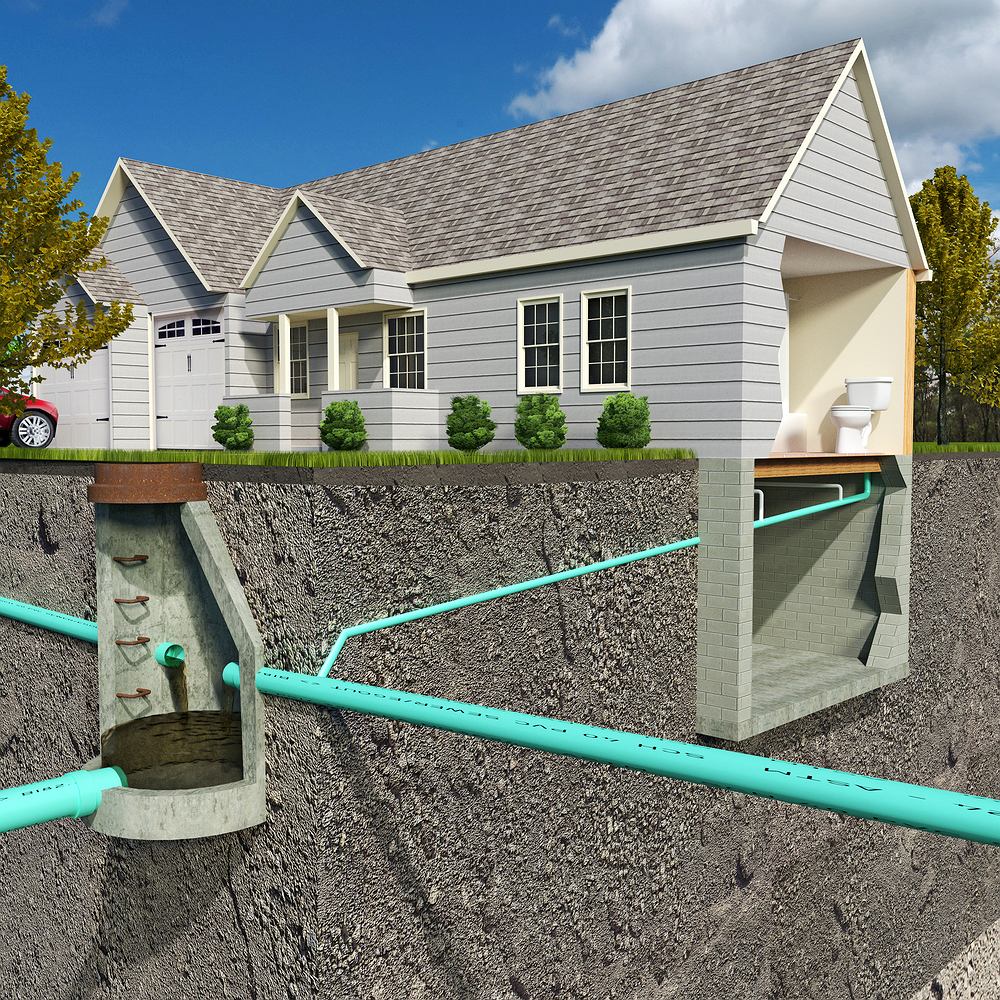
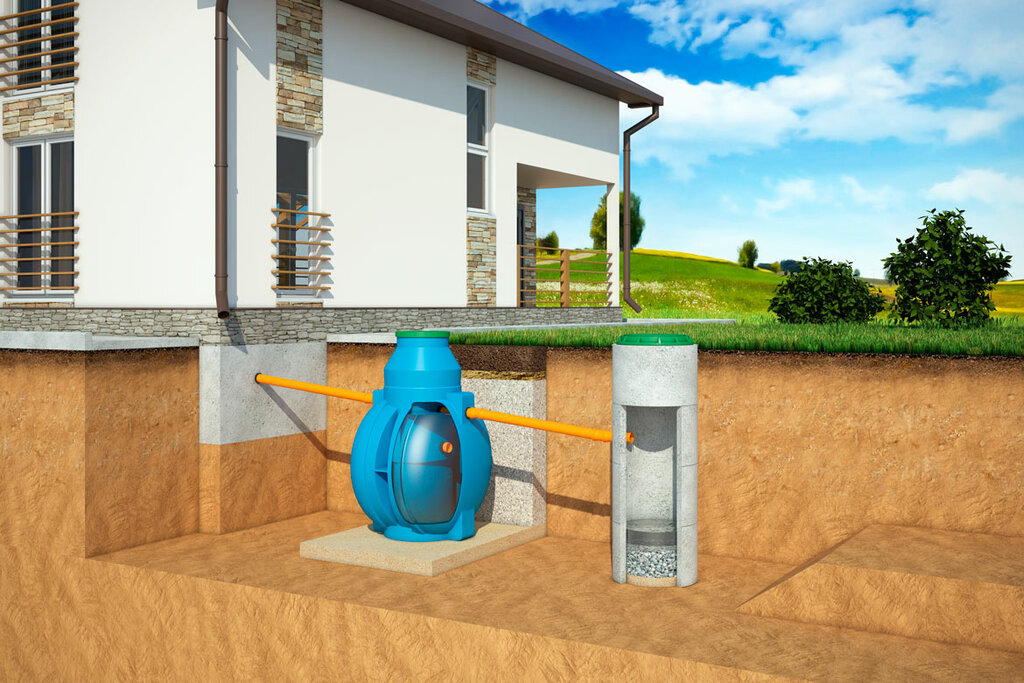
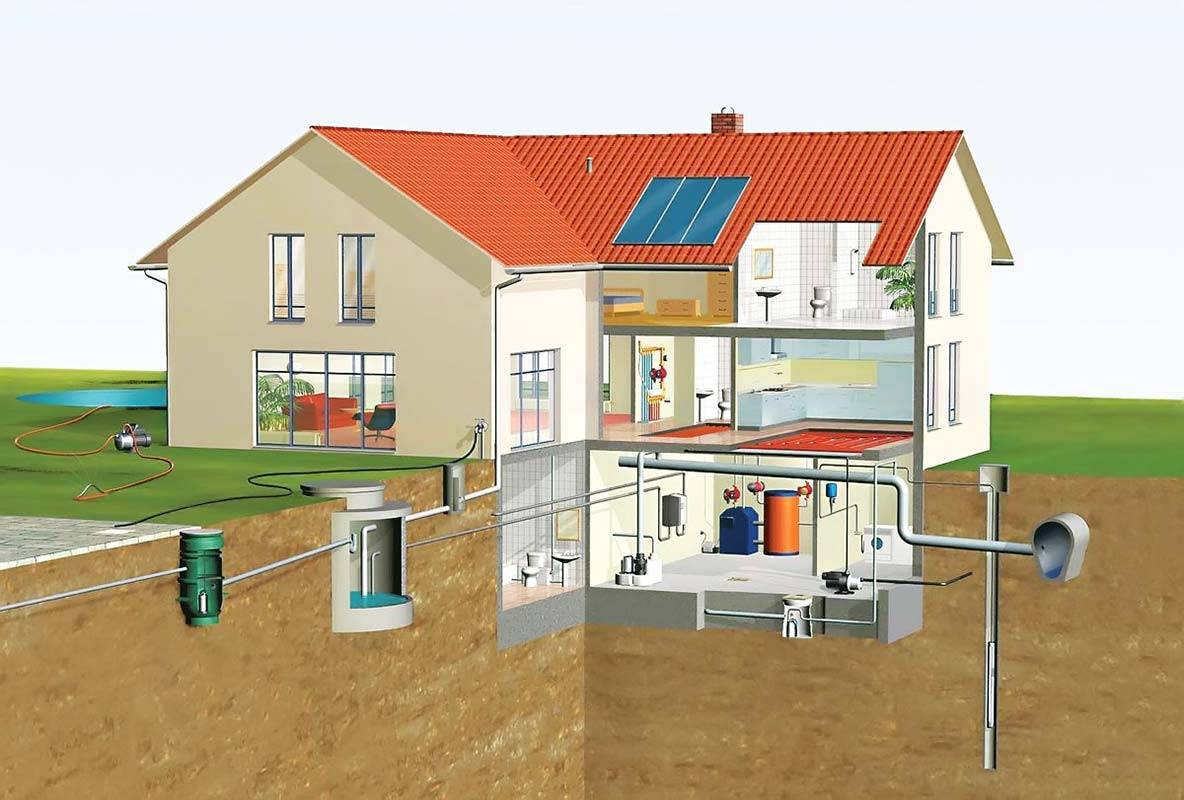

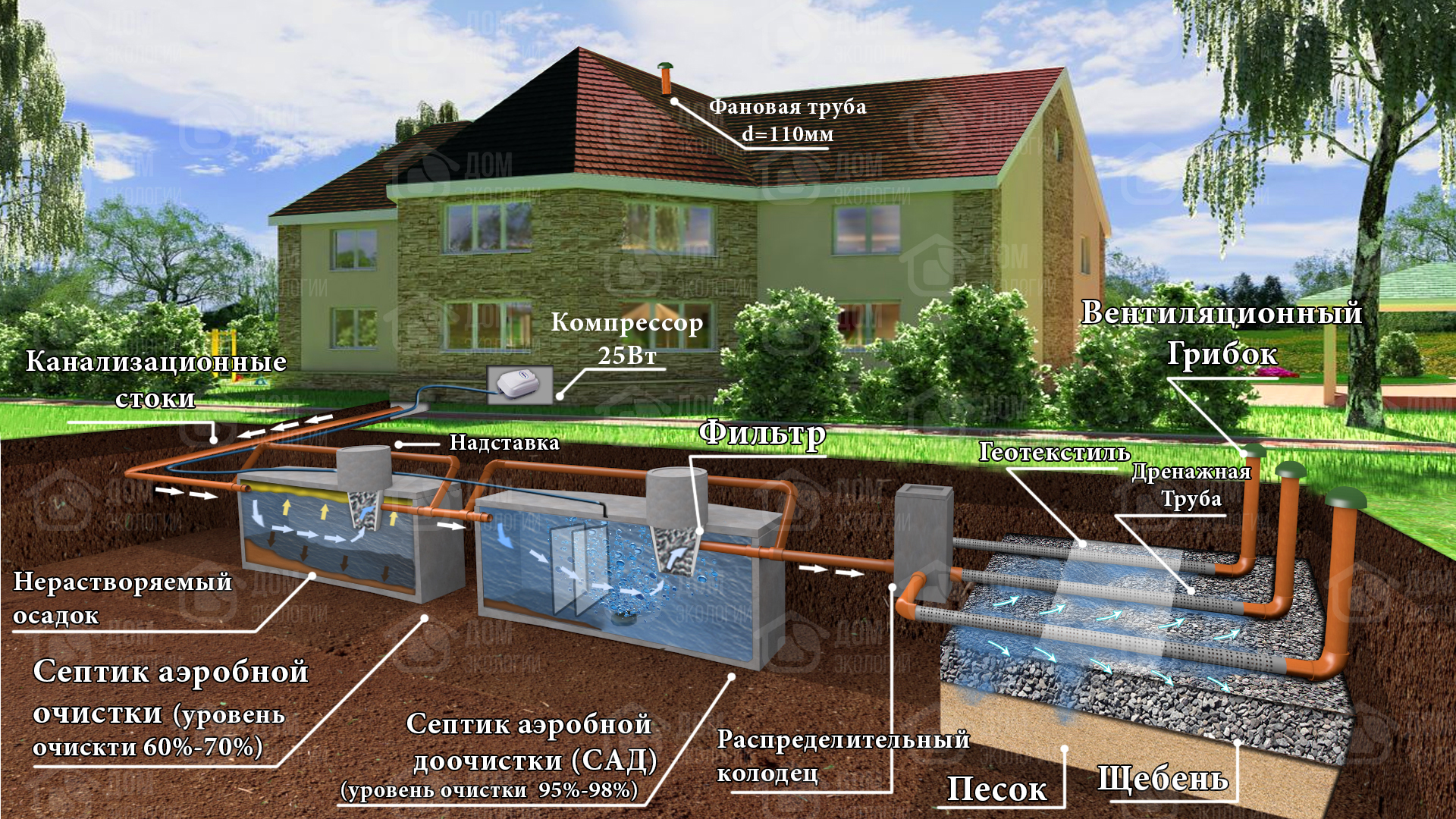
The depth of laying sewer pipes should be 10-15 centimeters more than the level of soil freezing. This is the law.
True, in some northern regions this figure can reach more than 2.5 meters. In such cases, it is necessary to use thermal insulation materials or install a heating cable so as not to dig deep.
It is from the depth of the sewer pipes that the depth of the pit under the collection tank will also depend. The fact is that sewer pipes should have a slope from the house towards the tank. It is 2-3 centimeters per 1 meter of the length of the sewer network. And the farther the collection from the house, the deeper it will have to be buried in the ground.
For country sewage, the optimal material for pipes is a polymer. And their diameter should be 110 millimeters. Such pipes are connected by couplings.But if there are side circuits, for example, sewerage from a bath or pool, then the connection is made with tees or crosses.
Before laying the pipes, the trench must be covered with sand, making a kind of pillow. But at the same time, you can not change the slope.
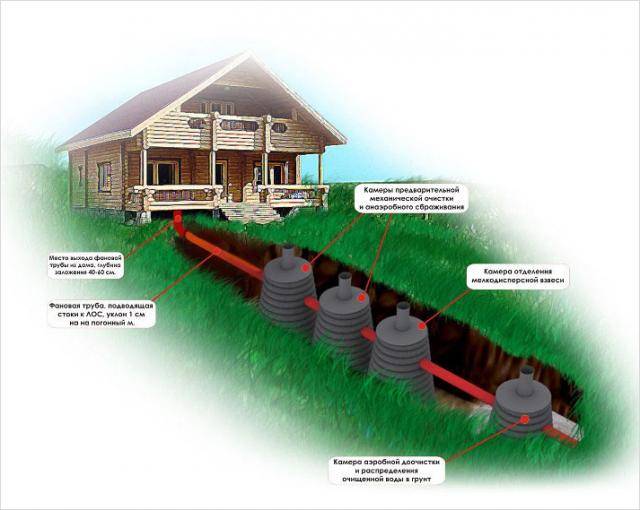
Installation of tanks and sewer pipes
And a few final touches. It remains to connect the collection tank and sewer pipes, as well as two parts of the sewer system - internal and external. And now you can fill the pipes and containers with soil.
As you can see, the country sewerage device has a fairly simple scheme, but it is necessary to follow the rules for installation work.
And finally, we recall those key points, without which it is impossible to build a country sewerage system. You will:
- The choice of the type of sewer network.
- The choice of a prefabricated tank, on which the quality of the entire system depends.
- The choice of materials from which containers, pipes, fixtures and additional products are made.
- Proper execution of the installation process and earthworks, especially observance of the slope.
- Determination of the depth of groundwater and the level of soil freezing.
- Preparation of the access road, if you plan to use the services of sewage companies for pumping.
Of course, these are not global things, but without them it makes no sense to talk about high-quality installation and uninterrupted operation of country sewerage.
Literature
- Sewerage // Encyclopedic Dictionary of Brockhaus and Efron: in 86 volumes (82 volumes and 4 additional). — SPb., 1890—1907.
- Sewerage //: / ch. ed. A. M. Prokhorov. - 3rd ed. — M. : Soviet encyclopedia, 1969-1978.
- Water Dictionary. - M., 1974
- SNiP 2.04.01-85* - Internal water supply and sewerage of buildings;
- SNiP 2.04.02-84 - Water supply. External networks and facilities;
- SNiP 2.04.03-85 - Sewerage. External networks and facilities;
- STO 02494733 5.2-01-2006 - Internal water supply and sewerage of buildings;
- S. V. Yakovlev, Yu. M. Laskov. Sewerage (drainage and wastewater treatment). 7th ed. — M.: Stroyizdat, 1987.
- G. S. Safarov, V. F. Veklich, A. P. Medved, I. D. Yudovsky New technology in housing and communal services - Kyiv: Budivelnik, 1988. - 128, p. : il; 17 cm. - Bibliography: p. 124-129 (68 titles). - 3000 copies. — ISBN 5-7705-0097-2
Site selection and installation
Before installation, you must make sure that the place under the septic tank, processing station or storage pit meets sanitary standards. Briefly list the main requirements:
- a place for a storage or treatment structure for wastewater should be located at a distance of at least 50 m from drinking water wells or wells;
- from reservoirs - 30 m, rivers and streams - 10 m;
- from the border of the territory of the site, house, road - 5 m, trees - 3 m.
It is also necessary to take care of the possibility of access to the cleaning or storage device of special equipment for cleaning.
Related video:
The organization of an external local sewer system begins with the earthworks stage. It is necessary to prepare a foundation pit for the structure, bring trenches to it, where pipes will be laid, through which water will flow and be discharged. If you plan to organize a drainage system, then prepare a place for it.
This stage is the most time-consuming and takes a lot of time; special equipment can be involved to speed it up if the budget allows.
Earthwork is recommended to be carried out in the dry season so that the excavated pit is not filled with rainwater, which can cause its walls to collapse. In addition, one should not forget about the level of groundwater. Their proximity to the surface can also lead to flooding.
After completion of earthworks (when the pit is dug, its bottom is leveled, and the trenches are summed up), the structure is installed. Small septic tanks can be installed by two or three people, large and heavy ones will require special equipment.


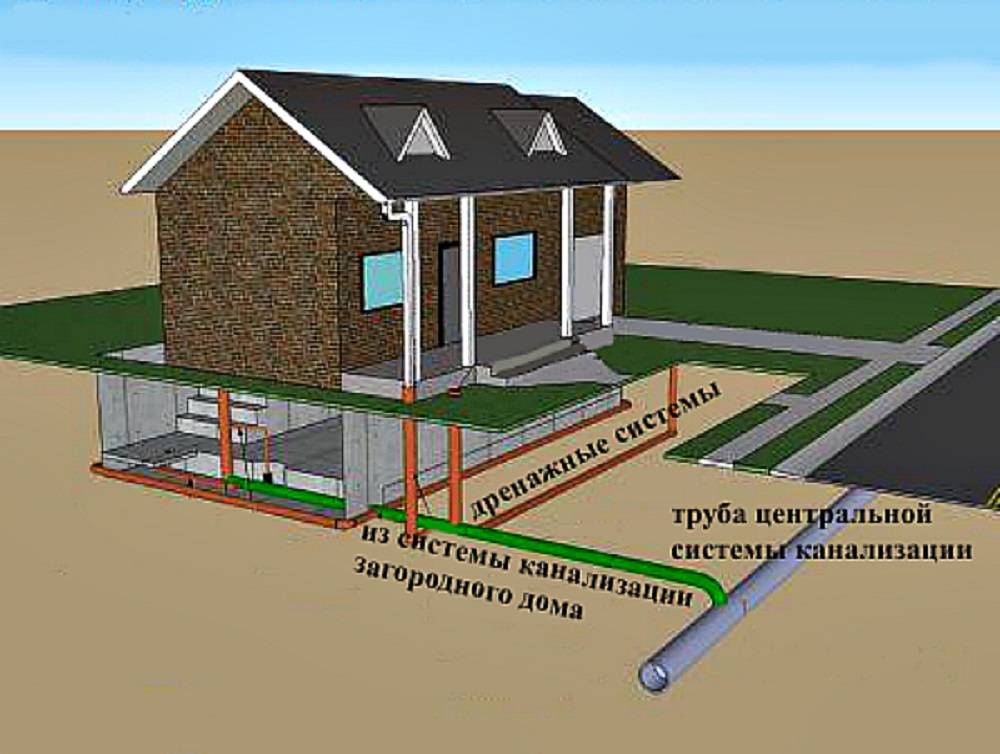
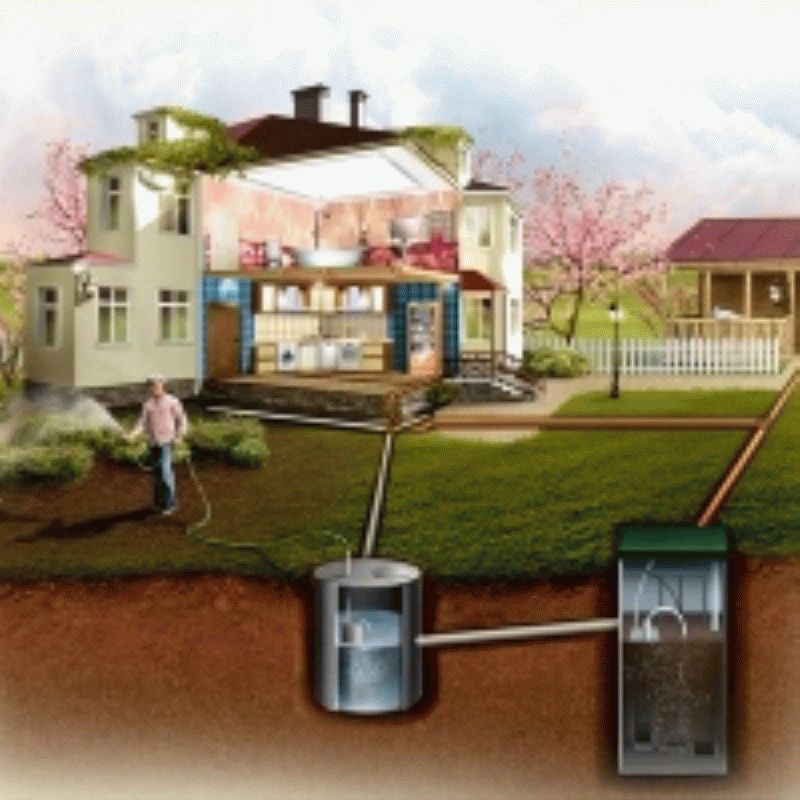
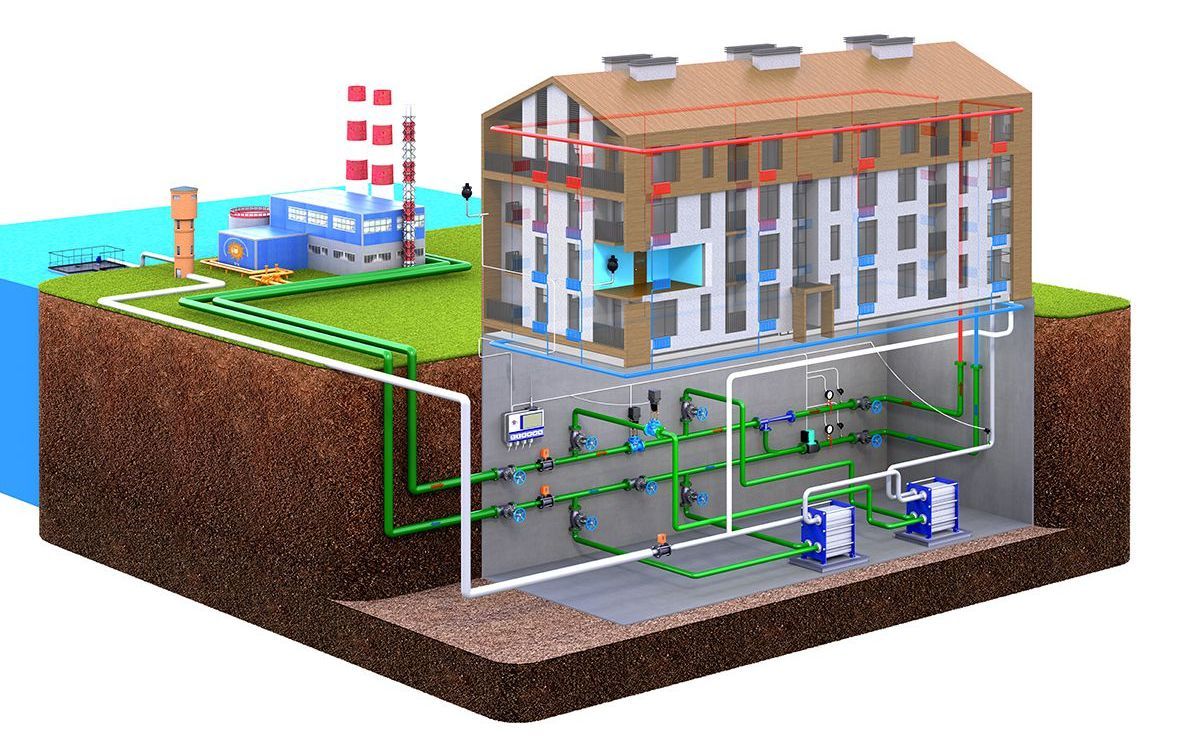


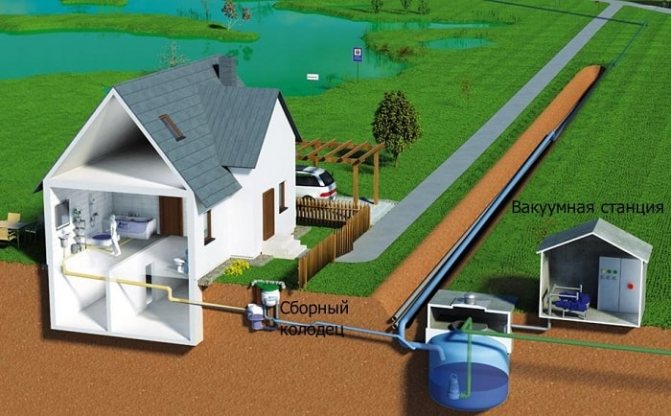

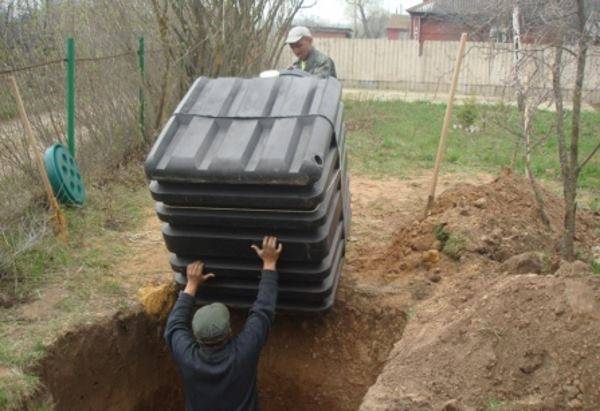
If the installation is carried out in freezing soils, it will be necessary to ensure the insulation of pipes and a septic tank.
After installation of the structure, pipes are laid and connected. At the last stage (when everything is connected), the septic tank, storage well or treatment plant is covered with soil. At the same time, it is necessary to leave access to the hatches through which preventive cleaning will be carried out. After that, the local sewage system is ready for operation.
List of documents
When deciding to independently draw up the legal side of the issue, it is necessary to prepare the following papers:
- Site plan prepared by a surveying company, with a house marked on it and a scheme for laying pipes for sewer communications.
- Proof of ownership of the house and land.
- Documentation specifying technical requirements is prepared by an organization specializing in sewer service.
- Plan of tie-in of a private pipeline to the central network, developed by a qualified designer.
- The plan consists of a longitudinal profile, a general plan and a master plan for networks.
- Permission for sewerage in a private house, agreed in accordance with the architectural design.
- Application to the executive company.
During the last stage, you should collect a package of necessary papers, you need to choose a company that will be entrusted with the installation of sewers in a private house to city communications.
The main stages of connecting a residential building to the central sewer system
All stages of the work can be divided into:
- Collection of necessary documents and coordination with neighbors;
- Preparation of a house adjoining area lying in front of the central sewer pipe;
- Direct connection to the central sewerage system;
- Putting the sewer into operation.
- In principle, all this can be entrusted to specialists, including the collection of documents. Or you can try to save quite a considerable amount and take it on your own. But it is worth preparing for certain labor and time, as well as nervous costs.
The main package of documents when making a tie-in to the municipal sewer system includes a notarized permission from the owners near the lying houses.
Connection to sewerage networks, what documents are required
Finished house plan. Mandatory, on paper, a diagram of the laying of a sewer pipeline must be presented. This process is carried out with the help of a company that conducts geodetic expertise.
All technical conditions for connecting sewerage. All these issues are considered by the organization.
The scheme on which the plan will be indicated, it is according to it that it is necessary to connect the sewer.This document must be provided by a specialist who designs and installs technical functions. It relies on the basis of the specification, thus producing a new plan.
The project, which is prepared in the water utility, with their approval. This process is carried out by architectural management.
It is also necessary to remember one main nuance. Before starting construction work, you must obtain permission from your neighboring residents. They are required to sign their consent. If additional questions arise regarding the pipeline that will pass through the places where other electrical or thermal networks have already been laid, then in this case, it is necessary to take another permit. It is necessary to require a special document in the organization. If the owner does not pursue certain requirements, he will have to pay a huge fine.
To lay the pipeline to the central highway, you need to take permission. If there is a well nearby. The pipe that will pass through the site to the well will be directed at a certain slope and angle. To determine the laying depth with accuracy, it is necessary to use the special values \u200b\u200bprovided by the data in SNiP.
There is also one main piece of advice to keep in mind. This question concerns the existence of existing curves on the track. As shown in practice, turns on the track should not exist, but if such a problem suddenly arises, then it is necessary to turn the highway a few degrees, about 90. It is also recommended to install an inspection well. Since, in this case, the well performs the function of control over this system.
A significant role is played by the correct selection of the height of the trench digging. Certain elements must be taken into account. The pipe diameter must be larger than the inner diameter. The usual size is up to 250 mm. Basically, pipes with a diameter of 150 to 250 mm are used. After the specialist decides on the size of the pipes, it is necessary to dig the bottom of the trench. As soon as the process is completed, the pillow can be provided for laying the pipeline.
Causes of clogging and solutions
The fecal sewerage system is a very complex system, but it can also fail. It is expressed in clogged pipes in any part of the network. This happens for a number of reasons:
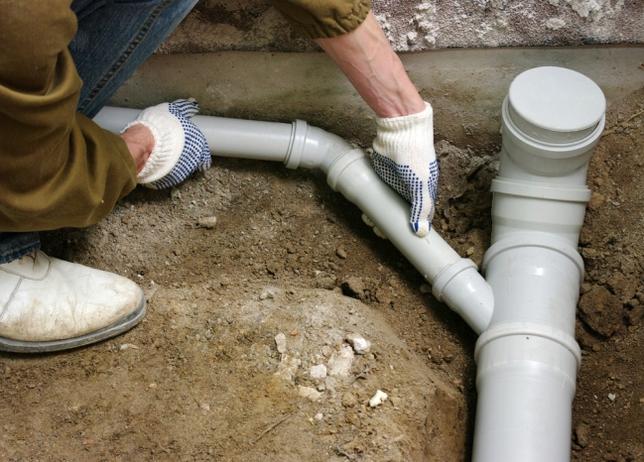


- Initially, pipes were installed incorrectly, namely, bricks were placed under the joints of horizontally running pipes. As a result, the joint sank and the normal flow of sewage stopped. This problem is eliminated by restoring the normal connection of the pipes. Under the joint, a normal, even stand of their concrete is mounted.
- Soil subsidence under horizontally laid pipes. In this case, blockage occurs in places of strong bending of the previously flat pipe route. To eliminate the problem, the place of uneven laying is determined and the normal level of the soil is restored under it.
- Fracture or roughness in the trays of the collector wells. Small debris and feces get stuck on bumps, creating water blockages. The solution to the problem is to repair the tray or replace its destroyed segment.
- Incorrect calculation of the slope of the horizontal pipe. If it is too small, then the flow of water and feces will be slow, resulting in a blockage. To eliminate the problem, pipes or trays are shifted, taking into account the angle of inclination of at least 2 degrees.
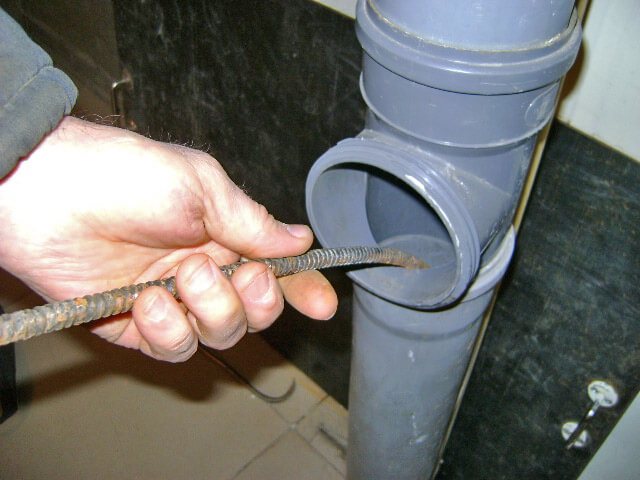
Before repairing any section of the sewer, the blockage is first removed with a long steel wire or a special cable. Be sure to cover the damaged area. And only after that, the repair work begins.
Types of sewer systems
All types of drain communications can be divided into two types - autonomous and centralized. The first option is characterized by a drain pit or septic tank, a treatment plant. Household and organic waste from them is either pumped out and taken to designated areas for treatment and processing, or cleaned on site using a system of filters and sedimentation tanks. When installing a centralized sewerage system, effluents go to the citywide (rural, township) system.
Since a centralized installation of sewerage in a private house is relatively rare, only in dense urban or rural areas, our article will mainly consider an autonomous system.
Allocate options:
- drain pit for temporary use. It is typical for street toilets, where, in addition to biological waste, liquid household waste is also sent. The pit in this case, after filling, is dug in and dug out in another place. Applicable only for rare use by unpretentious people;
- drain pit with pumping. It is possible both for toilets installed inside the house and drains from the sink / bath / sink / washing machine and dishwasher, as well as for outdoor “amenities”. It is mandatory to waterproof the walls of a concrete or brick container;
- cesspool with devices for partial clarification of drain waters. A filter well or a single-chamber septic tank is used as a working element.The well / septic tank periodically accumulates solid waste to be removed;
- multi-chamber septic tanks (otherwise filtering or treatment plants). The level of wastewater treatment in these devices allows you to dump clarified waste directly into the ground or a nearby body of water.
An autonomous sewage system for a private house can be arranged according to any of the options, but it is necessary to take into account the restrictions on the amount of waste that can be processed or allowed to be dumped:
- a temporary drain pit is actually a "disposable" structure. Its volume rarely exceeds 5 ... 10 cubic meters, so immediately after filling it ceases to be usable;
- with timely pumping out, drain pits in the form of a concrete or brick container with waterproofing can be used to service a small private house / cottage / guest outbuilding. The volume of such pits is also 5 ... 15 cubic meters, so the use of a washing machine / dishwasher and the active operation of the shower / bath will have to be limited;
- the performance of single-chamber septic tanks or filter wells is limited by their volume and design, but with the right choice of device, they are suitable for a family of 2 ... 5 people using water in normal mode;
- multi-chamber septic tanks and treatment plants are designed for active water use, the variety of their models allows you to choose a specific device for the planned volume of wastewater.
Of course, do-it-yourself sewerage in a private house is the easiest and fastest to arrange according to the first and second options. Installation of septic tanks requires either sufficient skills in the construction and laying of communications, or the involvement of specialists.