
- Basic rules of use
- How to choose the right model?
- DIY installation
- Septic tank and its modifications
- Models of septic tanks Tank
- Installation of a septic tank
- Why can a septic tank pop up?
- How does a septic tank work?
- Station device
- The principle of the station
- Design and principle of operation
- Principle of operation
- Not a bad exit
- Operation features
- Septic Tank 1
- Septic tank design
- The principle of operation of the septic tank Tank 1
- Installation of a septic tank Tank 1
- Septic tank operation
Basic rules of use
In order for a self-installed septic tank to serve for a long time, it is necessary to adhere to the rules for its use:
- It is necessary to regularly (usually once a year) clean the septic tank from accumulated solid waste. If the waste is not pumped out in time, the sediment will become very dense, which will adversely affect the operation of the sewer. After pumping out the contents of the septic tank, it must be immediately filled with water.
- To improve the quality of wastewater treatment, it is recommended to use special biological products for septic tanks. The use of such means reduces the amount of solid waste and reduces the need to use the services of sewers.
- Another reason affecting the quality of work is the discharge of a large amount of disinfectants into the sewer, which leads to the death of the biomaterial.
When planning to install a Tank brand septic tank, you should get acquainted with installation installation rules. If you wish, you can watch the process on the video, which shows the main points of the work.
How to choose the right model?
When choosing the elements of a wastewater treatment system, the number of people permanently residing in the house becomes the determining factor. According to the norms, each tenant needs 200 liters per day. Therefore, the minimum capacity of a septic tank for a small family of three is 600 liters per day.
In combination with Tank septic tanks, Triton-400 infiltrators are used. Their number is also selected taking into account the daily water consumption. The absorbency of soils is also taken into account - for clay representatives, the number of buildings is doubled.
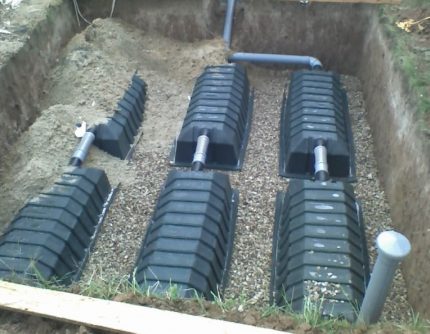
The number of infiltrators depends not only on the performance of the septic tank to which they are connected, but also on the filtration properties of the soil
Tank septic tanks are available in different modifications, each of which is provided with manufacturer's recommendations:
- Tank 1 - suitable for servicing three permanent residents and a daily wastewater volume of up to 600 liters. It has overall dimensions of 1.2 m x 1 m x 1.7 m, weight - 75 kg. One infiltrator is mounted in a chain with it when installed on peat and sandy deposits and two on clay soils.
- Tank 2 - processes up to 800 liters of wastewater per day, can serve up to four people. Dimensions - 1.8 m × 1.2 m × 1.7 m, unit weight - 130 kg. Two infiltrators go to it, four are installed on clay rocks.
- Tank 2.5 - daily capacity is one thousand liters, dimensions - 2 m × 1.2 m × 1.85 m. Suitable for four to five people. Weight - 140 kg. The number of infiltrators is similar to the Tank 2 installation.
- Tank 3 - the septic tank provides drainage in the amount of 1200 liters, serving five to six family members. The weight of the installation is 150 kg, dimensions are 2.2 m × 1.2 m × 2 m. In areas with peat and sandy soils, three infiltrators are connected to it, and six infiltrators on sandy loam and loam.
- Tank 4 - installed to drain wastewater from one or more buildings and serve up to nine permanent residents. Productivity - up to 1800 liters per day. The weight of the septic tank is 230 kg, overall dimensions are 3.6 m × 1 m × 1.7 m. Together with it, four infiltrators are installed on sand and peat, eight on clay and loam.
If the amount of runoff constantly exceeds the recommended amount, then insufficiently purified water will drain into the soil and the ecosystem of the site may suffer.
Too much septic tank volume will not be economical and will require more space. It is worth choosing a tank with greater productivity if guests are often received in the house or replenishment of the number of residents is planned.
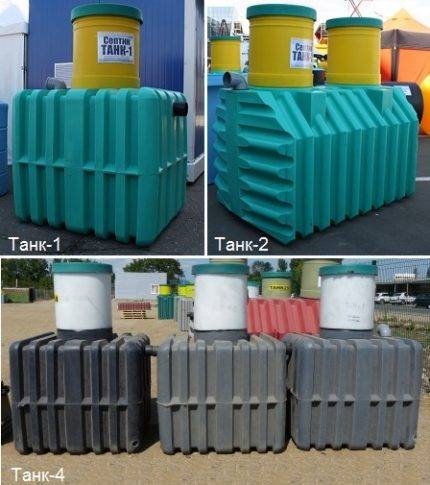
The septic tank model is chosen taking into account the volume of water consumption, which depends on the number of residents of the house
DIY installation
We will describe in detail how to do the installation yourself:
The delivered septic tank should be carefully and from all sides inspected for defects and damage to the body.
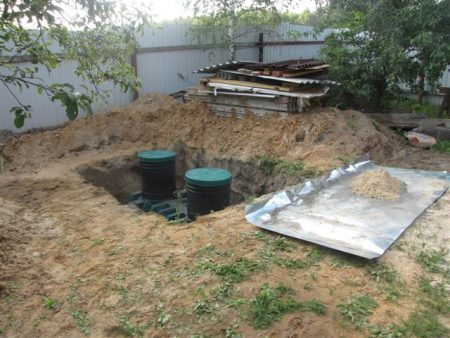
- The next step is the most time-consuming, you need to prepare a pit and trenches in order to install a septic tank. If possible, it is better to entrust the installation to a company that offers earthworks using earthmoving equipment. This solution will significantly speed up the installation of the treatment plant.
- Pipe trenches should be laid with a slope so that drains can move by gravity along them.
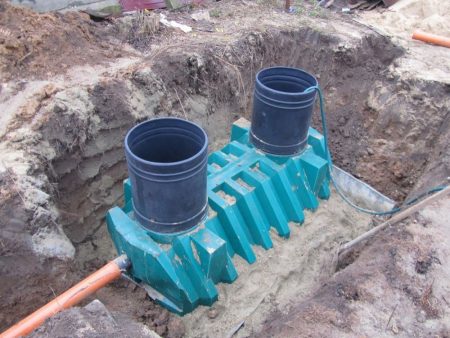
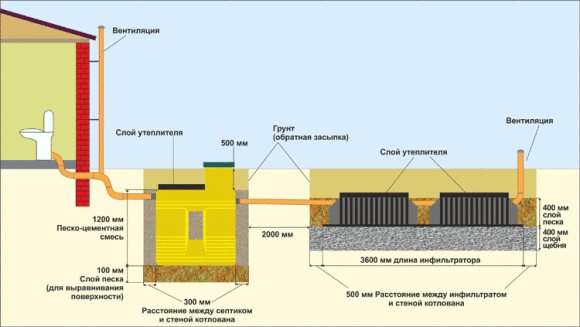
- The width of the pit and trenches should be such that after installing the equipment, 20-25 cm of free space remains on the sides.
- The bottom of pits and trenches should be well compacted, simultaneously removing large stones, plant roots and other inclusions. The holes formed after excavation should be covered with soil and compacted.
- Then start adding sand. The height of the sand cushion in the pit should be at least 30 cm, in trenches - at least 20 cm. Sand after backfilling should also be compacted.
- If soil water rises high on the site, then measures should be taken to prevent the septic tank from surfacing. To do this, a reinforced concrete slab is laid at the bottom of the pit, and its body is attached to the embedded parts of the slab using bandage belts.
- The septic tank must be lowered to the bottom of the prepared pit exactly in the center, avoiding distortions. Make it more convenient with the help of lifting equipment.
- Inlet and outlet pipes are attached to the branch pipes of the septic tank, the connections must be tight, but not rigid.
- Now you can start backfilling the pit. This should be done not with soil, but with a specially prepared dry mixture of sand and dry cement in a ratio of 5 to 1. The mixture is poured into the gaps between the wall of the septic tank body and the side of the pit in layers 20 cm high and is well compacted. After that, they begin to fall asleep the next layer until the pit is completely filled. No matter how much you want to make your life easier by using construction equipment, the backfilling operation will have to be done manually, as otherwise there is a risk of damaging the septic tank body.
- When backfilling, it is necessary to simultaneously fill the septic tank with water, making sure that the water level is always higher than the backfill level.
- The pipes of the external sewage system are also first covered with sand, and the backfill must be carefully compacted on the sides, and this, of course, does not need to be done above it. Ordinary soil is poured over the sand.
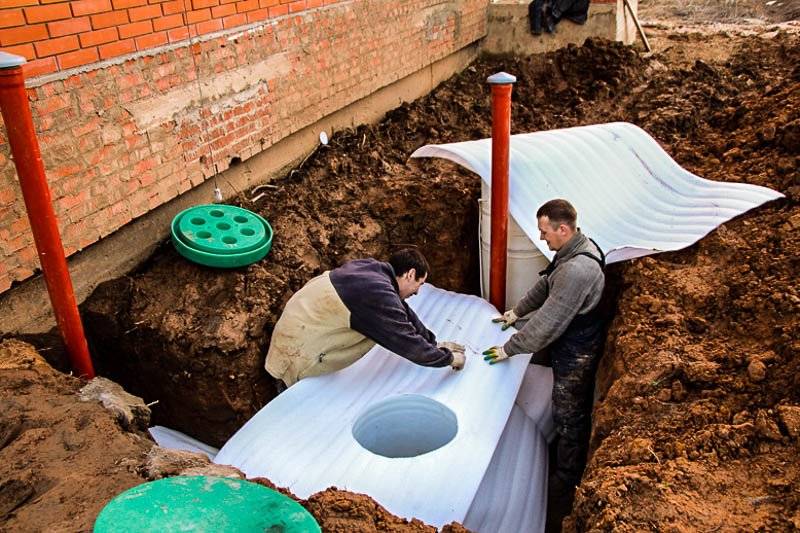
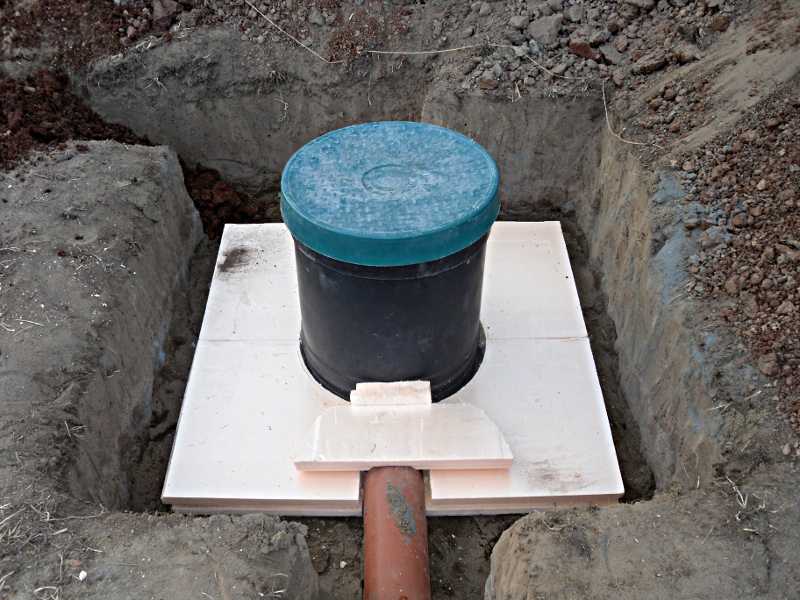
- It is recommended to cover the upper part of the septic tank with insulating material, laying it in two or three layers.
- Already at the stage of installing a septic tank, you should consider the issue of its maintenance. It is necessary to leave free space for the passage of a sewage truck, which will have to be called regularly (1-2 times a year) to clean the installation chambers from sediment. In addition, you should not plan to plant trees near the septic tank, as their roots can damage or move the hull. The minimum distance for planting trees is 3 meters in any direction.
- In the event that it is not possible to make sure that vehicles do not drive over the installation site of the septic tank, it must be protected from damage. To do this, before installing the septic tank, a reinforced concrete slab is laid, its height must be at least 25 cm.
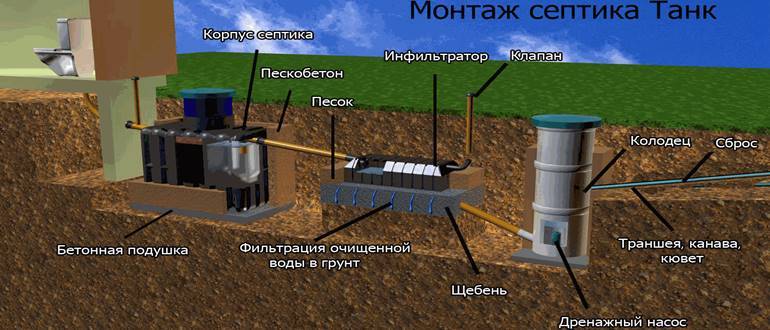
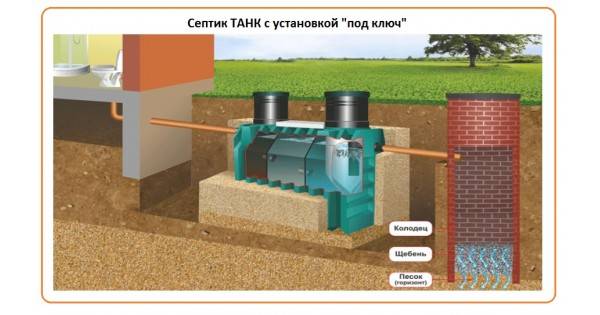
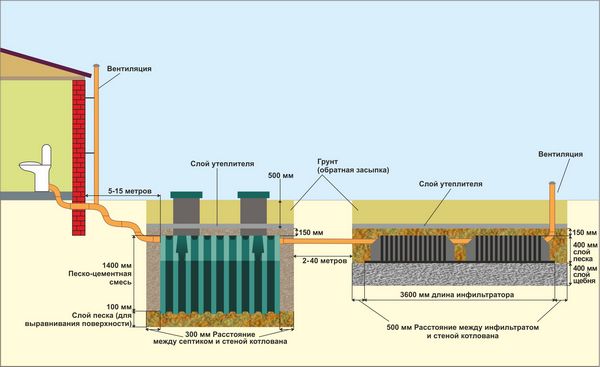
- Now consider how to install the infiltrator. This device is mounted at a distance of 1-1.5 meters from the septic tank. For its installation, a rectangular pit is being prepared.
- At the bottom of the pit, geotextiles or a plastic construction mesh are laid.
- Next, crushed stone is backfilled, the height of the filter layer should be at least 40 cm.
- On top of the poured rubble, they put a ready-made plastic installation - an infiltrator. It is connected to a pipe coming from a septic tank.
- A fan pipe is mounted on the back of the unit; it is necessary to ensure ventilation of the system.
- From above, the infiltrator is covered with geotextile, and then backfilled first with sand and then with soil.
Installation of ready-made wastewater treatment plants is not too difficult and can be done on your own. So that the home master does not have any questions, you should first see how the Tank septic tank is installed DIY - video with a step-by-step description of the process can be found on the net.
Septic tank and its modifications
The manufacturer offers customers a septic tank Tank in five versions:
-
Tank-1 - with a volume of 1200 liters for 1-3 people.
-
Tank-2 - with a volume of 2000 liters for 3-4 people.
-
Tank-2.5 - with a volume of 2500 liters for 4–5 people.
-
-
Tank-3 - with a volume of 3000 liters for 5-6 people.
-
Tank-4 - with a volume of 3600 liters for 7-9 people.




Model range of septic tanks Tank
Depending on the model, the performance of the septic tank ranges from 600 to 1800 liters / day. All these stations are anaerobic and do not need power supply.
In addition to the main model, the developer of septic tanks under the Tank brand offers three more of its modifications:
-
"TankUniversal" - with a reinforced body;
-
"MikrobMini" - a compact option for cottages and houses designed for seasonal living;
In the country, it is best to install a model of the MicrobMini series. This is a cheap and quite productive solution for a summer cottage. Such a station can be laid even in the project of a small house. But only if it will be used for seasonal living. With constant living outside the city, a more powerful and capacious bio-treatment station is needed.
-
"BioTank" - with aerobic bacteria, does not need a filtration field.
Unlike all other variations, the BioTank septic tank belongs to the aerobic VOC category. It has a compressor for pumping oxygen in order to aerate the waters. Without air pumping, the efficiency of organic-eating bacteria in it will be too low. At the same time, you have to pay with electricity for high productivity and improved cleaning quality (here it reaches 95%). This modification is volatile.
All Tank septic tanks with the prefix "Bio" are divided into two series "CAM" and "PR". In the first case, the movement of wastewater between the chambers and the withdrawal of purified water from the station occurs by gravity. But the second option has in its design a pump for forced ejection of purified water.
Models of septic tanks Tank
| septic tank | Human | LxWxH | Volume | Produces. | Price from* |
|---|---|---|---|---|---|
| Tank-1 | 1-3 | 1200x1000x1700 mm | 1200 l | 600 l/day | 17000 rub |
| Tank-2 | 3-4 | 1800x1200x1700 mm | 2000 l | 800 l/day | 26000 rub |
| Tank-2.5 | 4-5 | 2030x1200x1850 mm | 2500 l | 1000 l/day | 32000 rub |
| Tank-3 | 5-6 | 2200x1200x2000 mm | 3000 l | 1200 l/day | 38000 rub |
| Tank-4 | 7-9 | 3800x1000x1700 mm | 3600 l | 1800 l/day | 69000 rub |
*Prices are indicative for 2018, excluding installation
Installation of a septic tank
 External inspection before installation
If you have purchased septic tank for your country house tank, then the installation instructions will help you with installation. This document is included with any model. All features are included in the instructions. The general points are as follows:
The first thing to do before starting installation is to inspect the delivered septic tank. Check for any damage. If you skip them, the device may not work effectively.
Now it is worth starting to determine the place for installation. Septic tanks will not smell bad.Therefore, it is not necessary to remove them to the farthest corner of the site, but hygiene requirements must be observed. The septic tank must be installed at a small distance from residential buildings and the place of water intake.
 It is necessary to provide access to the septic tank for pumping
When choosing a place for installation, you need to remember some nuances. Firstly, from time to time it will be necessary to pump out the accumulated residues, therefore, the entrance of the sewer truck must be provided. Secondly, installing a septic tank far from home is uneconomical. In this case, you will have to mount a long sewer system.


It is also worth paying attention to plantings nearby. The roots of large trees can damage the walls. For this reason, it is undesirable to plant vegetation closer than three meters from the installation site.
For this reason, planting vegetation closer than three meters from the installation site is undesirable.
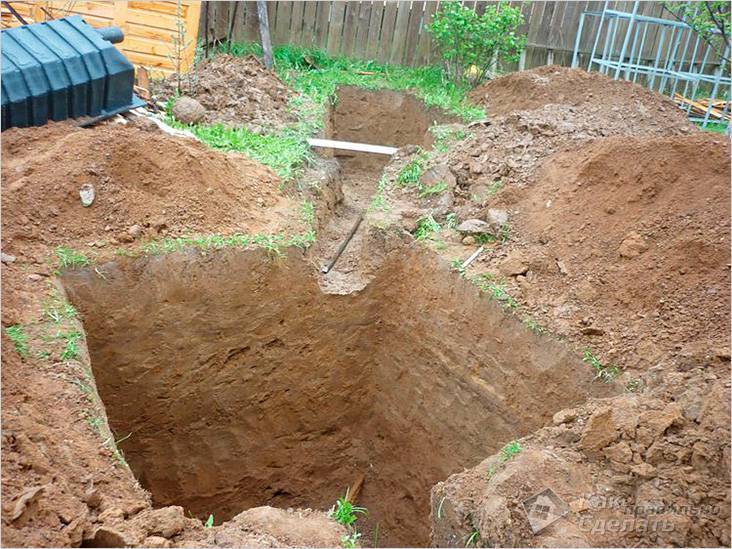 The foundation pit is ready
If you have decided on a place, you can get to work. Installation of a septic tank begins with digging a pit. Its dimensions should be slightly larger than the containers themselves. On the sides it is worth leaving 20-30 cm - for backfilling. Also, the depth must be increased by the thickness of the pillow (20–30 cm). Sand after backfilling must be carefully compacted.
Find out the depth of groundwater. If it is too close to the surface, then more work needs to be done. On the sand cushion you need to lay a concrete slab or sand-cement screed solution.
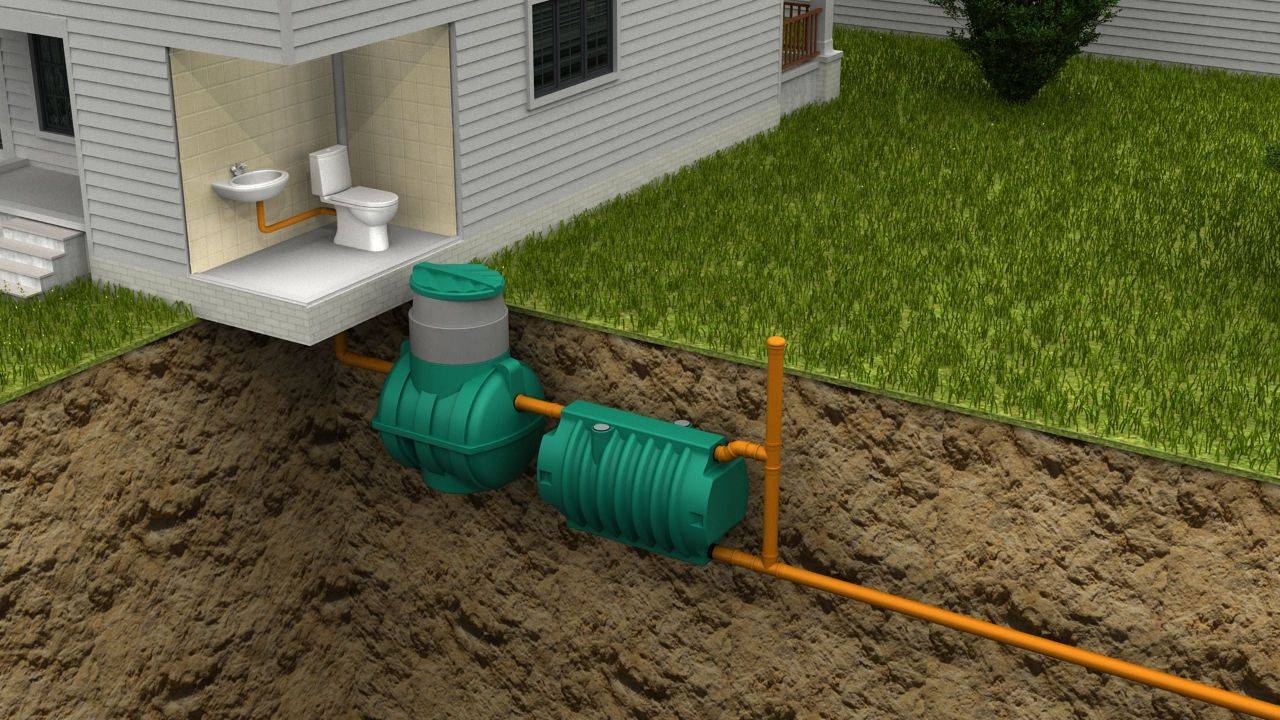
Now you should dig trenches for sewer pipes. Dig sections from the house to the septic tank, and from the septic tank to the infiltrator. Their depth should be sufficient to create the desired slope. In order for the drains to flow by gravity, a slope of 1-2 degrees is needed.
If there is no concrete screed at the bottom, then it is advisable to make a base for installing a septic tank. Gravel can act as such. The thickness of such a layer should reach 40 cm.
 Diving into the hole
Now it's time to lower the septic tank structure into the pit. Installation takes place manually or with the help of equipment. Everything will depend on the volume of containers. When lowering, make sure that there are no distortions, this can reduce the efficiency of the septic tank. If a slab or screed is installed at the bottom of the pit, you need to fix the body of the septic tank with braces or straps. The next step will be the installation of sewer pipes and their connection to the septic tank. The trenches under the pipes are covered with a mixture of sand and soil. Make sure that there are no large stones and hard pieces of earth in the material used for backfilling.
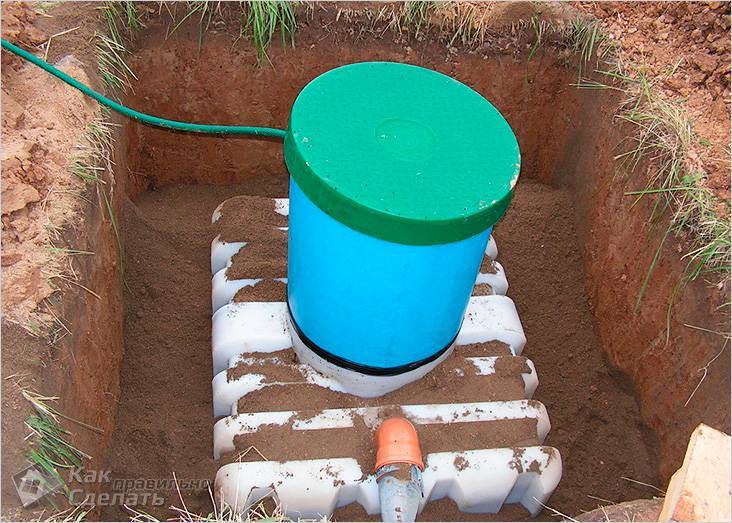 Backfill
Now we start backfilling the pit. To do this, we use a mixture of sand and cement in a ratio of 5 to 1. Backfilling occurs in layers of 20–30 cm, followed by tamping. All work is done only by hand. When using technology, the walls of the septic tank can be damaged.
To prevent the septic tank from deforming, it must be filled with water. But this is also done gradually, as the pit is backfilled. It is necessary to ensure that the water level in the containers is 20 cm higher than the level of the poured mixture.
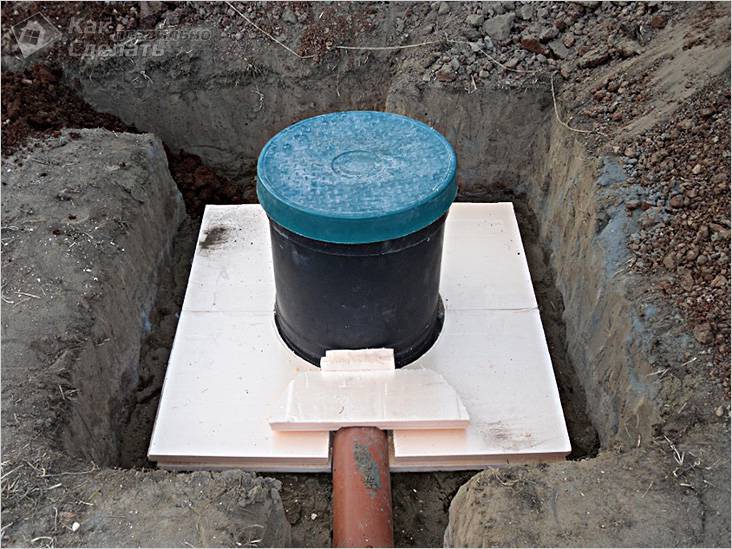 Warming
Before the final filling, the septic tank must be insulated.
Why can a septic tank pop up?
If we compare the design of the Tank and other septic tanks, then the Tank does not require anchoring the bottom of the pit, and in many cases the bottom does not need to be concreted. We are talking about clay and rocky soils. If the septic tank is properly filled with a mixture, and the mixture is compacted, then it will not float.
If you have on the site groundwater comes close to the surface, then you can make drainage around the septic tank, protecting it from flooding.
Many people think that in the spring, when the groundwater level rises, a bulky septic tank can simply float up. This will definitely happen if it was of poor quality and loosely fastened, and also if you left it incomplete or even empty for the winter.




In winter, if you do not use the sewer, follow the above points so that the bacteria do not die. And the vital activity of bacteria automatically raises the temperature of the water in the septic tank.
If we add to this the correct backfill, which is also the insulation of the tank, then the septic tank does not float under the action of the forces of heaving of the soil or groundwater. For the winter, it is recommended to leave filled to 30%.
How does a septic tank work?
A septic tank is a special tank that is a replacement for the central sewer system, it is installed in places where it does not exist. This is a great option for installation in a country house, in a country house, cottage, village, in a private house, etc.
In order to understand the features of the functioning of the station, to correctly perform the installation, taking into account all the specifics, and also to choose the most optimal model of the device, it is extremely important to know how the Tank septic tank works. This treatment plant clarifies the sewage that enters it from the bath, toilet and kitchen from all plumbing fixtures by 98%
It allows, as a result of cleaning, to use clarified and disinfected effluents for watering the garden and vegetable garden, fertilizing the soil, washing a car and performing other technical tasks.
Station device
In order to understand how the Tank septic tank works, you need to familiarize yourself with its device and the principle of operation, which provide effective purification and processing of wastewater. It is the device and principle septic tank work are key to the effective functioning of the system.
The design qualitatively copes with the breakdown of body fat, fecal matter, food debris, small debris and other types of sewage. How is a septic tank arranged? This is most often a two-chamber or three-chamber settling tank, which has soil additional filtration. The station has a strong and reliable body, has an average wall thickness of 15-16 mm. It consists of several chambers, a floating load, a biofilter and an infiltrator.
The Triton-Plastic LLC company manufactures Tank septic tanks with a rectangular cast body, they have no seams at all. The rectangular shape allows you to save on the installation of the device, as it takes up a minimum of space. Therefore, the installation of a tank septic tank with your own hands is carried out simply and without problems.
The principle of the station
Let's study the principle of operation of the Tank septic tank:
- Sewerage flows through the pipeline from the house from the toilet, bath, shower, sink, bidet, washbasin, dishwasher or washing machine to the first chamber of the septic tank.
- In the first chamber, wastewater passes the first stage of purification. Solid fractions settle to the bottom of the chamber as a result of splitting into organics and inorganics. It is the inorganic that settles to the bottom.
- The water that remains has already been purified by a few percent and is transported further through pipes and overflows to the second chamber.
- In the second chamber, the solid fractions are re-purified.The principle of operation of the septic tank Tank involves the functioning of aerobic microorganisms.
- Further, wastewater is transported to the third chamber, which has a special biofilter with a floating load. Floating loading for a septic tank The tank clears sewage drains for 75%.
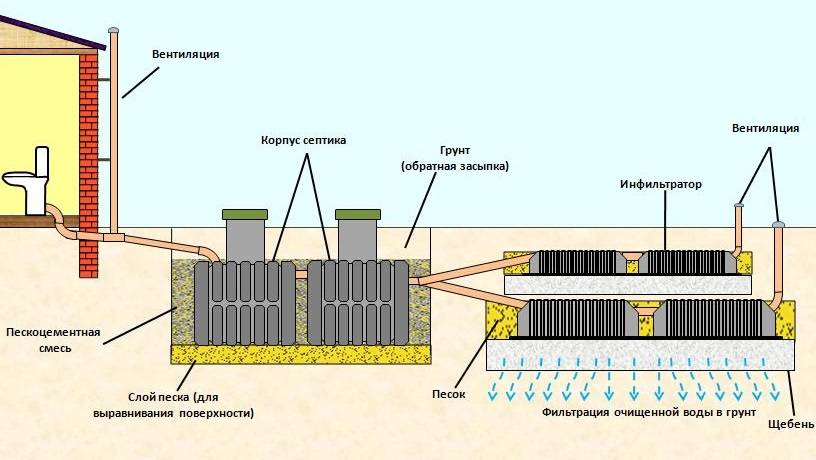
- Effluent was completely cleaned in the tank, then the process involves post-treatment in the soil. For this, a septic tank infiltrator functions. This is a specialized tank that has no bottom, its volume is 400 liters. In order to mount the infiltrator, you must first prepare a foundation pit with a cushion of crushed stone, through which water will be filtered. Gutters, passing cleaning through rubble, will be clarified by 100% and then go outside.
How does a tank septic tank work in winter? The device can be used irregularly, it is not necessary to preserve it in winter. If the load is small, then the accumulated drains will be inside the infiltrator, and then gradually go outside. If there is a peak load on the weekend, the unit will automatically work faster
Since there are several variations of devices, it is worth paying attention to the specifics of the functioning of each of them. For example, the septic Tank Universal has its own characteristics
It suggests the possibility of additional installation of several chambers in which liquid will accumulate.
How does a Tank septic tank work on a site with a high groundwater level? If on site clay or loamy soil, as well as a high level of groundwater, then it is additionally worth mounting a well for pump and check valve, which will pump out water in case of its excess.It is also imperative that the structure is installed on a reinforced concrete floor slab laid in the pit, the septic tank must be anchored by means of belts that are attached to the slab. This will protect the station from flooding and soil erosion. The mouth for a septic tank the Tank is in addition warmed.
How does a septic tank work? How does a tank septic tank work: characteristics, device and principle of operation. Working conditions of the septic tank in the winter, with high and low groundwater levels.
Design and principle of operation
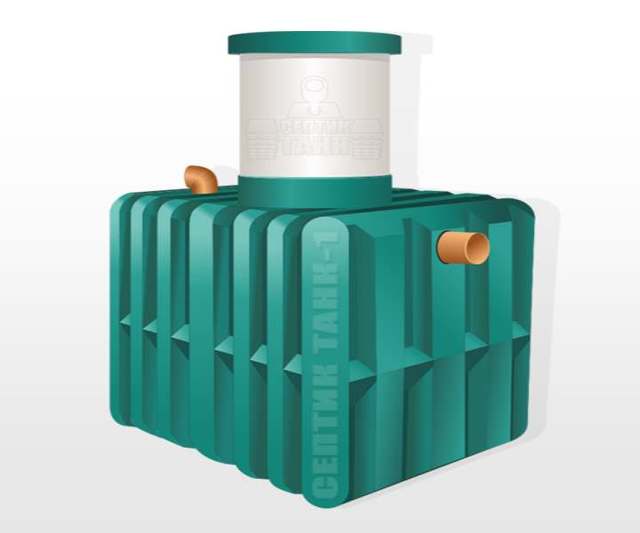
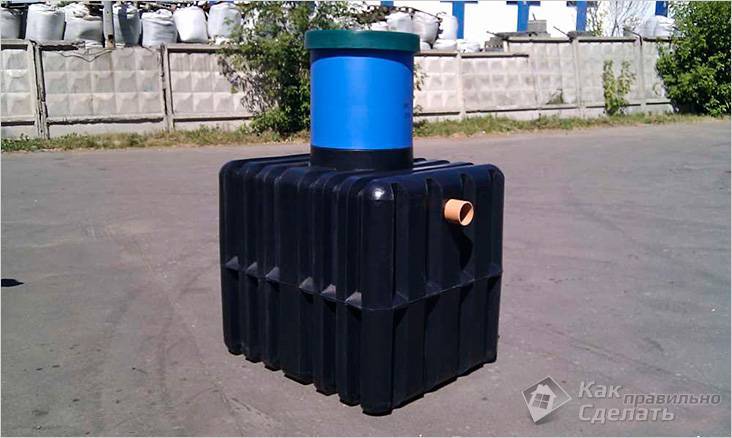
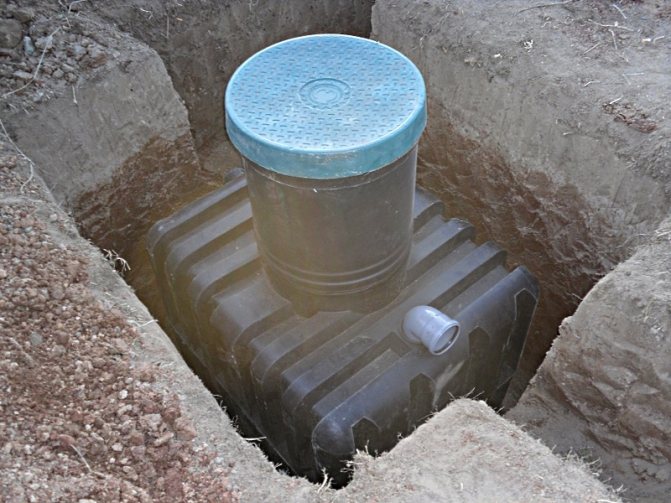
A septic tank looks like a large plastic cube with a ribbed surface and a neck (or two) sticking out above the surface. Inside, it is divided into three compartments, in which wastewater is treated.
The body of this septic tank is one-piece cast, it has no seams. There are seams only at the neckline. This seam is welded, almost monolithic - 96%.
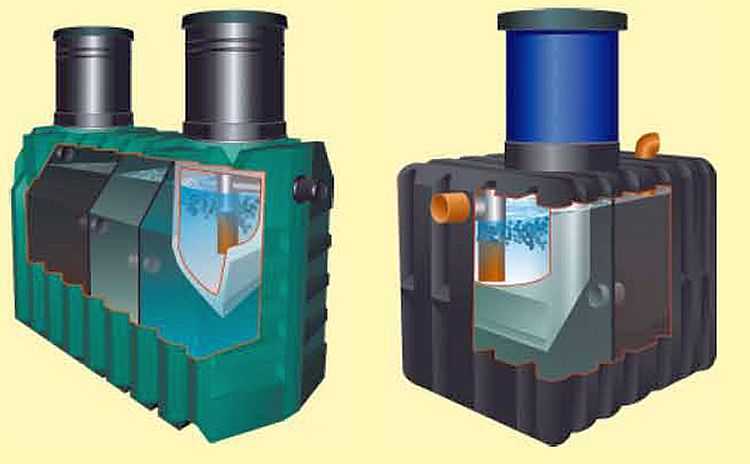
Septic tank: appearance
Although the case is plastic, it is definitely not fragile - a decent wall thickness (10 mm) and additional even thicker ribs (17 mm) add strength. Interestingly, when installing a septic tank, the Tank does not require a plate and anchoring. At the same time, even with a high level of groundwater, this installation does not emerge, but this is subject to the installation requirements (more on them below).


Another design feature is the modular structure. That is, if you already have such an installation, and found that its volume is not enough for you, just install another section next to it, connect it to the already working one.
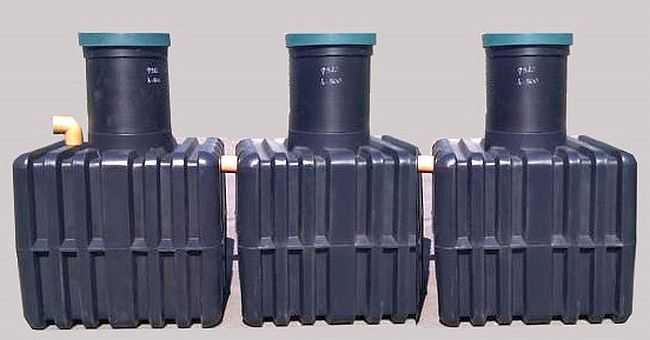
The modular structure allows you to increase the capacity of the Tank septic tank at any time
Principle of operation
A septic tank works in the same way as many other similar installations. The procedure for wastewater treatment is as follows:
- Water draining from the house enters the receiving compartment.It has the largest volume. While it is filling, the waste decomposes, roams. The process is carried out with the help of bacteria that are contained in the waste itself, and good conditions are simply created in the tank for their vital activity. During the cleaning process, solid sediments fall to the bottom, where they are gradually pressed. Lighter fat-containing dirt particles rise up, forming a film on the surface. The more or less pure water located in the middle part (purification at this stage is approximately 40%) enters the second chamber through the overflow hole.
- In the second compartment, the process continues. The result is a cleansing of another 15-20%.
-
The third chamber has a biofilter at the top. In it there is an additional treatment of effluents up to 75%. Through the overflow hole, water is discharged from the septic tank for further purification (into the filter column, into the filtration fields - depending on the type of soil and groundwater level).
Not a bad exit
As you can see, there are no difficulties. With proper installation and operation, the Tank septic tank works flawlessly - it does not depend on electricity, so it is not afraid of frequent power outages in rural areas. Also, the installation tolerates an uneven usage schedule, which is typical for summer cottages. In this case, the flow of effluents on weekdays, as a rule, is minimal or absent, and reaches a maximum on weekends. Such a work schedule does not affect the cleaning result in any way.
The only thing that is necessary for dachas is conservation for the winter, if accommodation is not planned. To do this, it is necessary to pump out the silt, fill all the containers with water by 2/3, insulate the top well (fill in leaves, tops, etc.).In this form, you can leave to winter.
Operation features
Like any septic tank, the Tank does not respond well to a large amount of active chemicals - a one-time supply of a large amount of water with bleach or a chlorine-containing drug kills bacteria. Accordingly, the quality of purification deteriorates, an odor may appear (it is absent during normal operation). The way out is to wait until the bacteria multiply or add them forcibly (bacteria for septic tanks are commercially available).
| Name | Dimensions (L*W*H) | How much can clear | Volume | Weight | The price of a septic tank Tank | Installation price |
|---|---|---|---|---|---|---|
| Septic Tank - 1 (no more than 3 people). | 1200*1000*1700mm | 600 sheets/day | 1200 liters | 85 kg | 330-530 $ | from 250 $ |
| Septic tank - 2 (for 3-4 people). | 1800*1200*1700mm | 800 sheets/day | 2000 liters | 130 kg | 460-760 $ | from 350 $ |
| Septic Tank – 2.5 (for 4-5 people) | 2030*1200*1850mm | 1000 sheets/day | 2500 liters | 140 kg | 540-880 $ | from 410 $ |
| Septic Tank – 3 (for 5-6 people) | 2200*1200*2000mm | 1200 sheets/day | 3000 liters | 150 kg | 630-1060 $ | from 430 $ |
| Septic tank – 4 (for 7-9 people) | 3800*1000*1700mm | 600 sheets/day | 1800 liters | 225 kg | 890-1375 $ | from 570 $ |
| Infiltrator 400 | 1800*800*400mm | 400 liters | 15 kg | 70 $ | from 150 $ | |
| Cover D 510 | 32 $ | |||||
| Extension neck D 500 | height 500 mm | 45 $ | ||||
| Manhole for pump D 500 | height 600 mm | 120 $ | ||||
| Manhole for pump D 500 | height 1100 mm | 170 $ | ||||
| Manhole for pump D 500 | height 1600 mm | 215 $ | ||||
| Manhole for pump D 500 | height 2100 mm | 260$ |
Another of the features that must be taken into account is not to flush waste into the sewer that does not decompose by bacteria. As a rule, these are wastes that appear during repairs. Not only can they clog the sewer, and you will have to clean it, but these particles significantly increase the amount of sludge, and you will have to clean the Tank septic tank more often.
Septic Tank 1
All tank treatment facilities differ from each other only in performance. Septic Tank 1 can be called a country option. The number that is present in the name indicates the volume of the tank, which is 1 m³ (for those who love accuracy - 1.2 m³).
This model refers to non-volatile installations for the treatment of domestic wastewater. A distinctive feature of this particular model is the combination of efficient performance and low price.
Septic tank design
The design of the septic tank is as simple as possible - a container with internal partitions that divide it into several compartments. The body of all septic tanks Tank is highly durable. This is due to the polymer body and numerous stiffeners. Due to this, the design can withstand heavy loads.
There are no complicated mechanisms inside the container, everything is simple, but well thought out. The inner tank is divided by plastic partitions into three parts, which are connected by overflows. Due to this, the water has time to settle and is freed from heavy impurities.
The device of the septic tank Tank 1 is as follows:
- The first chamber is a receiver and a primary clarifier,
- The second chamber is a secondary sump. Getting rid of small particles that did not settle in the first compartment,
- The third chamber is a biofilter. Here the liquid is released from the smallest particles.
Except mechanical wastewater treatment, in tank septic tanks biological treatment is also possible. Special bacteria are added to the container, and with their help, anaerobic (without oxygen) cleaning takes place.
The principle of operation of the septic tank Tank 1
Flowing from compartment to compartment, the liquid undergoes multi-stage purification. In the first chamber, insoluble particles settle to the bottom, and purified water enters the second.In it, the liquid also settles, getting rid of heavier particles.
After that, the effluents flow into the third compartment with a biofilter. The third tank uses a floating load, which filters out coarse impurities. Ultimately, 50-70% purified water enters the soil.




Characteristics of the septic tank
Septic Tank 1 has low productivity and is more suitable for a summer residence or a small family. Due to its small dimensions, it does not require much space:
- Size - 1200 × 1000 × 1700 mm,
- Volume — 1000 l,
- Productivity per day - 0.6 m³,
- Weight - 85 kg.
In addition, it is possible to install additional equipment:
- Adjustments on the neck, allowing you to set the septic tank to the desired depth,
- tank and pump.
Installation of a septic tank Tank 1
Any mistakes made during the installation of septic tanks can lead to their unstable operation. Therefore, it is better if specialists are engaged in this process.
- Preparation of the pit - leveling the bottom with a layer of sand 30 cm,
- Installation of a septic tank by level, exactly in the middle of the pit,
- Sewerage connection - pipes are laid and connected to the inlet drains from the house and the discharge of purified water from the septic tank,
- Backfilling of the pit - the gap between the walls of the pit and the body is filled. The backfill is made with a mixture of sand and cement, while the septic tank must be filled with water above the backfill level,
- The top of the installation is insulated and covered with soil.
Septic tank operation
In order for the treatment plant not to cause trouble, it is necessary to adhere to certain rules during its operation:
- Although the installation is not whimsical to the quality of sewage, it is still worthwhile to refrain from dumping into it substances that cannot be recycled (rags, bags and other garbage),
- With a frequency of at least 1 time per year, it is necessary to pump out the sediment from the bottom of the chambers,
- If the septic tank is installed in the country house and is not used in winter, it must be cleaned of sediment and filled with water by ¾. To prevent freezing water from damaging the body, wooden logs or a couple of plastic bottles with sand are placed inside on ropes.
Advantages of the model
Some of the benefits of this dress include:
- simple, reliable and efficient device,
- small size does not require a lot of space,
- ease and time of installation,
- no electricity required
- low cost.
Conclusion: Septic Tank 1 is a compact device that is optimally suited for installation in a summer cottage or for a small house in which no more than 3 people live. The treatment plant of this model is reliable and easy to operate, the cost of which does not exceed 30,000 rubles.
Septic Tank 1 An article about what the Tank 1 septic tank is like, its characteristics, principle of operation, design features, as well as how it is installed.



