- Features of operation of the heater with GSM control
- District heating control
- Tips for organizing remote control of heating
- Remote control of the boiler using multifunctional thermostats
- Algorithm for controlling heating in a separate zone
- Types of remote control heating systems
- Using the power of the Internet
- Advantages of remote control
- Features of use in a private house
- How to connect the controller to the heating boiler with your own hands
- What are GSM modules for heating boilers
- What is it for and how is it used
- Device and principle of operation
- How to connect?
- Elements of the gas boiler control circuit
- The best known manufacturers and models: features and prices
- "Boiler OK"
- KSITAL GSM 4T
- EVAN GSM CLIMATE
- ZONT H-1V
- Elements of the heating control system
- Remote control of a gas boiler
Features of operation of the heater with GSM control
The interface of the device is simple and clear, with its help you can set the following operating modes:
- disabled;
- comfort;
- economy
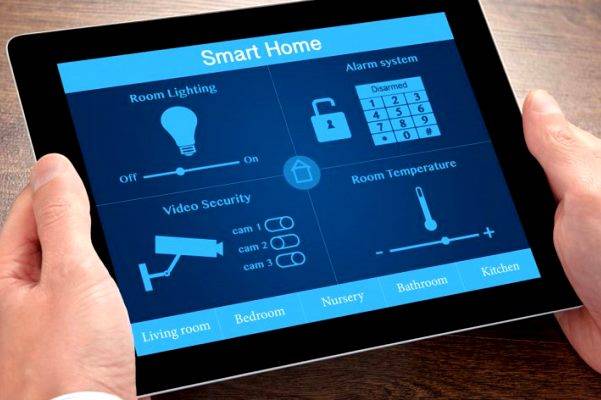
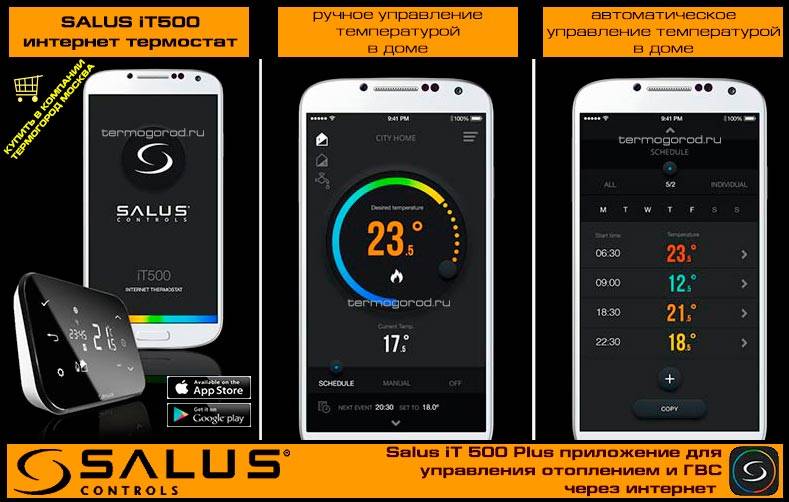
When the weather changes, the user of the gsm module can remotely change the air temperature throughout the house using a special application on a tablet (phone)
In particular, users note the convenience of turning on the boiler and raising the temperature of the working fluid some time before coming home. To do this, you need:
- send an SMS message with the required command (that is, you need to turn on the boiler);
- set the desired temperature.
All the necessary commands will be transmitted by the controller, taking into account the received settings and data from the temperature sensors.
District heating control
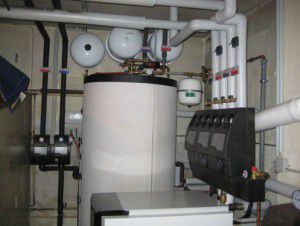
Heating control unit in an apartment building
For district heating, the control scheme will be much more complex. It may include several nodes - an equipped heating control cabinet in the central boiler room, a heat carrier distribution unit in an apartment building.
In this case, heating control via the Internet is practically not used. The exceptions are heat meters, which transmit the readings of the coolant flow directly to the management company.
In turn, it is not important for the consumer to know the features of the arrangement of heating control. Each heat consumer in an apartment building must be familiar with the norms for providing heat supply to residential buildings:
- The temperature range in residential premises is from +18 to +22 ° С;
- Perhaps the excess heating should not be more than 4 ° C;
- Decrease in temperature - not lower than 3 ° С.
If these readings go beyond the value of the norm, you must contact the management company. A systematic violation of the heating operation may be due to outdated control equipment.The only way out is to install an electronic district heating control unit.
An example of the installed heating control can be found when watching the video:
Tips for organizing remote control of heating
Scheme of connecting modules to the heating control unit
In most cases, you can make a cottage heating control system yourself. This is only possible with the right choice of system components. Those. first you need to analyze the condition and capabilities of the equipment already installed.
The classical scheme of the heating system control unit has one control unit, which is connected to all elements of the heat supply. The programmer must meet the following requirements:
- The number of connected terminals and their configuration must match with similar communication units of the boiler and thermostats. Otherwise, SMS heating control will not be possible. If necessary, adapters are purchased;
- The maximum distance of the user from the control unit. If this distance does not exceed 300 m, you can purchase models with mine management. To increase the communication area, it is recommended to use heating control by mobile phone or the Internet;
- The ability to independently (or with the help of specialists) set additional operating parameters. This is done with a controller based on heating control boards;
- Connecting the autonomous power supply unit. This requires a sufficiently large control box for the heating system. This parameter is taken into account when choosing the installation location of the control unit in the house.
Do not forget about the possibility of controlling heating radiators.This can be done with the help of local devices - mechanical temperature controllers. They have a low cost, but cannot be connected to a common electronic control system.
Remote control of the boiler using multifunctional thermostats
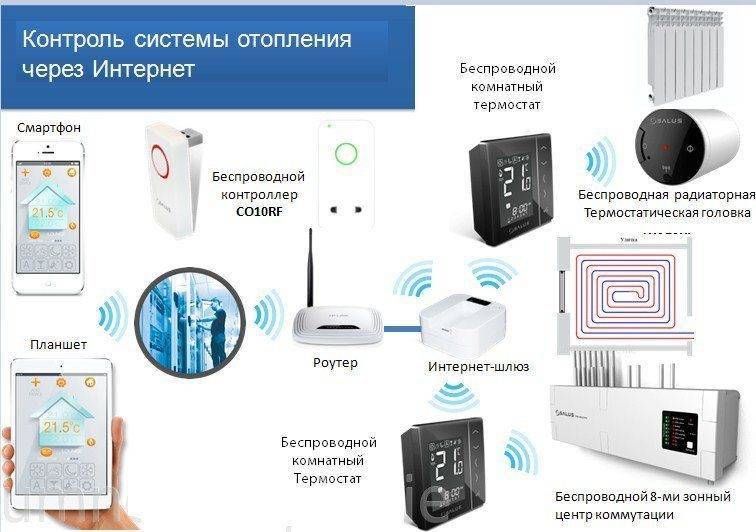
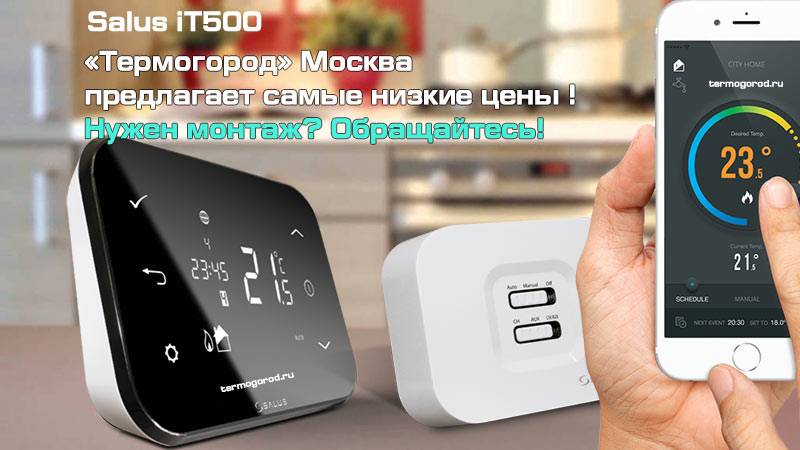
When the house has an outdated heat supply system without any hint of the possibility of connecting electronic components, there are no three-way valves and other automatic equipment - universal thermostats can be purchased on the market, which are easily combined into an extensive system into many zones with the ability to control heating via the Internet.
The set of such equipment includes an electronic controller, where all the settings for each zone take place.
It is also a WI-FI transmitter-receiver and through this channel "communicates" with electronic thermostats installed on each battery.
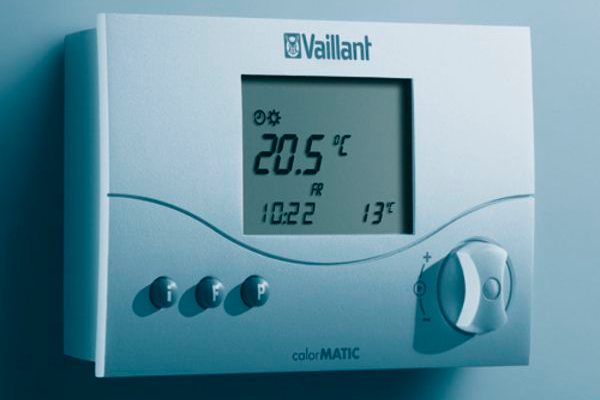
Remote control of the boiler using the Vaillant programmer
By a separate channel, it has a connection with the boiler shutdown unit. The heating parameters can be changed both on the controller itself manually and via the Internet channel.
Algorithm for controlling heating in a separate zone
- We measure the air temperature in the controlled area.
- Compare the measured temperature with the setpoint for the given zone. If the measured value is less than the setting , then we open the drive of the zone circuit and send the heat request to the boiler, otherwise we close the drive of the zone circuit and remove the heat demand for the boiler.
This is the easiest way to control (on/off). Instead, a PID controller with a discrete output (the so-called slow PWM) can be implemented.It should be kept in mind that the average opening and closing time of a thermoelectric actuator is about three minutes. Therefore, the PWM frequency must be less than 10 cycles per hour (usually a 10 minute cycle).



Types of remote control heating systems
In addition to the remote boiler control systems presented - using the Internet and using cellular communications, there is a third type, which is called combined. In this case, remote control over the heating boiler can be carried out in any convenient way, both using the Internet and using a mobile phone.
This system has the following modes of operation:
- Automatic - here the gsm controller for the heating boiler executes a number of specific programs, processing information received from external sources.
- SMS - works by transferring the parameters of the temperature sensor to the phone in the form of SMS messages, in this case the controller for the boiler sets up the heating system using the input data.
- Warning - sends alarm SMS in case of critical situations.
- Provisioner - performs remote coordination of related devices, such as heating elements for heating water, a thermostat for electric heaters, an electric boiler control unit or a gas boiler control board.
The equipment for the presented remote control system has the highest cost. However, in this case, remote control can be carried out in any convenient way and from any location.
Using the power of the Internet
If the gas boiler is located where there is Internet, then you can connect a thermostat to it that can work online. Moreover, the system works automatically if the temperature in the room drops. Information regarding the operation of the system is sent to the host via the router.
The owner monitors the operation of the heating system via a smartphone. If necessary, he can always make the necessary adjustments to the executable program. But when using this option, high-speed Internet is required both from the side of the user and from the side of finding the equipment.

Using the Internet allows you to:
- perform real-time data synchronization;
- keep the owner informed of any problematic situations.
The following video tells in more detail about one of the gas boiler control systems via the Internet:
Advantages of remote control
Not all users of household appliances are supporters of new technologies. Many are quite satisfied with the usual mechanical control - simple, affordable, without unnecessary "bells and whistles".
But before drawing final conclusions, we suggest considering the advantages of "smart" equipment, which not only makes life easier and more comfortable, but also allows you to significantly reduce costs.
The main advantage of remote control of a gas boiler is hidden in the method itself: you do not need to be constantly present in the house, “communication” with the equipment occurs at any distance.
Moreover, it is two-way - you send commands to the unit that it executes and, in turn, notifies you of the current parameters and instantly signals failures and irregularities in operation.
Users who have successfully "tested" the remote control system highlight the following advantages:
Increasing the service life of the boiler due to the optimal choice of mode, reducing the number of shutdowns / on/off, in general - more careful use.
A long-term absence no longer threatens to return to a cold cottage - you can set the desired temperature on the way home.
If outdoor weather sensors are installed, you don’t even have to intervene in the operation of the boiler during a thaw or frost - the temperature will be automatically adjusted.
At a distance, you can choose a more comfortable "night" mode for sleep.
If an emergency occurs or any part fails, you will know about it right away.
Of course, much depends on the nuances of installation and the complexity of the heating system.
The advantage is that from a smartphone you can manage not only the simplest, but also an extensive network - with radiator or convector heating, a "warm floor" system.
Some functions of the system are launched automatically, that is, you do not even need to select the mode on the phone - the equipment will automatically switch according to the signals from the sensors.
Features of use in a private house
Their presence is explained by the fact that two-pipe systems are used in such buildings. In them, the circulation pump pumps liquid, which is supplied through the distributor to each heater.
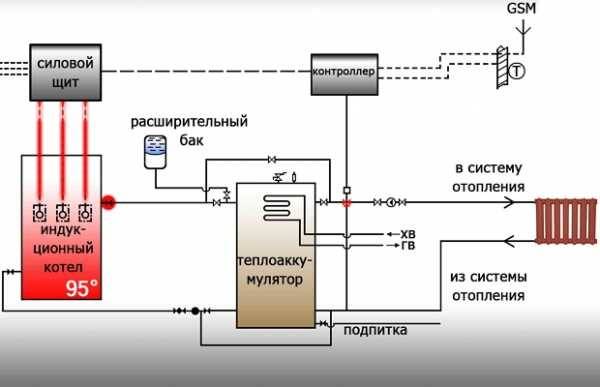
Photo 1. A possible heating scheme for a private house from an induction boiler with a controller.
In such cases, a safety block is used with the controller to protect the heating system from various emergency situations.And also additional sensors for adjusting the flow of liquid (coolant), special valves are used.
In the house, you can use thermostatic valves or room temperature controllers. The first allows you to set the desired mode to any source, and the second is responsible for the operation of the pump that supplies the coolant to the radiator.
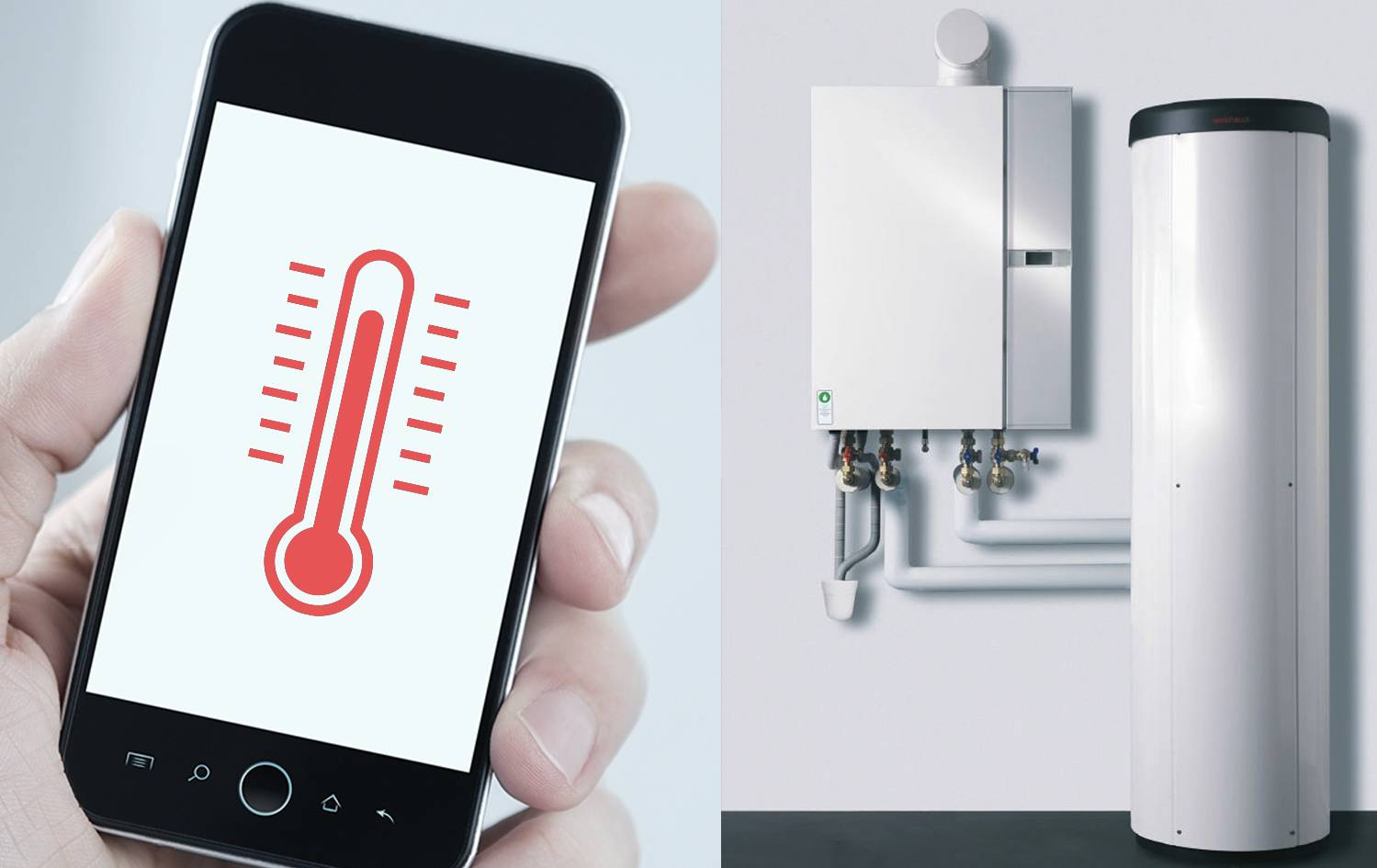
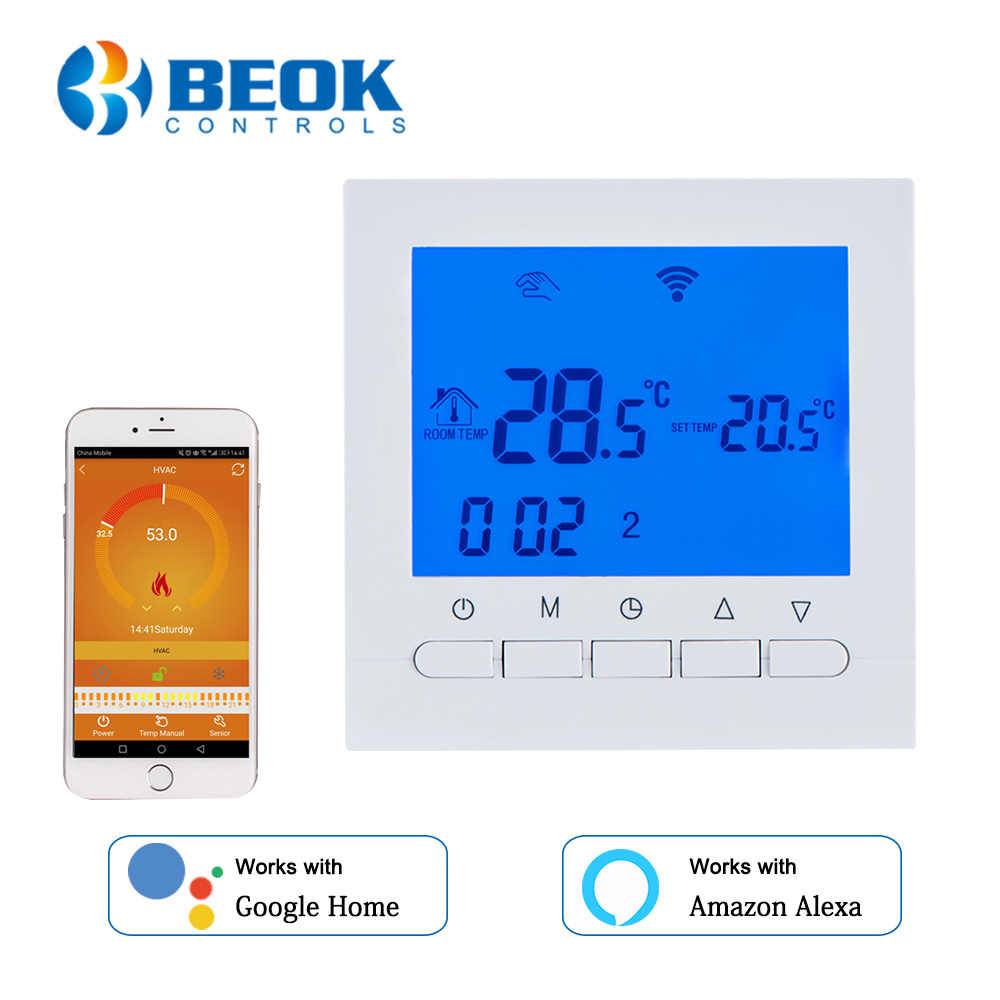


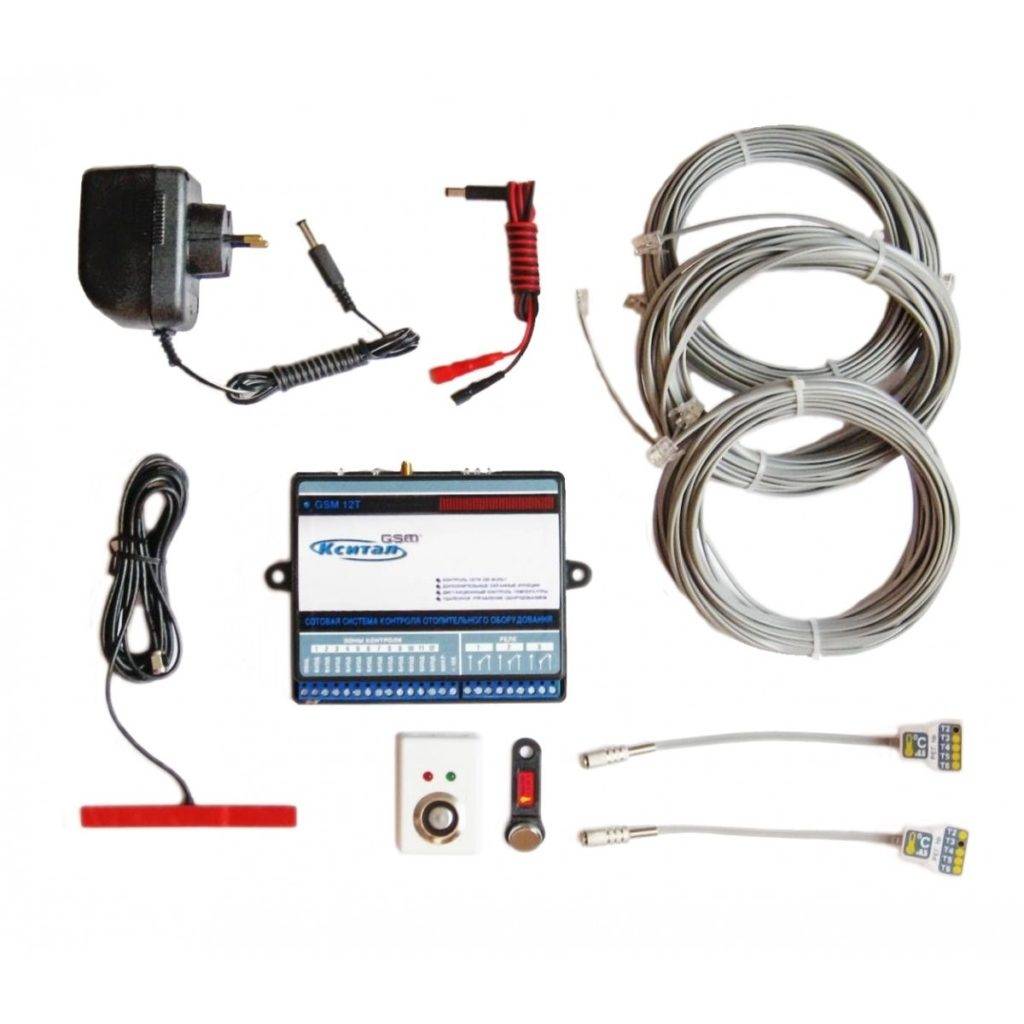

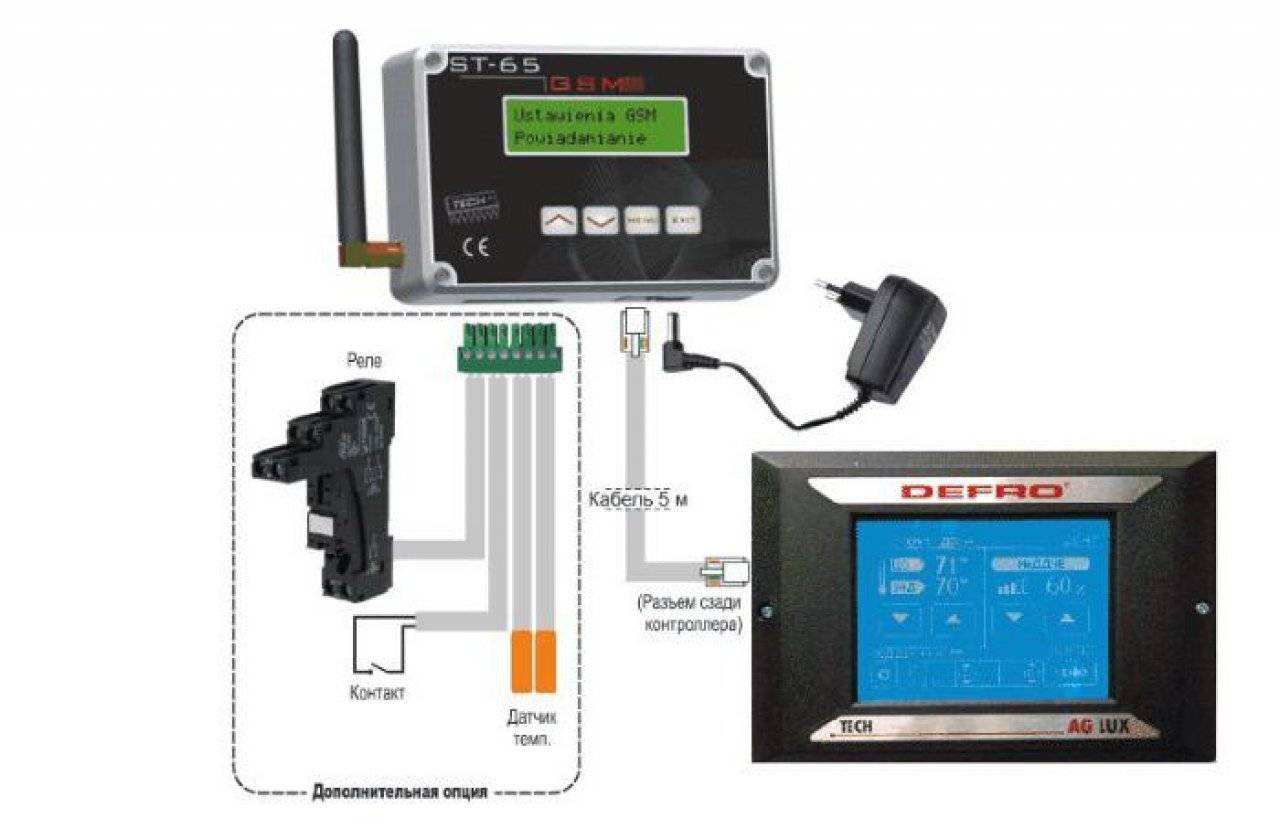
If there is no Internet in a private house, then a GSM module is used, which allows you to control the situation via a smartphone.
How to connect the controller to the heating boiler with your own hands
Pay attention to the nuances when installing the controller:
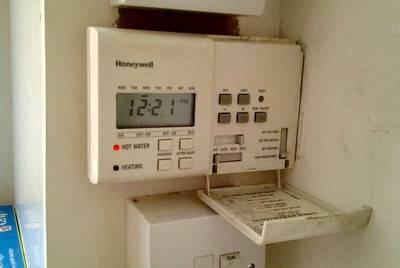
- avoid its contact with direct sunlight;
- isolate from all electrical appliances;
- carry out the process at a height of at least 1.5 m from the floor;
- provide a constant flow of air, avoiding drafts.
The controller with your own hands can be connected in two ways:
- using the terminal on the boiler;
- using the regulator cable.
Important! Such a process should not be carried out in the kitchen or in the bathroom, because due to a possible increase in temperature, malfunctions of the thermostat are permissible. Almost every boiler has special contacts for connecting a controller to it. You need to find this place and remove the jumpers and connect the thermostat
How to set up the device itself and start its operation is indicated in the instructions.
You need to find this place and remove the jumpers and connect the thermostat. How to set up the device itself and start its operation is indicated in the instructions.
Almost every boiler has special contacts for connecting a controller to it. You need to find this place and remove the jumpers and connect the thermostat. How to set up the device itself and start its operation is indicated in the instructions.
What are GSM modules for heating boilers
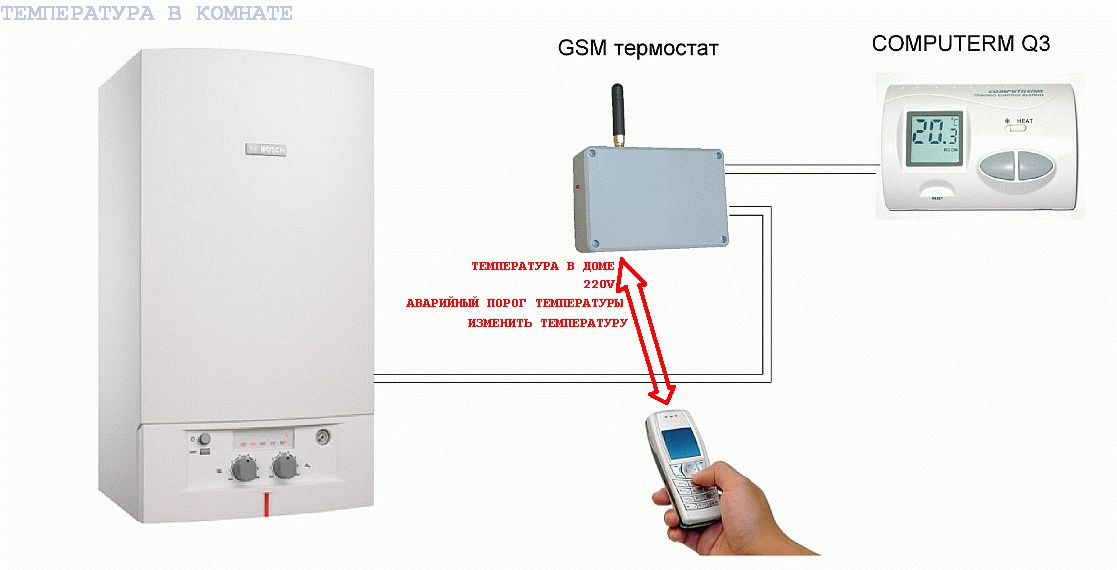
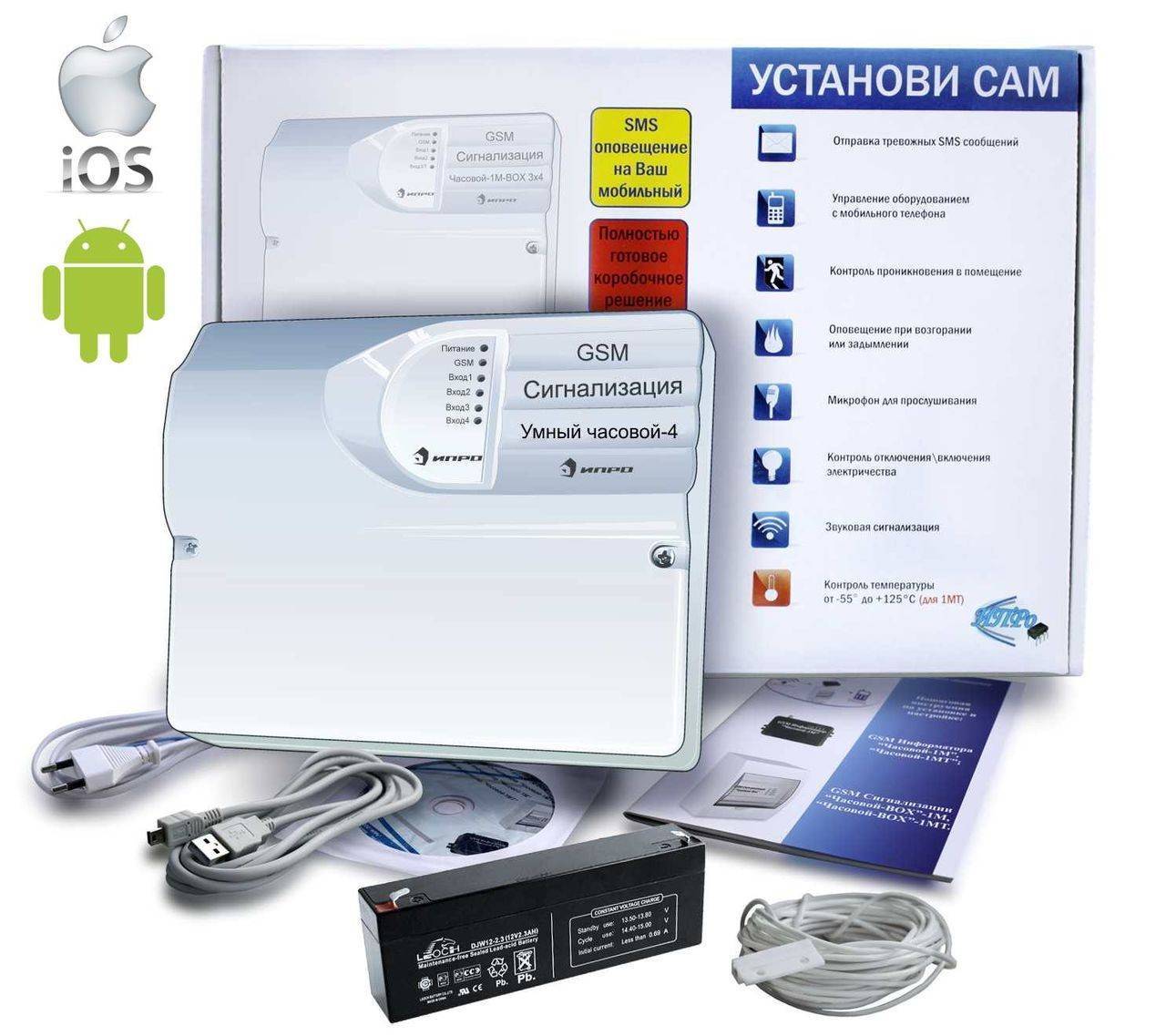
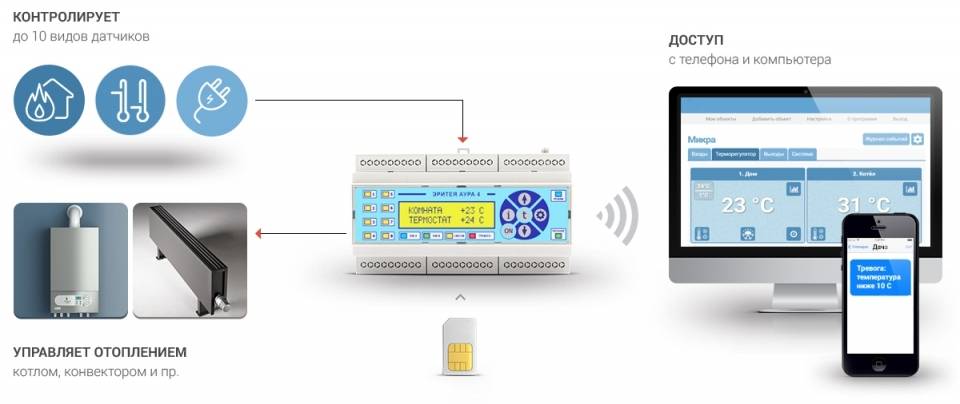
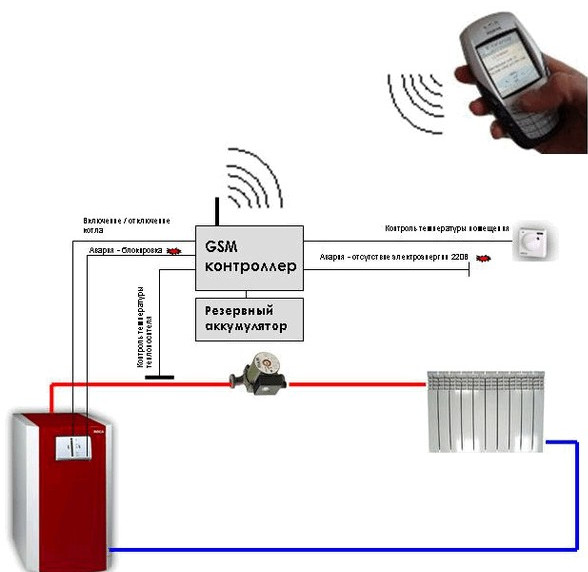
The GSM-module is a small device (controller), which, in fact, represents an alternative to the controls and automation of the boiler. It receives a signal via cellular communication and transmits a command to the boiler or in the opposite direction: it informs about the status and operating parameters of the boiler and the heating system as a whole.
What is it for and how is it used
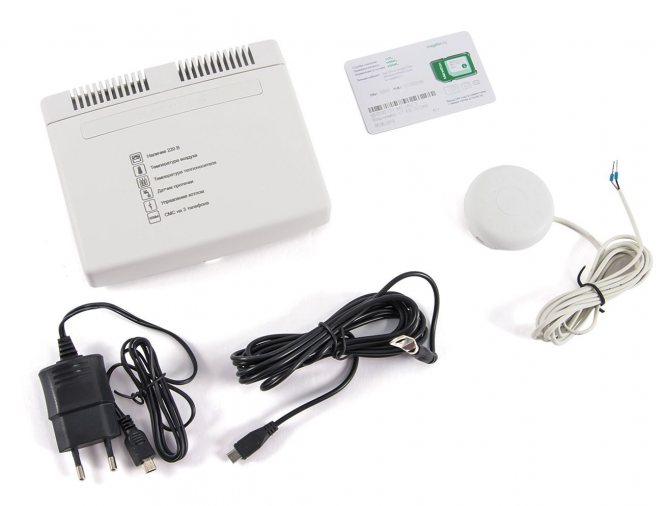
Usually, the primary purpose of buying a device is to save and increase the comfort of operating the heating system. Any GSM module allows:
- turn on or completely turn off the heating boiler;
- manage the temperature, for example, lowering the temperature during absence in order to save significant money and restoring the comfort mode even before arriving at the house;
- manage the temperature parameters of the DHW circuit;
- external thermal sensors included with almost any modern module allow to more accurately maintain the temperature regime by measuring the air temperature in the room, and not the temperature of the coolant. It is also possible to organize the weather-dependent operation of the boiler.
But no less important, in our opinion, and indeed a higher priority for some buyers, the purpose of the acquisition is safety. The GSM module is capable of notifying:
- on reaching the lower or upper specified temperature limit;
- about turning off the heating boiler due to a lack of electricity or gas supply, problems with the removal of combustion products, automation errors, system depressurization, etc.Often this is a rather underestimated feature that allows you to be calm during a long departure and, in the event of a malfunction, take timely measures to prevent freezing and damage to the heating system;
- it is possible to set temperature alerts and other boiler parameters with a certain frequency.
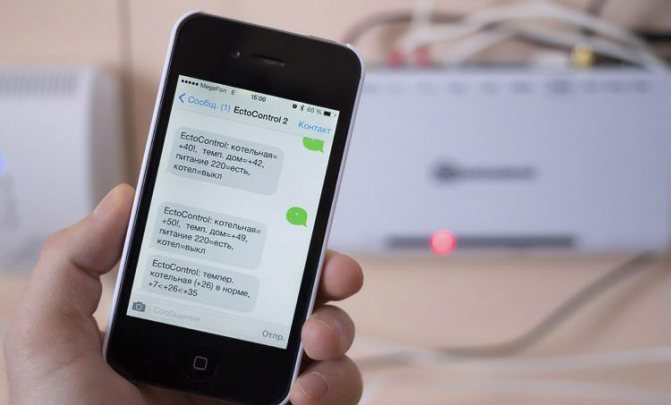
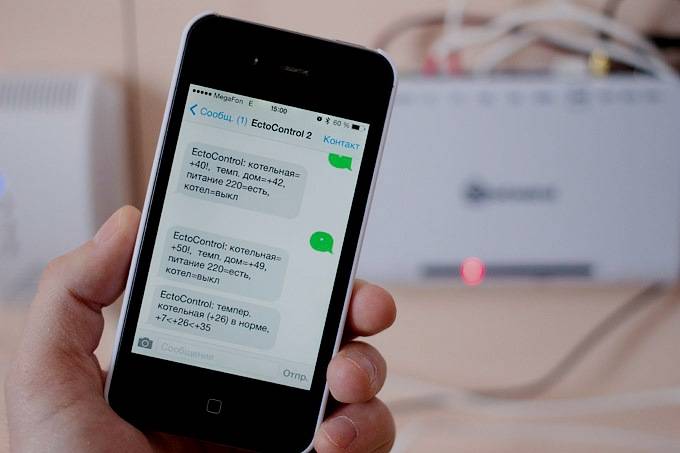
An example of an SMS report on the status of the heating system of the EctoControl module. Notifications and control from the phone can be carried out using SMS and, depending on the functionality of a particular model: through a special application, web interface or voice commands. The GSM-module can be connected to any boiler that has the ability to connect an external control (having the appropriate terminals), both gas, electric or liquid fuel, and solid fuel.
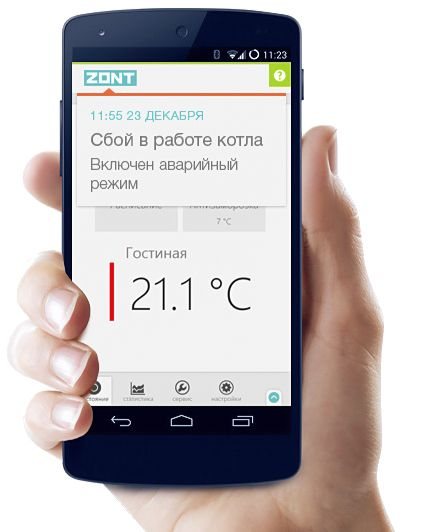
Boiler failure message using the ZONT H-1V module application as an example.
Almost all modern models allow you to bind at least 2, but usually up to 5 or 10 numbers to the controller and report to each of the attached ones. Modern devices, due to the ability to connect other modules to them, allow organizing even wider functionality: monitoring the level of liquid and even solid fuels (for example, pellets in an automatic feed bin), monitoring the status of flow sensors and carbon monoxide, monitoring pressure in circuits.
Device and principle of operation
The main element is the controller (electronic control board). It has a slot for a SIM card, without it the device will not work. Depending on the planned method of management and control, it is necessary to choose the most profitable mobile operator and tariff, constantly maintain the operation of the SIM card by replenishing the account.Regardless of the command transmission method, the controller receives it via cellular communication and converts it into a command for the boiler, which is a priority over the operation of standard automation.
To improve the quality of communication, the controller can be supplemented with an antenna. To ensure uninterrupted operation during a power outage, most models are equipped with a built-in battery, so they can send an alert about the problem without any problems. Almost all modern models are supplied with external temperature sensors (wired and wireless), the information from which is priority over the measurements of the boiler sensors.
How to choose and connect correctly gas boiler generator
How to connect?
To connect and install the gsm module yourself, you need to use the instructions that come with the kit. Installation and start-up of the device is as follows:
- Turn off the heater.
- Remove the protective cover from the boiler.
- Attach the module holder to the wall.
- Insert a SIM card and battery into the module, if necessary.
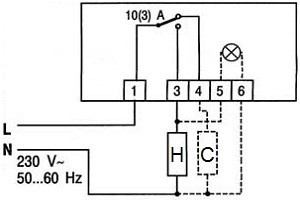
- Connect the gsm-based controller to the socket in the boiler.
- Connect all sensors to the module.
- Plug the device into the network.
- Put on the protective casing of the boiler.
- Connect the boiler to the mains.
It is worth remembering that in order to work on a SIM card, you must choose one of the best mobile operators with good signal quality. When the module is connected for the first time, the user needs to send an SMS to the controller's SIM card with its number.





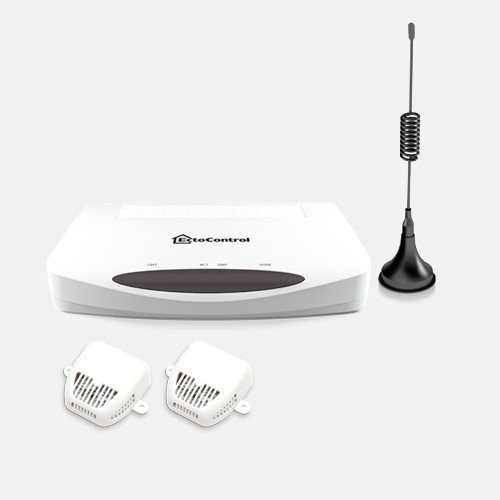
Under the condition of a weak signal, it is necessary to install the antenna that comes with the kit
For a better understanding of the connection process, it is recommended to watch the detailed video to avoid mistakes.
Gsm-modules work perfectly with both electric and gas boilers, they can also function with models in development. The boiler itself must have an output for connecting the controller. Such a device helps to save energy consumption and greatly simplifies the process of controlling the heater.
Elements of the gas boiler control circuit
The electrical circuit of the gas boiler includes blocks of electronic boards and their radio elements. You can consider an example of a diagram of a typical Ariston UNO 24MFFI unit, which displays the location of the boiler elements.
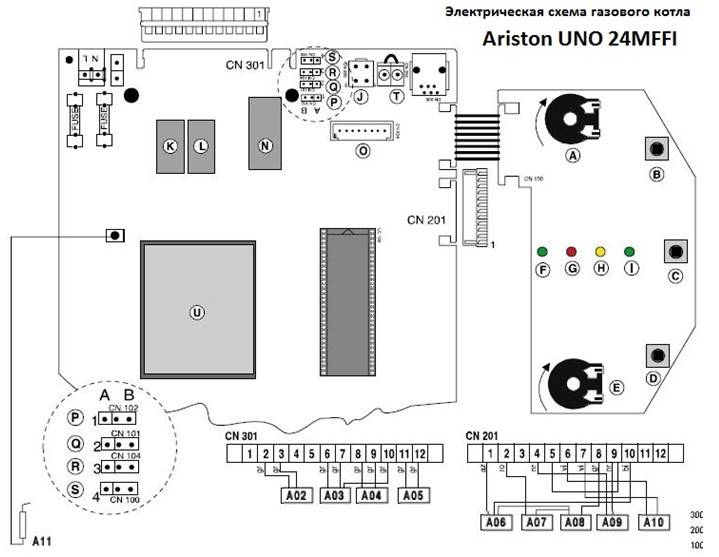
A - temperature regulator.
A11 - flame sensor.
B - a button that allows you to reset the error and reboot the device (Reset).
…
C - on / off (Power).
D - switch to the "Comfort" mode.
E - hot water temperature controller.
F, G, H, I - LEDs that indicate faults or certain operating modes.
J - connector for connecting a thermostat.
K - pump power supply relay.
…
L - three-way valve power relay.
M - fan control relay.
N - gas valve relay.
O - remote control control connector.
P, Q, R, S - jumpers responsible for sparking, ignition, temperature selection and smooth ignition with maximum power.
T - two-wire connector for external thermostat and set temperature control.
U - power supply of the electronic circuit.
Connection CN301 of the terminal block to which the gas valve, circulation pump, transformer and three-way valve actuator are connected.
To the CN201 connector, supply and return water temperature sensors, a chimney sensor, and a water flow sensor are connected.
Connector CN102 in position A is responsible for setting the ignition power of the burner. During the tuning process, the red sensor will blink.





Jumper CN101 on A turns off the ignition delay, in position B - turns on the delay by 2 minutes.
CN104 - sets operation in different temperature ranges: A - 35-45ºC, B - 43-82ºC.
CN100 is responsible for setting the maximum power of the unit.
The best known manufacturers and models: features and prices
"Boiler OK"
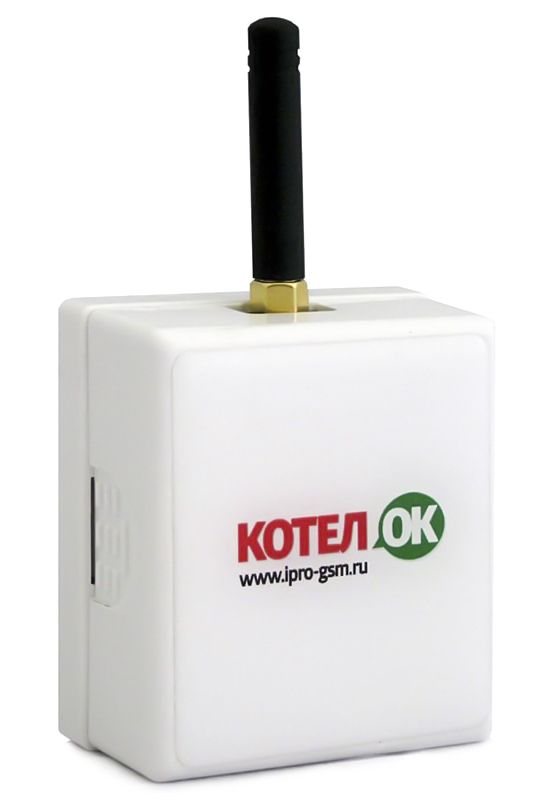
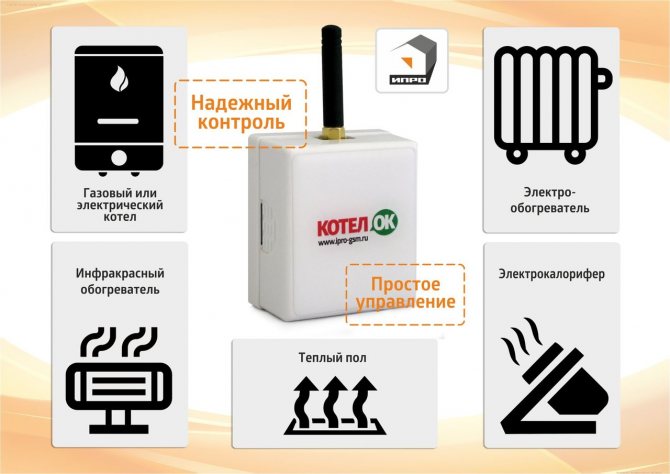
The most demanded on the market, one of the best and most inexpensive GSM-modules for Russian-made heating boilers. In addition to the price, it is distinguished by its compact size, the most simple and easy setup, the presence of an application that can send commands, including in the form of SMS, which is an excellent option that allows you not to use tariffs with Internet access.
The functionality of the device is quite simple, the minimum required: temperature control, setting alerts, checking the parameters of the boiler, and a relay is built into the module that allows you to turn the boiler on and off.
Among the shortcomings, it is worth noting a rather simple application with the minimum necessary functionality and an outdated interface, the presence of an external temperature sensor with a cable length of only 0.5 meters, which does not imply its installation in other rooms remote from the boiler room. The antenna is also not remote, screwed into the device by means of a threaded connection.
Cost: 3 990 rubles.
KSITAL GSM 4T
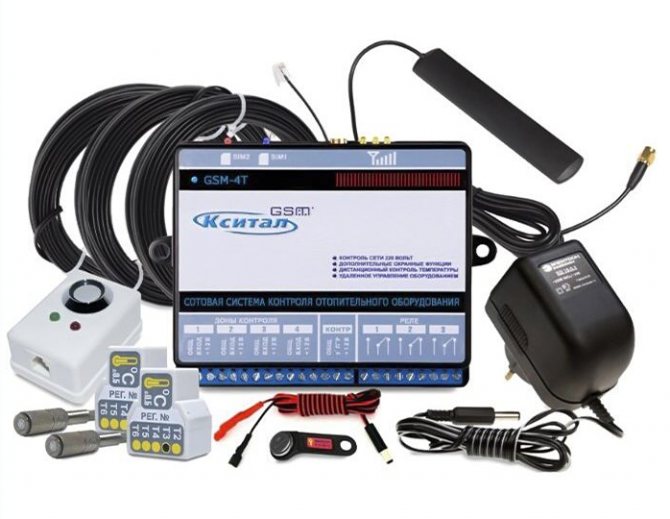
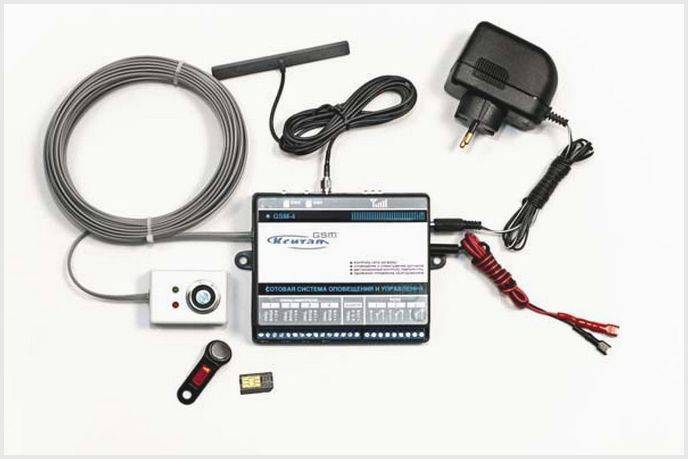
Another well-known, more professional and versatile device with a much richer package.The heating control functionality in it is approximately the same as in the previous “OK Boiler” - the minimum required, however, there are as many as 4 zones for additional devices (flow sensor, smoke, movement, flooding, door opening, etc.). Also included is an electronic key and a reader (similar to those installed in intercoms), so you can only influence the settings, if desired, only with an electronic key.
The main difference is the presence in the set of two remote temperature sensors with a 10 m long wire, as well as a remote wired antenna and a cord for connecting a backup external battery (unfortunately, there is no built-in one). Management and control can be carried out both via SMS and through the application.
The disadvantages, in addition to the lack of a built-in battery, are a poorly functional and inconvenient, albeit understandable, application interface, a less attractive appearance with open terminals, and large dimensions.
Please note that for heating it is necessary to choose a model that has the letter “T” at the end
Cost: 8 640 rubles.
When is a stabilizer indispensable? voltage for gas boiler and how to choose it
EVAN GSM CLIMATE
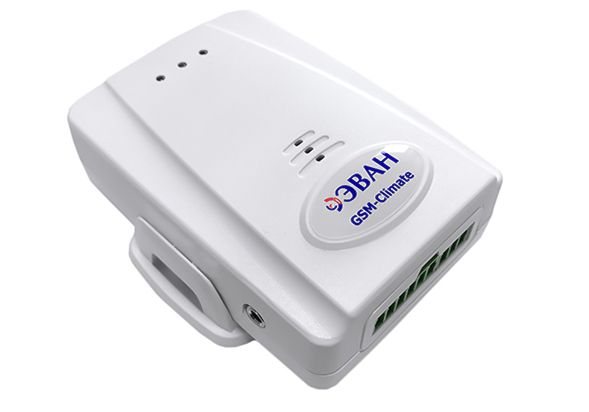
Also known as ZONT H-1, it is distinguished by a more modern and convenient application, with ready-made "Economy" and "Comfort" modes, as well as the ability to program the parameters of the boiler. It is enough to set the boiler operation template once and the module will automatically issue commands to the boiler to change the parameters depending on the time or day of the week. Control via the web interface is also available. The standard package includes one remote temperature sensor and a remote antenna.
Perhaps the only drawbacks are the lack of a built-in battery and only one contact for connecting an external temperature sensor.
Cost: 6 780-8 840 rubles.
ZONT H-1V
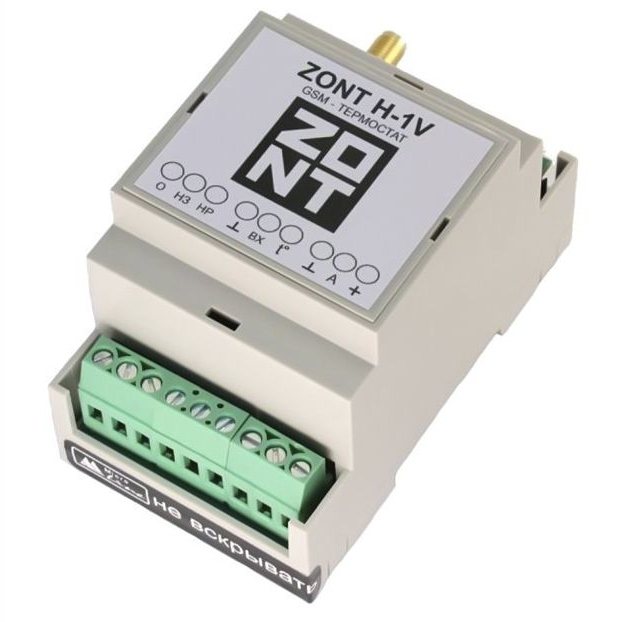
A more advanced analogue of the previous GSM CLIMATE (ZONT H-1). Despite the less attractive appearance, it has an additional "Anti-freeze" mode and a built-in battery for autonomous operation during power outages. Number of connected temperature sensors - up to 10 pcs.
Otherwise, in view of the same firmware, everything is similar to the previous model: the same control via SMS, application or web interface, which, by the way, is one of the most convenient and functional, with statistics. The kit still includes one remote temperature sensor and a remote wired antenna.




Cost: 7,400-9,200 rubles.
Elements of the heating control system
The heating control unit is a set of elements combined into a single circuit. Their selection becomes key to ensure the efficiency of the system. Elements may differ in characteristics. The main indicator of their effectiveness is the possibility of forming multilateral communication between the control unit, the owner and the heating elements.
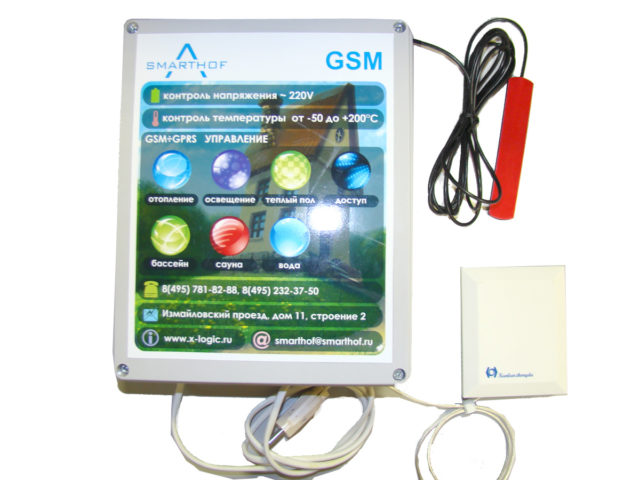
The basis of the system is a special electronic unit that has 1 or more slots (sockets) for installing conventional SIM - cellular communication cards
Typical complete set of elements of the GSM heating coordination system:
- connecting wires;
- several temperature meters;
- GSM controller;
- leak detector;
- electronic key scanner;
- access control mechanism;
- antenna for receiving and broadcasting a GSM signal;
- accumulator battery;
- an ethernet adapter that provides interaction with other elements;
- blocks intended for connection to the boiler;
Remote control of a gas boiler
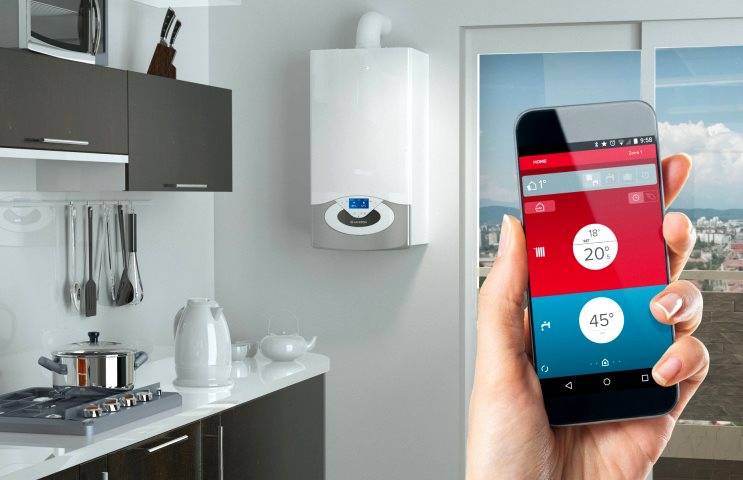
All modern technology provides for the possibility of remote control, not only from the remote control, but also from a smartphone. This is very convenient and makes it possible to turn on a more comfortable mode in the house before the arrival of the owners.
The scheme of the electronic remote control device for a gas boiler assumes the presence of the following components:
- GSM module installed in the unit;
- indoor or outdoor sensors;
- antenna for receiving signals;
- a battery that provides power if there is no mains voltage.
To control your gas boiler from your smartphone, you need to install a special application on it. It is suitable for OS versions above iOS 4.3 and Android 2. After installing the appropriate application, it becomes possible to control the unit by sending SMS from a smartphone.

The intermediary between the smartphone and the gas unit is the GSM module. It transmits the specified modes and, in which case, reports emergency situations. There are modules of varying degrees of complexity: with the simplest functions of budget boilers, allowing you to work with several units.
Automatic control allows you to control many characteristics. Their number depends on the type of module and smartphone model. The standard actions that can be performed from the phone are to turn the boiler on or off, set the desired temperature, and receive an error code.
The most modern devices make it possible to transfer many actions to the heating unit:
- transition to summer, winter, economical modes;
- DHW temperature control;
- temperature setting for each room;
- energy consumption report;
- programming by time of day.

Monitoring the state of the gas boiler is carried out using a variety of sensors:
- gas pressure;
- temperature sensors of water at the inlet to the boiler and at the outlet of it;
- indoor and outdoor temperatures;
- flame sensor;
- traction clamp.
Remote control allows you to quickly make adjustments to the heating of the house, which significantly saves fuel.
iv class="flat_pm_end">