- Storm sewerage of buildings and its slope
- Rules for laying stormwater
- Why you need to know the correct slope angle of the sewer pipe.
- What is the slope of the sewer pipe for?
- Individual slope calculation
- Internal systems
- External (outdoor) systems
- Storm sewer
- Problems with the wrong slope
- What document regulates the parameters of home sewage?
- How to calculate?
- How to choose a slope
- Minimum and maximum sewerage slope per 1 linear meter according to SNiP
- Sewer pipe slope 110 mm for outdoor sewerage
- Sewer slope calculator for a private house
- 160 or 110 sewer pipe which one to choose
- Sewer pipes come in different sizes. The following pipe sizes are distinguished:
- Polymer pipes for sewerage:
- Why do you need an angle of inclination
- How is the sewerage system
- main parameters
- Regulations
Storm sewerage of buildings and its slope
Storm sewers, or storm sewers, are used to collect and drain water that falls in the form of precipitation. Stormwater is designed to protect the building from unpleasant consequences - erosion of the base of the foundation, flooding of the basement, flooding of the adjacent territory, waterlogging of the soil.
Storm and domestic sewer systems operate separately; according to the norms of SNiP, integration into a common network is prohibited.In a closed-type storm sewer, water streams flowing to the ground enter through storm water inlets into a network of underground pipelines, from where they are discharged into a centralized sewer network or nearby water bodies.
The storm drain is filled extremely unevenly, during periods of peak load, the number of drains increases sharply.
Rules for laying stormwater
Pipes are connected both in a straight line and at an angle. If the site slopes away from the outlet, 90° elbow fittings are used to compensate for the difference in ground level.
Height difference compensation with fittings
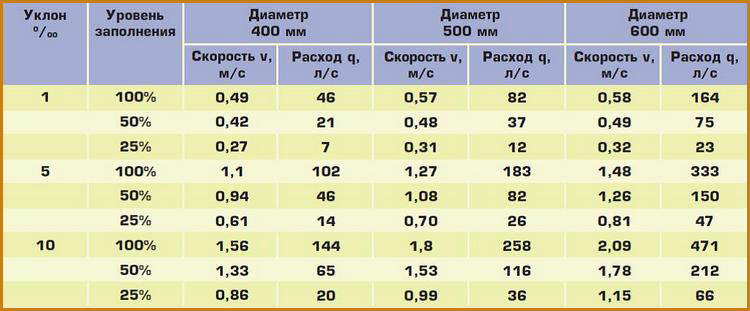
For storm sewer lines with a maximum diameter of 250 mm, the maximum filling level is 0.6.
The minimum flow velocity for storm water with a period of a single excess of the calculated rain rate of 0.33 years is 0.6 m/s. The maximum speed for pipes made of metal, polymers or glass composite materials is 10 m/s, for pipes made of concrete, reinforced concrete or chrysotile cement - 7 m/s.
Why you need to know the correct slope angle of the sewer pipe.
This is, of course, a naive question. Just in order for the sewerage system to work, so to speak, “correctly”, and the owners did not have to feel either visually or with other senses that this system is malfunctioning somewhere and is not coping with its direct task.
So, maybe just always give a larger slope angle - then the water, together with the drains, is guaranteed to quickly go into the collector or septic tank? It turns out - no, so you can only do harm.
Let's try to explain why.
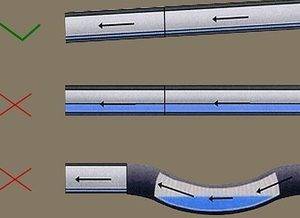
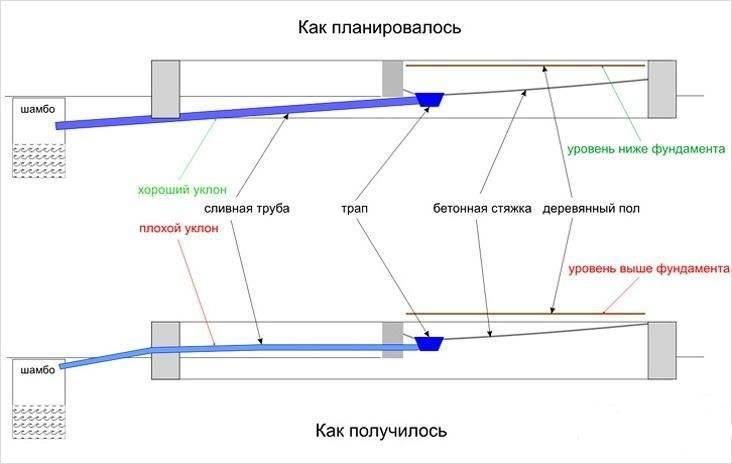
The figure below shows three options. In the first - the pipe is located without a slope, horizontally. In the second, the optimal slope angle is set.And in the third - the pipe was laid without any regard for the rules - "if only the water drained well."
The fourth option - with a negative slope angle, presumably, no one will think of doing.
Two unacceptable extremes - and the right approach to organizing the slope of the sewer pipe.
Sewage, as everyone knows, is not always just water. Most often, in addition to completely dissolved substances, a lot of solid insoluble particles and large inclusions, dispersed drops (fat, detergents) are weighed in it. The task of sewerage is to remove all these contaminants in full force.
And here the self-cleaning property of the pipe is very important. So that after flushing the drains (it is clear that in domestic conditions the drains do not flow constantly, but, so to speak, in portions), the pipe inside remains, if not completely clean, then at least empty
So let's look at the diagram.
- In the first case, a completely obvious stagnation forms in the pipe. Although the movement of water will be, but at a minimum speed. That is, solid inclusions have a full opportunity to settle to the bottom, while fat droplets have a “fixation” on the pipe walls. It turns out that the kinetic energy of the water flow is not enough to carry the pollution with it. They, having settled on the bottom, become an obstacle to subsequent discharges. The result is a very rapid overgrowth of pipes, the formation of traffic jams, which can be very difficult to deal with.
- The second option - the pipe is mounted at the correct angle of inclination, thanks to this, the optimal speed of movement of domestic wastewater is maintained in it. With this approach, the properties of self-cleaning are manifested - water captures and carries out the bulk of solid and suspended pollutants.
- The third option seems paradoxical - well, what could be wrong with the fact that the slope is made large, and the flow rate increases from this? Indeed, in short sections, for example, from the sink siphon to the sewer pipe passing from below, this is done - almost vertically ...
Yes, in a short section it "works". But when it is required to move sewage over a considerable distance, a completely different picture is obtained. Water rushes forward at high speed to the outlet of the pipe. And heavier insoluble inclusions begin to lag behind the overall flow rate. And in the end - they can remain on the walls of the pipe. They often have a lot of time to dry out or otherwise attach themselves to the wall.
And, of course, then these remaining fragments become interference with the next “portion” of drains, in which the situation not only repeats itself, but gradually worsens. And so on - until a narrowing of the channel first forms in the cavity of the pipe, and then a completely impenetrable plug that requires immediate intervention to restore the sewerage system to work.
Now let's go through the provisions of the Code of Practice. In the original, they may seem somewhat "dry" to a person who does not have experience in reading technical documentation. Therefore, we will try to state the main provisions concerning, of course, only private residential construction, in a more intelligible form.
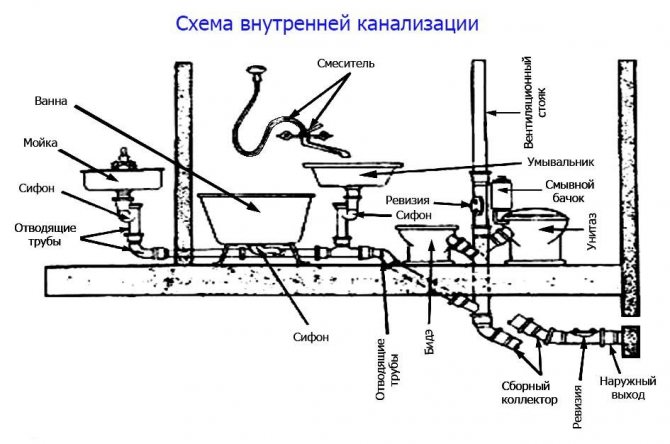
And let's start, of course, "from the beginning." That is, from those points where, in fact, the sewage system begins - from plumbing fixtures. And then - let's go further up to the outer pipes leading to the septic tank or to the sewer.
What is the slope of the sewer pipe for?
All plumbers know that the pipes that are used for sewage must be laid, observing the slope prescribed by SNiP - special building codes. In these standards, the slope of the sewer pipe is determined in special proportions that must be observed during plumbing work. These standards are only a recommendation and are not binding. They have been developed based on many years of experience in the installation and operation of internal and external sewers. Failure to comply with them in most cases leads to the formation of frequent blockages.
There are two most common mistakes that are made when installing sewer pipes:
- The slope is less than recommended. In this case, wastewater begins to flow through the system rather slowly. They are unable to push dirt particles further down the sewer system. This leads to clogging. If the problem is not fixed, the sewer will have to be cleaned at least once every two months.
- The slope is more than recommended. This method of laying sewerage in terms of the frequency of blockages does not differ from the previous one. The water in the system has time to quickly pass by the walls, not having time to pick up and wash off solid heavy inclusions of dirt from them, since the desired fullness is not achieved. This leads to their accumulation, rotting and the spread of odor. In the future, such inclusions lead to the formation of a hard-to-remove blockage.
Individual slope calculation
Do-it-yourself sewer pipe laying in a private house is carried out according to the standards that appear in SNiP. But you can calculate the parameters for the arrangement of sewerage and water supply networks on your own. To do this, use the following formula:
![What is the slope of the sewer pipe? [instruction]](https://fix.housecope.com/wp-content/uploads/a/7/5/a75735d72232fac1211dee7e3baaa86b.jpeg)


V√H/D ≥ K, where:
- K - a special coefficient that takes into account the properties of the material that was used in the manufacture of the pipe;
- V is the rate of passage of wastewater;
- H is the filling capacity of the pipe (flow height);
- D - section (diameter) of the pipe.
The slope of the sewer pipes can be calculated independently
Explanations:
- coefficient K, for pipes made of smooth materials (polymer or glass), should be equal to 0.5, for a metal pipeline - 0.6;
- indicator V (flow rate) - for any pipeline is 0.7-1.0 m / s;
- H / D ratio - indicates the filling of the pipe, and should have a value from 0.3 to 0.6.
Internal and external sewer systems
When laying sewerage and water supply networks in a private house, one should take into account some features that are determined by the location of their individual sections.
Internal systems
When installing sewer pipes in a private house, two of their diameters are mainly used - 50 mm and 110 mm. The first for drainage, the second for the toilet. The laying of the sewer pipe should be carried out in accordance with the following recommendations:
- turning the pipeline (if it is horizontal) should not be done at an angle of 90 degrees. To change direction, it is better to install bends at an angle of 45 degrees, this greatly facilitates the passage of the main flow and reduces the likelihood of accumulation of solid particles;
- fittings should be installed at the points of rotation of the system for revision and ease of cleaning or dismantling in case of clogging;
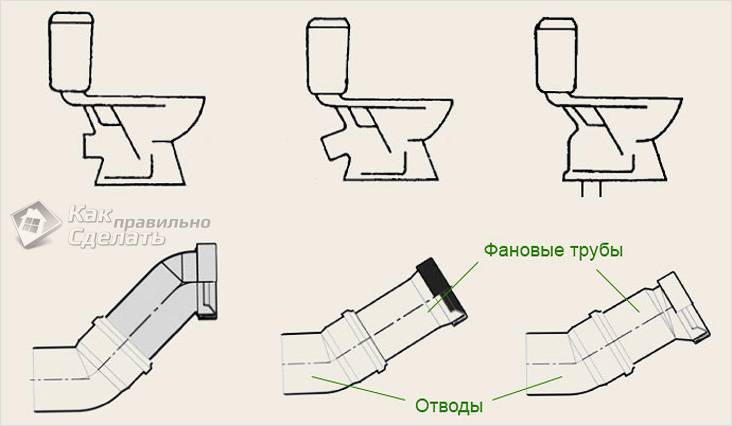
- in short individual sections, it is permissible to increase the slope, exceeding the recommended rate.Such a short sewer branch can be a pipe connecting the toilet to the riser;
- on each individual section, the slope of the pipeline must be uniform, without sharp drops, because their presence can create a condition for the occurrence of water hammer, the consequences of which will be the repair or dismantling of an already operating system.
External (outdoor) systems
Proper laying and installation of sewer pipes is necessary not only inside, but also outside a private house, from the exit point of the internal sewer to the septic tank.
Therefore, you should pay attention to the following points:
- laying of sewer networks is carried out in trenches with a depth of 0.5 to 0.7 meters. The depth of penetration depends on the characteristics of the soil and is adjusted for specific conditions;
- when preparing trenches, sand should be used at their bottom, in order to be able to establish the correct slope due to its backfilling;
- the pre-calculated slope (per linear meter) should be highlighted with a guideline from a cord stretched between the driven pegs. This will avoid unnecessary subsidence or elevations of the sewer system in certain areas;
- after laying the pipes at the bottom of the trench, once again check for the correct slope, and, if necessary, correct it with a sand cushion.
Storm sewer
The same slope-demanding system, and its presence is indispensable to eliminate the formation of water accumulation on the soil surface during precipitation.
Storm sewer laying
When arranging a storm drain, the same parameters are taken into account as for the main sewer - the diameter of the pipe and the material from which it is made. Slope averages:
- for pipes with a diameter of 150 mm - the indicator varies from 0.007 to 0.008;
- at 200 mm section - 0.005 to 0.007.
On private courtyards, you can get by with open storm drains.
But even with such a water drainage system, the slope must be present:
- for drainage ditches - 0.003;
- for trays made of concrete (semicircular or rectangular) - 0.005.
When laying sewer pipes, what slope of the sewer pipe should be?
Scheme of a storm sewer device for a private house
For normal operation of the sewer, the slope must be in accordance with the recommended standards for SNiP, or calculated using a special formula.
If you adhere to time-tested and operational standards, sewerage and water supply systems will not require repair or dismantling for many years.
Problems with the wrong slope
The first two approaches are rather ambiguous. It would seem that the sharp slope of the pipe will help the water reach the final destination faster, but not everything is so simple.
Excessive pressure exposes the pipe to harmful effects and rapid destruction.
In addition, if the water passes through the sewer too quickly, then various household waste can remain in it. Another problem is sewage silting. An incorrectly calculated slope for a sewer in a private house forces the owners to clean it again and again. The worse it is designed, the more often you have to do it.
That is why, the right approach in the design of sewers will be the management of regulations and standards. They indicate what slope the sewer should have in specific terms. With this approach, the sewer will not silt and clog, but will last for many years.




![What slope of the sewer pipe should be in a private house or apartment? | description for pipes with a diameter of 50, 110, 160 and 200 mm [instruction]](https://fix.housecope.com/wp-content/uploads/3/8/b/38bcb54b71a25c57bfa6efa1c9dd10ce.jpg)

What document regulates the parameters of home sewage?
If you open “offhand” several publications on this topic, you will notice that the authors most often refer to SNiP 2.04.01-85 “Internal water supply and sewerage of buildings” and SNiP 2.04.03-85 “Sewerage. External networks and structures. It would seem that everything is the way it is, however, there is some incorrectness in this statement.
The fact is that these SNiPs were adopted back in 1985. This does not mean that they are completely outdated. However, over the past time, nevertheless, some requirements in construction have changed, and this also affected the content of the documents.
That is, corrections and additions have already been made to these documents twice during their validity. For the first time, they were both revised in 2012, and the last (currently valid) version of SNiP 2.04.01-85 fell on 2016, and it was put into effect on June 17, 2017 under its own name of the Code of Rules SP 30.13330.2016. The full title stipulates that this is the updated version of SNiP 2.04.01-85*.
According to the second SNiP 2.04.03-85, the Code of Rules SP SP 32.13330.2012 is currently in force in a similar way.
A clear confirmation of the "evolution" of SNiP 2.04.01-85 "Internal water supply and sewerage of buildings"
Why is all this being said? Just to the fact that an incorrect reference to the source can somewhat misinform the reader. And there are changes, including in the question of interest to us, both in the numbering of chapters and articles, and in content.
How to calculate?
So, if the pipes for a particular sewer are selected, their diameter is known, the required flow rates are taken into account and are related to the degree of filling, then you can proceed to the calculation with an example of pipes by diameter using the table.
The task of the calculation is the selection of the correct slope of the drainage system. To simplify the task, a metric scheme can be taken as a basis, which will be correlated with a specific building. We assign the diameters of the branch branches without calculation, for drains from the toilet - 10 cm, from other devices - 5 cm.
The highest throughput of a riser of 100 mm is 3.2 l / s, for pipes with a diameter of 50 mm - 0.8 l / s. Q (flow rate) is determined from the corresponding table and for our example this value is 15.6 l-h. If the calculated flow rate is higher, it is enough to increase the size of the outlet pipe, for example, up to 110 mm, or choose a different connection angle with the riser of a particular internal branch to the plumbing fixture.
Calculation of horizontal branches in the yard part includes the selection of sizes and geodetic angles of inclination, at which the speed will be no less than self-cleaning. For example: with products of 10 cm, a value of 0.7 m / s applies. In this case, the figure for H / d should be at least 0.3. The value is taken into account based on 1 linear meter of the drain outer pipe. In the calculation formulas, the coefficient K-0.5 is also taken into account if the pipeline is made of polymeric materials, K-0.6 for drainage systems from other bases
To achieve gravity flow, it is important to take into account the characteristics of the pipe material
Based on the results of the calculations, a number should be determined that determines the maximum and minimum angle of inclination of the line in the control well. At the beginning of the system, the indicator must be no less than the indicator mark in the collector.
When laying a drainage system on the street, it is important to take into account the depth of freezing. Depending on the region, this value can be from 0.3 to 0.7 meters deep
If the highway is laid in a place with an increased traffic flow, it is important for the system to provide a place for mounting protection against destruction by the wheels of cars. If such a device is provided, its location is also calculated by the formulas.
If we take as an example the calculation of the slope of a common version of a 110 mm pipe used for an external sewer system, then according to the standards, it is 0.02 m per 1 meter of the main. The total angle indicated by SNiP for a pipe of 10 m will be as follows: 10 * 0.02 \u003d 0.2 m or 20 cm. This is the difference between the beginning and end of the entire system.
You can also calculate the filling level of the pipe yourself.
This will use the formula:
- K ≤ V√ y;
- K - the optimal value (0.5-0.6);
- V – speed (minimum 0.7 m/s);
- √ y is the square root of the filling of the pipe;
- 0.5 ≤ 0.7√ 0.55 = 0.5 ≤ 0.52 - the calculation is correct.
In the example, the verification formula showed that the speed was chosen correctly. If you increase the minimum possible value, the equation will break.
How to choose a slope
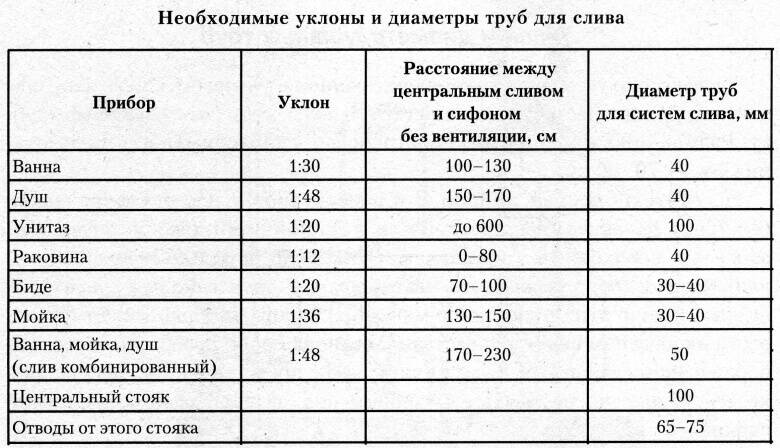
To determine what should be the minimum pipe slope that will be optimal for you, you need to know the length of the entire sewer system. The directories use data immediately in finished form, they are depicted in hundredths of a whole number. Some employees find it difficult to navigate such information without explanation. For example, information in directories is presented in the following form as in the figures below:


Table: required slopes and diameters of pipes for draining Table: slopes of outlet pipes in an apartment
Minimum and maximum sewerage slope per 1 linear meter according to SNiP
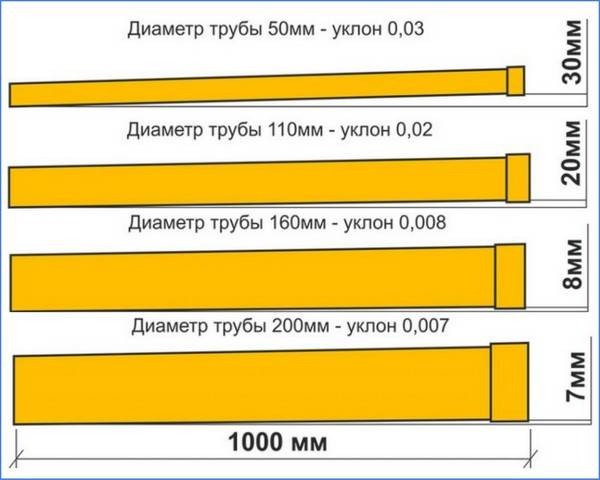
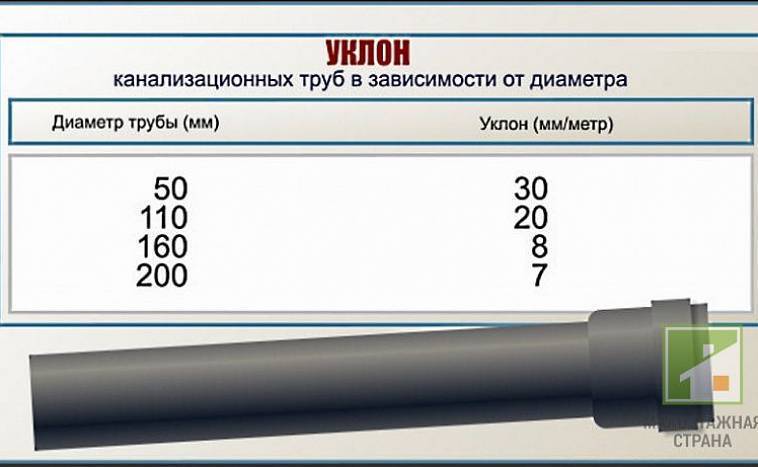
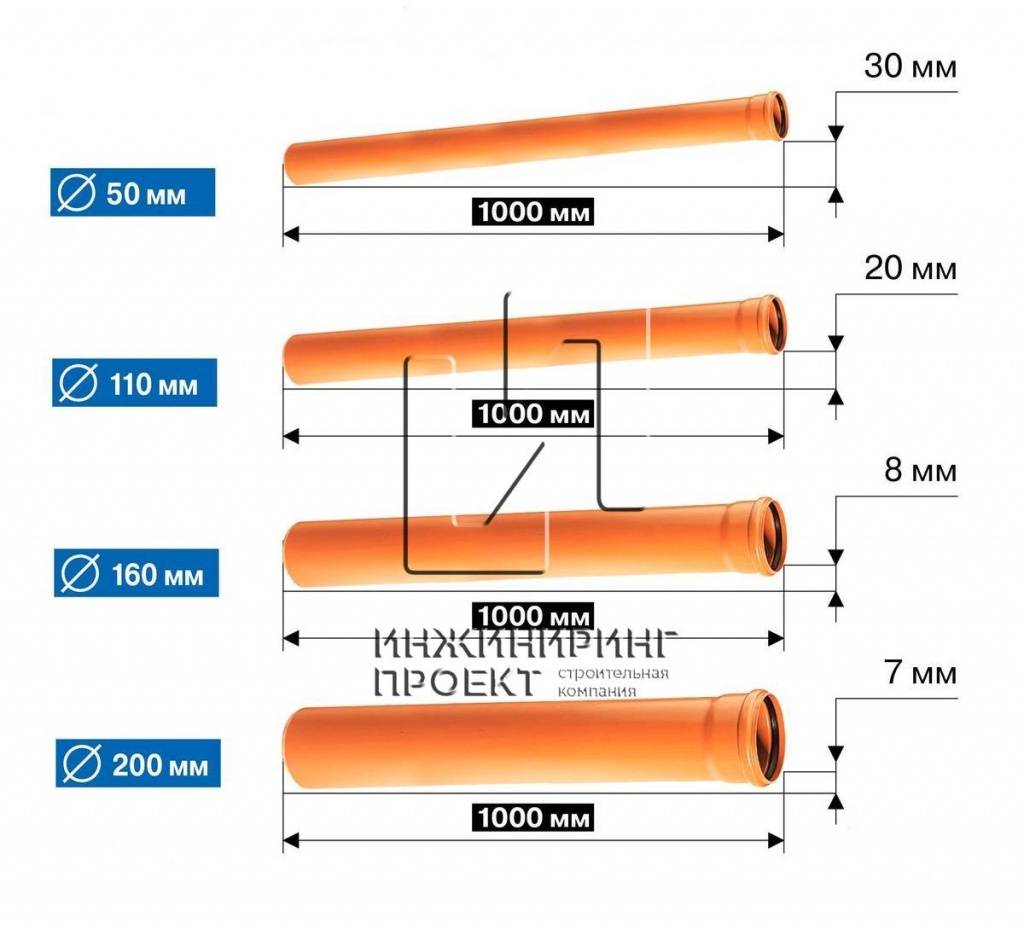
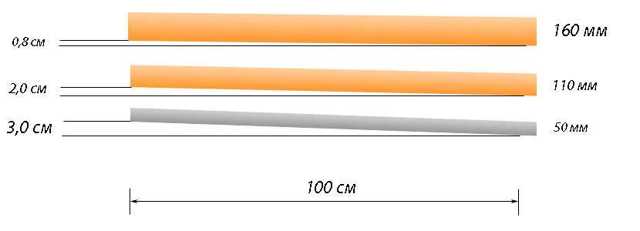
Below is a picture that shows the minimum slopes depending on the diameter per 1 meter running pipe.For example, we see that for a pipe with a diameter of 110 - the slope angle is 20 mm, and for a diameter of 160 mm - already 8 mm, and so on. Remember the rule: the larger the pipe diameter, the smaller the slope angle.
Examples of minimum sewerage slopes per 1 meter according to SNiP, depending on the diameter of the pipe
For example, a slope for a pipe with a diameter of up to 50 mm and a length of 1 meter needs 0.03 m. How was this determined? 0.03 is the ratio of slope height to pipe length.
Important:
The maximum slope for sewer pipes should not exceed 15 cm per 1 meter (0.15). The exception is pipeline sections whose length is less than 1.5 meters
In other words, our slope always lies between the minimum (shown in the picture above) and 15 cm (maximum).
Sewer pipe slope 110 mm for outdoor sewerage
Suppose you need to calculate the optimal slope for a common 110 mm pipe, which is used mainly in outdoor sewage systems. According to GOST, the slope for a pipe with a diameter of 110 mm is 0.02 m per 1 linear meter.
To calculate the total angle, you need to multiply the length of the pipe by the slope specified in SNiP or GOST. It turns out: 10 m (the length of the sewer system) * 0.02 \u003d 0.2 m or 20 cm. This means the difference between the installation level of the first pipe point and the last one is 20 cm.
Sewer slope calculator for a private house
I suggest you test the online calculator for calculating the slope of sewer pipes for a private house. All calculations are approximate.
| Pipe diameter | 50mm110mm160mm200mm | Estimated Slope:— |
| Leaving homebelow ground level | at depth cm | |
| The depth of the pipe entry into the septic tank or central sewer | cm | |
| Distance to septic tankthose. pipe length | m |
The pipe diameter is understood as the diameter of the pipe, which leads directly to the drain pit or the general sewerage system (not to be confused with the fan one).
160 or 110 sewer pipe which one to choose
Installation and installation of sewerage is a very important point in the design and construction of any house, cottage or any other building. Pipes are the backbone of every sewer system. Therefore, you must choose them correctly!
To begin with, consider what should be the pipes for sewage "ideally".
1. Durable. This quality is simply necessary for all types of pipes. Since most often sewers are built for more than a dozen years, therefore strength is the most important point.
2. Resilient. That is, pipes must be resistant to various external factors and influences that may affect their service life. Pipes must be invulnerable to: various chemicals and reagents, to lower and higher temperatures, to fire, to various damages (mechanical), to ultraviolet radiation, and if at least one of the listed factors negatively affected the pipes, they should not be used in sewerage.
3. Convenient for installation. This moment is also an important indicator. Pipes must be mounted securely and simply.
4. Smooth. If inside the surface of the pipe it has roughness and irregularities, then their clogging is just a matter of time
Therefore, pay attention to this important parameter.
Sewer pipes come in different sizes. The following pipe sizes are distinguished:
Ø 32 - outlet from sink, bidet, washing machine
Ø 40 - outlet from the sink, bathtub, shower
Ø 50 - internal wiring in the apartment
Ø 110 - outlet from the toilet, riser
Now we know how high-quality sewer pipes should look like, which will serve you for many years. But what material should they be made from?
Polymer pipes for sewerage:
- Resistant to high temperatures
- Have maximum throughput
- Have smooth walls
- Have increased strength and wear resistance
PVC pipes (polyvinyl chloride) are durable and resistant. They are gray or orange. They are best used for internal sewage, for external it is necessary to use only with a heater. But the disadvantage of such pipes is poor resistance to aggressive influences and temperature extremes. The permissible temperature should not exceed 40°C.



From the strength class, the following types of PVC pipes are distinguished:
SN2 - lungs. They are laid in trenches up to 1 meter deep.
SN4 - medium. Can be installed in trenches up to 6 meters
SN8 - heavy. Mounted in ditches with a depth of more than 8 meters.
Polypropylene pipes (pp). These pipes are the most common, as they have a fairly low cost and are easy to install. Usually they are gray. Compared to PVC pipes, they have greater rigidity and resistance to heat. In external sewerage, this type of pipe is not used.
Advantages of polypropylene pipes
- Service life - 50 years
- Complete tightness of connections
- Chemical and corrosion resistance
- light weight
- Easy installation
- hydraulic smoothness
- wear resistance
- High temperature resistance
- Reduced thermal conductivity
- Low cost
- No painting required
Corrugated polyethylene pipes. These are plastic pipes, which are most often used in external sewage.The diameter of these pipes is quite large Ø250 - Ø 850 mm. The inner side of such pipes is smooth, and the outer side is corrugated. Thanks to the corrugated layer, the pipes are very strong and resistant to compression, which usually occurs when subjected to various loads.
There are a large number of manufacturers of sewer pipes on the modern market. For outdoor sewage, we recommend sewer pipes - POLYTRON, from the company "EGOengineering". These are orange pipes. They are of excellent quality, made from high quality raw materials. POLYTRON sewer pipes have a small mass, which significantly reduces the cost of their transportation to the installation site. They are also very easy to install. They have great resistance to aggressive environments, which is also a definite plus.
On our website, you can also get acquainted with such a novelty as the low-noise sewage system POLYTRON STILTE.
We write about the life of our company, about new products, give advice. Subscribe to newsletter
Thank you for subscribing to us!
Why do you need an angle of inclination
In order for wastewater in the sewer to take dense particles with it, pipes must be laid at a certain slope. The angle of inclination should be set according to fixed, established norms of SNiP. To reduce installation time or when unskilled craftsmen work, many receive a sewer system that works with violations or does not cope with the task at all:
- not paying attention to the fixed rate of slope setting or when maintaining the slope angle below the minimum value, the entire system malfunctions. With such errors, the flow of water will be at a reduced rate. This will quickly clog the sewer.The sewer will need to be cleaned frequently. For example, when installing a toilet bowl, the measures for setting the pipe slope in the correct position were ignored, then the remnants of human life will not be washed off thoroughly. They will begin to accumulate, decompose. This will lead to the lightning spread of an unpleasant odor throughout the living space;
- if the slope indicator is significantly exceeded, then blockage cannot be avoided. Wastewater passes through communications at high speed, washing solid elements without taking them with them. This will lead to the accumulation of a fetid odor, spreading throughout the house;
- if the established indicator of the angle of inclination of the pipes is not observed, silting of the main system will occur. The work of all sewerage will be stopped. There will be an unpleasant smell, there will be a reason for replacement, cleaning;
- in an apartment building, in the absence of norms for installing a slope, a leak can occur, a breakthrough in communication. All residents will have drain problems until the problem is fixed;
- plastic pipes installed in the wrong position will suffer from silting, blockages. Cast iron communications are susceptible to corrosion, which leads to leakage - all waste will penetrate into the basement, spreading the stench throughout the entrance.
Related video:
Sewer slopes and their ways of setting:
and video
How to choose the right sewer slope:
Also, if there are no problems with corrosion during the slopeless installation of plastic, then gaps may appear in the cast-iron pipe. She will begin to let water and sewage into the basement.
Previously, in multi-storey buildings, sewers were not installed with a slope, which is why there are so many cases of drowning in an apartment on the ground floor or a breakthrough in the entire sewer system.
How is the sewerage system
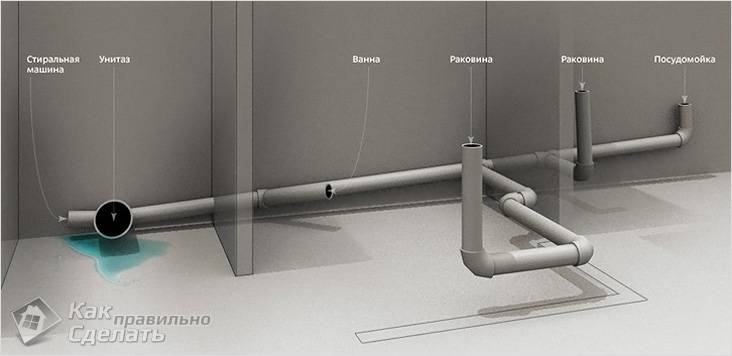 Home sewer system
A network of pipes that diverts effluents from plumbing fixtures to a sewage treatment plant forms a sewerage system. Unlike measuring various angles in degrees, the slope of the sewer pipe is determined in cm per meter of pipe.
Water does not flow uphill, so the pipeline is mounted at a slope, and drains move by gravity through the pipes. It would seem that the conclusion suggests itself, the greater the slope, the better, but this is not so. Sewer drains have various inclusions: garbage, grease, pieces of food. If all this settles in the pipe, then over time the passage will become completely clogged and the water will not be able to go to the treatment plant. The system will work fine if you select the optimal speed for the movement of wastewater through the sewer pipes, and it is regulated by the angle of the pipe. A speed of 1 m/s is optimal for liquid in a non-pressure sewer system. At this speed, the water will wash away all impurities into the septic tank. The sewerage system will be self-cleaning, and blockages can only occur in extraordinary cases. You don't have to fight them all the time.
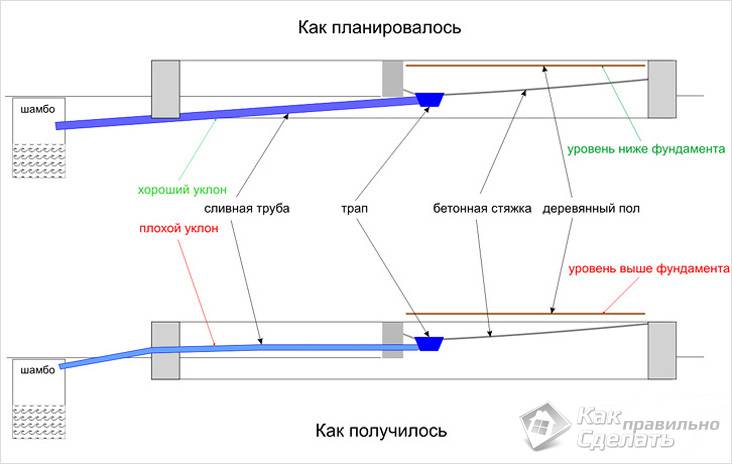 Insufficient slope
The slope of the pipe is made insufficient, what happens in this case? Water will not be able to wash away all the solids, they will precipitate and form a blockage in the sewer pipe.
The free-flow sewer slope is made large, but then various problems may arise:
- the speed of the water will be great, it simply will not have time to wash away the solids and are unclean;
- a large slope of the pipe can lead to disruption of water seals during draining, and this will lead to the appearance of a specific smell of sewage into the room.
main parameters
When laying sewer pipes with your own hands in a private house, it is very important to create their correct slope, observing all the rules when installing them. Too little slope will result in low flow within the line, allowing heavy components to be deposited and requiring all networks to be repaired in the future.
The rules for the correct laying of a sewer pipeline are to ensure sufficient speed for the movement of effluents. This indicator is one of the main ones, and it determines how efficiently the entire sewer works.

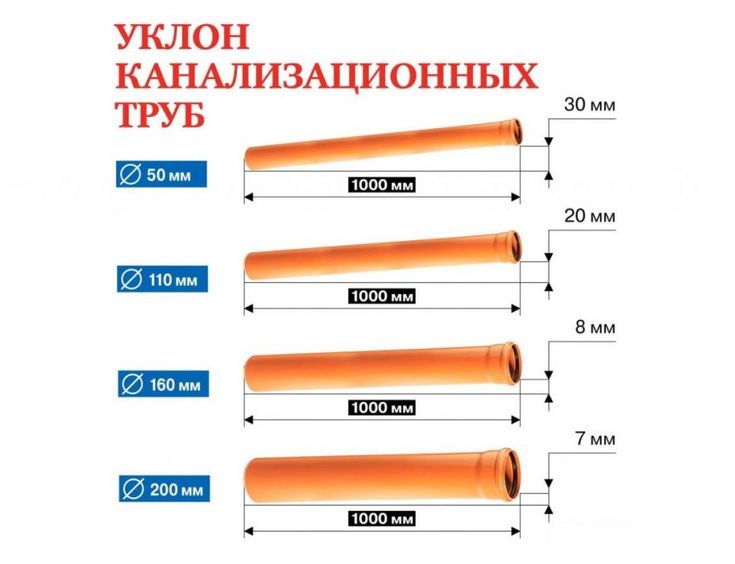


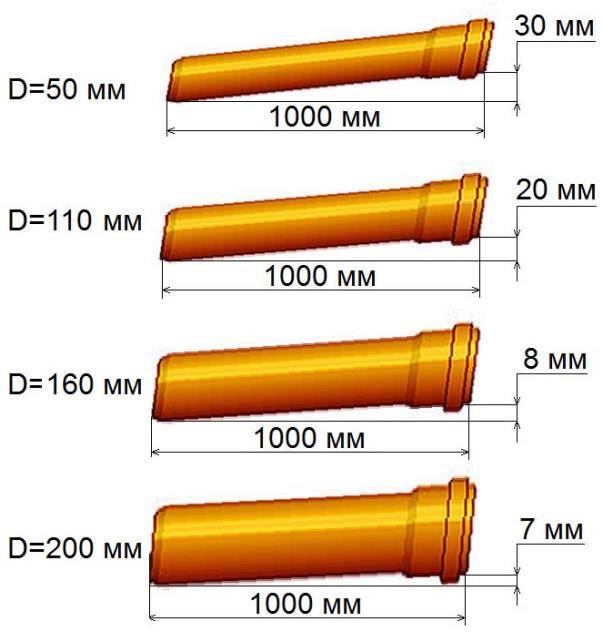
The size of the slope of the pipe depending on its diameter
The statement that the greater the slope of the pipe, the faster the flow moves, and the better the operation of the entire system, is erroneous. With a large slope, indeed, the water will leave very quickly, but this is the mistake - with the high-speed passage of water in the line, the self-cleaning of the system is significantly reduced.
In addition, this approach leads to noisy operation of the sewage system, and due to the high speed of movement, increased wear of the inner surface will occur in it.
This will lead to premature replacement of individual sections or the entire sewer will have to be repaired.
Since the speed of movement of effluents is set by the slope of the sewer pipes, there is one more parameter, which is expressed by the difference in height at the beginning of the pipeline (the highest point) and its end (the lowest point of the entire system).
The slope of 1 linear meter of sewer pipes in centimeters in height is the parameter that must be observed when laying sewers. It will be necessary to adhere to the norms for this value, since otherwise it will be necessary to dismantle the entire system, and sometimes repair or alter the water supply.
Regulations
When laying sewer pipes in a private house, it is necessary to follow the rules described in SNiP 2.04.01-85.
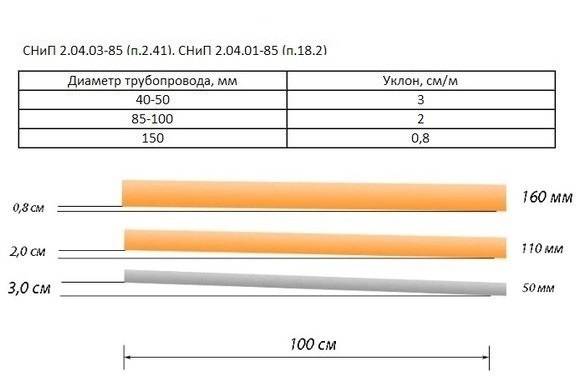
Optimal angles of inclination of sewer pipes according to standards
Taking into account the diameter of the pipeline, sewerage is laid with a certain slope per linear meter.
For example:
- if lines with a diameter of 40-50 mm are used, the slope should be 3 cm per linear meter;
- for pipes with a diameter of 85-110 mm, a 2-centimeter slope per linear meter is optimal.
In some cases, the slope parameters are expressed in fractional numbers, and not in centimeters per linear meter. For the above example (3/100 and 2/100), the slope information for the correct laying of sewer pipes in a private house will look like this:
- for lines with a cross section of 40-50 mm - a slope of 0.03;
- for lines with a cross section of 85-110 mm - a slope of 0.02.