
- Filter types
- Fatty
- Disposable
- reusable
- Coal
- Universal
- How to choose a device
- Types of hoods by control method
- Selection Tips
- Frequently Asked Questions
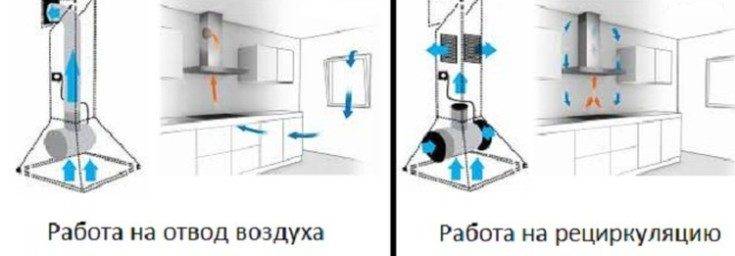
- Principle of operation: recirculation and flow hoods
- Comparison of different types of hoods: which one is better and why
- Built-in or suspended
- Recessed or domed
- Recessed or sloped
- Rules for mounting the recirculation model
- Grease filter maintenance
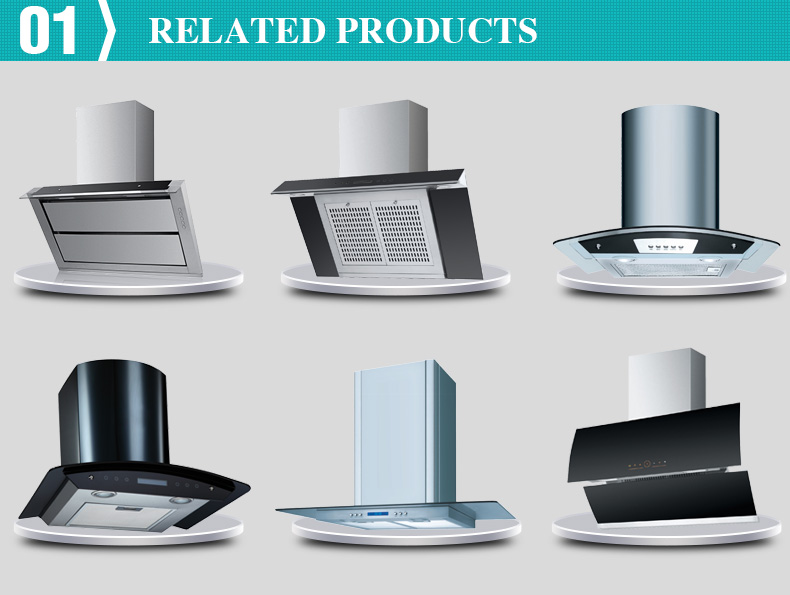
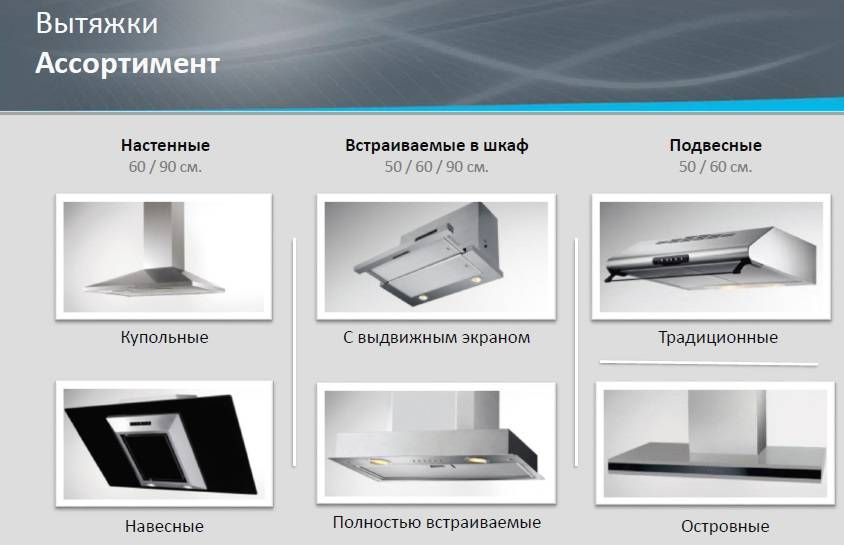
- Hood types
- Suspended
- Dome
- Embedded
- Dominoes
- Island
- Pull-out Models
- Why is it necessary to clean the air from grease?
- The design and principle of operation of the carbon filter
Filter types
Three types of filters are used in modern exhaust devices:
- Fat.
- Coal.
- Universal.
Let us consider in detail each type of filtration systems.
Fatty
A grease filter is an essential component of any hood. It traps fumes, grease and any other food splashes, preventing them from depositing on the inner walls, fan and motor. Without this filter, after 2-3 months, all the insides of the hood would become greasy, sticky and very dirty, and the engine would most likely burn out soon.
The grease filter can be disposable or reusable.It is installed in a flat bottom panel through which air is taken.
Disposable
They are found mainly in inexpensive models. They are a layer of synthetic material: synthetic winterizer, interlining or acrylic. The service life of such filters depends on the frequency of use of the stove. On average, it is 1-2 months.
These filters cannot be cleaned. As they become dirty, they must be removed and replaced with new ones. In some models of hoods, spare disposable "rugs" are included. In other cases, they must be purchased separately, which implies regular costs.
But there is an advantage in this: you do not need to waste time and effort on cleaning.
reusable
The reusable filter is a metal fine mesh made of galvanized steel, aluminum or stainless steel. Such structures are durable and do not require replacement.
As they get dirty, they need to be removed and washed. As a rule, they have special locks for easy removal and fastening.
Stainless steel meshes are considered the highest quality. They do not oxidize, do not give in to deformation. Depending on the specific model of the hood and its dimensions, the reusable grease filter can be a single (one-piece) or consisting of 2-3 separate cassettes.
Coal
Charcoal filters for the kitchen hood are built into all recirculation devices. Their main task is to purify the air from impurities and odors. Visually, this is a plastic cassette consisting of several cartridges filled with activated carbon.
The air, passing through all the coal compartments, is completely cleaned and comes out fresh and disinfected. The carbon filter is always installed after the fat filter.If you do not protect it with a fat-absorbing mesh, then it will quickly become unusable, clogged with food sticky particles. Cartridges get dirty over time and need to be replaced. Depending on the manufacturer, they have different service life from 3-4 to 6-7 months. If users rarely cook on the stove, the charcoal filter can last up to a year.
In conventional air outlet hoods, carbon cassettes are rarely installed. But if you wish, you can buy such a filter separately and mount it in the air outlet pipe.
If the dirty carbon filter is not changed in time, the air flow will be difficult to pass through it, which will increase the load on the motor.
Universal
This is a more advanced type of filter that combines a carbon cartridge protected by a grease-absorbing material. Universal cleaning systems are relevant for recirculation hoods when the most efficient air purification is required.
An additional fat-collecting layer of material is also disposable and may require several replacements during one operational life of carbon cartridges.
There are also universal filters, in which the walls of the cartridges themselves consist of a special material that enhances the filtration efficiency.
On average, such a system lasts for 6-12 months, after which a replacement is necessary.
How to choose a device
When deciding to purchase, you need to choose the right kitchen hood
What you should pay attention to when buying:
- What is the mode of operation. Flow hoods capture the air in the room and bring it to the general ventilation. This type of work is more efficient, the return of unfiltered air is prevented by special valves.However, this method is more difficult to install. Hoods operating by the circular method are based on the return of air that has passed through many filters and cleaned of the smallest particles back into the room. They are used when it is impossible to connect to the general ventilation. Such devices are easy to handle, easy to install with your own hands, but they require regular filter replacement.
- Type of hood according to its location. Wall-mounted are used in standard apartment buildings, where the hob, most often, is adjacent to the wall. This is a fairly convenient type, since access to ventilation is easily given. The central one is used when the exhaust hood is moved to a certain distance from the walls.
- Panel width. According to certain standards, the dome of the ventilation hood should not easily fit the size of the stove, but protrude beyond its limits by 10-12 cm. This allows you to better capture air and clean the room.
- How to switch modes. Mechanical control involves the use of buttons. Electronic is carried out by touch control or from the remote control.
- Design in harmony with the overall style of the kitchen.
Types of hoods by control method
Today, the market offers three main options for managing household hoods.
Budget home air purifiers for small spaces are equipped with a keypad. With a simple press of a button, air handling tasks at different speeds are started or the backlight comes on.
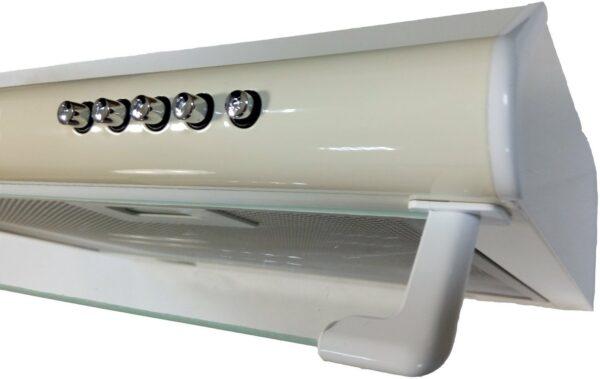
Button control is used in the budget segment
Slider control mechanisms are based on the work of external "sliders" that can be moved horizontally along the built-in scale.This is a mechanical way to switch functions for adjusting power, turning on the backlight, starting or stopping the hood.



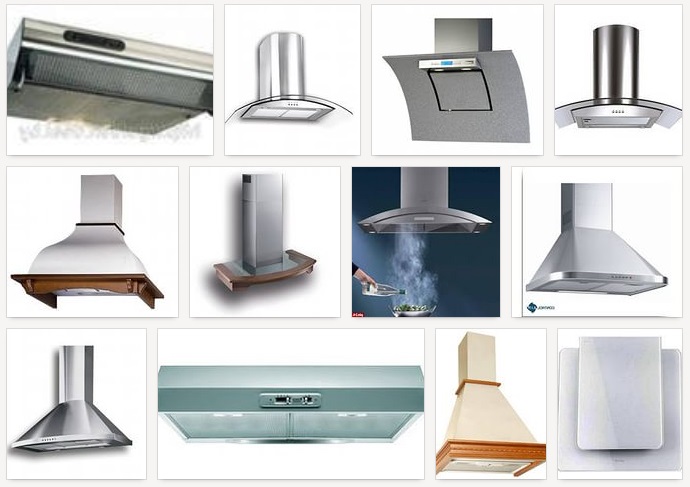

Sliding mechanisms are found in most types of fume hoods: built-in, domed, suspended or tilted. The working control area can be stationary or retractable. In inclined models, the sliders may include an adjustment of the direction of the air flow drawn in for cleaning. The versatility and reliability of slide mechanisms allows them to be built into devices with recirculation or when removed to ventilation.
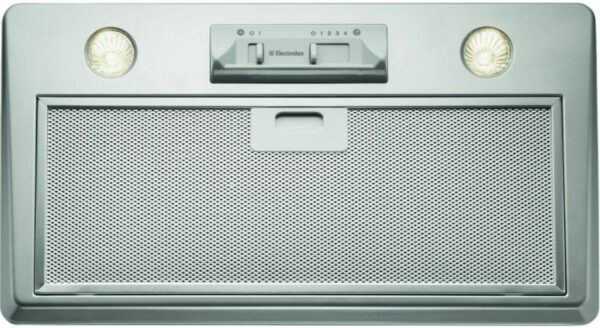
Slider or slider control
Touch panels are considered the most convenient, as they often come with a remote control. Such displays control all functions of the hood, showing the enabled mode backlit on the panel. An added bonus is the ease of maintenance of the smooth surface, which compares favorably with embossed buttons or sliders. The only downside to the system is the high cost.
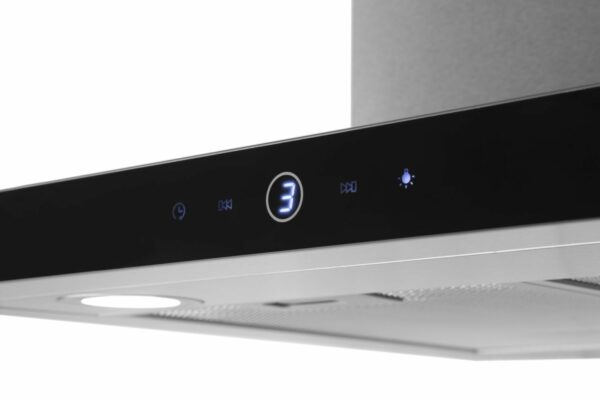
Touch control is convenient, but only used in expensive models
Selection Tips
We will not tell you how to select a hood in appearance and installation method. These are design characteristics, here each user has his own criteria for beauty. And the technical parameters must be approached carefully, otherwise the effectiveness of the funds spent will not meet the initial expectations.
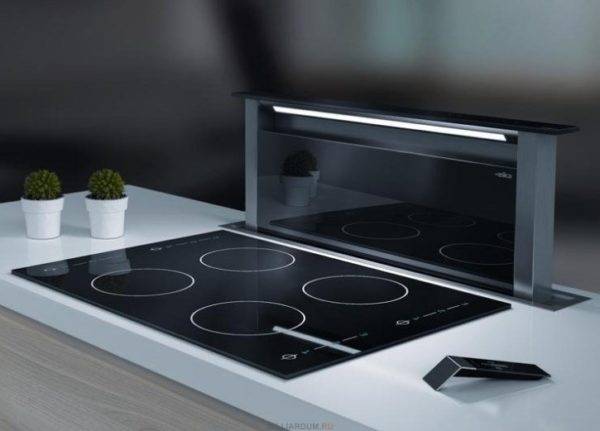 Such an extract takes up almost no space and does not attract attention.
 Suspended models look very original and fit perfectly into the modern interior of the kitchen.
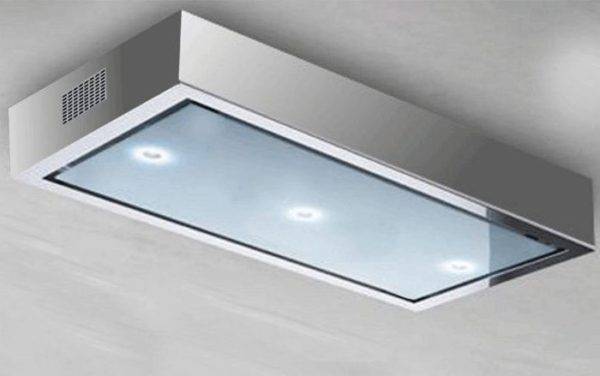 Ceiling hood in a concise design will suit any style of decoration
What performance characteristics should be checked before purchasing the unit?
Power. According to the current regulations for a kitchen with an electric stove, the air exchange rate must be at least 6, if the stove is gas, then the minimum rate increases to 9. In this case, ventilation should only be constant, not periodic. For example, the kitchen has a width of three and a length of four meters with a height of 2.7 m, a gas stove. How to choose the power of the hood? First, you need to calculate the volume of the room 3 × 4 × 2.7 = 32.4 m. The fan must draw at least 32.4 × 9 = 291.6 m3 / hour per hour. As always, it is necessary to provide a power margin of at least 20%. If the motor runs at full power for a long period of time, the stator and rotor windings overheat. High temperatures adversely affect lacquer dielectrics, namely, they cover the wires of electric motors. Long-term limiting heating significantly reduces the life of the hoods - the protective coatings of the windings reduce their original properties until a short circuit occurs. In our case, the fan power cannot be less than 291.6×1.2 = 349 m3/h. A very large stock is also not recommended. The reason is that unproductive losses of electrical energy increase, the efficiency of the device decreases.
Dimensions. Length, height and thickness must be taken into account if the hood is built into furniture. Its dimensions should allow the unit to be installed in a hanging bedside table - it is not advisable for it to make a new one.Manufacturers offer a wide selection, you can easily find the right option without much effort.
Types of filters. On all types of hoods, two types of filters are used: to capture fat and odor trapping. The former are necessary not only to clean the air, but also to protect the elements of the device from grease deposits. It has a negative impact on the appearance and performance. Fat sticks to the fan blades, disrupts its alignment, and this causes a noticeable increase in noise during operation. Fat filters can be disposable (paper, sintepon, non-woven) or reusable (aluminum, stainless steel or acrylic). Carbon filters purify the air from various chemical compounds and are installed after the grease traps. Activated carbon cleans the air from harmful odors, burning, etc. All carbon filters are disposable only.
Noisiness
Unfortunately, not all consumers pay due attention to this parameter. According to doctors, at present, the majority of citizens are worried about the negative consequences due to constant stay in noisy rooms.
Permissible noise levels in rooms are regulated by several state regulations, many subjects of the Russian Federation additionally introduce their own restrictions. On average, the permissible noise level in an apartment should not exceed 60 dB. Such pressure on the sound membranes appears during an ordinary conversation. Keep in mind that very few range hoods are below this limit. In addition, the noise level largely depends on the correct installation and operating conditions of the device.
Control system.There is no need to buy goods with expensive automation, these are unproductive costs. The vast majority of hoods operate only at a few speeds, all other functions are not used. Give preference to traditional push-button options, touch ones are not very reliable. Grease and dirt adhere to the screens and interfere with controllability.
As for the cost, it is better to buy a product of the middle category. There are hoods for 150,000 thousand rubles, you can find goods for 12-15 thousand. Do not go to extremes. Do not purchase products from unknown companies; unlicensed hoods will not bring actual savings. They will have to be thrown away after a few months and quality goods bought, as a result of which such savings turn into additional costs.
The choice of hood requires a responsible approach
Frequently Asked Questions
It is believed that flow-through hoods remove 100% of unpleasant odors from the room, and recirculation hoods operating on charcoal filters are much less. In fact, all odors from the kitchen cannot be removed, as they spread very quickly to neighboring rooms.
The difference in performance between the two types of hoods is about 15-20%, that is, carbon filters purify the air quite well.
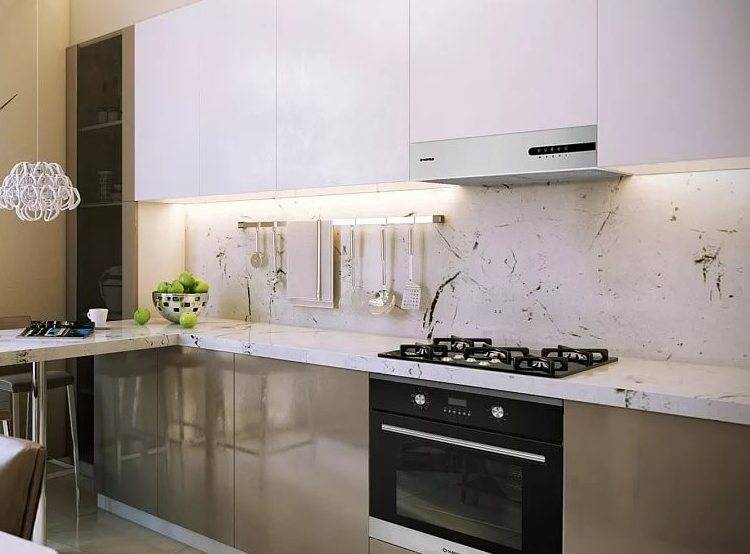
Exhaust equipment with new carbon filters, when used correctly, works in such a way that it protects wallpaper, tiles, ceiling and furniture from grease and other deposits
Many do not want to constantly spend money on consumables, and instead of hoods on carbon filters they buy a model with an air duct, believing that in the end it turns out to be cheaper.
To calculate the costs, you need to add the cost of cartridges to the cost of a recirculating hood - on average, about 20 pieces will be needed for 10 years. And to the price of the flow model, you need to add the payment for materials (boxes, corrugations, fittings) and services for installing the air duct. Additionally, you should take into account the cost of the suspended structure, if it is required for masking. It remains to compare the results.
Also, in order to save money, enterprising owners of hoods, instead of hard plastic cassettes recommended by the manufacturer, manage to put soft cloth filters into the case, which cost 5 times less. This is a gross violation of the use of exhaust equipment.
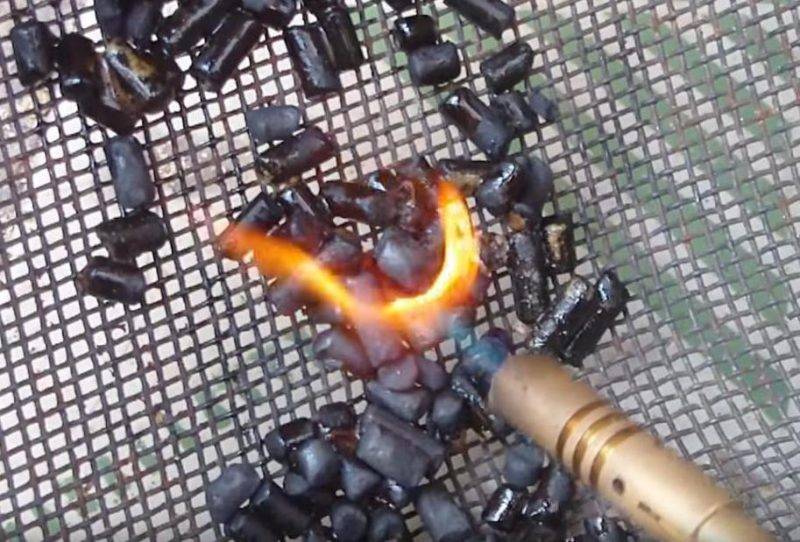
Homemade and remanufactured filters drastically reduce the performance of devices, and also do not give any guarantee that the engine will function for the prescribed period after such “protection”.
You can often hear the question - is it possible to use non-original cassettes and panels if there is no corresponding brand? Of course, you can, but on one condition - if they are suitable in composition and size. This is easy to do by carefully examining the packaging: the names of the models that the cassette or cartridge fits into are usually indicated right on the front side.
Principle of operation: recirculation and flow hoods
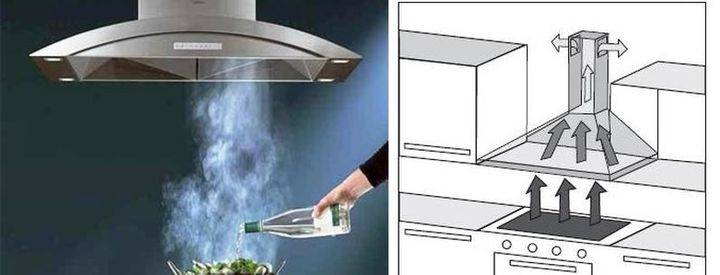
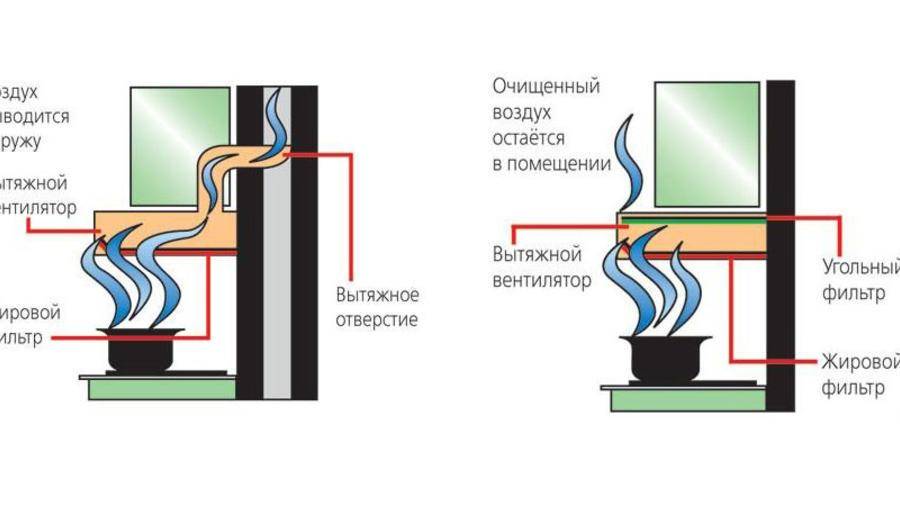
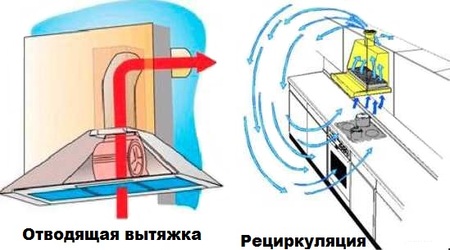
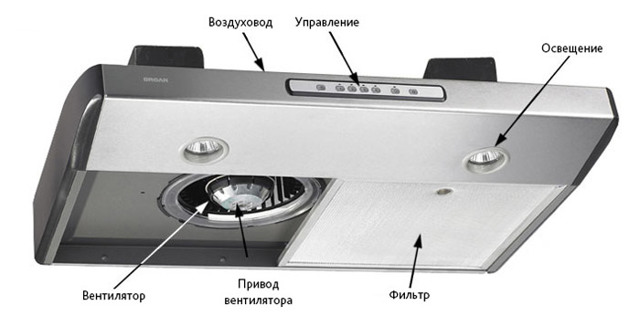
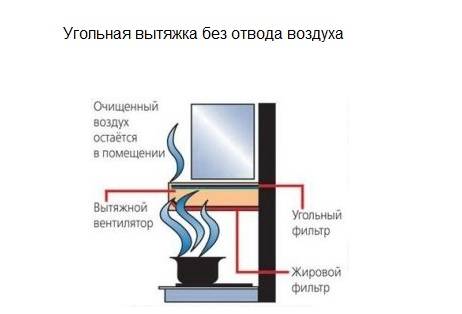
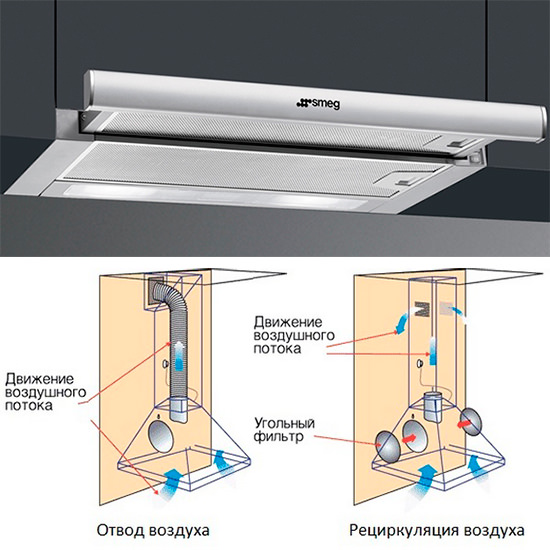
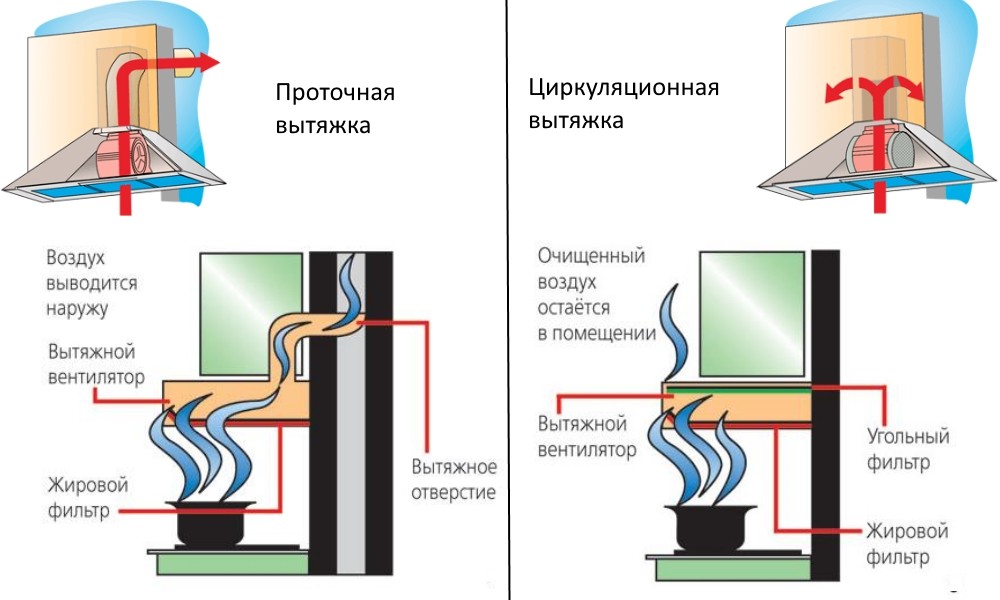
In short, the kitchen hood takes polluted air out of the room and in some cases even gives back clean air. A grease filter traps dirt and soot, while fans located inside draw in polluted air, which either enters the duct / ventilation shaft or passes through the carbon filter and is fed back.It is according to this principle that hoods are divided into flow and recirculation (without a drain).
Chimney hood Elica Zinc/F/50 operates in recirculation mode
The recirculation hood does not need to be connected to ventilation, all air purification takes place through a carbon filter and a built-in forced cleaning system - dirty air does not go anywhere, but is simply cleaned and returned. This is definitely a simpler solution in terms of installation, as well as insufficient draft in the ventilation of the house. You can install a recirculation hood anywhere, it does not require any additional structures. The main disadvantage is the need to frequently change the carbon filter (once every 3-4 or 6 months, depending on the intensity of use).



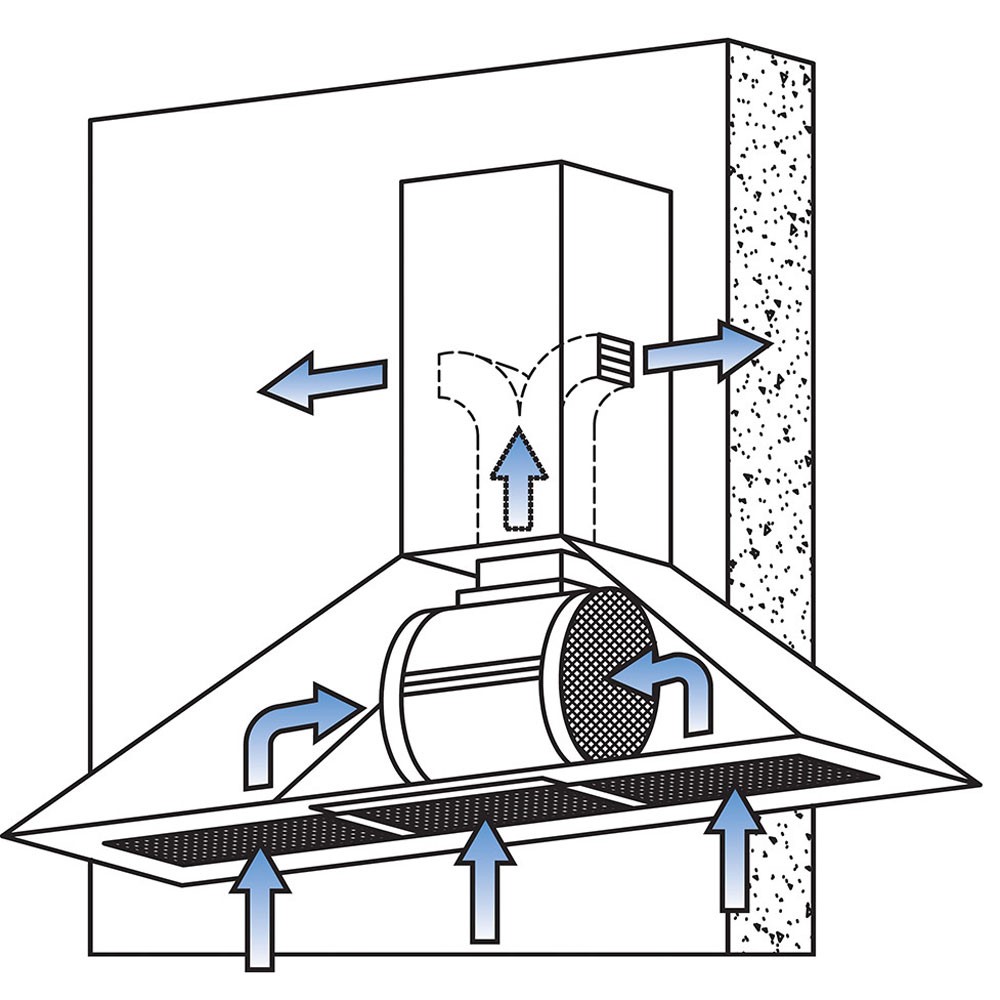


Flow hood Monsher MRE 62W01 is connected to the air outlet
Flow hoods are connected to an air duct or ventilation shaft - through them dirty air is removed from the room. This option is suitable for you if the ventilation system in your house has good draft. However, for the correct operation of the appliance, it is also necessary to ensure the flow of fresh air into the kitchen (open the window). A kitchen hood with a vent to the ventilation is usually more productive, that is, it eliminates odors faster than a recirculating one - it is convenient to install it in a large kitchen. It also does not require constant filter replacement. But it is usually more problematic to integrate it into the interior, and additional mounting structures with boxes often spoil the appearance of the kitchen.
The Elikor Classic Beta hood can operate in both exhaust and recirculation modes
Combined hoods work both as recirculation and as flow-through ones, there are most of such models on the market.Many manufacturers claim that it is mixed hoods that are the most functional - the user chooses the mode of operation himself. If you need to quickly clean the air, you can turn on the flow ventilation mode, in other cases, the operation of the carbon filter is enough, and then the latter will have to be changed less often
Built-in hood LG DCE9601SU with aluminum grease filter, three modes of operation and boost function
Combined hoods must also be connected to the ventilation system at home if you want both modes to function. Consequently, again mounting boxes and bulky structures.
Comparison of different types of hoods: which one is better and why
Now there are a lot of exhaust systems. When choosing, you need to consider that the unit fits the design of the kitchen and meets individual preferences.
They differ according to the type of work.
- circulation;
- flowing.
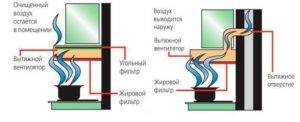
The flow system must be connected to ventilation. A special corrugation connects the ventilation pipe and the unit itself. Advantages of this model:
- high power and high performance;
- lack of consumables;
- the possibility of disguising in a headset locker;
- low noise level.
With all the pluses, there are also minuses: when the hood is operating, it is necessary to constantly open the window, since a lot of air leaves the room, and quite large-scale work is also required to install the corrugation connecting the unit to the ventilation.
Built-in or suspended
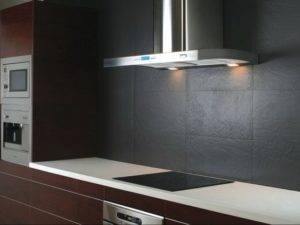
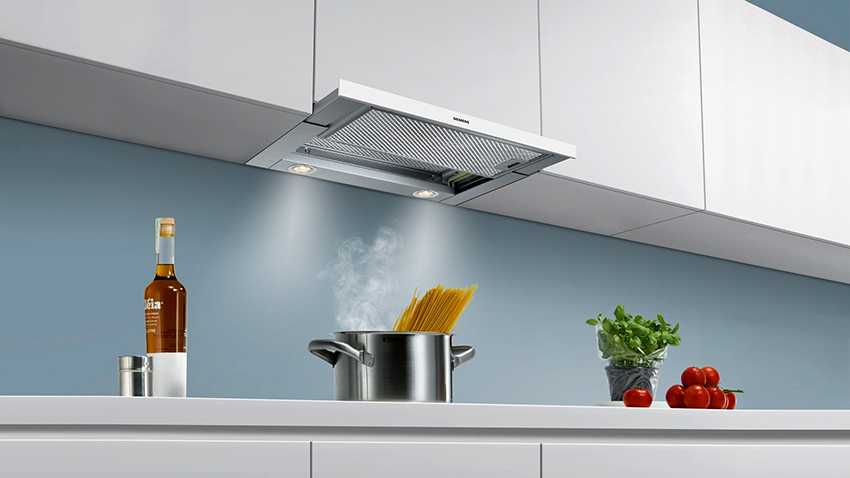
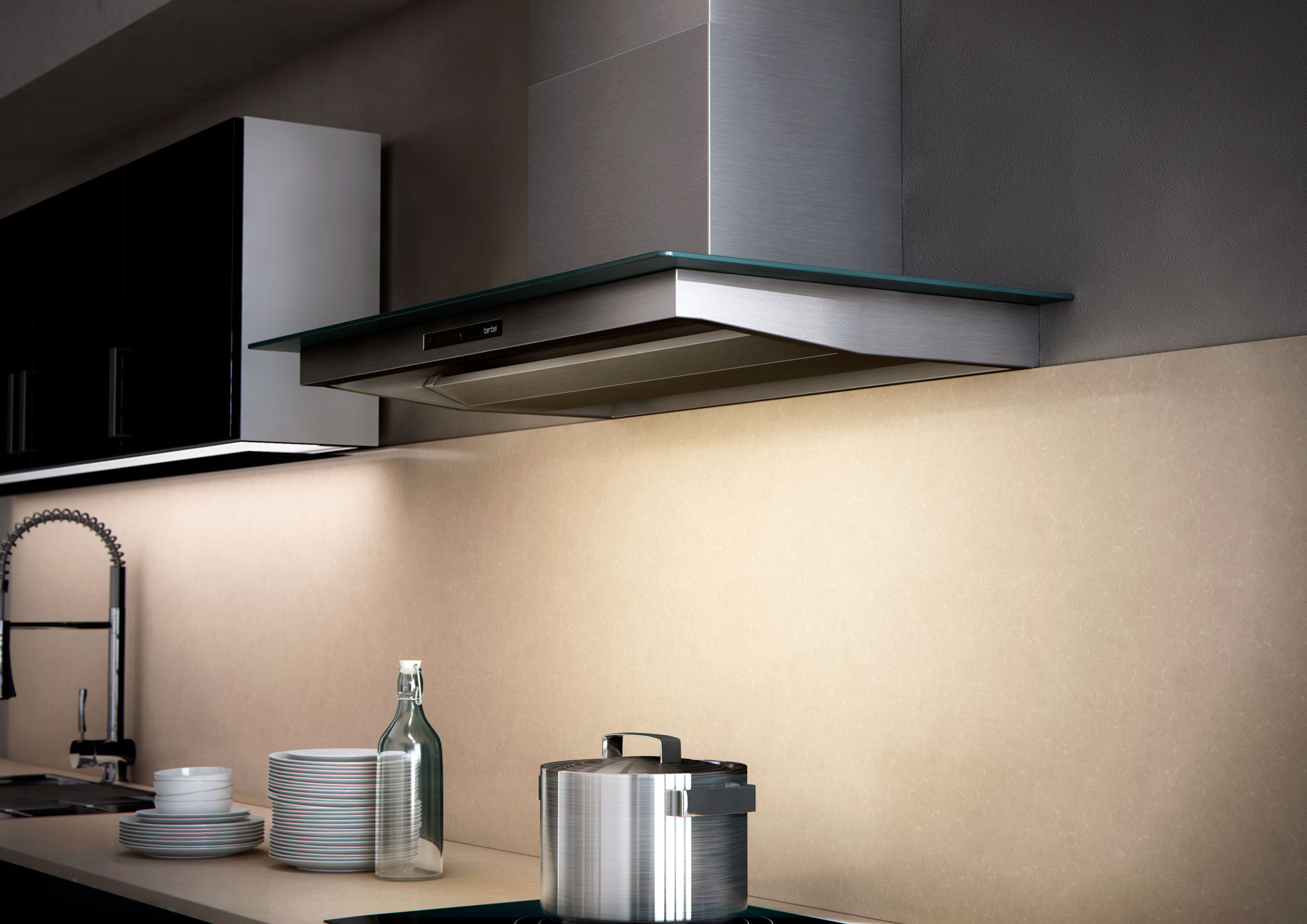
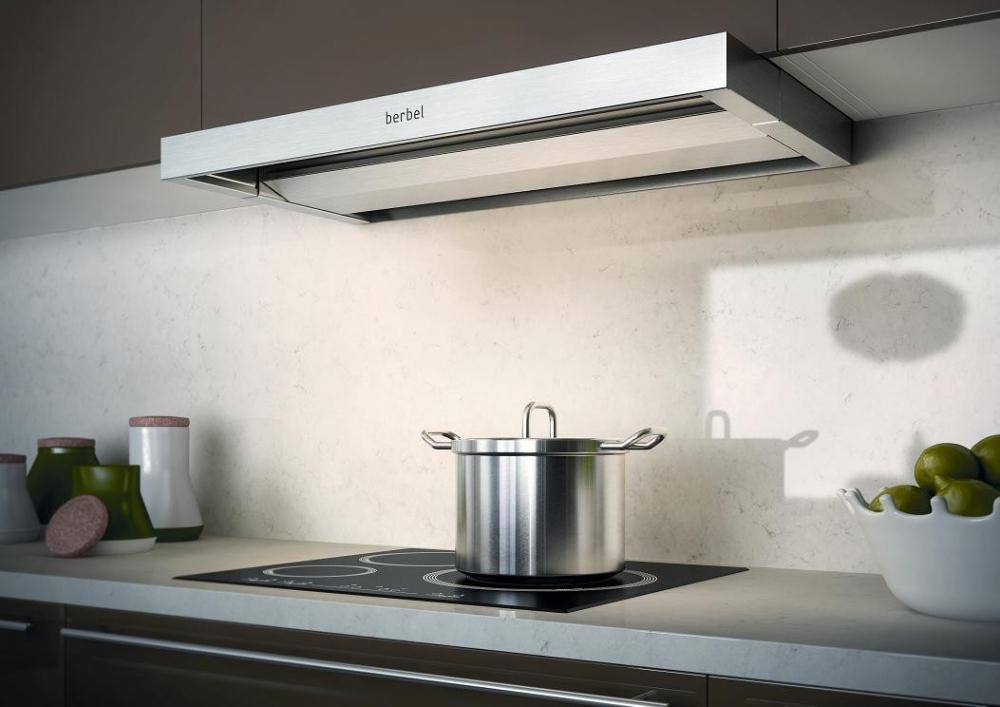
The built-in model is mounted in the cabinet of a kitchen garnish and is practically not visible at all. Only the exhaust surface of the apparatus is visible.The device has an air duct that is connected to the ventilation pipe - all this is hidden behind the cabinets. In most models, the exhaust surface extends forward to the entire cooking space. After the end of the cooking process, you can push it back and hide it from view.
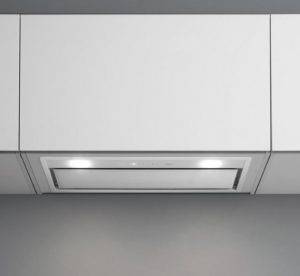
The built-in model is more reliable and more attractive. But if the device is necessary, and there is not much money, then the choice can be completely stopped on the suspension device.
Recessed or domed
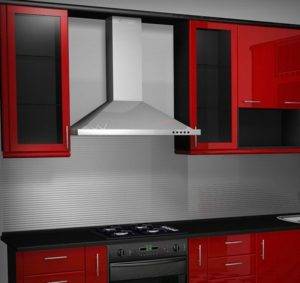
This hood has many design solutions, it comes in different colors and textures. Today, wood, metal and stone units are produced. Even the most picky buyer will pick up a model to your liking.
When choosing between built-in and dome hoods, only the taste of the buyer is decisive. Both units are endowed with excellent functionality and performance. The only difference is whether they want to hide the hood and disguise it as much as possible, or, conversely, give it a central place in their kitchen. In addition, the price is also important: the domed one is several times more expensive than the built-in one.
Recessed or sloped
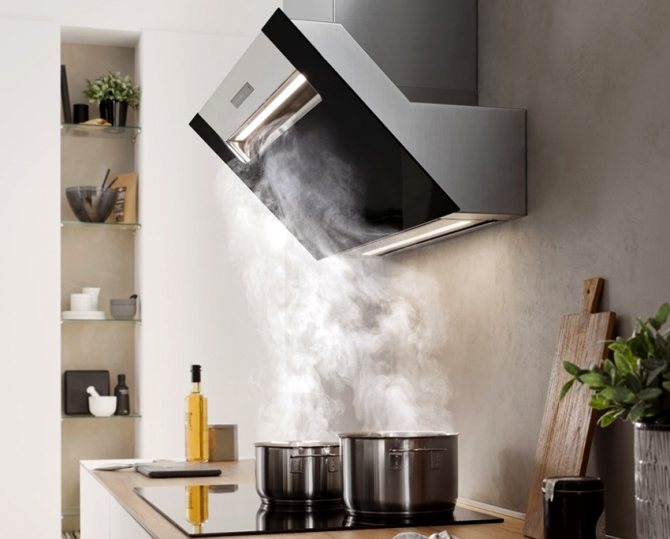
The inclined hood is located at a slight angle to the hob and looks like a plasma TV screen. A huge plus of such air purifiers in the compactness of the design is that it is much more pleasant to be near the stove, since nothing “presses” from above. The production technology of such models does not stand still and manufacturers come up with a new design of the unit, turning it into a real decoration of the kitchen. Also, in such models, dirt does not accumulate on the edges, as the air rushes directly into the filter.
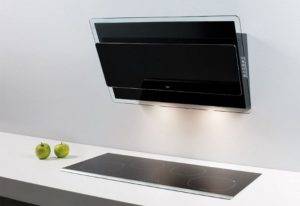
Understanding the types and principles of operation of kitchen hoods, it will be much easier to come to the store and choose the device that meets personal tastes and needs, functionality requirements and suits the design of the kitchen.
Rules for mounting the recirculation model
Before installing the hood in the kitchen, it is necessary to take measurements, and for the built-in model, prepare a cabinet above the stove. If the equipment is fixed to the ceiling or to the wall, the strength of the base must be checked.
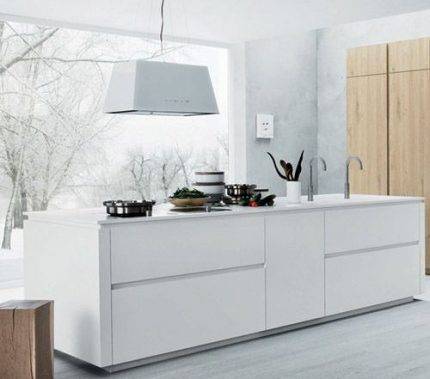
Typically, household appliances are equipped with brackets and holders for mounting. For example, for the island-type hood FALMEC LUMIERE, a set of fasteners is provided: a ceiling platform and a set of metal cables
The hood is installed strictly according to the instructions, since the functionality largely depends on the quality and installation conditions.
In order not to encounter problems associated with incorrect installation in the future, you must follow the rules:
- Keep the distance between the lower part of the hood and the stove. There are well-defined standards: to a gas stove - 0.75 m, to an electric one - 0.65 m. But in the instructions you can come across other figures - 0.6 m and 0.5 m, respectively.
- Prepare in advance a place of the required size. The standard dimensions of built-in appliances are 50 and 60 cm (similar to a stove), but you can find fireplace and island modifications of 80 cm, 90 cm or more.
- Provide (if necessary) free space at the outlet of the purified air.
- Install a separate power point with grounding. Check that the voltage settings of the hood and the mains are the same.
The nuances of installation completely depend on the type of model.For example, consider the procedure for installing a built-in recirculation hood.





Lastly, we insert metal filters. We check the performance of the device by connecting it to the power supply. Detail Process built-in hood installations reviewed here. The useful information presented in the article deserves close attention.
To turn on the simplest model-slider, it is enough to manually pull out the panel with the filter. If necessary, we attach an air duct for transporting polluted air to the ventilation duct.
Grease filter maintenance
All reusable products used to clean the air from grease are easy to maintain. It consists mainly of the removal of contaminants accumulated in the cells of the grids. To perform this procedure, the filters are removed from the seats.
It is not difficult to do this - for their fastening they use convenient latches that allow you to quickly deal with locking / unlocking. Next, the filter is placed in a container with soapy water and brushed.
As a detergent, you can use ordinary laundry soap, half a piece of which must first be grated on any coarse grater, and pour the resulting chips with 3 liters of moderately heated water. Despite its simplicity, this is a fairly effective and economical way to quickly get rid of dirt.
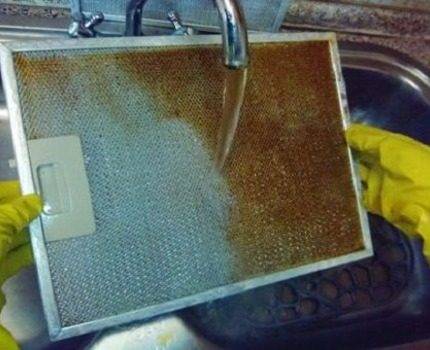
So much dirt can a grease filter filter out in just a few weeks of work in an ordinary kitchen of an average family
If you don’t want to bother with the preparation of a soap solution, then you can take any specialized products, including those used for washing dishes.After cleaning the mesh material, the filter must be washed under running water.
If you have a dishwasher and its appropriate dimensions, the washing procedure can be automated. But it is far from always possible to wash a very dirty product in this way. Therefore, hand washing is considered the main method.
To remove dirt, do not use:
- washing powders - often their use leads to scratches on the metal surface;
- aluminum cleaning soda - this product often leaves brown stains on the metal surface;
- alkaline, acid preparations for cleaning aluminum - these potent substances will lead to a darkening of the specified metal;
- abrasive brushes - they leave noticeable marks on the metal.
If the filter element is made of aluminum, then when washing in a dishwasher, you do not need to select high-temperature modes. Since hot water can contribute to the oxidation of this metal, which will lead to its darkening.
After finishing the cleaning procedure, the product is allowed to dry, and at room temperature and after any type of cleaning. Failure to do so may result in corrosion.
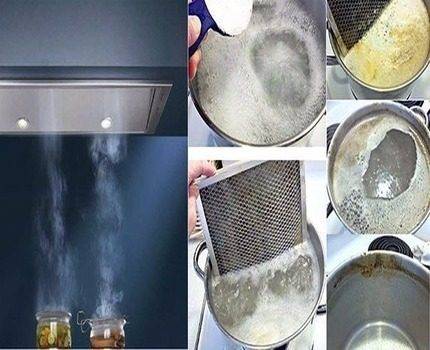
In order for the filter to be as effective as shown in the photo, it must be washed regularly and dried at room temperature.
Maintenance of disposable filters is reduced to monitoring their condition and replacing them with a new product after contamination. It is not difficult to determine the moment of replacement, since special signs begin to appear on the surface of the product, indicating the maximum allowable dirt content in the pores of the cleaning element.
Hood types
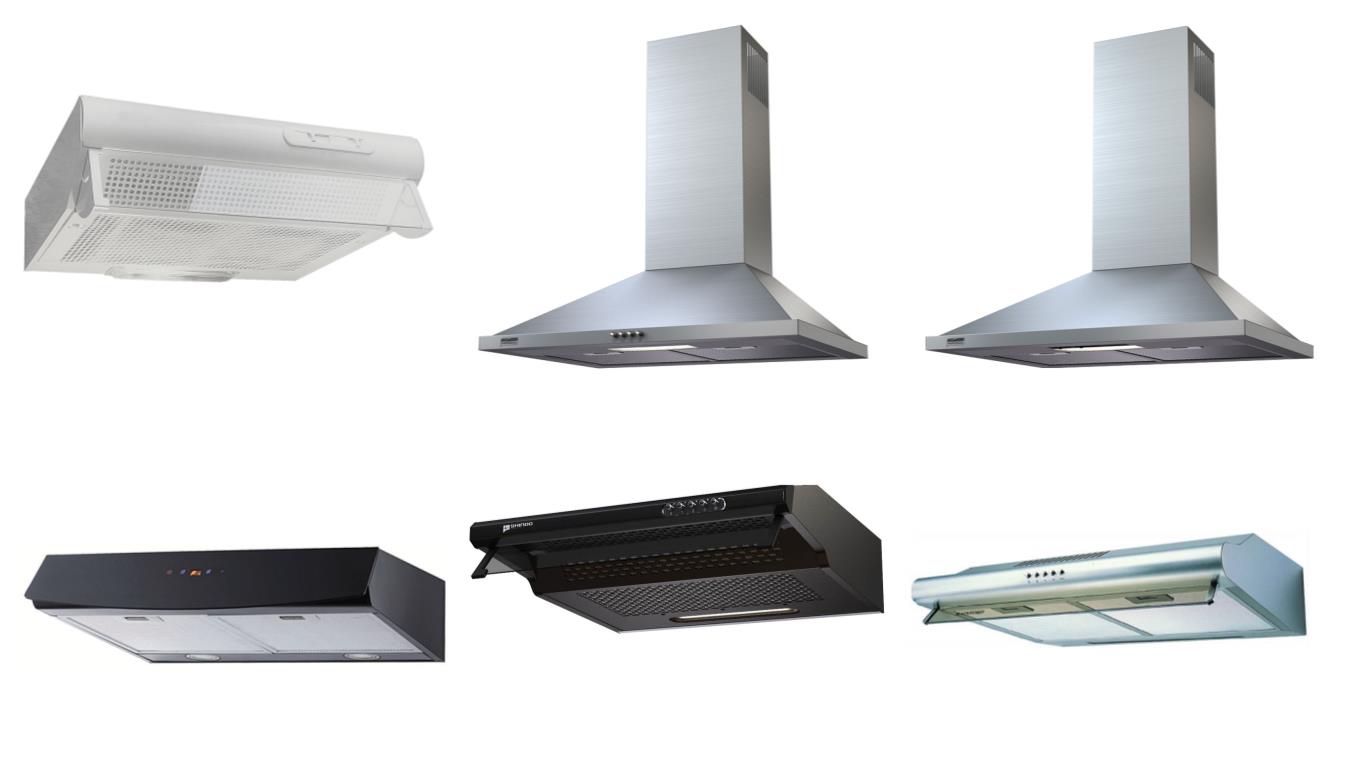
Today, the domestic market offers the consumer two types of exhaust devices: flow and circulation. Depending on the type of device, already cleaned air masses are released into the atmosphere (flow-through) through the general house ventilation system, or are returned back to the room (circulation type).
The advantages of flow hoods are their high performance, which, by the way, is very dependent on the quality of the ventilation system at home.
The disadvantage is considered to be a rather complicated installation and the mandatory organization of fresh air inflow in the required volume.
The advantages of "kitchen umbrellas" of the circulation type are the ease of installation, the absence of air ducts and the connection with the general house ventilation system.
The disadvantage can be considered mediocre performance and high cost of consumables.
Important! When running flow hoods in the kitchen, a slight vacuum occurs. In the area of low pressure (according to the laws of physics), air masses rush from other rooms, including from the toilet
Without a well-organized influx of fresh air, air from the ventilation of the bathroom will be drawn into the kitchen with the smells of the sewerage of the entire entrance.
To date, almost all models of exhaust kitchen hoods are available in six body designs. Let's consider each of them in more detail.
Suspended
Suspended exhaust hoods are only circulation type (do not require connection to the ventilation system). They are mounted on the wall directly above the hob. An ideal choice for small kitchens.
Advantages:
- low cost in comparison with other types of similar devices;
- simple installation.
Flaws:
low performance.
Suspended hood
Dome
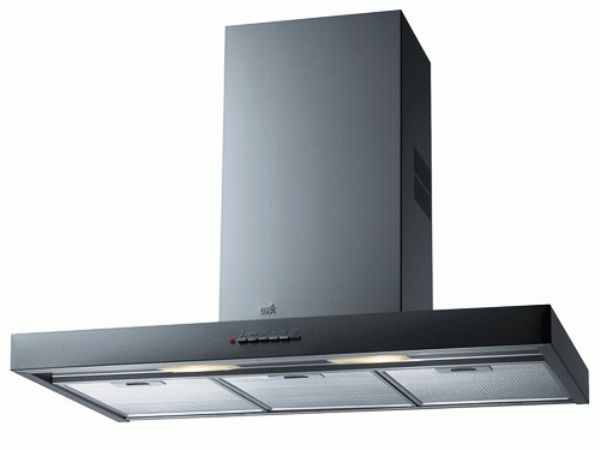
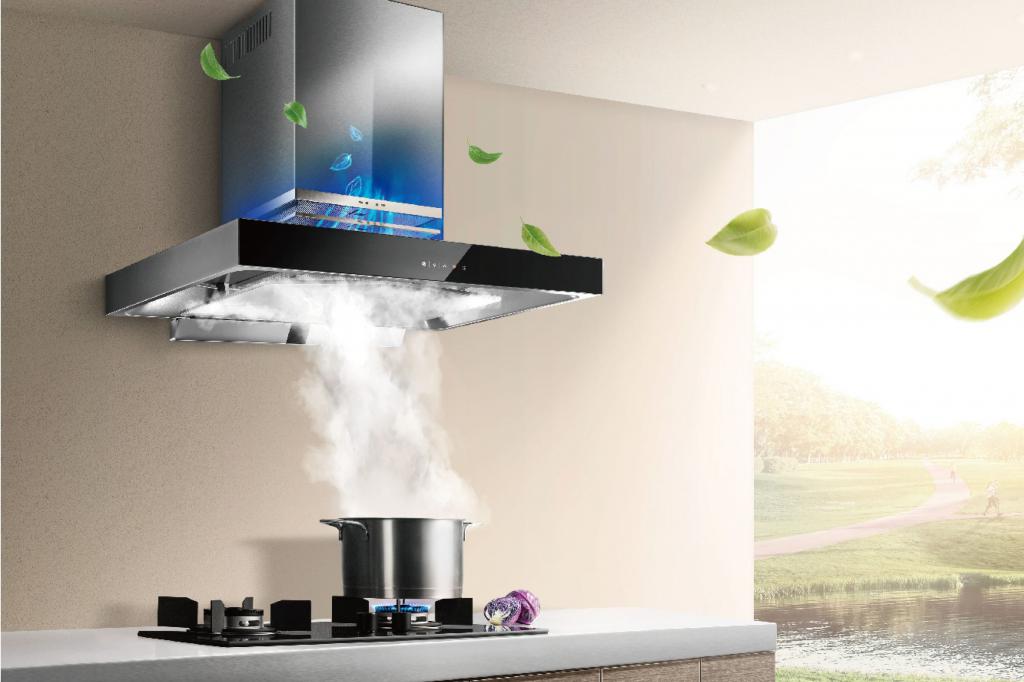
Dome or fireplace are made in the form of an umbrella, which with its "wide side" is located directly above the hob, and "narrow" goes into the ventilation system. The dome is attached to the wall. The air duct is mounted on the dome and to the “ventilation window” or is diverted directly outside the premises.



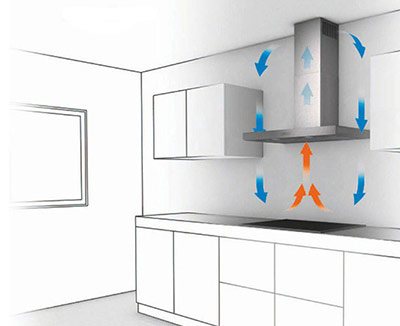

Advantages:
- aesthetic design;
- high performance.
Flaws:
The need for arranging forced ventilation.
Dome hood
Embedded
Built-in appliances are mounted inside the kitchen cabinet. This shape of the body allows you to hide the entire design of the hood, leaving "in front of" only an attractive front panel with controls. A great option for those who do not want to spoil the interior of the room with an “extra structure”.
Advantages:
- Doesn't take up space.
- Doesn't damage the interior.
Flaws:
- Has a higher cost.
- Requires skill to install.
Built-in hood
Dominoes
One of the most modern design options, which is installed inside the countertop (directly near the hob) and “leaves” it when the stove is turned on. A very convenient option for small kitchens.
Advantages:
- Compactness.
- Effective design.
Flaws:
- High price.
- Difficulty of installation.
- Short efficiency.
Domino hood
Island
This type of equipment is a classic kitchen umbrella with a ceiling mount. The best option for purifying the air above a kitchen island or freestanding stove.
Advantages:
- High performance.
- Large selection of design solutions.
Flaws:
- Difficulty of installation.
- High price.
- Impressive dimensions
Island hood
Pull-out Models
A retractable hood or slider when folded has a minimum size. During operation, an additional panel extends from the main body, which covers the entire perimeter of the hob. Such a design can be of a flow or circulation type. Ideal for those with limited space.
Advantages:
- Significant space savings.
- Good functionality.
- High performance.
- Fits into almost any interior.
The disadvantage is the high cost.
Pull-out hood
Why is it necessary to clean the air from grease?
Modern hoods are capable of operating in two demanded modes. The first is the removal of air outside the kitchen, that is, to the street or to the ventilation shaft. The second way is recirculation, after which the already used, but cleaned from pollution, air masses enter the room.
Depending on the operating mode of the hood, grease filters perform the following functions:
- When venting air. Protect structural elements, including the engine, from exposure to large particles of dirt (grease, soot).
- When recirculating. They purify the air from the above elements in order to purify the air, and also serve to protect the engine, other parts of the design of ventilation equipment.
In addition, in recirculation hoods, grease traps protect the carbon filter used to remove odors, gases, and some combustion products.
As the above information indicates, a grease filter for any modern hood is necessary to protect its structural elements from the effects of any large particles of dirt.
Protection of an expensive engine and other structural elements depends only on the grease trap
Why is this needed? If you do not clean from fat, soot, then in just a few weeks all kinds of internal surfaces of the hood itself and the engine will be covered with a suspension of accumulated dirt particles.
Its abrasive properties will be enhanced by unfiltered dust. What will cause a significant increase in the load on all rubbing elements of the hood, first of all, this concerns an expensive engine.




As a result, increased wear and tear will begin, after which early breakdowns will occur, which will lead to significant financial losses.
Steel filter, it is strong, durable. It is convenient that it can be used several times by removing grease from the surface with detergents.
When recycling duties, a grease filter is added. And poor-quality cleaning will lead to much greater negative consequences.
The reason for this lies in the fact that the air that will be reused is not only cleaned of fat, combustion products, but also of odors.
aluminum filter. In the foreground, a lock is visible, allowing the product to be easily installed or removed for maintenance.
Therefore, an expensive filter element is additionally used to remove them, which should also be protected. After all, dust and fat deposits easily, and most importantly quickly, lead to a loss in the efficiency of the odor filter.
As a result, cleaning with a coal hood will not be performed, and this is again additional financial costs, harm to health.
The design and principle of operation of the carbon filter
The appearance of the filter may be different, as it is made of either plastic or synthetic fabric. In the first case, this is a round or rectangular plastic cassette filled with activated carbon in the form of powder or granules, in the second case it is a dense piece of material impregnated with the same activated carbon.
Sometimes these two types are combined to create a more effective protection against hot vapors and impurities that pass through them.
Charcoal cassettes are often round in shape and are sold in packs of two. The plastic of which the cassette body is made is safe and does not emit harmful substances when heated.
Charcoal filters should not be confused with anti-grease filters, which are a metal mesh or grate and are the first step in protection. Particles of fat and substances settle on the anti-grease barrier - this is a kind of coarse filter, but it does not retain odors.
And the carbon filter passes through itself the air already cleaned of fat, and now it just eliminates unpleasant and sharp cooking odors.
The carbon filter is hidden inside the case. Most often it is attached directly to the motor. And everyone saw the anti-grease grille - this is a steel or aluminum mesh, which is in plain sight, at the bottom of the hood
When choosing replaceable blocks for the hood, you should be guided by the manufacturer's recommendations. The fact is that in order to increase the demand for products, most of the filter cassettes and cartridges are universal in nature, that is, they are suitable not for one particular model, but for several.The list can be up to 20 items.
On the packaging, the manufacturer indicates for which models of kitchen hoods the filter element is suitable (+)
You should ask the seller about the availability of consumables before buying the hood, otherwise you will soon encounter an unpleasant situation. After six months or 3-4 months (the service life is indicated in the instructions), you will want to purchase replacement cartridges, but you will not be able to find them on the free market.
The principle of operation of carbon protection:
- First, the air passes through a dense layer of viscose impregnated with a solution of coal. Part of the impurities and fat remains in the tissue structure.
- Then the partially purified air is sent to the cassette where the granules are located. Activated charcoal has remarkable properties - it not only retains the remnants of impurities, but also absorbs specific odors.
Several cleaning cycles completely free the airflow from dirt and kitchen aroma. When the properties of the filler, “clogged” with grease and dirt, decrease, a new filter must be installed. In this regard, devices with sensors signaling the need for replacement are very convenient.



