- How to install a toilet with a hidden tank with your own hands
- List of required tools
- Installation of suspended toilet bowls with block installation
- How to install a toilet with a hidden cistern with a frame installation
- Installing an attached toilet bowl with a block installation
- Type of toilet outlet
- Size Tips
- Methods for mounting corner toilets
- Corner toilet and its advantages
- Short modules
- Features of corner toilets
- Which exit is better: straight or oblique?
- Description of the "release"
- A few words in conclusion
How to install a toilet with a hidden tank with your own hands
List of required tools
- Perforator and drills (drills) for concrete;
- Marking and measuring tool: level, tape measure, plumb line, marker;
- Open-end wrenches of various sizes.
Installation of suspended toilet bowls with block installation
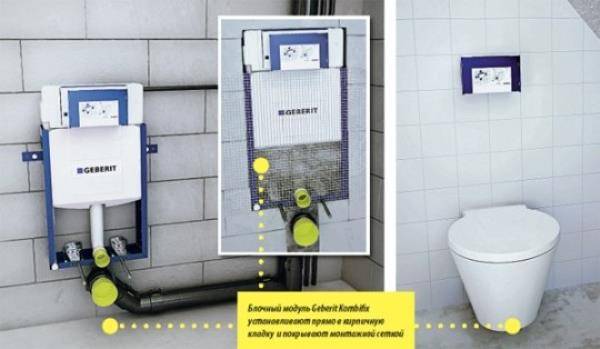
First you need to make markup. With the help of a tape measure and a level, we measure the height of the structure and find points for fastening. Using a perforator, we make holes and fix the dowels
We install a hidden tank, twist the drain hole (since this procedure can be carried out differently for different manufacturers, be sure to pay attention to the instructions). Be sure to check that all seals are present.
After that, the hidden tank can be connected by water.
In the holes already made, we attach the pins that will hold the toilet (usually these are already included with it). We install the bowl, at the end we fix the drain hose with clamps if necessary.
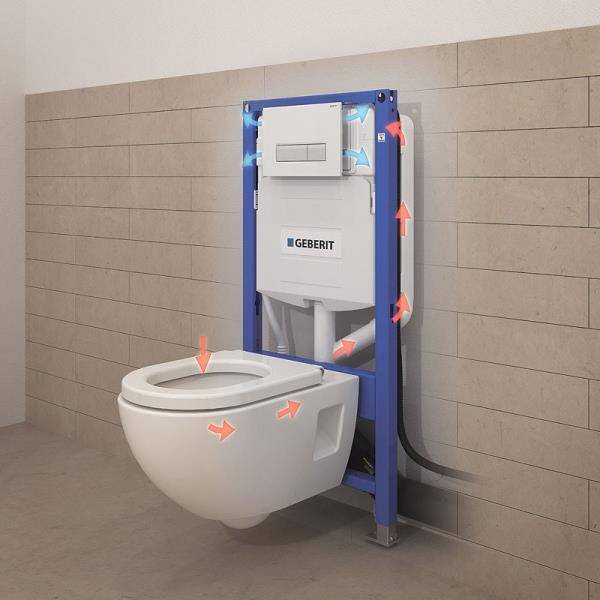
How to install a toilet with a hidden cistern with a frame installation
This procedure is somewhat more complicated. First you need to assemble the entire frame on which the hidden tank is attached. At the same time, pre-adjust the dimensions of the frame.
Installing a hidden toilet cistern should adhere to the following principles:
- The drain button should be located a meter from the floor;
- The height of the toilet bowl should be 40-45 cm;
- The sewer outlet should be at a level of 22-25 cm;
- The distance between the mounts for the bowl is determined by the location of its eyes.
The assembled structure is installed strictly vertically and horizontally. First, do not forget to check the slope of the wall with a plumb line, if there is one, you should definitely take it into account.
We attach the installation frame to the wall and mark the points where it is necessary to drill holes for fasteners. We install the frame, preferably, attach it to the wall and to the floor. Do not forget to check the correct installation with a level.
We supply water. This can be done either from the side or from above. Modern installation models allow you to choose the connection point
Please note that it is undesirable to use a standard flexible eyeliner, since it is unreliable, and to replace it, you will have to disassemble the entire structure. Plastic pipes are used for water supply
The hidden tank itself must be lined with insulating material (usually already included in the kit) to prevent condensation.
Next, we connect the outlet of the toilet bowl to the sewer, for this a corrugated pipe is useful.Don't forget to check the tightness of the connections.

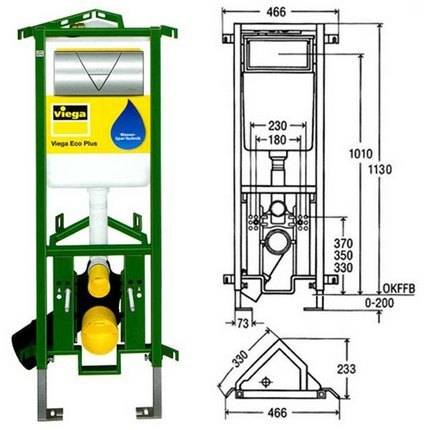
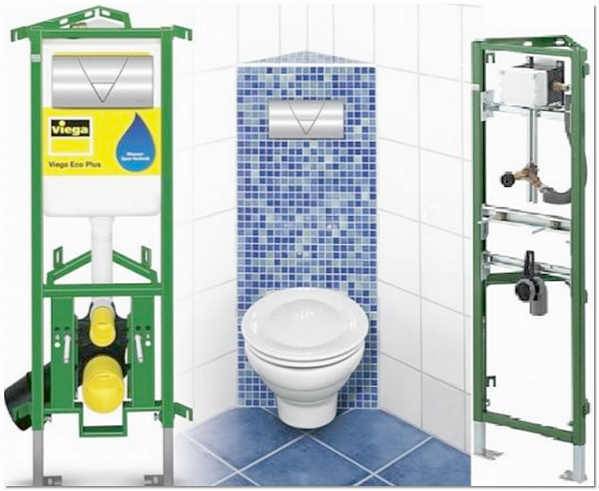


After that, you can start assembling a decorative plasterboard structure. First you need to close all the holes with special plugs so that construction debris does not get into them, and install the pins on which the toilet bowl will be attached. To assemble the decorative structure, moisture-resistant drywall with a thickness of at least 1 millimeter is used.
If the plasterboard construction was finished with ceramic tiles, at least ten days must pass before the installation of the bowl! After that, we adjust the release of the bowl to the sewer hole. Places where the bowl will come into contact with ceramic tiles are treated with a silicone-based sealant. We hang the bowl on the pins and tighten the nuts. After that, you can conduct a test drain of water.
Installing an attached toilet bowl with a block installation
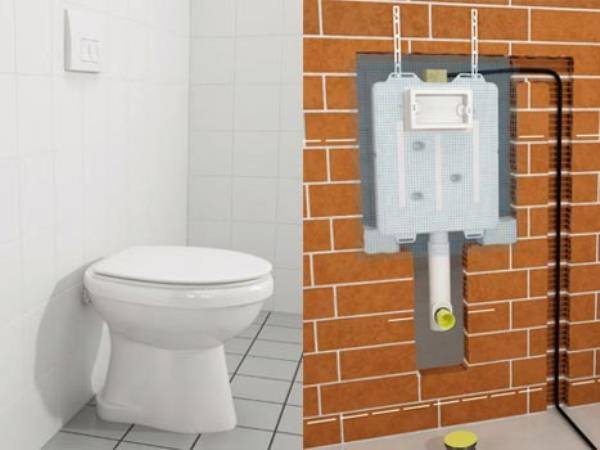
To begin with, the location of the knee is fixed, the release of the bowl is treated with a special technical ointment, the toilet is tried on at the installation site, marking the points of the mounting holes, the bowl is removed and the fasteners included in the kit are installed. Sanitaryware is put in place, and its outlet is installed in a fan pipe. A connecting cuff is installed at the junction. Installation of a hidden drain tank is carried out according to the instructions. The drain button is installed in the technological hole. The last step is to test the functionality of the structure.
Tips:
- If the attached toilet began to leak, most likely the problem is in the joint seams treated with sealant. Check the connection with the fan pipe;
- Under the drain button, it is worthwhile to provide a technological hatch (it can be made completely invisible thanks to the tile), this will greatly facilitate the repair work;
- Install main filters for water purification, this will extend the life of the system;
- The drain is mounted at an angle of 45 degrees, otherwise the water will stagnate;
- Often the cause of leaking flush-mounted drain tanks is improper installation of gaskets, be especially careful with them.
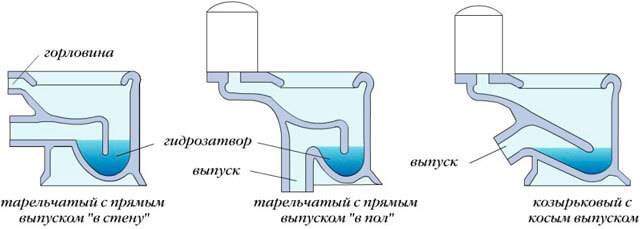
Type of toilet outlet
The comfort of using the toilet does not depend on the type of sewer outlet, no external differences were noticed either. However, the location of the sewer hole and its dimensions should be considered when choosing a toilet bowl.
For the consumer, toilet bowls are represented by three main types:
- With horizontal outlet. Such models are chosen if the socket of the sewer pipe is located at a height of 5-10 cm from the floor.
- With vertical outlet. The design of the toilet suggests the presence of a drain hole directed downwards, which allows you to save space in the bathroom as much as possible. However, it should be understood that such an arrangement of the sewer hole can only be found in private individual houses. Apartment buildings have a different structure of the sewer system.
- with oblique release. Most of the manufactured toilet bowls have such a tap; they are connected to a socket, which is located at a small distance from the floor level or at an angle to it.
Size Tips
For some people, this is quite a tangible task. Purchasing a product according to the required dimensions is not such an idle question as it seems initially.
The net area starts from 35 cm. Otherwise, you will feel cramped. The width and height of the toilet play a very important role.Choose the last one so that when you sit down, your legs do not rest much on the floor. The abdomen should be relaxed. To purchase a toilet in your size, do not be afraid to sit on it right in the store. Then you will definitely feel your size.
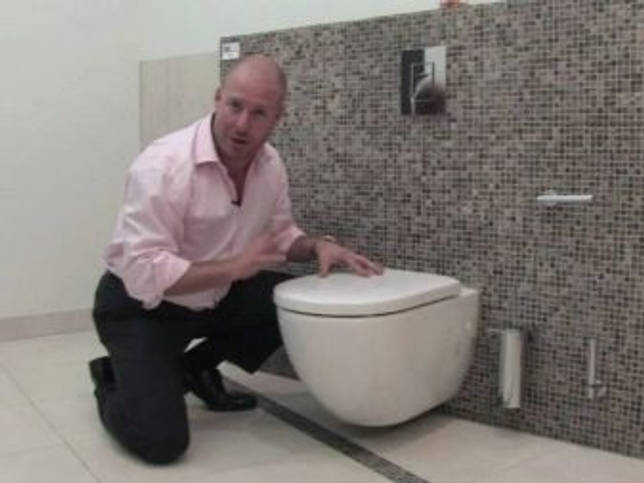

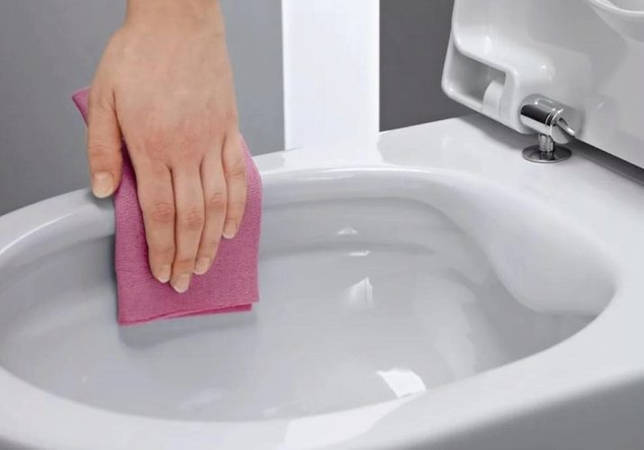
Consider the width of the rim as well. When sitting on it, you should not feel discomfort. If the bezel is too narrow for you, then it is better to refuse the thing. Otherwise, it will crash into your legs. If there are children in the house, and you installed the toilet for adults, then use a special nozzle for children. It will protect your child from falling. To choose the most comfortable model, feel free to try all the products. Find out more information, and only then make a choice in favor of a particular model.
You can learn about which hanging toilet is better and how to choose it from the video.
Methods for mounting corner toilets
According to the type of installation, floor and hanging toilet bowls are distinguished. The first option involves the placement and installation of the drain mechanism directly on the floor, in the second case - on the wall.


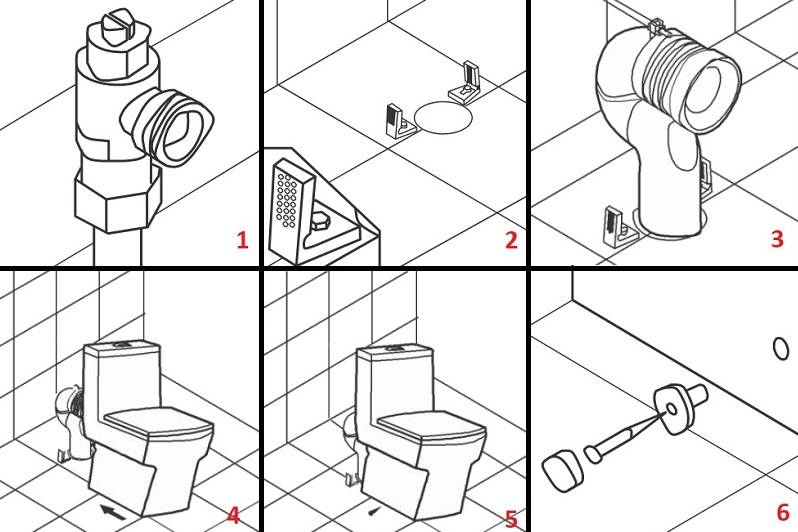


The installation of a floor-standing corner toilet is carried out according to the standard scheme, so special knowledge and time are not required when deciding how to install a corner toilet.
Hanging corner toilet involves the use of a special corner installation in the form of a metal frame. During the installation process, a sewer pipe, a water pipe are brought to it and a drain tank is installed.
The installation can be located in a pre-arranged niche in the wall or just in the corner. In any case, the design implies a complete disguise of the drain tank and the summed communications.
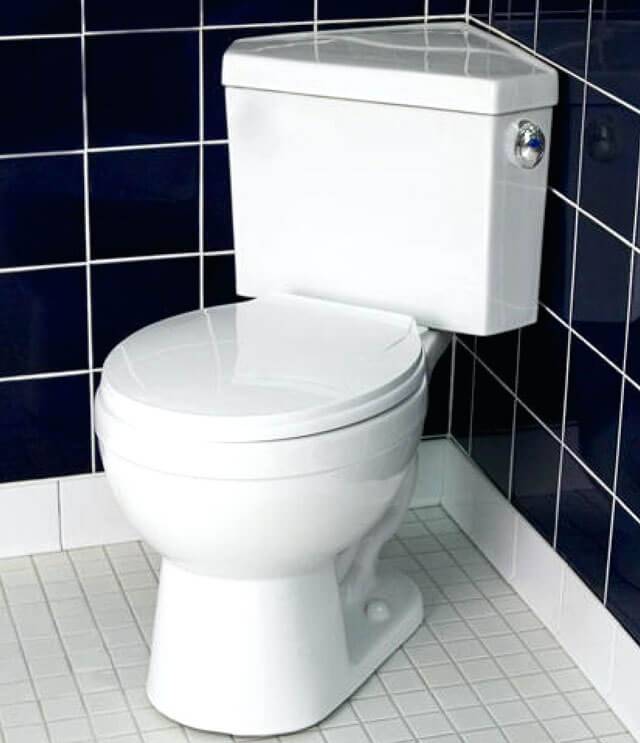
Another type of corner toilets is the side-mounted model.Similar plumbing is also located in the corner, but the vertical axis in this case has a direction along one of the walls, and not diagonally. The thicket of the toilet bowl in such designs has an asymmetric offset, which allows you to install the toilet close to the wall.
Depending on the type of water supply to the drain tank, there are models with bottom and side supply. The first option has some advantage due to the silent intake of water into the drain tank.
An attached-type toilet bowl for installation in the corner of a bathroom also allows you to hide the elements of communication systems in a wall or a special bedside table, which most often comes with a toilet bowl.
Corner toilet and its advantages
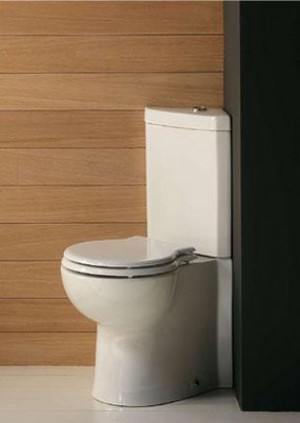
cistern shape only
The corner design of the toilet bowl is considered not only an indispensable item for apartments with a small area, but also an unusual option for the bathroom interior. The location of plumbing fixtures in the corners allows you to "round" the room, make it more spacious. At the same time, you can purchase not only a one-piece toilet installation, but also a toilet bowl with a hanging drain bowl.
For apartments with a separate bathroom, installing a corner toilet will significantly expand the space of the toilet, which will allow you to install a corner sink or bidet in the same room.
It is also important that such structures have a special emergency system. This means that at the time of a malfunction, the overflow channel drains the network water
At the same time, the drain bowl itself is made of solid material that cannot crack or burst.With such a design, there is no need to fear that in unforeseen situations of breakdown, the drain tank will leak and flood the apartment on the floor below.
Short modules
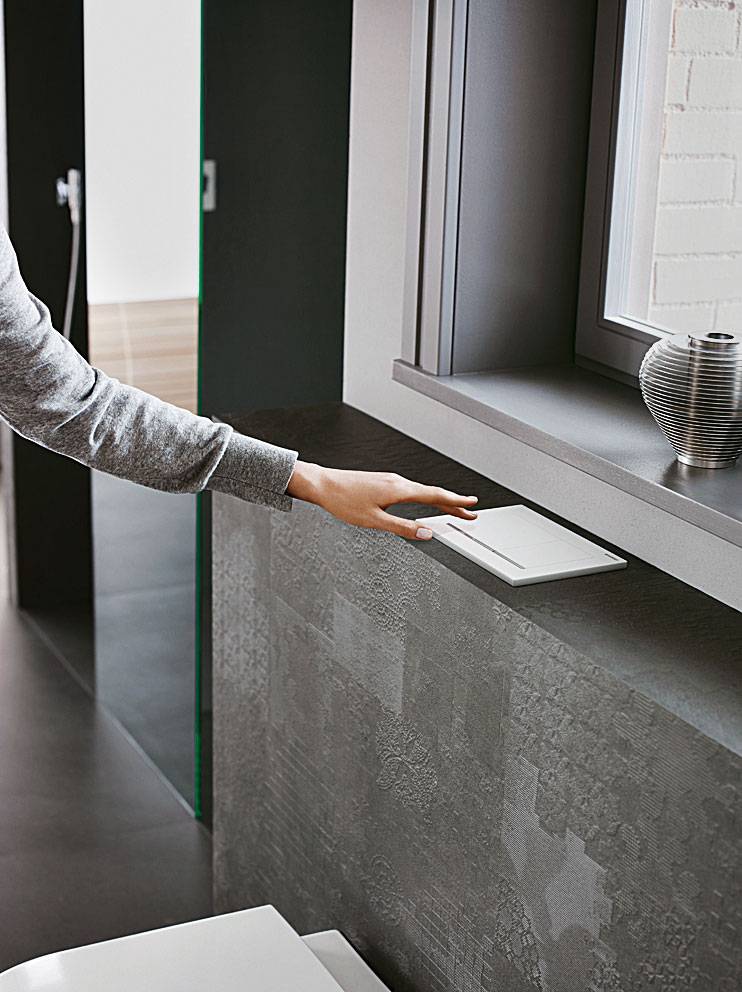
The shortened module allows you to install the device even under the window, and at the same time position the flush key horizontally so that it does not interfere with the toilet lid when opening.
A distinctive feature of this compact subspecies of modules is a frame shortened in height (82–83 cm instead of 113 cm). Such modules are suitable for installation in front of windows, under the door of a sanitary cabinet, hanging bathroom furniture and in other places where a low engineering module is required. In this case, the flush panel (if we are talking about a toilet) is located at the end. Similar systems are available from Geberit, TECE, Viega, Grohe and other companies.

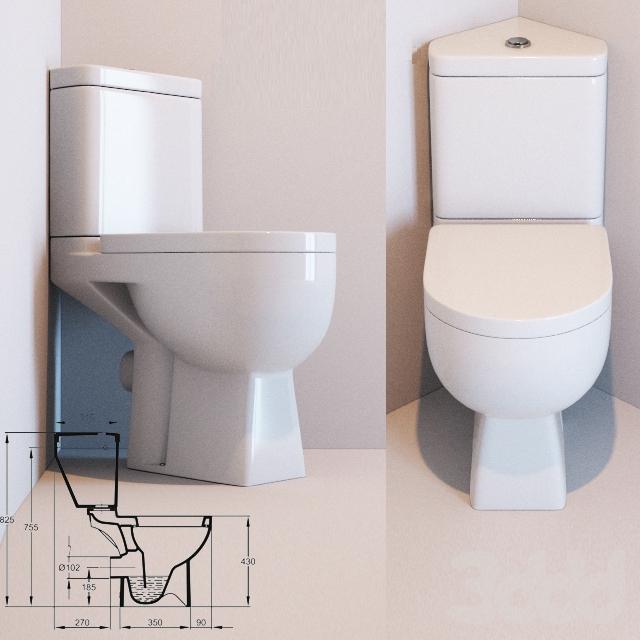



The Geberit Sigma Plattenbau installation for mounting a wall-hung toilet was designed specifically for Russian bathrooms. Thanks to the elongated studs, it can be built into almost any plumbing shaft.
The short module can be used alone when mounting the toilet on the wall, or together with the TECEprofil system anywhere in the bathroom. Height 820 mm, mounting depth 50 mm, center distance 180, 230 mm. The flush plate can be positioned frontally and horizontally.
Viega Eco Plus module for mounting a wall-mounted toilet bowl, height 113 cm, depth from 13 cm, width 49 cm. Floor mounting method (can be used for mounting on non-load-bearing walls), water drainage mode - two-mode (economy).
Double freestanding frame without wall support for toilet installation. It is especially relevant in rooms of non-standard layout.
Narrow module Duofix UP320. Mounting method - in the main wall and in the profile.Compatible with any wall mounted toilet. Height 1120 mm, width 415 mm, depth 170 mm.
Installation system from the series Grohe Rapid Sl for a wall-hung toilet bowl, it is adapted for simple fastening of handrails, which will be a support for users with disabilities or the elderly.
Engineering modules for mounting the Duofix washbasin (height 112 cm) for concealed installation in a plasterboard partition or on a solid wall with paneling (gypsum or wood), fastening to the floor.
Bidet (height 112 cm) for hidden installation in a plasterboard partition or on a solid wall with paneling (gypsum or wood), floor fixing.
Stand-alone module for mounting the toilet bowl Duplo WC, the weight of the structure and the entire load are taken by the reinforced lower legs. This module is so mobile that with it the device can be installed anywhere in the bathroom.
Corner installation for a wall-hung toilet from the extensive Viega Eco Plus collection. The module is compatible with any Visign flush plates. Available in two versions - 1130 and 830 mm high. The modules have retractable legs that allow you to set a comfortable toilet height.
Duofix UP320 is an installation for corner mounting of a wall-mounted toilet in front of or on a solid or hollow wall. Sturdy design with retractable legs for floor mounting (0-20 cm). Module height 112 cm, width 53 cm, depth 12 cm. Front key.
Shortened ViConnect mounting element. It comes with four flush panels made of high-quality plastic and glass. & Boch
The ViConnect mounting element allows practical, fast and inexpensive installation of all wall-mounted and wall-mounted toilet bowls Villeroy & Boch. & Boch
The scope of delivery includes a frame, a cistern with a volume of 10 l, selective flushing of a large (4.5/6/7.5/9 l) or small (3 l) volume of water, sets of fasteners for a toilet bowl (installation distance 180 or 230 mm ) and pipes.
Features of corner toilets
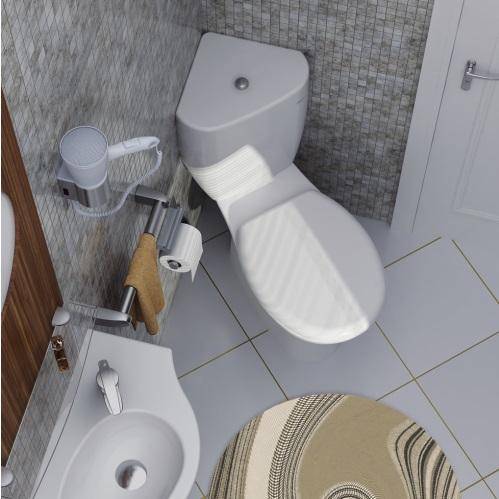
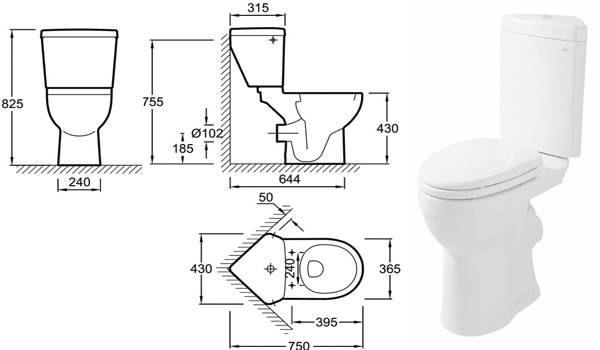
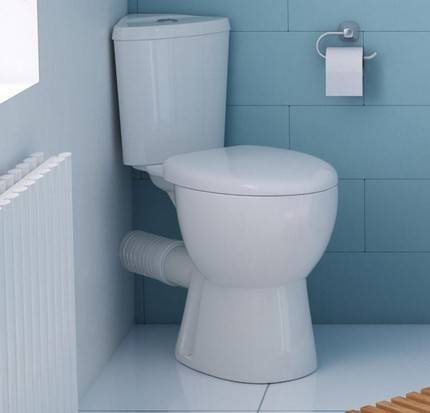
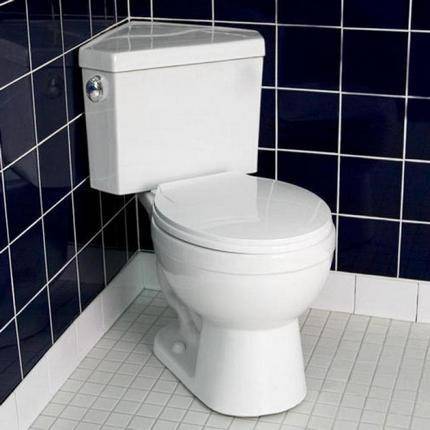
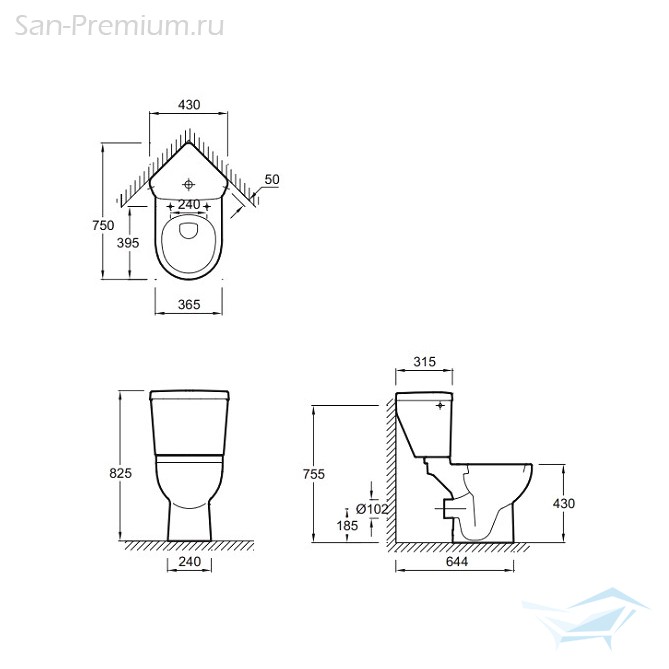
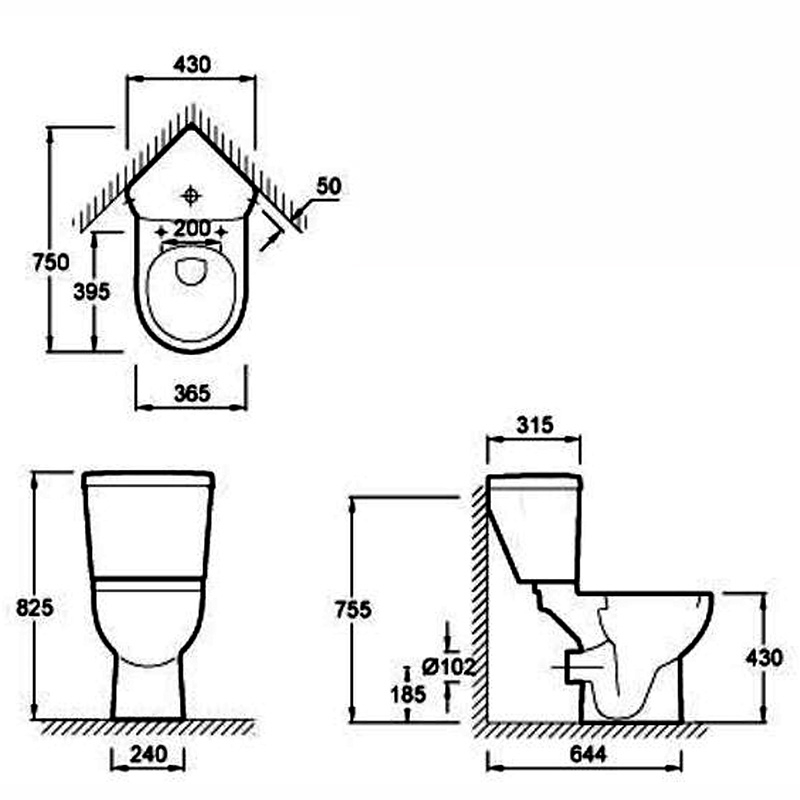
The corner toilet is a standard floor or wall-mounted design with a triangular cistern.
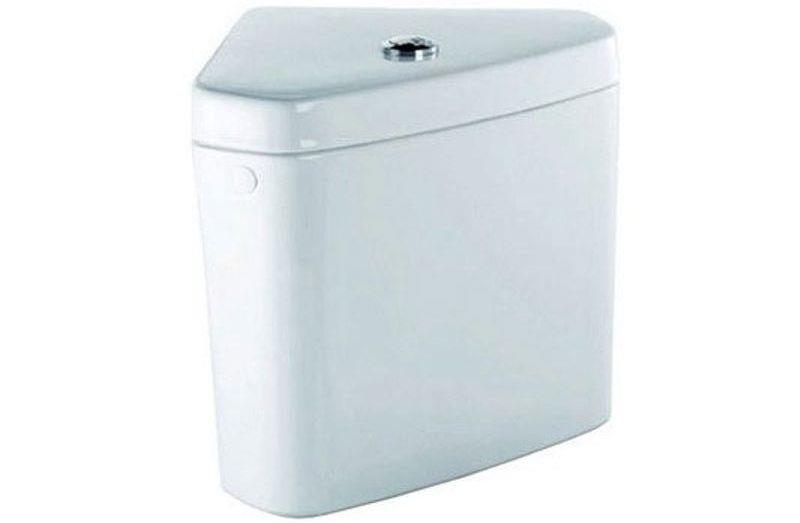
Triangular cistern for corner toilet
The advantages of this model are:
- significant space savings in the room due to the use of the "dead" zone behind the tank of the standard model;
- small overall dimensions. The corner toilet is compact and can be located in rooms of any size;
- uniqueness. Corner designs are not widely popular, and look more interesting than standard plumbing.
However, before choosing, one should take into account some negative characteristics of corner models, which include:
- the need for strong walls in the toilet room, since in most cases the cistern is mounted on the wall;
- the need to transfer communications. As a rule, in apartments of multi-storey buildings, sewerage and water supply systems are not designed for corner models, as they are located only along one or two walls.
Which exit is better: straight or oblique?
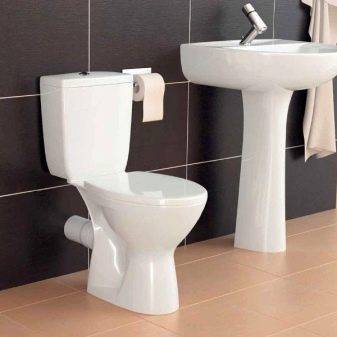
It should be noted that toilets with oblique or horizontal outlets are interchangeable in most cases, so the difference between them is small. But if it is quite easy to convert a direct model to an oblique one, then doing it the other way around is much more difficult.To do this, you will have to organize an additional elbow, which complicates the design of the outlet, as well as the already complicated process of sealing the joints (there is a high probability of residual water standing in the additional elbow).



In addition, it will not do without changing the installation location of the toilet bowl if the distance from the wall of the toilet bowl with a horizontal outlet that stood before this was minimal. You will have to prepare a new platform for attaching the bowl to the floor. In modern technology for the construction of residential buildings, sewers are mounted mainly under toilet bowls with an oblique outlet. Although another location of the sewage system is gaining popularity - under the toilets of the horizontal outlet.
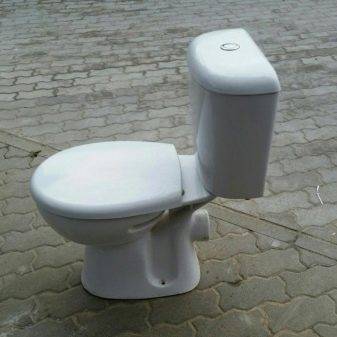
And if we compare the models with each other, without taking into account their interchangeability, then a toilet with an oblique type of outlet is considered a more versatile system, since such a bowl can be connected to a sewer pipeline located at an angle of 0 to 35 degrees relative to it. That is, some errors in the location of the sewer line are permissible, which is quite possible during the construction of high-rise buildings, when not everything turns out strictly according to the project as a result of previously unplanned circumstances
In addition, the process of installing a plumbing fixture with an oblique outlet is simpler, due to the lack of a strict point for its installation and connection to the sewer. This cannot be said about the analogue with a horizontal outlet - here the outlet must be located with the connection on the sewer strictly opposite each other.
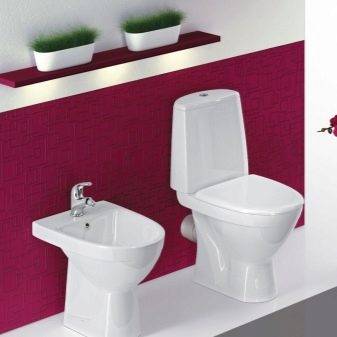
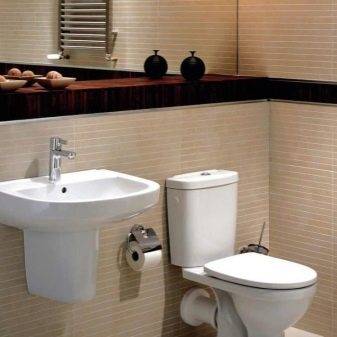
Description of the "release"
The drain hole that connects to the sewer is the outlet of the toilet. Connection is carried out in three ways:
- A universal option for connecting to a drain system, when the drain hole and its pipe are in a horizontal plane, on the same level. Finnish plumbing and Swedish models are produced.
- The drain pipe of the structure is directed to the floor, where the sewer wiring is hidden. Distributed in houses built in Soviet times (Stalin).
- The drain hole of the model is connected to the drainage pipe at a 45° angle - this is the oblique outlet direction. Models are produced by manufacturers in the Russian Federation.
Which outlet of the toilet is suitable will be prompted by the selected design of the sewer wiring. If its installation is entrusted to a specialist, then his recommendations will not interfere in the same way.
A few words in conclusion
Corner toilet allows you to change the space of the bathroom. Thanks to his presence, the central part of the room is freed. The room does not look like a pile of plumbing fixtures: everything is in its place. In addition, the capacity of the bathroom increases, its functionality expands.
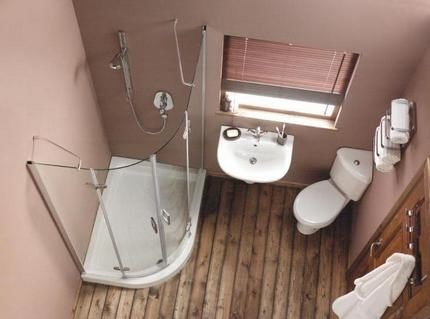 Due to the fact that the main plumbing fixtures in this small bathroom are located in the corners, there is space in the middle of the room.
Modern industry offers customers a wide variety of corner wall and floor structures. For each interior, you can choose the model that is most in harmony with it. Today, many apartment owners prefer corner toilets.
Such models gained popularity due to their compactness, ease with which they can be installed, durability, and the presence of a special drain system.