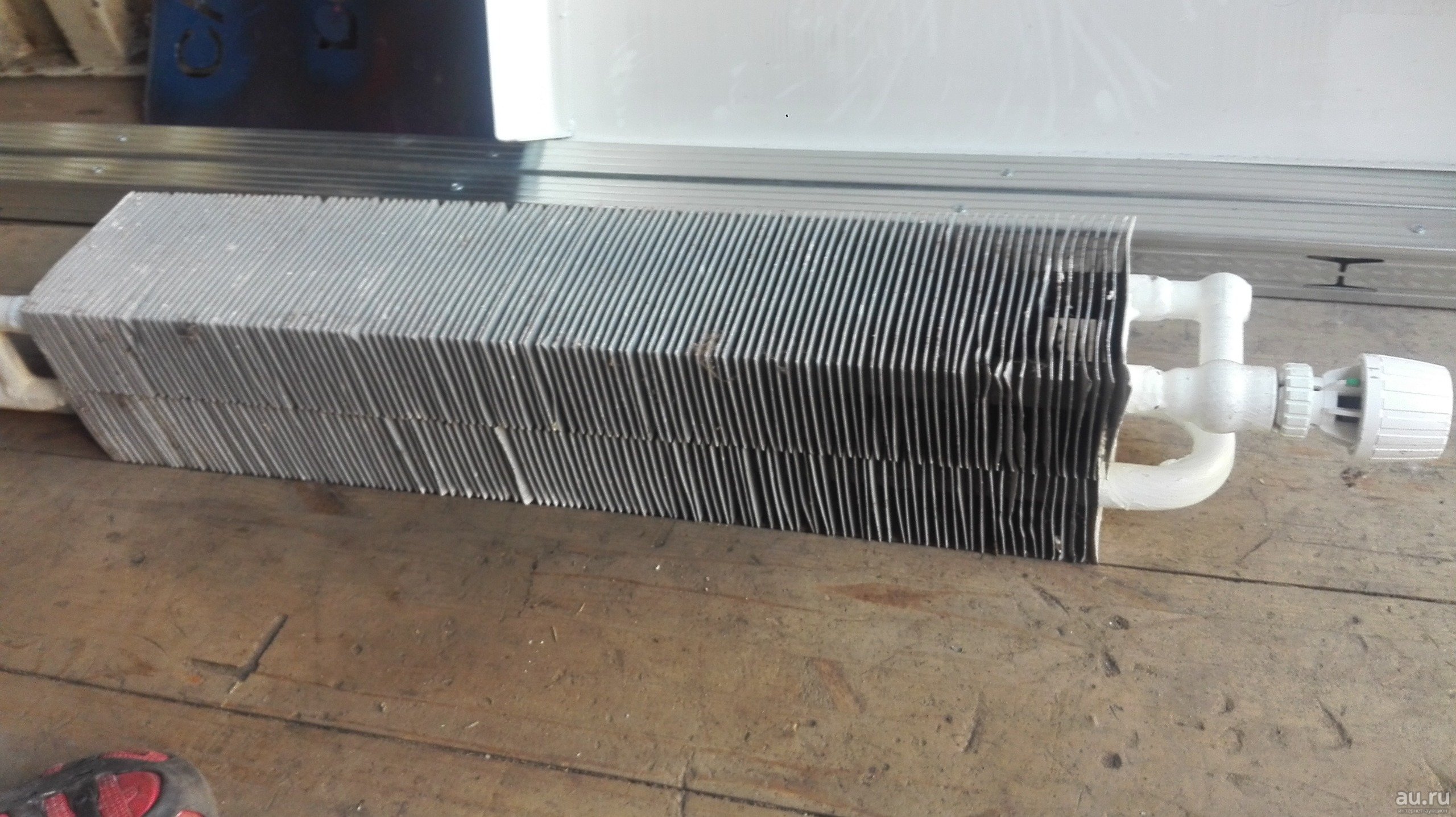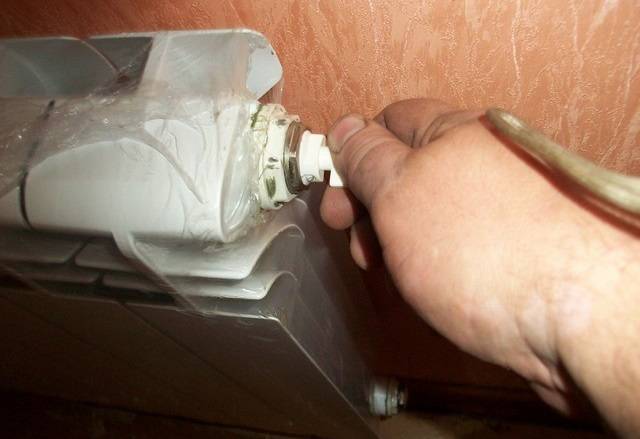
- How to delete - technical points
- Filling the heating circuit with coolant
- How is formed
- How to bleed air in an apartment building
- Bypassing the riser to discharge
- How to drive a traffic jam with a Mayevsky crane
- Remove with a conventional valve
- Expel through the stub
- Ways to remove air from water heating systems
- Causes and consequences
- Signs by which you can determine if there are air pockets in pipes and radiators
- Types of air vents and their design features
- Automatic
- Manual
- Radiator
- Troubleshooting
- First option
- Second option
- Third way
- Where does air come from in the heating system?
- What threatens the airing of the heating system
- Where does the air in the system come from
- Why does the heating system air out?
- How to bleed air from the boiler
How to delete - technical points
The problem of deaeration of the heating system should be solved at the planning and installation stage. You won’t be able to pass by, so you need to immediately foresee opportunities to bleed air and correctly mount the components. Here's what you can do:
-
During installation, hang radiators with a slope of about 1 ° - one side will turn out higher and it is on it that an air vent must be installed. It can be a Mayevsky crane or an automatic valve. The disadvantage of the first option is that you have to bypass the radiators and manually bleed the air. Automatic air vents are better in this regard, as they remove gases as they accumulate. Their minus is that they usually have a considerable size, so it’s quite difficult with aesthetic issues (there are also small ones, but they are imported, so they are more expensive).
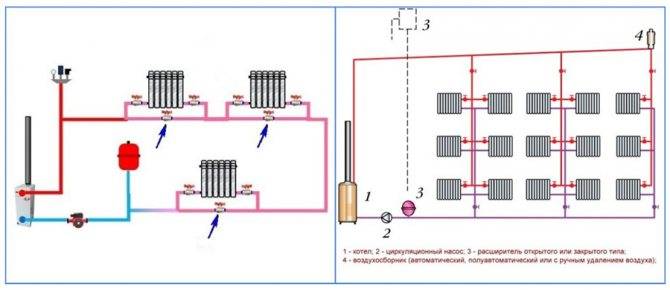
- Install an automatic air vent at the high points of the system (at the supply) and at bends. In addition to radiators, air accumulates at high points. If you do not put a valve here to remove it, an air lock may occur.
- If the system is large, with a comb, leave an air vent (preferably automatic) on the supply and return manifold.
- Another way to automatically remove air from a comb system is to install a flow or non-flow air collector in front of it. This is for houses with two floors or more. For smaller systems, there is a more elegant solution - in-line degassers. They work on the same principle as an automatic air vent (this is one of the options), only they are installed in a pipe break.
-
A flow-through air collector is a piece of large-diameter pipe with an automatic valve installed at the top. In this pipe, the flow of the coolant slows down (as in radiators), the gases dissolved in the coolant rise up and are discharged through the valve.
- A non-flow air collector is a small container welded on a perpendicular section of the pipe, all with the same bleed valve. The principle of operation is slightly different.Since the air bubbles are usually at the top of the flow, they enter the vertical branch, rise and exit through the valve.
-
-
Correctly calculate the volume of the expansion tank (this is especially critical for closed systems), monitor its serviceability (membrane integrity) and pressure in it.
And do not forget this moment: if your heated towel rail is connected to heating, it is also the top point. It is also desirable to install a device for removing air from the heating system on it.
Filling the heating circuit with coolant
For the heating system to work properly, it must be flushed and then refilled with water. Often it is at this stage that air seeps into the circuit. it happens due to incorrect actions during contour filling. In particular, air can be entrapped in too fast a flow of water, as mentioned earlier.
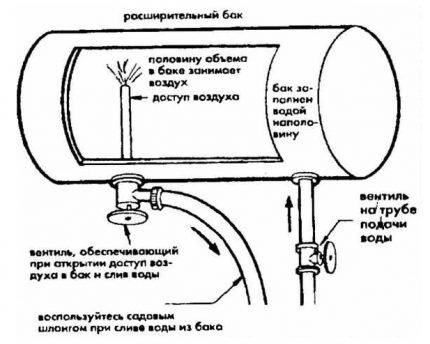 The scheme of the expansion tank of an open heating circuit allows you to get an idea of the procedure for filling such a system with coolant after flushing
In addition, the correct filling of the circuit also contributes to the faster removal of that part of the air masses that are dissolved in the coolant. To begin with, it makes sense to consider an example of filling an open heating system, at the highest point of which an expansion tank is located.
Such a circuit should be filled with coolant, starting from its lowest part. For these purposes, a shut-off valve is installed in the system below, through which tap water is supplied to the system.
A properly arranged expansion tank has a special pipe that protects it from overflow.
A hose of such length should be put on this branch pipe so that its other end is brought to the site and is outside the house. Before filling the system, take care of the heating boiler. It is recommended to disconnect it from the system for this time so that the protective modules of this unit do not work.
After these preparatory measures are completed, you can start filling the contour. The tap at the bottom of the circuit, through which tap water enters, is opened so that the water fills the pipes very slowly.
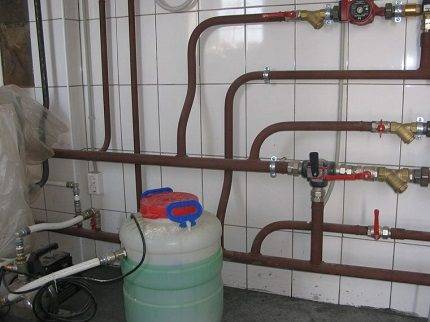
The recommended flow rate during filling should be about three times less than the maximum possible. This means that the valve should not be turned off completely, but only one third of the pipe clearance.
Slow filling is continued until water flows through the overflow hose, which is brought out. After that, the water tap should be closed. Now you should go through the entire system and open the Mayevsky valve on each radiator to bleed the air.
Then you can reconnect the boiler to the heating system. These taps are also recommended to be opened very slowly. During the filling of the boiler with coolant, a hiss can be heard, which is emitted by the protective air vent valve.
This is normal. After that, you need to add water to the system again at the same slow pace. The expansion tank should be about 60-70% full.
After that, it is necessary to check the operation of the heating system. The boiler is turned on and the heating system is warmed up. Radiators and pipes are then examined to identify areas where there is no or insufficient heating.
Insufficient heating indicates the presence of air in the radiators, it is necessary to bleed it again through the Mayevsky taps. If the procedure for filling the heating circuit with coolant was successful, do not relax.
For at least another week, the operation of the system should be carefully monitored, the water level in the expansion tank should be monitored, and the condition of the pipes and radiators should be checked. This will allow you to quickly resolve the problems that have arisen.
In a similar way, closed-type systems are filled with coolant. Water should also be supplied to the system at a low speed through a special tap.
You can fill the heating system of a closed type with a working fluid (coolant) on your own
It is important to arm yourself with a manometer for this. But in such systems, pressure control is an important point.
When it reaches a level of two bars, turn off the water and bleed air from all radiators through Mayevsky's taps. In this case, the pressure in the system will begin to decrease. It is necessary to gradually add coolant to the circuit in order to maintain a pressure of two bar
But in such systems, pressure control is an important point. When it reaches a level of two bars, turn off the water and bleed air from all radiators through Mayevsky's taps. In this case, the pressure in the system will begin to decrease. It is necessary to gradually add coolant to the circuit in order to maintain a pressure of two bar.
It is difficult to perform both of these operations alone. Therefore, it is recommended that the filling of a closed circuit is carried out together with an assistant.While one bleeds air from the radiators, his partner monitors the level of pressure in the system and immediately corrects it. Joint work will improve the quality of this type of work and reduce their time.
How is formed
With an illiterate bay of the coolant (for example, from the top point), turbulence forms: water tends to go down, and air goes up. In the process of movement, the liquid displaces air, if there are suitable irregularities in the inner surface, it stops in them. Gradually, the volume of trapped air increases.


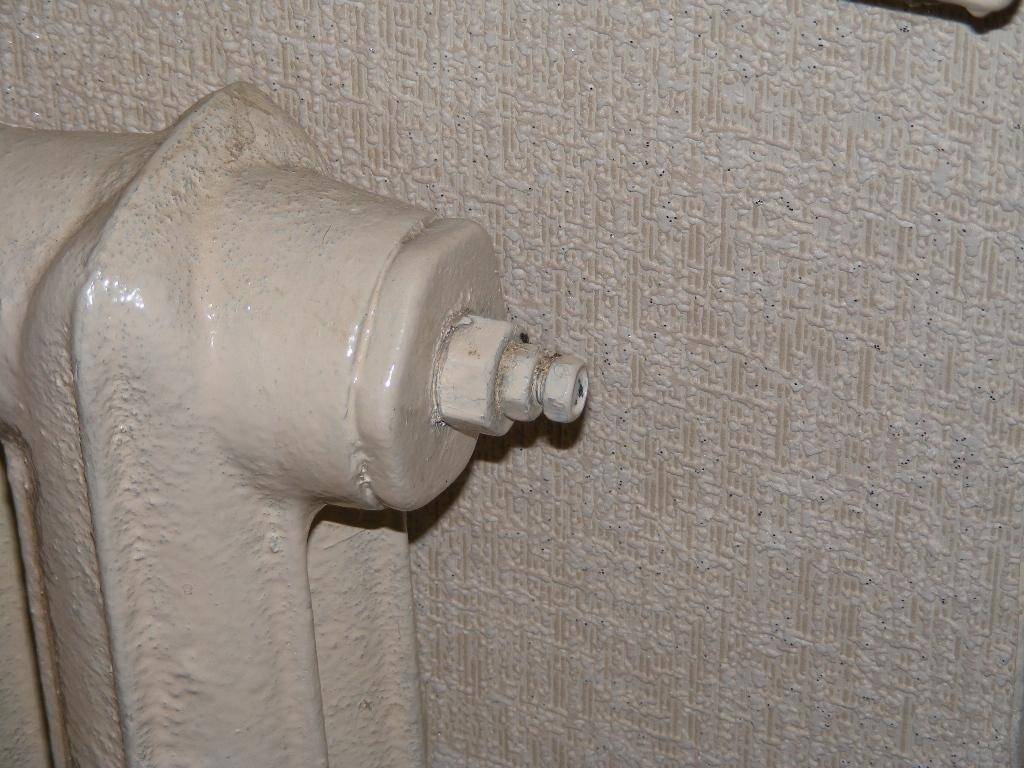


Why is it important to get rid of
Even a small amount of air in the system is highly undesirable, although a plus can also be found here: the appearance of a plug is a signal of a malfunction in the system. But there are many more troubles:
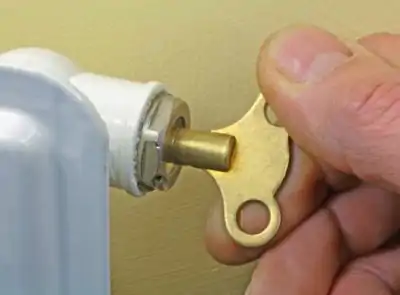
- weak heating of radiators or its absence;
- noise, vibration - create tangible discomfort;
- the combination of air and hot coolant leads to the occurrence of undesirable chemical processes, which leads to additional layers on the internal surfaces;
- part of the chemical processes entails an increase in acidity inside the system, which creates conditions for corrosion;
- if a circulation pump operates in the system, then its operation may go to waste, this will lead to a breakdown.
How to bleed air in an apartment building
Air release can be done in the following ways.
Bypassing the riser to discharge
Carried out by employees of the housing and communal services. For air release, devices are installed on the upper floors.
If you can’t use them (the apartment is closed, no one is at home), you can bypass from the basement - for two-pipe system.
On the risers should be vents are provided. They are located after the valves. If available, stock up on a ball valve with a diameter like that of a plug.
Process:
Risers are blocked (with valves)
On one of them, the plug is unscrewed very slowly and carefully. No more than 1-2 turns, so as to feel the pressure of the water
Before turning further, you must wait until the pressure subsides. A ball valve with a seal is screwed in place of the plug.
The installed vent opens completely, then water is supplied to the second one.
For a successful result, you need to see in advance how the wiring diagram of the heating plant at home is made.
Optimally, if the radiators along the circuit are located on the supply riser, then installing a second one with a vent on the return line will solve the problem: there will be no air. When heaters are distributed over two risers, there is no guarantee of a 100% result.
If the problem is not solved, the same actions are performed in the opposite direction. To do this, the ball valve is moved to the second riser.
Important! Screw valves do not tolerate the direction of water flow that does not correspond to the arrows on the body. If so, then you will have to reset the entire system
The usual scheme for organizing heating is the lower one. Pipelines, direct and return, are located in the basement. The connection between them is carried out through a jumper, on the top floor.
How to drive a traffic jam with a Mayevsky crane
Small cylindrical device. It is installed on the radiator from above, if there is a place for this in a niche. In one-story houses, all radiators are equipped with it.
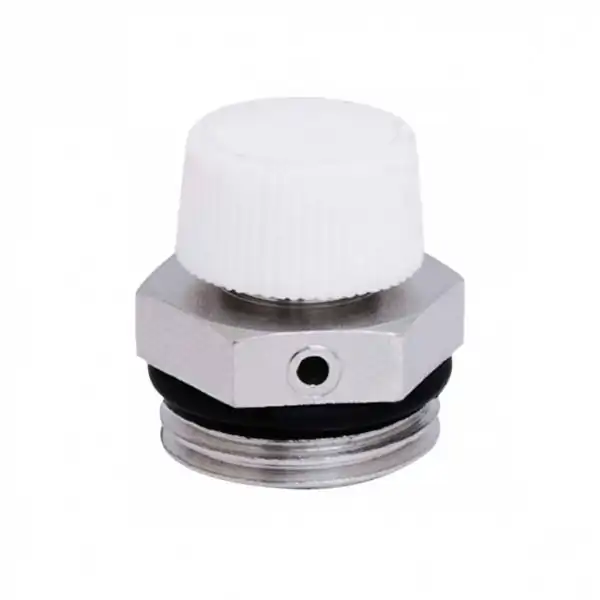
Photo 1. Mayevsky crane for airing radiators model 1/2 SL No. 430, equipped with an o-ring, the manufacturer is “SL”.
If the system is vertical, then the device is installed on the last floor in order to release the entire riser from air at once.
Additionally, the Mayevsky crane is installed on heating devices located below the common lower connection point to the riser. Sometimes - on the heated towel rail in the bathroom. It is placed vertically through a tee, which allows you to change the location of the axis of the device.

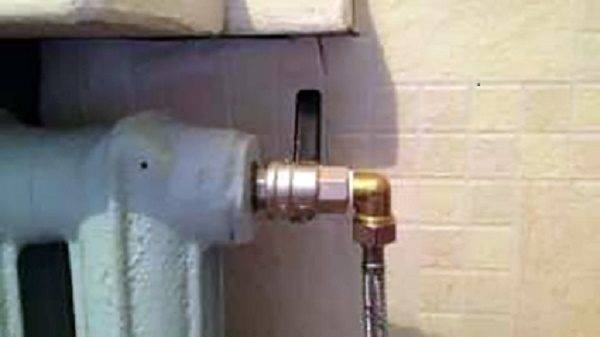
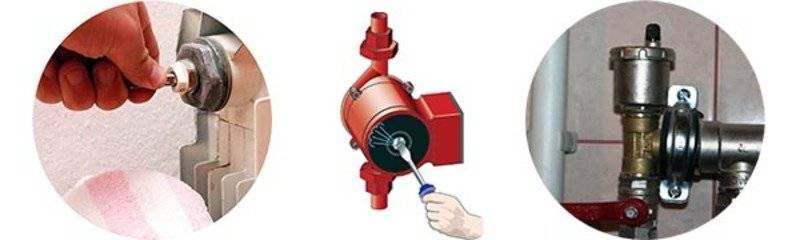
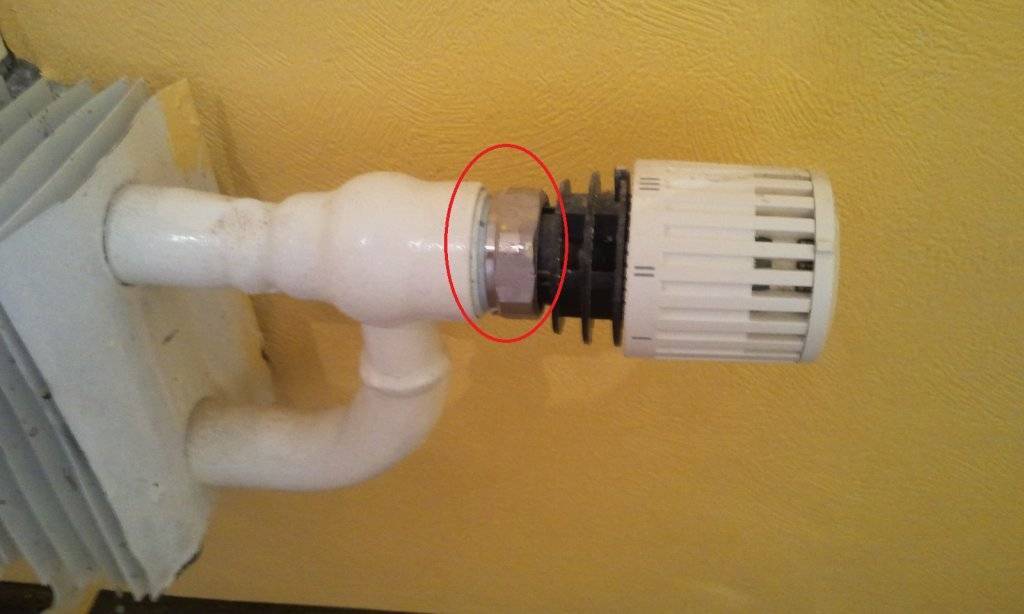
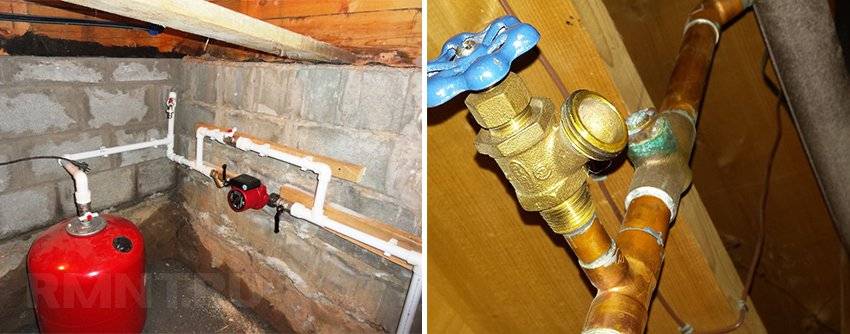
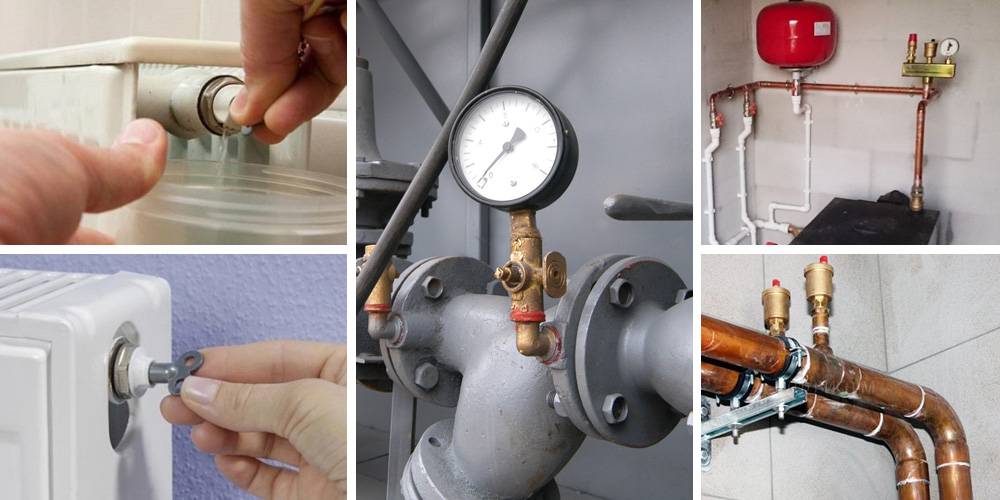


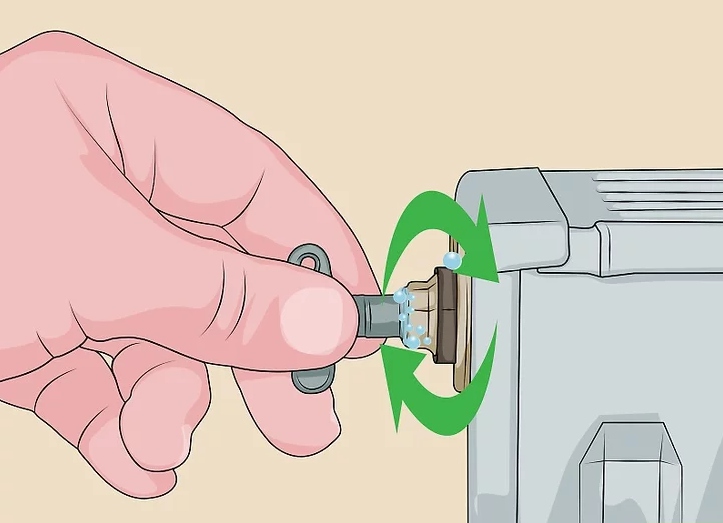
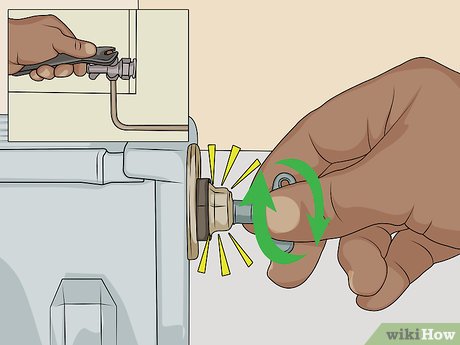
The Mayevsky crane is very easy to operate: the valve opens to release air, then closes. If this does not solve the problem of heating the radiator, then it will have to be cleaned.

- Before the air is released, the circulation pump is turned off if the water flow is forced.
- All objects that are close to the radiator are moved away.
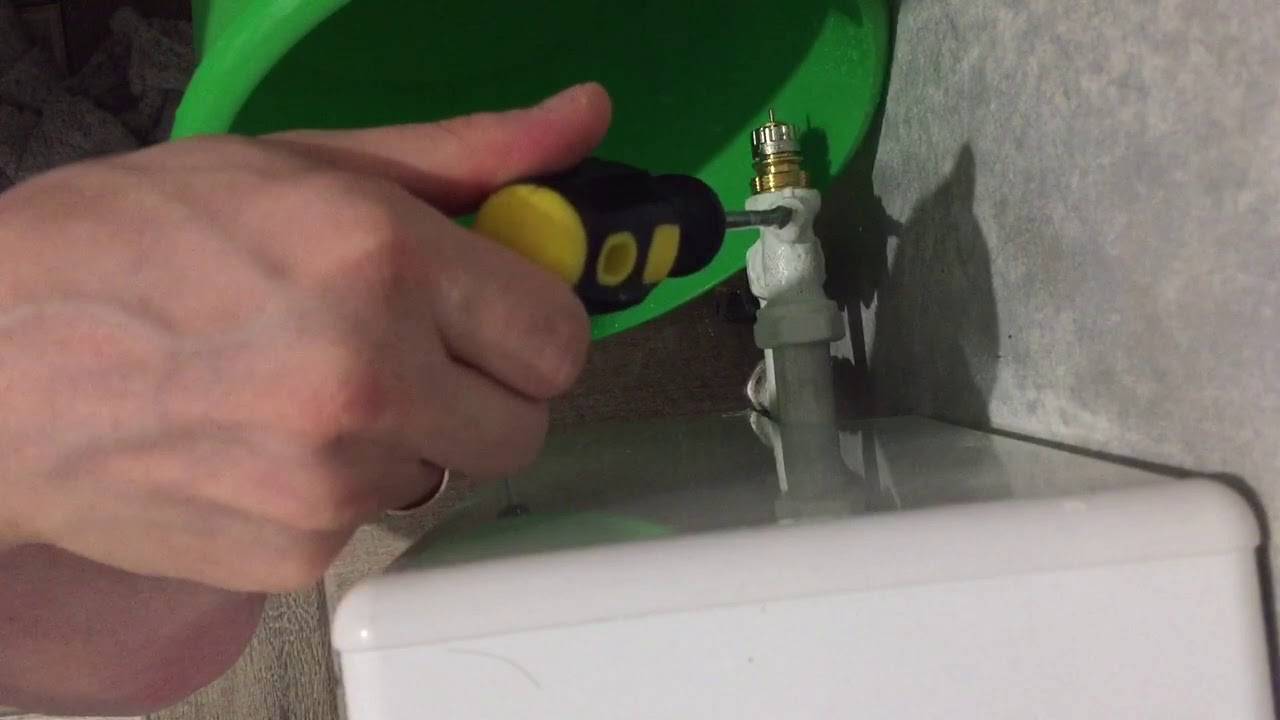
- A basin or bucket is placed under the valve.
- A screwdriver or wrench begins to turn until a hissing sound appears.
- When water appears, the faucet is closed.
Remove with a conventional valve
The valves must be located at the highest points in the circuit. The air is released according to the same algorithm as with the Mayevsky crane.
Expel through the stub
This method is used if nothing is specifically set.
To use the stub, you need:
turn off the riser; put a bucket or other container under the plug; if the plug is smeared with paint, it is softened with a solvent;
with an adjustable wrench, carefully and slowly turn the plug until a hiss appears, it is important not to miss this point, because you cannot open the plug completely; after the hissing stops, wait for the liquid to appear;
the plug is screwed back, if necessary, it can be sealed.Important! All manipulations are done slowly, without sudden movements.
Important! All manipulations are done slowly, without sudden movements.
Ways to remove air from water heating systems
Since heating can be both with natural and forced circulation of the coolant, the air in the heating system can also be bled in different ways.
For systems with natural circulation (upper piping is considered), the air lock can be removed through the expansion tank, which should be at the highest point relative to the entire system.
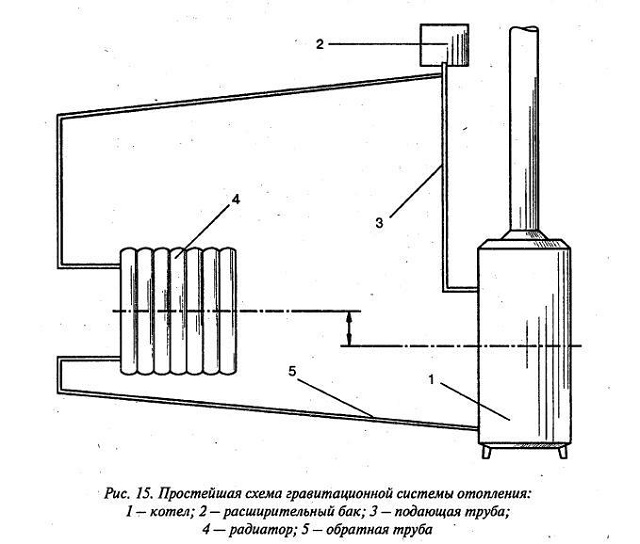
The supply pipeline should be laid with a rise to the tank. If the wiring is lower, air removal should be provided in the same way as in a heating system with a circulation pump.
For systems with forced circulation, an air collector should be provided - at the highest point, which will be responsible for air release.
The supply pipeline in this case is laid with a rise in the direction of movement of the coolant, and air bubbles, rising along the riser, are removed from the heating system through air valves, which must be installed at the highest point.
In any case, the return pipelines should be laid with a certain slope - towards the drain of the water, in order to speed up the emptying of the pipes during repair work.
In closed-type heating systems, automatic air vents are provided - they are installed at several points along the pipeline line, from which air is discharged separately.
If the installation of the heating system and the laying of pipes under the required slope is done correctly, then bleed through the "air vents" will be simple and not entailing any problems.
I would like to note that the removal of air from the pipes is accompanied by an increase in the flow rate of the coolant and an increase in pressure in them. In case of airing of heating batteries, poor tightness of heating pipelines or uneven temperature difference may occur.
Very often, in residential buildings equipped with an autonomous boiler with an open heating system, water can be discharged directly through the expansion tank: after emptying, it is advisable to wait at least half an hour and only then open the "air vent" on the tank - all the air will come out on its own when the water temperature in the system rises .
Causes and consequences
Air pockets are caused by the following factors:
- During installation, errors were made, including incorrectly made kink points or incorrectly calculated slope and direction of pipes.
- Too fast filling of the system with coolant.
- Incorrect installation of air vent valves or their absence.
- Insufficient amount of coolant in the network.
- Loose connections of pipes with radiators and other parts, due to which air enters from the outside into the system.
- The first start and excessive heating of the coolant, from which, under the influence of high temperature, oxygen is more actively removed.
Air can cause the greatest harm to systems with forced circulation. During normal operation, the bearings of the circulation pump are in the water at all times. When air passes through them, they lose lubrication, which leads to damage to the sliding rings due to friction and heat, or completely disables the shaft.
Water contains oxygen, carbon dioxide, magnesium and calcium in a dissolved state, which, when the temperature rises, begin to decompose and settle on the walls of pipes in the form of limescale. Places of pipes and radiators filled with air are most susceptible to corrosion.





Signs by which you can determine if there are air pockets in pipes and radiators
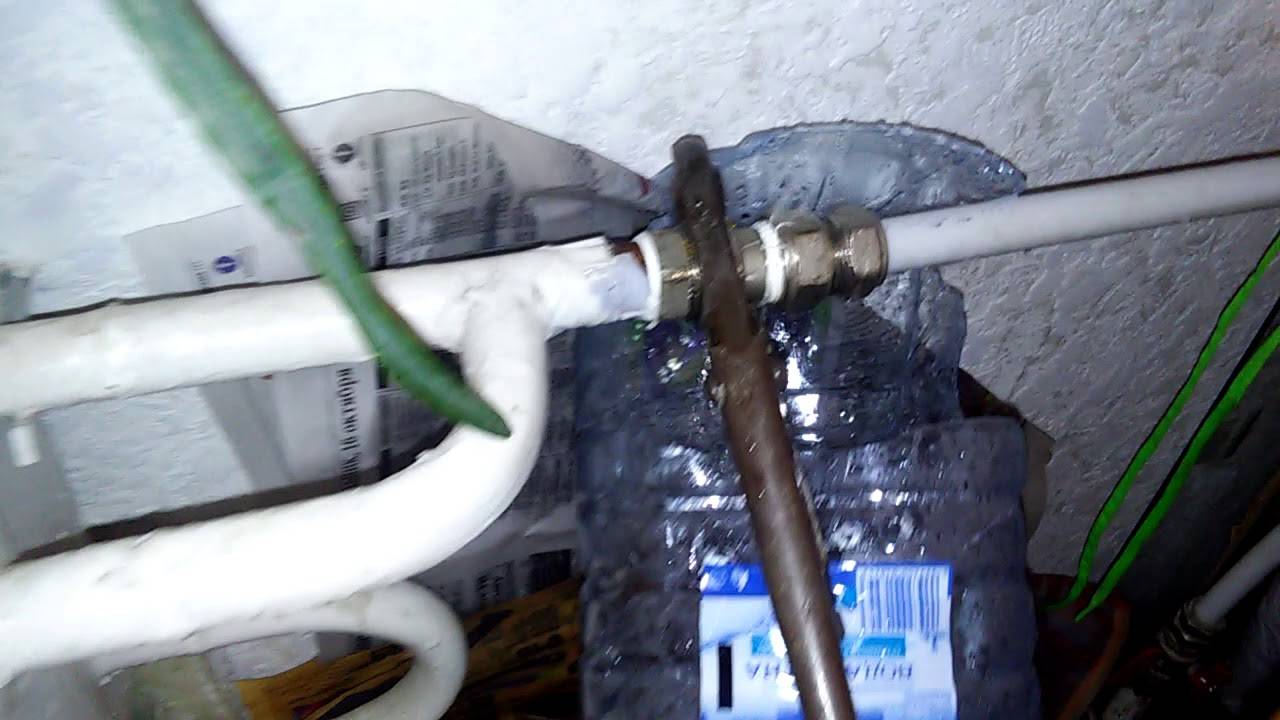
Due to the air in the heating system, the batteries heat up unevenly. When checked by touch, their upper part, in comparison with the lower one, has a noticeably lower temperature. The voids do not allow them to warm up properly, therefore the room is heated worse. Due to the presence of air in the heating system, when the water is very hot, noise appears in the pipes and radiators, similar to clicks and water flow.
You can determine the place where the air is located by ordinary tapping. Where there is no coolant, the sound will be more sonorous.
Note! Before removing air from the network, you should find the cause of its appearance and eliminate it. Especially carefully check the network for leaks. When heating is started, it is extremely difficult to identify loose connections, since water quickly evaporates on a hot surface.
When heating is started, it is extremely difficult to identify loose connections, since water quickly evaporates on a hot surface.
Especially carefully check the network for leaks. When heating is started, it is extremely difficult to identify loose connections, since water evaporates quickly on a hot surface.
Types of air vents and their design features
Distinguish air vent automatic and manual valves, the former are mainly installed at the upper points of collectors and pipelines, manual modifications (Maevsky taps) are placed on radiator heat exchangers.
Automatic devices are distinguished by a wide variety of locking mechanisms, their cost is in the range of 3 - 6 USD, presented on the market a wide range of models from domestic and foreign manufacturers. The cost of standard Mayevsky cranes is about 1 USD, there are products at a higher price, designed to operate in non-standard radiator heaters.
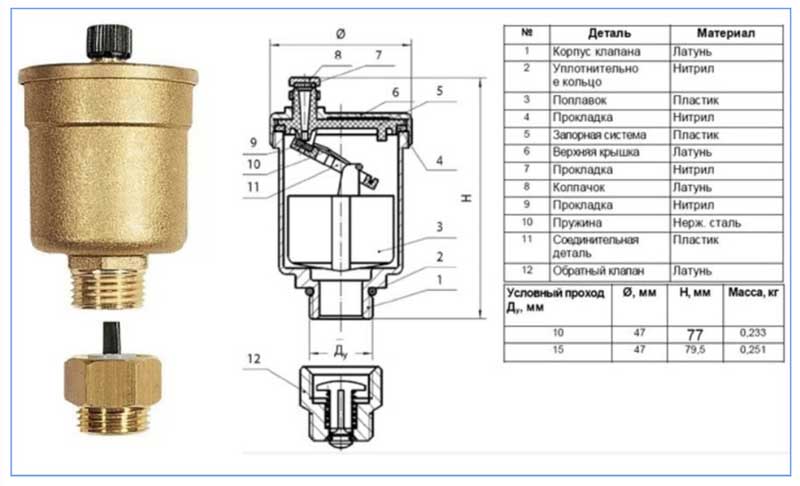
Rice. 6 An example of the construction of an air vent with a rocker mechanism
Automatic
Automatic taps have a different design depending on the manufacturer, the main differences between the devices:
- The presence of a reflective plate inside the case. It is placed at the entrance to the working chamber, protecting internal parts from hydraulic shocks.
- Many modifications are supplied complete with a spring-loaded shut-off valve, into which the air vent is screwed, when it is removed, the spring is compressed and the sealing ring closes the outlet channel.
- Some models of automatic taps are designed for operation in conjunction with radiator heat exchangers; instead of straight lines, they have side threaded pipes of the appropriate size for screwing into the radiator inlet. If necessary, angular automatic air vents of any type can be used, for example, at the points of connection of underfloor heating circuits, hydraulic switches, if their threaded diameters of the inlet and outlet fittings are the same.
- There are analogues of air vents on the market - microbubble separators, they are mounted in series in the pipeline on two inlet pipes corresponding to the diameter of the pipes. When the liquid passes through the body tube with a soldered copper mesh, a vortex water flow is created, which slows down the dissolved air - this contributes to the rise of the smallest air bubbles, which are bled through the automatic air release valve of the chamber.
- Another common design (an example of the first was given above) is the rocker model. In the chamber of the device there is a float made of plastic, it is connected with a nipple shut-off needle (like a car). When the float is lowered in an air-laden environment, the nipple needle opens the drain hole and air is released, when water arrives and the float rises, the needle closes the outlet.
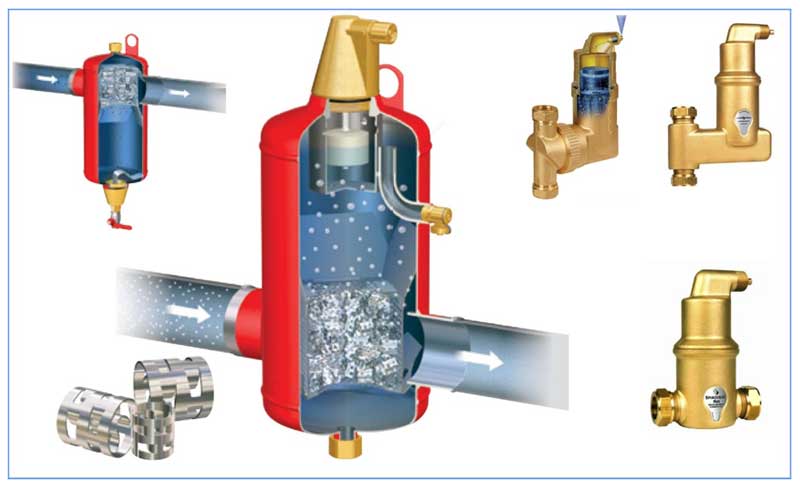
Rice. 7 Principle of operation of separator-type air vents for bleeding microbubbles
Manual
Manual devices for removing air from the system are called Mayevsky taps, due to the simplicity of the design, mechanical air vents are everywhere installed on radiators. On the market, you can find manual taps in the traditional design for installation in various places, and some modifications of shut-off valves are equipped with Mayevsky taps.
A mechanical air vent for removing air from the heating system works as follows:
- In operation, the cone screw is turned in and securely seals the housing outlet.
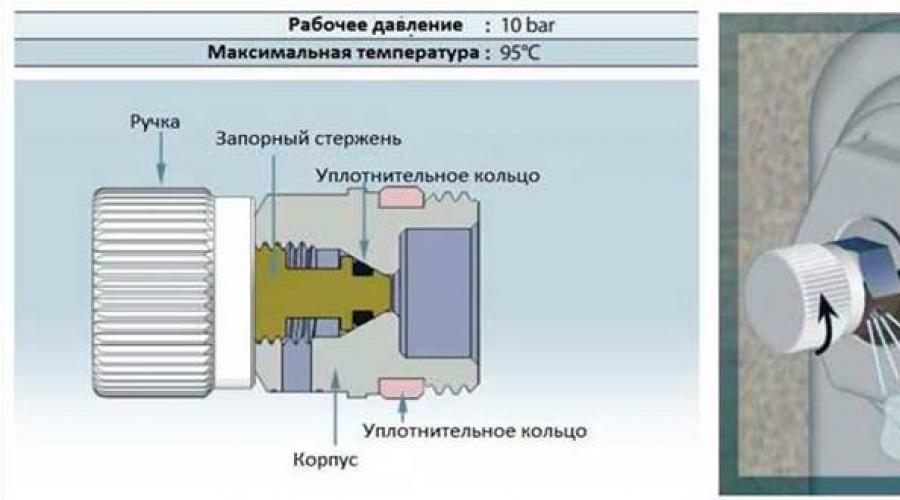
- When it is necessary to remove excess air from the battery, one or two turns of the screw are made - as a result, the air flow under the pressure of the coolant will exit the side hole.
- After the air is released, the water begins to bleed, as soon as the water jet acquires integrity, the screw is screwed in again and the de-airing operation is considered completed.
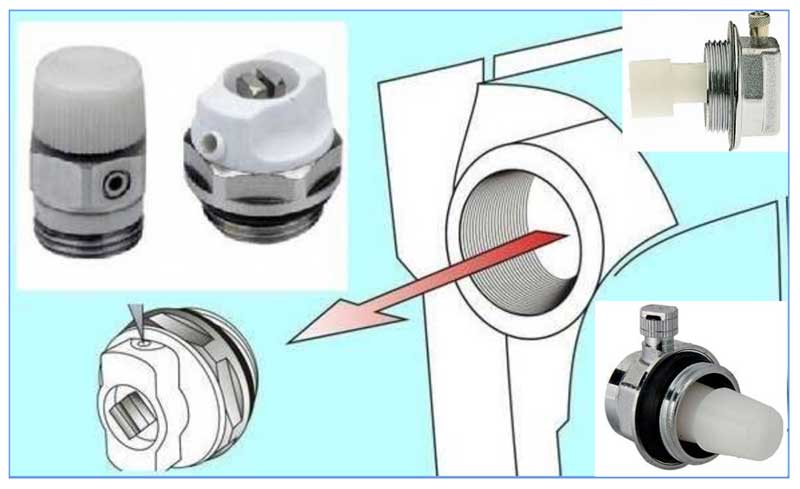
Rice. 8 Air vents from airing radiators
Radiator
Cheaper manual mechanical air vents are most often installed in radiators, if the body consists of two parts, the element with the outlet pipe can be turned around its axis to direct the drain hole in the right direction. The radiator device for bleeding air from the heating system has the following options for unscrewing the bleed screw:
- Swivel handle made of plastic or metal.
- Special plumbing tetrahedral key.
- Screw with a slot for a flat screwdriver.
If desired, an automatic-type angular air vent can be installed in the radiator - this will entail additional costs, but will simplify the airing of the batteries.
Troubleshooting
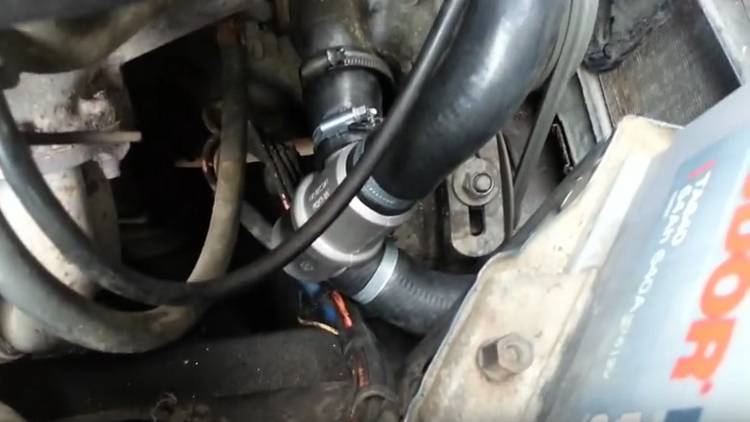
coolant hoses
There are three possible options for removing an air lock from the cooling system:
- Through the expansion tank with the removal of the pipe.
- Without disassembly, by tilting the car and adding fluid.
- With the help of heating.
Let's take a closer look.
First option
The first option on how to remove the airlock from the cooling system is suitable for most owners of domestic vehicles. In these vehicles, it is possible to disconnect the carburetor heating hose or the throttle assembly.To remove the hose, you will need to remove all parts that interfere with this procedure. Then you need to get this hose and remove it from the fitting. After that, unscrew the plug at the expansion tank and start blowing into it. As soon as the coolant began to flow out of the hose, you must quickly return it to its place and secure the pipe with a clamp. We return all the details to their place and enjoy the working stove.
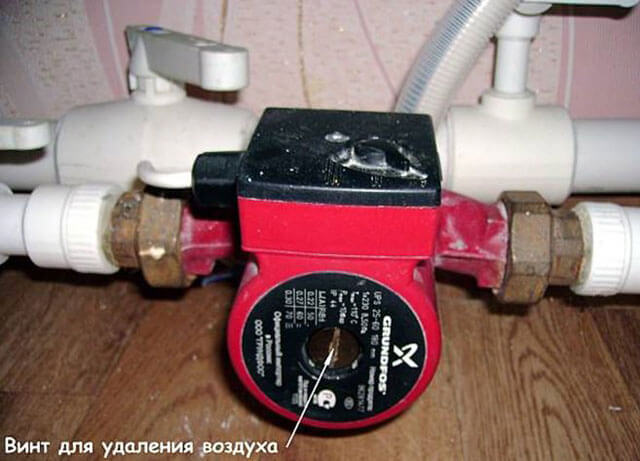


Second option
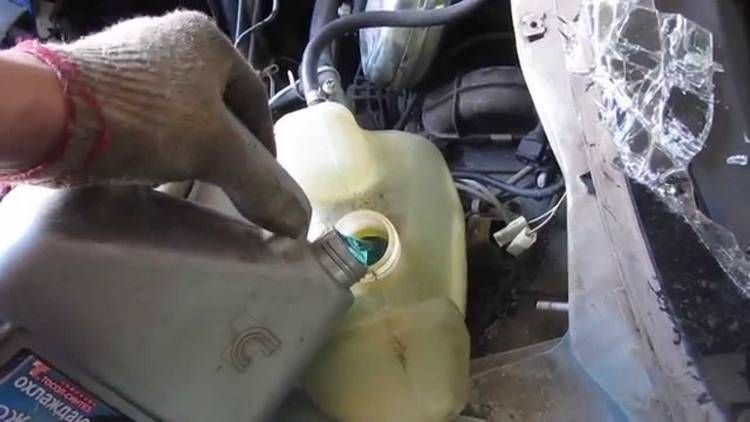
Coolant filling
In the implementation of the following method of self-removal of air, you will need to call on the inspection hole and install the car on hand brake. Using a jack or other suitable tool, raise the front of the vehicle at a slight angle. You can achieve the same effect without a jack by setting the car on a steep slope. How to break an air lock in the cooling system in this way? Everything is simple. We unscrew the caps at the expansion tank and at the radiator (if any). We start the engine and bring it to the optimum operating temperature. We are waiting for the damper to open and the fluid to move in a large circle. The switches on the stove should be at the maximum heating level.
While the engine is warming up, it is important to monitor the fluid level in the tank - it should fall. Gradually add the outgoing antifreeze (antifreeze). To increase circulation and outflow of antifreeze, it may be necessary to increase engine speed
A sharp drop in the liquid level can occur, and here it is important to add it to the correct level very quickly. You need to continue the procedure throughout the entire moment of the release of air bubbles. After completion, you will need to lower the car and add antifreeze to the required level.
To increase circulation and outflow of antifreeze, it may be necessary to increase engine speed
A sharp drop in the liquid level can occur, and here it is important to add it to the correct level very quickly. You need to continue the procedure throughout the entire moment of the release of air bubbles.
After completion, you will need to lower the car and add antifreeze to the required level.
Third way
The third method will also tell you how to remove the air lock from the cooling system. For its successful implementation, it will be necessary to start the engine and not turn it off until the optimum operating temperature is reached. After turning off the engine, remove the protective parts from it, to get to fitting heating hose. The coolant is very hot, as are the hoses through which it flows, so you must protect your hands to avoid burns. You can put on two pairs of gloves - working and on top of them - rubber. We disconnect the hose and wait for the liquid (antifreeze, antifreeze) to flow out of it. When this happened, we return everything to its place. It may happen that the antifreeze has not begun to flow out. In this case, we return the hose to its place, unscrew the cap at the expansion tank and screw it back on. Then try again with the hose disconnected.
After considering three possible options for removing an airlock from a vehicle cooling system, you only need to choose the right one. One thing is for sure - it is better not to delay the solution of this breakdown, because the air in the system causes a malfunction of the stove and serious problems with the engine, up to its complete failure.
Where does air come from in the heating system?
This question is asked quite often and I do not know the exact answer to it. Only guesses.
Air can be taken from the water itself, in which it is somehow present. If there is a lot of water, then there will be a lot of air. After a fresh filling of heating with water, air is actively released for several months.
Air can collect in dead ends, such as closed expansion tanks, and escape gradually. through the same water. This process is even longer. Hang closed expansion tanks upside down, as I described in the article about open and closed heating systems.
If you have a special air trap in the form of a vertical pipe with an automatic air vent at the end, then this can also be a source of bubbles. The fact is that automatic air vents often “freeze” and stop venting air. Then the tube is filled with air and the bubbles accumulated in the tube are torn off from below by the air flow and carried away into the system. In this case, I'm saying that bubbles start to walk around the system.
If you have an exceptionally strong circulation pump installed and there is a small hole in the system, then I think air can be sucked into the hole due to the Venturi effect. I have observed this many times in a water pipe, when there is a hole from which water does not flow, but into which air is sucked in by a stream of water. That is, if the water is turned off, then water flows from the hole. And if you open the water at the end, then the water from the hole stops flowing. But in reality, I have never seen this in heating systems. In heating systems, the water velocity is not so high. But that doesn't mean it can never happen.
Personally, in my heating system, the air stops bothering me about six months after the heating is freshly filled with water. I don't have automatic air vents. All valves are manual only. And my system is small and the house is small.
What threatens the airing of the heating system
The greatest danger posed by the air in heating system - plugs, which interfere with the movement of the coolant. For example, in a situation where the batteries are warm in one room and cold in another, the air lock is most likely to blame. The gas in the coolant accumulates in some place, blocks or impairs circulation.
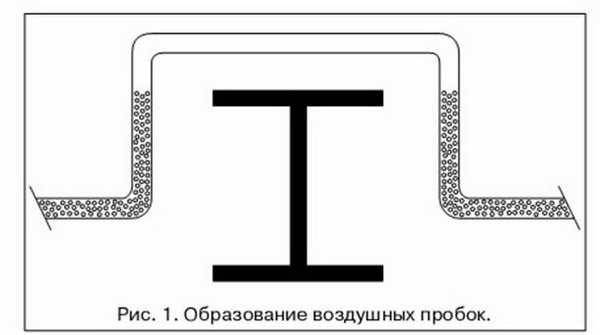
This creates air pockets and blocks the flow of coolant. This is just the place to install the device for venting air.
The second trouble that brings airing the heating system - noise. Radiators, pipes, the pump begin to make noise, gurgle, whistle. During the day, such noise may not be noticeable, but at night, it often interferes with sleep.
It also threatens to activate oxidative reactions and other chemical processes. As a result of these reactions, rust is formed, the walls are overgrown with salts and other deposits. All this impairs circulation. Sometimes so much so that the heating becomes inefficient.
Where does the air in the system come from
Practice shows that it is ideal to isolate the network water heating from external environment is impossible. Air penetrates into the coolant in various ways and gradually accumulates in certain places - the upper corners of the batteries, the turns of the highways and the highest points. By the way, the latter should be equipped with automatic drain valves shown in the photo (air vents).



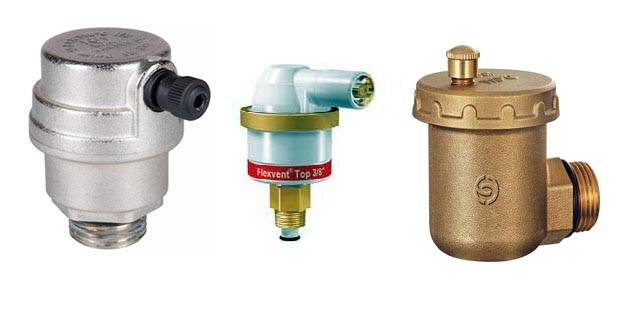
Varieties of automatic air vents
Air enters the heating system in the following ways:
- Along with water. It's no secret that most homeowners replenish the lack of coolant directly from the water supply. And from there comes water saturated with dissolved oxygen.
- As a result of chemical reactions. Again, not properly demineralized water reacts with the metal and aluminum alloy of the radiators, releasing oxygen.
- The pipeline network of a private house was originally designed or installed with errors - there are no slopes and loops are made, facing upwards and not equipped with automatic valves. It is difficult to expel air accumulations from such places even at the stage of refueling with coolant.
- A small fraction of oxygen penetrates through the walls of plastic pipes, despite the special layer (oxygen barrier).
- As a result of repair with dismantling of pipeline fittings and partial or complete draining of water.
- When microcracks appear in the rubber membrane of the expansion tank.
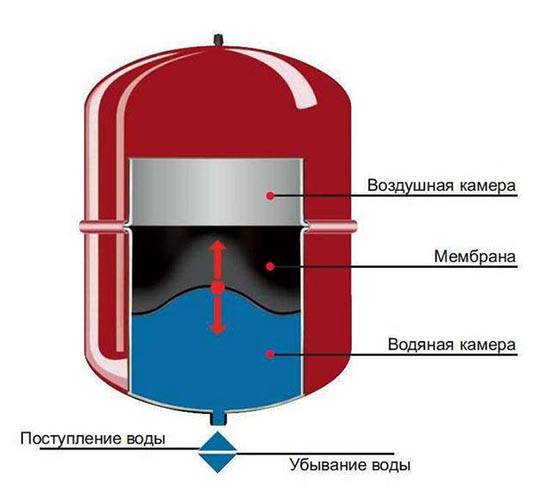
When cracks occur in the membrane, the gas mixes with water.
Note. Water taken from wells and shallow wells is prone to chemical reactions, since it is saturated with active salts of magnesium and calcium.
Also, a situation often arises when, after a long downtime in the off-season, the pressure in a closed heating system decreases due to air ingress. Lowering it is quite simple: you just need to add a couple of liters of water. A similar effect also happens in open-type systems, if you stop the boiler and the circulation pump, wait a couple of days and restart the heating. As the liquid cools, it contracts, allowing air to enter the lines.
As for the centralized heating systems of apartment buildings, air enters them exclusively together with the coolant or at the time the network is filled at the beginning of the season. How to deal with it - read below.
An example from practice. Air pockets had to be expelled from the open heating system every day due to a completely clogged sump. A working pump created a vacuum in front of it and thus drew oxygen into the pipelines through the slightest leaks.
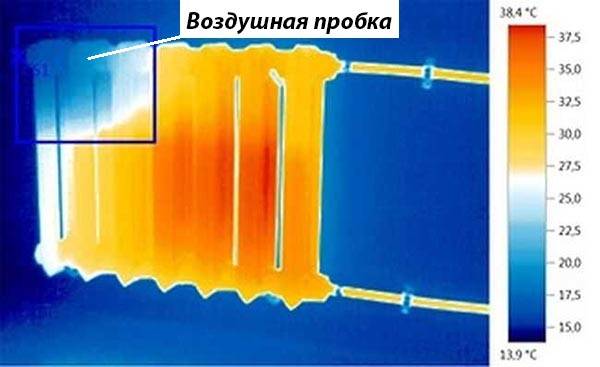
The thermogram shows the area of the heater where the air bubble usually lingers
Why does the heating system air out?

Most often, when traffic jams occur, it turns out that a small leak has formed somewhere. It is not visible to the naked eye, because a small amount of water can have time to dry on the surface of the pipe. A more effective way to detect leaks is to inspect the system with a thermal imager.
Air inevitably enters at the stage of filling with coolant
After the system has been filled, it is important to bleed the air several times.
Traffic jams could have been formed during repair work.
Even if the system has not been repaired, over time, oxygen is released from the water, which accumulates at the high points of the pipeline.
A leak can be where it is least expected - in air vents, modern automatic models operating in low quality coolant.
How to bleed air from the boiler
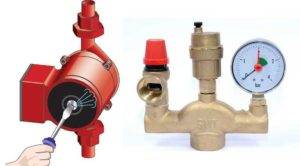
To do this, periodically open and close the Mayevsky tap, with an interval of several minutes. The procedure is repeated until a hiss or whistle appears, indicating the release of an air lock.The appearance of sound requires holding the bleed device in the open position until the coolant appears.
The absence of special devices for removing plugs on the boiler requires the use of the same devices on pipelines located above the heat source.
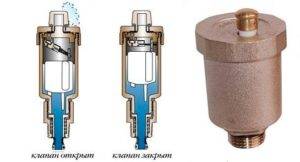
If there is no circulation pump in the closed circuit that cuts off the boiler with a return pipeline, then the energy source is turned on: gas, electricity, and in the solid fuel one, the furnace is ignited. After heating the "supply" pipeline, the air blower is periodically opened. The heat carrier, heating up, will rise from the boiler along the main line due to heating and return through the connecting pipeline - back to the heat exchanger. This technique requires careful monitoring of temperature, especially when servicing a non-solid fuel heat source. The movement of the coolant along such a circuit will be very slow and this is taken into account when performing work.
If it is not possible to shut off the water circuit of the boiler and there are devices for air removal only in the upper part of the line, it is necessary to drain the coolant, and then fill in the entire required volume of water. Before proceeding with such global events, it is recommended to cut off all devices (except for the boiler) and, turning on the pump, bleed pressure through the nearest air vent on the line until sound or bubbles appear. The absence of a result indicates the need for a complete drain of the coolant.