
- What pipes are used for irrigation in the country?
- Types of irrigation systems
- Overview of models and manufacturers
- Soldering polypropylene pipes is a simple process
- Polyethylene pipes in the country
- The positive aspects of automatic watering in the country
- Do-it-yourself drip irrigation system from a water supply system (with video)
- A few words about drip irrigation
- Conclusions and useful video on the topic
What pipes are used for irrigation in the country?
If in the past century the only available option for organizing any water pipes, including irrigation, were metal pipes, now the list of materials has become much more impressive. There are such types of pipes for irrigation, each of which has its own characteristics:
- Watering pipes made of steel. Durable metal pipes, the main disadvantage of which is a high susceptibility to corrosive processes. It should also be taken into account that less purified than drinking water is usually used for irrigation, therefore, overgrowing of the inner walls of the main line is formed in steel lines quite quickly (within 5-7 years). Because of this, it may be necessary to completely or partially replace the water line, especially if a pipe with a small diameter was originally chosen for it.
- Pipes made of non-corrosive metals: copper, stainless steel.Owners of pipelines made of these materials do not face the problems inherent in steel lines. But in home gardens, copper pipelines and stainless steel systems are not used due to the very high cost.
- Plastic pipelines. Polymer pipes are an ideal option for creating an irrigation water supply system. Plastic is very light, not subject to any biological and atmospheric factors (with the exception of pipes made of polypropylene, low-pressure polyethylene, the structure of which is destroyed due to ultraviolet radiation).
There are several types of plastic pipes suitable for irrigation systems:
polypropylene pipes. A strong and rigid pipe made of polypropylene can be an excellent basis for a country irrigation system. It should be borne in mind that the lack of flexibility of this material entails the need to use additional elements (corners, tees) to organize turns. The connection of polypropylene pipes is carried out using diffuse welding.
Important! Since ultraviolet radiation negatively affects the state of polypropylene, it is desirable to protect the pipeline from sunlight. In this case, the irrigation system will last much longer
- Polyethylene pipes. HDPE is more elastic than polypropylene, but also highly durable. Polyethylene perfectly withstands low temperatures, so a system made of this material does not need to be insulated: the pipe will not burst if water remains in it in winter. Polyethylene products can be thick-walled or thin-walled. The first type is used for main irrigation lines, the second - for drip irrigation.
- PVC products. They have all the advantages of plastic structures: light, rigid, but quite elastic. They can be used for both ground and underground plumbing. One of the positive qualities of PVC is the ability of the material to self-extinguish when ignited. True, a PVC pipe is not the best suited for operation at low temperatures: under the influence of frost, the plasticity of the material decreases.
- Metal-plastic irrigation water pipe. An excellent combination of the strength of metal pipes and the lightness of plastic structures. Metal-plastic products do not require welding and threading to create connections. However, do not forget that metal fittings (mostly brass) are still used to connect metal-plastic water pipes, which sooner or later corrode.
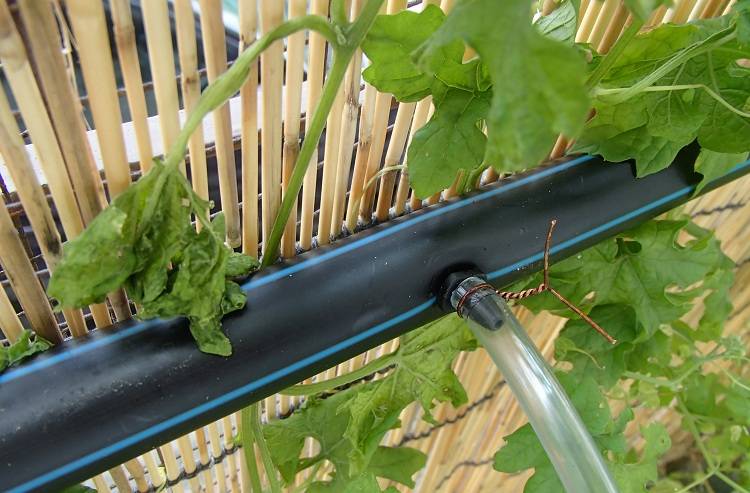
Today, in irrigation systems, light polymer pipes are used, which are not inferior in many respects to steel pipes.
One of the important parts of the irrigation water supply in the country can be called flexible hoses. They provide convenience and mobility when watering large areas of the garden manually. The laying of stationary lines from flexible hoses is undesirable, since the soft material reacts negatively to the constant exposure to ultraviolet radiation and high temperature. Flexible hoses are also not suitable for laying in the ground: in this case, the tube is very often pinched from the load.
Types of irrigation systems
The most important point from which it is necessary to build on when designing a country irrigation system is the climatic conditions inherent in this region.Depending on this factor, the type of system is selected, which, in turn, affects the set of system elements, its design and assembly sequence.

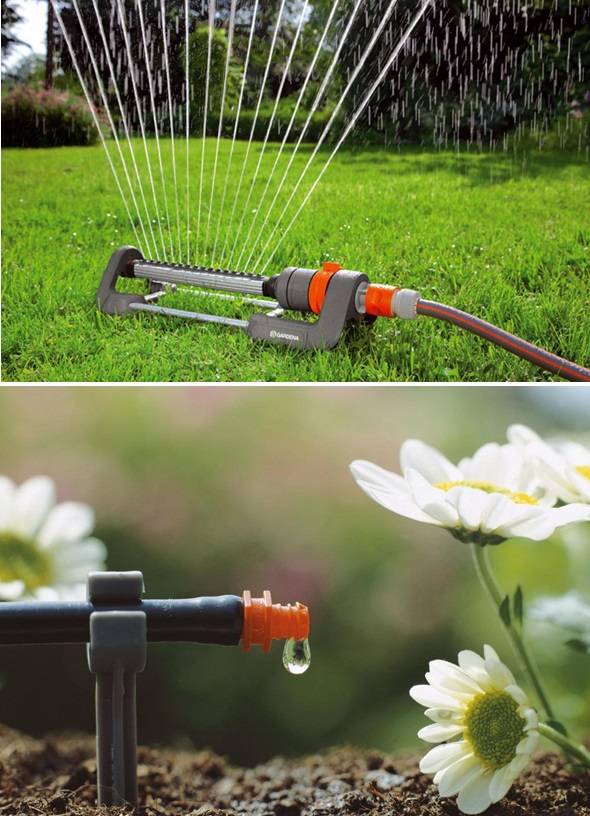


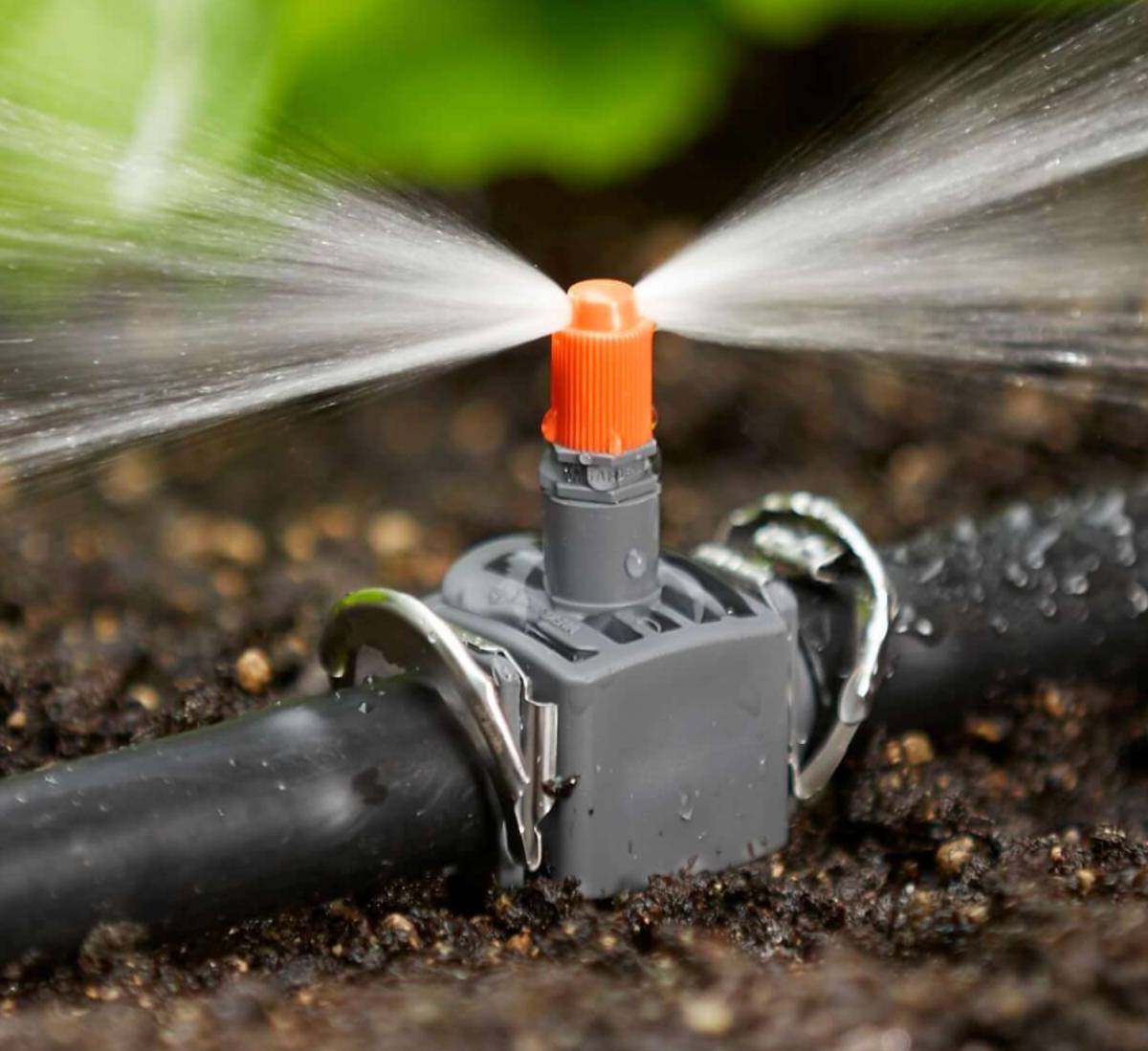

There are the following types of irrigation systems:
- Drainage systems. This method is best suited for areas with a large number of perennials that are constantly in one place. Drainage water supply is laid once and for a long time, which makes it ineffective for watering the garden with regular changes in the location of the beds.
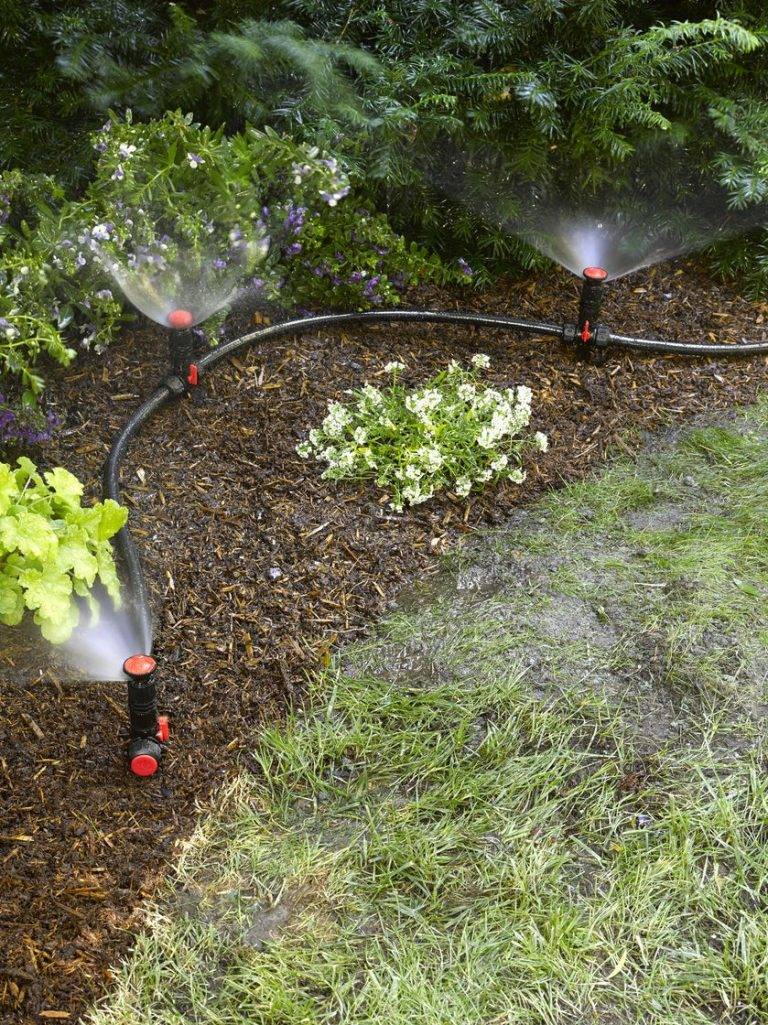
- Sprinkler watering. This method assumes the presence of a pipeline through which irrigation will be carried out. The design of such a pipeline is usually calculated individually, depending on the situation, but a sprayer is always installed on its extreme segment, due to which water is distributed between the plants.
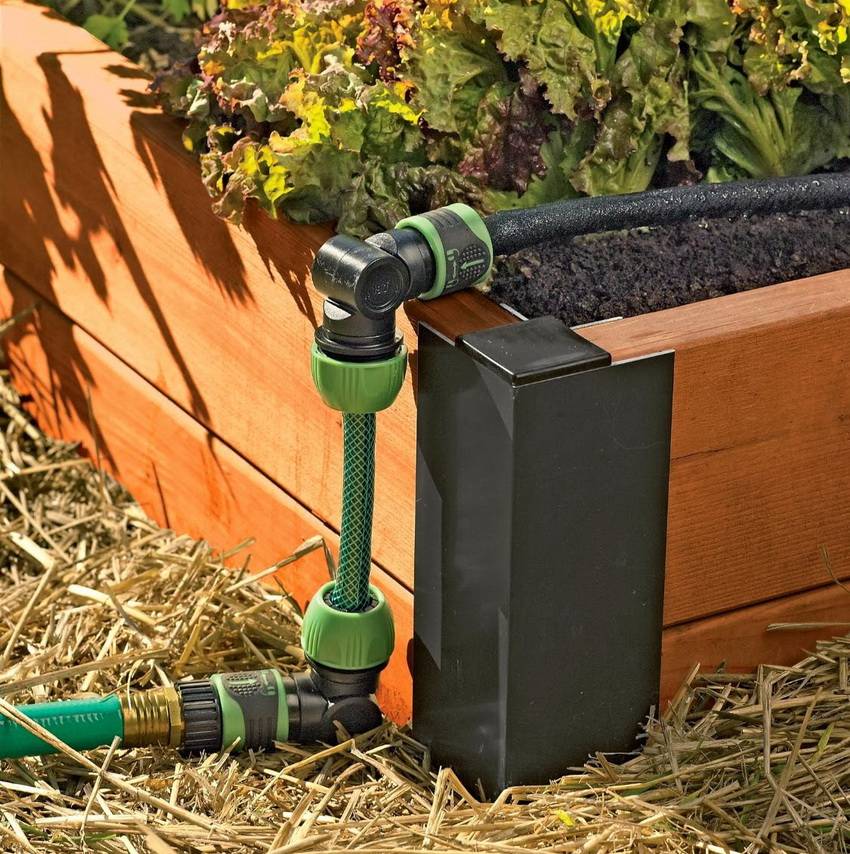
- Drip irrigation. The method of drip irrigation is characterized by maximum convenience and efficiency. Irrigation technology in this case allows you to minimize water consumption, which is extremely useful if the water supply system is equipped with a meter. Pipes for irrigation will have to be selected individually, depending on the characteristics of the site and the plants located on it. In addition, it will be necessary to correctly calculate the intensity and frequency of irrigation in advance.
- Surface watering. Such technology can be effectively used only in regions where there is practically no precipitation, and even in such situations, surface irrigation should be justified. Water supply is carried out using special ditches. The use of surface irrigation leads to violations of the soil structure, as a result of which air enters the roots of plants.
Overview of models and manufacturers
The selection of equipment begins with an inspection of how much this or that model costs.
But it is important to pay attention to the manufacturer. Here are some options for equipment for pumping / pumping water, which is well-deservedly popular:
- Water cannon - equipment designed to pump flows from a well / well. The throughput of insoluble inclusions is low, the price is from $ 80
- The kid is a design ideal for summer cottages. Low performance affects the low price (from $ 40).
- A brook is a device for supplying water from wells and wells of medium depth. Unpretentiousness to the percentage of pollution, excellent performance, ease of installation and lightness of the device are complemented by a low cost (from $ 30), but the duration of operation is no more than 3-5 years.
- The Gileks range is equipment designed for domestic use in both water supply and sewerage systems. Excellent practical qualities, work with different depths, unpretentiousness to pollution, a very long service life and good maintainability are the obvious advantages of the brand. Equipment cost from $200
- Belamos - models are used to supply clean drinking water and irrigation. They have a built-in control unit, which facilitates the use of the units, and can work in manual, automatic and scheduled modes. There is also a filter to improve the quality of the supplied flow, overload protection, productivity up to 2800 l / h, supply depth up to 8 meters. Price from 150 $
- Gardena is a brand of high reliability equipment.Universal devices are able to cope with the supply of liquid without interruption to high floors, be used for irrigation and at the same time are unpretentious to pollution, as they are equipped with a high-quality filter. Power up to 4000 l / h, ready for use immediately after purchase, the presence of 2 outlets for the hose (for irrigation and drinking water), a low noise threshold and a drainage tube for draining liquid add pluses to the device. Price from 120 $
- Aquarius is an ideal pump for wells up to 45 meters deep. The reliability of the unit is confirmed by the execution of parts made of brass and stainless steel, there is a thermal relay, as well as a complete non-susceptibility to power supply drops (performance will decrease, and the device will not break). Silent operation is also a plus, but it is better to use the unit on clean streams. Price from 120 $
- Whirlwind - pumps for deep wells (from 60 meters). Chrome-plated parts, durable housing, head up to 100 meters and price from $ 100 are the pluses of the unit. But energy consumption up to 1100 W is a drawback. However, the presence of overheating protection functions, smooth running, high pressure, high-quality assembly exceed the shortcomings.
All presented models from the Russian manufacturer have unique features - they are adapted to power outages, are resistant to mechanical stress and are easy to install. For users who prefer more expensive units, there are alternative options:
- The Grundfos range is an offer from German manufacturers. The company is engaged in the production of equipment for supplying and pumping liquids from wells, wells, tanks. The devices are equipped with sensors for overheating, overload, protection against dry running and voltage surges.Such functionality significantly extends the life of devices, but raises the price to $ 150. However, no matter how much the units cost, they deserve their price - the brand, according to consumers, is considered a leader in its field.
- Unipump is a brand of equipment indicated for use in wells with a high content of insoluble inclusions (up to 100 g/cubic meter). Feeding height up to 52 meters, productivity up to 4.8 m3/hour. There is overheating protection, soft start, automatic operation, but you will have to be careful in use if the liquid is very hard. The price is from $ 110, efficiency and noiselessness are pluses, but a weak network drive is a minus of equipment.
A preliminary analysis of the needs, the design of the water intake source, determining the length of the flow and the functional features of the water supply will allow not only to choose a good quality device, but also to correctly determine exactly how many pumps will be needed to uninterruptedly supply water to a house, household or suburban area.




Soldering polypropylene pipes is a simple process
First of all, paired nozzles of the desired diameter are installed on the soldering iron. It must be remembered that the nozzles are coated with a non-stick coating: you can clean them with a wooden scraper, but not with a metal object.
Soldering polypropylene pipes is very fast
The next stage - the soldering iron is set to a temperature of 260 degrees, after 6-7 minutes the soldering iron is ready for use. Farther it is necessary to cut the polypropylene pipe in accordance with the dimensions, and then simultaneously put the pipe and fitting on the heated nozzles.
The heating process takes place in this way: the pipe is pushed into the nozzle - the outer part is warmed up, the fitting is pushed onto the steam nozzle - the inner part is heated. As a result, after warming up, the parts should be removed from the nozzles, inserted into each other, fixing this position for 2-5 minutes. This method of soldering provides the maximum quality of the connection, does not require any special skills, and besides, the labor costs are the lowest.
Plumbing in a country house made of polypropylene is an objective, reliable, modern solution, in order for it to serve properly, you need to know some of the subtleties of the process:
- surfaces to be welded must be clean and free of grease;
- if pipes with a diameter above 50 mm are welded, it is advisable to chamfer at the end with a knife (angle 45 degrees);
- the longitudinal axis of the fitting must coincide with the longitudinal axis of the polypropylene pipe, that is, the “curve” welding is completely excluded;
- welding will be correct if there are no gaps between the fitting and the pipe, molten plastic does not hang from the inside of the pipe;
- poor-quality soldering is redone: the pipe is cut off and re-soldered.
The arrangement of a water supply system from this material is convenient to use, and with the help of adapters, fittings, it can be laid anywhere, providing civilized living conditions.
We told how to organize a constantly updated source of water for irrigation on the site. In this article, we will consider issues related to the organization of water delivery from the source to the beds.
Working in the garden, contrary to popular belief, may well bring joy, the main thing is to organize everything correctly.There are many devices, techniques and tricks that can greatly facilitate gardening. In the article “System of automatic watering of the garden. Part 1. Storage tank with water level control "we talked about how to organize a constant source of water for irrigation in the country. Its mere presence is a good help for facilitating irrigation work. The next step, designed to further simplify the life of a summer resident, will be the arrangement of a summer water supply on the site. We will tell you how and from what you can and should make summer plumbing.
Polyethylene pipes in the country
HDPE pipes are the most popular type of pipes that summer residents use in their areas for irrigation. These pipelines are produced in several diameters, and also differ in the thickness of their walls:
- thin-walled, not intended for year-round use in open areas;
- with an average wall thickness, designed for pressure up to 6 atmospheres;
- thick-walled, able to successfully withstand pressure up to 10 atmospheres.
Typically, pipes with a diameter of 2-4 cm are used, having a wall thickness of 2 mm.
Tip: If possible, prefer thick-walled pipelines that can last about 50 years in the harshest conditions (including frost).
Polyethylene pipes for irrigation have the following advantages:
- elasticity, which minimizes the number of joints on the pipes;
- polyethylene is not subject to destruction at low temperatures;
- the strength of the pipes is such that the integrity of their walls is ensured even under physical influences from construction equipment;
- polyethylene is not subject to corrosion;
- deposits do not form inside HDPE pipes;
- pipe material is non-toxic;
- relatively low cost.
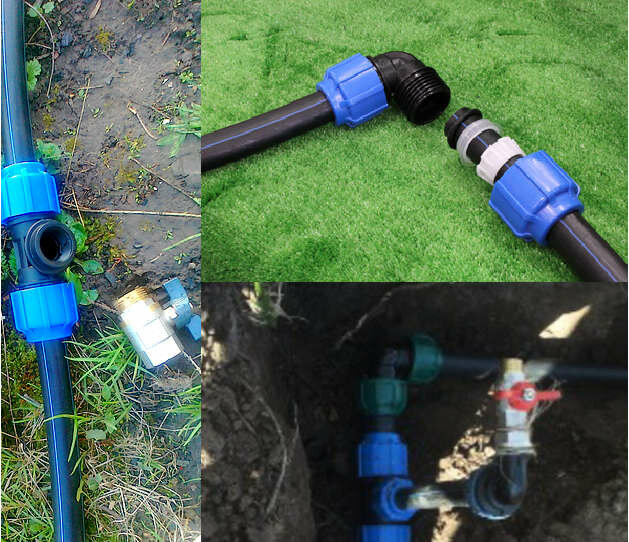
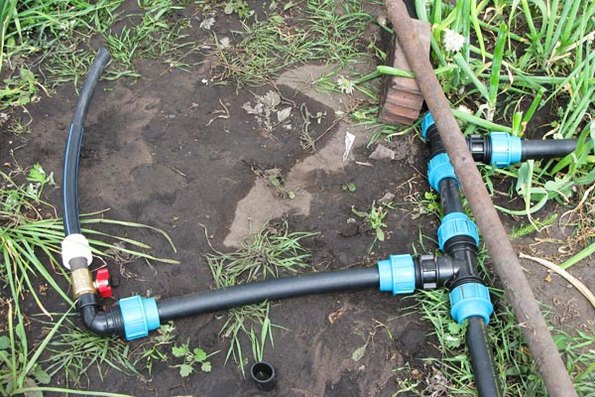
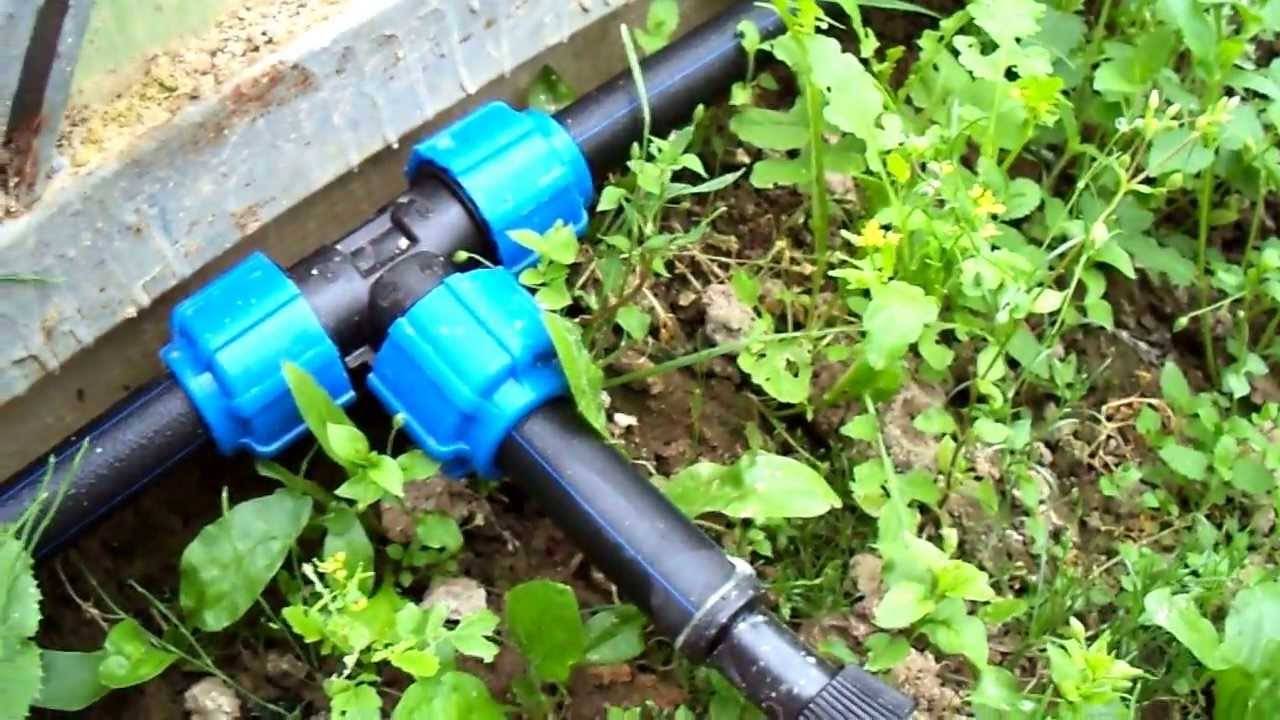
Plastic plumbing in the country for irrigation from polyethylene is mounted using compression fittings, which allow it to be disassembled if necessary.
The positive aspects of automatic watering in the country
Despite some disadvantages, we are still very pleased that we installed a drip irrigation system in the country. It has undeniable advantages:
- significant time savings;
- facilitation of physical labor;
- the ability to safely grow most garden crops, coming to the dacha only on weekends, even in the driest period;
- moisture goes directly to the roots of plants, thanks to which we do not waste water on accidental watering of paths and other nearby areas, contributing to the prosperity of weeds growing there;
- due to the fact that the soil is saturated with water very slowly, a crust does not form on its surface.
Do-it-yourself drip irrigation system from a water supply system (with video)
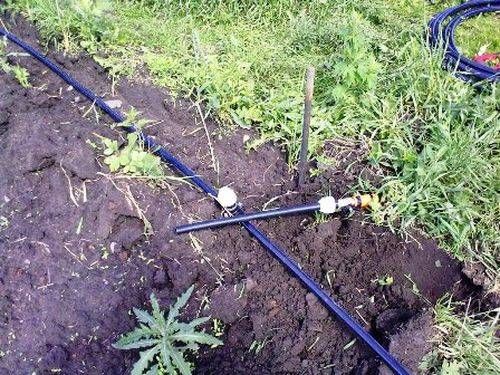
For a drip irrigation system from a water supply system, small holes must be made in a regular flexible hose at a distance of 30 - 40 cm from each other
With such a system, it is only important to properly route the hoses around the site. Water using a pump can be supplied from a river, a well or a well
Some summer residents use sprinklers in their home gardens to water lawns, potatoes, and strawberries. For watering a greenhouse or tomatoes, in order to avoid the occurrence of conditions for the development of phytophthora, a different system is used.On each bed, plants are planted in 2 rows, and in the center of the bed, pre-prepared pipes from various materials should be buried to a depth of 20 cm. You can take drainage short, ceramic pipes. Pipes must be laid end-to-end, joints on top so that earth does not pour into them, cover with pieces of polyethylene. When using plastic pipes, holes with a diameter of 2–3 mm must be made in them and only then buried in the soil.


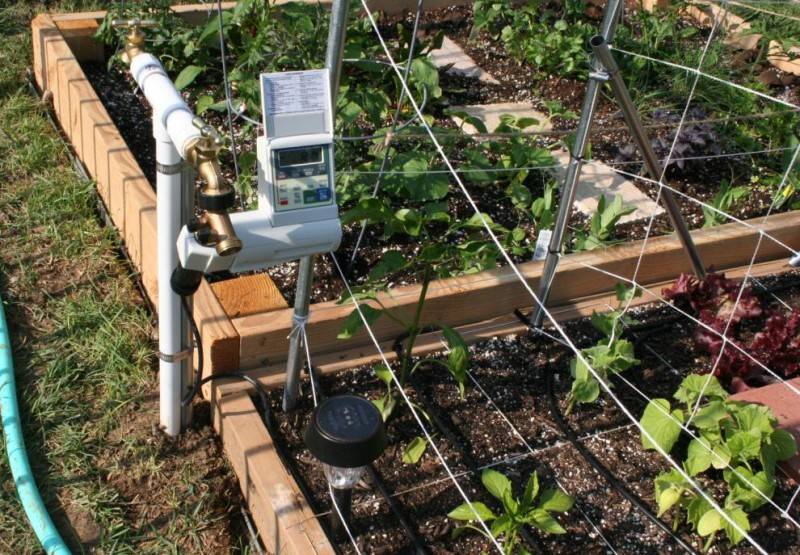
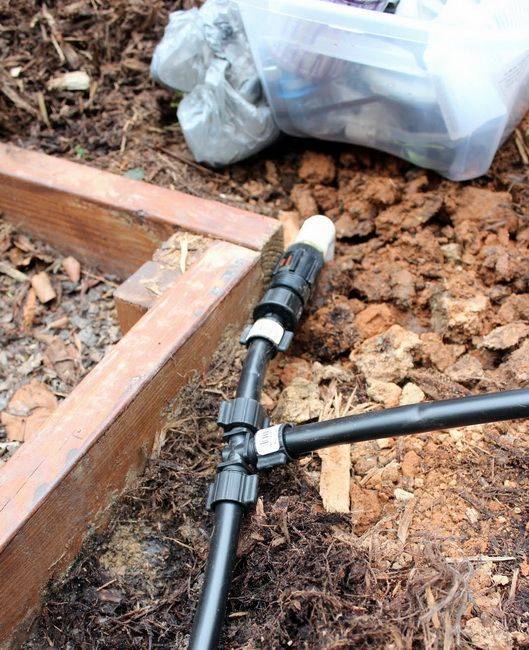
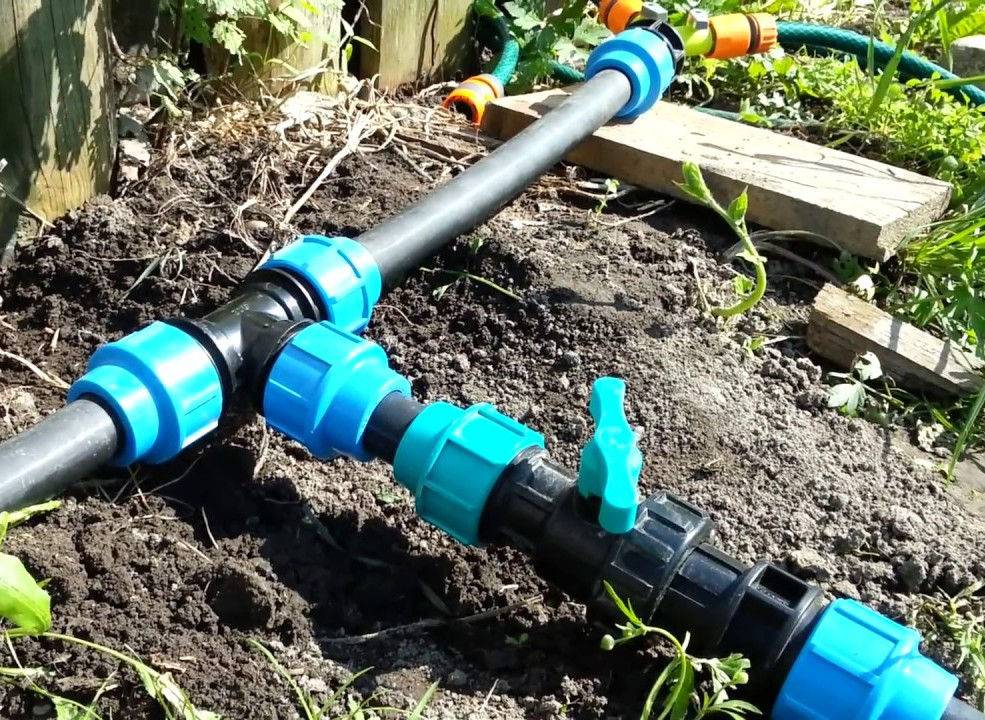


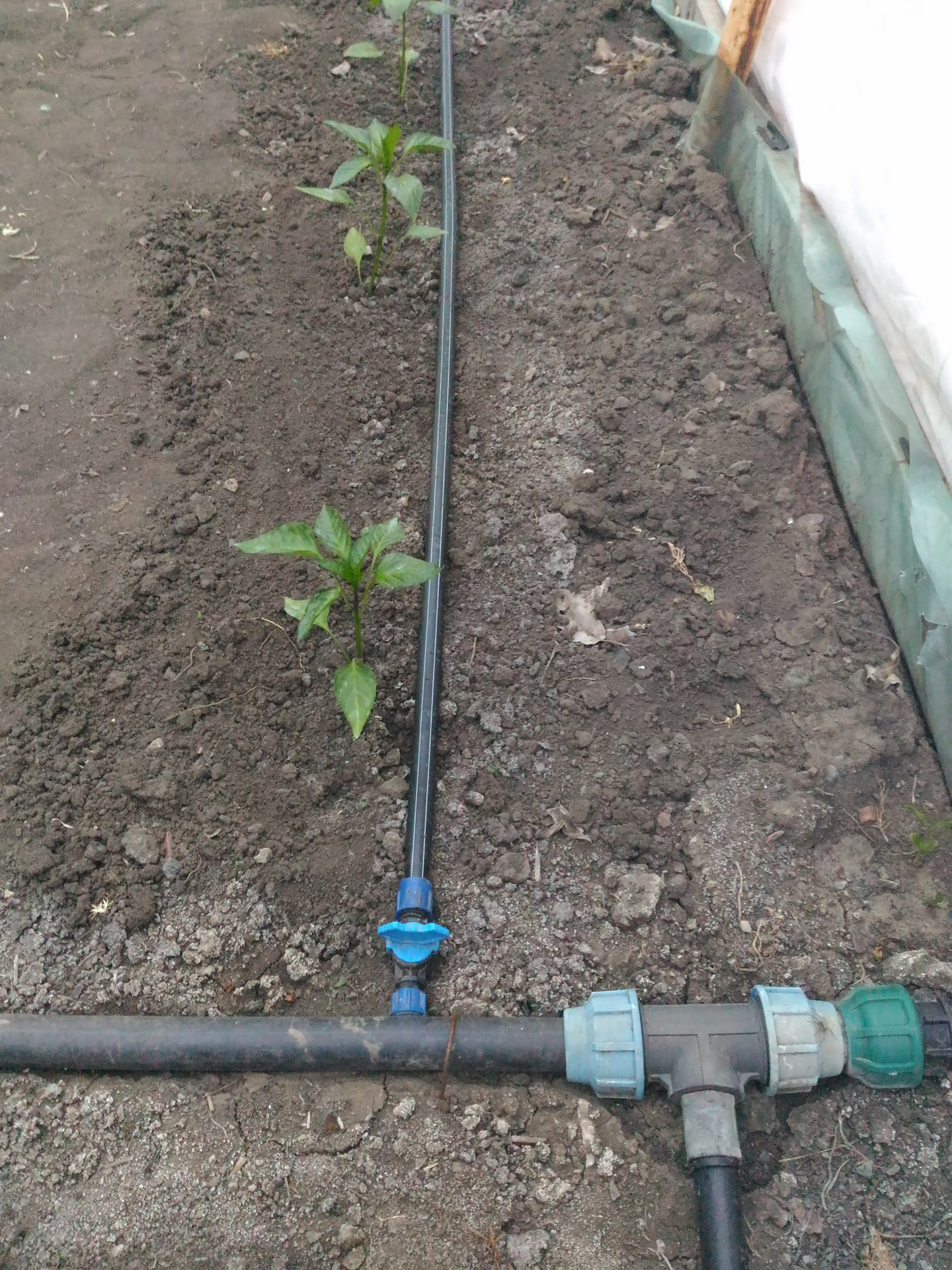

Access to pipes for a drip irrigation system from a do-it-yourself water supply system must be provided outside the greenhouse. When watering, water is pumped into each pipe through a hole that extends beyond the boundaries of the greenhouse until it is full. The 2nd, 3rd and all subsequent pipes are filled in a similar way. Watering should be done as needed, and the floor of the greenhouse will be dry. The greenhouse is watered according to a special system.
Many summer residents avoid the overhead sprinkler system due to its inefficiency. After such irrigation, a crust forms on the surface of the soil, which then has to be loosened. In addition, the sprinkler still cannot be used in hot sunny weather: plants can burn, which droplets of water fall on top of. In this case, underground irrigation should be used. For him, along the beds it is necessary to bury a hose with holes burned with a red-hot needle. In order to prevent the soil from clogging them, the hose should be wrapped with a cloth. The subsoil pipeline is convenient in that it does not interfere with the cleaning of the territory, does not get underfoot when walking. But for its laying underground, a lot of work is required.
In addition, some irrigation methods are much more convenient and easier to implement if water is supplied using a conventional hose or ground pipeline. To organize drip irrigation from the water supply to tomato bushes and cucumber beds, you can use an old, kinked hose that is perforated along its entire length. The hose does not even need to be buried in the ground, but simply laid between the rows of plants - the water will flow out of it evenly, without fountains. Water should be supplied warm to the hose, from a container - a large plastic container. It must be raised to a height of 1.5 m and placed in the sun. When watering, the water will flow out of it by gravity - you just need to open the tap. In order for the hose not to interfere with hilling, you just need to move it with your foot.
Watch the video "Drip irrigation from the water supply" to better understand how to organize such a system:
A few words about drip irrigation
For laying such systems, in principle, any of the listed pipes can be used. But keep in mind that the correct selection of line diameters, depending on the length of the line, the number of droppers and other factors, plays an important role.
As you can see, the choice of materials for laying highways for irrigation is quite wide. When choosing, first of all, you should be guided by the economic feasibility and reliability of the material, if you have any questions on this topic, then you should consult a specialist who develops irrigation systems.
Conclusions and useful video on the topic
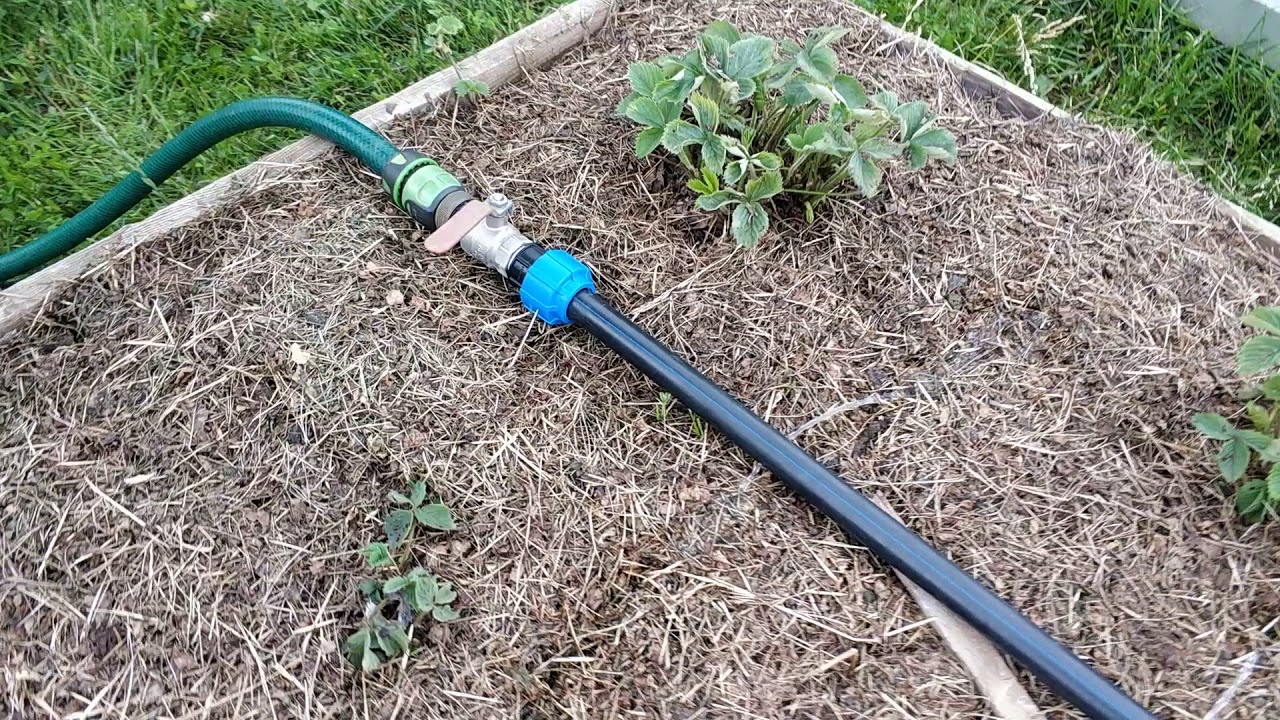
The presented videos demonstrate irrigation systems in the field. Viewing them will help you better understand the installation, operation and automatic control of drip pipes.
Installation of a blind drip pipe:





Working with a drip irrigation tube:
Automated drip system:
In skillful hands, drip irrigation turns into a powerful tool for saving money and personal time while improving the growth dynamics and well-being of plants.
These systems do not require special equipment and skills for installation, so anyone can assemble them. And certain financial expenses will pay off many times over in a couple of years.
Do you irrigate all the plants in your area with a drip system? Tell us which pipes you chose for the installation of the system, how much did it cost you, are you satisfied with the results? Share with beginners your success in growing vegetables and increasing their yield - leave your comments under our article.



