
- Clogged toilet prevention
- Sewer cable from improvised materials
- How to clean the sewer with a cable: video
- The best professional plumbing cables
- Crocodile 50310-13-30
- Spex STU-SN-16-15
- Vibromash VGS-20
- Santechkrep 437678
- Wicavo 10/15
- Types of blockages and their causes
- Design and features
- How to clean the pipeline with a cable
- Old cast iron wiring
- New polypropylene pipes
- General recommendations
- What types of blockages are eliminated
- Mechanical blockage
- Operational blockage
- Technological blockage
- Video about removing blockages in the sewer
- DIY tool making
- Types of sewer blockages
- Operational blockage
- Mechanical plugs
- Technological blockage
- How to make a steel sewer cable with your own hands
- How to choose the right option
- Varieties of cables
Clogged toilet prevention
To keep the pipes clogged as little as possible, you need to follow a few rules:
- Do not flush paper and other hygiene items down the toilet. It is better to put a separate bucket under the garbage and empty it periodically.
- Leftover food is also recommended to be thrown into the trash.
- Do not flush the contents of cat litter down the toilet. The filler can solidify in the pipe, forming an impenetrable "stone" plug.You will have to change the pipes, because it will not work to clear such a blockage with a cable.
- It is recommended to use a plunger to clear the blockage in the initial stages.
- During weekly cleaning, you need to pour special products into the toilet that will help clean small contaminants inside the drain system.
The most important thing is to prevent large objects, such as children's toys or construction debris, from falling into the drain.
Sewer cable from improvised materials
You can buy a cable at any plumbing store. But if necessary, you can assemble the tool on your own. The procedure is quite simple and affordable. It is enough to follow some useful recommendations. The effectiveness of using a homemade tool is not inferior to purchased options.
Do-it-yourself sewer cable assembly:
- For the core, any wire with a diameter of 9 mm is suitable.
- Depending on the type of blockage, the wire acquires the required shape. So from the end you can bend the hook. You can fluff the end with a hammer or other items at hand.
- The second end will serve as a handle, so it is bent in the shape of a ring. Such an element to make the use of the cable more convenient.
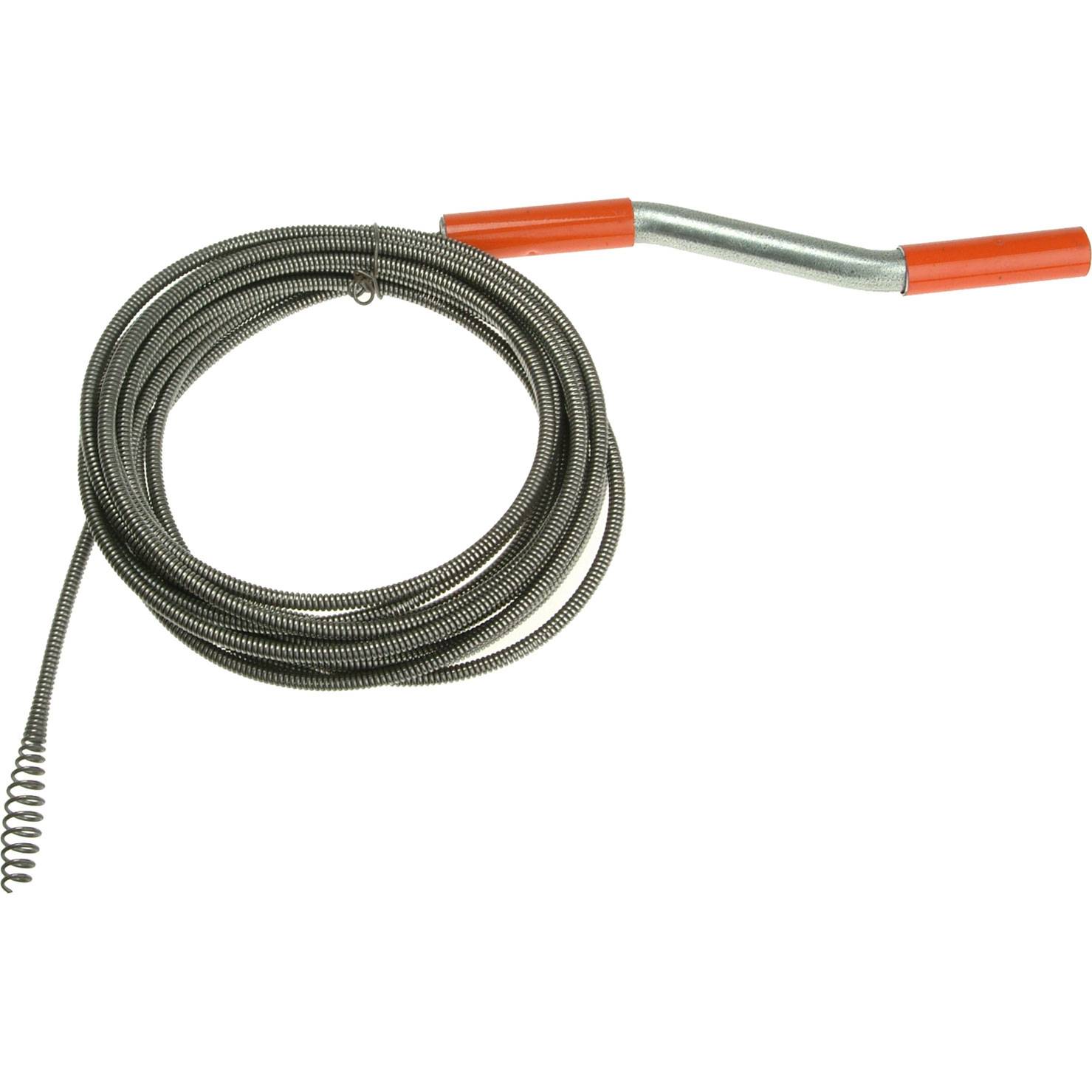
On this homemade cable is ready. The rules for its use are similar to a store brush. The main thing is that the wire is free of defects and cracks.
A do-it-yourself product can compete with professional options. Such a cable can be used to eliminate household blockages. This product will not damage the house, since no one is safe from blockages.
How to clean the sewer with a cable: video
Let's figure out how to use a plumbing cable.So what is a sewer system? This is a pipeline, which includes various water intakes. The sewage intake structure is equipped with a curved siphon.
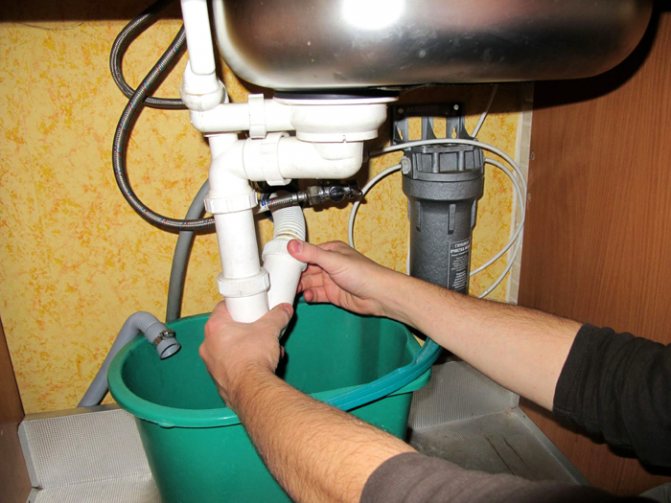
Disassembly of the siphon device
Before work, you need to inspect the device for integrity. Then cover the floor around with plastic wrap and put on rubber gloves. Unscrew the siphon and remove the rest of the parts. They need to be washed and dried. Then follow these steps:
- lower the working end into the pipe;
- rotate and pull the tool forward. Gradually, the cable will unwind. Rotate in one direction;
- when the structure reaches a blockage, it will stop advancing. Then move back and forth to clear the blockage. Periodically pull out the structure and remove contaminants;
- as soon as the plug is removed, the water will go on. Do not stop the procedure, but continue to move the device to remove everything completely;
- Finally, pour a bucket of hot water down the pipe to remove fine particles.
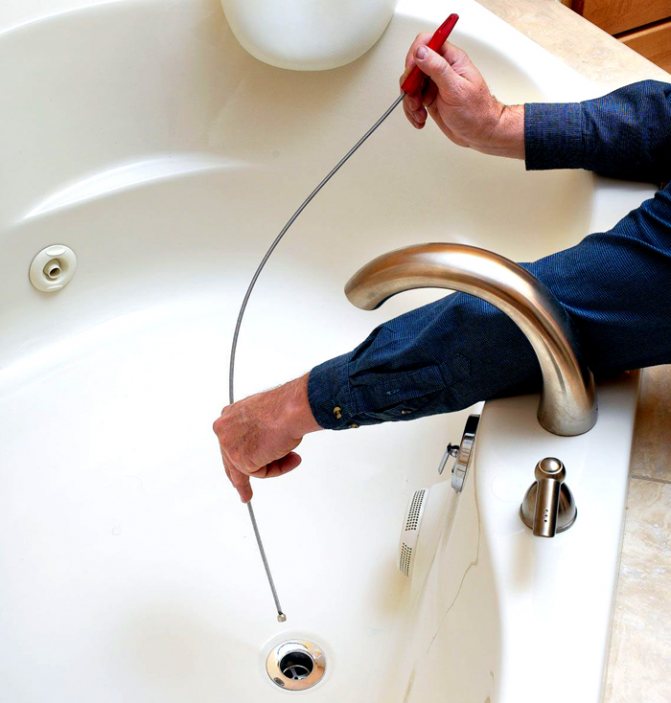
Compact design
If the water flows easily, then your actions were correct. After use, rinse the cable well, lubricate and wrap with paper. This will allow you to keep the product in working condition longer. You can not store the structure in polyethylene.
The best professional plumbing cables
Such models are characterized by a large diameter and high strength. They are designed for regular use, are not afraid of constant contact with aggressive media and are compatible with various types of nozzles.
Crocodile 50310-13-30
5
★★★★★
editorial score
100%
buyers recommend this product
The model is equipped with a universal nozzle with an anodized coating, which eliminates the possibility of corrosive media damaging the metal and causing corrosion. With its help, the owner can eliminate up to 80% of blockages. The main material of manufacture is high carbon steel.
The length of the cable is 30 m, the diameter is 13 millimeters. The kit includes a "floating" handle, providing comfortable operation regardless of the depth of immersion. The cable does not twist in the pipe, does not fold into a knot and retains its quality characteristics for a long time.
Advantages:
- high strength;
- protective covering;
- universal nozzle;
- comfortable grip.
Flaws:
high price.
The Crocodile cable is suitable for working on various sections of the pipe. The right solution for clearing blockages and removing foreign objects.
Spex STU-SN-16-15
4.9
★★★★★
editorial score
95%
buyers recommend this product
The model has a steel core, which provides resistance to twisting and breaking. It is not afraid of a large mechanical load and is equipped with a universal mount. One of 19 nozzles can be fixed on the cable, which greatly expands the range of its application.
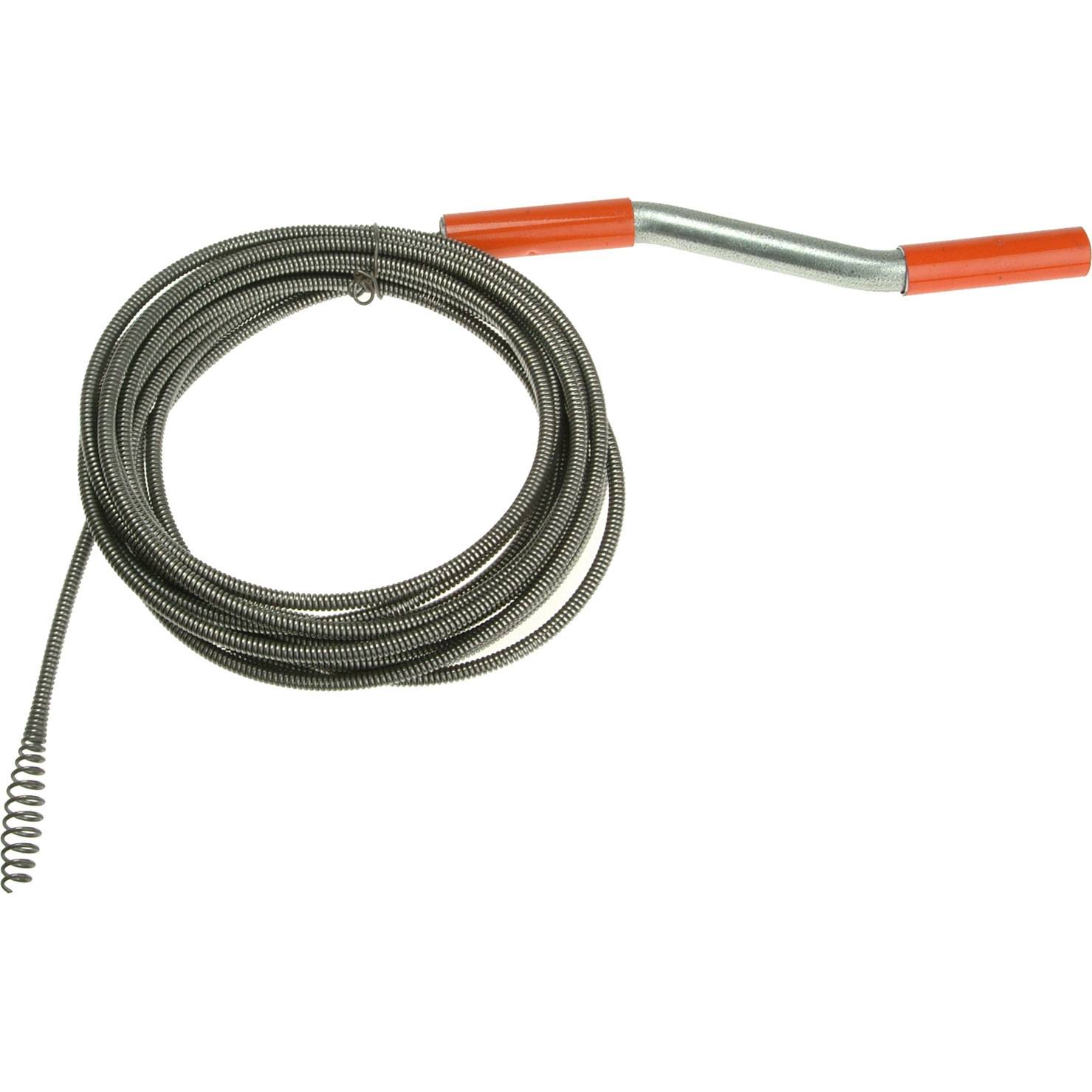
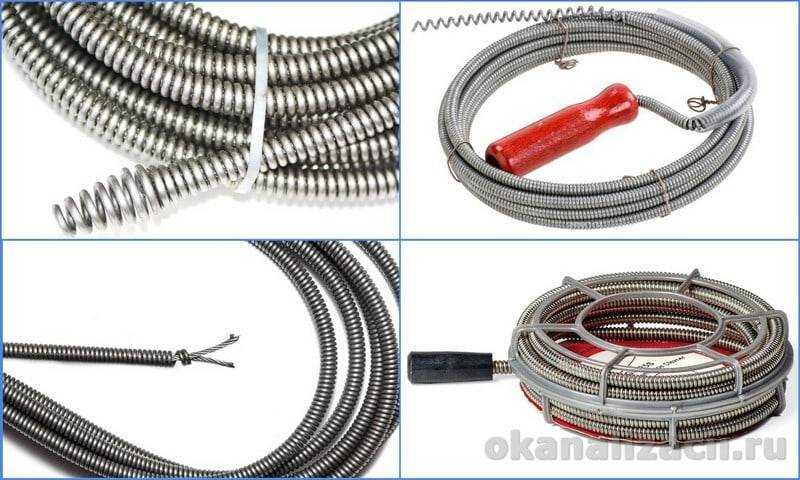


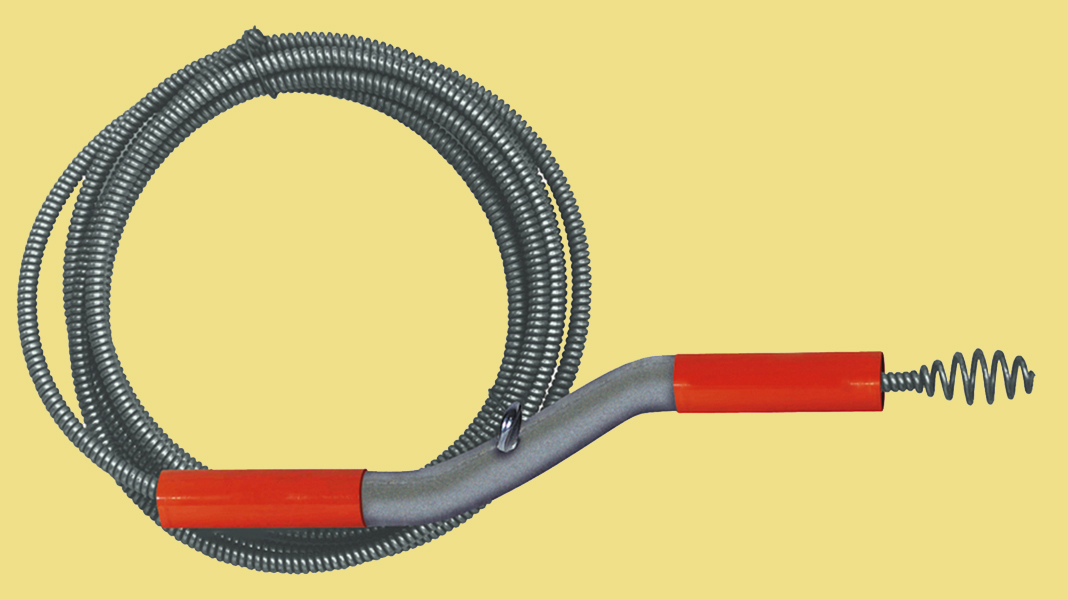
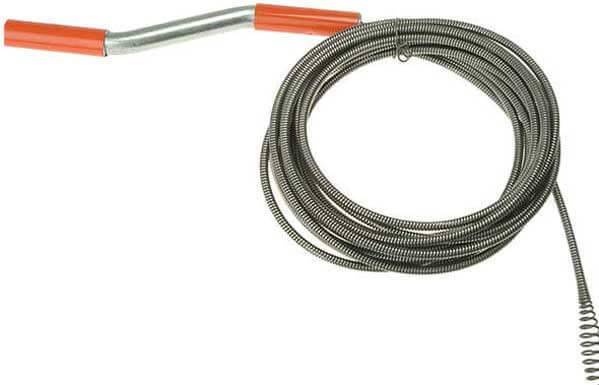


Rope diameter - 16 mm, length 15 meters. The device has a Spex-Handle, which can be moved if necessary. along the entire length for more convenient work.
Advantages:
- high strength;
- many nozzles;
- comfortable grip;
- long length;
- steel core.
Flaws:
heavy.
Spex STU-SN-16-15 is designed to clear difficult blockages. The reliable choice for heavy duty applications.
Vibromash VGS-20
4.9
★★★★★
editorial score
93%
buyers recommend this product
The model has a dense layer-wound structure, due to which it is characterized by high strength and resistance to high tensile loads. The Z-handle allows you to properly hold the attachment and reduces fatigue during intensive use.
With a diameter of 20 millimeters, the length of the cable is 40 m. A special punch-type tip facilitates the removal of blockages. The cable retains its original appearance and properties for a long time, does not twist or unravel.
Advantages:
- high strength and durability;
- long length;
- drill tip;
- comfortable to hold.
Flaws:
very large weight - 80 kilograms.
The Vibromash cable is designed for cleaning industrial pipes and fighting old deposits.
Santechkrep 437678
4.8
★★★★★
editorial score
88%
buyers recommend this product
The design of Santechkrep is a rigid spiral, mounted on a strong rod. The diameter of the spring wire is 3 mm. It is not afraid of high breaking load and mechanical damage. To improve the penetrating ability, a metal knob is provided.
The total diameter of the cable is 16 millimeters, but the length is only 2 m. A special handle allows you to increase the tension to the optimum. Adjustment is carried out using wrenches of two types.
Advantages:
- high strength and durability;
- protective covering;
- the presence of a tensioner;
- comfortable grip.
Flaws:
- small length;
- requires the use of additional tools.
Santechkrep is used to remove the most difficult blockages in short pipe sections.A good choice for regular professional use.
Wicavo 10/15
4.8
★★★★★
editorial score
87%
buyers recommend this product
The simple and robust design makes the Wicavo cable resistant to high mechanical loads and has a long service life. The extended handle makes it easy to grip, guaranteeing comfort during intensive use of the device.
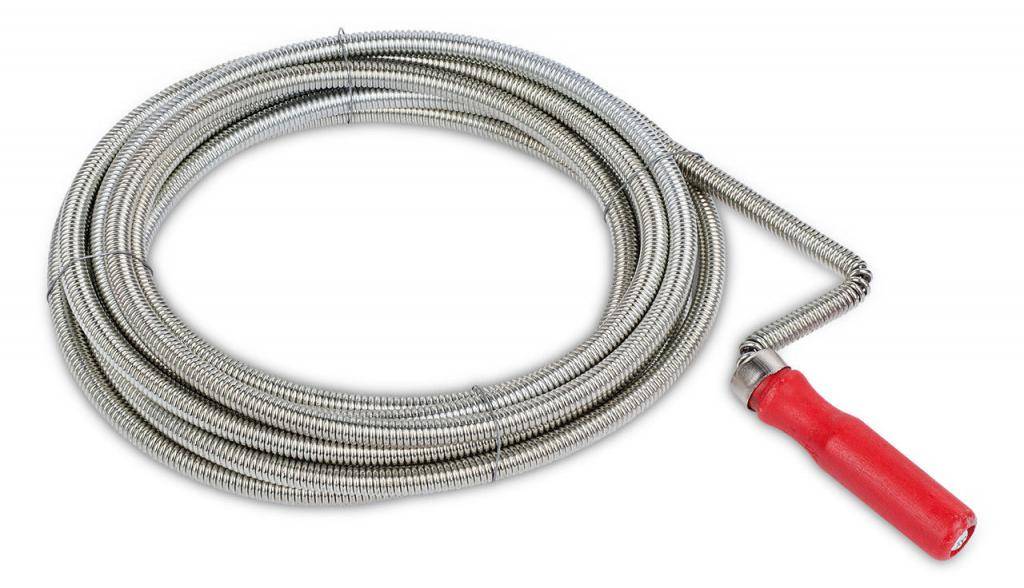
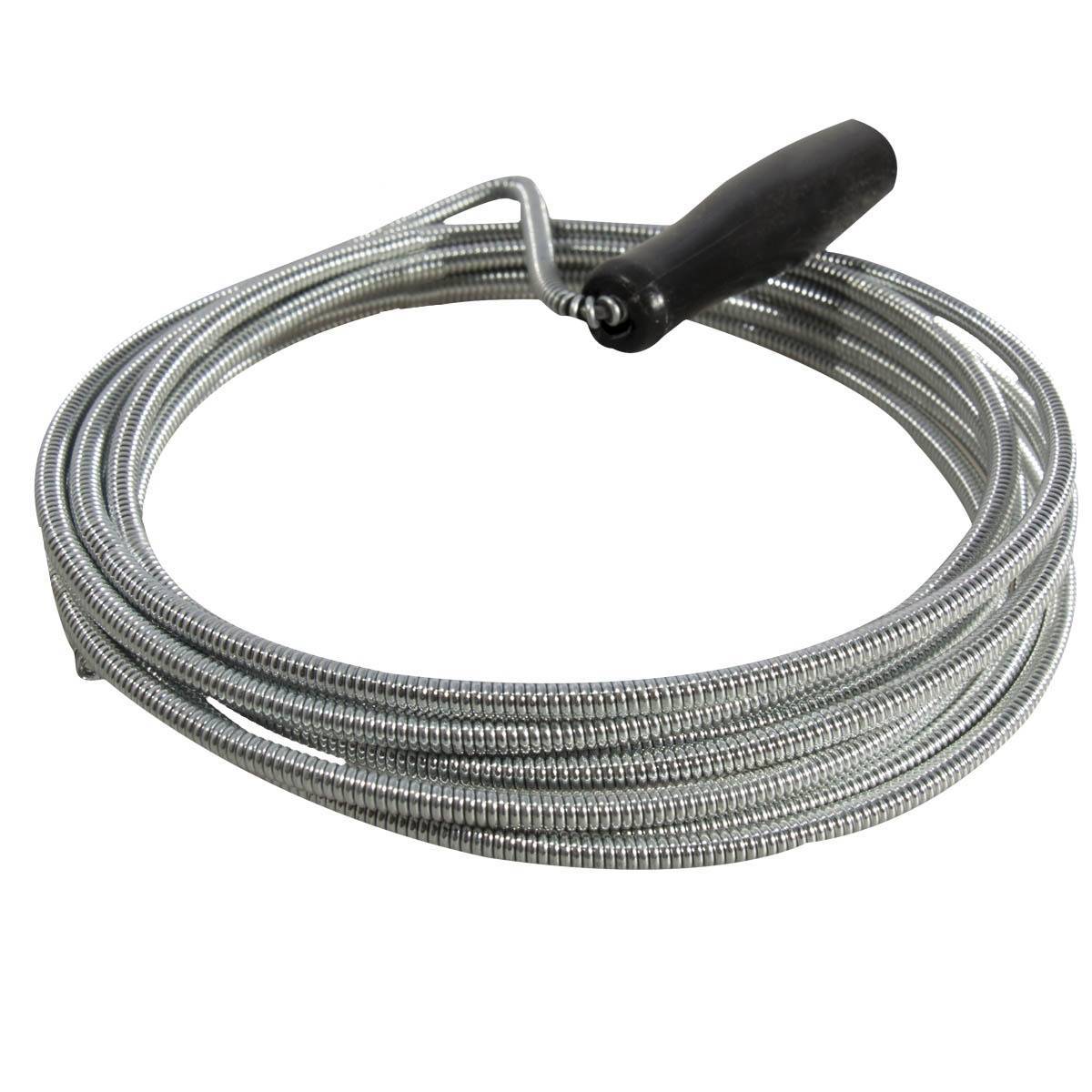

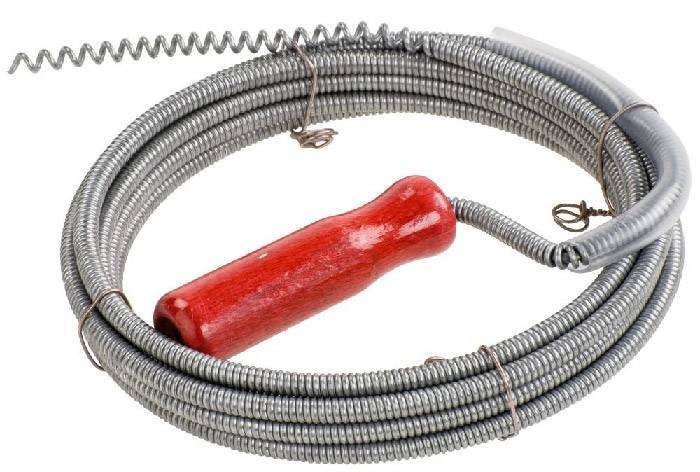


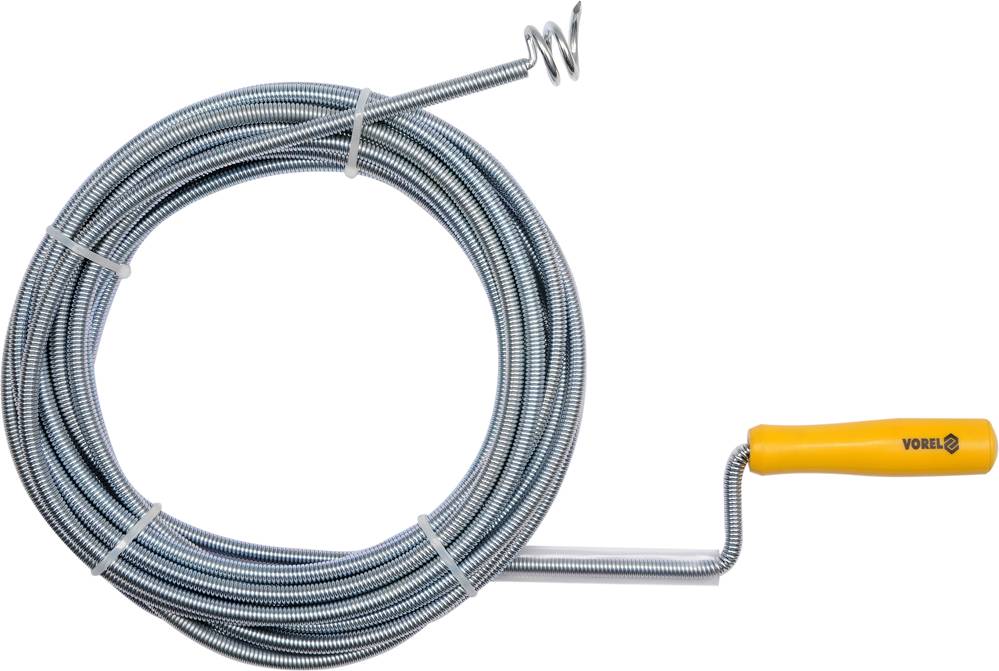

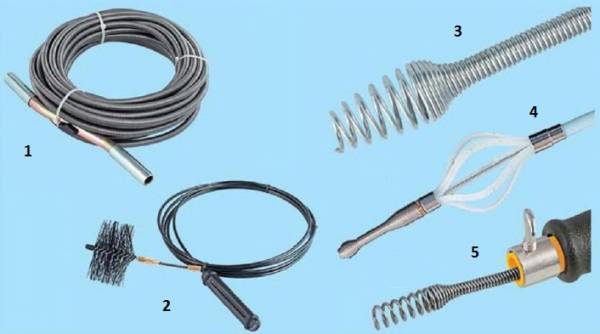
The cable is 15 meters long and 10 mm in diameter. Reinforced tip easily removes foreign objects from the pipe. If necessary, you can quickly change the nozzle.
Advantages:
- good margin of safety;
- comfortable grip;
- reinforced tip;
- quick nozzle change.
Flaws:
thin handle.
Wicavo 10/15 will do for regular pipe cleaning with a diameter of 50-75 millimeters.
Types of blockages and their causes
For what reasons does the sewer become clogged and why does someone rarely have blockages, and someone is persecuted with enviable regularity. 3 types of blockages contribute to disruption of the sewer system:
- mechanical
- operational
- technological.
Mechanical blockage occurs when solid objects enter the drain pipes and the toilet bowl, interfering with the normal flow of sewage waste. In this case, the plumbing cable will not help cleaning the pipes, since it will be necessary to disassemble the sewer system to remove a foreign object stuck in the pipe.
Operational blockage occurs during the daily use of the system. Fat deposits appear on the walls of the pipes, on which food particles that fall into the sink when washing dishes, pet hair, sand deposits and other small debris can stick. In this case, a cable for cleaning sewer pipes will help to quickly solve the problem.
Technological clogging occurs due to worn out pipes, and in a relatively new system, due to an incorrect connection scheme for pipeline sections. In both cases, cleaning will only eliminate the problem for a short time, and soon blockages will reappear. The only way out is to replace the old equipment or lay the pipes correctly, correcting the existing errors in the system.
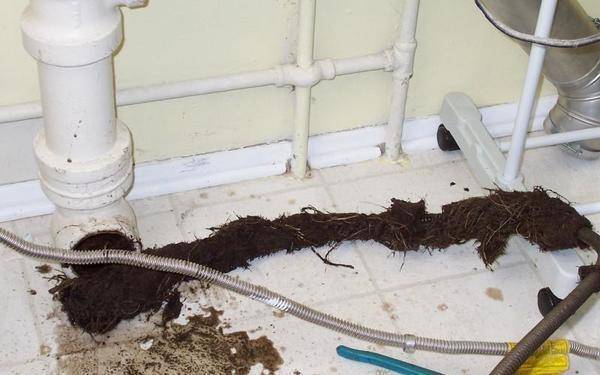
This is what a sewer blockage looks like
Design and features
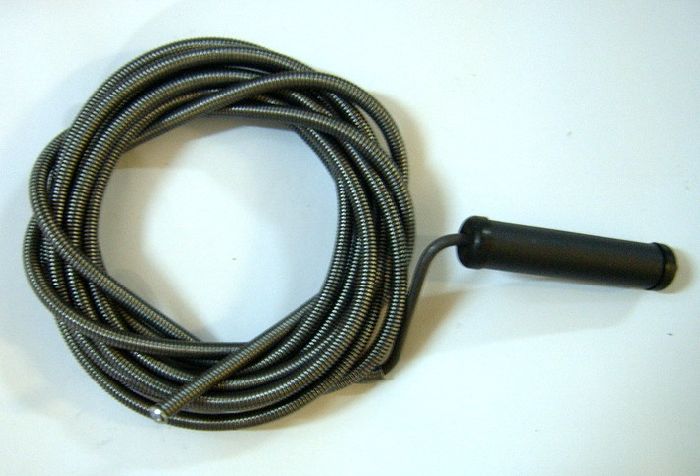
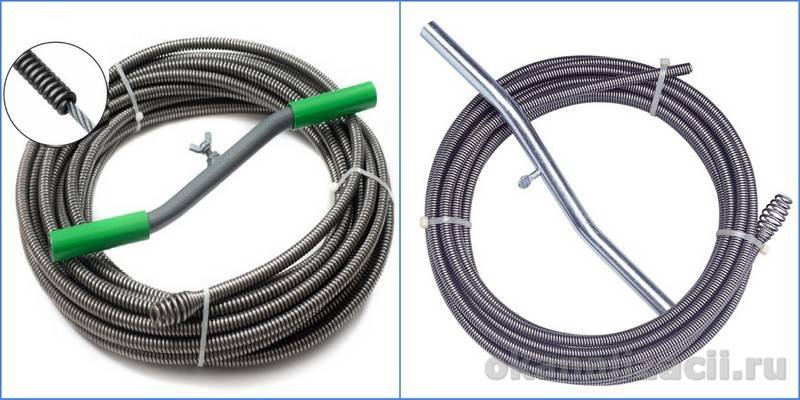
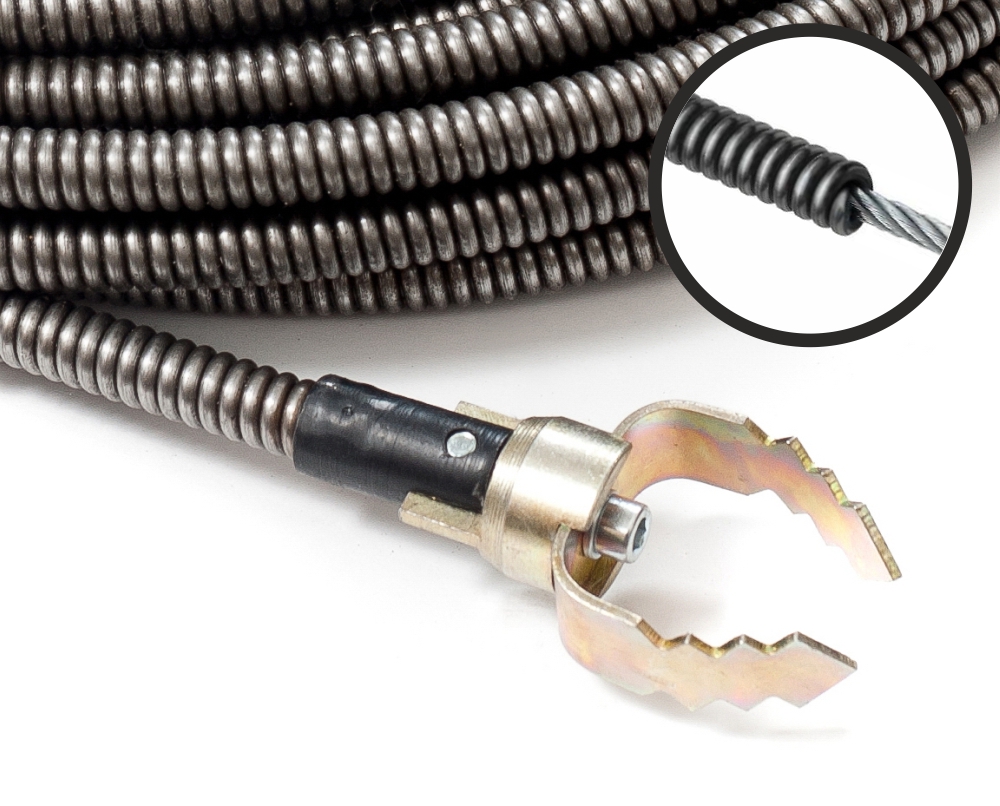
A traditional sewer cleaning cable is a product consisting of a core that is twisted from several strong wires (usually five). A wire of the required diameter is wound around the core in turns in several layers. In this case, the first layer is wound clockwise, the next - counterclockwise, that is, the direction of winding alternates. However, there are other constructions, which we will consider further.
The number of layers and the thickness of the wire used depend on the diameter of the product to be obtained:
- a product with a diameter of 1-1.2 cm is made of a wire with a cross section of 1.4 mm;
- cable 1.4 cm - from a wire with a cross section of 1.9 mm;
- construction 1.6 cm - from a wire with a cross section of 2.1 mm.
The whole structure has high strength, good elasticity, corrosion resistance and kink resistance. Therefore, the cable is suitable for cleaning:
- water and sewer pipes with a diameter of up to 20 cm;
- pipelines in boilers and boilers;
- The product is used to clear blockages in the storm sewer system.
Sometimes a sewer cleaner is placed inside plastic braids. This measure reduces the likelihood of damage to the inner surface of the pipeline.Typically, such cables are used to clean plastic sewer pipes.
How to clean the pipeline with a cable
Old cast iron wiring
First you need to assess the nature of the blockage and the degree of clogging of the pipe. If it's a rag or a swollen wad of cardboard (paper), a manual plumbing cable is the perfect solution. If, however, a technological blockage has arisen in the pipeline, associated with the wear of pipes and their narrowing due to rust, one cleaning is not enough here. Only a complete re-laying of the sewer system will help.
The handle of the flexible shaft after its introduction into the pipe must rotate only clockwise. This will allow the helix to gradually compress when it hits the trash plug, increasing pressure and torque. If the blockage is serious, cleaning the sewer with a cable hooking the plug and pulling out debris should be repeated several times.
New polypropylene pipes
To clean them, you will need a plumbing cable with a rubberized braid. Such a tool will not allow damage to the walls of the wiring, since it will scrape the plastic walls of the pipes less. Before starting work, the cable must be inspected for damage, because if it breaks inside a polypropylene pipe, it will be difficult to get it - you will have to dismantle the pipeline.
General recommendations
Having broken through the garbage plug with a cable, the sewer must be additionally rinsed with boiling water. You can pour a solution of vinegar in combination with baking soda into the drain. The plumbing cable after each use should be thoroughly cleaned of dirt adhering to it. This is done with the help of cleaning and fat-breaking agents. When not in use, the tool is stored rolled up in a dry place.
What types of blockages are eliminated
There are several ways to deal with blockages. But mechanical, with the help of a cable, is the most reliable. Chemical struggles with simple blockages, while you need to know the nature of the blockage, otherwise the reagent will not work


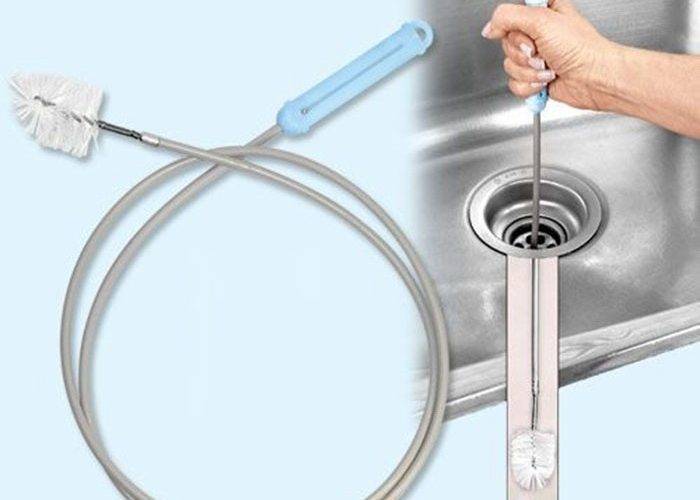


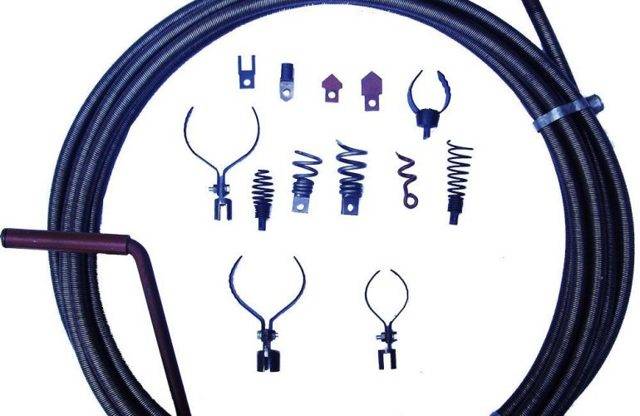


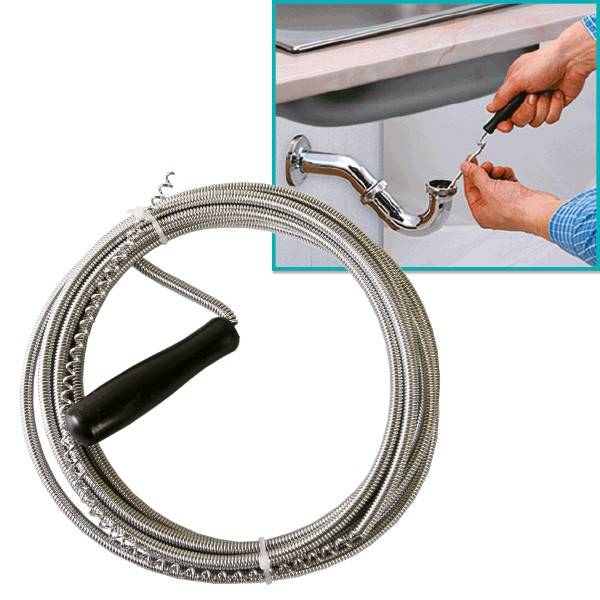
This is important when working in enterprises
Mechanical blockage
Occurs when a large clod of dirt gets inside the pipe. It can be as a separate item, such as a child's toy, clothes, dishes. So are products thrown away in a large piece. The sewer opening is clogged deep inside the pipe and the rest of the debris is stuffed on top. The more of the pipe is clogged, the more difficult it will be to clear it. In rare cases, the dismantling of the pipe is required, but most often, a sewer cable copes with this problem.
Operational blockage
Over time, the sewer pipe is overgrown with the accumulation of various fatty deposits. Sometimes the opening for the passage of waste becomes very narrow and the water begins to stagnate in the sink or toilet. Over time, she leaves, but this is a serious reason to call a plumber or clean the pipes on your own.
Technological blockage
They often occur when the sewer system is not properly installed, when non-professionals are engaged in the installation of plumbing equipment. This may not be the correct connection, the wrong slope of the pipes, the incorrectly calculated diameter of the drain holes. Cleaning with a cable will save for a certain time, but over time, it is better to redo the water supply and sewerage system.
Video about removing blockages in the sewer
Several interesting videos will help you in choosing a tool and tell you how to make a cable with your own hands.
Which plumbing cable to choose for home use:
Device for cleaning the sewer system without chemicals:
How can I modify the pipe cleaning cable:
How to make a homemade rope:
The mechanical method of cleaning the sewer is used only as a last resort, when household chemicals and a plunger are no longer able to help. Working with a plumbing cable is not the most pleasant pastime. Specific sewer dirt is poorly washed and extremely aggressive. But with a serious blockage, this flexible shaft is indispensable. And you don’t even have to call plumbers, you can clean a clogged pipe yourself.
DIY tool making
Instead of a store cable, you can use improvised items - a bicycle cable or a tape cut from a plastic bottle. But such devices are ineffective and are only suitable for eliminating light blockages. To eliminate blockage or remove fatty deposits, it is better to make a home-made analogue of metal.
Cast iron pipes can be cleaned with a thick wire, after bending the working end in the shape of a hook. But such a device cannot be used in highways with a large number of bends and turns. A more versatile option is obtained from a twisted steel cable.
Making a plumbing fixture step by step:
- Cut the cord of the desired length from the coil of metal cable. Depending on the location of the blockage, a segment of 1 to 3 m will be needed.
- Fluff the working end designed to destroy the cork.
- Twist the other end and fix it in the form of a ring. With this ring, you can control the cable, moving it forward, backward and around its axis.For ease of use, it is better to attach a homemade handle to the ring.
- Lubricate the finished flexible shaft along the entire length with technical oil or any anti-corrosion compound.
A home-made device is suitable for cleaning sinks, bathtubs, toilet bowls and sewer wiring within the apartment. If a blockage has formed in the common house riser between floors, it is better to use store products of the appropriate length and section.
Types of sewer blockages
Understanding their nature is very important for proper cable selection. Plumbing plugs differ in the reasons for their occurrence, respectively, and their strength can also be different.
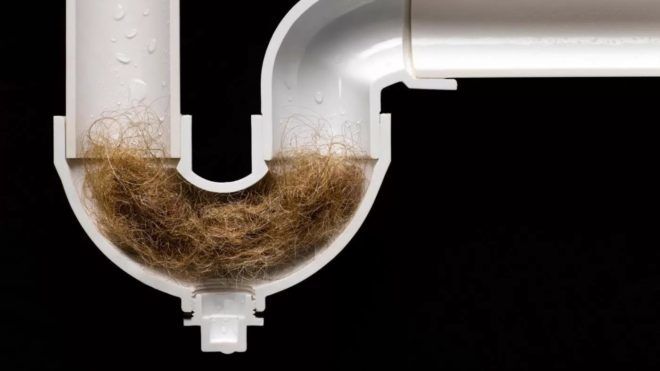
Operational blockage
An inevitable problem of any sewerage. It occurs due to the fact that particles of food, fat, fabric, hair, wool, sand and other very small debris are washed into the kitchen sink, which accumulates on the walls of pipes for months and years, forming dense plugs. To eliminate them, a thin cord will suffice, since such a blockage is called the simplest.
Mechanical plugs
They appear due to solid large objects lowered into the toilet or plastic bags that become a wedge in the pipe, collecting the rest of the garbage. To remove such a blockage, it is necessary to use a powerful thick cable for cleaning the sewer, which will damage and move the stuck object by force. If the object is very strong, then the device will not be able to damage it, and you will have to:
- calculate the approximate location of the plug along the length of the cable;
- cut the pipe
- physically remove it.
Technological blockage
Arises as a natural process of deposition of solid fractions on pipes.
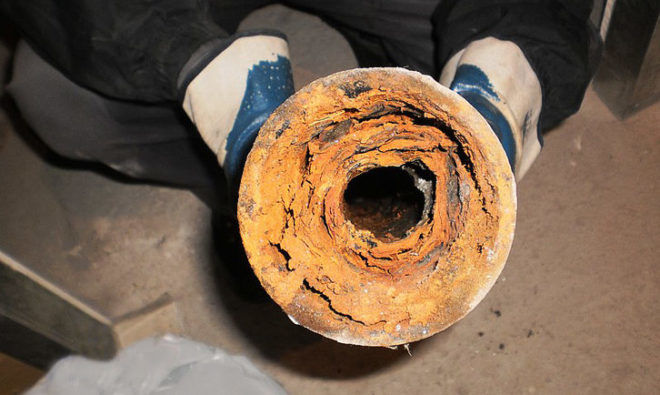
They have a very strong structure and are located almost along the entire length of the sewer pipe.Here, even a powerful cable is unlikely to help, except that it will temporarily break through a hole for draining sewage. This requires a complete replacement of pipes.




How to make a steel sewer cable with your own hands
 The brush can scratch plastic pipes
If you urgently need to break through a small blockage in the sewer of an apartment / house, and there is no time to go to the store, you can make a cable with your own hands. For this you will need:
- a piece of old rope 1-3 m long;
- a hammer;
- metal scissors;
- ring handle.
Cut off a piece of rope. At one end, a handle is attached to it, with which it will be convenient to rotate the product when it is fed into the collector. The other end of the product is fluffed like a ruff
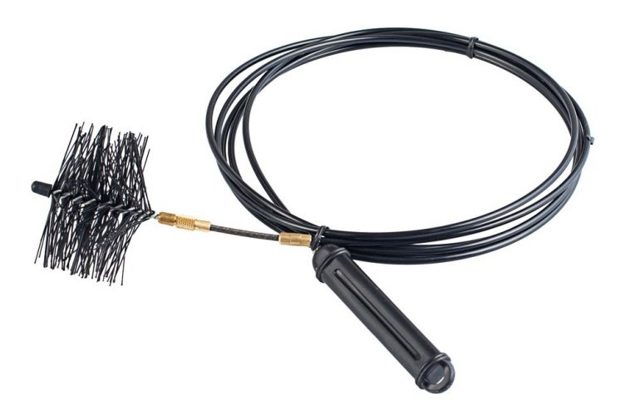
With the help of this detail, fatty sludge is well removed from the walls of the pipeline. The main thing is to clean the sewers carefully: the steel tips of the ruff can scratch plastic pipes from the inside. It is advisable to put a piece of rubberized hose on the base of the cable
They hold on to it when moving the product into the collector.
A ready-made homemade cable is suitable for cleaning small sections of the sewer.
How to choose the right option
The principle of using a plumbing cable is extremely simple. First, the tool is pushed into the sewer pipe until it stops, so that it ends up against the blockage.
Then, by means of rotational and reciprocating movements, the handle of the tool picks up the plug with the tip of this end in order to pull it out or destroy it in place inside the pipeline.
The specifics of the application and the efficiency of use depend on the structure of the cable, the correct choice of the tool size.
Plumbing cables in hardware stores are sold in four types:
- rope - a classic thin rope (rod) of several wires;
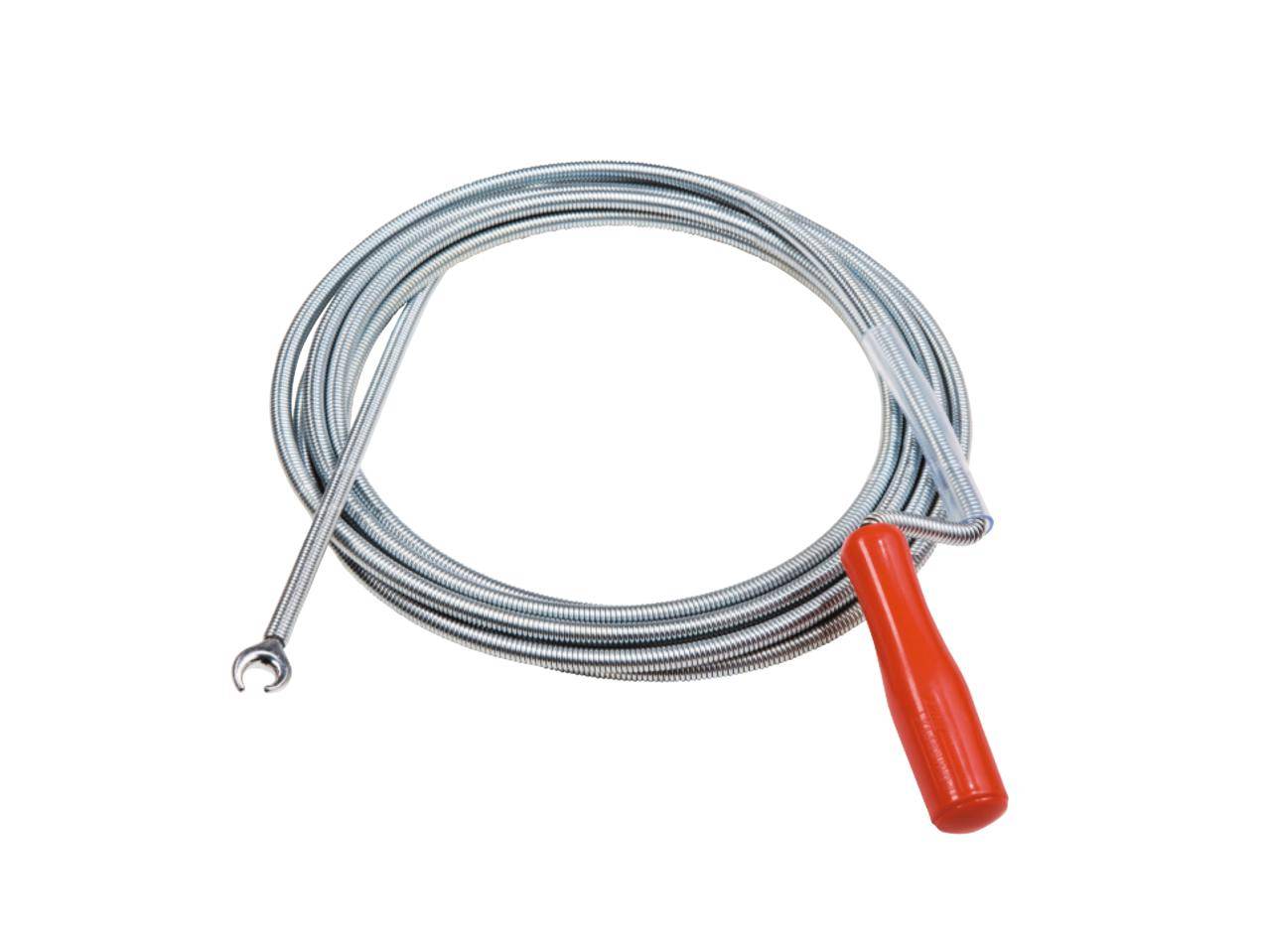
- spring - hollow spring, twisted from wire;
- spring-wound - a flexible core with a spiral wound on the outside;
- tape (flat) - a tape 1–4 cm wide.
For all types of plumbing cable, the working elements (handles, nozzles, tapes, wires) are usually made of durable steel.
There are models whose spiral is covered on the outside with a rubberized sheath that protects the inner walls of the pipes from mechanical damage by metal. But in most cases, a plumbing cable is just a steel spring without any braid.
On the one hand, the spiral allows the cable to bend around any turns in the sewer, and on the other hand, due to the torque, it enhances the mechanical effect on the blockage
Cable. A small cable-rope 1.5–3 meters long belongs to the household category of tools. It is ideal for cleaning sinks, clearing blockages in toilet bowls and on horizontal sections of pipelines up to a common riser.
Spring. The cable is small and ideal in terms of cleaning intra-apartment risers and sewer pipes suitable for them from plumbing fixtures.
Rope with core. This is a professional tool that can be used to push (push through) a weed plug. It is difficult to do something like this with an ordinary spiral because of its greater softness and compressibility.
Ribbon. Such a tool is not flexible enough and is not able to go into all corners of the sewer. It, unlike a spring, bends only in one plane. But the ribbon cable has smaller dimensions in a twisted state.
Most often, it is used when cleaning long main pipes of large diameter, which have an order of magnitude fewer bends than in-house ones.
When buying a cable for cleaning sewer pipes, you must correctly select its cross section. Too thick a tool to clean the sink or urinal is unlikely to succeed. It just won't fit in the drain hole. Such a flexible shaft is designed for cleaning risers and wide pipes of large diameter.
Correspondence of pipe diameters and santekhtros:
- pipes D {amp}lt; 50 mm - a flexible shaft should be selected with a cross section of up to 10 mm;
- pipelines 50-110 mm - you need a cable with a diameter of 11-15 mm;
- vertical risers more than 100 mm - it is required to choose a tool with a thickness of 16 mm or more.
An excessively thin 3–4 mm cable can break when a plug is pulled out of the pipe. Such a device is more intended for cleaning siphons and removing hair from drains.
It is not worth punching a thick pipe with a blockage in the form of a rag. A more solid option is required here.
The cable for cleaning sewer pipes has a lot of advantages:
- big torque;
- ideal balance of elasticity and flexibility;
- safety of use;
- simplicity and ease of use;
- high cleaning efficiency;
- Possibility to use different nozzles.
With active use for its intended purpose, the cable spiral loses its elasticity over time (it becomes loose) and simply breaks. But with proper care, cleaning and oiling after work, this device will last more than one year.


The easiest way to make it easier for yourself to clean sewer pipes is to supplement the cable with an electric drive in the form of a drill or screwdriver, only you will need to turn them on at low speeds
Professional plumbers prefer to use special tools to make the job easier. It can be either a handle on a rigid and stable stand, or a full-fledged power tool with a motor. Plus, there are different nozzles for different types of blockages.
A manual version of a conventional plumbing cable is cheaper and smaller in size than an electrical counterpart. However, the latter greatly simplifies the cleaning of sewer pipes. If the tool is needed for one-time work, then there is no reason to spend a lot on it.
However, if you have to constantly clean the sewers on a professional basis in the role of a plumber, then you should seriously think about purchasing a power tool.
Varieties of cables
There are several types of wire devices for clearing blockage
There are several types of wire devices for cleaning blockages. Each of them performs certain functions:
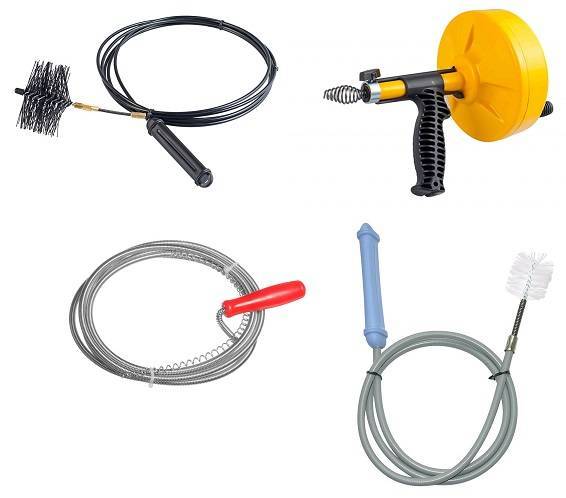
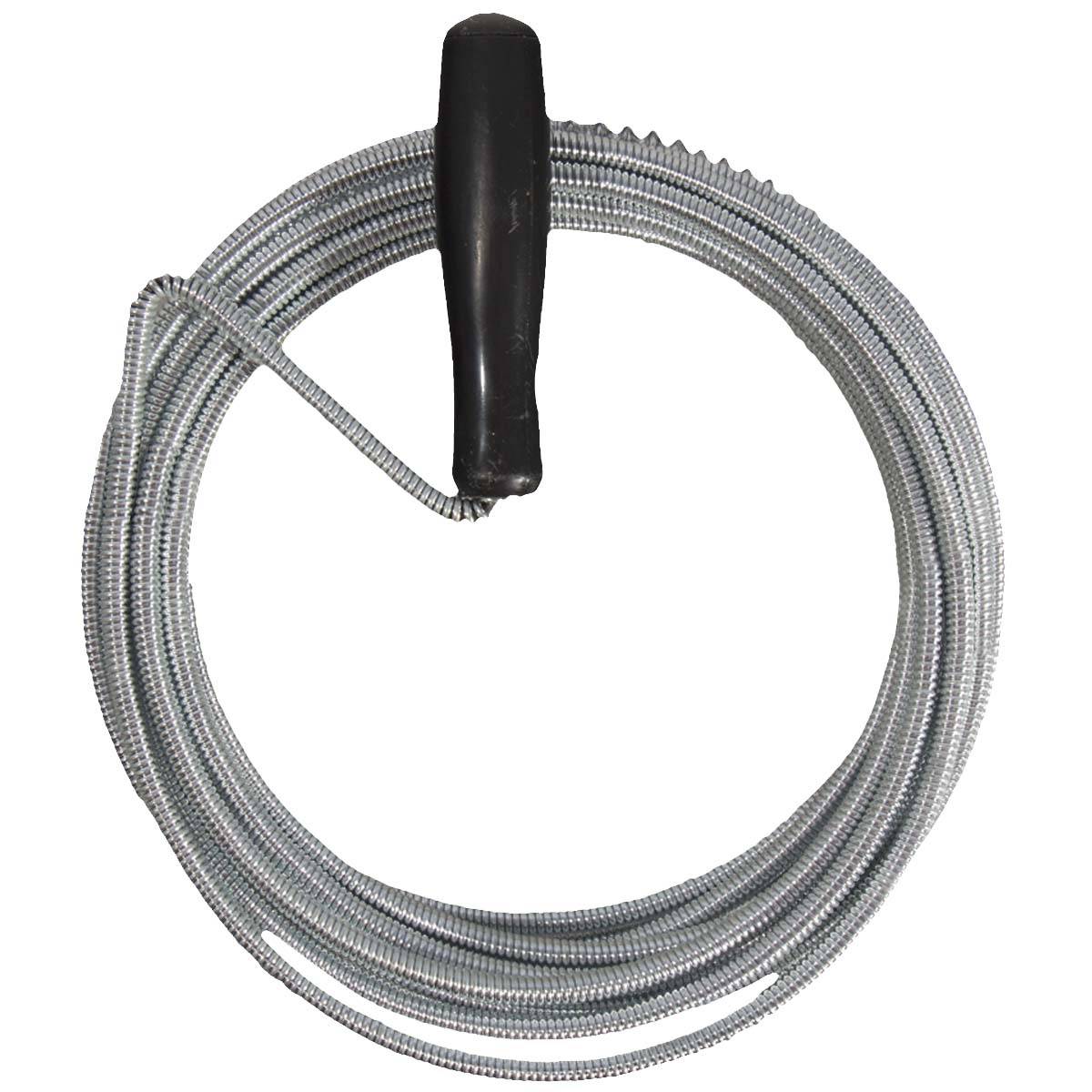
- Rope rope is often used for domestic purposes. Such devices are made of galvanized steel. This is a tightly twisted rope with a crimped end that can be used to clean sewers in a private house, apartment or office. The length of the product can be in the range of 2.5-5 m. Typically, the diameter of such a cable does not exceed 0.6 cm. Such cleaning devices have good resilience and flexibility, so all turns and junctions of pipes easily pass, which allows them to effectively cope with assigned tasks.
Tip: in order for the device to better cope with blockages, it is better to loosen its crimped end with hammer blows. Then the fluffy end, no worse than any nozzle, will cope with hair, grease and other types of blockages stuck in the sewer.
- Flexible cleaning products.This professional cable is more efficient and easier to use than cable type products. This device for cleaning pipes is made in the form of a metal spiral tightly wound around a steel core. The professional flexible cable is completed with the convenient handle for its rotation. The diameter of the device can reach up to 2.8 cm, and its length sometimes reaches 60 m.
- Metal tape also belongs to the category of sanitary devices for cleaning sewers. Usually this professional device is equipped with a tip in the form of a four-sided peak. The product also has a handle for easy rotation. The diameter of such a cable reaches 2.5 cm, and its length can reach 30 m.
- A professional spring pipe cleaner is also called a spring-wound sewer cable. It is very similar to the flexible product described in the second paragraph, but has a simpler design. The spring cable is made of a dense twisted hollow steel spring inside. The length of the pipe cleaning structure can reach 25 m, and the cross section can be up to 1.35 cm.
- A professional tension cable is used to remove the most difficult blockages in the sewer system that other types of pipe cleaners cannot handle. These are rather rigid structures, which come with special nozzles to increase the efficiency of use. These cables come with a vinyl sheath.
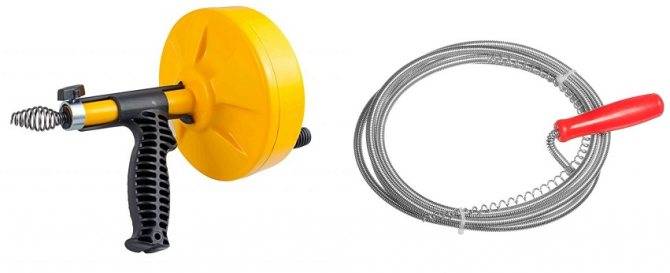
- Electric tools are one-piece units that are used to clear blockages in the sewer system of considerable diameter, as well as in the most difficult conditions.Electrical devices consist of a cable wound on a drum, a tip, a pistol-type handle with a drill connected to it. The product is placed in the pipe, by adjusting the speed of the drill, you can clear any blockage.
Attention: rope and spring rope have low torsional strength, so you need to be careful when using them. This is due to the fact that the rope device has a braided structure, and in a spring product, the turns can be displaced relative to the axis
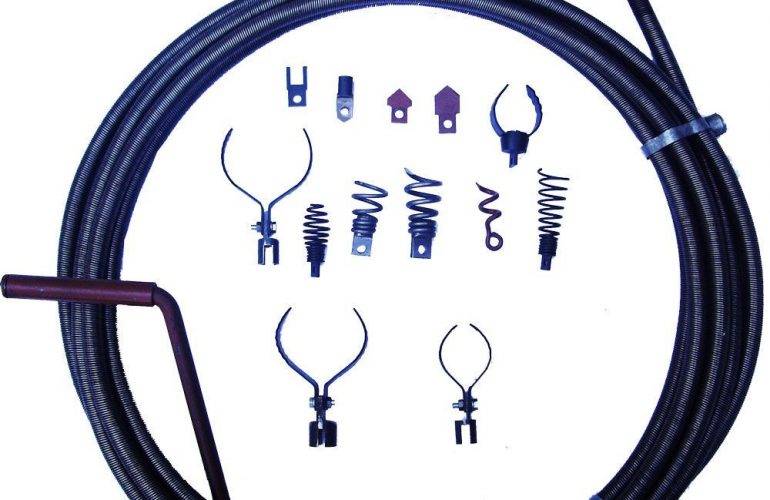
To increase the efficiency of using the cleaning device, special nozzles have been invented.
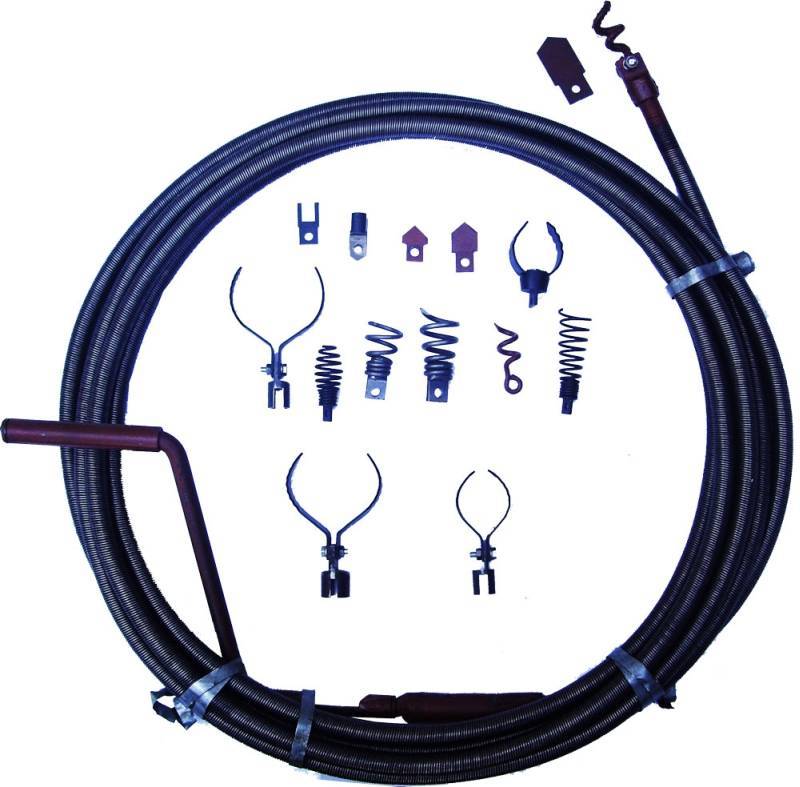
Since the sewer system can become clogged with various objects, grease, rags, sand, hair, wool or construction debris, it can sometimes be very difficult to clear the pipes. To increase the efficiency of using the cleaning device, special nozzles have been invented. They differ in purpose and appearance:
- the “ruff” tip is used to clean the pipeline from plaque collected on the walls;
- punching nozzles are suitable for removing dense compressed clogging;
- bottom devices are used to remove plugs from construction debris and stone chips;
- if hair, wool or rags have accumulated in the sewer, they can be removed using hook-shaped nozzles;
- loop-shaped nozzles were invented to combat the water seal.
Important: in addition to the configuration, the nozzles may differ in size. So, the same nozzle can be of different diameters, which allows you to choose a product for pipes of a certain section.



