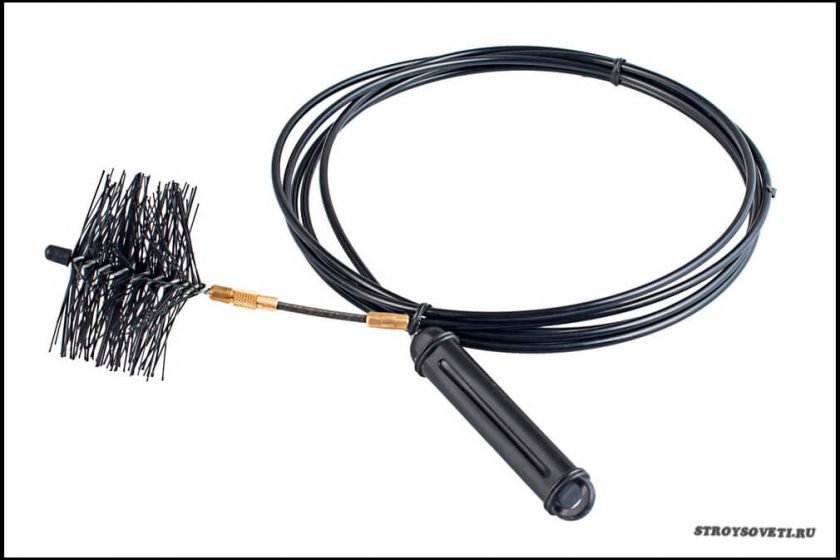
- Making from improvised means
- Types of blockages
- Assortment of santehtrosov
- Household varieties
- Professional Solutions
- Types of nozzles
- Step-by-step instructions for cleaning the sewer with a cable
- Preparatory stage
- Debris removal stage
- Final stage
- Cable for cleaning sewer pipes: the pros and cons of the application
- Sewer cable from improvised materials
- Manufacturers of sewer cables
- Making from improvised means
- The procedure for clearing the blockage
- How to choose the right option
- Cleaning sewer pipes with chemicals
- How to make a rope on your own
- How to use the rope correctly
- Varieties of plumbing cables
- Rope rope
- Spring coiled cable
- spring cable
- The best professional plumbing cables
- Crocodile 50310-13-30
- Spex STU-SN-16-15
- Vibromash VGS-20
- Santechkrep 437678
- Wicavo 10/15
Making from improvised means
As practice shows, sewer pipes can be cleaned not only with a factory cable, but also with a do-it-yourself device. To do this, it is quite enough to have elementary improvised materials. The simplest solution is a piece of flexible wire 10 m long with a bent end, but this option is only suitable for shallow blockages.If the sewer plug is more serious, then you will need the help of a professional cable.
To make a hand rope, you must perform the following steps:
- take as a basis a metal cable of the required length;
- fluff one end, giving it the shape of a brush;
- make a ring at the second end and attach a handle to it for greater convenience;
- coat the product with an anti-corrosion compound to preserve its original qualities.
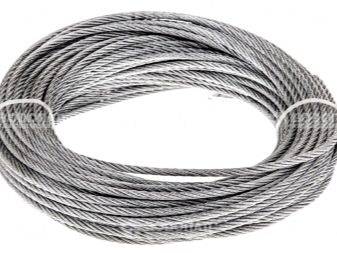
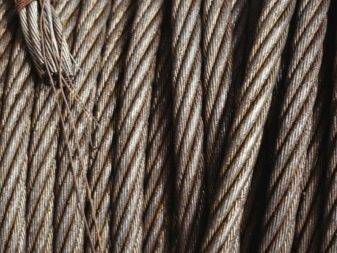
A similar cable can be used when cleaning pipes, as well as toilets and bathtubs. It should be borne in mind that for each type of blockage there is a version of the product with its own individual properties and features. In order to prevent such situations, it is necessary to regularly conduct a scheduled inspection of sewer pipes, and also to prevent food particles or other substances from entering the sewer system that can cause blockages. Such measures will help extend the life of the pipes, as well as create the most comfortable conditions for staying in a particular room.
You can see the best way to clean sewer pipes in a private house in this video.
Types of blockages
Obstruction of the pipes is a fairly common problem, which almost no one has been able to avoid. Sooner or later, owners of private properties and apartments located in apartment buildings face it. Pipes clog for various reasons:
- Most often, blockages are the result of natural exploitation, when food particles, grease, fish scales, animal hair and hair get into the drain. Such blockages are called operational.
- The obstruction of pipes caused by the ingress of large objects into the drain hole is the so-called mechanical blockage. As a rule, these can be plastic bags, sanitary pads, rags, etc. Such a blockage cannot be eliminated with the help of household chemicals, and the cable does not always help. In this case, to solve the problem, you have to dismantle the plumbing equipment.
- Clogged pipes in some cases are the result of worn out pipes, especially when it comes to old pipelines, where, due to long use, the integrity of the structure is violated, or installation errors when the pipes are connected incorrectly. Such problems lead to the emergence of technological blockages.
Assortment of santehtrosov
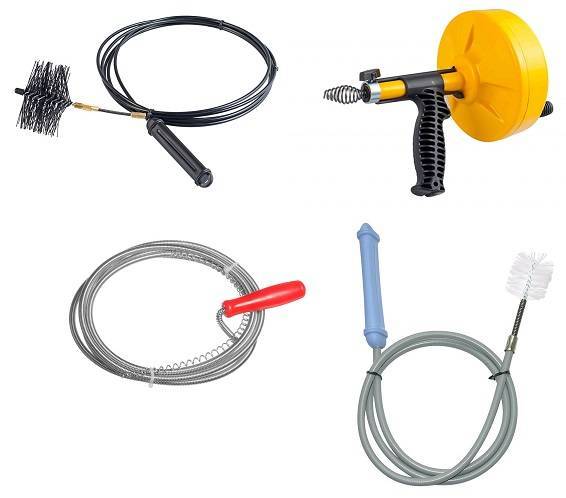
On sale you can find a huge range of cables, which differ not only in length and diameter, but also in purpose. The correct choice of product guarantees its effectiveness in removing clogs, so it is advisable to disassemble the most common options.
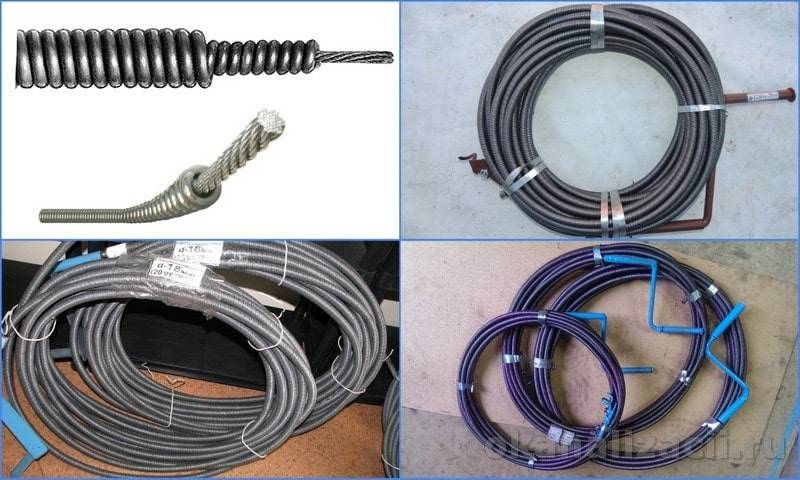
There are the following types of cables:
- rope, or rigging;
- flexible;
- spring;
- electrical;
- tension;
- metal tape.
Types of ropes can be divided into household and professional, depending on the purpose and efficiency. The former are inexpensive and are designed for simple removal of blockages, and the latter for the professional activities of workers.
Household varieties
The thickness is approximately 6 mm, while the length varies from 2.5 to 5 m. The main advantage is the ability of the cable to pass turns and connections in the pipeline.
Flexible cable is also called flexible shaft or hose.Its efficiency and ease of use are much higher than that of the previous analogue, which is explained by the presence of a steel core, as well as a handle that simplifies the rotation of the hose during cleaning. The length of the hose can be 60 m, while the thickness varies between 28 mm.
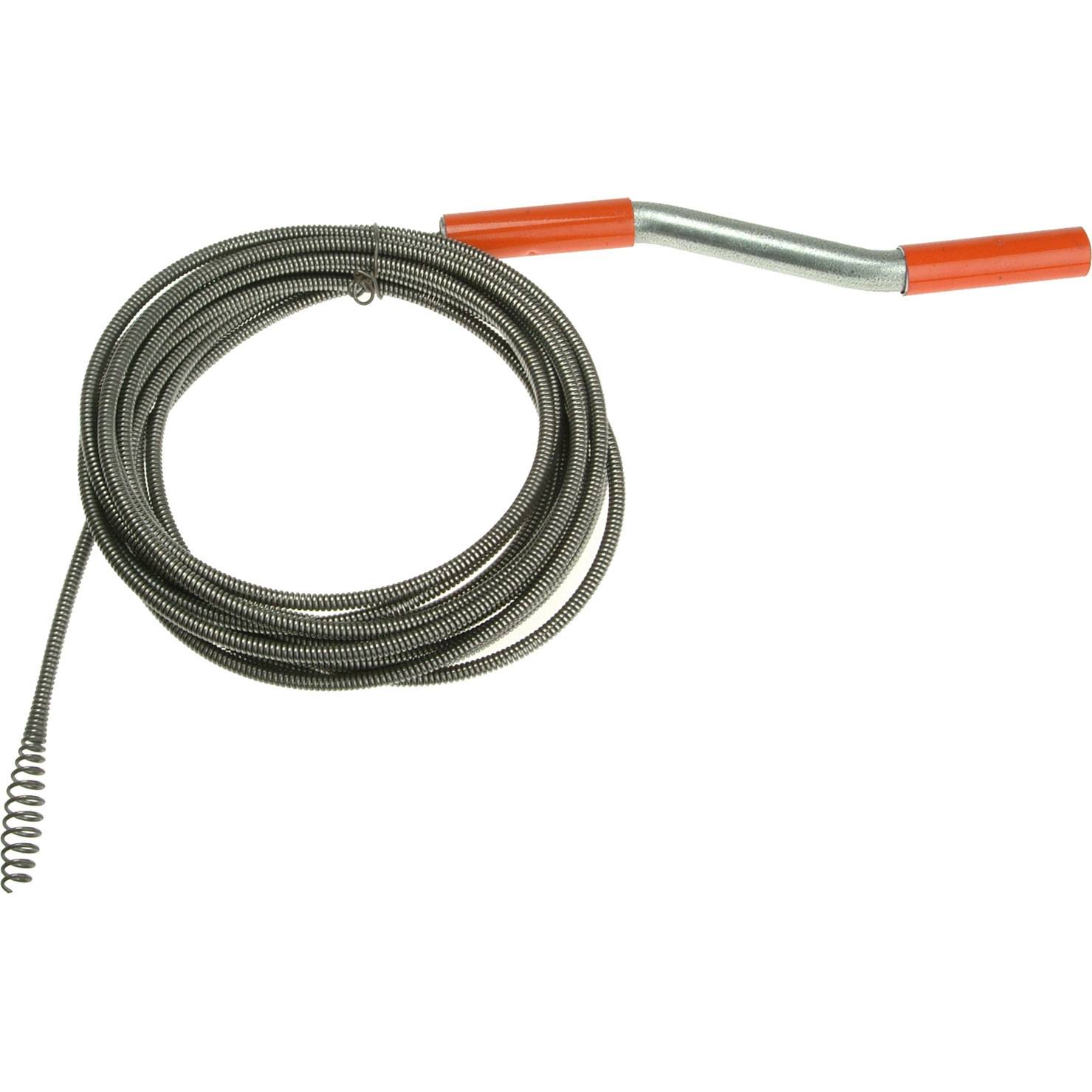
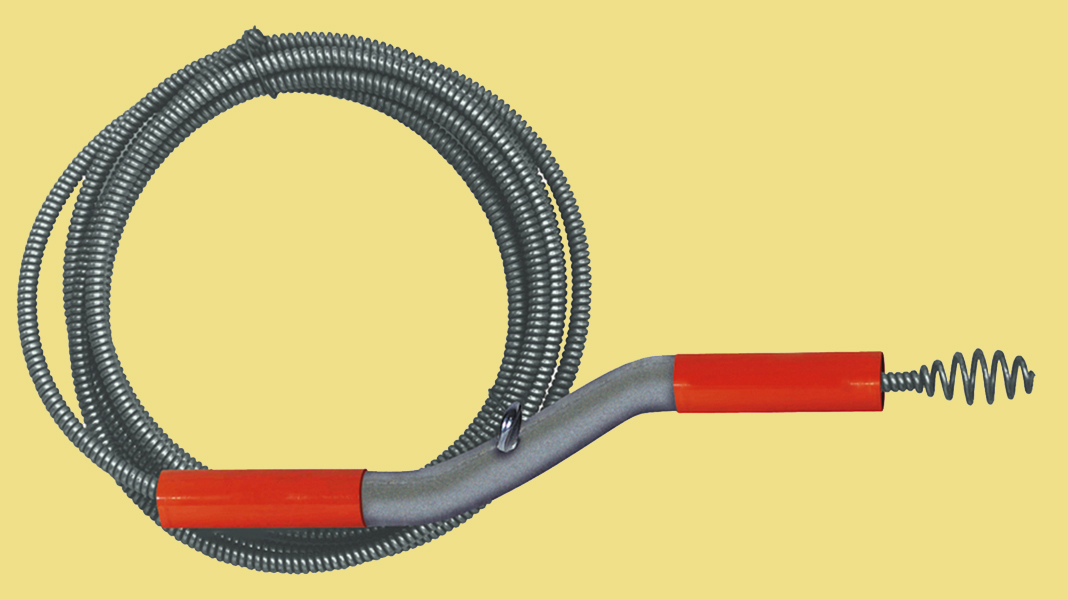
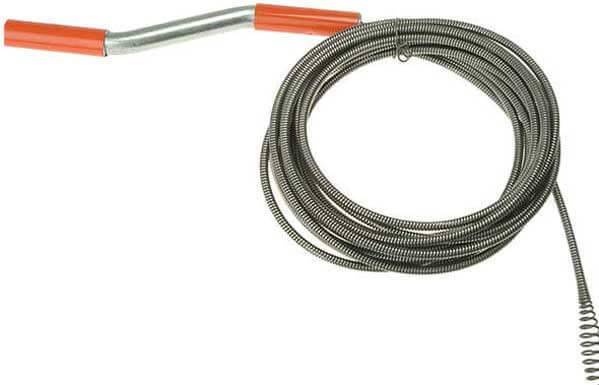
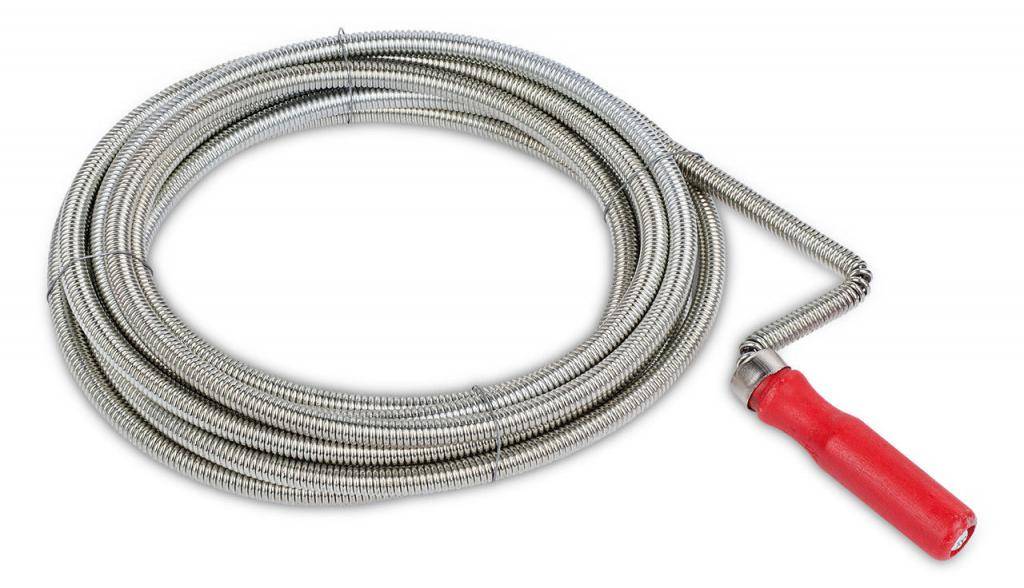
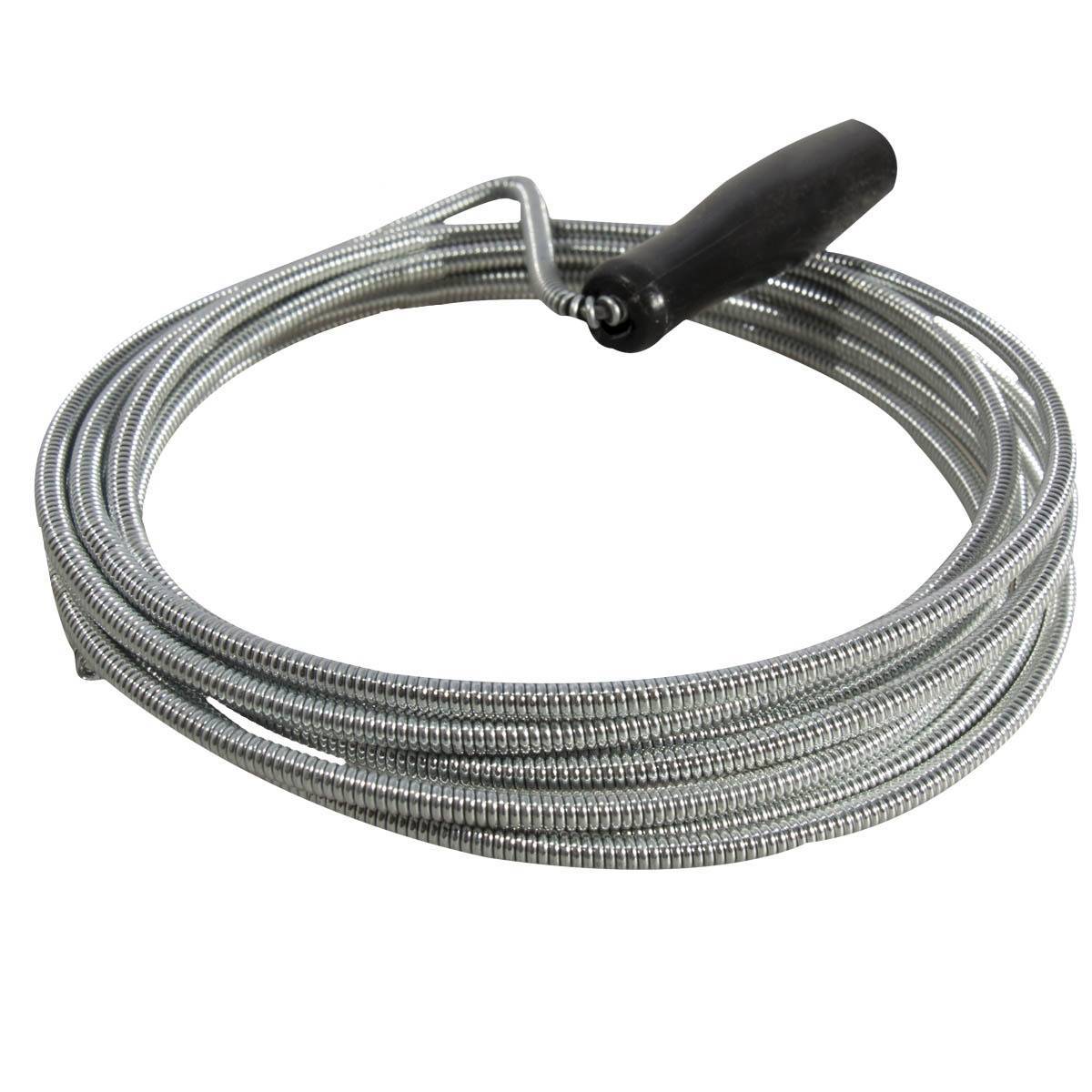
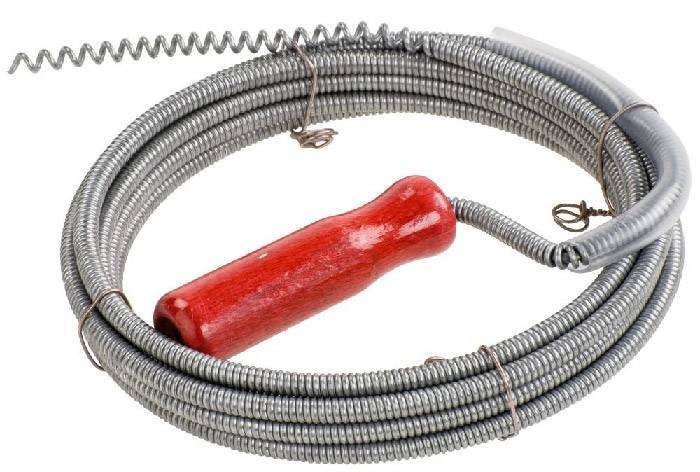
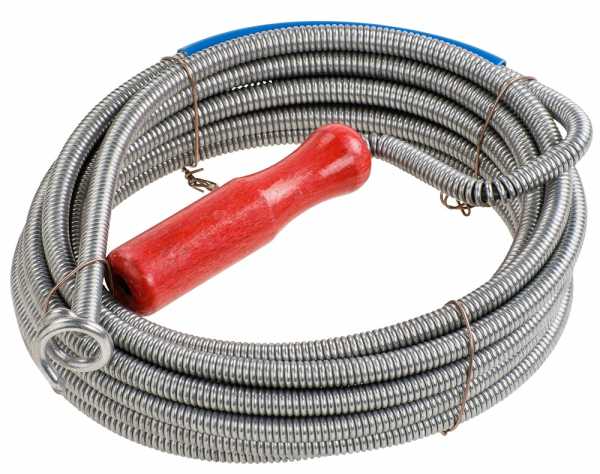
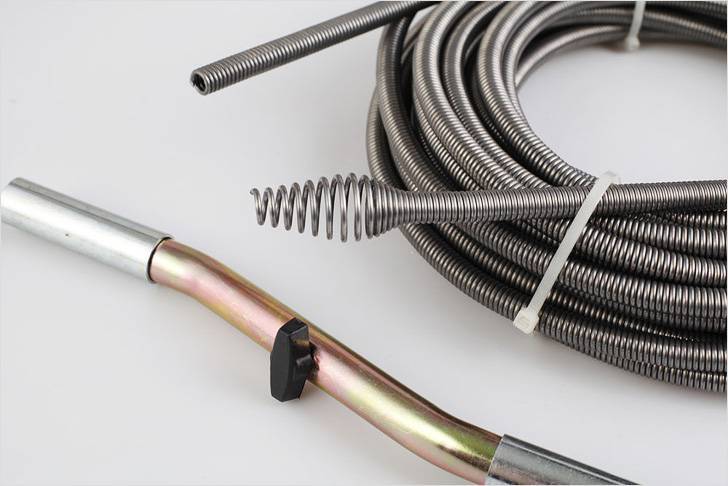
The spring version of the cable differs from the flexible counterpart in a simpler design, as well as less impressive length and width. In fact, the product consists of a twisted steel spring and a handle located on one side. The length of the spring can reach up to 25 m, and the width - up to 13.5 mm.
Professional Solutions
A professional sanitary tension cable of a tension type is significantly superior in its effectiveness to conventional analogues. Masters use them in the most difficult situations, when other types of rope are not able to clear blockages. The cable is professional, with an existing tensioner, it is rigid and is sold in sets with nozzles, which significantly increases its efficiency. The braid of the product can be all-metal or vinyl.
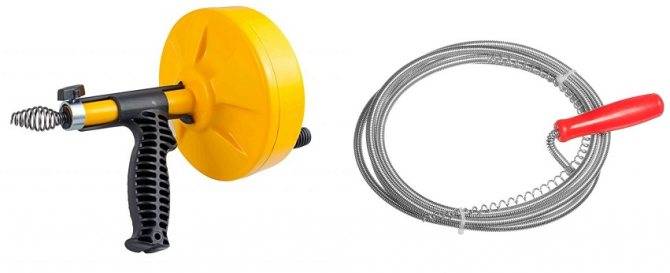
Another advanced solution can be considered an electric cable - a special installation that is used in conditions of serious blockages. The design assumes the presence of a cable with a tip attached to the drum. In addition, the unit is equipped with a pistol grip, which serves to connect a drill. Using a similar tool, you can easily remove any clogging.
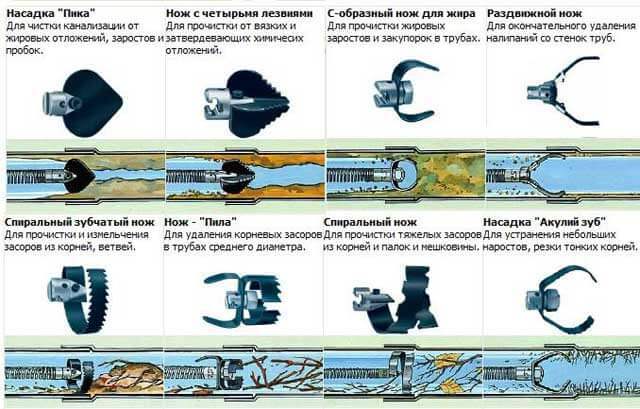
Types of nozzles
Particular attention should be paid to the various tools that are used in addition to the cables. Nozzles for high-quality cleaning of sewer pipes allow you to make the tool more efficient, as well as expand its capabilities
- "Ruff".It is intended for cleaning of organic stratifications.
- Punching tip. It is used to remove dense and problematic blockages.
- Donnaya. Best suited for cleaning traffic jams from construction debris.
- Hook. Allows you to remove those items that cannot be pushed through.
- The loop. It is used to eliminate water seals.
They may vary in size, which is selected individually depending on the conditions of work.
Step-by-step instructions for cleaning the sewer with a cable
Working with a plumbing cable does not require qualifications, and to successfully clear the blockage, you only need to follow a number of rules discussed in the instructions below.
Preparatory stage
The first step before cleaning is:
- Inspect the cable for damage, lubricate the bushings on the handle.
- Put on a cap, if available.
- Change into clothes that you don't mind throwing away later.
- Remove nearby things that cannot be simply washed off dirt later.
- Cover the floor and appliances near the place of work with oilcloth or rags.
Then it remains to pull the siphon corrugation out of the socket of the pipe being cleaned
Before cleaning the sewer, it is recommended to check for debris in the siphon. The reason for the stagnant water in the sink may be this
Before cleaning, it is advisable to fill the clogged riser with hot water. After the place of work is completely ready, you can proceed directly to the removal of debris from the pipe.



Debris removal stage
During the cleaning procedure, it is necessary to unwind the cable and slowly, with progressive movements, begin to push it into the pipe.
When resistance appears, it is necessary to proceed to translational-rotational movements with the help of a handle.
It is better to carry out the cleaning procedure together: one person should hold the cable and regulate the forward movement, and the second should turn the handle
Rotational movements must be performed constantly in one direction against the direction of winding the upper layer of wires on the cable. When a blockage is reached, it is necessary to increase the rotation and pushing of the tip into the pipe. Ropes with a rotating inner shaft can be tensioned - this increases their rigidity and penetrating ability.
If it is difficult to scroll the cable, you need to regularly pull it out and clean it of dirt, otherwise it may twist inside the loop.
The cleaning cable should be pulled out with rotational movements, and in the same direction as when moving towards the blockage.
A negative consequence of excessive force when advancing the cable can also be damage to the tightness of the pipes at the joints with the appearance of a leak.
It is required to carry out translational-rotational movements and cleaning the cable until the blockage is completely eliminated.
Metal pipes clog much faster due to the rough structure of their walls, on which food particles and grease easily stick.
You can check the effectiveness of the action with warm water, pouring it into the drain hole from a water hose or a plastic bottle. If the water leaves quickly, then you can try to insert the siphon drain hose into the sewer socket and supply the maximum pressure of hot water to the sink. Evidence of the elimination of blockage will be the formation of a funnel at the drain hole.
Draining boiling water into the sewer is not recommended: gaskets and sealant at pipe joints may be damaged, which is fraught with leaks
Final stage
After removing the blockage, you need:
- Unscrew the siphon, clean it of dirt and reassemble.
- Insert the corrugated drain hose into the sewer pipe.
- Check the tightness of the siphon and sewer system by draining hot water into the sink with increasing pressure for 2-3 minutes.
If attempts to clear the blockage with a cable were unsuccessful, then it will be necessary to dismantle the sewer and manually eliminate debris.
Cable for cleaning sewer pipes: the pros and cons of the application
A pipe cleaning cable will help you cope with the most difficult traffic jams. With it, you can return to working condition not only internal systems, but also external sewage pipes in a suburban household.
A conventional cable has a simple design
This device is versatile, you can purchase different nozzles for it to perform complex tasks. The main advantage of the drain cleaning cable is that it is flexible. It penetrates into any system and rotates at any angle.
This equipment also has disadvantages. There are only two of them: a rigid cable can damage plastic pipes, and in order to use it, you will need to remove the bars and other protective devices.
Sewer cable from improvised materials
You can buy a cable at any plumbing store. But if necessary, you can assemble the tool on your own. The procedure is quite simple and affordable. It is enough to follow some useful recommendations. The effectiveness of using a homemade tool is not inferior to purchased options.
Do-it-yourself sewer cable assembly:
- For the core, any wire with a diameter of 9 mm is suitable.
- Depending on the type of blockage, the wire acquires the required shape. So from the end you can bend the hook. You can fluff the end with a hammer or other items at hand.
- The second end will serve as a handle, so it is bent in the shape of a ring. Such an element to make the use of the cable more convenient.
On this homemade cable is ready. The rules for its use are similar to a store brush. The main thing is that the wire is free of defects and cracks.
A do-it-yourself product can compete with professional options. Such a cable can be used to eliminate household blockages. This product will not damage the house, since no one is safe from blockages.
Manufacturers of sewer cables
Plumbing equipment is produced both in Russia and abroad. There are not many enterprises, but they produce a sufficient number of cables to supply everyone with their equipment.
- Chebtros is a manufacturing plant in the city of Cheboksary, specializing in the production of sewer cables and accessories for them. You can make an individual order for any diameter and length.
- Zet-Techno is a universal production facility in the Moscow region that produces a wide range of building materials and equipment. Welding machines, equipment for pipe installation, cleaning and diagnostics.
- "Santekhtros" is a leader in the production of sewer cables, the plant is located in Cheboksary.
- "Metalorukav", a plant in Balashikha near Moscow. It specializes in the production of building materials: fittings, hydraulic hoses and others.
- "SPIKOMENERGO" specializes in professional equipment for plumbers.The head office is located in Barnaul, delivery throughout Russia.
Making from improvised means
As practice shows, sewer pipes can be cleaned not only with a factory cable, but also with a do-it-yourself device. To do this, it is quite enough to have elementary improvised materials. The simplest solution is a piece of flexible wire 10 m long with a bent end, but this option is only suitable for shallow blockages. If the sewer plug is more serious, then you will need the help of a professional cable.

To make a hand rope, you must perform the following steps:
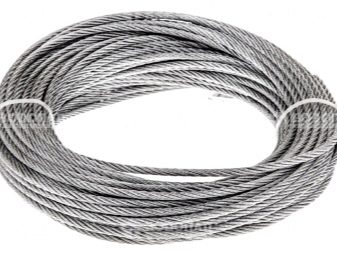
- take as a basis a metal cable of the required length;
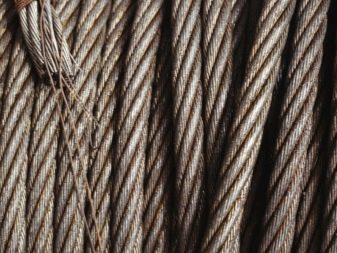
- fluff one end, giving it the shape of a brush;
- make a ring at the second end and attach a handle to it for greater convenience;
- coat the product with an anti-corrosion compound to preserve its original qualities.
A similar cable can be used when cleaning pipes, as well as toilets and bathtubs. It should be borne in mind that for each type of blockage there is a version of the product with its own individual properties and features. In order to prevent such situations, it is necessary to regularly conduct a scheduled inspection of sewer pipes, and also to prevent food particles or other substances from entering the sewer system that can cause blockages. Such measures will help extend the life of the pipes, as well as create the most comfortable conditions for staying in a particular room.





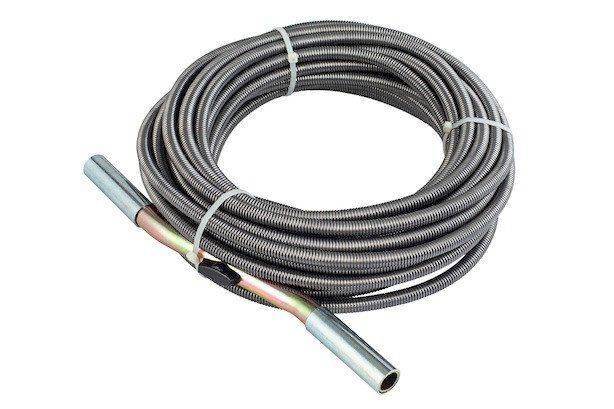
You can see the best way to clean sewer pipes in a private house in this video.
The procedure for clearing the blockage
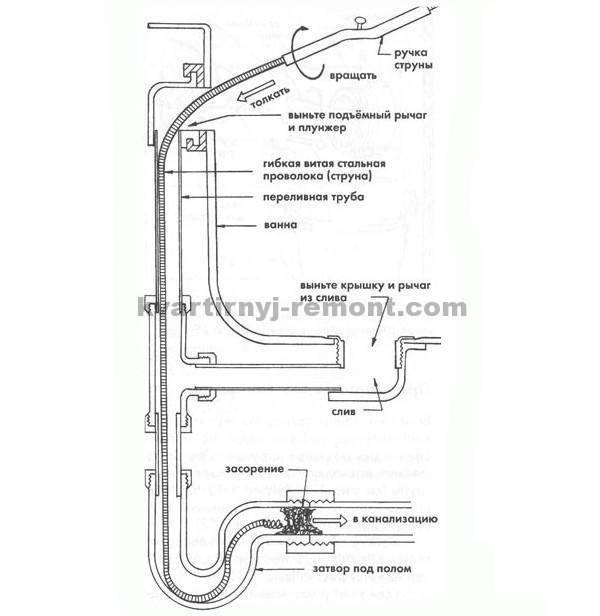
In the photo - Scheme of using the cable.
The standard sewer system is a pipeline with water inlets included in it. Each wastewater intake point is equipped with a curved siphon. It should not be forgotten when using cables. Namely, they are usually addressed by people who have ceased to leave the water from the bath, sink or toilet.
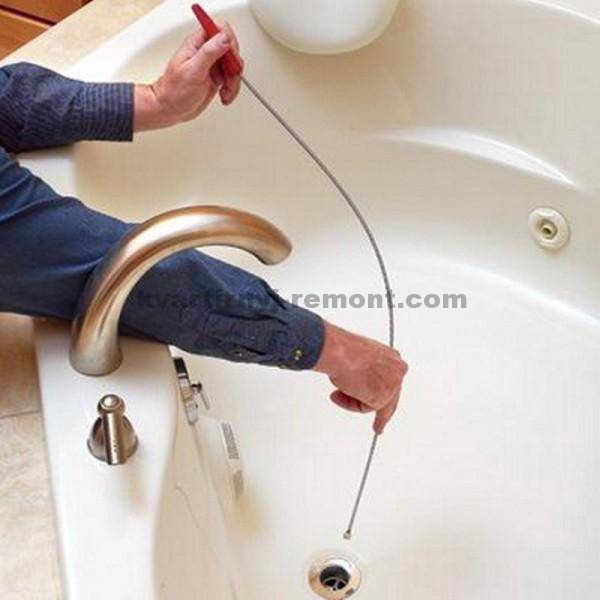
In the photo - the use of a cable to combat blockage.
Before use, inspect the cable for integrity, cover the floor near the clogged point with polyethylene, and put on rubber gloves. Next, the siphon is removed, the sealing plug standing on the outlet pipe, the parts are thoroughly washed with water and laid aside to dry. After that, you can start cleaning.
- The working end is lowered into the pipe.
- They make rotations with a cable, combining them with translational movements. It should gradually move forward, gradually unwinding. In this case, it is necessary to rotate only in one direction.
- As soon as the cable reaches the blockage, it will stop moving further. Here it is necessary to make movements back and forth in order to destroy a dense cork. From time to time it is necessary to pull out the device, inspect it, if fragments of debris are caught on it, it must be removed.
- When the cork begins to collapse, the water will pass unhindered further. But you can’t stop there, you should work with the cable more, finally removing all the accumulated particles.
- At the final stage, you need to pour a bucket of hot water into this pipe, it will eliminate the last smallest particles that the cable did not capture. If you can see that the water is calmly passing through the pipe, then you did everything right. After use, the cable is washed, lubricated and wrapped in paper so that it does not rust during storage.It is not recommended to store the product in polyethylene.
How to choose the right option
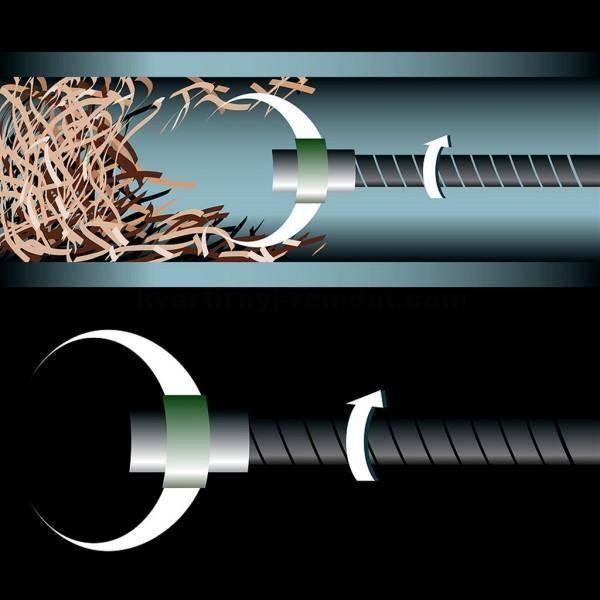
The principle of using a plumbing cable is extremely simple. First, the tool is pushed into the sewer pipe until it stops, so that it ends up against the blockage.
Then, by means of rotational and reciprocating movements, the handle of the tool picks up the plug with the tip of this end in order to pull it out or destroy it in place inside the pipeline.
The specifics of the application and the efficiency of use depend on the structure of the cable, the correct choice of the tool size.
Plumbing cables in hardware stores are sold in four types:
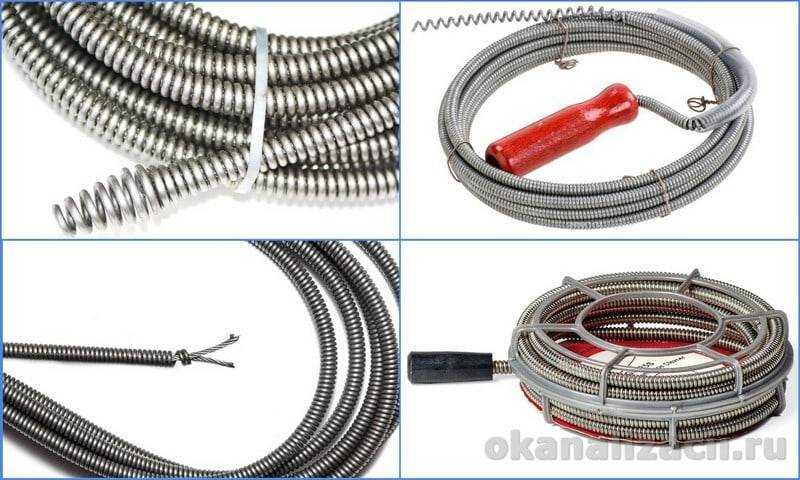
- rope - a classic thin rope (rod) of several wires;
- spring - hollow spring, twisted from wire;
- spring-wound - a flexible core with a spiral wound on the outside;
- tape (flat) - a tape 1–4 cm wide.
For all types of plumbing cable, the working elements (handles, nozzles, tapes, wires) are usually made of durable steel.
There are models whose spiral is covered on the outside with a rubberized sheath that protects the inner walls of the pipes from mechanical damage by metal. But in most cases, a plumbing cable is just a steel spring without any braid.
On the one hand, the spiral allows the cable to bend around any turns in the sewer, and on the other hand, due to the torque, it enhances the mechanical effect on the blockage
Cable. A small cable-rope 1.5–3 meters long belongs to the household category of tools.It is ideal for cleaning sinks, clearing blockages in toilet bowls and on horizontal sections of pipelines up to a common riser.
Spring. The cable is small and ideal in terms of cleaning intra-apartment risers and sewer pipes suitable for them from plumbing fixtures.
Rope with core. This is a professional tool that can be used to push (push through) a weed plug. It is difficult to do something like this with an ordinary spiral because of its greater softness and compressibility.
Ribbon. Such a tool is not flexible enough and is not able to go into all corners of the sewer. It, unlike a spring, bends only in one plane. But the ribbon cable has smaller dimensions in a twisted state.
Most often, it is used when cleaning long main pipes of large diameter, which have an order of magnitude fewer bends than in-house ones.
When buying a cable for cleaning sewer pipes, you must correctly select its cross section. Too thick a tool to clean the sink or urinal is unlikely to succeed. It just won't fit in the drain hole. Such a flexible shaft is designed for cleaning risers and wide pipes of large diameter.
Correspondence of pipe diameters and santekhtros:
- pipes D {amp}lt; 50 mm - a flexible shaft should be selected with a cross section of up to 10 mm;
- pipelines 50-110 mm - you need a cable with a diameter of 11-15 mm;
- vertical risers more than 100 mm - it is required to choose a tool with a thickness of 16 mm or more.
An excessively thin 3–4 mm cable can break when a plug is pulled out of the pipe. Such a device is more intended for cleaning siphons and removing hair from drains.
It is not worth punching a thick pipe with a blockage in the form of a rag. A more solid option is required here.
The cable for cleaning sewer pipes has a lot of advantages:
- big torque;
- ideal balance of elasticity and flexibility;
- safety of use;
- simplicity and ease of use;
- high cleaning efficiency;
- Possibility to use different nozzles.
With active use for its intended purpose, the cable spiral loses its elasticity over time (it becomes loose) and simply breaks. But with proper care, cleaning and oiling after work, this device will last more than one year.





The easiest way to make it easier for yourself to clean sewer pipes is to supplement the cable with an electric drive in the form of a drill or screwdriver, only you will need to turn them on at low speeds
Professional plumbers prefer to use special tools to make the job easier. It can be either a handle on a rigid and stable stand, or a full-fledged power tool with a motor. Plus, there are different nozzles for different types of blockages.
A manual version of a conventional plumbing cable is cheaper and smaller in size than an electrical counterpart. However, the latter greatly simplifies the cleaning of sewer pipes. If the tool is needed for one-time work, then there is no reason to spend a lot on it.
However, if you have to constantly clean the sewers on a professional basis in the role of a plumber, then you should seriously think about purchasing a power tool.
Cleaning sewer pipes with chemicals
Recently, chemical products for cleaning sewers have appeared in stores.
The use of these drugs helps to cope with small and medium blockages. Chemical pipe cleaners can be liquid or powdered.
In the first case, liquid is poured into the drain hole, according to the instructions. In the second, the powder is poured, after which a small amount of water is poured into the drain.
The pipe cleaner is left for a few minutes (the exposure time is indicated in the instructions), after which you need to open the hot water tap and rinse the system well.
The described cleaning methods can be used if the sewer pipes are made of plastic or cast iron. In the event that the pipes are steel, the use of chemical methods will lead to accelerated corrosion and the appearance of permanent leaks.
Previous Post Blockage Prevention and Sewer Cleaning
The next entry Home sewer cleaning: plunger, cable, chemistry
How to make a rope on your own
Instead of a factory fixture, you can make a cable for cleaning
sewer pipes with their own hands. For work, you can use
available materials at hand. The simplest analogue
the tool in question is a piece of flexible wire having a bent
the end. Such a device will perfectly cope with a shallow blockage, and flexibility
thick wire allows it to be used even on curved sections of the sewer
systems.
As a basis for a flexible shaft, you can use a regular cable
of steel. It is enough just to make a handle and fix it on a cable.
The sequence of actions to answer the problem, how to make a cleaning cable
do-it-yourself sewerage looks like this:
- A piece of the length necessary for work is cut off from the metal cable.
- On the one hand, the end fluffs up.
- On the opposite side, the cable is twisted into a ring and a handle is attached for ease of operation.
- The surface is treated with a composition with anti-corrosion properties.
A tool made by the described method can be used to remove any type of problem. This tool is considered to be universal and suitable for both professional cleaning and troubleshooting by the owners of apartments and houses.
How to use the rope correctly
Rope application steps:
- The free end is inserted into the opening of a pipe or toilet bowl.
- Turning the rope clockwise, gradually advance through the pipes.
- After the debris is removed, the blockage is removed and the water drain is working properly, you need to use the plunger.
- At the end of pipe cleaning, flush the system with a bucket of boiling water.
First, the pipes are washed with a weak jet of water to make sure of a positive result, and then with a jet under pressure in order to wash away all debris. The device itself (wire or cable), which was used in the process of cleaning the sewer, after work must be washed from dirt, rinsed and dried. The next step will be to test its ability to work, the presence of damage and, if necessary, minor repairs. At the end, the cable must be carefully lubricated, twisted and put into thick paper or cloth. Do not hermetically close the packaging with the cable.
The multifunctional characteristics of a sewer cable depend not so much on the materials used in its manufacture, but on proper care.
After application it is recommended:
- thoroughly clean the surface from sewer pollution. This is done carefully under hot running water, using a rag;
- after cleaning, all components are thoroughly dried. This is necessary to prevent the formation of a corrosive layer;
- the final step is applying a thin protective layer of oil and wrapping in thick paper.
Varieties of plumbing cables
To proceed with the instructions on how to properly clean the sewer with a cable, you must already have at least an initial idea of \u200b\u200bwhat this equipment is. There are currently three main types.
Rope rope
This cable is made from galvanized steel. In simple words, it is a dense long wire, protected from the outside by a sheath. The diameter of the rope cable is 6 mm, and its length reaches five meters, which is absolutely sufficient for cleaning the sewer.
 Rope rope
Due to its flexibility, but at the same time, a high level of strength, this device easily passes through the pipe, bending around all available corners and joints. The tip of the rope is often unraveled in order to obtain a "brush" shape. This effect allows you to remove blockage from the pipe, consisting of lumps of hair and wool.
The disadvantage of the rope type can be called its excessive softness, which prevents the cleaning of particularly difficult blockages. This cable can be used for self-cleaning pipes in an apartment or house. It is not suitable for external sewerage of buildings.
Spring coiled cable
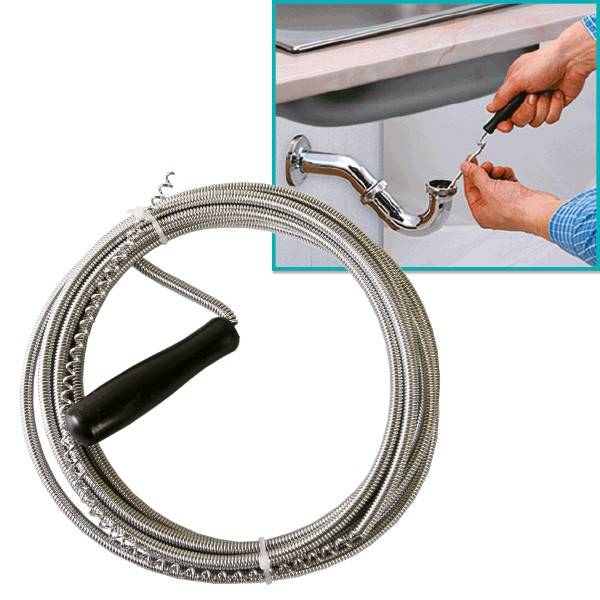
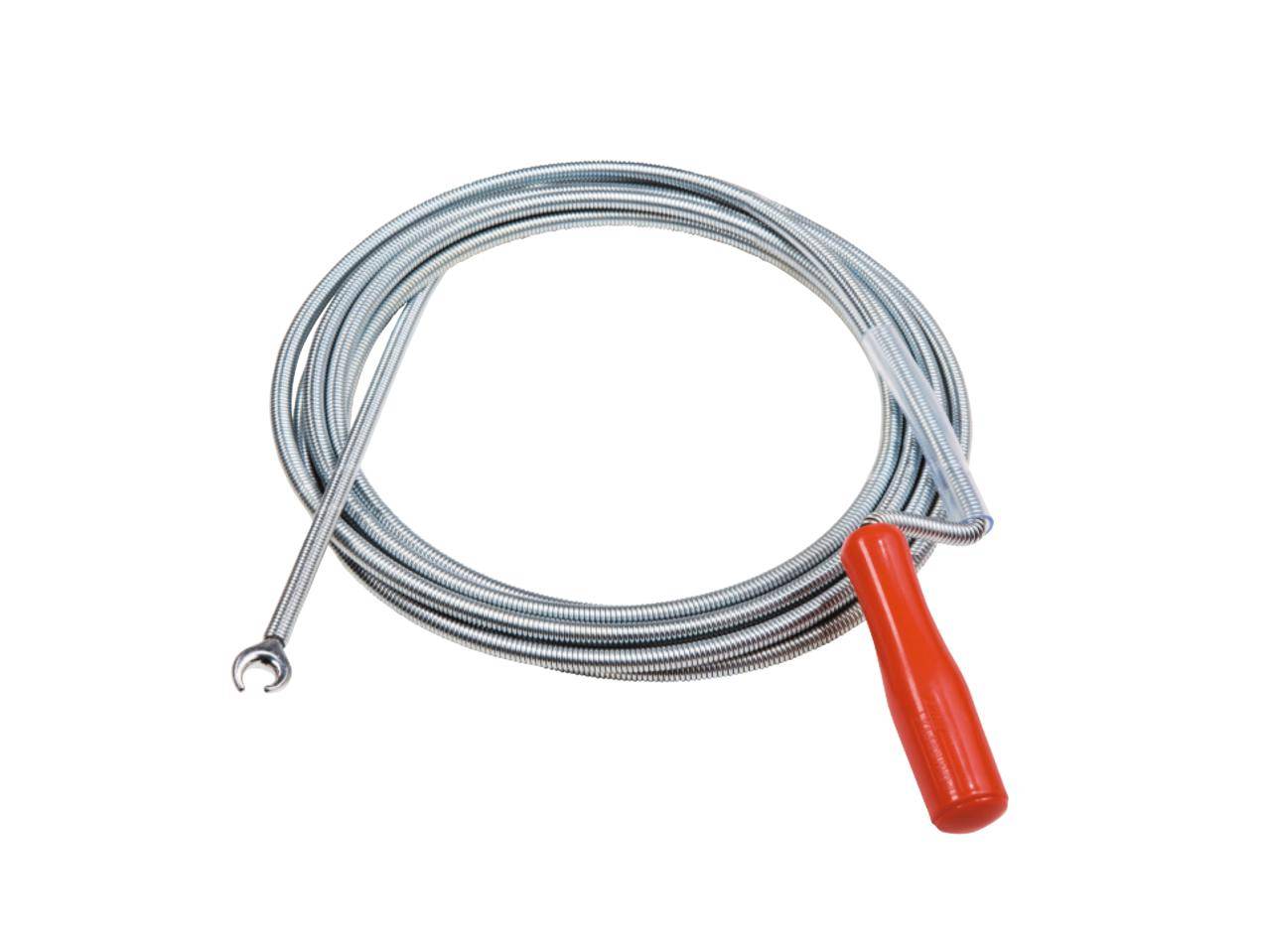
This type is also used to clean sewers at home. The device is a coiled spring wire, the diameter of which is usually 9 mm. The length varies from two to five meters.
The property of flexibility allows the cable to quickly and easily move through the sewer without fear of its deformation. But at the same time, a large blockage of this type may not be strong enough. Another disadvantage of this type can be called the complexity of caring for it, because dirt accumulates in the central cavity every now and then.




spring cable
Such a cable is professional equipment that can clean not only domestic types of pipes, but also the city sewer system. Due to its structure, this device is able to cope with even the most difficult types of blockage. On sale you can find cables in two diameters: 13.5 mm or 16 mm. And its length can reach 60 meters.
Depending on the structure, the spring cable has two modifications:
- With a rotating core;
- With a hard core.
If the first type is convenient due to its greater flexibility, then the second is used in cases where blockage requires a device with special strength and increased penetrating power.
A distinctive feature of the spring cable is the presence of a handle. It acts as a tensioner. In addition to the handle, the equipment can be additionally equipped with various kinds of nozzles. The type of nozzle directly depends on the nature of the blockage and the configuration of the pipes.
The best professional plumbing cables
Such models are characterized by a large diameter and high strength. They are designed for regular use, are not afraid of constant contact with aggressive media and are compatible with various types of nozzles.
Crocodile 50310-13-30
5
★★★★★
editorial score
100%
buyers recommend this product
The model is equipped with a universal nozzle with an anodized coating, which eliminates the possibility of corrosive media damaging the metal and causing corrosion. With its help, the owner can eliminate up to 80% of blockages. The main material of manufacture is high carbon steel.
The length of the cable is 30 m, the diameter is 13 millimeters. The kit includes a "floating" handle, providing comfortable operation regardless of the depth of immersion. The cable does not twist in the pipe, does not fold into a knot and retains its quality characteristics for a long time.
Advantages:
- high strength;
- protective covering;
- universal nozzle;
- comfortable grip.
Flaws:
high price.
The Crocodile cable is suitable for working on various sections of the pipe. The right solution for clearing blockages and removing foreign objects.
Spex STU-SN-16-15
4.9
★★★★★
editorial score
95%
buyers recommend this product
The model has a steel core, which provides resistance to twisting and breaking. It is not afraid of a large mechanical load and is equipped with a universal mount. One of 19 nozzles can be fixed on the cable, which greatly expands the range of its application.
Rope diameter - 16 mm, length 15 meters. The device has a Spex-Handle, which, if necessary, can be moved along its entire length for more convenient work.
Advantages:
- high strength;
- many nozzles;
- comfortable grip;
- long length;
- steel core.
Flaws:
heavy.
Spex STU-SN-16-15 is designed to clear difficult blockages. The reliable choice for heavy duty applications.
Vibromash VGS-20
4.9
★★★★★
editorial score
93%
buyers recommend this product
The model has a dense layer-wound structure, due to which it is characterized by high strength and resistance to high tensile loads. The Z-handle allows you to properly hold the attachment and reduces fatigue during intensive use.
With a diameter of 20 millimeters, the length of the cable is 40 m. A special punch-type tip facilitates the removal of blockages. The cable retains its original appearance and properties for a long time, does not twist or unravel.
Advantages:
- high strength and durability;
- long length;
- drill tip;
- comfortable to hold.
Flaws:
very large weight - 80 kilograms.
The Vibromash cable is designed for cleaning industrial pipes and fighting old deposits.
Santechkrep 437678
4.8
★★★★★
editorial score
88%
buyers recommend this product
The design of Santechkrep is a rigid spiral, mounted on a strong rod. The diameter of the spring wire is 3 mm. It is not afraid of high breaking load and mechanical damage. To improve the penetrating ability, a metal knob is provided.


The total diameter of the cable is 16 millimeters, but the length is only 2 m. A special handle allows you to increase the tension to the optimum. Adjustment is carried out using wrenches of two types.
Advantages:
- high strength and durability;
- protective covering;
- the presence of a tensioner;
- comfortable grip.
Flaws:
- small length;
- requires the use of additional tools.
Santechkrep is used to remove the most difficult blockages in short pipe sections. A good choice for regular professional use.
Wicavo 10/15
4.8
★★★★★
editorial score
87%
buyers recommend this product
The simple and robust design makes the Wicavo cable resistant to high mechanical loads and has a long service life. The extended handle makes it easy to grip, guaranteeing comfort during intensive use of the device.
The cable is 15 meters long and 10 mm in diameter. Reinforced tip easily removes foreign objects from the pipe. If necessary, you can quickly change the nozzle.
Advantages:
- good margin of safety;
- comfortable grip;
- reinforced tip;
- quick nozzle change.
Flaws:
thin handle.
Wicavo 10/15 is suitable for regular cleaning of pipes with a diameter of 50-75 millimeters.