Heat pump device
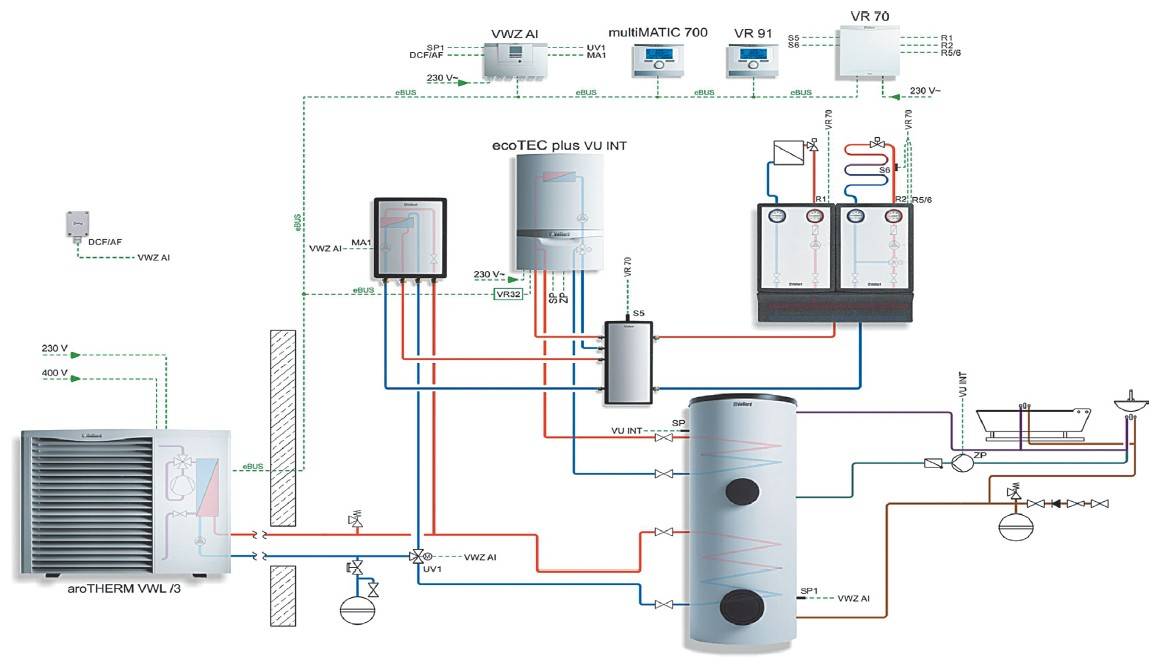
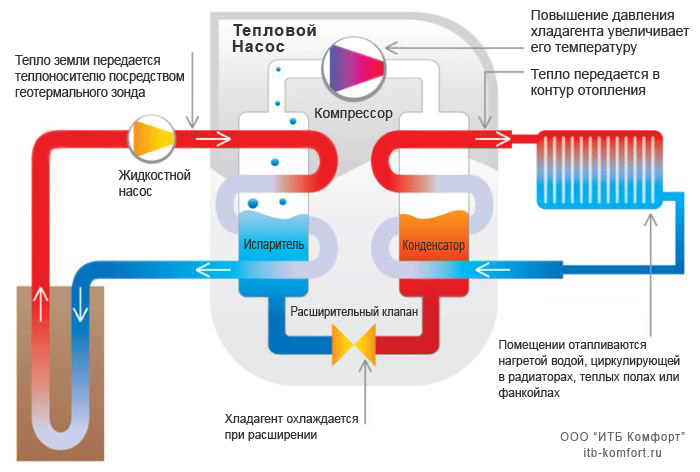
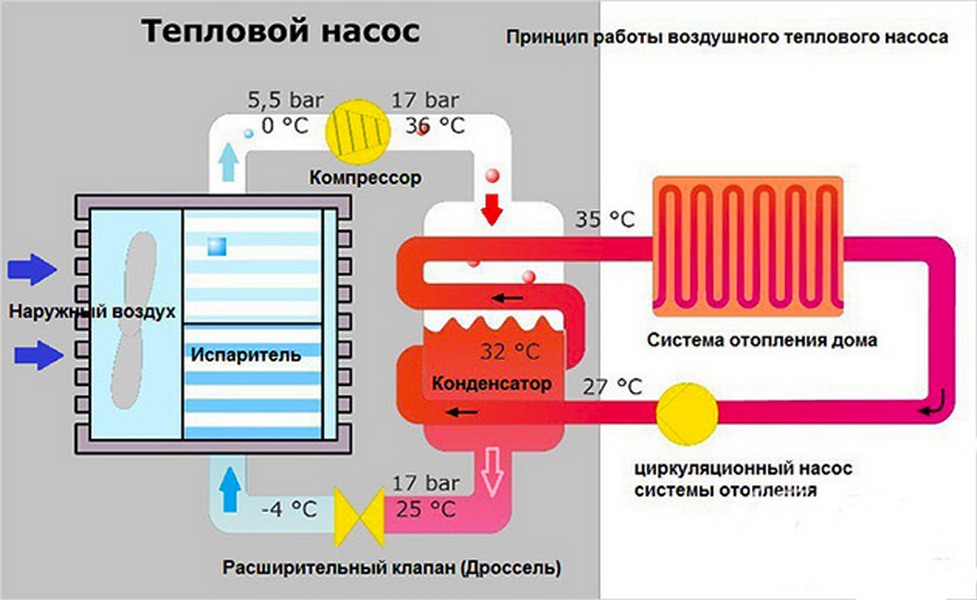
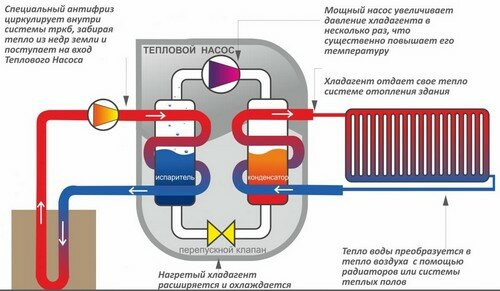
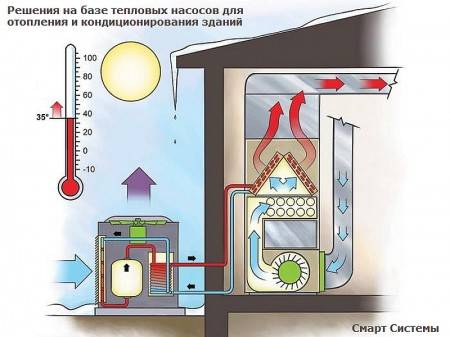
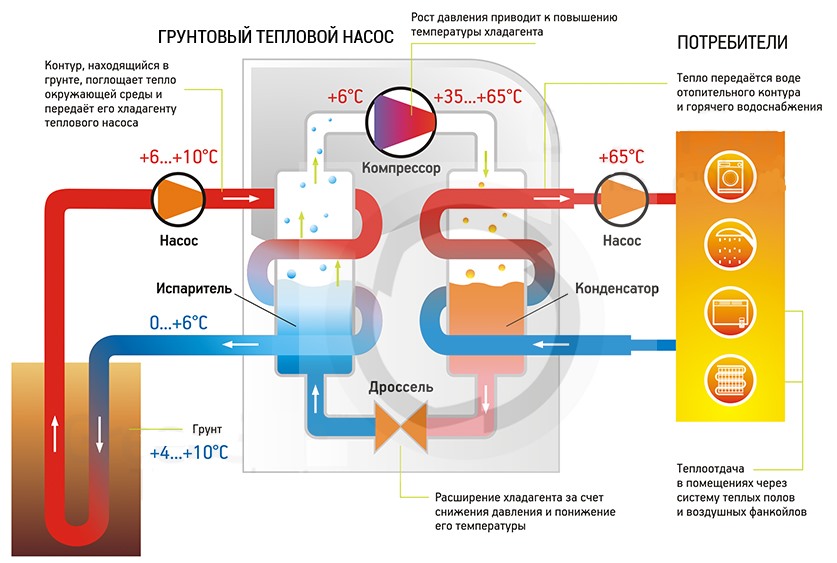
The principle of operation has long been known. There are three closed hermetic circuits - internal, compressor, external.
Main components:
- Heating system. It is best to use underfloor heating. An additional option is hot water supply.
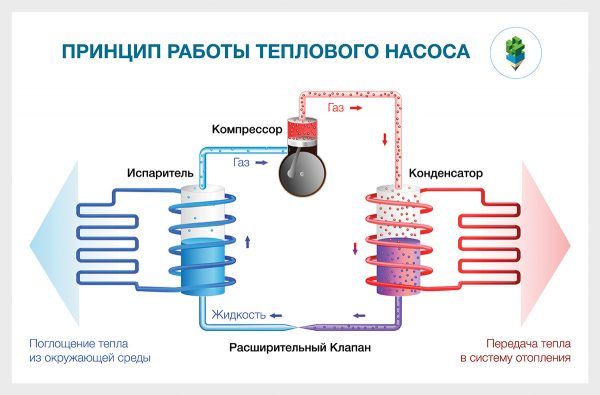
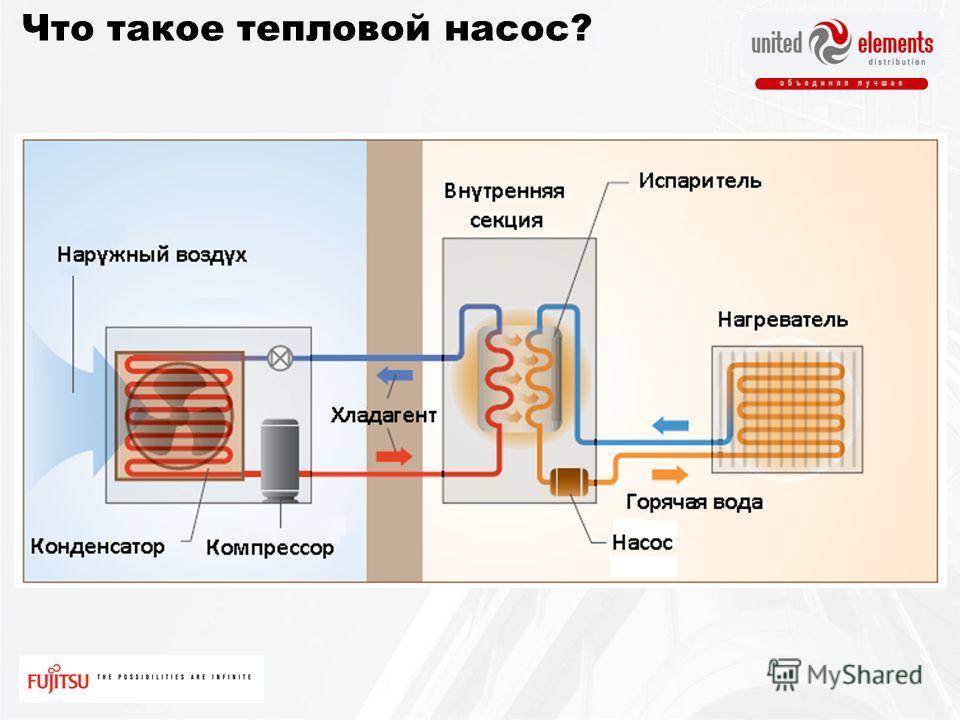
- Capacitor. Transfers the energy collected outside from the refrigerant (usually freon) to the heat carrier (water) for heating.
- Evaporator. Selects thermal energy from the coolant (for example, ethylene glycol) circulating in the external circuit.
- Compressor. It pumps the refrigerant from the evaporator, converting it from a gaseous state to a liquid state, increasing the pressure and cooling it in the condenser.
- Expansion valve. Installed with an evaporator. Regulates the flow of refrigerant.
- Outer contour. It is laid on the bottom of a reservoir or lowered into wells.
- Pumps of an internal and external contour.
- Automation.Controls the system according to a predetermined amount of space heating and changes in the outdoor temperature.
The outer contour in the pond near the building looks like this.

The collector is effective all year round. In winter, at a depth of more than 3 meters, the water temperature is sufficient for heating.
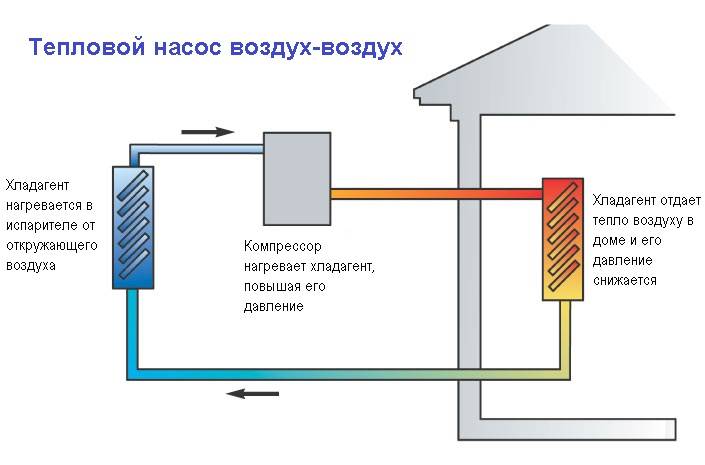
After the evaporator, the refrigerant passes through the compressor where its pressure and temperature increase. Then in the condenser it gives off heat to the heating system.
The refrigerant then passes through an orifice where the pressure drops sharply due to expansion. Upon transition to a gaseous state, the temperature of the refrigerant decreases almost instantly. This process can be felt in practice when refueling a gas lighter from a can of liquefied gas. A significant temperature difference contributes to the efficient absorption of heat by the refrigerant from the external circuit.
There is also an open collector option. Possible when the water is of good quality. Then the system and the pump are not threatened by silting, deposition of hardness salts, accelerated corrosion.

Such heat generators received practical application only after the energy crises of the 70s of the last century.
Until then, their development was hampered by the relative cheapness of energy sources - oil, gas, etc. In addition, the imperfection of technology hindered the mass introduction of innovation.
Is DIY installation possible?
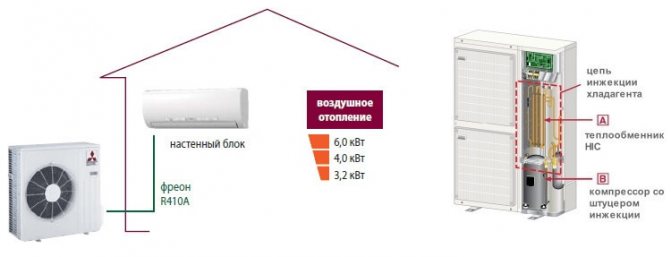
Despite the technical complexity of heat pumps, they can be installed independently. To be more precise, you are free to do all the “dirty work” with your own hands: laying technical pipelines and power networks, hanging indoor and outdoor units.The passport documentation for each specific type of heat pump contains comprehensive information about the installation conditions of the blocks, the slope, length and permissible bends of technical routes.




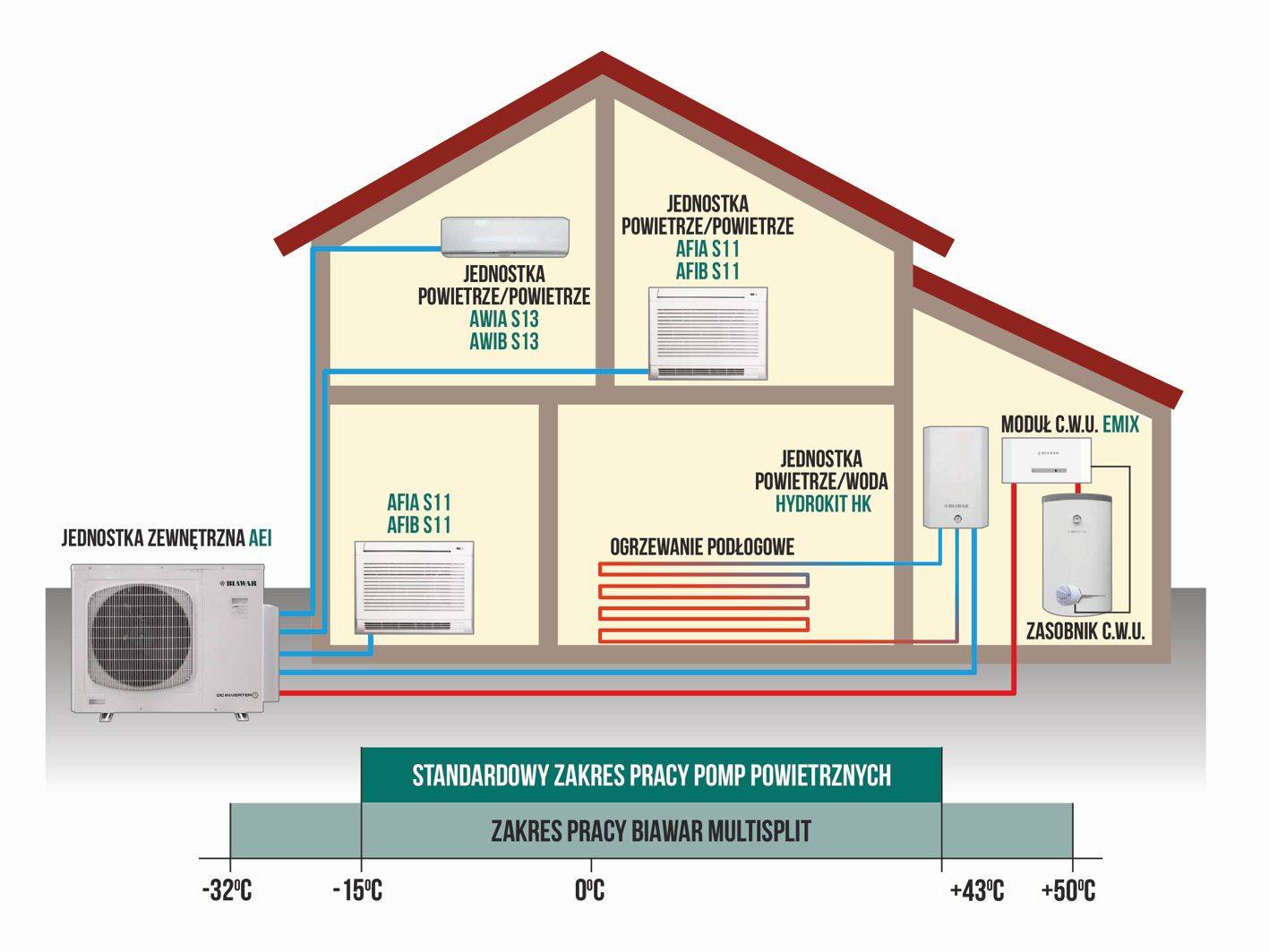
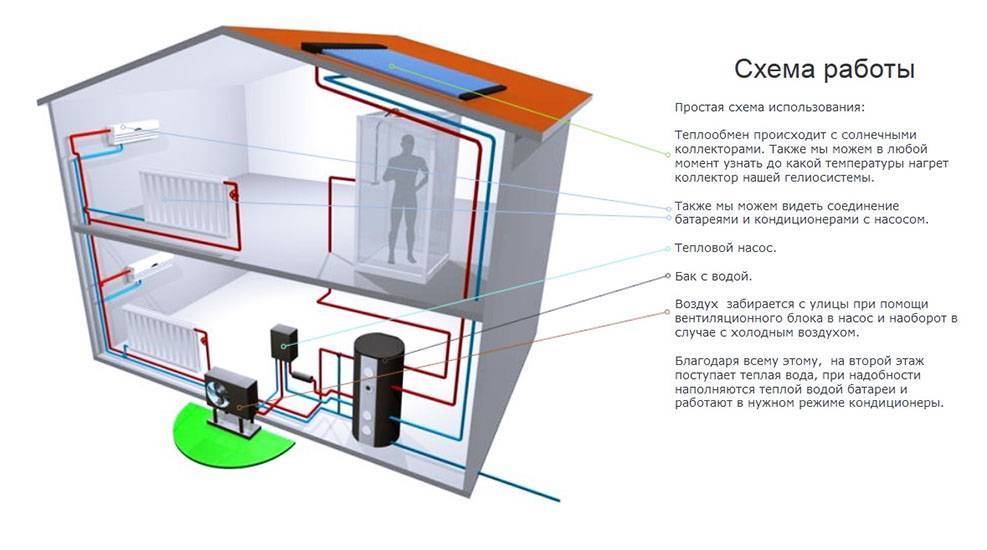

All that remains later is to invite a specialist who will check the correct installation of the system and ensure its correct commissioning. You cannot do this work yourself: you need equipment for cleaning and deaeration of the system, charging refrigerant - in general, this process is quite technological and complex.

It should be emphasized that the installation of such air conditioning systems is not done "on the fly". A detailed preliminary calculation is required, in particular, it is necessary to determine the class of equipment suitable for specific climatic conditions and calculate its sufficient power. Of course, district heating based on heat pumps causes even more difficulties in designing and coordinating work with building contractors.
Basic installation rules
For a high-quality installation of a natural circulation heater, the following important steps must be taken:
- It is preferable to place radiator heaters under windows at the same height.
- Install the boiler.
- Install expansion tank.
- Connect the installed elements with pipes.
- Place the coolant in the heating system and check all components for leaks.
- Start the boiler and enjoy the warmth of your home.
Important information from installers:
- The boiler must be installed as low as possible.
- Pipes must be laid with a backward slope.
- It is recommended to avoid a large number of windings in the system.
- Use large diameter pipes.
We hope that we have revealed all the nuances of a heating system without a pump that will help heat your home.
For information on installing a heating system without a pump, see the explanation of the gravity circuit in the following video:
Page 3
Circulation pumps are currently available as an option in fluid heating systems. They are used for heating all types of fuel.
In most cases, the installation of an additional pump in the natural circulation system significantly increases the speed of movement and heating of the room. The device itself does not have a particularly complex design and is small in size.



Particular attention should be paid to the parameters of the additional pump and system
System durability and maintenance
Many can be scared away by the system's service life of 7-10 years declared by the manufacturer. In practice, this figure is significantly higher, just a heat pump can lose performance over time.
This is primarily due to the gradual leakage of the refrigerant into the external environment and its contamination with moisture and other impurities. In this case, a fairly simple maintenance procedure is provided, which consists in cleaning the coolant and replenishing its concentration.

Wear and tear on mechanical components such as a compressor or fan is inevitable. However, a good heat pump provides for the possibility of modular replacement of its constituent parts. The durability of the equipment is entirely determined by the conditions of its operation and the technical perfection of the system.Working at the limit, periodic icing of the outdoor unit and other violations of the normal operating mode - this is what needs to be excluded from the very beginning so that the equipment has time to fully pay for itself and at the same time bring the desired warmth and comfort from use to the house.
rmnt.ru
Pros and cons
The benefits of using a heat pump include:
- Possibility of application in remote villages where there is no gas pipeline.
- Economical consumption of electricity only for the operation of the pump itself. The costs are much lower than when using electrical appliances for space heating. A heat pump consumes no more energy than a household refrigerator.
- Ability to use a diesel generator and solar panels as an energy source. That is, in the event of an emergency power outage, the heating of the house will not stop.
- The autonomy of the system, in which you do not need to add water and control the work.
- Environmental friendliness of the installation. During the operation of the pump, no gases are formed, and there are no emissions into the atmosphere.
- Work safety. The system does not overheat.
- Versatility. You can install a heat pump for heating and cooling.
- Durability of operation. The compressor requires replacement once every 15 to 20 years.
- The release of the premises, which was intended for the boiler room. In addition, there is no need to purchase and store solid fuels.
Disadvantages of heat pumps:
- Installation is expensive, although it pays for itself within five years;
- In the northern regions, the use of additional heating devices will be required;
- The soil installation, although slightly, violates the ecosystem of the site: it will not work to use the territory for a garden or vegetable garden, it will be empty.
The operation of the heating system from such a pump
The principle of operation of the installation itself has been described above. As a result, the heat carrier is heated in the second circuit of the heat exchanger, which will later serve as a heat source for heating the building or individual rooms.
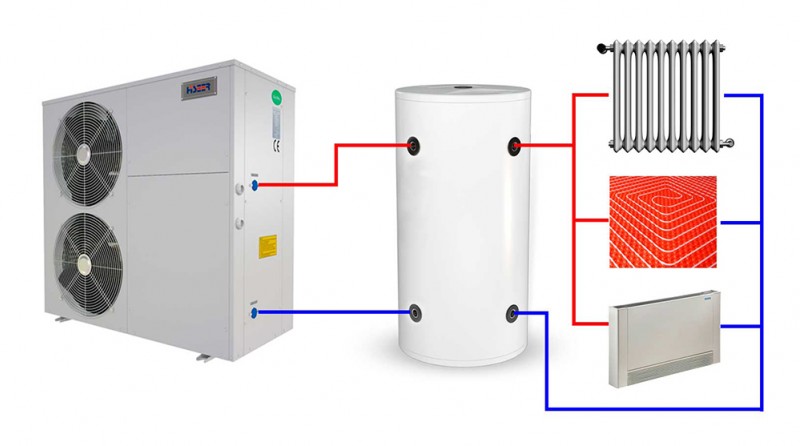
The classic option for distributing the heated coolant is to connect the heat exchanger with two separate lines to the distribution manifold and the water heater. In turn, heaters, underfloor heating and other equipment are connected to the comb. Such distribution is necessary because of the different modes of operation of hot water and heating systems.

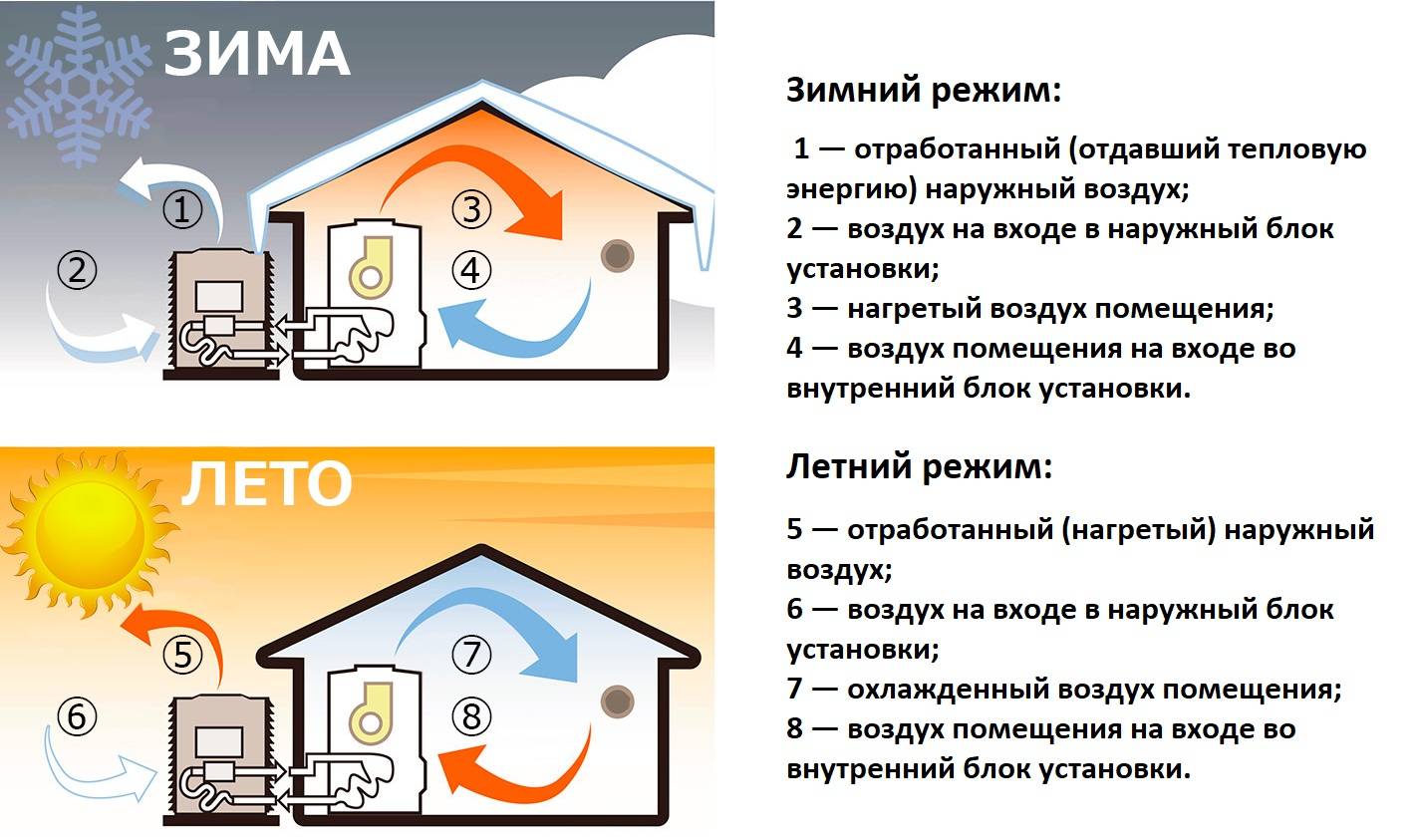



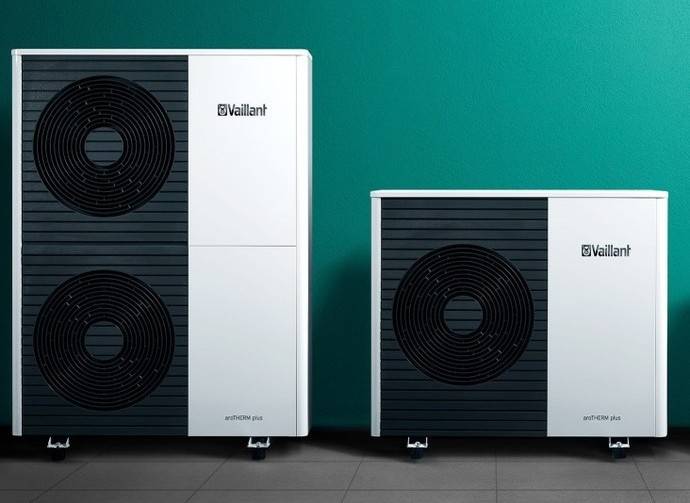
The line of air-to-water heat pumps determines the power of installations from 2 to 120 kW, which allows you to choose equipment for heating and hot water supply of a residential building of any size.
Cold air mode
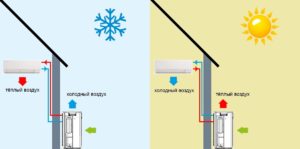
The design of heat pumps allows not only to heat the house in winter, but also to provide cooled air on hot days in summer. To do this, the circulation of the refrigerant is started in a reverse cycle. However, the cooling of heating devices will not provide the desired effect, since the cold air descending down will not be able to create comfortable conditions throughout the entire volume of the room. Therefore, in order to use the air-to-water unit for air conditioning, a convector blown by a fan is required.
In addition, a 4-way valve, a second throttle valve and 2 pipe lines are additionally installed in the circulation circuit.When the valve is switched, the line closes in the direction of the "winter" throttle and opens in the direction of the "summer" one, and the cooled coolant is supplied to the convector. Hot water heating will also be disabled.
The cost of such an improvement, taking into account additional equipment, materials and work, can be quite comparable to the cost of an air conditioner. Therefore, in most cases, it will be quite reasonable to refuse to operate in split mode, but simply buy an air conditioning unit.
Why not wood?
Neighbors mostly use wood-burning stoves, but this option was initially not to their liking. Every year it is necessary to make fuel supplies, clean the boiler, monitor its combustion. With electricity, everything is much simpler - you pressed the toggle switch, it went warm. The only disadvantage of this method is the high cost of electricity. At the time the heating system was launched, a kilowatt-hour in the Moscow Region cost 5.29 rubles.
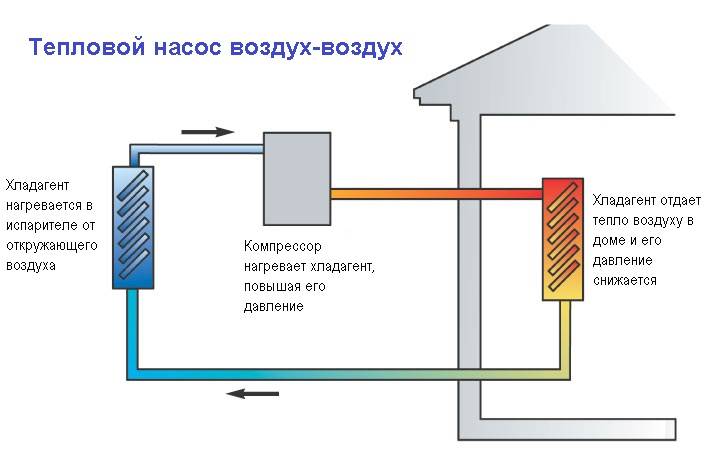
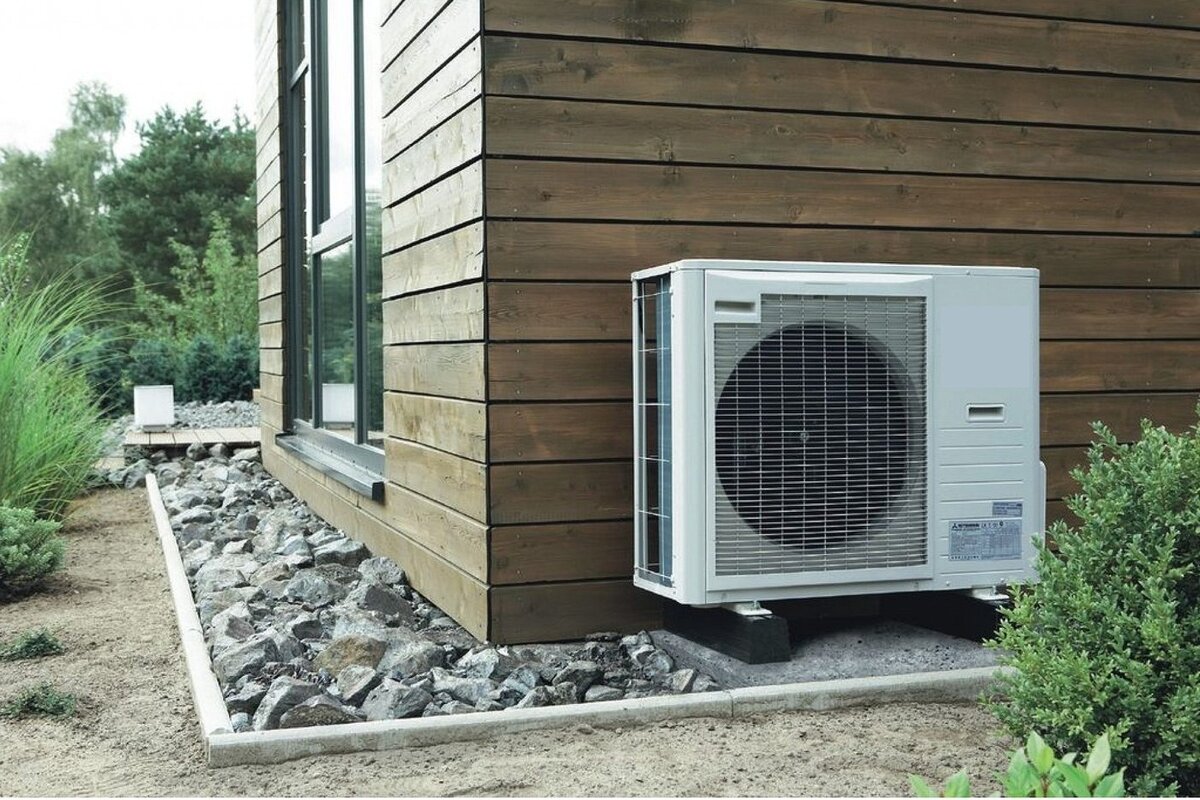
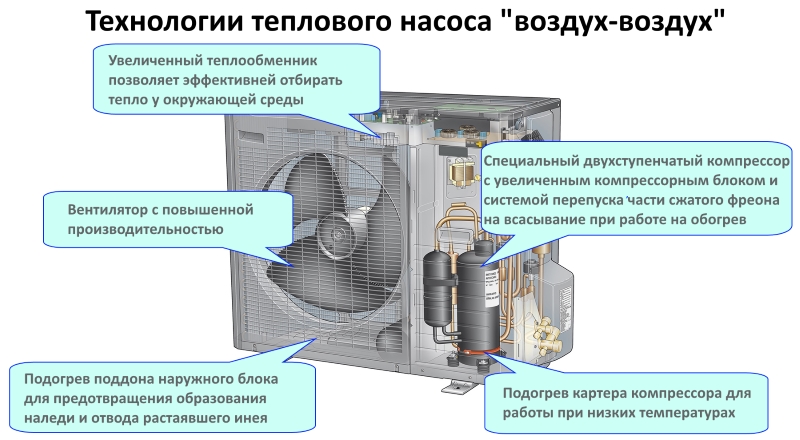
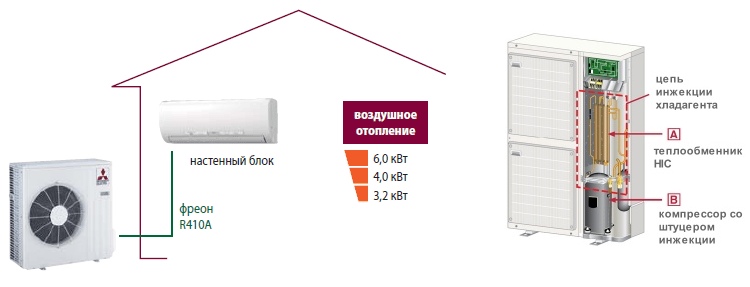
Naturally, we wanted to use such a valuable resource as economically as possible, which is why we settled on an air-to-air heat pump. This is the cheapest version of it, it works almost like an air conditioner.
Heat pump based heating system
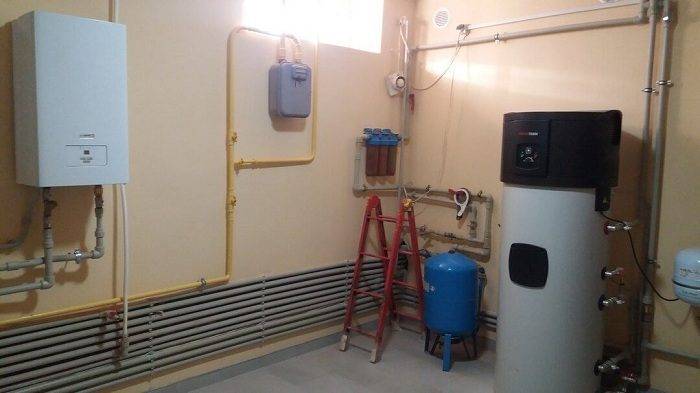
The heat energy produced by the heat pump can be used in any way. As a rule, such equipment is used to heat water, which is then used for hot water supply (kitchen, bathroom, bath) and for heating.
Practice shows that it is better to use underfloor heating than heating with radiators. In addition to the fact that this is soft heat and does not require heating water to a high temperature, there is a third, and important in terms of economy.
The lower the temperature of the water to be heated, the higher the efficiency of any heat pump.If for radiators the water should be warmed up to 50-55 degrees, then for warm floors - 30-35 degrees. Even if the inlet water temperature is 1-2 degrees, the difference in efficiency will be about 30%.
Air is often used for space heating. This is especially effective in regions where temperatures do not fall below 0, and also if a heat pump is used as an additional source of heat energy.
It is most convenient to use fan coil units for this, but for their installation you will either have to build a false ceiling or sacrifice aesthetics. If there is forced ventilation, you can use it to supply warm air.
Now heat pumps are not so widespread in the CIS than in other countries. We still have cheap traditional heat sources such as coal, gas and wood. But the situation is constantly changing and heat pumps are increasingly used for heating houses and non-residential buildings.


In this article, we tried to describe in detail the pros and cons of different types of heat pumps. We hope it was helpful to you. Don't forget to share the post with your friends!
Advantages or disadvantages?
Since these devices appeared with us relatively recently, many Russians still treat them with great distrust. In the USA, Europe and Japan they have been used for a long time and successfully. However, it cannot be said that such equipment is an absolute mystery for our country, “terra incognita”.
In the USSR, experiments were also carried out regarding such alternative energy sources. However, this technology has not been widely adopted.
Therefore, it is important to understand why, and does it make much sense to replace familiar systems with an eco-novelty? The prefix "eco" in this case can mean both ecology and economy.
Advantages
The first and undoubted advantage of heat pumps is significant energy savings. Yes, they, unlike solar collectors, need it, but in much smaller quantities. For example, an electric boiler (or heater) takes in as much energy as it produces heat. A heat pump, on the contrary, spends a minimum of electricity, and produces three to seven times more heat. The equipment can consume 5 kWh, but it generates at least 17 kWh of heat. High efficiency is the most attractive quality of thermal boilers.
- Serious energy savings. Prices for all types of fuel are rising inexorably, and a heat pump will allow you to get more heat with reduced energy costs.
- Possibility of installation in any area, since air, water or soil can become a heat source. Particularly relevant equipment for sites located far from the gas pipeline.
- Installation reversibility. Heat pumps are universal. In winter they provide warmth, in hot summer they provide an opportunity to provide coolness to the room. However, not all models have this feature.
- Durability. Equipment that is properly cared for can operate smoothly for 25-50 years. Compressor replacement may be required every 10-15 (maximum 20) years.
- Possibility of use in any conditions: where there is no electricity, a gasoline or diesel engine is installed.
- Savings on maintenance. The equipment does not require large expenses for it.
- Uninterrupted operation at -15°.
- Full automation of the heat pump.
- Safety for the environment.
- Free heat source.
In addition to the advantages, the systems also have weaknesses.
Flaws
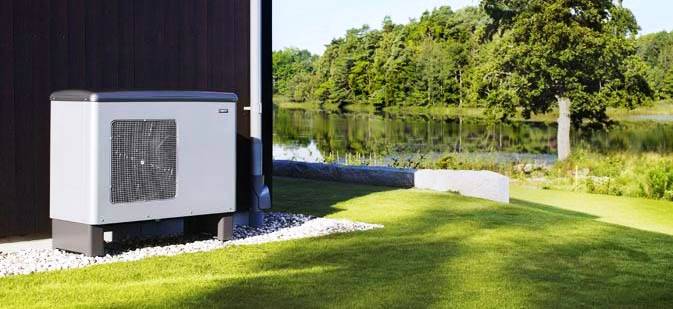
These include:
- The price of heat pumps and the cost of arranging a geothermal system. Moreover, the equipment will not pay off immediately. Owners will have to wait at least 5 years. The exception is air devices that do not require additional investments.
- The need to add an additional heat source in those regions where the temperature is often below -20 °. Such a system is called bivalent. If the heat pump fails, then the heat generator (gas boiler, electric heater) is connected.
- Environmental friendliness is still in question. There is no threat to humans, but it exists for the ecosystem. For example, microorganisms - anaerobes - live in the soil. With a strong cooling of the space near the pipes, they face imminent death.
- Almost a necessity to provide a three-phase electrical network in the house. For the correct operation of the heat pump, it is necessary to minimize voltage drops that can provoke a breakdown of the installation.
The use of such equipment is optimal in systems where a low-temperature coolant is used, for example, a “warm floor”.
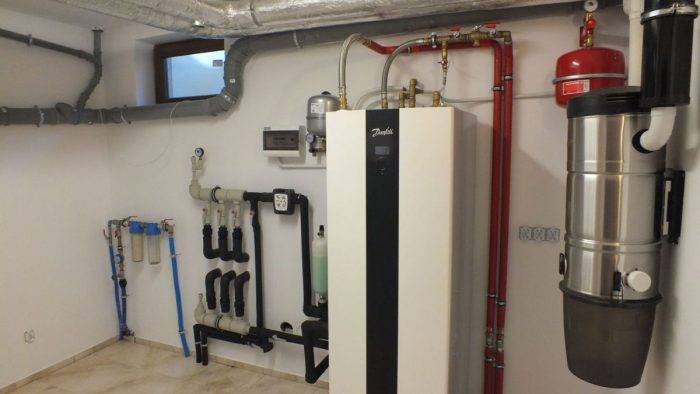
To understand whether it is advisable to purchase and install a heat pump, owners will have to evaluate all the pros and cons. The main "opponents" are energy (fuel) savings and serious purchase and installation costs. The significant disadvantages of HP include low efficiency in the cold season, however, there are models that can generate heat even at -35 °. But you will have to pay even more for them.

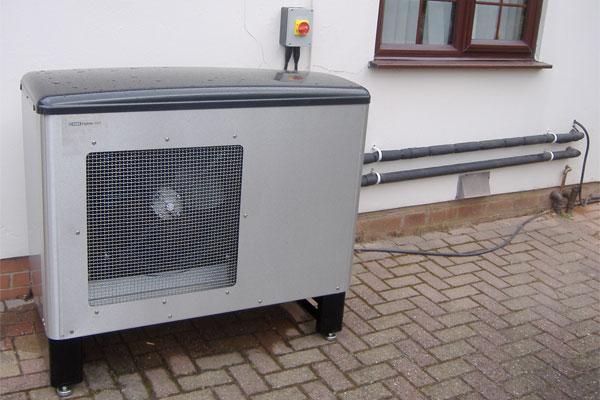



Is it worth it to spend money on the purchase and installation of a heat pump? Everyone decides for himself. A one-time investment will give you a chance to forget about big heating bills forever. In addition, its complete safety for residents, and almost complete safety for the environment, testifies in favor of the equipment.