
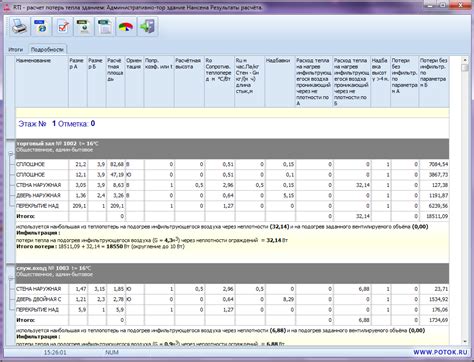
- Heat losses and their calculation on the example of a two-story building
- 1.3 Calculation of the outer wall for air permeability
- Parameters for performing calculations
- How to properly fix the mineral wool?
- Features of the selection of radiators
- 1 The general sequence of performing thermal calculation
- An example of calculating an external three-layer wall without an air gap
- Calculation of boiler power and heat loss.
- Table 1. Heat-shielding properties of walls
- Table 2. Thermal costs of windows
- How to reduce current heating costs
- An example of a heat engineering calculation
- Heat loss through walls
- Determination of losses through ventilation
- Determination of pipe diameter
- Conclusions and useful video on the topic
Heat losses and their calculation on the example of a two-story building
Comparison of heating costs for buildings of different shapes.
So, let's take for example a small house with two floors, insulated in a circle. The coefficient of resistance to heat transfer near the walls (R) in this case will be on average equal to three. It takes into account the fact that thermal insulation made of foam or foam plastic, about 10 cm thick, is already attached to the main wall. At the floor, this indicator will be slightly less, 2.5, since there is no insulation under the finishing material. As for the roofing, here the resistance coefficient reaches 4.5-5 due to the fact that the attic is insulated with glass wool or mineral wool.
In addition to determining how capable certain interior elements are of resisting the natural process of volatilization and cooling of warm air, you will need to determine exactly how this happens. Several options are possible: evaporation, radiation or convection. In addition to them, there are other possibilities, but they do not apply to private living quarters. At the same time, when calculating heat losses in the house, it will not be necessary to take into account that from time to time the temperature inside the room may rise due to the fact that the sun's rays through the window heat the air by several degrees. It is not necessary in this process to focus on the fact that the house is in some special position in relation to the cardinal points.
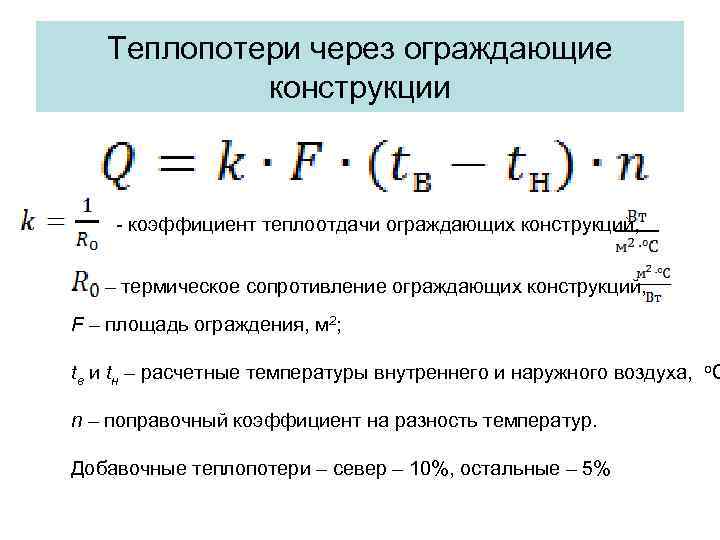
In order to determine how serious heat losses are, it is enough to calculate these indicators in the most populated rooms. The most accurate calculation assumes the following. First you need to calculate the total area of all the walls in the room, then from this amount you need to subtract the area of \u200b\u200ball the windows located in this room and, taking into account the area of \u200b\u200bthe roof and floor, calculate heat loss. This can be done using the formula:
dQ=S*(t inside - t outside)/R
So, for example, if your wall area is 200 sq. meters, indoor temperature - 25ºС, and on the street - minus 20ºС, then the walls will lose approximately 3 kilowatts of heat for every hour. Similarly, the calculation of heat losses of all other components is carried out. After that, it remains only to sum them up and you will get that a room with 1 window will lose about 14 kilowatts of heat per hour. So, this event is carried out before the installation of the heating system according to a special formula.
1.3 Calculation of the outer wall for air permeability
Characteristics
calculated design are shown - Figure 1 and Table 1.1:
Resistance
air permeability of enclosing structures Rin must be at least
required air permeation resistance Rv.tr, m2×h×Pa/kg, determined by
formula 8.1 [Rin≥Rv.tr]
Estimated
air pressure difference on the outer and inner surfaces of the enclosing
structures Dp, Pa, should be determined by formulas 8.2; 8.3
H=6.2,
mn\u003d -24, ° С, for the average temperature of the coldest five-day period
security 0.92 according to table 4.3;
vcp=4.0,
m / s, taken according to table 4.5;
rn— outside air density, kg/m³, determined by the formula:
Withn=+0.8
according to Appendix 4, Scheme number 1
WithP=-0.6,
at h1/l
\u003d 6.2 / 6 \u003d 1.03 and b / l \u003d 12/6 \u003d 2 according to Appendix 4, Scheme number 1;

Picture
2 Schemes for determination withn,WithPuki
ki=0.536 (determined by interpolation), according to Table 6, for terrain type
"B" and z=H=6.2 m.
 norms\u003d 0.5, kg / (m² h), we take according to table 8.1.
So
like Rin= 217.08≥Rv.tr=
41.96 then the construction of the wall satisfies clause 8.1.
1.4 Plotting the temperature distribution in the outdoor
wall
. Air temperature at the design point is determined by formula 28:
whereτn
is the temperature on the inner surface of the nth layer
fences, counting the numbering of layers from the inner surface of the fence, ° С;
- sum
thermal resistance n-1 of the first layers of the fence, m² °C / W.
R - thermal
resistance of a homogeneous enclosing structure, as well as a layer of a multilayer
structures R, m² ° С/W,
should be determined by formula 5.5;in — design temperature
internal air, °С, accepted in accordance with the norms of technological
design (see table 4.1);n — calculated winter
outdoor air temperature, °C, taken according to table 4.3, taking into account the thermal
inertia of enclosing structures D (except for filling openings) according to
table 5.2;
ain is the heat transfer coefficient of the inner surface
building envelope, W/(m²×°C),
taken according to table 5.4.
2.
Determine thermal inertia:
Calculation
is given in clause 2.1 Calculation of the floor structure of the 1st floor for resistance
heat transfer (above):
3.
Determine the average outdoor temperature:n=-26°C - according to the table
4.3 for "Mean temperature of the three coldest days with security
0,92»;in\u003d 18 ° C (tab. 4.1);t\u003d 2.07 m² ° С / W (see clause 2.1);
ain\u003d 8.7, W / (m² × ° С), according to
table 5.4;
.
We determine the temperature on the inner surface of the fence (section 1-1):
 ;
;
.
Determine the temperature in section 2-2:
 ;
;
.
Determine the temperature in section 3-3 and 4-4:
.
We determine the temperature in section 5-5:

.
We determine the temperature in section 6-6:
.
Determine the outdoor temperature (check):

.
We build a graph of temperature changes:

Picture
3 Temperature distribution graph (Design see Figure 1 and Table 1.1.)

2. Thermotechnical calculation of the floor structure of the 1st floor
Parameters for performing calculations
To perform heat calculation, initial parameters are needed.
They depend on a number of characteristics:
- Purpose of the building and its type.
- Orientation of vertical enclosing structures relative to the direction to the cardinal points.
- Geographic parameters of the future home.
- The volume of the building, its number of storeys, area.
- Types and dimensional data of door and window openings.
- Type of heating and its technical parameters.
- The number of permanent residents.
- Material of vertical and horizontal protective structures.
- Top floor ceilings.
- Hot water facilities.
- Type of ventilation.
Other design features of the structure are also taken into account in the calculation. The air permeability of building envelopes should not contribute to excessive cooling inside the house and reduce the heat-shielding characteristics of the elements.
Waterlogging of the walls also causes heat loss, and in addition, this entails dampness, which negatively affects the durability of the building.
In the process of calculation, first of all, the thermal data of building materials are determined, from which the enclosing elements of the structure are made. In addition, the reduced heat transfer resistance and compliance with its standard value are subject to determination.
How to properly fix the mineral wool?
Mineral wool slabs are quite easily cut with a knife. The plates are fixed to the wall with anchors, both plastic and metal can be used. To install the anchor, first of all, you need to drill a through hole in the wall through the mineral wool. Next, a core with a cap is clogged, reliably pressing down the insulation.
Related article: Do-it-yourself wall insulation with foam plastic inside the apartment
As soon as all the insulation is installed, it is necessary to cover it with a second layer of waterproofing on top. The rough side should be in contact with the mineral wool, while the protective smooth side should be on the outside. After that, a beam 40x50 mm is mounted for further finishing of the facade.
Features of the selection of radiators
Standard components for providing heat in a room are radiators, panels, underfloor heating systems, convectors, etc. The most common parts of a heating system are radiators.
The heat sink is a special hollow modular type alloy structure with high heat dissipation.It is made of steel, aluminum, cast iron, ceramics and other alloys. The principle of operation of the heating radiator is reduced to the radiation of energy from the coolant into the space of the room through the "petals".
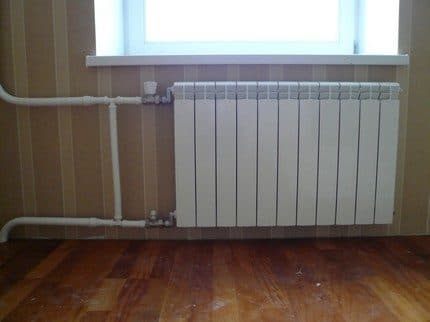
The aluminum and bimetallic heating radiator replaced the massive cast-iron batteries. Ease of production, high heat dissipation, good construction and design have made this product a popular and widespread tool for radiating heat in a room.
There are several methods for calculating heating radiators in a room. The following list of methods is sorted in order of increasing accuracy of calculations.
Calculation options:
- By area. N = (S * 100) / C, where N is the number of sections, S is the area of \u200b\u200bthe room (m2), C is the heat transfer of one section of the radiator (W, taken from those passports or certificates for the product), 100 W is the amount of heat flow, which is necessary for heating 1 m2 (empirical value). The question arises: how to take into account the height of the ceiling of the room?
- By volume. N=(S*H*41)/C, where N, S, C are similar. H is the height of the room, 41 W is the amount of heat flow that is necessary to heat 1 m3 (empirical value).
- By coefficients. N=(100*S*k1*k2*k3*k4*k5*k6*k7)/C, where N, S, C and 100 are similar. k1 - taking into account the number of cameras in the double-glazed window of the room window, k2 - thermal insulation of the walls, k3 - the ratio of the area of windows to the area of \u200b\u200bthe room, k4 - the average minus temperature in the coldest week of winter, k5 - the number of external walls of the room (which "go out" to the street), k6 - type of room from above, k7 - ceiling height.
This is the most accurate option for calculating the number of sections. Naturally, fractional calculation results are always rounded to the next integer.
1 The general sequence of performing thermal calculation
-
AT
in accordance with paragraph 4 of this manual
determine the type of building and conditions, according to
which should be counted Rabouttr. -
DefineRabouttr:
-
on
formula (5), if the building is calculated
for sanitary and hygienic and comfortable
conditions; -
on
formula (5a) and table. 2 if the calculation should
be conducted on the basis of energy saving conditions.
-
Compose
total resistance equation
enclosing structure with one
unknown by formula (4) and equate
his Rabouttr. -
Calculate
unknown thickness of the insulation layer
and determine the overall thickness of the structure.
In doing so, it is necessary to take into account typical
outer wall thicknesses:
-
thickness
brick walls should be a multiple
brick size (380, 510, 640, 770 mm); -
thickness
exterior wall panels is accepted
250, 300 or 350 mm; -
thickness
sandwich panels are accepted
equal to 50, 80 or 100 mm.
An example of calculating an external three-layer wall without an air gap
To make it easier to calculate the required parameters, you can use the wall heat calculator. It is required to hammer in certain criteria that affect the final result. The program helps to quickly and without long delving into mathematical formulas to get the desired result.
It is required, according to the documents described above, to find specific indicators for the selected house. The first is to find out the climatic conditions of the settlement, as well as the climate of the room. Next, the layers of the wall are calculated, all of which are in the building. This also takes into account the plaster layer, drywall and insulating materials available in the house. Also the thickness of aerated concrete or other material from which the structure is created.
The thermal conductivity of each of these wall layers.The indicators are indicated by the manufacturers of each material on the packaging. As a result, the program will calculate the necessary indicators according to the necessary formulas.
To make it easier to calculate the required parameters, you can use the wall heat calculator.
Calculation of boiler power and heat loss.
Having collected all the necessary indicators, proceed to the calculation. The end result will indicate the amount of heat consumed and guide you in choosing a boiler. When calculating heat loss, 2 quantities are taken as the basis:
- Temperature difference outside and inside the building (ΔT);
- Heat-shielding properties of house objects (R);
To determine the heat consumption, let's get acquainted with the indicators of heat transfer resistance of some materials
Table 1. Heat-shielding properties of walls
| Wall material and thickness | Heat transfer resistance |
| Brick wall thickness of 3 bricks (79 centimeters) thickness 2.5 bricks (67 centimeters) thickness of 2 bricks (54 centimeters) thickness of 1 brick (25 centimeters) | 0.592 0.502 0.405 0.187 |
| Log cabin Ø 25 Ø 20 | 0.550 0.440 |
| Log cabin Thickness 20cm. Thickness 10cm. | 0.806 0.353 |
| frame wall (board + mineral wool + board) 20 cm. | 0.703 |
| Foam concrete wall 20cm 30cm | 0.476 0.709 |
| Plaster (2-3 cm) | 0.035 |
| Ceiling | 1.43 |
| wooden floors | 1.85 |
| Double wooden doors | 0.21 |
The data in the table are indicated with a temperature difference of 50 ° (in the street -30 °, and in the room + 20 °)
Table 2. Thermal costs of windows
| window type | RT | q. Tue/ | Q. W |
| Conventional double glazed window | 0.37 | 135 | 216 |
| Double-glazed window (glass thickness 4 mm) 4-16-4 4-Ar16-4 4-16-4K 4-Ar16-4К | 0.32 0.34 0.53 0.59 | 156 147 94 85 | 250 235 151 136 |
| Double glazing 4-6-4-6-4 4-Ar6-4-Ar6-4 4-6-4-6-4K 4-Ar6-4-Ar6-4K 4-8-4-8-4 4-Ar8-4-Ar8-4 4-8-4-8-4K 4-Ar8-4-Ar8-4K 4-10-4-10-4 4-Ar10-4-Ar10-4 4-10-4-10-4K 4-Ar10-4-Ar10-4К 4-12-4-12-4 4-Ar12-4-Ar12-4 4-12-4-12-4K 4-Ar12-4-Ar12-4К 4-16-4-16-4 4-Ar16-4-Ar16-4 4-16-4-16-4K 4-Ar16-4-Ar16-4K | 0.42 0.44 0.53 0.60 0.45 0.47 0.55 0.67 0.47 0.49 0.58 0.65 0.49 0.52 0.61 0.68 0.52 0.55 0.65 0.72 | 119 114 94 83 111 106 91 81 106 102 86 77 102 96 82 73 96 91 77 69 | 190 182 151 133 178 170 146 131 170 163 138 123 163 154 131 117 154 146 123 111 |
RT is the heat transfer resistance;
- W / m ^ 2 - the amount of heat that is consumed per square meter. m. windows;
even numbers indicate airspace in mm;
Ar - the gap in the double-glazed window is filled with argon;
K - the window has an external thermal coating.
Having available standard data on the heat-shielding properties of materials, and having determined the temperature difference, it is easy to calculate heat losses. For example:
Outside - 20 ° C., and inside + 20 ° C. The walls are built of logs with a diameter of 25cm. In this case
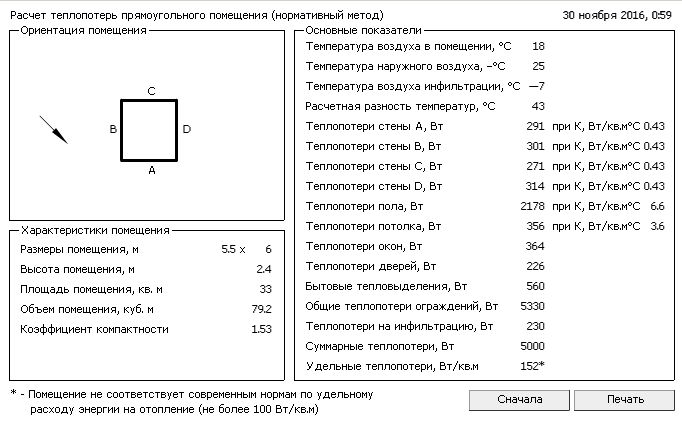

R = 0.550 °С m2/W. Heat consumption will be equal to 40/0.550=73 W/m2
Now you can start choosing a heat source. There are several types of boilers:
- Electric boilers;
- gas boilers
- Solid and liquid fuel heaters
- Hybrid (electric and solid fuel)
Before you purchase a boiler, you should know how much power is required to maintain a favorable temperature in the house. There are two ways to determine this:
- Calculation of power by area of premises.
According to statistics, it is considered that 1 kW of heat energy is required to heat 10 m2. The formula is applicable when the ceiling height is not more than 2.8 m and the house is moderately insulated. Sum the area of all rooms.
We get that W = S × Wsp / 10, where W is the power of the heat generator, S is the total area of the building, and Wsp is the specific power, which is different in each climatic zone. In the southern regions it is 0.7-0.9 kW, in the central regions it is 1-1.5 kW, and in the north it is from 1.5 kW to 2 kW. Let's say a boiler in a house with an area of 150 sq.m, which is located in the middle latitudes, should have a power of 18-20 kW. If the ceilings are higher than the standard 2.7m, for example, 3m, in this case 3÷2.7×20=23 (round up)
- Calculation of power by the volume of premises.
This type of calculation can be done by adhering to building codes. In SNiP, the calculation of the heating power in the apartment is prescribed. For a brick house, 1 m3 accounts for 34 W, and in a panel house - 41 W. The volume of housing is determined by multiplying the area by the height of the ceiling. For example, the apartment area is 72 sq.m., and the ceiling height is 2.8 m. The volume will be 201.6 m3. So, for an apartment in a brick house, the boiler power will be 6.85 kW and 8.26 kW in a panel house. Editing is possible in the following cases:
- At 0.7, when there is an unheated apartment one floor above or below;
- At 0.9 if your apartment is on the first or last floor;
- Correction is made in the presence of one external wall at 1.1, two - at 1.2.
How to reduce current heating costs
Scheme of central heating of an apartment building
Given the ever-increasing tariffs for housing and communal services for heat supply, the issue of reducing these costs becomes only more relevant every year. The problem of reducing costs lies in the specifics of the operation of a centralized system.
How to reduce the payment for heating and at the same time ensure the proper level of heating of the premises? First of all, you need to learn that the usual effective ways to reduce heat losses do not work for district heating. Those. if the facade of the house was insulated, the window structures were replaced with new ones - the amount of payment will remain the same.
The only way to reduce heating costs is to install individual heat meters. However, you may encounter the following problems:
- A large number of thermal risers in the apartment. Currently, the average cost of installing a heating meter ranges from 18 to 25 thousand rubles.In order to calculate the cost of heating for an individual device, they must be installed on each riser;
- Difficulty in obtaining permission to install a meter. To do this, it is necessary to obtain technical conditions and, on their basis, select the optimal model of the device;
- In order to make timely payment for heat supply according to an individual meter, it is necessary to periodically send them for verification. To do this, dismantling and subsequent installation of the device that has passed verification is carried out. This also entails additional costs.
The principle of operation of a common house meter
But despite these factors, the installation of a heat meter will ultimately lead to a significant reduction in payment for heat supply services. If the house has a scheme with several heat risers passing through each apartment, you can install a common house meter. In this case, the cost reduction will not be so significant.
When calculating payment for heating according to a common house meter, it is not the amount of heat received that is taken into account, but the difference between it and in the return pipe of the system. This is the most acceptable and open way to form the final cost of the service. In addition, by choosing the optimal model of the device, you can further improve the heating system of the house according to the following indicators:
- The ability to control the amount of heat energy consumed in the building depending on external factors - the temperature in the street;
- A transparent way to calculate payment for heating. However, in this case, the total amount is distributed among all apartments in the house depending on their area, and not on the amount of thermal energy that came to each room.
In addition, only representatives of the management company can deal with the maintenance and configuration of the common house meter. However, residents have the right to demand all the necessary reporting for reconciliation of completed and accrued utility bills for heat supply.
In addition to installing a heat meter, it is necessary to install a modern mixing unit to control the degree of heating of the coolant included in the heating system of the house.
An example of a heat engineering calculation
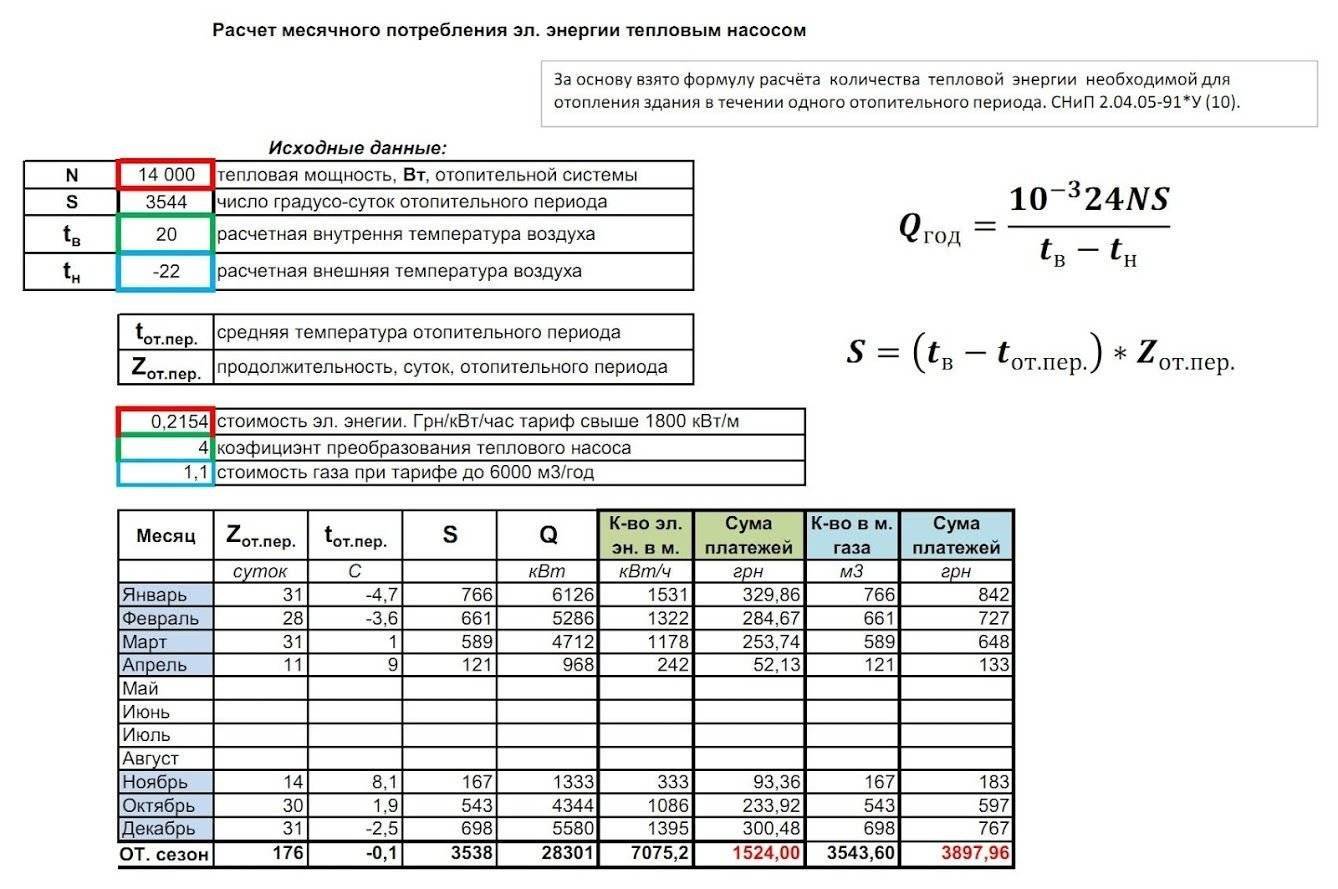
We calculate a residential building located in the 1st climatic region (Russia), subregion 1B. All data are taken from Table 1 of SNiP 23-01-99. The coldest temperature observed for five days with a security of 0.92 is tn = -22⁰С.
In accordance with SNiP, the heating period (zop) lasts 148 days. The average temperature during the heating period at the average daily air temperature in the street is 8⁰ - tot = -2.3⁰. The temperature outside during the heating season is tht = -4.4⁰.
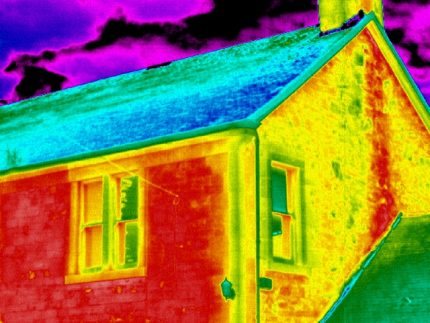
Heat loss of the house is the most important moment at the stage of its design. The choice of building materials and insulation also depends on the results of the calculation. There are no zero losses, but you need to strive to ensure that they are as expedient as possible.
Mineral wool was used as an external insulation, 5 cm thick. The value of Kt for her is 0.04 W / m x C. The number of window openings in the house is 15 pcs. 2.5 m² each.
Heat loss through walls
First of all, it is necessary to determine the thermal resistance of both the ceramic wall and the insulation. In the first case, R1 \u003d 0.5: 0.16 \u003d 3.125 square meters. m x C/W. In the second - R2 \u003d 0.05: 0.04 \u003d 1.25 square meters. m x C/W.In general, for a vertical building envelope: R = R1 + R2 = 3.125 + 1.25 = 4.375 sq. m x C/W.
Since heat losses are directly proportional to the area of the building envelope, we calculate the area of the walls:
A \u003d 10 x 4 x 7 - 15 x 2.5 \u003d 242.5 m²
Now you can determine the heat loss through the walls:
Qс \u003d (242.5: 4.375) x (22 - (-22)) \u003d 2438.9 W.
Heat losses through horizontal enclosing structures are calculated in a similar way. Finally, all results are summed up.
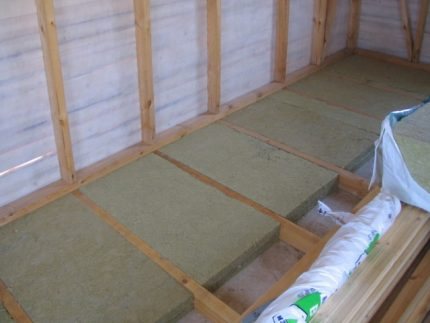
If there is a basement, then the heat loss through the foundation and the floor will be less, since the temperature of the soil, and not the outside air, is involved in the calculation.
If the basement under the floor of the first floor is heated, the floor may not be insulated. It is still better to sheathe the walls of the basement with insulation so that the heat does not go into the ground.
Determination of losses through ventilation
To simplify the calculation, they do not take into account the thickness of the walls, but simply determine the volume of air inside:
V \u003d 10x10x7 \u003d 700 mᶾ.
With the air exchange rate Kv = 2, the heat loss will be:
Qv \u003d (700 x 2): 3600) x 1.2047 x 1005 x (22 - (-22)) \u003d 20 776 W.
If Kv = 1:
Qv \u003d (700 x 1): 3600) x 1.2047 x 1005 x (22 - (-22)) \u003d 10 358 W.
Efficient ventilation of residential buildings is provided by rotary and plate heat exchangers. The efficiency of the former is higher, it reaches 90%.
Determination of pipe diameter
To finally determine the diameter and thickness of the heating pipes, it remains to discuss the issue of heat loss.
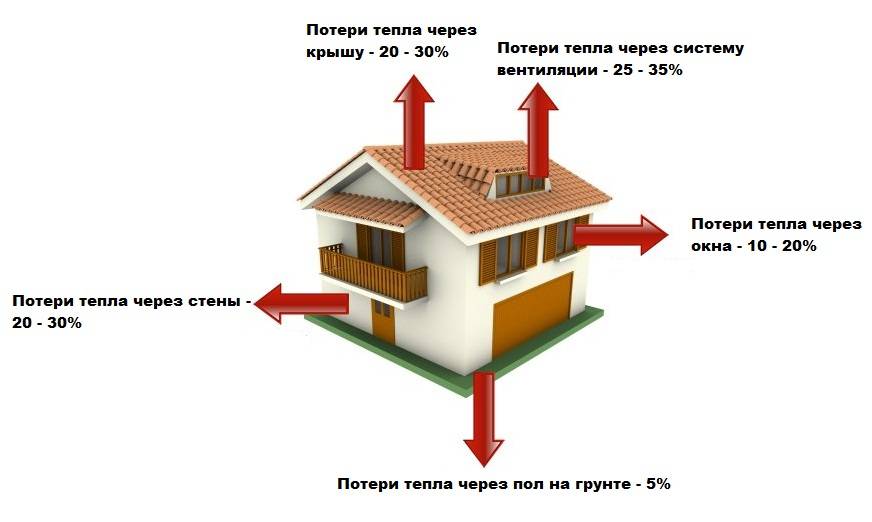
The maximum amount of heat leaves the room through the walls - up to 40%, through the windows - 15%, the floor - 10%, everything else through the ceiling / roof. The apartment is characterized by losses mainly through windows and balcony modules.
There are several types of heat loss in heated rooms:
- Flow pressure loss in a pipe.This parameter is directly proportional to the product of the specific friction loss inside the pipe (provided by the manufacturer) and the total length of the pipe. But given the current task, such losses can be ignored.
- Head loss on local pipe resistances - heat costs on fittings and inside the equipment. But given the conditions of the problem, a small number of fitting bends and the number of radiators, such losses can be neglected.
- Heat loss based on the location of the apartment. There is another type of heat cost, but it is more related to the location of the room relative to the rest of the building. For an ordinary apartment, which is located in the middle of the house and adjacent to the left / right / top / bottom with other apartments, heat losses through the side walls, ceiling and floor are almost equal to “0”.
You can only take into account the losses through the front part of the apartment - the balcony and the central window of the common room. But this question is closed by adding 2-3 sections to each of the radiators.
The value of the pipe diameter is selected according to the flow rate of the coolant and the speed of its circulation in the heating main
Analyzing the above information, it is worth noting that for the calculated speed of hot water in the heating system, the tabular speed of movement of water particles relative to the pipe wall in a horizontal position of 0.3-0.7 m / s is known.
To help the wizard, we present the so-called checklist for performing calculations for a typical hydraulic calculation of a heating system:
- data collection and calculation of boiler power;
- volume and speed of the coolant;
- heat loss and pipe diameter.
Sometimes, when calculating, it is possible to obtain a sufficiently large pipe diameter to block the calculated volume of the coolant.This problem can be solved by increasing the boiler capacity or adding an additional expansion tank.


On our website there is a block of articles devoted to the calculation of the heating system, we advise you to read:
- Thermal calculation of the heating system: how to correctly calculate the load on the system
- Calculation of water heating: formulas, rules, examples of implementation
- Thermal engineering calculation of a building: specifics and formulas for performing calculations + practical examples
Conclusions and useful video on the topic
A simple calculation of the heating system for a private house is presented in the following overview:
All the subtleties and generally accepted methods for calculating the heat loss of a building are shown below:
Another option for calculating heat leakage in a typical private house:
This video talks about the features of the circulation of an energy carrier for heating a home:
The thermal calculation of the heating system is individual in nature, it must be carried out competently and accurately. The more accurate the calculations are made, the less the owners of a country house will have to overpay during operation.
Do you have experience in performing thermal calculation of the heating system? Or have questions about the topic? Please share your opinion and leave comments. The feedback block is located below.



