
- How to change the heater
- How to connect the heating element correctly and safely
- 5 reasons why the washing machine does not heat water
- Step-by-step instructions for installing a heating element
- Step 2 - Provide access to fasteners
- How to find and dismantle a faulty heating element
- Selection of a heating element for a washing machine
- According to technical characteristics (appearance):
- Select by manufacturer
- Prevention
- Where to buy a heating element for a washing machine
- How to replace
- Features of the design and disassembly of various models
- Samsung
- Indesit
- Ariston
- LG
- Bosch
- Disconnecting wiring and checking with a tester
- Dismantling
- Installing a new element
- Reassembly and Inspection
How to change the heater
Before you change the ten in the Kandy washing machine, you should prepare the following tools:
- New heating element;
- Tubular and wrenches;
- Slotted screwdriver;
- Hammer (preferably rubber);
- Sealant-glue (if instead of a failed one, an already used heating element will be installed.
To remove the heater yourself, you will need to partially disassemble the machine. For some models of the Kandy brand, the heating element can be located behind a decorative cover both at the back and at the front. It will have to be removed.
To understand what principle is implemented in this model, it is better to find out in the instructions. If not, a visual inspection will be required.If the car has a large back cover and it can be removed, then the heating element can be located just behind it. If the back cover is not too large and there are no fasteners, then the heater is located behind the front wall, and it can be seen in its lower part.
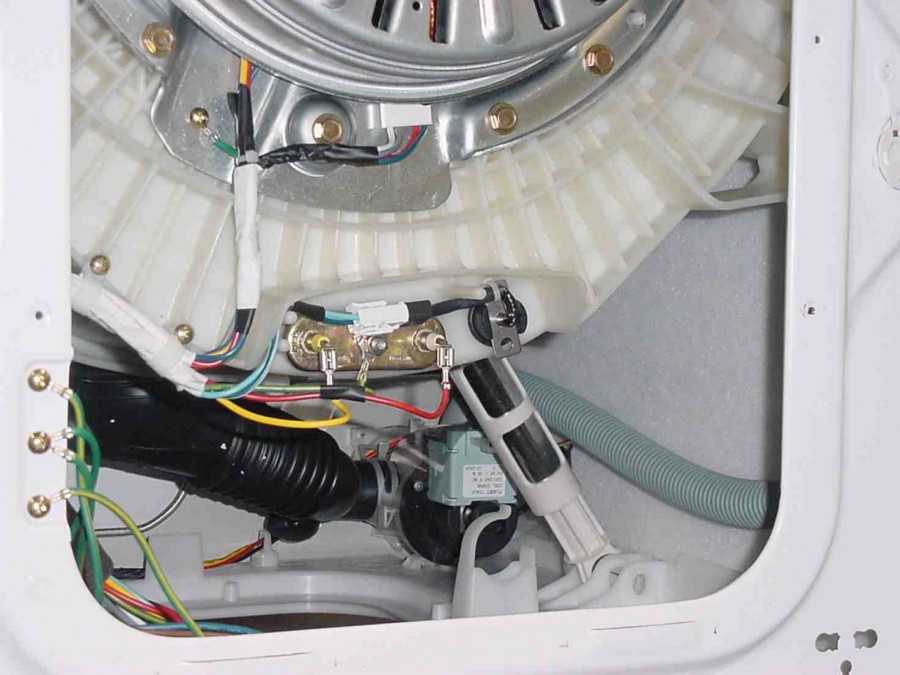
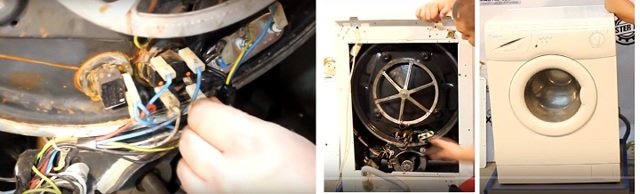
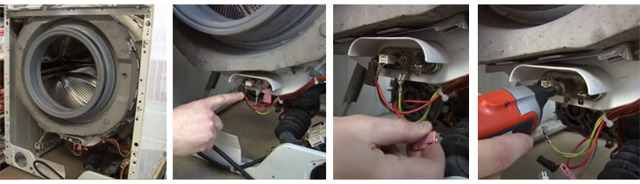
After dismantling the cover, you can get to the heating element. It is usually located at the bottom of the tank and wires lead to it. There are two or three terminals on the heater itself. Usually at the edges - phase and zero, the middle one is used to connect the ground wire. The wires should be disconnected and the heating element should be checked for operability using a tester.
Important: there should be no water in the machine during work. To drain it, you need to unscrew the filter
Using a wrench (sometimes you may need a tubular) wrench, you must loosen the central nut and drown the stud inward, either by hand or with a rubber mallet. The pin should go inside the device.
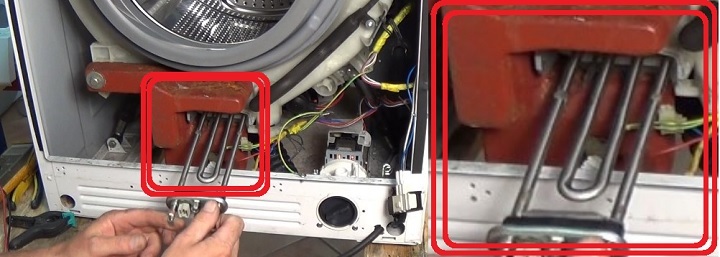
After removing all fasteners and disconnecting the wires, the heater can be pulled out. Usually the heating element is installed on a rubber gasket, which from time to time can deform and interfere with the extraction of the element. It must be carefully pry with a screwdriver and remove the heating element. It will not be superfluous to remember how it is located in order to install a new part in the same way.
In order not to confuse the connection of wires to the heating element, it is recommended to first take a couple of pictures of the connection diagram. This will help to avoid errors when assembling the machine.
After removing the broken heater, you need to install a new element in its place. The heating element usually enters tightly due to the seal and most likely a screwdriver will come in handy. The main thing is to avoid distortions and displacements. The part should fit right into place.
After installing the new heater in its place, you need to screw special fasteners onto the stud and tighten them.Excessive efforts should not be applied - you should act carefully so as not to transfer, otherwise the heater may fall into the drum.
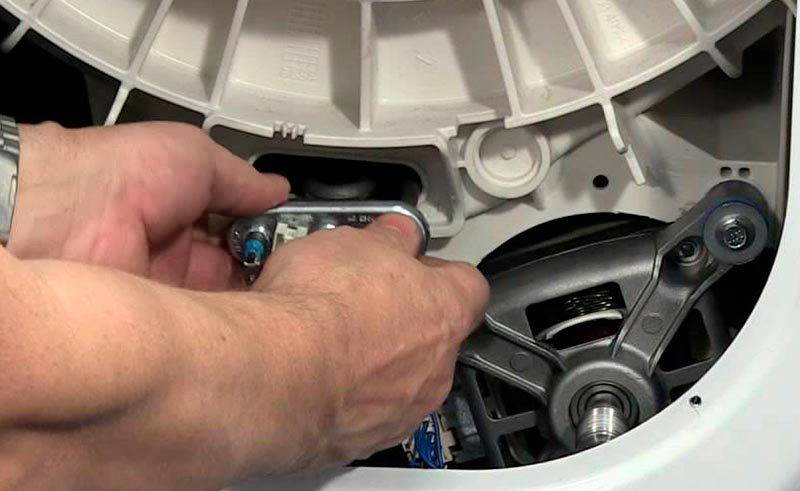


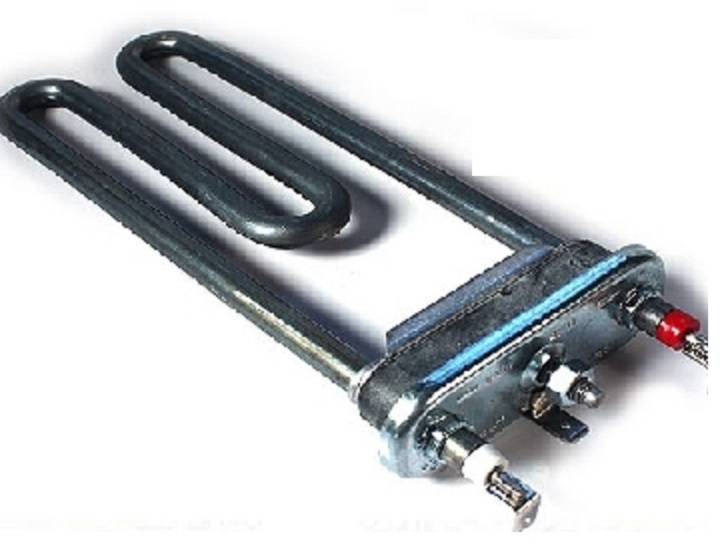


The wires are connected to their places, and the back wall is installed. On this repair can be considered completed.
Some washing machine repair experts recommend using a sealant when replacing the heating element yourself so that water does not leak. However, if everything is done correctly, then the new heater will stand tight without it.
It is better to check the new heating element immediately. To do this, set the washing mode to at least 50 degrees and start the machine. After 10-15 minutes, you should touch the loading hatch with your hand and if it is warm, the new heater is working normally and the machine is working.
How to connect the heating element correctly and safely
We will skip the disassembly step, since the technology is different for each brand and model. You can find detailed instructions for disassembling machines in our other materials:
- How to disassemble LG washing machine.
- How to disassemble a Bosch washing machine.
- How to disassemble the washing machine Indesit.
- How to disassemble a washing machine Ariston.
Consider how to properly install and connect the heating element:
Buy the original one. Let your dealer know the make and model of your CMA so they can help you find the right part for your car. The heating element should be similar to the old one in terms of power and size. Together with the part, purchase a rubber gasket, since the old one is most likely already unusable.
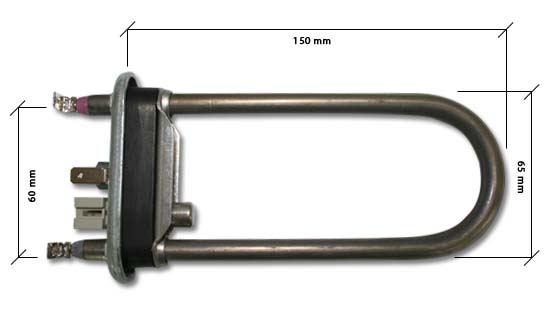
- Before installing a new part, clean the mounting hole from debris, scale residues and fragments (if the old element has exploded).
- Install the part in the groove, carefully controlling its position. It should stand exactly the same as the previous one was installed.There should be no slopes and curvature, and the heating element should sit tightly in the seat.
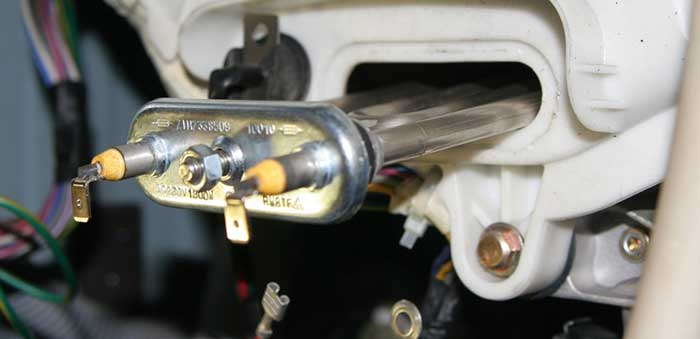
While holding the heater with one hand, carefully tighten the fasteners with the other.
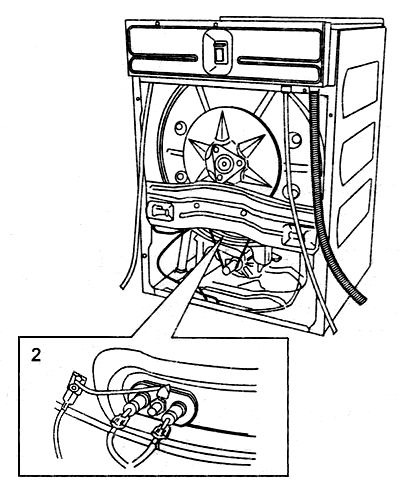
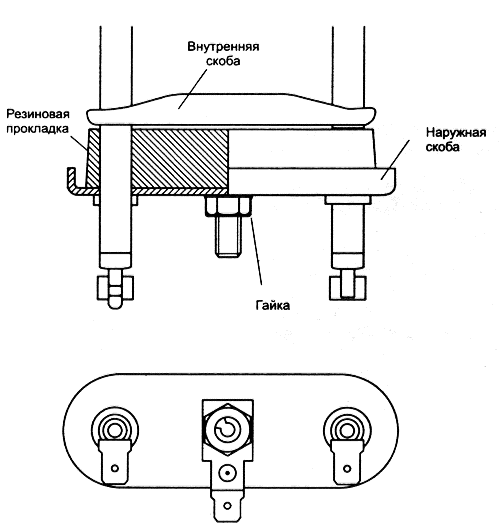
- Assemble the machine (if you dismantled the back, you may not close the hatch, you may need to fix something else; screw the lid when you make sure that the washer is fully operational).
- Run a test wash. To make sure that the heater heats the water, set the temperature to 60 degrees and when washing, touch the glass of the hatch with your hand, if it is warm, heating occurs.
If everything is fine, the washing is going on, there are no errors on the display and the water is heating up, you can put the panel back in place and use the machine.
Keep in mind that water quality will affect the life of this fragile part, so use a water softener to prolong the life of the element. Also carry out periodic cleaning by pouring a mixture of citric acid and soda into an empty car.
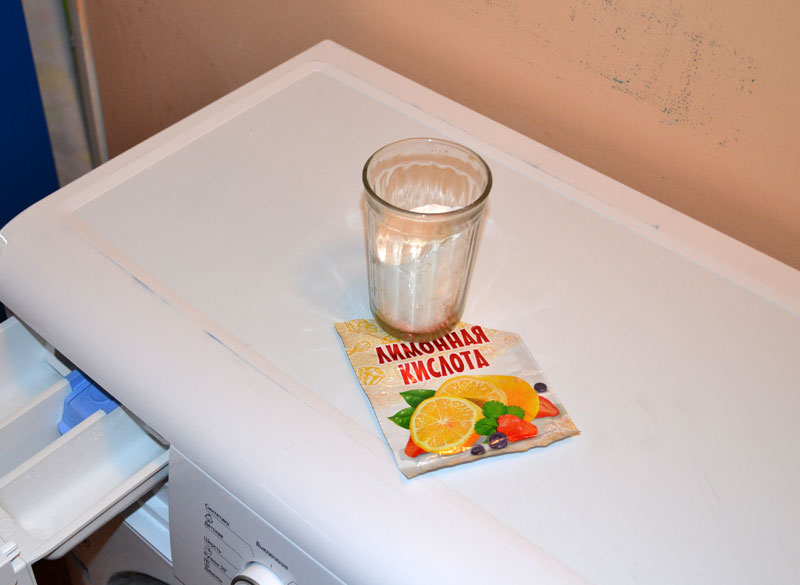
Now you know how to properly connect the heating element in the washing machine. Repair household appliances yourself without problems and extra costs.





5 reasons why the washing machine does not heat water
Washing machine does not heat water
The water in the washing machine does not heat up at all or does it heat up, but very badly and somehow weakly? Today we will analyze this problem and you will learn what to do in this case.
Poor heating of water in the washing machine during the washing process is noticeable almost immediately
This can be determined by placing your hand on the glass of the closed door of the washing machine (Attention! Do this carefully, as you can get burned if the water is heated to very high temperatures by negligence).Also, such a malfunction is noticeable by the poor quality of the washed laundry.
If 20-30 minutes after the start of washing, the water has not changed its temperature (it has not become warmer and hotter), then this may be the first alarm signal. It is possible that the washing machine has stopped heating water, and the price of repairs will depend on the reason specifically in your case.
Different models of washing machines behave differently in case of problems with water heating. Most often, modern models of washing machines (you can read about the history of the development of washing machines here) stop the washing process at the moment when, according to the program, water heating should begin, and give an error signal.
Simpler models can continue to wash clothes as if nothing had happened in cold water. As a result, the washing machine washes with cold water, finishing with a rinse as usual. This behavior can be observed when the water heating is not working in the washing machine. By the way, about how and what works - we have a good article where you can find out how a dishwasher works.
So, we give 5 reasons why the washing machine may refuse to heat water:
Wrong connection of the washing machine. Sometimes, in cases where they save on the quality of connecting a washing machine, there is a problem of unauthorized water leaving the sewer. In such a situation, the water in the tank simply does not have time to heat up to the required temperature, since warm water is constantly drained into the sewer and a new cold portion is automatically topped up. It should be noted that another malfunction is also associated with the unauthorized behavior of water, which is discussed in the article “Water is collected in the washing machine. Looking for a reason."
Wrong choice of washing program.The washing machine does not heat simply because such a washing mode is currently selected. How is this possible? This may be a banal inattention, which manifests itself in choosing the wrong program. Or it may be some feature of the choice of programs for a particular model. It's just that in some models it happens that the choice of the washing program and the water temperature is carried out by different handles / switches. For example, you set the temperature mode selection knob to 95 degrees. But the program selection knob was set to a mode that provides for a temperature of only 60 degrees. Usually, the selected program has priority and the separately selected temperature regime of 95 degrees is simply ignored. Read the instructions for your washing machine if in any doubt.
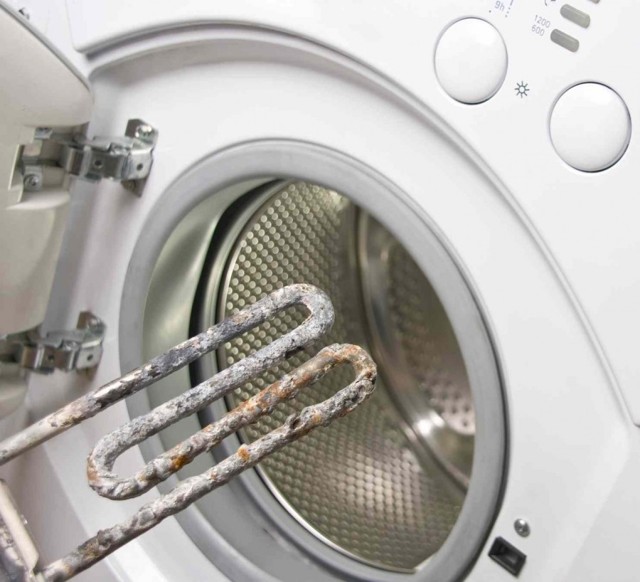
The heating element (tubular electric heater) burned out. It's simple - the water does not heat up, because the heating element is out of order - the main character in this matter, so to speak  There are several reasons for failure - power surges, short circuits, factory defects, age (heating elements with our water quality serve an average of 3-5 years). In this case, the replacement of the heating element by an experienced specialist will help.
Faulty thermostat (water temperature control sensor). The thermostat, depending on the model of the washing machine, can be located either in the heating element itself, or separately on the surface of the tank. It monitors the water temperature and gives signals to heat the water if necessary.
The control module (programmer) is faulty. What might happen to him? Yes, anything, starting with bad contacts (for example, microcracks on the tracks) on the board and ending with the “rally” of the firmware.As a result, the module (the main brain center of the washing machine) begins to fail, and with it the entire operation of the washing machine is disrupted. In some cases, the module can be repaired (on site or in a service center), and in some cases, only replacement with a new one is possible.
We looked at 5 main reasons why the washing machine does not heat water. This malfunction can be successfully eliminated by our experienced washing machine repair specialists.
Of course, you can decide to fix the machine yourself, but is it worth spending your precious time on mastering the skills of repairing a washing machine? You don't study hairdressing when you want to cut your hair and turn into a dentist when you have a toothache, do you? Our masters will diagnose, accurately determine the cause of the breakdown, and then make a quality repair and give a guarantee.
Step-by-step instructions for installing a heating element
To install a new element, follow the following sequence of actions:
- insert the new heating element into the niche and check that it is firmly in place and does not stagger. It is necessary to ensure tight fixation without distortions and gaps;
- holding the element, tighten the nut until it stops, but without strong effort, so as not to squeeze out the element;
- attach the wires and terminals to the shank in their original places;
- turn on the test washing program with heating up to 60 degrees. If the water is heating (this can be checked by placing your hand on the door 10-15 minutes after the start of washing), then fix the back panel and twist the case.
In the process of installing a new part, follow the steps carefully, check that the heating element is exactly in the mounts.If installed incorrectly, it may be located above the prescribed level, and during the washing process there will be friction against the drum, which will lead to serious malfunctions of all elements of the device.






Step 2 - Provide access to fasteners
When you determine where the heater is located in the washing machine, you can proceed to disassemble the case. To do this, the first step is to disconnect the equipment from the mains in order to prevent electric shock when replacing the heating element. If the location is rear, you will have to additionally disconnect the drain pipe and water supply. Also, you can not do without draining the remaining water from the washer. You can drain the water through a special drain filter or if you lower the drain hose below the level of the machine body, which can be a more problematic solution.
Next, remove the back cover. If the heating element is behind it, everything is fine, it remains to remove and replace it, which we will discuss below. If you need to remove the front cover, follow the instructions below:
- Remove the top cover.
- Remove the detergent drawer. As a rule, it is fastened with self-tapping screws and additionally fixed with a latch, which must be carefully detached.
- Remove the steel hoop from the seal on the hatch. It is held by a spring, which just needs to be stretched a little. After removing the hoop, carefully dismantle the seal itself, as well as the door lock, from which you want to disconnect the wires.
- After that, you can unscrew the front panel, which is fixed with screws and, possibly, clips.
- Access to replace the heating element is provided, you can proceed to the main process.
How to find and dismantle a faulty heating element
In modern automatic washing machines, the heating elements are located at the bottom of the tub. Some manufacturers, including Bosch and Samsung, place them on the front, while others, including LG and Atlant, mount the heaters on the back.
Visually, the location of the heating element in front-loading machines is easy to determine by the size of the back cover: if it is large, then most likely the water heater is located just behind it. If the model is equipped with a plinth panel, then the desired part should be looked for behind this door. In units with vertical loading, it is most convenient to carry out repairs through the side wall.
Before dismantling a failed device, disconnect the equipment from the power supply and drain the remaining water in the system. After that, you can unscrew the screws holding the back cover and remove it. Do the same with the side wall and the plinth panel.
For convenience, it is also recommended to remove the drive belt. Having found the heating element, it is necessary to free it from the supply cables and grounding. If the heating element is equipped with a temperature sensor, then it must also be turned off.
To remove the heating device, loosen the nut on the central screw (usually no more than six turns are sufficient) and push in the retaining screw. After that, the water heater is removed from the socket with little effort using two flat screwdrivers. In machines with plastic tanks, the process of removing the heating element goes without problems, with metal parts you will have to tinker a little longer
It is important to dismantle carefully and without excessive pressure so as not to damage the washing machine tank.
Selection of a heating element for a washing machine
Heating elements are selected taking into account several criteria.
According to technical characteristics (appearance):
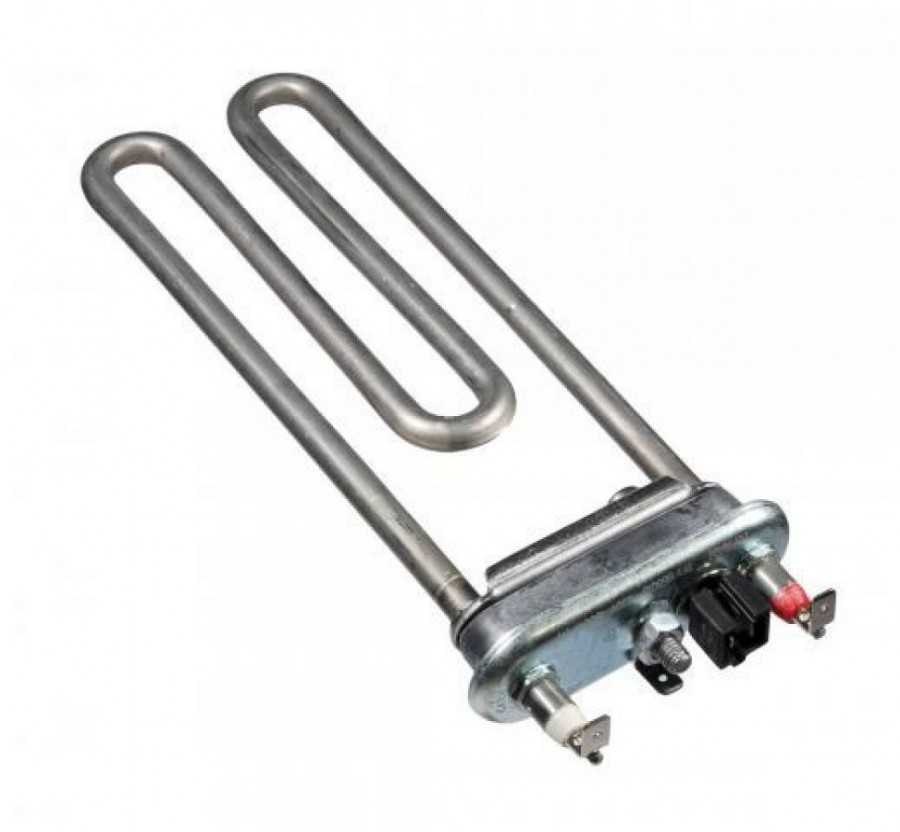
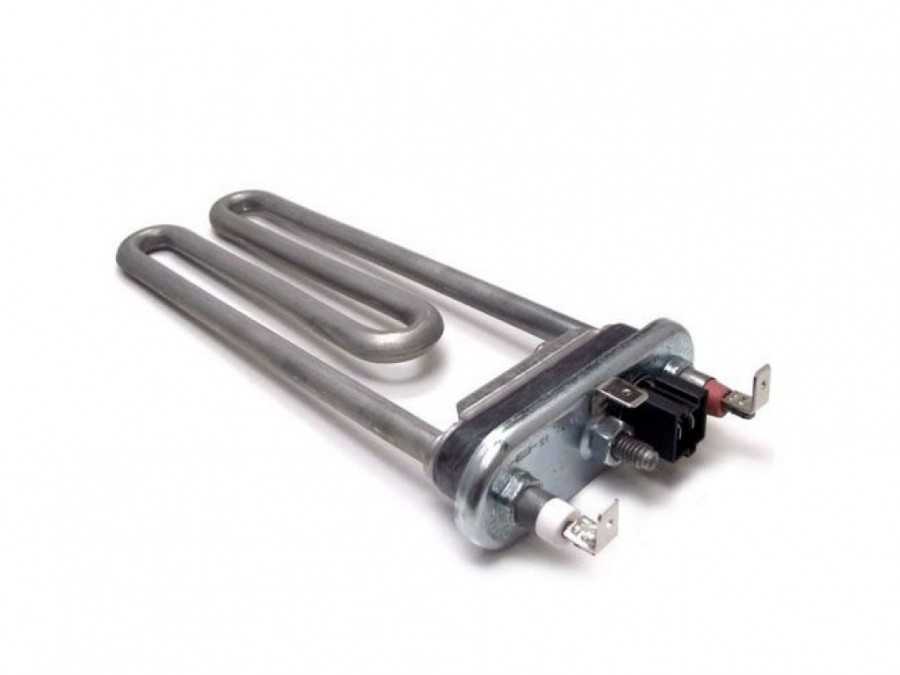
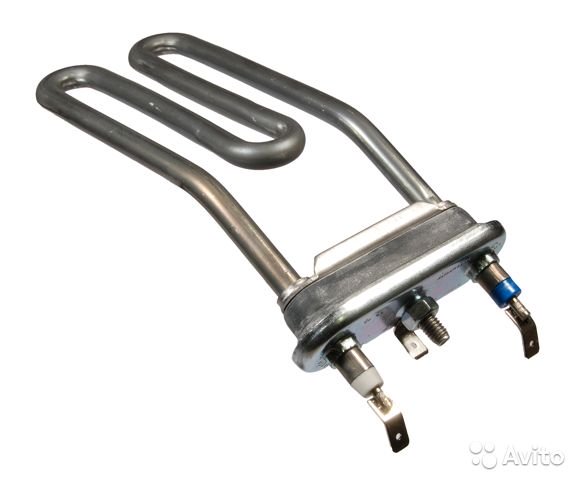
- Power; on the heater flange, as a rule, next to the temperature sensor connector, its power is indicated. But some masters are of the opinion that power does not play a big role. It only affects the rate of water heating. However, there is a temperature sensor nearby. The deviation from power should be +/- 10%.
- The shape of the heating element: most of the heaters are straight, but there are also bent at an angle. This should also be taken into account when choosing.
- Length; One of the important selection criteria is the length of the device. They come in three types long, medium and short. Instead of long heating elements, short ones can be installed (if they meet other criteria), but it is not necessary (the allowable difference is +/- 1 cm, but it is impossible to install long heaters in units where short heaters are provided.
- Presence of a temperature sensor: Heating elements come with and without temperature sensors. Heating elements without temperature sensors are designed for those models of washing machines where water heating sensors are installed separately from the heating element.
- By seat; For the last decade, manufacturers have been trying to produce products with standard seats for water heating elements, which means that the flange and sealing rubber bands for them fit almost any model. But earlier models of washing machines had different seats. This should also be taken into account when choosing a heating element.
- By coating: the coating of the heating element can be made of stainless steel, non-ferrous metals or ceramics.The fundamental difference when choosing a heater, the coating does not matter much, but the ceramic coating and the special coating of nickel and chromium are the least susceptible to the negative effects of scale.
For example, a Samsung DC47-00006X heating element with a ceramic coating, and its counterpart with an anodized heating element. Both are of good quality.
Read more >>> Teng Samsung DC47-00006X: Specifications
Select by manufacturer
There are three main manufacturers of water heaters for washing machines.
- Thermowatt (Made in Italy). One of the most common manufacturers of heating elements for washing machines. The products of this manufacturer are considered the highest quality.
- Heating devices of this manufacturer are considered the second in quality.
- According to user reviews, it is in last place in terms of quality characteristics.
Prevention
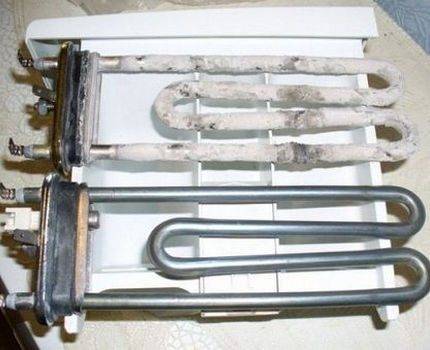
Do not forget about preventive measures in relation to washing machine Indesit. Having changed the old heating element to a new one, it will be necessary to prevent the tank in order to remove dangerous deposits that have accumulated there. There may be solid impurities in the tank in the form of scale. Sometimes non-split fats from things are deposited there (in the form of mucus). This fat gives off an unpleasant odor.


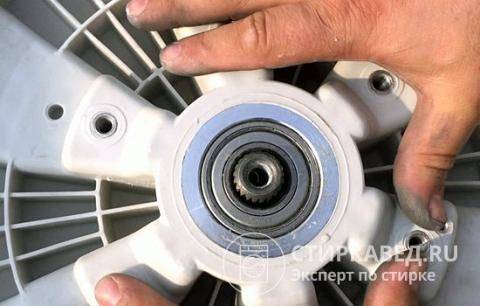

Preventive measures should be carried out periodically, depending on how often you start washing, at what temperature conditions. So, to prevent the formation of deposits in Indesit machines, it is recommended to perform the following actions.
- A special salt filter will need to be installed in the break in the supply of operated water. This should be a high-quality softener, the replacement of which will always need to be done in a timely manner.
- For washing, it is recommended to use only high-quality powders and helium compounds - with their operation, heating elements and other components of washing machines last much longer.
- Do not forget to carry out periodic preventive maintenance of equipment from scale by using specialized products sold in many retail outlets. Often people use folk remedies, such as vinegar or citric acid, which easily remove excess fat deposits and scale. But it must be taken into account that no one can say for sure how these products, with their chemical composition, can affect the condition of the rubber elements and seals of the machine.
- Do not be zealous with too frequent washing cycles using high temperature water. Detergents, which are produced by modern manufacturers, can effectively deal with most contaminants at low temperatures. Thus, washing clothes is more careful and gentle.
- You should always keep under control the condition of your household appliances. Of course, many users do not delve into possible problems and only think about them when they encounter them. It is advisable to check from time to time whether all the units of the unit are working properly, whether there are any malfunctions.
See below for a master class on replacing a heating element.
Where to buy a heating element for a washing machine
When you yourself try to fix your washing machine, it is considered as an economical option in terms of money. Since finding new parts for a washing structure is a difficult job, because parts are not sold in home appliance stores.But you can solve such problems, you just need to order the necessary items at a service center or on the Internet, but keep in mind that they will be very expensive for you.
The most optimal and effective option is to buy heating elements and other parts for a washing machine in online stores that sell such spare parts.
It won't be difficult to find them. Just type in the following words into any search engine: (the desired part, in our case, the model of the heating element you need) for the washing machine (your model).
TOP stores of washing machines and household appliances:
- /- household appliances store, a large catalog of washing machines
- — profitable modern online store of home appliances
- — a modern online store of home appliances and electronics, cheaper than offline stores!
How to replace
To replace a non-functioning heater with a new one, you will need:
- Disassemble the washing machine, taking into account the features of its design.
- Disconnect the wiring and check its condition with a tester.
- Perform dismantling.
- Install a new, serviceable heating element.
- Assemble the washing machine in its original state and check its performance.
Features of the design and disassembly of various models
Depending on the manufacturer of the washing machine you use in your home, disassembling it may have some nuances that need to be considered. Among the common models often bought in stores, there are brands:
- Samsung;
- Ariston;
- LG;
- BOSH;
- Indesit.
Samsung
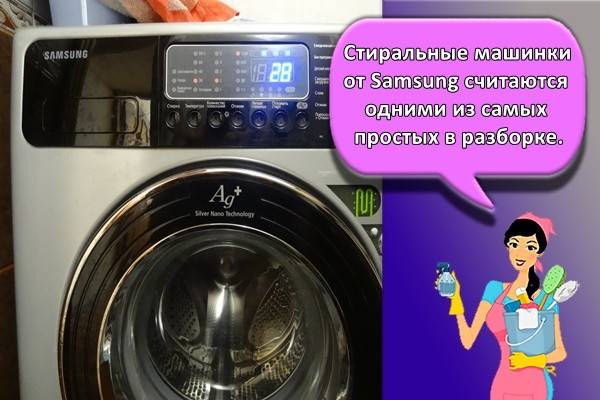
Washing machines from Samsung are considered one of the easiest to disassemble. To work with them, you need to know the following things:
- The heating element in need of replacement is located under the front cover, at the bottom of the water tank. Access to it is not closed by anything, and getting to it is not a problem.
- The compartment for loading the washing powder is attached to the structure with 2 self-tapping screws and, if necessary, can be easily dismantled.
Indesit
Equipment manufactured by Indesit is also not difficult to disassemble. Necessary:
- minimum set of tools;
- carefully disconnect the board with wires when dismantling the heating element;
- the heater itself is very convenient, to dismantle it, just unscrew the back cover of the machine.
Ariston
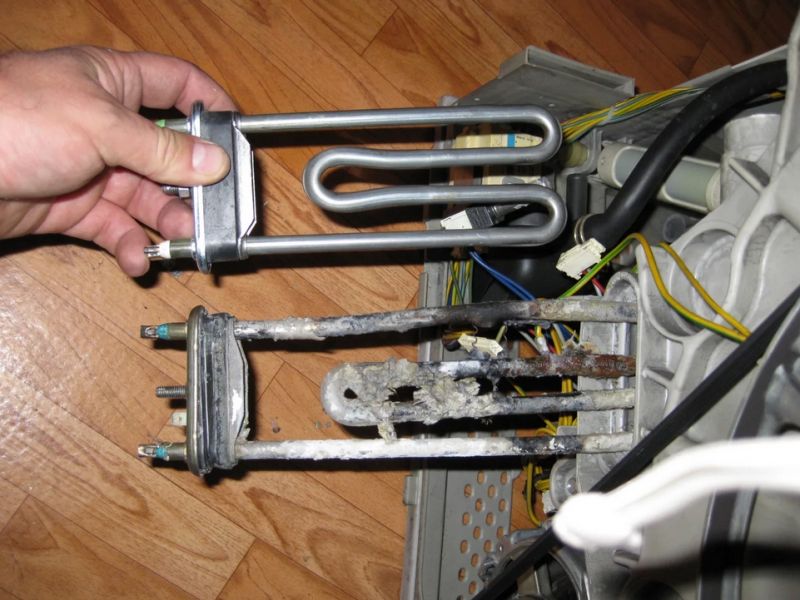
Replacing the heater in Ariston does not pose any problems for the owners. It is extremely convenient and practical. Problems arise when the bearings located inside the tank fail.


LG
Household appliances from LG are not designed in the most convenient way and you will have to tinker with them when disassembling them. Action algorithm:
- First, the nuts are unscrewed, with which the hatch cover is attached.
- Once the nuts are removed, remove the front panel.
- The next step is to unscrew the screw, with which the clamps holding the cuffs are held.
- Ten is located under the tank.
- To remove the tank, you must first twist the weighting agent.
Bosch
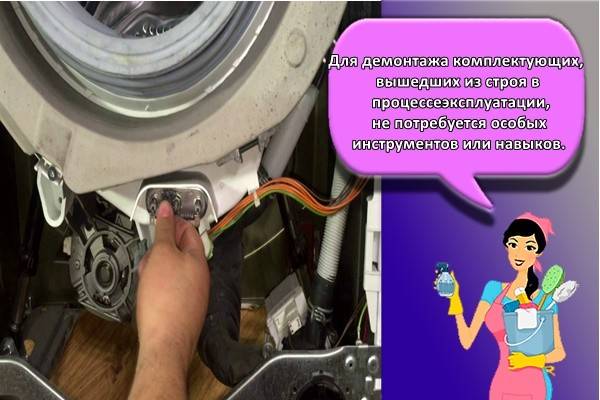
Bosch is easy to disassemble. To dismantle components that have failed during operation, no special tools or skills are required. According to experts, for a complete disassembly of the washing machine, it is enough to have in stock:
- cross screwdriver;
- wrench.
Disconnecting wiring and checking with a tester
Before disconnecting the heater from the machine, be sure to do the following:
- Unplug the appliance from the mains and turn off the water.
- Before disconnecting the wires leading to the heater, their location must be remembered or photographed.
- A tester check is carried out to determine the condition of the heater. If the tester shows a few ohms, the device is working. When the tester determines large values, ranging from 10 and above, the part can be safely thrown away.
Dismantling
The procedure for dismantling may vary slightly, depending on the manufacturer of the unit, but, in general, it looks like this:
- It is necessary to remove the nut, with the help of which the heating element is fastened to the body.
- With a rubber mallet, carefully knock out the pin.
- Carefully remove the damaged item.
- Let's check it works.
Installing a new element
To install a new element, follow these steps:
- install the heater and tighten the nut on the main screw;
- we connect the electrical wires to the places where they were before dismantling.
Reassembly and Inspection
To reassemble, install the parts twisted from the machine in reverse order. Once the assembly is completed, do the following:
- We start a test wash and carefully observe if there are leaks anywhere.
- We check how the water heats up.
- If everything is in order, we put the machine in place.



