
- Types and types of fixtures
- Mounting
- Briefly about the main
- Features of lighting in different rooms
- The corridor
- Kitchen
- Bedroom
- Children's
- Bathroom
- Ceiling spots in the interior: photos in different rooms
- Living room
- Bedroom
- Kitchen
- Mounting
- On the concrete ceiling
- On drywall surface
- On a stretch ceiling
- How to calculate the required number of fixtures
- We calculate the number and location of fixtures on the stretch ceiling
- Power calculation
- Calculation of the number of required fixtures
- Choosing a Layout
- Light sources for stretch ceiling systems
- Electricity and high humidity
- Illumination of mirrors, washbasin, other elements
Types and types of fixtures
Manufacturers offer a huge range of lighting products. It will be much easier to choose the right one if you do it after the decoration of the room is completely finished, all plumbing equipment and furniture filling are installed, and decorative accessories are hung.
All lamps that can be used to illuminate the toilet and bathroom are divided into three large groups.
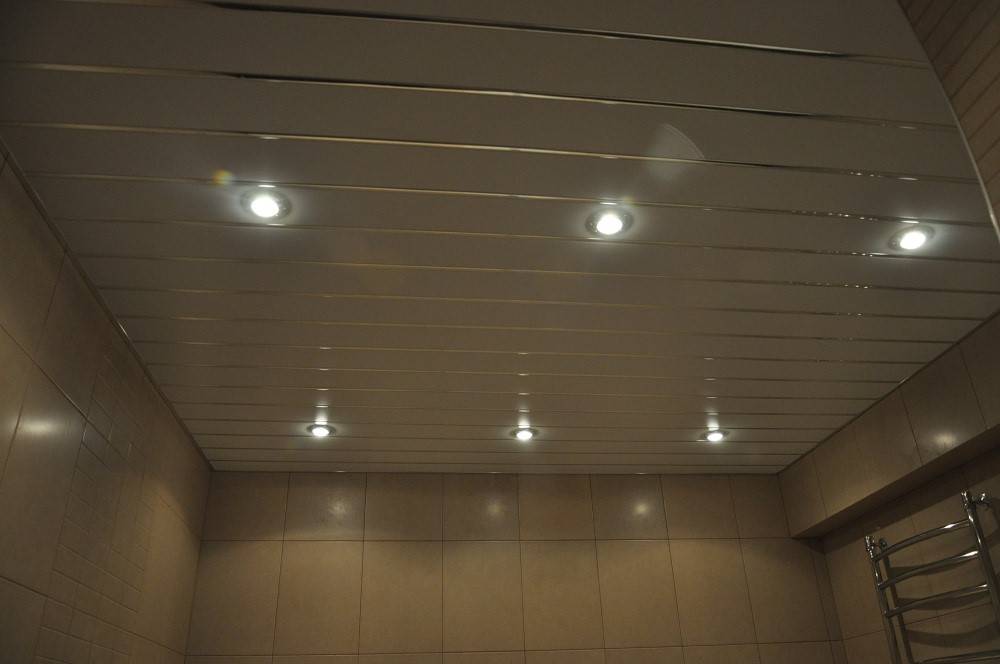
Embedded models are the most popular and practical. They are usually mounted in suspended ceiling systems. They are simply inserted into pre-cut holes and fixed in them with the help of special latches.The case heats up weakly, so the trim elements do not heat up. This feature of recessed luminaires allows you to choose lamp models with minimal depth.

Recessed oval luminaire
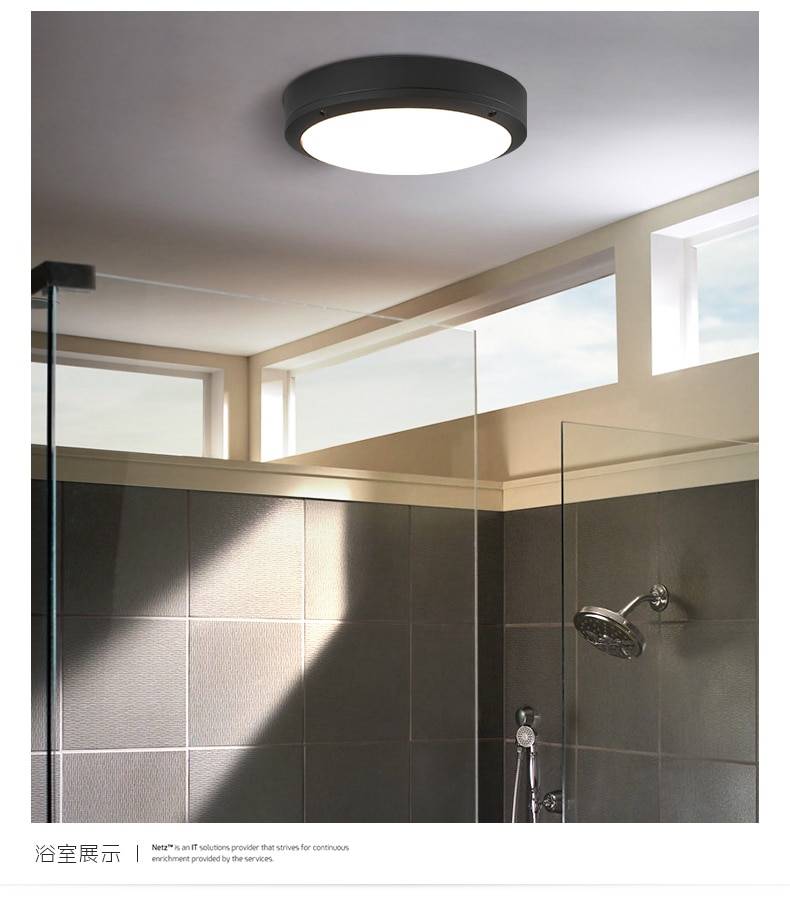
Overhead models are the second most popular lighting fixtures. Their design consists of two parts: a thin base made of metal, and a ceiling made of translucent plastic. Such a device weighs almost nothing. It is attached to concrete, to the ceiling with self-tapping screws. It is inexpensive. When turned on, it creates an even diffused light, soft, not cutting the eye.

Surface-mounted model with a metal body and a matte shade
Suspended models (single-arm or multi-arm lamps). Their main advantage is the variety of forms of execution. Design can be very different. And all because everything is used for their manufacture: metal, glass, and plastic. Difficult execution options require reliable fastening to the base.
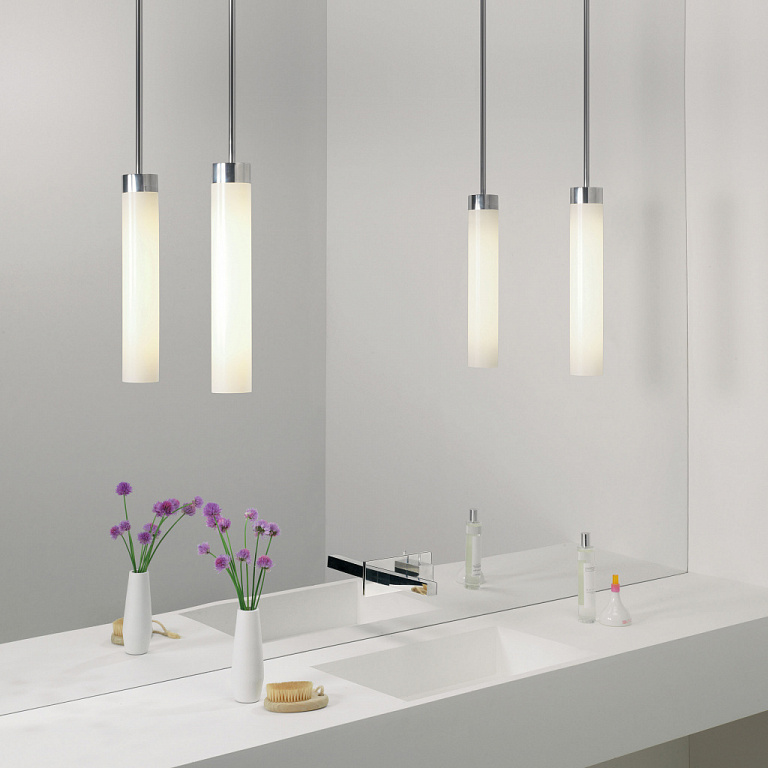
Strict pendant lights above the sink
The choice of something specific is usually dictated by the style of bathroom design.
It is important to take into account the features of the base on which the equipment is mounted.
In the video, the expert explains how get the right lighting in the bathroom:
Mounting
The material of the ceiling covering in most cases becomes the determining criterion for choosing a luminaire. If there is no overhead finish and the ceiling is a painted concrete slab, an overhead model in the form of a plate with a matte shade is best. Lighting in a small bathroom will be quite intense if the lighting fixture is designed for two 7W LED bulbs. It is installed as follows:
- A drill or puncher makes holes in concrete for self-tapping screws.
- The metal base of the lamp is applied to them and screwed to the base with self-tapping screws.
- Completely with the help of the machine, the electricity in the house is turned off.
- An electrical wire is connected to the ceiling.
- Light bulbs turn on.
- Plafond snaps on.
- The electricity is turned on and the operation of the device is checked.

Scheme of mounting the overhead lamp
It will be more difficult to attach lighting equipment to a drywall base. If multi-level light is installed in the bathroom, the design of the room only benefits from this. But to implement such an idea is not so simple. To begin with, a lighting project plan is drawn up, then, according to it, the location of the light bulbs is marked. Double-insulated wires are led to it, they are laid along a metal profile, with the help of which a frame is formed for installing drywall.
The wires are fixed with ties. Before installation, holes are drilled on a sheet of drywall for ceiling lights of the desired diameter. After attaching the sheet, wires are threaded into them, which are then stripped and connected to the terminals of the ceiling. At the final stage, a light bulb is inserted into the lamp. The toilet is illuminated in the same way if drywall is used as a ceiling finish.
The video clearly demonstrates the installation steps of a spotlight:

Scheme of mounting the device on a stretch ceiling
The video demonstrates ready-made lighting placement ideas:
Briefly about the main
Even in a small bathroom, lighting must be properly organized.First of all, experts carry out calculations that show the number and power of the installed fixtures.
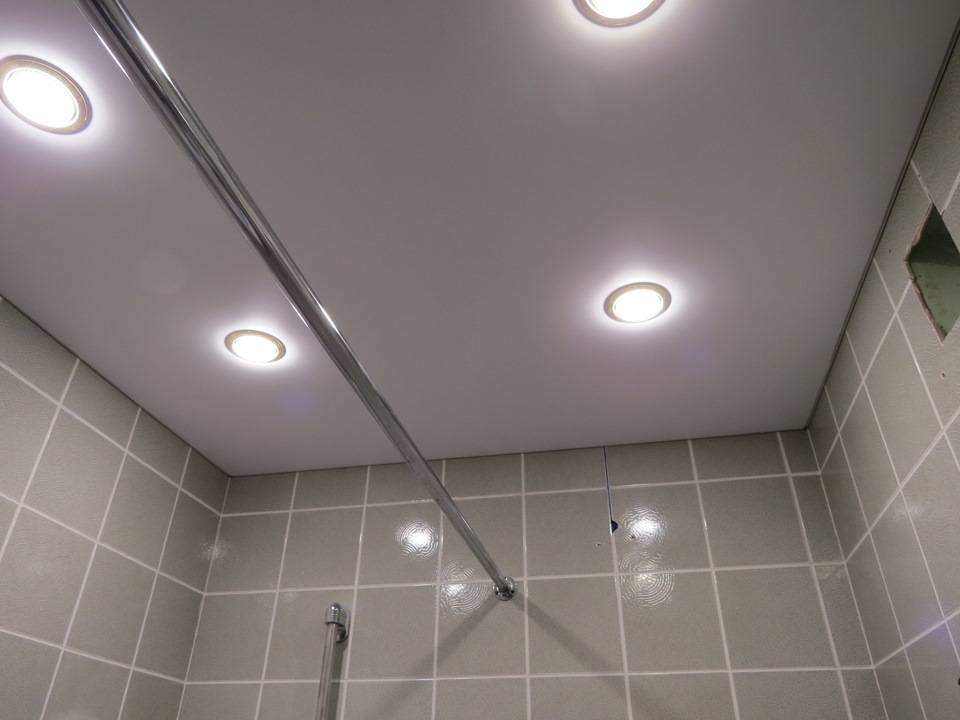


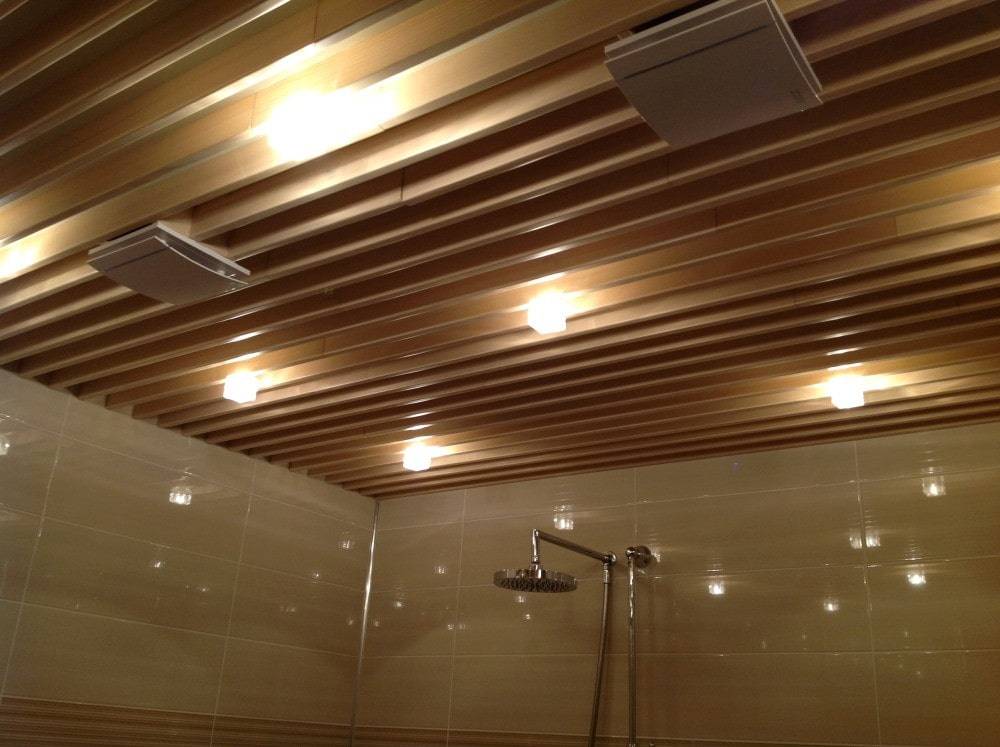


Since the bathroom is a room with high humidity, safety requirements must be taken into account.
Not all lighting fixtures are suitable for the bathroom - in addition to brightness and safety, you need to choose lamps depending on the finish of the ceiling.
Features of lighting in different rooms
Each way of arranging lighting fixtures is attractive in its own way, but not universal, that is, it cannot be used in any room. That is why we will further consider the features of the location of light sources in different rooms: living room, hall, kitchen, bedroom, etc.
The corridor
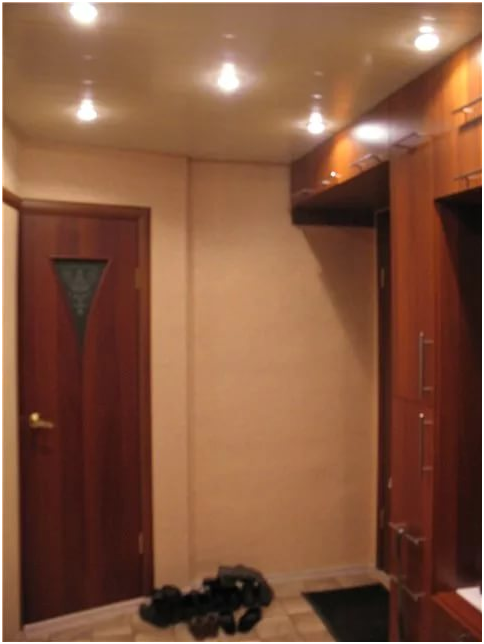
In most apartments, the corridors are rather uncomfortable, narrow and long, often L-shaped, so it is recommended to place the light here individually. With rectangular and elongated corridors, it is better to place spots along the perimeter of the ceiling, if necessary, highlighting the center.
Kitchen
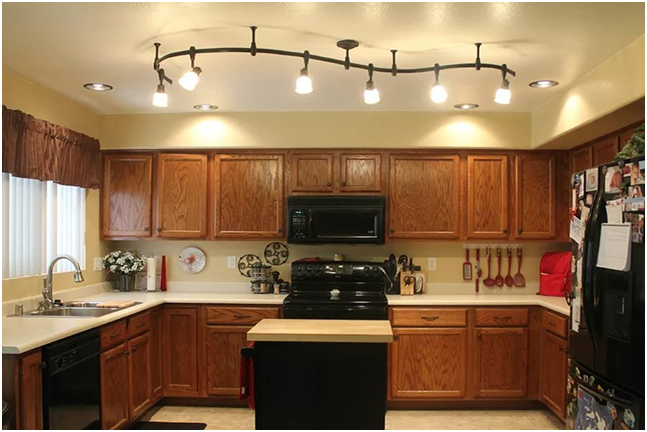
In the kitchen, it is best to place lamps on a stretch ceiling according to this principle: to concentrate the light above the dining table, it is good if it is a chandelier, and it is good to install spotlights in the working area. The most suitable schemes in this case are 2, 5, 8 and 9 (see the table). This arrangement is recommended so that only the necessary parts of the kitchen are illuminated. By the way, this also allows you to save electricity, because you can always turn off the light in the area that is not needed now.
Bedroom
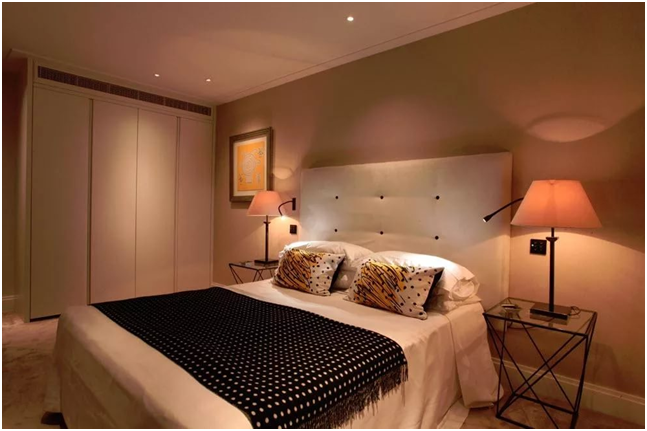
The bedroom is a place of rest, because there is no need for bright lighting, which means it is quite possible to do without a chandelier.Nowadays, in the interior of the bedroom, spotlights are increasingly used, placed in a circle or oval. You can also arrange the lamps in a checkerboard pattern or in a zigzag pattern to give some zest to the room. For reading, sconces near the bed are also relevant.
Children's
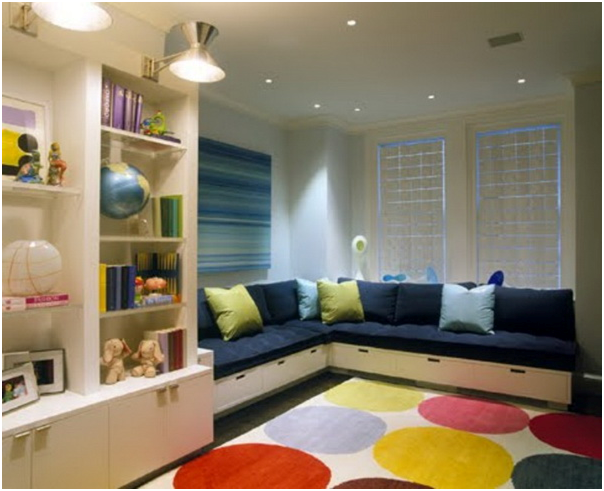
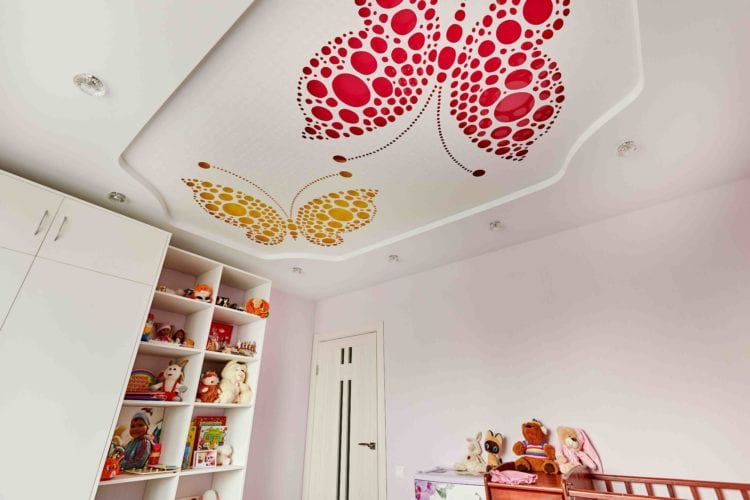
Since the nursery is often divided into 3 zones: study, play and sleep, it is recommended to apply room zoning and approach lighting individually. The brightest lighting can be equipped with spotlights above the desk, a chandelier can be used for general lighting, and sconces can be placed near the bed.
Bathroom
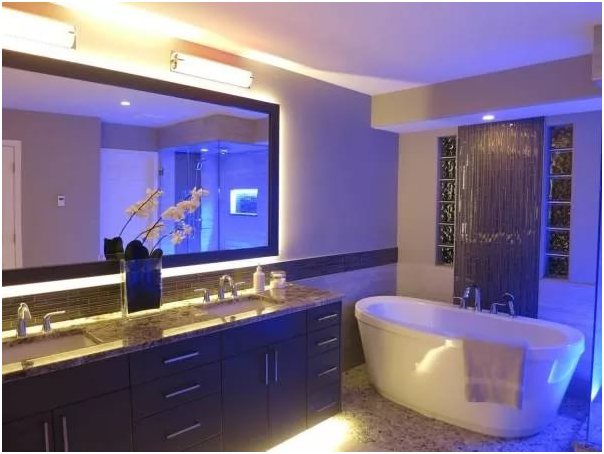
And finally, the bathroom. When placing lamps on a stretch ceiling, of course, you need to take into account the size and layout of the bathroom. Also note that only moisture-resistant lighting fixtures can be installed in this room. You can arrange them around the perimeter of the room or in a checkerboard pattern. The sconce in the area of the mirror and dressing table adds a lot to the comfort of the bathroom.
That's all the basic rules that you need to follow when placing lighting. We hope that our recommendations will be useful to you, make your work much easier and help you create skillful lighting in your home.
Ceiling spots in the interior: photos in different rooms
If you have not seen the location of the fixtures on the ceiling, it is quite difficult to imagine the result from the diagram. Even the simplest schemes - in the corners, in a semicircle near one of the walls, along opposite or adjacent walls - are quite problematic to imagine.Moreover, the appearance varies significantly depending on the shape, size of the lamp, on the type of lamp selected for it. After all, there are they with different scattering angles - from narrowly directed (about 30-40 °) to shining in different directions (120-180 °). Therefore, in this section, we have collected photos of the schemes, and grouped them by type of premises, because the view also changes from the design.
Living room
In the living room, a chandelier is most often used, and most often it is quite large. If the room is square or close to a square, it makes sense to choose symmetrical schemes. They emphasize the correct geometry.
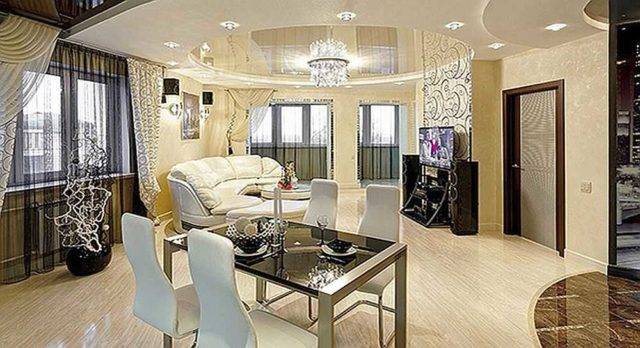
Spotlights are located around the chandelier and in the corners
This is true only for those cases where zoning is not required to be emphasized. In this case, asymmetry is more suitable, and you can use spots that are different in appearance.
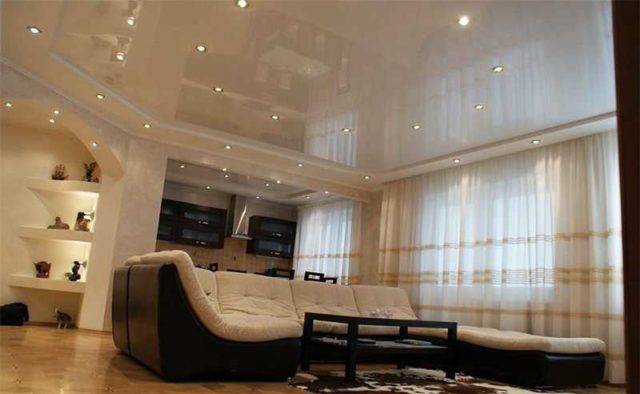
In some areas, the number of spots may be more
In living rooms, a large number of light sources are most often used, which are divided into several groups. This makes it possible to vary the intensity of illumination over a wide range.
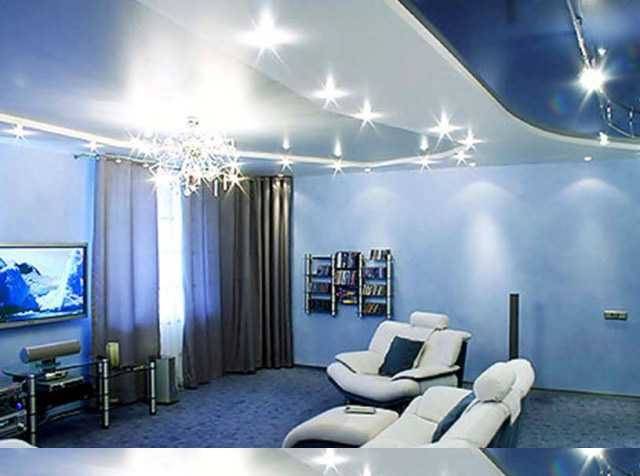
Zoning is emphasized not only by light, but also by lighting
It does not matter, with or without a chandelier, but the schemes contain more than a dozen spots, and more often several dozen. So in this case, to save electricity, it makes sense to put LED lamps.
Yes, they are much more expensive, but in terms of efficiency they have no equal. Anyway, for now.

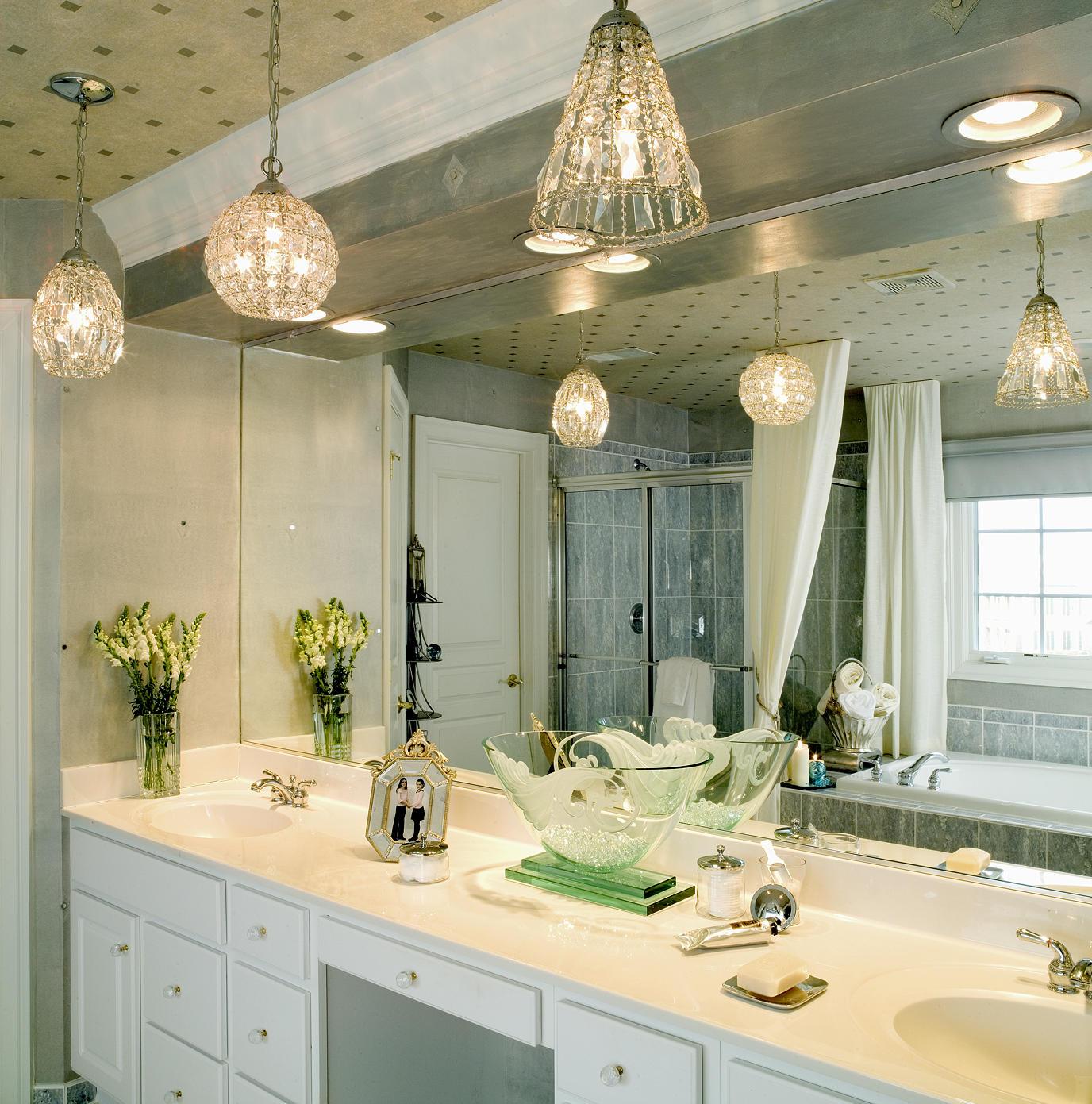
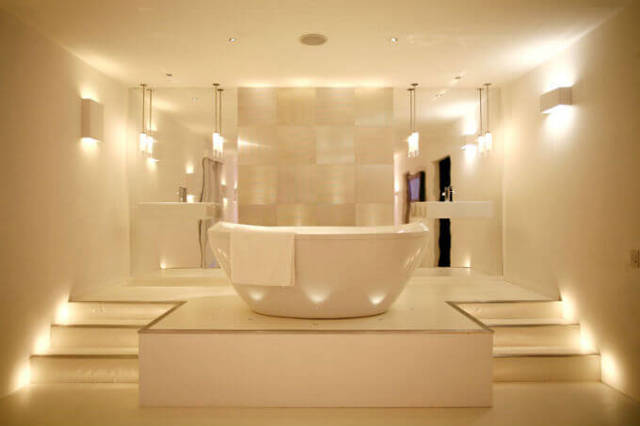


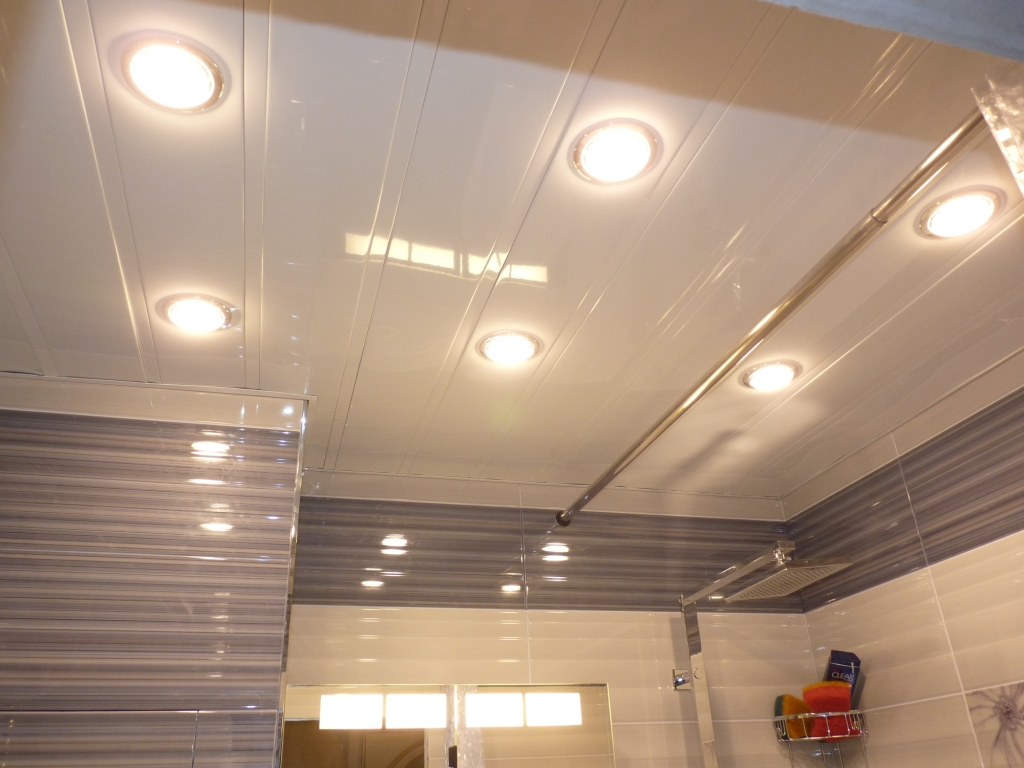


Bedroom
It is necessary to select the location of the lamps on the ceiling, taking into account the fact that the atmosphere should be cozy and relaxing. Therefore, when choosing lamps, you need to choose them with a warm glow temperature, that is, those that give a slightly yellowish light.Putting lamps with a blue or bright white tint in the bedroom is not worth it - it will be difficult to relax.
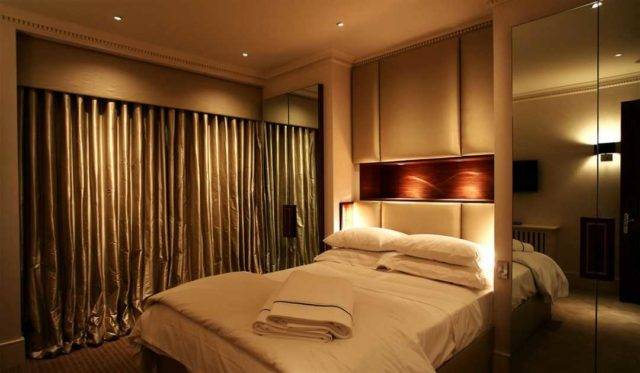
The light should be warm
Bedroom lighting schemes usually do not differ in great complexity. A contour of small lamps around the perimeter of the room, maybe a few more of them above the bed. That's all the exploration. The simpler the better. The task is to create a cozy atmosphere and everything is subordinate to it.
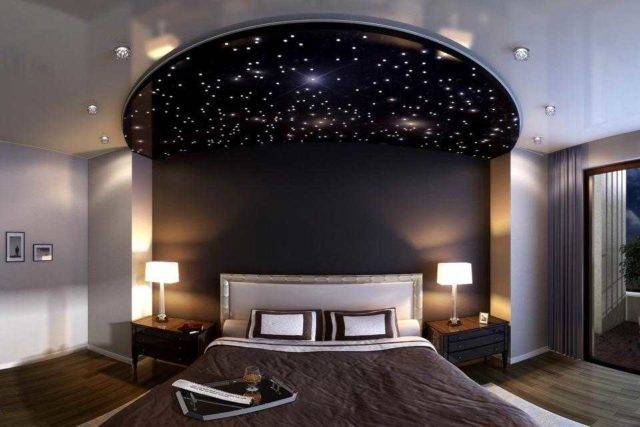
If you want something original
If there are still other areas in the bedroom - a dressing table or even a workplace, you can "get" the illumination with the help of wall lamps. The second way out is to install more lighting fixtures in this area, enter them on a separate switch and turn them on as needed.
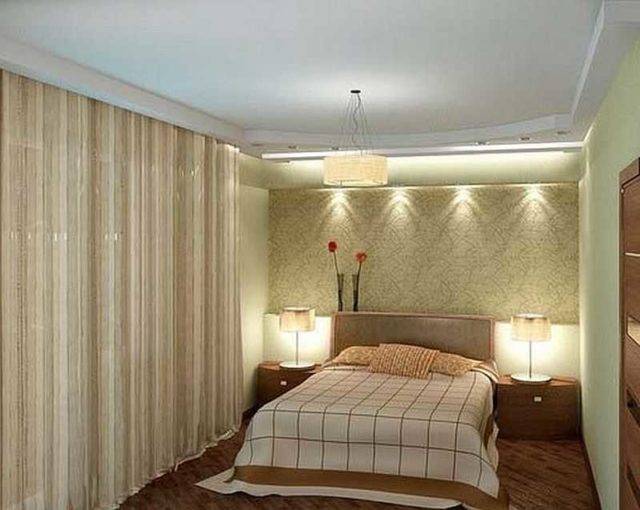
Sconces are usually hung at the head of the bed or table paws are placed on the bedside tables.
So when choosing a layout for built-in lamps in the bedroom, one of the basic rules is conciseness.
Kitchen
Most often, the kitchen, even if small, is divided into two parts. One prepares food, the other takes it. When developing a lighting scheme, these zones are often emphasized. In this case, the spots are usually placed along the kitchen set, and a rectangle, an oval, an arbitrary figure is built above the table.
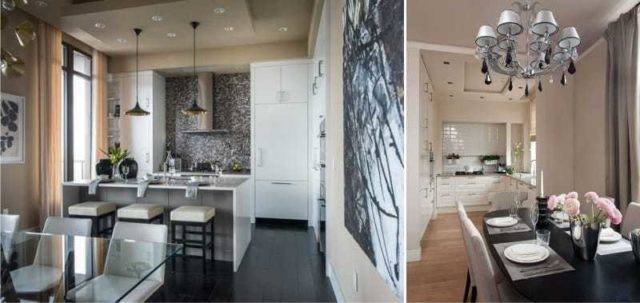
The location of the lamps in the kitchen: two zones, two schemes
If the kitchen is very small, you can’t set up complex schemes. In such cases, spots are distributed along the perimeter or along two walls - opposite or adjacent. This is already necessary to look at the situation, but both options are not bad.
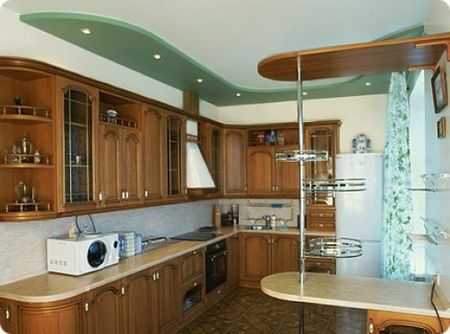
In kitchens, simple schemes are more often used.
An oval or a square also looks good. Just do not install large lamps with complex shades in a small room.They, of course, look beautiful, but are more suitable for the living room, in a small amount they are good in the bedroom. Even in the corridor and hallway are appropriate. But not in the kitchen. Firstly, they are very difficult to wash, and secondly, they do not look good in a small room. Here, concise forms are more suitable. But a circle or a square - this is your choice.
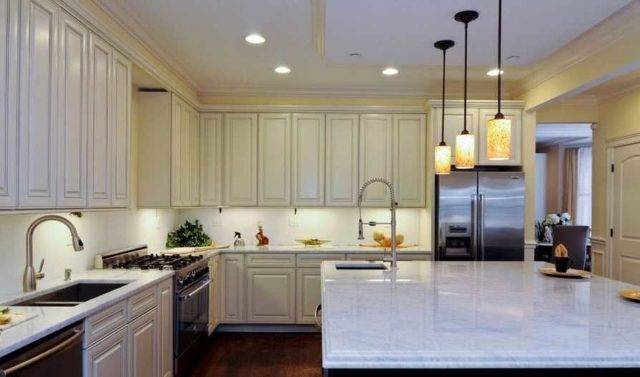
How to arrange spotlights in the kitchen
Various types of lamps can be used. For example, as in the photo - on long legs. By the way, this is one of the trends. Plafonds can be of any shape, but the most common are cylindrical or round.
Mounting
A decisive role in the number and location of fixtures in the bathroom is often played by the material of the ceiling covering.
On the concrete ceiling
In this case, the IP54 surface-mounted luminaire with a matte plate-shaped shade, designed for one or two light bulbs, is ideal for the bathroom. The power of two 7 W LED lamps is enough to illuminate the bathroom in a standard city apartment. Installation is carried out in the following sequence:
- drill holes for fastening the metal base and screw it with self-tapping screws;
- turn off the power supply and connect the electrical wires to the cartridge;
- screw the light bulb, check the performance and snap the ceiling.
On drywall surface
Works with drywall have more nuances and are performed in strict sequence. The location of the fixtures in the bathroom with plasterboard ceiling is planned in advance. Double-insulated wires are fixed with ties inside the building profile and brought to the places where the fixtures are placed with a margin of 25 cm. Then a sheet with holes of the desired diameter is attached to the profile.Wires are threaded into the holes, stripped and connected to the terminals. At the final stage, light bulbs are inserted and the assembled lighting device is fixed.


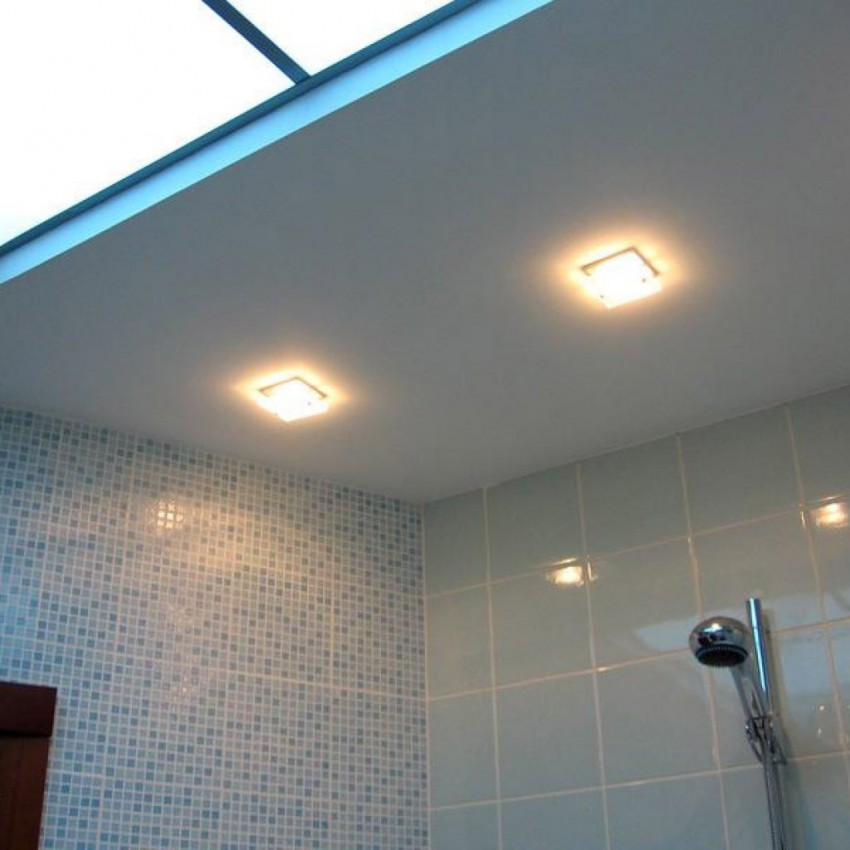


On a stretch ceiling
How to make lighting in a bathroom with a stretch ceiling is best known to professional installers. The whole procedure requires practical experience, accurate calculations and a considerable amount of time. But in general terms, the installation of spotlights on a stretch ceiling can be represented as follows:
- fastening the frame of the lighting device to the concrete base;
- installation of a tension fabric with the subsequent formation of holes;
- connection of the luminaire with the frame with the help of protective insulating rings that prevent tearing of the canvas.
To avoid deformation of the PVC film, experts do not recommend using incandescent lamps with a power of more than 40 watts for lighting. The invention of LED light sources with E14, E27, GU5.3 base solved this problem. Now, in rooms with stretch ceilings, you can easily achieve the desired luminous flux and forget about the negative thermal effects forever. In addition, there are recessed luminaires with diffusers, from which part of the light is reflected into the ceiling film, forming a beautiful pattern on it.
How to calculate the required number of fixtures
To purchase the right number of fixtures, you need to consider the area of \u200b\u200bthe bathroom. If the room is small (about 5 m²), then 1 chandelier with two shades can be installed on the ceiling. For it, you can use ordinary light bulbs with a 60 W incandescent filament.In addition, you should think about additional illumination of certain areas, such as mirrors, sinks, bathtubs or showers.
If the area of the bathroom is more than 6 m², then you need 1-2 chandeliers for the main lighting and spotlights, spots or sconces to illuminate functional areas.
To calculate the required number of lighting fixtures, you need to take into account the following indicators: illumination in Lx (Lux) and luminous flux per 1 m², the unit of which is Lm (Lumen). If the bathroom is small, then Lm and Lx are equal, for example, 200 Lx \u003d 200 Lm / m².
If the area of the room is 5 m², then lighting fixtures of 1000 Lx are needed to illuminate it. This value must be converted to W to find out the total power of the light sources. For example, a conventional 75 W light bulb produces a flux of 935 lm. This is enough to illuminate a five-meter bathroom.
To determine the power of the lamps depending on the luminous flux, pay attention to the following indicators:
- 25 W - 220 lm.
- 40 W - 420 Lm.
- 60 W - 71 Lm.
- 100 W - 350 Lm.
- 200 W - 2500 Lm.
- Halogen bulb (HL) 42 W - 625 lm.
- 55 W - 900 lm.
- 70 W - 1170 lm.
- GL (12 V) 65 W - 1700 lm.
These indicators will help you determine the total power of the bulbs and choose the right type of light source. To do this, it is enough to calculate the area of \u200b\u200bthe bathroom and the power of the lamp.
If you opted for LED lamps, then you also need to know their power and luminous flux. For example, 10 W lighting fixtures emit 860 lm, which is enough for a room of 4 m². If the power of one lamp is 2.7 W, then you need to purchase 3 - 4 pieces. To calculate the number of lamps and lighting devices, divide the total power by this indicator of one device.
We calculate the number and location of fixtures on the stretch ceiling
Models for stretch ceilings are selected not only for functionality or design. Together, all lighting fixtures should provide sufficient lighting, as well as create decorative effects when necessary. Accordingly, if spotlights play the role of an addition to the chandelier, a certain arrangement is used. If only these devices provide lighting, their placement should be different.
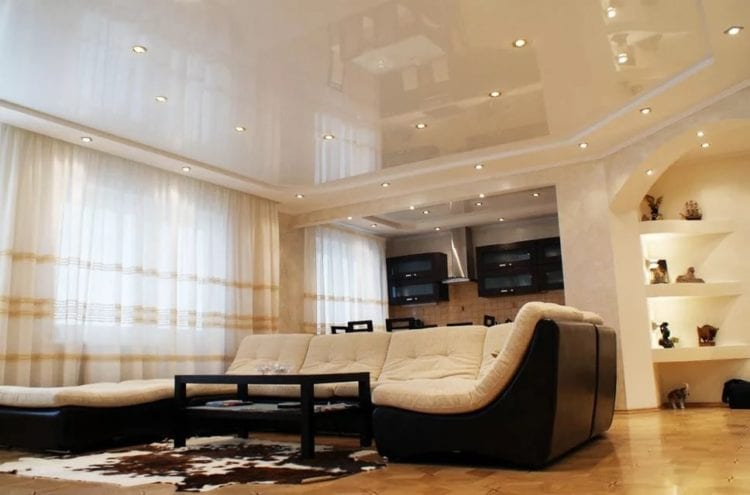
To calculate the optimal location stretch ceiling lamps, need to know:
- type of lighting fixtures - fluorescent, LED incandescent lamps generate a luminous flux with different intensities;
- room dimensions - 1 spot can provide coverage of no more than 2 square meters. m. area;
- the presence, number and area of windows;
- living room design - style also dictates certain requirements for the layout;
- the need for zoning - spotlights successfully solve the problem of dividing into zones.
Power calculation
There are certain lighting standards for all types of rooms:
- the living room requires at least 3 W per 1 sq. m;
- in the bedroom you don’t need such bright lighting - 2 W per 1 sq. m;
- but in the nursery, lighting should be maximum - 8 W per 1 sq. m.
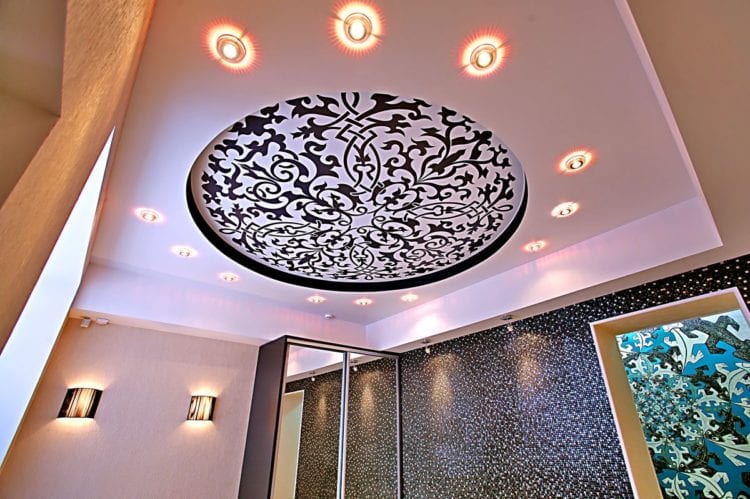
Based on the norm, you can easily calculate the required total power. For example, with a living room area of 20 square meters. m requires lighting with a power of 20 * 3 \u003d 60 watts. If there is no central lighting device, with a power of LED lamps of 5–7 W, 10 to 14 devices will be required. Preference is given to an even number, but this condition is commensurate with the design.
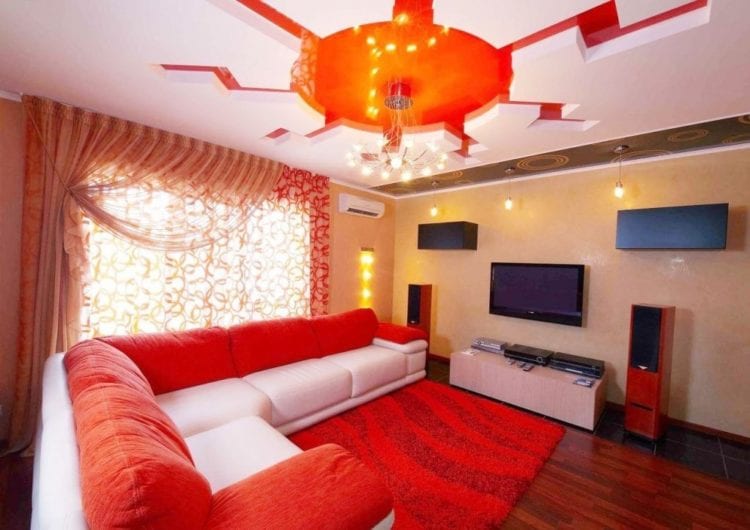
Calculation of the number of required fixtures
Correctly calculate the number of fixtures and their required technical characteristics will allow the existing recommended standards of illumination for each type of premises. Currently, apartment owners are increasingly switching to LED lamps, so the calculation of the lighting rate for each room in the apartment will be shown using their example.
The illumination rate is expressed in W per square meter and is:
- for toilets and bathrooms - 2 W / m2;
- for halls - 3 W / m2;
- for corridors and hallways - 1 W / m2;
- for the bedroom - 2 W / m2;
- for a nursery - 7 W / m2.
Based on the above norms, you can easily calculate the required number of devices and decide how to place the fixtures on the stretch ceiling. This will require:
- Multiply the area of the room by the norm of illumination, for example: 12 m2 x 7 W / m2 (for a children's room) \u003d 84 W.
- Divide the found value by the power of one lighting device, for example: 84 W / 6 W \u003d 14 pcs.
It turns out that to create the necessary illumination in the children's room, you will need 14 LED lamps with a power of 6 watts.
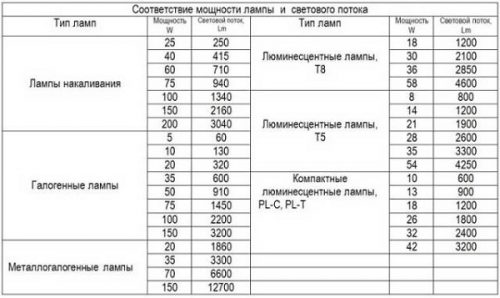
If necessary, recalculate the number of fixtures with other lamps, you can multiply the rate for LED lamps by a correction factor:
- for incandescent lamps - 4;
- for fluorescent lamps - 2.5.
For this example, it turns out that the total lighting power for a children's room using incandescent lamps will come out: 84 W x 4 \u003d 336 W, and for fluorescent lamps: 84 W x 2.5 \u003d 210 W. If the calculation results in a non-integer number, it is rounded up to an integer value.


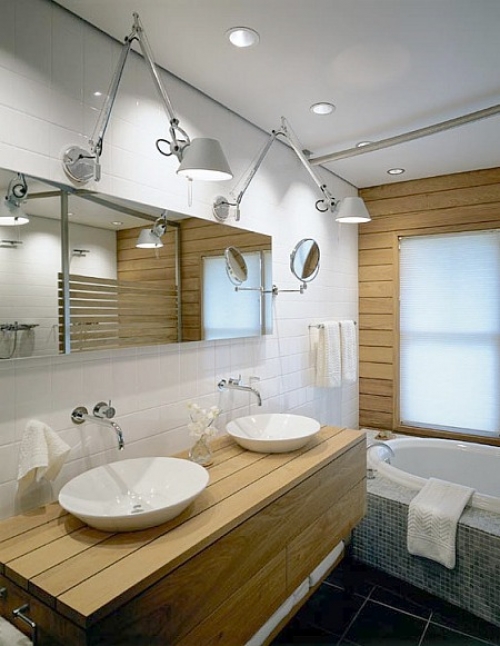
Choosing a Layout
It depends equally on the required level of lighting, and on the style.In addition, you need to keep in mind the additional requirements due to the purpose of the premises.
The living room is a room with a high level of lighting. It is unlikely that it will be possible to manage here only with spots.
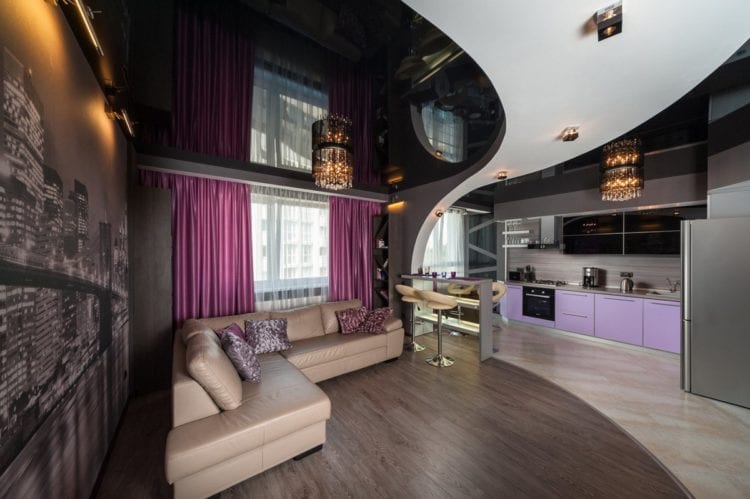
But if you use them together with a chandelier, you can greatly diversify the design of the room:
- lamps are used for zoning: in areas where bright lighting is required, devices have a close group or select high-power products. In the recreation area, on the contrary, they organize subdued soft lighting;
- it is preferable to place light bulbs on a stretch ceiling in the hall in front of a wall with an interesting decor or furniture composition;
- 2 rows of point light sources along a shorter wall will visually correct the proportions of the room.
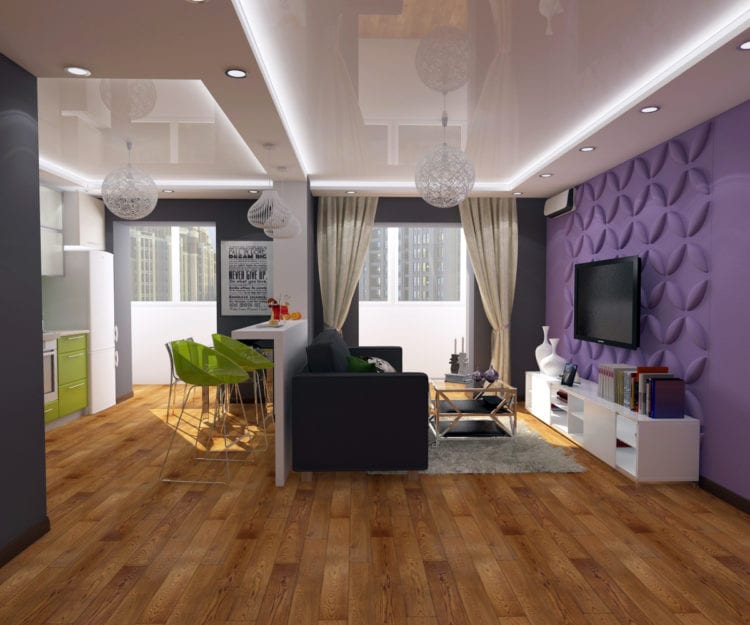
Bedroom - here they often do without a chandelier. Spotlights mark zones:
- a couple of pieces are enough above the bed to create very soft lighting;
- the wardrobe is distinguished by more powerful lighting fixtures. The dressing person must see himself in the mirror;
- the dressing table also needs good lighting.
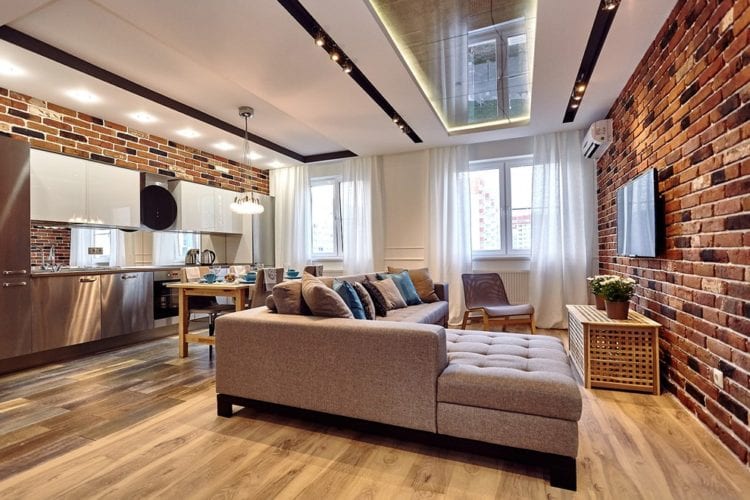
Kitchen. Spots here provide sufficient illumination and serve as a universal tool for zoning. They allow you to visually change the proportions of the room.
Children's
In the lobby or hallway
Light sources for stretch ceiling systems
Spotlights for a stretch ceiling in the bathroom will perfectly complement the interior. In this case, the light source can be anything, but halogen or energy-saving illuminators with a power rating of up to 35 watts are most suitable.It should be remembered that experts do not recommend in this case the purchase of incandescent lamps with a power greater than 60 watts. Otherwise, the coating near the device will turn yellow, which can significantly spoil the overall aesthetics of the interior.
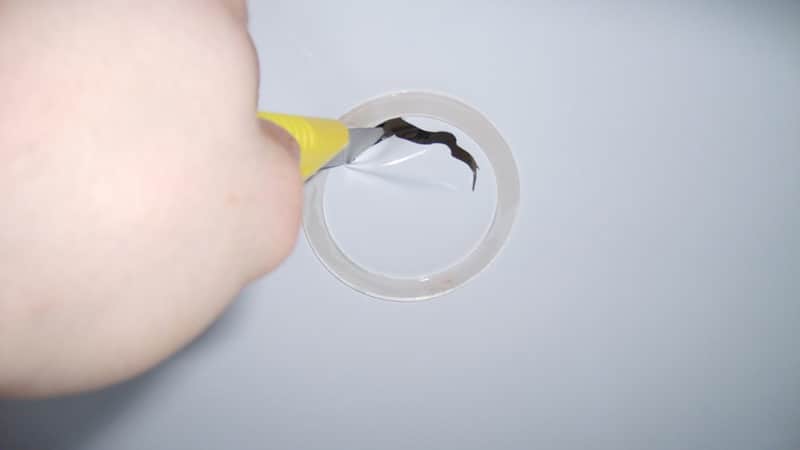
In the stretch ceiling, you need to fix the thermal ring and cut a hole for the lamp
In addition, protection should be provided between the ceiling surface and the appliance. For this, special double thermal rings are used. Compliance with this norm is a mandatory fire safety rule. Otherwise, the coating may simply catch fire.
When choosing illuminators, special attention should be paid to their fastenings.
It is very important that their diameter matches the dimensions of the inner mounting platform. As a rule, its dimensions are from 60 to 85 mm.
Smaller clips will not hold the light and it will fall out. Larger fasteners simply won't fit into the finished hole.
As a rule, its dimensions are from 60 to 85 mm. Smaller clips will not hold the light and it will fall out. Larger fasteners simply won't fit into the finished hole.
When using LED backlighting, you need to take care of purchasing a voltage stabilizer that can extend the life of the devices. However, lamps of this type quickly fail when the light is turned on and off frequently.
Electricity and high humidity
A large amount of water, frequent temperature changes, humidity and hot steam, condensate - all these conditions characteristic of the bathroom create an increased danger when using electricity within it.
To ensure the safety and proper operation of electrical appliances, in such premises, during installation, electricians use only elements protected from the effects of steam with water.
Waterproof terminal blocks are perfect for the bathroom, which are able to endure high humidity for a long time, and at the same time they significantly facilitate installation.
Installation of any junction boxes and assemblies must be carried out strictly outside the bathroom. Inside the bathroom, you should, as far as possible, avoid connecting individual wires.
If for some reason it is still necessary to make a so-called twist, then each such place should be protected as carefully as possible with insulating materials from moisture penetration. Most often, lighting in the bathroom is organized using low-current systems with a power consumption of 12 V.
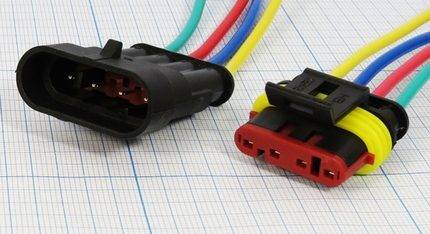
When installing the main and additional lighting in the bathroom, it is recommended to use special terminal blocks equipped with additional moisture protection
It is almost impossible to get any dangerous electric shock from such an LED lamp even at high humidity. But this does not mean that you can forget about security measures. All LED devices must be grounded.


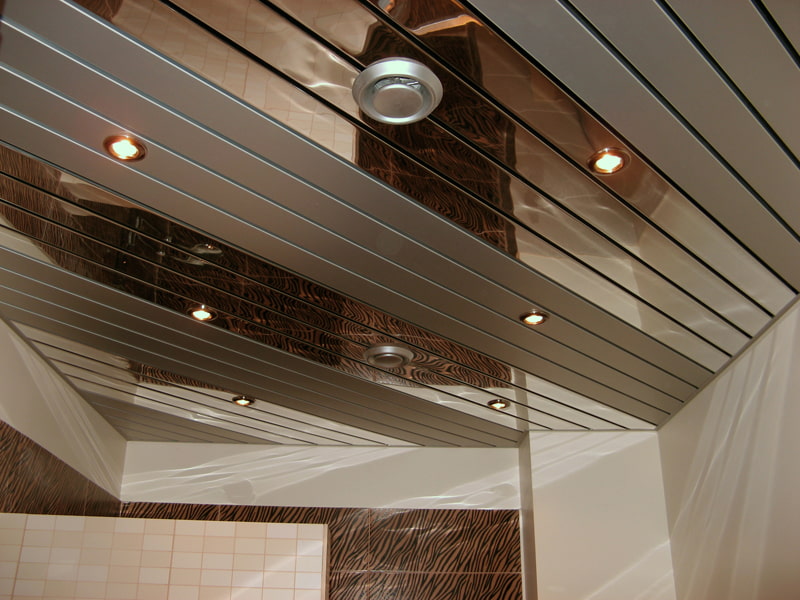


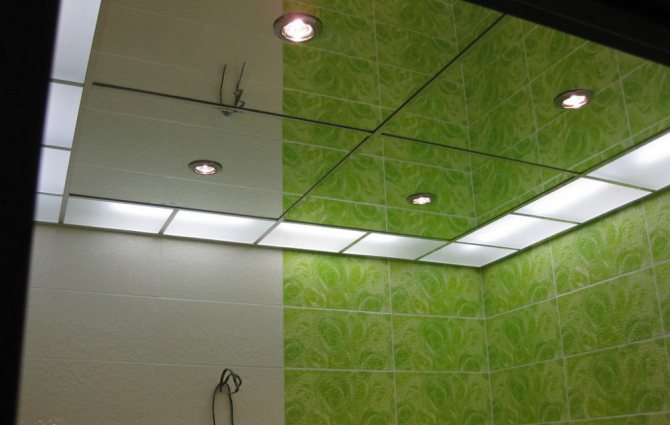

The lighting system must be connected to a residual current device that is activated when a current leakage occurs and interrupts the power supply to a particular object.
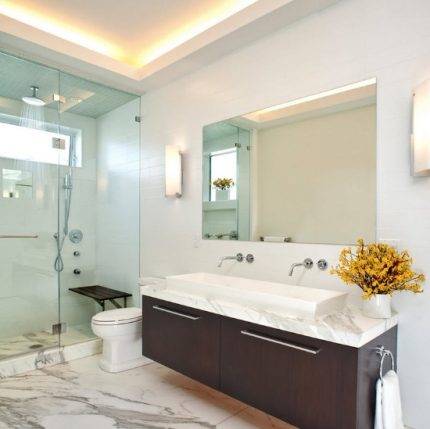 With the help of LED lamps and LED strip, you can significantly diversify the interior design of the bathroom, providing the necessary amount of light in the room.
In bathrooms, it is recommended to organize a separate power supply line to each object or group of objects. Usually, a line is allocated for sockets and separately for lighting fixtures.
If the bathroom is supposed to use powerful equipment (automatic washing machine, hydromassage cabin, electric sauna, etc.), then a separate power line should be made for each such object. And for each such group of electricity consumption, it is recommended to install a separate RCD.
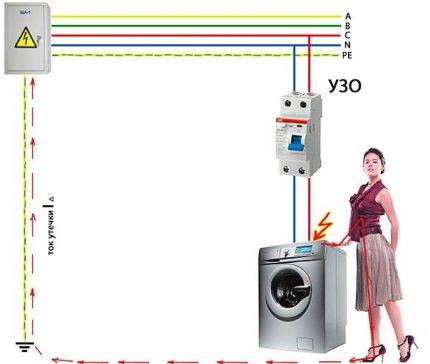 All lighting and electrical appliances located in the bathroom must be connected to the switchboard through a residual current device (+)
The supply of electricity to low-current LED systems is carried out through a special step-down transformer. This appliance must also be installed outside the bathroom, i.e. away from sources of high humidity. Almost all modern LED lamps are equipped with a special ground terminal.
Do not neglect this method of protection. Even weak currents can be transmitted and accumulated on wet surfaces. And thanks to steam and condensate, any surface in the bathroom can become wet: walls, floors, profile structures, ceilings, furniture, appliances, etc.
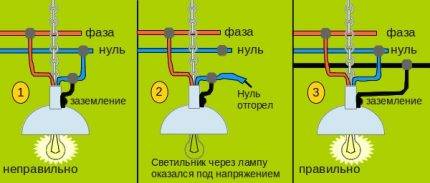 Every fixture installed in the bathroom should be properly grounded. The lack of such protection can bring many problems to the owner of the premises (+)
An accidental touch can transfer a discharge of accumulated electricity to the human body, which in some cases can not only cause discomfort, but also lead to serious electrical injury.
Illumination of mirrors, washbasin, other elements
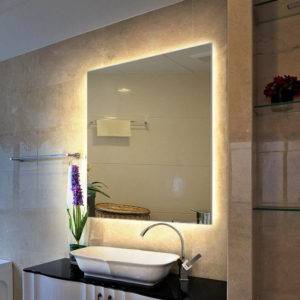 The lighting of the mirror should be natural so that it does not distort the reflection. It is better to install a lamp above it, on the sides, or combine these 2 options. Opt for light fixtures with matte white shades that give off a soft light.
The LED strip can be installed under the sink or along the edges of the bathtub. Plates with diodes are used to illuminate niches, drawers with clothes, cabinets, or they are allowed along the perimeter of the wall.
In the bathroom or shower, lighting helps to create a relaxing atmosphere. Several devices can be installed above the bath or in the shower.



