
- Fan riser: purpose and consequences of its absence
- Causes of ventilation failure
- Causes of reverse thrust
- Cold attic ventilation
- What it is
- Implementation of the installation
- Installation of fan pipes
- Roof vent pipe
- Requirements for a vented valve (aerator)
- Mounting Features
- Fan ventilation design principles
- Fan ventilation equipment
- Fan ventilation installation tips
- Typical mistakes when installing fan ventilation
- Conclusions and useful video on the topic
- Pros and cons of roof ventilation
Fan riser: purpose and consequences of its absence
In short, the sewer fan riser is nothing more than ventilation. Its main task is air supply inside the sewer system, which ensures its ability to quickly cope with the transport of large volumes of water and remove unpleasant odors. Let's face it - the relevant services of the housing office have a negative attitude towards the issue of removing this part of the riser, even if it is being replaced with an air valve. Why? Everything is simple here - its absence entails a lot of problems that begin to pour one after another on their heads. And although these troubles can be counted on the fingers, they can make life unbearable for residents of a high-rise building.Such problems include the following.
-
A fetid smell spreading through the apartments located along the riser, where the fan riser was cut and muffled. This behavior of the sewer is due to the fact that the smell has nowhere else to go and instead of being freely vented through the ventilation pipe, it seeps through even the smallest pores in the pipe joints of the apartment. The situation is aggravated by the fact that when flushing the toilet bowl, a large amount of water immediately enters the sewerage system, acting like a piston, drawing in air, which, in the absence of a vent pipe, has nowhere to come from. The system itself looks for where to get it and finds it in the most unexpected places for a person - it simply sucks out water locks in the siphons of a bathtub, washbasin or kitchen sink and starts sucking in the necessary air in these places. As a result, again, unpleasant odors spread throughout the apartment. This does not happen in one apartment - as mentioned above, all the lower floors located along the riser will suffer.
-
Problems with the operation of the sewer system. In addition to the suction of water locks, the absence of a vent pipe will certainly affect the operation of the sewer - as a rule, it begins to clog more often. The absence of the same full-fledged air flow does not allow the system to quickly and efficiently remove human waste. This nuance is especially true for sun loungers - if earlier you didn’t know grief with them, now you have to clean them with enviable regularity.
Now decide for yourself whether you need a fan riser in your apartment, or maybe it’s better to put up with its presence? By the way, if you are a resident of a private house, then you should not think that you will not have such problems. It should be understood that no matter how large the sewage system is and no matter how correctly it is assembled, the fan riser is its integral part, and there is simply no complete replacement for it. Think about it at your leisure, but for now I will tell you about one alternative that supposedly allows you to remove the ventilation of the sewer system.
Peculiarities fan riser devices and the nuances of its installation, see the video.
Causes of ventilation failure
A large number of factors can be attributed to the causes of the malfunction. The main thing to understand is that when it blows from the ventilation system in the apartment, this is not the same thing if the same effect appeared in a private house. That is, malfunctions in two buildings can be different, because the violation of draft in them has different causes.
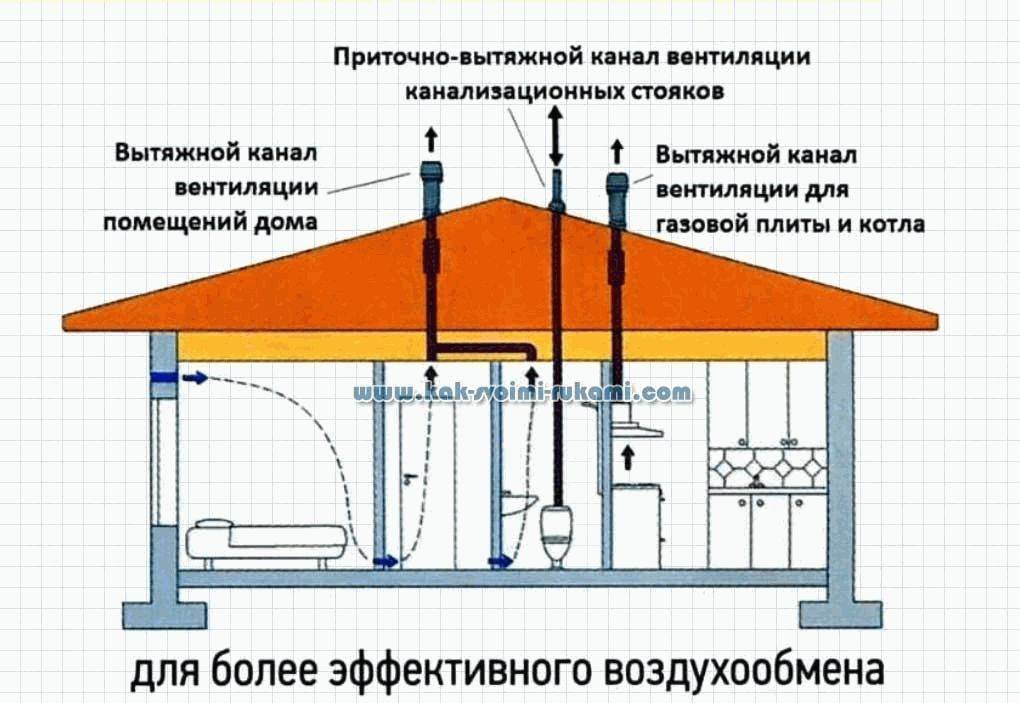
For example, in an apartment, most often this happens due to the installation of a fan or an exhaust hood in the kitchen, which begins to press through its channel, and the air inside, moving to the riser with pressure, does not have time to go up with the whole mass. That is, it partially enters the adjacent channel of the toilet or bathroom. It is in these rooms that the opposite effect is formed. The same happens in the opposite direction if the kitchen fan is turned off and the toilet is turned on. This also happens with neighboring apartments located one above the other.
This suggests that it is impossible to mindlessly install additional exhaust devices without calculating their power.And the more powerful the fan, the stronger the reverse draft of the ventilation system in the apartment of a multi-storey building.
> For this reason, this cannot happen in a private house, because at the design stage today they are trying to distribute ventilation ducts to all rooms separately. That is, the kitchen has its own riser, the toilet and bathroom have their own. But sometimes there is another problem in the house. Most often, risers are combined into one or two common channels inside the attic, and then one or two pipes are led out through the roofing. And here horizontal sections appear in the ventilation system. The main task of the designer is to use as little of this type of duct as possible, and to minimize the angle of inclination of the horizontal sections (the decrease should be minimal). That is, the steeper this section, the better the upward movement of air.
And three more reasons:
- Lack of thermal insulation. Cold air in winter enters the air ducts, where it freezes, turning into ice. This usually occurs at the mouth of the canal. The consequences are a reduction in cross section.
- The absence of an umbrella (visor), which can lead to rain and reduce traction. This disrupts air circulation.
- The ventilation in the house is littered.
So, in order to remove reverse thrust, you must first understand why it appears.
Causes of reverse thrust
As mentioned above, reverse draft in ventilation appears for two main reasons:
- Full tightness of the premises.
- Installation of additional exhaust devices in the ventilation ducts.
All other reasons are secondary, some of which do not create reverse thrust, but simply the ventilation stops working.With ventilation in an apartment it is more difficult, because the system itself is a complex set of channels, often made of concrete. Branches depart from the riser for all apartments, through which the air from the premises must be removed to the street. And if a neighbor on the lower floor installs a powerful kitchen hood, then the reverse flow of air masses will be felt not only by him, but also by the neighbors from the floors closest to him.
> In a private house, back draft occurs for other reasons, because the ventilation in the apartment is different from the ventilation system of a private house. This is where installing fans can solve the problem. But you just need to determine the installation location for different risers.
Cold attic ventilation
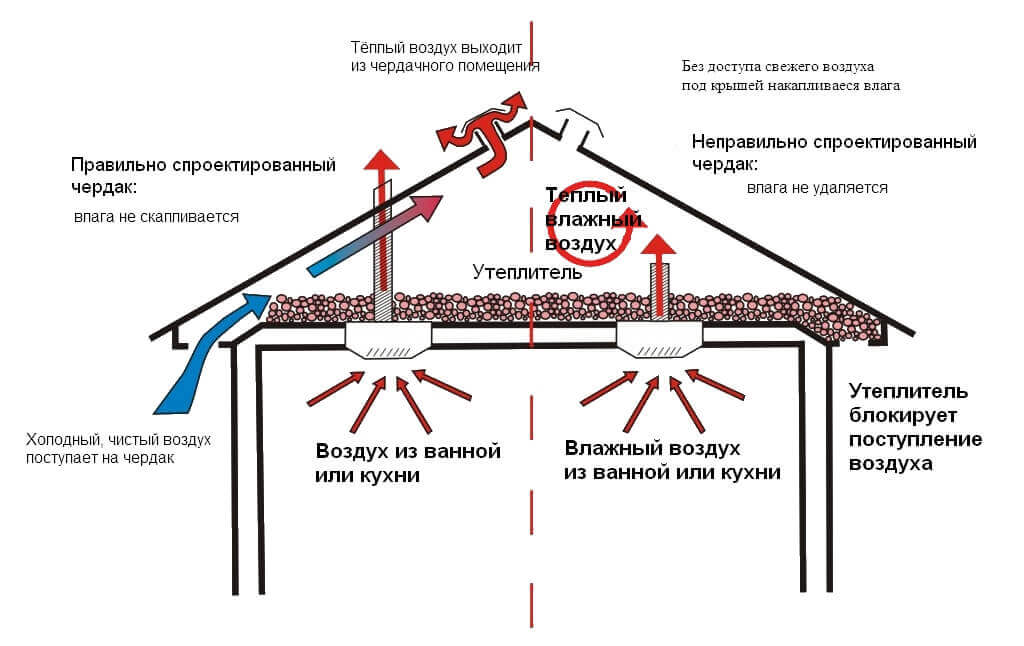
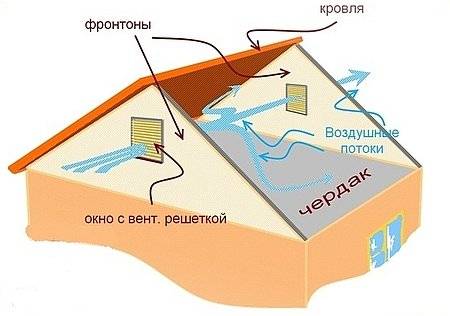
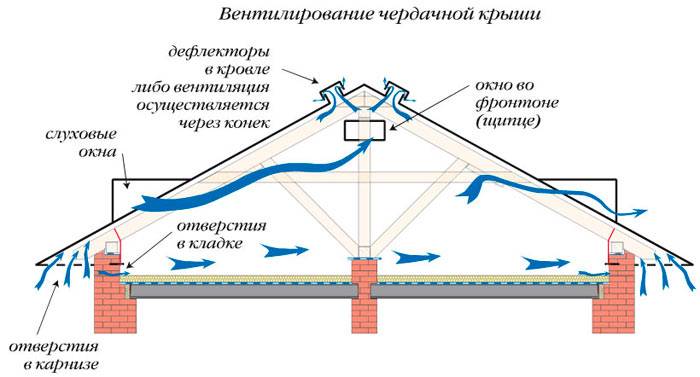
Ventilating a cold attic can be easily done by hand. This will require knowledge of a little theory and some practical skills. Making sufficient ventilation in a cold attic will not cause any particular difficulties due to the large air volume and the absence of barriers to normal air circulation. Air exchange can be carried out through the cornice overhang, the ridge and ridge of the roof, as well as gable windows and grilles.
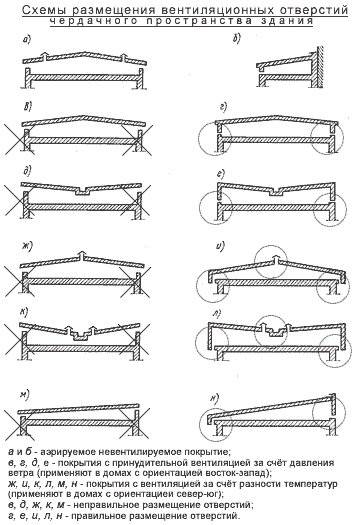
For gable roofs, ventilation of cold attics is done either through gables or through loosely fitting wooden filing of cornice overhangs. If the pediments are made of stone, then holes can be made in them for dormer windows with ventilation grilles.



Dormer windows should be installed on opposite sides to ensure proper attic ventilation.
There is also an alternative, more economical option.To do this, install standard ventilation grilles (pediment vents), one of which is adjustable, and the other is turned down with the vents. To protect against insects, such a grill is equipped with a protective mosquito net.
Hip roofs do not have gables due to the shape of their design, so for them there is another option for providing ventilation in the attic - with the help of cornice overhangs. The air flow will be carried out through the filing of the roof, and its outlet will be at the top of the ridge. If the filing is made of wood with your own hands, then small gaps are left between the bars for the passage of air. When sheathing the eaves with plastic soffits, such a procedure is not necessary, due to the presence of pre-made holes on the elements - perforations.
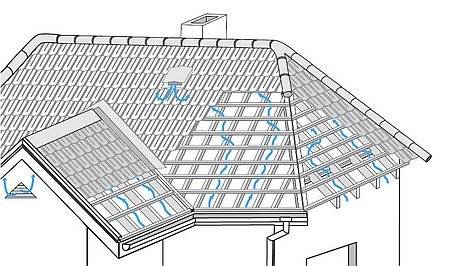
The air outlet is made from above, through the ridge of the roof. Its design features depend on the type of roofing material used. As a rule, any manufacturer of roofing materials has its own ready-made and practical solutions. !
Valleys (grooves) are one of the problematic and complex sections of the roof. To make normal ventilation of the attic space, point aerators are installed along the passage of the valley. However, this method is acceptable for roofs with slope angle from 45° and more. On sloping roofs, there is a high probability of snow accumulation in the valley area and therefore such ventilation becomes inefficient in winter. You can fight this by installing forced ventilation - inertial turbines, electric roof fans, or use high nozzles that will not be covered with snow.
What it is
When a private house is being built, it is necessary to bring various communications to it.One of them is sewerage. At first glance, you might think that it is enough for her to equip only a sewer drain. Actually this is not enough.
In order to explain the purpose of the fan riser, you need to remember how the toilet is drained in more detail. After the sewage merges, a certain amount of water then gets there. Part of it remains in the toilet. It is actually a water seal, the role of which, in particular, is to prevent the unpleasant smell from drains from entering the living quarters.
It is important to understand that this protective layer of water is inside the toilet.
If several such plumbing fixtures are installed in the house, then in each of them, which is not currently in use, there is such a water seal.
When a drain occurs in one of the toilet bowls, then for a short period of time immediately after the outflow of sewage and drained water, the pressure here decreases. Since all the others are connected to this pipe, water seals are broken in them and an unpleasant smell penetrates into the premises.

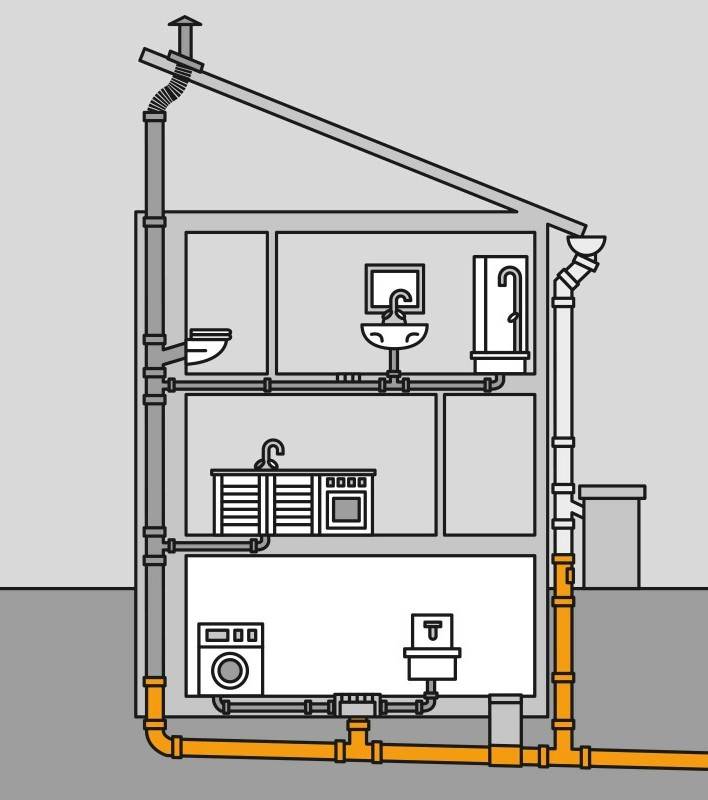
Scheme of the device and operation of the ventilation system
It is important to note that this situation exists not only in relation to toilets, but to all drains that are connected to the sewer. For example, we can talk about a water seal in a bathroom or in a sink if they are connected in the indicated way
This situation could have been avoided if the pipe had an additional outlet through which air could freely enter it. In this case, low pressure at the drain point would not arise and the water seals would not be broken anywhere.



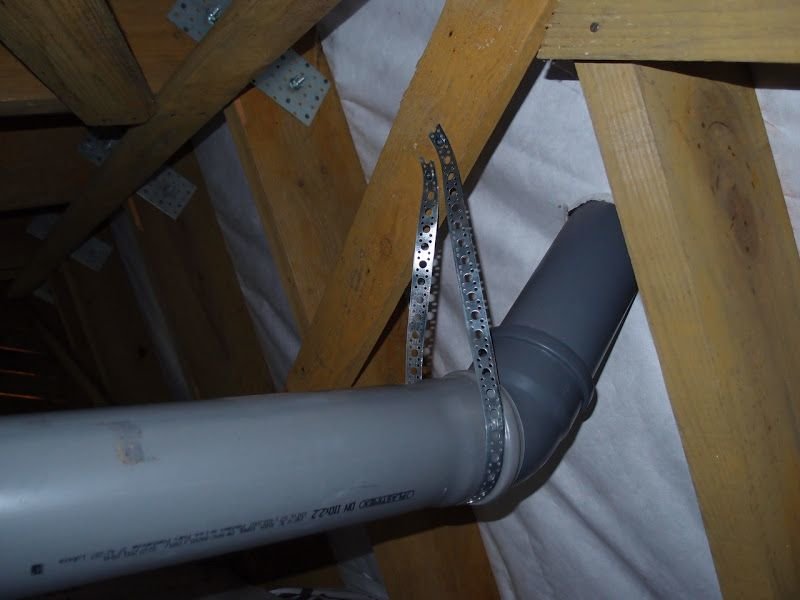

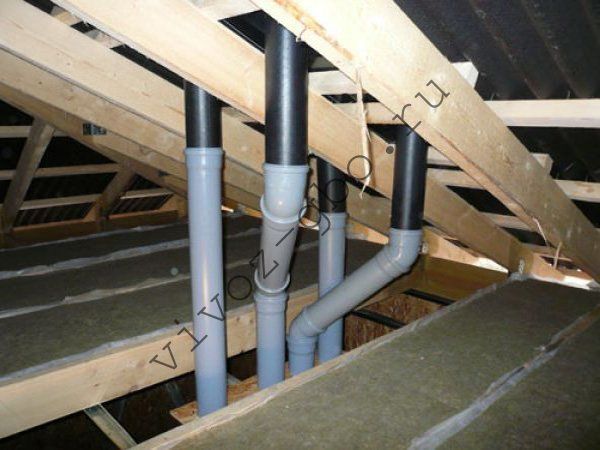

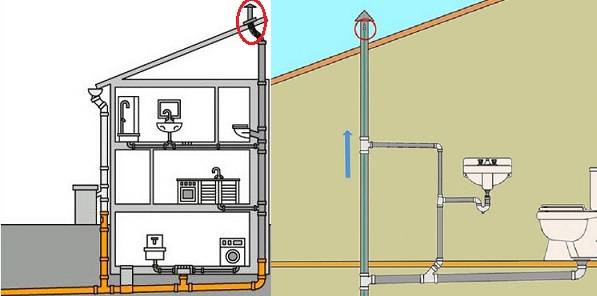
Odors from the sewer could also come out through a similar pipe.A fan riser is a pipe that performs the indicated functions, which is connected to the sewer system of the house and brought out of it.
How necessary. In fact, the system in question is actively used in apartment buildings. In the sewer system, the flow from the apartments goes into a vertical pipe.

A system of vertical sewer pipes that performs the function of a fan riser
Its lower end is connected to the drain system, and the upper end is brought to the roof and actually performs the function of a fan riser.
Implementation of the installation
Installation of fan pipes
If you are spending fan pipe installation with your own hands, follow the basic rules:
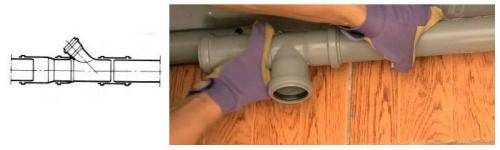
The fan pipe is installed by inserting a tee
- when purchasing building materials, make sure that the sections of the sewer riser and the fan pipe match; the optimal diameter of the fan pipe (as well as the riser) is 110 mm;
- the outer section of the riser should be placed in such a place that sewer "aromas" from it quickly and freely disperse in the atmosphere;
- the starting point of the sewer should be located in a heated room, but the end point, on the contrary, in a cold one. This provides the necessary temperature and pressure difference, due to which unpleasant odors are removed from the house.
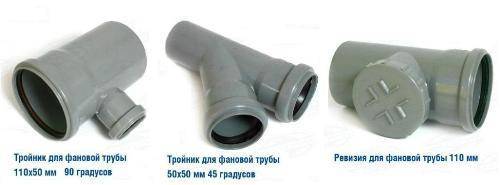
Appearance of tees and revisions for the fan pipe
Pro tip: The drain pipe is actually an extension of the main sewer riser and can be made by yourself from a sewer pipe of the appropriate diameter.
Unpleasant odors in the bathrooms appear due to the fact that siphons of insufficient volume are installed on sanitary appliances. In small siphons, the remaining water dries quickly (in 3-5 days if the plumbing is not used), which opens up free access to smells from the sewer into the room. Sometimes the installation of siphons of a larger capacity is impractical, then the replacement of the fan pipes in the apartment is required.
If the sewerage of a residential building has such a component as plastic pipes, the problem is solved as follows:
- the air in the sewer riser, rising up and falling outside the pipes, creates a vacuum in the sewer system;
- when the siphons are dehydrated, the air from the room seeps into the sewer, and not vice versa;
- the air remains fresh, without an unpleasant odor, even when the plumbing is not used for a long time.
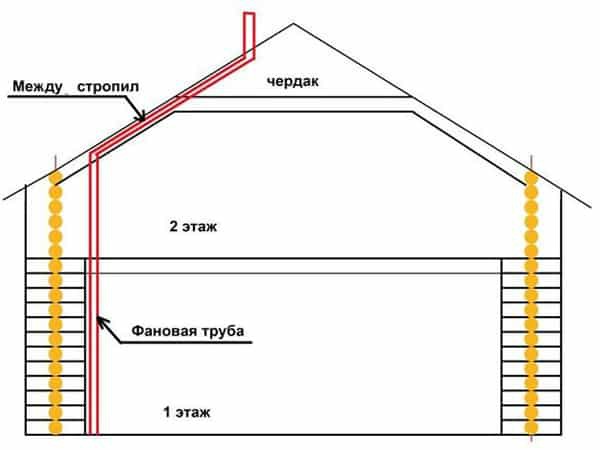
Roof vent pipe
The tasks of household intra-house sewerage include the transportation of effluents from the building to an external sewer system. For its effective operation, good ventilation is required, which is provided by risers equipped with fan pipes.
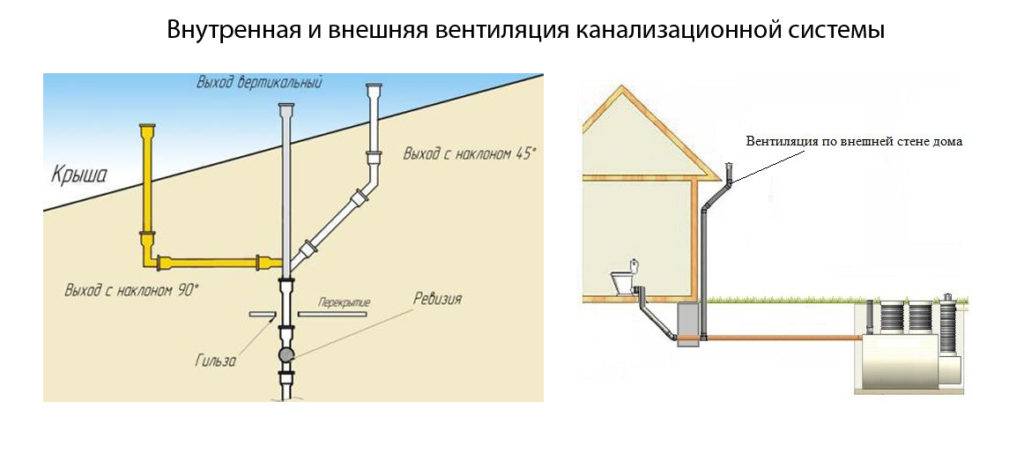
Scheme for the output of the fan pipe to the roof
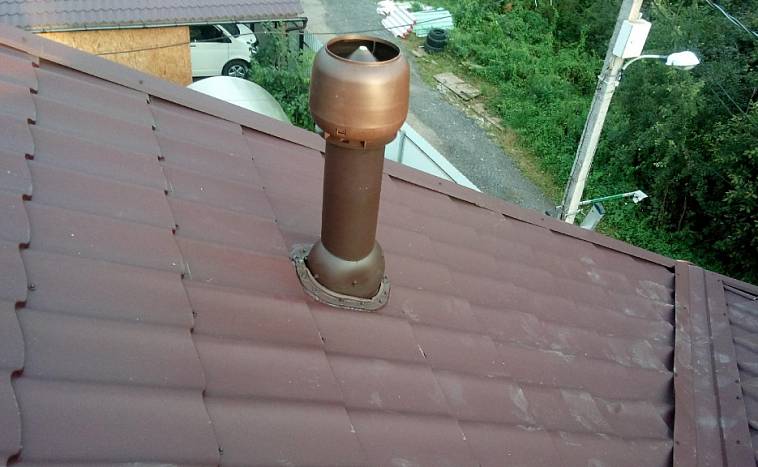
Pro tip: The vertical fan riser should lead to the roof. It is strictly forbidden to place the output in the attic.
To properly install a fan pipe, you must adhere to the following principles:
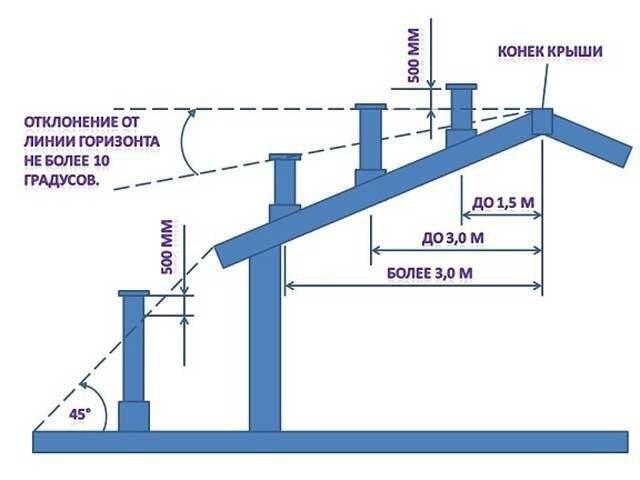
- ensuring the outlet of the fan pipe to the roof, the optimal height is provided - 50 cm; if the roof is used for any purpose and is actively used, the outlet of the riser should not be less than 3 m;
- a sewer pipe for a fan 110 mm in diameter is connected to a sewer riser of equal cross section;
- one fan pipe can connect several risers at once;
- it is forbidden to organize the output of a riser equipped with a fan pipe, together with a ventilation system or stove chimneys;
- the exit of the fan pipe, located above the roof, is made at a distance of 4 m or more in the horizontal direction from the opened windows, balconies, etc.
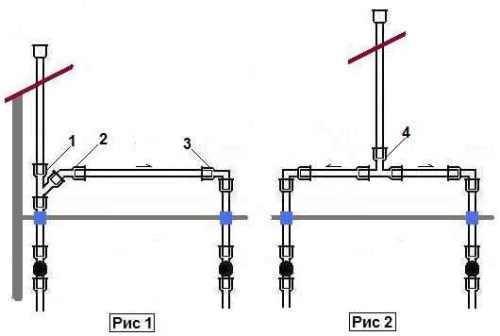
Connection of several risers with one fan pipe: 1 - oblique tee; 2 - knee at 45 degrees; 3 - straight knee; 4 - straight tee.
The sewer riser brought to the roof does not need to install any additional exhaust devices (for example, a deflector, a weather vane). Moreover, the use of these attachments may cause condensation to form in the system, which, if frozen, will block the outlets.

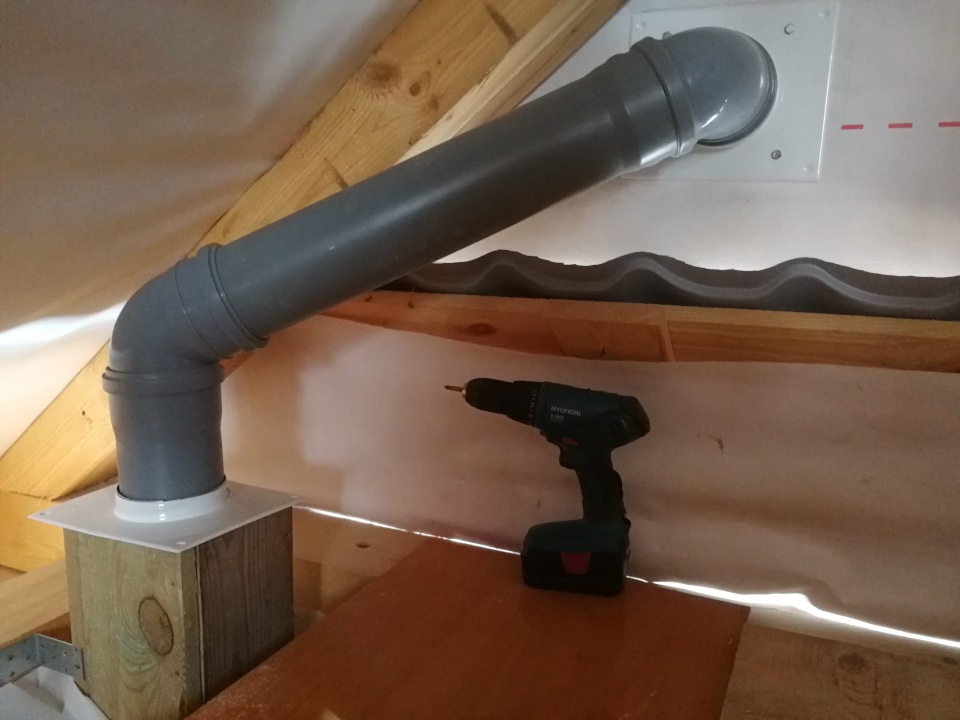


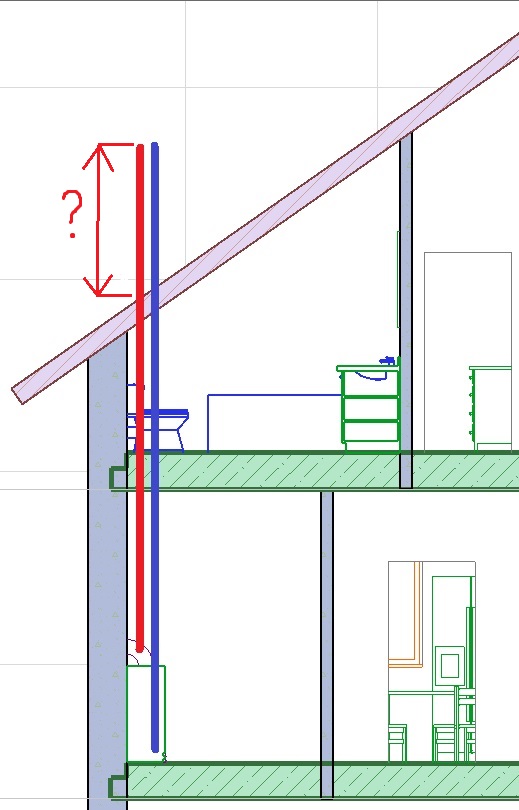
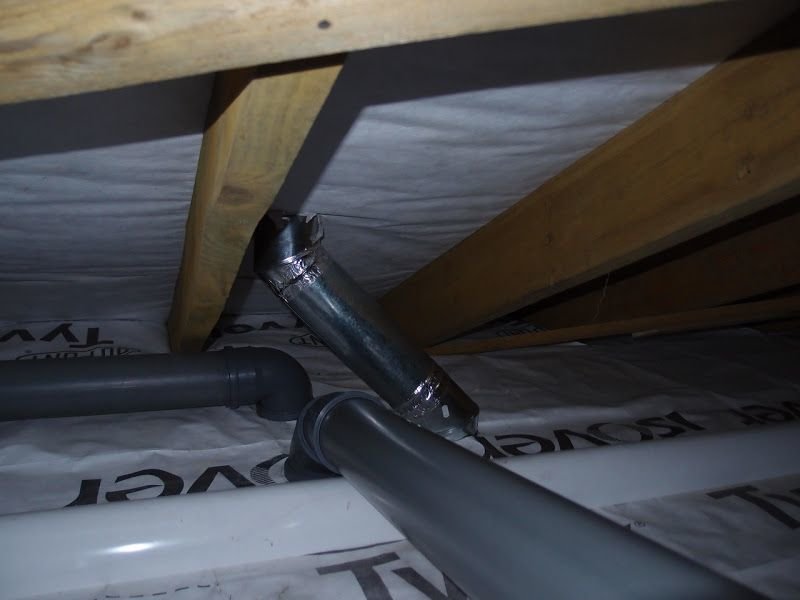


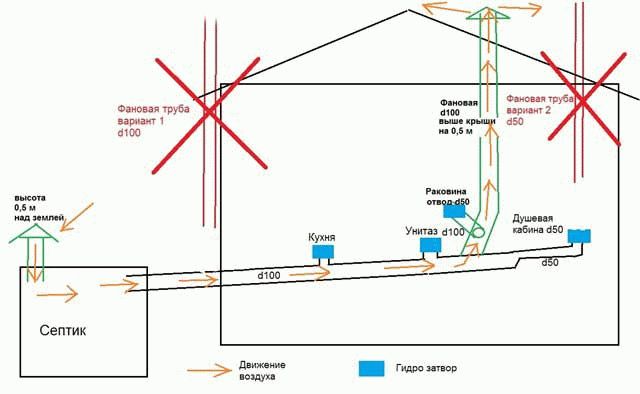
It is also not recommended to divert the ventilation pipe under the roof overhang. In the cold season, it can be damaged by snow sliding and falling from the roof.
For ventilation of the sewer system, fan pipes are used: the sizes of such products vary, but the most common use is 110 mm pipes.
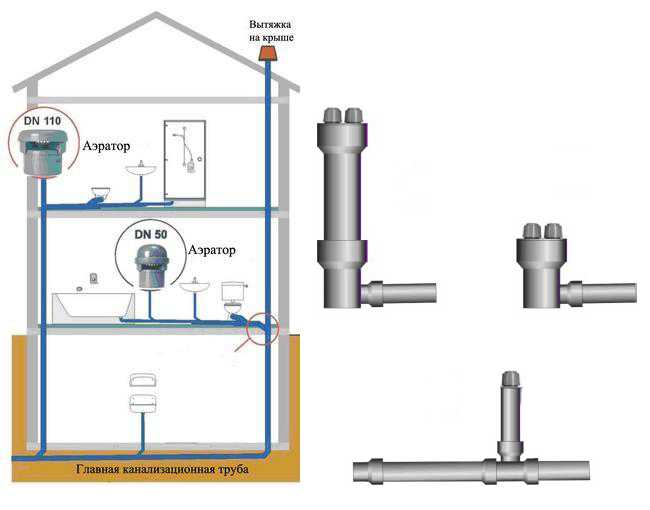
Requirements for a vented valve (aerator)
The installation of vented valves for sucking air into the system (Figure 5), which guarantees the normal operation of the sewer, is carried out on the basis of appropriate calculations. The throughput of the aerator must correspond to the design parameters of the throughput of the riser. In turn, the liquid flow through the riser depends on its diameter, type (ventilated / non-ventilated) and height.The calculations also take into account the diameter of the dictating floor outlet (with the highest flow rate), the angle of fluid entry through it, the height of the hydraulic seals and other initial data.
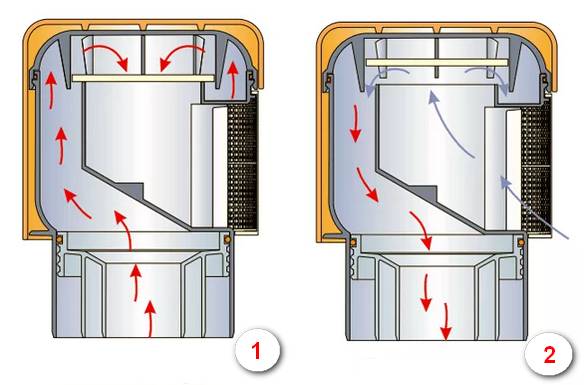
Figure 5. The principle of operation of the aerator - air sewer valve:one. In the working position, the valve is closed - air from the sewer does not enter the room.2. When a vacuum occurs in the sewer riser, the aerator valve opens, the missing amount of air enters from the room, preventing the hydraulic seal from breaking.
In a simplified form, it is possible to coordinate the throughput parameters of the aerator and the ventilated riser using tabular selections. Initially, you should refer to Appendix "B" of SP 40-107-2003 for the installation of internal sewerage from polypropylene pipes. It is to him that SP 30.13330.2012 refers to determine the characteristics of the aerator.
Table 1. Capacity of a riser made of polypropylene pipes ∅110 mm equipped with a ventilation valve with an air flow area of 3170 mm2 and 1650 mm2.
| Floor outlet diameter, mm | Angle of fluid entry into the riser, ° | Riser capacity, l/s | |
|---|---|---|---|
| 1650 mm2 | 3170 mm2 | ||
| 50 | 45.0 60.0 87.5 | 5.85 5.10 3.75 | 7.7 6.8 4.54 |
| 110 | 45.0 60.0 87.5 | 4.14 3.64 2.53 | 5.44 4.8 3.2 |
Next, you should find out the sewerage consumption parameters with similar initial data. For ventilated risers, they can be gleaned from tables 6-9 (SP 30.13330.2012).
Table 2. Capacity of ventilated risers made of polyvinyl chloride (PVC) pipes (SP 30.13330.2012 (table 7)).
| Outer diameter of floor outlets, mm | Angle of connection of floor outlets to the riser, ° | Throughput, l / s, risers with pipe diameter, mm | |
|---|---|---|---|
| 50 | 110 | ||
| 50 | 45 60 87.5 | 1,10 1.03 0.69 | 8.22 7.24 4.83 |
| 110 | 45 60 87.5 | 1,10 1.03 0.69 | 5,85 5.37 3.58 |
This also takes into account the diameter of the floor outlet and the angle of its connection.From the tables it becomes clear that, for example, for one of the most popular PVC pipes today Ø 110 mm with a branch Ø 110mm / 45 (bracket for connecting the toilet), the second throughput of the riser will be 5.85 l / s. This indicator turns out to be somewhat higher than with similar geometric parameters of the sewerage system with an air valve (5.44 l / s (Table 1)).
Mounting Features
Installation is carried out in the following sequence:
- Begin to collect elements at the bottom of the contour. Connect with a tee, one hole of which is directed upwards.
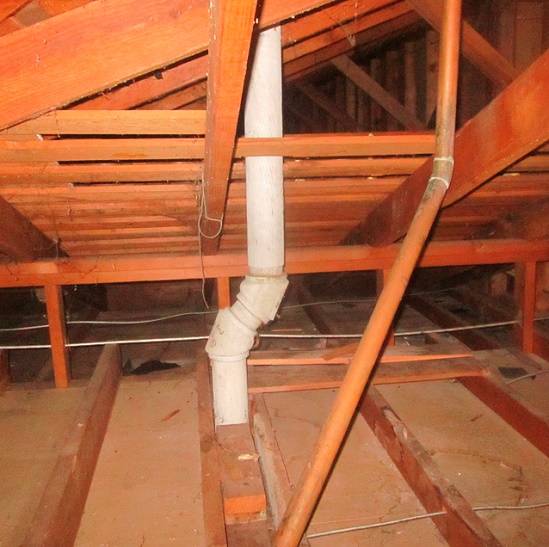
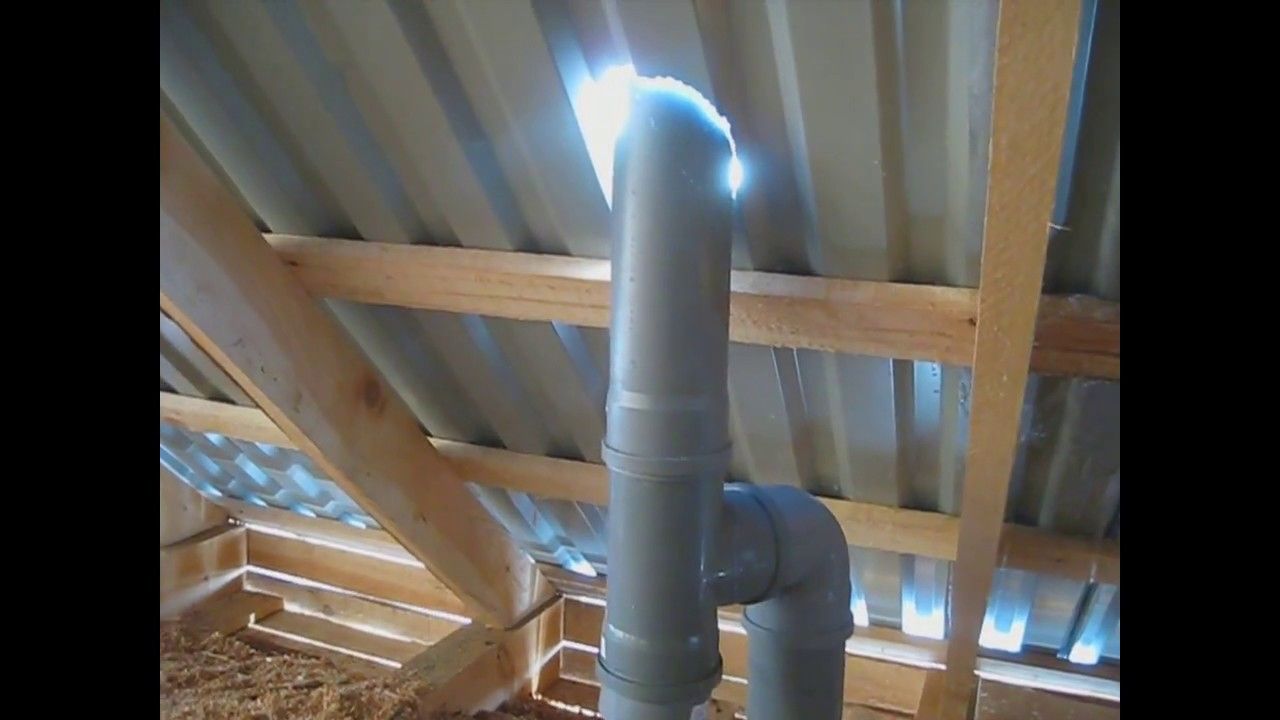
- An element of the fan pipe is inserted into the opening of the tee, the joint should be located above the attic floor.
- The junction is isolated with silicone sealant.
- Every 1.5 meters, the pipeline is fastened to the wall with clamps.
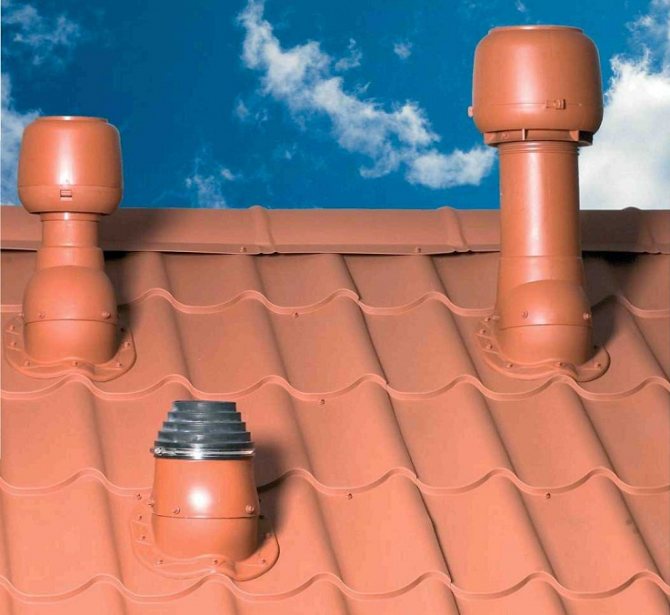
The fan pipe, as part of the riser, is displayed on the roof. On a pitched roof, it should protrude 0.5 m above the ridge, if the roof is in use, the distance increases to 3 m.
Fan ventilation design principles
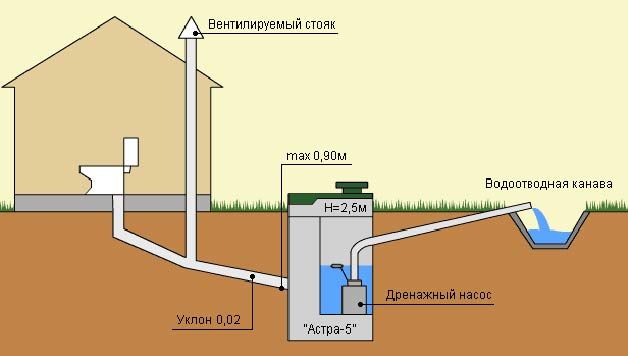
Project of a sewer system with a ventilated riser
When designing fan ventilation, two main requirements should be followed:
- The diameter of the exhaust pipe must not be less than the diameter of the sewer riser.
- The outlet of the fan pipe is carried out in the direction from which the unpleasantly smelling gases will be carried away by the wind.
As a rule, the installation of a fan riser consists in supplying a pipe to the ventilation duct. If this is not possible, the outlet pipe can be routed through the wall (also find out which bathroom better - acrylic or cast iron).
Fan ventilation equipment
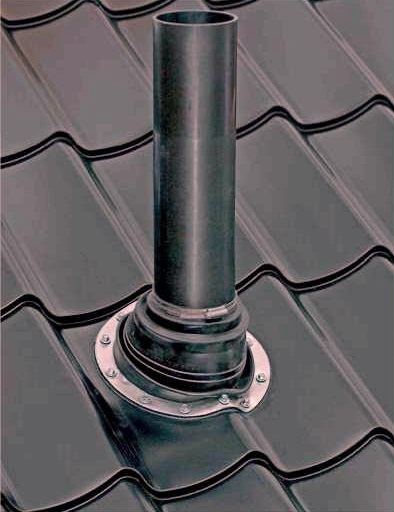
Exit of the vent pipe in the roof
Fan ventilation may include the following elements:
- Fan pipes;
- Connecting pipes;
- Ventilation channel;
- Fitting.
Fan ventilation installation tips
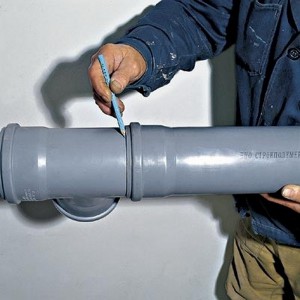
Do-it-yourself fan ventilation installation
- The diameter of the exhaust pipe must be equal to the diameter of the riser from which it removes gases.
- For a fan hood, you can use both plastic and cast iron pipes. Fittings are selected according to the pipe material.
- If you plan to use a combination of materials (for example, a plastic fan pipe will be installed on a cast-iron riser), then a rubber adapter should be used.
- If you need to connect several fan pipes, tees with an angle of 45 or 135 degrees are used.
- Horizontal sections of fan pipes are laid with a slope, which must be at least 0.02% and be made in the direction of gas flow.
- If it becomes necessary to change the direction of the vent pipe, then it can only be done above the last device connected to the ventilated riser.
- Changing the direction of the pipe is carried out by installing fan bends with an angle of 135 degrees.
The fan riser itself must meet the following requirements:
- The outlet of the pipe must be carried out above the roof at a distance of at least 0.3 meters from the roofing.
- If the house has a used attic space, then the height of the output should be increased to three meters.
- The distance from the outlet of the fan pipe from the balcony or window closest to it must be at least four meters.
- The riser itself must pass through "warm" rooms or be insulated.
- When using plastic pipes, metal sleeves should be used to organize the output through the ceiling.
- It is forbidden to organize fan ventilation and a chimney in one channel.
- If there are several sewer risers in the house, then the fan pipes can be combined into a single hood so that there is only one outlet on the roof.
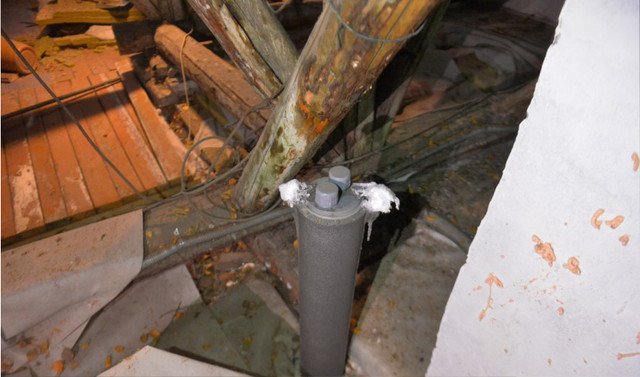
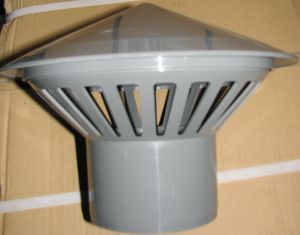
- In the upper part of the fan pipe, a cover with a mesh should be installed, which will protect the system from the penetration of insects and rodents.




Typical mistakes when installing fan ventilation
fan fungus
- Some owners of private houses, not wanting to bother with organizing the connection to the pipe on the roof, consider it possible to cut the fan pipe in the attic.
Such a solution is fraught with the accumulation of gases under the ceiling and their penetration into the premises of the upper floor. - It is undesirable to mount the fan pipe on an external wall, as this solution will lead to problems with the formation of condensate.
- Some homeowners, in an effort to improve draft in the fan pipe, install a weather vane instead of a protective fungus at the outlet. Such a solution does not give the desired effect and, on the contrary, can worsen the outflow of gases and there will be a problem with the smell of sewerage in the bathroom.
Conclusions and useful video on the topic
Thoughtlessly bringing ventilation to the attic is not a good idea:
Device guide ventilation components in a gable or gable roof:
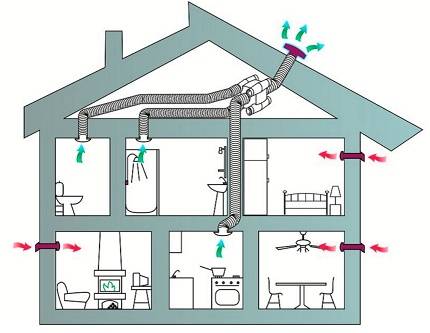
Features of the device and the operation of natural ventilation in the attic:
Properly organized ventilation in the attic floor and in the unheated attic space will provide a standard microclimate in the residential area and extend the service life of the structures.
However, when bringing all ventilation components to the attic, building rules must be observed.Along with the exhaust air, condensate must be fully removed, from which elements made of wood and metal actually suffer equally. From moisture, they lose their bearing capacity.
Tell us about how and how they brought ventilation through your own attic or attic. Share useful information on the topic of the article that will help interested site visitors. Please leave comments in the block below, post photos on the topic, ask questions.
Pros and cons of roof ventilation
In your case, combining pipes into one common riser suggests itself. This is a good decision. But the output only to the attic is not worth doing. Although you will not use it (judging by the size), the whole space stinks with the “aromas” of the sewer and, most likely, the smell will also be felt on the attic floor.
Such an installation is harmful to your roof. From the riser will blow warm moist air, which will begin to settle on the internal under-roof structures with non-weak condensate. So all the wood will become damp and gradually covered with fungus. And in winter, the settled moisture is transformed into icicles and ice. Therefore, if you bring ventilation, then it is on the roof.
For normal ventilation, a pipe of 20-30 cm is enough. The higher you raise it above the roof, the faster it will freeze, because the air is warmer inside, and the temperature difference will lead to the formation of an ice plug. For the same reason, wind vanes and deflectors are not placed on the pipe, which prevent the exit of warm air. You should not be afraid that the low height of the pipe will be covered with a snow cap in winter.Due to the release of warm vapors, the snow in the hole will still thaw, creating a kind of funnel through which your sewer can “breathe”.
Be sure to check how far your pipe will be from the ventilation outlets and windows of the attic floor. You should not put it close, because it can suck all the smells into the house with a reverse draft.
If your drain pipe is on the opposite end of the roof, away from the ventilation systems, then sewer smells will not be drawn back into the house.
The option with air valves for a private house is also acceptable, especially if you only have one bathtub. Simultaneous draining in both toilets will not give such a strong flow of water to disrupt the water seals, so VK can be installed. But if you have your own septic tank, then the smells of the sewer without a fan pipe will be heard near it. In addition, the valves do not last forever, and if they fail, then sewer aromas will reach the house until you replace the failed part. And it happens that the owners leave for a long time, and the odor-blocking siphon has time to dry out. Imagine how the house will be saturated with the stink until the family returns from a long journey! It is very difficult to get rid of these odors.

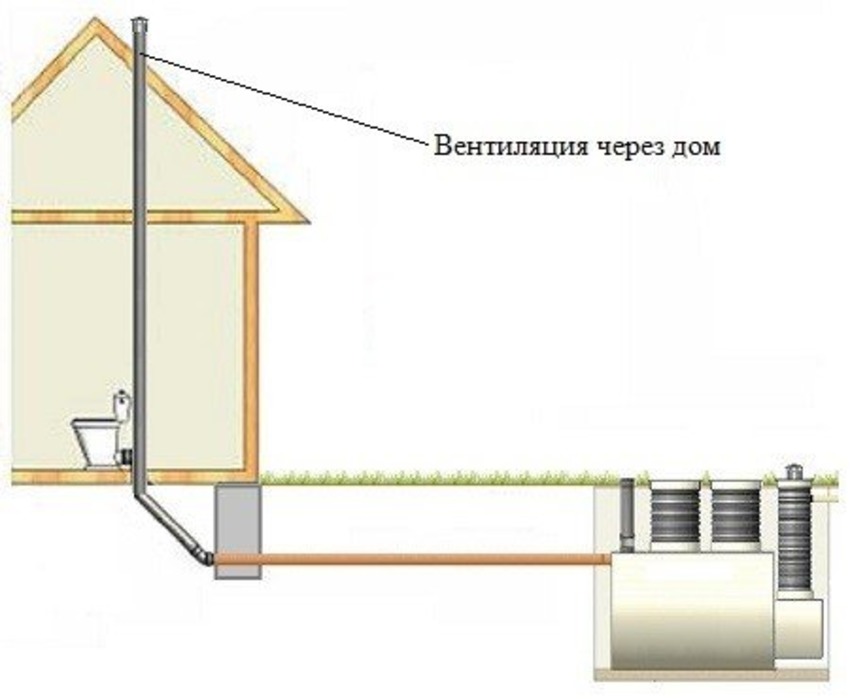
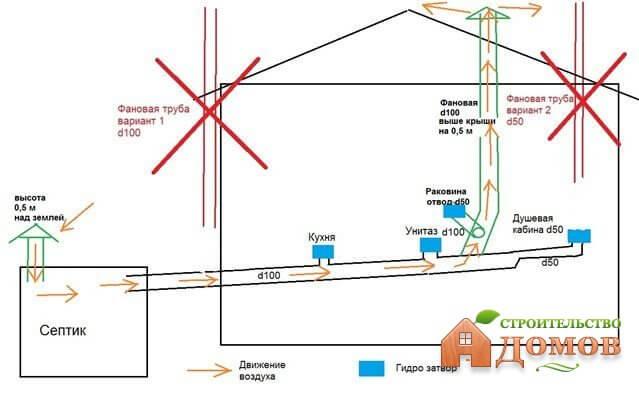


A fan pipe is a more reliable option. As they say, set it once and forget it forever.



