
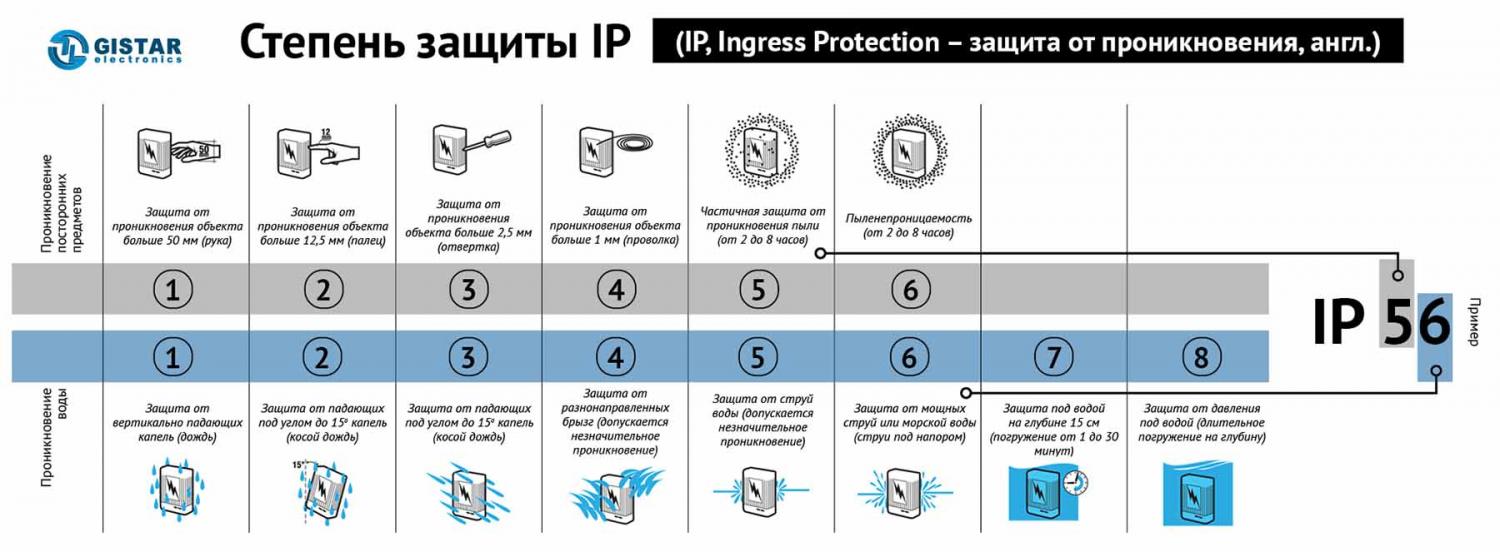
- IP rating table
- Application in everyday life
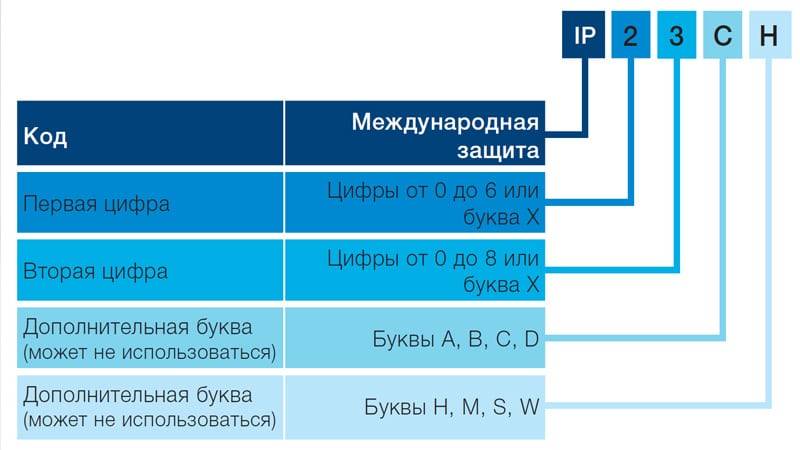
- Decoding the degree of protection
- First digit
- Second digit
- Additional letters
- Which devices to choose
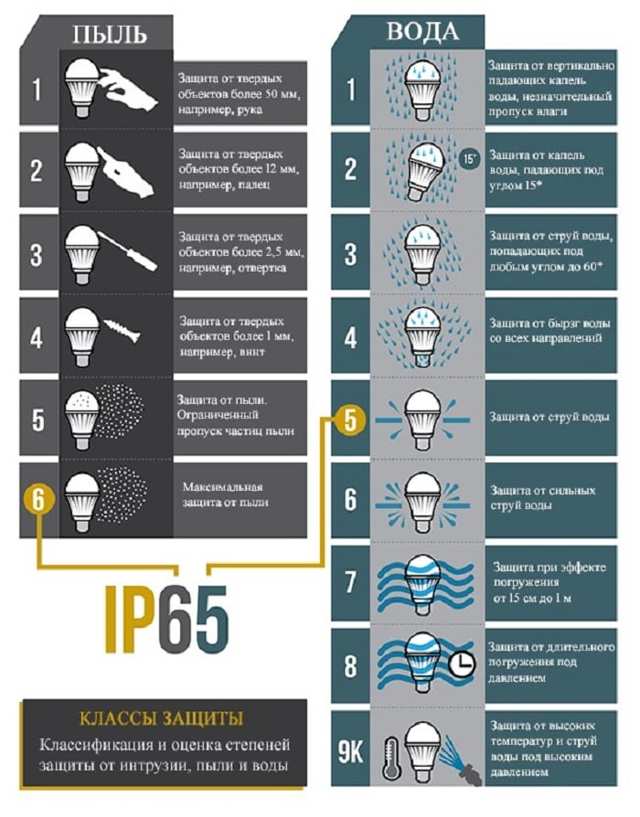
- Decryption: IP65
- Table of codes
- Solid body protection
- Protection against water ingress
- Additional and auxiliary designations
- How to decipher IP44, IP40 characters
- IP definition
- Protection class letters
- Deciphering the first letter
- What does the second letter mean?
- Protection of electrical installations according to IP classification
- What is the point?
- Complement letters
- What is the degree of IP protection
- What class of protection of electrical equipment to choose for the house
- Indicators: degree of protection IP65
- Extended German Standard
- Degree of protection according to PUE and GOST
- Deciphering the numbers on the labeling of products
- The first digit on the device
- The second digit of the marking
- Symbol table
- IP for electrical devices
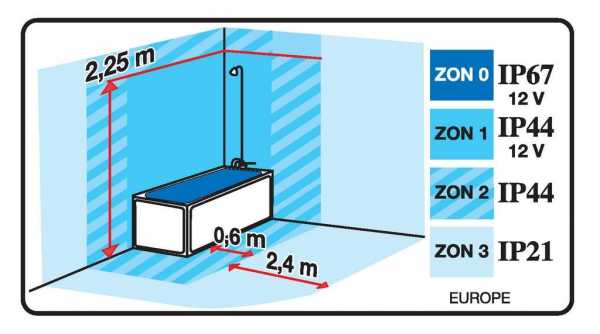
- Electrical safety in the bathroom: IP class
IP rating table
The degree of protection is marked with the IP protection mark and two digits:
» The first digit is the protection against solid objects
| No protection provided | ||
| Hand penetration protection | Protection against the penetration of solid objects with a diameter of more than 50 mm | |
| Finger protection | Protection against finger contact with current-carrying parts and against penetration of solid objects with a diameter of more than 12 mm | |
| Tool penetration protection | Protection against contact of a tool, wire or similar object with a thickness of more than 2.5 mm to live parts. Protection against penetration of solid objects with a diameter of more than 2.5 mm | |
| Protection against the penetration of solid granular particles | Protection against contact of a tool, wire or similar object with a thickness of more than 1.0 mm to live parts. Protection against penetration of solid objects with a diameter of more than 1.0 mm | |
| Protection against dust accumulation | Complete protection against contact with live parts and against harmful accumulation of dust. Some penetration of dust is allowed in quantities that do not affect the operation of the luminaire | |
| Dust protection | Complete protection against contact with current-carrying parts and against the ingress of dust |
» The second digit is the protection against water penetration.
| No protection provided | ||
| Protection against vertically falling drops | Vertically falling drops have no harmful effect | |
| Protection against drops falling obliquely at angles up to 15 degrees from the vertical | Water drops have no harmful effect | |
| Rain and spray protection | Drops of water falling obliquely at angles up to 60 degrees from the vertical do not have any harmful effects. | |
| Splash protection | Spray from any direction has no harmful effect. | |
| Protection against water jets | Jets of water shot from a nozzle and falling from any direction have no harmful effect. Nozzle diameter 6.3 mm, pressure 30 kPa | |
| Protection against water jets | Jets of water shot from a nozzle and falling from any direction have no harmful effect. Nozzle diameter 12.5 mm, pressure 100 kPa | |
| Waterproof | Protection against water ingress during temporary immersion in water. Water does not cause damage to the equipment at a certain depth and time of immersion. | |
| Hermetically sealed waterproof | Protected against ingress of water when permanently immersed in water. Water does not cause damage to equipment under given conditions and unlimited immersion time. |
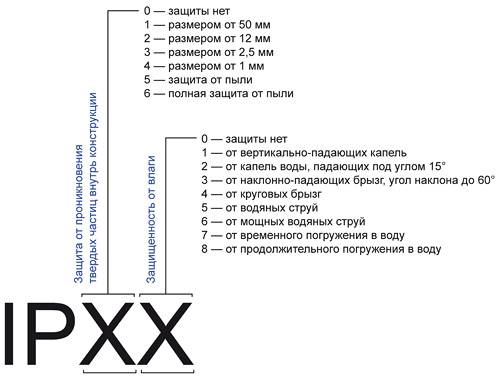
In addition to numbers, additional and auxiliary letters may be present in the marking. An additional letter indicates the degree of protection of people from access to dangerous parts and is indicated if:
- the actual degree of protection against access to dangerous parts is higher than the degree of protection indicated by the first characteristic numeral;
- only protection against the harmful effects of water is indicated, and the first characteristic numeral is replaced by the symbol "X".
| The back of the hand | High voltage equipment | ||
| finger | During testing of water protection, the device worked | ||
| Tool | During testing of water protection, the device did not work | ||
| wire | Weather protection |
Application in everyday life
IP20 class devices and below must only be used in closed rooms with normal humidity. Such equipment must be low voltage and properly grounded for safety.
The bathroom, bathroom or kitchen in the house is characterized by high humidity and the possibility of water jets. According to the requirements of the standards, electrical equipment must comply with a class of at least IP66, and preferably several IP66 / IP67 classes at once, which ensures safety both when hit by water jets and when immersed in liquid.
The same requirements apply for the use of equipment outdoors.In other rooms, IP44 and even IP41 equipment is allowed.
Decoding the degree of protection
The marking involves numbers from 1 to 9, and an increase in the serial number of the code indicates an increase in the degree of protection. Ingress protection, according to the classifier, ranges from IP00, when the structure is completely unprotected, to IP 69 with the maximum level of security.
If no tests have been carried out for any parameter, then the manufacturer is obliged to inform the consumer accordingly, that is, to reflect in the marking, putting the “x” sign, for example, IP5X.
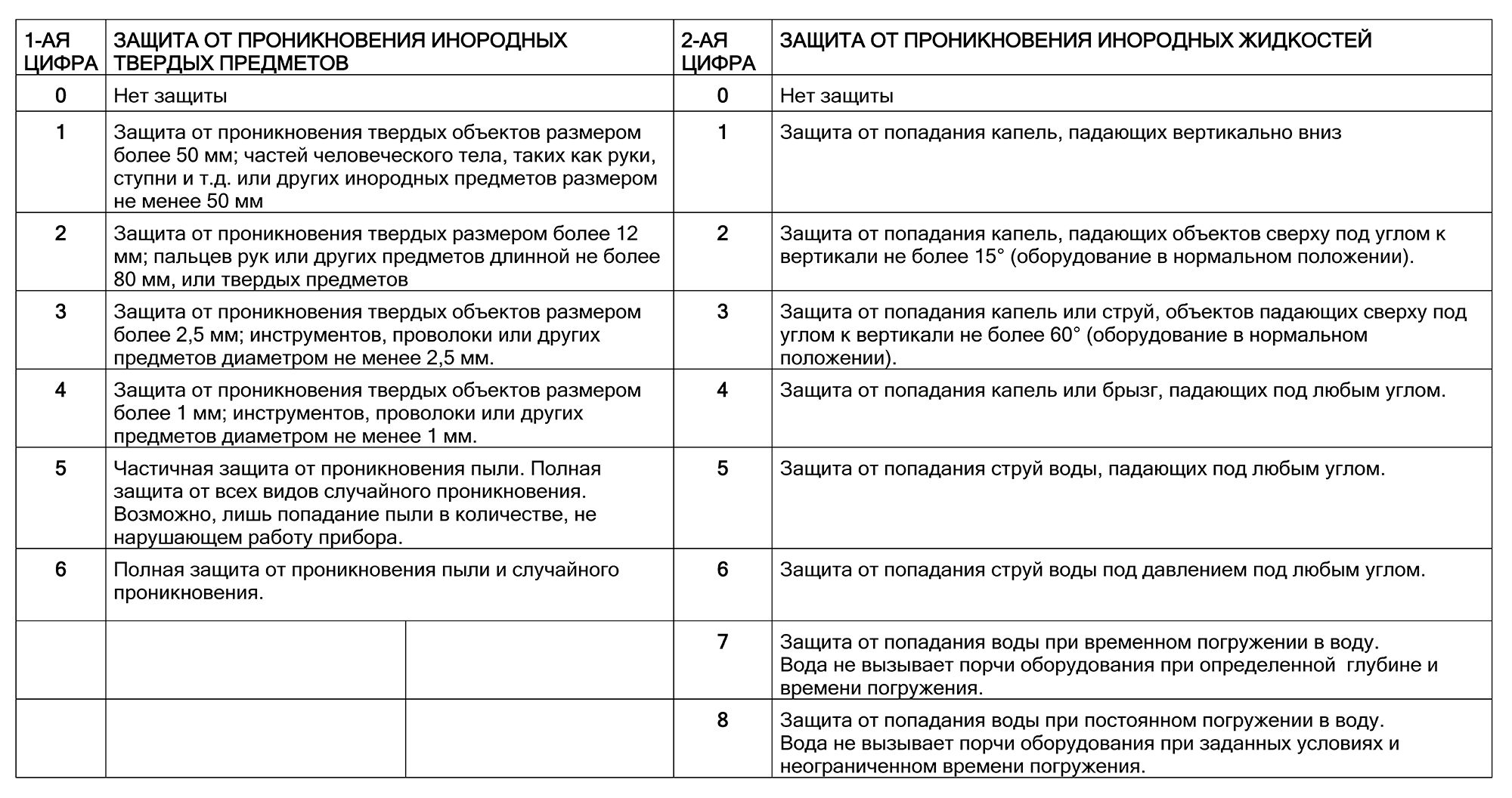
First digit
The first character characterizes the protection against dust and mechanical objects. The higher the number, the more resistant it is to smaller objects:
- 0 - complete lack of protection;
- 1 - protection against accidental touches, hitting large objects (50 mm), lack of protection against conscious exposure;
- 2 - protection against contact with fingers and objects larger than 12.5 mm;
- 3 - it is guaranteed that tools, cables and particles larger than 2 mm cannot get in;
- 4 - the impossibility of getting wires, fasteners and particles larger than 1 mm;
- 5 - partial protection against dust ingress, which does not affect the performance of the device;
- 6 - full guarantee against dust ingress.
The sixth class guarantees complete protection against any possible contact of parts of the human body with the elements of the device.
Second digit
The second digit of the marking carries broader information, since it guarantees protection from moisture (drops, splashes), immersion in water. Normal functioning is ensured both during interaction with adverse factors and after that.
Important! Water resistance and water resistance have different meanings, with the second property providing greater reliability. Waterproof watch
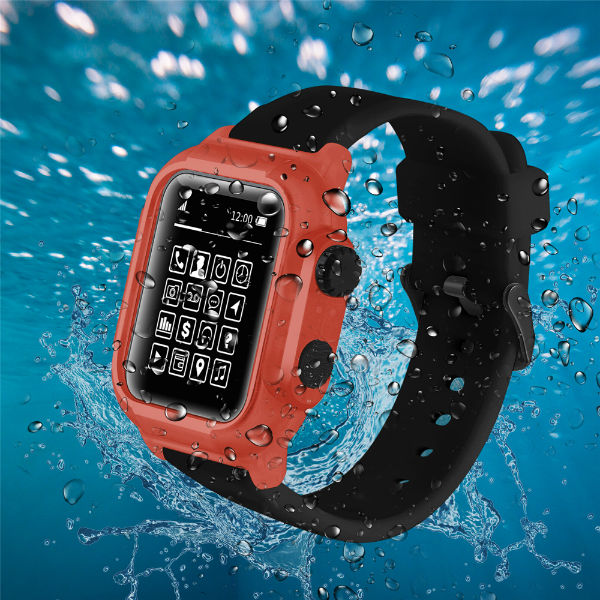
In this case, the classification is complicated by the fact that water splashes can fall on the device from any direction, respectively, the protection must ensure the operability of the devices in all situations. The class table looks like this:
- 0 - no protection;
- 1 - normal operation of the device when vertical drops of water hit;
- 2 - operation of the device when the drops are deflected at an angle of up to 15⁰;
- 3 - protection against rain splashes at an angle of up to 60⁰ to the vertical;
- 4 - splashes from any direction are allowed;
- 5 - protection from continuous jets of water;
- 6 - improved protection against jets (strong jets are allowed);
- 7 - normal operation during short-term immersion in water to a depth of 1 m;
- 8 - normal operation with a duration of stay in water up to half an hour at an immersion depth of up to 1 m;
- 9 - protection against high-temperature high-pressure water jets.
According to the data given, the highest and most common degree of protection is provided for equipment of class ip 68. IP 69 devices are used in car washes and similar enterprises. For domestic use, the ip67 class is quite enough, since according to the degree of protection ip67, the decryption should mean:
- the case of the device guarantees the impossibility of dust getting inside;
- Accidental immersion of the device in water will not impair function.
Note! The above classification does not have a position that guarantees the operability of the structure when it is in the water for one hour or more. This requirement is met by following the standards for military equipment.In addition, such standards provide for a higher degree of reliability when exposed to physical loads (shocks, accelerations)
In addition, such standards provide for a higher degree of reliability when exposed to physical loads (shocks, accelerations).
Additional letters
In the event that the degree of protection is increased compared to the classification, or does not fall under the classification (the first digit X), then an alphabetic character can be added after the digital designation:
- A - protection against touching the back of the hands;
- B - protection against touching with fingers;
- C - the impossibility of touching the tool;
- D - the impossibility of hitting the wire;
- H - a symbol for the designation of high-voltage equipment;
- S - operation of the device during water resistance tests;
- M - turn off the device for the duration of the test;
- W - resistance to other weather conditions.
Note! The classification has the disadvantage that devices that can withstand immersion in water may be poorly protected against the ingress of water jets. Therefore, for structures that fall simultaneously under several classes, double marking is allowed, which is indicated through a fraction sign, for example, IP65 / IP68
Which devices to choose
It all depends on where exactly they will be used. For industries in which there are special conditions (dustiness, humidity, explosion hazard), equipment of the recommended class should be used. For the home, you can get by with inexpensive options.


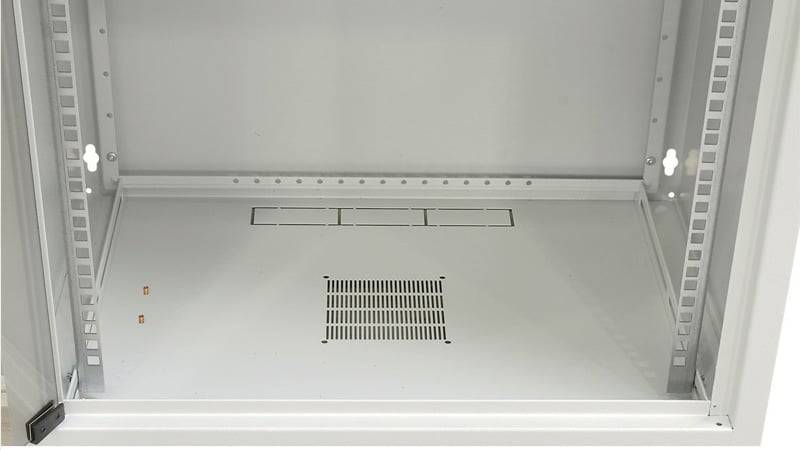 Box for installation of unprotected devices
Much depends on where exactly the device will stand - outdoors or indoors:
In dry rooms heated in winter (house, apartment), devices of the 20th class can be installed. You already know that this is the degree of protection IP20 and you will be able to decipher this parameter
But installing IP20 sockets in a bathroom or sauna is not recommended, since the humidity in these rooms is still high and there is a possibility of contact with water.
If you want to install a lamp or socket in a cellar or basement with high humidity, then pay attention to the IP44 rating (you can also choose more protected options).
If you select sockets or a lamp for a bath (sauna), then choose IP54 and higher devices.
IP68 rated luminaires are suitable for creating landscape lighting, pond or pool lighting.
When installing sockets or lamps on the street (not under the roof), you should choose IP54. They reliably protect the equipment from outside interference and moisture.
For dusty places (warehouses, workshops) it is also recommended to use IP54
Decryption: IP65
The IP65 marking is the most favorable and exploitable characteristic of the security of devices, since today most household appliances are such, which are often subject to many destructive circumstances coming from outside. Such items are convenient, durable, endowed with the quality of long-term functioning, and it’s also not scary to accidentally fill them with water, since this will not entail significant violations.
Detailed explanation of indexing
- The number 6 after the IP marking is an indicator of the penetration of external objects and dust. Since today there are only 6 levels, this one is the maximum.
- The number 5 is an indicator of the retention of performance in a collision with water.
There are 8 levels in total, so 5 is enough protection for contact with a small amount of water without strong pressure.
Table of codes
To understand the meaning of the IP index, you need to familiarize yourself with the decoding of each class. Further, it is given separately for the 1st digit (protection against solid bodies) and for the 2nd (against moisture).
Solid body protection
It is convenient to present the data in the form of a table.
Class
Minimum diameter of solid particles, the penetration of which is not allowed, mm
Description
–
No protection, current-carrying parts are completely open
1
50
Careless touching of current-carrying parts with the back of the hand, forearm, elbow, etc. is excluded.
2
12,5
Touching current-carrying parts with fingers and objects similar in size is excluded
3
2,5
Internal parts are inaccessible to tools, cables, etc.
4
1
Even the thinnest wires, small hardware, etc. will not get inside.
5
Sand
Only fine dust can get inside the case. Touching live parts even with the thinnest tool is completely excluded
6
Dust
The housing is impervious to even the finest dust. Devices with class "0" are allowed to operate only if installed in any shell.
Devices with class "0" are allowed to operate only if installed in any shell.
Protection against water ingress
The data is also summarized in a table.
| Waterproof class | Under what influence of water protection is effective | Comment |
| No protection | The device must not be exposed to water in any form. Installation - dry room only | |
| 1 | vertically falling drops | — |
| 2 | Drops falling at an angle up to 150 to the vertical | In fact, this means that the device can be rotated relative to the horizontal axis under the falling drops at an angle of up to 150 |
| 3 | Drops with an angle of deviation from the vertical up to 600 | Such devices are no longer afraid of rain and can be installed outdoors. |
| 4 | Spray from any direction | We are still talking about drops, but already falling at any angle. Such equipment is installed, for example, in the bathroom near the washbasin or shower. |
| 5 | A low-pressure jet that shoots from any direction | — |
| 6 | A jet with strong pressure, hitting from any direction | The device can be washed with a water jet. Also, it is not harmed by rolling waves. |
| 7 | Short-term immersion to a depth of 1 m | — |
| 8 | Diving to a depth of more than 1 m for more than half an hour | In fact, this means that the device is designed for operation under water. Example - fountain lighting |
| 9 (given in DIN 40050-9) | Jet with high pressure and temperature | Relatively recently introduced class for equipment requiring thorough washing with hot water: concrete mixers, dump trucks, other road equipment, machines in the food and chemical industries |
 Category "7" and "8" do not inherit the properties of the previous classes. That is, belonging to the 7th type of moisture protection (short-term immersion is allowed) does not mean at all that the device is protected from a directed jet (classes 5 and 6). Similarly, class 9 (high pressure hot jet) does not mean that the device is submersible (classes 7 and 8).
If the equipment is both protected from jets and can work under water, two indices are indicated, for example: IP65/68.
Each class for moisture protection implies a certain category for dust protection. That is, a device protected from splashes (4th class in terms of moisture protection) by itself will not penetrate even solid objects the size of sand (5th class in dust protection).
Additional and auxiliary designations
In some cases, the degree of inaccessibility of live parts for a person is indicated by an additional letter A, B, C or D, affixed after two digits.
Under what conditions are additional designations used:

- the class for protection against penetration of solid objects is not indicated in the marking, that is, instead of the 1st digit, the sign “X” is affixed;
- the actual level of protection against penetration of objects is higher than stated in the label.
The letters mean that contact with live parts is excluded:
- A - the back of the hand;
- B - fingers;
- C - tool;
- D - wire.
For example, according to the test results, the device was assigned to the 1st class of protection against the penetration of solid bodies (up to 50 mm or the back of the hand), but subsequently measures were taken to prevent fingers from getting inside. Write down: IP10B.
Letters can also be additionally written:
- H. Means the ability to connect to high voltage - up to 72.5 kV;
- M and S. Are affixed to equipment with movable elements. “M” means that operating equipment was tested for the level of moisture protection (moving elements moved), “S” - it was tested with stationary elements.
The W symbol indicates the presence of weather protection.
How to decipher IP44, IP40 characters
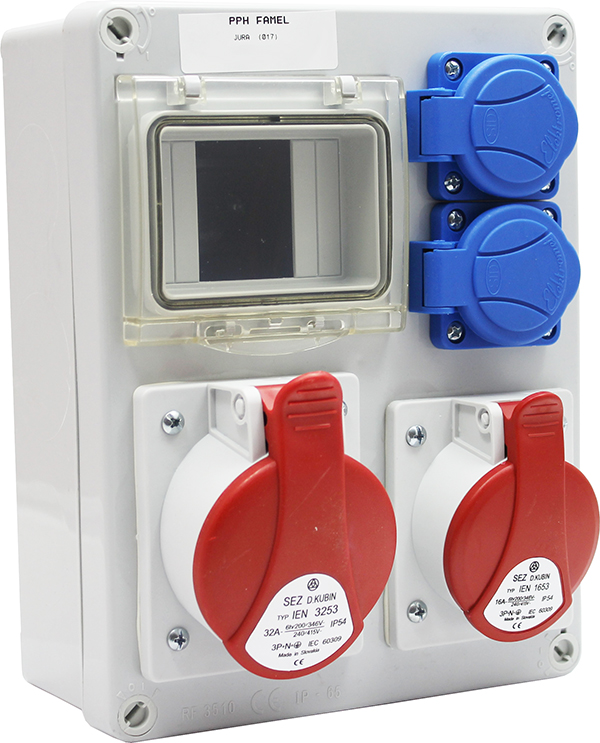
IP44 symbols are often found on table lamps, socket housings, switches and other household appliances. This is the basic marking, which, according to standards, is allowed for use in residential premises. Sockets and switches can be installed in the kitchen and bathroom, with a minimum standard of IP44. On balconies and other rooms with air access, it is necessary to install equipment with IP45.
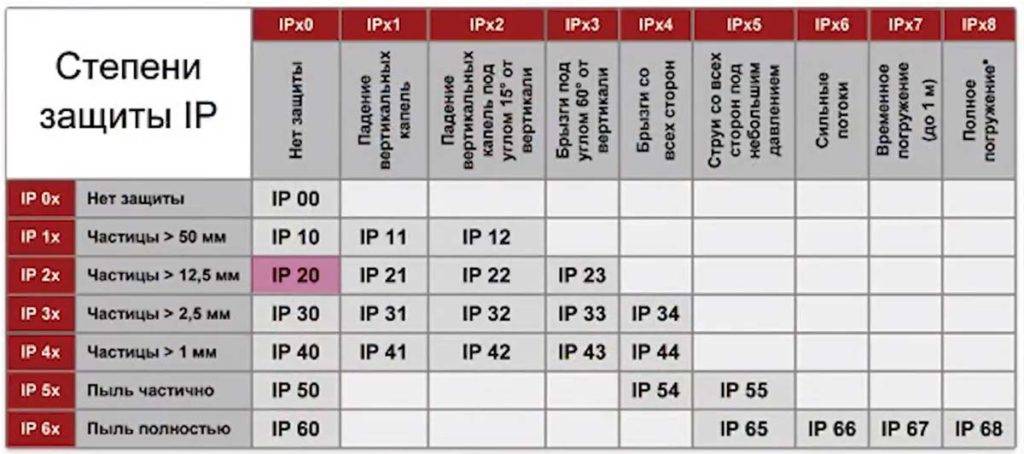

IP40 can often be seen on electrical equipment that is located indoors, completely protected from the ingress of moisture. And also with slight temperature differences, to avoid condensation. Since devices with IP40 are not protected from water at all. Otherwise, it is recommended to use electrical appliances marked IP44.
IP definition
The abbreviation IP in this case means International Protection - “international protection”, in place of XX is a two-digit numeric index. This protection determines the availability of any electrical product for the following external damaging factors:
- solid bodies (human fingers, tool parts, wire, etc.);
- dust;
- water.
Simply put, this is a classification according to the security of shells and cases of various products. It does not apply to internal nodes.
An example of marking may be the following: “Degree of protection IP67”, “Protection class IP54”, and the like. Sometimes the numbers may be followed by a capital letter of the Latin alphabet, which serves as an addition.
Protection class letters
According to the standards adopted in GOST 14254-96, letters can additionally be used in the designations, which are placed after the numbers. To determine the degree of IP protection, you need to be able to read the marking, that is, decipher it.
Deciphering the first letter
The symbol immediately after the numbers indicates the access parameters to the internal device of the electrical equipment.
The table provides an explanation of the first and second letter designations indicating the level of protection when touched, permissible use, functional features of the devices (+)
The first alphabetic character after a two-digit number has the following meaning:
- A - the body of such devices creates an obstacle to the penetration of large objects; parts of the device that are energized must not be touched with the palm of your hand;
- B - the shell of the device does not allow the user to touch the current-carrying elements with his finger;
- C - reliable protection makes it impossible for the conductors to contact with a screwdriver, wrench and other tools;
- D - a perfectly fitted casing prevents access to the device by a needle or thin wire.
As an example, consider the marking IP20B. The device on which it is applied does not have any protection against moisture; it cannot be penetrated by an object whose thickness is more than 12.5 mm.
What does the second letter mean?
The next letter symbol used in the marking indicates the possibility of the operation of electrical equipment in special conditions.
The second letter of the marking contains additional information that may be useful to the user (+)
The following Latin letters are used in the marking:
- H - high-voltage device that can withstand voltage up to 72 kV;
- M - the device is able to withstand high humidity while in motion;
- S - moisture does not get into a fixed electrical equipment;
- W - the device has additional safety equipment that guarantees absolute protection against climatic factors: dew, wind, snow, hail, rain, frost.
It is worth noting that the current GOST has abolished the designation “W”, but it may be present in the markings of age equipment.
Protection of electrical installations according to IP classification
This standard defines and classifies the levels of protection for equipment by means of outer enclosures (enclosures) and electrical cabinets. There are also equivalents to this standard adopted by various organizations:
- European Committee for Standards - EN 60529;
- German Institute for Standardization - DIN 40050;
- Interstate Council for Standardization - GOST 14254.
What is the point?
The approach adopted is to classify the degrees of protection using IP codes (International Protection Marking, sometimes the abbreviation is interpreted as Ingress Protection Marking).
Using the IP marker, the level of external protection of the electrical installation from the following external influences is assessed:
- the possibility of penetration of body parts, solid objects and dust;
- moisture intrusion into the protective coating.
Complement letters
Everything is simple here. The letters A to D of the Latin alphabet replace the first digit of the index, but their range does not include dust protection.
- A - protection against accidental contact with the palm;
- B - finger;
- C - from the penetration of the tool;
- D - thin wire, cable or probe.
An example is IP3XD. Here - the third class of moisture protection and protection against wire, X indicates the missing number.
A number of other letters denote some individual nuances:
- H is a high voltage technique;
- M - an apparatus with moving parts that can operate under water;
- S - the same as above, the machine can withstand being under water, but cannot work there;
- W - all-weather version;
- K - hot water supplied under pressure (some types of washing).
Knowing this classification, you can easily choose the right equipment for a specific task. The main thing to remember is that it is better to overdo than underdo.
What is the degree of IP protection
A significant amount of electrical equipment and some other electrically powered devices have an enclosure that protects against the ingress of solid objects/dust and water/moisture. The degree of this protection is checked during tests, the results are displayed in the form of two numbers that follow the Latin letters IP.
The numbers following the letters IP indicate the degree of protection. The first digit shows how much the case protects the "insides" from dust or other large objects. The second is the degree of protection from moisture ingress (water jets, splashes and drops).
The general form of recording the protection class of electrical equipment
In some cases, this formula is supplemented by two Latin letters that describe auxiliary characteristics. This part is optional and only appears in certain situations.
The degree of IP protection is important when choosing electrical appliances (lamps, heaters, etc.) and electrical installation products (sockets, switches) that will be operated in conditions of high humidity (bathrooms, baths, saunas, swimming pools, etc.) and / or in places with a lot of dust (outdoor installation, garage, workshop, etc.).
What class of protection of electrical equipment to choose for the house
For rooms where water is not used (bedrooms, living rooms), standard sockets, lamps and switches of class IP22, IP23 are usually sufficient. There will be no moisture there, and there will be no direct contact with current-carrying parts either. In the children's room, it is advisable to install sockets of a class of at least IP43 with a special cover or curtains.
For the kitchen, bathroom - rooms where there is water, splashes, the IP44 class is suitable for both sockets, switches, and lamps. Also suitable for sanitary facilities.On balconies, loggias there is dust and moisture. It is recommended to install electrical equipment of at least IP45 and IP55 class. When the house has a basement, it is also recommended to install electrical equipment there at least IP44 class.
Indicators: degree of protection IP65
In fact, the most common level of resistance to electrical and other objects is the IP65 protection level. As we can see from the characteristics, such things have extremely high isolation from the influence of dust, and are also able to withstand significant water sprinkling.
Description of equipment with IP65 rating:
- Absolute resistance to all penetrations of solid particles of the environment and dust, as evidenced by the highest possible index of 6.
- Sufficiently high resistance to penetrating moisture, up to withstanding jets and light water pressure of this type (index 5).
- Such products are intended for operation in an open environment, which exposes them to all atmospheric phenomena, including rain.
It is this degree of IP that is the most used, since it belongs to the category of the highest quality in terms of protection. Examples include most mobile phones, protective cases for various applications, lamps, a cable or conduit for electrical wiring, and many others.
Extended German Standard
There is also the German standard DIN 40050-9, which provides for an increased level of protection IP69K, which indicates the possibility of high-temperature washing.
Appliances marked with this marking are not only completely dust-tight, but also withstand the extreme combination of hot water and high pressure.
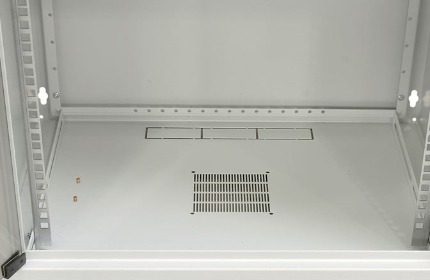
To protect devices with a zero class of protection against water vapor, special boxes are used, the design of which prevents moisture from entering.
Initially, this level of protection was used to mark special vehicles - concrete mixers, trucks, waterers, which need regular intensive washing.
Later, the updated format found application in the food and chemical industries, as well as in other areas of the national economy.
Degree of protection according to PUE and GOST
Before installing electrical equipment, it is necessary to find out its degree of protection in accordance with the PUE, TU or GOST. In other words, you need to decide, for example, which sockets and lamps are allowed in the bathroom.
The PUE is the main document for the safe use of electrical equipment. It displays the rules for electrical installations. Hence the abbreviated name PUE. The rules state that:
- the electrical equipment used must comply with GOST or TU;
- the design, method of installation of electrical equipment and the characteristics of the insulation of wires must meet all the requirements of the PUE;
- electrical equipment and structures combined with it must be protected from negative external influences.
So, we figured out the PUE, and as for other standards, the international index IEC 60529 or GOST 14254-96 just indicate the degree of protection, denoted by IP. This GOST applies to electrical equipment with a voltage not exceeding 72.5 kV. On the territory of the Russian Federation, GOST R 51330.20-99 applies.
Deciphering the numbers on the labeling of products
Electrical appliances may contain different values on the case or in the passport / technical documentation, indicating the safety of their use in certain conditions. Below we will take a closer look at what each of these indicators means.
The first digit on the device
The first digit indicates protection against solid objects.
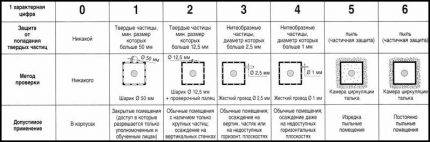 The table deciphers the first digital IP value in detail, and also provides information on the verification method (+)
The notation scale includes indicators from 0 to 6:
- "" - suggests the complete absence of a protective barrier. Dangerous components of the device with such markings are essentially freely available;
- "1" - indicates certain restrictions for the intervention of a solid object whose size exceeds 50 mm, as an example, such a device cannot be penetrated with the back of the hand;
- "2" - indicates the presence of an obstacle for objects whose size exceeds 12.5 mm, which corresponds to the finger of the hand;
- "3" - indicates the impossibility of getting inside the device with the help of locksmith tools or objects with a diameter of more than 2.5 mm;
- "4" - guarantees the protection of the equipment from the ingress of any solid particles, with a parameter > 1 mm;
- "5" - indicates partial dust protection;
- "6" - the highest level of protection; the case of the device reliably protects the internal mechanism from the smallest elements scattered in the air.
Marking 4-6 indicates the impossibility to get to the current-carrying parts of the device with a needle, hairpin, thin wire.
The second digit of the marking
The next digit of a two-digit number is no less important than the previous one. Marking is indicated by numbers in the range from 0 to 8
The possibility of using the equipment in a room where water vapor is contained depends on it.
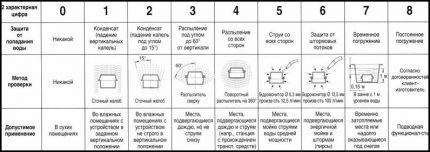 The table shows the meanings of the numbers included in the IP markings, with a detailed explanation and the designation of the determination method (+)
As in the previous case, "zero" means the absence of any protection, essentially open contacts.
Equipment marked with this symbol may only be used in absolutely dry rooms that are well heated in winter.
Explanation of values:
- "1" - assumes protection of the mechanism from water drops falling vertically on the device shell; without getting inside, where the parts are energized, moisture flows from the surface;
- "2" - the body prevents the penetration of water drops falling at an angle of 15 °;
- "3" - a barrier to water drops flowing down at an angle of 60 °;
- "4" - electrical devices with this indicator can be placed under the open sky, since the casing protects the mechanism from light rain and splashes;
- "5" - the shell withstands weak trickles of water, so they cannot get inside;
- "6" - protection against high power water jets;
- "7" - a device of this class can be immersed under water for a short time;
- "8" - the maximum level of protection, for devices with this marking, stable operation under water for a long period is available.
Possible, but optional options for combining numbers with letters.
Symbol table
It is easiest to present information in a tabular form. Let's start with the first number.


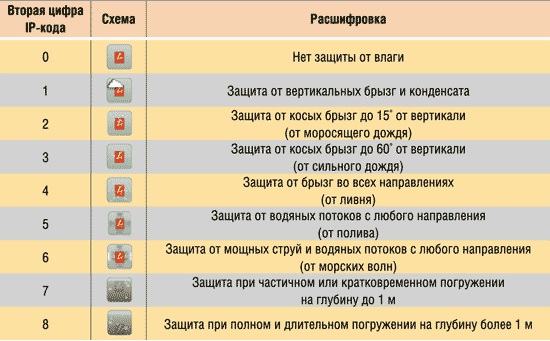
Table 1 - foolproof and dust protection
| Protection class | Objects of protection | Explanation |
| – | There is no protection. | |
| 1 | From objects with a diameter of 50 mm and above. | Back of the hand; accidental touch. |
| 2 | From objects with a diameter of 12.5 mm and above. | Fingers, large bolts. |
| 3 | From objects with a diameter of 2.5 mm and above. | Tools - screwdrivers, pliers, thick cables. |
| 4 | From objects with a diameter of 1 mm and above. | Fasteners, wires and cables. |
| 5 | Dust. | A slight ingress of dust is acceptable, which does not affect the operation of the device. |
| 6 | Dust. | Absolute dustproof. |
Designs with 5 and 6 degrees of safety completely protect their contents from contact with the surface of the human body, even accidental.
Table 2 - water protection
| Class | The degree of danger of water damage |
| There is no moisture protection. | |
| 1 | Drops of water falling strictly vertically. |
| 2 | Water dripping vertically or with a deviation from the vertical up to 15 degrees. |
| 3 | Falling large drops with deflection angle up to 60 degrees. The product is protected from light rain. |
| 4 | Large drops, splashes flying in any direction. |
| 5 | Water jets in any direction. The product will withstand heavy rain. |
| 6 | Sea or river waves (short-term dousing with water). |
| 7 | Short-term immersion to a depth of 1 m. Permanent operation in water is not guaranteed. |
| 8 | Dive to a depth of 1m or more for up to 30 minutes. Protected nodes perform their functions under water. |
| 9 | Long exposure to hot water jets under high pressure, the device withstands high-temperature pressure washing. |
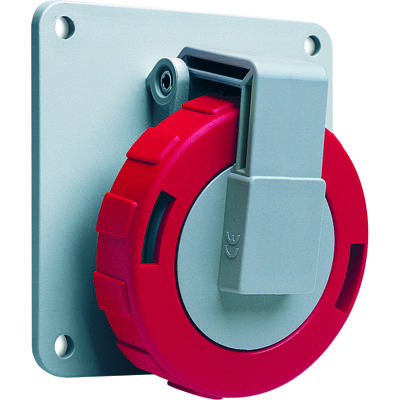
IP for electrical devices
The worldwide abbreviation IP has several possible decoding options: International Protection Marking / international security code, Internal Protection / internal protection, Ingress Protection Rating / degree of protection against interference.
The marking indicates the level of protection of the technical device from the ingress of dust, solid objects, water into it.
The data that characterize the class of the device are found out experimentally using specially developed verification methods.
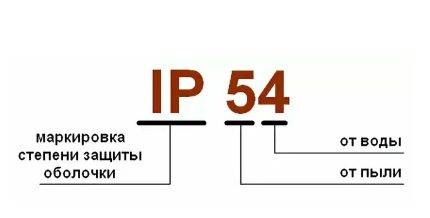 The protection class of any electrical device is marked as follows: a combination of the letters IP and two numbers
To determine the IP level, the international standard EC60529 is used, the analogue of which is GOST 14254-96, as well as the complicated German version of DIN 40050-9.
On the territory of Russia, any equipment that is installed indoors must comply with the PES - rules for the installation of electrical installations, technical specifications - TU, GOST R51330.20-99.
According to the accepted Russian and international classification, the maximum level of protection is marked with the IP68 code.
This designation indicates the complete dust tightness of the device, which is also capable of being in water for a long time, experiencing significant pressure.
In a convenient table, the meanings of two letters are brought together, which are used to indicate the degree of protection IP with a decoding of all the indicators given (+)
The highest degree of security provided by the DIN system is marked as IP69-K; such marks are applied to products that are able to withstand hot water washing carried out at high pressure.
You can find devices that have an indefinite degree of protection. In this case, the digital designation is replaced by the letter "X", that is, the marking will look like "IPX0". Such a designation may also be followed by one or two Latin letters.
Electrical safety in the bathroom: IP class
A high degree of security is especially important for devices that have to operate in difficult conditions.
Such rooms in the house include a bathroom, the air of which contains a high percentage of water vapor.
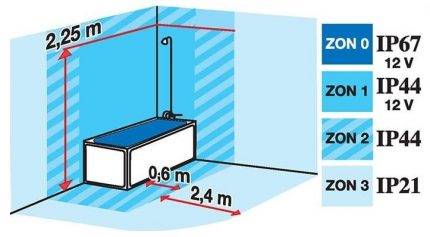 The increased humidity inherent in bathrooms requires particularly careful selection of electrical appliances. In such conditions, it is necessary to use devices with a high degree of moisture protection (+)
Before equipping this room, a plan for the placement of electrical appliances should be developed in advance, taking into account their remoteness from moisture sources.
The highest, almost 100% degree of humidity is observed directly at the shower or bath. In this area, it is required to use low-voltage luminaires with the highest protection levels IP67 or IP68.
The area above the font or shower is also considered quite dangerous: splashes and steam get here in large quantities. Devices marked IP45 are suitable for installation.
If the luminaire is planned to be mounted in the center of the room at some distance from sources of moisture, it is enough to choose an IP24 class option or higher.
For the driest part of the bathroom, a product marked IP22 is recommended. Some degree of protection must be considered due to the background moisture content of the room and the potential for steam release.

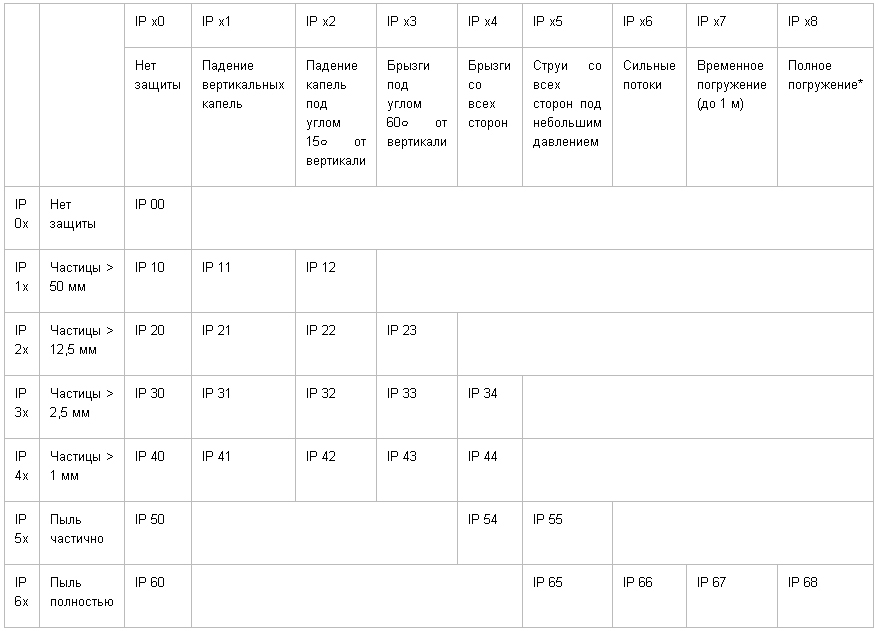


 A combination of letters and numbers indicating the security class is applied to all types of electrical appliances. As a rule, it can be found on the body
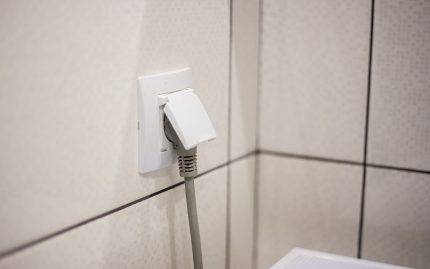
When choosing a waterproof outlet, it is better to give preference to the one with a moisture protection class in the range of 4-6. If it is supposed to be placed away from the shower or the font, marking 4 is sufficient.
At a closer location with possible splashes, the level of protection should be higher - 5 or 6.
To equip a bath or sauna with lamps and / or other electrical appliances, you need to choose electrical accessories of class IP54 and higher.
For more information on arranging a bathroom, see the articles:
- How to choose bathroom fixtures: which one is better and why? Comparative review
- Installing sockets in the bathroom: safety standards + installation instructions



