
- Choosing equipment
- Convector device
- Safety
- What type of heating device is better to choose?
- Convector type heaters: types and features
- The presence of a thermostat in the convector
- Types and characteristics of equipment
- Water
- Electrical
- Prices of electric wall-mounted heating convectors with a thermostat, the cost of floor and universal models
- main parameters
- Mounting method
- Benefits of convectors
- Additional functions
- What does a conventional heating convector look like?
- Electric heater power calculation
- By room area
- By volume
- As an additional source of heating
Choosing equipment
The functional efficiency of the heating system depends on the correct choice of product.
Experts advise users to pay close attention to such nuances:
- type of heating system - autonomous or centralized;
- what temperature do you want to have;
- what temperature was previously in the room, before installing the convector;
- the product will be the main heater or in combination with a centralized heating system;
- the amount of heat from other types of heating located nearby.
Particular attention should be paid to the last item of this list: any equipment used in everyday life emits thermal energy, so its calculation must be done.At the same time, you will save significantly when buying a convector.
Floor-type products are among the most efficient type of heating - they allow you to set the most comfortable climate for living.
Such equipment is popular due to stable safety and high ergonomics, but you need to purchase products from well-known manufacturers that have an impeccable reputation for many years and a guarantee for product quality.
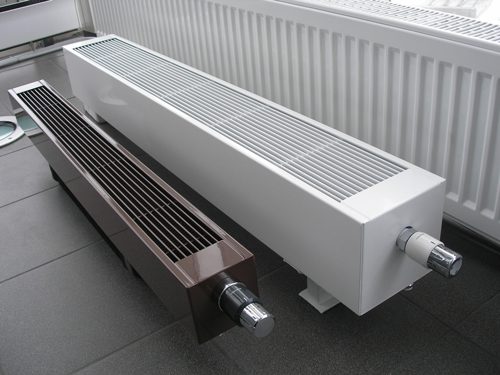
Convector device
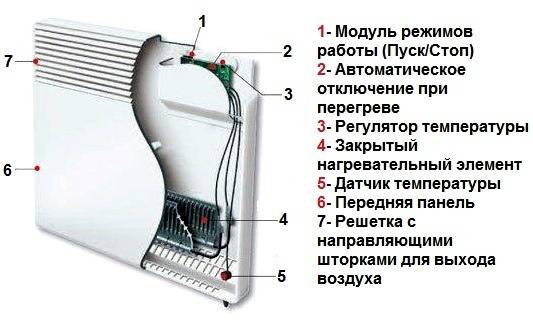
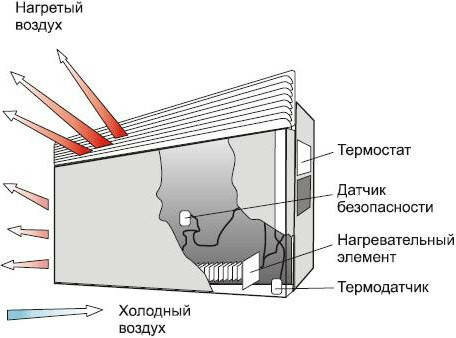
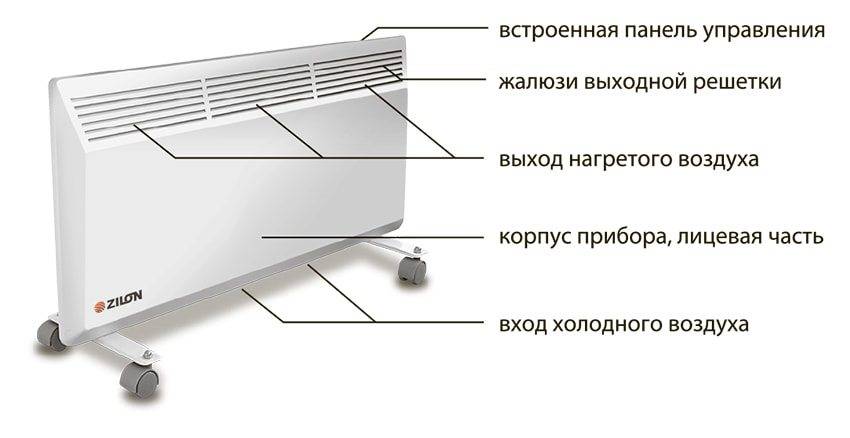
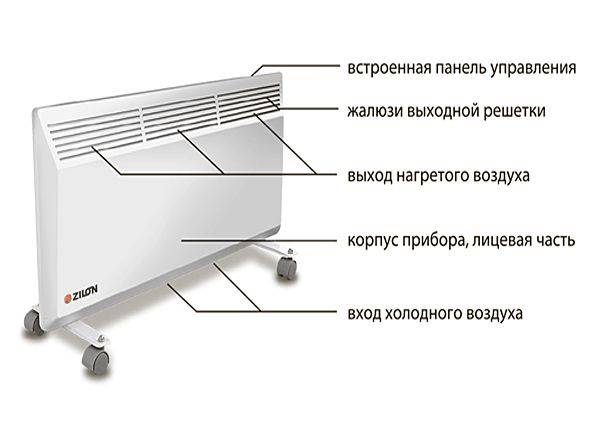
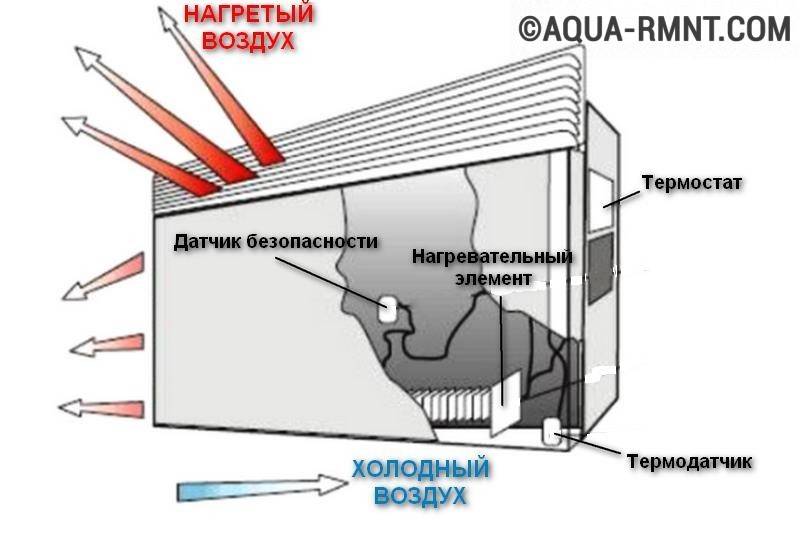
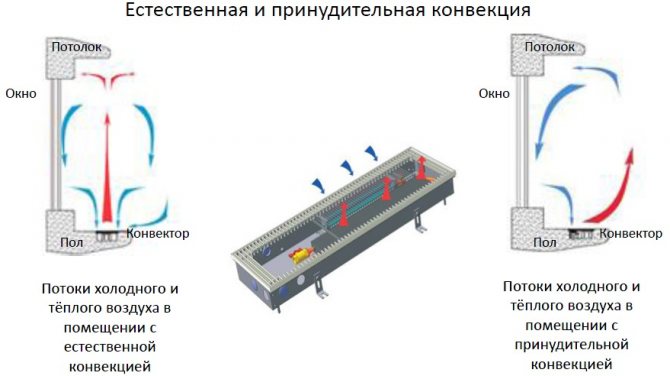
The standard design of a convector of any type is not particularly complex, and is based on a couple of basic elements, which are the heating component and the body. On the body part there are a number of holes through which cold air masses are launched.
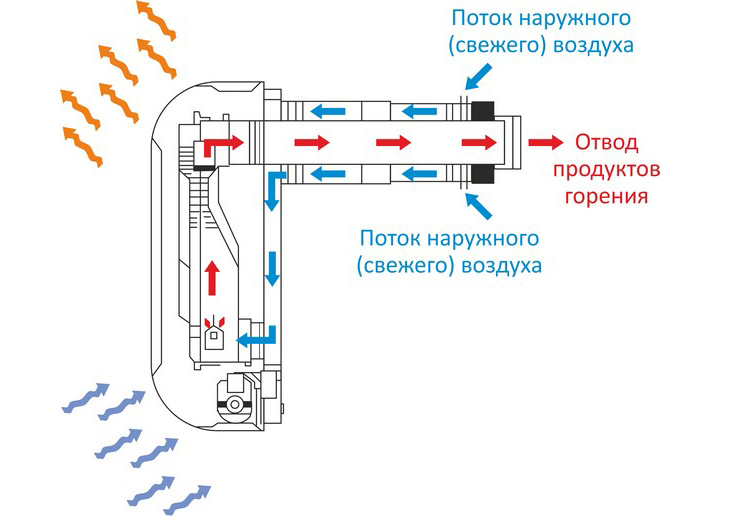
The principle of operation of the gas convector
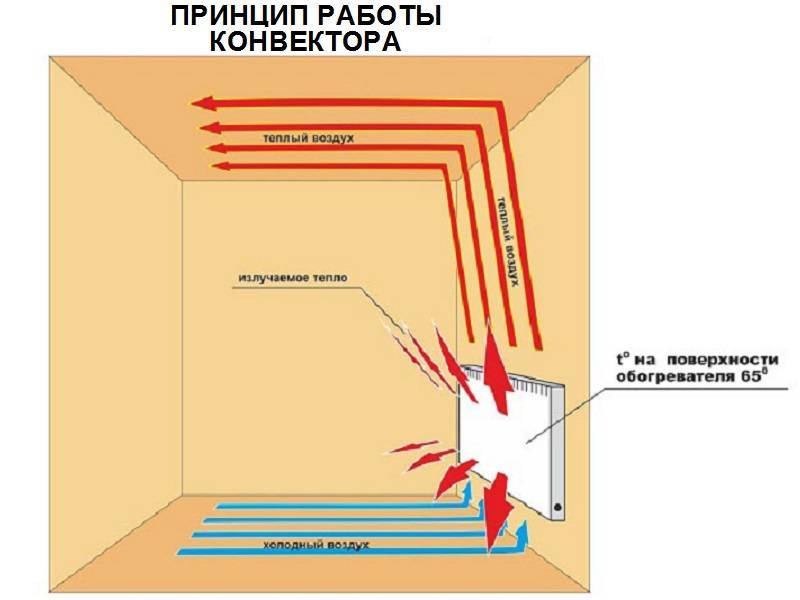
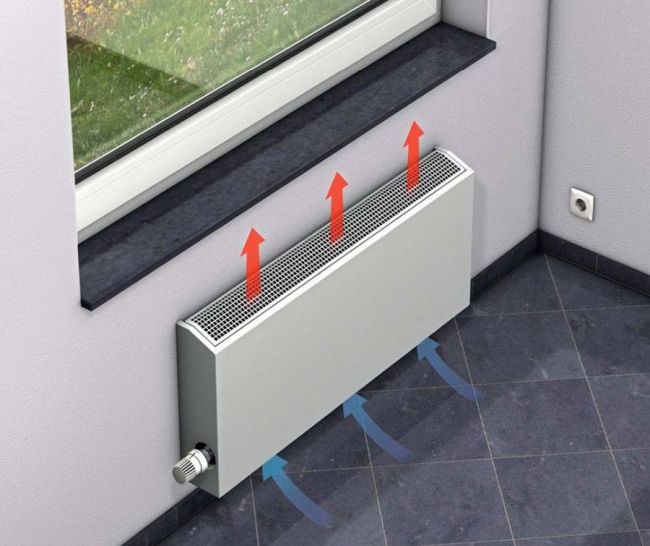
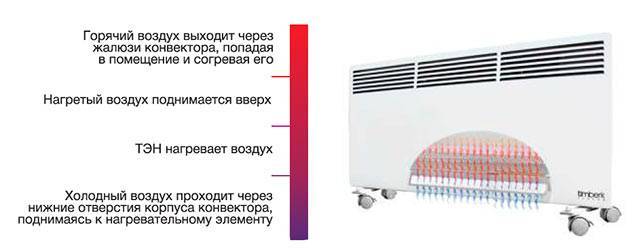
Through the openings located in the upper part, an unhindered exit of hot air is carried out. As a rule, a traditional heating element is located on the lower part of the heating body, which contributes to the heating of the air masses passing through the walls of the body. The air warmed up to optimal levels naturally rises up, after which it passes at a certain angle through the lattice holes in the upper part of the case.
The hot air masses that heat the room gradually cool down and quite naturally fall down, after which the entire heating process is repeated cyclically.
Safety
During the operation of the convector, it is not allowed to cover it (it is forbidden to dry clothes, bed linen or any other materials). The appliance may overheat and fail, and clothing may catch fire.
It is not recommended to lay the power cord under linoleum or carpet, or press it against furniture.
Do not store flammable materials and liquids (any type of fuel, paint, etc.) near the device.
Advice! For more efficient operation of the device, it is necessary to regularly remove dust and other contaminants from it. Dust deposits on the surface of the convector reduce the power of the heater declared by the manufacturer and, as a result, the efficiency of the entire heating system.
If an extension cable is required to connect the unit, it must be selected based on the power of the electric convector.
Household electric convector heater Ballu Enzo BEC/EZMR-1500. Degree of protection - IP24. Dimensions of the device - 595x400x113mm, weight - 4 kg. First class electrical protection. It is intended for heating of air in premises. Manufacturer: LLC "Izhevsk plant of thermal equipment".
The device may only be operated in a vertical position (operation at an angle or in a horizontal position is prohibited).
Do not mount the appliance under a socket or a functioning electric cable, which can overheat under the influence of warm air currents.
When installing an electric heating convector, it is necessary to provide free space around the device. The space above and below the unit must remain free - by 50 cm, on the sides - by 20 cm, in the front - by 50 cm. This is due to fire safety rules, moreover, such a mounting scheme allows you to use all the power declared by the manufacturer of the device.


What type of heating device is better to choose?
It all depends on the goals of the owner of the premises.If you need to achieve uniform heating of the entire area, and speed is not critical, then it is better to install a convector.
If the main goal is to get a directed flow of hot air and instant heating of a specific area in the room, a fan heater would be the best choice.
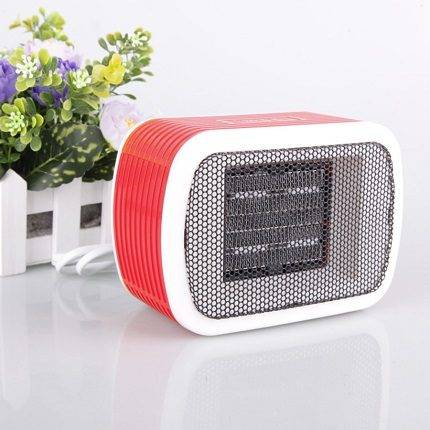
In the home office or office, you can easily install a fan heater. The measured buzz of the blades will not interfere, but will only help to concentrate, cutting off external sound stimuli
In residential premises, convectors are more often installed due to the lack of noise, and for an office, where there are always some sounds, a fan heater is appropriate.
None of the above devices suits you? We recommend that you familiarize yourself with the most popular types of heaters for houses and apartments, and tips on choosing the best one.
Convector type heaters: types and features
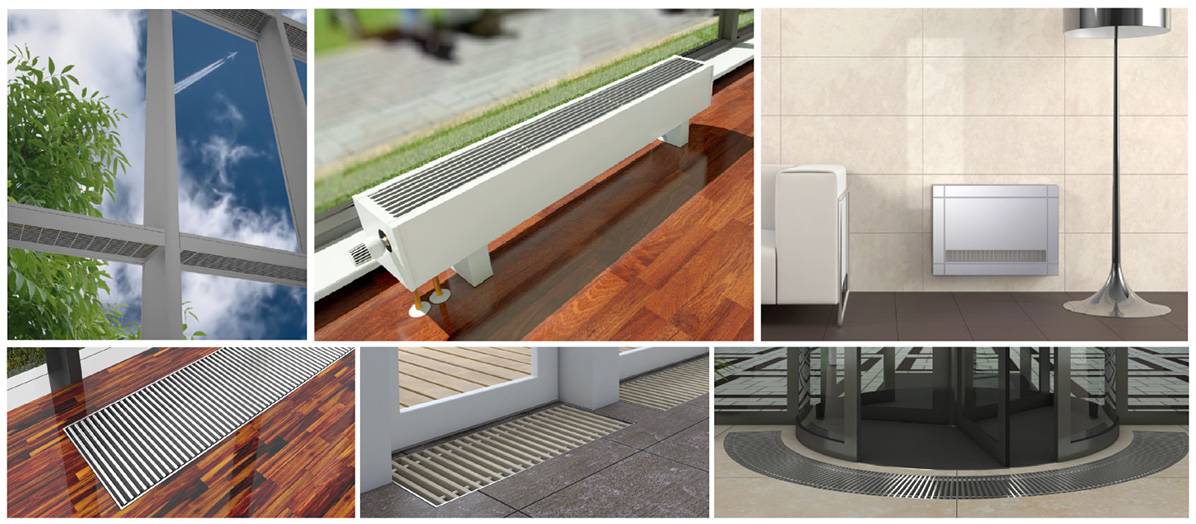
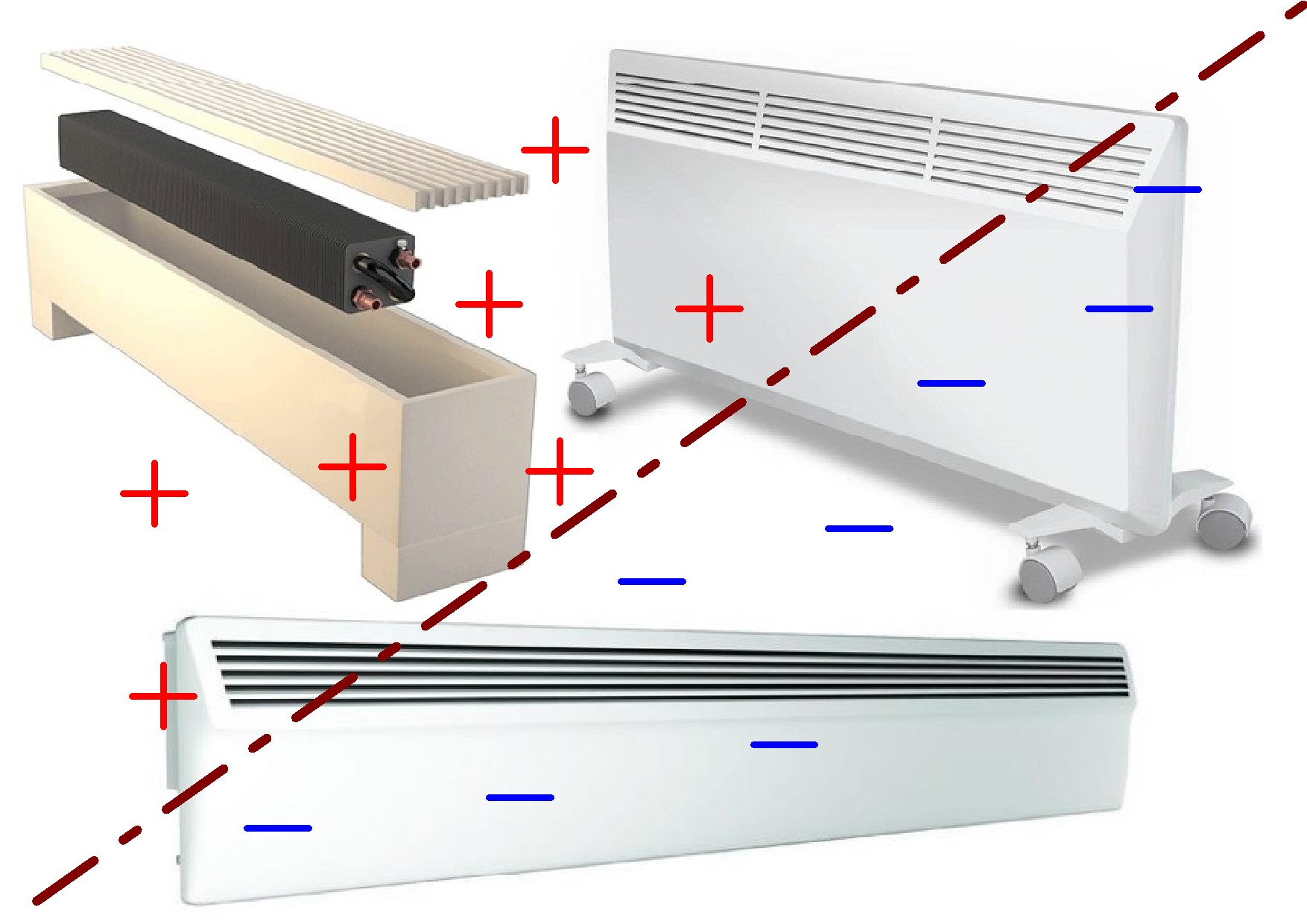
Electric convector heaters are floor, wall and baseboard. Floor and wall convectors are usually up to 45 cm high, but skirting boards are usually no higher than 25 cm, but much longer - the length of such a convector can reach 2.5 m.

Floor plinth electric convector
Install electric heaters of convector type on the floor or on the wall. Where you want to place the device depends on the choice of its type. If you want to put the heater under the window opening, take a closer look at the plinth convectors. You can move them from place to place with the help of a handle and wheels. Due to the length, frequent movement of the plinth convector is not always convenient, but you can be sure that the air in the lower part of the room will be well warmed up, and this is especially true when sitting at a computer and a cold parquet floor.
If you want the unit not to take up space in the room, convector-type wall-mounted heaters are suitable for you. Such a heater is mounted on the wall with the help of special brackets, it is compact and organically fits into a modern interior.
What to look for when buying an electric wall-mounted convector with a thermostat A good convector will serve you for many years, so you should take your purchase seriously and choose a quality appliance. The following characteristics are important:
- power. The choice of this parameter is related to the size of the room. For example, the area of your room is 19 m?, the ceiling height is 2.7 m. To heat 1 m? room, requires 25 watts of power. Thus, we multiply both numbers by 25 and we get 1285.5 watts. When rounded up, we get one and a half kilowatts - this is the heater power we need;
- heating element and its type. The cast monolithic heater functions the longest and most efficiently;

For efficient heating, you need to choose a convector with a capacity for your room.
dimensions. Altitude affects the speed of air movement. As a result, a small convector 60 cm high will heat up the room much faster than a tall one.
If you have chosen a floor or baseboard heater, pay attention to its weight - after all, you may want to move it from place to place or one day the convector heater will need to be repaired and you will need to carry it to the master;
safety in use. It is clear that everyone strives to choose the most secure device.
In the case of a convector, you should only worry about the lack of sharp corners in the unit.After all, one of the main advantages of convectors in the question of which is better, heaters or convector systems, is that the convector is free from the risk of ignition. It will not burn the skin if accidentally touched, as it heats up to a maximum of 60 ° C, does not require grounding and copes with voltage surges;
additional options. When buying a convector type heater, which has useful features in addition to directly maintaining the desired temperature in the room, you can control its operation mode.
| Function | How to use |
| Temperature regulator | You can always maintain a comfortable temperature in the room. In frost, you can unscrew the regulator to the maximum, and in the thaw, reduce the temperature. |
| Thermostat | Allows you to constantly maintain the desired comfortable temperature in the room. |
| Timer | Allows you to turn on the heater and set the time for its automatic shutdown. Thus, you can put the convector on heating and go to bed. |
| Ionizer | Absorbs dust and saturates the air with negative ions. The microclimate in the room becomes healthier, and you have better sleep and increased productivity. |
| Remote control | Allows you to turn on the heater remotely. |
| On timer | Allows you to pre-set the time to turn on the device. Especially important on cold winter mornings, when you want to get out from under the covers into an already warm room. |
| Rollover protection | It will help to avoid troubles in the presence of small children and pets in the house. |
The presence of a thermostat in the convector
The device of the thermostat in the convector.
In modern electrical devices, both electromechanical and electronic thermostats (which have an air temperature sensor) are used. All convectors, regardless of the type of thermostat, are equipped with overheating protection.
Similar devices with a mechanical thermostat have the following features:
- affordable price;
- accuracy in air temperature measurement (+/0.5-1°С);
- when the heating is turned off and on, a characteristic click is heard;
- high reliability during operation in conditions of unstable supply voltage (dacha, village, and so on).
In electronic thermostats, a microcontroller thermostat is installed. Its temperature sensors regularly measure the temperature of the cold incoming air and send a signal to the control element, which is able to maintain the set mode with an accuracy of +/-0.1-0.3°C.
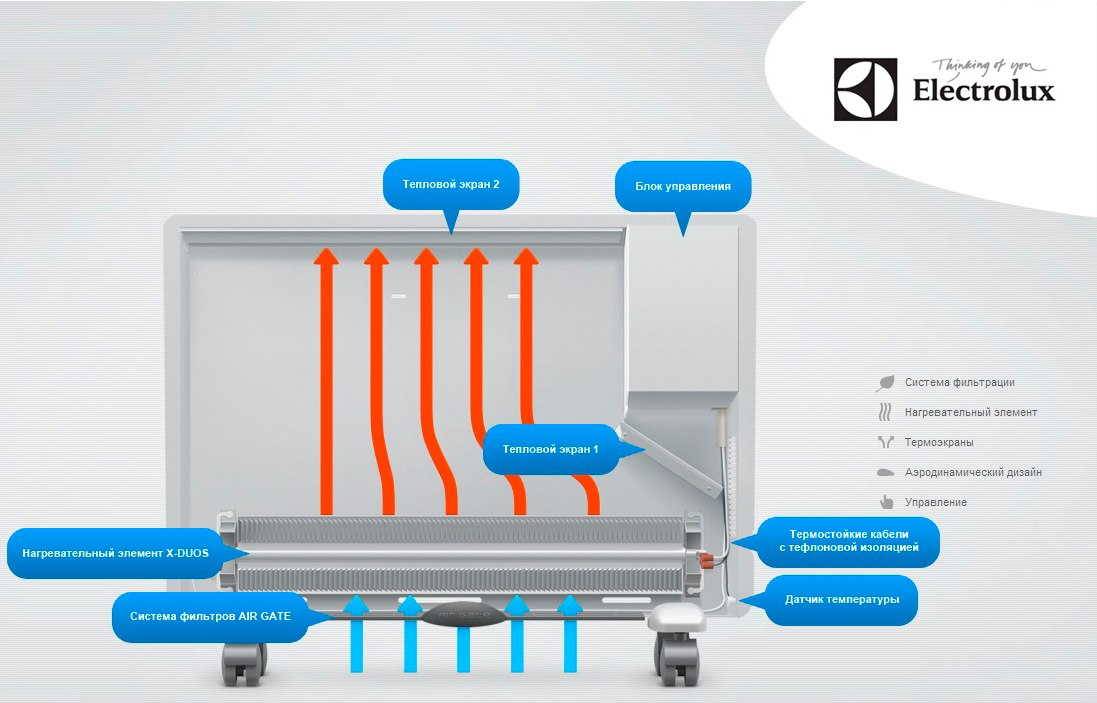
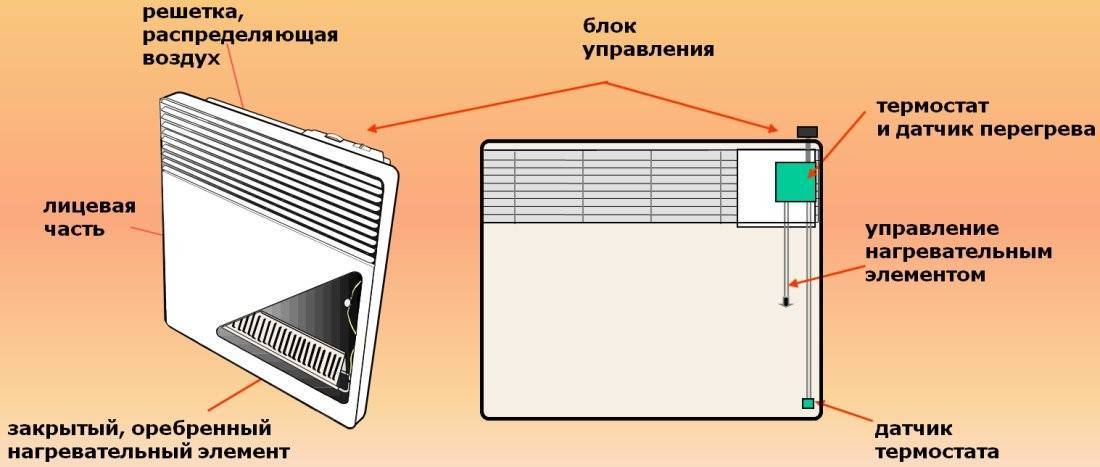


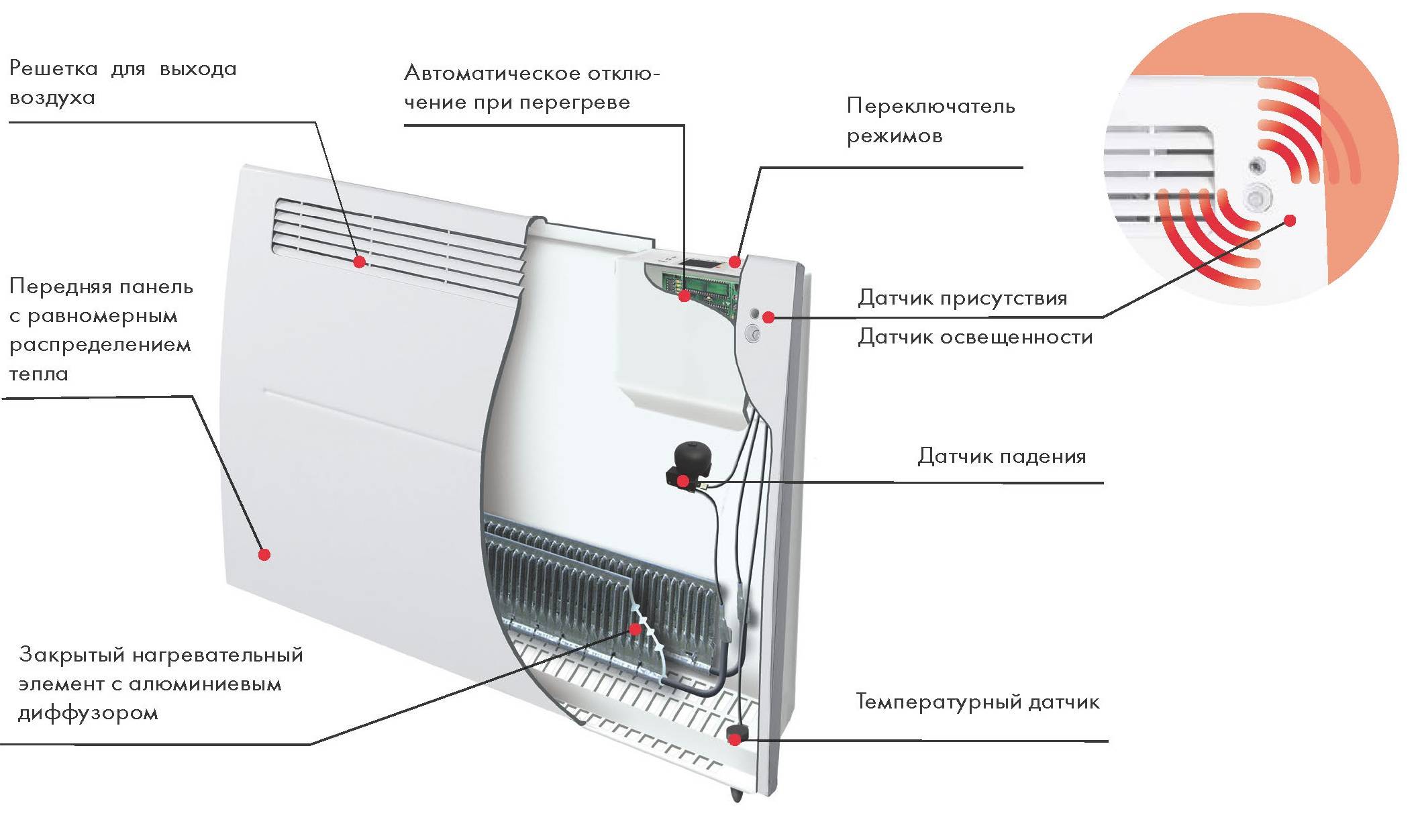
Features of similar devices with electronic thermostats:
- higher price;
- completely silent operation;
- good temperature measurement accuracy.
Due to the higher accuracy of temperature measurement, the use of convectors with an electronic regulator can save 3-5% in electricity compared to electromechanical designs. Models that have an electronic thermostat most often support several operating modes: economical, comfort, anti-freeze (the temperature is regularly maintained at + 5-6 ° C) and automatic.
Types and characteristics of equipment
Floor convectors with convection of natural and forced type are represented by different types, which differ in their design and main technical characteristics.All models produced today have a different method of heating air flows and a type of convection of heated air.
Water
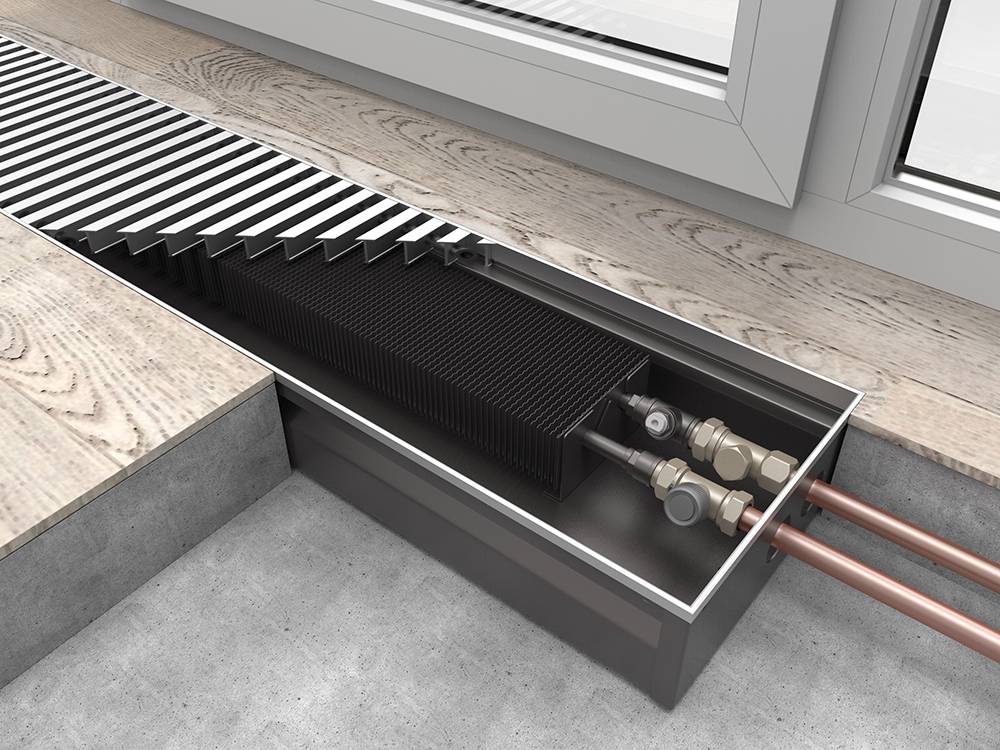
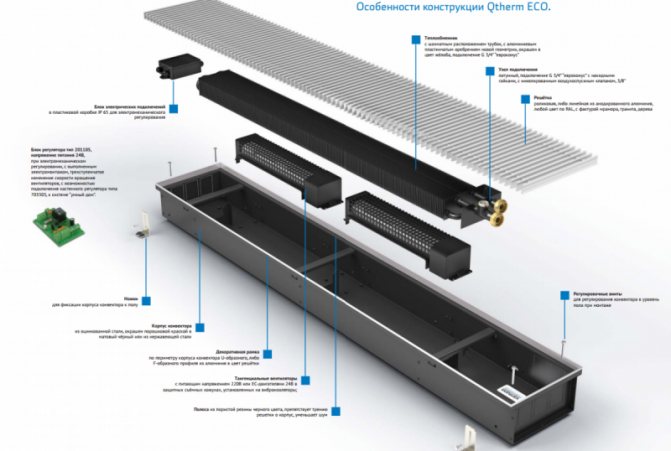
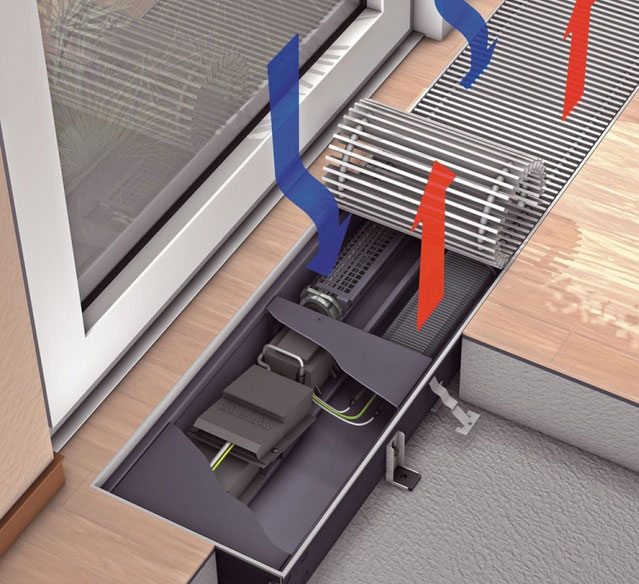
The heating element in a water heater built into the floor is a hollow tube with pressed or welded plates. To transfer thermal energy in such structures, a coolant is used in the form of antifreeze or ordinary water.
The dimensions of the floor convector can be individual and depend on the room for which it is intended.
Connection to the general water heating system is carried out by branch pipes with a threaded connection
Particular attention must be paid to the heat exchanger. The most expensive elements based on copper and copper-aluminum alloy have the maximum power
Budget models are distinguished by steel and galvanized heat exchangers.
The convector is connected to the heating using a special fitting
The principle of operation is based on convection, represented by the mixing of hotter, rising air masses with cold air, which descends to the convector, and after warming up again rises towards the ceiling surface. The result of this functioning is a gradual, but noticeable heating of the air inside the room to the desired temperature.
Due to the special movement of air masses, the device gradually warms up the room
The advantages of underfloor water convectors are represented by smooth and uniform heating of the air in the room, low weight and compact dimensions, quite modern appearance, as well as saving free space.
The disadvantages include only the likelihood of dust accumulation under the grate and its spread around the room if there are fans in the designer.
Electrical
Floor electric convectors can work on the principle of natural convection, that is, without the installation of fans, or they can be equipped with special ventilation elements to increase the heating efficiency.
Fans built into the convector increase the efficiency of air heating
Models with a fan are the optimal solution and are installed mainly in rooms with very high heat costs.
Advanced electric built-in models have compact dimensions and a practical steel body, and the latest generation of components are used as equipment.
The equipment is characterized by silent operation, durability, as well as economical consumption of electrical energy.
The principle of operation of any electrical models is based on the properties of the thermal convention.
Electric convectors provide efficient air exchange
The disadvantages include only the absolute impossibility of operation in rooms with a high level of humidity and the need to perform professional installation of such equipment.
Prices of electric wall-mounted heating convectors with a thermostat, the cost of floor and universal models
The cost of the heater depends on its characteristics. A wall-mounted flexible convector will cost the most economical.As a rule, the price is directly proportional to the power of the device, although each company has economy options.



For example, the average Nobo model will cost twice as much as the similar Elektrolux model, while the Nobo heater from the economy class can cost less than democratic Watt WCH products.
The price of the best convector heaters using infrared radiation is the highest. They do not dry the air and work on the principle of heating objects. Slightly cheaper heaters operating on gas, and even more economical than water heaters, the price of which is still several times higher than the cost of electric ones.
Be prepared for the fact that a truly effective and high-quality device will cost a lot. However, it will last for decades, so it makes sense to overpay for reliability in operation and efficient space heating.
main parameters
Having figured out what convector heating is, you should arm yourself with general information about its technical characteristics. The power of electric convectors is in the range of 0.8 -3 kW, weight - from 3 to 9 kilograms.
Electric convectors currently on sale are divided into three groups:
- High (450-670 mm).
- Medium (up to 330 mm).
- Narrow (for skirting boards), 140-200 mm high.
Due to their parameters, high-type heaters are able to provide a significant level of convection. Skirting models are equipped with less powerful heating elements. To maintain the proper level of efficiency, they are given a large length (up to 2.5 m).
Mounting method
Electric convectors are wall and floor.Special fasteners are often supplied with wall modifications, but sometimes they need to be purchased separately - they are sold in specialized stores. Due to the low weight of most heaters, you do not need to buy overly powerful fasteners.
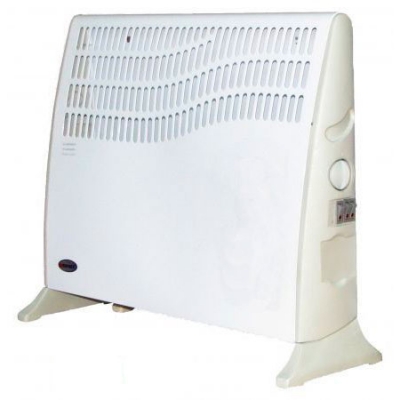
Choose models with removable legs and the ability to mount them on the wall.
As for the floor models, they are equipped with legs / wheels for placement on the floor. Convective heaters can work as a permanent equipment, as well as an auxiliary one. By placing it at one point or another in the room, you will be able to quickly adjust the heating zone. For example, if the room goes deep into the building, you can place the convector at a remote point for the most uniform heating of the air.
In most cases, electric convectors are universal - it is best to choose wall-mounted models with complete feet for floor mounting. Such a scheme will allow you to quickly remove the heater from the wall and install it at the desired point in the room. In addition, almost all floor-standing appliances have removable legs - thanks to this, they instantly turn into wall-mounted samples.
In some modifications, positioned as universal, there are no complete legs - they must be purchased separately. It is best to clarify this point before buying, than to swear later that the manufacturer "clamped" the legs.
Benefits of convectors
— instant heating of the room;
— simple management;
- affordable cost;
- no installation difficulties;
— no need to maintain, except for the usual cleaning of dust;
- does not dry the air;
- it is possible to set a certain temperature regime;
- silent operation;
- among a wide range, you can choose a model that is suitable for power;
- high efficiency;
- safety during operation (the maximum heating rate is within + 60 ° C).
It is worth noting that electric heaters have disadvantages, which should also be taken into account when buying:
— additional power consumption;
- the limited length of the wire requires the close proximity of the outlet.
If the issue with the outlet is solved with the help of extension cords, then the power consumption should be pre-calculated in order to estimate the additional costs.
Additional functions
Let's now look at the additional features that can be found in electric convectors. Moreover, they are most often endowed with electronically controlled models. Let's put them in the form of a list:






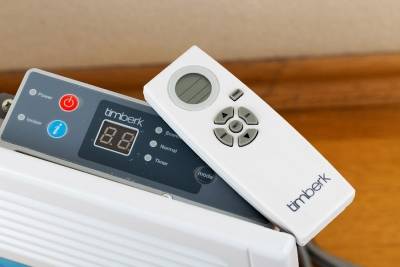
The remote control is a great addition to a standard convector heater.
- Anti-freeze - the technique maintains the temperature at +5 degrees, preventing buildings from freezing. The function is relevant for owners of country houses and cottages, where accommodation is carried out only on weekends. Thus, users can not worry about the complete freezing of the house and the unnecessarily high power consumption;
- Work according to the program is an interesting function that allows you to set the operating modes by the hour. For example, at night the temperature may drop to rise again in the morning. It is also possible to set other operating modes;
- Timer - electric convectors turn on and off according to the timer. Devices with this function are best suited for those who are at work during the day;
- Remote control - heaters are supplied with remote controls that allow you to adjust the temperature directly from the sofa;
- Work as a slave and master equipment - the function is useful when it is necessary to implement complex temperature control in rooms. In this case, only one control unit is used, and the rest operate in the modes specified by it;
- Humidification is a great option. If you care about your health, it is best to look at equipment with this function. The humidification module will make indoor air healthier;
- Bluetooth control is another option for remote control of equipment from a tablet or smartphone. A dubious feature, and hardly better than a classic remote;
- Air ionization is one of the most useful options. We recommend these heaters to those who care about their health and well-being. If you feel a breakdown and weakness, it is best to install at least one such device in the room.
The presence of additional functions is better because you get heating equipment that is easy to manage and operate. And simple devices are better for their reliability and reliability.
Please note that each additional function is an increase in the cost of electric convectors.
What does a conventional heating convector look like?
The device looks like a box, masking the system arranged inside it, thanks to which uniform and efficient heating of the room is achieved. Its length can be from 1 to 2 meters.
All convectors are connected to the heating system in a parallel way, so the outlet air temperature will be the same.This allows you to achieve an even distribution of heat throughout the house.
The box of the device can be of any color, so it is easy to match it to the interior. The decorative grille is designed in the same style as the casing. The manufacturer must include instructions with the convector.

According to the installation method, convectors are of three types:
- floor;
- wall;
- embedded.
By their principle of operation, they are all the same. Floor heating convectors have special “legs” at the bottom that can be securely attached to the floor.
Electric heater power calculation
There are two ways to calculate the power of the device.
By room area
It should be borne in mind that the calculation of the power of the heating unit by area gives approximate figures and requires amendments. But it is simple and can be used for a quick, approximate calculation. So, based on the established norms, for a room with one door, one window and a wall height of 2.5 meters, a power of 0.1 kW / h per 1 m2 of area is required.
For example, if we take a room with an area of 10 m2 for calculation, then the required power of the unit will be 10 * 0.1 = 1 kW. But it is worth considering some factors. In the case of a corner room, the correction factor will be 1.1. This number should be multiplied by the found result. Provided that the room has good thermal insulation, plastic windows (energy saving) are installed in it, then the result of the calculation should be multiplied by 0.8.
By volume
To calculate the power of a heating convector by volume, you need:
-
-
- calculate the volume of the room (width * length * height);
- the found number must be multiplied by 0.04 (namely, 0.04 kW of heat is needed in order to warm up 1 m3 of the room);
- apply the coefficients to refine the result.
-
Due to the fact that the height of the room is also used in the calculation, the power calculation will be more accurate. For example, if the volume of the room is 30 m3 (area 10 m2, ceiling height 3 m), then 30 * 0.04 = 1.2 kW. It turns out that for this room you will need a heater with approximately a power slightly higher than that found.
For a more accurate result, the power should be calculated using a coefficient. If there is more than one window in the room, then for each next window, 10% is added to the result. This indicator can be reduced if good thermal insulation of the walls (floor in a private house) is made.
As an additional source of heating
If the main heating during severe frosts is not enough, then often an electric convector is used as an additional source of thermal energy. The calculation, in this case, is as follows:
-
-
- when calculating the indicator by area, 30-50 W are required for each square meter;
- when calculating by volume, 0.015-0.02 kW is required per 1 m3.
-



