
- Rules for installing the outdoor unit of the air conditioner
- main parameters
- What to buy
- How to hide a split system socket?
- Finished Size Examples
- Principle of operation
- Outdoor unit in multi-systems
- What is an outdoor air conditioner unit for?
- Outdoor module device
- Parameters and principle of operation of the outdoor unit
- The length of the freon line
- Norms of distance between blocks
- Pipeline too short
- Distance is greater than standard
- Types of brackets
- Corner brackets
- Structures from U-shaped profile connected by bolts
- U-profile brackets with additional reinforcement
- U-profile brackets fastened with a horizontal bar
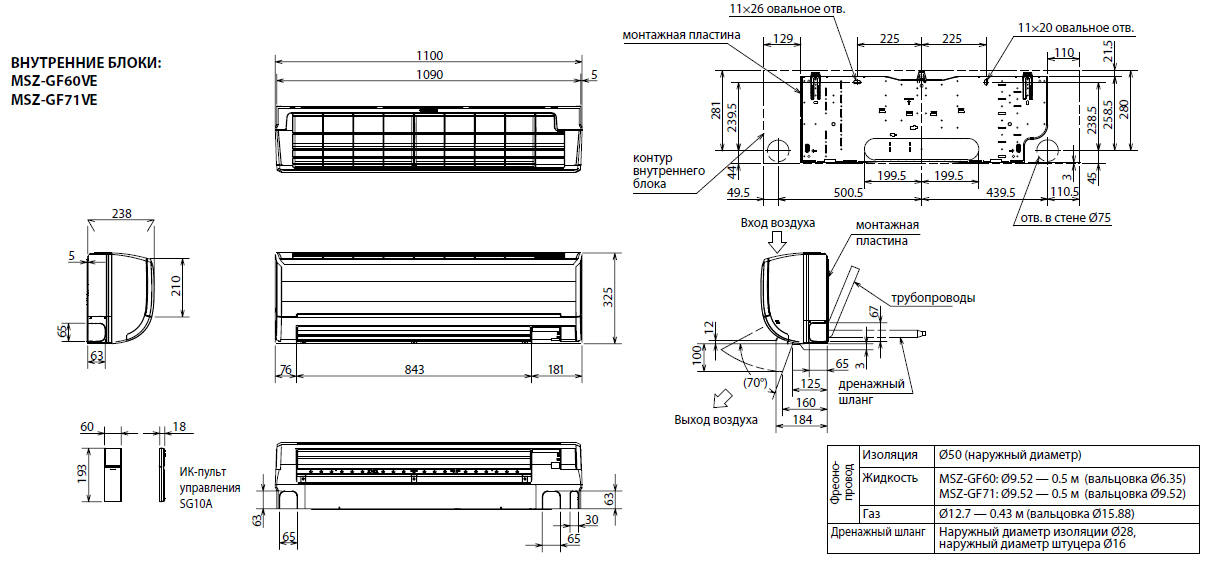
- Why you need to know the dimensions of the air conditioner
- Installation of the external unit of the air conditioner
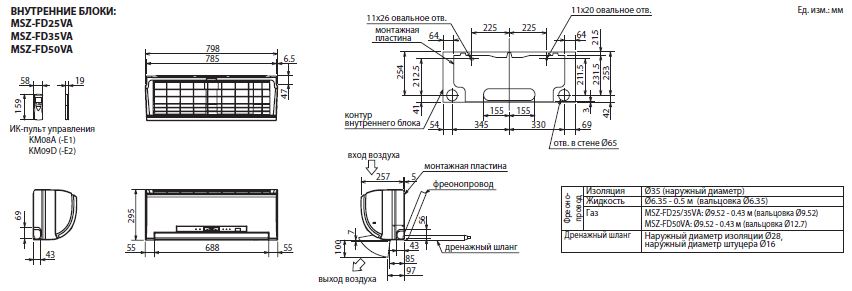
- Specifications of the indoor unit
- Conclusions and useful video on the topic
Rules for installing the outdoor unit of the air conditioner
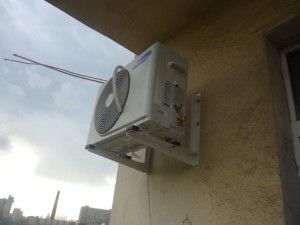 normal block placement with access to main service valves
Before proceeding with fixing, you should take into account the rules for installing the outdoor unit of the air conditioner, non-compliance with which entails incorrect operation of the device:
- The device should not break the silence at night - the maximum allowable noise is about 32 dB.It is necessary to organize a normal condensate drain so that it does not fall on the walls of the house, the porch visor and people passing by;
- Be sure to take into account the strength of the walls. It must withstand a load of several tens of kilograms. It is impossible to attach the air conditioner to aerated concrete structures, the external cladding of the house and the insulation layer;
- Brackets with a block provide the most reliable base and fastening;
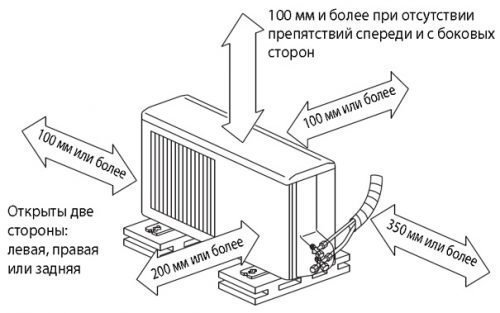
- In order to avoid overheating of the compressor, the minimum distance from the wall to the outdoor unit should not be less than 10 cm. There should not be any obstacles for normal airflow;
- The air conditioner is placed taking into account the need for free air circulation. The radiator needs normal cooling;
- Provide good access to service valves so that preventive inspection can be carried out;
- It is impossible to allow multiple bending of the copper pipeline, since the creases prevent the normal pumping of freon by the compressor;
- The maximum length of the pipeline between the modules of the split system should not exceed the length set by the manufacturer, otherwise the work efficiency drops noticeably;
- Do not allow direct sunlight to fall on the back of the device, so there should not be too much distance from the outer wall to the outdoor unit;
- It is desirable to provide protection against moisture.
main parameters
When choosing and buying an external unit of a split system, you need to pay attention to four main characteristics:
- Size, height, width, length.
- Power.
- Noise.
- Line length.
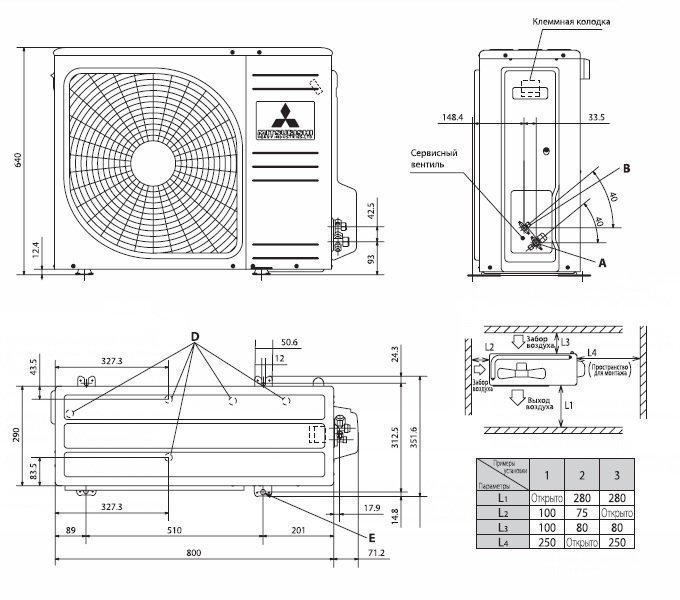
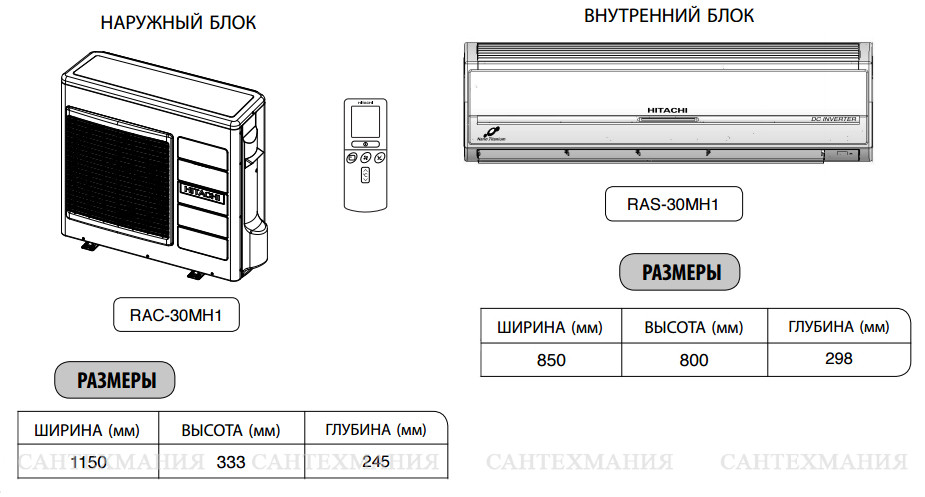
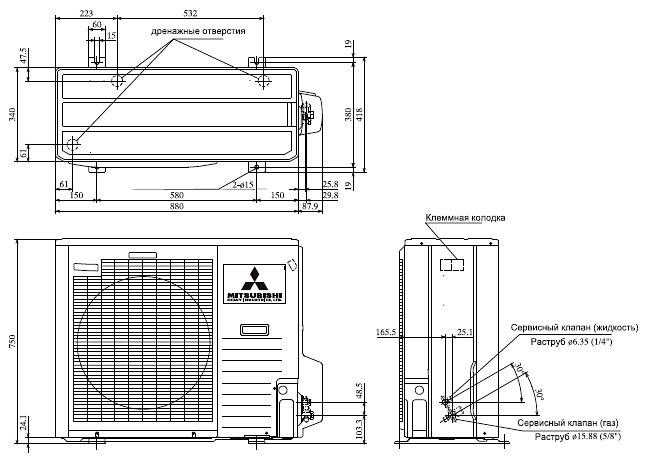
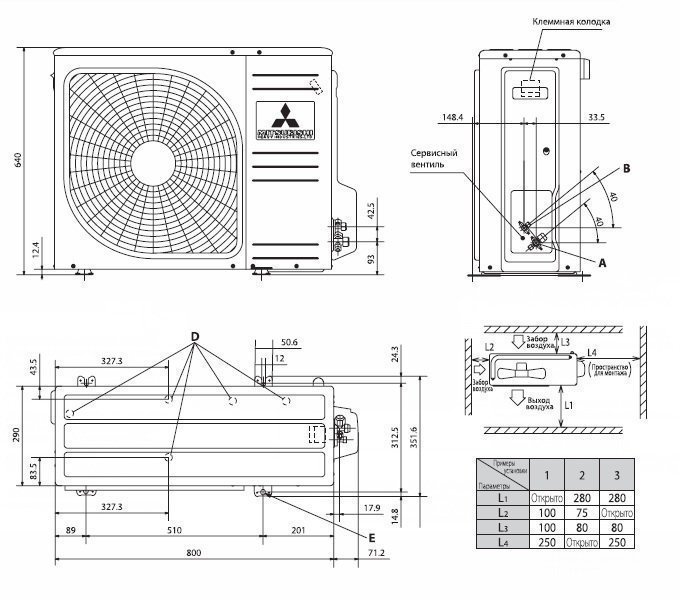
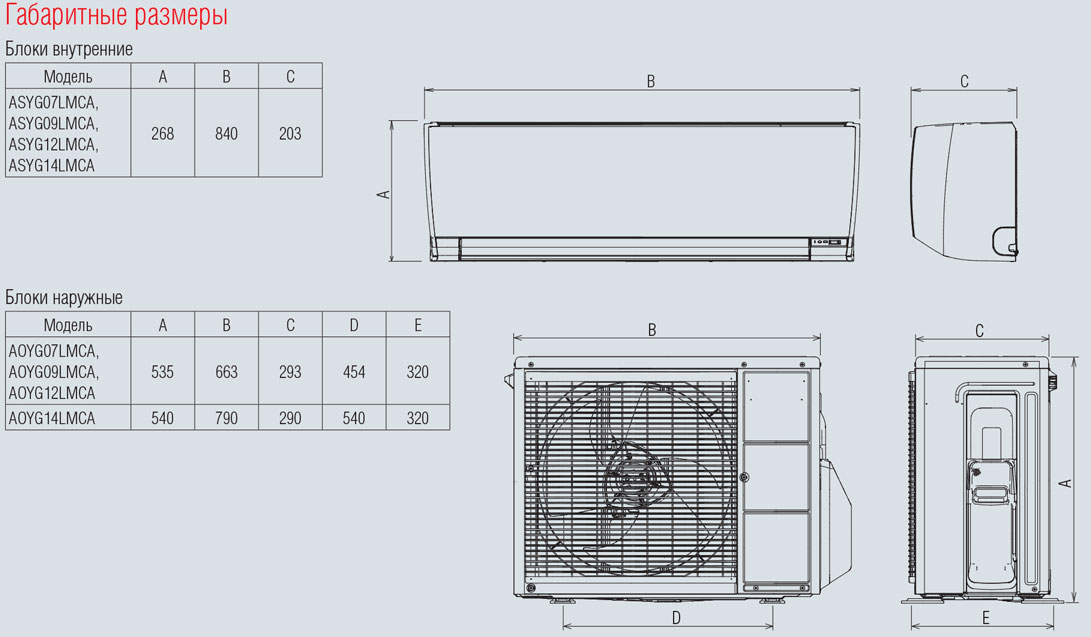
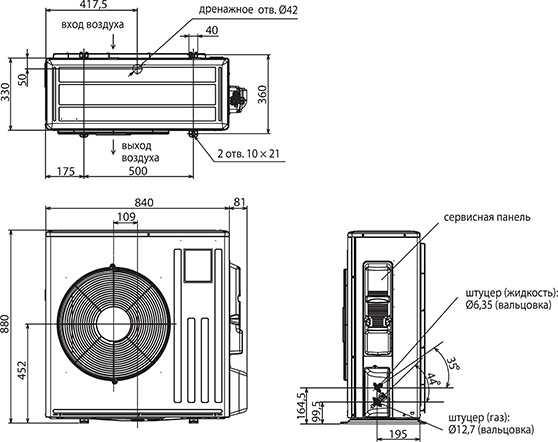
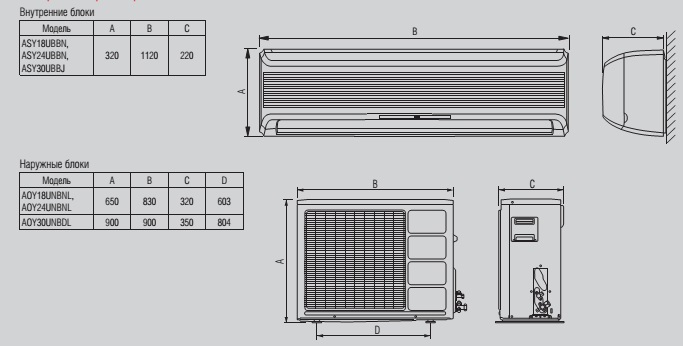
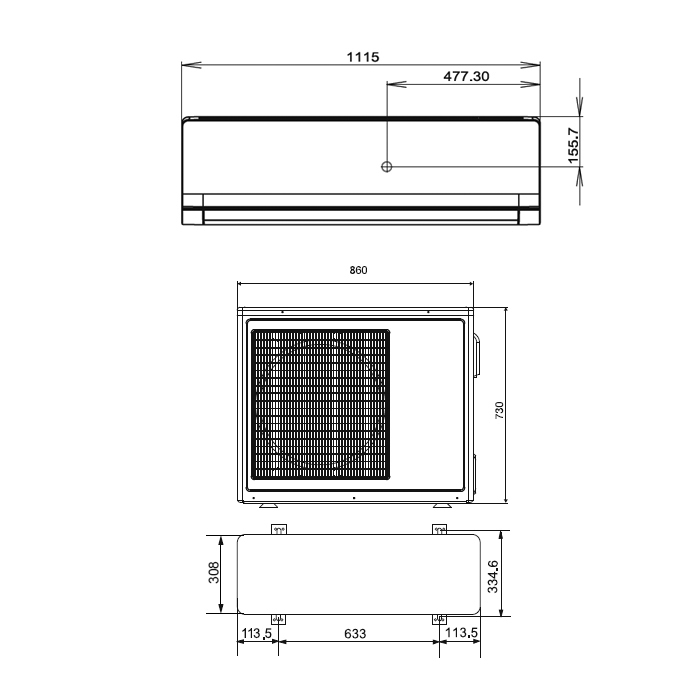
Dimensional dimensions of external units depend on the power and functionality of the equipment.
- width 80 cm;
- height 50 cm;
- thickness 30 cm.
Models that are offered on the market may have different capacities. It all depends on the purpose of the equipment. A standard household split system has a capacity that allows you to cover a space of up to 100 square meters. m.
An important characteristic of the outdoor unit is noise. If the air conditioner in the room works without noise, then the external unit can cause significant inconvenience to the neighbors. When choosing a model, it is better to clarify the indicator of the noise produced during the operation of the external unit. Permissible indicator 32 dB.
It is necessary to pay attention to the permissible length of the connecting lines between the blocks.
What to buy
For those who are interested in buying a compact low-power split system, I will suggest paying attention to the following 5 models:
Tips:
- If the mobility of the air conditioner is not a key requirement, then I still advise you to opt for a traditional wall-mounted split system. It does not occupy a useful area in the room, makes less noise and will cost a little more than mobile climate control equipment of similar power only due to installation.
- If there is no room for either wall or mobile devices, then look towards duct devices, the indoor unit of which is hidden behind the ceiling or in the attic. In the room, only special gratings (anemostats) will be visible from the air conditioner.
I came across one interesting invention - a desktop air conditioner (watch the video). If anyone has come across such a device, write reviews about how effective it is.
How to hide a split system socket?
Sockets for the air conditioner are usually in plain sight. They do not need to be forced with furniture or appliances, but sometimes they can disrupt the overall design concept of the entire room.
This applies even to modern flat sockets, which only protrude slightly on the wall, which is to say about the usual "pot-bellied" models. In this case, designers go for small tricks and mask sockets in the most unusual ways.


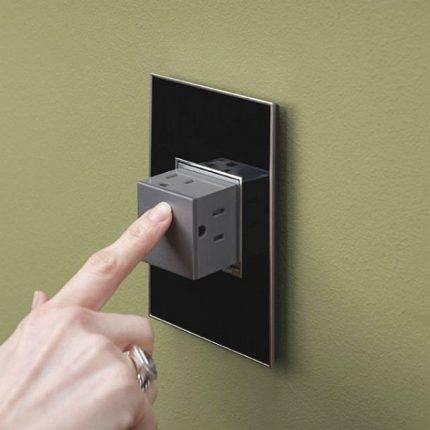 Spectacular retractable sockets are ideal for living spaces made in a modern style (hi-tech, modern, gothic, etc.)
For example, the socket is mounted in a shelf on which the climatic equipment is located, hidden in a three-dimensional picture next to the air conditioner, or made in the form of a block that slides out of the wall when pressed. The latter option is suitable if the air conditioner will only occasionally be connected to the power supply.
Also today sockets with covers (folding and retractable) are produced. These covers can be additionally decorated, painted in a bright color or made as invisible as possible.
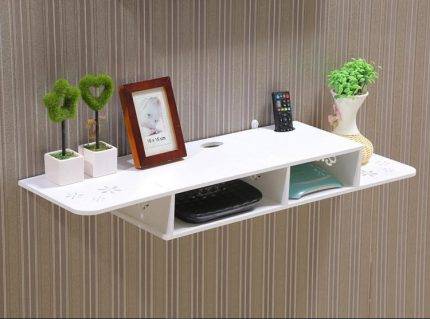 The shelf next to the air conditioner, in which the electrical outlet is hidden, can also be used for its intended purpose, i.e. you can put books or figurines on it
If there is a closet next to the air conditioner, then the socket can be hidden in it and arranged in the form of a retractable block (top, bottom or side). It can also be closed with a false panel or cornice.
If the air conditioning equipment has a cord that is too long, then it, together with the outlet, can be masked using a non-standard volumetric plasterboard block made in the same interior style.
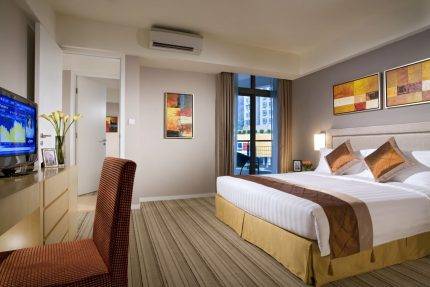 Installing an unusual painting near the air conditioner in the bedroom, hall or living room allows you to refresh the interior of any living space.
Also today there are other ways to mask outlets.They can be closed in a small cabinet with compartment doors or hung with a folding mirror. If the style of the interior allows, the connector can be placed behind a small decorative door. Such a solution will look interesting in interiors in country style, Provence, chalets, etc.
The outlet can be covered with artificial flowers. In the bedroom or living room, you can use a print, stained glass panel or pattern to mask the connector so that it looks like part of the design composition.
In the children's room, the electrical outlet can be hidden behind a retractable multi-colored panel, an interactive map, or any three-dimensional models. For example, if your child is into Star Wars, you can hide the connector behind a plastic model of the Death Star or the Millennium Falcon.
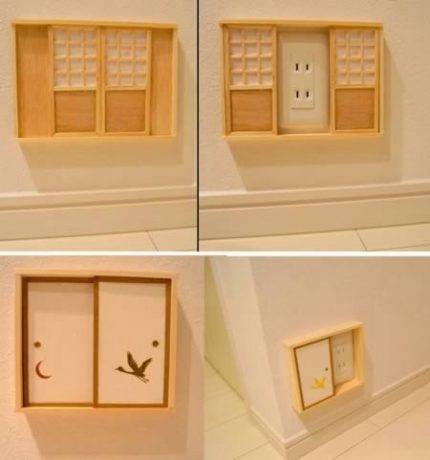 You can hide the outlet for the air conditioner in a mini-locker in the living room, and in the corridor, and in the bedroom, and in the children's room
Typically, outlets for the air conditioner are hidden in the same way as outlets for other household appliances in the room. The choice of one or another method of disguise depends on the design features of the room. But today, some architects propose not to hide sockets and wiring to the air conditioner, but to make them as open as possible.
Moreover, the design concept provides for the use of wires in contrasting colors (for example, fix black wires on a white wall almost in the central part of the wall). If the wiring of the air conditioner is open, then there will be no point in installing a hidden outlet, and this detail can be made bright.
Finished Size Examples
So, at Gree, the depth of the room module is only 18 cm.The length and width here vary within 70-120 and 24-32 cm, respectively.
Mitsubishi air conditioners have the following dimensions: 110-130x30-32x30 cm. Such dimensions are taken for a reason: for high-quality airflow, the radius of a cylindrical fan must be at least several centimeters, and its length must be at least 45 cm.
Chinese air conditioners from Ballu are the smallest systems. The BSWI-09HN1 model has a unit with dimensions of 70×28.5×18.8 cm. The BSWI-12HN1 model is similar, differing only in a slightly larger outdoor unit, the size of which does not matter much for the internal living space.
But Supra has come the furthest with its US410-07HA model with an indoor unit of 68x25x18 cm. Pioneer is slightly behind, with the KFR-20-IW at 68x26.5x19 cm. Finally, Zanussi has also succeeded: the ZACS model -07 HPR has an indoor unit with dimensions of 70 x 28.5 x 18.8 cm.
A further reduction in the size of the outdoor and indoor units could lead to a decrease in efficiency due to insufficient overall capacity. No manufacturer has yet introduced a rectangular indoor unit whose length would be no more than 60 cm.
Principle of operation
The principle of operation of the room module of the air conditioner is based on forced air circulation, its cooling or heating. The air intake in the room is made through a special hole in the module case. The operation of the fan allows the air flow to be pushed back into the room, preheated or cooled by a heat exchanger located in the indoor unit of the air conditioner.
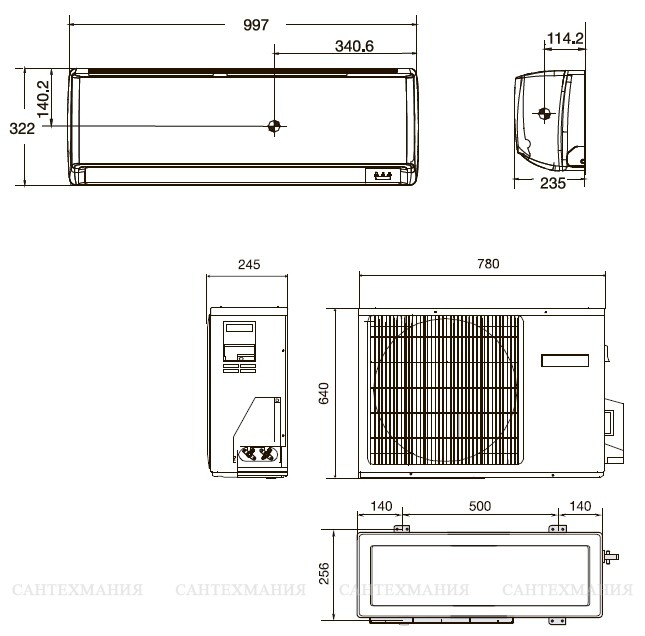


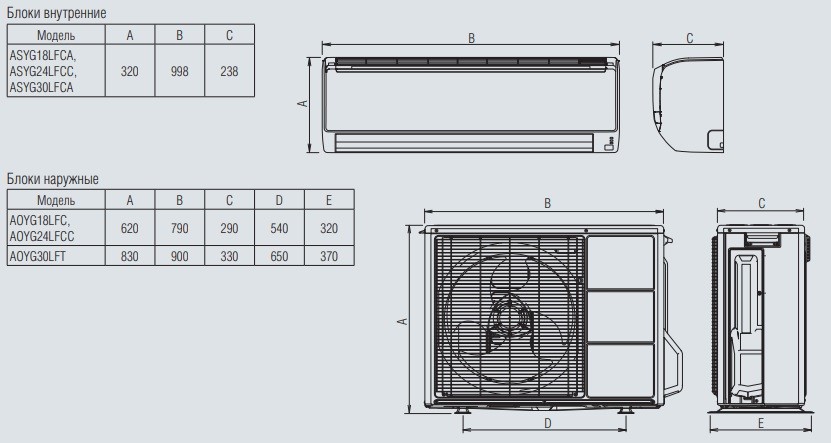
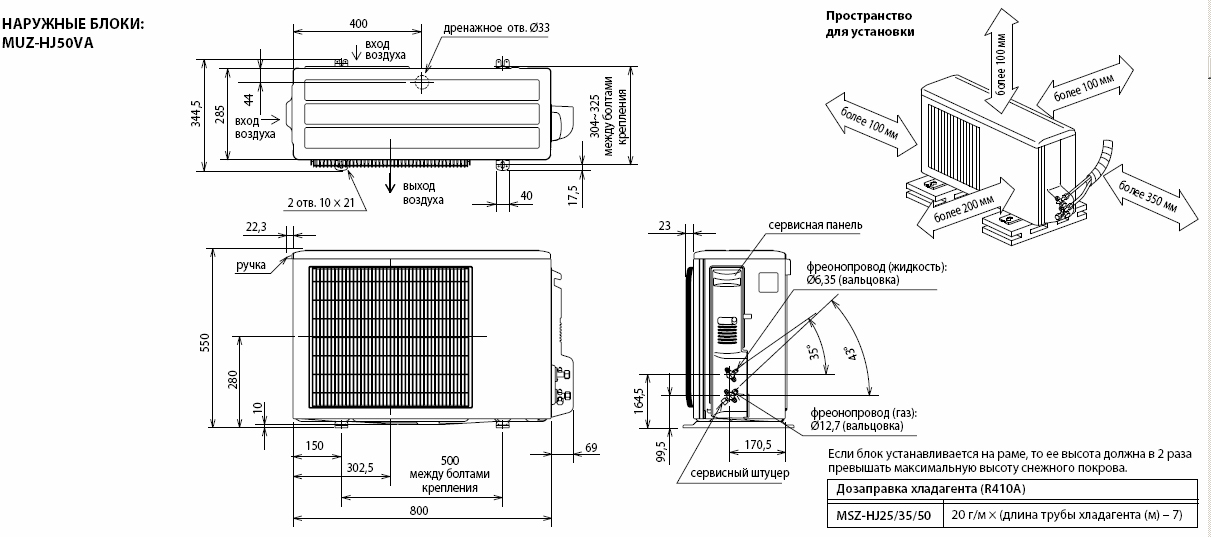


Thanks to the installed filter system, microclimatic conditions favorable for human health can be achieved, even if the air conditioner serves domestic and industrial premises with a low and medium level of pollution.
Indoor unit device
Outdoor unit in multi-systems
The concept of technical implementation of a split system provides for the possibility of using several indoor modules in one complex, which are serviced by one outdoor unit. Unlike standard configurations, the external module of such a system has engineering differences. For integration into a multi-system, it is equipped with an additional thermostat, which allows you to more effectively control the settings of the fan and compressor. In turn, the indoor unit of the air conditioner acts as a source of information signals that determine the control of the outdoor module. That is, the user, using the remote control, accesses the panel of the indoor unit, and the latter, in turn, regulates the system of bypass communications on the freon line via a digital channel.
What is an outdoor air conditioner unit for?
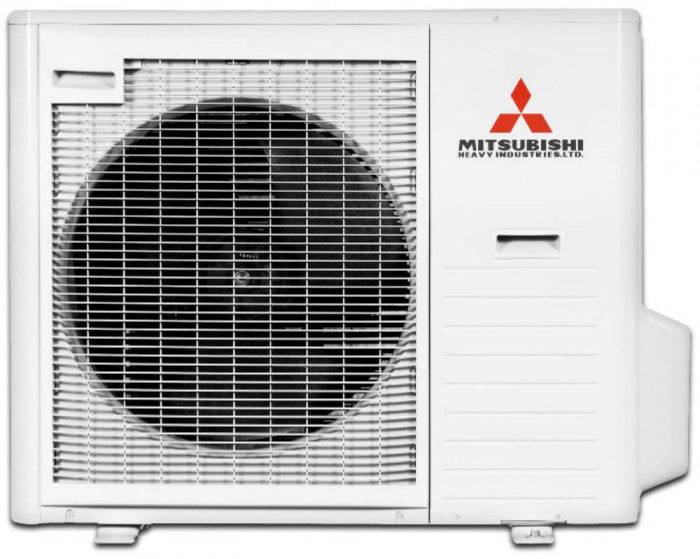
The outdoor unit of the air conditioner is one from the constituent parts of a modern split system. It houses the compressor and condenser unit of the air conditioning system. This element of climatic equipment is designed to cool or heat a room using a refrigerant.
Inside the block are:
- compressor;
- four-way valve;
- heat exchanger;
- capillary tubes;
- expansion coils;
- receiver;
- fan.
To maintain the unit's performance in winter, a special "winter kit" is sometimes installed.
Outdoor module device
This is a box of a rectangular configuration, inside of which the following elements are installed:
- The fan is needed to blow the condenser. Thanks to this, the air masses actively move in the outdoor unit.
- A condenser is a special device designed to cool freon for the purpose of its subsequent condensation.
- The compressor compresses the refrigerant to circulate it through the refrigerant line to the indoor unit.
- A four-way valve is installed in air conditioners that can work not only for heating the room, but also for cooling it. It is needed to change the direction of movement of the refrigerant in different modes of operation of the climatic equipment.
- The control board is located in the external modules of inverter-type units. Such devices have a smooth adjustment of the speed of rotation of the fan blades and are more resistant to temperature extremes and atmospheric influences.
- Fitting fasteners are needed to connect copper pipelines that connect two blocks and are designed to circulate the coolant.
- The protective grill protects the outdoor unit from various insects, all kinds of contaminants and objects that can block the fan blades.
- A drain tube is installed to remove condensed moisture.
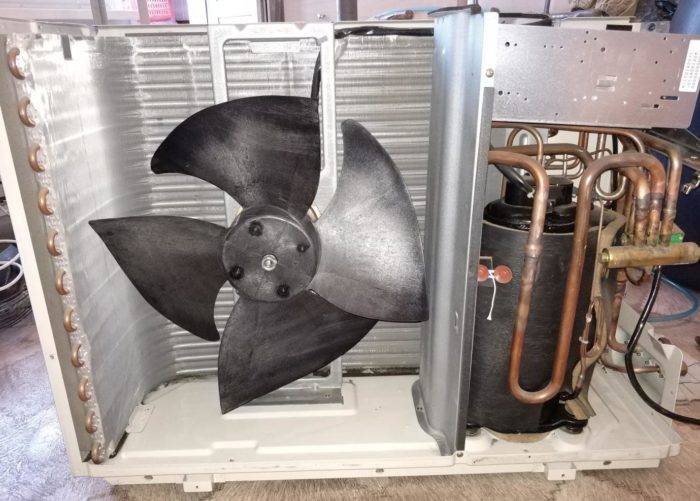
The unit has a voltage regulator that protects against peak loads and normalizes the current parameters. Some models are equipped with special casings that protect the unit from the negative effects of snow, wind and freezing. To protect against falling ice, icicles and parts of the facade finish, a visor is installed above the outdoor module.
Parameters and principle of operation of the outdoor unit
The principle of operation of any climatic equipment is based on the movement of thermal energy from one environment to another. If the unit works for cooling, then it transfers heat from the room to outside. When heating the air in a house or apartment, the device performs the opposite action, that is, it takes heat from the external environment and transfers it to the room air.
When freon evaporates in the indoor unit, it absorbs heat from the air in the room. And after entering the outdoor unit, it condenses there. In the opposite direction, liquid freon flows from the external unit to the internal module, which is again cooled due to the fact that it has given off thermal energy to the external environment. The room air again passes through the air conditioner and is cooled, giving off heat.
The principle of operation of the outdoor module is as follows:
- gaseous freon enters the compressor from a special container;
- here, under high pressure, it enters the condenser, where it passes into a liquid state and gives off heat;
- after the loss of part of the thermal energy, the refrigerant goes to the freon line;
- from it, freon passes into a throttling device (here the pressure drops and the substance cools down);
- the cooled liquid medium enters the evaporator tubes, where it begins to actively circulate;
- streams of warm air from the room also pass through the evaporator, they give off heat to freon and cool;
- cooled air masses are supplied by the air conditioner to the room;
- while receiving heat from the room air, the refrigerant in the heat exchanger of the indoor unit goes into a gaseous state;
- from the heat exchanger, the refrigerant in the gaseous state goes back to the compressor, the process repeats again.
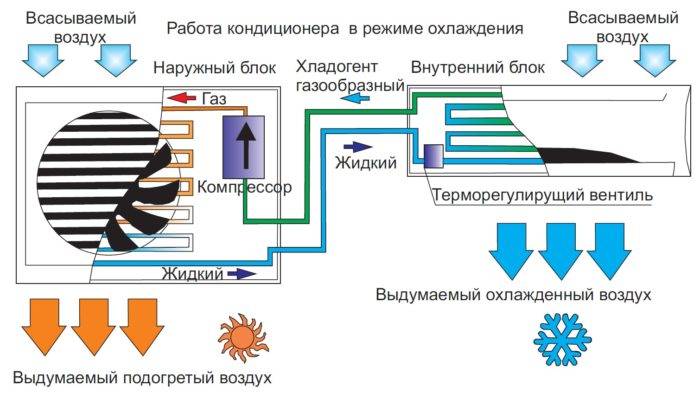
Important parameters of external units that must be taken into account when choosing climate equipment are the power of the unit, the noise level emitted by the equipment during operation, the length of the line and dimensions. The dimensions of the outdoor unit are directly related to its power. The average parameters are within 80x80x30 cm.
The power of a standard household air conditioner is enough to cool an area of 100 m². The permissible noise level should not exceed 32 dB, so as not to cause discomfort to the residents of the apartment and neighbors.
The length of the freon line
Users of climate technology often argue about the distance from the external air conditioning unit to indoorand then experiment with the installation. They can be understood - sometimes the features of the interior or the location of the rooms require an increase in the length of the pipeline.
But professional installers know for sure that it is impossible to arbitrarily increase or decrease the length of the pipeline. Indeed, deviation from the required parameters immediately affects the performance of the air conditioner.
We will find out what the installation standards should be and why they cannot be changed.
Norms of distance between blocks
Installation standards are set by the manufacturer. If you take the instructions, then in the installation section you will find diagrams and operating parameters that you need to focus on during installation.
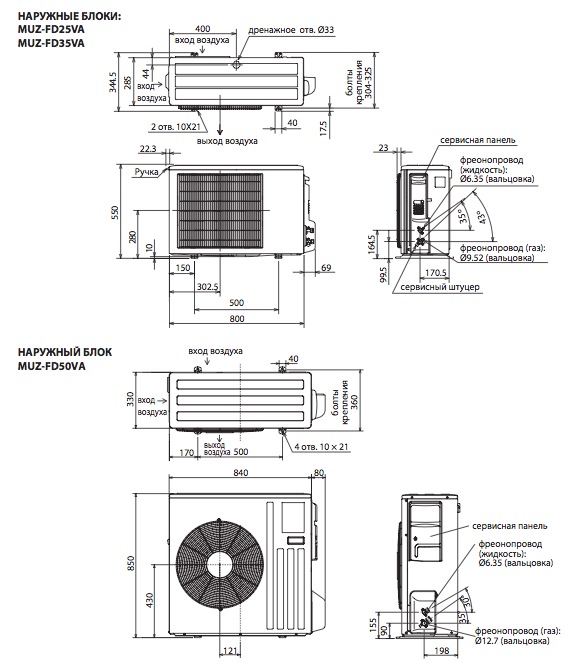

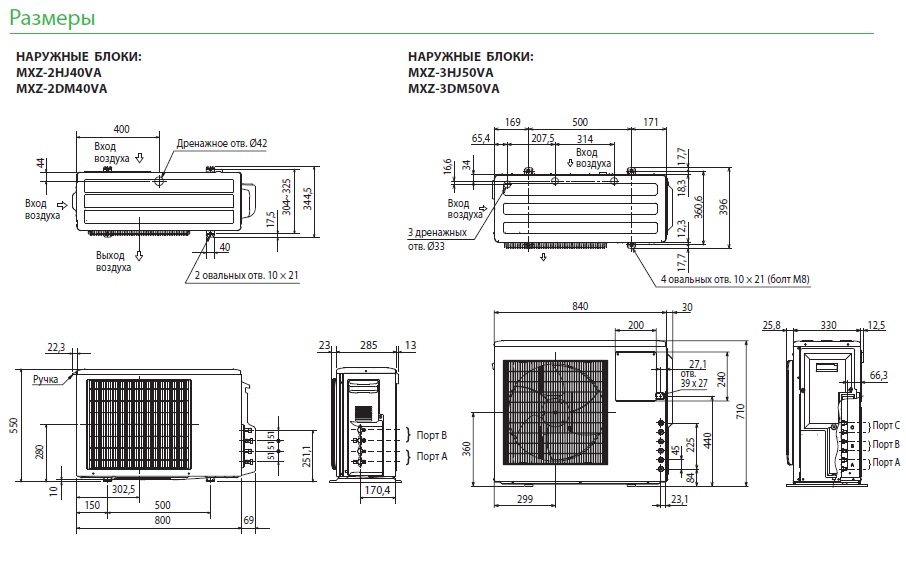
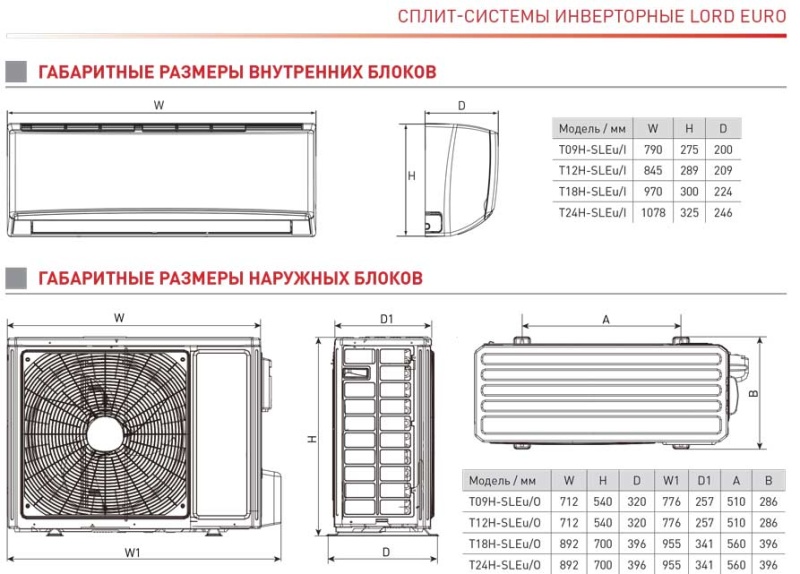


As a rule, they indicate the maximum length of the trunk, nothing is said about the minimum. But in the kit with the blocks you will find copper tubes for connecting them - in no case should they be shortened.
The piping length depends on the model.
For household split-systems with indoor wall unit the following rules apply:
- the maximum distance between the blocks is 15 m or 20 m (less often - 10 m);
- the minimum distance between the blocks is 3, 4, 5 m (along the length of the pipe in the kit).
The exact data is indicated in the technical documents for a specific model.
According to the parameters indicated in the table, it is clear that when the route is extended, additional filling of the circuit with freon is required.
If the split system is equipped with a 5-meter pipe, it cannot be shortened. What if the distance between the blocks is only 3 m, and the tube is 5 m? You just need to carefully wind it up in large rings, without breaking or twisting, and hide the remaining 2 m in one of the blocks.
Pipeline too short
If the manufacturers do not indicate the minimum length of the freon line in any of the available sources (paper or electronic instructions, video), be guided by the generally accepted value - 3 m. You cannot make the route shorter.
If we remember how the process of transition of the refrigerant from one state to another takes place, then we will understand that a short pipe is simply not enough for a complete transformation of the substance. Freon, which did not have time to turn into a gas in the evaporator, will enter the compressor in the form of a liquid, which must not be allowed.
The consequences of installing a pipeline that is too short are different:
- breakdown of air conditioner parts;
- the transition of vibrations from the outdoor module to the wall;
- noises uncharacteristic for an air conditioner - freon gurgling in the pipeline.
These troubles can be eliminated only by increasing the length of the pipeline. As you can see, a small mounting nuance turned out to be very important.
Distance is greater than standard
As you already know, the maximum length of the freon line is limited to 20 meters. This value is relevant for home models with an average performance of 2.5-3 kW. But for semi-industrial units from 8-9 kW, other boundaries are used - the length of the pipeline increases to 50 m.
It can be concluded that the parameters of the distance between the blocks of split systems are directly related to such a technical characteristic as performance.
The most dangerous thing that can happen if the pipeline is too long is a decrease in pressure. Moreover, both sections - gas and liquid - expect negative consequences.
If the gas pressure drops before it enters the compressor, then it also becomes lower at the outlet. As a result, the temperature parameters decrease, freezing occurs.
There is no special line heating function, so the compressor overheats and breaks down due to the load. You have considered the features of the compressor diagnostics and the method of its repair in the article: How to lay the air conditioner route: specifics of the communication device
A decrease in pressure in a pipeline section with liquid freon leads to an increase in the proportion of gas. A high gas content increases the speed of the refrigerant, which leads to an even greater pressure drop. In such conditions, the normal functioning of the air conditioner is simply impossible.
But there is one way out: to reduce pressure losses in the line, increase the diameter of the copper pipe. To do this, use the formula:
Professional installers advise increasing the length of the freon line only in horizontal sections.
In order not to resort to complex calculations, it is recommended to increase the diameter pipes for gas (it is slightly thicker) by 1 size: that is, replace 3/8 with 1/2, 1/2 with 5/8, etc.
We do not recommend doing the usual installation of an air conditioner or replacing pipes on your own. Experienced professionals know better how to deal with difficult cases and avoid problems.
Types of brackets
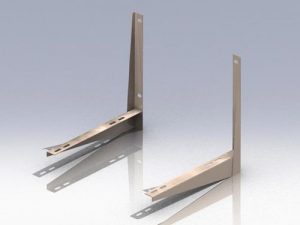
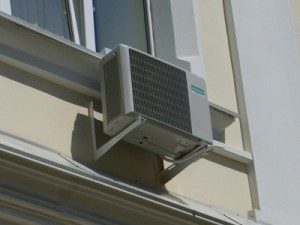 Brackets for stable mounting of air conditioners have horizontal elements on which the installed unit is placed and secured from spontaneous displacement, and vertical parts that are pressed against the wall. Holes are provided for ease of attachment.


In most cases, the brackets look like L-shaped parts used in pairs. The differences usually relate to the shape of the profiles used in the manufacture and the presence of additional elements designed to reinforce the structure.
Important! For the production of brackets used outdoors, stainless or ordinary structural steel with anti-corrosion treatment is used.
Corner brackets
 This simplest type of fastening is made by perpendicular welding of corners with a shelf thickness of at least 2 mm. It is able to withstand moderate loads, but over time, vibration adversely affects the strength of the seam.
In addition, accidental damage to the anti-corrosion coating can lead to a rapid decrease in the strength of the product and a change in its configuration.
Structures from U-shaped profile connected by bolts
Such brackets are more reliable due to the presence of additional stiffeners and vibration-resistant bolting.Fasteners made of galvanized steel do not corrode for a long time and can be replaced with new ones if damage is suspected.
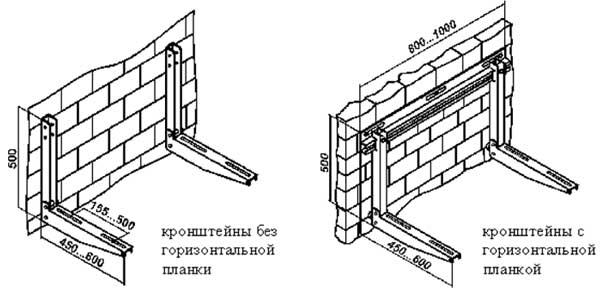 Brackets for outdoor unit
U-profile brackets with additional reinforcement
This design is similar to the previous one, but has somewhat elongated vertical elements, to which an additional jib is attached at a certain angle. It gives the entire system absolute rigidity and allows it to be loaded with a fairly heavy load.
U-profile brackets fastened with a horizontal bar
Such devices, in addition to all the positive qualities of the previously described models, are also resistant to horizontal displacement and easy to mount to the wall. They can be installed under the most expensive and critical equipment.
For information! The presence of elongated holes on the horizontal shelves of the brackets makes them suitable for installation under any brand of air conditioners.
Why you need to know the dimensions of the air conditioner
For those people who care about their health and well-being, it does not matter how much electricity the air conditioner will consume.
In order for the system to work effectively and maintain the temperature at the desired level, it is necessary to select the climate system, taking into account its dimensions and power.
 It is recommended to install split systems in bedrooms and offices. It has been proven that at temperatures above +26 and below +22 degrees, labor productivity decreases. This negatively affects the working rhythm, the psyche. Properly sized air conditioner will ensure the maintenance of an optimal microclimate in the room
The size of the air conditioner is especially important for small rooms.Large systems in small rooms will look bulky and spoil the appearance. In addition, when installing them, serious difficulties can arise: the purchased device may not fit in the space provided for it.
Air conditioning is important to position correctly. From the ceiling, you must maintain the distance recommended by the manufacturer
As a rule, it is in the range of 60-150 mm. The optimal distance from the perpendicular wall to the system is 400 mm.
If these requirements are ignored, the efficiency of the equipment will be low.
Recently, new approaches to the placement of air conditioners have appeared. Now there are vertical indoor units of split systems on sale. Such devices are equipped with a side exit of the cooled air.
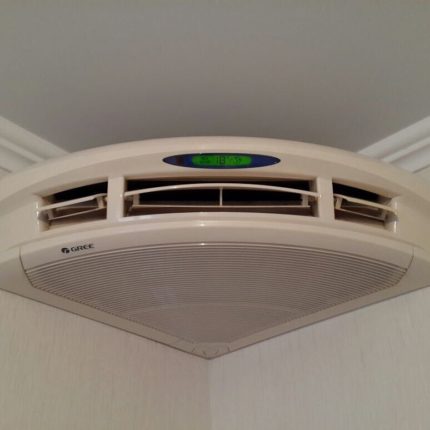 Corner air conditioners do not look as bulky as rectangular ones, they take up less space. Such models are the best option for small rooms.
It is important to choose an air conditioner of such a shape and size that it fits perfectly into the place intended for it and looks organically in the interior of the room. Also, the unit should not be too noisy.
Installation of the external unit of the air conditioner
When installing air conditioners, special installation kits are used, which include pipes with flex, brackets with sets of fixing hardware, drainage communications, etc. The physical installation of the segment is carried out using load-bearing components that are embedded in the walls using anchor elements. At the same stage, brackets are used, the power potential of which is oriented to the mass of a particular module. Also, the installation of the external unit of the air conditioner provides for its communication connection with the internal segment.To do this, a hole of the required diameter is made in the wall, which will allow organizing, in addition to the main wiring, also the laying of a vacuum pump and a gauge manifold. At the final stage, a direct connection of communications between the two blocks is made.


Specifications of the indoor unit
To choose the optimal model of the air conditioner, you should pay close attention to the technical characteristics of the device. Each manufacturer may have its own set of performance characteristics, but the main list of indicators is the same for all and includes the following items:
- Power consumption. Often the total value is indicated for the outdoor and indoor units, where the indoor module consumes only a small part - no more than 100-200 watts.
- Heating power.
- Cooling power.
- Air flow. Shows how much air the device is able to pass through itself per unit of time.
- Device dimensions.
- The weight.
- Recommended area. Facilitates the choice for consumers by showing for which volumes of premises the device will be optimal.
All this data is written in the accompanying documentation, as well as on the information panel on the device itself.
Conclusions and useful video on the topic
General information about duct air conditioners:
Theory and practical experience:
An example of installing a channel split system in a city apartment:
For a standard city "kopeck piece" with ceilings of 2.5 or a small country house, which is more often used seasonally, during the warm season, a channel system is not needed. But for a spacious apartment with high ceilings or a cottage, a channel-type split system can be the best solution to improve the microclimate in the rooms.
To install the equipment, you will have to make friends with locksmiths and installers; you cannot cope with the installation of a technically complex unit on your own. It will be much more expensive than a conventional split system. But the result will be higher - you will get a reliable design that provides you with coolness, warmth or just fresh air when you need it.
Want to talk about how your ducted air conditioning system works? Do you have useful information on a topic that is worth sharing with site visitors? Please leave comments in the block form below, post photos and ask questions.



