- Dimensions of bimetallic heating radiators: height
- What are panel radiators
- Features of tubular batteries
- Characteristics of tubular devices
- Strengths and weaknesses of batteries
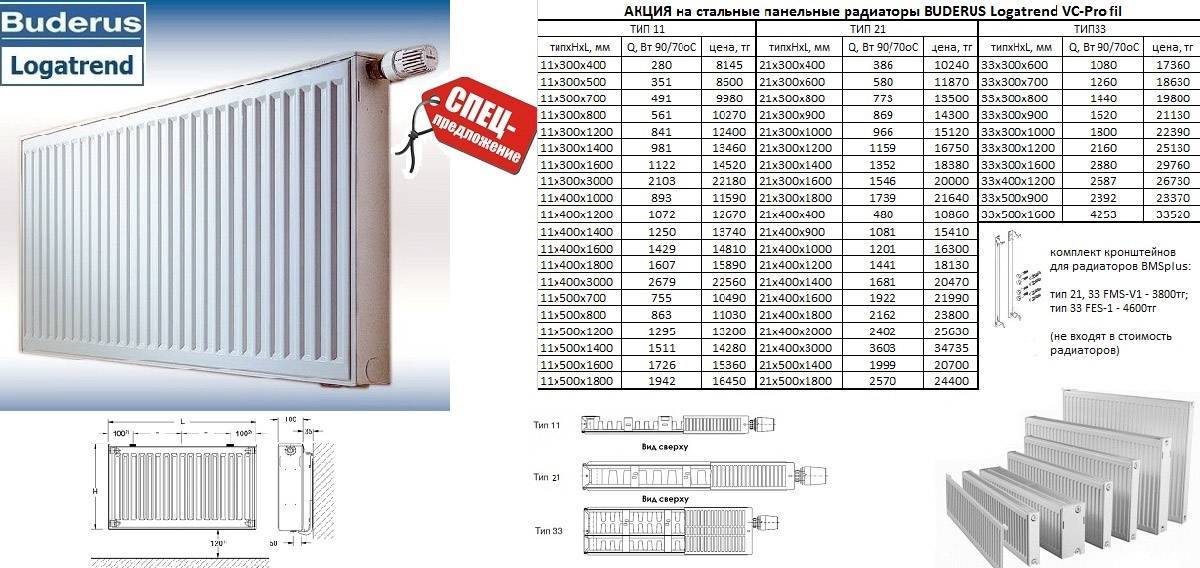
- Overview of manufacturers and prices for panel radiators
- Calculation of panel steel radiators
- What are the dimensions of steel heating radiators
- Advantages and disadvantages
- Steel heating radiators
- Panel steel radiators
- Tubular steel radiators
- Installation of aluminum heating radiators
- Varieties and selection criteria
- The most important characteristics of steel radiators
- Heat dissipation
- Operating pressure
- Coolant quality
- Center distance.
- dimensions
- steel thickness.
- Durability
- Ease of installation
- The main advantages of panel radiators
- Features of mounting radiators
Dimensions of bimetallic heating radiators: height
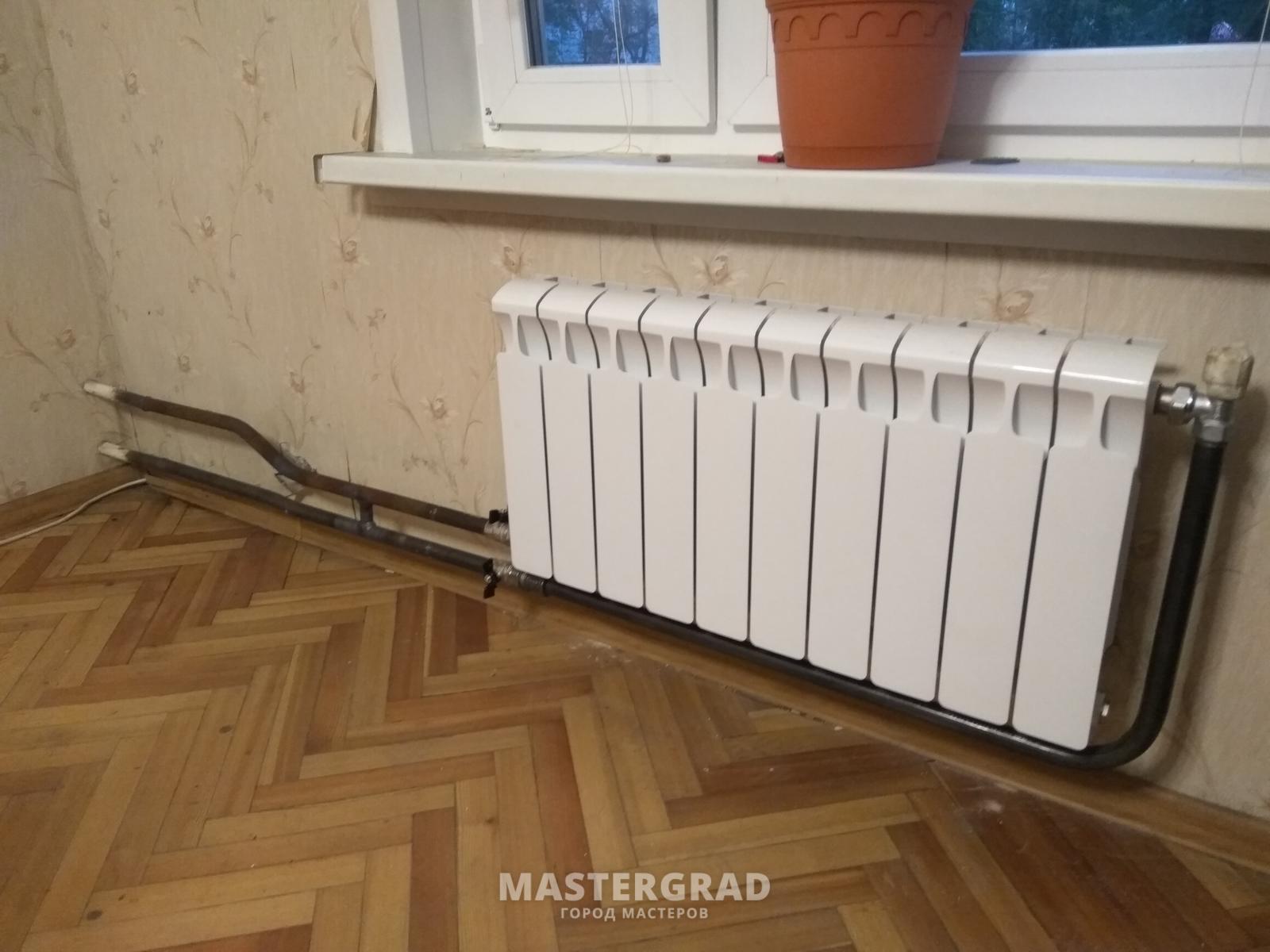
In the manufacture of heating batteries, like any other equipment, of course, certain standards are observed. Bimetallic radiators (depending on modification) according to the passport can have a height of 200, 350 and 500 mm. All of these options are quite popular, and you can purchase them if necessary without any problems. However, the figures 200, 350 and 500 mm are not the actual height of the radiator, but only indicate the distance between the centers of the inlet and outlet pipes.But the battery sections themselves are usually slightly longer. What sizes of heating radiators in height will be the most convenient, you can find out if you add 8 cm to the center distance. Thus, a battery marked 350 will take about 430 mm under the windowsill, a 500 mm model - 580 mm, 200 - 280 mm.
What are panel radiators
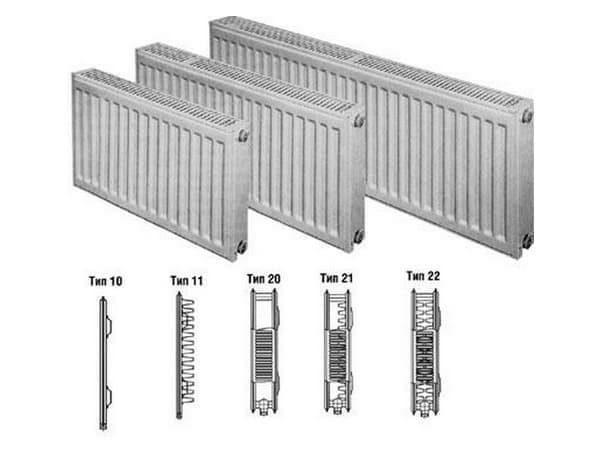
There are several varieties of steel panel batteries.
According to the method of connection to the heating circuit, products of this type are divided into two large groups:
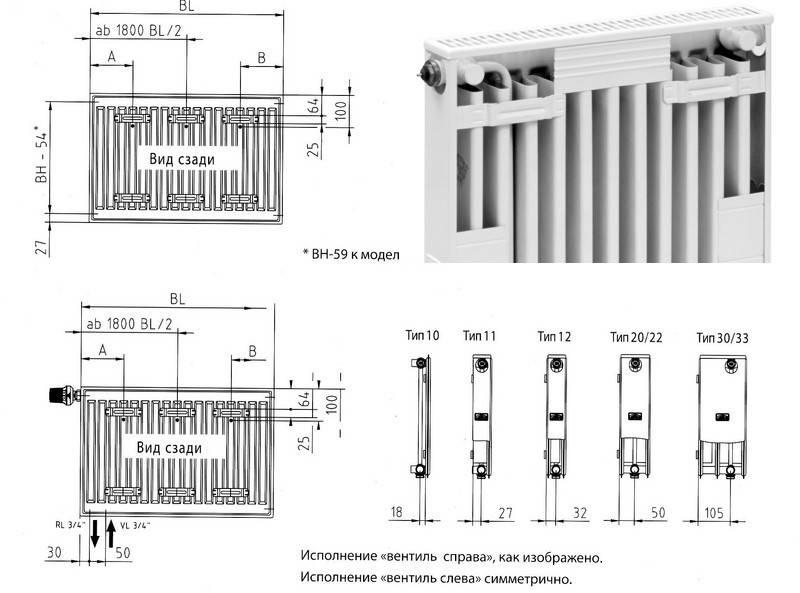
- With bottom connection. Another name for these devices is universal. Their package includes additional accessories, including a thermostatic valve, a thermal head, etc. The cost of universal batteries is slightly higher (15-20%) than other varieties. The advantage of the lower connection is its almost complete invisibility and the ability to fit more harmoniously into the environment. This is facilitated by the use of special angular and straight fittings (plumbers call them "radiator binoculars").
- Side connection. They are in great demand among buyers (not only because of the lower cost). This type of device makes it possible to apply several switching options: most often it is a one-sided side circuit that allows you to maximize the potential of the heater. In batteries with a large number of sections, a lateral diagonal connection is used. At the same time, aesthetics suffer, because. cranes protrude on both sides. But in this way the optimal level of heating and heat transfer of the device is achieved.
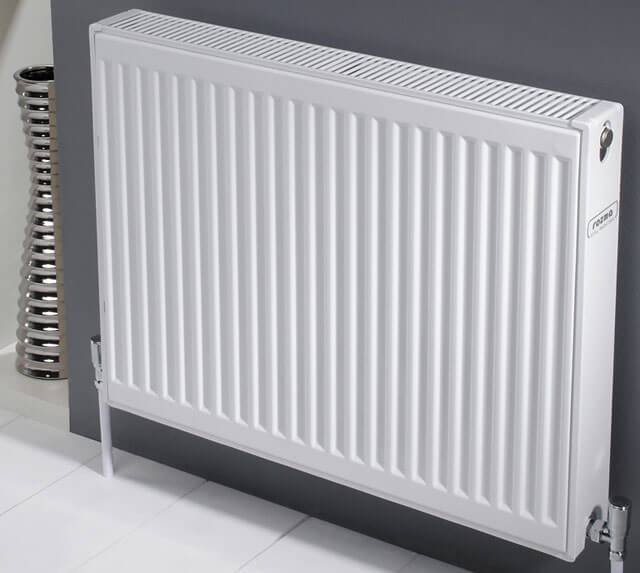
A less noticeable connection method is a scheme in which the connecting pipes are located below, on both sides of the radiator. However, according to the manufacturers, this provokes a drop in the heat output of the heater by 5-20%.
Features of tubular batteries
Due to the higher cost, tubular steel batteries are used much less often than panel ones. The design consists of several rows of parallel tubes. In this case, the rows can be located not only horizontally or vertically, but also at an angle.
Characteristics of tubular devices
With an identical principle of operation, the methods for manufacturing tubular equipment vary. Some are made in the form of sections, similar to cast iron, which are joined by welding. For others, steel rows of tubes are used, connected in the lower and upper parts by collectors.
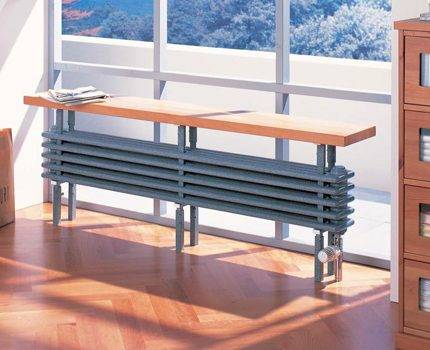
It is not difficult to turn a tubular heater into a significant element of room decor.
Although the design of tubular radiators varies, almost all models have similar characteristics. This equipment is optimally suited for installation in heating systems in low-rise buildings.
The heat transfer of tubular radiators, in comparison with analogues of panel type, is greater, but the price is much higher.
Tubular radiators have the following technical characteristics:
- working pressure 15 atmospheres - 2 tests are carried out during the manufacturing process - with air for tightness and water for strength;
- able to withstand a significant temperature of the coolant - up to 130 ° C;
- a large selection of dimensions - depth from 40 to 290 mm, height from 190 to 3000 mm, there are no restrictions on length at all;
- for manufacturing use steel with a thickness of 1.32 to 1.5 mm;
- outlets for side and bottom connection.
The inner walls of tubular devices are most often coated with a polymer composition. This greatly extends their service life. The smooth surface prevents the accumulation of dust, therefore, in terms of hygiene, tubular appliances compare favorably with aluminum, cast iron and bimetallic counterparts, the cleaning of which causes a lot of inconvenience.
Strengths and weaknesses of batteries
Tubular models of heaters are appropriate for use in private homes, where the heating system is characterized by stable and low operating pressure in the absence of sudden surges and water hammer.
The popularity of tubular devices is due to a set of their positive qualities:
- high working pressure and ability to withstand water hammer;
- resistance to mechanical damage due to the absence of gaskets in welded sections;
- uniform heating of the surface and high heat transfer;
- smooth surface prevents dust accumulation;
- ease of installation, the possibility of bottom and side connection, various placement options;
- the possibility of adjusting the temperature when equipped with a thermostatic valve.
In addition to fasteners, tubular radiators can be equipped with special brackets used as heated towel rails.
There is also a whole category of models belonging to the category of design radiators - they are used to create an interior. These fixtures are available as mirror frames or stair railings. Floor-to-ceiling models are successfully used for zoning a room.
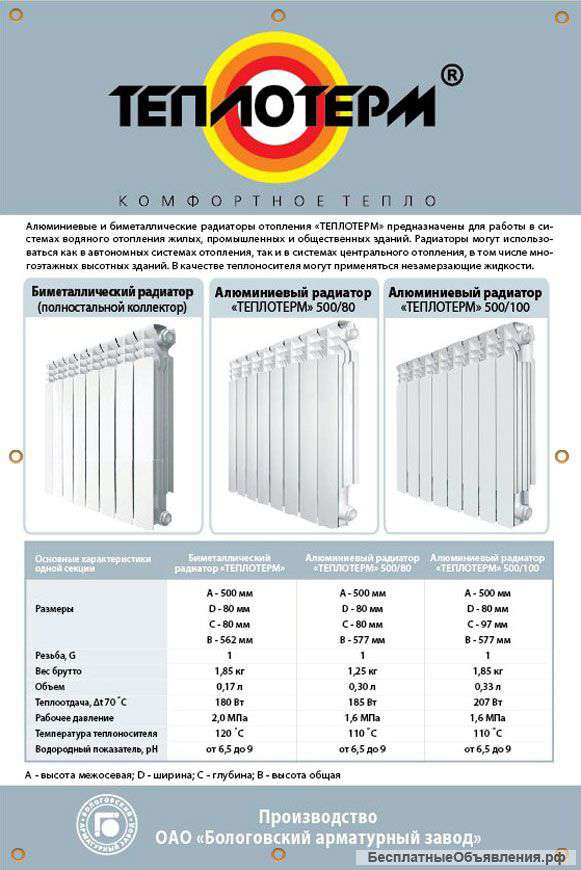
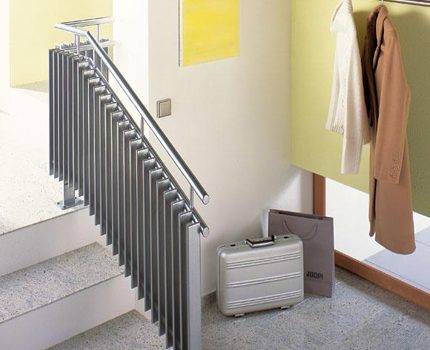
By giving intricate shapes to heating devices, manufacturers increase the competitive attractiveness of their products.But in steel railing-shaped batteries, the functional load increases
A lot of positive qualities and excellent characteristics inherent in steel heating radiators make their use attractive. Such devices are easy to fit into the interior, they allow you to visually expand the space.
However, do not forget about the shortcomings of tubular models, which are as follows:
- low resistance to corrosion processes, especially manifested with a low quality of the coolant; spot welds are most susceptible to corrosion.
- high cost.
As for the cost, tubular batteries are by no means a budget solution. Their installation is most often resorted to by designers who, when implementing their projects, are not constrained by funds.
Overview of manufacturers and prices for panel radiators
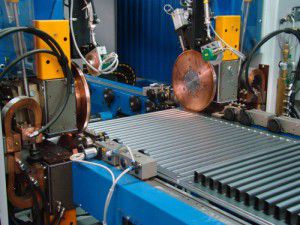 Production of panel radiators
Currently, there are several manufacturing companies that specialize in the production of panel radiators. Their products are of high quality, reliable operation and long service life.
These positive characteristics apply to many Russian panel heating radiators. For the correct choice of the optimal model, in addition to the characteristics, it is necessary to make an initial price analysis.
| Manufacturer/Model | Power, W | price, rub. |
| Kermi FKO type 11 L – 400 | 474 | 2920 |
| Korado Radik type 11 L - 300 | 355 | 1800 |
| Prado Classik type 11 L – 500 | 376 | 1950 |
| Prado Universal type 11 L – 500 | 376 | 3145 |
For those who decide to install the radiator on their own, it is useful to watch a video that describes this process in detail:
Calculation of panel steel radiators
To calculate the required power, you must do the following: first you need to calculate the volume of the entire room. The resulting volume is multiplied by 41 watts. A power of 41 W is the average power required for normal heating of 1 cubic meter of a room. If the calculation is made for a room located in the corner of a building, the power of 41 W will need to be replaced with a higher value.
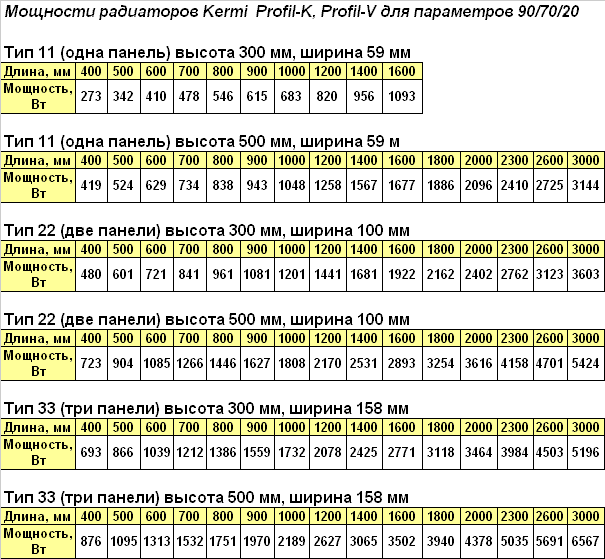 Power of Kermi steel radiators
Panel steel radiators also have some disadvantages, as reviews tell us. Before choosing which panel heating radiators are better, you need to familiarize yourself with these disadvantages:
It is unacceptable for the internal surface of the device to come into contact with oxygen. Therefore, such radiators cannot be without water for a long time. This period may not exceed two weeks.
Metal panel heating radiators are designed for a relatively low operating pressure. The maximum allowable indicator for such heaters is 9 atmospheres. Steel panel radiators are only suitable for low-rise buildings, so it is best to use them for heating systems in a private or country house. In addition, they are not able to withstand strong hydraulic shocks, and this phenomenon is not uncommon in multi-storey buildings.
In order for a steel flat heating radiator not to be affected by corrosion, it is necessary to test the pH level of the water
It is important that it be as stable as possible. In the case of a district heating system, the pH level of the water cannot be controlled.
Panel heating can also use infrared panels.Infrared heating radiators are a fairly new development. Infrared heating batteries do not heat the air, but the objects around. As a result, objects begin to give off heat.
What are the dimensions of steel heating radiators
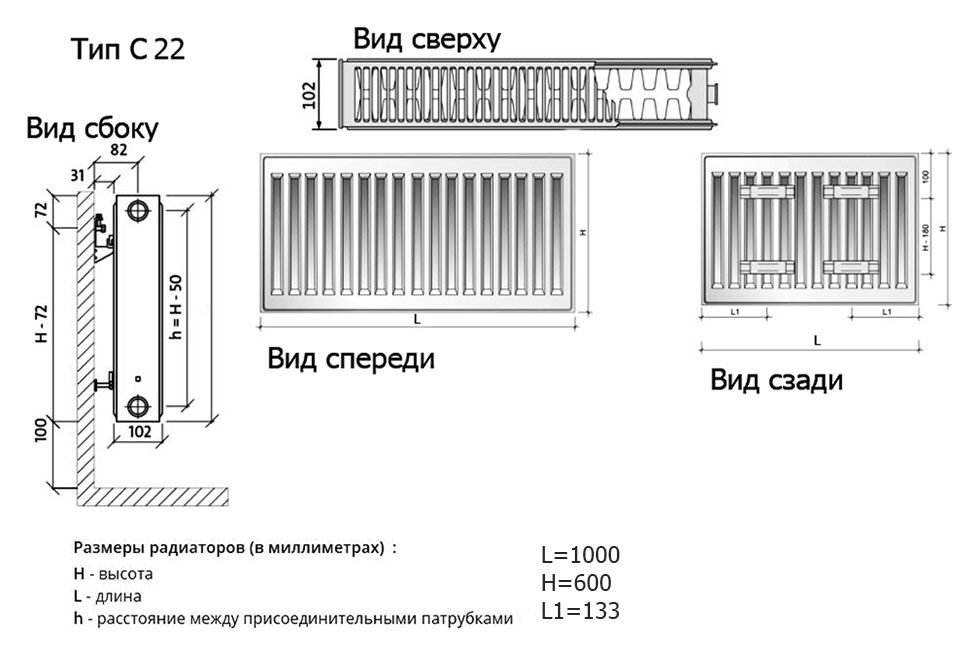
Structurally, such batteries differ from both cast iron and bimetallic ones. Represent steel radiators as a single rectangular panel. Inside it there are channels designed for the coolant. On sale there are also tubular steel radiators. In appearance, they resemble cast-iron models. In turn, tubular batteries can be sectional or solid.
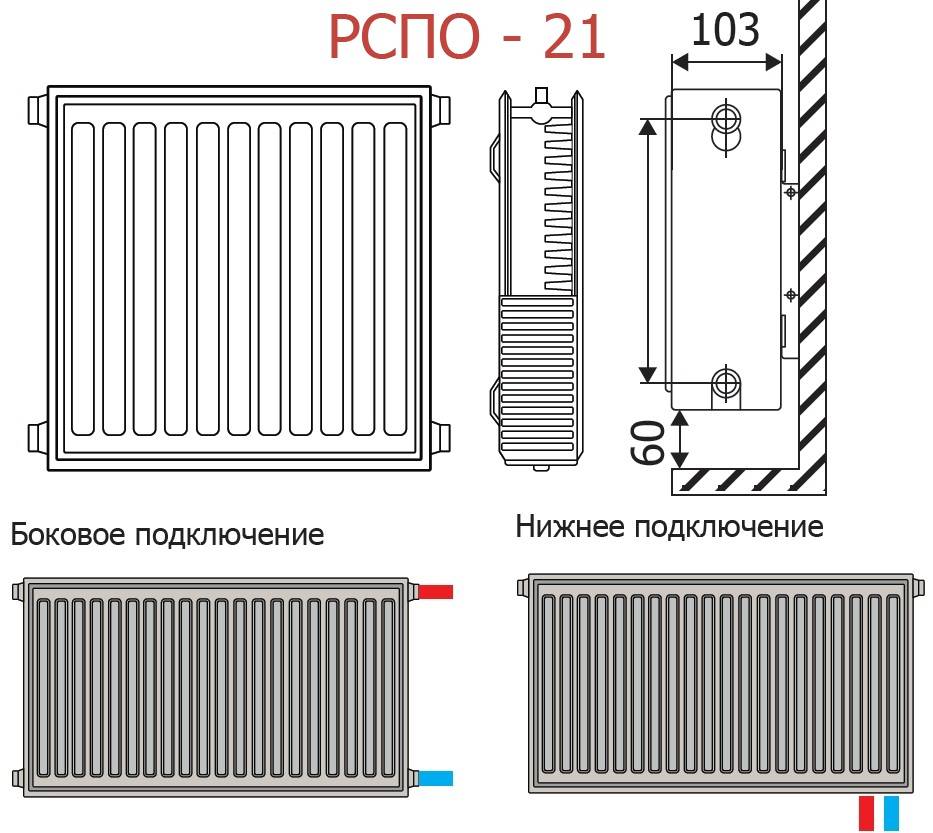
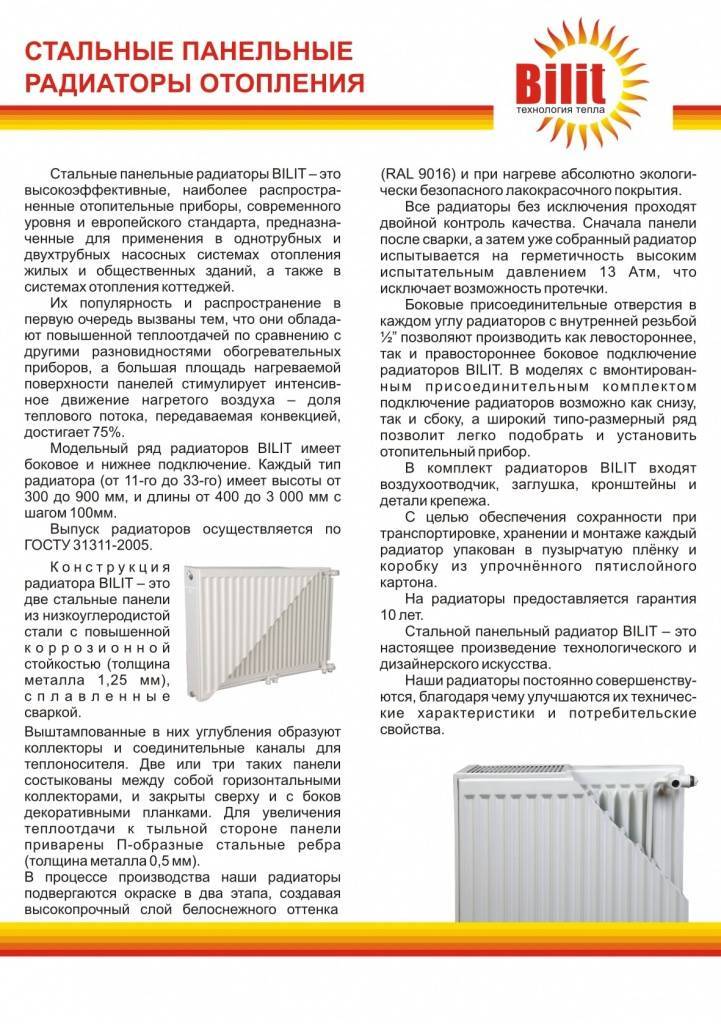
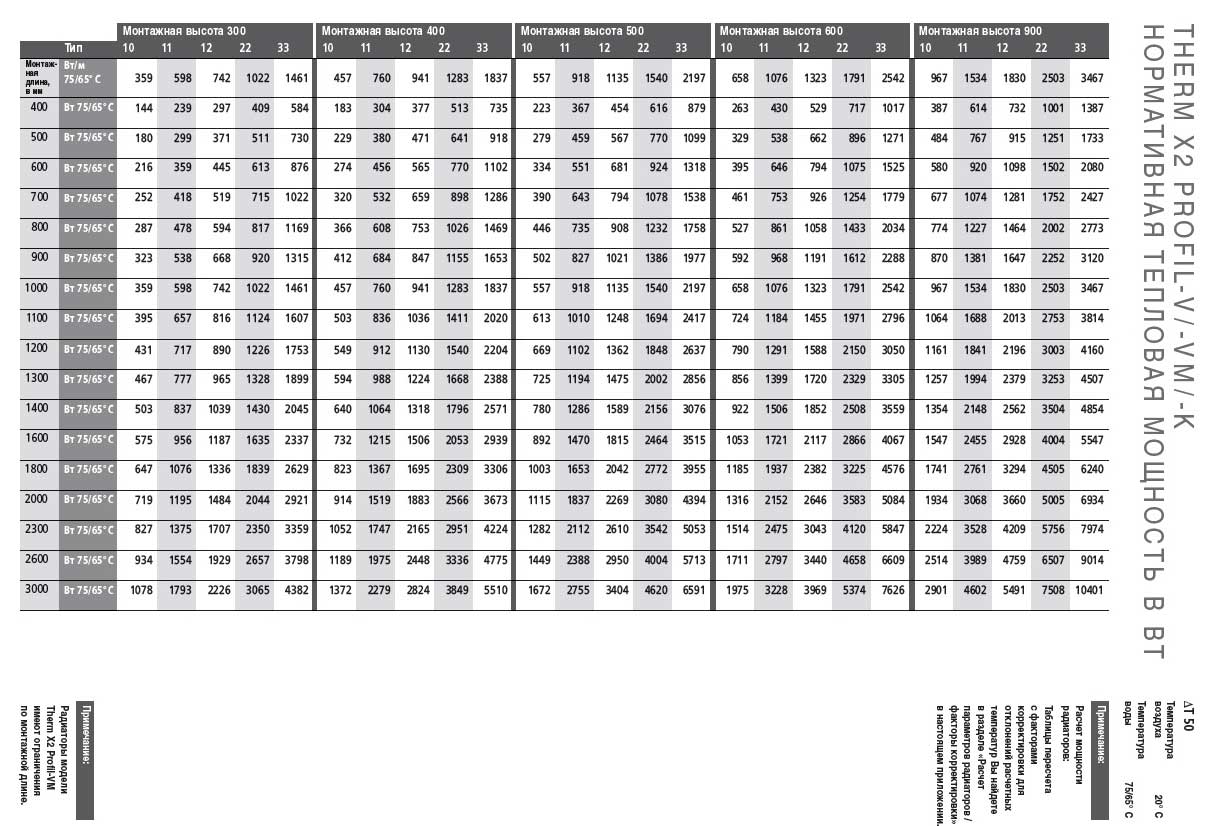
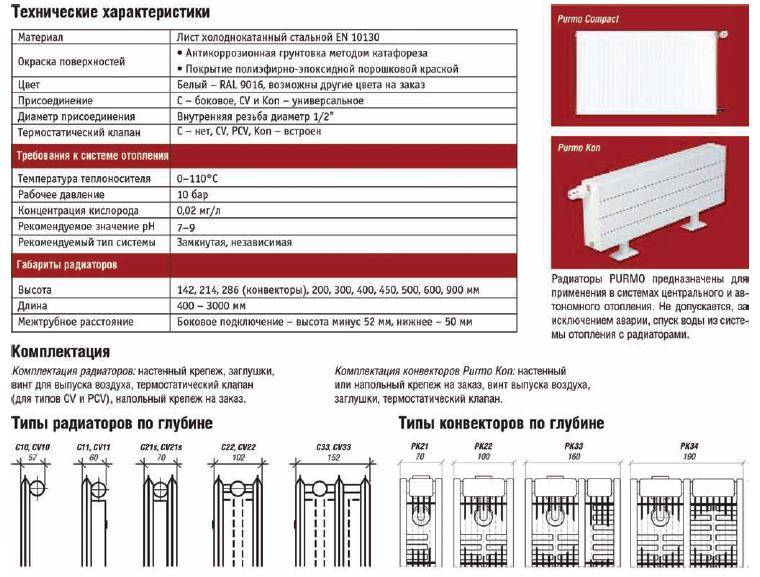
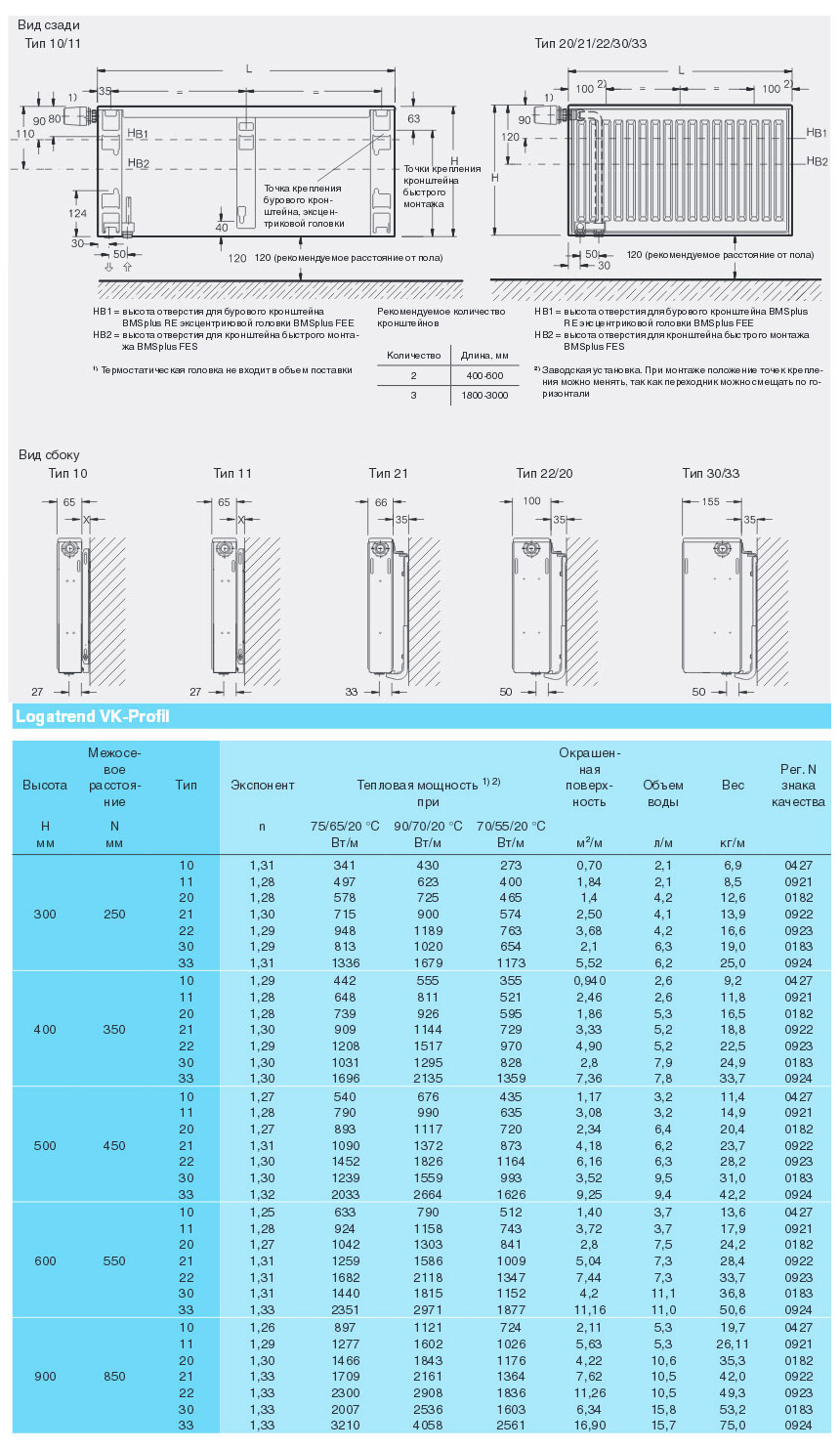
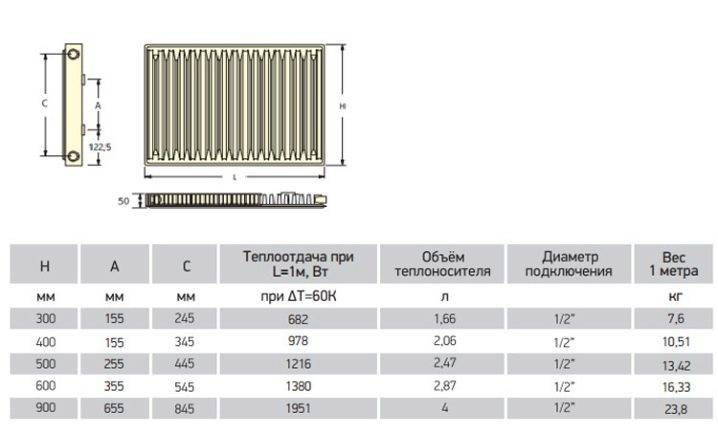
Steel heating radiators dimensions in height and width can have a variety of
When choosing such radiators, first of all, pay attention to the thickness. The higher this value, the more powerful the battery.
The thickness of steel radiators depends on the number of panels and rows of fins. The latter indicator can range from 0 to 3. Thus, the thickness of a steel radiator is most often 61-170 mm.
The width of tubular heating radiators depends on the number of sections used in them. Models of this type, due to their special design, are usually installed only in offices or administrative premises.
Advantages and disadvantages
The units in question, like any other on the market, have both a number of strengths and certain disadvantages. The list of key benefits includes the following:
As for the weak qualities, their list is given below:
- Susceptibility to corrosion.At the same time, this property does not depend on the type of the selected battery: when oxygen enters a closed system or in the absence of a coolant in the latter due to any reason, the device begins to rust quite quickly. That is why any water drains for steel radiators are akin to a disaster.
- Sensitivity to the coolant. The reality is that in our area the quality of the coolant for the most part leaves much to be desired. When equipping a heating system using panel steel radiators, be sure to consider installing additional filters.
- Relatively large weight. In practice, the simplest panel model is likely to weigh more than its cast-iron counterpart, which imposes additional requirements regarding the reliability of fasteners. Because of this, a steel battery cannot be hung on a drywall wall.
- Low resistance to powerful water hammer.
- Reduced heating efficiency when the temperature of the water circulating through the system decreases.
Steel heating radiators
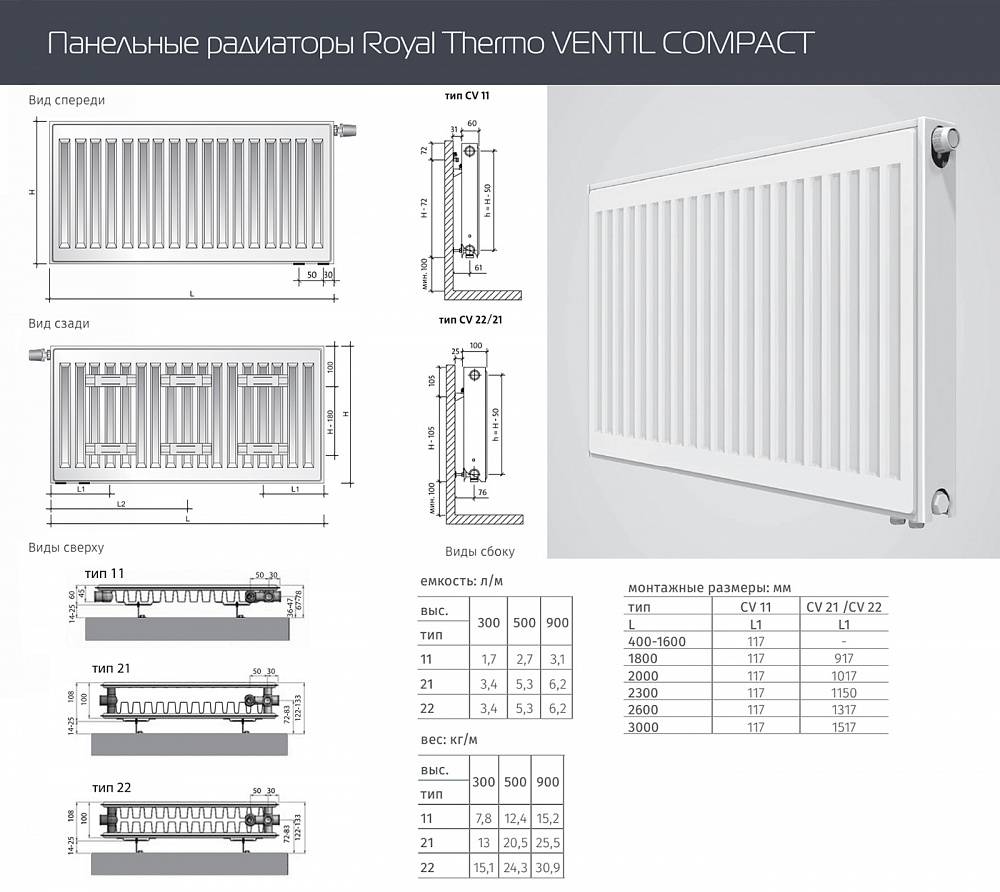
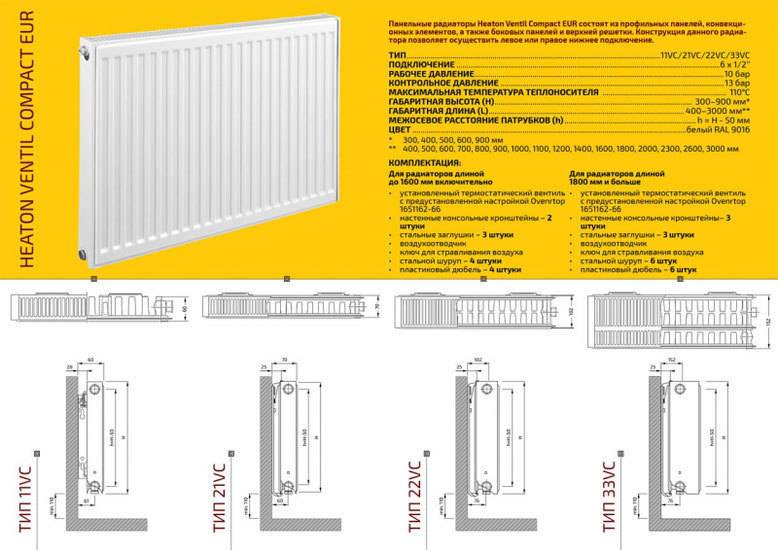
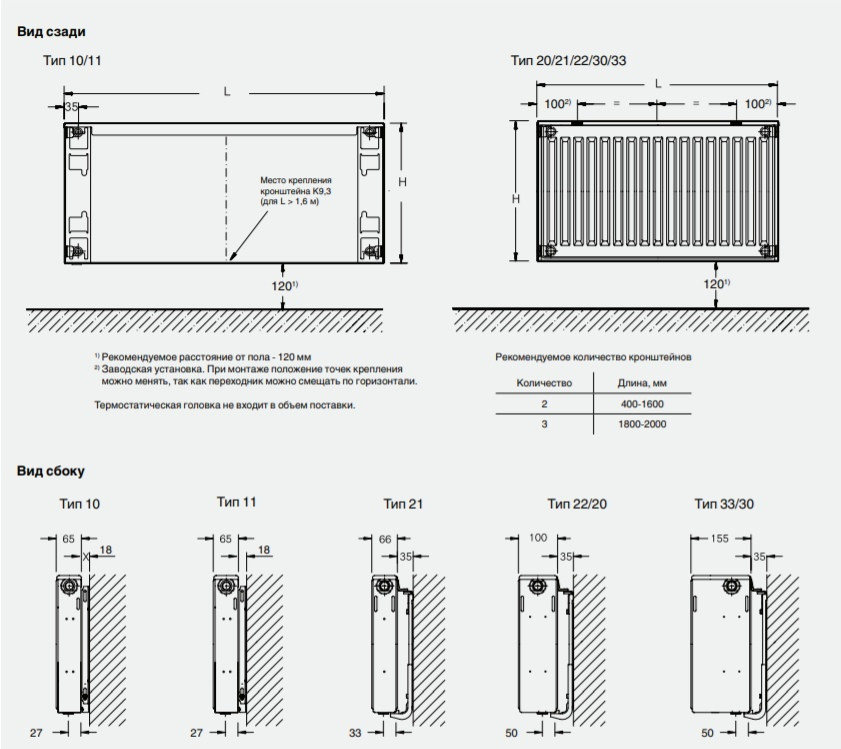
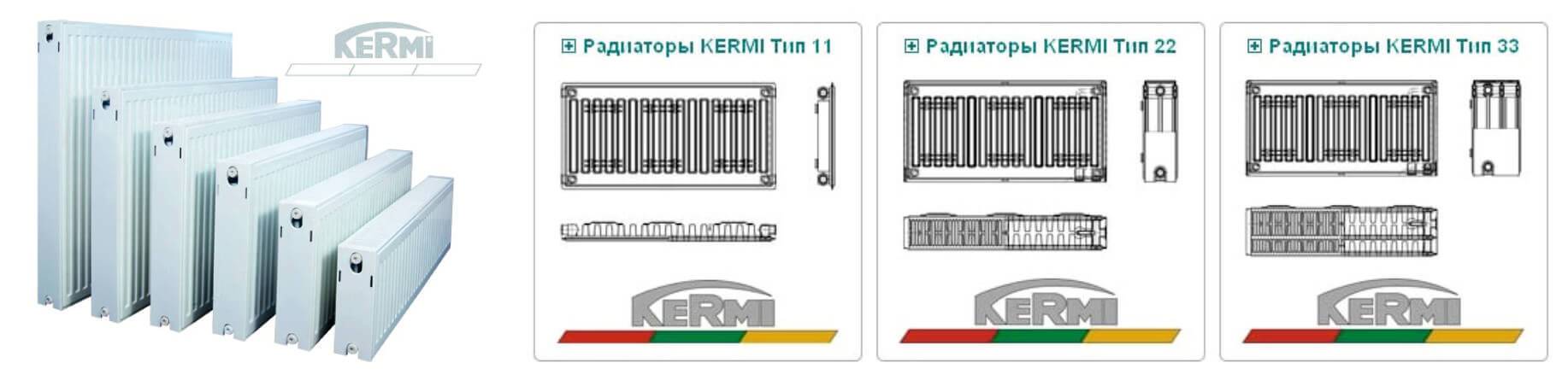
Panel steel radiators
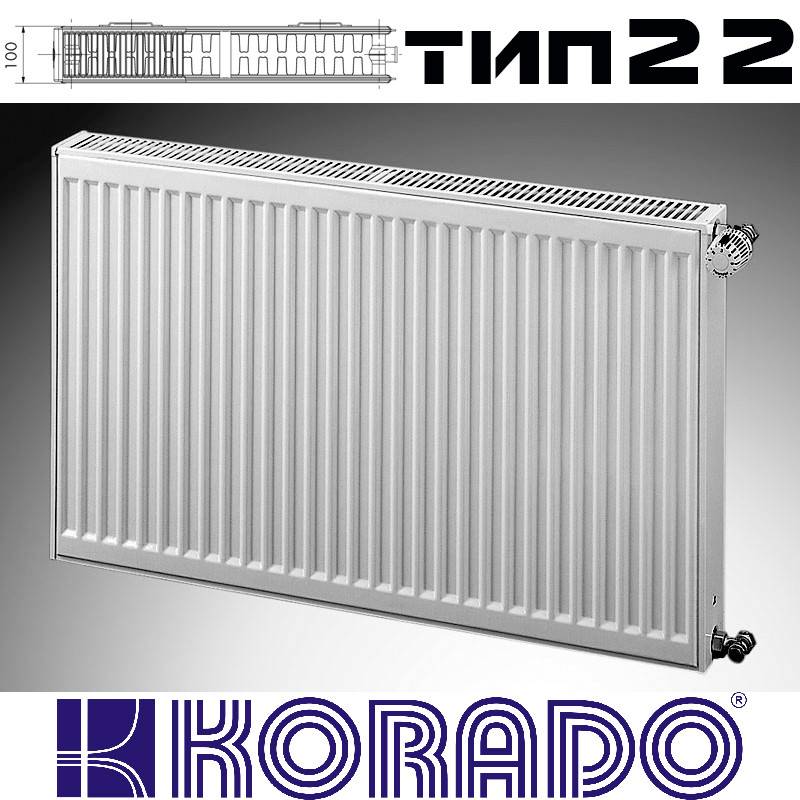
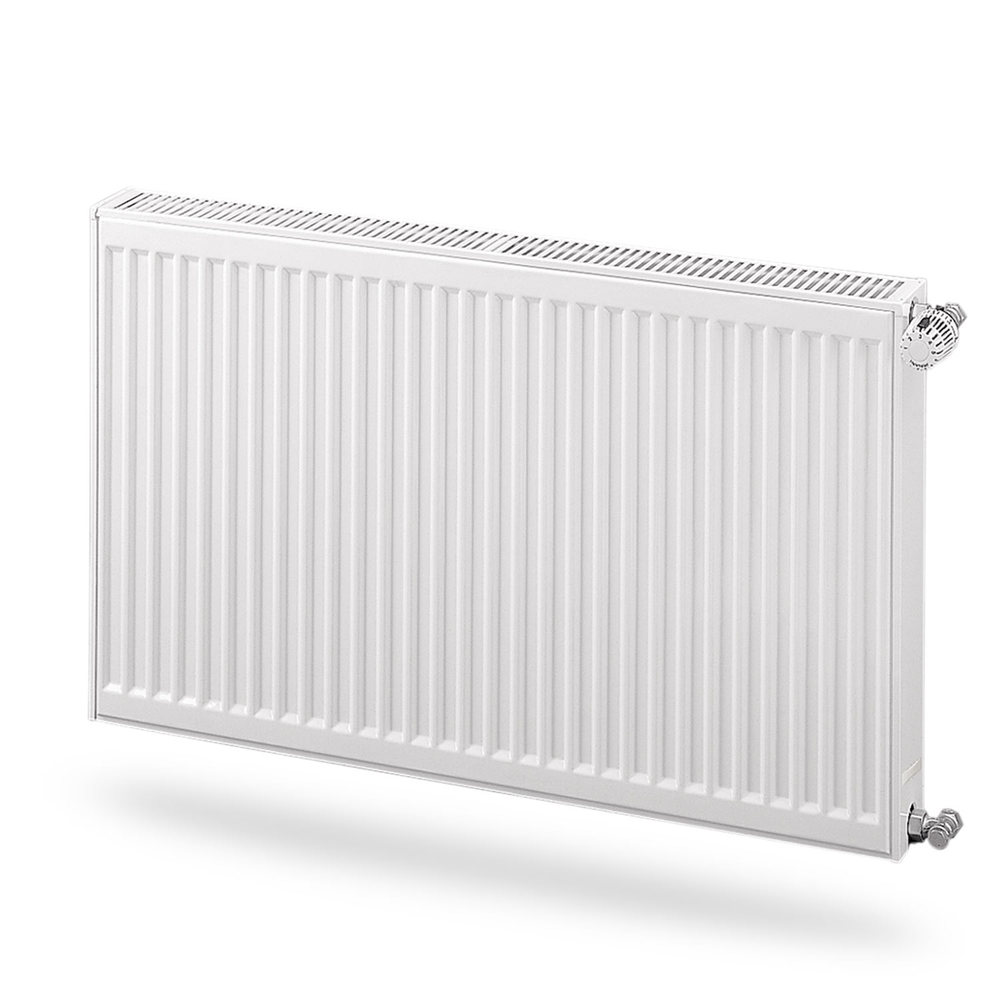
Such radiators are also called convectors, they have a high efficiency - up to 75%. Inside the radiators there is one or more steel heating panels and convector fins.
The device of a steel panel radiator.
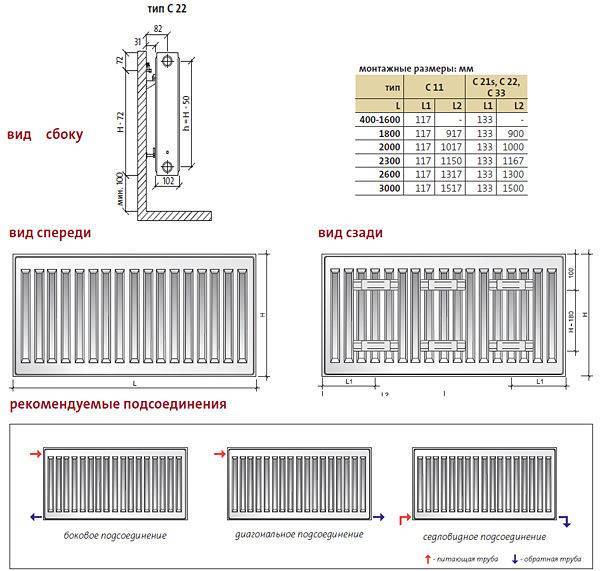
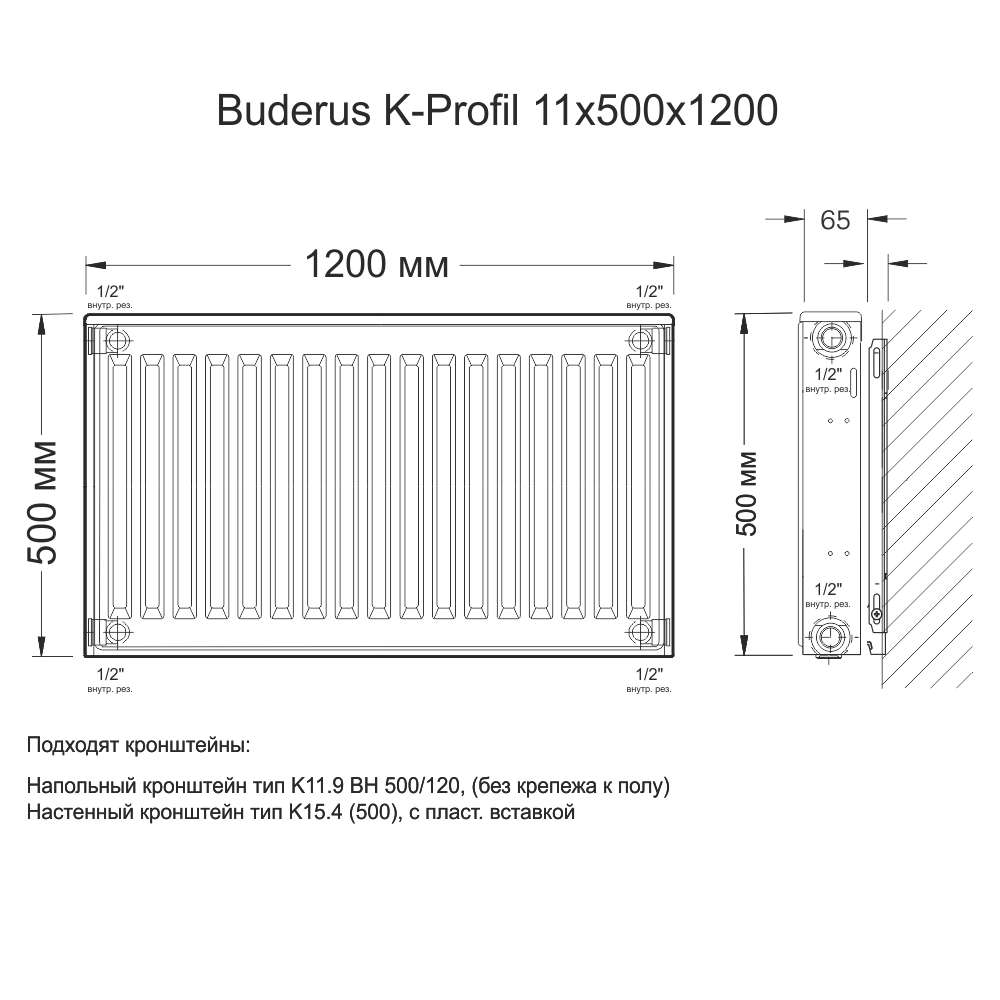
Panel radiators are the most budgetary solution for your own home and, therefore, are the most common in autonomous heating systems. Depending on the number of heating panels and convection fins, the following types of water heating radiators of panel design are distinguished: 10, 11, 20, 21, 22, 30, 33.
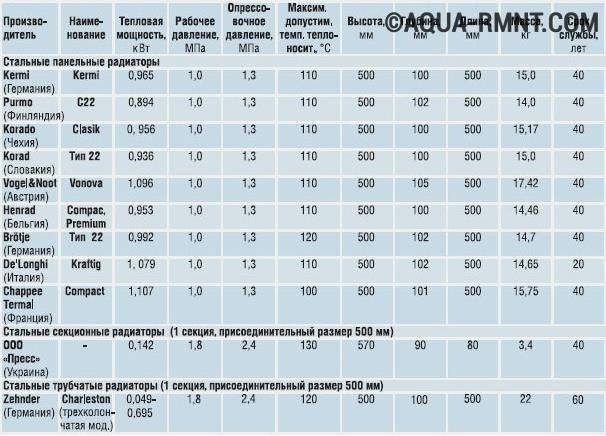
Manufacturers: These are mainly European countries - Germany (Buderus and Kermi), Czech Republic (Korado), Italy (DeLonghi), Finland (PURMO). Their prices are not high, so Russian manufacturers are not very strongly represented in this market.
+ Pros:
- Inertia is low, heat transfer is excellent.
- The volume of the coolant is small, energy consumption is small.
- These radiators are environmentally friendly and harmless, so they can be used in hospitals, schools and kindergartens.
- Extremely low price.
- Minuses:
- If water is drained from the heating system, then when oxygen comes into contact with the walls of the radiator, corrosion begins to form.
- Water hammer is dangerous for steel radiators. Therefore, they cannot be used in multi-storey buildings.
- Due to convection, drafts and fine dust may be raised.
Tubular steel radiators
The design of the radiator is a structure made of steel pipes through which hot water passes. The production of such devices is more expensive than panel ones, and therefore their price is higher.
There are many design options - this is a real feast for the designer's imagination.
Manufacturers:
Of the European producing countries, Germany (Kermi, Charleston, Zehnder Charleston, Arbonia) and Italy (Israp Tesi) can be mentioned. Domestic devices manufactured by the KZTO plant (Kimry) are distinguished by a working pressure of up to 15 bar. And the models "RS" and "Harmony" are also protected from corrosion by a polymer coating.
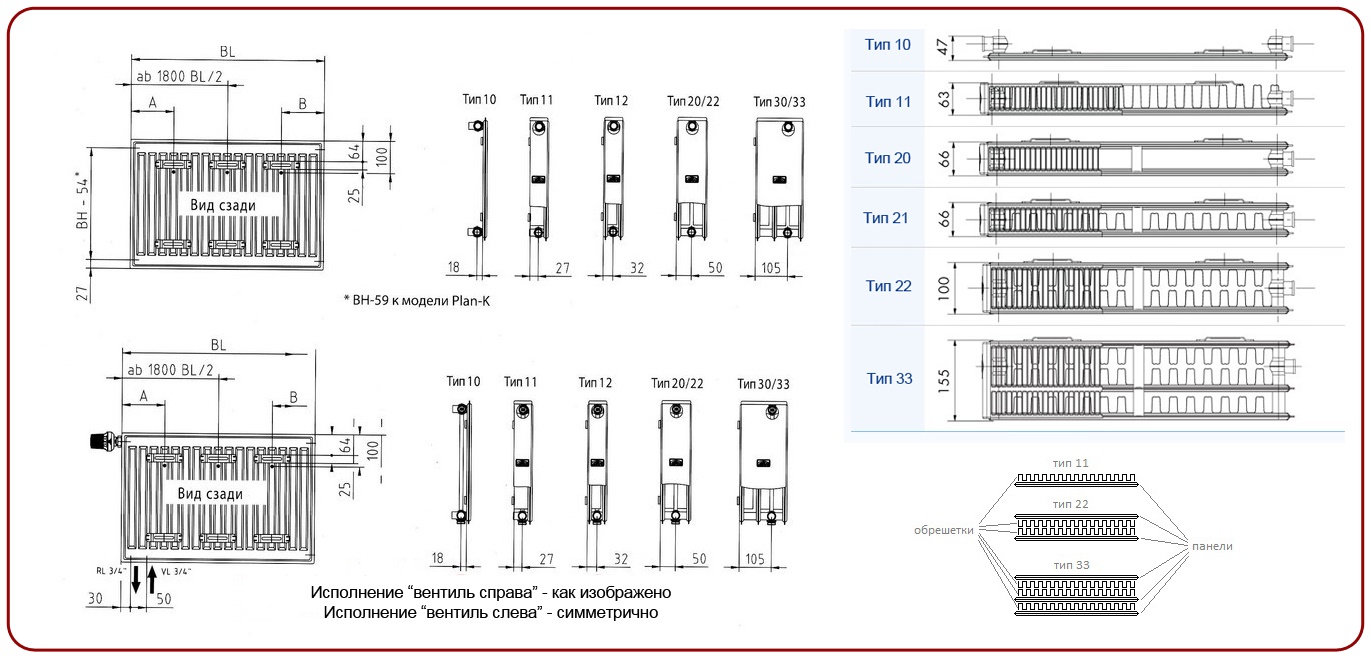
Pros and cons: These radiators, like panel radiators, have advantages and disadvantages inherent in steel products. However, in terms of pressure, they have better indicators (this is a plus), and their price is significantly higher (this is a minus).
Main characteristics:
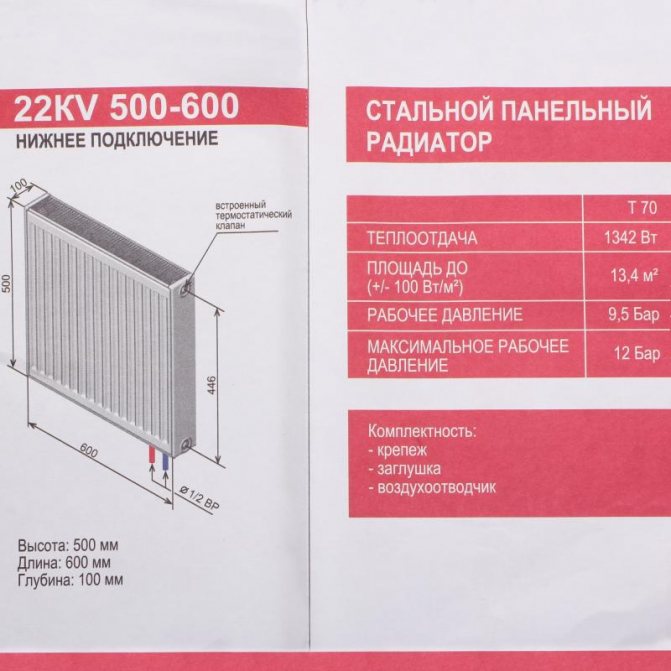
- Pressure (working) - an average of 6-10 bar (for panel radiators) and 8-15 bar (for tubular radiators).
- Thermal power (total) - 1200-1600 watts.
- Hot water temperature (maximum) - 110-120 degrees.
- pH of water - 8.3-9.5.
Installation of aluminum heating radiators
Use a spirit level when installing the battery. The radiator must be installed strictly horizontally.
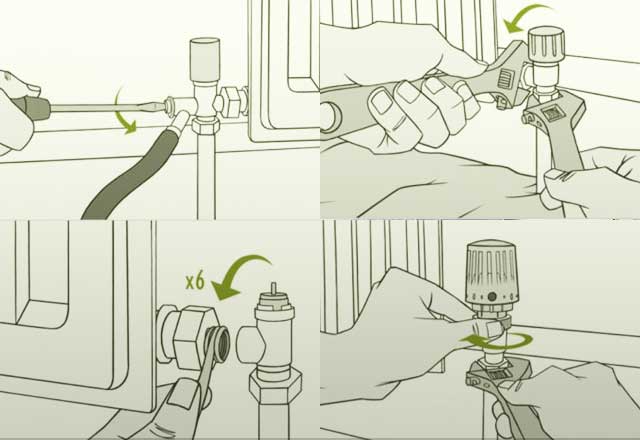
Installation of aluminum heating radiators does not cause any difficulties. For their connection, plastic pipes are most often used that can withstand high pressure and high temperature. The heating system can be one-pipe or two-pipe, but you need to remember that in a one-pipe system and with a lower connection, heat transfer will decrease. The radiators are fixed with brackets.
The process of installing batteries is carried out in several stages:
- Brackets and radiators are attached.
- Radiators are connected to pipes through taps or thermostatic valves.
- Air vents are installed.
In conclusion, we check the tightness of the connections - they must be made with high quality in order to exclude possible leaks. The final check is carried out when the heating system is filled with coolant.
Varieties and selection criteria
Panel-type radiators are equipped with both convective and hygienic fins, assuming the absence of convective plates. Hygienic batteries are distinguished by the fact that they can be easily cleaned from dust. They are produced without decorative grilles, so this design is characterized by easy access to the internal structure of the product. Such models are installed mainly in hospitals and other types of premises with high hygienic requirements.
Depending on the type of front panel, the devices are available with a corrugated, smooth and flat surface. Products with a flat surface may have vertical or horizontal grooves. Thus, the outer case of the device is assembled from standard and decorative panels.
Metal radiators are best connected to an autonomous heating system. If they are embedded in a centralized system, then the service life of the devices will be halved.
In order for the device to reliably serve for a long time, experts recommend taking into account the following nuances when choosing it:
- Working indicators. The pressure in the heating system must not exceed 10 bar. Some manufacturers produce products that can maintain a pressing pressure of 13 bar, but the water temperature in this case is no more than + 110C.
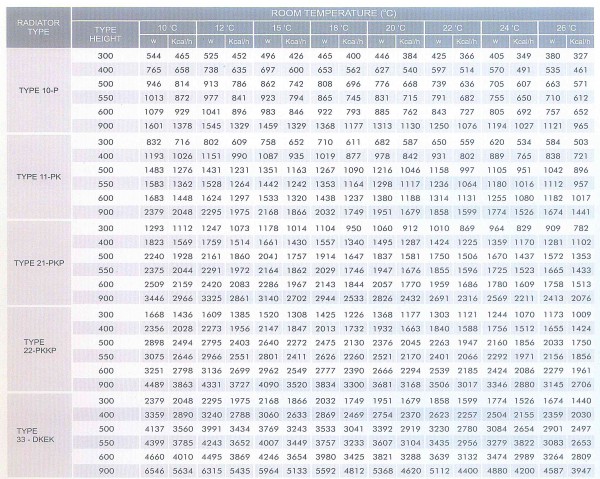
- Thermal power. For each type of radiators, it is installed individually.
- Connection method. Typically, devices are mounted either from below or from the side, so the choice is determined both by the personal preferences of users and by the characteristics of the heating system.
- Availability of additional features. Most modern models are equipped with a thermostatic valve, which allows you to effectively maintain a certain temperature in the room. In addition, the design can be supplemented with thermostats that simplify heating control.
The most important characteristics of steel radiators
Heat dissipation
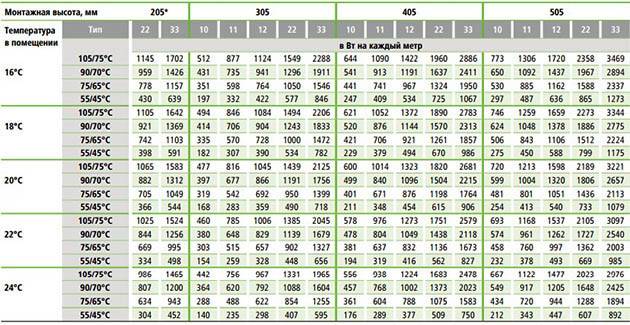
Things are going quite well with heat transfer - the heat transfer rate varies from 1200 to 1800 watts and even more. This parameter depends on the dimensions of the radiator, its brand and type of a particular model. Note that a big plus of these devices is their low inertia.They heat up very quickly and begin to give off heat to the room.
The very process of heat transfer in them occurs in two ways - this is the direct radiation of heat and the transfer of heat by convection.
Operating pressure
The maximum working pressure for this type of radiators ranges from 6 to 10 atmospheres for plate radiators. This parameter is limited due to such property of steel as ductility. However, tubular radiators can withstand greater pressure - from 8 to 15 atmospheres. All this means that steel radiators cannot be used in central heating systems. They will not be able to withstand the pressure of the central heating system.
Coolant quality
An important detail is how “gentle” the radiator will be in relation to the quality of the coolant. For steel, this is a real stumbling block - because it rusts so easily when air comes into contact with water.
However, manufacturers are not giving up - they are trying to overcome this problem. Apply special internal coatings for protection. But, unfortunately, this struggle often ends with the victory of corrosion. Therefore, it is better not to install steel radiators in an apartment in a multi-storey building. In the summer, the water will be drained, and rust will begin to eat radiators.
Center distance.
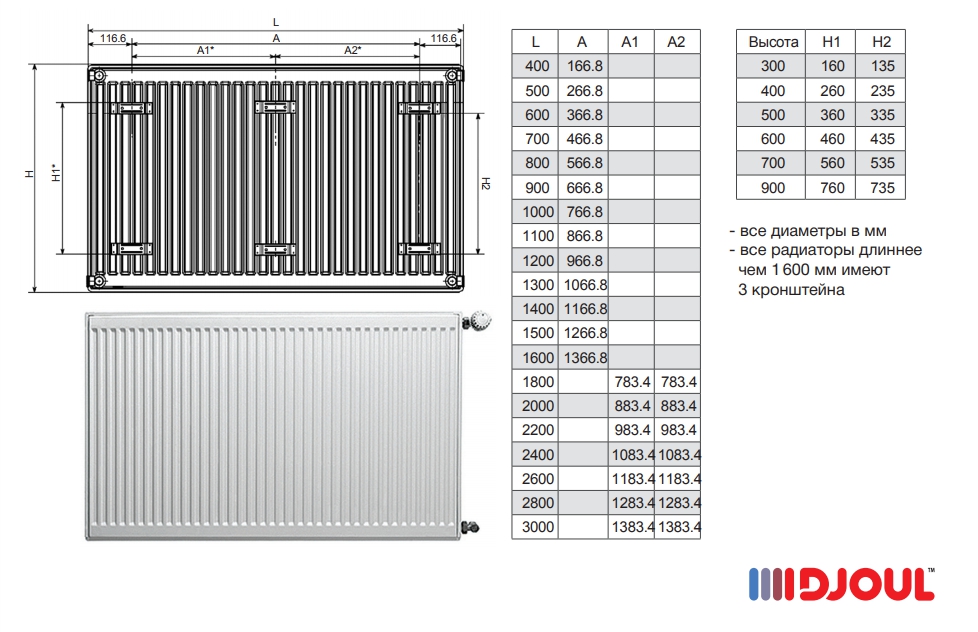
Steel radiators can have both side and bottom connections.
Center distance is important for radiators with lateral connection. It determines how far the upper collector is from the lower one.
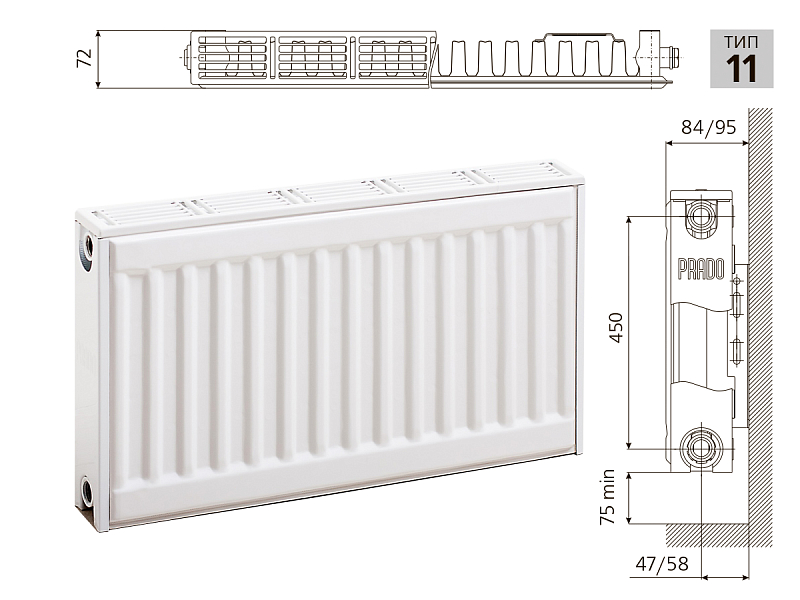
This must be taken into account when installing the radiator.Steel panel radiators, depending on the model, type and manufacturer, may have a center distance equal to the height of the radiator minus 50 - 70 cm. For tubular steel radiators, the center distance varies within from 120 mm to 2930 mm.
dimensions
Now a few words can be said about the external parameters, in particular, about the dimensions. The length of panel-type radiators can reach 3 meters, their height is from 20 to 90 centimeters. A tubular radiator can be made of almost any length, and its depth is limited to 22.5 centimeters. Height varies from 19 to 300 centimeters.
steel thickness.
Few people pay attention to this indicator, however, manufacturers use steel of various thicknesses for the manufacture of steel radiators. This indicator can vary from 1.15 to 1.25 mm. It is clear that the thicker the steel, the better.
Durability
Thanks to the material of manufacture - durable and reliable steel - these radiators are able to live a long life without letting their owners down. Particularly well serve high-quality products with thick walls (0.12-0.15 centimeters), produced by reliable and responsible brands for their products.
Ease of installation
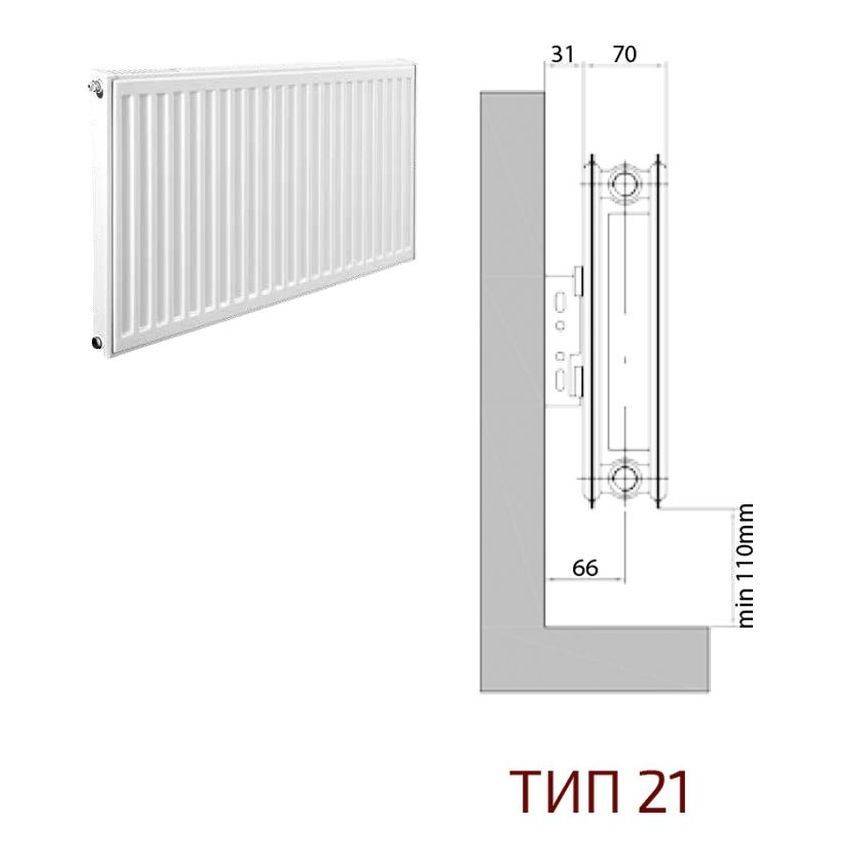
Installation of these heaters is not very complicated. Moreover, it is very convenient that it is possible to choose a panel-type radiator with connection both from the side and from below. In the latter case, the pipes can be hidden under the floor, and the temperature sensor is connected directly to the radiator. And the panels of the radiator itself can be connected in series or in parallel - both types of models can be found on sale.
Panel type radiator with bottom connection system.
The main advantages of panel radiators
Design of panel radiators
First you need to figure out how steel panel radiators differ from similar aluminum and bimetallic ones. Structurally, these heat supply devices are vertical channels for the coolant, which are connected to the outer panels with the help of heat exchange plates.
Because of this structure, panel heating batteries have received a number of important distinctive advantages:
- Low degree of work inertia. Warming up of an external surface happens much quicker, than at pig-iron analogs. For additional air convection, special purposes are provided in the upper lower part of the structure. Air circulates through them and it is further heated;
- Reliability. Unlike sectional radiators, panel radiators have much fewer mechanical joints, which increases their level of reliability;
- Light weight. For fastening, the simplest models of brackets for panel heating radiators are used. This has a positive effect on the cost.
However, along with these qualities, it is necessary to take into account the disadvantages that steel panel heating radiators have. First of all, they include susceptibility to corrosion. If the acidity of the coolant is at a high level, and there is also a large amount of oxygen in it, there is a high probability of rust on the inner walls of the devices. In addition to this, panel heating is not recommended to be left without water for a long time.
Features of mounting radiators
The dimensions of bimetallic heating radiators, as well as cast iron or aluminum ones, should therefore be selected as carefully as possible.Whatever dimensions, however, the battery has, it must, of course, be installed correctly. Heating radiators are usually mounted on brackets to the wall. Before installing them, markup is mandatory. Radiators are mounted either strictly horizontally, or with a slight slope in the direction of the coolant current. In the latter case, it is easier to remove air plugs from the sections. Batteries can be connected to the battery lines in three ways: from below, diagonally and from the side. In any case, an individual valve should be installed on each radiator. This allows you to repair the battery without having to turn off the entire heating system as a whole. Also, a Mayevsky crane (or some of its modern analogues) must be installed on each radiator without fail.
What is it like to be a virgin at 30? What, I wonder, women who did not have sex until almost reaching middle age.
What does the shape of your nose say about your personality? Many experts believe that by looking at the nose, you can tell a lot about a person's personality.
Therefore, at the first meeting, pay attention to the nose of an unfamiliar
9 Famous Women Who Have Fallen In Love With Women Showing interest in someone other than the opposite sex is not unusual. You can hardly surprise or shock someone if you admit it.
13 Signs You Have the Best Husband Husbands are truly great people. What a pity that good spouses do not grow on trees. If your significant other does these 13 things, then you can.
How to look younger: the best haircuts for those over 30, 40, 50, 60 Girls in their 20s don't worry about the shape and length of their hair. It seems that youth was created for experiments on appearance and bold curls.However, already
10 Adorable Celebrity Kids Who Look Very Different Today Time flies and one day little celebrities become unrecognizable adults Pretty boys and girls turn into s.