

- Mechanical and manual cleaning
- Tools and materials
- How to make a ruff with your own hands?
- Roof side cleaning
- Cleaning the chimney from the stove
- Why is contamination dangerous?
- How to clean the pipe from soot in the bath with your own hands
- Chimney Inspection
- Making a pipe cleaning brush with your own hands
- Primary cleaning
- Soot removal
- How to clean a brick chimney in a bath
- What do buyers say about logs?
- Chimney cleaning methods, tools and fixtures
- Mechanical cleaning method
- Chemical cleaning method
- Folk methods for cleaning chimneys
- Types of blockages
- Soot
- Condensate
- How to get rid of a foreign object
- Mechanical means
- Use of chemicals
- Optimal session mode
- How to make self-cleaning tools
- Plastic brush: short-lived, but gentle on the chimney
- Plastic bottle brush: at no cost
- Hard round brush: the use of improvised materials
- Asymmetrical wire brush: for difficult sections of the chimney
- Telescopic brush: for work from the room
- Boiler chimney cleaning
- Why clean your chimney?
- How often is a chimney cleaning necessary?
- Chemicals
- Chemical cleaning of chimneys: prevention and cleaning
- Conclusions and useful video on the topic
Mechanical and manual cleaning
For mechanical cleaning of chimneys, the same tools are used today as 200 years ago. The technology itself has not undergone major changes either. Cleaning is carried out from the side of the roof and from the side of the oven.
Tools and materials
To perform cleaning from the side of the roof, use:
- rope or steel cable;
- hard metal brushes and weight;
It is important that the load has the correct center of gravity. Otherwise it might get stuck
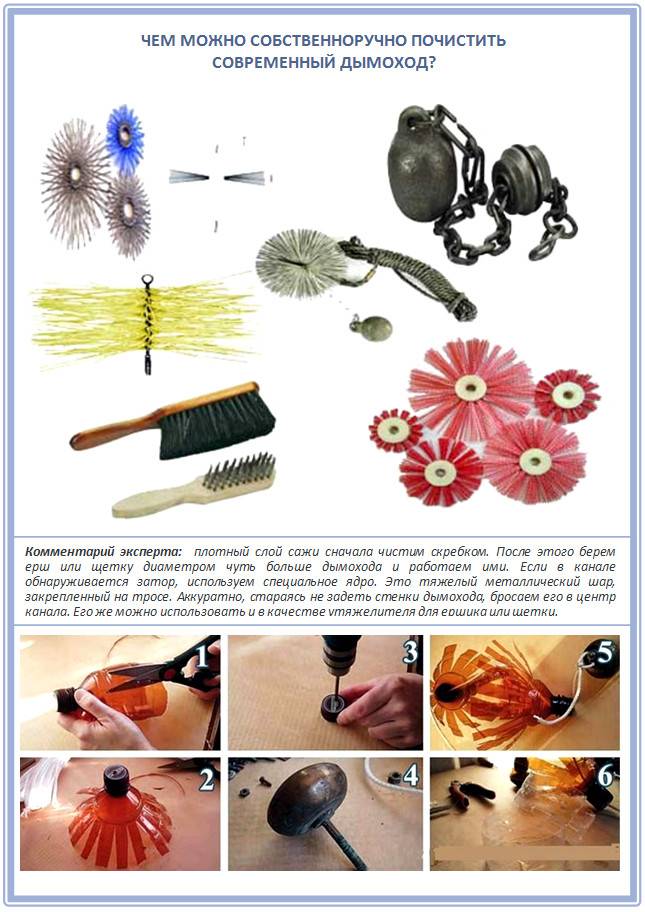
It is ideal to use a round metal core as a load. It is they who break through the blockage. And only then the brushes come into play.
If there is no suitable brush at hand, you can make it yourself from an old plastic bottle. Step by step instructions below.
How to make a ruff with your own hands?
- Take a plastic bottle and cut off 150 mm from the top. Make cuts along the top in 15 mm increments. The length of the notch is selected depending on the diameter of the pipe. If the pipe diameter is 100 mm, then the brush diameter should be 130 - 140 mm.
- Drill a hole in the center of the cork. Screw the cork into place and bend the petals.
- The first brush is ready. Now do the same for the second one.
- Find the right cargo. Its weight must be sufficient for the brush to pass through the chimney.
- Tie the load to a strong cord or steel cable. Thread the other end of the cord into the brushes. The brushes should be facing each other.
- Take the rest of the bottle. Cut off the bottom. It turns out a cylinder. Cut it lengthwise. Insert it between the brushes. The length of the cylinder should be about 150 mm. Give it a diameter equal to half the diameter of the brush. Fix with a stapler.
-
Tie a knot over the plug of the top brush. The tool is ready.
The process of making a brush with your own hands
There is another option for making a brush with your own hands:
Brush in the form of a brush with your own hands
Roof side cleaning
The whole process consists of 6 steps:
- Prevent soot from entering the room. To do this, hang a firebox with a wet cloth and close all hatches.
- Prepare in advance and use all the necessary equipment for its intended purpose, comply with all safety requirements when working at height. You will need: safety glasses, closed non-slip shoes, gloves, insurance. It is forbidden to carry out work in the rain and strong wind. And also under the influence of drugs, alcohol and other drugs.
- Remove the cap, inspect the channel. If necessary, remove debris with a broom.
- The first pass is done with a load. From cleans the chimney from large contaminants.
- After that, install brushes and clean the walls of the channel from soot. It's not worth rushing. It's not complicated, but it's a messy and time-consuming process.
- The last step is cleaning the revision chambers.
Cleaning the chimney from the stove
The previous method will allow you to clean the channel only up to the first turn. Further, another tool will help to clean the stove from soot without disassembling it. You can't use gravity.
The furnace must be provided with special hatches for cleaning. To do this, use another tool. A section with a length of 3 - 5 m will help to clean a special brush with a rigid but flexible fiberglass cable. Such a set is sold in hardware stores.
There is also a more specific tool:
Chimney cleaning tool
Such a device allows you to clean a longer area. The easiest way to clean the outer chimney. But only if it is properly assembled.
Step-by-step instruction:
Unscrew the plug.Clean it of dirt, soot and debris.
If the pipe is made of stainless steel, then the use of a metal brush is strictly prohibited.
We attach a suitable brush and perform cleaning, gradually moving the brush up.
Similarly, cleaning is carried out from the furnace itself. Flexible but rigid support allows you to push the brush far enough.
The collected soot is removed. And carry out minor repairs to the chimney
It is important not to forget to install the pipe head in place.
Why is contamination dangerous?
An uncleaned chimney can cause irreparable damage.
- Insufficient traction can cause smoke from the combustion chamber to enter the room, which will at least result in smoke, and at the maximum - carbon monoxide poisoning.
- Low draft contributes to the massive deposition of condensate, the rapid contamination of the pipe with soot.
- A massive layer of soot acts as a good thermal insulator, which does not allow the stove to warm up well, reduces the efficiency of stove equipment, and leads to excessive consumption of firewood.
- Soot is a combustible substance. When gas streams emit sparks, not only the chimney pipe, but also the house can burn out.
- Hot elements of solid soot particles fly out of a clogged chimney. Falling on the roofs of neighboring buildings, pieces of soot can start a fire.
To avoid a fire due to accumulated soot in the pipe, you need to regularly clean the chimney channel.
How to clean the pipe from soot in the bath with your own hands
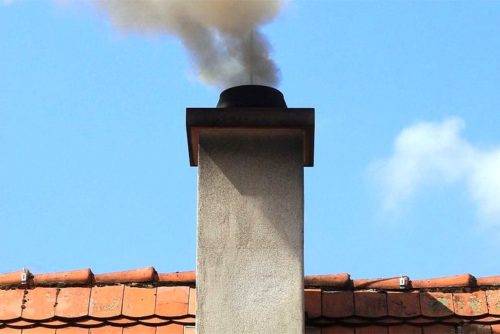
Cleaning the chimney pipe of the bath is not a difficult task, but it is required to observe the sequence of work and accuracy.
Chimney Inspection
Cleaning begins with an inspection. According to the results obtained, a suitable method is selected. If the chimney of the bath is equipped with inspection hatches, they are all opened.The accumulation of soot at the connecting joints of a metal pipe indicates their depressurization. The chimney will first have to be disassembled, each element cleaned and reassembled, treating each joint with heat-resistant paste.
Making a pipe cleaning brush with your own hands
If a factory-made ruff is not at hand, it is easy to make it from a PET bottle. The bottle is selected according to the diameter with an approximate correspondence to the pipe section. The container must freely enter the channel. The bottom of the bottle is cut off, the body is cut to half in strips 1.5 cm wide, bent to the sides. A rope is threaded through the neck, the load and the bottle itself are fixed so that it does not move. Ersh is ready.
Important! Brushes with metal bristles should not be used to clean steel chimneys.
Primary cleaning
The chimney of the bath begins to be cleaned from the street. The first step is to dismantle the head. Thick growths of soot are scraped off with a scraper, dumped on the ground or in a bucket. Clean the head itself. If the bath has not been used for a long time, nests of birds, wasps, and wild bees can be found inside the chimney. All items are removed with hooks or other devices.



Soot removal
Based on the results of the inspection, one of the existing cleaning methods is selected
It is important to know that manufacturers of metal chimneys do not recommend burning them out. Only the mechanical method is applicable here, but without the use of steel scrapers and ruffs
How to clean a brick chimney in a bath
For a brick channel, all existing methods are applicable. Filling water according to the popular method is excluded
Ruffs will work even with metal bristles, but caution is needed. Scratched walls are an increased roughness of the canal.Soot will catch on burrs and potholes, the bath pipe will clog faster
It is optimal to blow a brick pipe with a vacuum method or clean it by burning chemicals
Soot will catch on burrs and potholes, the bath pipe will clog faster. It is optimal to blow a brick pipe with a vacuum method or clean it by burning chemicals.
What do buyers say about logs?
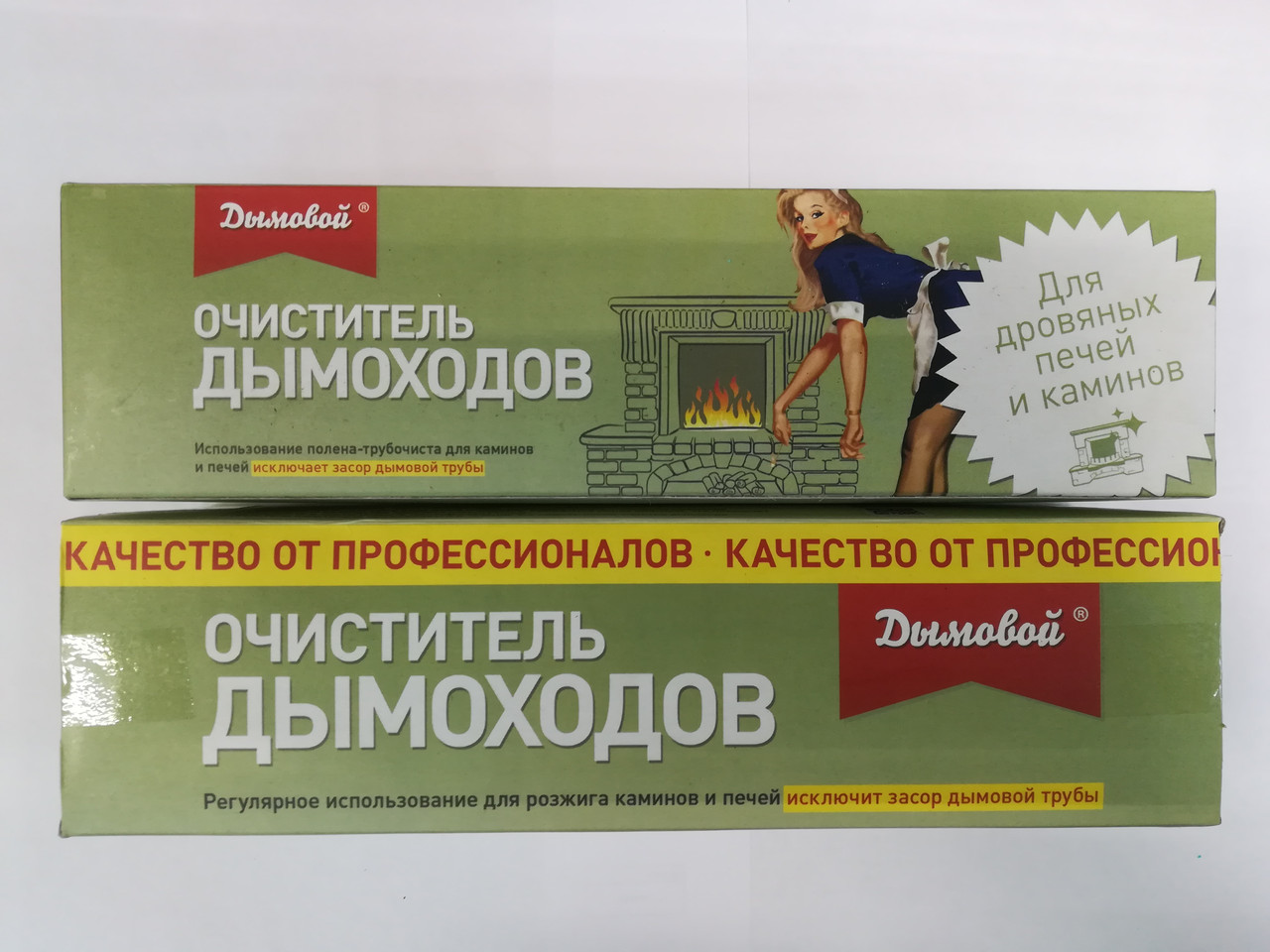
According to the manufacturer's official website, Chimney sweep logs show good performance and demonstrate high cleaning quality. The use of products does not require special skills and abilities. This makes the drug especially in demand among buyers.
Homeowners who have already tried the Chimney Sweep speak well of it. The tool copes with the tasks and gives real results.
However, before starting the procedure, you need to carefully examine the chimney system and find out if there are any fatal damages in it. If there are any, they must be eliminated urgently.
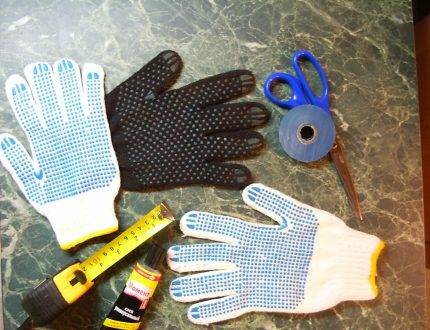 To avoid direct contact with the log structure during use, it is recommended to wear work gloves. They will reliably protect the skin of the hands from accidental contact with chemicals.
Chemical log raises soot burnout temperature to record highs. Under such intense thermal exposure, a damaged chimney may crack or begin to collapse.
The disadvantages of the drug include an unpleasant odor that remains in the room for a long time, and the inability of the product to remove large, old soot deposits.
Chimney cleaning methods, tools and fixtures
There are several methods for cleaning the chimney pipe in private homes. All these methods, as a rule, do not cause difficulties for independent application. However, we do not advise you to clean the chimney yourself if you are not sure of your abilities, or the condition of the chimney leaves much to be desired due to wear and tear.
Mechanical cleaning method
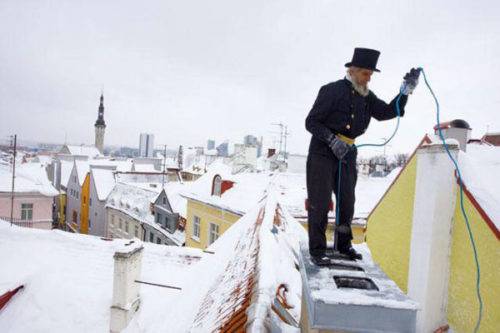
The mechanical method is the most effective and time-tested method. Remember how in the old days they portrayed a chimney sweep? The main tool of his labor is a long stick with a brush at the end. In our time, no fundamental changes have occurred, except that the tools and devices are adapted to real conditions.
Cleaning is desirable to carry out in the warm season, in the absence of wind. Before directly cleaning the chimney, close all the openings of the stove in the room, so soot will not enter the room. An open hearth or fireplace is enough to completely cover with a wet rag. On the roof, be sure to secure yourself with a safety cable. Feet must be firmly supported.
Tool used for cleaning:
- Scraper, which is used if the soot layer is too thick.
- Metal ruff. They lower it into the pipe with the help of a cable, sometimes a weighting agent in the form of a core is attached from below. Such a device (total weight of at least 9 kg) passes through the entire pipe, cleaning off soot.
- Stiff bristle brushes with flexible holder. Used for square and rectangular pipes.
- Core or weight. Use if a blockage has formed due to accumulated debris or collapsed masonry.
It is also possible to clean the pipe from the inside of the room, if the design allows, and the entrance to the roof is difficult. Of the tools, a ruff on a flexible holder is used.The disadvantage of this method is that the soot falls down and it is necessary to protect the furniture and surfaces with a tarp. Professional chimney sweeps in such cases use a special "vacuum cleaner" to collect soot. Also, cleaning from the inside of the room is used in the presence of bends in the chimney.
If there are no special tools for cleaning in the arsenal, you can make them yourself. So, for example, you can make a full-fledged brush from an ordinary plastic bottle. The video provides detailed instructions:
Chemical cleaning method
It is used to prevent contamination of chimneys. Agree that it is better to use this method once or twice a year than to bring the state of the chimney to a deplorable state.
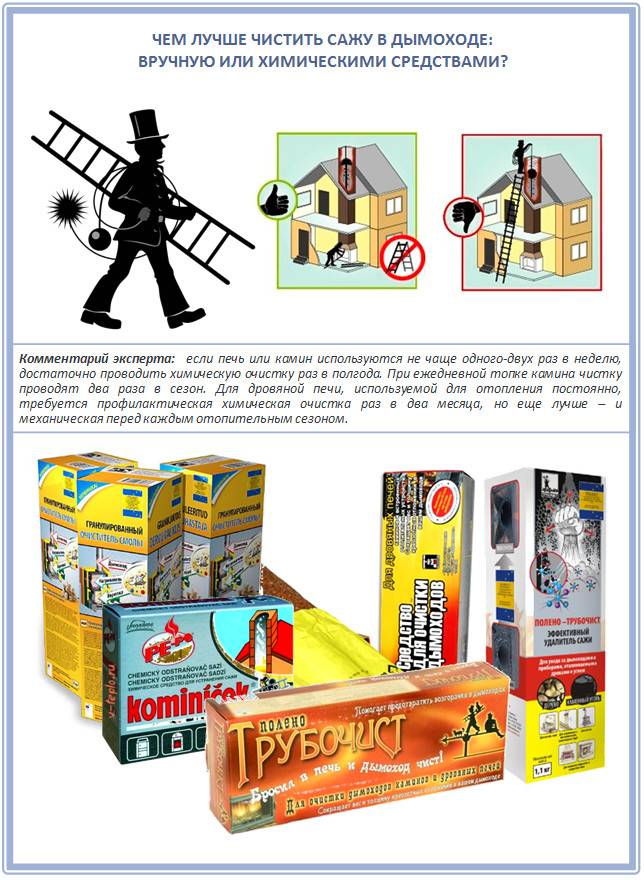
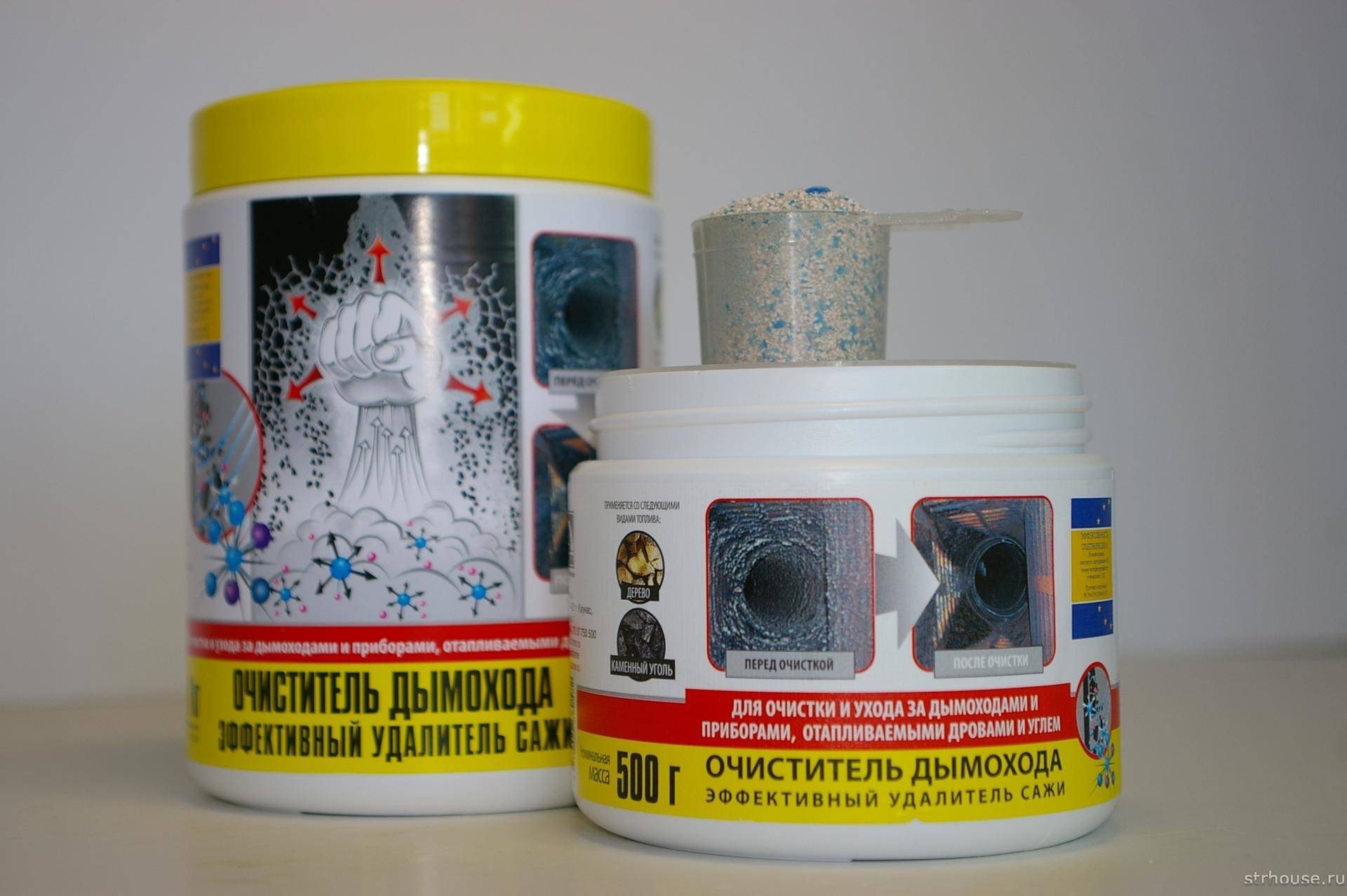
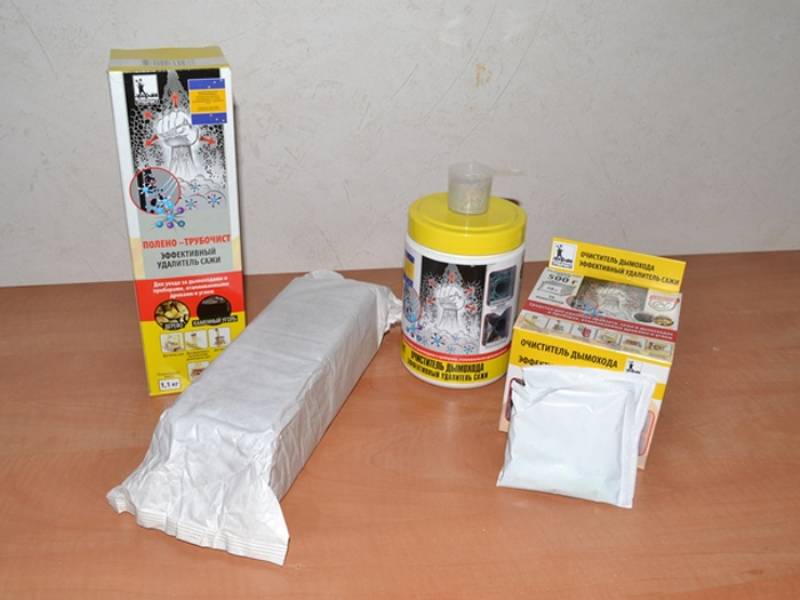
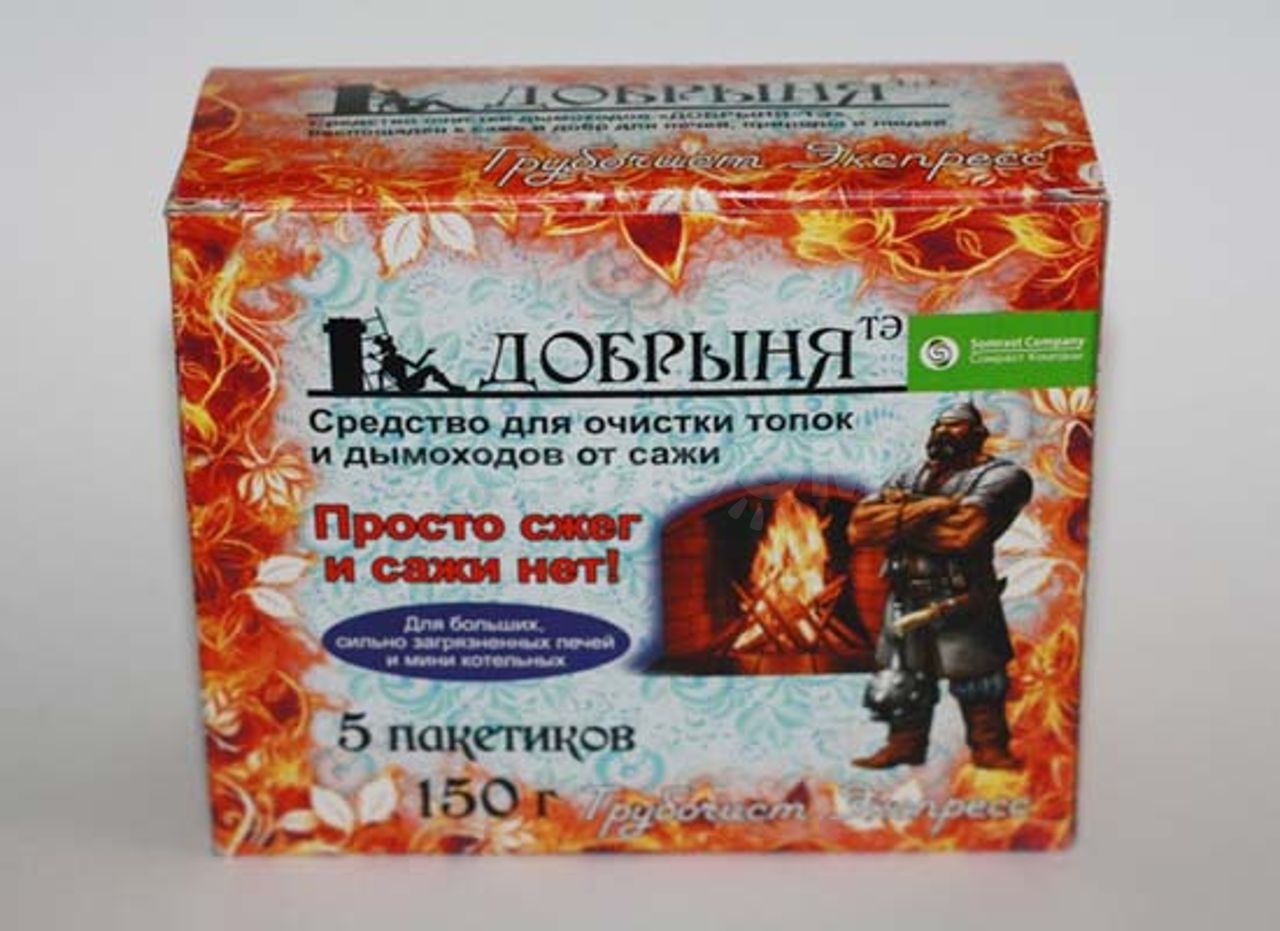
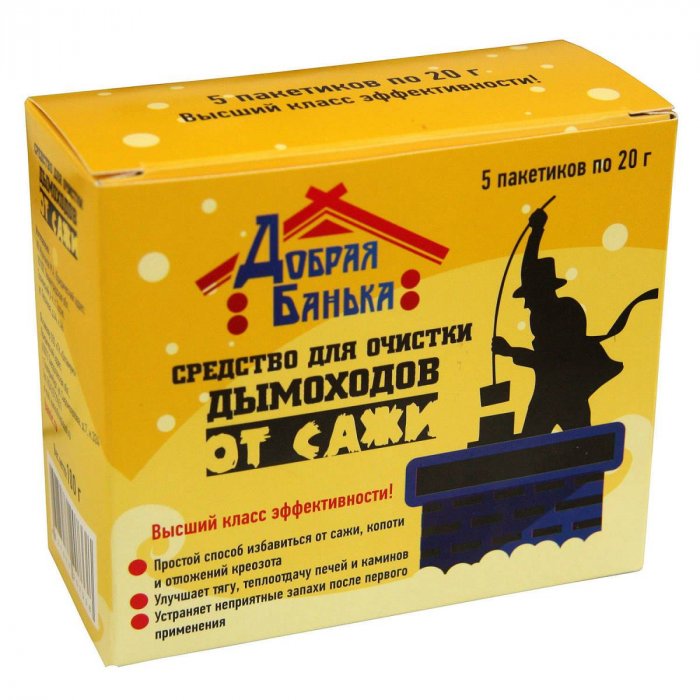
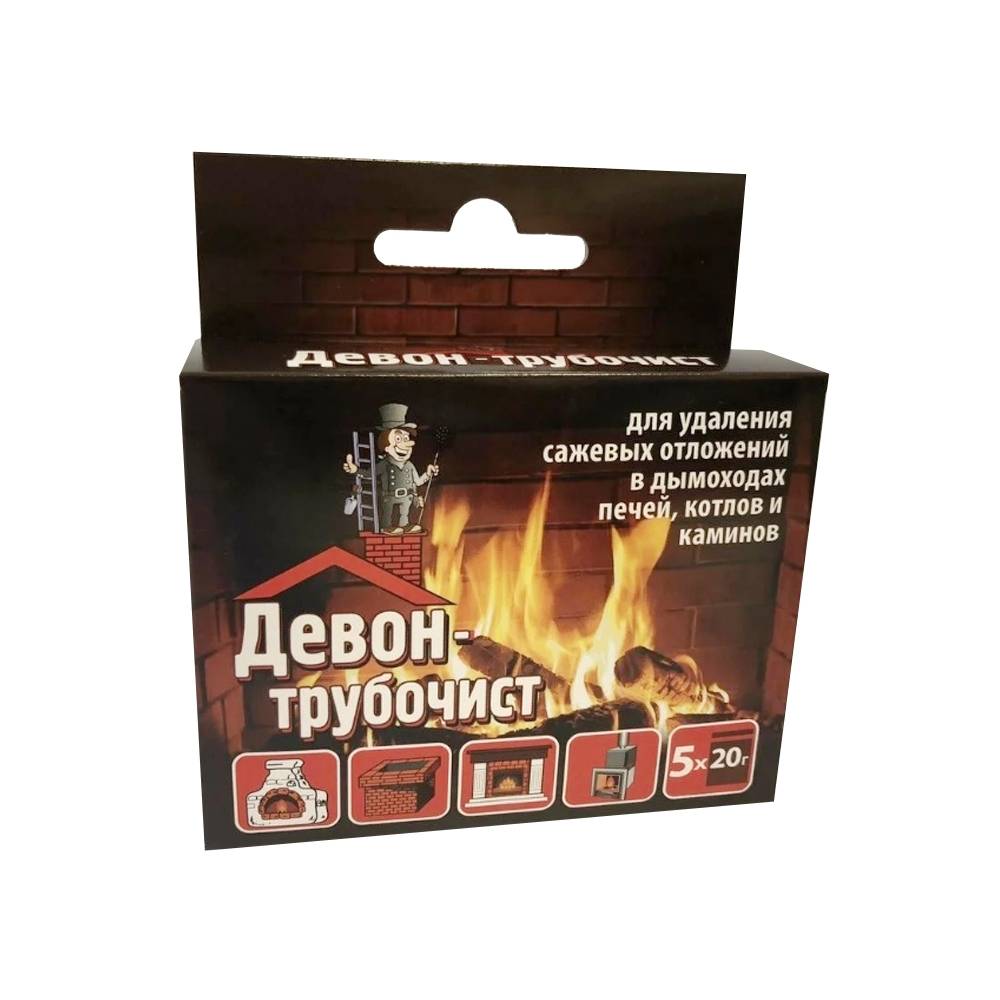
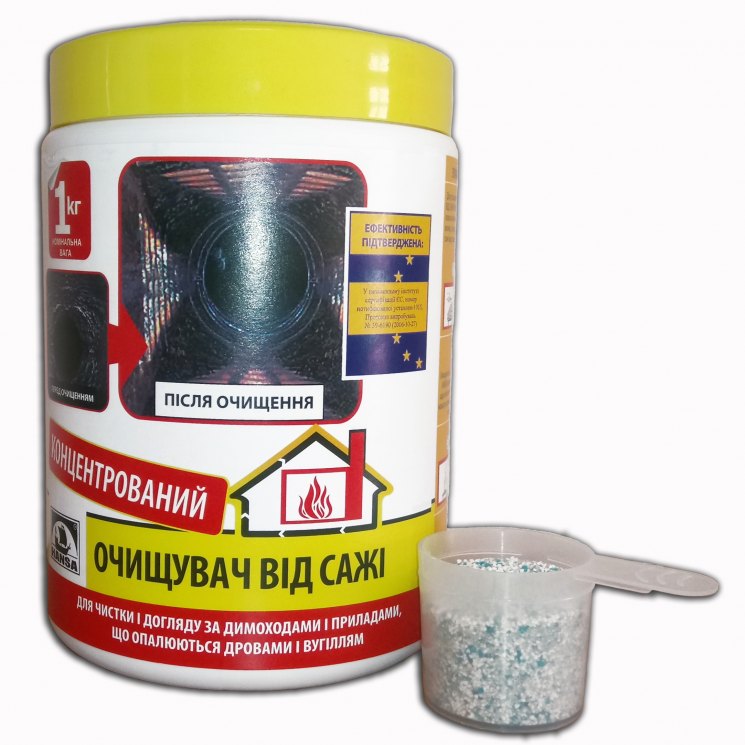
Chemical cleaning agents are a special powder or briquette, which, when burned, forms a specific gas that destroys soot. The soot accumulated in the chimney simply crumbles from the walls and is removed along with the ash. These methods are very effective for ceramic chimneys or stainless steel pipes.
Chemistry can be divided into three groups:
- Paper bags with granulated substances of Czech production. Laid together with firewood. Remove dirt up to 2mm thick.
- Briquette in the form of a log. Can be used with firewood or burned separately. Softens soot and facilitates mechanical cleaning.
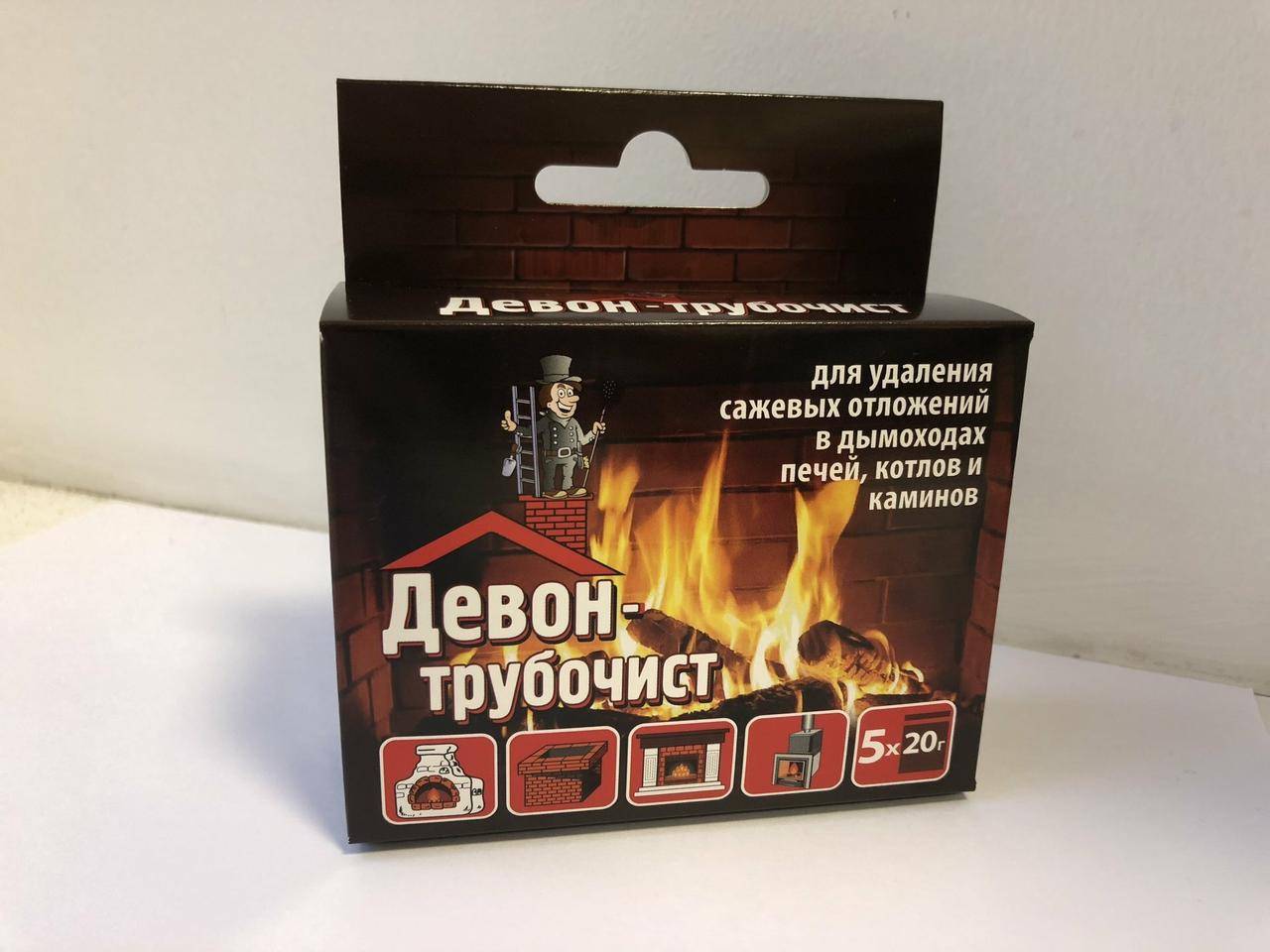
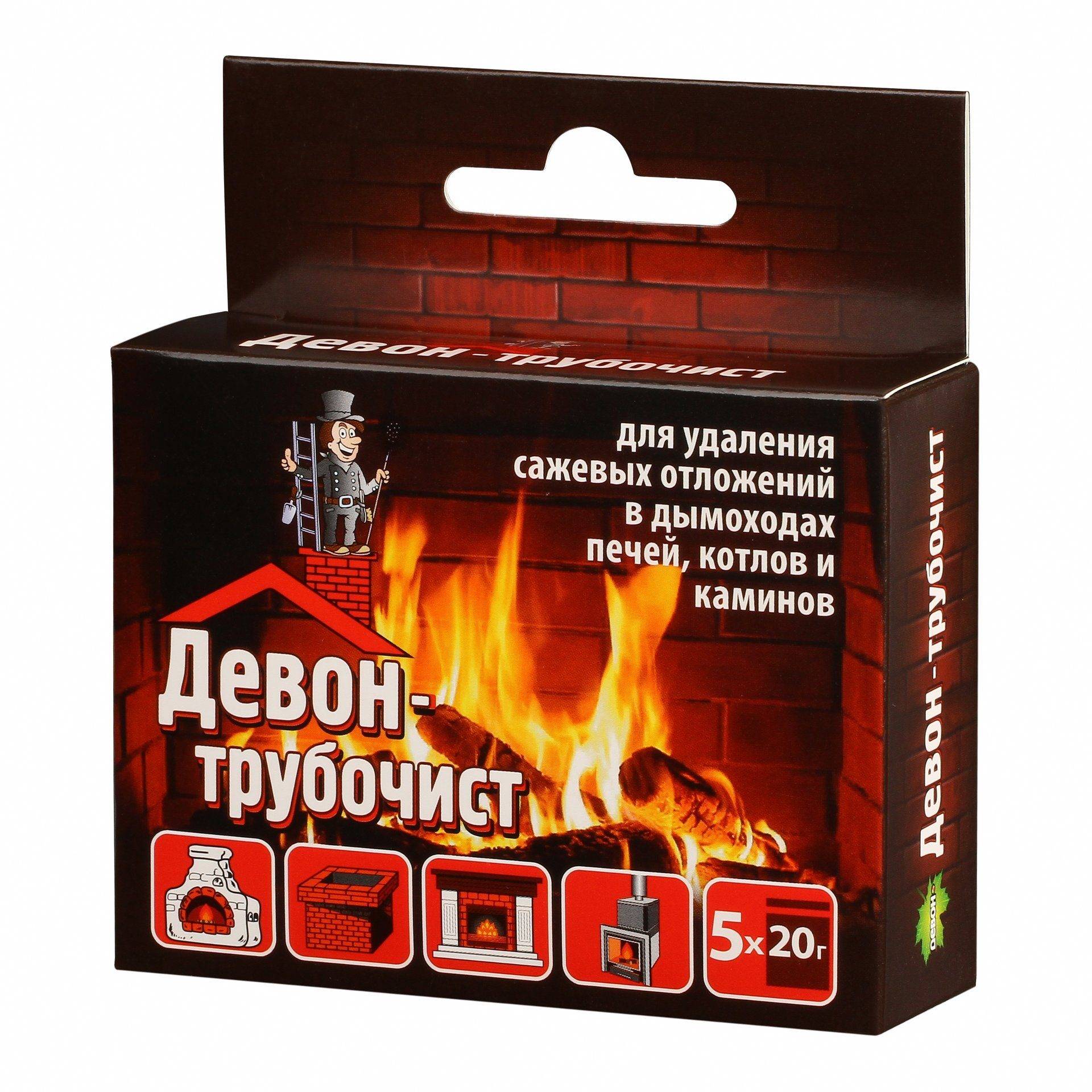
- Powder, analogue of the Czech cleaner, but Russian-made.
Chemical cleaning methods will be ineffective if the deposit is already too large and can only be removed mechanically. Therefore, as mentioned above, such funds are effective only as a preventive measure.



Folk methods for cleaning chimneys
If the pollution is not too great, then you can use one of the popular methods for cleaning the chimney. It will not be possible to remove old deposits, but as a preventive measure, these methods have proven themselves on the positive side.
- Salt. Once a week, add regular table salt (100-200g) to the firewood. It interacts with water in burning wood and releases an acid that binds soot and prevents it from settling on the walls. Do not use if you have a metal pipe as this will corrode it.
- Starch. When burning potato slices and their peels, starch is released, which decomposes soot, but "potato raw materials" must be burned at least a bucket at a time. You can also use other products containing starch (peas, beans).
- Alder, aspen or walnut shell. Aspen, alder or walnut shell firewood burns very hot. The high temperature simply burns the soot formed. With good draft, black flakes will fly out of the pipe, and then crumble into the furnace for several days. This method is effective, but can cause a fire.
Types of blockages
The most obvious consequences of a poorly cleaned chimney have been described above. But it is worth remembering that cleaning the pipes in the bath from soot is only a small part of the preventive work. The fact is that the chimney becomes clogged much more often than the owners of the bath may suspect. There are several reasons for this:
- Soot and soot, which were mentioned earlier;
- Excessive amount of condensate that does not have an outlet;
- Debris and other foreign objects.
For each type of blockage, we apply our own cleaning method. So, how to clean the pipe in the bath from soot, condensate or foreign objects, we will consider further.
Soot
During operation, the chimney accumulates a thick layer of soot inside.
Important! The layer of soot and soot covering the surface of the chimney pipe reaches 1-2 cm per year.
Of course, this figure varies depending on the type of fuel used. Thus, the use of firewood, briquettes or coal entails the smallest amount of soot formed.
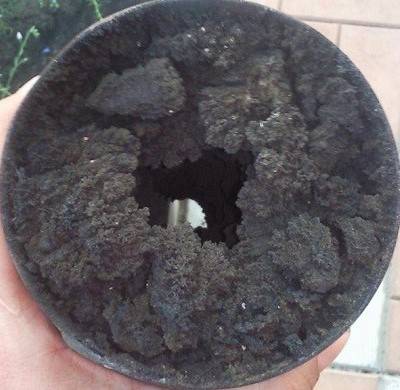
They emit a fairly large amount of combustion products, which subsequently remain on the walls of the pipe.
About the same thing happens with conifers, because at high temperatures they release resin, which turns into soot.
To date, special chemical briquettes are very popular, which, when burned, destroy the deposited soot and soot.
After a short period of time, it breaks off and crumbles into the furnace, where the cleaning process is much easier.
Of course, the method is effective, but for use in the bath is quite dangerous.
It is better to dwell on the classic cleaning method - using a ruff or brush. Usually they are attached to the weight and slowly lowered into the pipe.
Important! Some avid bath attendants have their own cleaning methods. These include using a plastic bottle instead of a brush. But it is worth remembering that this method is applicable only for perfectly flat pipes.
But it is worth remembering that this method is applicable only for perfectly flat pipes.
Condensate
Different tree varieties have different resin content. Thus, with frequent use of the bath, the condensate formed in the pipes has a small resinous precipitate, while with a rare firebox it can reach up to three centimeters in thickness.
Pollution of this type is most difficult to remove, since during cleaning, the tar condensate is simply smeared over the surface of the chimney.
For such cases, cleaning with a special log is provided. The frequency of cleaning with this method depends on the type of wood used. For example, when using pine and spruce firewood, log cleaning is done monthly, and if birch firewood is used, then once every two or three months will be enough.
How to get rid of a foreign object
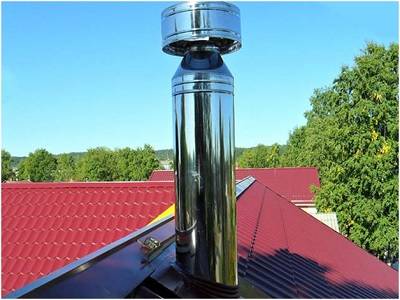
Cases in which foreign objects enter the chimney are not uncommon.
Detecting this problem is quite simple, since the smoke stops being pulled out of the chimney, but goes back, smoky the bath room.
A foreign object can be either a brick that has broken off from a brick chimney, or debris that has fallen into a chimney that is not protected from above.
Eliminating such a blockage is the most difficult and problematic. Of course, you can try to push the object inward with a long stick or pole, or hook it with a nail at the end of the stick.
In addition, telescopic brushes are available for sale, the length of the entire pipe, you can use them. In the event that all attempts were unsuccessful, the pipe must be dismantled in order to eliminate the unnecessary item.
Information. If you find yourself in a similar situation, you should be as careful as possible, because the possibility of carbon monoxide poisoning is high.
Mechanical means
A variety of mechanical methods for removing soot from pipes have been actively used for many centuries.The most popular tool is the ruff. It is a long elastic cable. Its diameter is selected individually depending on the size of the chimney. Often a small metal ball is tied to it. Such a device is required in order for the tool to move down with minimal effort.




The tool is lowered and raised until the pipe is completely free of deposits. Working with this device is easy. Deposits are easily knocked off the pipe.
Not all houses have a chimney of a simple design, so it is not always possible to clean it easily.
For this, a ruff is used, supplemented by flexible rods. Fragments of this structure are interconnected. As a result, the device moves along the pipe. During cleaning, the soot particles that have come off the walls are easily pulled out. But some of them are falling. To prevent the room from getting dirty, experts use a special type of vacuum cleaner. If the work is done independently, then you will have to collect deposits manually.
Use of chemicals
 Today, the chemical industry produces a variety of formulations - liquid, powder and briquettes - the use of which greatly facilitates the task of maintaining the chimney.
The combustion products of these substances either cause soot to lag behind the walls of the chimney, followed by shedding, or have a preventive effect, making the inner surface of the pipe less prone to soot fouling.
Here are the most popular ones:
- Anti-carbon chemical composition (PCC): in order to achieve the maximum effect, 150-200 g of this powder must be burned for each ton of fuel.It should be put into the firebox directly with the packaging.
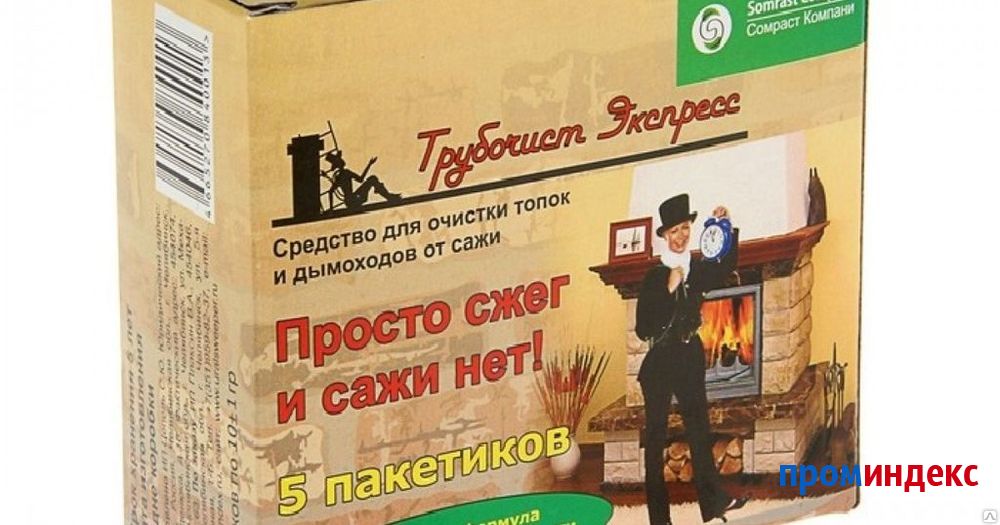
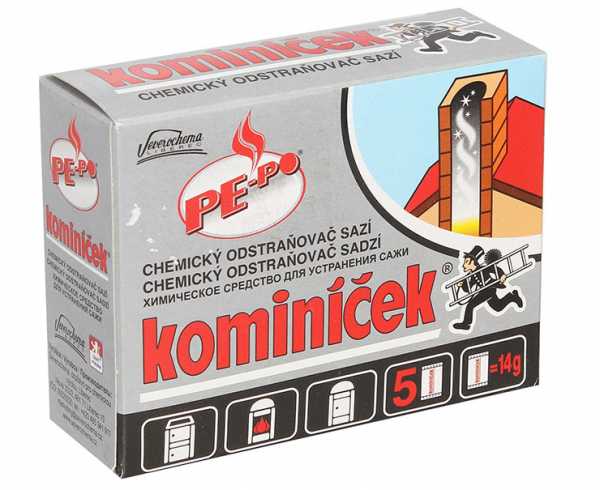
- Kominichek: a Czech remedy, one package of which (it contains 5 14-gram sachets) is enough for about 3 months. It is intended for removal of a layer of soot up to 2 mm thick. The gas formed during the combustion of Kominichek causes the soot to ignite.
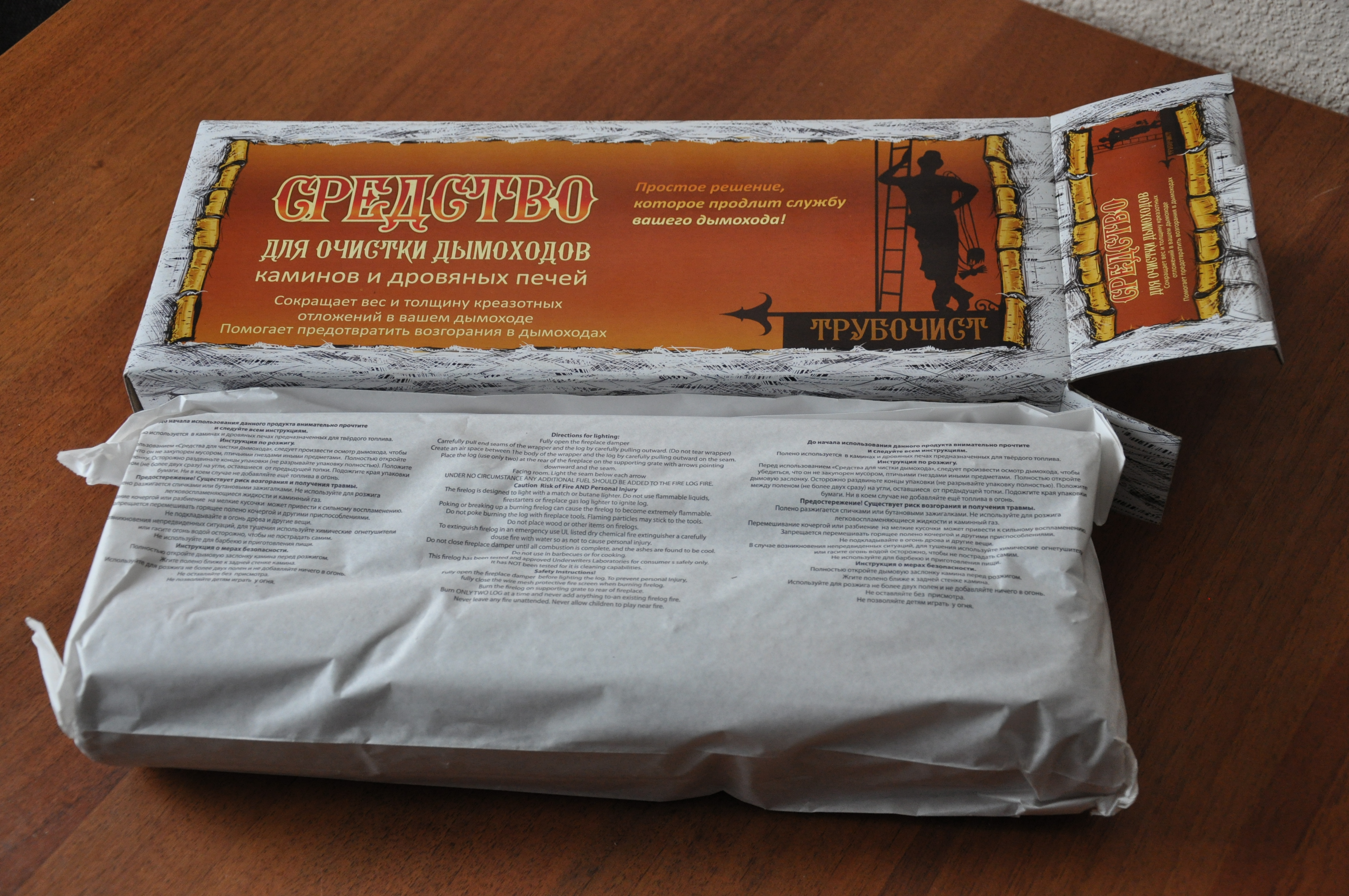
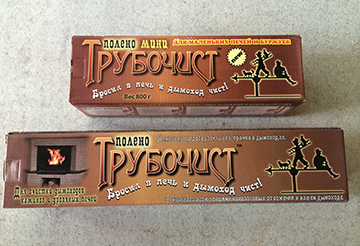
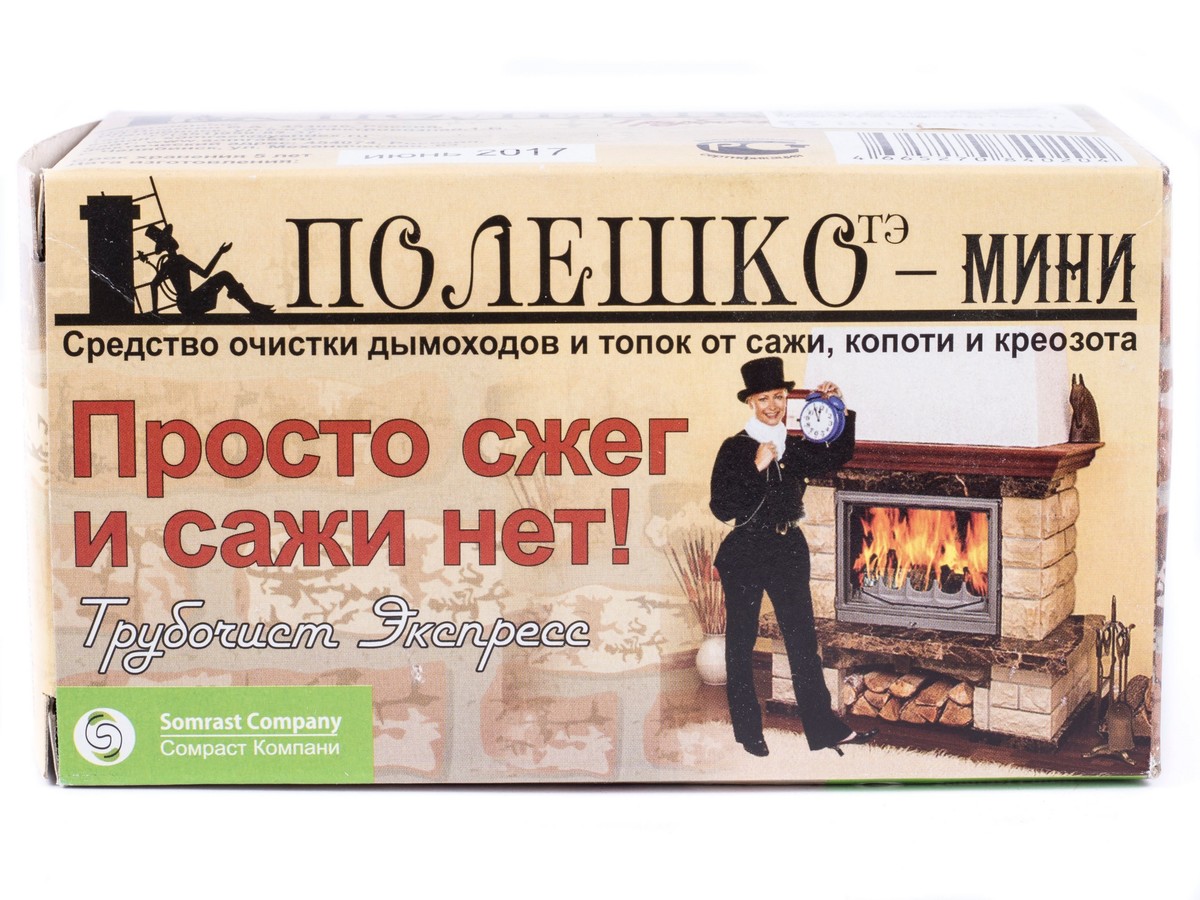
- Log "Chimney sweep".
The last product, produced in the form of a briquette, dries up soot deposits during combustion, as a result of which it crumbles down. Effective "Chimney sweep" and as a prophylactic. Thanks to it, the likelihood of the formation of creosote deposits is reduced and the danger of soot ignition is eliminated. All this has a positive effect on the durability of the chimney. This tool is suitable for cleaning chimneys of boilers - solid fuel and liquid fuel.
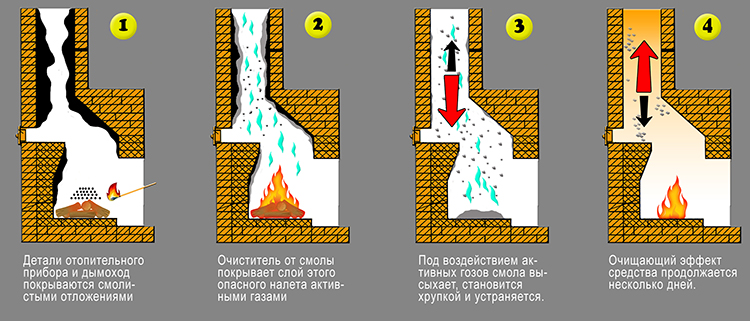
The process of cleaning the chimney with chemicals
The consumption of the Log "Chimney sweep" depends on the intensity of operation of the heat generating plant:
- if the stove or boiler is operated no more than 2 days a week: one briquette should be burned every six months;
- in daily operation: the briquette is burned every 3 months;
- if the furnace works constantly and with maximum load: we reduce the frequency of burning a briquette to 2 months.
In large installations, two briquettes should be burned sequentially, that is, one after the other, in one session.
“The chimney sweep log should be placed on the fuel bookmark right in the wrapper. The film, which is formed on the walls of the chimney by the products of combustion of this agent, remains active from 7 to 14 days. During this period, it provides a "soot-repellent" effect, due to which all the soot will pour into the firebox. After this period, the furnace and chimney must be cleaned.
Optimal session mode
It is recommended to process chimney channels with the “Chimney Sweep” tool at least twice a year before and after the end of the heating season. This is a universal mode that is relevant for all systems.
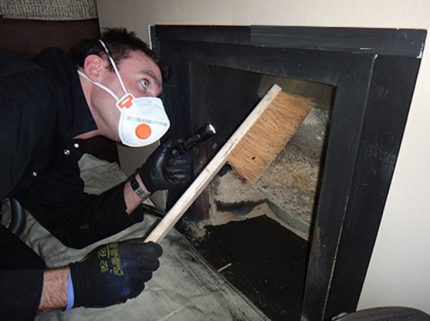 When clear signs of blockage are observed in the chimney, it is advisable to clean it as soon as possible. Postponing the procedure will only exacerbate the problems and require additional financial costs.
Fireplaces and stoves that melt once a day should be cleaned twice every six months. The procedure will require one bar. For heating units that turn on once a week, 1 session every 6 months is enough.
How to make self-cleaning tools
Special fixtures for cleaning the chimney soot is sold in a regular building supermarket or specialty store, or you can make it yourself.
Let's compare a metal brush with a plastic one. Let's start with the fact that a metal brush, of course, will retain its working shape longer, but with particularly intensive cleaning it can scratch the chimney from the inside. Modern plastic brushes are soft, scratch the chimney much less, although they do not last long and at the same time easily break, losing their working shape. That is why there is an unspoken rule among summer residents: for a brick chimney, take a metal brush, and for a metal one, use a plastic one. Basically, these are the following devices:
Plastic brush: short-lived, but gentle on the chimney
Making a plastic brush is as easy as shelling pears:
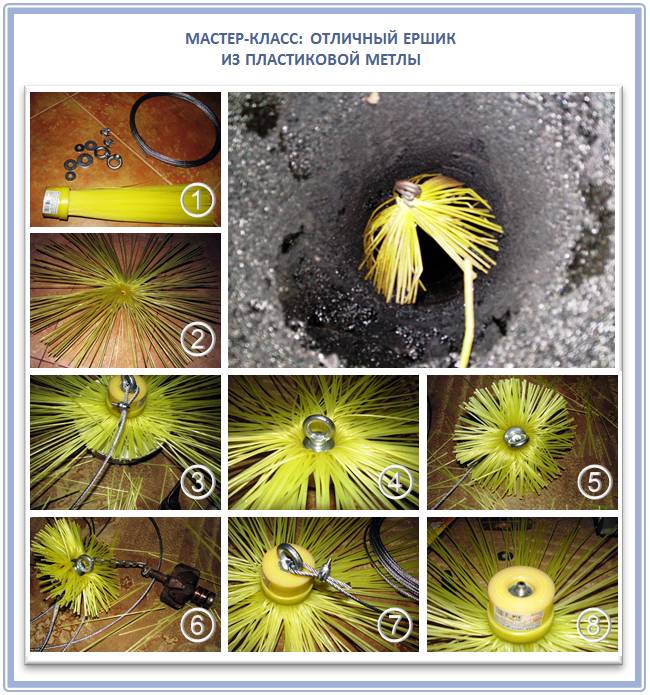
If you are going to build such a brush for cleaning the chimney, then all the work will take you no more than 15 minutes.
So, the usual chimney brush is a strong base with a brush, threaded through a metal wire with a load on the chain. To all this, you will need a rope along which the brush will need to be lowered into the chimney. Instead of weight and rope, it is also quite enough to use a special holder. At least then the brush will not get stuck in the chimney and will not have to be pulled out later.
Plastic bottle brush: at no cost
Moreover, you can even make a homemade ruff from an ordinary plastic bottle (at least a few). Just 2-3 of these brushes is enough for one season. So, here's how to make such a bottle brush:
- Step 1. Make round holes in the center of the lid.
- Step 2. Cut the walls of the bottles into strips along, about 1.5 or 2 centimeters wide.
- Step 3. Make a hole in the bottom of the bottle with a heated nail and thread a 5 mm thick wire through it.
- Step 4. Now just insert one bottle into another through the cut strips and attach a thick wire to one end.
- Step 5. Put two plastic bottles on, press and fix them so that it is convenient to tie them with plastic wire.
- Step 6. Spread the cut strips of plastic evenly in a circle and secure the steel cable as it is done.
Hard round brush: the use of improvised materials
Another great option is to make such a brush from a disc brush for a grinder. Such a brush is much stronger than the previous options and will cope even with the soot itself.
It is only important that the diameter of the brush is equal to the diameter of the chimney, because its bristles are hard and bend poorly:
To clean the chimney with such home-made devices, you need to do this:
Step 1.Climb onto the roof, remove the damper from the chimney and lower such a brush into the chimney to the very end.



Step 2. Start pulling the brush back now.
Step 3. Lower the brush down again and pull it out again.
Step 4. All this must be done within a few minutes, keep in mind that below, inside the room, soot will pour abundantly and it must also be removed.
As you can see, everything is simple!
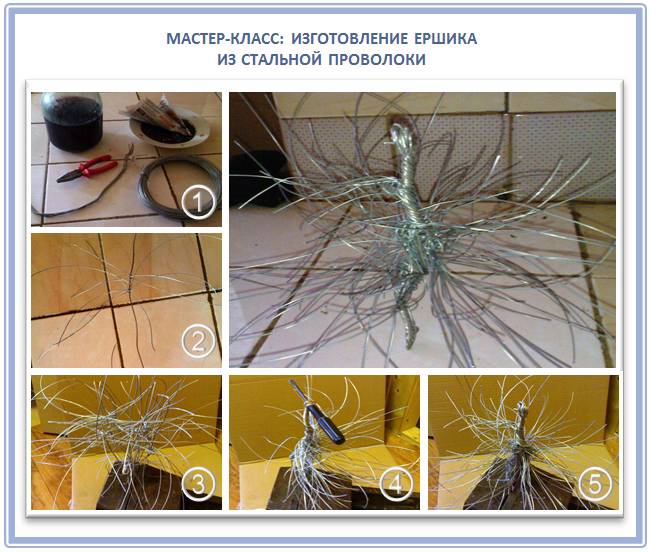
Asymmetrical wire brush: for difficult sections of the chimney
If your chimney does not have a large length, knees, bends and is not very clogged (for example, we are talking about a chimney in a seasonal bath), then such simple devices are also suitable for its one-time cleaning:
Telescopic brush: for work from the room
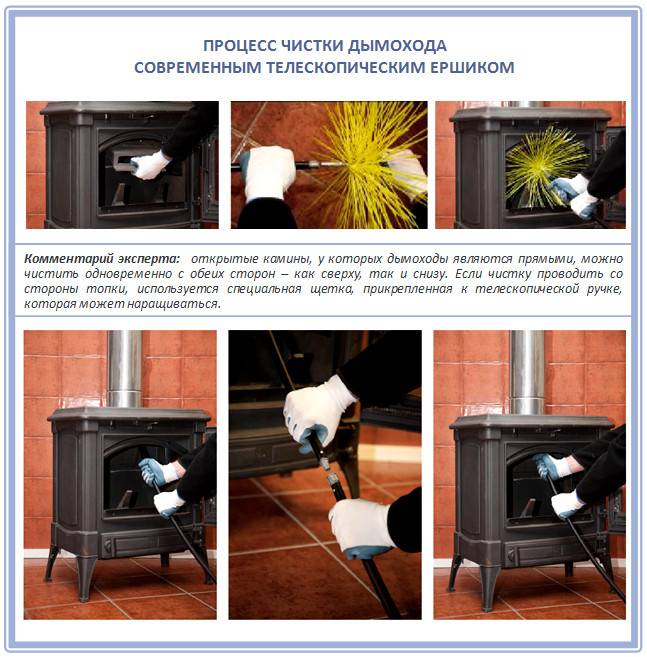
Usually, as a gesture, flexible meter sticks go well, which are twisted into each other and are also called telescopic, in other words, prefabricated. Working with it is quite simple:
Step 1. Screw the brush onto the first handle, stick it straight through the heater, push it through and clean one meter.
Step 2. The next step to the end of the handle that you are still holding and which is sticking out of the chimney, screw the second one and push the brush another meter up the chimney.
Step 3. Repeat this whole process until you have completely cleared the entire chimney.
See how easy it is in practice:
The telescopic brush is able to penetrate the chimney very deeply:
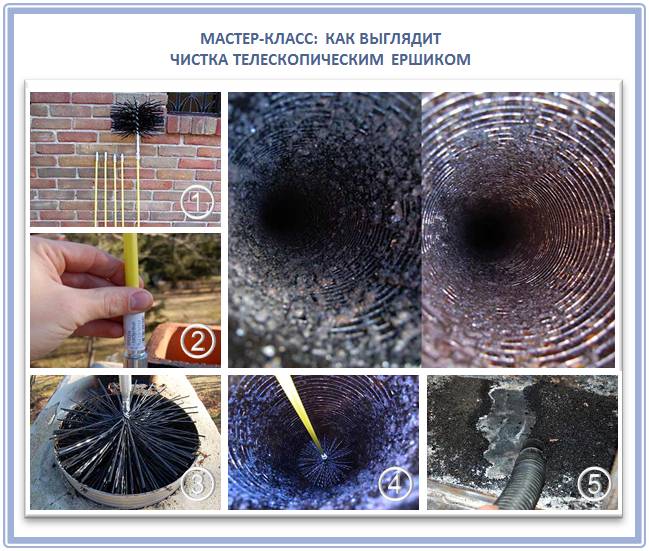
Such a brush is significantly more expensive than the previous option, but the advantage is that such sticks usually do not break and serve for a long time. In addition, with the help of such a rigid handle it is easier to push the blockage in the chimney.In addition, this method is quite difficult to clean the soot in the knees of the chimney bends.
As for the choice of the size of the brush, everything is simple here: you need to select one according to the diameter of the chimney, preferably equal to it or 12 cm larger, so that the brush can easily catch on, and not slide along the walls, slightly not reaching them:
Boiler chimney cleaning
A feature of solid fuel boilers is the presence of a long burning system (smoldering firewood). This is necessary so that users do not throw up firewood so often, both in order to save time, and in order to save firewood or other fuel, briquettes, coal.
It is this mode that negatively affects the amount of soot formed. She's a lot! And yet, due to the resulting condensate, it cokes, turning into a dense mass. The principle of cleaning the boiler pipe is the same, but requires more labor.
Why clean your chimney?
A chimney is an engineering structure, the purpose of which is to ensure the uninterrupted removal of combustion decay products, which include soot (amorphous carbon).
Soot is widely used in the rubber industry, less widely for the manufacture of paint and varnish products, ferrous metallurgy and the electrical industry.
But, two properties of soot should bother you and me, ordinary people. First, soot is harmful to health, its small particles are not filtered out in the upper respiratory tract. Secondly, soot burns beautifully, and burns at temperatures above 1100 degrees.
All types of chimney systems are not designed for operation at such temperatures and become unusable.During the period of soot burning, there is a danger of their destruction and ignition of nearby structures.
I hope that the question "Why clean the chimney?" no longer relevant. Let's move on to the next question.
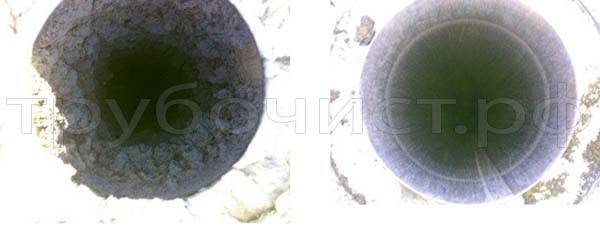 Chimney from a solid fuel boiler, before and after cleaning.
The growth of soot is more than 3 centimeters. Operation is not safe!
How often is a chimney cleaning necessary?
According to the current legislation of the Russian Federation, a constantly operating heating device (stove, fireplace, boiler) must be cleaned:
- once every three months - for heating stoves;
- once every 2 months - for furnaces and continuous hearths;
- once a month - for cookers and other continuous (long-term) furnaces.
If we talk at the household level, because not all of us heat the stove or fireplace regularly, then a reasonable period for cleaning work can be considered - once a year, before the start of the heating season or after it ends. A longer period should be attributed to unsafe operation.
Folk remedies and chemical chimney cleaners
Be aware that there are no chemicals for cleaning chimney systems, they can be classified as preventive agents that will be effective when used after each firebox. But if you have been heating the stove, fireplace, boiler for a year, they will not help you at all.
In Russia, a prophylactic folk remedy for cleaning the stove from soot is well known - potato peelings. I confirm, starch decomposes soot and removes light plaque. In order to save money, after each firebox, you can toss potato peelings into the dying firewood, thereby maintaining the chimney system in working order. This will not eliminate the call of the Chimney Sweep, but will reduce the frequency of his visits.


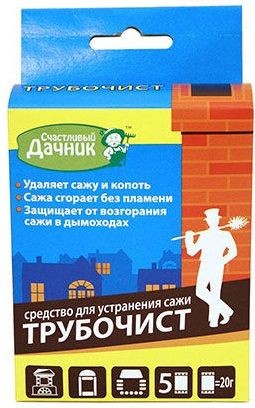


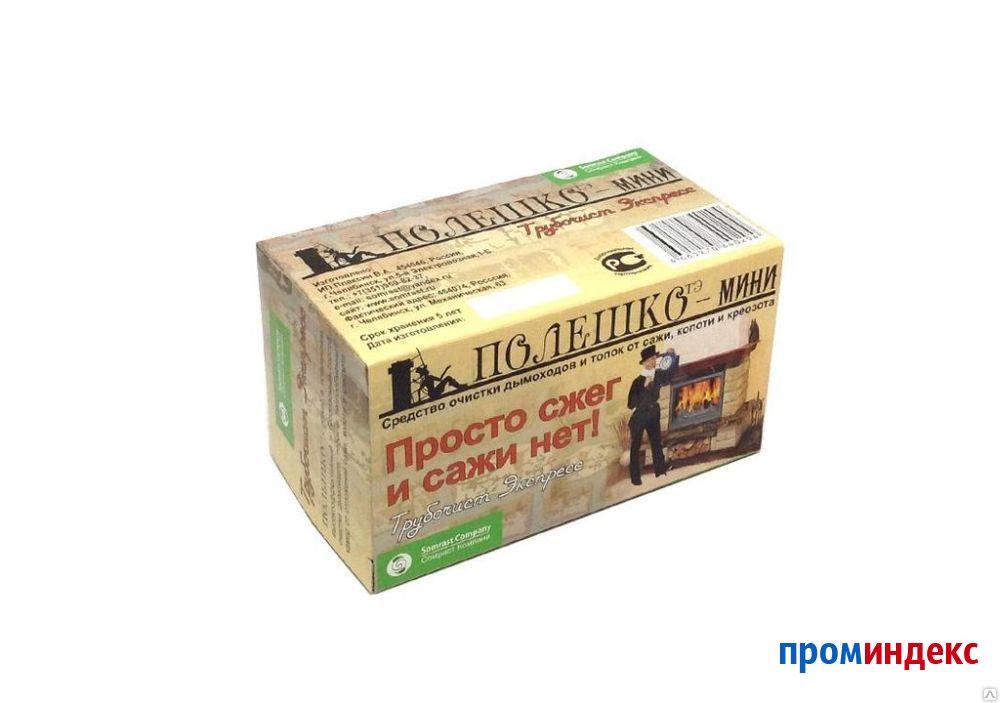
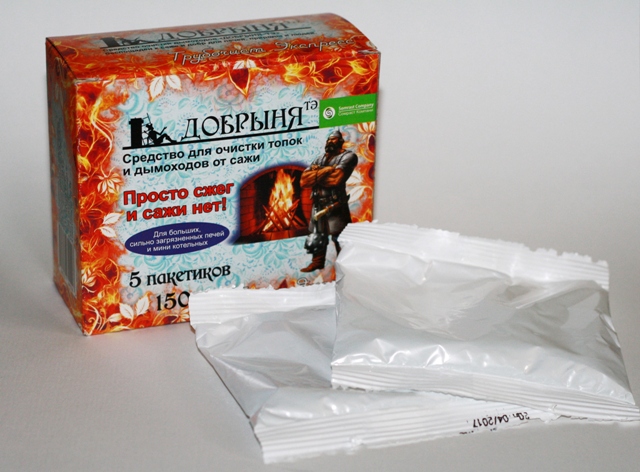
Aspen firewood. On one of the sites, I read that aspen firewood cleans the chimney. Please do not believe everything that is written on the Internet. Aspen wood burns at a higher intensity and at a higher temperature. High temperatures cannot clean the chimney, but they can ignite the soot accumulated in it.
Please don't forget the safety rules. The cost of calling a chimney sweep is completely incomparable with the value of your property. Timely cleaning of the smoke exhaust system is a paramount measure for preventing fires and maintaining a favorable environmental situation in your home.
Start of the heating season
Chemicals
If the chimney is not heavily clogged with soot, then chemicals can be used to clean it. Removing deposits from a brick pipe with the help of special powders will make it less likely to put it in order mechanically. As an independent tool, chemistry should be used for structures made of:
- ceramics;
- stainless steel.
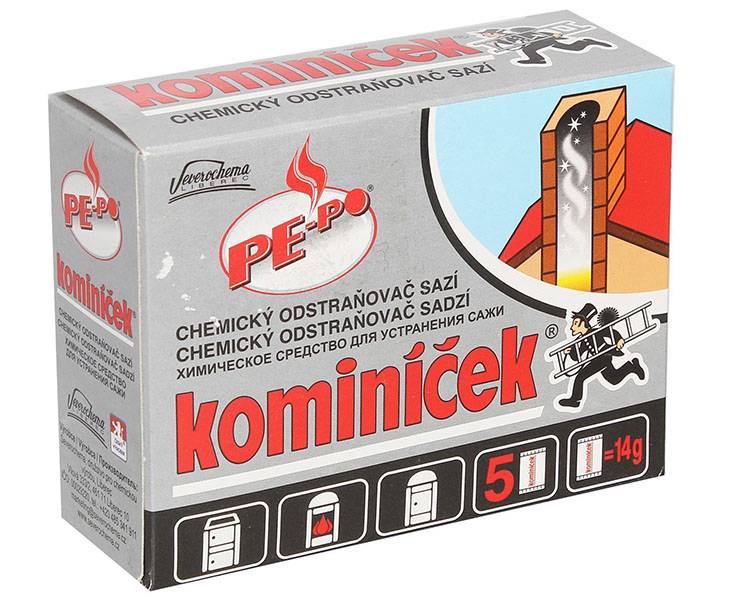 One of the most popular chemical chimney cleaners
Although special preparations have certain disadvantages, they are still in demand. The thing is that during processing, the deposits that are in boilers and bath stoves are softened. Cleaning such equipment by hand is a rather dubious pleasure. With regular use of the compositions, there is no need to use the manual method.
In specialized stores there is a large selection of such products. They are similar to each other both in composition and in the method of application. With their help, effective cleaning of the pipe is ensured. The most popular include the following:
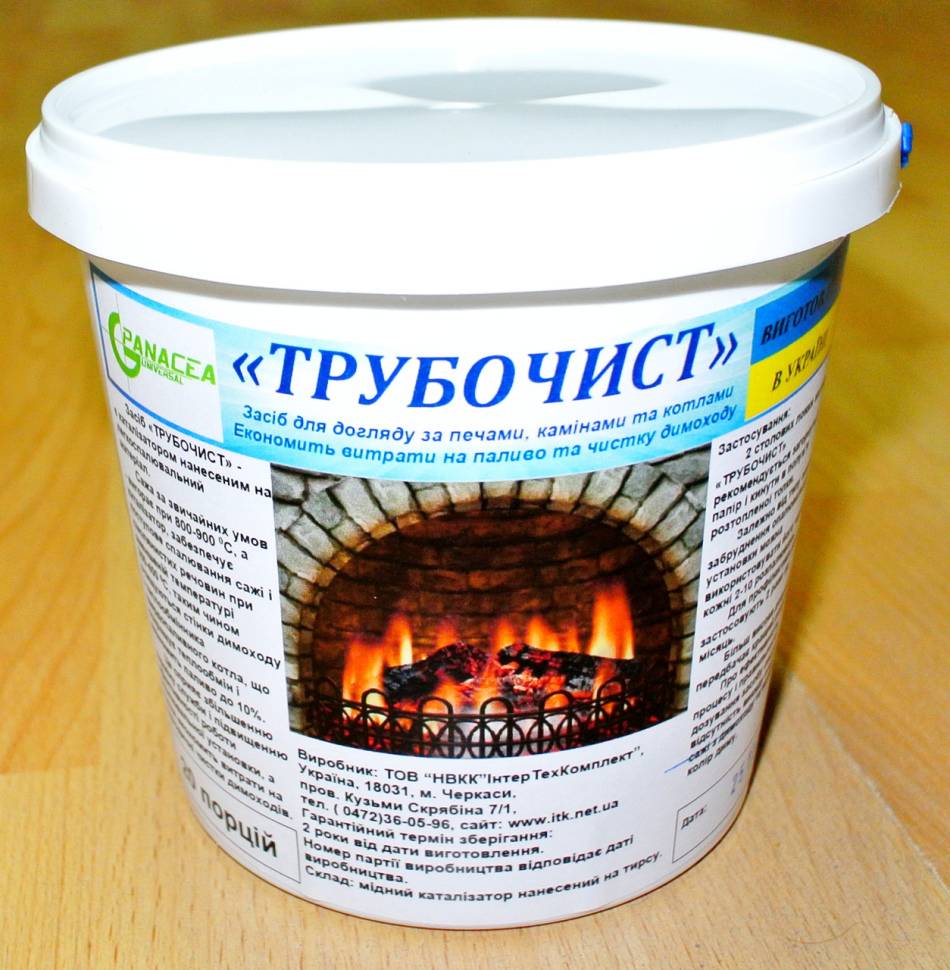
- Means "Kominichek".This drug is offered by a company from the Czech Republic. In the package you can find paper bags in which the granules are packaged. One bag is enough to clean the pipe. The composition is quite effective in the fight against soot. If the layer of deposits on the pipe does not exceed 2 mm, then after the procedure the walls of the structure will become clean.
- Log for cleaning the chimney. This tool is produced by various companies, so the boxes can have a variety of designs. The rules of use are the same regardless of the manufacturer. It is necessary to heat the stove, and then put a log into the firebox for cleaning. When burning, the substance contained in the smoke leads to softening of the soot. If the draft is good, then the particles lagging behind the walls immediately disappear or fall to the floor.
- Domestic drugs. They are offered in a wide range and may have different names. They differ little from each other. The method of application is the same as that of imported products: the composition is placed in a stove or fireplace after preliminary heating.
After removing deposits from the chimney in this way, it is necessary to ventilate the room. Before using the oven, it should be well cleaned of soot. Within a few days after the procedure, particles of polluting sediment may pour out of the pipe.
Chemical cleaning of chimneys: prevention and cleaning
Technological progress has not bypassed the chimneys. The modern market offers a chimney soot remover in liquid, powder or solid form.They operate according to the following principle: during combustion, a harmless gas is released from the active component, which decomposes combustion products that can form soot and thus prevents the formation of deposits on the walls of the flue ducts.
A device for cleaning chimneys can take the form of, say, tablets, logs or special briquettes.
Among these compositions, the following can be noted.

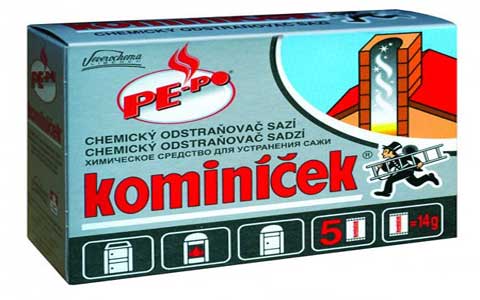
When buying this or that chemical agent, you need to carefully read the instructions or consult with the seller, since not every product is universal and may not be suitable for a particular heater at all.
2020
- Safety
- Roof types
- Attic
- flat
- pitched
- glass
- Roofing materials
- Keramoplast
- natural
- Ondulin
- Polycarbonate
- Slate
- Roofing
- Soft roof
- metal
- Repair and maintenance
- Types of jobs
- Sealants
- Leakage
- truss system
- Mauerlat
- crate
- Roof tiles
- flexible
- metal tile
- Roof device
- Warming and insulation
- Hydro and vapor barrier
- Thermal insulation materials
- Warming
- I-beams and channels
- roof elements
- Ventilation
- drains
- Chimneys
- Skate
- stairs
- Low tide
- Snow guards
- Gable
Conclusions and useful video on the topic
How to properly use a log for fireplaces and stoves "Chimney sweep".
Features of cleaning solid fuel boilers with chemical logs - a test and real results.
For which systems the Chimney Sweep is not suitable - warnings to users.
Artificial log is a modern way to clean chimney pipes from clogging and blockages. The tool is sold in the public domain and is not inexpensive.Use does not require specific skills or experience in cleaning outflow channels.
The "chimney sweep" works efficiently, removing small soot deposits, soot and soot. Works best as a preventive cleaner. The preparation is not very suitable for removing old contaminants, but it gives good results as a concomitant for mechanical cleaning.
Do you have experience with the artificial log "Chimney sweep"? Or do you want to ask questions about cleaning the chimney of stoves and fireplaces? Please comment on the publication and participate in discussions - the feedback block is located below.



