- Water
- Fuel consumption
- Pros and cons
- Heat pump
- Advantages and disadvantages
- Use of solar energy
- Mounting Features
- Real advantages and disadvantages
- Heating electric convectors
- Air heating of the building
- Electric heating
- pros
- Minuses
- Why electricity
- Geothermal systems
- What materials can be used?
- Copper
- metal-plastic
- Made of cross-linked polyethylene
- Steel
- Polypropylene
- Types of thermal media
- Conclusions and useful video on the topic
Water
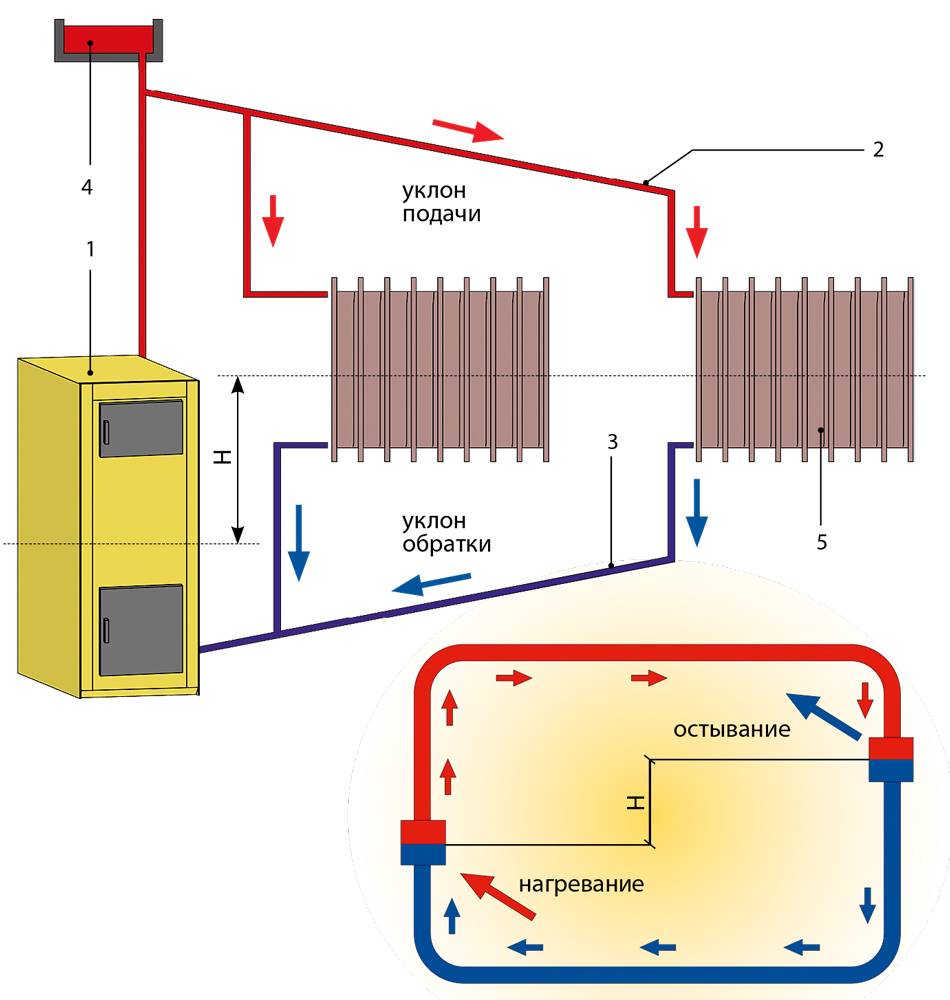
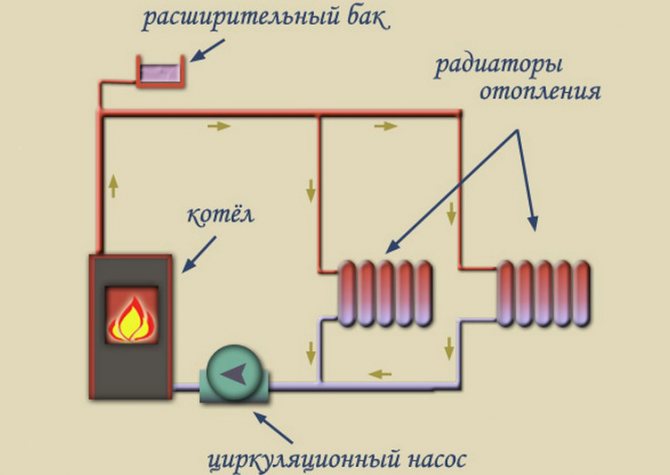
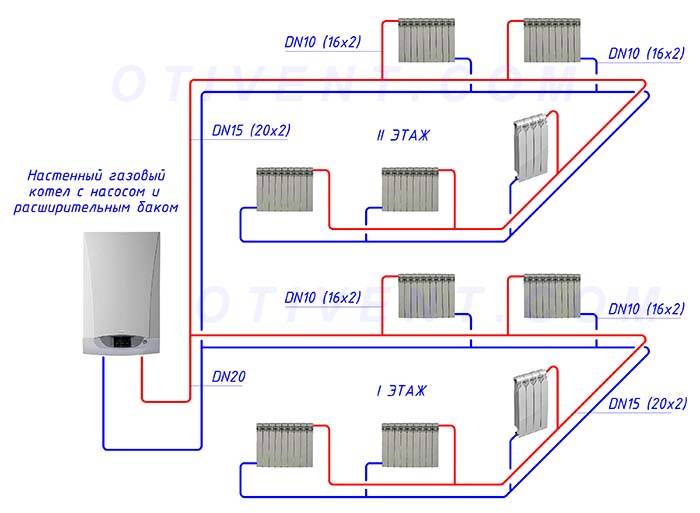
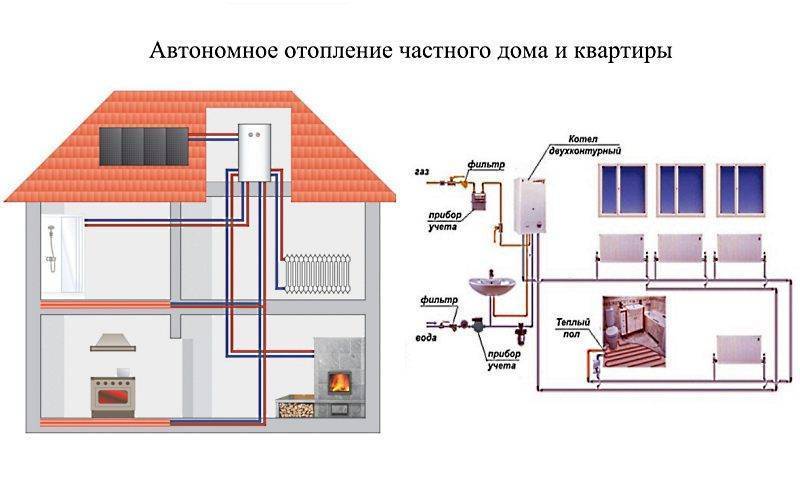
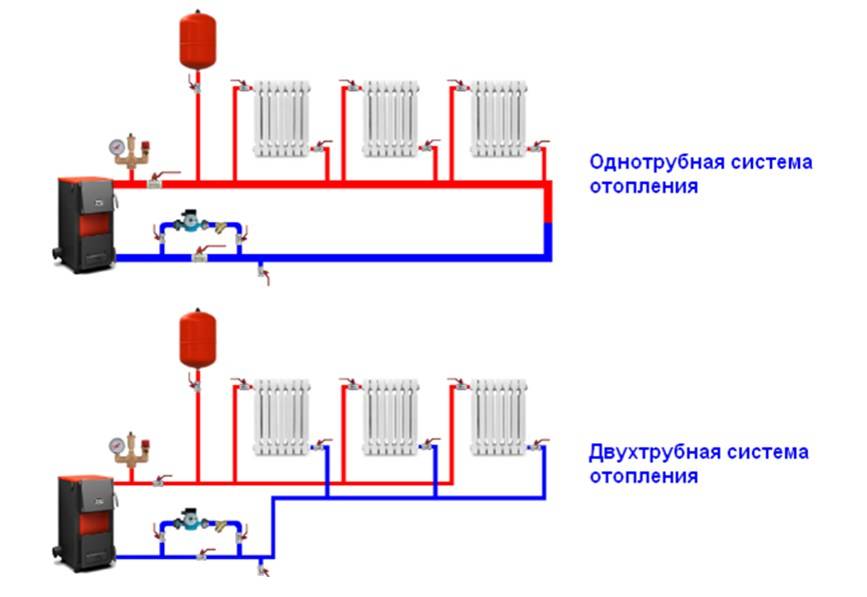
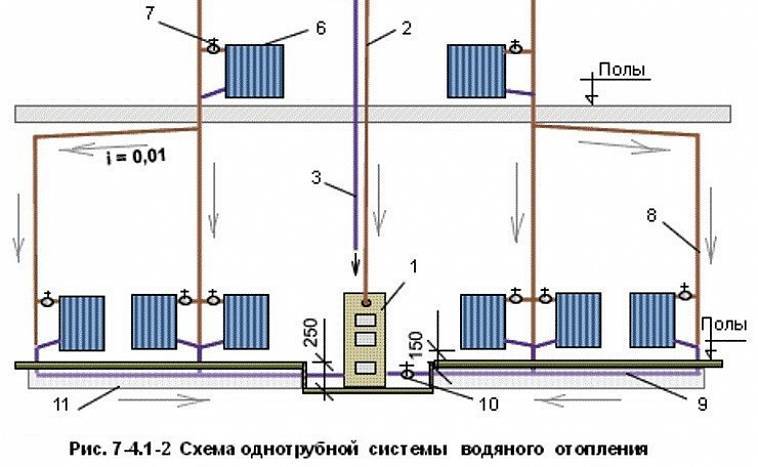
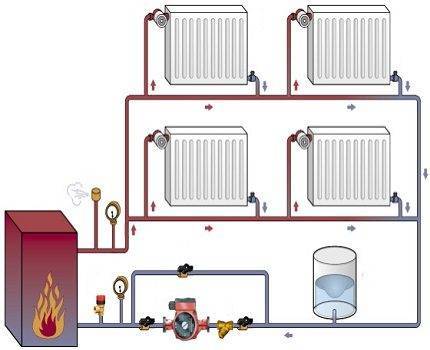
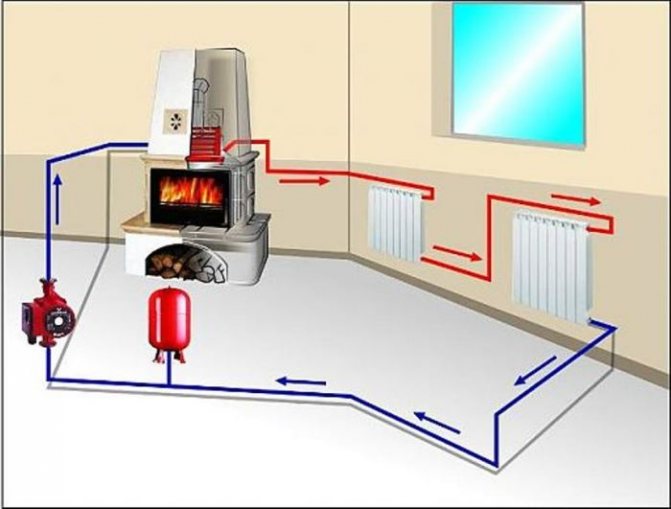
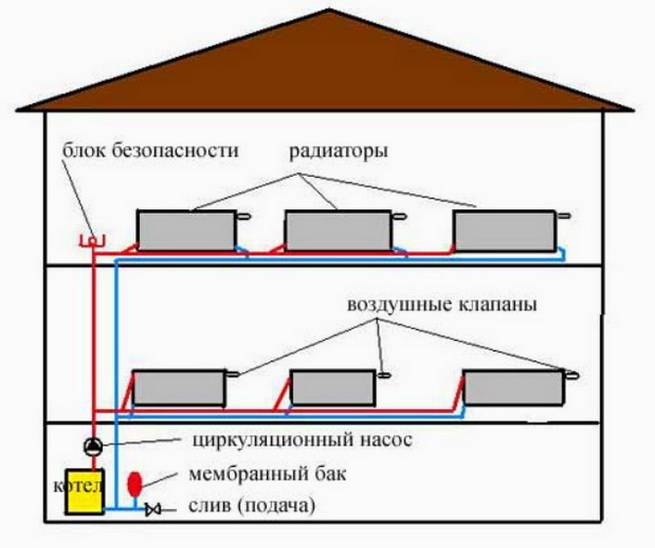
Water heating is a closed system through which hot water circulates continuously. The boiler acts as a heating element. Radiators are installed in each room. From the boiler, water circulates through the pipes along the circuit and, passing through the radiators, gives off heat.
The benefits of a water system depend on the type of fuel used by the boilers. If there is a gas main nearby, then it is wiser to purchase a gas boiler. Gas fuel is considered the most economical. However, such structures require regular maintenance by special services. For non-gasified areas, it is better to purchase solid fuel boilers.
It is not advisable to use liquid fuel for a boiler, as it is expensive and a special reservoir in the ground will be required to store it.
Fuel consumption
Example No. 1. Calculation of fuel consumption in a water heating system: gas will act as a fuel, since it is the most common. For the calculation, you will need the power of the unit and the area of \u200b\u200bheated housing. The power of the boiler for a private building is determined based on the proportion: 1 kW per 10 m². For a room of 100 m², a 10 kW boiler is required.
To calculate the fuel consumption, it is necessary to multiply the boiler power by 24 hours and by 30 days. As a result, we get 7200 kW / h. Since the unit does not always operate at full capacity, this number must be divided by 2. Monthly fuel consumption is approximately 3600 kW / h. The heating period lasts approximately 7 months. Fuel consumption for the heating period is 3600 * 7 = 25200 kW / h.
Given that 1 m³ of fuel generates 10 kWh of energy, we get: 25200/10 = 2520 m³.
We translate the resulting value into a monetary equivalent: the cost of gas per 1 m³ on average in the country is 4.97 rubles. Accordingly, gas heating for the year: 4.97 * 2520 = 12524.40 rubles.
Pros and cons
The main advantages of a water heating system are:
- operational heating of even a large room;
- noiselessness of work;
- ensuring the same temperature in all rooms;
- fuel economy;
- ease of maintenance and repair;
- increase in operating time.
Heat pump
This term refers to a heating system based on the transfer of heat from the external environment into the room.Such units in private homes are still installed infrequently, but their prevalence is increasing.
Any heat pump is designed in the same way as a refrigeration unit. The difference between these devices is why the heat is taken away and where it is transferred. A refrigerator absorbs heat in a closed space and releases it to the outside, while a heat pump transfers heat energy into a room.
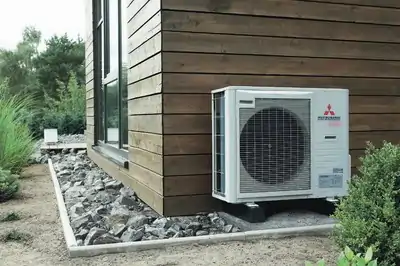
A well-known example of a heat pump is a heated air conditioner. In summer, its indoor unit operates in evaporator mode, and the outdoor unit serves as a condenser.
In winter, the heat pump mode is switched, as a result of which the outdoor unit becomes the evaporator, and the indoor unit turns into a condenser. Thus, the heating air conditioner is a universal heat pump.
There are also heat pumps that work only for heating. The evaporator of such a unit is placed in the ground or in the nearest body of water, and the condensers are placed in the rooms of the house. The heating system is filled with refrigerant, which is pumped by the compressor. The heat pump is controlled by an electronic unit that maintains a constant temperature in the rooms.
Advantages and disadvantages
Heat pump advantages:
- High efficiency. The unit does not generate heat, but only transfers it. So, with a pump motor power of 1 kW, the thermal power of the unit reaches 4-5 kW.
- No need for fuel.
- Ecological purity.
- Possibility of switching to cooling in the summer.
Cons of a heat pump:
- Dependence on electricity supplies.
- To lay the evaporator, you need a large area of \u200b\u200bthe site or reservoir.
- Individual design requires the services of specialists.
- High price.
Use of solar energy
If you live in a sunny region of Russia, then solar panels will be an excellent solution for you, which will generate heat and heat water for most of the year. You will not have to pay monthly utility bills, and the heat will be taken “out of thin air”. This is suitable for owners of summer cottages that are used only periodically, for example, for planting crops in the backyard and for summer holidays in a cozy country house. Consumers who install such systems are not afraid of power outages. You can also use photovoltaic panels, which are used as an additional power source. If there are power outages, then the energy of such devices will be enough to keep boilers and heaters running for several hours, as well as watch TV and charge the phone.

Contrary to all stereotypes: a girl with a rare genetic disorder conquers the fashion world This girl's name is Melanie Gaidos, and she broke into the fashion world quickly, shocking, inspiring and destroying stupid stereotypes.

11 Weird Signs That You're Good in Bed Do you also want to believe that you're giving your romantic partner pleasure in bed? At least you don't want to blush and apologize.

7 body parts you shouldn't touch Think of your body as a temple: you can use it, but there are some sacred places that you shouldn't touch with your hands. Display research.




9 Famous Women Who Have Fallen In Love With Women Showing interest in someone other than the opposite sex is not unusual.You can hardly surprise or shock someone if you admit it.

10 Adorable Celebrity Kids Who Look Very Different Today Time flies and one day little celebrities become unrecognizable adults Pretty boys and girls turn into s.

20 photos of cats taken at the right moment Cats are amazing creatures, and perhaps everyone knows about it. They are also incredibly photogenic and always know how to be at the right time in the rules.
Mounting Features
Having bought pipes for the heating system, it is necessary to properly install
Features to pay attention to:
- To correctly calculate the number of pipes, fittings, and other elements of the pipeline, you need to draw the location of the main elements on a piece of paper.
- Consider what connections are best to make - detachable or soldered. The former are better suited for open systems, the latter for closed ones.
- In a private house, a separate room should be equipped in which a heating boiler, overhead taps, and pipeline openings will be located.
- Choose in advance the radiators that will be located in the rooms. Their choice depends on the diameter of the tubes, the heated area.
- Do not tighten the fixing nuts during installation. This will break connections.
- Threaded fasteners are covered with FUM tape before tightening.
Before putting the pipeline into operation, a test run is carried out to avoid leaks.
Real advantages and disadvantages
If in Russia geothermal heating of the private sector has received a relatively small distribution, does this mean that the idea is not worth the cost of its implementation? Maybe it's not worth it to deal with this issue? It turned out that this was not the case.
Using a geothermal home heating system is a profitable solution. And there are several reasons for this. Among them is the quick installation of equipment that can work for a long time without any interruptions.
If you use not water in the heating system, but high-quality antifreeze, it will not freeze through and its wear will be minimal.
We list other advantages of this type of heating.
- The procedure for burning fuel is excluded. We create an absolutely fireproof system, which, during its operation, will not be able to cause any damage to housing. In addition, a number of other issues related to the presence of fuel are excluded: now there is no need to look for a place to store it, to procure it or deliver it.
- Substantial economic benefit. During the operation of the system, no additional investments are required. The annual heating is provided by the forces of nature, which we do not buy. Of course, during the operation of a heat pump, electrical energy is consumed, but at the same time, the amount of energy produced significantly exceeds the consumption.
- environmental factor. Geothermal heating of a private country house is an environmentally friendly solution. The absence of the combustion process excludes the entry of combustion products into the atmosphere. If this is realized by many, and such a heat supply system will be properly widespread, the negative impact of people on nature will decrease many times over.
- The compactness of the system.You do not have to organize a separate boiler room in your house. All that will be needed is a heat pump, which can be placed, for example, in the basement. The most voluminous contour of the system will be located underground or under water; you will not see it on the surface of your site.
- Multifunctionality. The system can work both for heating in the cold season, and for cooling during the summer heat. That is, in fact, it will replace you not only with a heater, but also with an air conditioner.
- acoustic comfort. The heat pump runs almost silently.
Choosing a geothermal heating system is cost-effective, despite the fact that you have to spend money on the purchase and installation of equipment.
By the way, as a drawback of the system, it is precisely the costs that you have to go to install the system and prepare it for work. It will be necessary to buy the pump itself and some materials, to carry out the installation of the external manifold and the internal circuit.
It is no secret that resources are becoming more expensive year by year, so an autonomous heating system that can pay off within a few years will always be economically beneficial for its owner.
However, these costs pay off in just the first few years of operation. The subsequent use of a collector laid in the ground or submerged in water saves a lot of money.
In addition, the installation process itself is not so complicated as to invite third-party specialists to perform it. If you do not engage in drilling, then everything else can be done independently.
It should be noted that some craftsmen, in an effort to save money, have learned to assemble a geothermal heat pump with their own hands.
Heating electric convectors
The operation of these devices is similar to the operation of heating radiators. They also heat up and transfer heat to the air around them. The difference lies in the fact that there is no coolant in the convectors. Therefore, inlet/outlet pipe systems are not needed.




Instead, heating elements are located inside the device, which heat its surface. The lower part of the device is intended for cold air intake.
It penetrates inside the convector through a special mesh. Heating up from the heating element, the air rises higher and exits through the upper grate.
During the operation of the heater, a steady upward flow of warm air is created, which quickly heats the room. To control the heating temperature, the equipment is equipped with a thermostat, an automatic control unit can be installed.
Manufacturers produce a wide range of devices of various capacities and designs. For rooms with high humidity, you can purchase devices with special protection. The following article, which we recommend reading, will introduce the criteria for choosing an electric convector.
Convectors are extremely easy to use and safe. The heating element of the device is located inside its case, while the outer panel heats up very little, so it is impossible to get burned on it.
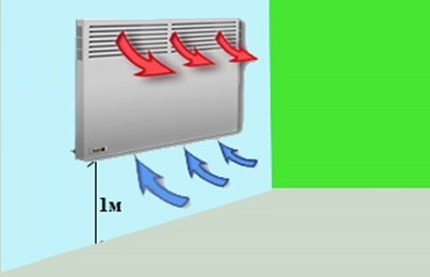
The figure schematically shows the principle of operation of an electric convector: cold air masses are drawn in by the device from below and, after processing, are brought out at the top
Heating appliances are silent, so they do not create any inconvenience. Various variations of convectors are produced, among which there are mobile portable models.There are devices designed for floor mounting. They are installed under windows, in front of doors and in other similar places where the devices create an effective thermal curtain that prevents cold from entering the room.
The negative characteristics of convectors include their low power. Therefore, to heat the building, a sufficiently large number of them will be required, which is a serious load on the wiring. In addition, the efficiency of such devices is low. They consume quite a lot of electricity.
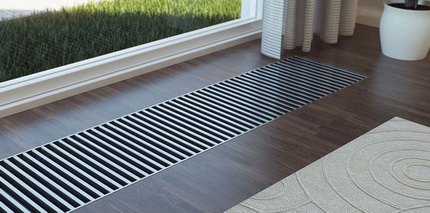
A type of electric convector that is built directly into the floor
Air heating of the building
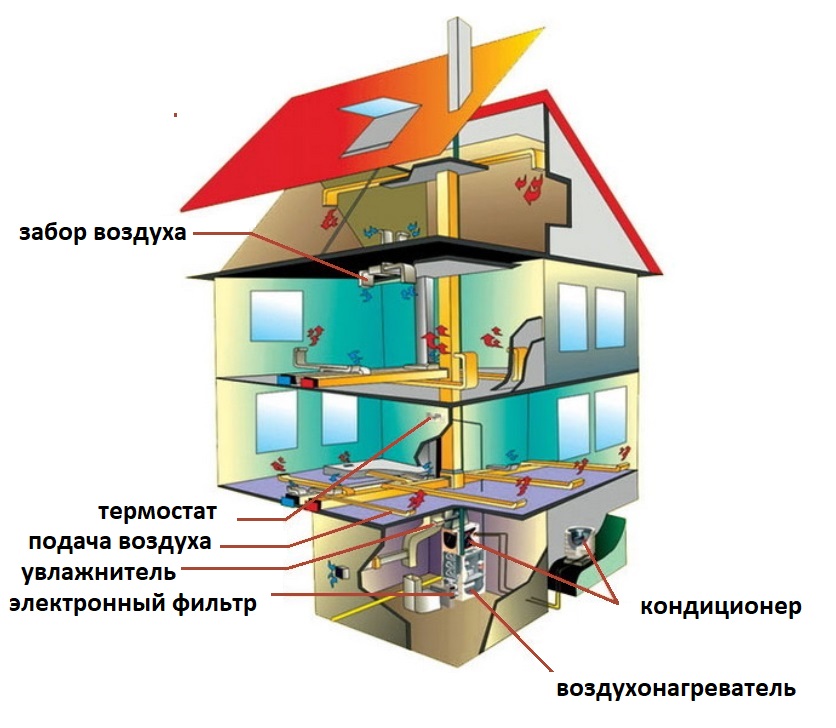
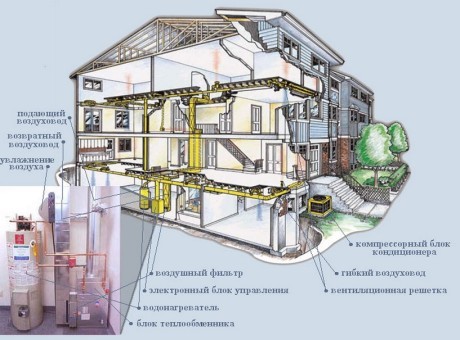
This is another type of heating a private house. Its main distinguishing feature is the absence of a coolant. The air system is designed so that air flows pass through the heat generator, where they are heated to the desired temperature.
Further, through special air ducts, which can have a wide variety of shapes and sizes, the air masses are sent to heated rooms.
Air heating can be used to heat a private house of a large area, while it is possible to create a comfortable microclimate in each room
According to the laws of convection, heated flows rise, cooled ones move down, where holes are mounted through which air is collected and discharged to the heat generator. The cycle is repeated.
Such systems can work with forced and natural air supply. In the first case, a pump is additionally mounted, which pumps the flow inside the air ducts. In the second - the movement of air is carried out due to the temperature difference. It is clear that forced circulation systems are more efficient and powerful.We talked about the arrangement of air heating with our own hands in the next article.
Heat generators are also different. They can operate on a variety of fuels, which determines their performance. Most of all, gas, electric and solid fuel appliances are in demand. Their disadvantages and advantages are close to similar water heating boilers.
The circulation of air masses inside the building can be carried out in different ways. It can be a closed cycle without adding outside air. In this case, indoor air quality is poor.
The best option is circulation with the addition of air masses from the outside. The indisputable advantage of air heating is the absence of a coolant. Thanks to this, it is possible to save the energy required for its heating.
In addition, installation of a complex system of pipes and radiators is not required, which, of course, also increases the efficiency of the system. The system does not have the risk of leaks and freezing, like its water counterpart. It is ready to work at any temperature. The living space heats up extremely quickly: literally, about half an hour passes from starting the heat generator to raising the temperature in the premises.
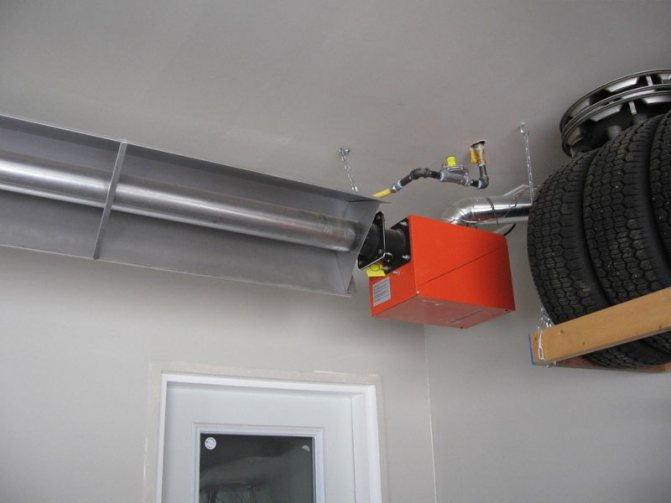
A gas heat generator is one of the possible solutions for the implementation of an air heating project for a private house. However, such systems are rarely used in practice.
Another significant plus is the possibility of combining air heating with ventilation and air conditioning. This opens up the widest possibilities for realizing the most comfortable microclimate in the building.
The air duct system in the summer can be successfully used for air conditioning. Installing additional equipment will make it possible to humidify, purify and even disinfect the air.
Air heating equipment lends itself well to automation. "Smart" control allows you to remove burdensome control over the operation of appliances from the homeowner. In addition, the system will independently select the most economical mode of operation. Air heating is very easy to install and durable. The average life of its operation is about 25 years.


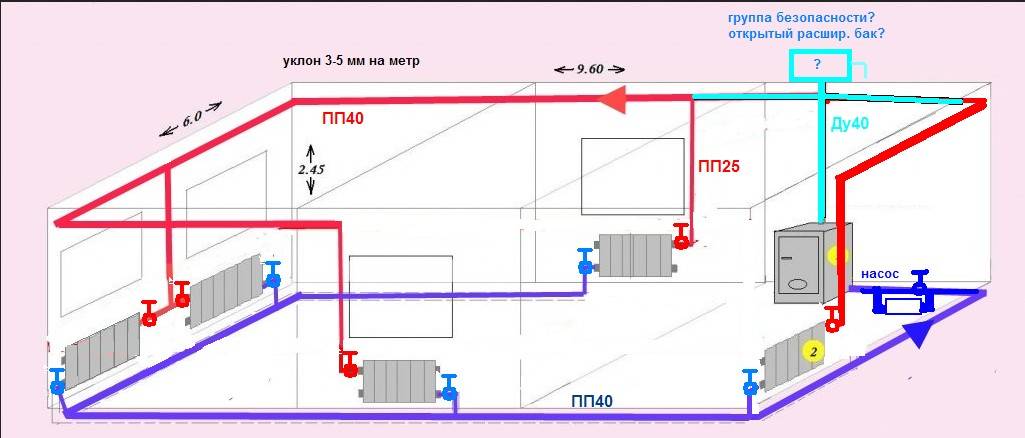


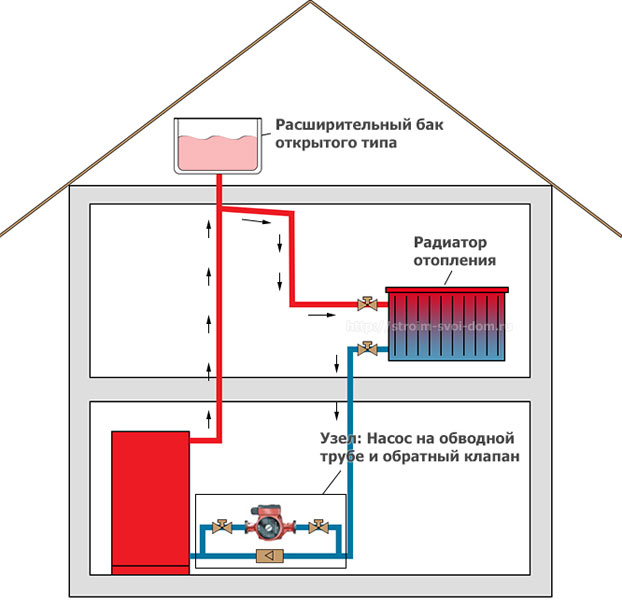
Air ducts can be installed at the construction stage of the building and hidden under the ceiling covering. These systems require high ceilings.
The advantages include the absence of pipes and radiators, which gives room for the imagination of designers decorating the interior. The cost of such a system is quite affordable for most homeowners. Moreover, it pays off quickly enough, so its demand is growing.
Air heating also has disadvantages. These include a significant difference between the temperatures in the lower and upper parts of the room. On average, it is 10 ° C, but in rooms with high ceilings it can reach up to 20 ° C. Thus, in the cold season, it will be necessary to increase the power of the heat generator.
Another disadvantage is the rather noisy operation of the equipment. True, this can be leveled by the selection of special "quiet" devices. In the absence of a filtration system at the outlets, a large amount of dust in the air may occur.
Electric heating
A well-known heating system using electrical appliances, in which heat releases a current passing through a conductor. Often the electrical system is used as an auxiliary, but in the absence of gas in the house can be the main one.
pros
- Ecological purity.
- Easy installation.
- Heating appliances can be freely rearranged in any room with electrical wiring.
Minuses
- The need to pay for the consumed electricity, the consumption of which will be large.
- During a power outage, the heating system does not work.
- During the operation of electrical appliances, oxygen burns out, so the premises should be ventilated as often as possible.
In dachas and small houses, electric heating is often used, but heating a large house will require a large amount of electricity. If you decide to choose this particular system as the simplest and does not require special knowledge for self-assembly, take care of high-quality thermal insulation at home.
Why electricity
Electric heating differs from classic water-furnace and gas systems in greater efficiency and practicality. We will leave the first aspect for discussion a little lower, and describe the operational advantages here:
Electric heating is not only silent, but also environmentally friendly. It is transported safer than gas and does not emit harmful substances at all, both into the atmosphere and into the room. In the absence of waste, the need for exhaust chimneys and traction structures also disappears. Heating on coal or wood is not at all comparable to electrical systems.
Heating with electricity does not require large one-time costs.You can make a comparison using the example of gas: in order to connect a house, you must purchase equipment for each room, install communications, a boiler, and crash into a common highway. Moreover, it is necessary to do all this together, since it is impossible to postpone bringing some part of the house to the system. And the electric method allows you to organize sequential installation: first, the most important parts of the house are connected, and then, as funds accumulate, peripheral ones.
Thanks to the possibility of using a multi-tariff meter in a private house or apartment, as well as the constant development of technologies in this area, heating with electricity is already the most economical among analogues
Do not focus on the high price of equipment - it quickly pays off due to low energy consumption.
Almost every method of organizing electric heating allows you to do the installation yourself, without many additional tools.
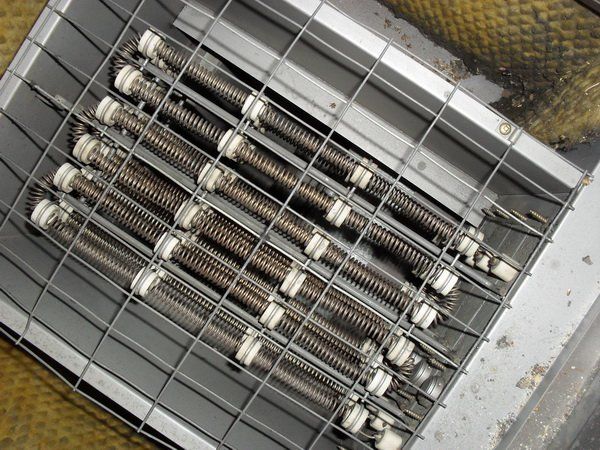
Of course, the use of electrical systems for heating cannot be called ideal. Work on high-quality heating of each house requires taking into account many features. In some regions, the cost of electricity can be so high that gas cannot be abandoned. In old apartment buildings, it is difficult to switch to electric heating for two reasons: it is very difficult to disconnect from the central highway, and the power grid will have to be built again, taking into account powerful equipment.
Despite this, the overall picture tips the scales in favor of electricity. For rooms in which there is no gas or there is no possibility to supply it, it is a real salvation.
Geothermal systems
New heating systems for private houses make it possible to obtain energy that can be used not only for heating, but also for other purposes. The most popular way to obtain energy is the use of geothermal installations. Such installations work on the same principle as a heat pump. The heat intake is provided from the ground, which is located in the immediate vicinity of the house.
Geothermal heating system
A geothermal installation, as an innovation in home heating, has the following design: a heat pump is installed in the house, which will be fully responsible for pumping the coolant. In the mine, located near the house, it is necessary to lower the heat exchanger. Through this heat exchanger, groundwater will be transferred to the heat pump. As they pass through the pump, they will lose some of their heat. This is because the pump will take heat and use it to heat the house.
If geothermal innovative heating of a country house is necessary, then the coolant should not be groundwater, but antifreeze. To do this, you will need to equip a tank designed for this type of coolant.
What materials can be used?
All materials can be divided into: plastic and metal.
The first are made of cross-linked polyethylene, or polypropylene, or metal-plastic.
The second is made of steel, iron or copper.
Reference. Metal and polymer pipes can be easily combined. It is necessary to choose and connect them correctly.





Copper
Differ in durability and reliability.
Advantages:
- Ease.
- Strength.
- Withstand high temperatures.
- The pipe bends when heated.
- No additional fasteners needed.
- Inexpensive parts for connection.
- High thermal conductivity.
- If the water contains a minimum of impurities, the heating main will last a century.
Minuses:
- Long to install.
- Heaviness. It won't be cheap to ship.
- Susceptibility to corrosion. Hidden in the wall, deteriorating.
- They quickly lose heat if the rooms are cold.
- The roughness of metal surfaces is an excellent environment for the appearance of oxidation.
- High cost.
metal-plastic
Made of plastic, with a thin layer of aluminum inside.
Pros:
- Inexpensive.
- Easy to clean.
- They hide in the walls.
- The plastic is smooth, and plaque rarely forms in the pipe.
- Lightweight - you can bring your own.
- They serve 20 years or more.
Photo 3. Metal-plastic pipes for the heating system. In the central part of the products is an aluminum layer.
Flaws:
- If there is a breakdown in some heating main, a separate segment cannot be removed. Remove the area between the two fittings.
- Do not bend when heated. If you need an angle, then use special parts: fittings.
- Difficult to connect.
- Additional wall mounts required.
- If you turn off the heating in winter, the pipes will crack.
Made of cross-linked polyethylene
Modern and high tech.
Advantages:
- Durable. They last half a century or more.
- Inexpensive. Both the price and delivery will not hit the budget.
- Unique property: when hot liquid enters, the pipe bends and then returns to its place.
- Easy to assemble. Additional details are simple and accessible.
- Smooth inside, do not accumulate mineral deposits.
- High density.
- Ideal for hiding in walls.
- Withstand a temperature load of 90 °C.
Photo 4.Pipes made of cross-linked polyethylene for heating systems. Often used for arranging underfloor heating.
No deficiencies found.
Steel
Made of steel using two different technologies:
- sewn from a sheet;
- use special equipment.
Pros:
- Tightness.
- They are inexpensive.
Minuses:
- Due to the high electrical conductivity, they are not suitable for electric boilers.
- Subject to destruction over time.
- Heaviness. Difficult to deliver and install.
Polypropylene
Inexpensive and great for heating a private house.
Advantages:
- Long service life (from 30 years).
- Easy to mount on the wall.
- When used in a country house with seasonal residence, they will not freeze when the heat is turned off.
The disadvantages are similar to metal-plastic ones: additional fasteners, fittings, the inability to repair a separate segment.
Types of thermal media
Let's consider in more detail types of thermal media.
_
Water - a chemical compound of hydrogen and oxygen that exists in liquid, solid and gaseous states.
room - a unit of a complex of real estate (a part of a residential building, another real estate object associated with a residential building), allocated in kind, intended for independent use for residential, non-residential or other purposes, owned by citizens or legal entities, as well as the Russian Federation, subjects of the Russian Federation and municipalities. ; - the space inside the building, which has a certain functional purpose and is limited by building structures. (SNiP 10-01-94); - the space inside the house, which has a certain functional purpose and is limited by building structures. (SNiP 31-02-2001)
To transfer heat from the generator to the heated room, water is usually used, which has been heated to a specific temperature and circulates through the pipeline. To date, this is predominantly an affordable and simple solution. By correctly calculating the number of radiators and the power of the boiler, you can organize a high-performance system that does not need any special care. In addition to water heating, in a private house made of wood, it is used:
- electrical.
- air;
- furnace;
_
Heating — maintenance of normalized temperature in enclosed spaces with an average unavailability of 50 h/g. (SNiP 2.04.05-91)
A combined option is also often used. Without spending a lot of money, building a system that will completely warm up the house in a matter of hours, a well-designed scheme provides an opportunity.
Let's consider in more detail types of thermal media.
The transfer of heat energy can be carried out in various ways, such options can be considered:
airy wooden house;
use of water (the most popular option);
stove heating in a wooden house;
underfloor heating systems.
We have already considered the system of underfloor heating above, it will not be able to fully provide the house with heat in the winter. This option is used as part of a system with different coolants or when living in a cottage only in the summer.


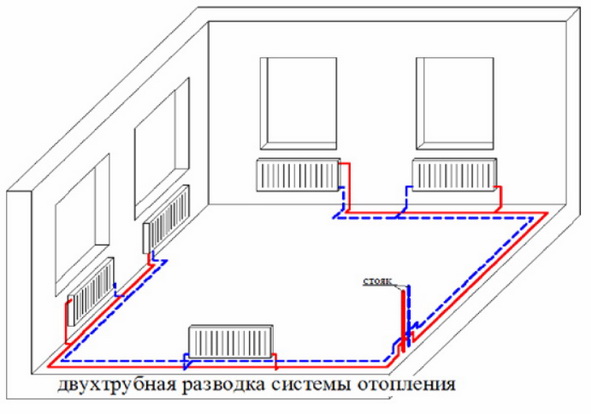
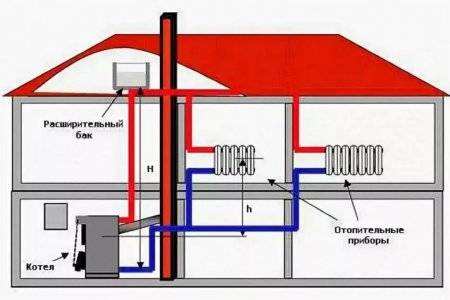


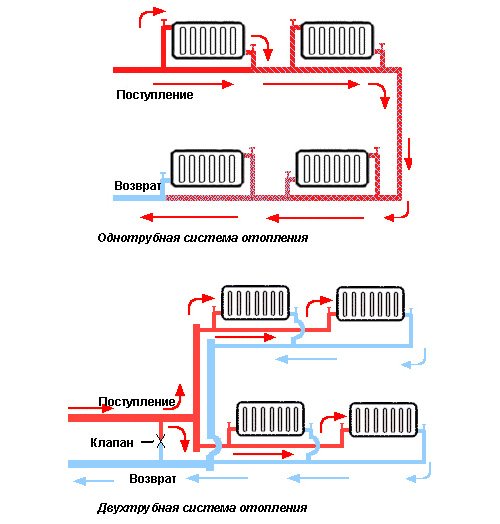
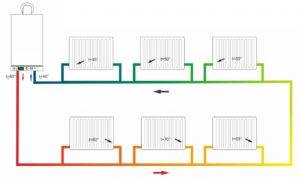
Generally, water is used as a heat transfer medium for many reasons. The system will have high performance and efficiency, it is mostly an easy way to provide space heating.
Furnaces for heating a wooden house are a traditional option for space heating. oven heating in a wooden house sometimes it is not able to heat distant rooms, which becomes a serious drawback. This method has been tested by time, in our time there is a preservation of its high demand. However, when combined with other options, the oven shows good performance.
The use of air as a heating medium is also often used. Care will have to be taken to prevent the temperature from dropping when moving, if it is planned to heat houses with a large area. It is relatively safe, the disadvantage is often significant heat loss during transmission over long distances.
We should also mention quartz heating, which is more economical in comparison with classical electric heating systems. Quartz equipment consumes several times less electricity, at the same time it is able to heat rooms in a short time.
Conclusions and useful video on the topic
To heat a private house, different types of heating are used, and sometimes several are combined. How heating is performed, you can find out from the following videos.
Pros and cons of air heating:
What users say about infrared heating:
Features of arranging water heating with your own hands:
In a private house, it is technically possible to equip almost any heating system. Therefore, the owner must choose the most practical and most suitable option for the conditions existing in his house. When making a choice, you should listen to the opinion of experts, correctly calculate your heating system. Then it will be very warm in your house, even if it is a fierce winter outside.
What heating system do you use? What advantages and disadvantages have you noticed in the operation of your heating system? Or are you still looking at choosing the best option? Do you have questions after reading this article? Please ask them below - our experts and other site visitors will try to help you.