
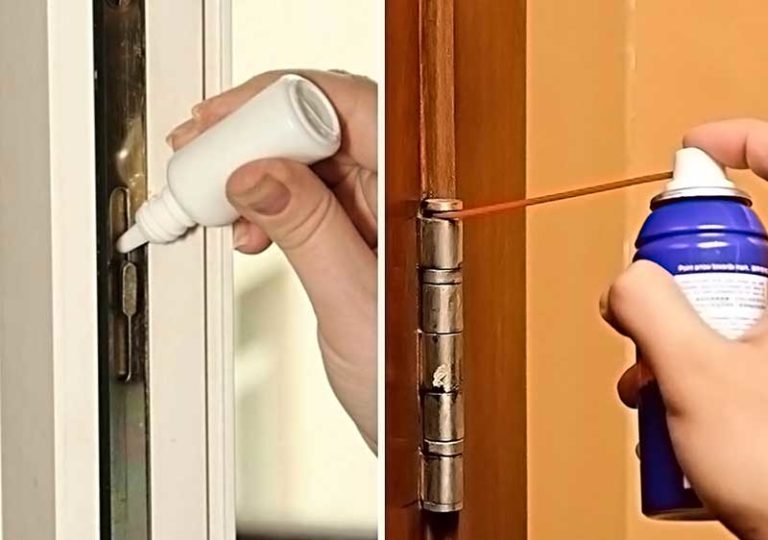
- What can be used as hinge lubricant
- Machine oil
- Household sewing machine oil
- Advice
- WD-40
- Silicone Grease
- Litol
- The best lubricants against squeaking hinges
- How to properly apply lubricant
- Lubrication of door parts
- How to grease hinges
- Sheds
- Guides
- Causes of creaking and how to fix it
- How are furniture hinges processed?
- Causes of door creaking
- We fix the problem
- Other factors
- Reasons for the appearance of a creak
- How to lubricate door hinges so that they do not creak?
- Why do doors start to creak?
- Means for lubricating door hinges
- How to lubricate door hinges?
- Helpful Hints:
- Hinge lubrication
What can be used as hinge lubricant
Means for lubricating door hinges, as well as tips for their use, there are many. Some lubricants have a short-term effect, some can disrupt the operation of canopies, so how not to miscalculate when choosing? To begin with, let's look at how you can lubricate the hinges.
Machine oil
This universal type of lubricant can be found in the garage or trunk of a car for every second driver. Preference should be given to viscous oils, for example, for an engine or diesel.
Household sewing machine oil
The indisputable advantages of such a tool are its availability (sold in any economic department) and the form - small bottles of 30 or 50 ml with a thin nose, which makes it easy to apply oil deep into door fittings.
Advice
It is not necessary to replace engine oil with an analogue of organic origin (olive, vegetable, butter or petroleum jelly), since organic matter quickly evaporates in air, so the loops will creak again in the near future. As the organic lubricant dries, it becomes sticky, which gets small particles of dirt and dust that impede the operation of the mechanism. In addition, organic matter provokes the appearance of rust on the hinge, which, in combination with an indelible sticky layer, increases the likelihood of replacement with new fittings.
WD-40
Such a lubricant eliminates the creaking of canopies in a few minutes. A convenient form in liquid or aerosol form allows you to apply the product without additional equipment at hand. WD-40 not only lubricates the canopy, but also cleans it of dirt and dissolves rust. But it is worth noting that WD-40 dries quickly, without constant renewal, forming a coating that does not allow parts of the mechanism to slide easily. As a result, in the future you will have to remove the canvas, disassemble, clean the hinges and select a more suitable lubricant.
It is considered the most effective long-lasting lubricant, but, unfortunately, such a lubricant will have to be diligently searched for in stores.
Silicone Grease
An affordable analogue of graphite grease, characterized by long-term action for several years. Suitable for outdoor entrance doors, as the lubricant is resistant to frost and temperature extremes.
Litol
A thick lubricant that is usually used to improve the operation of the canopies of the doors of private houses. Fittings lubricated with lithol will not creak at temperatures from -40 to +120 ° C, which allows the product to be used in severe weather conditions and boiler rooms. Litol can be replaced with budget grease, which retains its viscosity at air temperatures from -35 to + 65 ° С.
Due to the high viscosity of such products, it is recommended to disassemble the hinges and lubricate from the inside, in which case the door will not be disturbed by a creak for many years. If you are unwilling or unable to remove the canvas, you can carefully coat the surface and the joint of the loop with lithol using a cotton swab or swab, but it should be borne in mind that the period of silent operation will be significantly reduced.
The core of a simple soft pencil is considered an effective and affordable option for eliminating squeak. It is not necessary to grind the rod into powder in order to rub the joint of the canopy later, it is enough to slightly raise the door leaf so that the hinge rod slightly protrudes from the second part and put a piece of graphite there. Several movements of the door and the rod in the hinge is crushed into crumbs under the weight of the canvas.
The best lubricants against squeaking hinges
In fact, in most cases, these problems are solved quite simply. As a rule, the fact that the door creaks is a consequence of the friction of the elements of the door hinges against each other. These elements need to be lubricated. There are several popular and effective means for this:
- machine oil;
- diesel oil;
- spindle oil;
- cyatim;
- grease;
- various silicone lubricants and aerosols;
- special lubricants.
It is clear that the substances and materials listed above are unlikely to be at hand in an apartment or house at the right time. They will have to go to specialized stores.
Meanwhile, there are alternative means that are almost one hundred percent found in any home:
- vegetable oil;
- candle paraffin;
- Graphite shavings from a soft grade pencil.
However, these simple "folk" remedies still cannot be compared in terms of their effect, say, with engine or diesel oil.
Special mention should be made of vegetable oil. The door structure, after lubricating the hinges with this oil, will most likely begin to make sounds again in a few days. In addition, abundant and frequent use of sunflower oil causes corrosion. So, instead of the old creak, an even more unpleasant rattle may appear. That is, to achieve a short-term result, vegetable oil is quite suitable, but in order to achieve a long-term victory, you still need to apply something more serious.
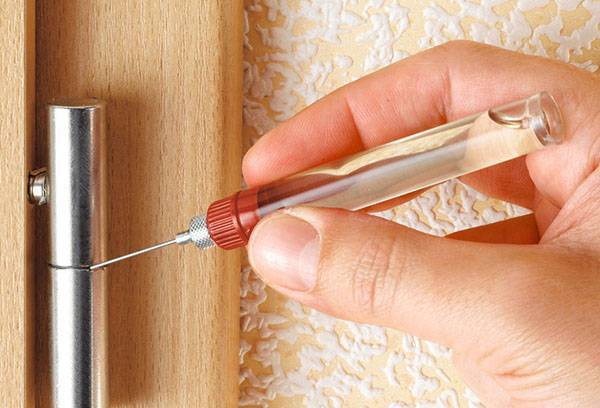
How to properly apply lubricant
So that efforts are not in vain, you need to follow simple rules for applying lubricant. Then the result of the work will be better and last longer.

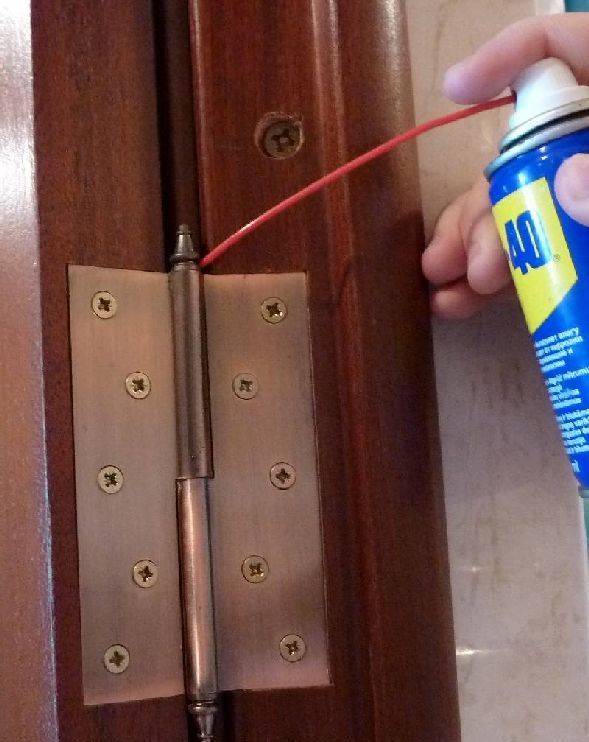
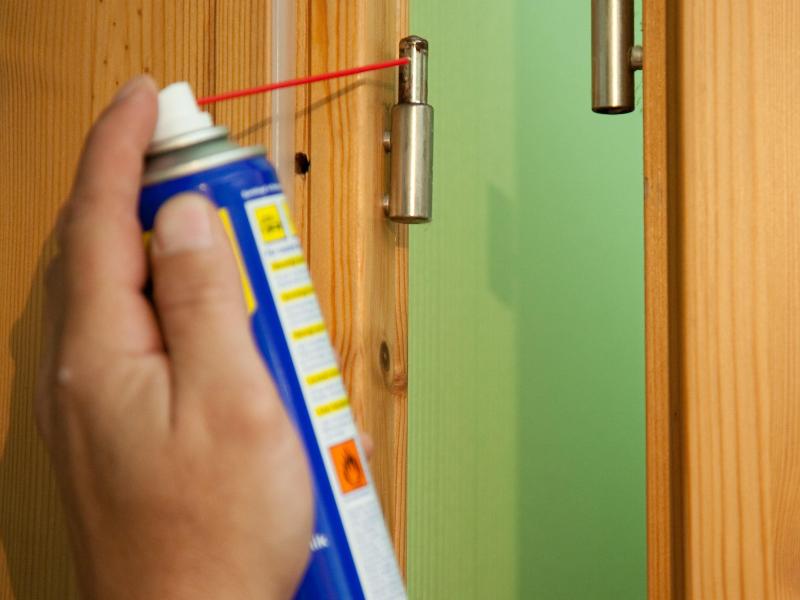
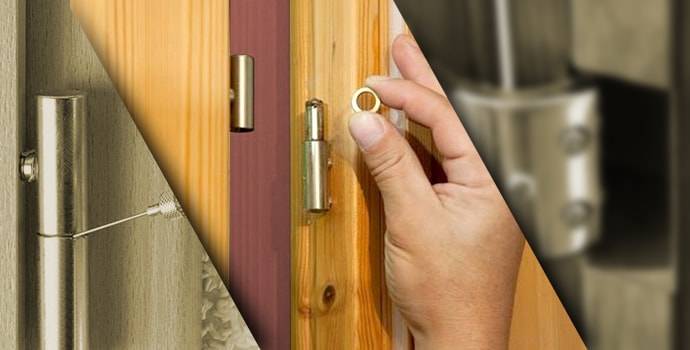


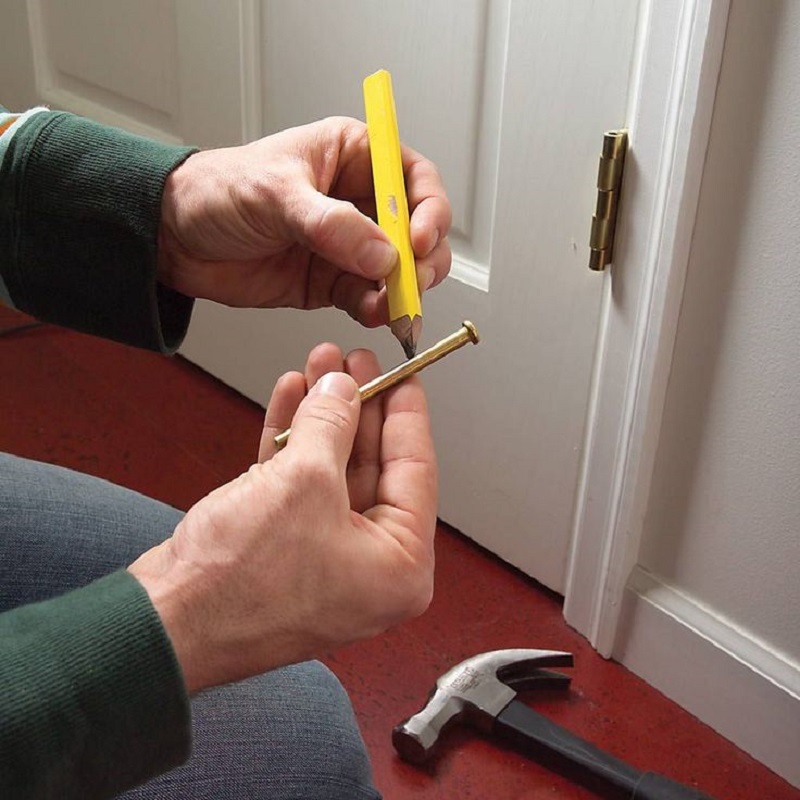
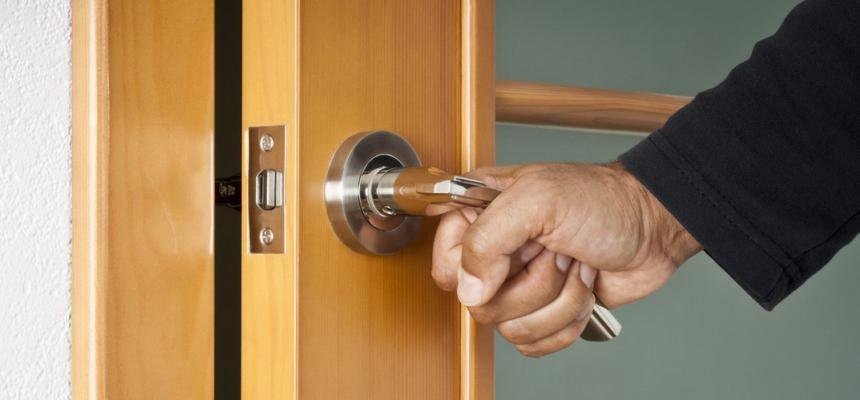
- It is best to apply the lubricant using a convenient oiler or from a bottle with a fine nozzle. In case of poor access to the inside of the loops, you can use a syringe or pipette.
- If the door is removed from the hinges, then it is easier to lubricate their open parts with a brush or cotton swab.
- Carefully remove excess grease with absorbent material.
- Worn moving areas need to be treated more carefully. It is very possible that they are the cause of the creak.
- The rubbing parts are located, as a rule, inside the loops.You need to try to provide them with a sufficient amount of lubrication.
- Before processing, all surfaces must be well cleaned of dirt.
Video instruction on how to properly lubricate the hinges.
Lubrication of door parts
Hardware parts may have various types of construction. In accordance with the design of the mechanism, you need to choose a method for lubricating it.
How to grease hinges
Hinge hinges are often one-piece. A door with such hinges can be dismantled only by unscrewing all the screws. Such loops consist of a large number of elements. Therefore, they have many rubbing surfaces that need regular lubrication.
Despite the difficulty in care, these loops are very popular. They are universal and suitable for both right and left doors.
Sheds
Detachable hinges, or canopies, in the simplest case, consist of two parts. The door can be easily removed without unscrewing the hinges. If the canopies are heavily rusted, you need to put a rag soaked in machine oil on them and leave for several hours. After that, the oxide is easier to clean. Finally, the metal is lubricated and the door is hung in place.
Guides
Before lubricating the guides, they must be cleaned. Only after making sure that the dirt does not interfere with the movement of the valves, you can apply silicone grease.
Causes of creaking and how to fix it
The reasons for the creaking of the door may be faulty hinges, or the friction of the door leaf itself on the box. The most common is still the friction of the product on the box. If this happens periodically during the off-season, then the apartment has high humidity, leading to swelling of the canvas. To get rid of the problem, you need to reduce the humidity.If the creak worries the owners all year round, radical methods must be applied here:
- Find friction points. To do this is quite simple, just attach a copy sheet to the end of the product. To do this, you need to open the door and stripes will remain on the paper in the place of friction.
- Eliminate friction. After identifying the place of friction of the door on the box, you will need to apply carpentry skills. It is necessary to remove a small layer of wood from the frame or the end of the door with a planer.
If the problem is in the hinges, this may be due to their wear or poor fixation. When the hinges are worn out, they can only be replaced with new ones. If the creak appeared due to the fact that the door canopies were loose and could not cope with the loads, they should be tightened. It is better to take screws or self-tapping screws of large sizes.
Attention: to tighten the screws more firmly, you can use glue. It will need to be applied to the existing holes and after that, the loops must be pulled well
Also, door hinges can creak because it is high time to lubricate them. For this, a special lubricant or machine oil is used. You can use any oil, the main thing is that it be of high viscosity. If you find Litol lubricant, then you will forget about how the door creaks forever. A universal remedy is WD aerosol, which motorists always have. But the effect of its use will not last long.
How are furniture hinges processed?
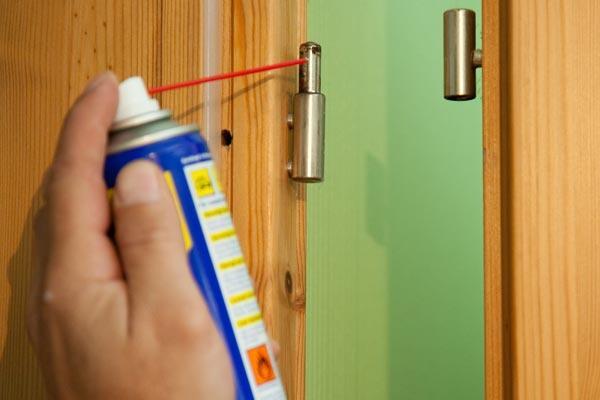
If the reason is that the oil in the part has dried up and does not allow it to fully function. It is necessary to lubricate the hinges with a special substance. Suitable for this:
- Solidol;
- Oil lubrication;
- Spray WD-40 (available at automotive stores)
When there were no special tools at home, you can use improvised means:
- Sunflower oil.
- Coconut oil.
- Petrolatum.
- Cream.
- Paraffin.
- Soap.
The main thing is that the substance is slippery and greasy. Improvised means will help get rid of the squeak for 1-2 weeks. Choose special oils for furniture hinges or grease. They penetrate deep into the cracks and ensure long-term operation of the furniture.
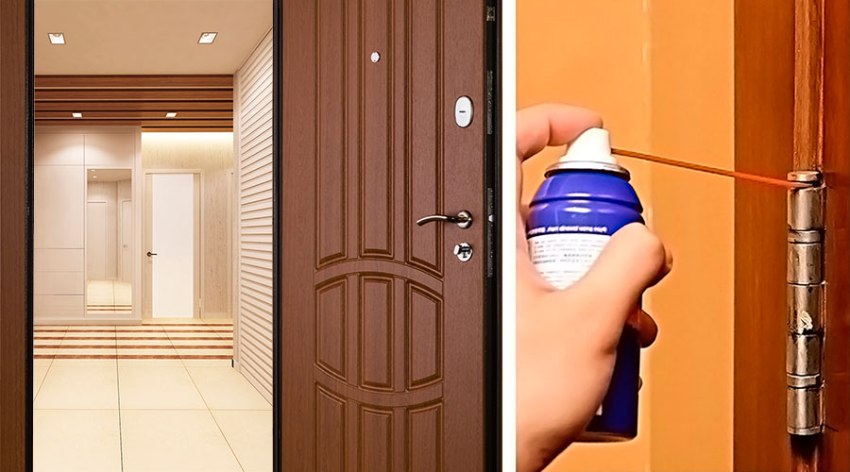




Causes of door creaking
Only in Eduard Khil's famous New Year's song at the time, the words about the icy ceiling and the creaky door could evoke positive emotions. In fact, the creaking of the door, especially intensely piercing, can lead to a stressful state. To prevent this from happening, you need to urgently take measures to eliminate the causes of the creak, and first of all, you need to establish the cause of its appearance.
Door creaking mainly appears for two reasons:
- due to friction of the door leaf when opening on the door frame or floor covering;
- due to corrosion that has occurred in the door hinges due to high humidity or insufficient lubrication.
In practice, there are cases when the sources of creaking are cracked panels of a wooden door or even poorly fixed glass, but such cases, of course, are extremely rare.
It is easier and faster to identify the cause of a creak when one person slowly opens or closes the door, while the second person at this time visually or aurally identifies its origin.
The friction of the door leaf against the frame or the floor, which causes a nasty creak, may be the result of an installation error (the hinges are incorrectly installed, the frame is poorly strengthened or incorrectly set and “plays” under the weight of the door leaf), loosening the fastening of the door canopies or their corrosion.
It is quite difficult to correct a mistake made during installation without being a specialist in this matter, since for this, in addition to certain skills, special tools (chisels, chisels) are also needed, which are not always profitable to purchase for performing one-time work, it is cheaper to invite a master for this.
The “sagging” of the door due to the loosening of the canopies can be easily eliminated on your own. Sometimes for this you just need to tighten the screws securing the canopies well. If this cannot be done, since the screw does not tighten, but simply scrolls, it is necessary to replace it with screws of a larger diameter or seal the holes with wooden pegs (you can use matches or toothpicks lubricated with PVA glue, which will allow even old screws to be tightened tightly).
If the door hinges are the source of the squeak, then they need to be well cleaned and lubricated. The removal of the door leaf (if the hinge design is removable) will greatly facilitate this work. It will simplify the procedure for removing the door using any lever (axe, mount, nail puller), the main thing is to ensure that so as not to damage the door leaf itself or the floor covering, if necessary, put a gasket. For personal safety, this work should preferably be done by two people. After that, it is necessary to carefully clean the steel pin and the hinge knuckle from scale and residues of hardened grease. To do this, it is better to use various kinds of solvents.Some designs of door hinges use steel balls and various kinds of spacers to improve their performance, so they need to be carefully inspected and, if their integrity is violated, replaced, if possible. After completing this preparatory work you can start directly to eliminate the cause of the squeak. And here the question often arises, how to lubricate the door so that it does not creak, so that you can not return to this procedure for as long as possible.
We fix the problem
Suppose you decide to bend the loop so that there is no spontaneous opening or closing. A year or two later, the creak began. In theory, you need to remove the door and coat the hinges with oil. The whole business is…
But before that, it is necessary to remove the casing, which prevents this from being done:
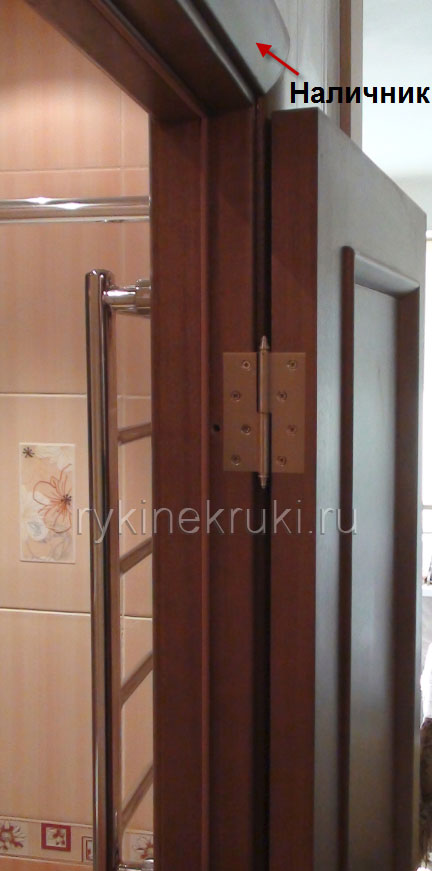

We remove the casing and begin to remove the door and ... and ... and ... it was not there! Not removed!
At the moment, you certainly do not remember the conversation with the master. You are simply bewildered, and you begin to pull the door with force. But in vain. Then you call a neighbor for help and pull it together - there is no result. Why?
And then you start to remember everything to the smallest detail. Aaaaaaaaaaaaaa! The master bent the loop, that's the point. He probably bent her a lot or bent her more than necessary!
Unfortunately, this is so. But the creak is one thing, and what has not yet been removed from the hinges is another:
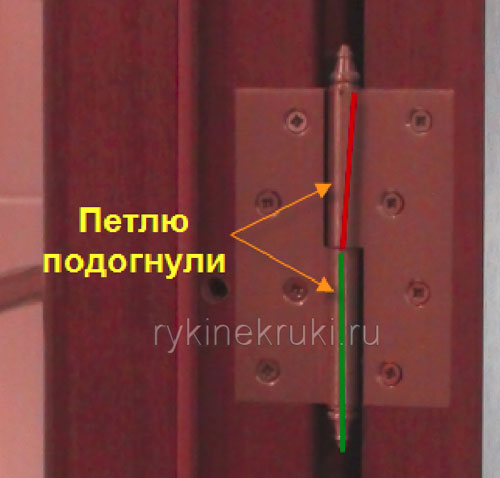
The loop was bent, but too much! Where is the guarantee that you will be bent normally? No guarantee. It is clear that such a technique used by the master will not have an effect in the 1st year of service (there will be enough lubricant in the loop). But then there will be problems.But by that time the guarantee for the installation of the door will have passed, because usually it is given for a year, and you will solve the problem with a creak at your own expense!


Nuance! Just do not try to take the armature (scrap) and try to pry it from the bottom of the door and push it up with force. There is a very high probability that you will peel off the veneer from below, but then the door will be damaged.
What to do, you ask, how to defeat the creak?
And there is nothing to do. Go to the store and buy exactly the same hinges. It is very unhealthy if the factory does not produce them already and you will not find similar ones. If the loops are found, then breathe a sigh of relief.
Next, call a neighbor. Let him hold the door, and you carefully, one by one, unscrew 8 screws from the top hinge and 8 screws from the bottom hinge. A neighbor is needed in order to hold the door. One will be difficult. If you remove one hinge and the door swings somehow unsuccessfully, then you will tear out the second hinge by the root, damaging the door or frame:
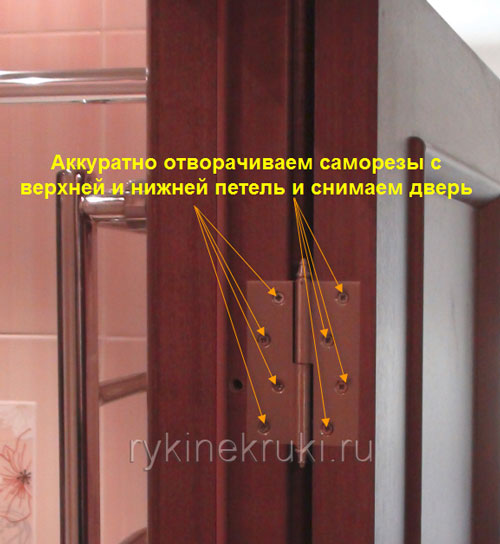
We take new loops and fasten. (The neighbor continues to help). It is clear that in this case it is not necessary to bend the loop). Otherwise, in a year or two you will get the same effect, you will again buy new loops, but you can’t twist and unscrew the self-tapping screws from the same places indefinitely - the strength of the fastening is broken.
There is only one summary - make even walls, according to the level! (see article: Putting the first plaster beacon). Otherwise, you will have to live with self-opening and self-closing doors all the time. And bend the hinges, be sure to hear that the door creaks.
Other factors
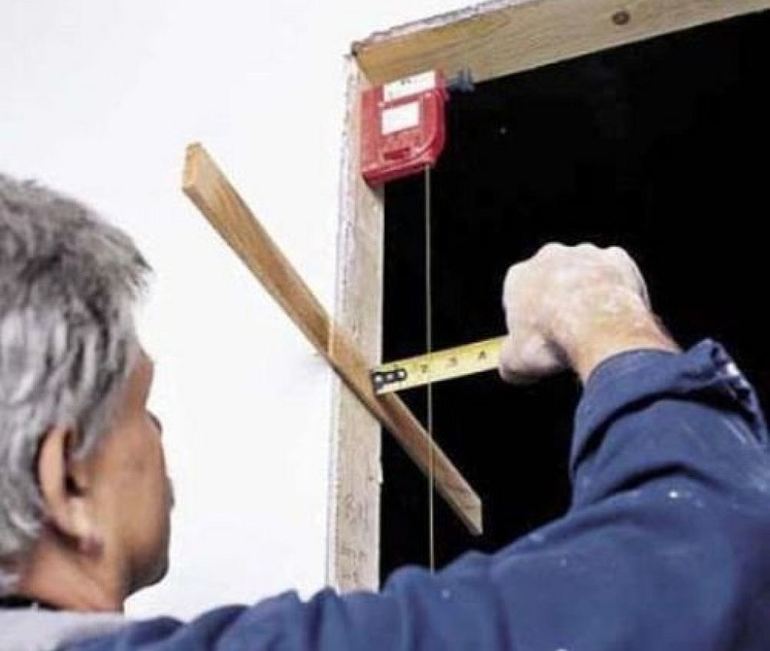
Sometimes a creak occurs as a result of the displacement of the walls. After the repair, the exposed doors will be clearly beaten off in level. After a certain time, if you apply a level to them, the bubble will move to either side.If the door was installed by specialists, most likely they could note such a problem, but as often happens during repairs, they try to quickly eliminate and forget the difficulties. But when the time comes, these problems begin to arise in different forms, including in the violin. In this case, you need to know what to do if interior doors creak.
When the question is that the door has shifted because of the wall in the apartment, then you can bend the loop. This will remove the effect of self-opening or closing, and for some period the creaking will stop. Over time, the hinges will fray and begin to creak anyway.
The most unpleasant situation is the occurrence of a creak due to a cracked door jamb. It is difficult to notice a defect, because it can appear anywhere. The first thing to do is try to find exactly where the problem is (usually a small crack). This place can be filled either with a not too thick oil (replaces the sealant), or with regular shampoo. This is a simple method, but, unfortunately, not always effective. If the desired effect is not achieved, it is necessary to turn to a more radical method - creating an additional fixation.
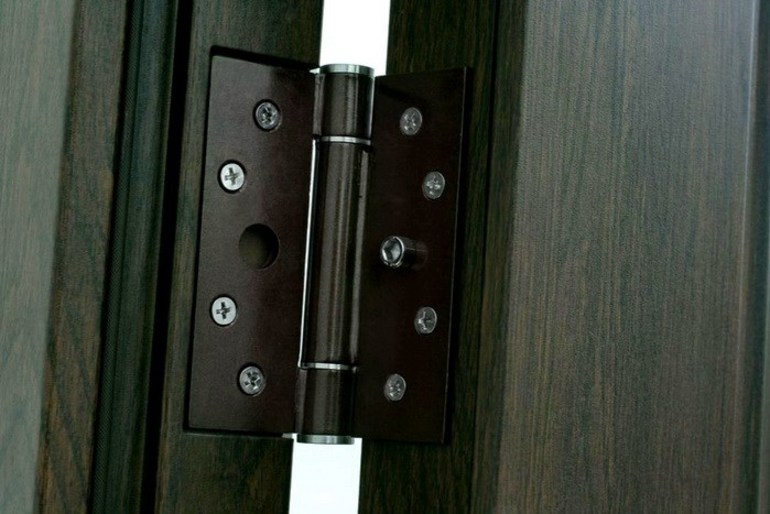
When a wooden door creaks, you must again determine the source. The reason may be increased humidity in the room, especially often this is observed during the off-season. By the way, it is at this time that wooden doors are prone to swelling, as they absorb excess moisture. Because of this, the canvas increases in volume. To get rid of creaking in such a situation, only minimizing moisture in housing will help.
Also, a creak develops with incorrect or weak fixation of the loops. They kind of start to "hang out".If you attach an ax or a mount under the door and lift the canvas a few centimeters, the hinges will unload, respectively, the creak will go away. Replacing fasteners, fixing screws or self-tapping screws with a large diameter will help solve the problem.
Reasons for the appearance of a creak
An unpleasant grinding is heard when the front doors are in operation, open or close. Sometimes a creak occurs when the canvas comes into contact with the floor surface or door frame. To more accurately determine where the creak comes from, move the flaps. There are four causes of creaking that professionals identify.
- Errors were made during the execution of the construction: hinges were attached incorrectly. This problem is solved by rearranging the loops. But it is better not to undertake this work on your own, since the functioning of the valves in the future depends on its results.
- The facing material of the web is in contact with the hinges. To remove the creak, the lining is carefully removed and adjusted to the desired dimensions.
- There are no balls in the design of the loops. To correct the situation, the hinges are removed from the door leaf and the missing elements are placed - special balls.
- There is not enough lubrication, or the selected lubricant is not suitable for the properties.
How to lubricate door hinges so that they do not creak?
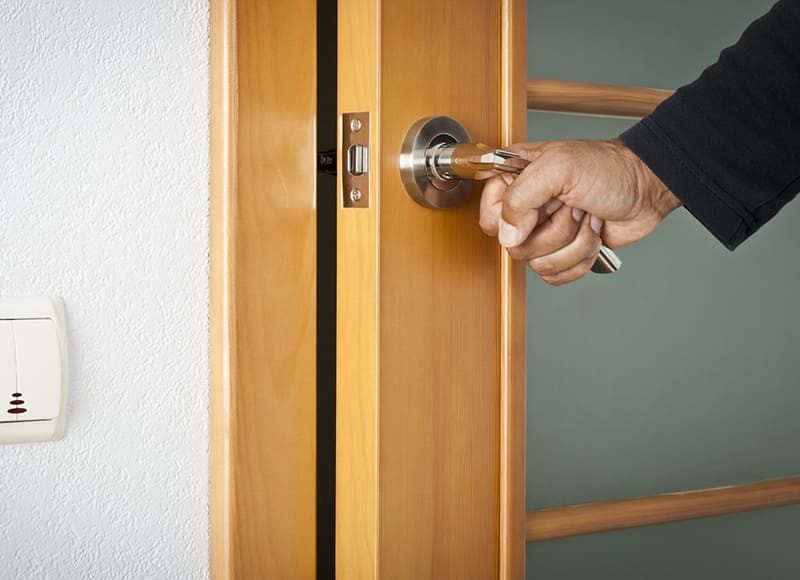
Everyone knows how annoying the sound of a creaking door can be. It creates inconvenience to the household both day and night. How to get rid of creaking door hinges? It turns out that this is not difficult to do if you follow simple tips.


Why do doors start to creak?
Lubricant dried up in the hinges. After some time, the door grease thickens and dries
From this moment, a slight creaking begins, which is important to notice in time. Without enough lubrication, parts begin to wear out and break.
Doors are skewed
It happens that the door is installed unevenly. And no matter how much the loops do not lubricate - anyway, after a few days they begin to creak. In this case, the door should be reinstalled so as not to damage the fittings.
Dust got in. Debris that gets into the hinges absorbs almost all the grease and leads to a squeak. Before “oiling” the hinges, you need to clean them.
Rust has appeared. Due to the high humidity, the metal is subject to corrosion, which quickly damages the parts. It is easier to prevent rust with the help of special tools than to spend money on replacing fittings.
The hinges are worn out. Every part has its own lifespan. Mechanisms inevitably “age”, becoming unusable. This is where lubrication helps. The hinges will still need to be replaced.
Means for lubricating door hinges
Let's start with special tools that provide reliable lubrication and metal care. Here are some of the most popular:
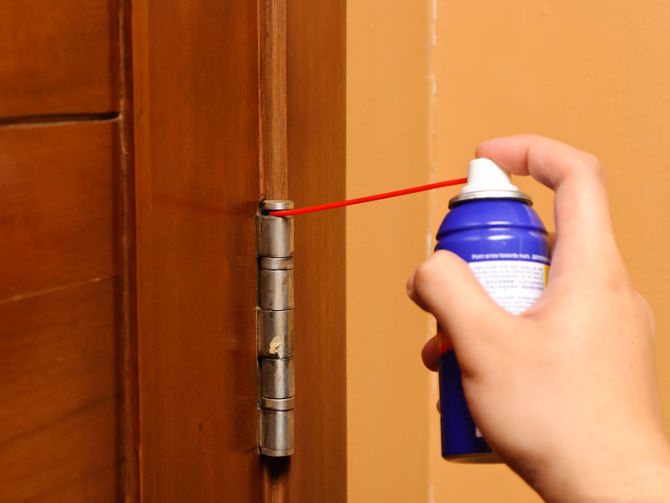
- WD 40 is the leading product for door hinges. Thanks to its composition, it improves glide, prevents rust and fights rust that has already formed.
- Litol is indispensable for street doors and gates. This tool not only lubricates the hinges, but also creates a waterproof and frost-resistant layer.
- Ciatim is a universal thick oil product developed in the last century. It is used in a variety of mechanisms to prevent friction. It also has frost-resistant properties.
- Solidol is a tool on everyone's lips. They lubricate a variety of parts - from door hinges, but also car hinges.
It happens that the above lubricants are not at hand, and the door creak is already unbearably on the nerves.
It is even more unpleasant if the creaking begins to produce hinges installed on the inter-room doors in bedroom or nursery room. Such a sound can easily wake up a child or even an adult.
Improvised tools will come to the rescue:
- Vegetable oil. Everyone has this item at home. It cannot be guaranteed that you will get rid of the squeak of the loops for a long time, but it is quite possible to apply it until you purchase a special solution.
- Waste engine oil. According to the reviews of those who have tried this tool, it serves as a lubricant for loops longer than the previous one. The only downside is the smell.
- Sewing machine oil. Many housewives know that this tool is great for processing door hinges.
- Petrolatum. It does not last long, but thanks to its properties, it perfectly performs the necessary function.
- Pencil lead or plain soap. It is necessary to make chips and process the hinges by closing and opening the door several times.
How to lubricate door hinges?
This question worries everyone who first encountered the problem of a door creak. There are several basic steps:
- Clean the hinges of dirt. To do this, you can use an old toothbrush or a hard-bristled brush.
- Prepare a lubricant and a tool - a special oiler (thin tube) or a syringe. You can also use cotton buds, soft brushes, makeup sponges and cloth.
- Determine the places of corrosion - processing must begin with them.
- Lubricate the hinges with the selected agent, and wipe off the excess with a napkin.
Helpful Hints:
- You can also lubricate unassembled hinges without removing the door.In this case, give more time to the process so that the product is better saturated.
- The wider the door is opened, the better it will be possible to process the hinges. Just make sure to secure the position first so as not to hurt your fingers.
- Apply more oil to the upper part of the door hinges, because most often this part wears out earlier.
If you follow the tips, you can quickly and easily get rid of the annoying squeak. Take good care of your door hinges and they will serve you for years to come!
Hinge lubrication
Loops are the main source of unpleasant sound. Over time, the lubricant is developed, metal parts begin to rub against each other and creak.

One of the main causes of unpleasant sound is not lubricated hinges.
Special tools or any homemade oil formulations will help to fix the problem:
- WD-40;
- "Litol";
- "Ciatim";
- synthetic lubricant;
- grease;
- vegetable oil;
- shavings from a slate pencil;
- petrolatum.
For spot application of the composition, you will need a syringe, pipette or a special oiler:
- Open the sash to its maximum width.
- Clean the accessories from dust and dirt. Use a slightly damp cloth, toothbrush.
- Apply lubricant to all moving parts.
Important! Dry the hinges thoroughly if water gets into them before greasing.



