- Air solar collector: design scheme device
- Responsible assembly stage
- Air manifold
- Temperature classification
- Types of solar water heaters and their characteristics
- By type of circulation
- By collector type
- By type of circulation circuit
- coolant
- Absorber, the most important part of the system
- By building type
- Is it possible to use a solar collector in winter
- How to make a solar water heater with your own hands
- Do-it-yourself tools and materials for a water heater
- Manufacturing process of solar water heater
- Solar energy is an alternative source of heat
- Prices for factory appliances
- Advantages and disadvantages
- How does it work in winter?
- How does a solar collector work?
- How does a solar collector work?
- The device and principle of operation of an air solar collector
- How the collector works - it's simple
- The difference between solar panels and collectors
- How to make a solar collector with your own hands
- Solar collector design
- Making a device from corrugated board
- Additional operating costs
Air solar collector: design scheme device
In order to make an air solar collector from the means that are in any household, you need a little.
You will need:
- Wooden boards, bars, plywood;
- Self-tapping screws, nails or other fasteners;
- Iron cans for drinks;
- Black paint;
- Glass.
First of all, you need to prepare a wooden box of the required dimensions (length x width). The depth of the box should be slightly larger than the diameter of the cans planned for use. The walls of the box can be fastened with self-tapping screws or any suitable fasteners. Then, at the top and bottom of the box, retreating 10-15 centimeters from the upper and lower walls, you need to install shelves, along the entire length of which drill holes for cans equal to their diameter.
It is necessary to cut holes in the cans, cutting off the neck and bottom, thus obtaining a through pipe that looks like a small air duct. You need to connect the cans by inserting the second can into the empty bottom of the first can, the next one into it, and so on for the entire length of the box. Then insert the resulting pipe from the cans into the box through the holes drilled for this. Thus, it is necessary to fill the entire box with cans, not counting the space between the upper wall and the upper shelf into which the cans are attached, and the space between the lower shelf and the lower wall.
The junctions of the upper and lower shelves with the cans must be fastened with self-tapping screws by drilling the shelf along with the wall of the can. Air from the room will enter the space between the upper wall of the box and the upper shelf, for which it is necessary to provide holes, preferably a couple. Passing through the cans and heating up, the air will enter a similar space between the bottom shelf and the wall, from where it will enter the room through the holes, here it will be necessary to provide a fan. Thus, a full-fledged process of air circulation and heating should take place.
The box itself and the installed cans need to be degreased and painted with black matte paint (you can use the cheapest one) to create the impression of a single structure and increase the heating rate.
Responsible assembly stage
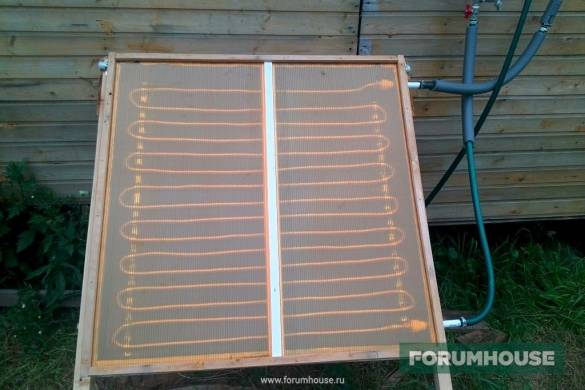
The final step is to assemble the case, which will fasten all the components of the device into a single structure. Using a sheet of plywood and wooden blocks, you need to knock down a strong box. In the used wooden bars, cut grooves in advance, then you will insert a polycarbonate screen into them (groove depth is about 0.5 cm). Tube outlets can be made after all major components have been installed. Next, in the already assembled wooden box, to create an air pocket, you lay mineral wool insulation. Mount a panel with a coil over the mineral wool. Tuck the edges of the cotton wool so that the coil does not touch the walls of the box. The heating panel and the polycarbonate panel must also have a distance between them and not touch each other.
The final stage consists in treating the body with a special water-repellent solution and enameling (except for the front part).
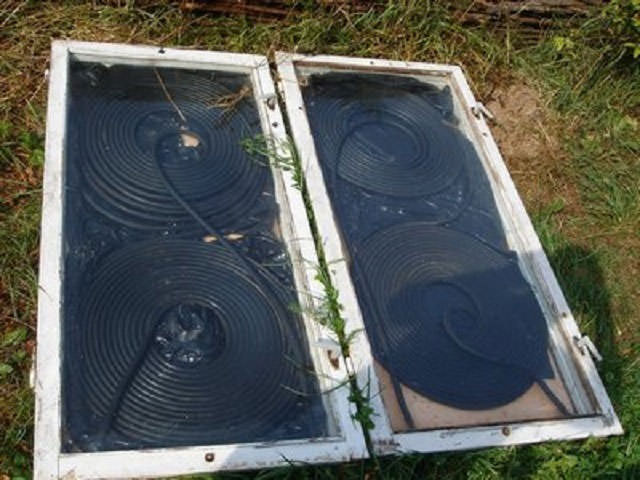
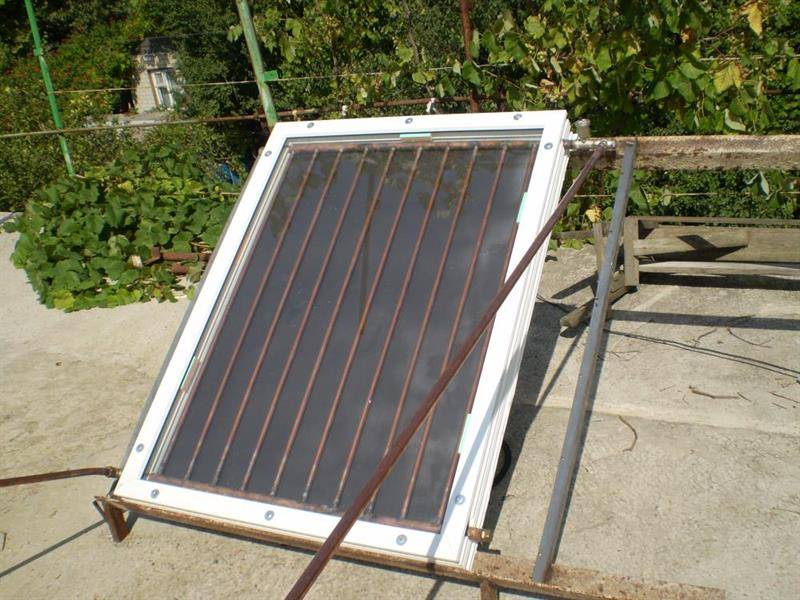
Solar collector from old frames
That's all, the do-it-yourself solar collector is ready. In order to activate it, place it on a support structure, turning its front part towards the sun so that the rays fall on the front part at the most right angle. On the roof, install a tank for the accumulation of water, it will serve as a reservoir. To the top of the tank, run a hose connected to the top tube of the manifold, to the bottom of the bottom tube. By connecting water according to this scheme, you will ensure operation in natural circulation mode.According to the laws of physics, hot water will rise up towards the tank, and the cold water that is displaced will enter the collector for heating in the coil. Do not forget that it is necessary to attach a hose and a valve to the tank to draw water from the tank, as well as to fill it with a new one.
Air manifold
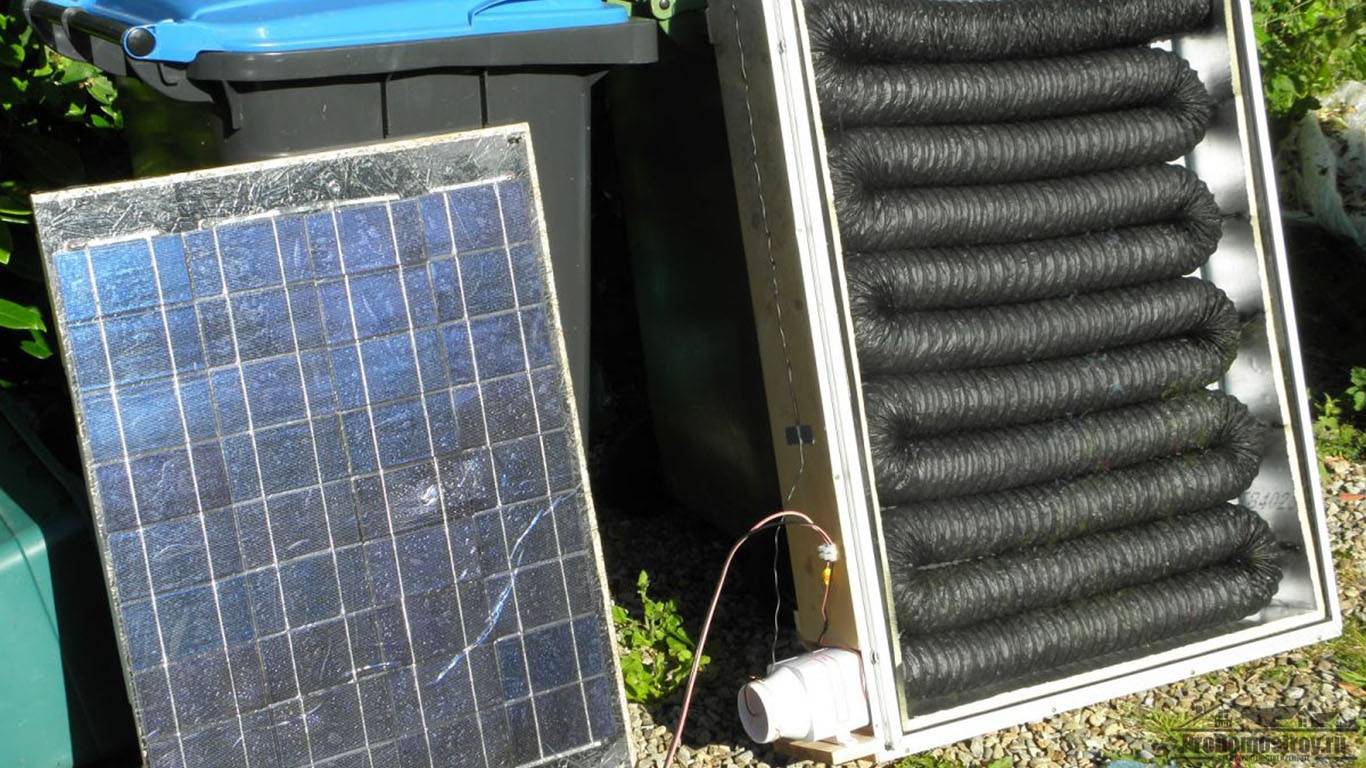
The air collector is one of the most successful developments. But air-type solar panels are very rare. Such devices are not suitable for home heating or hot water supply. They are used for air conditioning. The heat carrier is oxygen, which is heated under the influence of solar energy. Solar panels of this type are identified with a ribbed steel panel painted in a dark shade. The principle of operation of this device is a natural or automatic supply of oxygen to private homes. Oxygen with the help of solar radiation warms up under the panel, thus creating air conditioning.
It is allowed to install an air collector in private houses, commercial premises.
Temperature classification
Solar equipment for the home is often classified according to the type of coolant. Today in the world market you can find liquid and air systems. In addition, the collectors are divided according to the temperature regime of operation, that is, the classification is applied according to the maximum heating temperature of the working elements. There are the following types of systems:
- low-temperature — the heat carrier for solar collectors is heated up to 50℃;
- medium temperature - the temperature of the circulating liquid does not exceed 80℃;
- high-temperature - the maximum temperature of the heat-transfer material can rise up to 300 degrees.
The first two options are most suitable for home use, while high-temperature collector models are more often used in the manufacturing and industrial sectors of the economy. This is due to the fact that in high-temperature water heating systems, the process of transforming solar energy into heat is quite complicated. At the same time, such solar installations occupy large areas. Not every owner of "dacha" real estate can afford such a luxury.
Types of solar water heaters and their characteristics
Solar water heaters are a set of equipment for heating water using solar energy. Another name for these devices is solar collectors. Unlike photovoltaic panels that use sunlight to produce electricity, solar heaters immediately receive thermal energy, which they transfer to a coolant (water, antifreeze, etc.).
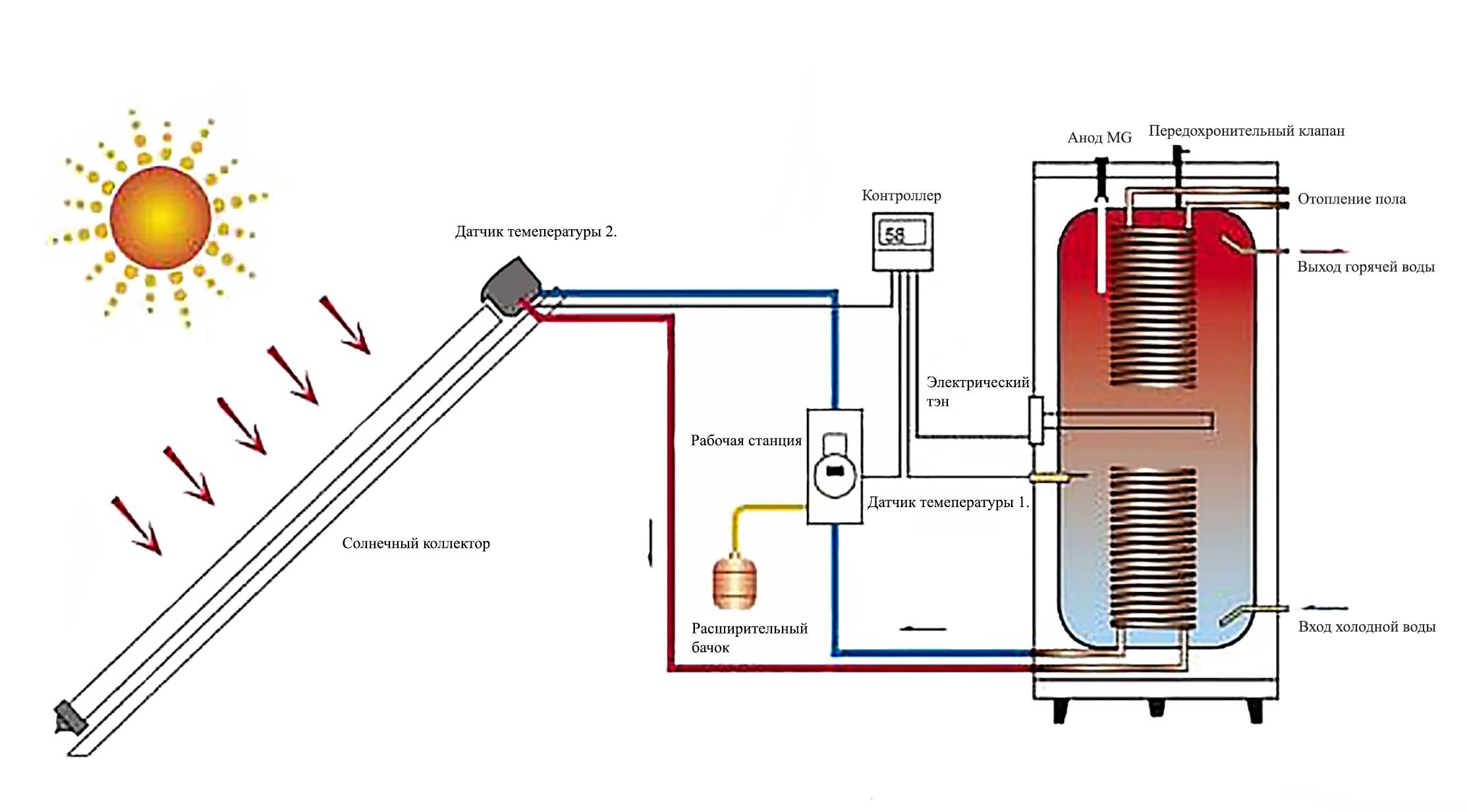
They form a whole system consisting of the following elements:
- Collector. A panel that receives thermal energy and transfers it to the coolant.
- Storage tank. A container in which heated water is accumulated and the cooled coolant is replaced by a freshly heated flow.
- Heating circuit. Conventional radiator system or underfloor heating, realizing the energy of the coolant. In some types of system, the heating circuit is not included in the volume of the collector system, receiving energy in the storage tank, which in this case is a heat exchanger.
By type of circulation
The circulation of the coolant allows you to receive thermal energy in return for the energy released into the internal atmosphere of the house. There are two types:
- Natural. The movement of heated liquid layers upwards with their replacement by colder layers is used. It does not require any devices or the use of electricity, but depends on many factors - the relative position of the collector, storage and other elements of the system, temperature, etc. Fluid movement is unstable, able to increase and decrease.
- Forced. The flows are directed by a circulation pump. There is a stable mode with a constant flow rate, which allows you to provide a stable mode of heating the house.
By collector type
There are designs of collectors with different efficiency, capabilities and method of heat transfer. Among them:
- Open. Flat long trays or gutters made of black plastic in which water circulates. The efficiency of open collectors is very low, but simplicity and cheapness contribute to their popularity. Used to heat water for an outdoor shower or pool.
- Tubular (thermosiphon). The main element is a coaxial tube with a vacuum layer between the outer layers, which reliably insulates the contents of the tubes. The design is efficient, but expensive and beyond repair.
- Flat. These are closed containers with a transparent top panel. The inner surface is covered with a layer of thermal energy receiver, which transfers it to water, which moves inside the tubes soldered to the receiver. A simple and effective design, in which, for greater effect, a vacuum is sometimes created for thermal insulation.
By type of circulation circuit
- Open - used to provide hot water to a residential area. The heat carrier in this case is water, which is used for various household needs and, accordingly, it no longer enters the circuit.
- Single circuit system - used for home heating. The coolant heated in this way is used as an additive to the coolant heated by the traditional method. In this case, the heated coolant passes into the heating system, after which it is again transferred to the receiving tank and to the collector.
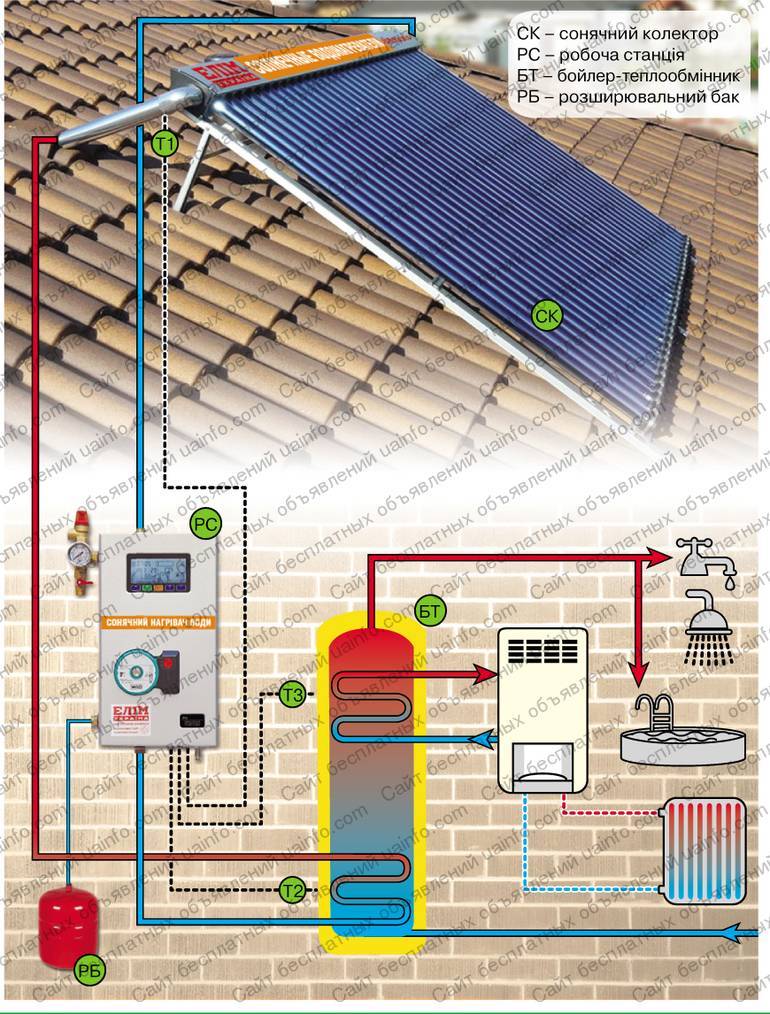
- The double-circuit heating system is the most versatile. It is possible to use it for heating in winter or for water supply.
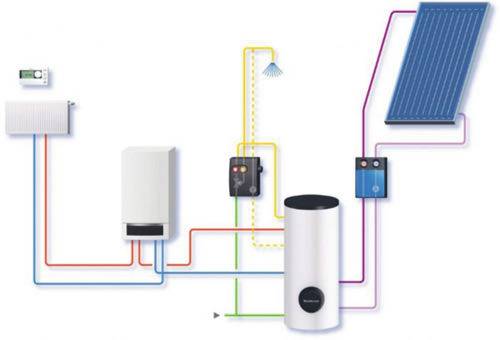
Double-circuit water supply and heating system
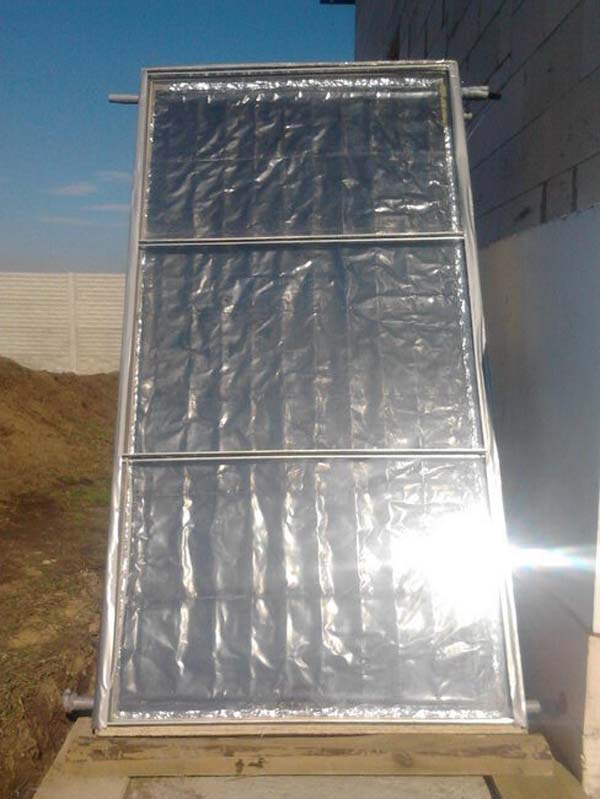
You can also choose one of the possible coolants - water, oil or antifreeze. After the collector, the coolant passes through a heat exchanger, in which heat is transferred to the second circuit. The second coolant used is already used for its intended purpose - for heating or water supply.
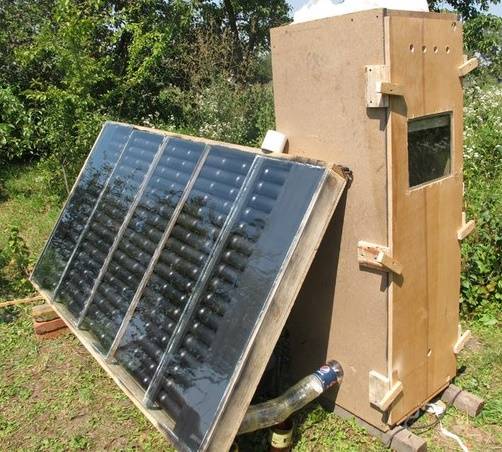


coolant
For such water heaters, various coolants are used: antifreeze, lubricating fluid and water.
Application
Solar systems are gradually gaining popularity. With their help, they solve many problems:
- Heating the liquid to the required temperature.
- Improving the performance of the heating system.
- Water heater for the pool, for a summer shower.
- Heating of liquid for other needs.
Absorber, the most important part of the system
The part of the solar collector that receives, accumulates and transfers heat to the coolant is called the absorber.It is from this element that the efficiency of the entire system depends.
This element is made of copper, aluminum or glass, followed by a coating. The effectiveness of the absorber depends more on the coating than on the material from which it is made. Below, in the photo, you can see what coatings are available and how effectively they can absorb heat.
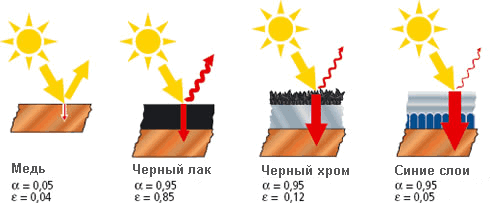
The description of the system indicates the maximum possible absorption of solar energy falling on the absorber. "α" is the maximum possible absorption percentage. "ε" is the percentage of reflected heat.
By building type
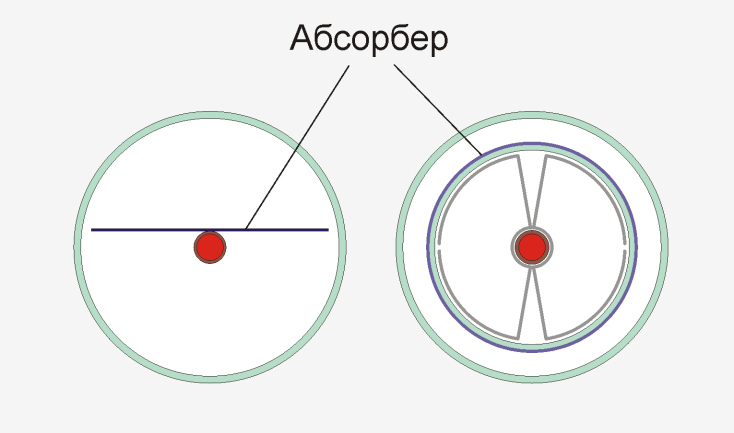 Absorbers also differ in the type of device, now there are only two types:
Feather - arranged as follows. The plates connect the tubes with the coolant to each other. The tubes themselves can be interconnected into one system in several ways. This is a simple type of absorber that you can make yourself.
Cylindrical - in this case, the coating is applied to the glass surface of the flask and used in vacuum collectors. Thanks to this device, heat is concentrated more just in the center of the tube where the heat remover, or rod, is located. This system works with a higher efficiency than a pen system.
Is it possible to use a solar collector in winter
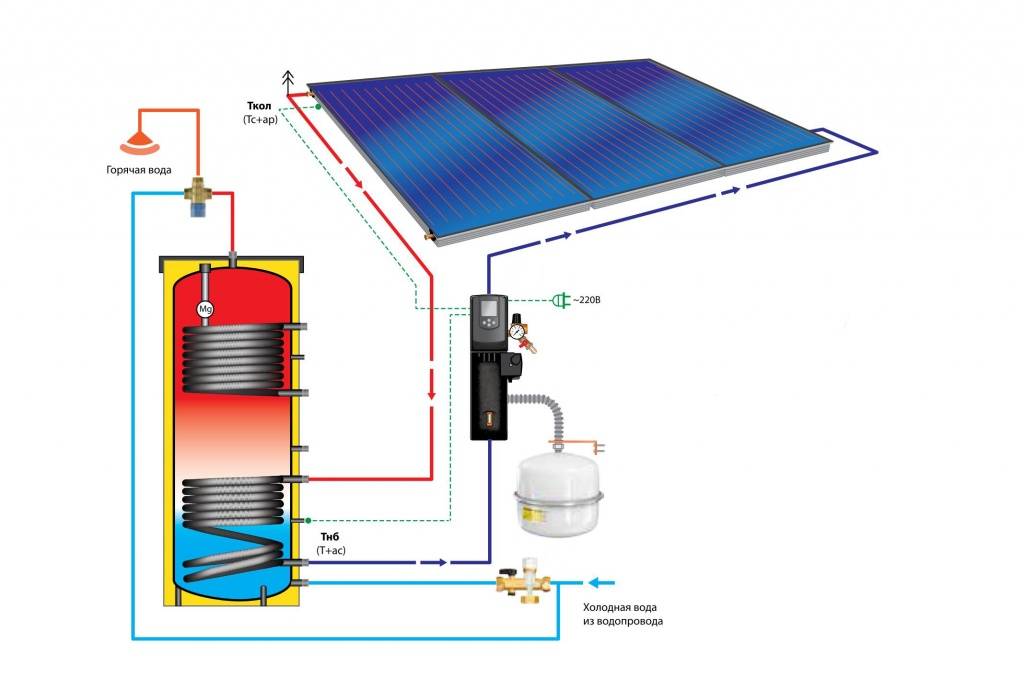
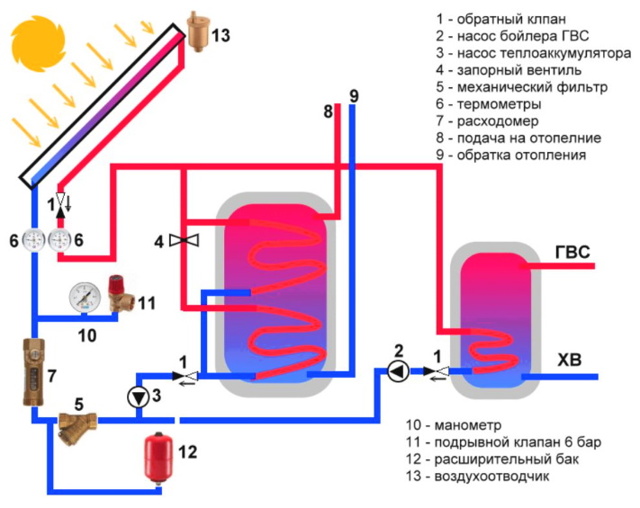
For year-round use of the device, you need to learn more about how the solar collector works in winter. The main difference is the coolant. Since water can freeze in the circuit pipes, it must be replaced with antifreeze. The principle of indirect heating works with the installation of an additional boiler. Next, the diagram is:
- After the antifreeze heats up, it will flow from the battery located outside into the coil of the water tank and heat it up.
- Then warm water will be supplied to the system, cooled back.
- Be sure to install a pressure sensor (pressure gauge), an air vent, an expansion valve to relieve excess pressure.
- As in the summer version, to improve circulation, it is necessary to provide for the presence of a circulation pump.
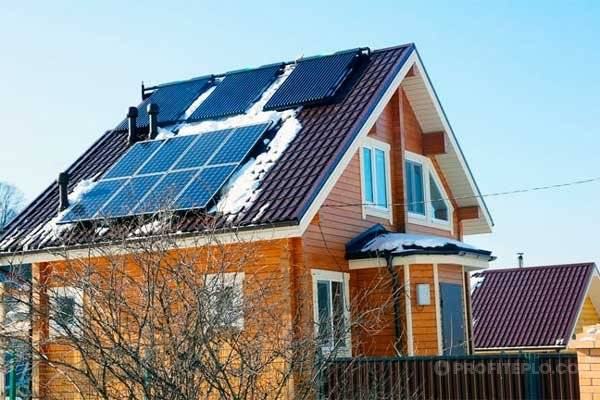 Solar collector on the roof of the house in winter
How to make a solar water heater with your own hands
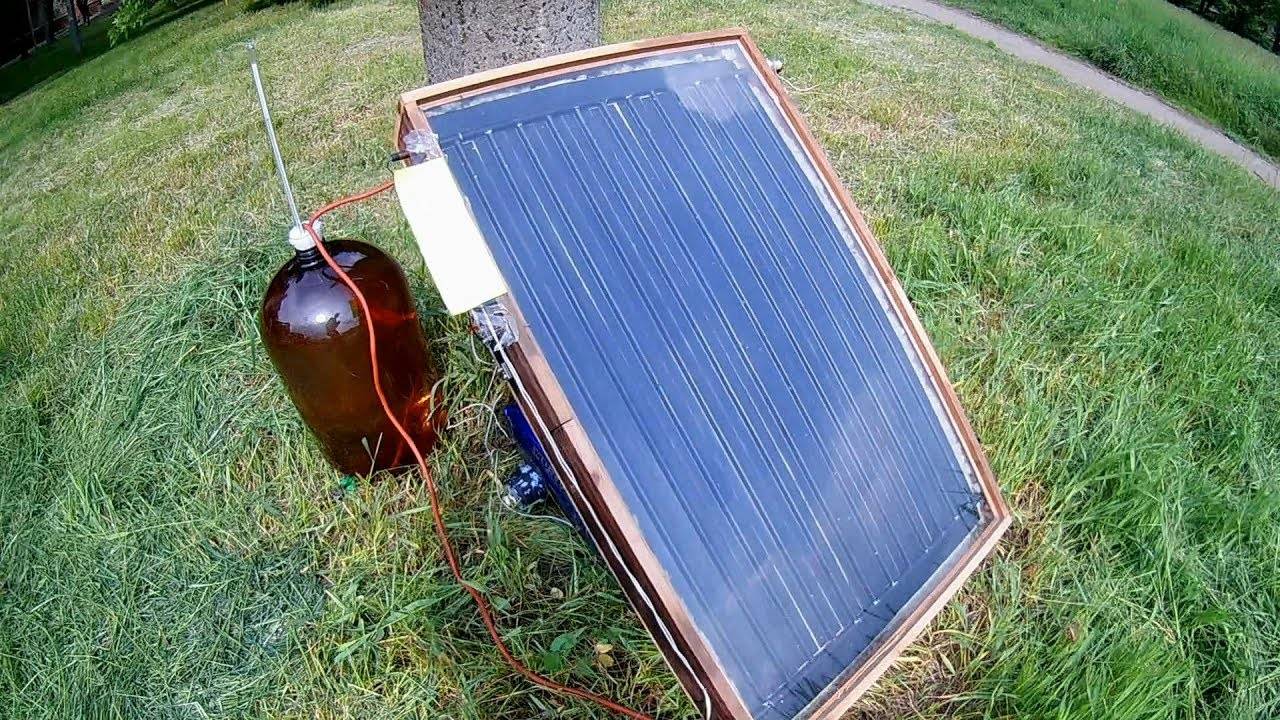
The device is a tubular radiator, with a diameter of 1 inch, placed in a wooden box. The structure can be thermally insulated with foam. With the help of a galvanized iron sheet, it is necessary to additionally insulate the bottom of the device. Be sure to paint the materials black to speed up the heating process, with the exception of the glass cover, which is painted white.
As a container for water, you can use a large iron barrel, which is placed in a box made of wood or plywood. The empty space must be filled. For this, sawdust, sand, expanded clay, etc. are suitable.
Do-it-yourself tools and materials for a water heater
To construct a solar water heater, the following materials and tools are required:
- glass with a frame;
- construction cardboard under the bottom;
- wood or plywood for a box under a barrel;
- coupling;
- filler for empty space (sand, sawdust, etc.);
- iron corners of the lining;
- pipe for the radiator;
- fasteners (for example, clamps);
- galvanized iron sheet;
- iron tank with a large volume (300 liters is enough);
- paint black, white and silver plated;
- wooden bars.
Manufacturing process of solar water heater
The process of making a solar collector with your own hands is not only exciting, but also brings a lot of benefits. The created device will make it possible to rationally use solar radiation to solve various economic problems. The specifics of creating a collector in stages is as follows:
- First you need to make a box for the tank, which needs to be strengthened with bars.
- A heat-insulating material is applied from below, on top of which a metal sheet is installed.
- A radiator is placed on top, which must be properly fixed with prepared fasteners.
- The smallest cracks in the body of the structure must be smeared and sealed.
- Pipes and metal sheet must be painted black.
- The barrel and box are painted silver and after drying, the tank is installed in a wooden structure.
- Empty space is filled with prepared filler.
- To ensure constant pressure, you can purchase an aqua chamber with a float, which is installed in the water storage tank.
- The design should be placed in sunny space at an angle to the horizon.
- Further, the system is interconnected by pipes (their number and material depends on the size and type of the project).
- To avoid the formation of air locks, you need to start filling from the bottom of the radiator.
- According to such a system, heated water moves upward, thereby displacing cold water, which subsequently enters the radiator and heats up.
If everything is calculated correctly, after a while warm water will come out of the outlet pipe. Do not forget that sunny weather is a prerequisite. So, the temperature inside the water heater system can be around 70 degrees.The difference between the water temperature at the inlet and outlet will be 10-15 degrees. At night, it is recommended to block the access of water, in order to avoid heat loss.
The performance of such a device is significantly inferior to store heaters. The efficiency of a home-made device will be much lower, but if there is no need to purchase such an expensive system, you can do everything yourself.
Solar energy is an alternative source of heat
The idea of using solar energy for heating is not new. Moreover, the expediency of its use has been proven by the Americans, the Chinese, the Spaniards, the Israelis and the Japanese.
The market is replete with offers of various installations for converting solar energy and its further use for household needs.
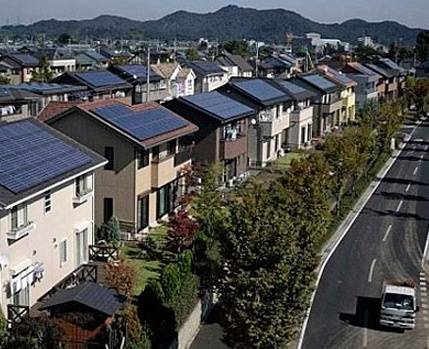
Solar systems are actively used as the main source of heat in many countries of the world. In our latitudes, it is still used as an addition to the heating system.
The cost of systems depends on their type, area, material used in the manufacture. From year to year, there is a steady downward trend in prices for all types of solar installations - solar systems.



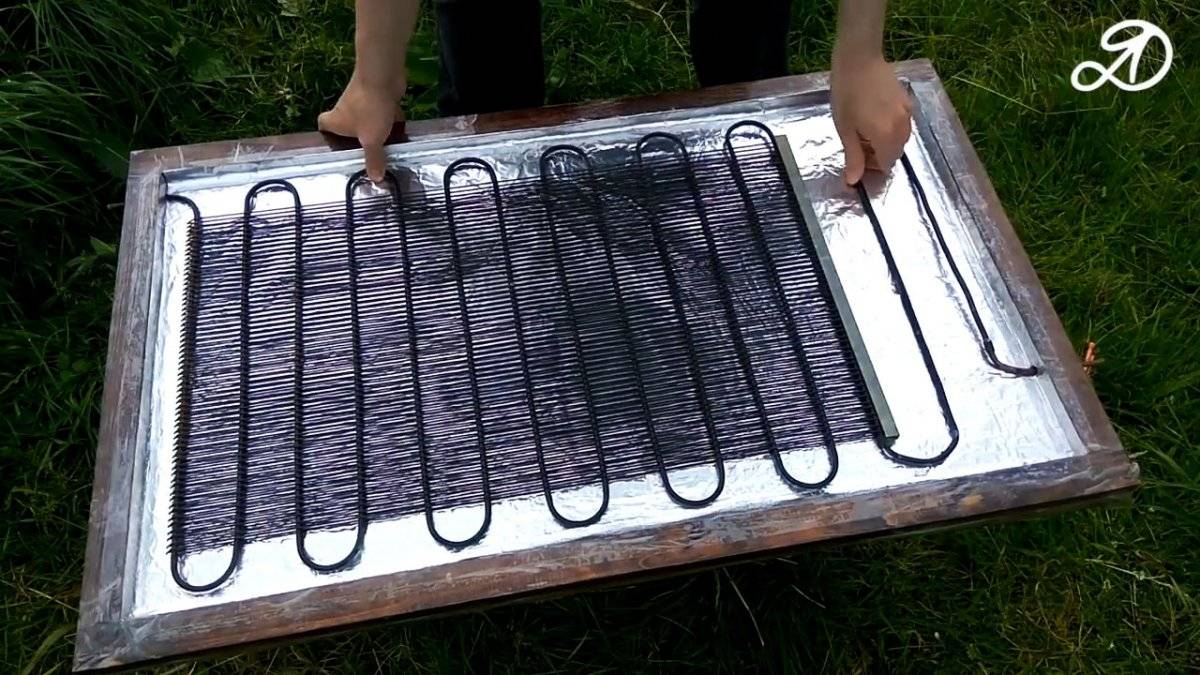


This makes them more accessible to the general population. That's just not everyone is ready to make such a purchase.
But, if desired, you can build an efficient solar heating system with your own hands, spending significantly less money.
A familiar heating system that has performed its functions perfectly for many years is becoming more and more expensive. The reason for this is the global rise in the price of energy resources around the world. The natural desire that arises from the owner is to save on heating, which eats up a significant share of the family budget.
So the solar heating system can fully replace the usual solid fuel, gas or any other. It all depends on the type and size of the room in which it will be used.
An option suitable for a granary is not suitable for a residential building, and a system that meets the needs of a summer residence cannot cope with the heating of a 2-story mansion.
Complete replacement of traditional heating with solar heating is sometimes problematic. The owner is afraid that the system may not be able to cope or there is not enough space to install the required number of panels.
Therefore, a combined heating system is often used, without completely abandoning the installed gas (electric or other) equipment. The level of replacement of conventional heating with solar heating can reach 90%.
Also, the annual number of sunny days of the area in which the dwelling is located is important. Moreover, the average daily temperature is not so important.
Many installations effectively absorb light on frosty winter days (solar collectors using antifreeze as a coolant).
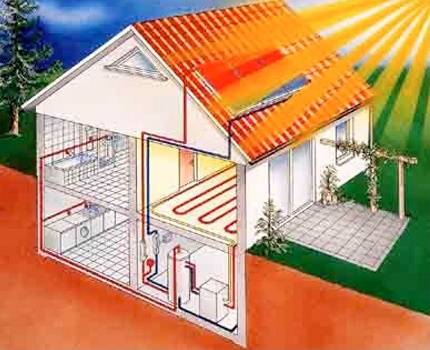
In addition to heating, a solar installation is able to provide a home with warm water and electricity.
Prices for factory appliances
The lion's share of the financial costs for the construction of such a system falls on the manufacture of collectors. This is not surprising, even in industrial samples of solar systems, about 60% of the cost falls on this structural element. Financial costs will depend on the choice of a particular material.
It should be noted that such a system is not able to heat the room, it will only help save on costs by helping to heat the water in the heating system. Given the rather high energy costs that are spent on heating water, a solar collector integrated into the heating system significantly reduces such costs.
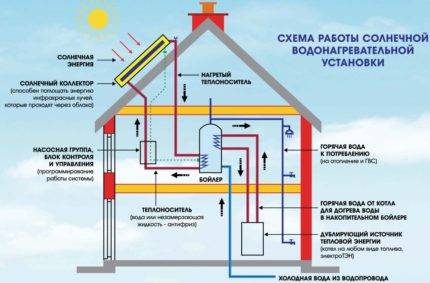 The solar collector is quite simply integrated into the heating and hot water supply system (+)
For its manufacture, fairly simple and affordable materials are used. In addition, this design is completely non-volatile and does not require maintenance. Maintenance of the system is reduced to periodic inspection and cleaning of the collector glass from contamination.
Advantages and disadvantages
All types of installations have their positive and negative characteristics. For solar collectors, too, there are indicators.
Pros:
- Solar heating system saves energy for hot water.
- Part of the heating costs in winter can be reduced by using solar radiation.
Minuses:
- It will require the manufacture of a completely new heat supply system, which must be installed in traditional heating installations and hot water devices.
- Solar systems cannot guarantee peak frosts. Here you will need to use devices that burn fuel or electrical installations for space heating.
How does it work in winter?
In heating systems, as a rule, vacuum collectors are used, this is determined by their technical characteristics and operating conditions.
The main element of the vacuum solar collector is a vacuum tube, which consists of:
- An insulating tube made of glass or other material that transmits the sun's rays with minimal loss of their power;
- Copper, heat pipe placed in the interior of the insulating tube;
- Aluminum foil and absorbent layer located between the tubes;
- The cover of the insulating tube, which is a sealing gasket that provides vacuum in the internal space of the device.
The system works as follows:
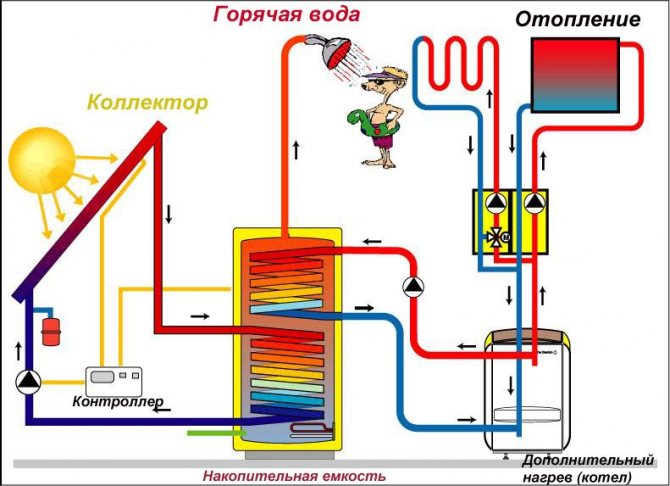
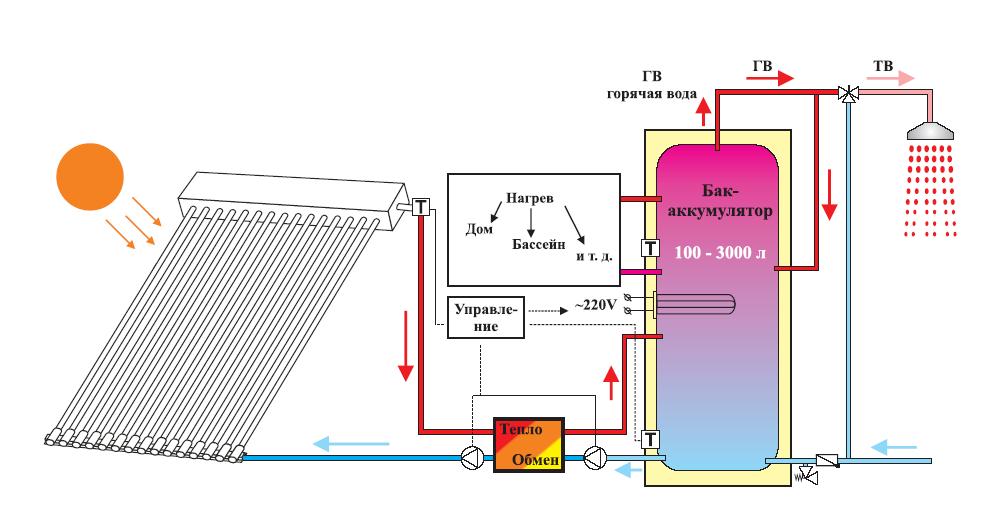
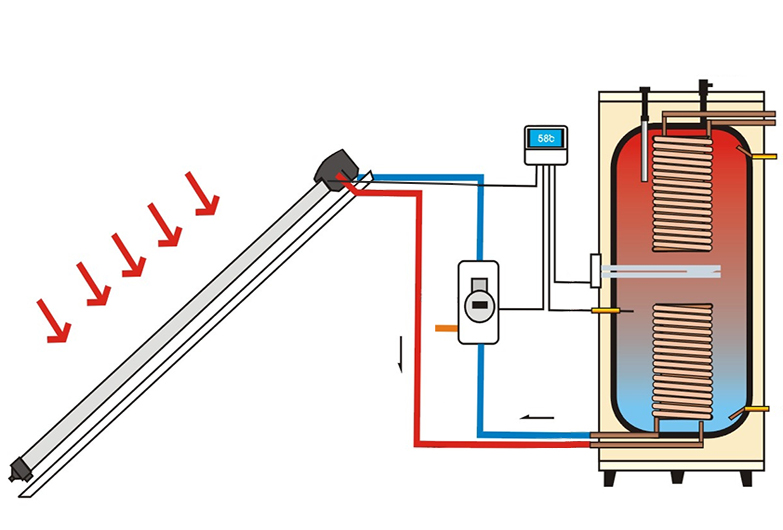
- Under the influence of solar energy, the heat carrier of the tube circuit evaporates and rises, where it condenses in the collector heat exchanger, transfers its heat to the coolant of the external circuit, and then flows down, and the process is repeated.
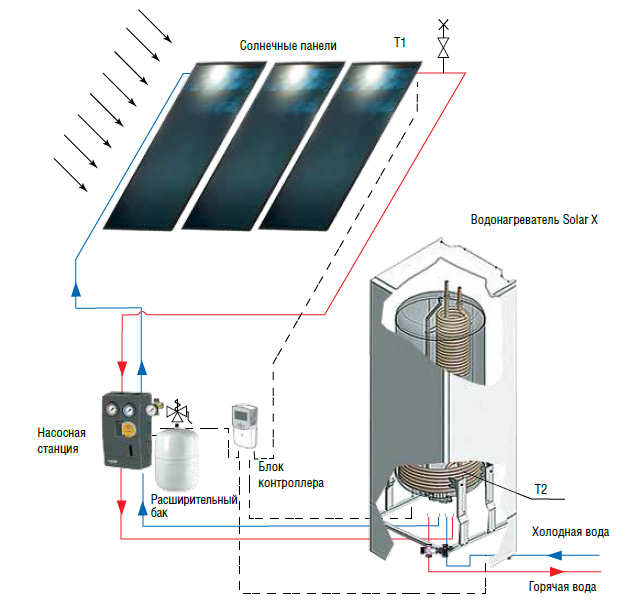
- The heat carrier of the external circuit, from the heat exchanger of the solar collector, is fed to the storage tank, where the received thermal energy is transferred to the heat carrier of the heating and hot water supply system.
- The circulation of the coolant of the external circuit is carried out by installing a circulation pump and automation systems that ensure the operation of the system in automatic mode.
- The automation system complex includes a controller, sensors and controls that provide the established parameters of the system operation (temperature, fluid flow in the DHW system, etc.)
In order for this system to be efficient and cope with the tasks set, including during the winter period, the system provides for the installation of redundant energy sources.This may be an additional heating system using a heat carrier, as in the above diagram, when the heat carrier of the additional circuit is heated by using various types of fuel (gas, biofuel, electricity). Also, a similar task can be performed by installing electric heating elements directly into the storage tank. The operation of backup energy sources is controlled by the automation system, including these devices in operation, as necessary.
How does a solar collector work?
The principle of operation of the collector is based on the absorption (absorption) of the thermal energy of the sun by a special receiving device and its transfer with minimal losses to the coolant. Copper or glass tubes painted black are used as receivers.
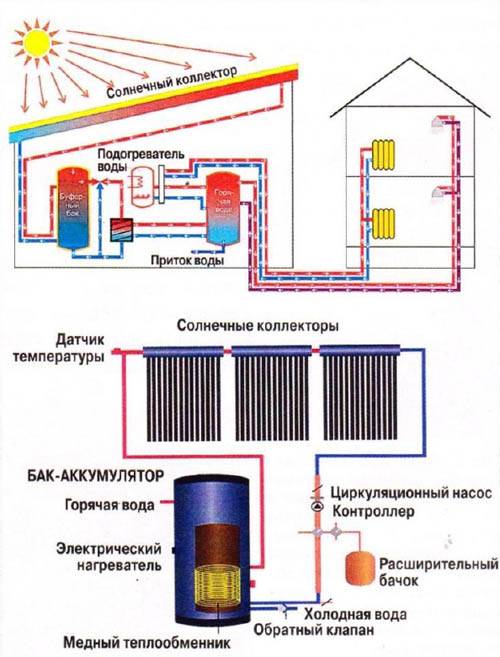


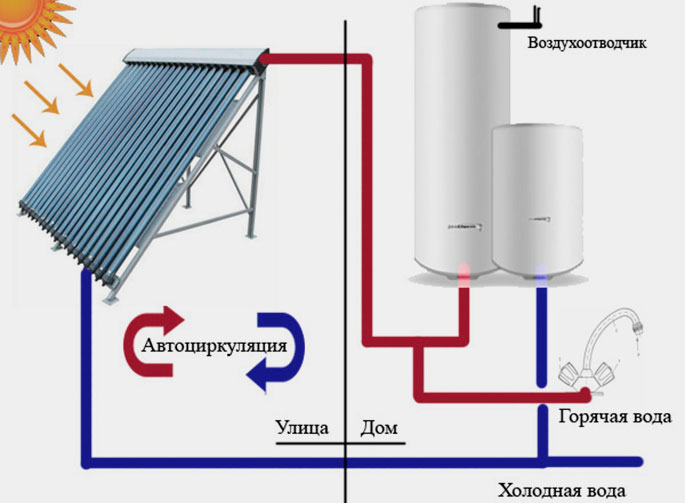

After all, it is known that objects that have a dark or black color are best absorbed by heat. The coolant is most often water, sometimes air. By design, solar collectors for home heating and hot water supply are of the following types:
- air;
- water flat;
- water vacuum.
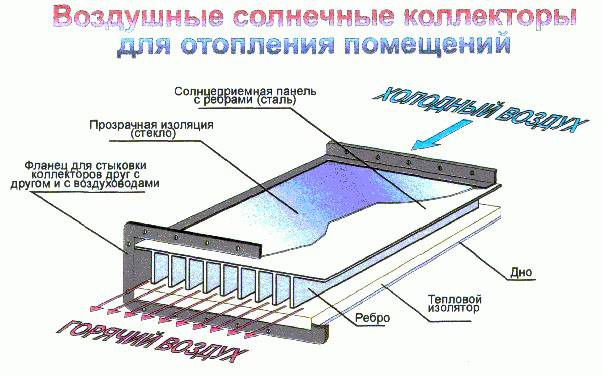
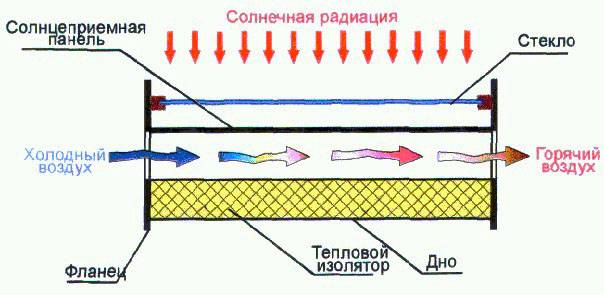
Among others, the air solar collector is distinguished by its simple design and, accordingly, the lowest price. It is a panel - a solar radiation receiver made of metal, enclosed in a sealed case. The steel sheet is equipped with ribs on the back side for better heat transfer and is laid on the bottom with thermal insulation. Transparent glass is installed on the front, and on the sides of the case there are openings with flanges for connecting air ducts or other panels, as shown in the diagram:
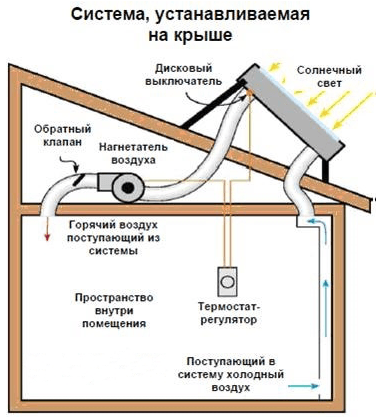
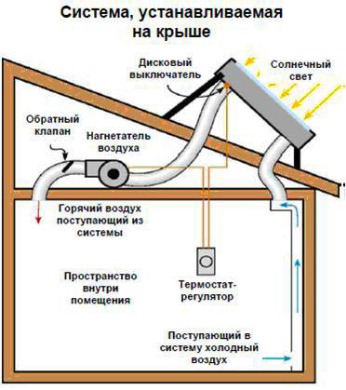
I must say that the installation of solar collectors with air heating has its own characteristics.Due to their low efficiency, several similar panels combined into a battery must be used for space heating. In addition, you will definitely need a fan, since the heated air from the collectors located on the roof will not go down on its own. The circuit diagram of the air system is shown in the figure below:
This is interesting: Canopy for a polycarbonate porch: we state all the nuances
How does a solar collector work?
The principle of operation of the collector is based on the absorption (absorption) of the thermal energy of the sun by a special receiving device and its transfer with minimal losses to the coolant. Copper or glass tubes painted black are used as receivers.
After all, it is known that objects that have a dark or black color are best absorbed by heat. The coolant is most often water, sometimes air. By design, solar collectors for home heating and hot water supply are of the following types:
- air;
- water flat;
- water vacuum.
Among others, the air solar collector is distinguished by its simple design and, accordingly, the lowest price. It is a panel - a solar radiation receiver made of metal, enclosed in a sealed case. The steel sheet is equipped with ribs on the back side for better heat transfer and is laid on the bottom with thermal insulation. Transparent glass is installed on the front, and on the sides of the case there are openings with flanges for connecting air ducts or other panels, as shown in the diagram:
I must say that the installation of solar collectors with air heating has its own characteristics.Due to their low efficiency, several similar panels combined into a battery must be used for space heating. In addition, you will definitely need a fan, since the heated air from the collectors located on the roof will not go down on its own. The circuit diagram of the air system is shown in the figure below:
The device and principle of operation of an air solar collector
The solar air collector consists of several main parts:
Scheme of work of an air solar collector
- The entire collector structure is placed in a durable and sealed case, which is necessarily equipped with a thermal insulator. The heat that has got inside the collector should not "leak" to the outside.
- The main part of any collector is a solar panel, which is also called an absorber or absorber. The task of this panel is to receive solar energy and then transfer it to the air, so it must be made of a material with the highest thermal conductivity. Such properties available in everyday life are copper and aluminum, less often steel. For better heat transfer, the lower part of the absorber is made as large as possible, so ribs, a wavy surface, perforation and other methods can be used. For better absorption of solar energy, the receiving part of the absorber is painted in a dark matte color.
- The upper part of the collector is hermetically sealed with transparent insulation, which can be tempered glass or plexiglass, or polycarbonate glass.
The solar collector is oriented to the south and the surface is tilted so that the maximum amount of solar energy hits the surface.As experts say - for maximum insolation. Cold outside air naturally or forcibly enters the receiving part, passes through the fins of the absorber and exits from the other part, equipped with a flange for joining with the air duct leading into the heated room. It should be noted that there are a lot of solar collector design options and the above is shown only as an example.
Air heating with the help of solar collectors cannot completely replace the main heating in our climate zone, but it will be a very good help even on frosty winter sunny days.
How the collector works - it's simple
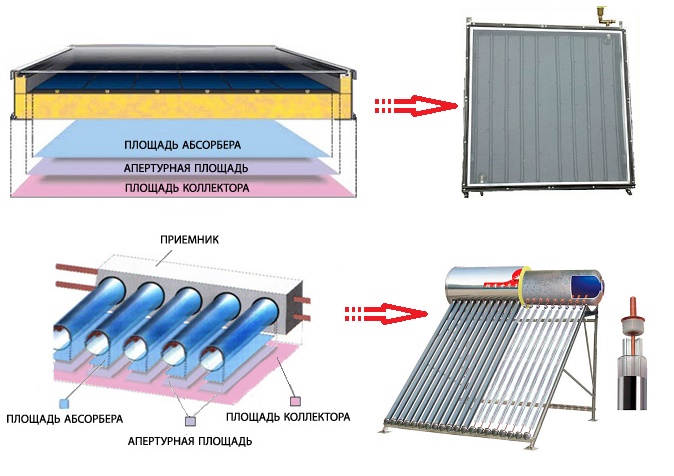
Any of the structures considered in the article for converting solar energy into thermal energy has two main components - a heat exchanger and a light-catching battery device. The second serves to capture the sun's rays, the first - to modify them into heat.
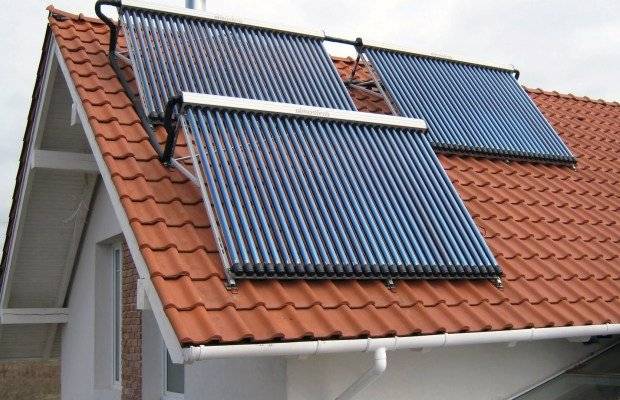
The most progressive collector is vacuum. In it, accumulators-pipes are inserted into each other, and an airless space is formed between them. In fact, we are dealing with a classic thermos. The vacuum collector, due to its design, provides an ideal thermal insulation of the device. The pipes in it, by the way, have a cylindrical shape. Therefore, the rays of the Sun fall on them perpendicularly, which guarantees that the collector receives a large amount of energy.
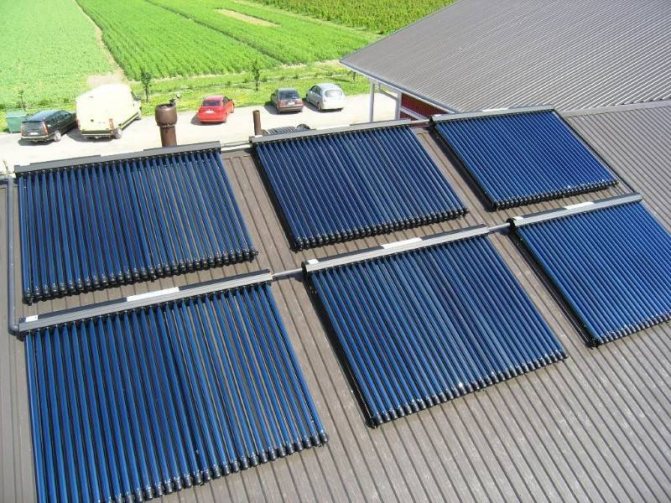



Progressive vacuum devices
There are also simpler devices - tubular and flat. The vacuum manifold outperforms them in every way. Its only problem is the relatively high complexity of manufacturing. You can assemble such a device at home, but it will take a lot of effort.
The coolant in the solar collectors for heating in question is water, which costs little, unlike any modern fuels, and does not emit carbon dioxide into the environment. A device for capturing and converting the rays of the Sun, which you can make yourself, with geometric parameters of 2x2 square meters, is capable of providing you with about 100 liters of warm water daily for 7–9 months. And large-sized structures can also be used for heating a house.
If you want to make a collector for year-round use, you will need to install additional heat exchangers on it, two circuits with an antifreeze agent and increase its surface. Such devices will provide you with warmth in both sunny and cloudy weather.
The difference between solar panels and collectors
Before continuing the description of the main characteristics and scope of solar systems for heating water, you need to understand how solar panels differ from collectors.

1) Solar battery - device, which generates electricity from the energy of the Sun with the help of highly sensitive photocells, combined into a single autonomous system. Since photovoltaic converters produce direct current, an inverter is additionally used, which allows you to get alternating current suitable for domestic needs: electricity and lighting.

2) Solar collector - a functional split system, the main task of which is the absorption of near infrared radiation and visible sunlight. Batteries generate current and collectors heat the fluid inside the tubes. This is their main difference.
The coolant for solar collectors is selected taking into account the time of year, as well as the features of operation. For multifunctional structures, antifreeze (antifreeze) is usually used, and seasonal type systems are filled with water. Today you can buy a more versatile option - a hybrid solar collector. This device is attractive in that it simultaneously produces electricity and heats water. The advantages of its use are obvious: the photovoltaic modules are cooled by an active heat removal system, due to which twice as much electricity is generated, and excess heat resources are spent on heating water.
How to make a solar collector with your own hands
solar collector can be made with your own hands, thereby obtaining a natural heater and saving a significant amount when paying for electricity.

Production will consist of several stages:
- Definition of the goal - it will be an air collector (for heating) or a water collector (for heating water);
- Removal of the required dimensions of the future collector, preparation of the design scheme;
- Manufacture of the body, its insulation;
- Installation of the constituent elements of the collector (vacuum tubes, which are a self-made heat exchanger);
- The device of openings of an entrance/exit;
- Glazing of the finished structure (you can also use polycarbonate or film, but glass is still better).
You can use most of the materials available in the house, for example, as an absorber, the use of corrugated board painted black is often found.
Solar collector design
Solar collector design
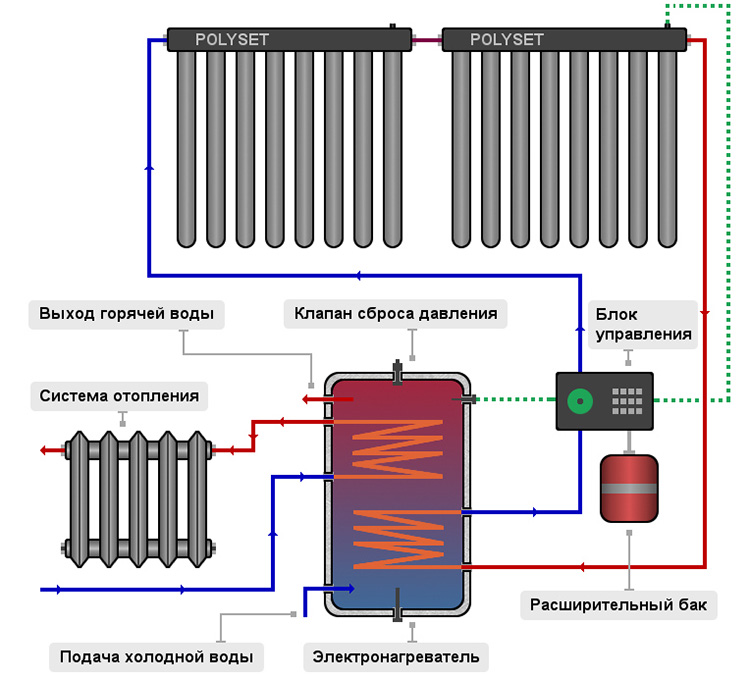
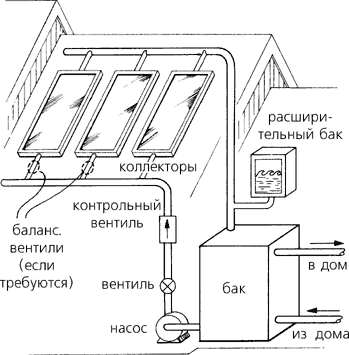
The considered units have a fairly simple design.In general, the system includes a pair of collectors, a fore-chamber and a storage tank. The work of the solar collector is carried out according to a simple principle: in the process of passing the sun's rays through the glass, they are converted into heat. The system is organized in such a way that these rays are not able to get out of the closed space.
The plant operates according to the thermosyphon principle. In the process of heating, the warm liquid rushes up, displacing cold water from there and directing it to the heat source. This allows you to refuse even the use of a pump, because. the liquid will circulate by itself. The installation accumulates solar energy and stores it inside the system for a long time.
Components for assembling the installation in question are sold in specialized stores. At its core, such a collector is a tubular radiator installed in a special box made of wood, one of the faces of which is made of glass.
For the manufacture of the said radiator, pipes are used. Steel is the preferred pipe material. The inlet and outlet are made from pipes traditionally used in plumbing. ¾ inch pipes are usually used, 1 inch products also work well.





The grate is made from smaller pipes with thinner walls. The recommended diameter is 16 mm, the optimal wall thickness is 1.5 mm. Each radiator grill must include 5 pipes 160 cm long each.
Solar collectors
Making a device from corrugated board
This is an even simpler solar collector design. You will build it much faster.
First stage.First, make a wooden box in the same way as in the previous version. Next, lay a bar along the perimeter of the back wall (approximately 4x4 cm), and lay mineral wool on the bottom.
Second phase. Make an exit hole in the bottom.
Third stage. Lay corrugated board on the beam and repaint the latter in black. Of course, if it was originally a different color.
Fourth stage. Make perforations over the entire area of \u200b\u200bthe corrugated board for air flow.
Fifth stage. If you wish, you can glaze the entire structure with polycarbonate - this will increase the heating temperature of the absorber. But do not forget that you also need to provide an outlet for air flow from the outside.
Additional operating costs
The use of this does not imply any care or maintenance other than periodic cleaning of dirt and snow in winter (if it does not thaw itself). However, there will be some associated costs:
Repair, everything that can be changed under warranty, the manufacturer can be replaced without problems, it is important to buy an authorized dealer and have warranty documents.
Electricity, it is spent quite a bit on the pump and controller. For the first one, you can put only 1 solar panel at 300 W and it will be enough (even without a battery system).
Flushing of the coils, it will need to be done once every 5-7 years
It all depends on the quality of the water (if it is used as a heat carrier).