- Overview of silicon-free devices
- Solar panels from rare metals
- Polymeric and organic analogues
- The principle of operation of a solar power plant at home
- Video description
- How solar energy is used to generate heat
- Popular manufacturers of solar panels
- Battery Installation Steps
- As a result - the prospects for the development of solar technologies
- The best stationary solar panels
- Sunways FSM-370M
- Delta BST 200-24M
- Feron PS0301
- Woodland Sun House 120W
- Safety and climate control
- The cost of the kit and the main technical characteristics, payback period
- What are the sellers of solar panels silent about?
- SB types
- Single crystal wafers
- Polycrystalline solar panels
- Amorphous panels
- Hybrid solar panels
- Polymer batteries
- Making at home
- Disadvantages of solar panels
Overview of silicon-free devices
Some solar panels made using rare and expensive metals have an efficiency of more than 30%. They are many times more expensive than their silicon counterparts, but still occupied a high-tech trading niche due to their special characteristics.
Solar panels from rare metals
There are several types of rare metal solar panels, and not all of them are more efficient than monocrystalline silicon modules.
However, the ability to work in extreme conditions allows manufacturers of such solar panels to produce competitive products and conduct further research.
Panels made of cadmium telluride are actively used for cladding buildings in the equatorial and Arabian countries, where their surface heats up to 70-80 degrees during the day
The main alloys used for the manufacture of photovoltaic cells are cadmium telluride (CdTe), indium copper gallium selenide (CIGS) and indium copper selenide (CIS).
Cadmium is a toxic metal, while indium, gallium and tellurium are quite rare and expensive, so mass production of solar panels based on them is even theoretically impossible.
The efficiency of such panels is at the level of 25-35%, although in exceptional cases it can reach up to 40%. Previously, they were used mainly in the space industry, but now a new promising direction has appeared.
Due to the stable operation of photocells made of rare metals at temperatures of 130-150°C, they are used in solar thermal power plants. At the same time, the rays of the sun from tens or hundreds of mirrors are concentrated on a small panel, which simultaneously generates electricity and transfers thermal energy to a water heat exchanger.
As a result of heating water, steam is formed, which causes the turbine to rotate and generate electricity. Thus, solar energy is converted into electrical energy simultaneously in two ways with maximum efficiency.
Polymeric and organic analogues
Photovoltaic modules based on organic and polymer compounds began to be developed only in the last decade, but researchers have already made significant progress. The European company Heliatek shows the greatest progress, which has already equipped several high-rise buildings with organic solar panels.
The thickness of its HeliaFilm roll film construction is only 1 mm.
In the production of polymer panels, substances such as carbon fullerenes, copper phthalocyanine, polyphenylene and others are used. The efficiency of such solar cells already reaches 14-15%, and the cost of production is several times less than that of crystalline solar panels.
The question of the degradation period of the organic working layer is acute. So far, it is not possible to reliably confirm the level of its efficiency after several years of operation.
The advantages of organic solar panels are:
- the possibility of environmentally safe disposal;
- low cost of production;
- flexible design.
The disadvantages of such photocells include relatively low efficiency and the lack of reliable information about the terms of stable operation of the panels. It is possible that in 5-10 years all the disadvantages of organic solar cells will disappear, and they will become serious competitors for silicon wafers.
The principle of operation of a solar power plant at home
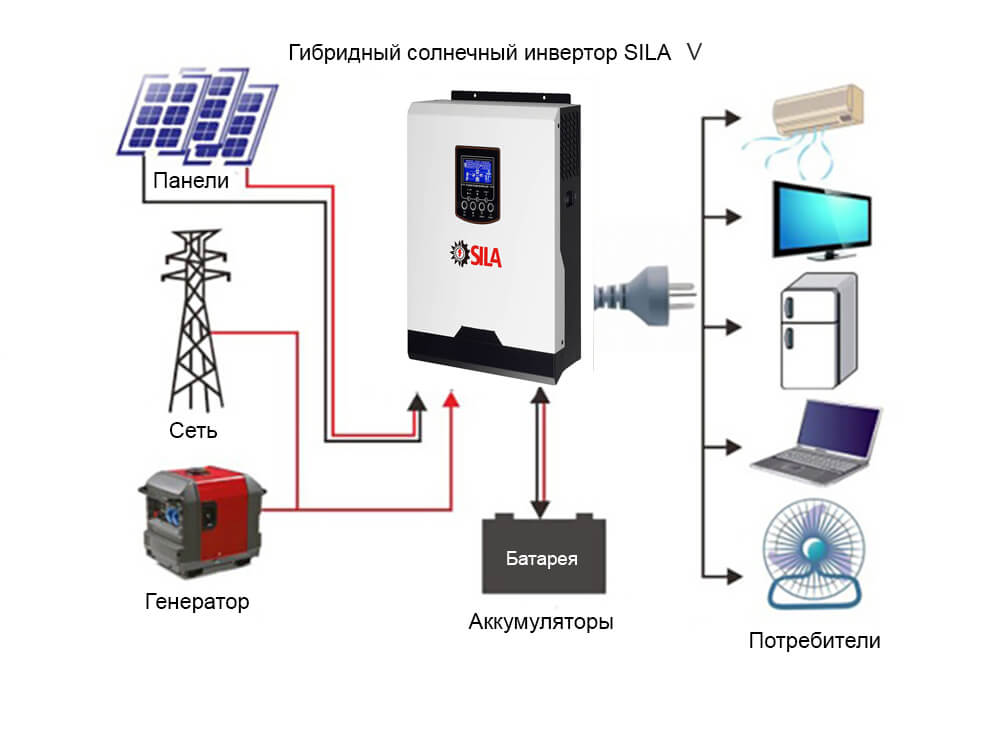
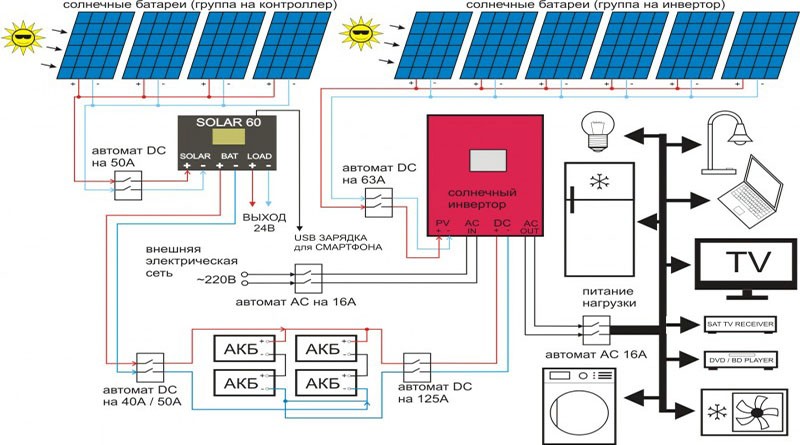
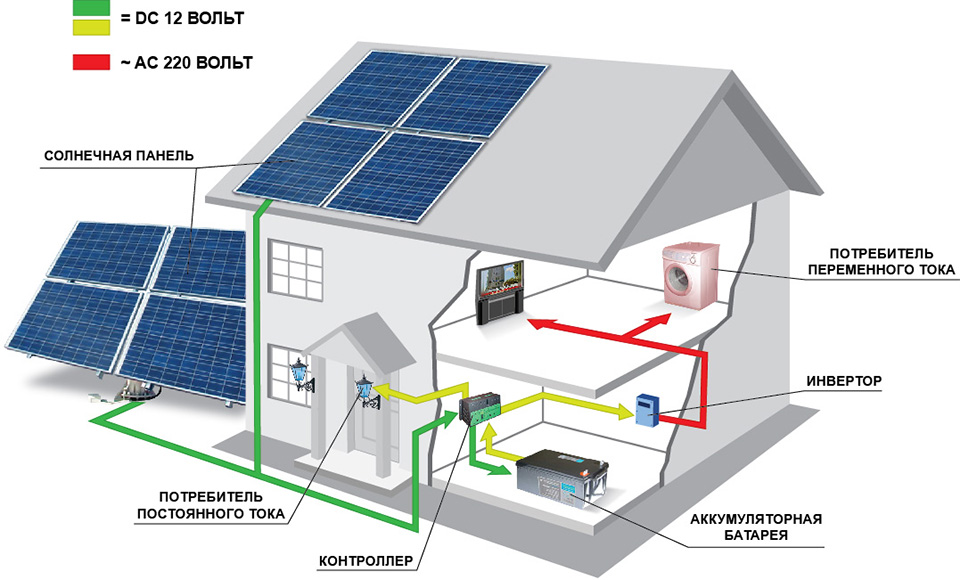
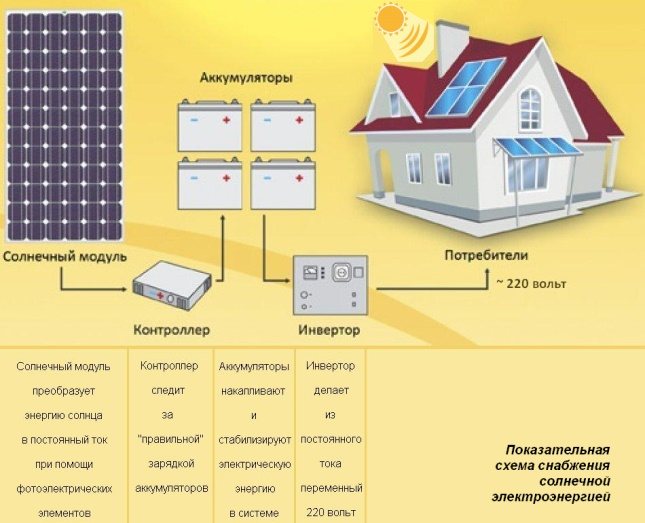
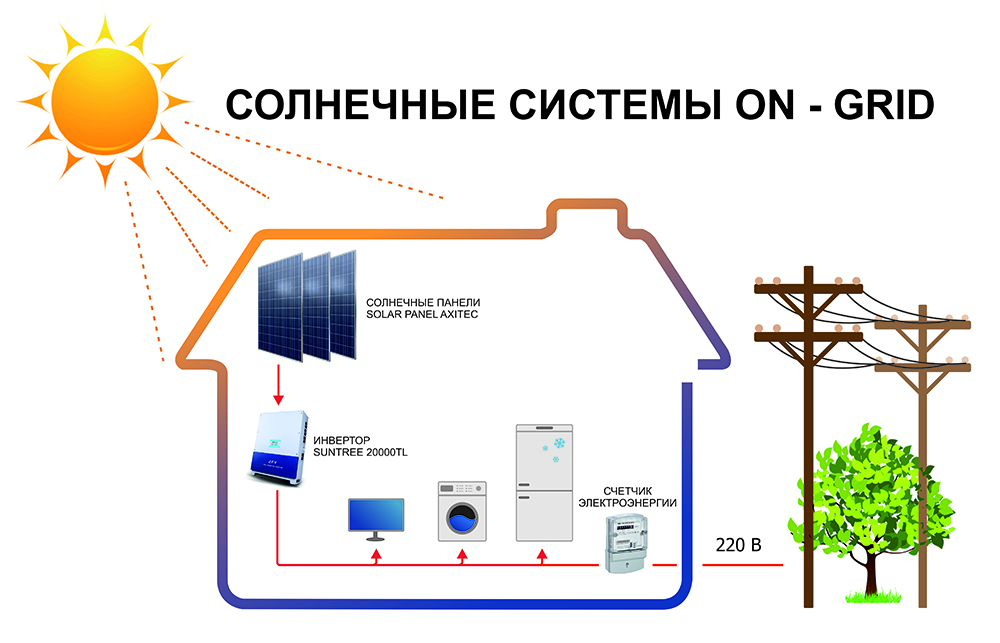
A solar power plant is a system consisting of panels, an inverter, a battery and a controller. The solar panel transforms radiant energy into electricity (as mentioned above). Direct current enters the controller, which distributes the current to consumers (for example, a computer or lighting).An inverter converts direct current into alternating current and powers most electrical household appliances. The battery stores energy that can be used at night.
Video description
A good example of calculations showing how many panels are needed to provide an autonomous power supply, see this video:
How solar energy is used to generate heat
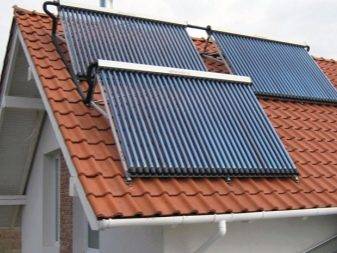
Solar systems are used for water heating and home heating. They can provide heat (at the request of the owner) even when the heating season is over, and provide the house with hot water for free. The simplest device is metal panels that are installed on the roof of the house. They accumulate energy and warm water, which circulates through pipes hidden under them. The functioning of all solar systems is based on this principle, despite the fact that they may be structurally different from each other.
Solar collectors are made up of:
- storage tank;
- pumping station;
- controller
- pipelines;
- fittings.
According to the type of construction, flat and vacuum collectors are distinguished. In the former, the bottom is covered with heat-insulating material, and the liquid circulates through glass pipes. Vacuum collectors are highly efficient because heat losses are kept to a minimum. This type of collector provides not only solar panel heating private house - it is convenient to use it for hot water systems and heating pools.




The principle of operation of the solar collector
Popular manufacturers of solar panels
Most often, products of Yingli Green Energy and Suntech Power Co. are found on the shelves.HiminSolar panels (China) are also popular. Their solar panels produce electricity even in rainy weather.
The production of solar batteries has also been established by a domestic manufacturer. The following companies do this:
- Hevel LLC in Novocheboksarsk;
- "Telecom-STV" in Zelenograd;
- Sun Shines (LLC Autonomous Lighting Systems) in Moscow;
- OJSC "Ryazan Plant of Metal-Ceramic Instruments";
- CJSC "Termotron-zavod" and others.
You can always find a suitable option for the price. For example, in Moscow on solar batteries for home the cost will vary from 21,000 to 2,000,000 rubles. The cost depends on the configuration and power of the devices.

Solar panels are not always flat - there are a number of models that focus light at one point
Battery Installation Steps
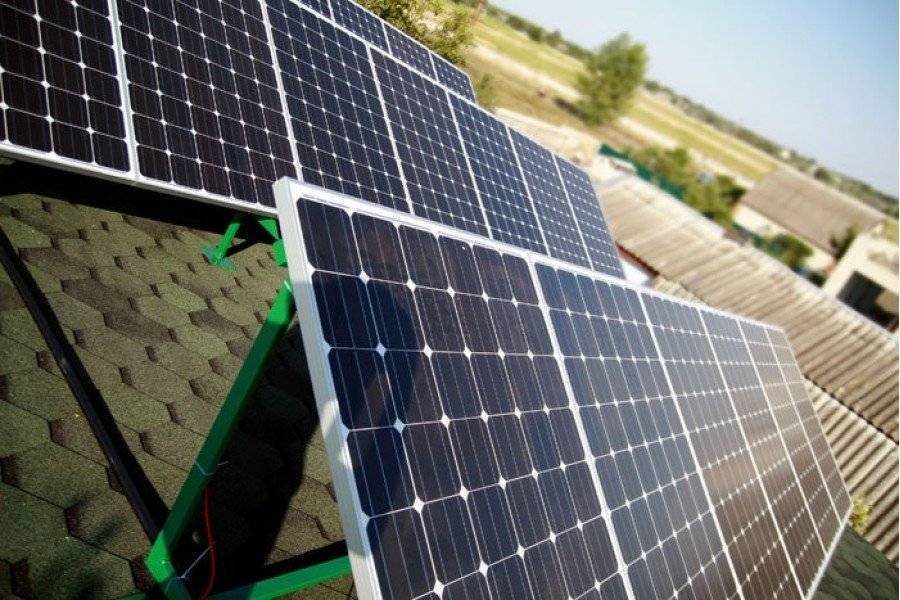
- To install the panels, the most illuminated place is selected - most often these are the roofs and walls of buildings. In order for the device to function as efficiently as possible, the panels are mounted at a certain angle to the horizon. The level of darkness of the territory is also taken into account: surrounding objects that can create a shadow (buildings, trees, etc.)
- Panels are installed using special fastening systems.
- Then the modules are connected to the battery, controller and inverter, and the whole system is adjusted.
For the installation of the system, a personal project is always developed, which takes into account all the features of the situation: how it will be carried out installation of solar panels roof of the house, price and terms. Depending on the type and scope of work, all projects are calculated on an individual basis. The client accepts the work and receives a guarantee for it.

Installation of solar panels must be carried out by professionals and in compliance with safety measures.
As a result - the prospects for the development of solar technologies
If on Earth the most efficient operation of solar panels is hindered by air, which to a certain extent scatters the radiation of the Sun, then in space there is no such problem. Scientists are developing projects for giant orbiting satellites with solar panels that will operate 24 hours a day. From them, the energy will be transmitted to ground receiving devices. But this is a matter of the future, and for existing batteries, efforts are directed towards improving energy efficiency and reducing the size of devices.
The best stationary solar panels
Stationary devices are characterized by large dimensions and increased power. They are installed in large numbers on the roofs of buildings and other free areas. Designed for year-round use.
Sunways FSM-370M
4.9
★★★★★
editorial score
98%
buyers recommend this product
The model is made using PERC technology, thanks to which it is stable in adverse weather conditions. The anodized aluminum frame is not afraid of sharp impacts and deformation. High-strength tempered glass with low UV absorption ensures the safety of the panel.
Rated power is 370 W, voltage is 24 V. The battery can operate at outdoor temperature from -40 to +85 °С. The diode assembly protects it from overloads and reverse currents, reduces efficiency losses with partial shading of the surface.
Advantages:
- durable corrosion-resistant frame;
- thick protective glass;
- stable operation in any conditions;
- long service life.
Flaws:
great weight.
Sunways FSM-370M is recommended for permanent power supply of large facilities. An excellent choice for placement on the roof of a residential building or office building.
Delta BST 200-24M
4.9
★★★★★
editorial score
96%
buyers recommend this product
A feature of Delta BST is the heterogeneous structure of single-crystal modules. This has improved the panel's ability to absorb scattered solar radiation and ensures its efficient operation even in cloudy conditions.
The peak power of the battery is 200 watts with dimensions of 1580x808x35 mm. Rigid construction withstands difficult conditions, and a reinforced frame with drainage holes ensures stable operation of the panel during bad weather. The protective layer is made of tempered anti-reflective glass 3.2 mm thick.



Advantages:
- stable operation in difficult weather conditions;
- reinforced construction;
- heat resistance;
- stainless frame.
Flaws:
complex installation.
The Delta BST is designed to provide consistent power throughout the year and will provide reliable power for many years to come.
Feron PS0301
4.8
★★★★★
editorial score
90%
buyers recommend this product
The Feron solar panel is not afraid of difficult conditions and functions stably at a temperature of -40..+85 °C. The metal case is resistant to damage and does not corrode. The battery power is 60 W, the dimensions in ready-to-use form are 35x1680x664 millimeters.
If necessary, transport the structure can be easily folded. For convenient and safe carrying, a special case made of durable synthetics is provided. The kit also includes two supports, a cable with clips and a controller, which allows you to immediately put the panel into operation.
Advantages:
- heat resistance;
- stable operation in all weather conditions;
- durable case;
- fast installation;
- convenient folding design.
Flaws:
high price.
Feron can be used in any weather. A good choice for installation in a private home, but you will need several of these panels to get enough power.
Woodland Sun House 120W
4.7
★★★★★
editorial score
85%
buyers recommend this product
The model is made of polycrystalline silicon wafers. Photocells are covered with a thick layer of tempered glass, which eliminates the risk of mechanical damage and external factors. Their service life is about 25 years.
The battery power is 120 W, the dimensions in the ready-to-use state are 128x4x67 centimeters. The kit includes a practical bag made of wear-resistant material that simplifies storage and transportation of the panel. For ease of installation on a flat surface, special legs are provided.
Advantages:
- protective covering;
- fast installation;
- compact size and easy to carry;
- long service life;
- durable bag included.
Flaws:
the frame is flimsy.
Woodland Sun House is capable of charging 12-volt batteries. Beautiful installation solution at the dacha, hunting base and in other places remote from civilization.



Safety and climate control
To monitor the security of a suburban area, it is worth installing an outdoor video surveillance system. We have already written about such devices, but they can be powered not only from the network, but also thanks to solar energy - this is also convenient if the cameras are installed far enough from the house and the outlet.
The Link Solar Y9-S IP camera can work from the sun, which records information on a memory card or transfers it to the cloud via Wi-Fi. The gadget shoots with Full HD resolution and has a viewing angle of 100 degrees. The distance at which the infrared sensor works when shooting at night is 10 meters.
The solar panel is located on the "back" of the camera
You can supplement the security system with a motion sensor that works on moving objects weighing 25 kg or more (so as not to waste energy on notifications about small dogs and cats). One of these devices is Dinsafer DOP01B, capable of detecting movement at a distance of up to 35 m and transmitting a signal to the alarm control panel at 100-200 m. without constantly changing batteries or connecting the device to the mains.
By protecting the site from outsiders, you can purchase protection from pests. For example, from mice and moles that dig in and eat root crops. The device brand Solar will scare away rodents that can seriously reduce the volume of the harvest. Repellers look like lawn repellers lanterns on solar battery and operate at a distance of up to 15-20 meters.
The mole repeller looks like a small mushroom with a solar panel on its hat.
Another interesting device that can work with solar energy is a home weather station. Such devices, as a rule, can be installed outdoors - they are protected from water and withstand temperature extremes.
Solar weather station
For example, the Z-Wave POPP-POPE005206 model is capable of predicting changes in the microclimate - humidity, wind speed, temperature - with a fairly high accuracy. The station uses solar panels for operation, and periodically turns off to save energy.
The cost of the kit and the main technical characteristics, payback period
Prices for ready-made kits mainly range from 30,000 to 2,000,000 rubles. They depend on the devices that make them up (on the type of batteries, the number of devices, the manufacturer and characteristics). You can find budget options costing from 10,500 rubles. The economy set includes a panel, a charge controller, a connector.
Standard kits include:
- energy module;
- charge controller;
- battery;
- inverter;
- shelving *;
- cable *;
- terminals*.
* Provided in the extended configuration.
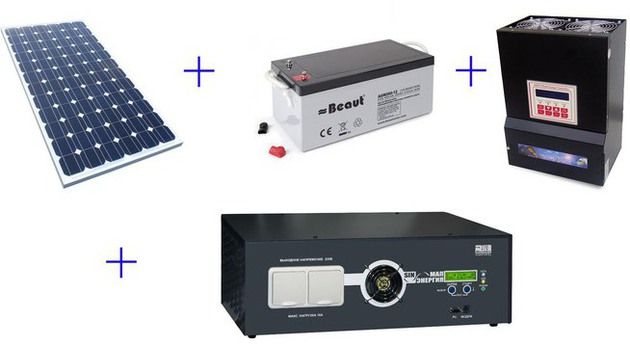
Standard Equipment
Specifications are indicated in the instructions for use:
- Power and dimensions of panels. The more power you need, the more profitable it is to buy larger batteries.
- System energy efficiency.
- The temperature coefficient shows how much temperature affects power, voltage and current.
So, for example, a set with a capacity of 5 kW C3 of a network solar power plant from the Hevel company - based on heterostructure solar modules - is suitable for covering the needs of energy supply for a private house or small business facilities: pavilions, cafes, shops, guest houses, etc. d.
The Hevel network solar power plant allows you to save on electricity bills, while increasing the power supplied to the facility.Autonomous and hybrid solar power plants Hevel are equipped with rechargeable batteries, so they eliminate power outages, and also help out if there is no connection to the main network at the facility.
Qualified managers of Hevel will help you calculate energy consumption and choose the most suitable kit for your home, as well as perform installation and commissioning of solar power plants.
A long-term official warranty for modules, an official warranty for all components, quality conformity certificates - this is what distinguishes a reliable supplier.
All developments, solar modules and cells undergo multi-stage quality control, as well as strength and wear resistance tests, which allows us to speak with confidence about the reliability and durability of modules and structures, as well as provide a guarantee for Hevel products - up to 25 years.

Grid solar power plant "Hevel" C3
What are the sellers of solar panels silent about?
If you take a walk through the forums and reviews, you can find such warnings from the happy owners of solar panels.
- Panels require a grid inverter to work: when buying panels, you need to match the voltage of the inverter and panels for compatibility.
For example, to operate two panels, each with 100 watts, you will need a 300-500 watt inverter.
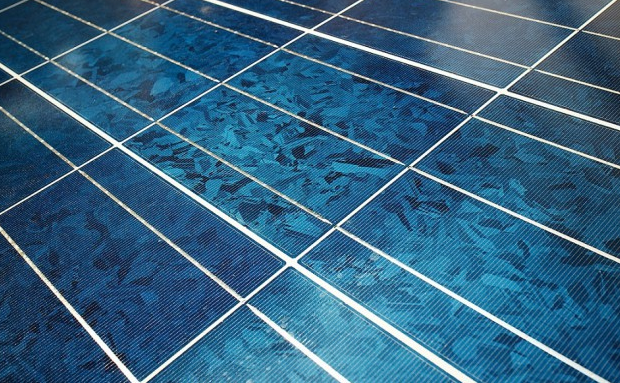
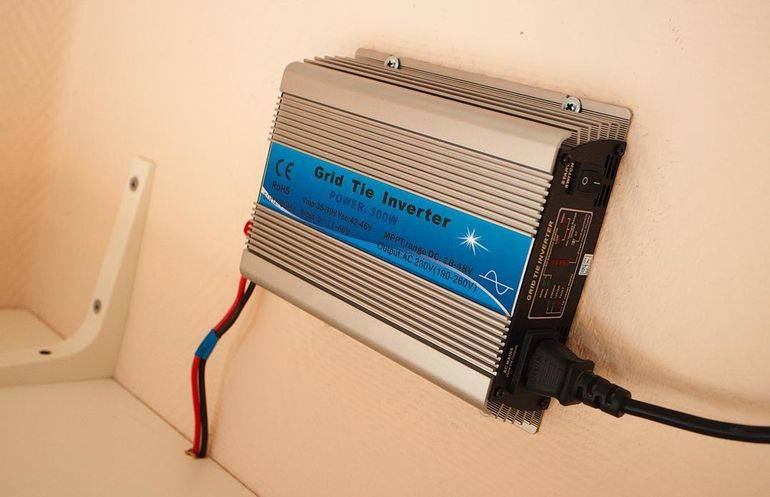
Chinese and usually quite high-quality inverters still often indicate power on the case that does not correspond to reality. Be careful during the purchase and specify the details. The device operates in the presence of mains voltage, so it cannot be backup power supply.
If electricity is not consumed immediately, it is transferred back to the grid.At the same time, the counter turns either forward or backward. This is unusual and is not taken into account by many counters. There is a risk of paying for the energy returned back


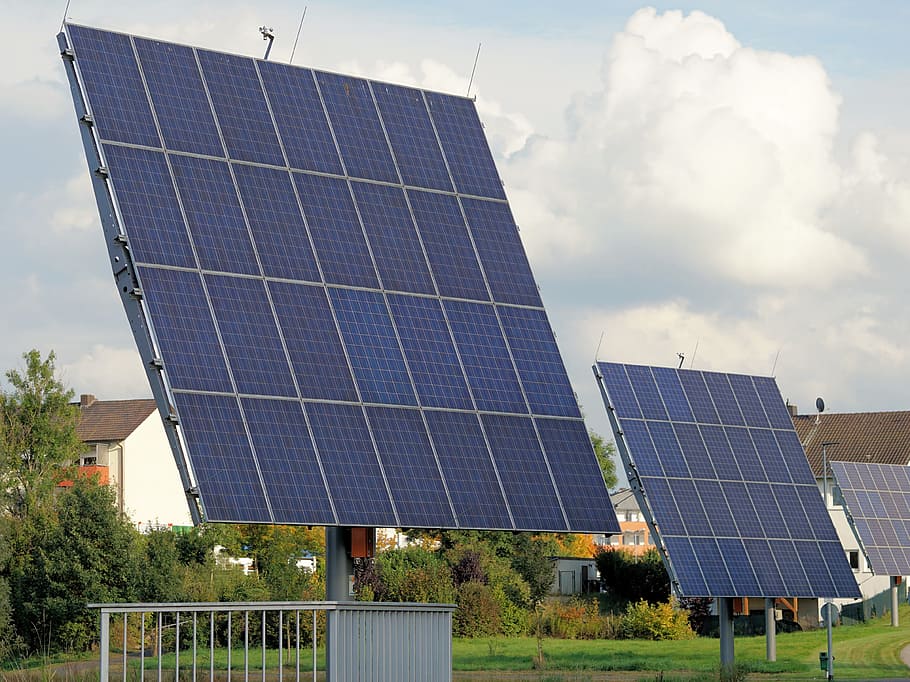


It is important to take into account the type of meter and include the cost of replacing it in the calculations.
If your area is often cloudy, it is important to take it into account and equate it with a shadow.
It is important to take into account the time and effort to clean the panels, especially in winter from snow.
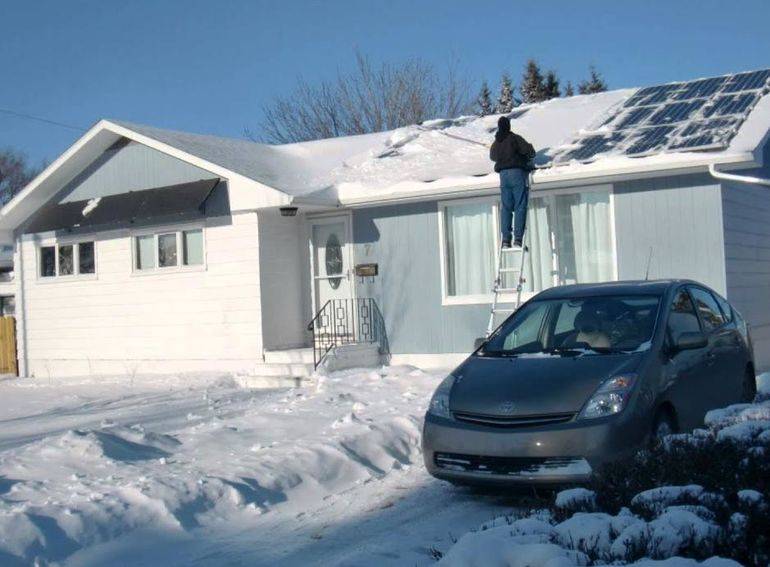
The main conclusion of those who purchased the panels in our country is that for the time being it is too expensive and should be considered as a hobby.
SB types
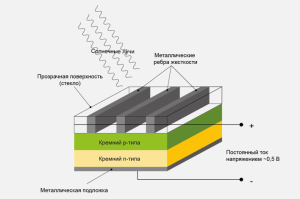 The principle of operation of the solar battery. (Click to enlarge) Today, there are more than ten types of solar devices that are used in a particular industry. Each type has its own characteristics and operational features.
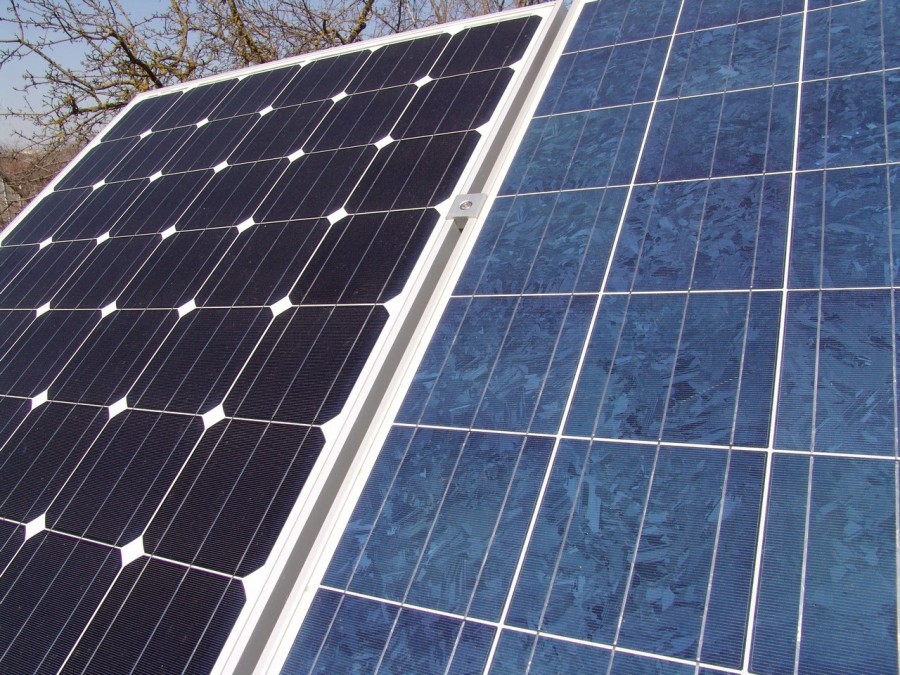
The principle of operation of silicon solar cells: sunlight enters the silicon (silicon-hydrogen) panel. In turn, the plate material changes the direction of the orbits of the electrons, after which the transducers produce an electric current.
These devices can be roughly divided into four types. Let's look at them in more detail below.
Single crystal wafers
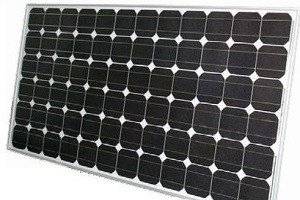
Single-crystal SBThe difference between these converters is that the light-sensitive cells are directed only in one direction.
This makes it possible to obtain the highest efficiency - up to 26%. But at the same time, the panel must always be directed to the light source (the Sun), otherwise the output power is significantly reduced.
In other words, such a panel is good only in sunny weather. In the evening and on a cloudy day, this type of panel gives a little energy.Such a battery will be optimal for the southern regions of our country.
Polycrystalline solar panels
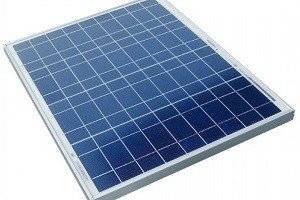
Polycrystalline SB The wafers of solar panels contain silicon crystals that are directed in different directions, which gives a relatively low efficiency (16-18%).
However, the main advantage of this type of solar panels is their excellent efficiency in poor and scattered light. Such a battery will still power the batteries in cloudy weather.
Amorphous panels
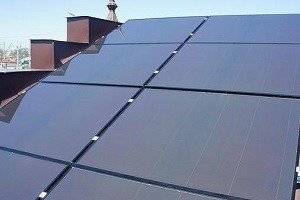
Amorphous SBAmorphic wafers are obtained by vacuum deposition of silicon and impurities. A layer of silicon is applied to a durable layer of special foil. The efficiency of such devices is quite low, no more than 8-9%.
The low "recoil" is explained by the fact that under the action of sunlight a thin layer of silicon burns out.
Practice shows that after two to three months of active operation of an amorphous solar panel, the efficiency drops by 12-16%, depending on the manufacturer. The service life of such panels is not more than three years.
Their advantage is low cost and the ability to convert energy even in rainy weather and fog.
Hybrid solar panels
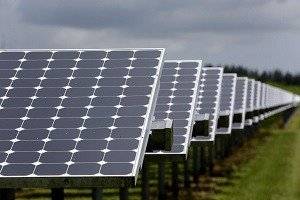
Hybrid SBs The peculiarity of such blocks is that they combine amorphous silicon and single crystals. In terms of parameters, the panels are similar to polycrystalline counterparts.
The peculiarity of such converters is the best conversion of solar energy under conditions of scattered light.
Polymer batteries
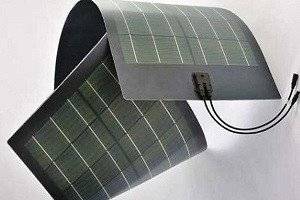
Polymer SB is considered by many users to be a promising alternative to today's silicon panels. This is a film consisting of polymer sputtering, aluminum conductors and a protective layer.
Its peculiarity is that it is light, conveniently bends, twists and does not break.The efficiency of such a battery is only 4-6%, however, low cost and convenient use make this type of solar battery very popular.
Expert advice: to save time, nerves and money, buy solar equipment in specialized stores and trusted sites.
Making at home
A complex solar system will require a considerable investment. But all the money spent will be returned in the future. The payback period will vary depending on the number of modules and how solar energy is used. But still, it is possible to reduce initial costs not due to loss of quality, but due to a reasonable approach to the selection of solar battery components.
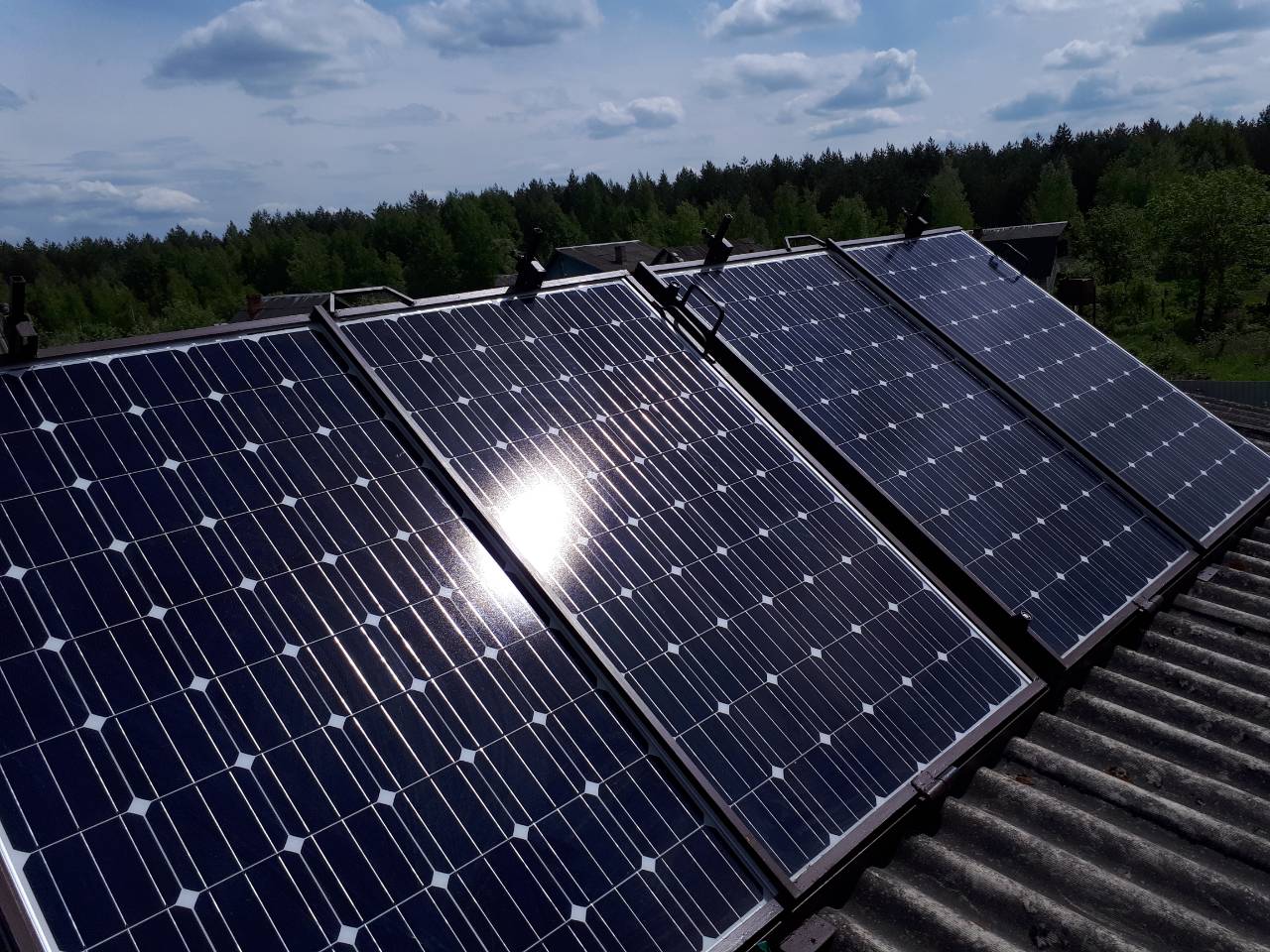

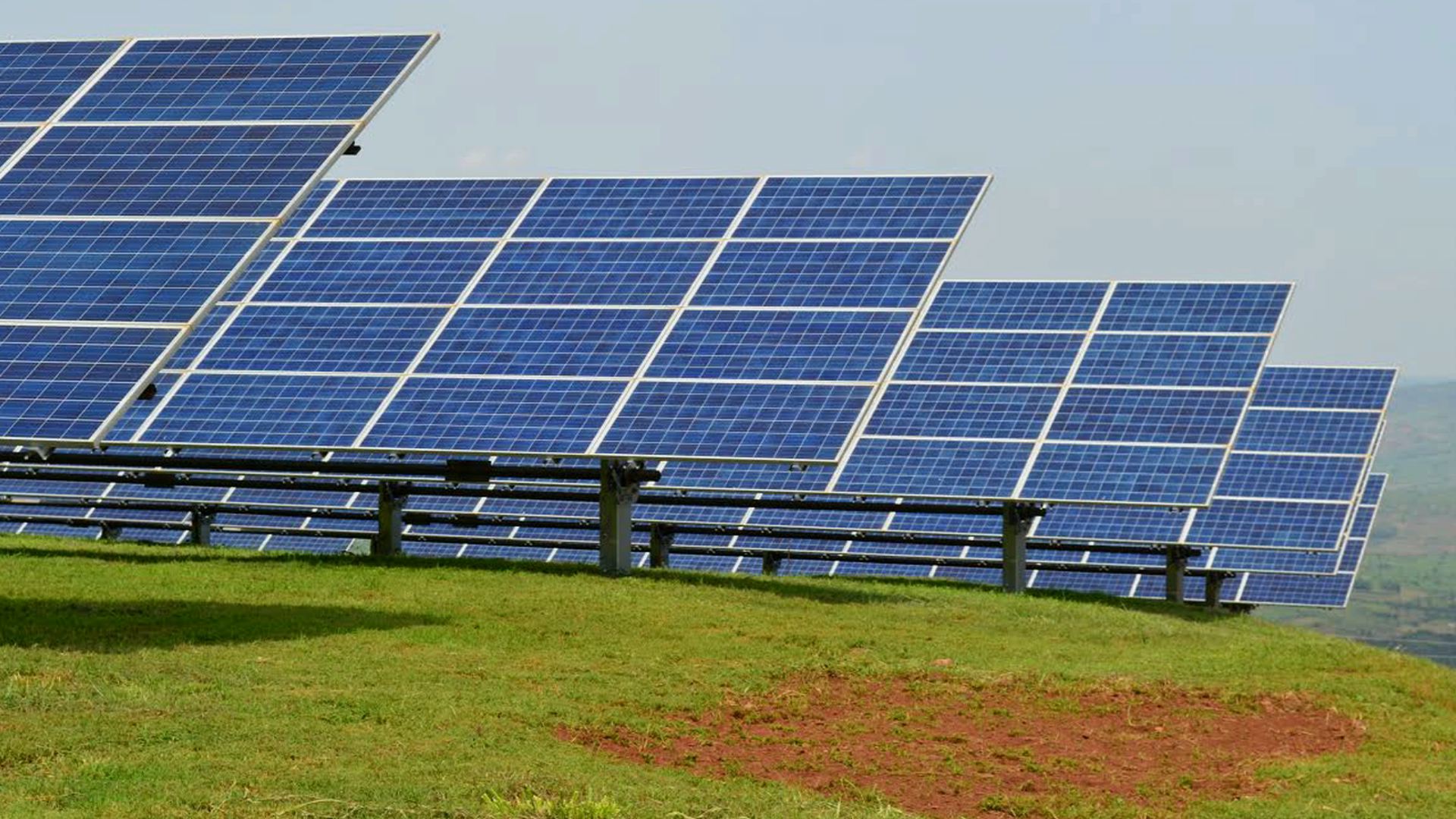



If you are unlimited in the area of \u200b\u200binstallation of solar modules, and you have a decent space at your disposal, then for 100 square meters. m you can install polycrystalline solar panels. This will save a considerable amount in the family budget.
Do not try to completely cover the roof with solar panels. To get started, install a couple of modules and connect to them the equipment that runs on DC voltage. You can always increase the power and increase the number of modules over time.
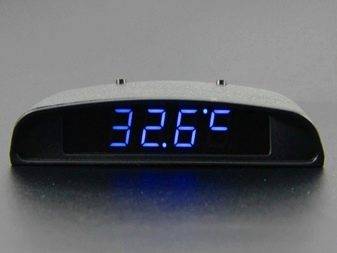
If you are on a tight budget, you can opt out of installing a controller - this is an auxiliary element that is needed to track the battery level. Instead, you can additionally connect another battery to the system - this will avoid overcharging and increase the capacity of the system. And to control the charge, you can use an ordinary car clock that can measure voltage, and they are many times cheaper.
Disadvantages of solar panels
Unfortunately, this practically inexhaustible source of energy also has certain limitations and disadvantages:
- The high cost of equipment - an autonomous solar power plant of even low power is not available to everyone. Equipping a private house with such batteries is not cheap, but it helps to reduce the cost of utility bills (electricity).
- Equipping your own home with solar panels will require financial costs.
- The frequency of generation - a solar power plant is not able to provide full-fledged uninterrupted electrification of a private house.
- Energy storage - in a solar power plant, the battery is the most expensive element (even small batteries and gel-based panels).
- Low environmental pollution - solar energy is considered environmentally friendly, but the production process of batteries is accompanied by emissions of nitrogen trifluoride, sulfur oxides. All this creates a "greenhouse effect".
- Use in the production of rare earth elements - thin-film solar panels are composed of cadmium telluride (CdTe).
- Power density is the amount of energy that can be obtained from 1 sq. energy meter. On average, this figure is 150-170 W / m2. This is much more than other alternative energy sources. However, it is incomparably lower than that of traditional ones (this applies to nuclear energy).