
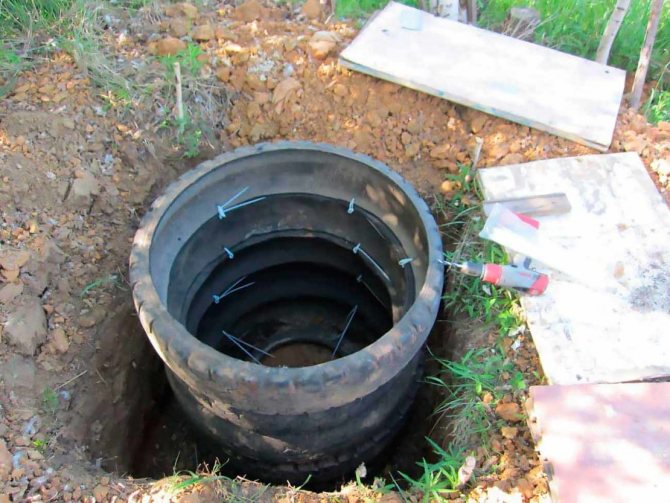
- Tire pit construction
- The device and principle of operation of the sump
- Improving the drainage capacity of the pit
- Cleaning a cesspool in a private house
- Exploitation
- Where to start the arrangement of the sewer system?
- The feasibility of a drain collector from tires
- What is important to understand before starting work?
- Use of specialized packaging
- Do-it-yourself car tire well
- Works on the device of a cesspool from automobile tires
Tire pit construction
The most budgetary and lack of costly is a drain pit made from tires with your own hands. With this choice of design, the only problem will be the need to dig a foundation pit for it. Its diameter depends on which tire is used. If the stock is needed for a summer residence, where it will be actively used only in the summer during the vacation period, then tires from a car are quite suitable. With active use - the volume will be clearly insufficient.
An ordinary do-it-yourself tire cesspool is not very productive. For a large drain, you will need tires from trucks or agricultural equipment. And it is also necessary to take into account that their diameter must be the same, so that after installation on each other it is possible to obtain an even well.Tires require the side rim to be cut off. This will prevent clogging between their folds. It is most convenient to do this with a jigsaw.
Having picked up the necessary materials, you can dig a pit. Its diameter should be only slightly larger than the tires. If the work is done manually, then it must immediately be made round; when using an excavator, the laying task will become a little more complicated. Before you make a cesspool of tires, you need to take care of the purchase of cement if complete tightness is required.
To do this, the bottom is first concreted, after which the tires are laid. A solution is poured into the space between them and the earthen walls of the pit. In order for it to fully spread, it should be pushed with a wooden handle.
For a leaky structure, these precautions will not be necessary, and all that is required is to fill the voids with gravel or dug clay
Having brought the intake pipe from the house, it is necessary to close the pit. And you should also make a hatch to control the filling and have access to pump out the liquid. A budget option would be a slate coating, on top of which concrete should be poured. The solution must go beyond the outline of the pit so that the resulting roof is securely fixed.
Slate under the bottom will facilitate the process of pouring concrete, but it will be useless to give strength. For this, you should definitely use iron fittings, because it is better to be safe than to fall into a drain well later.
The device and principle of operation of the sump
A cesspool is the simplest option for arranging an autonomous sewer.With the advent of highly efficient septic tanks and local treatment systems, the use of drain collectors in private households and cottage villages has decreased. However, among summer residents this method of wastewater disposal remains in demand.
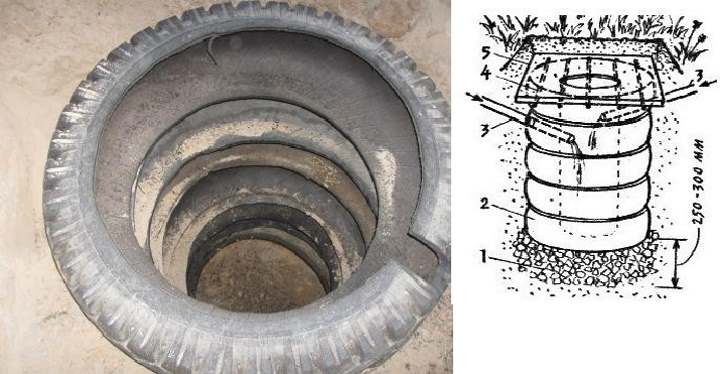
The most budgetary and easy to implement local sewage system is based on the use of old tires. In this case, the walls of the drain collector are reinforced with rubber tires, the bottom of the tank is missing.
There are two options for organizing a drain pit: 1 - an absorbing well without a bottom, designed for the processing and disposal of gray effluents and clarified water that has been treated in a septic tank, 2 - a sealed storage tank arranged to collect mixed or brown waste masses. Both methods are simple and easy to implement.
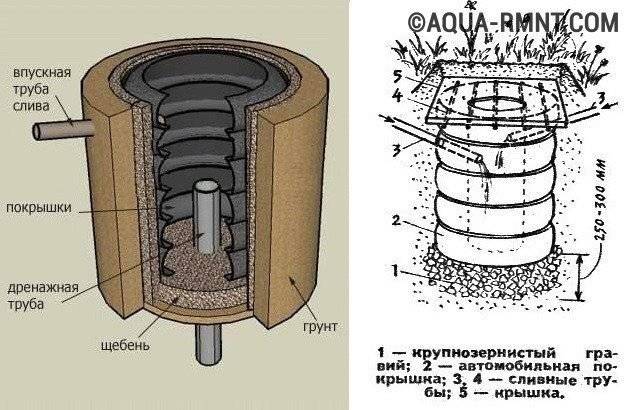
The base of the absorbent, or else filter option - drainage layer from rubble and sand. The stability of the structure is achieved due to the weight of the tires themselves, the earth filling and the accumulated wastewater.
In the upper part of the "tower" of tires, a sewer pipeline is provided. The entire structure is covered with a lid, which prevents the spread of unpleasant odors and clogging of the pit.
The principle of operation of the absorbing pit:
- Waste liquid enters the tank through the pipe.
- Heavy, solid suspensions settle on the surface of the "cushion" of crushed stone.
- Semi-purified water seeps through the drainage layer and goes deep into the soil.
- The accumulated sludge is periodically pumped out of the tank.
To improve the quality of filtration and accelerate the drainage of effluents, a hollow perforated pipe is installed inside the tire tank.
Part of the wastewater is subjected to double cleaning - suspensions that have not settled to the bottom are filtered out by a drainage pipe and undergo post-treatment in a sand and gravel backfill
This is interesting: Do-it-yourself tire septic tank: device technology
Improving the drainage capacity of the pit
Significantly improve the efficiency of such a pit can be a simple method. Very often, at such a depth, the soil is clayey, which practically does not absorb water.
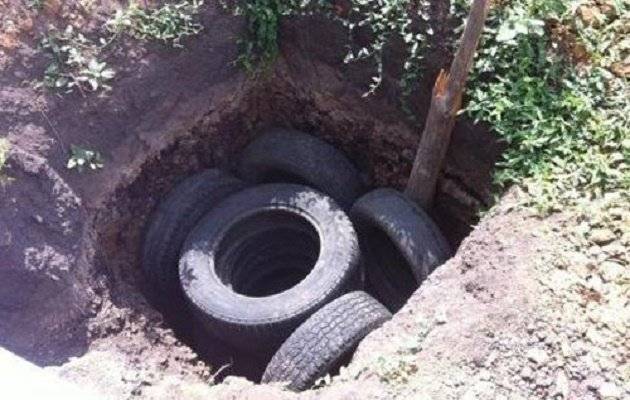

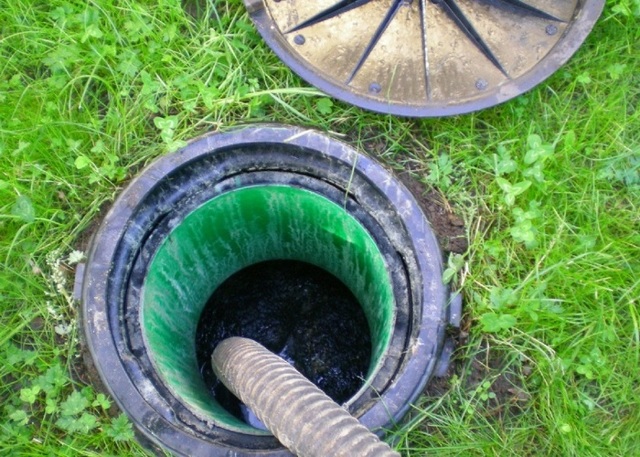
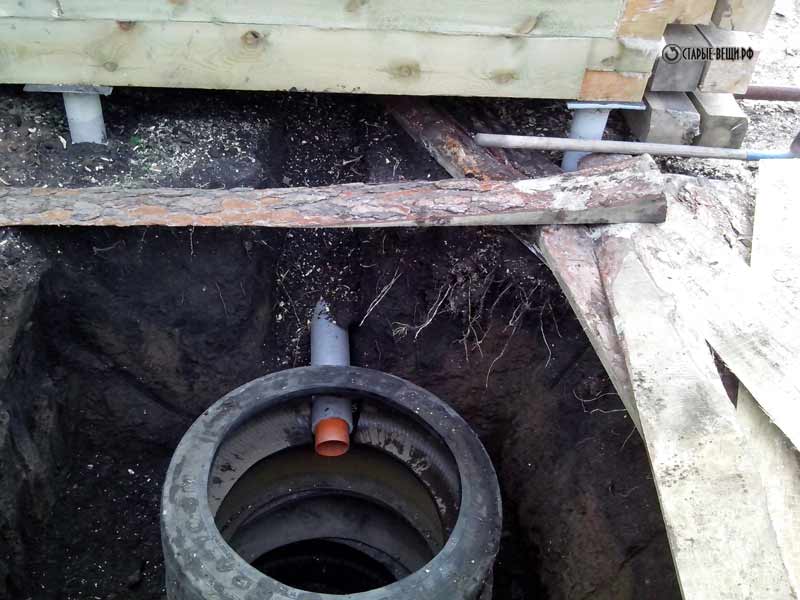

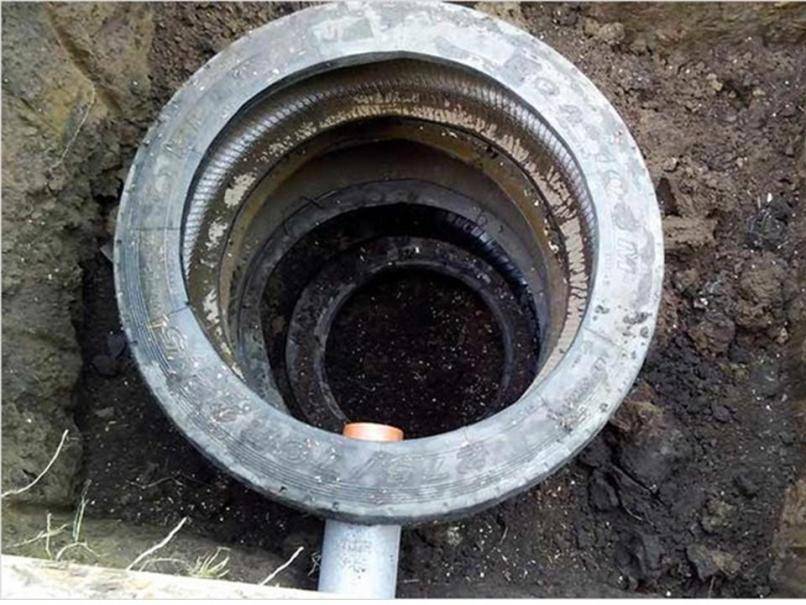

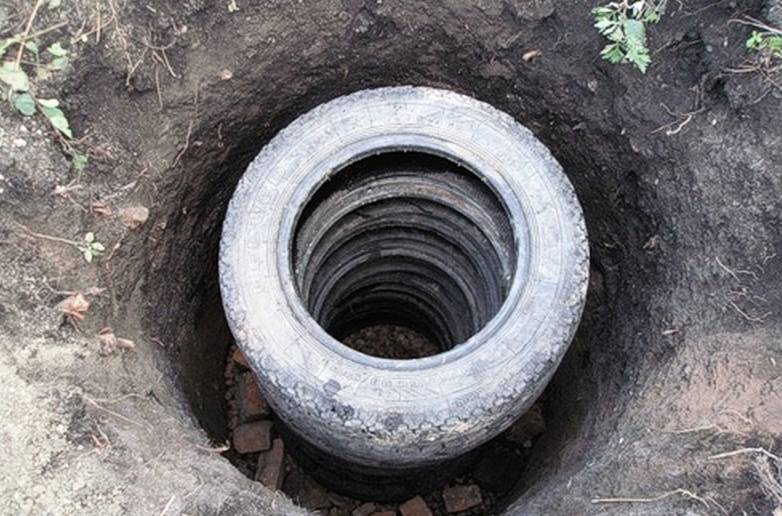

In this case, and not only, it is necessary to drill several drainage wells. In the presence of simple devices, they can be brought to a depth of 4-5 meters from the bottom of the pit.
These wells are cased with a pipe of a suitable diameter, while the upper edge of the pipe should be about a meter above the bottom, this will protect it from silting.
A series of holes are drilled in the upper part, through which water will flow into it already in the first stages of filling. If desired, you can wrap the top with a fine mesh, which will play the role of a filter.
A layer of crushed stone or coarse gravel is laid at the bottom of the pit. After that, it remains only to lay out the drain pit with car ramps.
Cleaning a cesspool in a private house
The operation of vacuum trucks does not guarantee complete cleaning of the tank. Only liquid can be pumped out, and sediment will accumulate at the bottom. Speaking about cleaning, it should be noted that special preparations are used to optimize the process:
- bioactive complexes. They include colonies of bacteria that eliminate unpleasant odors when working together. They are environmentally friendly, but they live only at temperatures above +4 ° C, so the use of such products in the winter is impossible.
- nitrate oxidants.They do not emit hazardous substances and do not pose a danger to people, animals and plants. Suitable for use in the cold season.
When disinfecting cesspools, use a product whose constituent components are:
- sodium hypochlorite - 5%;
- Creolin - 5%;
- bleach - 10%;
- naphthalizole - 10%;
- sodium metasilicate - 10%.
To eliminate unpleasant odors, ventilation is used as an additional means. It is equipped with plastic sewer pipes, 10 in diameter and 60 cm high. They are installed in the upper part of the pit.
Exploitation
Regardless of the chosen material for construction, cesspools need to be pumped out. To prevent sewage from flooding the site, it is necessary to monitor the filling height (normally below ground level on 30 cm). After reaching a certain level, a special machine is called to clean the tank.
To reduce the amount of costs, you can use bioactive complexes or nitrate oxidizers, which contribute to the decomposition of sediment and reduce unpleasant odors.
It is recommended to think about the costs of cleaning up before starting construction work. Financial costs can be reduced if several holes are made at the bottom of the pit and plastic tubes are inserted into them, the ends of which protrude 70-80 cm above the bottom.
If during operation it was discovered that cesspool volume insufficient, then you should dig another hole nearby and attach it to the main one using plastic tubes.
Where to start the arrangement of the sewer system?
When arranging the system, the priority is to draw up a plan, prepare the necessary materials and tools.
Before digging sewers and building a drainage well, it is recommended to check the soil.
To do this, 0.5 meters from the foundation of the house, you need to dig a small hole 1.5 meters deep and consider the occurrence of groundwater. If it's all right, then you can safely proceed to the arrangement of the drainage well.
If you notice that water is poorly absorbed by the soil, then it is better to provide a pit in which water taken out of the house will be collected. In order to ensure the correct outflow of water from the house and drain it into the sewer, it is necessary to make an airtight outflow with a slight slope towards the pit.
Then, from the very bottom of the pit, at a level of 10-12 cm, an outlet drain pipe is equipped.
The feasibility of a drain collector from tires
When planning the construction of a cesspool from tires, it is necessary to compare the features of the arrangement, the efficiency of the drain collector with the expected operating conditions and "loads" on the sewer system.
The main arguments in favor of a well made of rubber products:
- Low cost. Used tires can be obtained free of charge - a lot of old tires are left for recycling at a car service or a trucking company. In extreme cases, worn-out car tires can be purchased for almost a penny at a flea market. The main item of expenditure is the arrangement of the supply pipeline.
- Ease of installation. Preparing the material, installing and connecting the drain tank is a feasible task for one person.The work does not involve the use of expensive tools and equipment.
Rubber does not corrode, so the pit will last longer than a structure made of metal barrels. The average service life is 10-12 years.
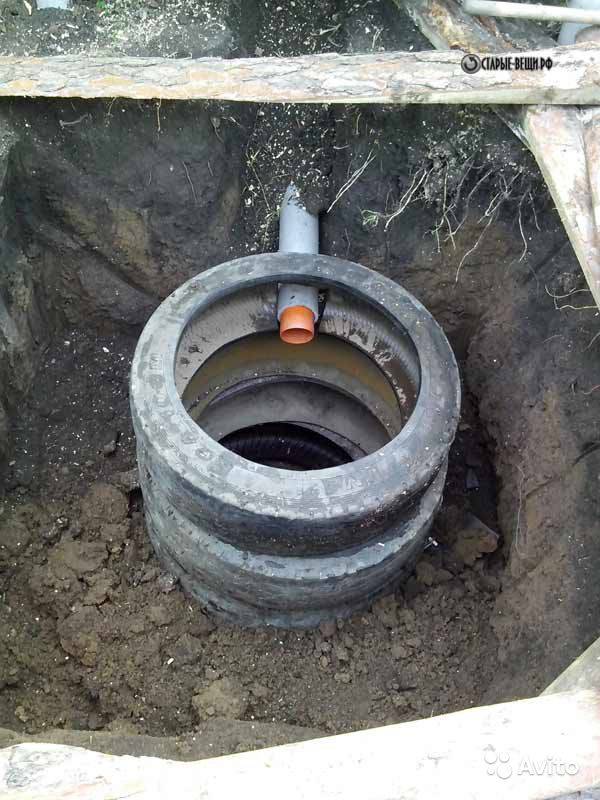



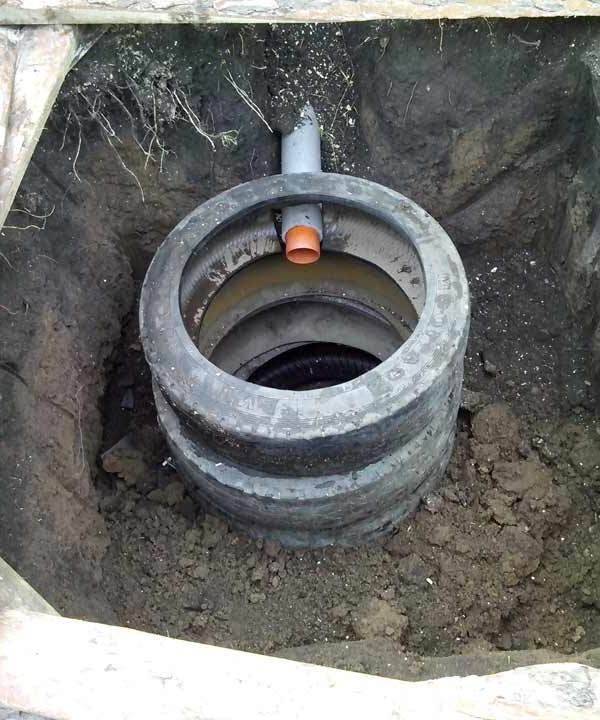
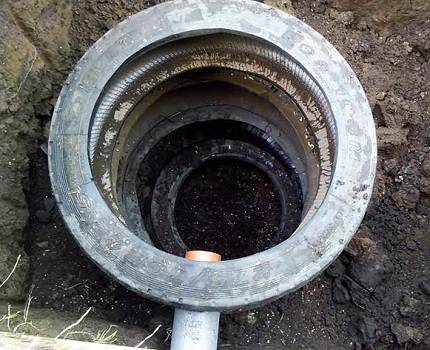
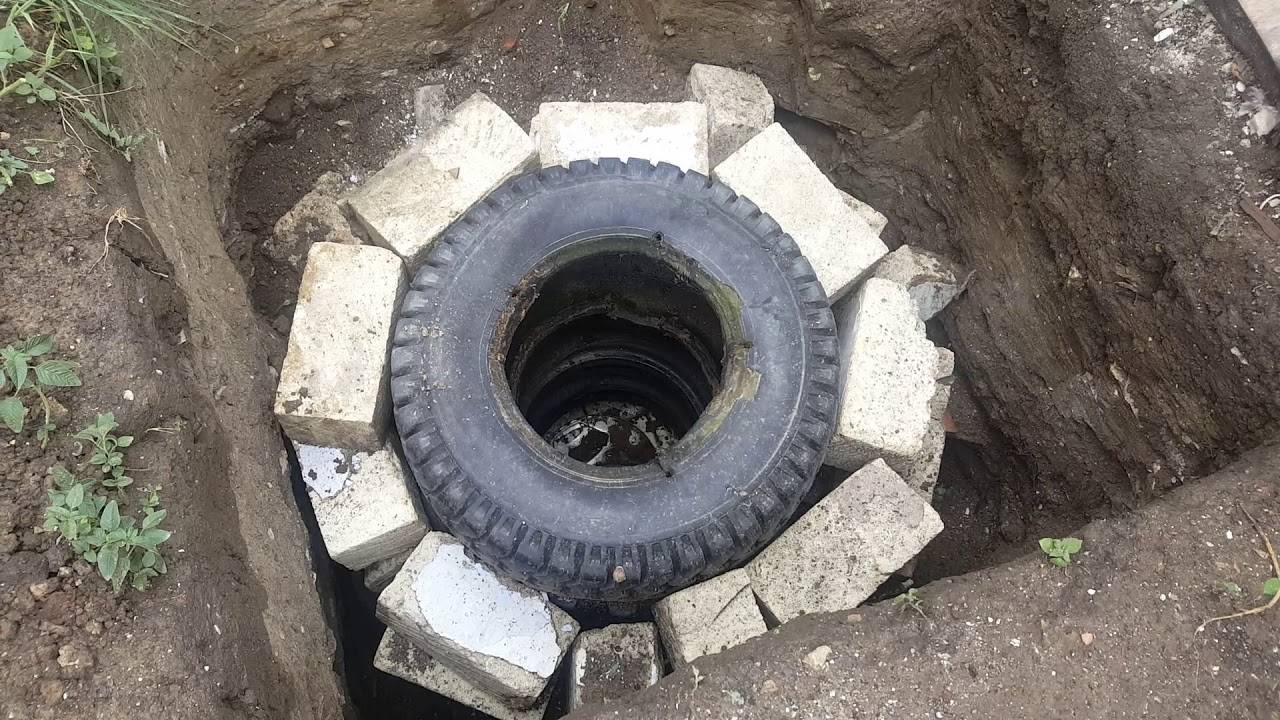
For the construction of an absorbing well, any car tires with a diameter exceeding 1 meter are suitable. The whole process of building a drain pit from tires will take 1-2 days
"Handicraft" sewage treatment plant has a number of negative factors that limit its use:
- Low performance. Even tires of a very large size are not able to provide sufficient volume for the accumulation and removal of wastewater. The absorbing pit made of tires is suitable for a family of two or three people.
- System freezing. Despite the use of heat-insulating materials, in severe frosts, rubber stings, which is fraught with freezing drains and stopping sewerage.
- Bad smell. From time to time, "aromas" of sewage can be heard from the side of the cesspool. To fix the problem, install a fan ventilation pipe and cover the hatch with a tight lid.
- Limited use. The degree of wastewater treatment with an absorbing pit reaches 40% - this is not enough for a safe discharge into the ground. In order not to upset the ecological balance, heavily polluted liquid and fecal matter should not be dumped into the drain pit from tires.
- Insufficient tightness. It is quite difficult to ensure complete impermeability of the joints between tires. With soil movements and after cleaning, there is a high probability of depressurization of the structure - sewage begins to seep into the soil.
Loss of tightness is the most common cause of failure in the sewer system.
Possible solutions to the problem: overhaul of the structure after cleaning or complete dismantling of the rubber well, followed by the construction of a trench from new tires.
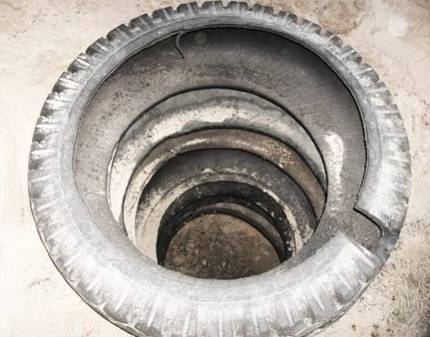
The accumulated sludge interferes with the normal drainage of sewage, so the collector must be cleaned regularly. The cleaning process is very time consuming due to the unevenness of the tank walls
It is advisable to build an absorbing well from tires under the following conditions:
- the volume of the waste liquid does not exceed 1 m3/day;
- the groundwater level on the site is at a depth of 2 m;
- it is preferable to equip a cesspool without a bottom on light, well-drained soils (sand, sandy loam), on heavy substrates (clay), the slope water stagnates.
The construction of a pit is advisable for a summer cottage, a sauna or a bath for seasonal use.
What is important to understand before starting work?
The purpose of the septic tank
A comfortable residential building will differ from all others in that it is equipped with the benefits of civilization. These are resources that are necessary for people to live in a house - gas, electricity, sewerage, water supply. If electricity, plumbing and gas, or rather the problems associated with them, the homeowners somehow try to solve on their own and it even works out well, then sewerage is extremely expensive and will depend on whether there is a main pipe nearby so that you can was to make a drain of sewage from the object of residence.
The difference between a septic tank and a cesspool
Drainage pit and septic tank are not equivalent concepts. These are completely different objects, which have a different target direction.The cesspool is airtight and serves only to fill with sewage. When it is full, the operation of the structure stops. In order to continue using it, you need to call a special sewage machine that will pump out all the contents of the pit. And how different is the septic tank from it. Such a structure is not hermetic.
Please note that waste water that enters a tank with loose walls begins to partially seep through them, and a large amount of water is absorbed into the bottom of the object. The principle of operation of the device
The principle of operation of the device
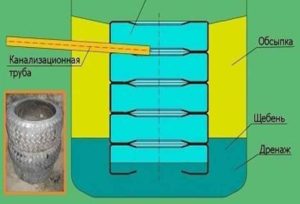 Creating your own septic tank for your home from autonomous type tires instead of sewers is interesting and even useful. What's more, it's even more interesting when the owner of private property wants to carry out his plan using the cheapest building material - worn-out car tires. If you have your own car, then you can collect tires within one day around car workshops, as well as behind garage cooperatives.


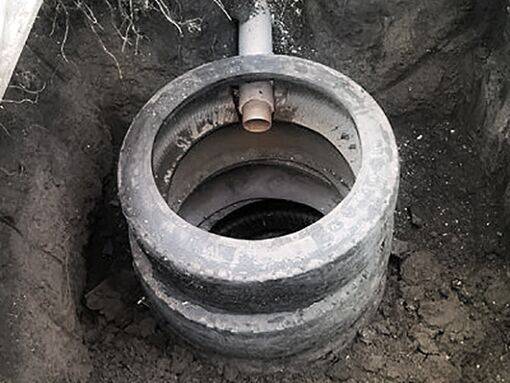


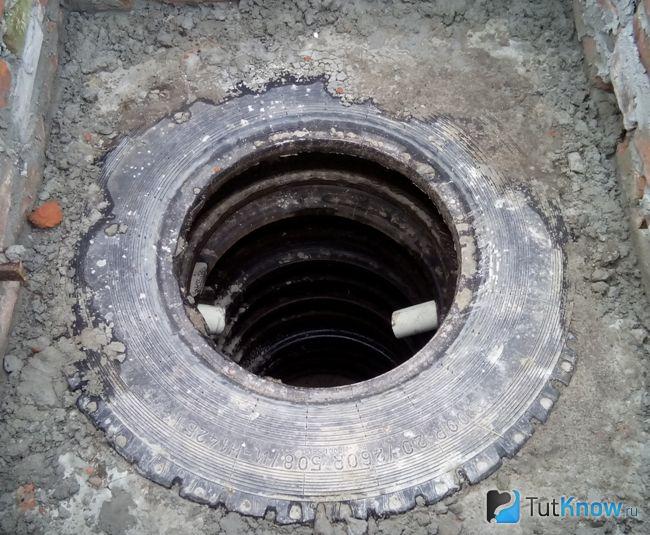

Please note that such a network for draining waste water resources for the home is done using a minimum number of construction tools, materials and equipment. You may not even plan your financial expenses.
It should only take into account one point that such a structure will not be designed for large volumes of fluid circulation. When draining water into a septic tank, which is made of car tires, its level should be constantly monitored.A homemade, self-made septic tank made from waste rubber is considered an autonomous sewer system that performs biological wastewater treatment. There is a container in the ground, which is made from the internal cavities of tires from a car. A sewer pipe should be laid from the house, the installation of which will be done at an angle. The slope of the pipe should be such that it is possible for the waste liquid to drain into the container on its own.
You may not even plan much financial spending. It should only take into account one point that such a structure will not be designed for large volumes of fluid circulation. When draining water into a septic tank, which is made of car tires, its level should be constantly monitored. A homemade, self-made septic tank made from waste rubber is considered an autonomous sewer system that performs biological wastewater treatment. There is a container in the ground, which is made from the internal cavities of tires from a car. A sewer pipe should be laid from the house, the installation of which will be done at an angle. The slope of the pipe should be such that it is possible for the waste liquid to drain into the container on its own.
Sewage in the form of large contaminated particles will simply settle to the bottom surface. Next, the activity of bacteria begins, which will purify the wastewater. Partially purified water will begin to seep through the cracks and the porous bottom between the tires into the earthen walls of the septic tank. More intensive cleaning will require the use of chemicals. They will decompose silt deposits, as well as liquefy them to the maximum.
Use of specialized packaging
Now on the market you can find a specialized container, which is a large barrel. It must be dug into the ground, which will protect you from having to worry about strengthening the walls and sealing. Cesspool barrel pit will cost more than the above options. Special plastic containers for cesspools are light, but large. For their delivery, freight transport is required. Some summer cottages are located in such a way that it is simply impossible to bring a barrel to them due to the complete absence of an entrance.
It should be noted that the cesspool pit of plastic very light and if you pump out all the liquid, then groundwater can squeeze it out of the ground. To prevent this from happening, it will need to be anchored to the screed. It's done chains or cables
For areas where there is not much rainfall, and groundwater is deep, such a precaution is not necessary.
A short video about the construction of a pit from tires
After construction, each cesspool requires special care. It needs to be pumped out periodically. For an open design, this happens less often, but the frequency can be increased even more. To do this, you need to understand what bacteria are processing organic matter. These microorganisms decompose sewage into water and gas. As a result, a purified liquid is better absorbed than a thick slurry. For them to work, it is necessary to limit the runoff of chemical detergents that kill microorganisms.
Now on the market you can find special biological products with a culture of these organisms. By adding them to the septic tank, you can improve the absorption of liquid into the soil.They will also be useful for sealed cesspools, because as a result of work, an unpleasant odor is removed. At the same time, the contents of the drain become more liquid, so pumping out the sewer truck with a pump will be easier and faster.
Add site to bookmarks
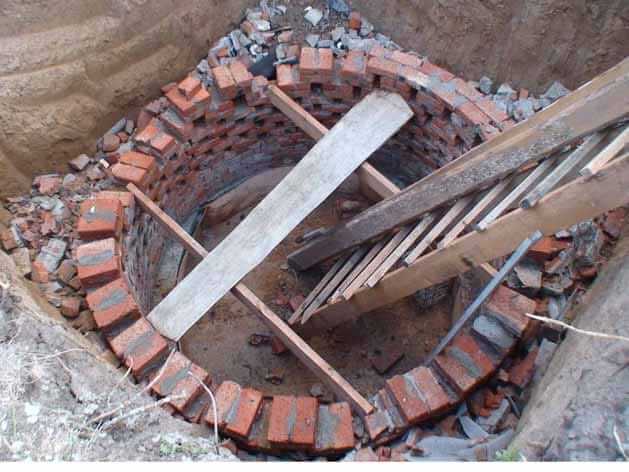
The water collector of a private house can be made of concrete rings or bricks, but it takes a lot of time and effort to install it in the country. A good alternative to such a water collector is a tire drain pit. You can arrange it only in the country, since the volume of such a pit will be small. What are the advantages of a tire pit and how to make it?
Do-it-yourself car tire well
When arranging a well from tractor or automobile tires, it is important to remember that the task of any septic tank is to receive wastewater as quickly as possible. And only then gradually distribute the effluents into the ground, where they are disposed of naturally and do not cause any harm to the environment
It will not be difficult to get car tires, rather the opposite: they will be happy to give them to any car repair shop so as not to pay money for subsequent disposal.
Tires from cars, trucks and special equipment are suitable for arrangement. That is, you do not need to look for a specific size - any tires will fit. The only condition is that all tires must be approximately the same size and thickness.
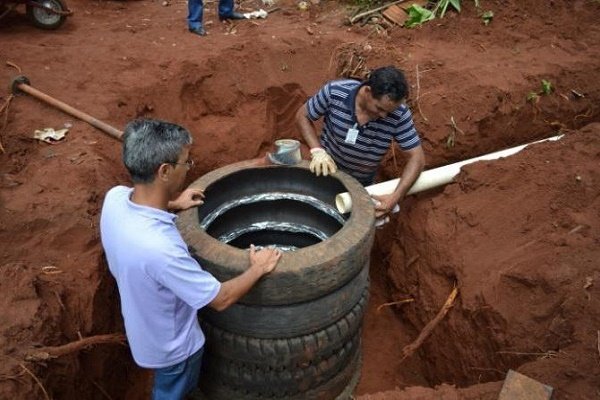


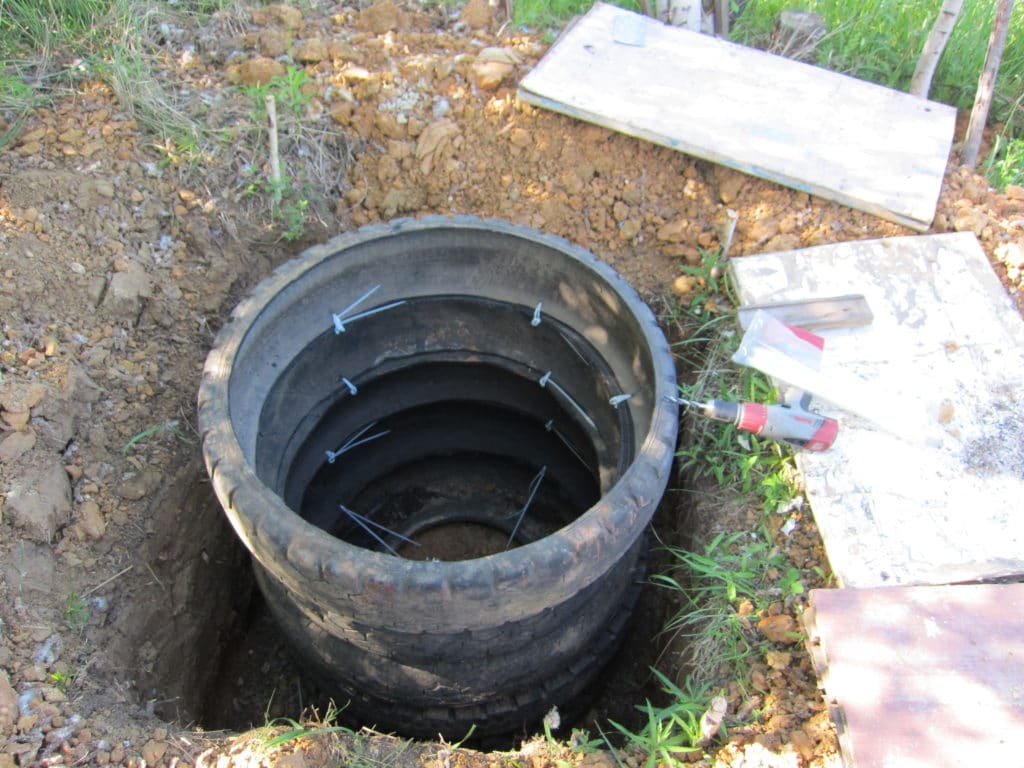
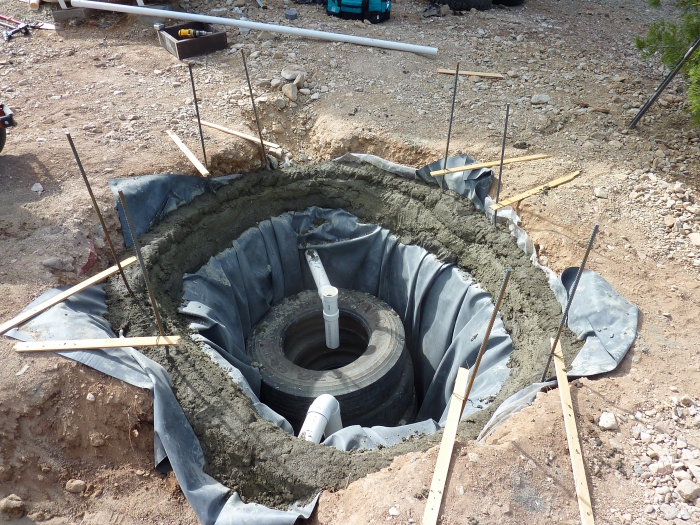
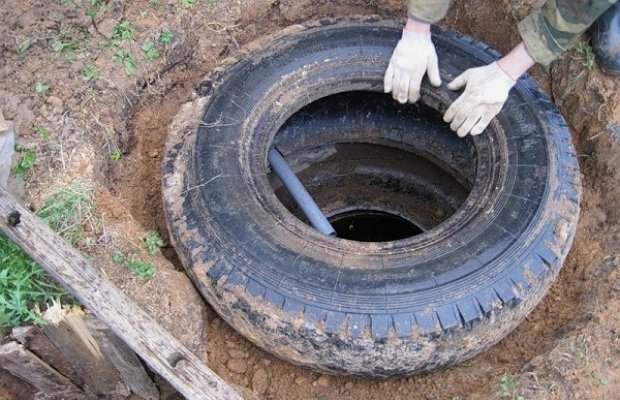


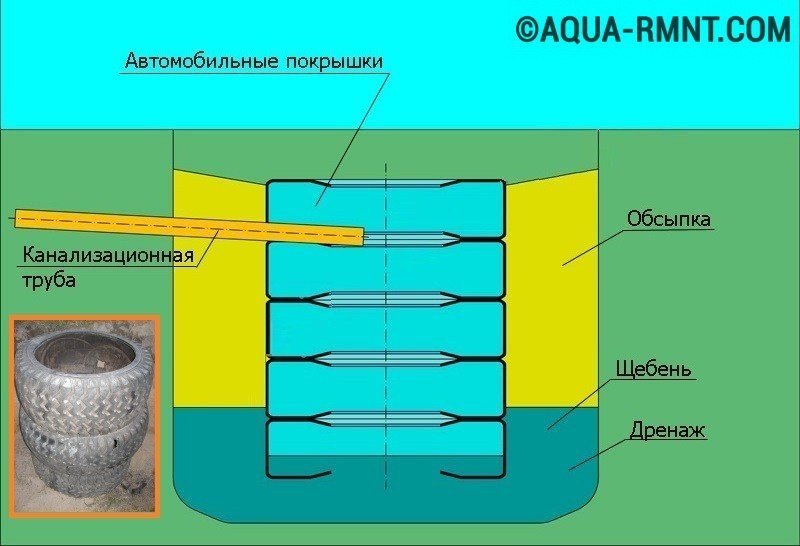
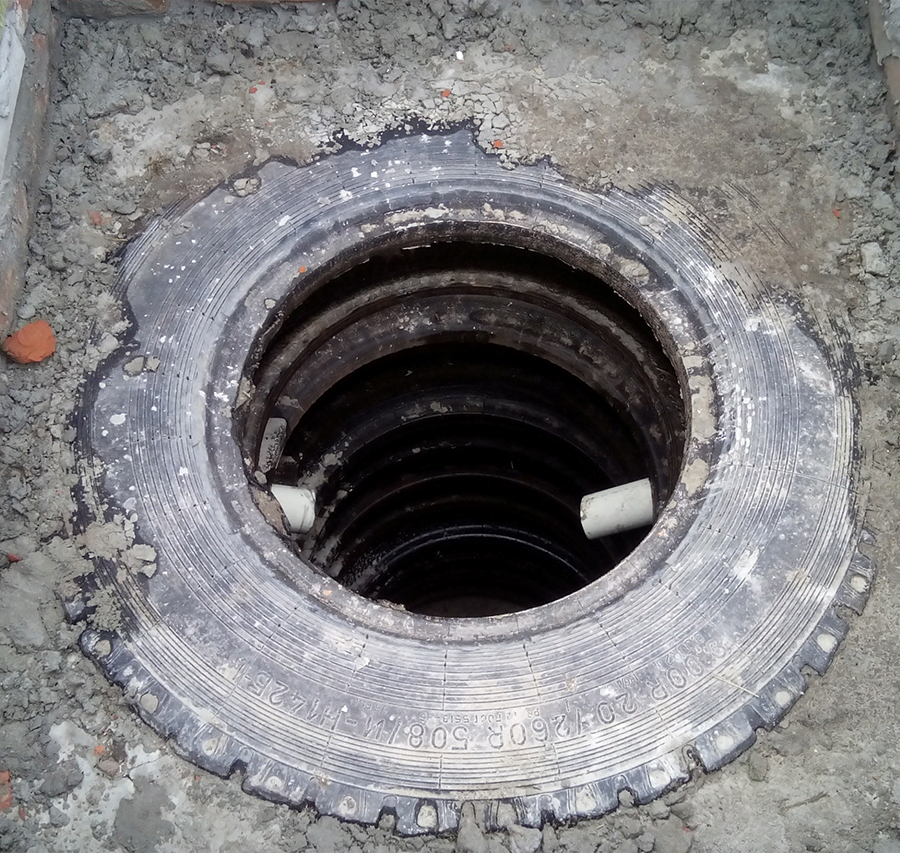
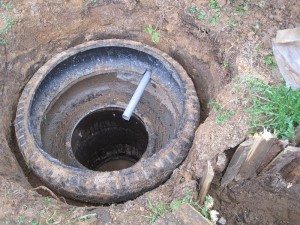
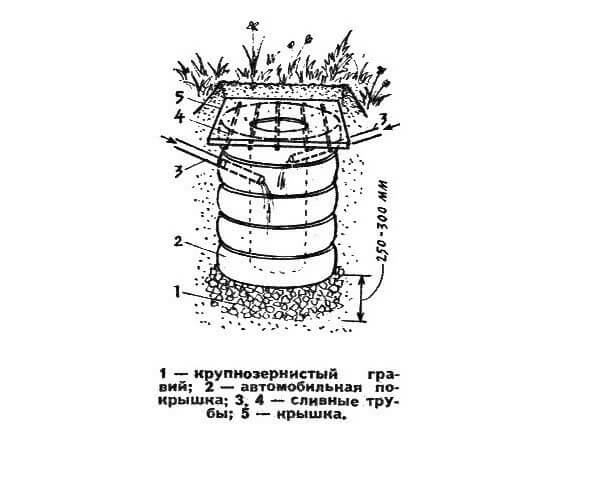
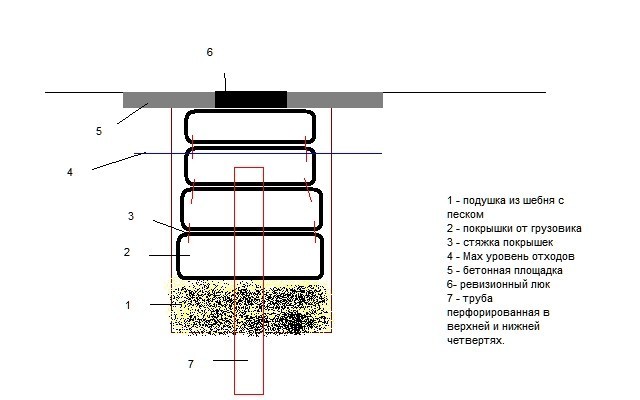
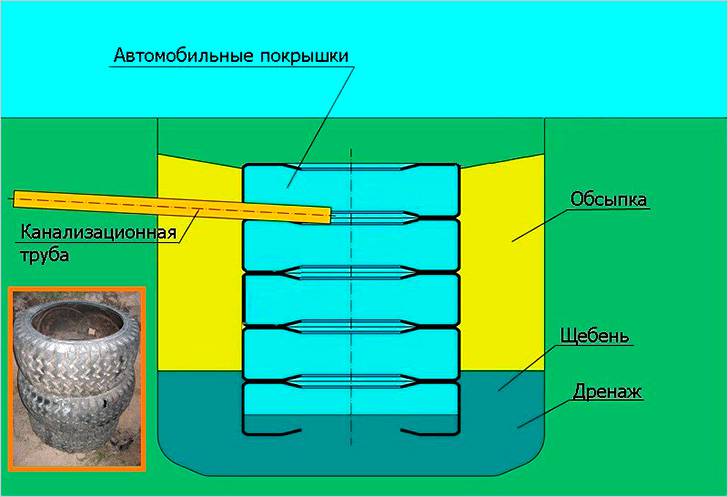
Consider the antiseptic device in the figure. If you look closely, the sewerage from automobile tires is nothing more than a barrel, the constituent elements of which are automobile tires.
It must be remembered that from the drainage and manhole, as well as water wells, the septic tank must be located at a distance of 25-30 meters and no closer than 5 meters from the buried foundation.
Works on the device of a cesspool from automobile tires
To get started, we suggest taking a look at the schematic representation of the final structure below.
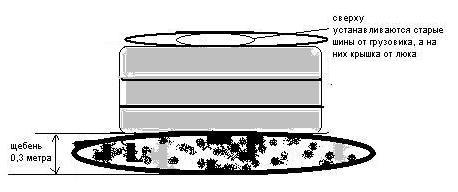
Scheme: how to make a cesspool of tires
Do-it-yourself step-by-step technology for building a cesspool:
- If you want to arrange a toilet with a cesspool on your site, you will need several car or tractor tires. The quantity depends on what volume of the cesspool you consider optimal, on average it is 10 pieces, no more.
Pro tip: If you don't have any old tires, before you buy new cesspool tires, go to a car repair shop. Perhaps somewhere you will be offered to pick up used ones for free.
- Digging of cesspools begins after the preparation of all materials. Put the tire on the ground in the place chosen for the location of the pit, note what its size will be. Start digging, given that the bottom in relation to the future hatch should have a slope. Be prepared for the fact that this work is hard and will take several days. If you do not know how to dig a cesspool correctly, you can resort to the services of a tractor, this will help optimize the process and complete the task in less than an hour.
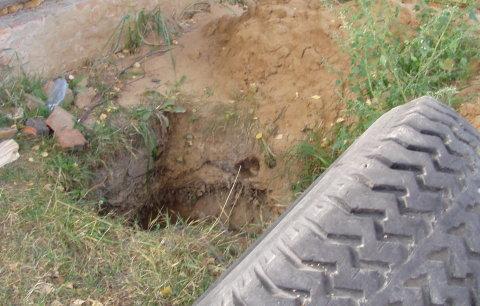
Pit prepared for tires
- After digging the hole to the desired depth, a drainage well is drilled in its center with a garden drill. It is needed in order to enable wastewater to pass, without stagnation, through all waterproof layers of soil.
- A drainage pipe is inserted into the resulting hole, the upper end of which should be 1 meter higher than the bottom of the cesspool. This will avoid clogging the pipe with large particles of wastewater. Holes are made on the sides, through which water will be drained. The holes, as well as the top of the pipe, are additionally protected by a polypropylene mesh.
- The bottom of the pit is covered with large gravel, a layer of 10 cm. Next, car tires are laid out. To ensure that water runs off unhindered and prevents it from accumulating inside the tires, the inner rim is cut off from each tire using a jigsaw.
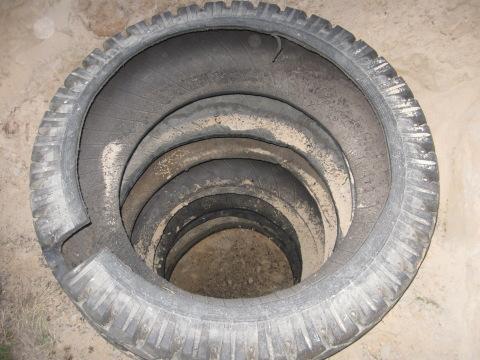
Cutting inner rims
- Then the inlet pipe is installed. An electric jigsaw cuts a hole of the desired diameter on the side surface of the tire.
- Tires should be laid in such a way that the top one is at a slight elevation above the soil level. The voids between the tires and the walls of the cesspool are filled with earth, and the internal joints between the tires are carefully insulated with sealant.
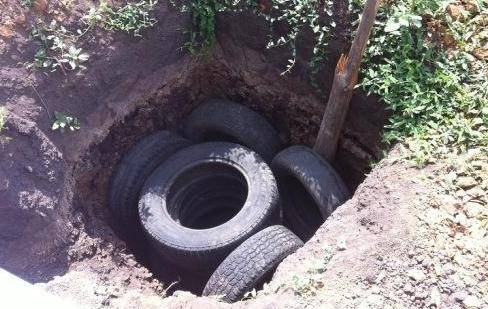
The tire structure can be further strengthened with the remaining materials
Pro tip:
The top layer of soil formed as a result of digging a cesspool is fertile, it is reasonable to use it to create beds on the site. Don't forget to also leave some soil to fill the top of the hole. Unused soil can be safely disposed of.
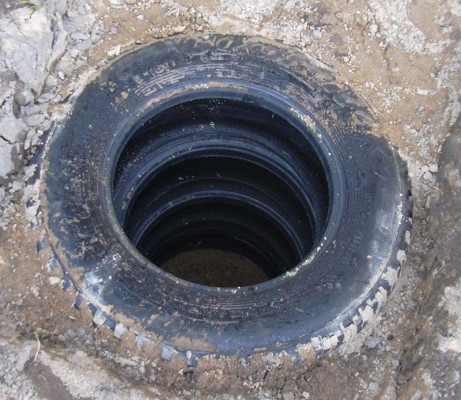


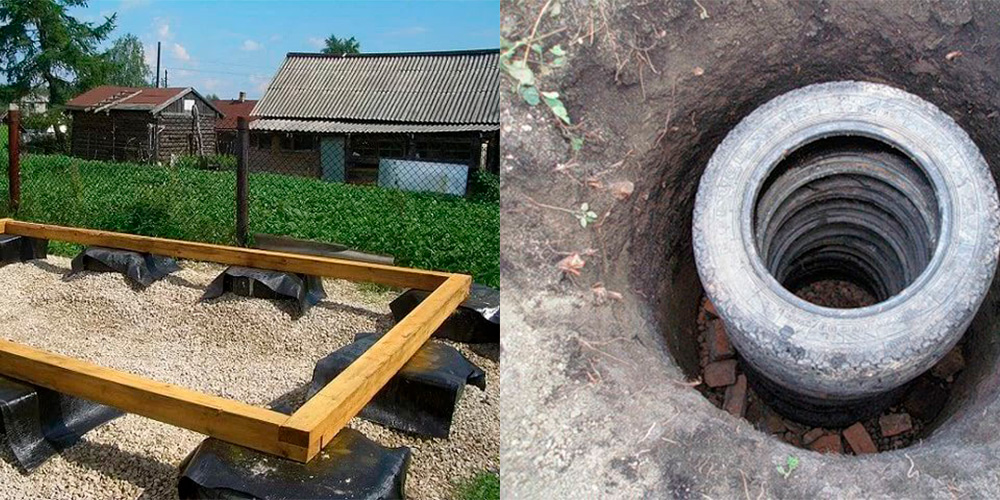

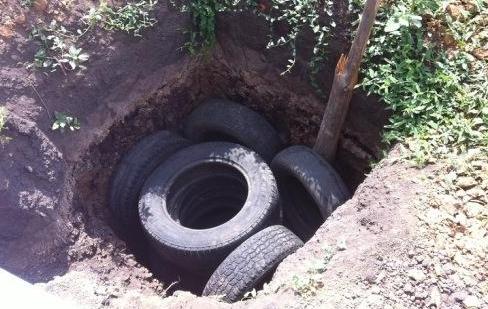
- The top of the cesspool is closed with a hatch - a polymer cover. The system must be well ventilated, for this purpose, build a ventilation pipe that will rise 60 cm above the ground.



