
- Varieties and principle of operation of equipment
- Features of mechanical devices
- Characteristic features of semi-automatic devices
- What are the advantages of automatic drains and overflows
- Criteria for choosing a bath siphon
- Device types
- Simple look or traditional
- Drainage system - semi-automatic
- Tying automatic type
- Technical features of the system
- Helpful Hints
- Mounting Features
- Tips for care and use
- Technical features of the system
- Siphon installation
- Siphon installation: select material and assemble with your own hands
- Applied material and tools
- Pipe classification
- Pipe selection criteria
- Required equipment
- The principle of operation and design of the device
- Preparatory work
- Bath drain: device and varieties
- Instructions for self-installation of the drain mechanism
- Semi-automatic siphon and its best sides
- Conclusions and useful video on the topic
Varieties and principle of operation of equipment
Equipment is needed to drain the used fluid. Thanks to the device, the bath does not overflow with an uncontrolled supply of liquid. The design provides for the presence of 2 holes - in the wall and at the very bottom. Hoses are connected to them, which are also connected to the sewer.
Before choosing a drain-overflow, you need to consider the advantages and disadvantages of all types.
Features of mechanical devices
Mechanical devices are considered the simplest type of construction. They are common, although they began to give way to more advanced models. The peculiarity of mechanical devices is that there are no levers, moving parts. A set of water occurs when the cork is closed, and when opened, the liquid descends.
The advantage of products is reliability. A mechanism of this type rarely breaks, but lasts a long time. The drain hole is closed with a stopper manually. The latter is attached by a chain to the drain grate, which makes it easier to remove it from the hole.
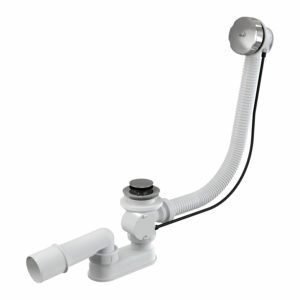
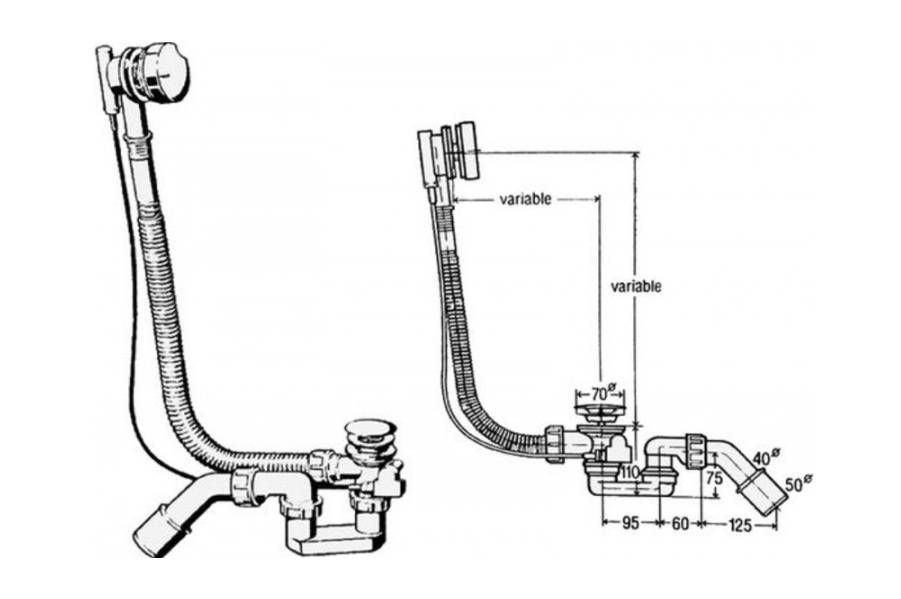
Semi-automatic drain-overflow with chrome-plated control handle, chrome-plated plug and drain grate.
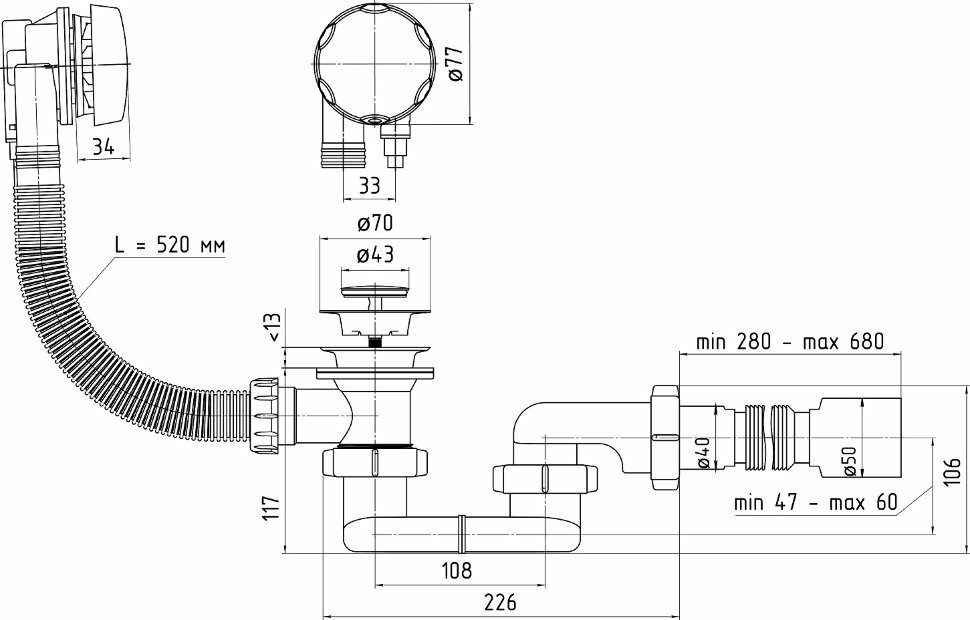
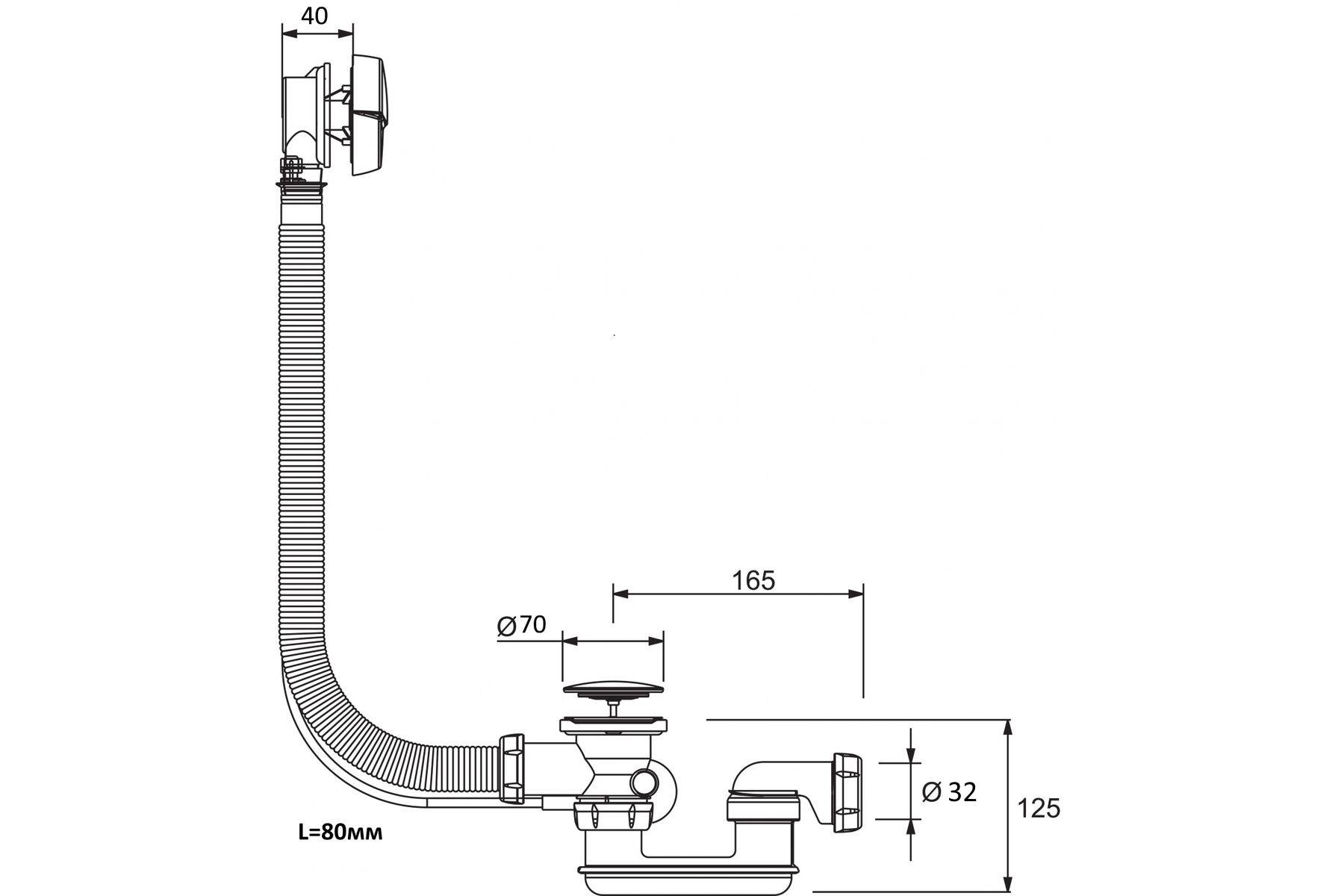
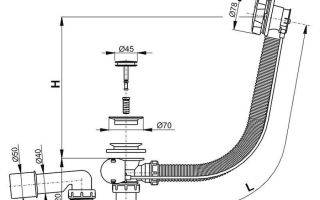
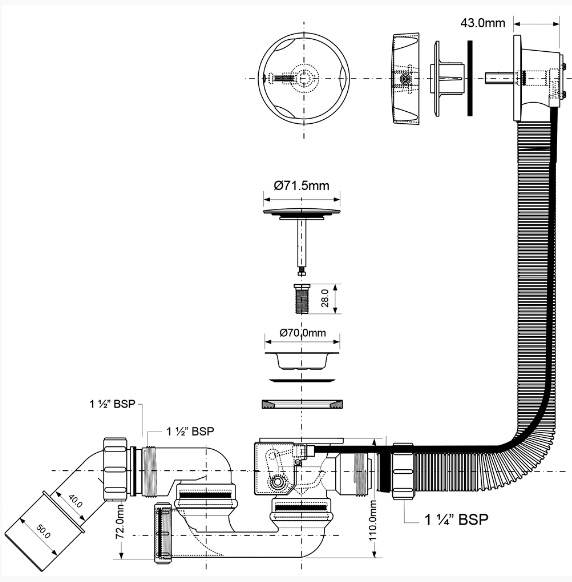
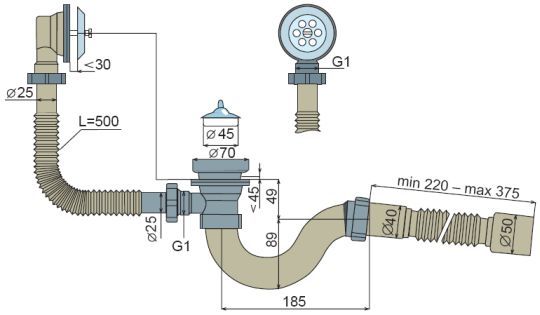
The design of the device is as follows:
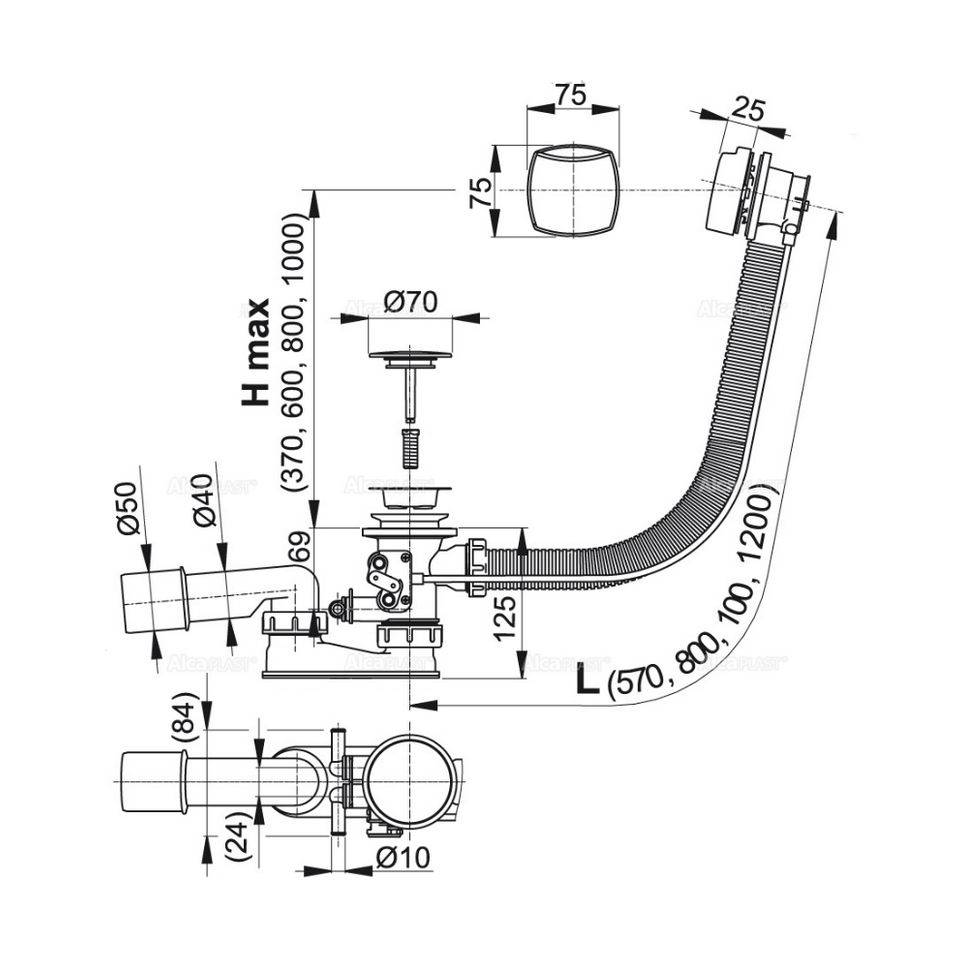
- Siphon. This is an arcuate branch pipe of a removable type, which plays the role of a water seal. It is needed so that unpleasant odors from the sewer do not enter the bathroom. It connects all mechanisms with each other, is responsible for connecting to the sewerage system.
- Connecting tube (corrugated). Serves to divert water that enters the overflow to the siphon.
- Additional pipe. It can be both soft and hard. Responsible for draining water.
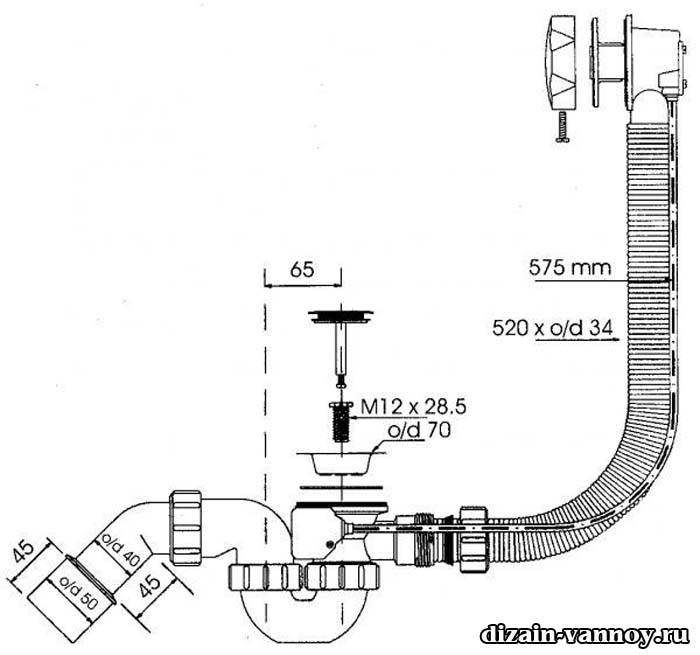
- Drain neck. It is fixed in a hole located in the bottom. Represents the chromeplated steel funnel helping to detain large particles of pollution. It is mounted on an expanding branch pipe equipped with a built-in nut. Docking of parts is carried out through a reinforced metal screw. The rubber gasket is responsible for the waterproofness of the device.
- Overflow neck. This is the part of the product that is inserted into the wall of the bathroom.The principle of construction is the same as that of the drain, the difference is in the way it is installed.
The kit also includes connecting elements that are needed to increase tightness. For example, flat or cone type gaskets. They are used together with a union nut.
In addition to reliability and durability, the advantages of mechanical systems for the bathroom are low cost, simple assembly. But there are disadvantages, such as rapid wear of the seal.
Characteristic features of semi-automatic devices
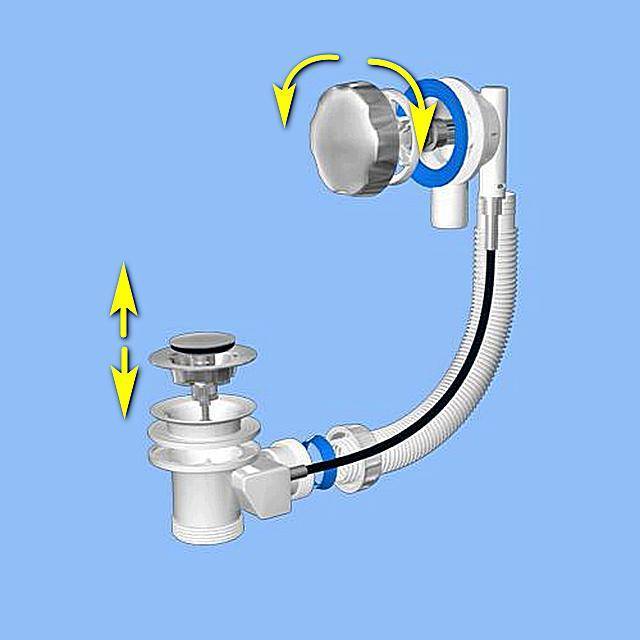
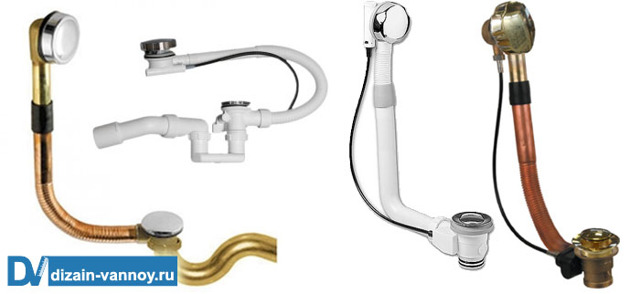
The semi-automatic is considered an advanced modification of the mechanical design. The number of elements in this system is much larger. In addition to traditional components, a control unit is provided, which is responsible for raising and lowering the plug. The system is equipped with a cable, a shutter valve. The latter opens or closes depending on the position of the closing rod.
The control unit consists of several parts. It is equipped with a valve, a handle, a rotary ring, a button. To start the system, you need to turn the lever, and in some models, press the element in the form of a button.
Advantages of semi-automatic types:
- attractive design;
- a convenient way to close the drain - no need to bend down, wet your hands;
- user-friendly installation, operation and maintenance.
But such systems are more expensive than mechanical ones.
What are the advantages of automatic drains and overflows
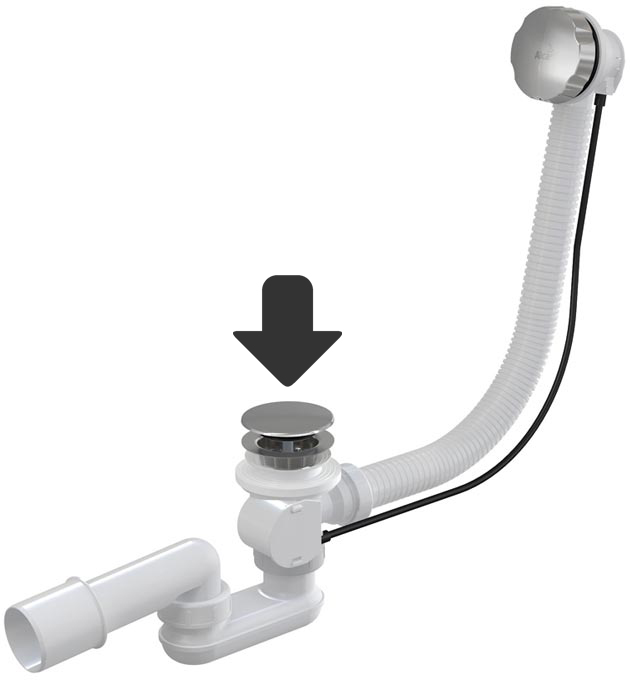
Automatic is an expensive variety. It has a complex structure. There is a button-valve "click-clack", which is equipped with a latch, built-in spring. As in semi-automatic systems, the button is pressed manually. Then the plug falls, the drain hole closes. If you repeat the manipulation, the hole will open.
Buttons of this type are designed in different styles. The most popular option is metal. Nickel or chrome plated brass and copper alloys are often used.
Advantages of machines:
- attractive appearance;
- ergonomics with care for user comfort;
- convenient descent of water;
- compactness.
The main disadvantage is the high cost. In addition, it is difficult to connect such a drain-overflow on your own, here you need the help of specialists. Difficulties may arise when replacing a button. Such systems are characterized by the vulnerability of the valve spring.
Drain-overflow from polypropylene differs in the democratic price, durability and durability of elements.
Criteria for choosing a bath siphon
What should I pay attention to when buying a bathroom siphon? There are several rules, guided by which we can purchase the product you need.
Not all bathtubs will fit standard drains. In particular, this rule applies to custom-made bowls. Before you go shopping, measure the gap from overflow to drain and the diameters of the drain holes. If the corrugation can be stretched a little, then the metal model must be selected, strictly taking into account the dimensions of a particular bath.
The design of the siphon should not be pressed very tightly against the floor or the bottom of the bowl. If the gap under the bathtub is too small, try to find a flat model that has a horizontal layout.
As a rule, a siphon in the bathroom is needed not only for a bath. If a bidet, a washbasin and a washing machine are also located here, then the drain devices from all these plumbing fixtures can be replaced with a single model, which will have several inlets.
The price of the product should not be decisive in your choice
It is important that the siphon is reliable and of high quality. Then it will protect your property from possible leaks.
Check the product for completeness: all the elements that are necessary to connect the siphon to the bath bowl and to the sewer drain must be included in the set
It is also worth inspecting the device to make sure that there is no damage on it that can significantly reduce its service life.
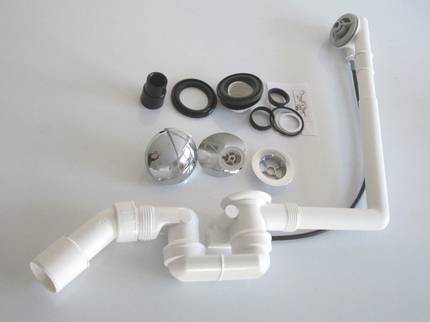 The completeness of the siphon must be checked before its purchase: the kit must include all the elements necessary for the assembly of the device itself and its installation
Make a choice, guided by all the rules listed above, without excluding any
Pay special attention to modern models, because this device should last you a long time.
Device types
The well-known piping, when water is drawn into the font with a closed hole with an ordinary cork, is called traditional. For convenience, the cork is usually on a chain.


Simple look or traditional
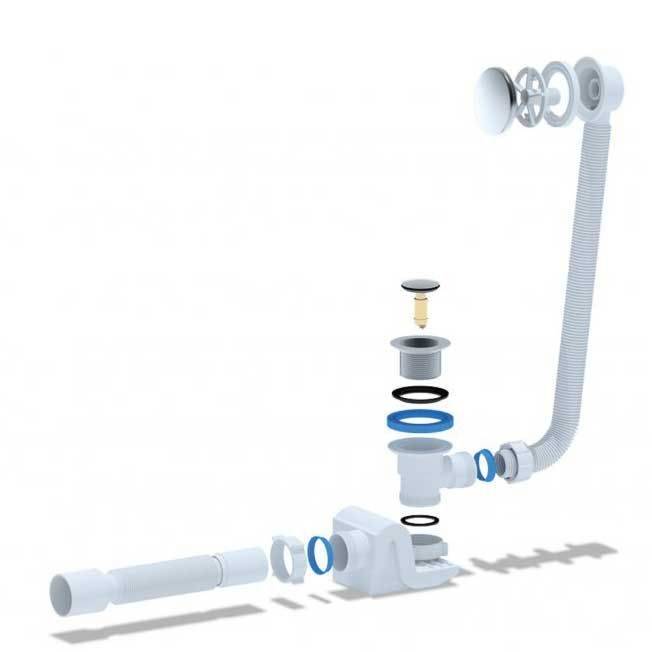
The drain device in the traditional bathroom can be decomposed into spare parts:
- at the bottom of the font is the first element of the device - the drain neck. The element itself consists of 2 halves: the bottom is represented by an expanded pipe (located below the font bowl) and equipped with a built-in nut; top - in the form of a chrome-plated bowl (located above the font bowl). These two parts are pulled together with a special long connecting screw. For the tightness of the connection between the parts, a sealing gasket is installed;
- on the wall of the font, a side drain of the water supply network is connected to an additional hole - an overflow neck.In the side outlet, the difference is in the device with a drain neck. Its direct purpose is to eliminate the overflow of the font. But you can not leave the process of filling the bath without control. If the pressure in the tap is strong, then the overflow may not be able to cope, the flood cannot be avoided;
- prevents unpleasant sewer odors from entering the room - siphon. Occurs due to a water plug in the bend of the pipe. A siphon with a bend, where 300-400 ml of liquid is placed, provides the drain system with a high-quality water seal;
- connects an additional side drain to the siphon - a connecting hose. More often it is a corrugated pipe. When the bath bowl is full, water is drained through it from the overflow into the siphon. With a simple overflow drain design, the connecting hose is pulled onto the desired nozzles without special fixing fasteners. When a siphon with an overflow is installed of a more serious design, the hose is mounted with a gasket and a compression nut;
- the discharge of the waste liquid from the siphon to the sewer occurs through the outflow pipe. A corrugated pipe or a rigid structure is installed. The first option allows you to adjust the length as needed, the second type of pipe is more reliable.
Knowledge of how the drain in the bathroom with overflow is arranged will be useful in the future. Lots of people have had to deal with seal replacements. You can easily disassemble the drain system, but you also need to know how to assemble it into a single whole.
Drainage system - semi-automatic
An improved drain-overflow model includes a semi-automatic device. All modifications of the drain system have common elements: a drain siphon, drainage pipes.The semi-automatic type bath drain has changed structurally. Elements appeared:
- with the help of a button, a valve, a handle, the plug is lowered and raised. The new control unit regulates the opening and closing of the drain hole on the bottom of the tub;
- plugs are installed instead of the valve;
- the movement of traffic jams occurs with the help of a cable.
The scheme of operation of the control unit is the operation of a chain of interconnected elements:
- the valve is turned by hand, which makes the cable move;
- from tension or relaxation of the cable - the cork rises or falls.
The overflow hole in this design is hidden behind the control unit. The elements of the drain-overflow system that are visible look aesthetically pleasing. This gives the design of the bath a unique design. Installing a drain in a semi-automatic type bathroom has another plus - it is the comfort in closing and opening the drain hole. The device makes it possible not to bend over to remove the cork and release unwanted water.
The disadvantage of the selected drainage system is also noted. Only a harness bought at a high price will last for a long time. It is better to immediately replace an inexpensive model with a traditional type of strapping.
Tying automatic type
The difference between the strapping machine is the presence of an automated plug-valve.
Scheme of operation of a plug equipped with a spring with a latch:
- the initial pressing of the plug leads to the closure of the drain hole on the bottom of the bath;
- pressing again causes the plug to rise and water begins to drain into the free space.
The automatic design is mounted on baths for children. The system can be controlled by hand and foot. Elements open to the eye are compact. Buttons are made from different materials and in different designs.It is used for the manufacture of brass, the element is covered with chrome, antique. The button becomes the decor of the bath.
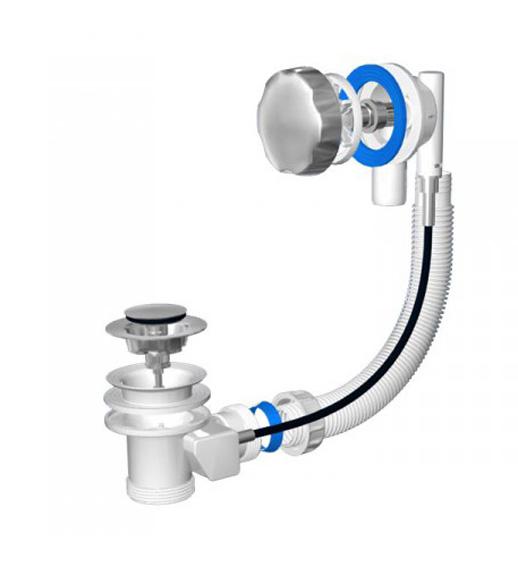
In order to avoid problems in the operation of the button-valve, it is recommended, before making a drain in an automatic type bathroom, to study and choose a reliable brand that works with quality material. Otherwise, if the valve button breaks, you will need to replace the entire drain-overflow device.
Technical features of the system
The bath overflow drain is a closed system of pipes, one end of which is connected to the drain on the side of the bathroom, and the other to the outlet to the sewer.
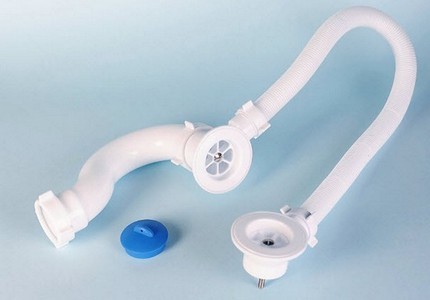 Hermetically interconnected pipes must be equipped with a siphon, the key task of which is to prevent the spread of an unpleasant odor in the room
The main elements of modern overflow systems for the bath are:
- Drain neck. It is made of two halves: the upper part is a chrome-plated funnel that acts as a “trap” for large debris, and the lower part is an expanding pipe equipped with a nut inserted inside. The element is mounted in the drain hole at the bottom of the bowl.
- Overflow neck. It has the same design as the drain neck. The only difference is that the water outlet is not located directly, but on the side.
- Siphon. Easily removable curved pipe serves as a water seal. It can have a different configuration and capacity.
- Connecting hose. The corrugated pipe is designed to divert water from the overflow neck into the siphon. It is connected to the elements of the system by means of special pipes without crimps or using a crimp nut equipped with a gasket.
- Auxiliary tube.It is a rigid or easily bending corrugated pipe designed to connect a siphon to a sewerage system. Drain fittings with a rigid pipe are more reliable, but not very easy to install.
When choosing a strapping, pay special attention to the volume of the water seal. If at some point the ventilation of the sewer riser cannot function properly, due to the resulting excess pressure, water from the damper will begin to be drawn into the drain
As a result, an extremely unpleasant persistent odor will appear. A siphon with a water barrier bowl volume of 300 cm3 or more will not allow the smell to spread into the room.
Helpful Hints
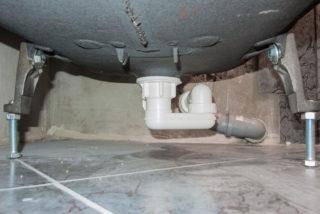
First of all, you need to choose the right siphon. Its main characteristic is the quality of the material. This is especially true for plastic products. Here the main indicator is the wall thickness. The larger this value, the better the load resistance.
Other recommendations:
It is necessary to determine the space under the bathroom - whether the siphon will fit there or not.
Before assembling, read the instructions from the manufacturer
Follow his instructions exactly.
If the drain hole on the bathroom has a rough surface, sand it with sandpaper
This also applies to cast iron plumbing fixtures and acrylic.
When assembling, pay great attention to gaskets and cuffs.
They often cause leaks.
The siphon is a gravity flow device, so it is important to maintain the slope of the pipe part.
Seals are recommended to be changed at least once a year.
They often cause leaks.
The siphon is a gravity flow device, so it is important to maintain the slope of the pipe part.
Seals are recommended to be changed at least once a year.





Mounting Features
It is not recommended to leave large sections of the siphon drainage system unsupported. Suspended structures experience small variable and thermal loads, however, as the gaskets age, unwanted leaks can form in the joints.
- To improve the reliability of connections, drain designs with union nuts are recommended.
- In the absence of reliable and durable silicone gaskets, it is allowed to extend rubber analogues pre-treated with silicone grease.
- Silicone cone gaskets will work effectively if they are properly installed, in this case, the thick edge towards the union nut, and the thin edge towards the end of the nozzle.
Tips for care and use
All drain-overflow systems need proper care. This is the only way to preserve their original state and performance, to ensure durability and high efficiency. Devices must be regularly inspected to make sure there are no mechanical damages or leaks.
Also, do not forget about additional events:
- to prevent the accumulation of deposits and scale, the siphon is washed every three months with hot water with the addition of citric acid or suitable chemical oxidizing agents;
- approximately every six months, thinned rubber gaskets that have lost their elastic properties are replaced;
- the water lock is periodically cleaned, collecting various contaminants and debris.
If chips and cracks are found during visual inspection, the siphon must be replaced. Such malfunctions provoke flooding of the premises and cannot be repaired.
Technical features of the system
 Drain-overflow for bathroom
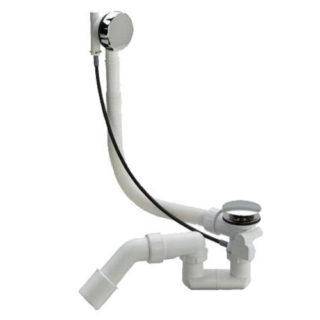
The design of the drain-overflow consists of branch pipes tightly connected to each other and providing the necessary tightness. When the water reaches the appropriate opening with an uncontrolled supply, the excess flows into plastic or flexible hoses and exits through the sewer pipe. A corrugated tube is a practical option, as it can be bent and led out in any direction in a small area. The device is equipped with a siphon to protect the bathroom from unpleasant odors coming from downpipes.
External parts of the system are made of stainless or galvanized steel, which corresponds to its high quality and durability.
When buying a system, you should pay attention to the high-quality performance of all elements and mechanisms, as well as the presence of special seals and cuffs. If they are absent during operation, serious leaks often occur due to insufficient tightness of pipe connections.
They can be purchased separately by the diameter of the coupling or pipe.
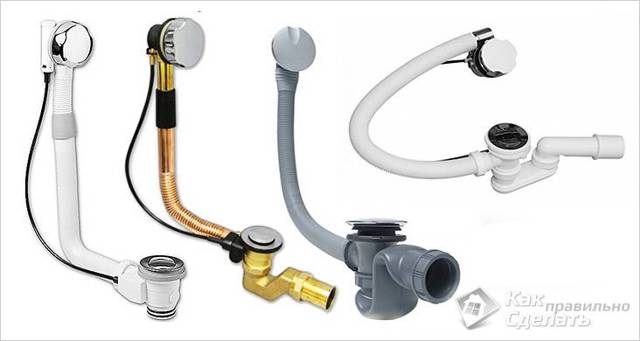
Today, a wide range of bath drains is presented, the prices of which depend on technical features, material and equipment. Manufacturers produce standard plastic versions, as well as models made of expensive metals with ornaments or engravings. There are such types of drain-overflow systems:
- ordinary siphon with a plug;
- semi-automatic system;
- automatic drain mechanism.
A certain type has advantages and disadvantages, but their use depends on the design features and individual needs.
Siphon installation
If you know how to assemble a sink siphon, you can get the job done quickly. Before installing a new siphon, it is necessary to dismantle the old device.
Siphon complete set
The dismantling process is carried out in the following sequence:
- Water is shut off in the room.
- A bowl is placed under the sink to collect the flowing water.
- The screw located in the center of the sink inlet is unscrewed.
- The siphon is removed, and the sewer pipe is plugged with something to prevent the passage of foreign odors into the room.
- The inside of the sink, to which the siphon was attached, is cleaned.
How to assemble a standard bottle siphon for a plastic sink is shown in the video.
Now let's figure out how to install a siphon for a sink with an overflow:
- Install the protective grill in the drain hole on the gasket or sealant.
- From below, a docking pipe is attached to the sink along with a gasket, which is screwed to the grate with a long screw.
- A union nut is put on the branch pipe, and after it - a conical gasket.
- The body of the siphon is put on the pipe, after which it is joined to it with a union nut. At this stage, the height of the siphon is adjusted.
- The outlet pipeline is inserted into the sewer hole, and then fastened with a union nut to the housing outlet through a cone gasket. Siphon connection to the sewer
- The overflow pipe is installed. One end of the tube goes into the sink, where it is fastened in its special hole with a screw. The other end of the tube is connected to the docking pipe.
- The tightness of all connections is checked by running water into the sink.
If a washing machine will be connected to the siphon, then you first need to prepare a hose that goes from the washer to the siphon body. It should be long enough, because you need to place it not on the aisle, but somewhere under the bathroom or along the wall. Accordingly, the hose is connected to the fitting on the siphon body.
Siphon installation: select material and assemble with your own hands
Pressing the bulb a few times isn't difficult, but changing the batteries in the siphon is an added headache. And what happens if the electric motor still breaks down….
Battery siphon with mechanical filter
The siphon for cleaning the aquarium is not used only if the aquarium is completely planted with plants. First, I can't imagine how you can siphonize, for example, chemanthus cuba or Eleocharis.
This will inevitably lead to damage to aquarium plants. Secondly, all the sediment that accumulates in the soil is food for aquarium plants. I have not poured the soil for many years, the floors were completely dirty, but now it seems to me that the root will be on my soil.
But still, if there are areas in the aquarium in which plants do not grow siphonized, soil is necessary.
The soil exceeds the number of fish in the aquarium: from once a week to once a month. The soil siphon is suitable for combination with partial water changes - 20% of the sediment is dried, 20% of fresh water is added.




It is not difficult to make a siphon for cleaning the aquarium with your own hands. To do this, you need a hose and a plastic bottle.
on the bottle we cut off the bottom and connected the door to the tube. It is not easy to fix the pumping bulb, so the pipe must be removed to create back draft.But, in my opinion, an aquarium siphon is not equipment that is worth saving less than 100 rubles. It's better to buy ready-made, cheap ones, and you'll be served for years.
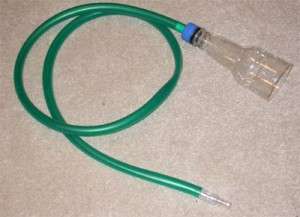
Internal siphon
When choosing a siphon, it is necessary to take into account the diameter of the pipe, the larger the diameter of the pipe, the greater the pressure of the water flow.
And if you have a tank of 20 liters, then you don't have time to phon the whole earth faster than to combine all the water in the aquarium :). A 100 liter aquarium fits well with the pipe diameter in centimeters. The siphon process alone will collect about 20 percent of the water needed for water replacement.
Applied material and tools
Pipe classification
Currently, sewerage is laid only with the use of plastic pipes.
They have undeniable advantages:
- small weight;
- long service life (guaranteed up to 50 years);
- ease of installation (no special equipment is required for cutting and joining).
There are a couple of types of material:
- from polypropylene;
- from polyvinyl chloride;
- from polyethylene.
The last two varieties are not used for sewerage installation. polypropylene pipes are best suited, since they can withstand high temperatures of the liquid passing through them without trouble.
When buying, pay attention to the marking:
- Pipes with the letter "A" are used for the manufacture of ventilation systems. Their walls are thin.
- Pipes with the letter "B" have thick walls and are great for sewer systems.
Pipe selection criteria
The main parameter by which pipes are selected is their diameter.But many manufacturers show external dimensions, while the parameters of the hole itself are serious for sewers.
The minimum pipe size for various plumbing fixtures is shown in the table.
| device | Diameter, mm |
| Washing machine and dishwasher | 25 |
| Bidet and sink | 35 |
| Shower cubicle, bath | 50 |
| Connecting multiple devices to one drain (bath plus sink) | 70 |
| Toilet and central riser | 100 |
Another issue is length. On sale there are products from 1 to 6 meters. Experience says that it is most ergonomic to work with pipes 2-3 meters long. The footage should be selected taking into account the connecting elements (fittings) used.
Required equipment
For a sewer system in a standard bathroom, you will need:
- sewer plastic pipes with a diameter of 50 to 100 mm;
- sealing cuffs for fixing parts of the system;
- plastic fittings of the desired configurations (twins, tees, elbows and without that later);
- compensator (its diameter for an apartment should be 110 mm);
- clamps - help to secure sewer pipes and give them the desired slope;
- a hatch that allows you to control the state of the riser;
- sealant;
- cement mortar.
In addition, the following tools make the work much easier:
- grinder;
- hammers;
- chisel;
- building level;
- measuring tape (roulette);
- marker.
The principle of operation and design of the device
A standard bath piping is essentially a more complex design than a conventional siphon. It is equipped with a special tube and controls that are attached to the overflow hole.
Thanks to the pipe, excess liquid is drained into the siphon, which prevents the bathtub from overflowing and overflowing water.
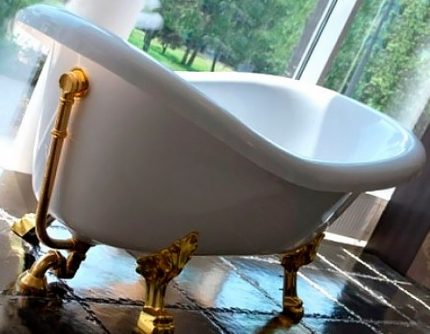
Such a system eliminates the need to close the drain hole with a plug. It also allows you to adjust the outflow of liquid so that its amount is equal to the volume of incoming water. This allows you to take a bath while basking in running water.
The drain-overflow system also makes it possible to control the outflow of water. To do this, a rotary handle is mounted on the overflow hole, connected with a small metal cable to the drain valve, which is installed in the lower siphon.
By turning the handle in different directions, you can adjust the tension of the cable, which in turn affects the throughput of the siphon drain.
Preparatory work
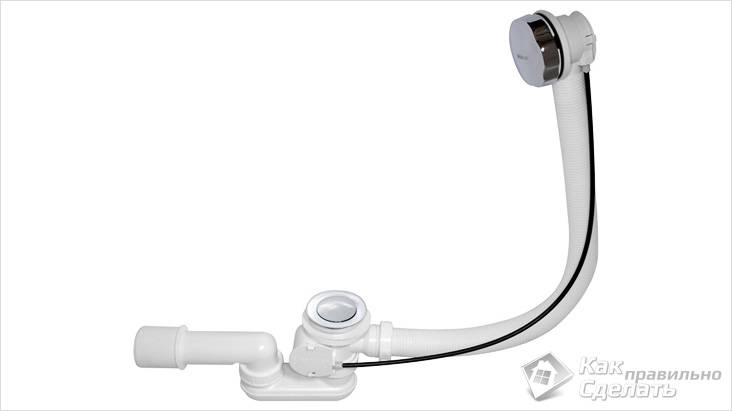 Bath siphon with overflow
First of all, you should perform a number of preparatory work. Also consider what material you will use to connect the bath to the sewer. It is recommended to connect the bathtub only with a siphon. It has a special system and nodes that allow you to connect the overflow and drain holes into one whole. It is not recommended to use only corrugated pipes. Why?
- corrugated hose is poorly cleaned of possible contaminants;
- they quickly fill up with various kinds of pollution.
Before direct connection, it is important to achieve an appropriate height difference between the connection point and the drain pipe. The height of the outlet of the siphon must be sufficient to ensure a good outflow of water.
It is equally important to provide free access to the already installed siphon. From time to time it will need to be cleaned from internal contaminants.
If it is in a hard-to-reach place, it will be difficult to do this job.
Bath drain: device and varieties
Let's start with the siphon device, since without this knowledge it is impossible to solve some purely domestic problems, for example, such as an unpleasant smell from the bath or poorly draining water.
The siphon in the bathroom is arranged quite simply. It can be divided into four separate parts - maybe more, if you take into account additional connecting elements, which are of no particular importance, except for the convenience of assembly and connection.
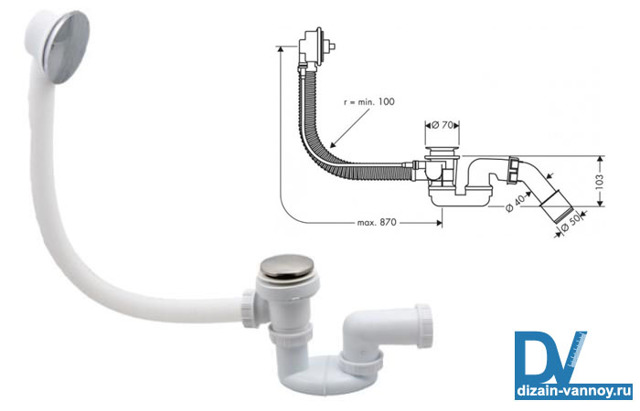
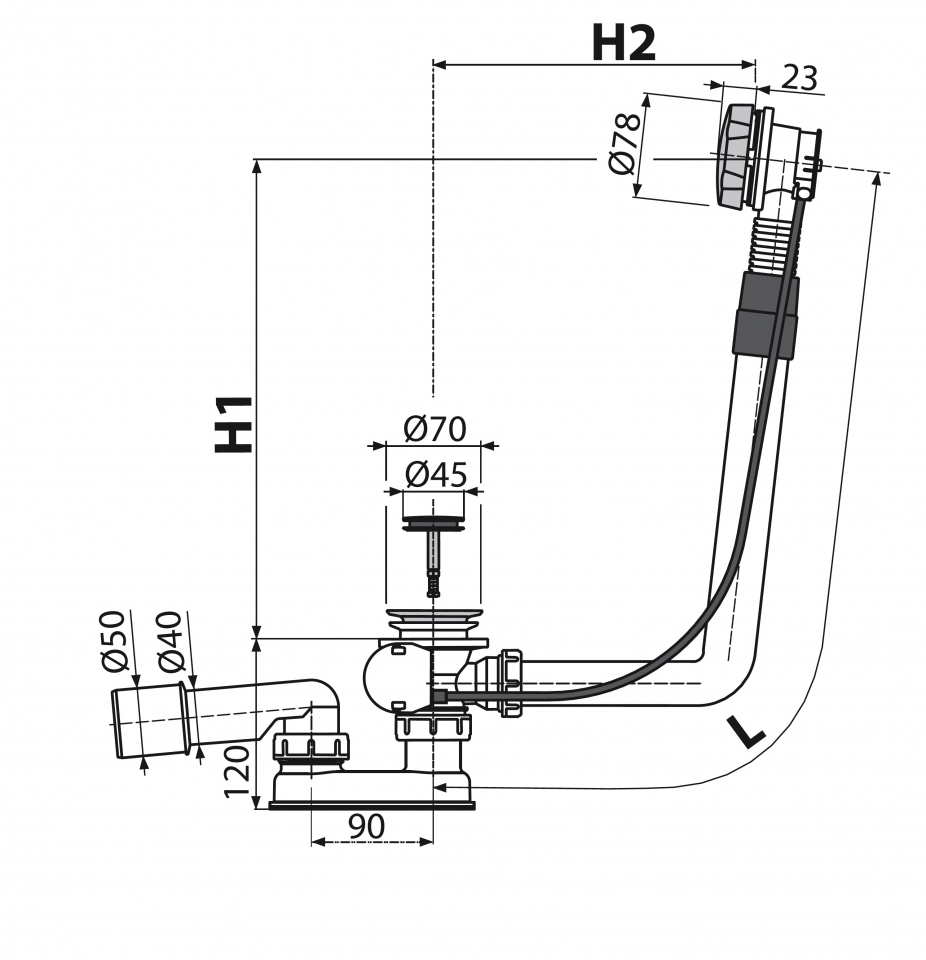


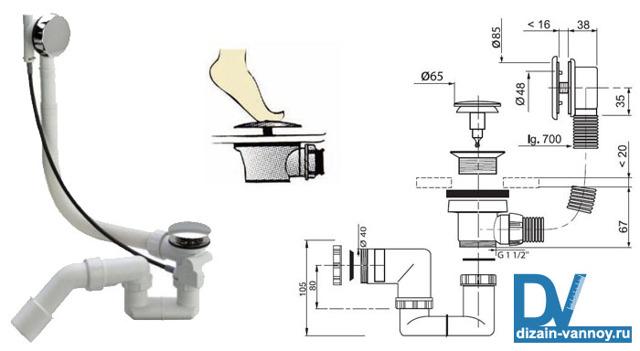

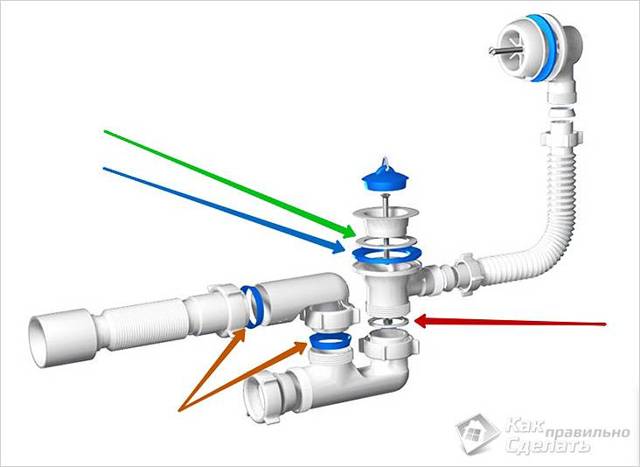

- Drain neck - it is mounted in a hole in the bottom of the bath and consists of two parts. The lower part, which is a branch pipe with an extension and a nut built into the inside, as well as the upper part, made in the form of a chrome plated cup. The bath, as it were, is placed between these parts, which, in turn, are interconnected by a long metal screw. The tightness of this connection is ensured by a special sealing gasket.
-
Overflow neck. In principle, it is arranged in exactly the same way as the drain, only it does not have a direct outlet for water, but a side one. Its task is to remove excess water from the bath in case of its uncontrolled filling.
- Siphon. It may have a different configuration, but almost always it is a removable curved pipe, in which water constantly remains. This is a water seal that prevents the penetration of odor from the sewer. I will immediately note one detail - the volume of the water seal is of great importance. With poorly functioning ventilation of the sewer riser, this water (especially if it is small) can be sucked out of the siphon, and then an incredible stench is guaranteed to you. It is better to give preference to a siphon with a deeper water seal, which holds at least 300-400 ml of water.
- Connecting corrugated hose - used to divert water from the overflow into the siphon. The water pressure in this area is quite low, so in most cases this hose is simply put on special nozzles (brushes) without any crimps. In more serious products of this type, the connection of the hose with overflows is sealed with a compression nut with a gasket.
- Pipe for connecting the siphon to the sewer. It can be of two types: rigid and corrugated. The first is reliable, and the second is more convenient to connect. In addition, the main advantage of the corrugation is the adjustable length.
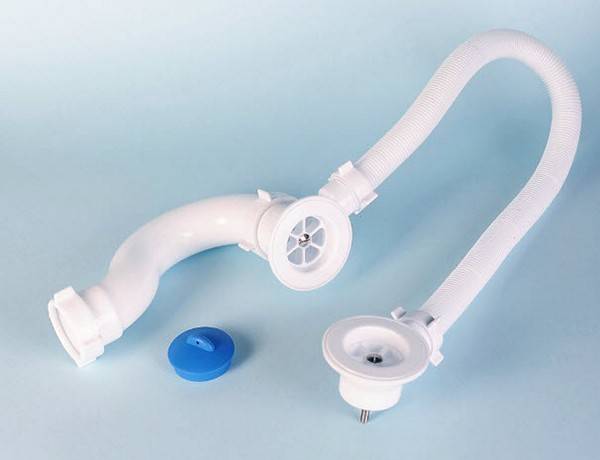
Bath drain photo
That's all the parts into which you can disassemble almost all modern siphons - the only thing you need to know to solve the question of how to assemble a siphon for a bathroom is about the so-called types of connection of its individual parts. They can be of two types: in the first case, a flat sealing gasket can be used, and in the second, a conical one. In both situations, a so-called union nut is used to connect the parts of the siphon.
Now about the varieties of drain siphons for the bath - there are not so many of them. If we do not take into account the technological and design features, then there are only two of them: an ordinary siphon with a stopper and the so-called drain overflow automatic for a bath. The difference between them lies in the plug opening system, which is carried out by turning a special lever mounted on the overflow. With it, you do not need to bend down and pull the cork out of the hole, just turn the round lever located under the top of the bath.If we talk about simple siphons, then they can differ only in the shape of the pipes (round or rectangular), the element for connecting to the sewer (corrugated or rigid pipe) and the method of sealing the connections (conical or straight gaskets).
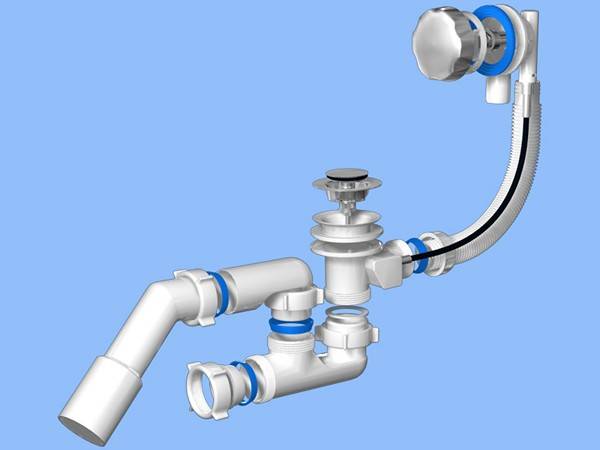
How to assemble a bath siphon
That's the whole theory, now we just have to deal with the principle and intricacies of installing a drain siphon.
For details regarding the types of bath siphons and their installation by your own hands, see the video.
Instructions for self-installation of the drain mechanism
Drain-overflow of both mechanical and automatic types is installed, in general, according to the same scheme. However, before fixing the device, it is recommended to read the manufacturer's instructions. Improper installation leads to incorrect operation of the device.
Automatic systems should be installed by a specialist, because after self-installation, the manufacturer withdraws the warranty:
- Unscrew the fasteners and remove the old siphon.
- Clean the nozzles and adjacent areas from plaque and debris.
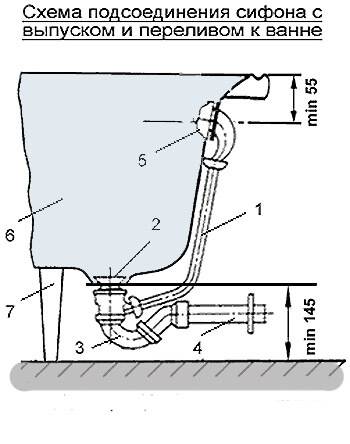
- Install drain. A sealing gasket is applied to the drain pipe and attached to the drain hole. On the inside, another cuff is simultaneously applied, a grate is installed on it and screwed to the bottom with a screw. Tapered cuffs have a thick edge closer to the nut, and a narrow one - to the neck. Do not overtighten the screw to avoid damage to the parts.
- The overflow is installed in the same way. The bath must be level and at least 15 cm from the floor.
- To connect the drain hole to the overflow, a corrugation is installed.The connections are fixed with a nut with a gasket, which is first put on the corrugation.
- Then the siphon is connected. It is also fastened with a nut with a sealing gasket. Surface defects are removed with a file to ensure a tight fit of the parts.
- The connection to the sewer is made through a sealing cuff or a pipe is simply inserted into the socket, and the connection is sealed with silicone. If the diameters do not match, adapters can be used.
- After installing the harness, check the system for leaks by turning on the water and laying the floor with paper.
The most common installation problem is thread misalignment.
Silicone grease will extend the life of the sealing parts.
In order for the automatic system to seal the hole with high quality, it is necessary to clean the drain from dirt, hair, debris in a timely manner, and it is also recommended to clean the siphon once every six months.
Drain-overflow for the bath ensures the drainage of water from it into the sewer and protects against overflow. The more complex the system, the more expensive and more convenient it is to use, so you should find a compromise between convenience, quality and price of the goods.
Semi-automatic siphon and its best sides
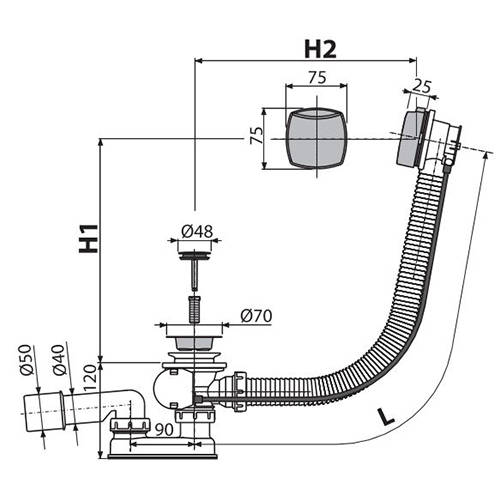
A semi-automatic drain-overflow system, despite its ease of use, is a rather complex design. In addition to the standard hermetically sealed wastewater outlet and overflow system, models of this type are equipped with a shut-off valve, which is actuated by a lever mounted on the overflow outlet. It is made in the form of a decorative handle or valve.
Managing such a drain system is quite simple.The user turns the control lever 90° and the closing rod rises to open the drain hole, and if the handle is turned in the opposite direction, the rod lowers, making it possible to fill the bath with water.
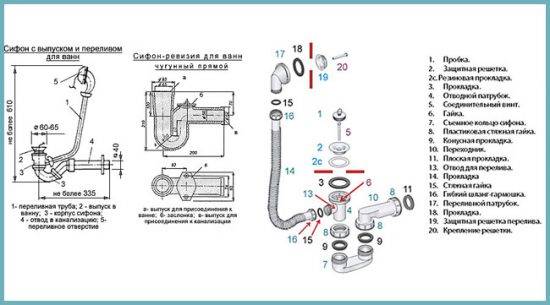 Diagram: semi-automatic bath drain device
The system works thanks to an auxiliary cable, the tension of which allows the cork to rise and fall. The design of the valve control knob can be varied. The most popular models are made in the form:
- buttons;
- swivel ring;
- handles;
- decorative valve.
The overflow device in such systems is hidden under the control knob of the drain structure. This gives the harness a more aesthetic and stylish look. Also, one of the advantages of such a system is ease of use. By turning the handle located at the top of the bath, the user does not have to wet his hands or bend over to the bottom of the bath once again.
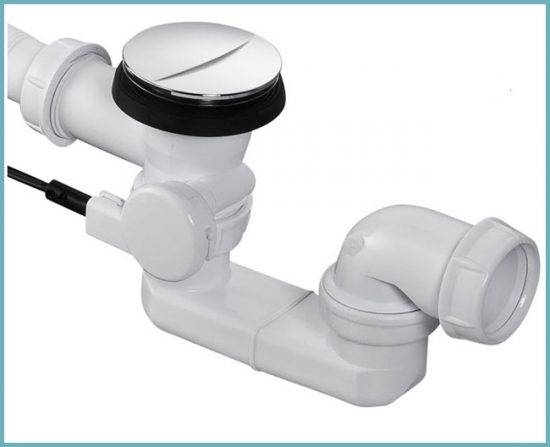 Semi-automatic drain with decorative valve
And if we talk about the disadvantages of such a system, then it should be noted that the design is quite complex and has a lot of connecting and moving parts, and therefore attention should be paid only to models of responsible and conscientious manufacturers who have already proven themselves in the sanitary fittings market. There is a kind of semi-automatic drain-overflow system that allows you to fill the bath
This is the most complex of all automatic and semi-automatic tying. For the installation of such a design, it is necessary to supply water pipes to it. With this type of piping, it is possible to eliminate the installation of a mixer for filling the bath
There is a kind of semi-automatic drain-overflow system that allows you to fill the bath. This is the most complex of all automatic and semi-automatic tying. For the installation of such a design, it is necessary to supply water pipes to it. With this type of piping, it is possible to eliminate the installation of a mixer for filling the bath.




Conclusions and useful video on the topic
Principles of operation of automatic systems in video:
In the video, an overview of the semi-automatic drain-overflow:
A competent choice of a drain-overflow system guarantees the full, comfortable and high-quality functioning of the bath. It is not difficult to cope with its installation, the main thing is to correctly assemble the parts and properly seal the junction areas. If you still have incomprehensible problems, it is always better to turn to professionals.
Do you want to share the experience gained during the installation of the drain-reilva with your own hands? Do you have information that may be useful to site visitors? Please write comments in the block below, publish photos on the topic of the article, ask questions.



