
- The cost of materials for the well
- Estimated table of the cost of the well by depth and number of rings:
- What determines the cost of work
- The first factor is the depth and quality of the soil
- The second factor is the method of digging
- The third factor is cladding and the cost of shipping materials
- Materials for building and digging a well
- The choice of location for the location of the well of concrete rings
- Determining the depth of the well and the number of rings
- What time of year is the well dug?
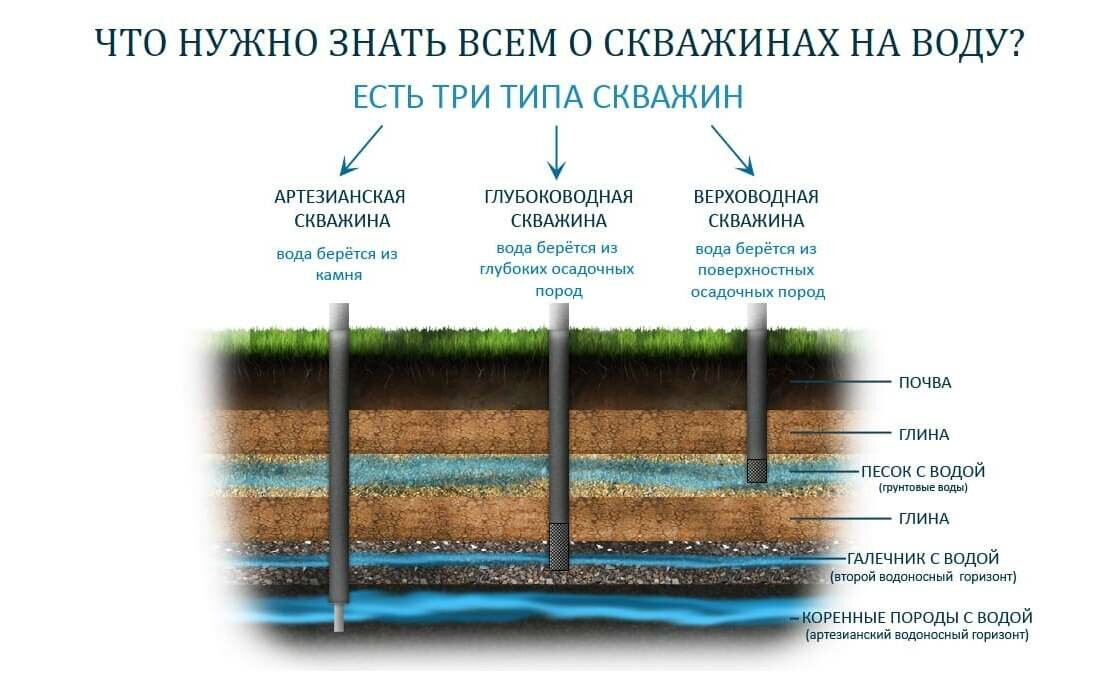
- About types of wells
- Why do we need well houses
- The main stages of installing a well
- Types of work on digging a well
- Do-it-yourself digging of a well
- Location selection
- Preparatory work
- well digging
- How much does it cost to dig a well?
- Dig a well on the site - where is it better?
- Search for water in the area for a well
- The main nuances of building a well and security measures
- Well prices
- About self-installation of wells
- Offers from some companies, the cost of work
- How much does a well pump cost?
- Cost of work
- Well device
- What makes up the cost
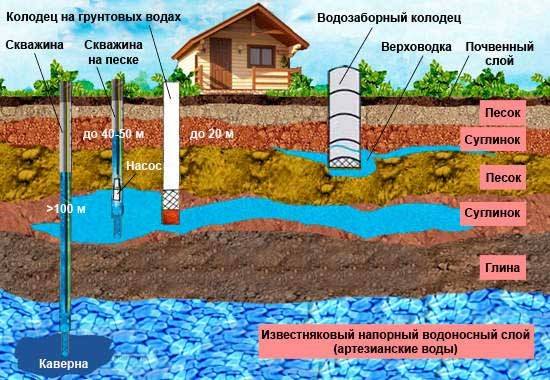
- Water well device
- How much does a well cost in Russian cities
- Recommendations for the construction of a well on the site
- Calculation of the cost of digging a well
The cost of materials for the well
| Ring without grooves. Height 0.8 m., ext. diameter 1 m. | 1.500 rub. |
| Ring with grooves.Height 0.8 m., ext. diameter 1 m. | 1.600 rub. |
| Ring with grooves. Height 0.9 m., ext. diameter - 1 m. | 1.700 rub. |
| Composite manhole cover | 1.000 rub. |
| Reinforced concrete manhole base under the cover | 2.500 rub. |
| Metal pipe with a diameter of 80 cm, thickness 2mm. | 3000 rub./p.m. |
| Plastic pipe with a diameter of 80 cm. | 1000 rub./r.m. |
| Stainless steel sleeve d. 124 mm, thickness 2 mm. for pump | 6800 rubles / piece |
| Stainless steel sleeve d. 154 mm, thickness 2 mm. for pump | 8500 rub./pc. |
| Metal mesh for bottom filter | 1500 rub./sq.m. |
| Filter mesh for repair work | 700 rub. |
| Pebble bottom filter equipment | from 1.500 rub. |
| High Grade Expanding Cement | 500 rub. |
| well house | from 7.000 rub. |
| Lift kit (metal rope with carabiner) | 100 rub. per p.m. |
Estimated table of the cost of the well by depth and number of rings:
| Number of rings | Depth in meters | Price w / w ring excluding delivery | Price |
| 10 | 8,0 | 16.000 | 18.500 |
| 11 | 8,8 | 17.600 | 20.800 |
| 12 | 9,6 | 19.200 | 23.100 |
| 13 | 10,4 | 20.800 | 25.400 |
| 14 | 11,2 | 22.400 | 27.700 |
| 15 | 12,0 | 24.000 | 30.500 |
| 16 | 12,8 | 25.600 | 33.300 |
| 17 | 13,6 | 27.200 | 36.100 |
| 18 | 14,4 | 28.800 | 38.900 |
| 19 | 15,2 | 30.400 | 41.700 |
| 20 | 16,0 | 32.000 | 45.000 |
| 21 | 16,8 | 33.600 | 48.300 |
| 22 | 17,6 | 35.200 | 51.600 |
| 23 | 18,4 | 36.800 | 54.900 |
| 24 | 19,2 | 38.400 | 58.200 |
| 25 | 20,0 | 40.000 | 63.000 |
* Prices valid until
29 November 2020
Note:
1) The prices for the manufacture of a well in the calculation table of costs by the number of rings and depth are indicated when working in soils of a standard category of complexity - chernozem, clay, loam, sand, sandy loam, i.e. without the use of special equipment and tools for driving difficult areas.
2) Our specialists, who have many years of practical experience, dig wells up to 40 rings deep!!!
3) Prices for the delivery of materials for the construction of a well to the object are calculated one way. The removal of the remaining superfluous rings is estimated additionally. Transportation of rings on the site at a distance of up to 20 meters is free of charge.
During the construction of turnkey wells, our company uses only certified reinforced factory rings, manufactured in accordance with the requirements of GOST, with a meter diameter, having a groove connection.
The cost of wells manufactured by us includes the price of well rings at the wholesale price of manufacturers. The cost of delivering the rings to the well construction site within the Moscow region does not exceed, and often is significantly lower than, the average market price.
The optimal combination of the above three components in terms of cost (the price of well rings, the cost of delivery, the price of digging a well), the quality of the materials used in the construction of wells, the qualifications for the execution of work on the construction of a well and the accompanying list of services in the arrangement of wells give our Customers the best price characteristics for the construction of a mine well from reinforced concrete rings on a suburban area.
The best price for wells is determined, in the end, not by a catchy advertising offer, but by a complex combination of the optimal cost and quality of materials, the professionalism of the work on finding water on the site, digging an impeccable well shaft of a strictly required depth, installing well rings, arranging and commissioning a mine well. We provide a guarantee both for the materials used in the construction of the well, and for the types of work performed.
Consultations and acceptance of Applications are carried out from 9.00 to 21.00 by phone in the header of the site
What determines the cost of work
The first factor is the depth and quality of the soil
The depth depends solely on the level of groundwater. The closer they are to the surface, the shallower the well will be, and the lower will be the cost of drilling a well and materials.The type of soil affects how much effort will be applied during work. If the soil is soft, it is much easier to dig it compared to dense rocky soil.
The second factor is the method of digging
At the moment, there are two types of drilling - this is manual digging and digging with the help of special equipment. One method or another is chosen based on the depth of groundwater.
The third factor is cladding and the cost of shipping materials
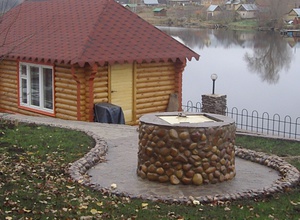 Lining is necessary so that the internal surfaces of the shaft do not crumble, and also that surface water does not flow into the well. Materials that can be used for this purpose are:
- stone;
- concrete rings;
- brick;
- wooden frame.
Each of them has its own advantages and disadvantages. For example, cladding with bricks is very time consuming and also unsafe compared to concrete rings. With the help of the latter, the work is done much faster. But the disadvantages include the error in tightness. Often, after a few years, the upper rings begin to move under the influence of rains and other factors that change the upper layers of the earth. Because of this, earth, sand and stones begin to fall into the water of the well.
In addition, other materials that are used for fixing and sealing are taken into account.
You can include the costs of delivering materials into the work of your contractor who is building the well, or you can do it yourself.
Materials for building and digging a well
- typical reinforced concrete well rings; - metal and reinforced concrete pipes of different lengths and diameters; - brick, rubble stones, cobblestones, etc.; — solutions of concrete with fillers for monolithic construction; - steel fittings; - wood of various species;
The most optimal ratio of price and quality during the construction of the well is achieved through the use of reinforced concrete rings. The most commonly used well rings are KS-10-9 or KS-10-8 ("10" means in the marking the inner diameter of the ring - 10 decimeters, "9" or "8" the height of the ring in decimeters. The wall thickness of the first and second types of rings is 10 cm, the mass of the ring is 600 and 540 kg, respectively.
Reinforced concrete rings KS-10-9 and KS-10-8 are produced in two types: with a flat end, and L-shaped selection (lock) for fixing the end connection.
Rings with a selection ("lock", fold, groove) provide better water tightness of the connections and the stability of the well shaft to lateral, horizontal displacements. This is especially true when building deep wells in moving soils.
Concrete mixture (gravel or crushed stone, sand, cement) is prepared in the ratio: 3:2:1 or 4:2.5:1 with a ratio of water mass to cement mass - 0.5–0.7.
For reinforcing concrete, you can use any bar and strip steel, or wire, but reinforcing steel with a corrugated surface is best
It is very important that the metal is not affected by rust. Hooks are welded to the ends of the reinforcement, and the round ends are bent, for greater adhesion and work of concrete and reinforcement as a whole under tensile loads
Sand is better to use quartz, washed from organic impurities, clay and dirt. Particles of gravel or crushed stone should not exceed the size of the minimum distance between the reinforcement bars.


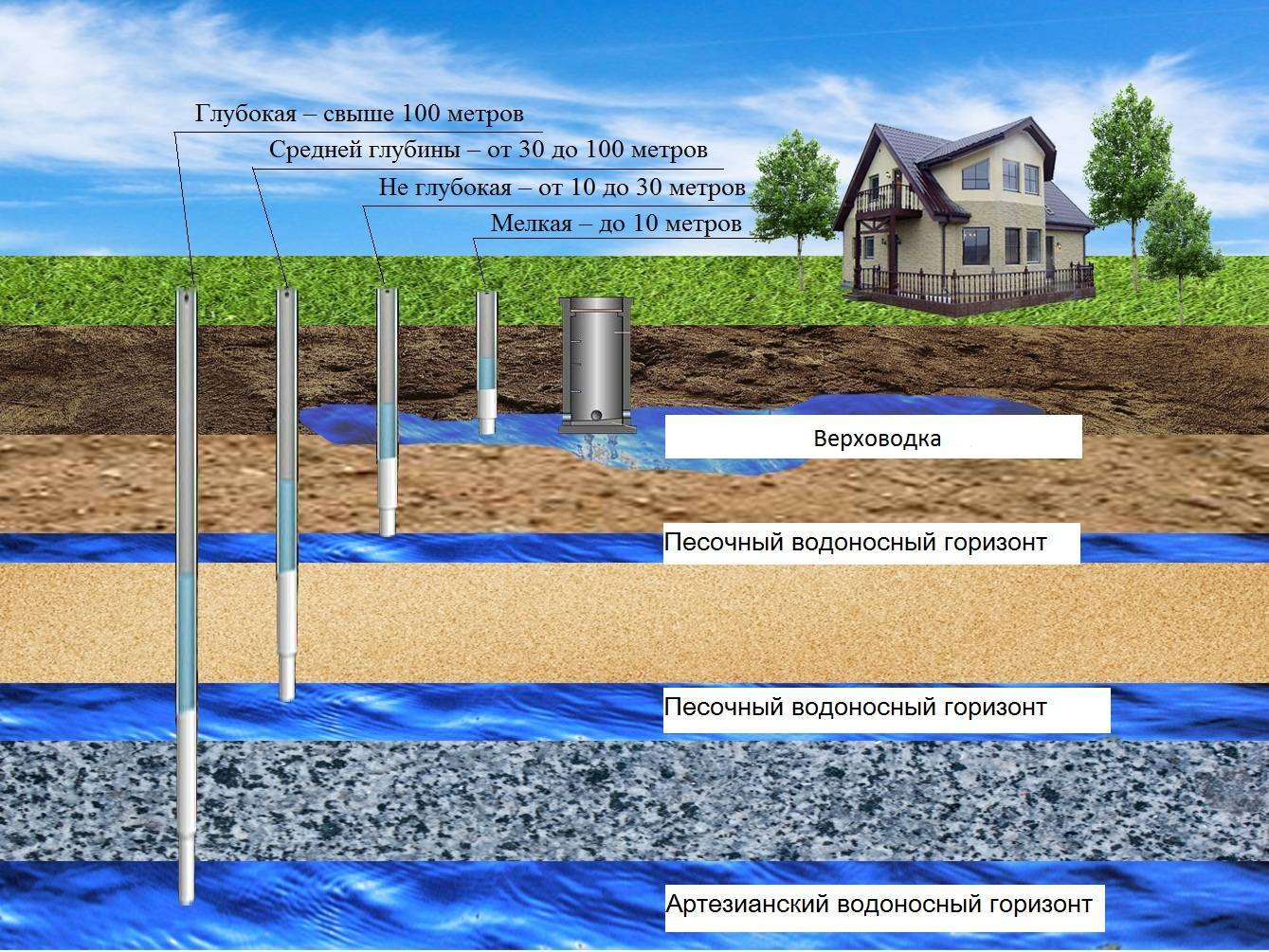

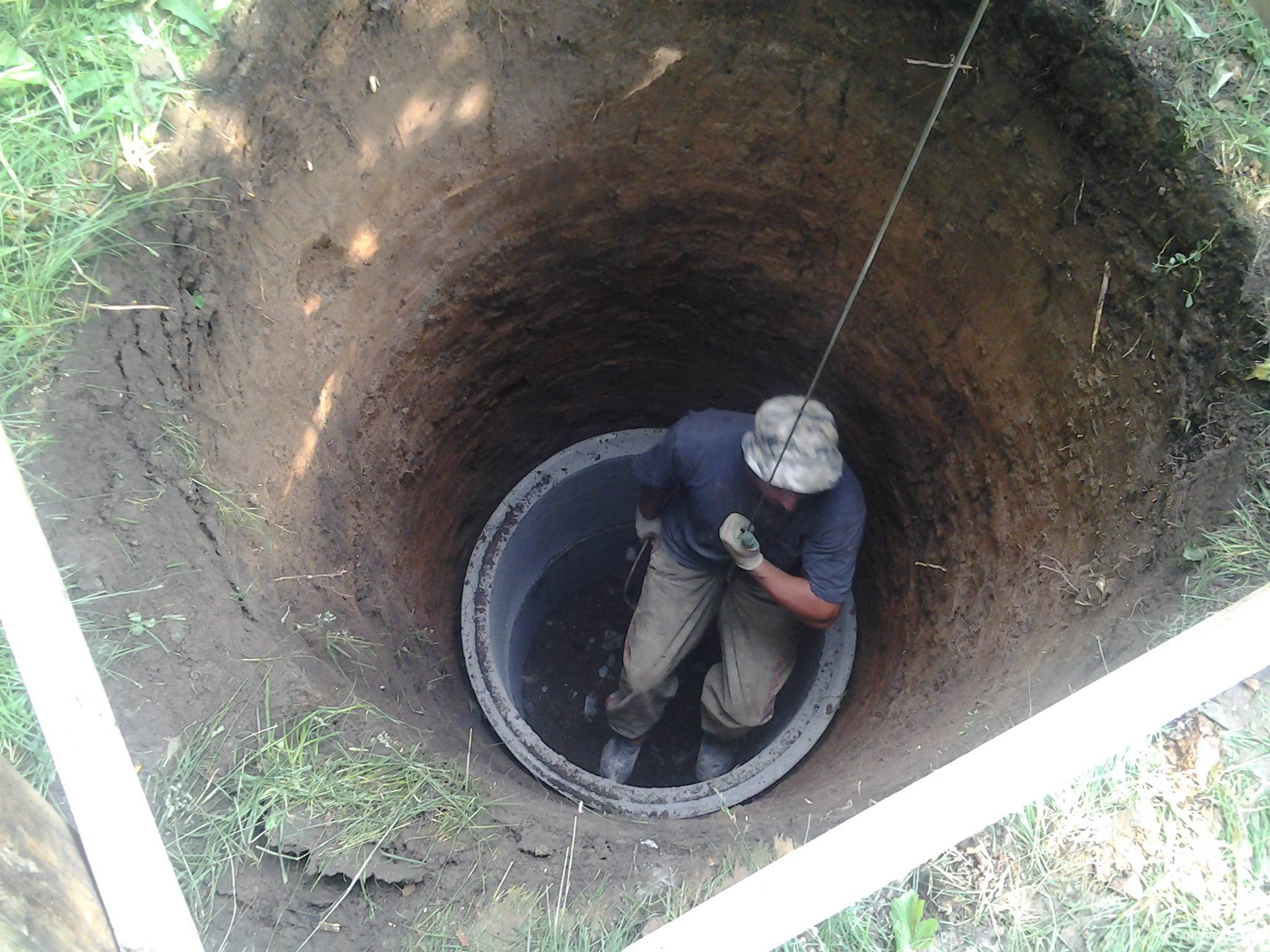


Significantly more expensive (almost 2 times compared to the construction of a well using reinforced concrete rings) and much less frequently used is the construction of wells made of wood.
The choice of location for the location of the well of concrete rings
Before you dig a well, you need to decide on its location. To do this, take into account several important nuances:
-
the location of the fence (digging of wells is carried out at a distance of at least two meters from them);
-
the presence in the immediate vicinity of livestock pens, roads, a car wash, garbage containers, landfills, regularly fertilized gardens, sewers and sewers that can become a source of water pollution - they should be at a distance of at least 20 meters;
-
soil features on the site;
-
the presence of slopes;
-
depth of occurrence in the soil of groundwater;
-
the location of the bath, house, paths, architecture and functionality of individual zones on the site;
-
distance from home.
When arranging a well in a specific place, they think in advance the convenience of its daily use in everyday life. It is desirable that a path pass next to it, along which the owners of a country house can move freely with a bucket of water or a watering can.
Concrete rings are ideal for arranging water supply. They are environmentally friendly, do not corrode, do not collapse for many years. Well water can be used for drinking - no oil film forms on its surface.
Determining the depth of the well and the number of rings
This issue cannot be resolved without a survey of the site. To calculate the depth of a well based on concrete rings, call our specialist.After analyzing the terrain features, soil composition, the depth of underground (ground) water, the level of soil freezing in winter, our representative will make a calculation for your site (the upper ring is located above the ground, its height should be comfortable).
Correctly calculated by our engineer, the depth of the wells guarantees all-season water supply to customers. The scope of work and the final cost of our services depend on these calculations.
Note: the standard inner diameter of the well rings is 100 cm, the height is 80 cm. If necessary, rings of a smaller diameter can be purchased.
What time of year is the well dug?
You can dig a water well all year round, but there are a few recommendations. So, digging a well is undesirable during the season of heavy rains. The best period is summer and winter, since the aquifer is located at a minimum level and groundwater does not interfere with digging a pit, does not wash away its walls. In spring and late autumn, digging is complicated by flood waters and rains.
About types of wells
Reinforced concrete structures that act as water sources differ in the fastening of adjacent elements and the type of bottom filter (it depends on the quality of the soil at the bottom). River pebbles, shungite, aspen shield (for sandy swimmers and loose soils) are used as a filter layer at the bottom.
Why do we need well houses
A wooden house is not installed on a well for beauty, although this function is also inherent in it. The fully enclosed design keeps water out of dust, snow, debris, insects, birds, rodents and animals. Provides security relevant for families in which children grow up - their curiosity requires constant monitoring and the creation of a safe environment.For convenience, such a house on the well has a built-in window - a hatch through which you can freely get a bucket filled with water. Buy ready-made options or place an order for an individual design - at your discretion.
The main stages of installing a well
-
Determination of a place for arranging a well.
-
Calculation of the number of rings.
-
Delivery of necessary materials.
-
Immersion and fixation of the rings (the method depends on the flowability of the soil).
-
Seam sealing.
-
Installation of a clay castle.
-
The choice of the type and arrangement of the bottom filter.
-
Installation of a well house.
Types of work on digging a well
There are two main types of well digging. This is an open type and a closed one. The first is suitable for working on solid ground, and the second is recommended in the presence of loose soils.


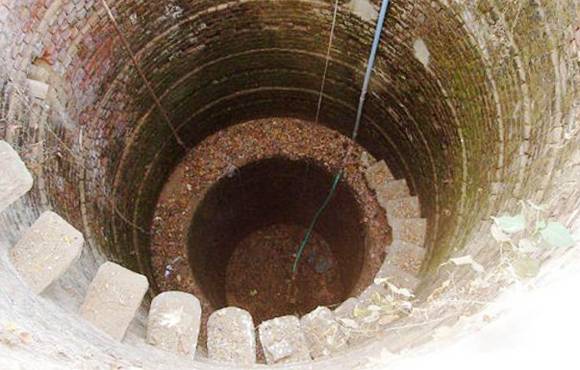


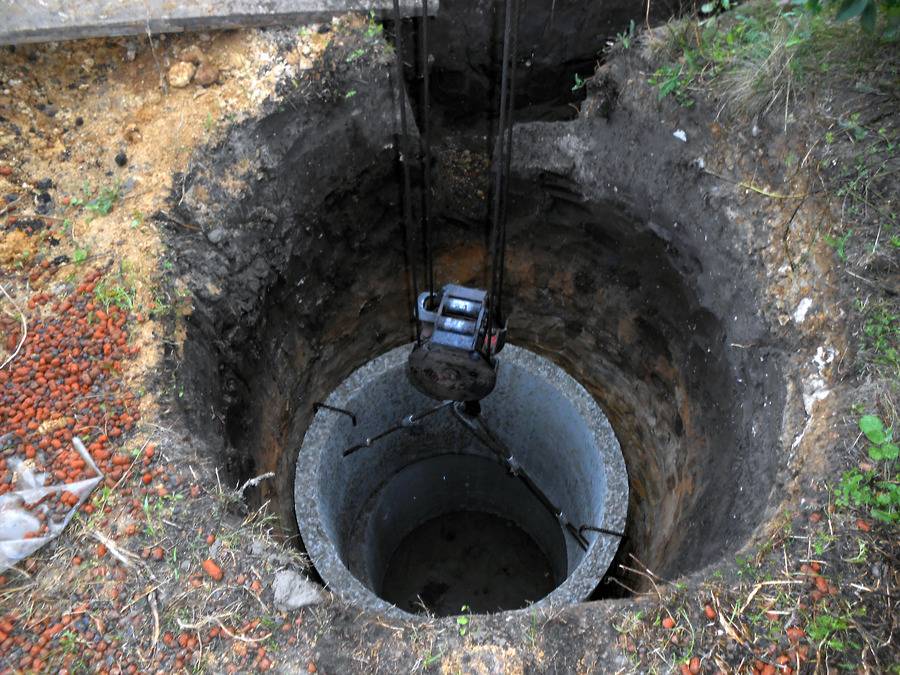

At open well digging work is carried out until reaching the aquifer. The next step is to install the rings and seal them. In this case, it is necessary to slightly increase the diameter of the well so that the installation of the rings goes without problems. This may delay the work a bit.
Digging wells in a closed way involves the installation of rings at the first stage, and then the earth is removed from the base. The rings are placed on top of each other until the water comes through. This type of digging is more difficult, although it takes less effort.
Do-it-yourself digging of a well
Before you dig a well in the country with your own hands, think carefully about whether you can handle this job? Because the following surprises may lie in wait for you:
- You just won't get to the water;
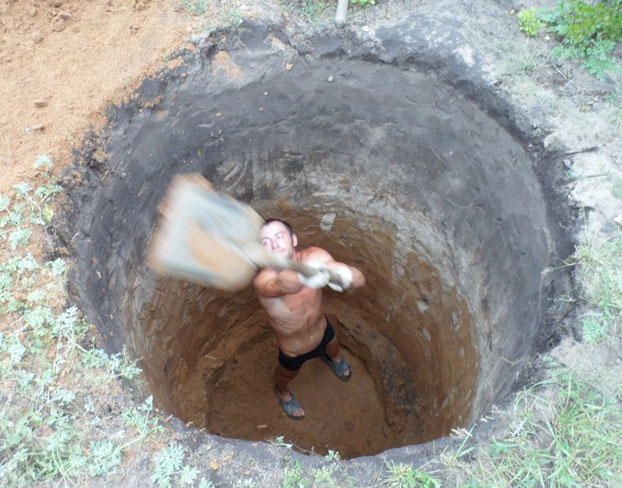
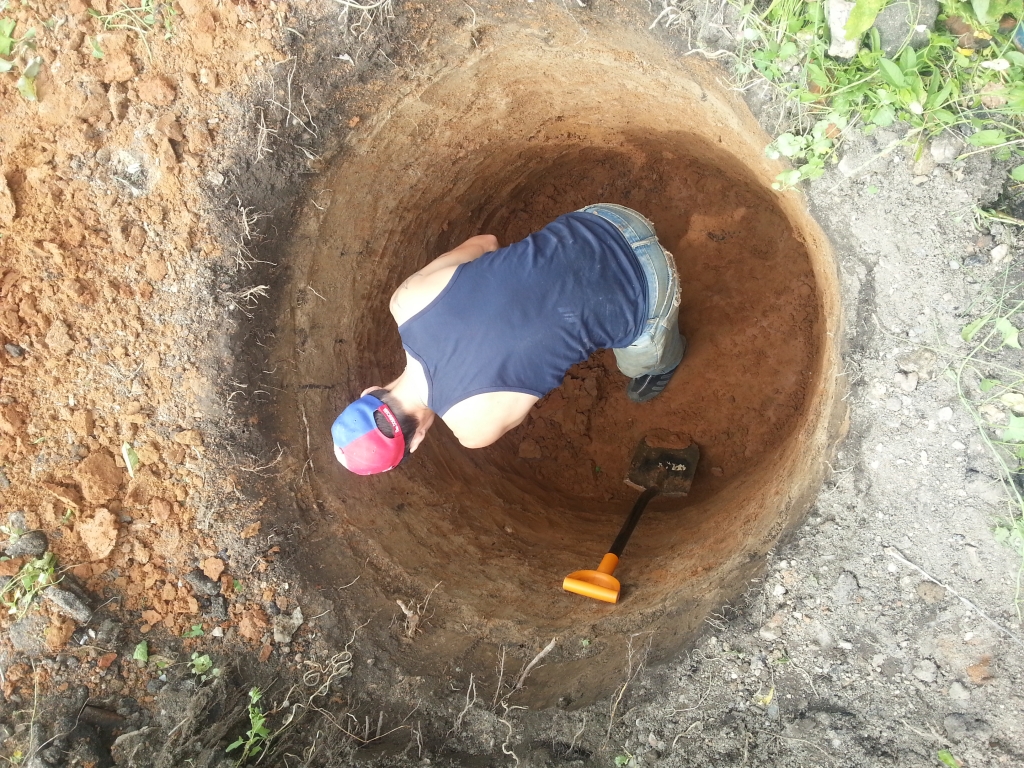
- During digging, the soil will begin to collapse, which is very dangerous for a person at the bottom of the mine;
- It is very difficult to work at great depths.And not only because it has to be done in a narrow space, but also because of the gases accumulating there;
- You will need at least two or three assistants to pull the soil to the surface and install rings in the shaft;
- When installed without the use of lifting equipment, concrete rings can crack or break.
Other difficulties and failures are possible, which become not your problem if professionals take up the matter. If you are not doing this for the first time and they do not scare you, if you want to save a considerable amount by digging a well yourself, then let's get started.
Location selection
Ideally, in order to accurately hit the aquifer, you need to make exploration by drilling, but this is also expensive.
Therefore, most summer residents, when deciding where to dig a well in the country, are guided to folk tales and ask the neighbors how deep the well is on their site.
But it is important not only to find water, but also to ensure its quality and suitability for household and drinking needs. To do this, it is necessary to locate the well at a considerable distance from sources of groundwater pollution - toilets, cesspools, compost and manure heaps, landfills, sheds.
This distance, depending on the type of soil, is 20-50 meters.
The relief of the site is also taken into account: the well, in the presence of a slope, must be above the listed objects
In addition, it should not be done too close to the foundation of a house or other structure.
Preparatory work
For construction, you need to prepare all materials and tools in advance. Their set depends on how the well will be dug and what it will be made of.
Most often it is built of reinforced concrete rings with a diameter of 1 m and a height of 90 cm.Their number is calculated from the estimated depth of the well plus one ring above ground level.
Much easier to assemble a well from polymer-sand rings - they are several times lighter, easier to install, but much more expensive.
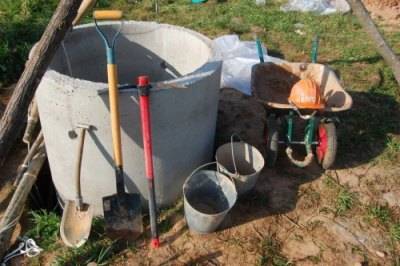
To work in the mine you will need shovels with a short handle
As for the tools. Standard set: shovels, crowbars, buckets and ropes for lifting soil, ladder. If the rings will be lowered into a fully dug shaft, a sturdy tripod with a lifting mechanism will also be required.
well digging
Let's move on to the question of how to dig a well in the country. It is better to do this with gradual digging of the soil under the rings - this will save energy and avoid collapses. The algorithm for performing the work is as follows:
- Site marking. The diameter of the pit is made slightly larger than the outer diameter of the wall rings.
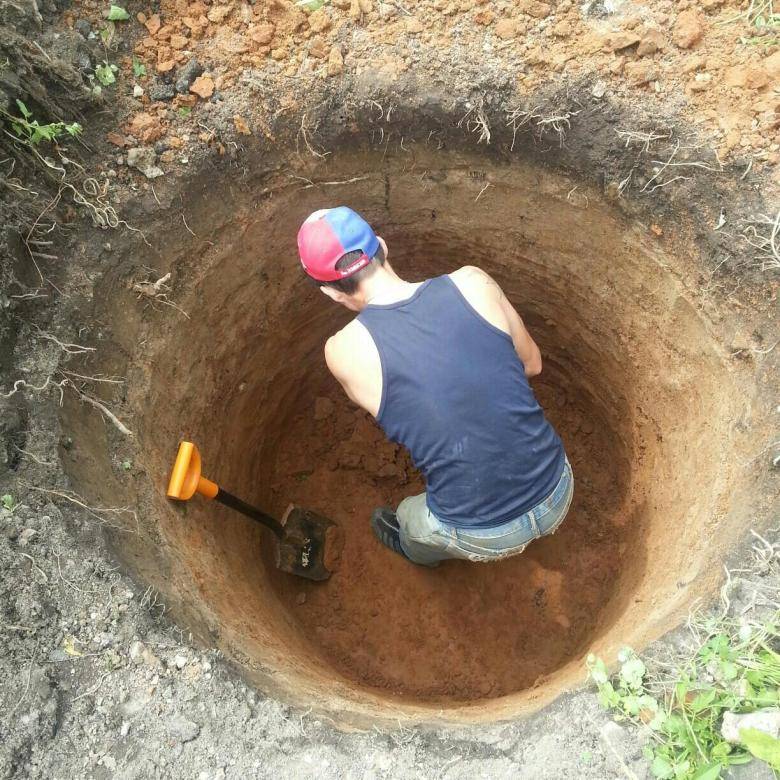
- A hole about 80 cm deep is dug according to the marking. After leveling the bottom, the first ring is lowered into it.
- Further, the pit deepens inside the ring with soil under it. In this case, it is necessary to ensure that the ring falls evenly and maintains a vertical position.
Digging a well with a gradual immersion of the ring
- When the ring drops almost to ground level, the next one is placed on it and connected to the first with metal brackets.
- This continues until water appears at the bottom. After that, you need to deepen the well for one more ring, pumping out the liquid with a drainage pump.
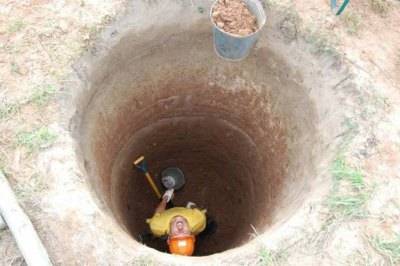
When digging a well, there is a high risk of a loaded bucket falling down
To make the mine airtight, the joints between the rings and possible cracks in their walls are sealed with a cement-sand mortar.
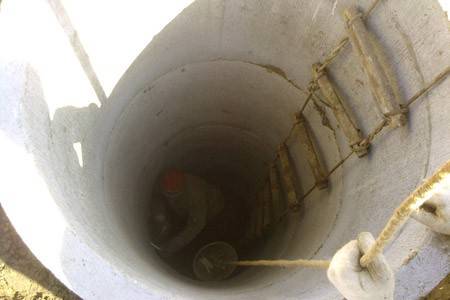
Sealing joints
At this point, the main stage can be considered completed.Next, you need to completely pump out water from the well several times to rinse the bottom and walls. After the last pumping, a three-layer filter is placed on the bottom.
It is advisable to insulate the walls of the well from the outside to the level of freezing of the soil and fill the sand and gravel mixture between them and the edges of the pit. It is also necessary to make a clay castle or a blind area, equip the neck with a water-lifting device, and make a canopy.
All issues of arrangement are described in detail in other materials of the site.
How much does it cost to dig a well?
The cost of digging a well in the country depends on the following factors:
- ring diameter
- number of rings
- remoteness of the object from the Moscow Ring Road
In this regard, the range of prices for the service associated with sinking a well can be quite wide. At the same time, the minimum price of work, as a rule, is 800 rubles for 1 installed well ring, and the maximum is up to 1600 rubles. However, as the aquifer level has been reached, the cost of such work, as a rule, increases proportionally by 150-200 rubles.


Among the most popular brands of well rings made of concrete and often used in practice, the following can be distinguished:
Also, a cover is needed for the well ring. The popular brands of these products include such types of covers as:
- PP 20-2 - its diameter is 220 centimeters, height 16 centimeters. You can buy such a cover for a well ring for 3200 rubles;
- PP 15-2 - this cover is 168 centimeters in diameter with its height of 15 centimeters. It is quite possible to buy it for 1950 rubles.
Dig a well on the site - where is it better?
Keep the well away from all sources of soil contamination: septic tanks, garbage dumps, public roads, cattle pens, etc.
If the site is sloping, it is better to place the well at the highest point so that water does not flow from the entire site into the well or consider water drainage.
It is better to dig a well not far from the sources of water consumption (house, bath), since when arranging water supply, this significantly affects the cost. Closer than three meters to residential buildings, it is not recommended to dig a well, since it is possible to break the strength of the foundation of buildings, and also water from under the foundation can drain into the well.
The well should not interfere with everyday life, its location should harmoniously fit into the architecture of the site. It is also worth noting that digging near an existing (neighboring) well is not recommended, since wells will be fed by one part of the horizon and water may not be enough for two.
Search for water in the area for a well
To determine the location of the future well, they often rely on the dowsing method. When searching for water veins and lenses, they use a vine from bushes, steel frames, copper pendulums, etc. - each team has its own method of searching and identifying water veins.
It is usually thought that the dowser finds only water veins and lenses, but no matter how it is. The oscillations of a vine or a pendulum indicate the presence of various structures in the earth, it is in these places that impulses arise that are caught by the dowser. Maybe this is not an accumulation of water (a lens, a water vein), but earth faults, ledges, boulders or engineering communications. Also, sometimes there are no signals at all, this may indicate the absence of water, or vice versa, an extensive, uniform layer of water. Frame or vine signals not related to water can be distinguished in most cases.In practice, this method is quite effective.
The main nuances of building a well and security measures
It is advisable to start digging a well if groundwater passes at a depth of five to fifteen meters. Otherwise, it is better to equip the well.
The location of the well should be determined by specialists, since it will be very difficult for an amateur to position it correctly. The source of water should be located away from sources of groundwater pollution - a toilet, places for keeping animals and sewers. To dig a shaft for a well should be in the driest time of the year, around the end of summer or early autumn. At this time, groundwater is at its lowest level.
When digging a well, it is imperative to observe safety precautions: work in a protective helmet so that earth and stones do not get into your head when they are pulled to the surface and every day test the strength of the ropes and fastening parts.
Well prices
Service name/Price
| Works: | |
| Digging 1 ring - clay, loam, sand | 2 000 rub. |
| Digging a well with the customer's rings (+ to the price for the work) | 400 rub. |
| Digging of complex soil - clay with stones 1st category | 3 000 rub. |
| Digging a well in rings with a diameter | 2 000 rub. |
| Digging of complex soil - clay with stones 2nd category | 4 000 rub. |
| Surcharge for deep work from 11th to 15th ring (each ring) | 300 rub. |
| Digging of complex soil - sandy quicksand | 4 000 rub. |
| Surcharge for deep work from 16th to 20th ring (each ring) | 600 rub. |
| Surcharge for deep work from 21st to 25th ring (each ring) | 900 rub. |
| Surcharge for deep work from 26th to 30th ring (each ring) | 1 200 rub. |
| Bonding seams (1 seam - 3 staples or plates) | 600 rub. |
| Seam putty | 200 rub. |
| Digging in water or opening pressure water (one-time) | 1 000 rub. |
| Top ring installation (above ground) | 300 rub. |
| Clay castle device 50 x 90 cm (clay from a well) | 7 500 rub. |
| The device of a clay blind area 50 x 50 cm (clay from a well) | 4 500 rub. |
| Installation and putty of the reinforced concrete cover | 1 000 rub. |
| Installing a wooden shield | is free |
| Digging of complex soil - clayey quicksand | 4 000 rub. |
| Digging of complex soil - limestone 1st category | 3 000 rub. |
| Digging of complex soil - limestone 2nd category | 6 000 rub. |
| Digging of complex soil - limestone category 3 | 9 000 rub. |
| Digging of complex soil - limestone 4th category | 12 000 rub. |
| House installation | 300 rub. |
| Digging of complex soil - limestone category 5 | 15 000 rub. |
| Chiselling of frozen soil 10 cm x 120 cm. | 500 rub. |
| Soil removal from the well 5 - 20 meters | 500 rub. |
| Removal of soil from the well further than 20 meters | negotiable |
| Rolling rings further 20 meters | negotiable |
| Brigade travel > 50 km. (for each buried ring) | 200 rub. |
| Brigade travel > 100 km. (for each buried ring) | 300 rub. |
| Work in cramped conditions (one-time) | 1 000 rub. |
| Well cleaning up to 8 rings deep | 7 000 rub. |
| Cleaning a well with a depth of 8 to 12 rings | 9 000 rub. |
| Cleaning a well with a depth of more than 12 rings | 12 000 rub. |
| Disinfection of the well with tablets | 1 000 rub. |
| Deepening the well (clay, loam, sand) | 5 000 rub. |
| Clearing the site for the well | negotiable |
| Delivery of rings less than 5 pcs. | from 2 000 rub. |
| Materials: | |
| House on the well (delivery with rings) | 6 500 rub. |
| House on the well (delivery separate) | 7 000 rub. |
| Bottom filter - gravel 25 kg. | 500 rub. |
| Bottom filter - shungite 25 kg. | 3 000 rub. |
| Wooden shield pine | 3 500 rub. |
| Wooden shield aspen | 4 000 rub. |
| Wooden shield larch | 5 000 rub. |
| Ring KS 10 9 with grooves, height - 80 cm, diameter 120 cm. | 2 000 rub. |
| repair ring | 2 000 rub. |
| Reinforced concrete cover with a polymer hatch | 3 000 rub. |
| Construction bracket | 60 rub. |
| Steel plate | 200 rub. |
| anchor bolt | 21 rub. |
| Mix M 300 | 250 rub. |
| Liquid glass | 200 rub. |
| tile adhesive | 350 rub. |
show in full
Number of blocks: 21 | General number of characters: 20422
Number of donors used: 4
Information for each donor:
About self-installation of wells
Thoughts to dig a well in the country on their own arise as a result of the desire of the owners of the plots to save money on attracting professionals. Building a well is a technically difficult task, because even a small error will cause the lack of water or its unsuitability for use as drinking water.
Before digging a well shaft, it is necessary to find a place that will meet a number of requirements. After that, calculate the exact depth, find the labor and equipment in order to dig a hole of the desired depth and immerse the rings into it. If this is your first experience, as an experiment, you can dig several pits and choose the most suitable one for the water resource, but this requires a lot of physical effort and a lot of time. Prices for digging wells are quite affordable, so it is better to entrust this to professionals.
Offers from some companies, the cost of work
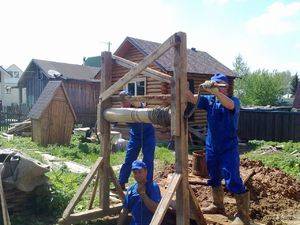 If we consider the construction of a well using grooved rings, then the price can be symbolically divided into 3 main points.
Cost of work. Digging, installation and other work on one ring 80 cm high is 1800 rubles. The deeper the mine, the higher the cost of work. So, if the depth of the well is eight meters, then you need to install 10 rings.The cost of work (without materials) will cost you 18,000 rubles.
Add here the cost of the main material - the grooved ring. One such ring costs 2000 rubles, 10 rings will cost the customer 20000 rubles. In total, at this stage we have an amount of 38,000 rubles.
This cost will also include materials for sealing the seams, for creating a filter at the bottom, as well as a well house. According to one of the contractors, a well of 10 rings with a full set of works will cost 45,000 rubles.
How much does a well pump cost?
For the operation of the well, it is necessary to choose a high-quality pump that properly copes with its main function. According to their classification, well pumps are divided into submersible pumps, automatic pumps, and surface pumps.
For only 1000 rubles you can buy a well pump Patriot 10M "Forest Stream"
If it is possible to purchase more expensive pumps, you should pay attention to a model such as Karcher SSP 33 Inox 1.645-409. Even taking into account the cost of 13,000 rubles, with a long service life of such a pump, equipped with various sensors and having a housing that is not subject to corrosion, the benefits of the pump can significantly exceed the money spent earlier!
Before starting the construction of a well, it is very important to plan your budget so that there is a certain so-called “margin of safety”. After all, a well-equipped well is ready to delight all residents of the house with clean, cool water for many years!
Cost of work
To understand what the cost of building a well consists of, you need to know its device and decide which work will be carried out by hired teams, and which ones you take on.
Well device
The simplest water well consists of a trunk, a bottom water intake and an above-ground head of the well, which is often protected by a canopy or a small well “house”.
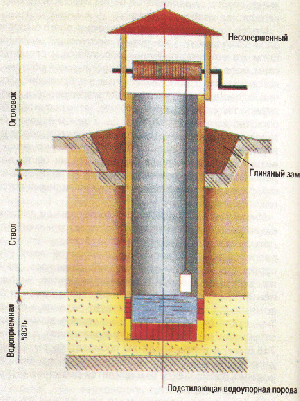
Shaft well construction
For its construction you need:
- Dig a mine to an aquifer;
- Equip the walls of the well, preventing the ingress of soil and surface water into it;
- Pump out water and clean the bottom;
- Provide the water intake with a bottom filter;
- Eliminate the infiltration of melt and rainwater into the soil around the well (clay castle, blind area (see Blind area around the well - recommendations for the device));
- Equip the well with water-lifting mechanisms;
- Build a house or shed.
This is a full range of works, and its price, of course, will be much higher than if you order only digging a foundation pit.
What makes up the cost
In addition to the list of works performed by the contractor, the cost of his services will depend on the following factors:
- Soil type and terrain. The soil can be soft, sandy, easy to dig, but there is a risk of collapse.
And it can be dense or rocky. The more effort required to develop and excavate it, the more expensive the work will cost. - Depth. Drinking water in different places lies at different depths.
It can be both at a depth of 5-6 meters, and at a much greater depth. It is clear that the scope of work also turns out to be different.
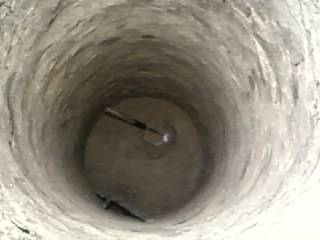
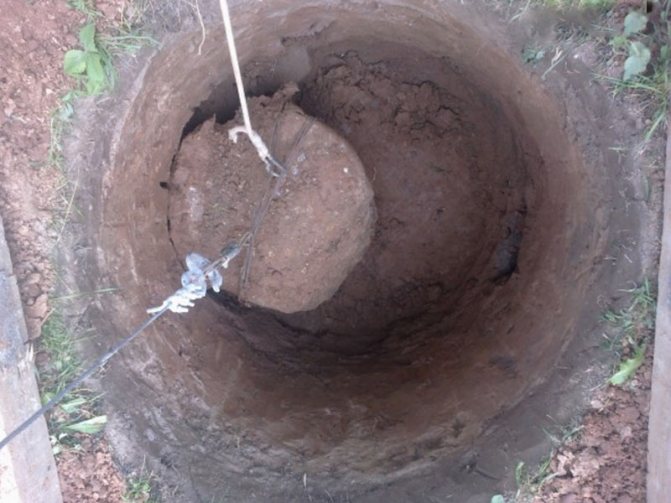
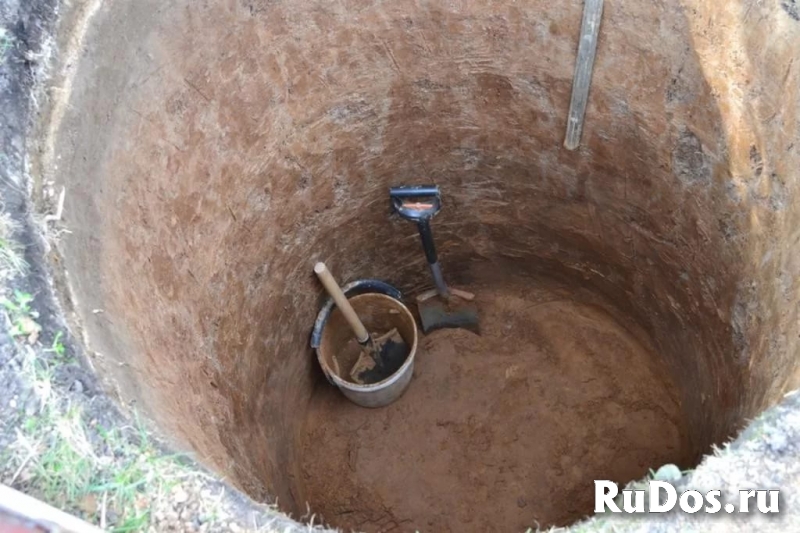
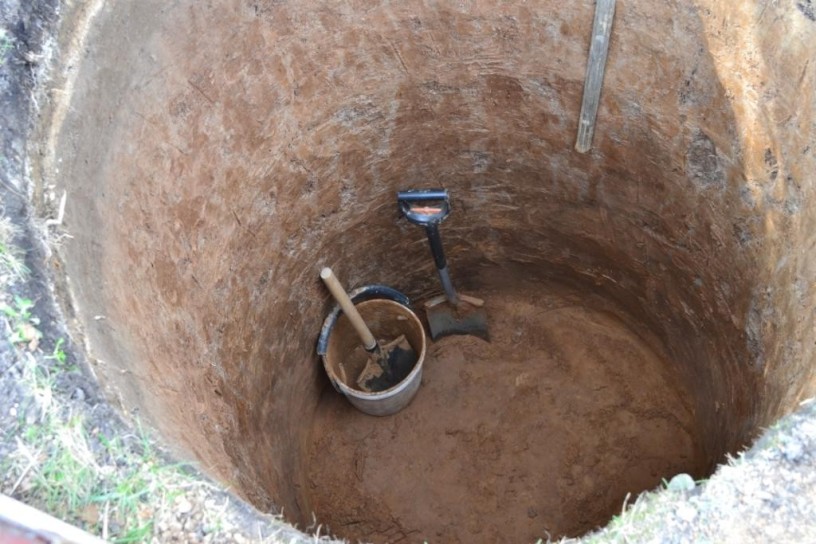
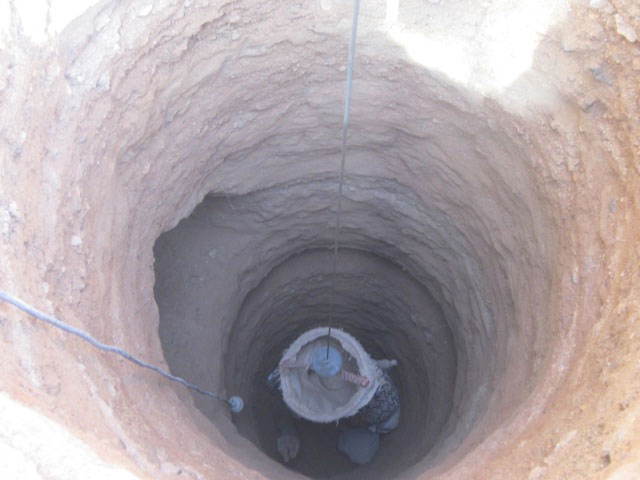
Photo of the mine of the future well
- The number of rings installed in the shaft.It also depends on the depth of the well - the deeper it is, the more rings will have to be lowered into the shaft, tied together and sealed joints.
- Delivery of materials. This refers to materials for arranging the walls, bottom and head of the well. If you did not attend to their independent delivery to the site, you will have to pay extra for this.
- Soil removal. After digging a well, a large pile of unusable soil remains on the site. Decide right away who will take care of it.
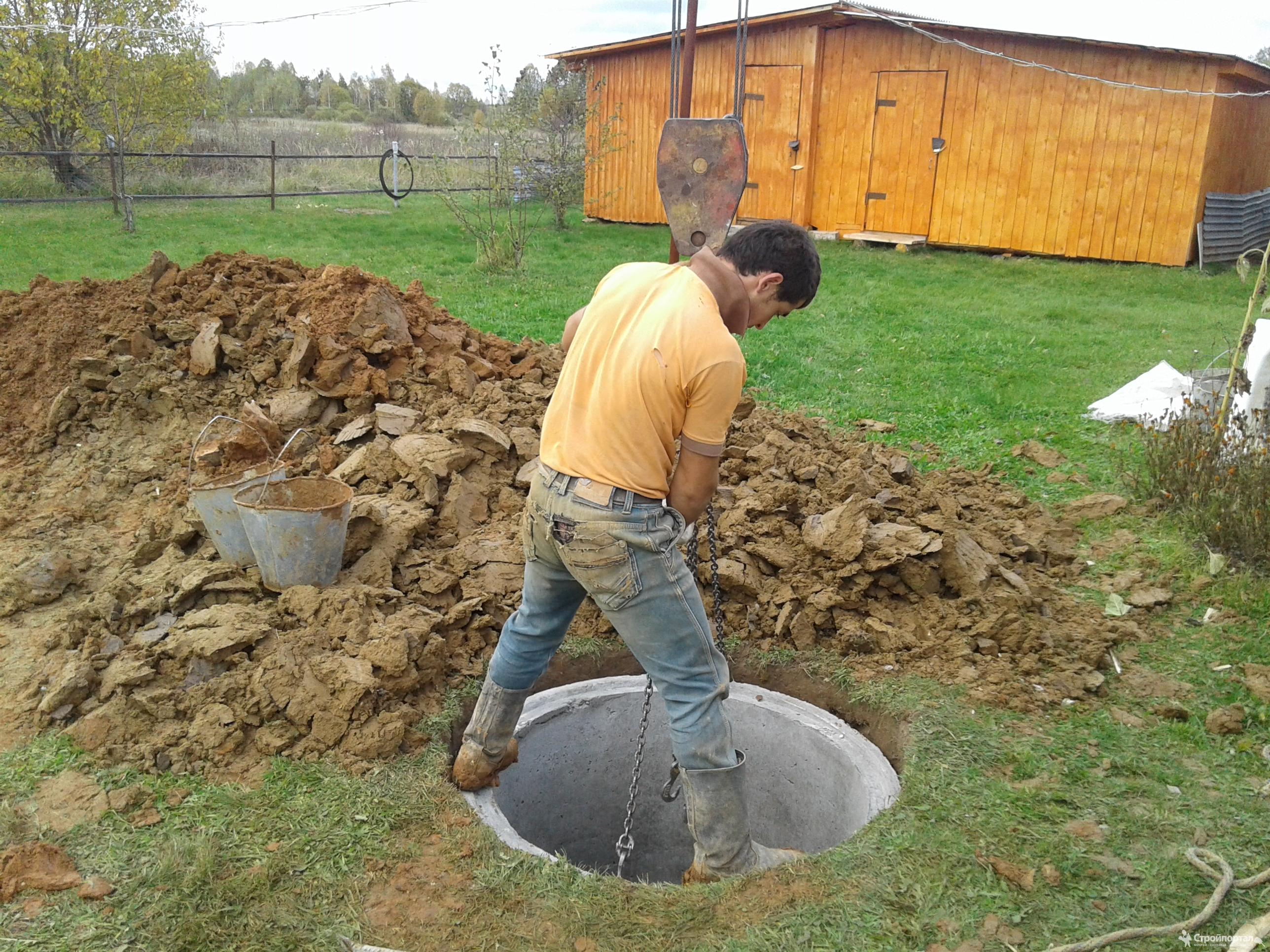
The first method is dangerous with the probability of soil collapse
Summarize. The cost of a well consists of the cost of materials used for its construction and the cost of paying for the work performed. The deeper it is, the longer it will take to dig, install more rings, take out more soil, etc.
That is, there is a direct dependence on the depth of the structure. Therefore, many contractors indicate the price per linear meter, but it is very conditional, indicative, because it depends on the factors listed above.

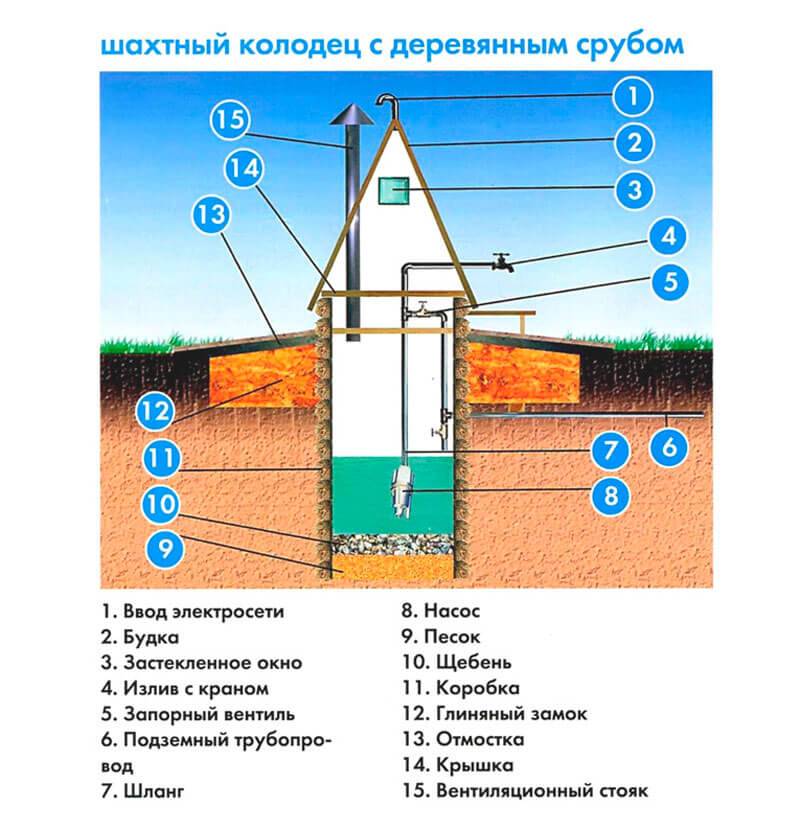



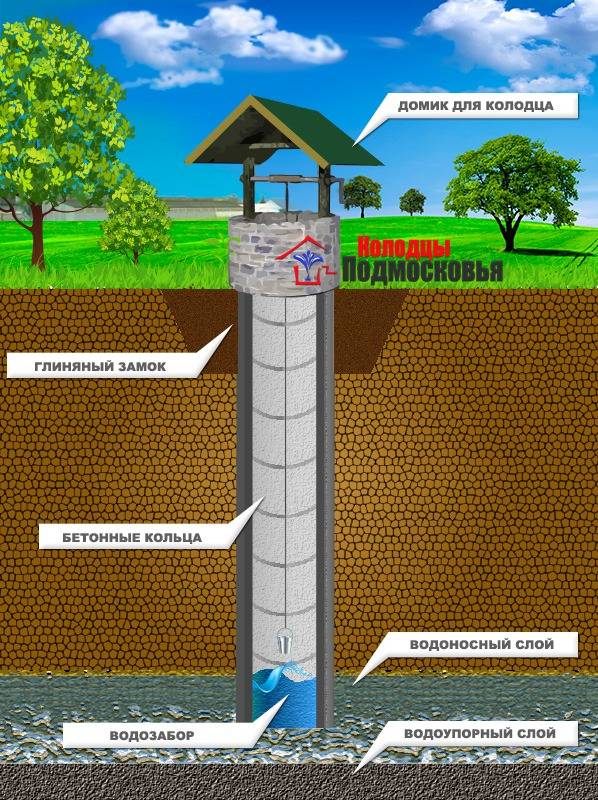
Water well device
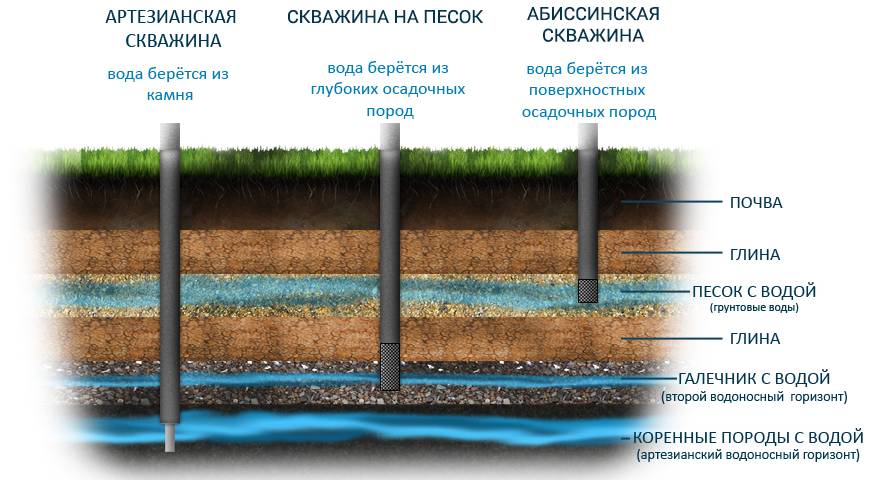
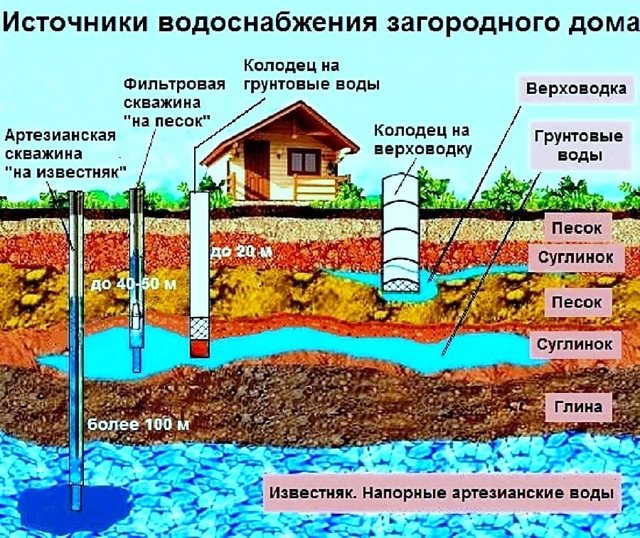
A simple household well under water has a standard scheme. The lower level of the well structure is a water intake, then the trunk is located, which passes into the head - the above-ground part.
The water intake part must be located deep in the water-saturated horizon in order for the well to be an inexhaustible source of water. In addition, a natural filter is installed at the bottom of the well bowl, consisting of significant layers of sand, pebbles and stones, so the total depth of the trunk, in which water is filled, should be 1.5-2 rings below the aquifer.
The shaft and the bottom of the well have a standard construction scheme, and the water lifting mechanism and the above-ground head can have different configurations, depending on the needs of the residents of the house
A well shaft consists of a shaft that is dug by hand or with a truck-mounted drilling rig equipped with a large diameter auger. Automated digging allows you to raise a large amount of earth in a short time, while the shaft will have the correct width throughout the depth, as well as even walls due to the fact that the drill boom is located strictly horizontally.
In addition to digging a well shaft, a crane with a drilling rig allows you to easily place wall rings in a pit, especially since the first 2-3 rings must be primed, cemented and brackets installed on them before immersion.
After installing the underground rings, a head is installed. The head includes ground rings, as well as a mechanism for lifting water. It can be a gate, manual and electric pump. When arranging a private house, you can carry out a winter water supply system, which is located underground, and install a summer surface tap.
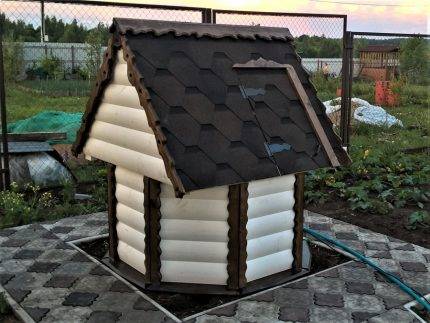 The well house serves as protection from precipitation, dirt and debris. In addition, the individual design of the building will become an element of decor on the backyard.
The final works on the arrangement of the well are: the arrangement of the roof, shed or house, hoods and blind areas. A well made in accordance with all requirements will become a source of household, and possibly drinking water.
How much does a well cost in Russian cities
Prices for digging wells in Russia vary depending on the mechanical composition of the soil and the depth of the well shaft.For example, only in the Moscow region, prices differ significantly: in the north of the Moscow region (in the direction of Zelenograd, Putilkovo, Solnechnogorsk, Krasnogorsk, Skhodnya, Khimki) they amount to 4500-5000 rubles for one ring, and in the direction of Volokolamsk, Mozhaisk, Ruza, Istra - about 2500-4300 rubles.
Despite the approximate equidistance from Moscow, the cost of a well ring in Tver is about 2,000 rubles, and in Kaluga it is already 4,300 rubles, almost twice as expensive.
Nizhny Novgorod, Smolensk and Yaroslavl are also located at about the same distance from the center, among them the highest price must be paid in the Smolensk region - 5000-6000 rubles, in the Novgorod region - 5000 rubles, and in Yaroslavl - only 2000-3000 rubles.
In remote Ufa, prices are kept at the level of 3500-4000 rubles, and in almost the same distant Samara - 2300 rubles.
The Leningrad region boasts affordable prices, much lower than those in Smolensk or Novgorod.
Analyzing such a spread in prices, it can be established that the cost of one ring when digging a well does not in any way depend on the proximity or remoteness of the area from Moscow, but only on the structure of the land, the depth of groundwater and the complexity of the work.
Recommendations for the construction of a well on the site
If you assume that in the future a well will be located at your dacha, it is best to designate a place for it even at the site planning stage. It must be positioned so that the groundwater in the selected area lies as close as possible to the surface of the earth. This factor affects the depth of the well, and, consequently, the cost of its construction. In addition, it was good to place it as close to home as possible.If you want to bring water into the building after, you do not have to dig up the entire site.
Another point concerns the time of work. It is not necessary to combine the construction of the house itself with the drilling of a well shaft. Heavy equipment or trucks that will bring materials and carry out work on the construction of a house can lead to a collapse of the soil in the well.
Calculation of the cost of digging a well
The final (personal) price of digging wells depends on several factors. Among them:
-
well depth;
-
the number of rings;
-
composition and characteristics of the soil;
-
time of year and weather conditions;
-
details (installation of a cover with a hatch, a house, a wooden shield);
-
urgency;
-
scope of work;
-
the number of involved workers and special equipment.
For example, the cost of a well in Moscow and the Moscow region will take into account:
-
unloading work (for 1 ring) - 50 rubles.
-
drilling holes (for connecting communications) - 300 rubles. per piece
-
-
install 1 ring - from 100 rubles.
-
fastening adjacent rings with metal staples - 500 rubles.
-
sinking of quicksand at the level of the aquifer - 3,000 rubles.




We have the best price in the Moscow region (the cost of wells built by our teams is 10–15 percent or more cheaper). See the prices for digging wells, their repair in our price list, which is freely available on the website.



