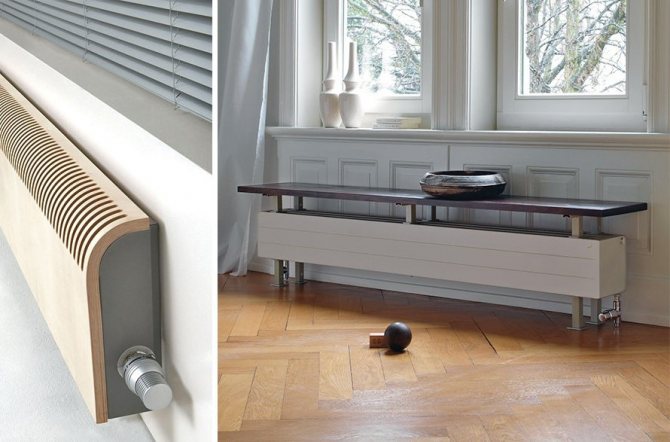
- Ways to connect radiators
- Types of heating systems for a private house
- Water heating and schemes
- Air heating and circuits
- Electric heating
- Stove heating
- Beam wiring connection diagram
- preliminary stage
- Rules for installing beam wiring
- Advantages and disadvantages of furnace heating
- Two-pipe system with top wiring
- How to arrange water heating of a private house with your own hands, installation diagrams
- Features of the device of a single-pipe system
- How a two-pipe system works
- How is the water heating system arranged?
- Option #1 - natural or gravity
- Option #2 - forced system
- Mounting order
- Comparison of costs of different heating systems
- Do-it-yourself heating system for a private house
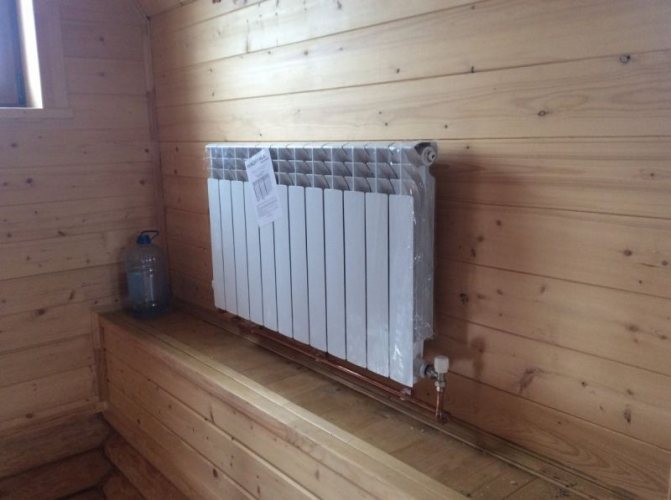
Ways to connect radiators
If two-pipe or three-pipe heating is selected, the batteries must be connected exactly according to the scheme. If the building has a large area, then it is better to call specialists for installation work.
There are several ways to connect:
- Lateral. Water enters and exits from one side of the radiator. In those sections that are located farther from the connection point, the uniformity of heating is disturbed.
- Upper. This type of connection will lead to the fact that only the upper half of the battery will heat up.If the system has a top connection, then you need to purchase batteries designed for it, which are equipped with a plug that redirects the liquid to the bottom.
- Lower. Here, too, complete heating of the entire area of \u200b\u200bthe battery is excluded, since the main flow of liquid moves in the lower part.
- Diagonal. The proposed connection method allows you to distribute hot liquid evenly.
The latter option is ideal for a two-pipe system.
Types of heating systems for a private house
When it comes to home heating, there are many factors to consider. Systems differ according to the type of carrier, heat source. The choice of one or another design depends on the material of manufacture of the building, the frequency of residence, remoteness from centralized highways, ease of fuel delivery and ease of operation of the equipment.
For example, if a gas main is laid nearby, then a gas boiler will be the best way, and if there are problems with the passage of vehicles, then you will have to choose a system in which fuel can be stored in the season and in the right amount. Consider all possible options for obtaining heat in more detail.
Water heating and schemes
Representing a structure in which a heated liquid acts as a coolant, water heating in a private house is the most convenient option. When arranging a properly selected heat source, such as a stove, the system becomes independent of any interruptions in the supply of electricity, gas.
Structurally, water heating is a boiler, from which pipelines connected to radiators are laid. The coolant is transported and warms the air in the room.This type also includes a water heated floor, in which you can do without wall radiators. With horizontal placement of pipes, the design should be supplemented with a circulation pump to facilitate the movement of water.
The heating scheme can be one-, two-pipe - with this placement, water is supplied in series, which reduces efficiency. Collector scheme - an option with the placement of one heat source and the connection of each radiator, which ensures efficient heating of rooms. Scheme examples.
The advantages of water systems include the ability to operate the device on any type of fuel and the formation of a gravity system, ease of installation and the availability of doing all the work yourself. In addition, the coolant is incredibly cheap, available even for private houses located far from engineering networks.
Air heating and circuits
In these designs, the coolant is heated air. There are suspended and floor options, on which the location of the air ducts depends.
The system is classified according to the installation area of the equipment, the type of air circulation, heat exchange and scale. For air heating, air ducts with a large pipe diameter are needed, which is not always beneficial for a private house. To ensure high-quality heat transfer, it will be necessary to install a forced ventilation device, which means that costs will increase.
Arrangement scheme.
Electric heating
It is considered the optimal, but expensive type of heat generation in a private house, it completely depends on the availability of a network and the uninterrupted supply of electric current.The pluses include many location options, for example, you can equip underfloor heating or lay out a contour along the ceiling, taking into account the finishing sheathing of the plane. It is also possible to install mobile electric heaters that are easily deployed in the system and have the ability to heat only a local area.
The advantages are the regulation of the heat supply, the efficiency of heating the room. High-quality electric boilers can be connected and disconnected, the intensity of heat supply can be changed depending on the requirements of the owner.
Stove heating
A time-tested heating option in which the heat source is a stove. It can be supplemented with a hob, a connected water heating circuit. For energy production, solid fuels are used - firewood, coal, pellets from recycled waste. The main requirement for the arrangement of the furnace is the presence of a chimney.
The benefits include:
- autonomy;
- the possibility of choosing an energy carrier;
- low cost of maintenance and service.
The disadvantages are the need for human participation, it will be necessary to lay down new portions of fuel, clean the ashes. Also a minus is the obligatory appeal to a specialist - only a professional will correctly lay out a Russian brick oven. The massiveness of the structure should be taken into account; a strong floor is needed for the furnace. But if the equipment is a kind of "potbelly stove" - a home master will cope with this if he has experience in constructing a structure.
To reduce human participation in the heating process, experts advise choosing long-burning boilers.They allow you to lay large amounts of fuel, provide a long burning time, which means that the heat in the house will last much longer.





Beam wiring connection diagram
When choosing a heating scheme, in most cases they stop at the radial floor distribution of the pipeline. All pipes are hidden from view in the thickness of the floor. Collector - the main distribution body is installed in a niche of the wall fence, often in a special cabinet located in the center of the house / apartment.
In the vast majority of cases, the implementation of beam wiring requires the presence of a circulation pump, and sometimes several, installed on each ring or branch. Its necessity is described above. The beam wiring of the heating system assembly is most often performed on the basis of one- and two-pipe installation, almost completely replacing the tee type of connection.
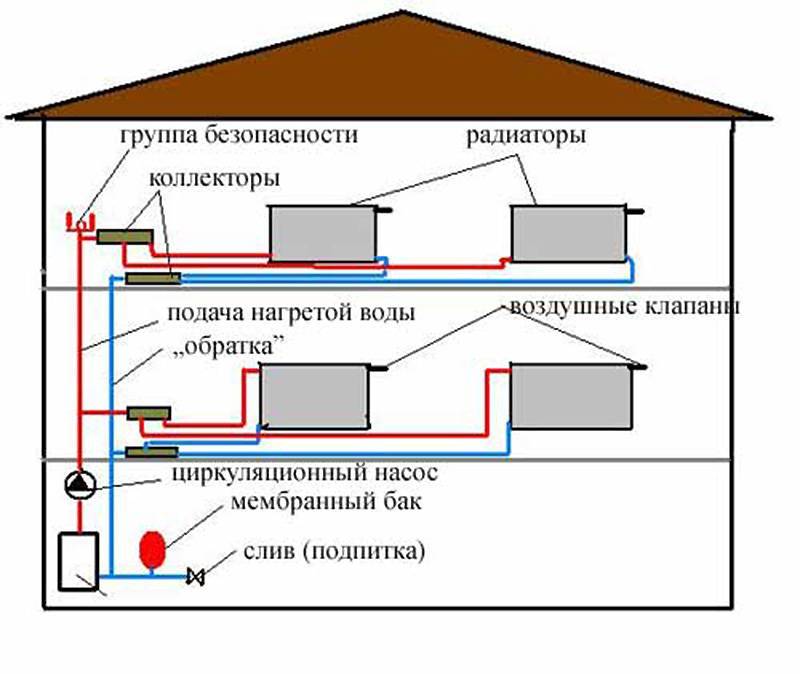
This is a simplified beam wiring diagram in which each radiator is connected to a collector connector for direct and reverse flow of coolant
On each floor, near the riser of the two-pipe system, the supply and return manifolds are mounted. Under the floor, pipes from both collectors run in the wall or under the floor and connect to each radiator within the floor.
Each of the contours should have approximately the same length. If this cannot be achieved, then each ring must be equipped with its own circulation pump and automatic temperature control.
In this case, the change in the temperature regime will be completely independent on each circuit and will not affect each other. Becausethe pipeline will be under the screed, each radiator must be equipped with an air valve. The air vent can also be placed on the manifold.
preliminary stage
Before starting work, the task of the owner is to correctly select all the components and locations of the equipment, namely:
- determine the location of the radiators;
- choose the type of radiators based on pressure indicators and the type of coolant, as well as determine the number of sections or the area of \u200b\u200bpanels (calculate heat losses and calculate the heat output required for high-quality heating of each room);
- schematically depict the location of radiators and pipeline routes, not forgetting about the rest of the elements of the heating system (boiler, collectors, pump, etc.);
- make a paper list of all items and make purchases. In order not to make a mistake in the calculation, you can invite a specialist.
So, in order to proceed to the next stage, it is necessary to take into account the rules for mounting the beam system
Rules for installing beam wiring
If you have chosen to lay pipes under the floor, follow a few rules that will help to avoid heat loss and freezing of the coolant. There should be enough space between the rough and finish floor (more on this later in the description).
When installing pipes in the floor, it is important to take into account several requirements, one of which is the presence of sufficient space between the finishing and subfloor
A concrete foundation slab can be used as a subfloor. A layer of insulation is first laid on it, then a pipeline is arranged. If pipes are laid without a heat-insulating substrate, then the water in these areas can freeze, losing a lot of heat.
As for pipes, it is better to opt for polyethylene or metal-plastic models, which are highly flexible. The polypropylene pipeline does not bend well, therefore it is not suitable for beam wiring.
The pipeline must be attached to the base so that it does not float during pouring with a finishing layer of screed. You can fix it with mounting tape, plastic clamps or other available methods.
The pipe under the screed must be insulated to reduce heat loss to a minimum, and on the ground floor it is imperative to lay a layer of thermal insulation
Then, around the pipeline, we lay the insulation with a layer of 50 mm from foam or polystyrene. We also fasten the insulation to the base of the floor using dowels-nails. The final step is to fill the solution with a layer of 5-7 cm, which will serve as the base of the finishing floor. Any floor covering can already be laid on this surface.
If pipes are laid on the second floor and above, then the installation of a thermal insulation layer is optional.
Remember one important rule, there should not be any connections in the sections of the pipeline under the floor
If there is a circulation pump of sufficient power and performance, the collector is sometimes placed one floor lower relative to the level of the radiators.
If the collector is located at the lower level (basement), then you need to take into account several rules for the correct piping from the comb to the radiators, which are located on the next level
Advantages and disadvantages of furnace heating
From time immemorial, there were stoves in many dwellings, and today stove heating in a private house is not uncommon, since it is often the only possible way to warm a room.The advantages of the system include:
- Economical installation. The stove is laid quickly enough; its arrangement does not require serious financial investments. Often you can use local material for its installation.
- Simplicity and low cost of maintenance.
- The ability to combine a stove and a fireplace, getting a unique decor and heater at the same time.
- Creating a unique atmosphere of special comfort in the house, which is typical only for this type of heating.
- Relatively high efficiency. A well-built furnace can have a capacity of about 60%, which is quite comparable to the efficiency of an oil-fired boiler.
Possibility of regulation of process of burning, preservation and use of heat. The return and supply of air is carried out with the help of dampers, their location allows you to adjust the temperature in the house.




The design of modern stoves can be very different, even so futuristic
It is important for everyone who is going to equip the stove heating of a country house or any other building to know about the most significant disadvantages of the system, which include:
- Prolonged heating of the oven. Quite a lot of time will pass from the moment of ignition until the design begins to fully give off heat.
- Significant loss of floor space. The device requires a lot of space, since the larger its size, the longer it will give off heat.
- Uneven heating of the room: the temperature near the stove is higher, near the walls - much lower.
- Non-compliance with sanitary requirements: significant contamination of the room in which the furnace is located.
- High fire hazard.
- Possibility of carbon monoxide poisoning exists if the equipment is improperly maintained.
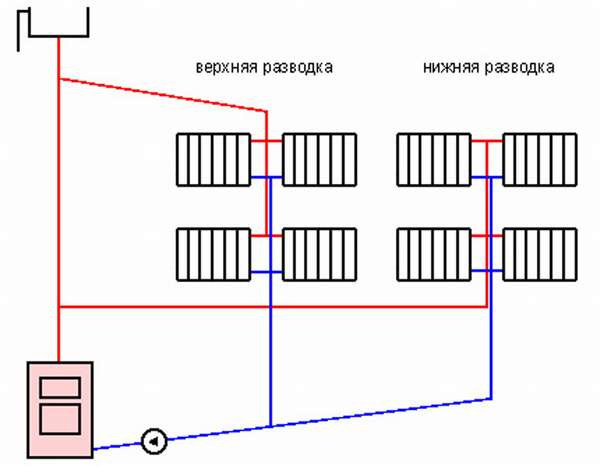
Two-pipe system with top wiring
The main supply pipeline is laid under the ceiling, the return line is laid along the floor. This explains the constantly high pressure in the system, allows the use of pipes of the same diameter even when forming a gravity-flow type structure. The expansion tank must be installed in the attic, be sure to insulate it, or placed between the ceiling - the lower part remains in the heated room, the upper one - in the attic.
Experts recommend mounting the upper highway above the level of window openings. In this case, it is possible to place the expansion tank under the ceiling, provided that the riser is high enough to pressurize the system. The return pipe is laid out on the floor or lowered under it.
In the case of the upper wiring, the upper pipes remain in sight, which does not improve the appearance of the room, and part of the heat remains at the top and is not used to heat the premises. You can put the pipes of the passing line under the radiators, and to ensure normal circulation, install a pump, which allows the use of pipes of small diameter.
In two-story buildings of a private type, the upper wiring is considered effective and helps to achieve good heating in all rooms. The expansion tank is placed at the highest point, the boiler - in the basement. Such a height difference guarantees the efficiency of transporting the coolant, the availability of connecting a tank to provide hot water supply - water circulation will ensure a constant flow of hot water to all appliances.
If you install a gas or non-volatile boiler in the house, then the circuit becomes autonomous. To reduce costs, consider combining a one- and two-pipe heating system.For example, make a warm (single-circuit) floor on the second floor, and equip a double-circuit structure on the first floor.
Advantages of the scheme in:
- speed of movement of the coolant;
- maximum and even heating of the premises;
- eliminating the risk of air pockets.
The disadvantages include the high consumption of components, the lack of energy for heating large rooms and the difficulty in placing an expansion tank.
How to arrange water heating of a private house with your own hands, installation diagrams
In order to make water heating of a private house with your own hands, you need to study the installation diagrams in detail. However, first of all, you need to stock up on all the necessary materials and equipment, the need for which is calculated in advance depending on the type of battery connection.
Modern gas boilers are a good solution for a reliable heating system
Useful advice! Buy boilers, batteries and other equipment only from trusted manufacturers. Cheap analogues do not always meet the requirements and can be dangerous.
Features of the device of a single-pipe system
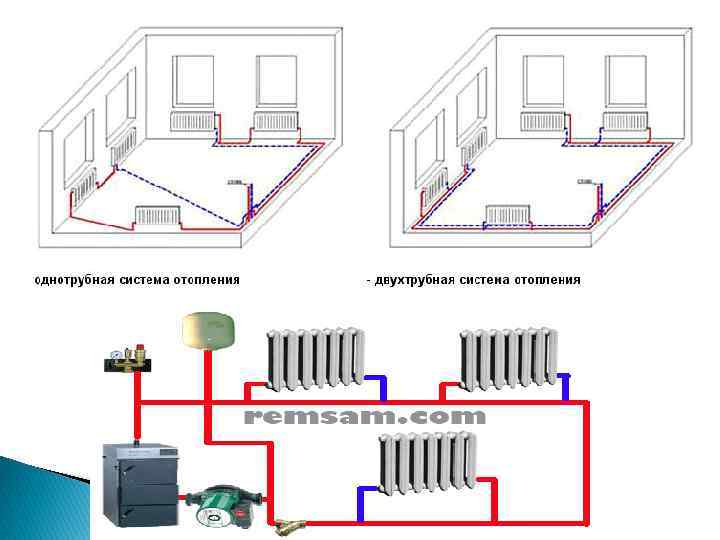
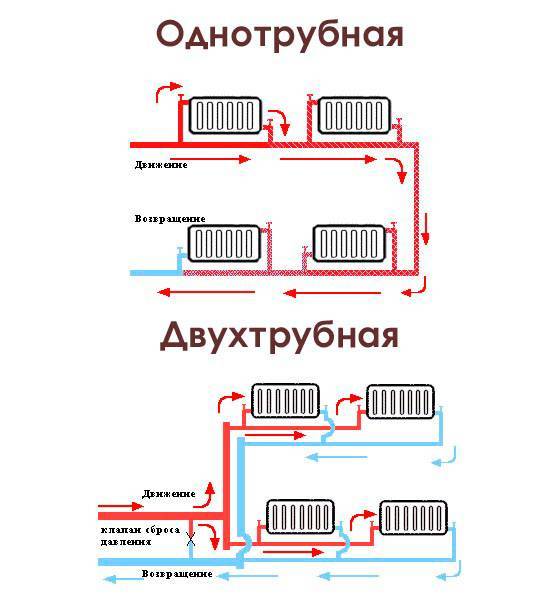
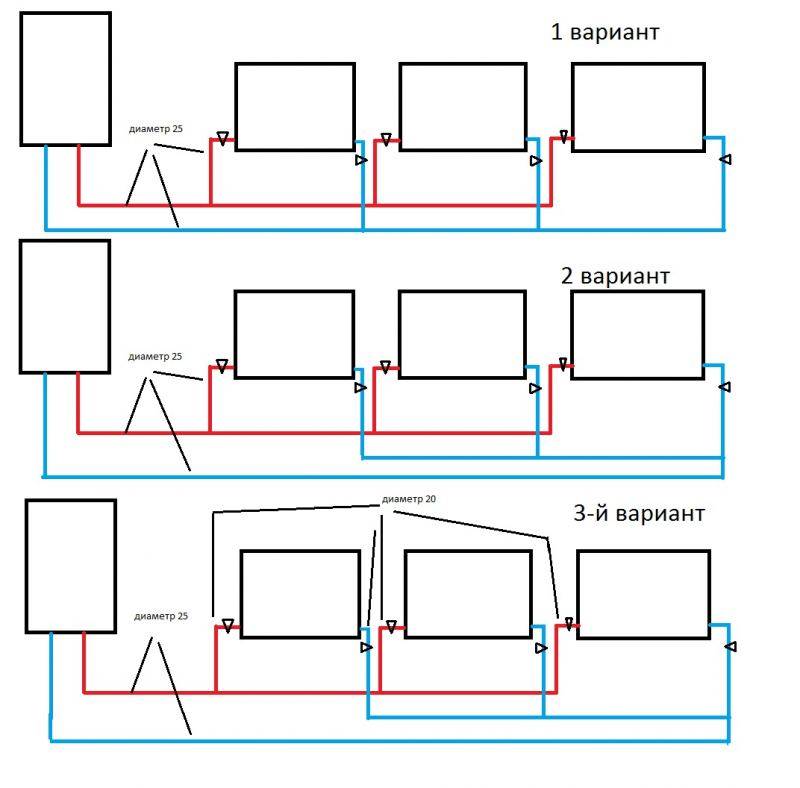
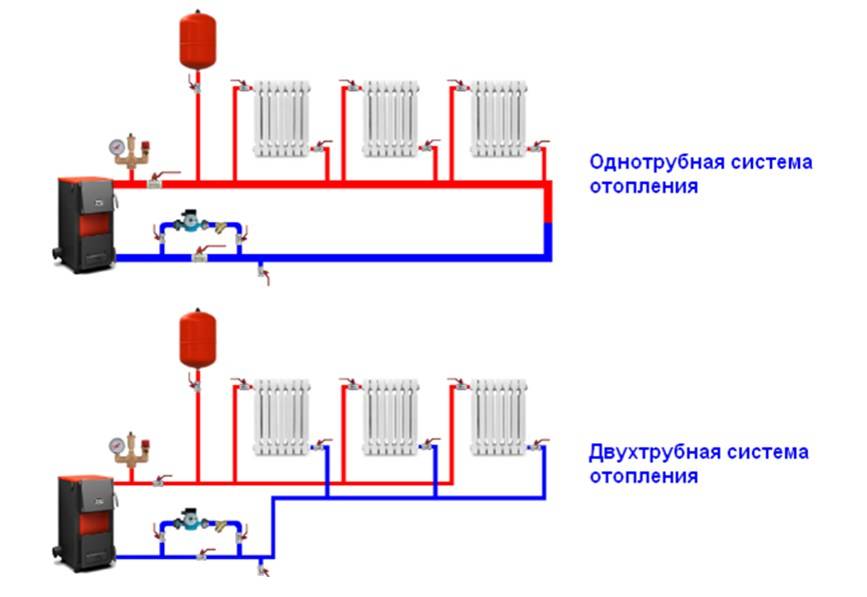
The easiest way to connect radiators to the boiler is to install a single-pipe heating system. The scheme of this design assumes the presence of only one pipe laid around the entire perimeter of the house. It comes out of the supply pipe of the boiler, and enters the return pipe. Branches exit from this pipe near each radiator, to which it is connected through shut-off valves or directly.
The principle of a one-pipe heating system with natural water recirculation
Such a device is not only the simplest, but also the cheapest, both in terms of materials and installation. The use of one pipe eliminates the need to make many pipe bends, and much less various small things are consumed. It's no secret that these fittings cost a significant part of the cost of all home heating. The use of a single-pipe heating system, the scheme of which is simple, is justified in small houses with a simple layout of rooms, since the water passes through the entire ring and has time to cool significantly. In this regard, the last radiators along its path heat up much less than the first ones. Therefore, if the building is large, then by the end of its route, the coolant will lose all its energy and will not be able to heat the last rooms. This is especially true of the natural type of water circulation.
Boiler room of a private house with modern heating equipment
When constructing a single-pipe heating system, the design scheme should assume a slight slope, of the order of 3 - 5 degrees. This will ensure more efficient operation of the entire structure. In addition, all radiators must be equipped with air valves, which are needed to maintain a stable pressure in the system by bleeding air. Such taps have small holes and are unscrewed with an ordinary screwdriver.

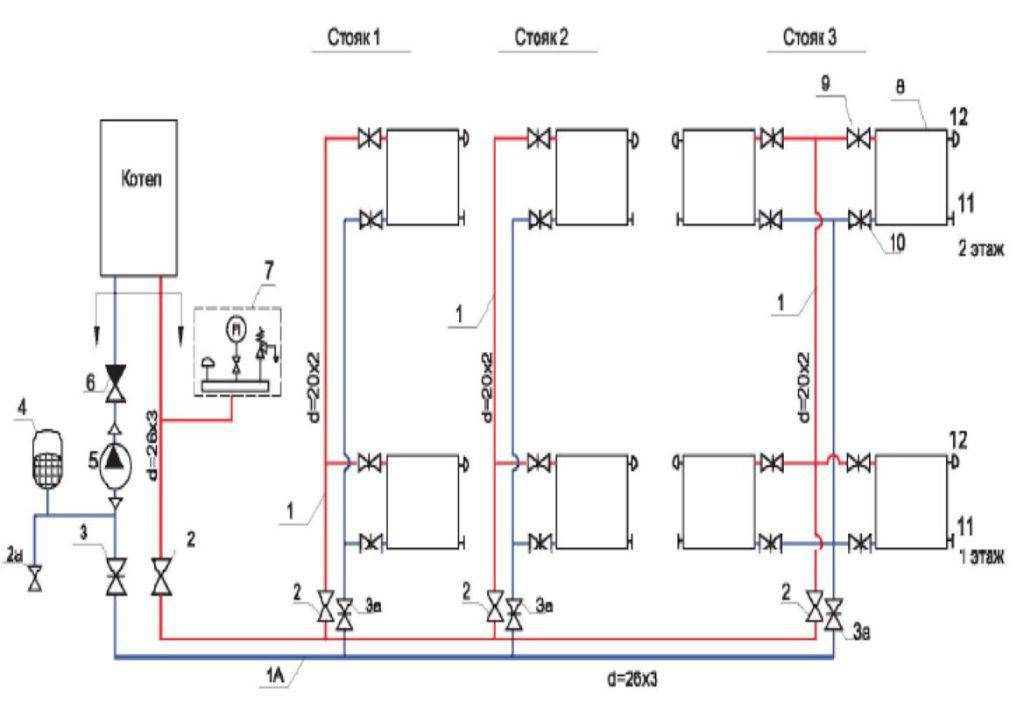



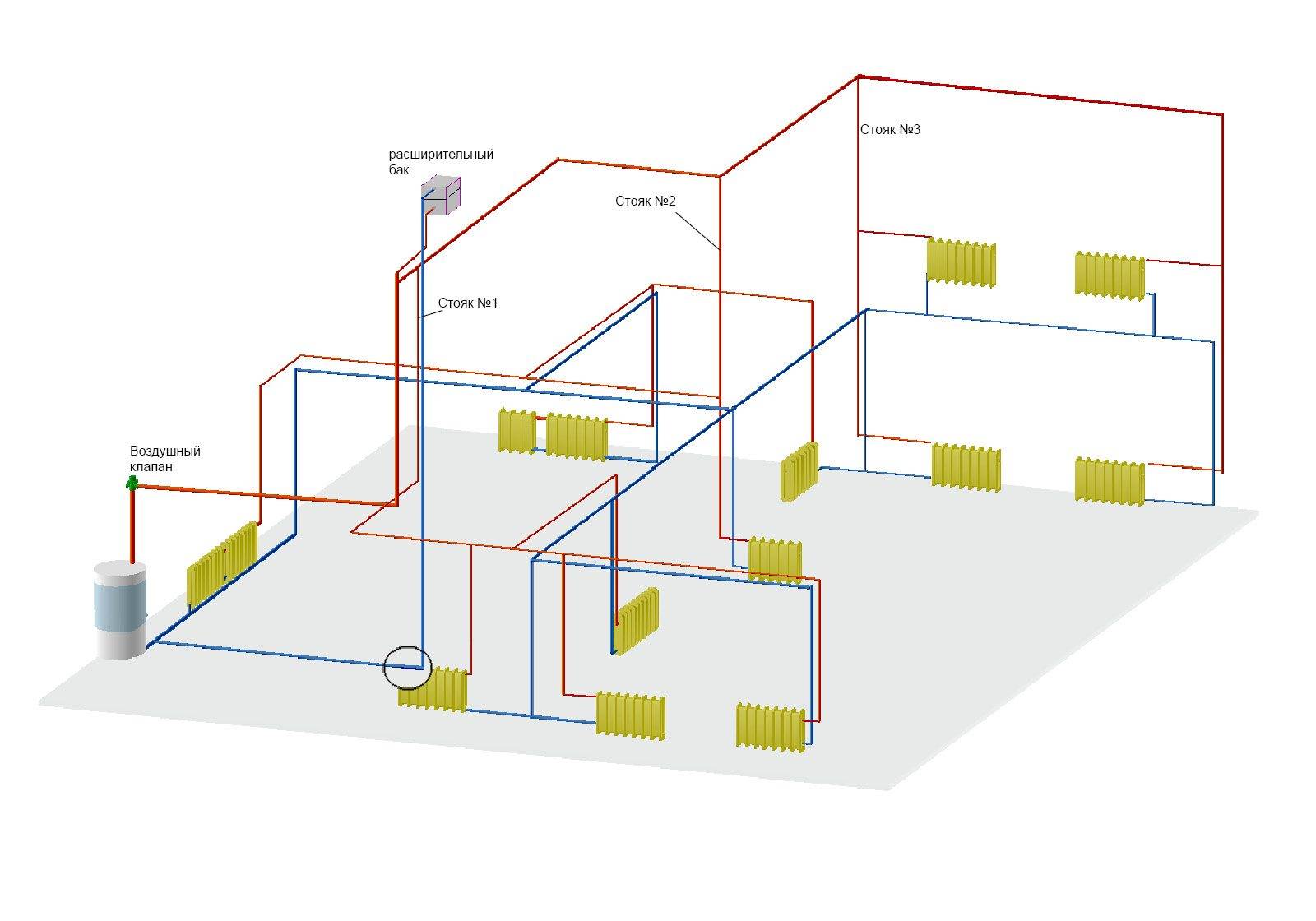


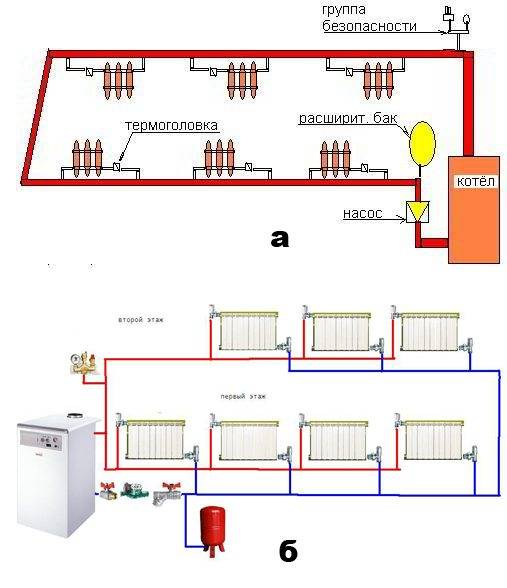
Scheme for connecting radiators to a two-pipe heating system
Useful advice! When it becomes necessary to clean or replace the battery, you can not drain the water and stop the entire system, for this you need to use Mayevsky taps. They connect the radiator to the pipe outlets. If the battery needs to be removed, the taps can simply be closed.
How a two-pipe system works
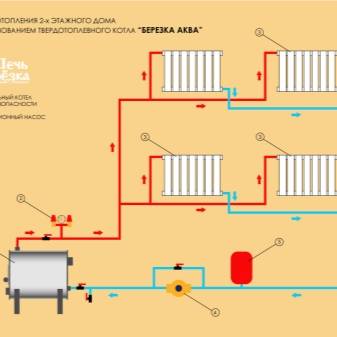
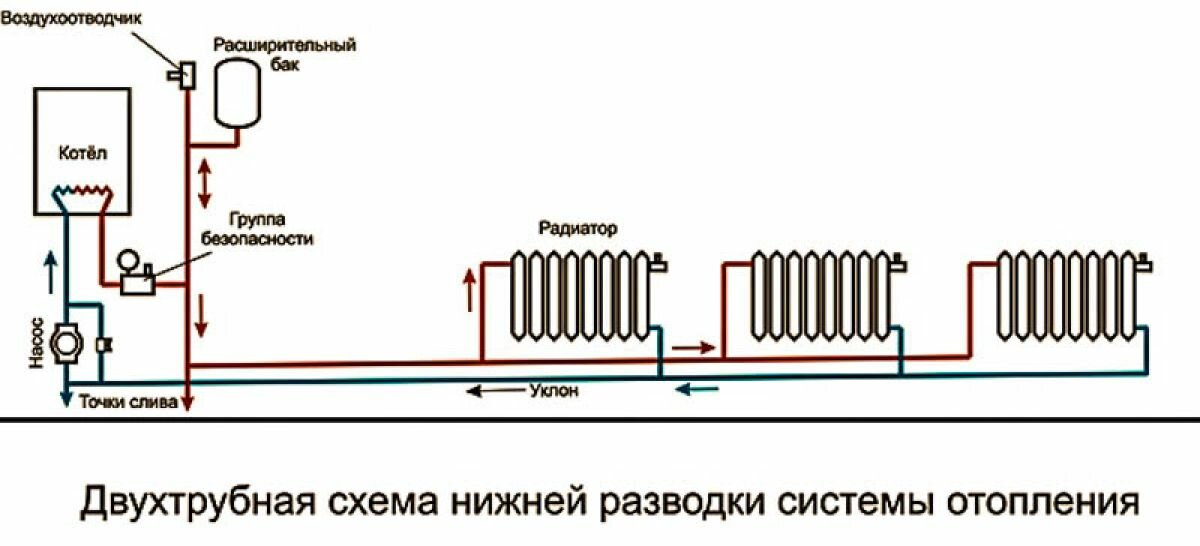
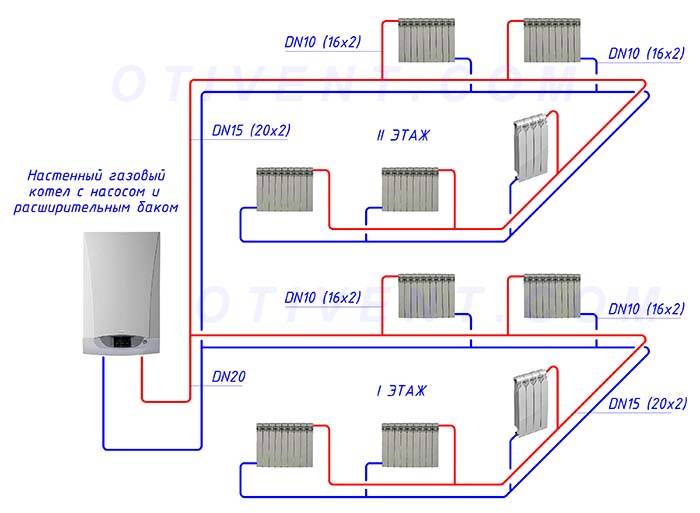
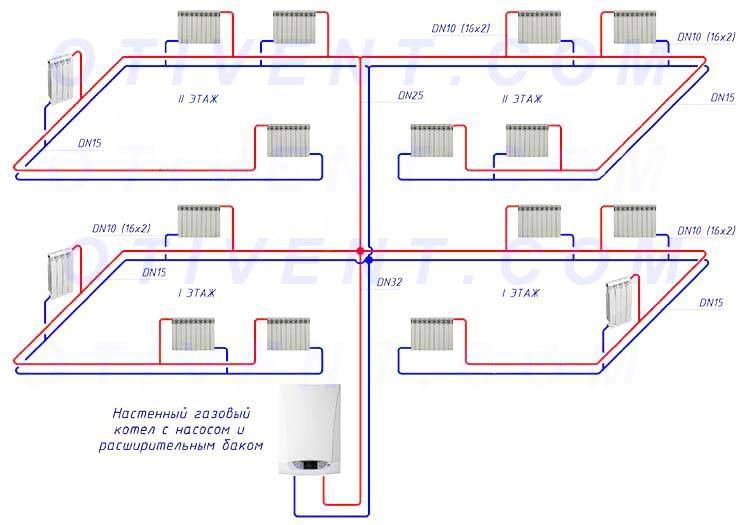
Unlike the previous one, a two-pipe heating system, the scheme of which assumes the presence of two pipes: supply and return, is more complex in design. It is designed in such a way that the supply pipe enters directly into each battery. and the reverse comes out of it. This is also called a parallel device, since all radiators are connected to the boiler with pipes not in order, but in parallel.
A two-pipe heating system, the scheme of which is more complex, requires more pipes and fittings. Therefore, it costs a little more. At the same time, it is more efficient, since all batteries heat up equally, regardless of their location, near the boiler or in the farthest room. Such wiring is most often used in two-story houses and cottages.
Connection diagrams for a two-pipe heating system in a two-story cottage
An important advantage of such a device is that each battery functions almost independently of the others, as it has its own circuit. Therefore, it can be easily replaced or repaired without affecting the rest of the structure. Due to the fact that the two-pipe heating system has a parallel radiator connection scheme, it is very easy to regulate the temperature and pressure in them, which will provide additional savings in fuel resources.
Useful advice! When using a heating system with two pipes, it is advisable to use a circulation pump. It will greatly increase the efficiency and heating rate of the batteries.
Scheme of an open heating system with a circulation pump
How is the water heating system arranged?
The principle of operation of water heating is quite simple.The design is a closed system consisting of a heating boiler, piping and radiators.
The boiler heats up the coolant, it can be water or a solution based on one of the glycols, which enters the radiators located in the heated room through pipes. The batteries heat up and give off heat to the air, due to which the room itself heats up. The cooled coolant returns through the pipes to the boiler, where it heats up again and the cycle repeats.
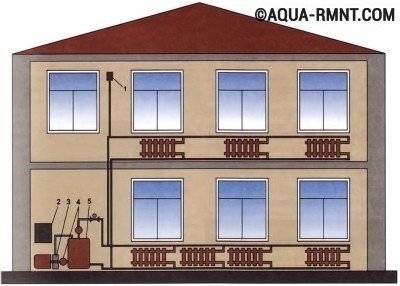
Water heating is a closed system in which the coolant circulates: 1 - expansion tank; 2—automatic control unit; 3—vortex generator; 4 - circulation pump; 5—tank thermos
The circulation of the coolant, on which all water heating systems are based, can be carried out in two ways - natural and forced.
Option #1 - natural or gravity
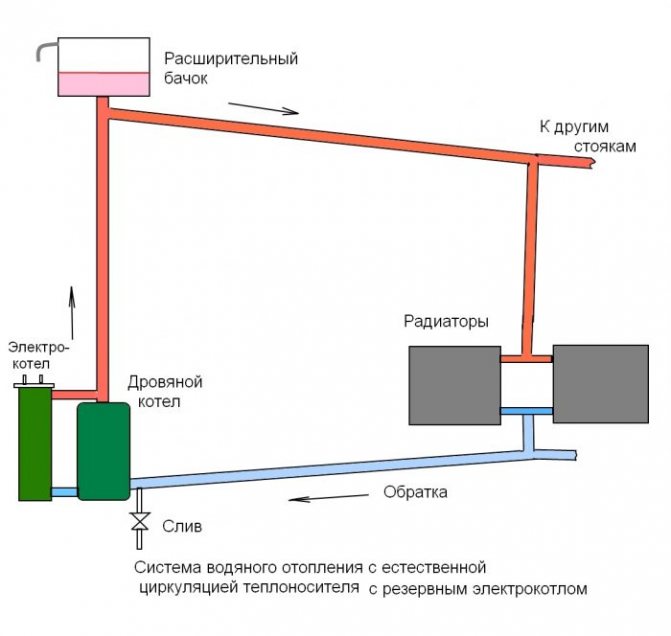
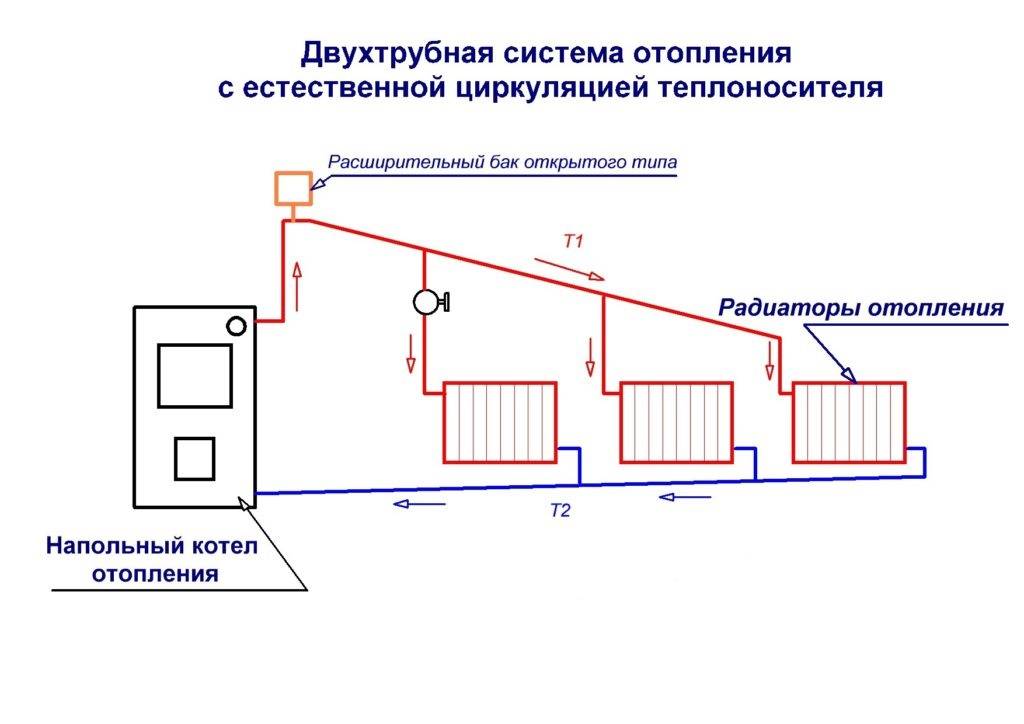
The process is carried out due to different densities of cold and hot water. The heated liquid becomes less dense and, accordingly, weighs less, so it tends to move upwards through the pipes. As it cools, it thickens and then returns to the boiler.
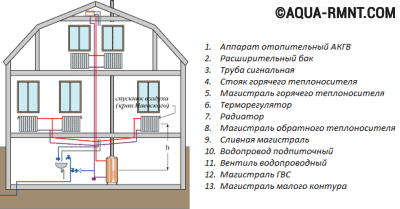
The natural circulation system works due to the action of natural gravitational forces.
The main advantage of a natural system is autonomy, since it does not depend on electricity, and the utmost simplicity of design. The disadvantages include the need to use a large number of pipes, and their diameter must be large enough to provide natural circulation. As well as the inability to use modern models of batteries with a small cross section and the need for strict adherence to a slope of at least 2 °.
Option #2 - forced system
The movement of the coolant through the pipes occurs due to the operation of the circulation pump. The excess liquid formed during heating is discharged into a special expansion tank, most often closed, which prevents water from evaporating from the system. If a glycol solution is chosen as the coolant, the expansion tank must be closed without fail. In addition, the system has a pressure gauge that monitors pressure.


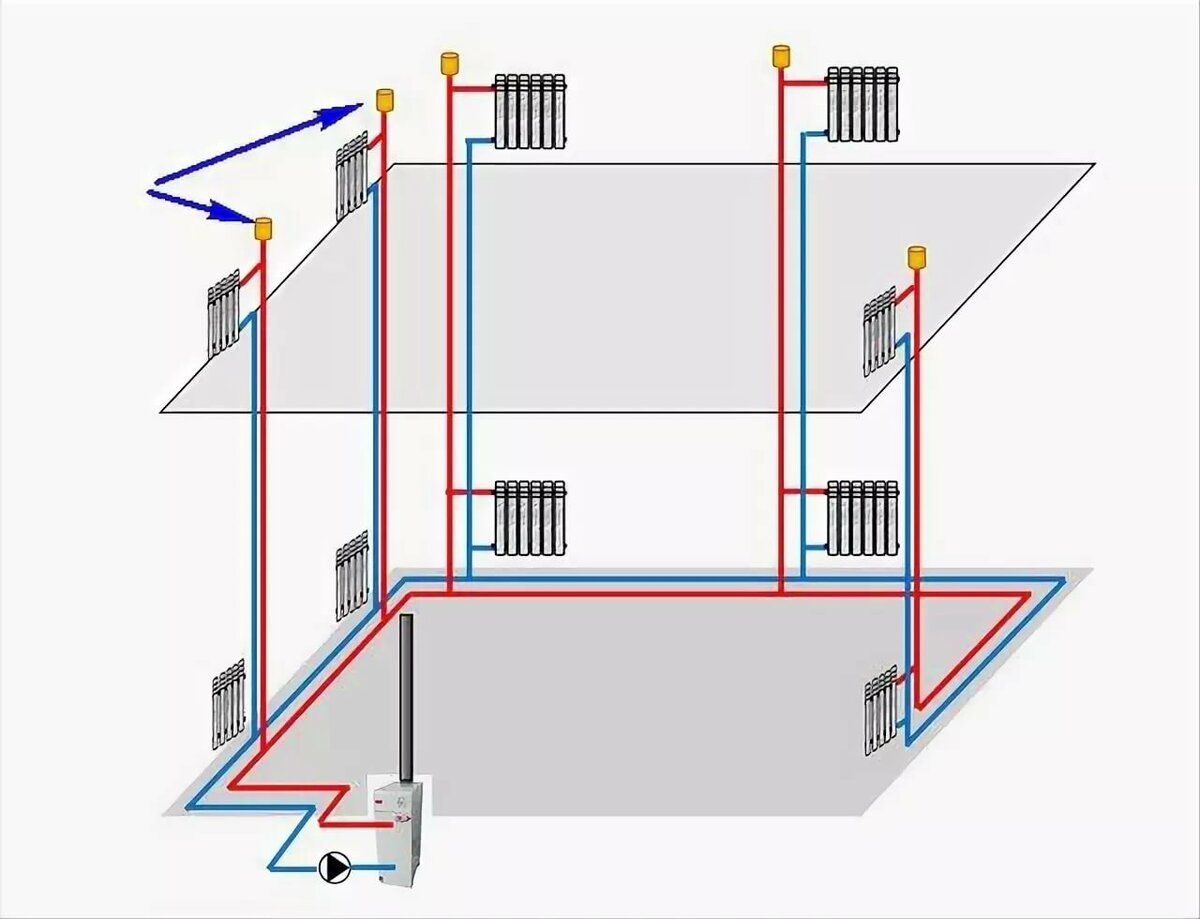

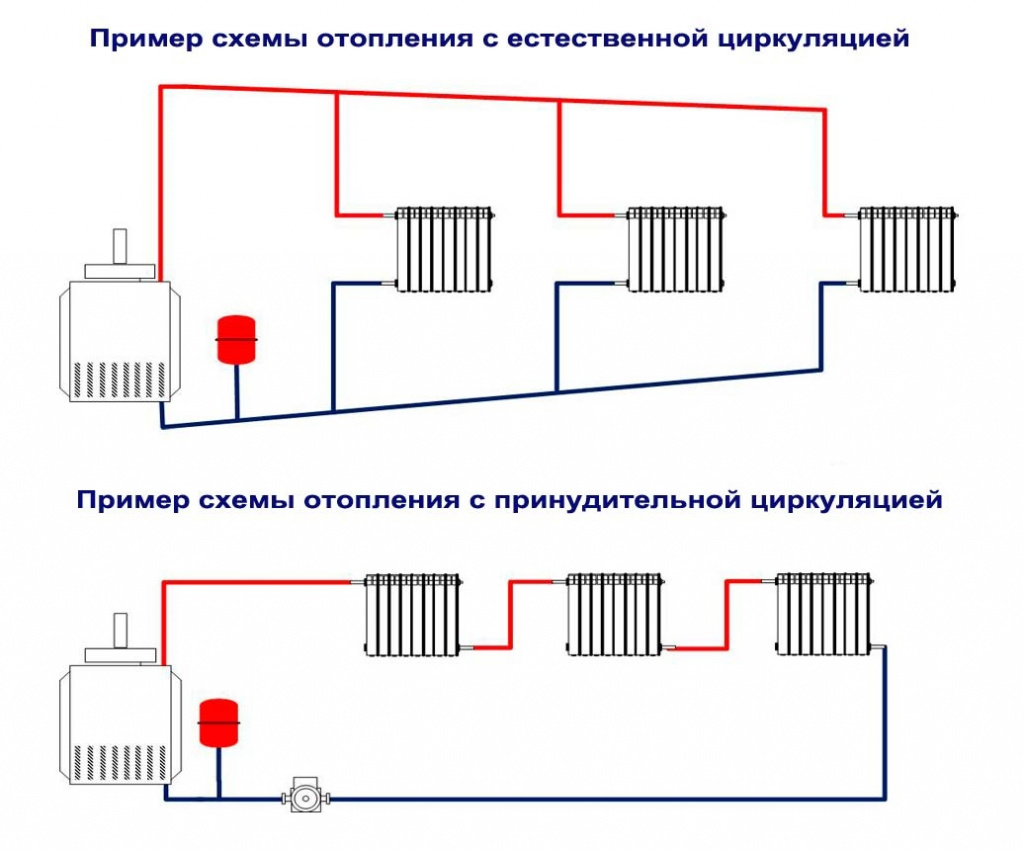


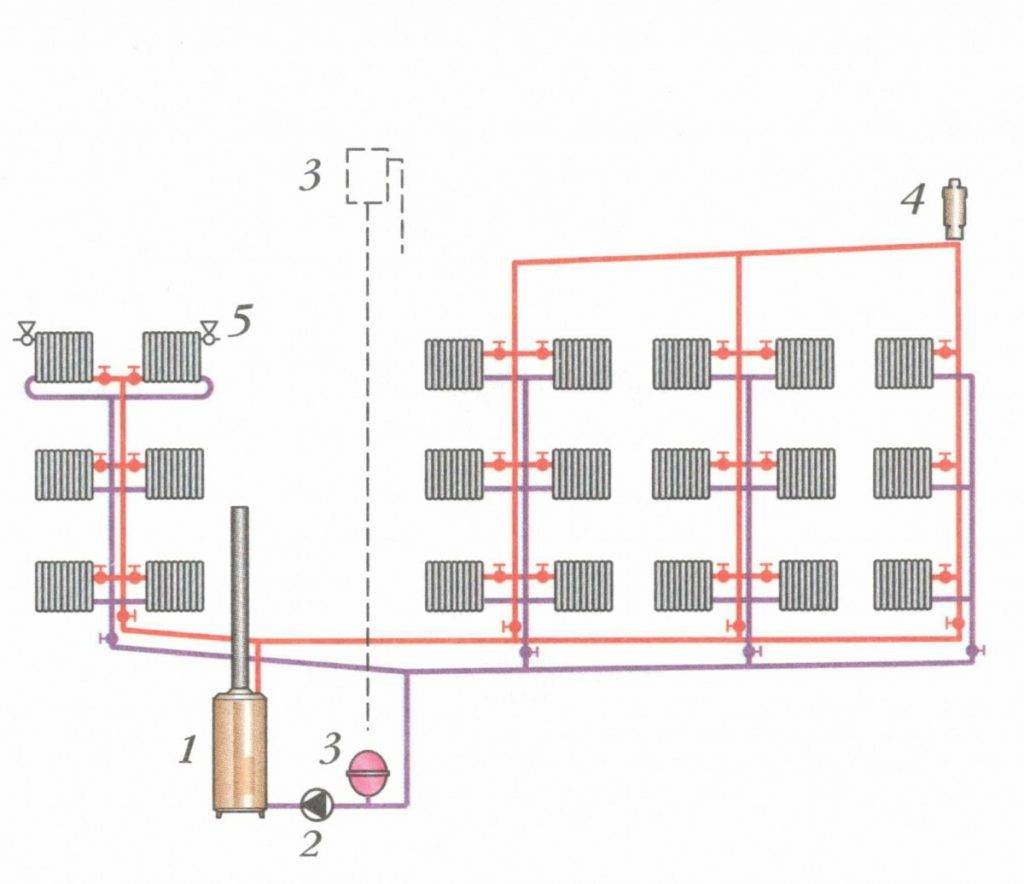
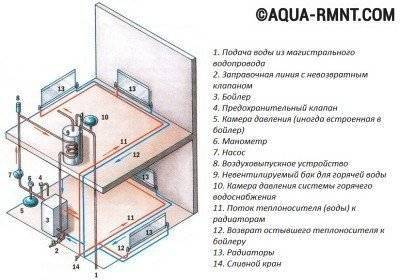
The forced system implies additional costs for the expansion tank, pressure gauge, pump, thermostats, etc.
The advantages of the design are undeniable: a small volume of coolant, which can be used not only water, less consumption of pipes, the diameter of which is smaller than in the previous case. The ability to control the temperature of heating radiators, batteries can be of any type with any pipe diameter. The main disadvantage is the dependence on the supply of electricity, with which the pump works.
For a more detailed comparison of the two options, check out this video:
Mounting order
A single-pipe system is assembled as follows:
- In the utility room, the boiler is installed on the floor or hung on the wall. With the help of gas equipment, the most reliable and efficient one-pipe heating system of a two-story house can be arranged. The connection diagram in this case will be standard and will allow you to do all the work, if desired, even on your own.
- Heating radiators are hung on the walls.
- At the next stage, the “supply” and “reverse” risers are mounted to the second floor. They are located in the immediate vicinity of the boiler. At the bottom, the contour of the first floor joins the risers, at the top - the second.
- Next is the connection to the battery lines. A shut-off valve (on the inlet section of the bypass) and a Mayevsky valve should be installed on each radiator.
- In the immediate vicinity of the boiler, an expansion tank is mounted on the "return" pipe.
- Also on the "return" pipe near the boiler on the bypass with three taps, a circulation pump is connected. A special filter cuts in front of it on the bypass.
At the final stage, the system is pressure tested in order to identify equipment malfunctions and leaks.
As you can see, the single-pipe heating system of a two-story house, the scheme of which is as simple as possible, can be very convenient and practical equipment.
However, if you want to use such a simple design, at the first stage it is important to make all the necessary calculations with maximum accuracy.
Thinking about the installation of heating, it is initially determined what type of fuel will be used
But along with this, it is extremely important to decide how independent the planned heating will be. So, a heating system without a pump, which does not need electricity to work, will be truly autonomous. All you need is a heat source and a well-placed piping for efficient operation.
For efficient operation, you only need a heat source and properly located piping.
The heating circuit is a set of elements designed to heat the home by transferring heat to the air.The most common type of heating is a system that uses boilers or boilers connected to the water supply as a heating source. Water, passing through the heater, reaches a certain temperature, and then goes to the heating circuit.
In systems with a coolant, which is used as water, circulation can be organized in two ways:
Boilers (boilers) are used as a heat source for heating water. Their principle of operation is based on the transformation of the type of energy defined for them into heat, followed by its transfer to the coolant. According to the type of heating source, boiler equipment can be gas, solid fuel, electric or fuel oil.
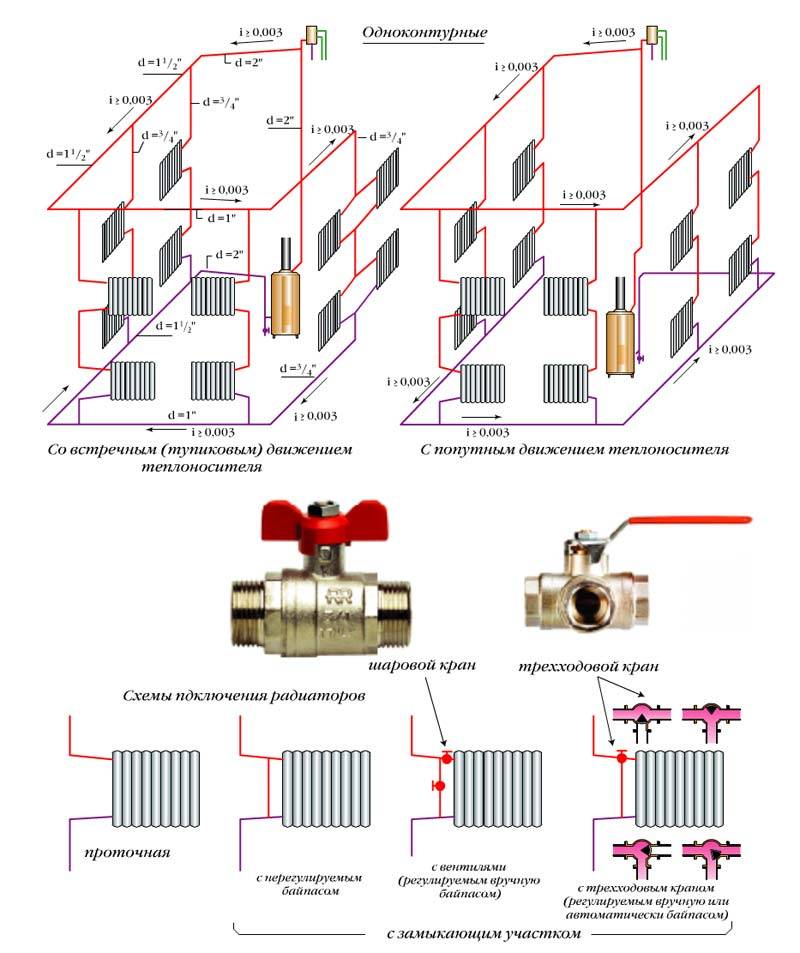
According to the type of connection of the circuit elements, the heating system can be one-pipe or two-pipe. If all circuit devices are connected in series relative to each other, that is, the coolant passes through all the elements in order and returns to the boiler, then such a system is called a single-pipe system. Its major drawback is uneven heating. This is due to the fact that each element loses some amount of heat, so the difference in boiler temperatures can be significant.


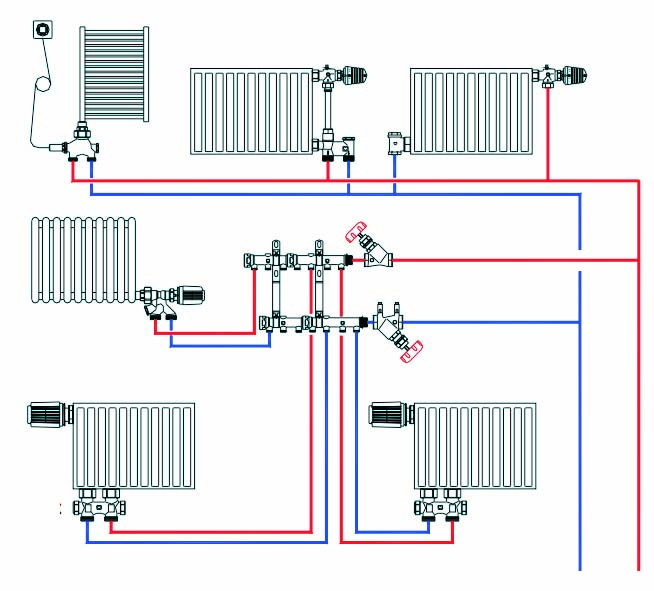


A two-pipe type system implies a parallel connection of radiators to a riser. The disadvantages of such a connection include a design complication and a doubled material consumption compared to a single-pipe system. But the construction of a heating circuit for large multi-storey premises is carried out only by such a connection.
A gravity circulation system is sensitive to errors made during heating installation.
Comparison of costs of different heating systems
Often the choice of a particular heating system is based on the starting cost of the equipment and its subsequent installation. Based on this indicator, we obtain the following data:
- Electricity. Initial investment up to 20,000 rubles.
- solid fuel. The purchase of equipment will require from 15 to 25 thousand rubles.
- Boilers for liquid fuel. Installation will cost 40-50 thousand.
- Gas heating with own storage. The price is 100-120 thousand rubles.
- Centralized gas line. Due to the high cost of communication and connection, the cost exceeds 300,000 rubles.
Do-it-yourself heating system for a private house
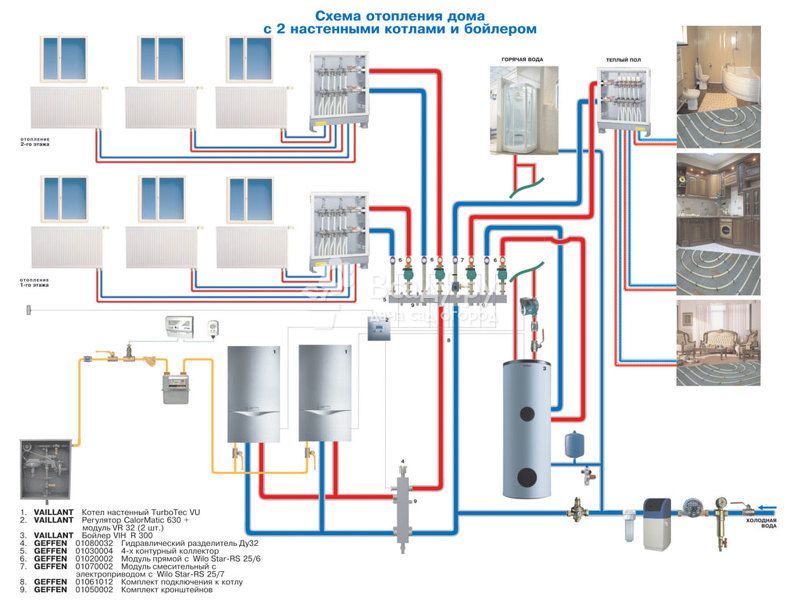
Before proceeding with the organization of heating, you need to draw up a scheme for laying communications. To do this, you have to choose which system to install: water, steam, electric or open fire. Its choice depends on financial capabilities, personal tastes and the appropriateness of installation in the room. The scheme must take into account all elements of the heating system. Also at the design stage, you need to calculate the power.
Heating systems of country houses and cottages differ in the type of energy used, coolant, installation method, as well as a set of components.
Despite the difference in performance, the principle of operation of most consists of the following steps:
- The boiler is heated: water, steam, antifreeze or oil.
- The coolant diverges through pipes leading to radiators.
- When moving through the pipes, the heated substance gives off heat to the radiator and heat exchanger that are installed in the boiler or collector, due to this, the water is heated.
- Then it returns to the boiler, where it heats up again and goes through the whole cycle again.

Water, by right, is considered the best coolant, due to the following qualities:
- availability;
- high energy intensity;
- accumulative properties;
- environmental cleanliness;
- security.
Despite all the advantages of water heating, including the ease of replacing the coolant (drain) to replace part of the system, there is a significant minus: in winter, water freezes and pipes can burst. Therefore, it should be chosen in the case when a private house warms up constantly (poorly suitable for summer cottages, where the owners appear very rarely in winter).
Using antifreeze or oil as a coolant will solve the freezing problem, but when draining, special containers will be needed and the cost of replacing the substance will be quite expensive. Therefore, water heating is preferred.
Heating of liquids is carried out in boilers for which fuel is used: firewood or pellets (eurowood) as well as coal, gas, electricity or diesel fuel.