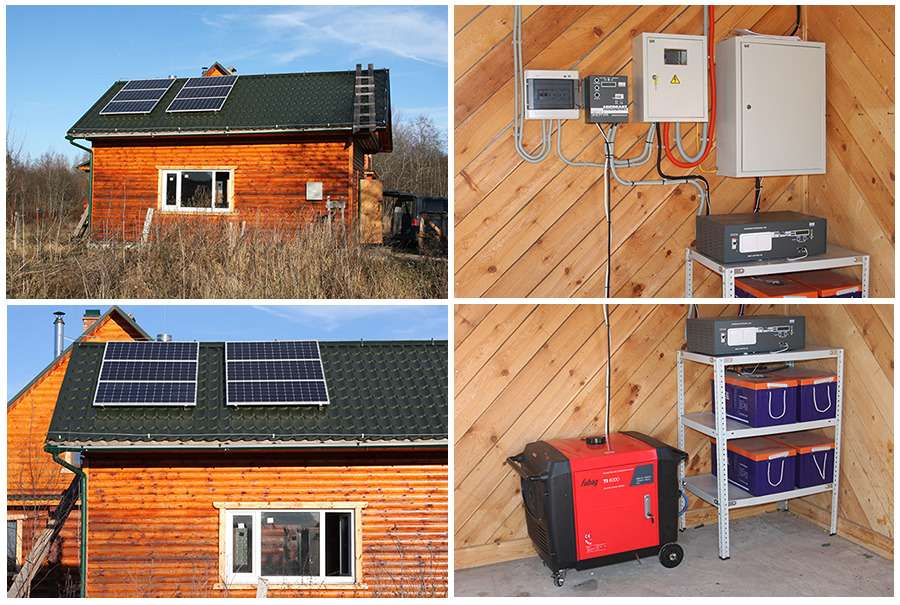
- Varieties of electricity sources
- Mini power stations or generators
- Batteries or uninterruptible power supplies
- Solar power generators
- Wind power or wind turbines
- Portable hydroelectric power plants for the home
- Advantages of autonomous power supply
- Pros and cons of AE sources
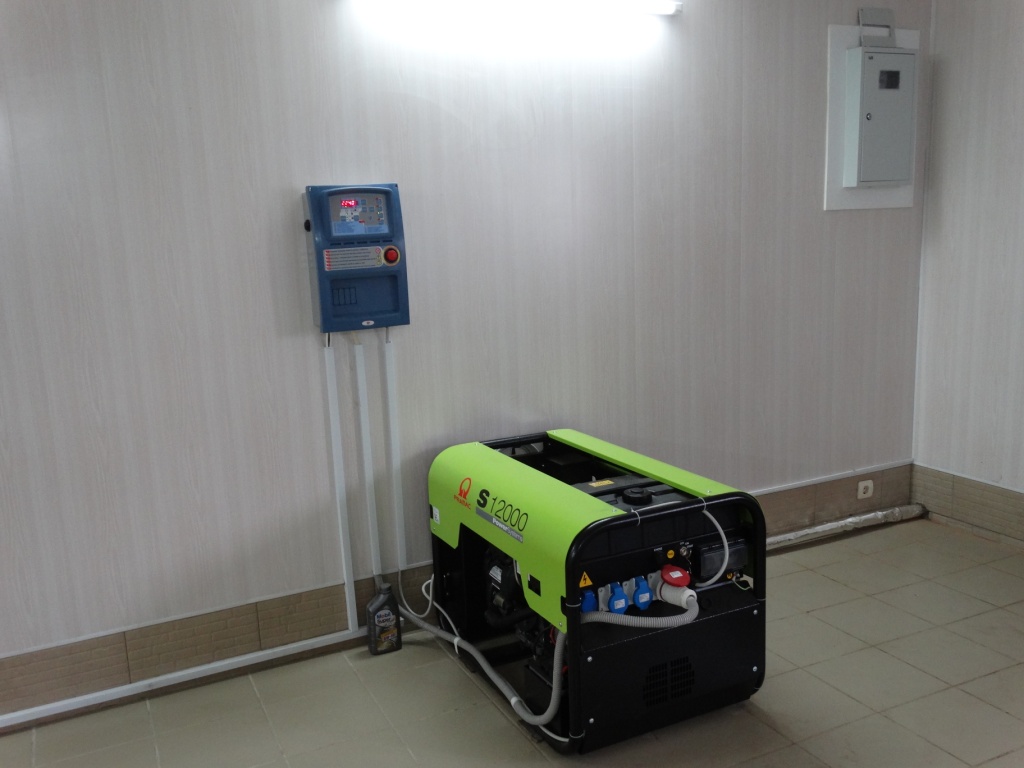
- Fuel generators
- Fuelless generators
- Solar panels
- Batteries
- Other autonomous power supply systems at home
- Requirements for autonomous power supply
- Wind turbines and feed-in tariff
- Technical characteristics of wind turbines for autonomous power supply at home
- Specifications:
- Autonomous power supply systems of a private house
- small scale hydropower
- Types of alternative electricity
- Electric generator
- Alternative to hydrocarbon fuel
- Varieties of generators
- Gas generators
- Gasoline generators
- Diesel generators
- Unconventional Power Sources
- Solar panels
Varieties of electricity sources
 Autonomous supply of electricity to a private house is most often provided by:
- uninterruptible power supplies (UPS) in the form of batteries;
- solar batteries;
- mini-power plants with wind, gas, diesel and gasoline generators.
In our country, generators are most often used, which operate at the expense of thermal energy - gas, gasoline and diesel fuel.
Mini power stations or generators
Such EPSs are easy to use and relatively cheap.
Benefits of generators:
- A mini-power plant can work for a long time. This requires only the presence of fuel.
- Autostart of the generator makes it possible to use it offline.
- A mini-power plant with a power of 5-6 kW is able to provide electricity to all electrical appliances at home.
- The cost of installation depends on the power of the generator, the quality of workmanship and the manufacturer.
The disadvantages of this setup include:
- The need for constant maintenance. You will need to regularly check the oil level and the presence of fuel.
- Generators are quite noisy devices. Therefore, if it is not possible to install them away from home, then even when using silencers, the noise they make makes the use of the installations not very comfortable.
- Not all autonomous mini-power plants at the output are capable of delivering a stable voltage and a pure sine wave.
- Generators require good ventilation and a separate insulated room.
Batteries or uninterruptible power supplies
Such devices are charged at a time when there is electricity in the network and during interruptions they give electricity.
- The UPS does not need to be constantly monitored. It will only be necessary to monitor the condition of the battery.
- Batteries do not require a separate room and a lot of space.
- An uninterruptible power supply is a completely autonomous system that instantly turns on in the event of a power outage in the house.
- At the output, an autonomous device gives a stable voltage.
- The UPS is silent.
The disadvantages of batteries include limited operating time and relatively high cost. The battery life of a UPS is directly related to the capacity of its batteries.
Such an installation would be the right solution for an apartment building with autonomous heating.
Solar power generators
 Solar panels are special photovoltaic safety modules with protection on the outside made of tempered textured glass, which increases the absorption of sunlight several times.
- Such power generators can be recognized as the most promising type of equipment for achieving autonomous electrification of the house.
- The set of the device includes a set of batteries that stores electric current and supplies it at night.
- A special inverter is attached to solar panels, capable of converting current from direct to alternating.
- Devices equipped with silicon monocrystals are the most durable modules. They are able to work for thirty years without reducing the amount of energy produced and efficiency.
- One properly selected solar panel is able to provide the entire house with the necessary amount of electricity to operate all household equipment.
Wind power or wind turbines
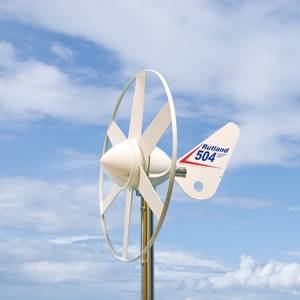
 If local weather conditions do not allow the use of solar power generators, then wind energy can be used.
- Such energy is taken through turbines, which are located on towers from three meters high.
- Energy is converted using inverters installed in autonomous windmills.The main condition is the presence of wind with a speed of at least fourteen kilometers per hour.
- The set of generators also includes an inverter installation and batteries that store electricity.
Installation of such devices is not possible in places where there is no natural air movement. This is a significant disadvantage of wind turbines.
Portable hydroelectric power plants for the home
This device for autonomous power supply is powered by a stream of water. They can only be used in houses that are located near small rivers and streams. Therefore, hydroelectric power plants are the least common devices.
Advantages of autonomous power supply
It would seem that there is only one point in an autonomous power supply system - this is when there is no power line near the house, and it is too expensive to pull your own line. However, many homeowners create their own electrical system even if they are already connected to the public system.
So what is the benefit of autonomous power supply?
- Regardless. Your system will protect against power outages for various reasons. An autonomous system is also not immune from accidents and other troubles, but if you create duplicate devices, then the protection against accidents will reach a maximum.
- In economy. Electricity supplied through a single system is expensive. Creating a stand-alone system is also not cheap, but many homeowners find that it pays off very quickly, and just as quickly becomes not only cheap, but also profitable.
- In mobility. Autonomous system, built on several sources of electricity, allows you to quickly respond to the situation, remaining in the light in any situation.
Pros and cons of AE sources
Fuel generators
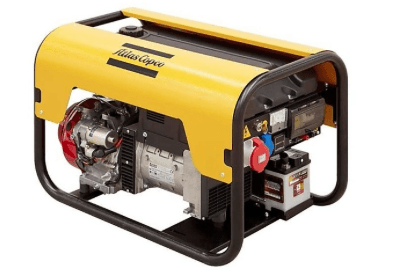 Such generators require a considerable supply of fuel, which must be constantly replenished at their own expense. Most often, this type is used for mixed uninterruptible power generation, when the generator is activated when the main network “falls asleep”. In cases where only a generator is used, a minimum of 2 pieces of equipment is required to avoid overloads by switching on in turn.


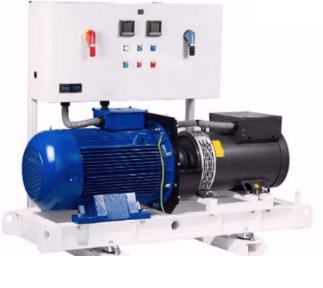 Fuelless generators
A good option for part-time work with other sources, if you are not embarrassed by the bulky size. In micro modifications, there are only hydraulic turbines. All types are considered environmentally friendly, but require the connection of additional equipment. Wind models are dependent on air flow speed (at least 14 km/h).
Solar panels
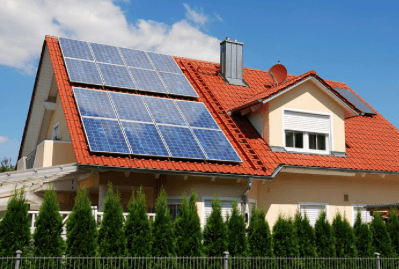 The most environmentally friendly way to get electricity in an alternative way. Batteries operating on the basis of solar rays can not only provide any typical building with power, but also generate a surplus. In practice, they are characterized by a large area of solar panels, often covering entire roofs or walls for high-quality power and need additional equipment. The whole system can even occupy a separate room of about 5-6 sq.m (not counting the solar panels themselves). Dependent on the landscape, climatic conditions, the ratio of the number of cloudy and sunny days.
Solar panels shown in the video
Batteries
Suitable for emergency power supply only. Not able to work for a long time without recharge. Most models are only capable of supplying charge in the presence of an inverter to increase the voltage (for example, from 12 to 220V).
Other autonomous power supply systems at home
Electricity for autonomous power supply at home must be generated continuously, be an environmentally friendly source of energy. The main energy sources used to generate electricity are wind, water, biomass, geothermal and solar energy sources.
Creating an autonomous power supply for a private house on solar panels is quite profitable. Within a few years, you will have completely free electricity for the life of the solar panels (40 years or more). The payback will largely depend on the source of purchase of solar panels and other equipment.
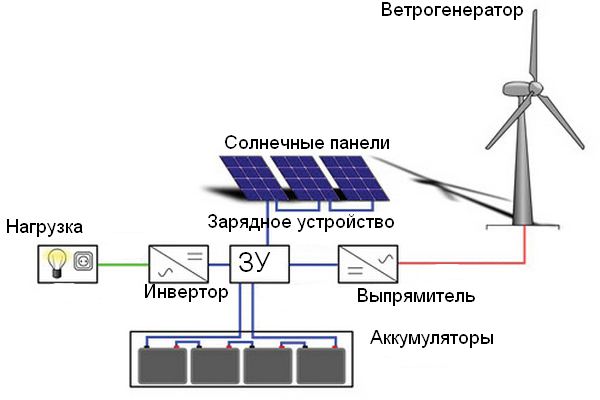
Options for autonomous power supply on solar panels and wind turbines
Buying this equipment in China will be much more profitable than in Western countries, and they differ little in quality and service life. The main disadvantage of energy from solar panels is the large area covered by roof panels and maintenance, which consists in cleaning the panels from snow.
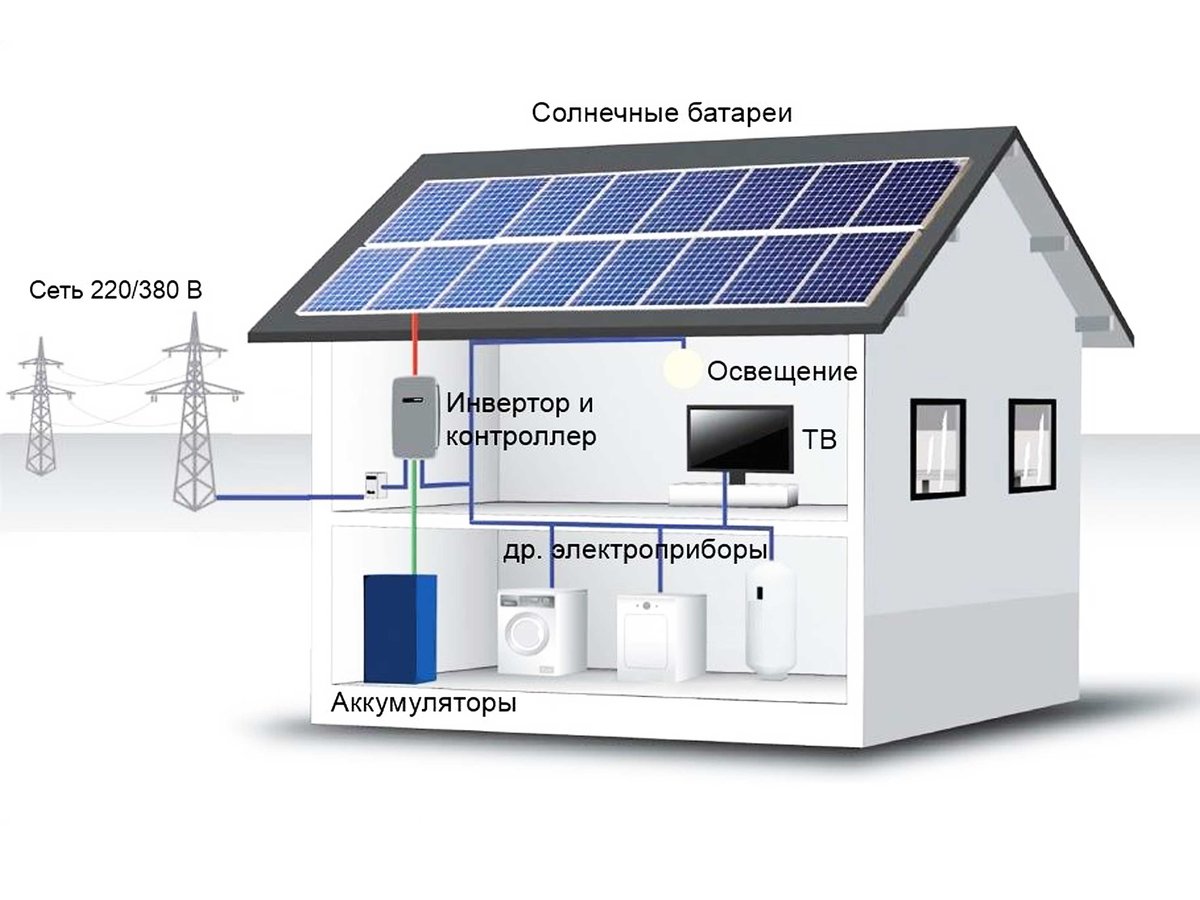
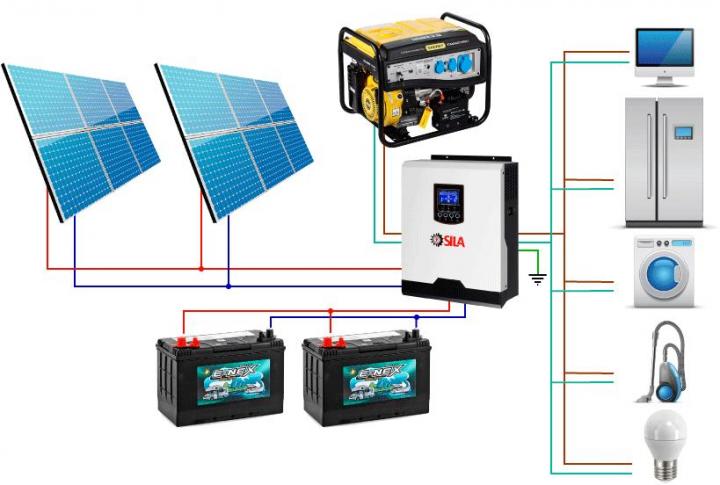
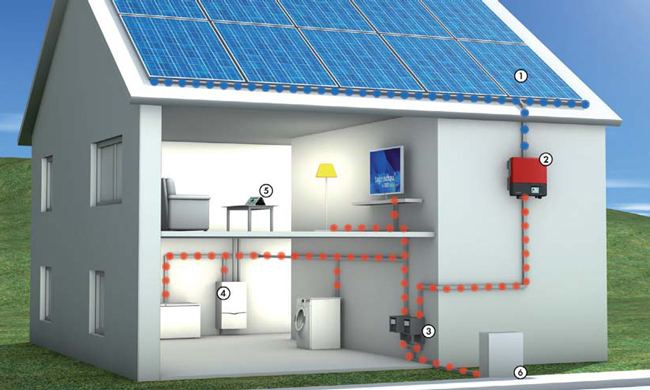
As additional equipment for the operation of solar panels, inverters are used to convert direct current to alternating current and batteries, the number of which depends on the power of your solar power plant.
Such autonomous sources of solar energy are installed without any permits. Wind energy is used in areas where there is wind. Wind turbines require an inverter to operate. The height of wind power installations depends on the strength of the wind, for example, in urban areas, the height of the tower is more than 10 meters.

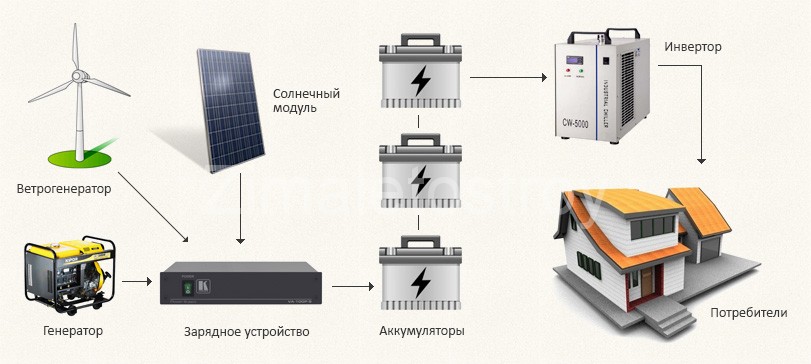
Autonomous power supply options on solar panels, windmill and generator
Authorities may require permits, explaining that windmills are an obstacle to the flight of birds. Wind turbines create a lot of noise. Wind turbines also quickly pay for themselves and are a good source of autonomous power supply at home. The use of water energy is suitable in areas where there are rivers, lakes. On a small scale, where there are no environmental consequences, using water turbines is quite profitable.
In this case, it will be necessary to issue permits for the installation of a water turbine. To determine whether this or another autonomous power supply system for a private house is beneficial, you need to calculate all the costs of purchasing, installing, calculating the payback period for autonomous power systems and drawing an appropriate conclusion. However, using an autonomous power supply will be much more profitable than using a source of industrial power networks.





Requirements for autonomous power supply
One of the conditions for the normal life support of a private house is considered to be a stable, uninterrupted supply of electricity to all installed household appliances and equipment. These requirements are fully met by autonomous power supply sources that consistently generate electricity, regardless of any external factors. When choosing one or another option, it is necessary to take into account the degree of influence of autonomous systems on the environment.
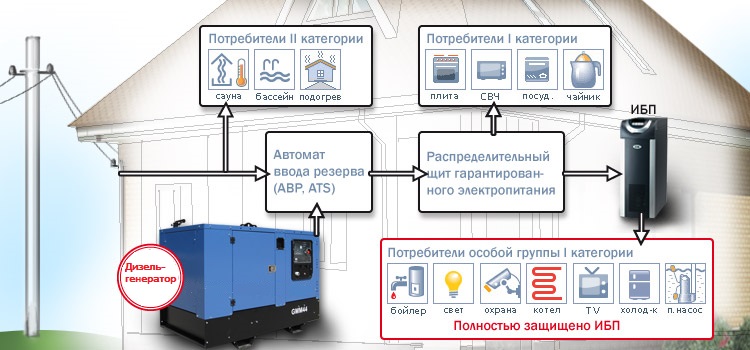
The final choice of an autonomous source of electricity is carried out in accordance with the total power of consumers in the house.These are heat and water supply systems with pumping equipment, air conditioners, various types of large and small household appliances. Regardless of the power of consumers, general requirements are imposed on the power supply network.
Without fail, the total power is preliminarily determined, which is compared with the capabilities of the selected autonomous power supply system. It is recommended to increase this figure by about 15-25% so that electricity consumption can be increased in the future.
The requirements for the system and its technical characteristics are completely dependent on the further use and assigned tasks. That is, it can be a completely autonomous power supply or only a backup source of electricity that functions during the period when the central network is turned off. In the second case, the duration of the operation of the backup system is necessarily set during the absence of the main electricity.
The choice of a particular autonomous system must be made taking into account the real financial capabilities of the owners of the house. The project budget determines the cost of the purchased equipment, as well as the work performed. Many people try to create an autonomous power supply for a country house with their own hands, however, in these cases, special knowledge of theory and practice, skills in working with tools, and some experience in installing such systems are required. Poor assembly will lead to unstable operation of expensive equipment and its rapid failure.
Wind turbines and feed-in tariff
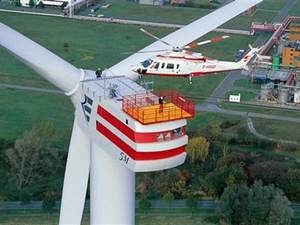
 The use of wind turbines for domestic energy purposes has been used in the world for a long time. Europe has been producing energy from wind for many years - in Germany, Spain, Denmark and France.Many other countries, such as China and India, have recently begun to intensively develop their wind energy production.
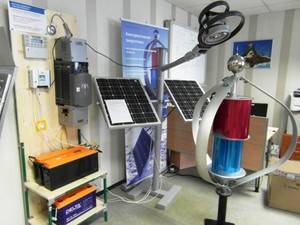
Wind turbines have three main parts: blades, mast and generator. Three large bladed propellers are mounted on top of a large mast, which are driven by the wind. If the turbine produces more energy than needed, it can be sent to the general energy system, at the so-called feed-in tariff. Such a tariff is applied in almost all countries of the world (except Russia).
In Ukraine, in 2018, according to the "feed-in tariff", the state returns for the supply of "extra" kW to the network in the following amounts:
- for private power plants up to 30 kW - 18 euro cents per 1 kW / hour;
- for ground industrial stations 15 euro cents per 1 kWh;
- for rooftops - 16.3 euro cents per 1 kW / hour.
 This approach allows the household power producer to recoup all its costs for installing power plants with a capacity of 30 kW in just 4 years, receiving an annual profit of about 6500 USD. e. As wind turbines have become more popular, they have become cheaper and more accessible to a wide range of consumers.
The advantages of a wind generator include the following:
- Wind is free and 100% renewable;
- the wind generator does not pollute the environment with greenhouse gas emissions and other harmful substances;
- require small areas to accommodate, as they are placed at high altitude;
- create an interesting landscape;
- an excellent backup source of autonomous power supply in remote settlements;
- low payback period when using the "green tariff" up to 4 years.
But wind generators also have their drawbacks:
- High initial cost of energy supply;
- the need for land plots for construction;
- the need for sufficient wind potential of the area;
- overall dimensions, building codes may not allow the installation of turbines in some places;
- noise pollution of the environment and emergency zoning for migratory birds;
- low level of use - up to 30% of the installed capacity;
- high level of lightning hazard.
 Looking back at this data, it seems that such autonomous electricity has more “cons” than “pluses”. However, the force of the wind has a much smaller impact on the environment than electricity produced from coal or oil, so for residents of areas with a stable energy wind, this type of autonomous power supply at home is very promising.
Technical characteristics of wind turbines for autonomous power supply at home
Each type of wind turbine has its own characteristics, which can be compared using the table:
| Brand/manufacturer | Power, kWt | Voltage, V | Wind wheel diameter, m | Wind speed, m/s |
| T06/China | 0,6 | 24 | 2,6 | 9 |
| T12/China | 1,2 | 24/48 | 2,9 | 10 |
| T23/China | 2,3 | 48 | 3,3 | 10 |
| T60/China | 6 | 48/240 | 6,6 | 11 |
| T120/China | 12 | 240 | 8 | 11 |
| Passaat/Netherlands | 1.4 | 12/24/488 | 3,1 | 14 |
| Montana/Holland | 5 | 48/240 | 5 | 14 |
| Alize/Holland | 10 | 240 | 7 | 12 |
| W800/Ukraine | 0,8 | 48 | 3,1 | 8 |
| W1600/Ukraine | 1,6 | 48 | 4,4 | 8 |
Specifications:
With the right choice of solar array, battery capacity and other components, our solution has the following outstanding features:
- A quick charge of the battery from the sun guarantees that even with two or three hours of sunshine a day, you will be provided with energy for a day.
- Fast battery charging from the alternator (two to three hours) provides fuel savings and silence on cloudy days
- High overload capacity provides "survivability" and allows you to start difficult loads, such as a well pump
- Thanks to the right lithium-ion batteries and control system, the power plant is compact and durable




Autonomous power supply systems of a private house
The use of autonomous systems will cost much less than the laying of a new power line, which requires significant material costs. An autonomous power source is fully owned by the owner of the house. With regular maintenance, it can operate for a long time.
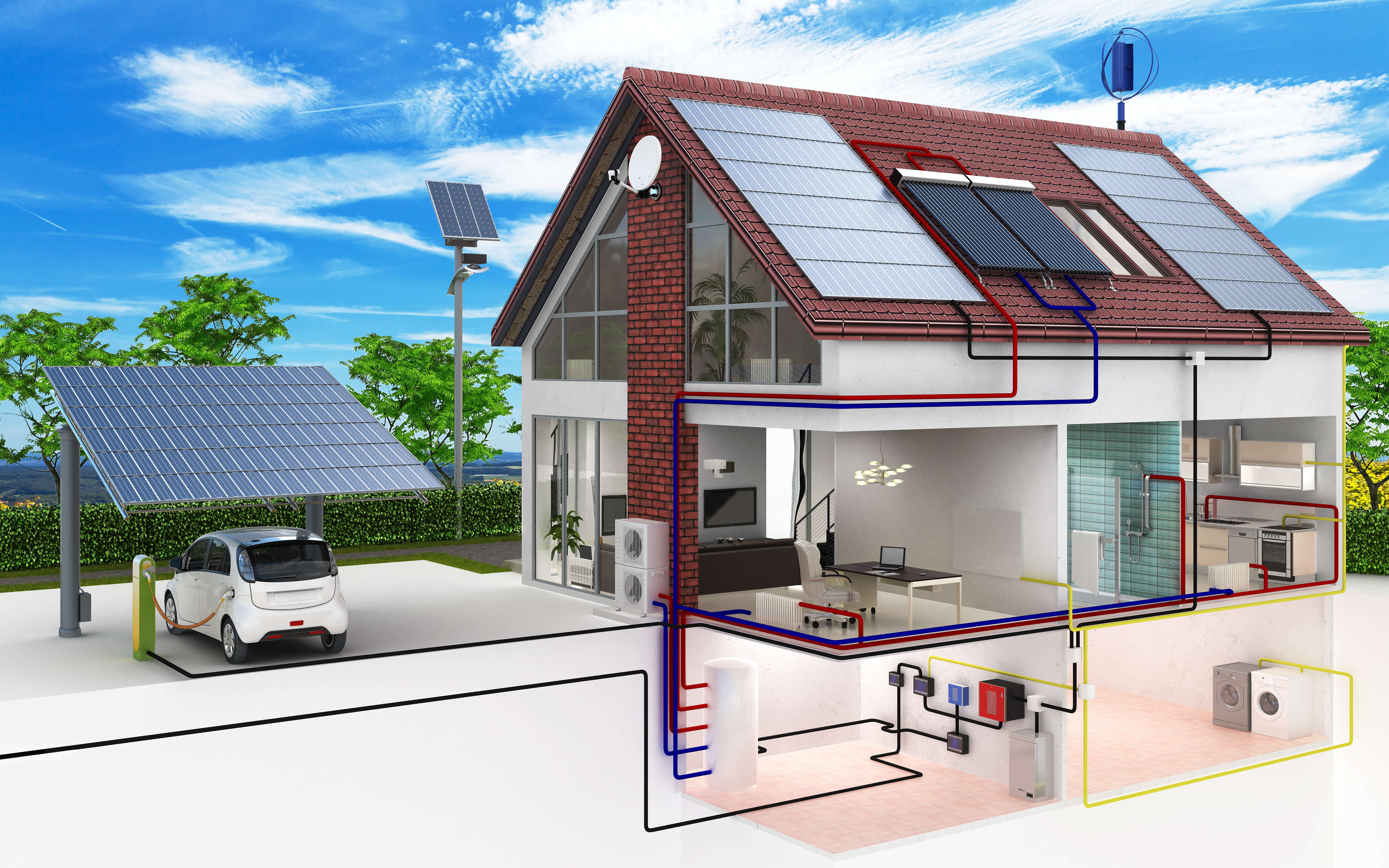
Own water supply, sewerage and heating system provide complete independence from local utilities. The issue of providing electricity is much more difficult to solve, however, with the right approach using alternative power sources, this problem is relatively easy to overcome. There are several options for autonomous power supply, each of which is the most suitable for specific operating conditions, including solar power supply systems.
All autonomous systems have a single principle of operation, but differ in the original sources of electricity. When choosing them, various factors are taken into account, including operating costs. For example, gasoline or diesel generators constantly require fuel.Others, conditionally related to the so-called perpetual motion machines, do not need energy carriers, but, on the contrary, they themselves are able to generate electricity by converting the energy of the sun and wind.
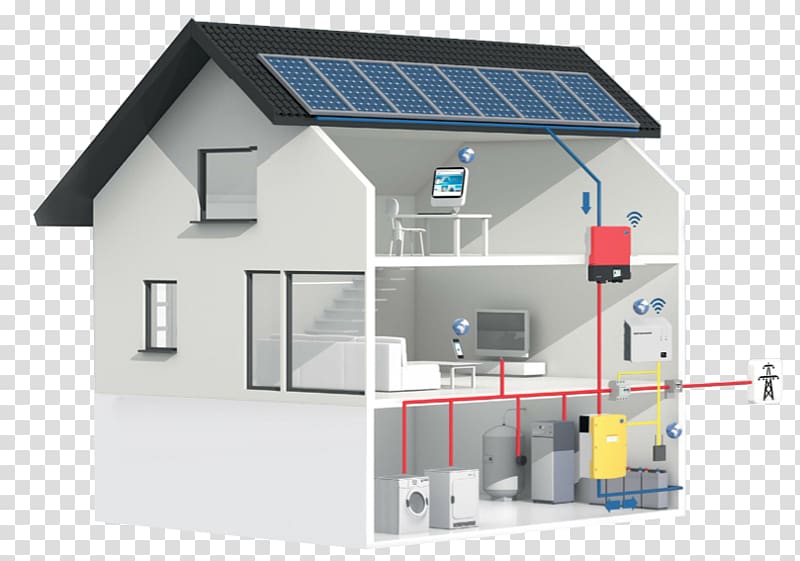
All autonomous power supply sources are by and large similar to each other in their common structure and principle of operation. Each of them consists of three main nodes:
- Energy converter. It is represented by solar panels or a wind generator, where the energy of the sun and wind is converted into electric current. Their effectiveness largely depends on the natural conditions and weather in the area - on solar activity, strength and direction of the wind.
- Batteries. They are electrical containers that accumulate electricity that is actively generated in optimal weather. The more batteries there are, the longer the stored energy can be used up. For calculations, the average daily electricity consumption is used.
- Controller. Performs a control function for the distribution of generated energy flows. Basically, these devices monitor the condition of the batteries. When they are fully charged, all energy goes directly to consumers. If the controller detects that the battery is low, then the energy is redistributed: it partially goes to the consumer, and the other part is spent on charging the battery.
- inverter. A device for converting direct current 12 or 24 volts into a standard voltage of 220 V. Inverters have different power, for the calculation of which the total power of simultaneously operating consumers is taken.When calculating, it is necessary to give a certain margin, since the operation of the equipment at the limit of its capabilities leads to its rapid failure.
There is a variety of autonomous power supply for a country house, ready-made solutions of which are complemented by various elements in the form of connecting cables, ballasts for discharging excess electricity and other components. For the correct choice of the unit, you should familiarize yourself with each type of alternative power source in more detail.
small scale hydropower
 Autonomous electricity for a private house using water energy - Hydro Power (hydropower), has advantages over other types of renewable energy, if the system is designed and installed correctly, it creates a minimum of environmental risks for the environment.
As a rule, all that is needed is a river with enough water and the speed of the current flowing to a water turbine connected to an electricity generator. Depending on the size and the required power generation capacity, mini-power plants for hydroelectric circuits are divided as follows:
- Small Scale Hydro Power generates electrical power between 100kW (1kW) and 1MW (megawatt) by feeding this generated energy directly into the utility grid that feeds more than one household.
- Mini Scale Hydro Power (mini-scale), which generate power from 5kW to 100kW, feeding it directly to the public grid or stand-alone system with AC power.
- Micro Scale Hydro Power (micro-scale), domestic scheme of EPS for rivers, with a DC generator to produce electrical power from hundreds of watts to 5kW as part of a stand-alone system.
Mini-hydroelectric power plants (hydroelectric power plants), depending on the type of water resources, are divided into:
- channel - small rivers with artificial reservoirs on the plains;
- stationary - alpine rivers;
- water-lifting with a water drop at industrial enterprises;
- mobile - the water flow enters through reinforced devices.
The following types of turbines are used to operate mini hydroelectric power plants:
- water pressure > 60 m - bucket and radial-axial;
- with a pressure of 25-60 m - radial-axial and rotary-blade;
- at low pressure - propeller and rotary-blade in reinforced concrete devices.
 Autonomous home power supply using Hydro, Mini Hydro Systems or Micro Hydro Systems can be designed using either water wheels or impulse turbines. The generation potential of a particular site will depend on the amount of water flow, which in turn depends on the conditions and location of the site, as well as the rainfall characteristics of the site. Water wheels and water turbines are great for any small hydropower scheme because they extract kinetic energy from moving water and convert that energy into mechanical energy that drives an electrical generator.
The maximum amount of electricity that can be obtained from a river or stream of running water depends on the amount of energy at a particular point in the stream. But the water turbine is not perfect, due to the power loss inside the turbine caused by friction.Most modern hydro turbines have an efficiency of 80 to 95% and can be used as a mini-power plant for a private house. Mini hydroelectric power plants operate on a reliable principle. Water acts on the turbine blades through a hydraulic drive, sets in rotation an electric generator that generates electricity.
The process is controlled by automation systems. A reliable automation system protects equipment from overloads and breakdowns. The devices of modern hydro generators reduce to a minimum the installation work during the construction period and create an optimal energy supply with electricity.
Autonomous sources of power supply mini-HPP is designed in full compliance with the parameters of the turbine and hydraulic unit to produce the required speed and current.
The advantages of mini hydroelectric power plants include:
- environmental safety of equipment;
- low cost of 1 kWh of electricity;
- autonomy, simplicity and reliability of the scheme;
- inexhaustibility of the primary resource.
The disadvantages of mini hydroelectric power plants include a weak material, technical and production base for the production of the entire necessary set of equipment in the country.
Types of alternative electricity
The consumer is always faced with a choice based on the question, which is better? And this plan implies, firstly, the cost of acquiring a new type of source of electricity, and secondly, how long this device will work. That is, will it be profitable, will the whole idea pay off, and if it pays off, then after what period of time? Let's just say that no one has yet canceled saving money.





As you can see, there are enough questions and problems here, because do-it-yourself electricity is not only a serious matter, but also quite expensive.
Electric generator
Let's start with this installation, as with the simplest. Its simplicity lies in the fact that you need to purchase an electric generator, install it in a secure enclosed space that will comply with fire safety regulations. Next, connect the electrical network of a private house to it, fill in liquid fuel (gasoline or diesel fuel) and turn it on. After that, electricity appears in your house, which depends only on the presence of fuel in the generator tank. If you think over an automatic fuel supply system, then you get a small thermal power plant, which will require a minimum presence from you.
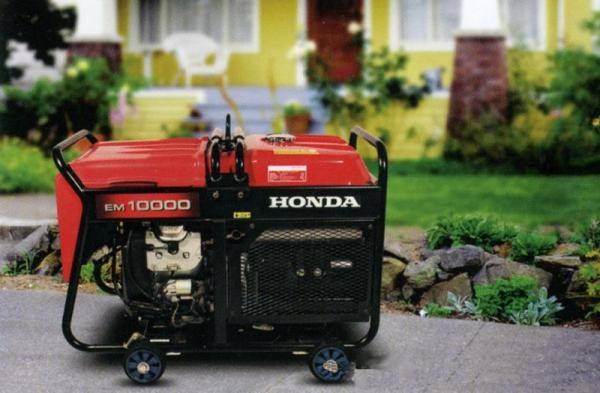
gasoline generator
In addition, electric generators are reliable and convenient installations that work almost forever if they are properly operated. But there is one moment. There are two types of generators currently on the market:
- Petrol.
- Diesel.
Which is better? Let's just say, if you need an alternative source of energy that will be used constantly, then choose diesel. If for temporary use, then gasoline. And that is not all. The diesel electric generator has large overall dimensions, compared to gasoline, it is very noisy during operation and emits a huge amount of smoke and exhaust gases. Plus, it's more expensive.
Gas generators have recently appeared on the market that can run on both natural gas and liquefied gas. A good option, environmentally friendly, does not require a special room for installation.It is possible to connect, for example, several gas cylinders to one generator at once, which will automatically be connected to the installation.
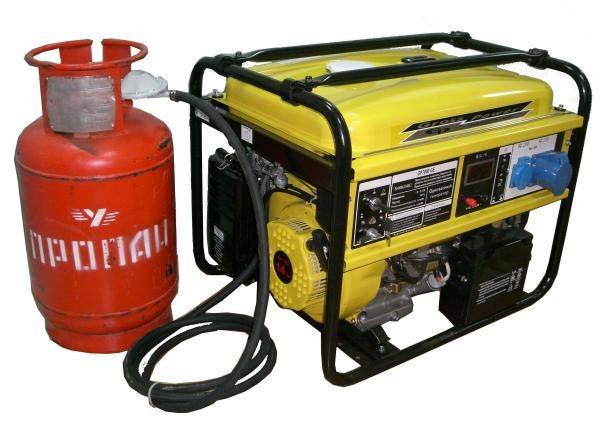
Gas power generator
Alternative to hydrocarbon fuel
Among the three types of electric generators, gas is the best and most efficient. But the cost of fuel (liquid or gaseous) is not cheap, so you should think about how to produce fuel on your own, investing a minimum of money in it. For example, biogas, which can be obtained from biomass.
By the way, alternative types of energy, which today are called biological, can replace almost all alternative sources of electricity. For example:
- Biogas is obtained by fermenting manure, bird droppings, agricultural waste, and so on. The main thing is to install equipment that is used to capture methane.
- From garbage, for example, in landfills, the so-called cellulose standard is extracted. Or, as experts call it, landfill gas.

IBGU-1 - biogas plant
- From soybeans and rapeseed, or rather, from their seeds, fats are produced, from which biosolar fuel can be obtained.
- Beets, sugarcane, corn can be used to produce a bioetalon (biogasoline).
- Scientists have proven that ordinary algae can accumulate solar energy.
That is, there is a large number of scientific developments that produce alternative forms of energy. And many of them have already received practical application. For example, the IBGU-1 installation, with the help of which up to twelve cubic meters of biogas can be obtained from manure per day.Domestic farmers have appreciated the work of scientists, so this equipment is sold out quickly.
Varieties of generators
When choosing a generator for an autonomous backup power supply, it is necessary to take into account not only the cost of a set of equipment, but also the price of fuel. The parameters of the place for placement and operation must comply with the rules and regulations. This is also a big investment.
Gas generators
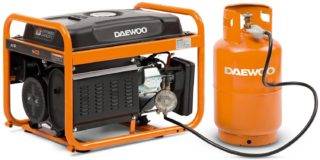 gas generator
Can be placed in an unheated room. They make little noise. For liquefied gas, special containers are needed - a gas tank or a cylinder. One bottle of 50 liters is enough for 15 hours of power supply for a small house. If you use the main gas, you must properly make the exhaust ventilation in the room. Draw up and coordinate with the gas services a package of documents for connecting the facility.



Gasoline generators
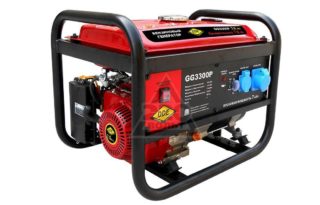 Gasoline generator DDE GG3300P
Advantages: the ability to work at sub-zero temperatures, the availability of fuel. They have a motor resource for 5-7 hours of work, then a break of 1 hour is needed. Automation is not included in the basic package. You need to buy it, install it, configure it separately. No operating permit required.
Diesel generators
Can work in any weather conditions. Economical - fuel consumption is 1.5 times less than that of gasoline. Operating time - 6-15 hours, depending on the capacity of the fuel tank. Disadvantages: noise, exhaust fumes, expensive maintenance compared to gasoline. To start on frosty days, it is necessary to provide fuel storage in a warm room.
Unconventional Power Sources
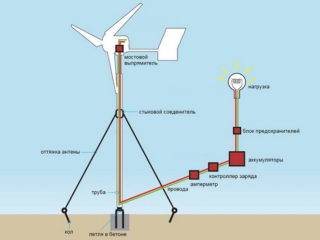 Scheme of a homemade wind generator
These include wind turbines, which will only work in places where the wind is constantly blowing. Geothermal installations using hot water from the bowels of the earth. But such water is saturated with minerals and toxins. You can not merge it into open sources.
Solar panels
Backup power supply of a country house with the help of solar panels is an expensive, but good solution to the problem. The equipment is environmentally friendly, silent. The kit consists of modules, controller, inverter unit, batteries. The disadvantage is the high price.
Options for the combined use of different backup power sources are possible.