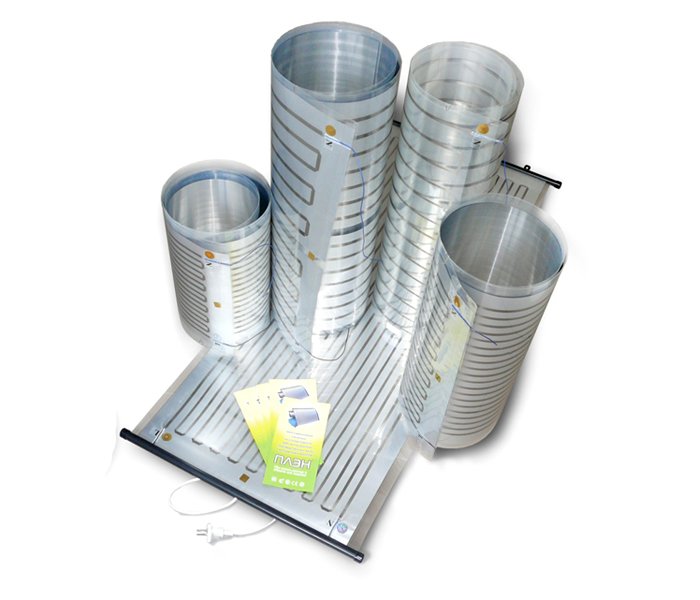
- Benefits
- How to make a warm ceiling in the house with your own hands?
- Ceiling insulation
- How to calculate the area of infrared film?
- Installation of thermal equipment
- Electrical connection
- Finishing
- PLEN ceiling infrared heater
- The principle of operation and design of heating elements of this type
- Film installation in the house
- The range of application of the heating system PLEN
- Warm ceiling
- The main advantage of a warm ceiling
- The lack of a warm ceiling
- Installation of a warm ceiling
- The principle of operation of film heating
- PLEN heating: specifications, price, advantages and disadvantages
- Pros and cons
- Price
- Installation of infrared ceiling film
- Installation of film heating on the ceiling
- Benefit or harm of infrared radiation
Benefits
| Spot infrared heaters | PLENs |
|
|
How to make a warm ceiling in the house with your own hands?
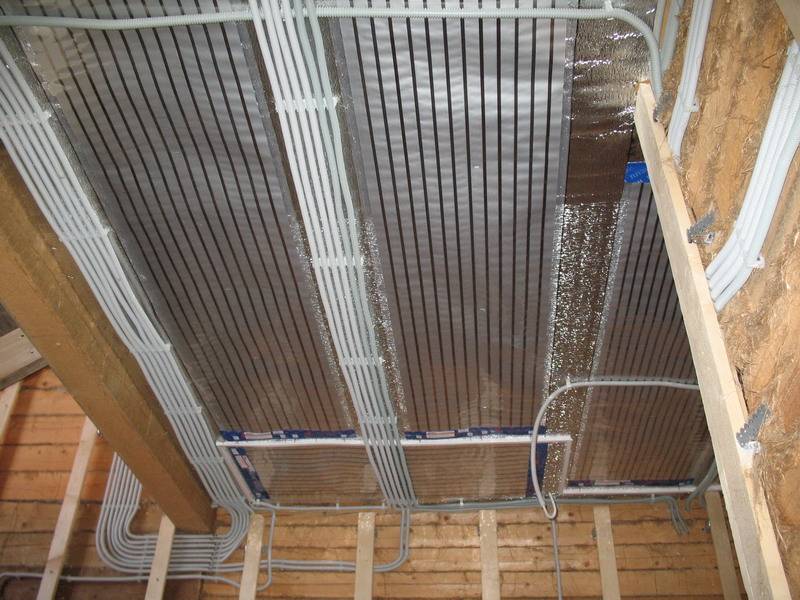
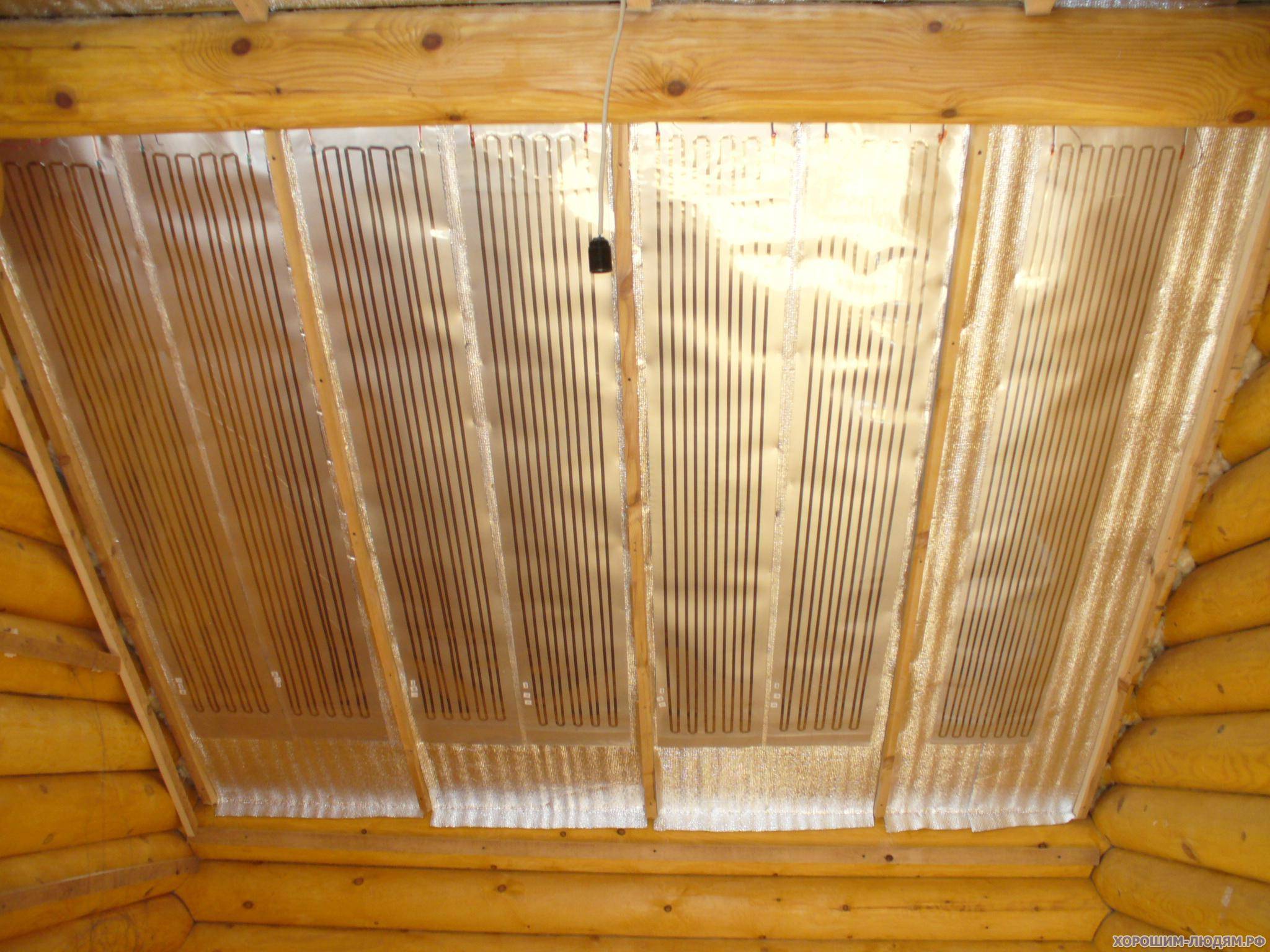
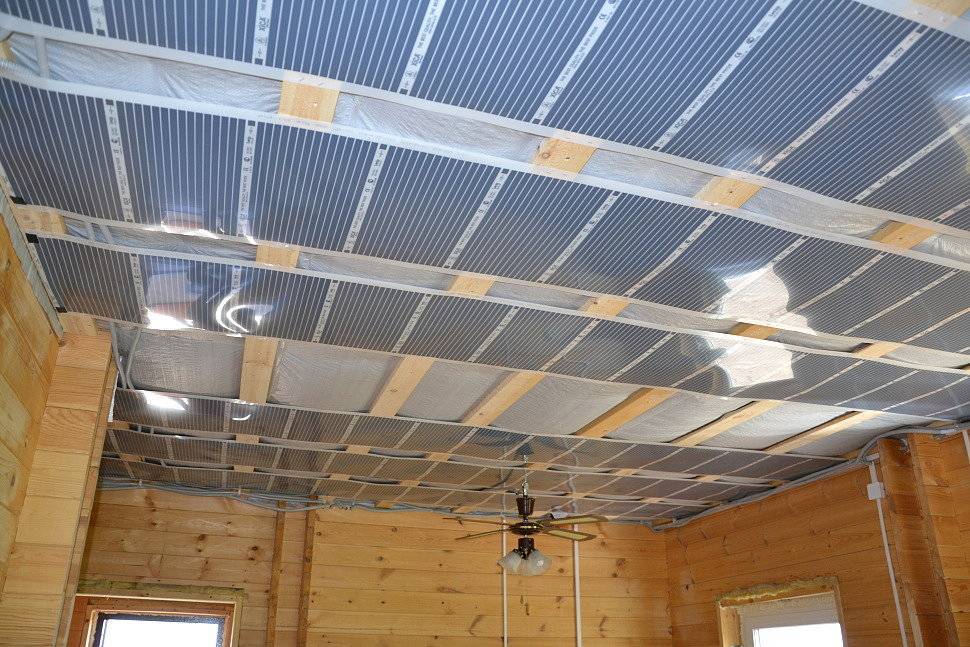
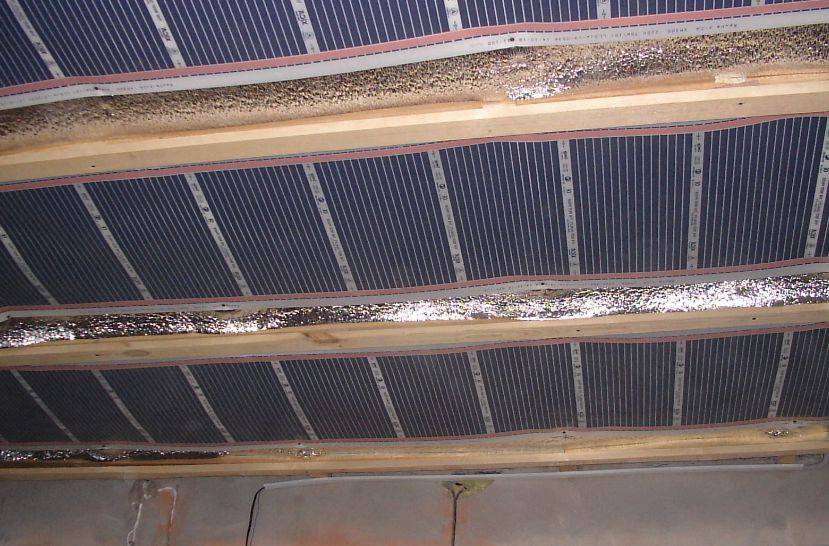
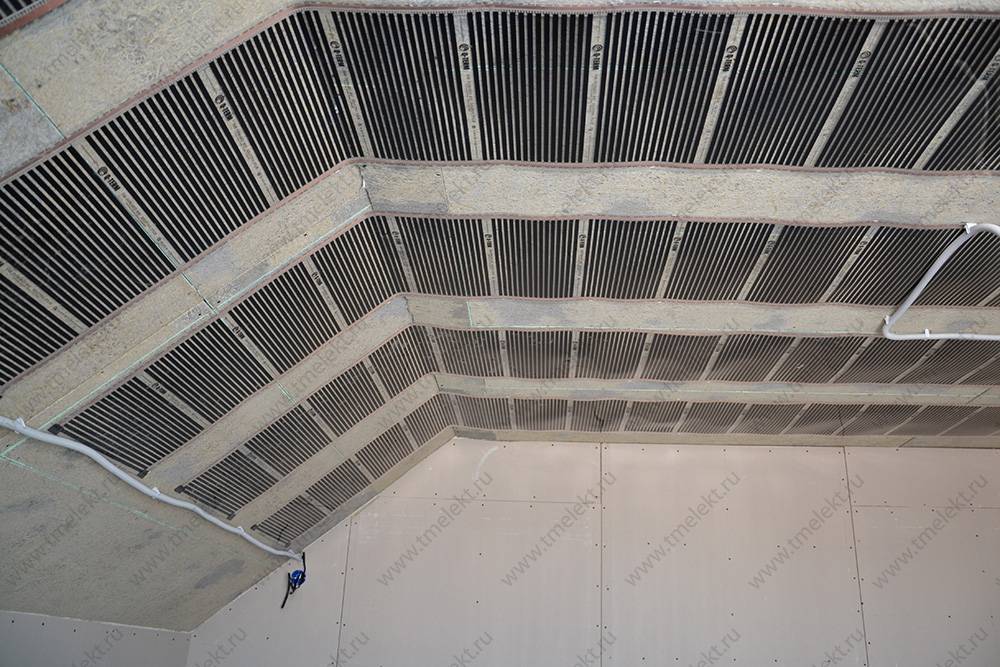
Installation of infrared film on the ceiling takes place in several stages:
- thermal insulation of the ceiling;
- calculation of the film area;
- installation of a film, thermostat and sensor;
- network connection and performance check.
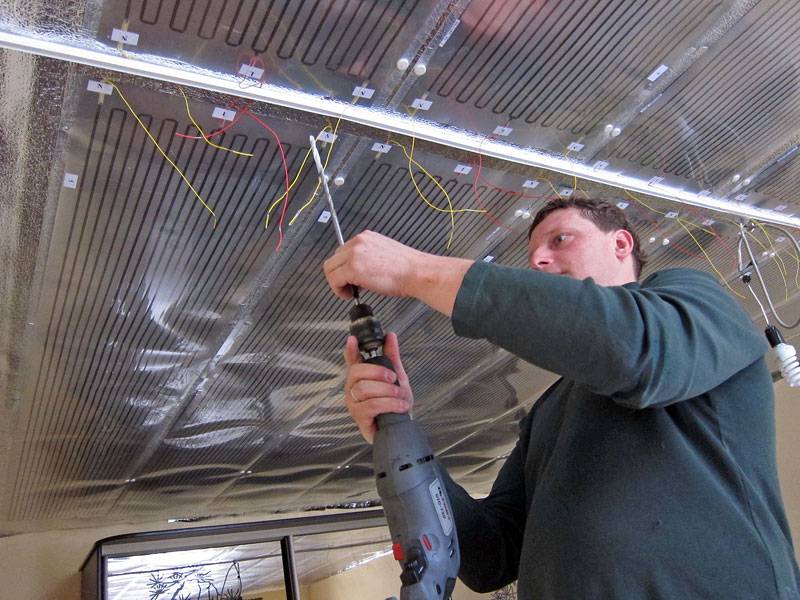
Prior to the installation of the thermal film, it is necessary to complete all construction and finishing work on the ceiling, excluding finishing.Also carry out all work on laying communications and lighting wires.
Now consider stages of installation of a warm ceiling.
Ceiling insulation
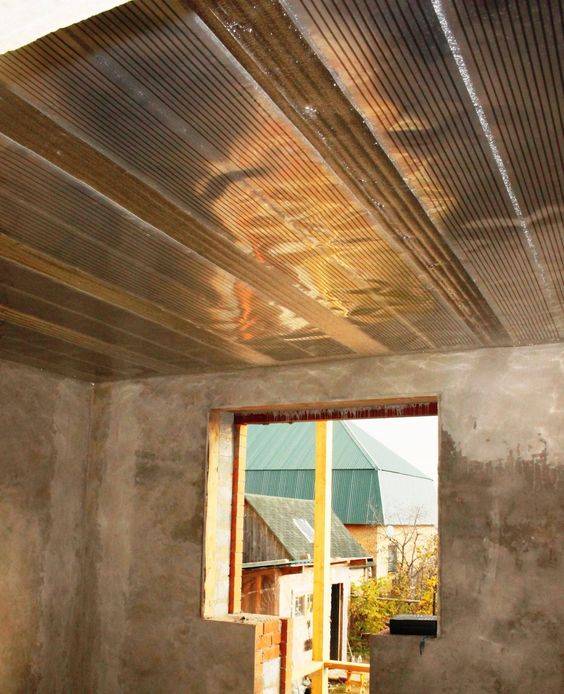
It is necessary in order not to heat the attic or the neighbors on the floor above. A properly insulated ceiling will return all the heat to the room, thus increasing the efficiency of the device and reducing energy costs. Thermal insulation with a reflective layer is attached to the entire surface of the ceiling and extends a few centimeters onto the walls. This will prevent heat loss through the gaps between the ceiling and the wall. The joints in the heat-insulating material are sealed with adhesive tape. The material itself must have a thickness of at least 5 mm.

How to calculate the area of infrared film?
To correctly calculate the required area, the following must be taken into account:
- how well the building itself is thermally insulated. For a brick house or a light frame structure, these data will vary;
- whether it is planned to live in the house in the winter, permanently or on short visits;
- heated area. It can be either the whole room or part of it;
- whether infrared heating will be primary or secondary.
If a warm ceiling is planned as the main type of heating, it must occupy at least 70% of the entire ceiling area. As an additional, this figure can be reduced according to the power of the main heating system. The average film power is approximately 0.2 kW per 1 square meter. By dividing the power of the thermostat by this number, you can find out the area of \u200b\u200bthe film that can be connected to it.

Installation of thermal equipment
Thermal film can only be cut along the special lines marked on it. Each type of film has its own maximum cut length.This information can be found in the attached documentation or ask the seller. There should be no gaps or air gaps between the film and the ceiling insulation.
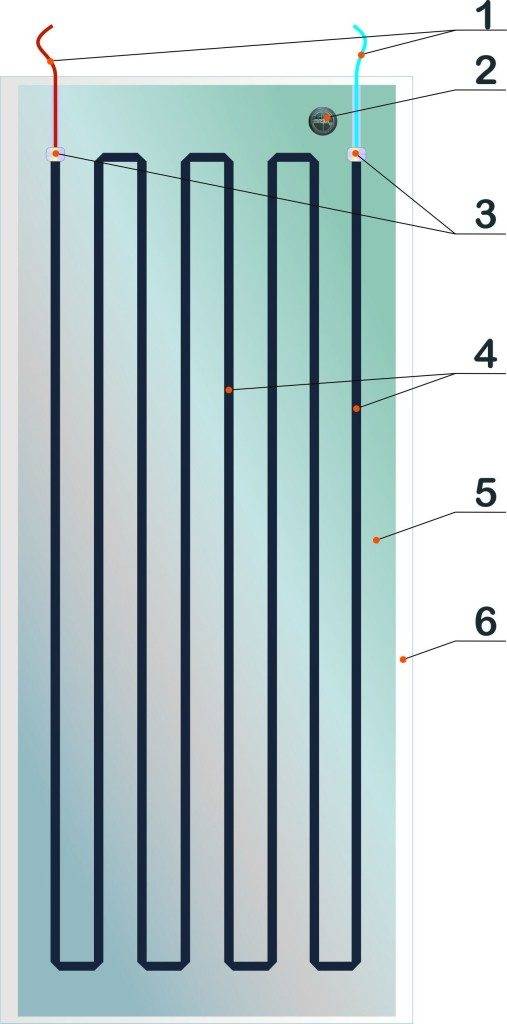
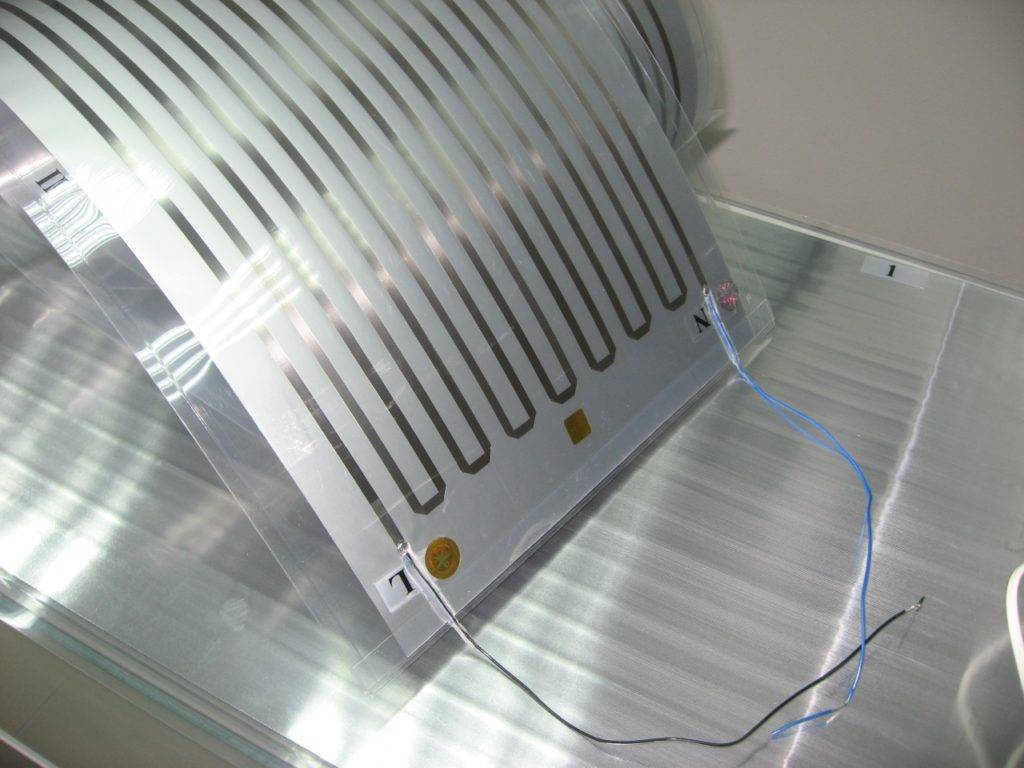
Next, you need to connect the copper contacts of the conductive bus with electrical wires using contact clips. One half of the clip should be located on the copper bus, and the other half should be inside the heater. After that, the ends of the film are insulated with bituminous tape on both sides.
The sensor is attached to the thermal insulation cutout and connected to the regulator and heating elements.

Electrical connection
Connect the thermal film through the regulator to the network in parallel. If the warm ceiling will have more power, it is better to connect it through a separate machine.
A properly installed warm ceiling, when turned on, should radiate comfortable uniform heat, not overheat anywhere and turn off in a timely manner when the set temperature is reached.

Finishing
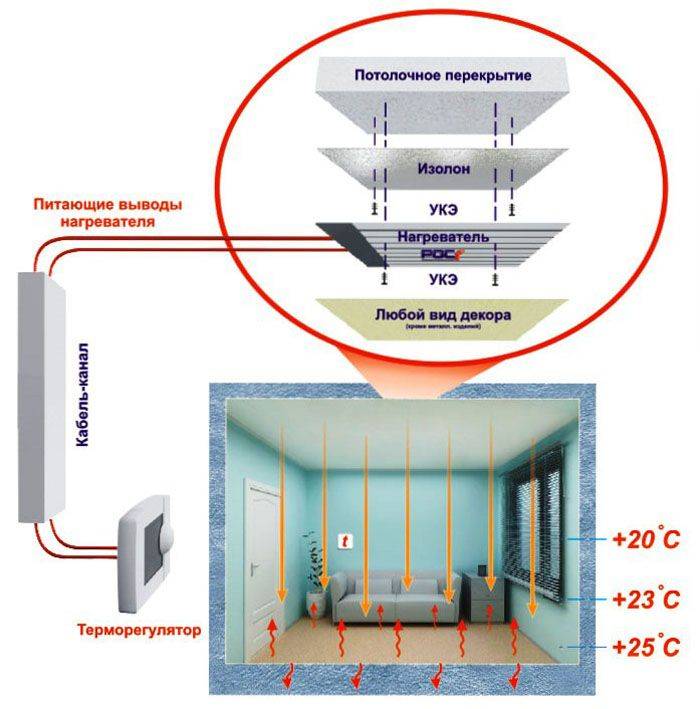
Next, produce the final finish of the ceilings. It can be a stretch ceiling with special microperforation. It perfectly transmits infrared waves. The stretch ceiling in this case is mounted along the edges of the wall, without affecting the ceiling itself.
You can also close the structure with a false ceiling: plasterboard sheets, clapboard or plastic panels. A small gap should be left between the stretch or false ceiling and the infrared heating system. To finish the ceiling, you should choose waterproof materials with a thickness of no more than 16 mm.
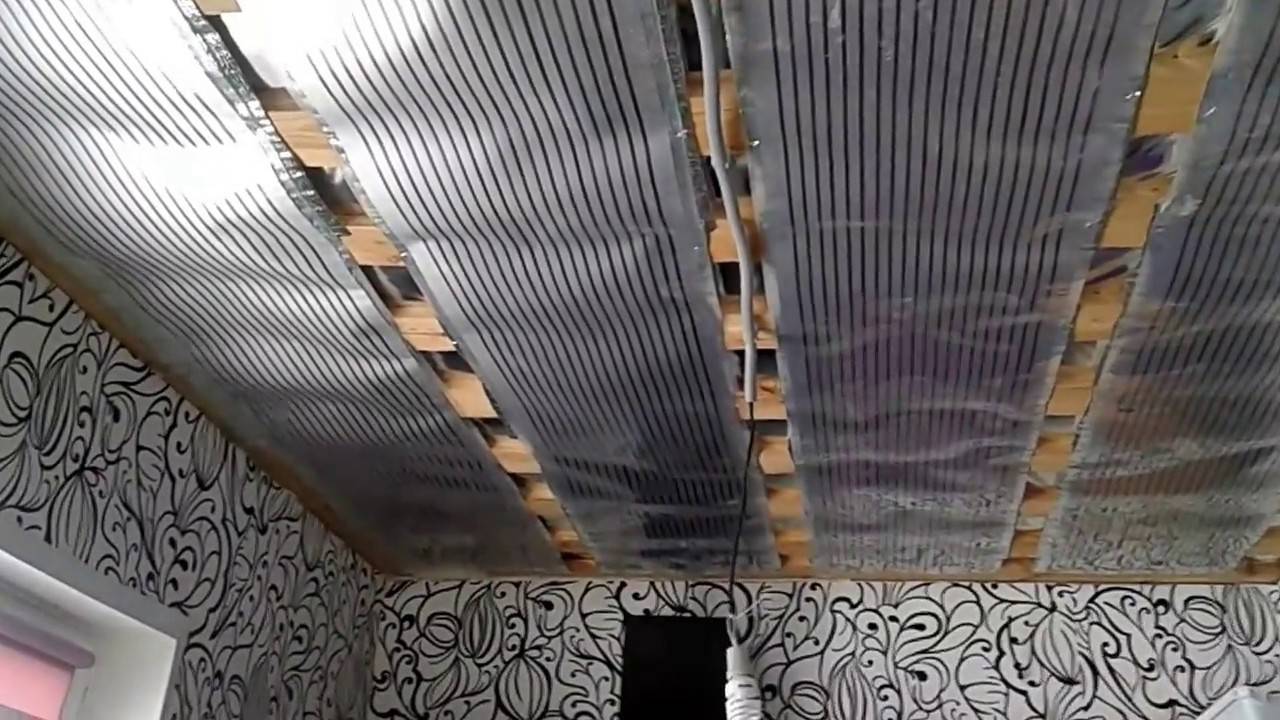
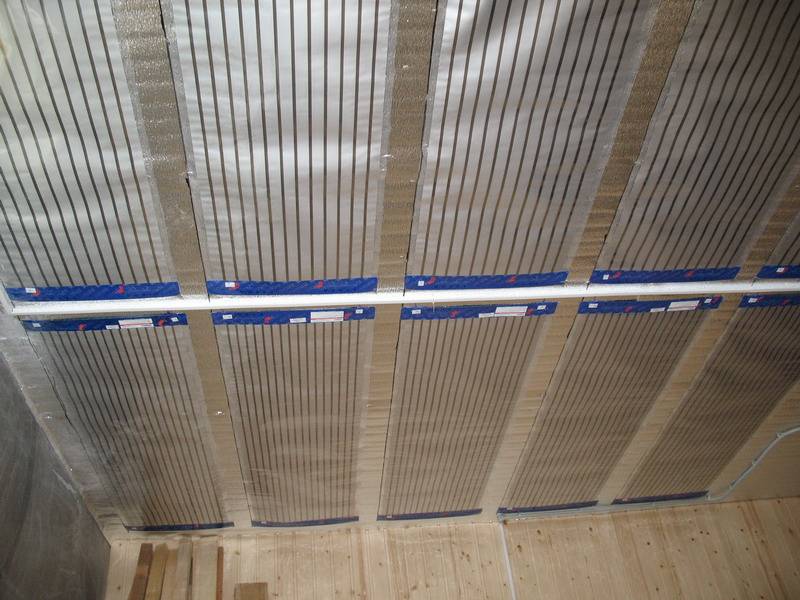
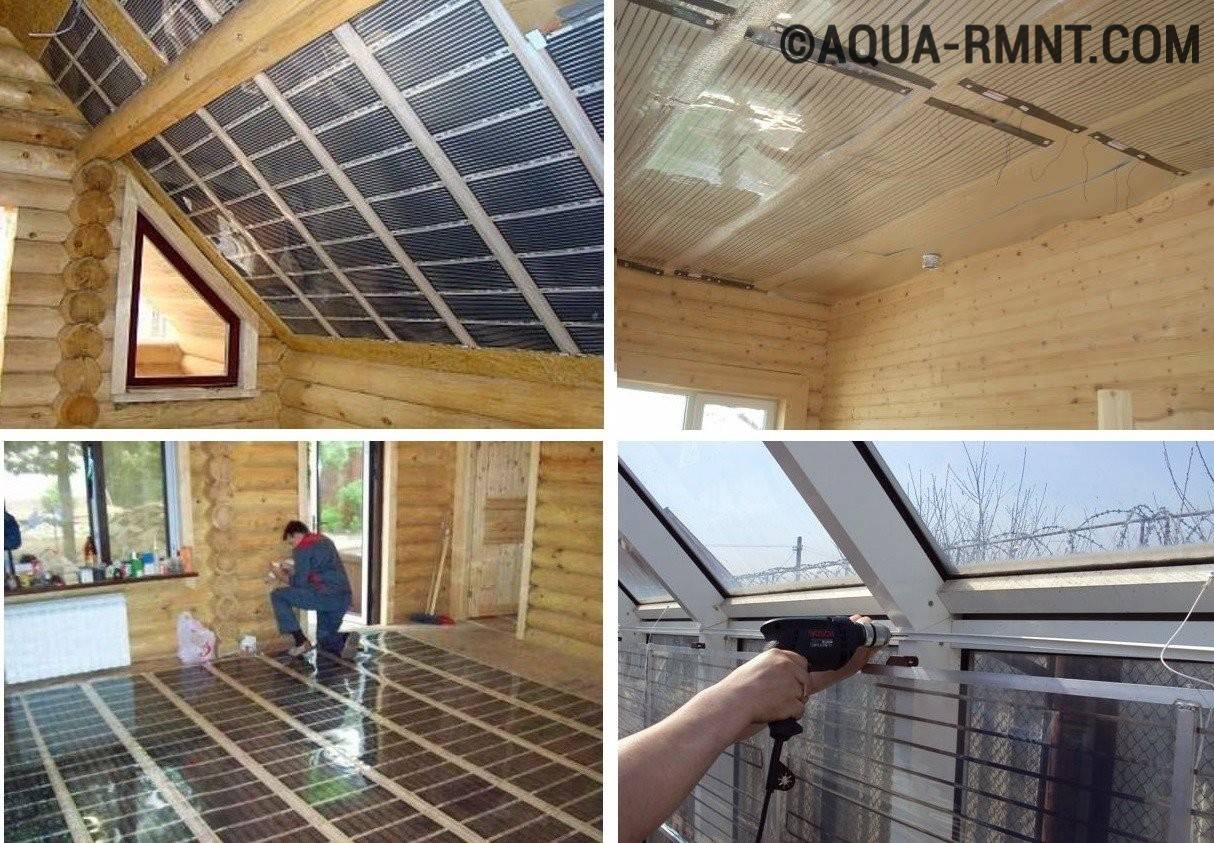
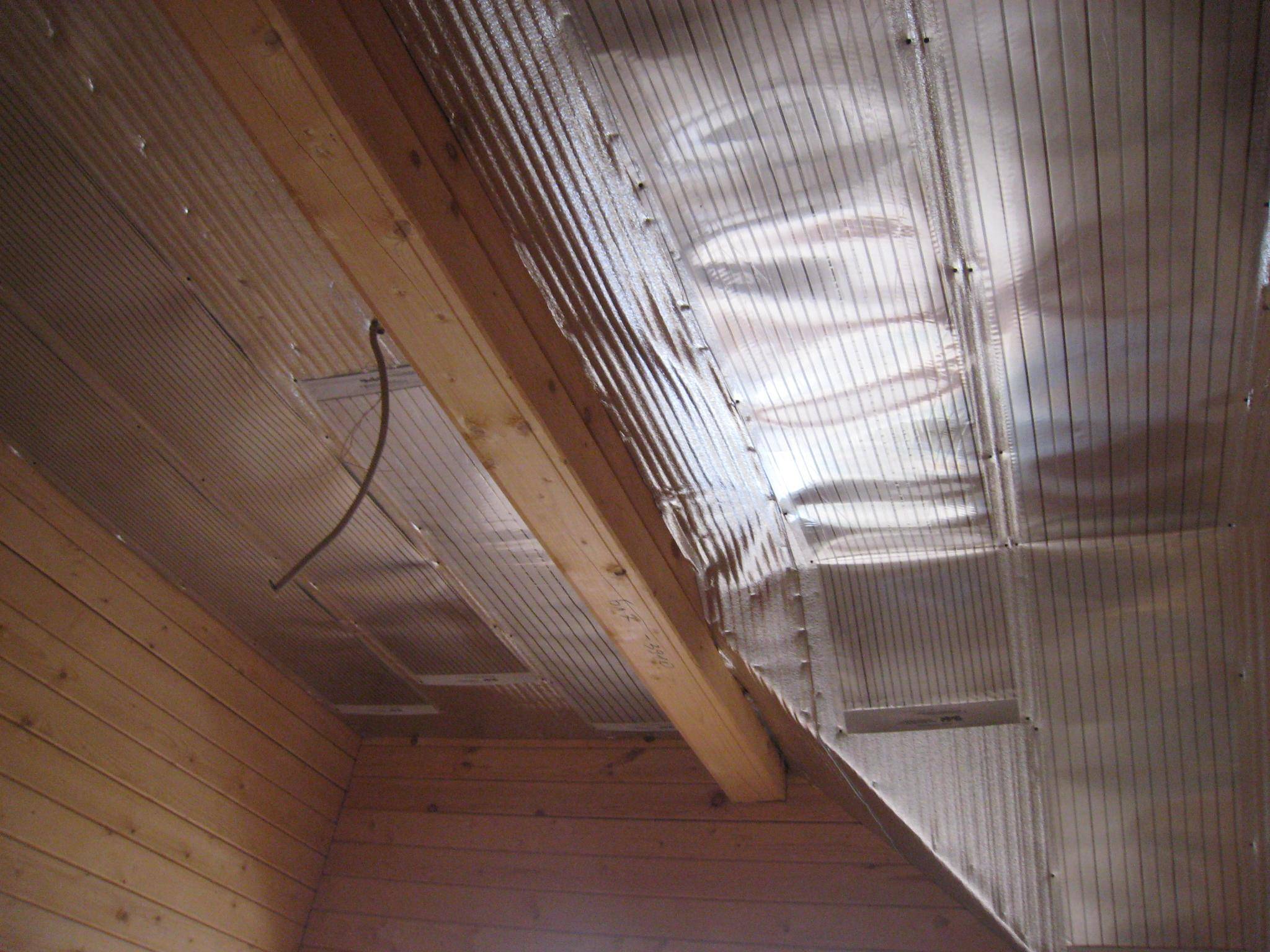
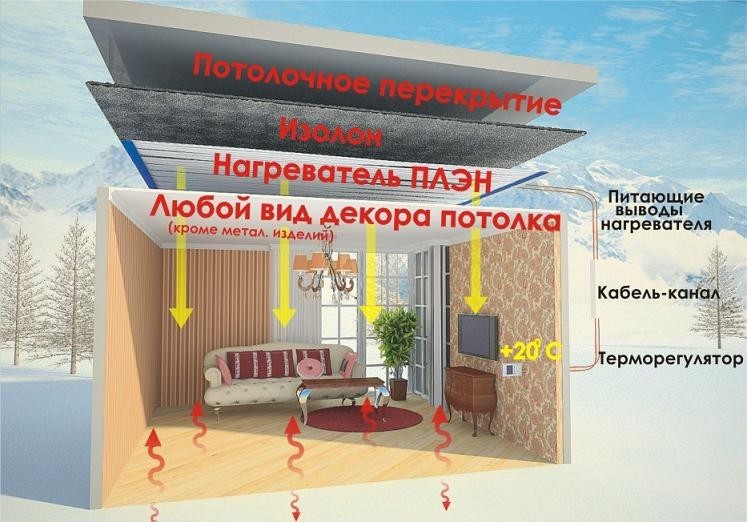
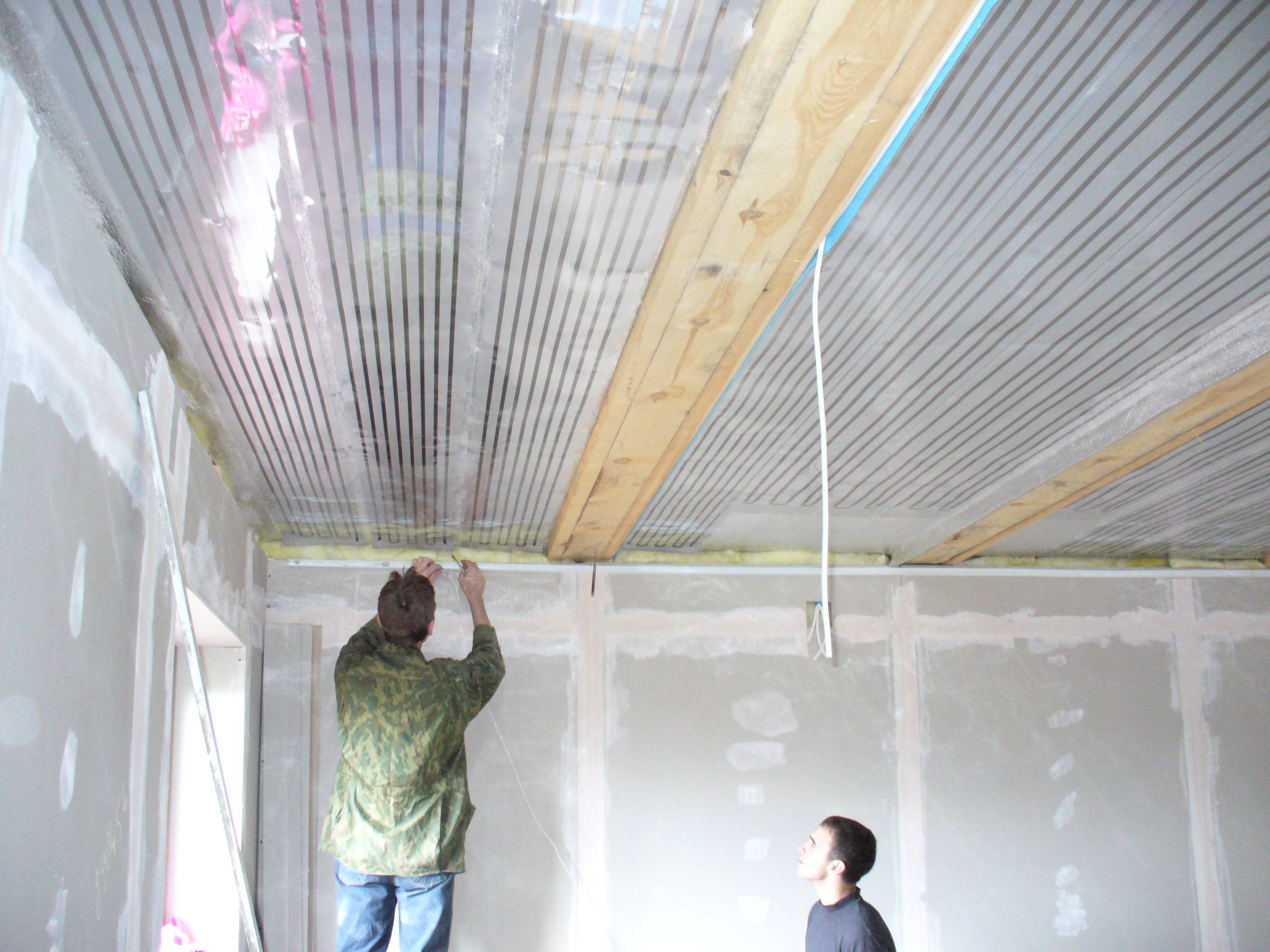
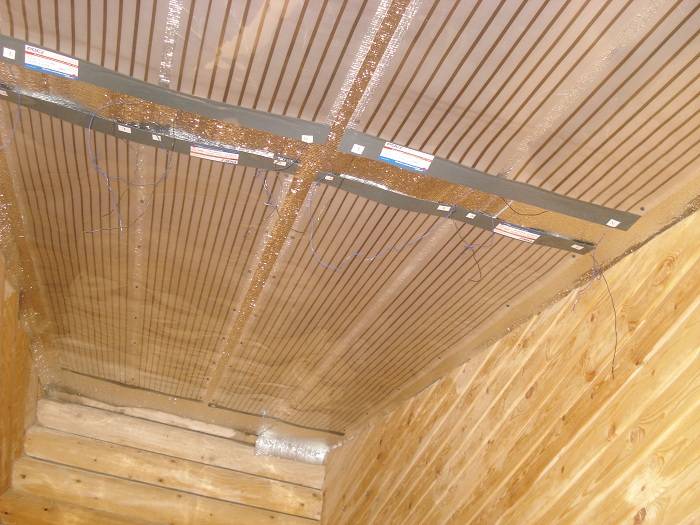
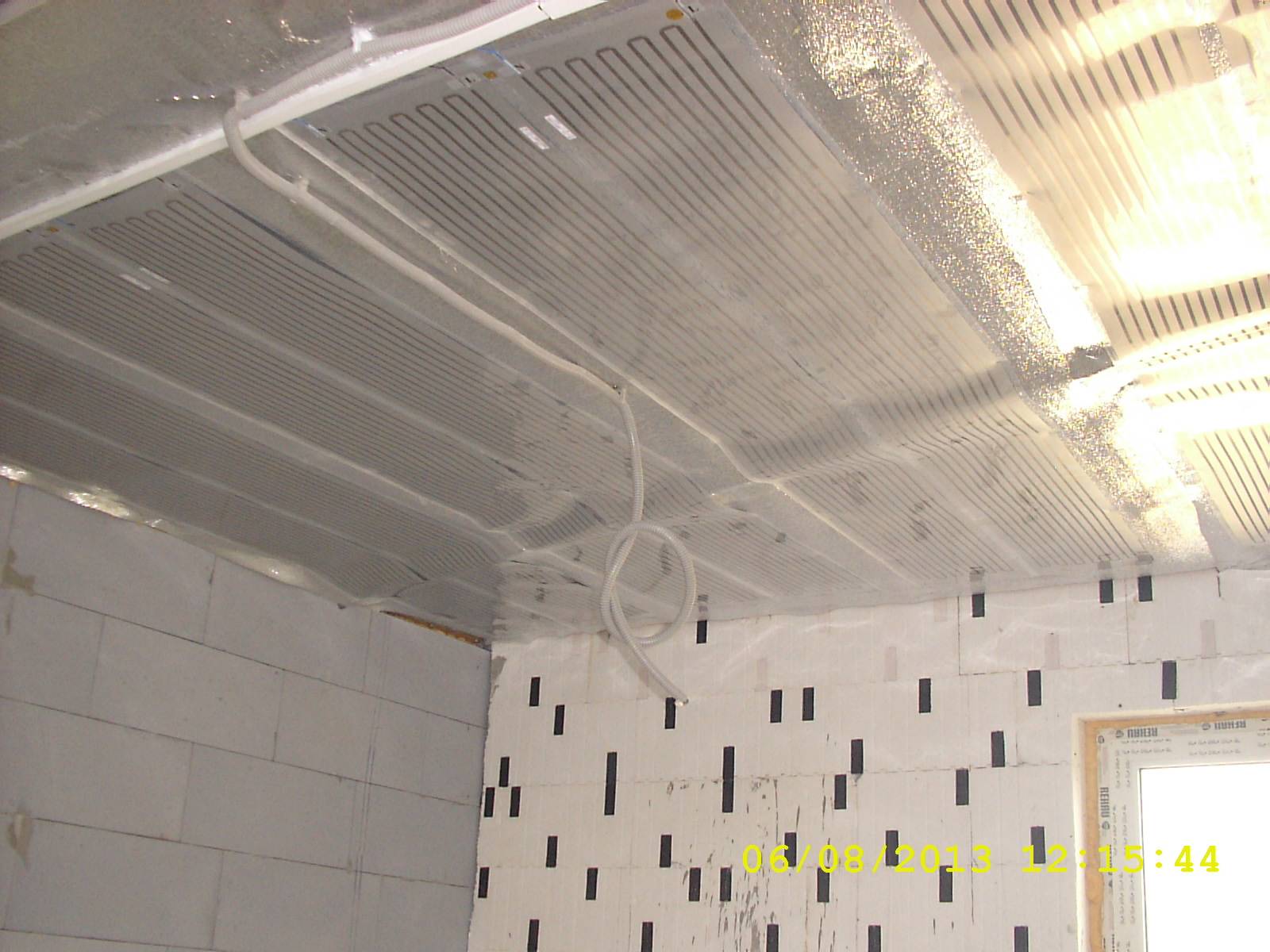
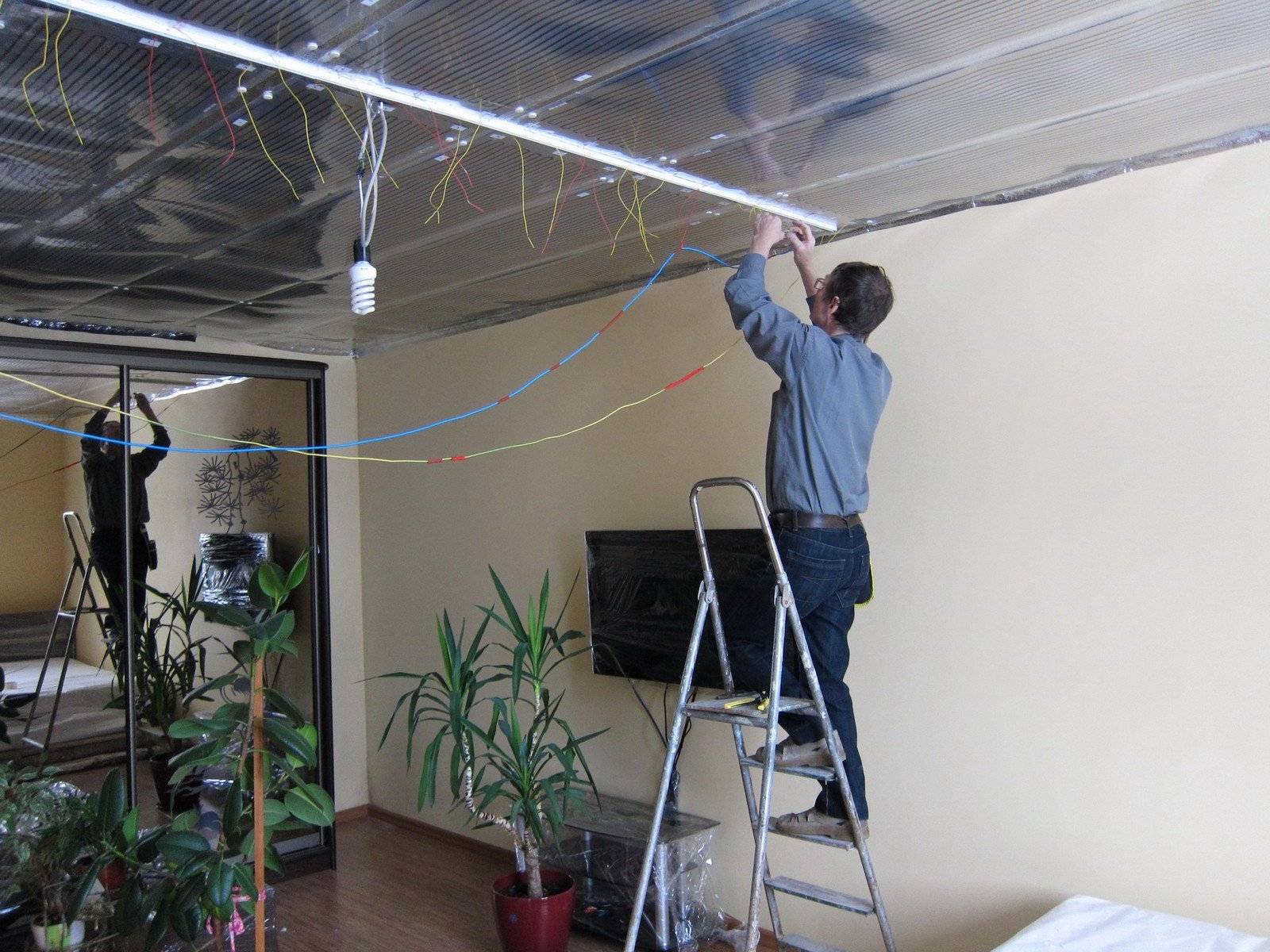

Ceiling infrared heating system is the most modern, safe and efficient of all electric heating options.With proper installation, it will last a long time, filling the house with warmth and comfort and remaining completely invisible.
PLEN ceiling infrared heater
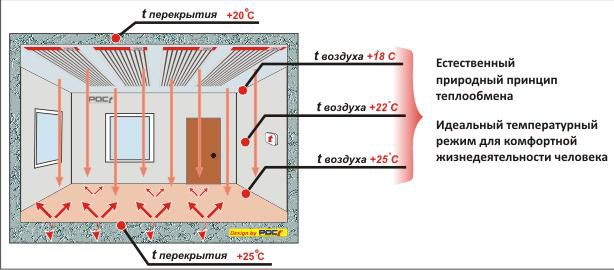
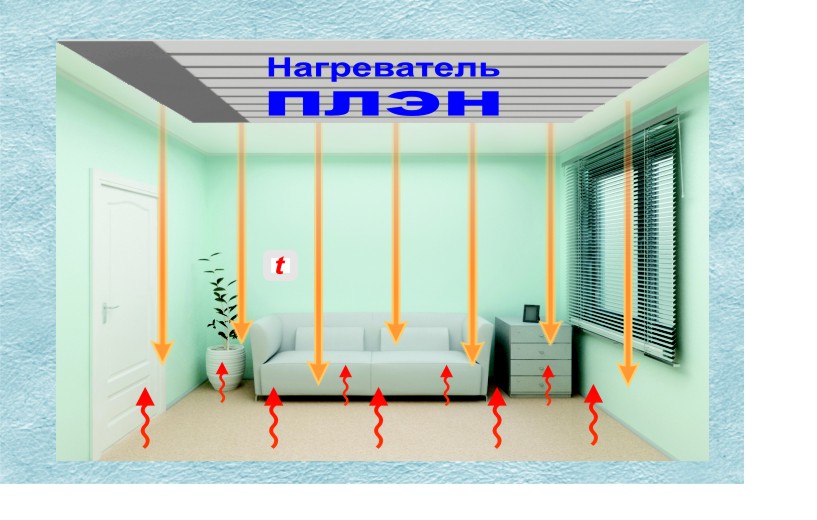
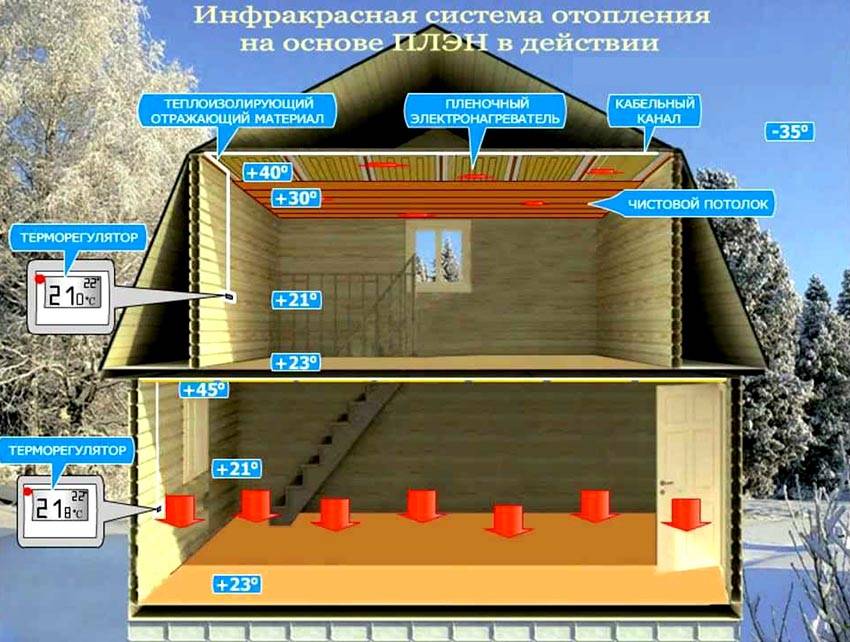
The work of film heaters placed on the ceiling occurs according to established physical laws. The system, which is in an activated state, emits infrared waves from top to bottom. Reaching the end point, these waves are absorbed by the floor surface. The rest of the radiation is delayed by furniture and other large-sized objects. Thus, at first there is an accumulation, and then the release of heat.
Then the laws of physics come into play, according to which the air heated from the floor rises. The air mass with a lower temperature sinks down and also heats up. As a result, the highest temperature in this room will be in the floor area. With increasing height, it gradually decreases and becomes the most optimal for the human body.
You can close the heating system installed on the ceiling with almost any coating from the available list of building materials. The exception is various types of stretch ceilings, which can be deformed under the influence of high temperature. If, nevertheless, it is necessary to combine PLEN ceiling heating with stretch ceilings, in this case it is recommended to install drywall for additional protection.
In addition, the PLEN heating system installed on the ceiling is less prone to accidental damage.However, in apartment buildings there is a high probability of flooding from the neighbors from above, after which the heating will completely fail. Another disadvantage that distinguishes the ceiling PLEN is a more complex and inconvenient installation, although technically it is practically no different from the floor version. This type of heating is not recommended for installation in rooms with a ceiling height of more than 3.5 m due to increased energy costs.
The principle of operation and design of heating elements of this type
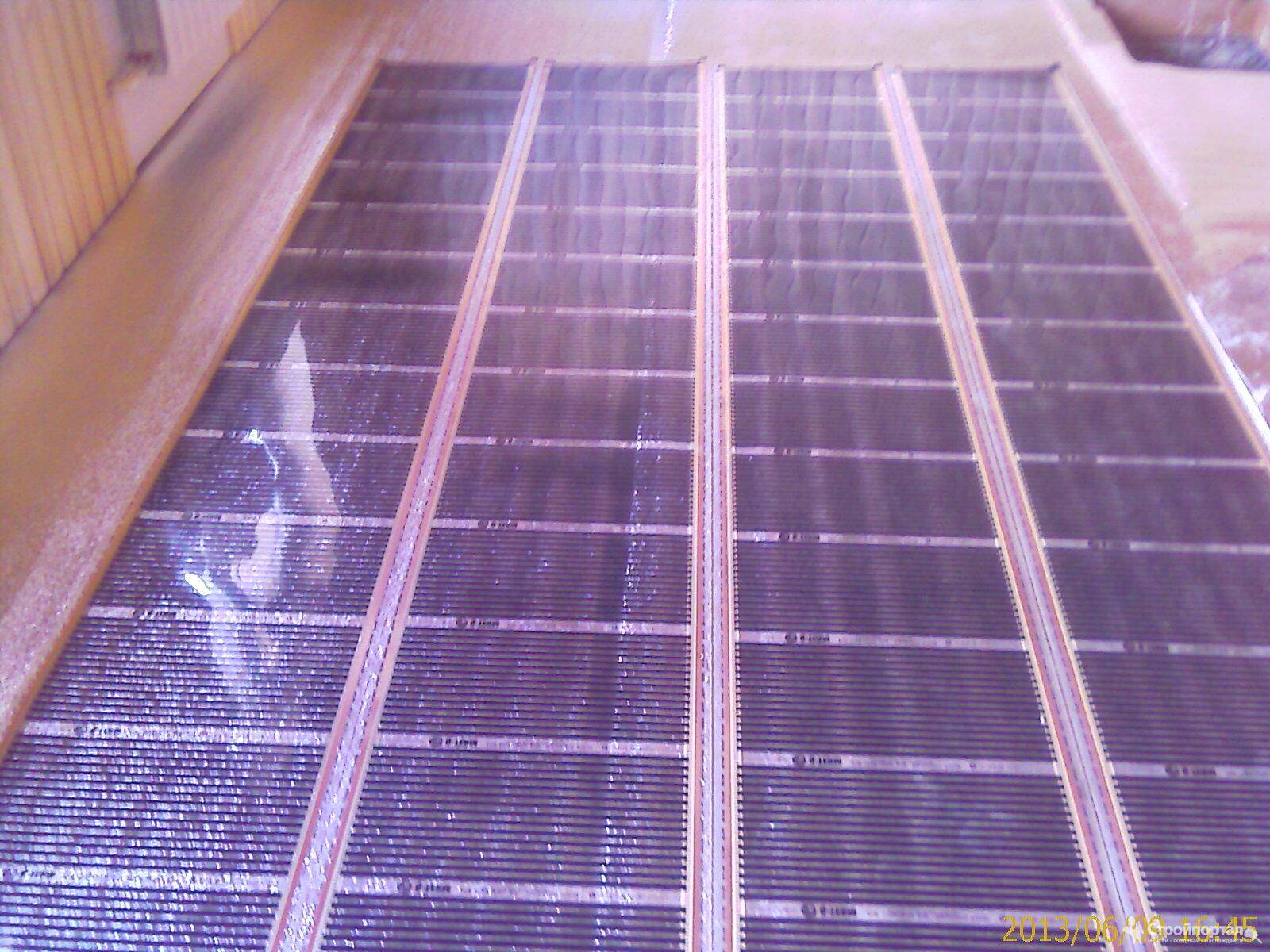
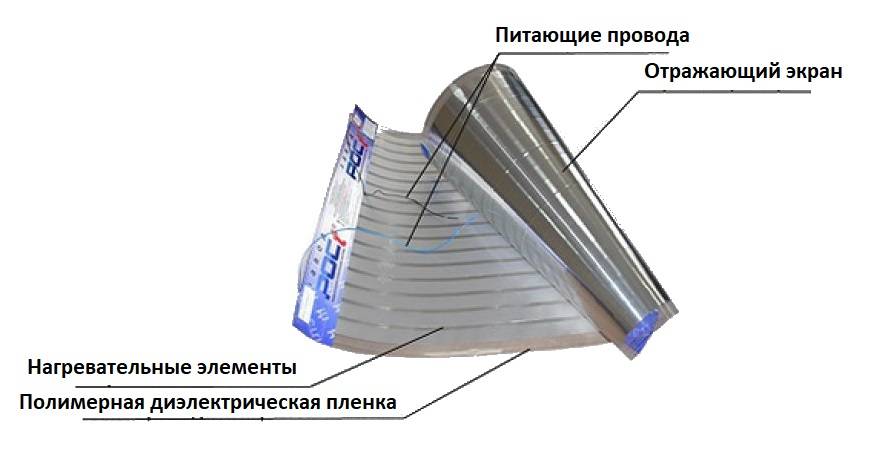
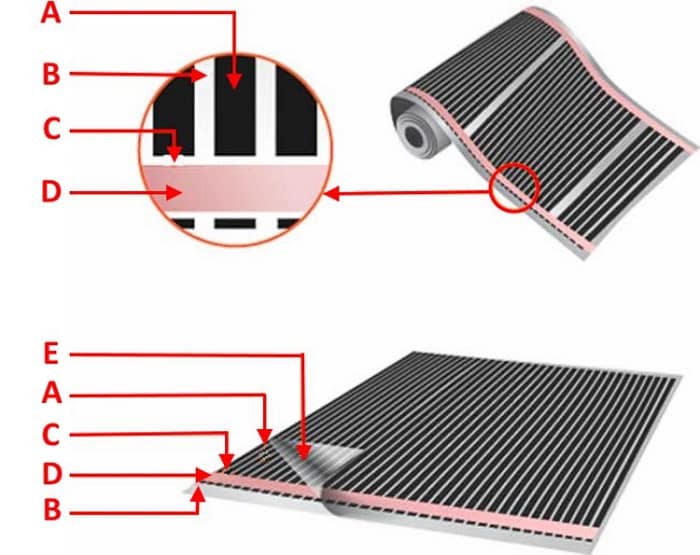
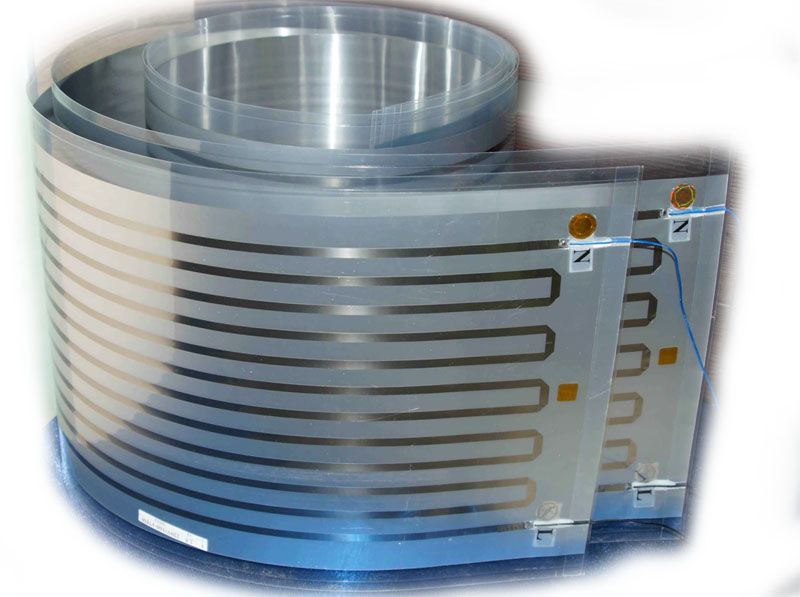
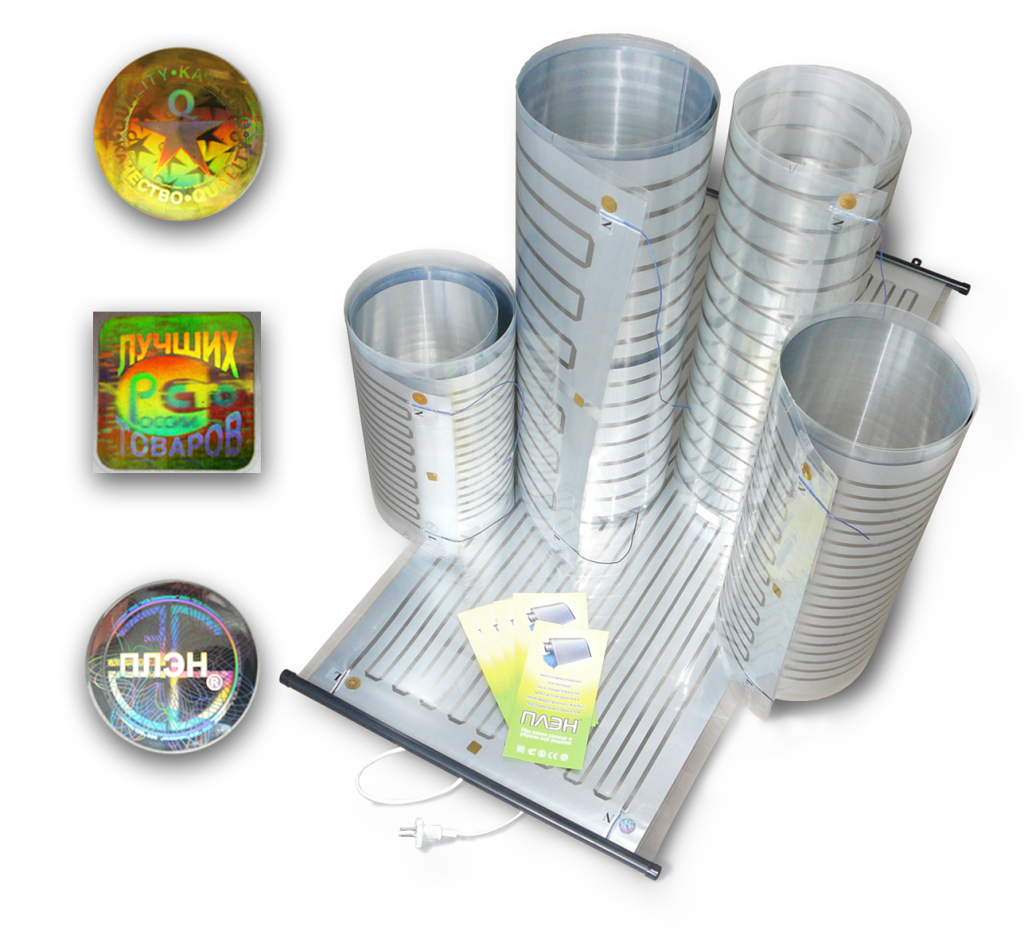
Film infrared heating systems are a flexible structure of small thickness (up to 1.5-2 mm). The fastening of such an element is carried out directly on the ceiling of the heated room, the equipment does not take up space in the room, it can be covered with a variety of finishing materials.
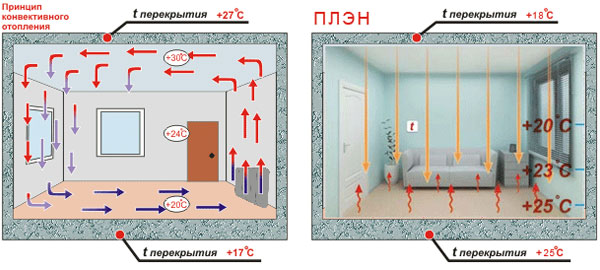
Comparison of two space heating systems
The basis of the heating element is aluminum foil, on which a resistive heating system powered by electricity is fixed. The film radiant electric heater is subjected to double-sided lamination with an especially strong heat-resistant film, which ensures its high reliability and durability.
Space heating is based on the transfer of thermal energy through radiation in the infrared range (wavelength is about 10-20 microns, depending on the model of the system).
There are two main periods of operation of the heating system:
- The resistive elements included in the PLEN ceiling heating generate infrared radiation, which transfers thermal energy to all underlying objects.Moreover, not only the floor of the room is heated, but also the walls, large furniture, while all of them become original elements of the heating system itself.
- The resulting heat is accumulated by furnishings and structural surfaces of the room. When a certain temperature is reached, heat transfer to the room begins, due to which the temperature in the room rises.
Film installation in the house
Using the fastening elements, you can independently make the installation of "Plan". The heating is regulated by the control unit. In installation, it is quite simple, anyone can switch modes. To fix the film, you need to make all measurements and prepare fasteners. Work should always start from the edge. If the heating element is damaged, the canvas can be thrown away immediately. Thus, it is necessary to fasten the sheets very carefully.
At least the overlay must be made by 5 cm. In this case, it is not recommended to use hooks. Otherwise, after a while, the sheet may sag, and this is undesirable. In this regard, everything is done very quickly with dowels. They are expensive on the market, but such elements are reliable.
As a result, you can ignore them for many years.
The range of application of the heating system PLEN
Infrared heater "PLEN" is a unique development and it has no analogues! This is not just a heater - it is a system for heating, deodorizing and improving the microclimate of your home!
The Earth's atmosphere transmits infrared energy in the range of approximately 7–14 microns. When the Earth warms up, it emits IR rays in a band of approximately 7-14 microns with a peak of 10 microns.Infrared waves are usually divided into 3 ranges along the length: near (from visible light) - 0.74-1 microns, medium - 1.4-3 microns and far - 3-50 microns. They are also called short, medium and long waves.Read more
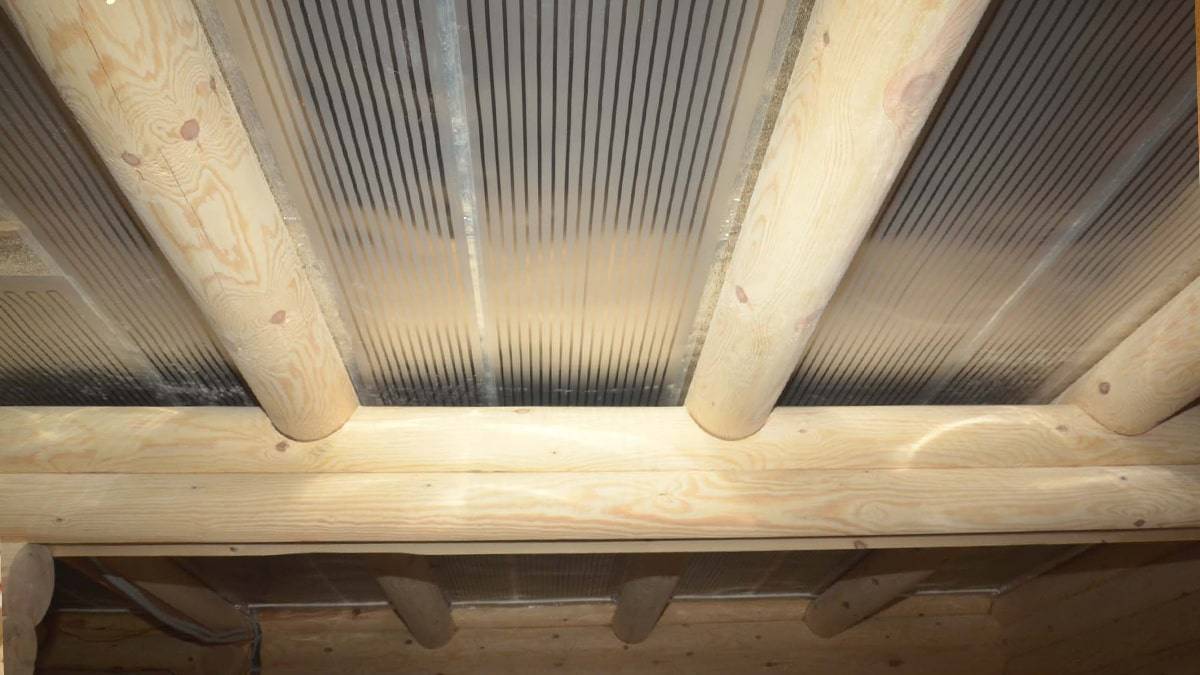
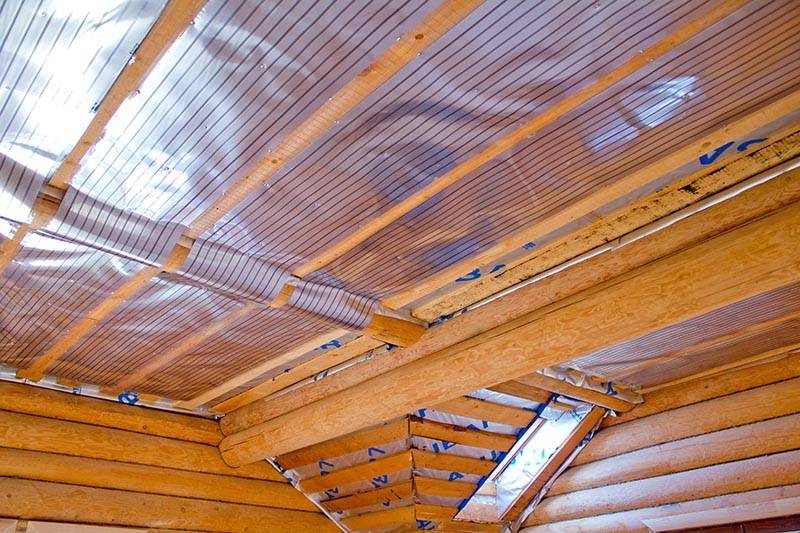
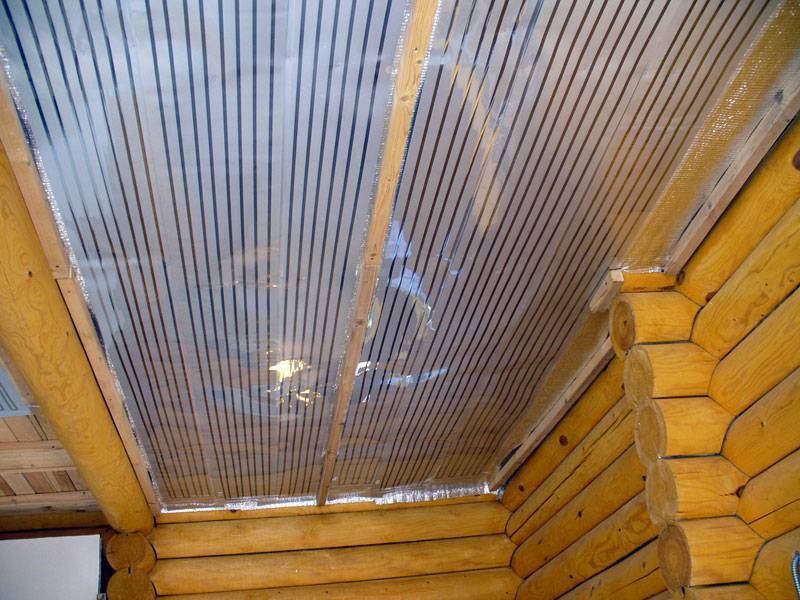
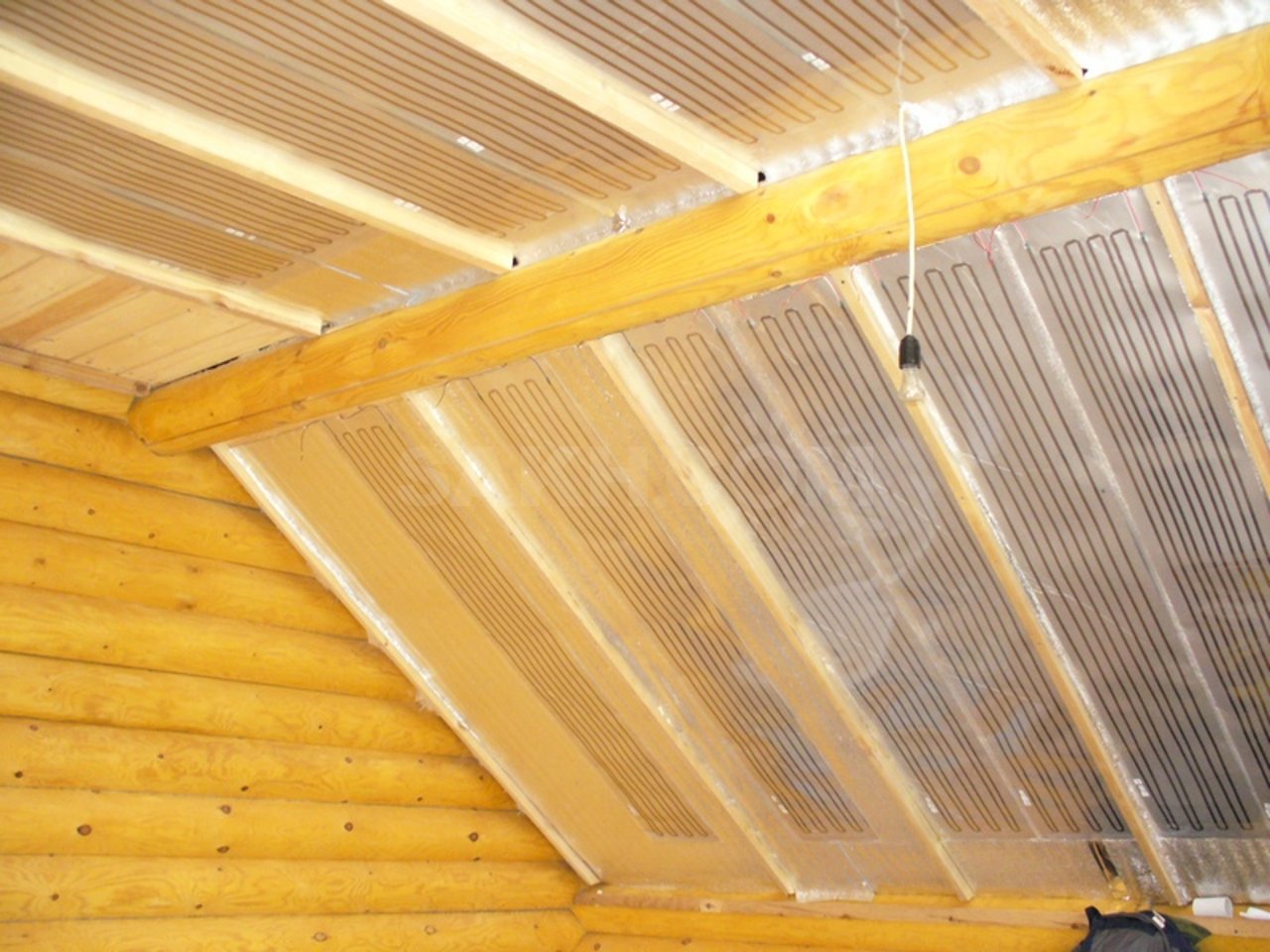
Warm ceiling
- The main advantage of a warm ceiling
- The lack of a warm ceiling
- Installation of a warm ceiling
The main advantage of a warm ceiling
So, the most important argument in favor of using infrared heating is precisely the low power of this type of heating compared to other heating systems.
For example, the power of a water-heated floor system averages 50-80 watts per square meter. And the power of films for a ceiling heating device, declared by the manufacturer, is 15 watts. It's great of course. But not everything is so simple.
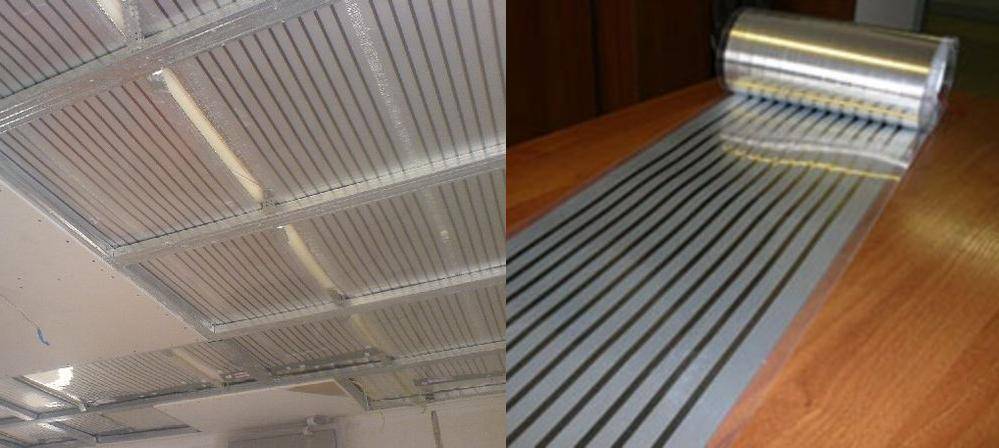
To mount the heating film on the ceiling, it is necessary to mount the lathing, mount heat-insulating mats, mount the reflector layer, and only then mount the heating film.
At the same time, you need to understand that the heat loss of your home or premises should be minimal. Otherwise, the energy consumption when using a warm ceiling will be comparable to traditional heating systems.
This is of course cheaper than a device, for example, a concrete system for a warm water floor. But the quality is the only positive.
The lack of a warm ceiling
If you have warm water floors, then they can be heated by any boiler. For example, electric, gas, diesel, solid fuel, heat pump, solar collector and so on.
But the infrared heating film works only on electric energy. Thus, if the electricity is turned off, you will be left without heating.
According to the principle of heating, warm ceilings and warm floors are the same. Both of these systems work in the range of long-wave infrared heating.
Therefore, I would not consider warm ceilings as the main heating. As an alternative please. For example, you turn on warm ceilings during the day while you are at work. And at night, heat the stove or turn on another boiler.
It is also convenient to use ceiling heating in the off-season to maintain a comfortable temperature in the house without turning on the main heating.
Installation of a warm ceiling
When installing a heating film on the ceiling, it is necessary to pay attention to the quality of the connection between the supply cable and the film and the reliable insulation of this connection, since water leakage from the roof or upper apartments is not ruled out. And if the connection is poorly insulated, then you can get an electric shock or a fire can occur due to a short circuit with water. And if the connection is poorly insulated, then you can get an electric shock or a fire may occur due to a short circuit with water.
And if the connection is poorly insulated, then you can get an electric shock or a fire can occur due to a short circuit with water.
The next rule when installing a warm ceiling is precisely the permissible installation of a finishing ceiling at a distance of no more than 100 mm from the heating film.
In this case, the thickness of the finishing ceiling materials should not exceed 20 mm.
In addition to all of the above, a heating film for a warm ceiling device differs from a film for a warm floor device.
The film for a warm ceiling is equipped with additional reflective elements, which in turn allow you to mount warm ceilings with a height of no more than 4 meters.
To summarize the above, it is advisable to use warm ceilings in well-insulated buildings and premises as an alternative heating or in the off-season.
It is also convenient to use warm ceilings with an uninterrupted supply of electrical energy. Although today no one will give guarantees for an uninterrupted supply.
And to provide basic heating, you can use radiator heating systems, underfloor heating or any other system.
If you have questions about the installation of underfloor heating systems, then follow the links and you will receive comprehensive answers on the installation of water or electric underfloor heating.
If you have any questions on this topic, ask them to specialists and readers of our project here.
The principle of operation of film heating
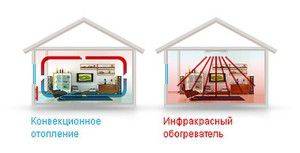 The principle of operation of heating PLEN and conventional
During the operation of almost all heating systems, the air in the premises is heated. Its convection leads to a gradual increase in temperature throughout the volume of the room. IR heating PLEN works on a different principle. It is based on the generation of infrared thermal radiation, which heats the surface of objects that have fallen into the zone of influence of the device.
Heating of the new generation PLEN was developed on the basis of the properties of carbon metallized compositions. During the passage of current through them, heating up to a maximum temperature of + 45 ° C occurs. But this is not the source of heat. The resulting waves with a length of 9.4 μm are reflected from the film surface and concentrated on the surface of objects. As a result, they heat up.
Infrared PLEN heating has a number of important features of work and operation:
- Simple installation of PLEN heating with your own hands. To ensure maximum coverage, installation is most often carried out on a ceiling surface. This can be done independently without special tools and experience;
- Energy saving. Despite the fact that PLEN ceiling heating is powered by electricity, the level of energy consumption is an order of magnitude lower than that of electric boilers or similar devices;
- Low inertia of work. This is due to the absence of an intermediate stage of heating operation - heating the coolant;
- Possibility of use as additional heat supply. Almost all reviews of the PLEN heating system speak of the advantages of its operation together with water heating systems.
Almost any video about PLEN heating talks about compactness and ease of installation, as well as work efficiency. However, they often remain silent about the limitations of operation. Firstly, good thermal insulation of the room must be ensured. The second factor is the impossibility of partial or complete covering of the film with interior items. This can lead to overheating and, as a result, failure. Ceiling mounting is allowed. But at the same time, the minimum distance from the heating elements to the panels must be at least 3 cm.
In addition, unlike water heating, after the system is turned off, the temperature in the room decreases almost immediately.
PLEN heating: specifications, price, advantages and disadvantages
Infrared warm ceiling, the price of which is different, has its own technical characteristics, which can be collected in one summary table below.
| Parameter | Manufacturer's declared data |
|---|---|
| Production material | Special alloy for the heating element, and the insulation is made of three-layer PET. Aluminum acts as a reflector. |
| Weight 1 m² | 550 g |
| Thickness | 0.4 mm |
| The highest heating temperature | 45 ⁰С |
| Power consumption | 150 or 175 W per m² |
| efficiency | About 98% |
| Lifetime | At least 50 years old |
In addition to the general values, there may be differences in power density from 100 to 150 W/m². choose this parameter should be based on the height of the ceiling.
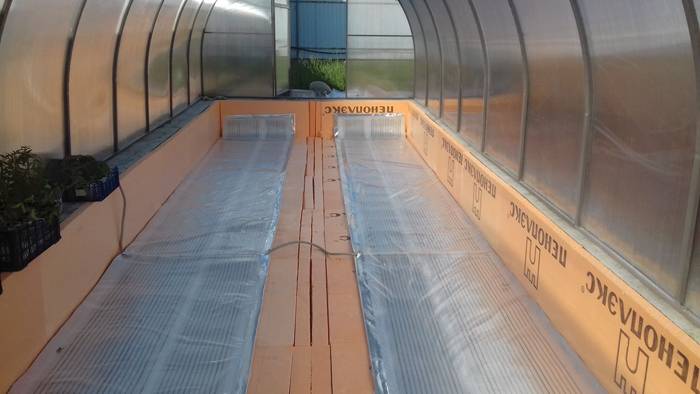
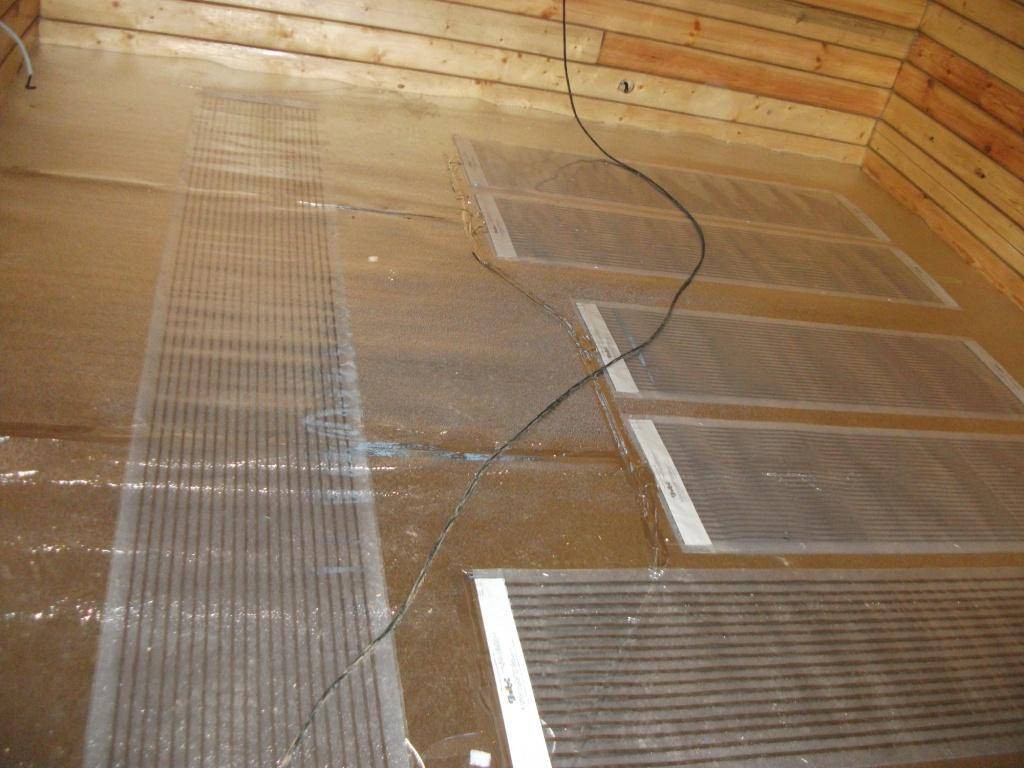
PLEN is also applicable to greenhouse heating in winter period, only mounted differently
So, with a height of up to 3 m, a power of 125 W / m² is applicable, and from 3 to 4.5 m it is necessary to buy a film with an indicator of 150 W / m². This parameter, when choosing, is influenced not only by ceilings, but also by the average negative temperature. The lower it is, the more heating power is needed.
Pros and cons
Quite often in private houses you can find IR heating, the reviews of which are in a positive way, because the rays resemble solar ones in the way they give off heat. In addition, there are many other advantages:
- Dimensions. Only a film with a small thickness is mounted on the ceiling, so the entire heating system, to which it remains to add wires, does not take up much space. It is not necessary to fasten the PLEN to the ceiling, any surface can be used.
- Mounting.The heating system with the help of "warm film" is easy to install, so every consumer who knows how to handle tools can mount it on their own. Since the material is light, then assistants can not be involved. Typically, work with a ceiling surface of 70-80 squares takes 2-3 days.
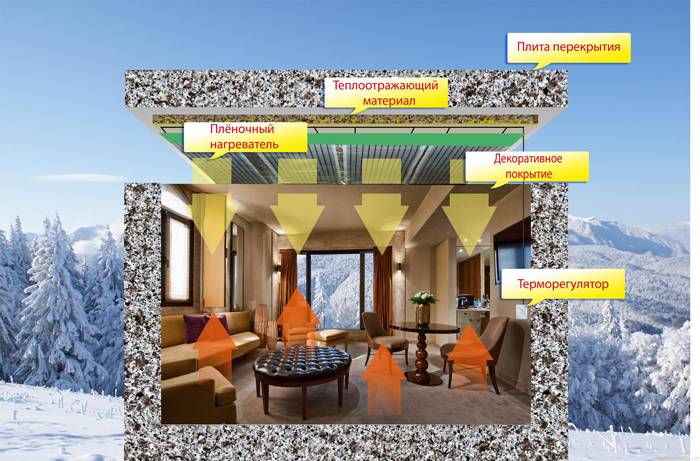
Heating options using PLEN (schematically)
- Low irrationality. You can easily change the temperature in a separate room by setting the necessary parameters.
- Safety. From the side of the fire protection system, PLEN heating is the safest. The maximum heating is only up to 45 ⁰С, which cannot lead to fire.
Thanks to these advantages, it is increasingly possible to meet IR heating using a film in private homes, but this option cannot be called cheap. The material itself will require financial investments, and the price of electricity is constantly growing. In addition, the disadvantages, according to consumer reviews of infrared heating using a film, include:
Finishing difficulties. The information from the manufacturers states that the film can be hidden under any finish that does not contain metallic inclusions. But, for example, they closed the PLEN with a clapboard and got a multi-layer device through which it is difficult to break through the IC, thereby the heat level drops. It turns out that to mount a warm ceiling, not the floor. Therefore, it is worth considering the thermal resistance of various coatings. It is best to use through structures with a coating of no more than 50%, which transmit heat rays.
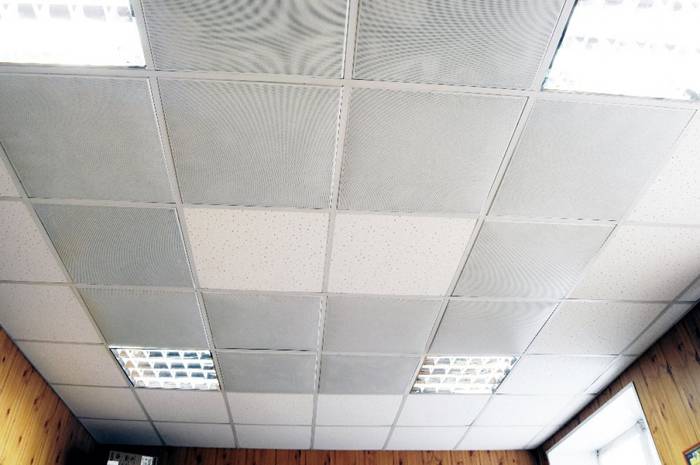
Ceiling finishing option using infrared heating
Design. An uncovered film will heat the room best, but outwardly such a room will look like a warehouse.
It turns out that although the film is easier to mount, closing or decorating it is much more difficult than conventional pipes with batteries.
Price
Having considered the technical characteristics of heating PLEN, we will give the price of some options in the table below, so that there is something to focus on when planning the heating of a private house.
In different cities, there are various companies offering turnkey installation and sale of IR film heating.
Installation of infrared ceiling film
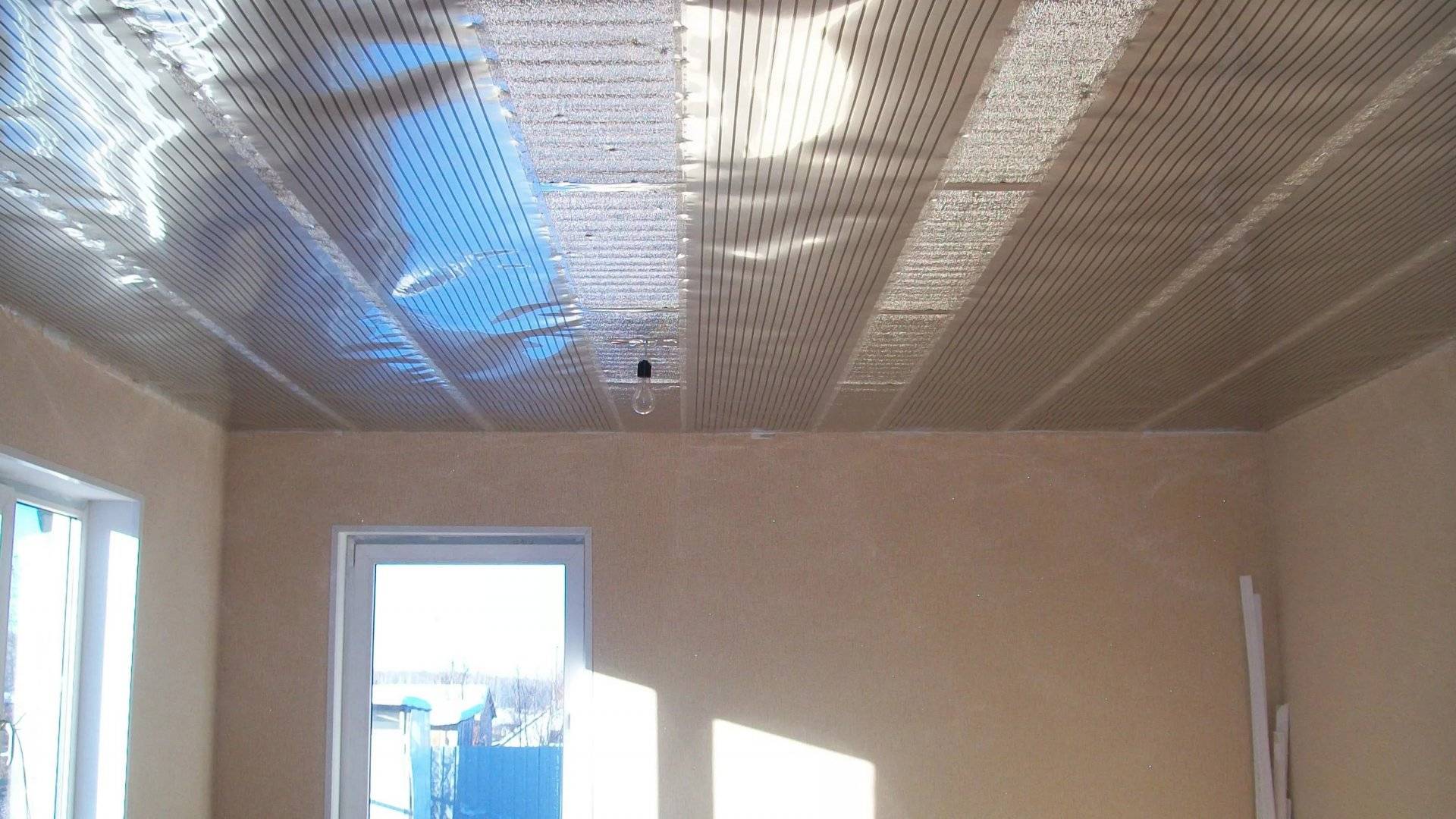
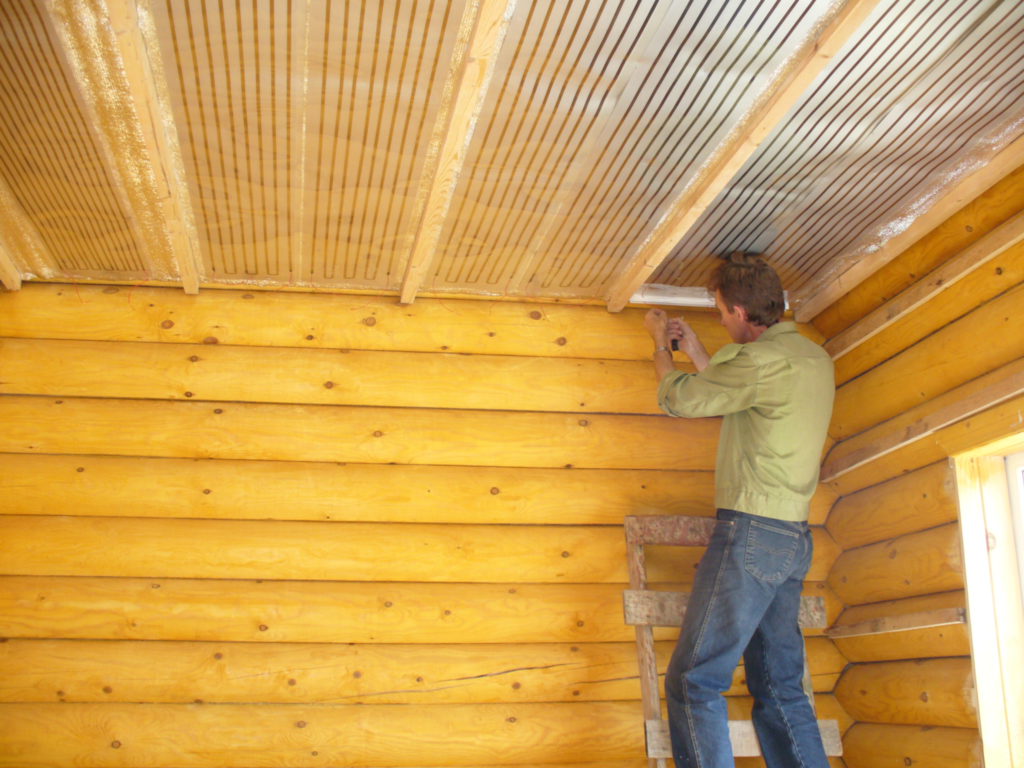
In the event that this system will act as the main source of heat, it is recommended to first fix the mats on the surface, which will occupy about 80%. If an infrared ceiling heater is used as an additional heat source, then it is enough to install mats on 30% of the total area of the entire ceiling surface.
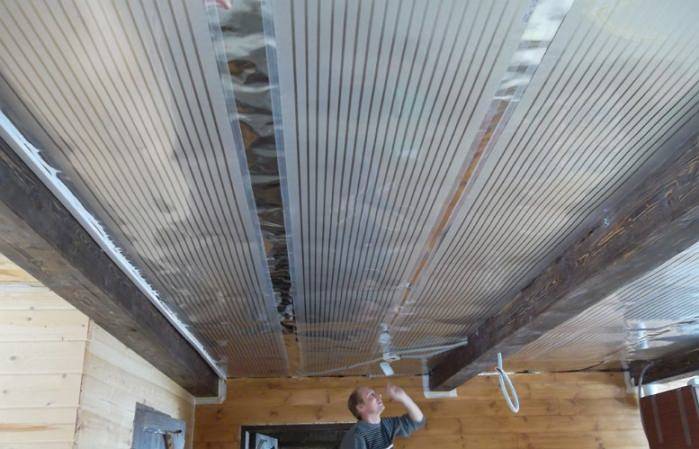
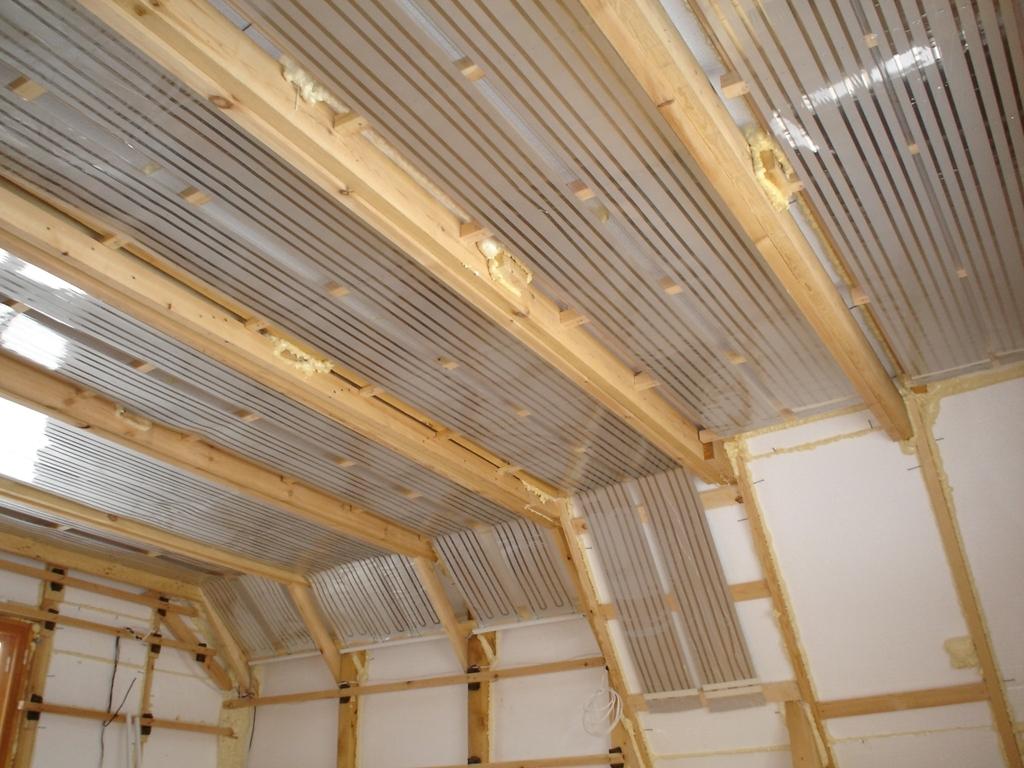
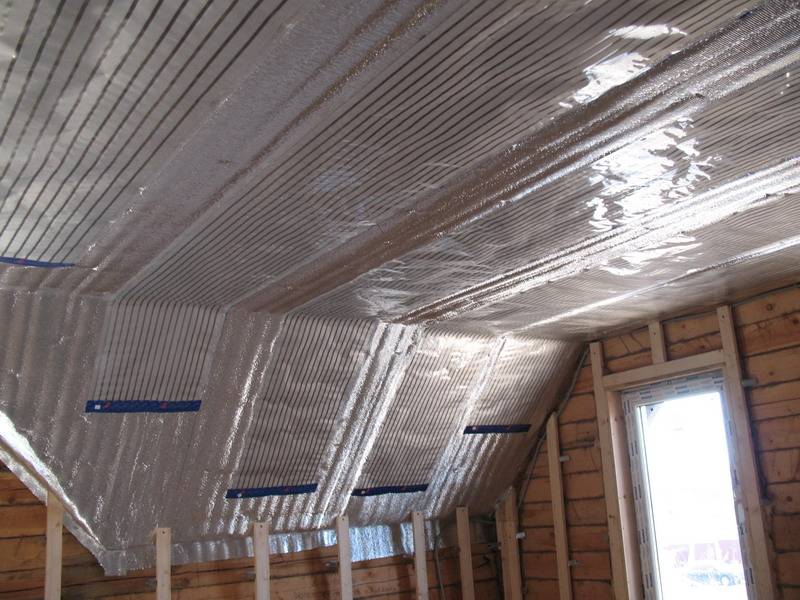
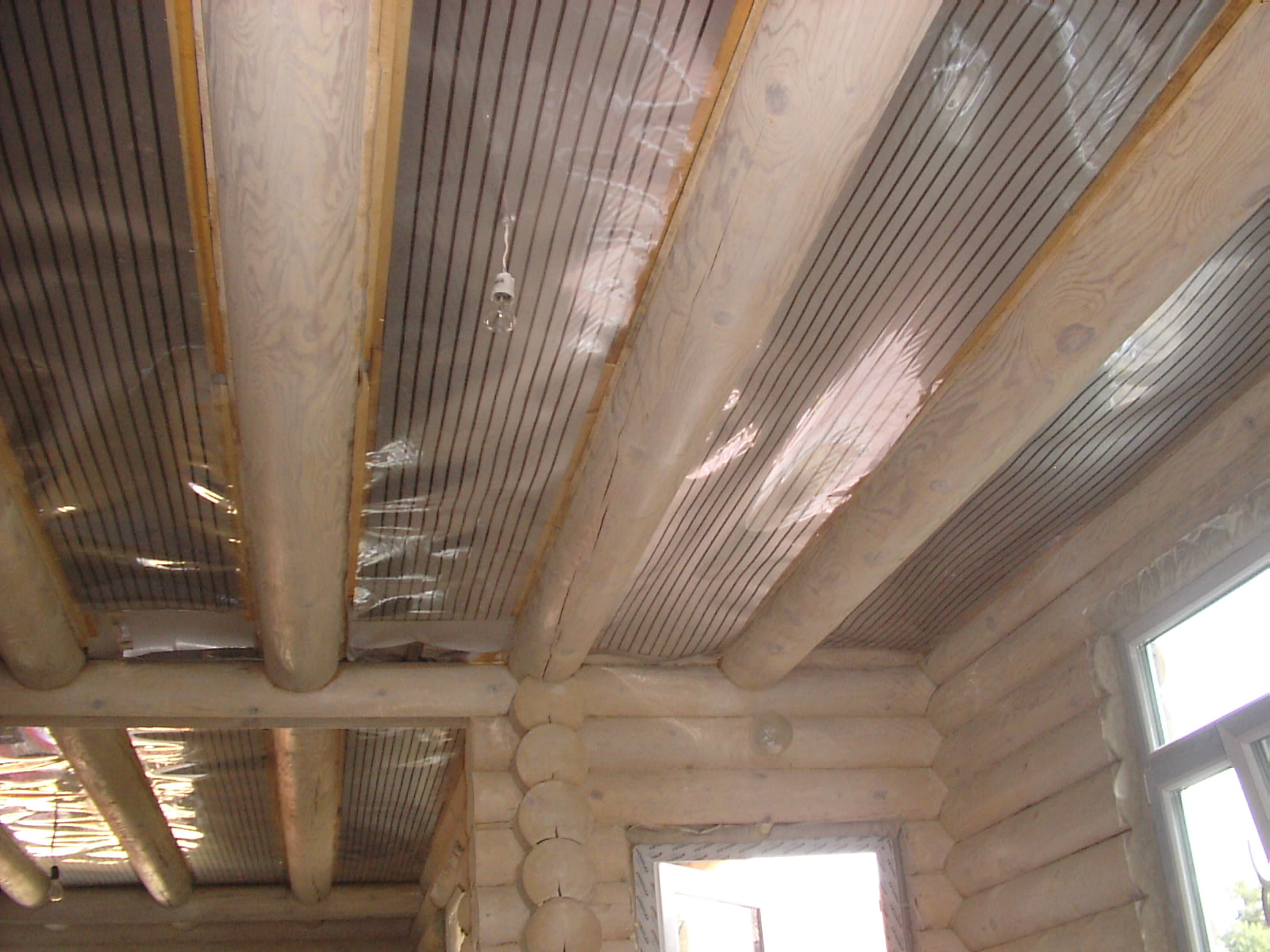
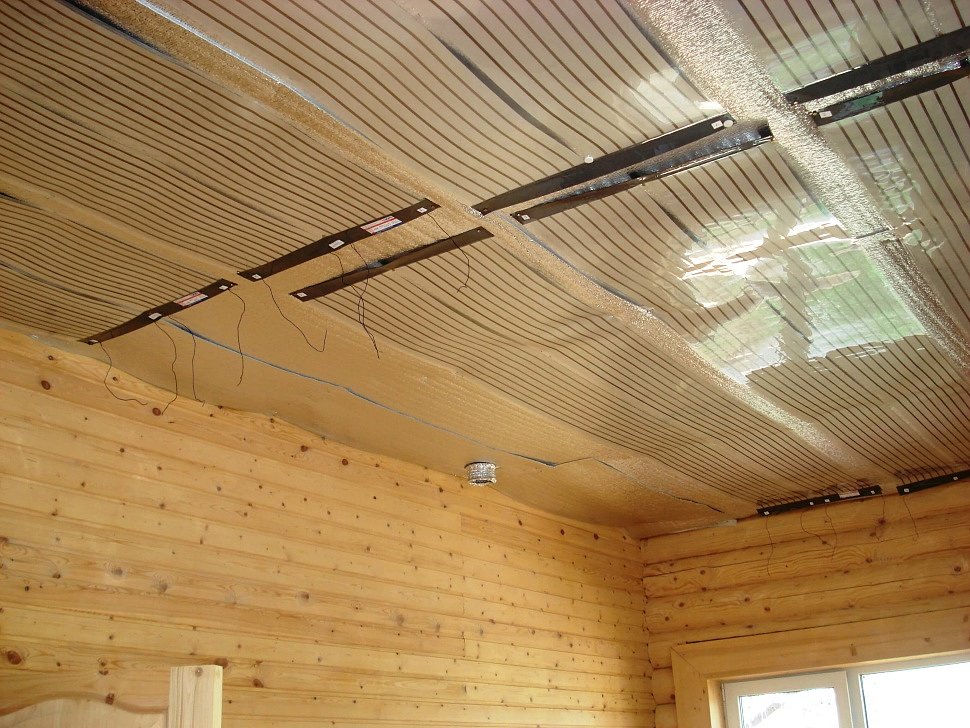
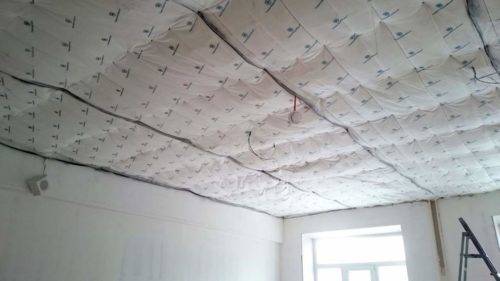
Before proceeding with the installation work, it is necessary to first correctly calculate the power level of the heating elements. Thanks to the calculation of power, it will be possible to choose a thermostat. For example, a thermostat consumes 4 kW, for each sq. m of film accounts for 0.2 kW. In this case, the surface area should be up to 20 square meters. m.
After that, proceed to the installation of thermal insulation materials. If it is planned to install an infrared heater in a multi-storey building with a concrete floor, then due to thermal insulation, heat loss can be prevented. In wooden houses, thermal insulation prevents heat dissipation and, as a result, drying out of the wood.
For insulation, you can use foamed polystyrene, which is covered with a layer of foil on one or both sides. The material should be fixed to the ceilings using refractory dowels for this purpose. Joints are recommended to be glued with adhesive tape made of foil. Only after that you can proceed with the installation of a film ceiling heater.
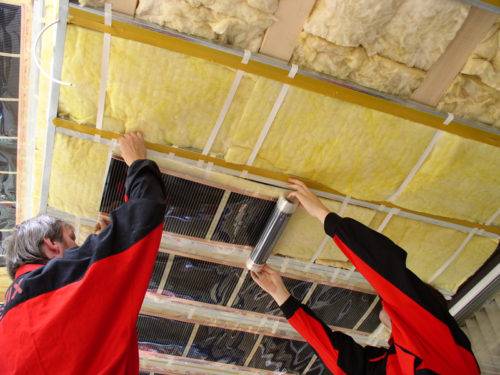
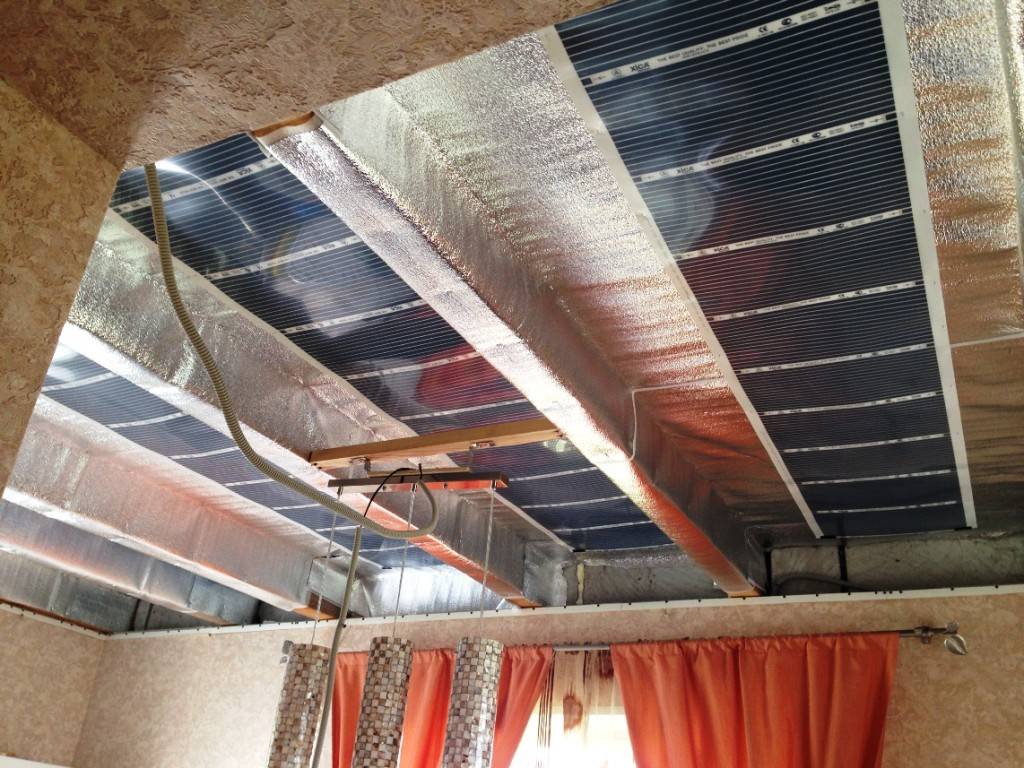
When attaching an infrared film sheet, it is necessary to first step back around the entire perimeter from the walls of about 35 cm. A distance of up to 5 cm should be left between the strips. The infrared film should be placed parallel to each other on the ceiling surface. During the work, it is recommended to follow a special scheme, according to which the heating elements should not be located above the sleeping places and electrical appliances.
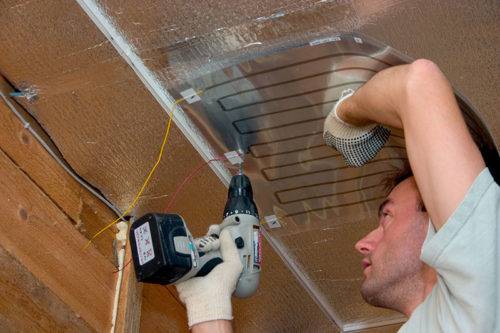
After all the elements have been fixed, it is worth checking the performance of the system. To do this, you have to connect the terminals to the copper busbars and clamp them tightly with pliers, the connection points must be securely insulated.
To interconnect infrared film sheets, electric copper wires are used, which have a minimum cross section of 2.5 square meters. mm. If necessary, the wires can be masked; for this, a strobe is made in the walls using a perforator, which is then covered with plaster.
Attention! If necessary, you can install an infrared warm floor on the ceiling.
Installation of film heating on the ceiling
In order for the finished heating system to be effective, the following rules should be followed when working:
- Before installation, it is necessary to perform thermal insulation of the room (walls, doors, windows).
- Do not install film heating in a room with high humidity or at low temperatures.
- The heating system, which acts as the main one, must occupy at least 80% of the total ceiling area. For additional, 40% is enough.
- The current power must correspond to the value specified in the passport of the heating system. If it is less than required, it is necessary to install a distribution block.
- The temperature sensor must be installed at a level of 170 cm from the floor level.
- It is forbidden to bend the roll heater at an angle of 90 °.
- For ceilings that are too high - above 360 cm - standard models will not work, since the energy consumption in this case will be unreasonably large.
- In order to reduce heat loss, it is recommended to mount a foil film under the IR film. It will reflect heat into the room.
- The roll heater should be cut only along the marked lines.
- You need to fix the IR heater with a stapler or special fasteners, while the fasteners must be located on the transparent sections of the film.
- The distance between the film strips should be no more than 50 mm.
- During installation, make sure that the heating surfaces do not come into contact with flammable or combustible materials.
- Electrical wiring contacts must be carefully insulated using insulating tape and plastic caps.
Film infrared heating is mounted in four stages:
- Calculation of materials for the installation of a film heating system.
- Carrying out work on thermal insulation of the ceiling.
- Installation of elements of the heating system, installation of a temperature sensor.
- Connection to the network and thermostat.
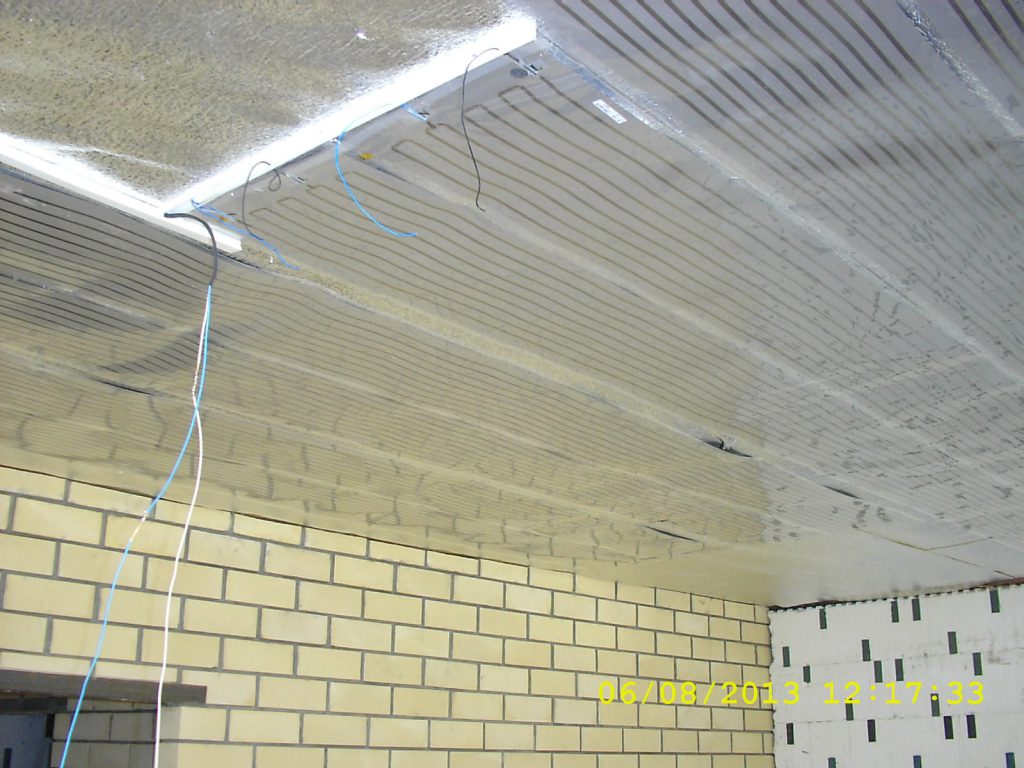
After determining the required amount of materials and their purchase, proceed to the thermal insulation of the ceiling. To do this, use a foil heat insulator (folgoizol penofol and others). The material should be reinforced over the entire surface of the ceiling and go a little on the walls to reduce heat loss.
An IR film is mounted on top. Fix it on the fasteners included in the kit, positioning it so that it falls on the places marked for the cut - this way the heating elements will not be damaged.
When the film is fixed, on the one hand it is necessary to isolate the contacts, and on the other, connect the wires. Then you need to install a thermostat on the wall. Testing the operation of the system. If it works as it should, move on to finishing.
You can close the IR film with various finishing materials: MDF, plastic clapboard, drywall and others. The main thing is that they do not have heat-reflecting properties.
Home heating with infrared heaters is a modern alternative to traditional electrical systems. Its high cost is justified by ease of use, ease of installation, reliability and efficiency.
Efficiency and economy are the main indicators when choosing infrared ceiling heating. The cost of energy sources is high, and many owners of private houses try to use them rationally. These two indicators form the basis for the creation of a unique and modernized IC heating system. How does this system work and is it possible to install it yourself?
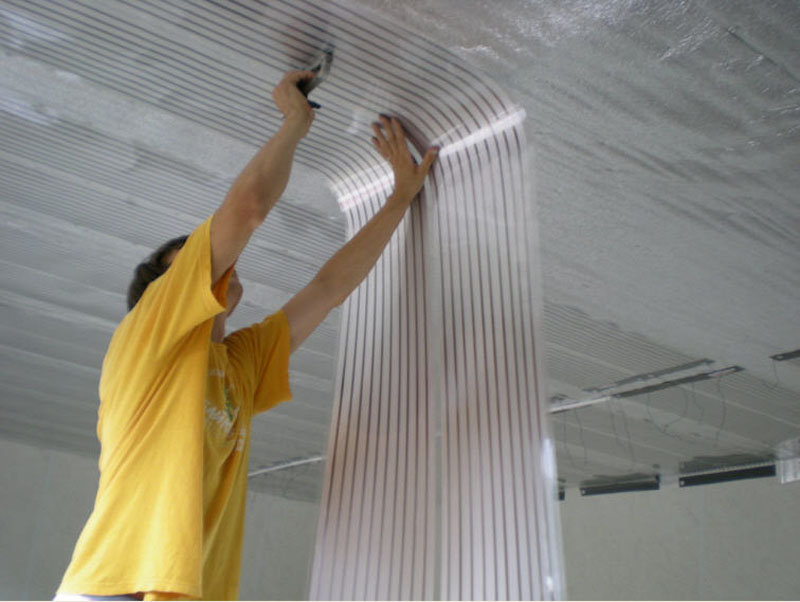
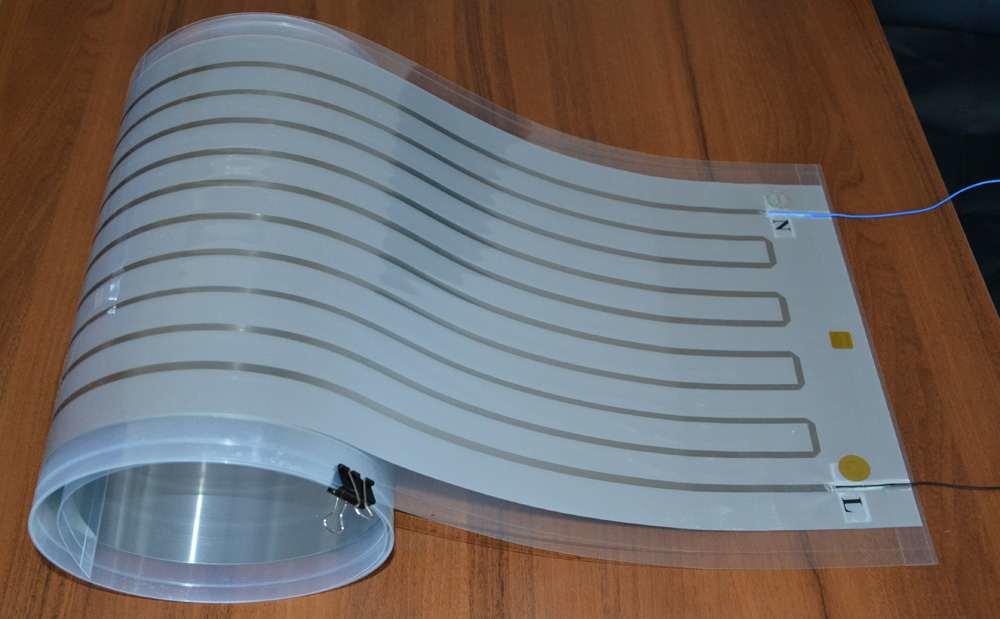
Ceiling infrared heating
Benefit or harm of infrared radiation
Most of those who are thinking about installing infrared equipment in their home have a question about the safety of such a system.
First, let's look at what IR radiation is. These are electromagnetic waves of a certain length. Their natural source is the Sun, which emits a large number of waves of various spectra. The longest of them are so-called red, because the human eye sees them as red.
However, scientists have proven that there are also infrared waves, the length of which is somewhat longer. They belong to the waves of the spectrum invisible to humans. They get on the skin and are felt as a thermal effect. But not all infrared radiation is the same.
Physicists distinguish three groups of such waves:
- Short, radiated by bodies with temperatures above 800 °C.
- Medium. They are emitted by objects heated to 600 ° C.
- Long. Radiated by bodies with temperatures up to 300 °C.
Depending on the wavelength, infrared radiation affects living organisms in different ways. Short waves penetrate deep enough into the human body and are able to heat up the internal organs.
In areas of the skin that have been exposed to short infrared waves, redness, blisters and even burns form. Waves of medium length have a milder effect, but still undesirable for the body.
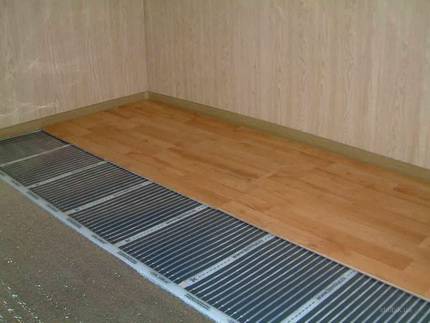
Film heaters are heated to a temperature of 50C, respectively, they emit only long infrared waves that are useful for humans
Long-wave infrared radiation is perceived by a person as a pleasant warmth. It penetrates the upper layers of the skin and gently warms the moisture in them. That is why all living organisms so love to bask in the sun.
Long-wave infrared radiation not only warms, but also activates the immune system, triggers the mechanisms of restoration and regeneration of many systems and organs.
Considering that the film equipment is heated up to 45-50C, you can be sure that it emits long infrared waves. In the operating mode of maintaining the set temperature, the system operates on average from 6 to 10 minutes per hour.
Thus, it has a short-term effect on a person. The safety of PLEN is confirmed by many certificates. It is recommended for installation in medical and children's institutions.
Detailed information about the dangers of infrared heaters is discussed in our other article.