- Air heating of the building
- Subtypes
- How coolant circulates
- Features of "natural" circulation
- Features of forced circulation
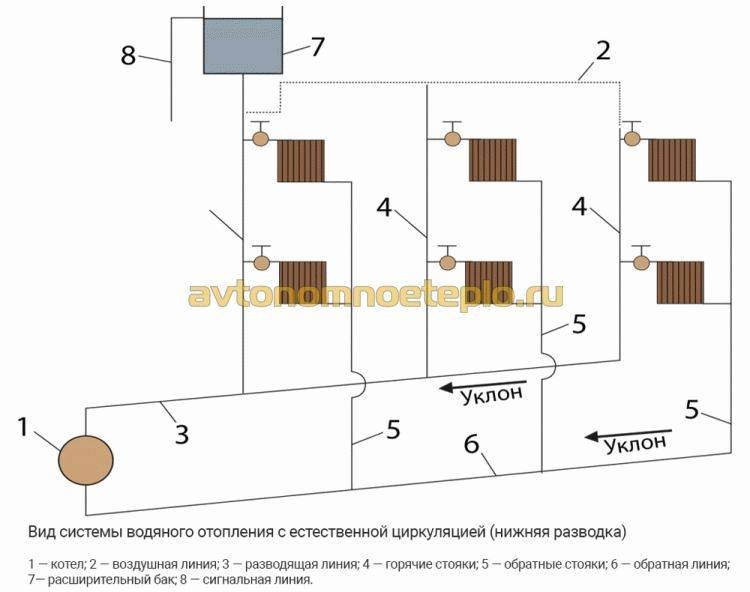
- Bottom wiring
- Residential heating options
- Features of building air heating
- How to fill a closed heating system
- Types of heating system "Leningradka"
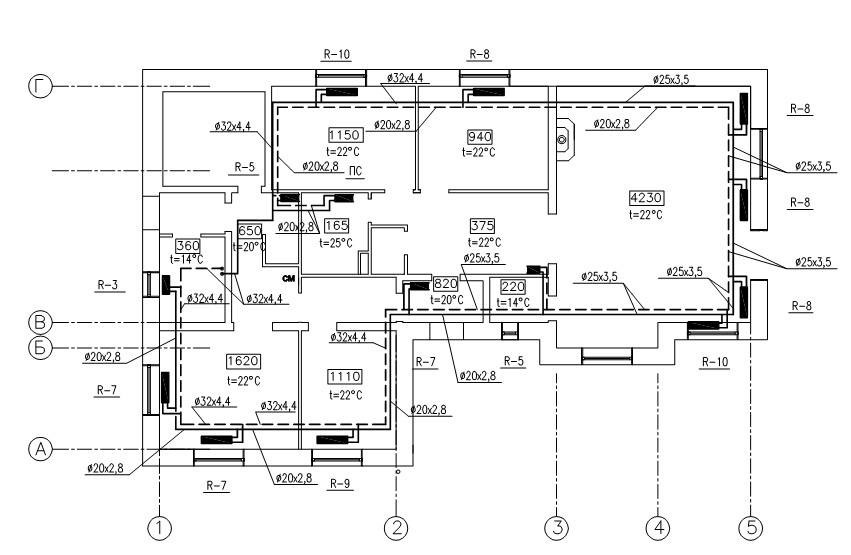
- One-pipe heating scheme for a one-story house ("Leningradka")
- ethylene glycol
- Tips for installing a house heating system
- Expansion tank for closed heating system
- Volume calculation
- Place for installation of expansion tank of membrane type
Air heating of the building
This is another type of heating a private house. Its main distinguishing feature is the absence of a coolant. The air system is designed so that air flows pass through the heat generator, where they are heated to the desired temperature.
Further, through special air ducts, which can have a wide variety of shapes and sizes, the air masses are sent to heated rooms.
Air heating can be used to heat a private house of a large area, while it is possible to create a comfortable microclimate in each room
According to the laws of convection, heated flows rise, cooled ones move down, where holes are mounted through which air is collected and discharged to the heat generator. The cycle is repeated.
Such systems can work with forced and natural air supply. In the first case, a pump is additionally mounted, which pumps the flow inside the air ducts. In the second - the movement of air is carried out due to the temperature difference. It is clear that forced circulation systems are more efficient and powerful. We talked about the arrangement of air heating with our own hands in the next article.
Heat generators are also different. They can operate on a variety of fuels, which determines their performance. Most of all, gas, electric and solid fuel appliances are in demand. Their disadvantages and advantages are close to similar water heating boilers.
The circulation of air masses inside the building can be carried out in different ways. It can be a closed cycle without adding outside air. In this case, indoor air quality is poor.
The best option is circulation with the addition of air masses from the outside. The indisputable advantage of air heating is the absence of a coolant. Thanks to this, it is possible to save the energy required for its heating.
In addition, installation of a complex system of pipes and radiators is not required, which, of course, also increases the efficiency of the system. The system does not have the risk of leaks and freezing, like its water counterpart. It is ready to work at any temperature. The living space heats up extremely quickly: literally, about half an hour passes from starting the heat generator to raising the temperature in the premises.
A gas heat generator is one of the possible solutions for the implementation of an air heating project for a private house. However, such systems are rarely used in practice.
Another significant plus is the possibility of combining air heating with ventilation and air conditioning. This opens up the widest possibilities for realizing the most comfortable microclimate in the building.
The air duct system in the summer can be successfully used for air conditioning. Installing additional equipment will make it possible to humidify, purify and even disinfect the air.
Air heating equipment lends itself well to automation. "Smart" control allows you to remove burdensome control over the operation of appliances from the homeowner. In addition, the system will independently select the most economical mode of operation. Air heating is very easy to install and durable. The average life of its operation is about 25 years.
Air ducts can be installed at the construction stage of the building and hidden under the ceiling covering. These systems require high ceilings.
The advantages include the absence of pipes and radiators, which gives room for the imagination of designers decorating the interior. The cost of such a system is quite affordable for most homeowners. Moreover, it pays off quickly enough, so its demand is growing.
Air heating also has disadvantages. These include a significant difference between the temperatures in the lower and upper parts of the room. On average, it is 10 ° C, but in rooms with high ceilings it can reach up to 20 ° C. Thus, in the cold season, it will be necessary to increase the power of the heat generator.
Another disadvantage is the rather noisy operation of the equipment. True, this can be leveled by the selection of special "quiet" devices. In the absence of a filtration system at the outlets, a large amount of dust in the air may occur.
Subtypes
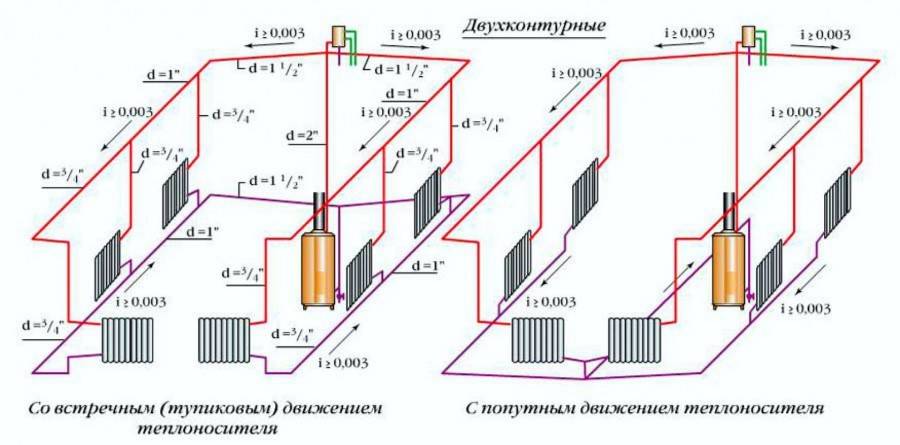
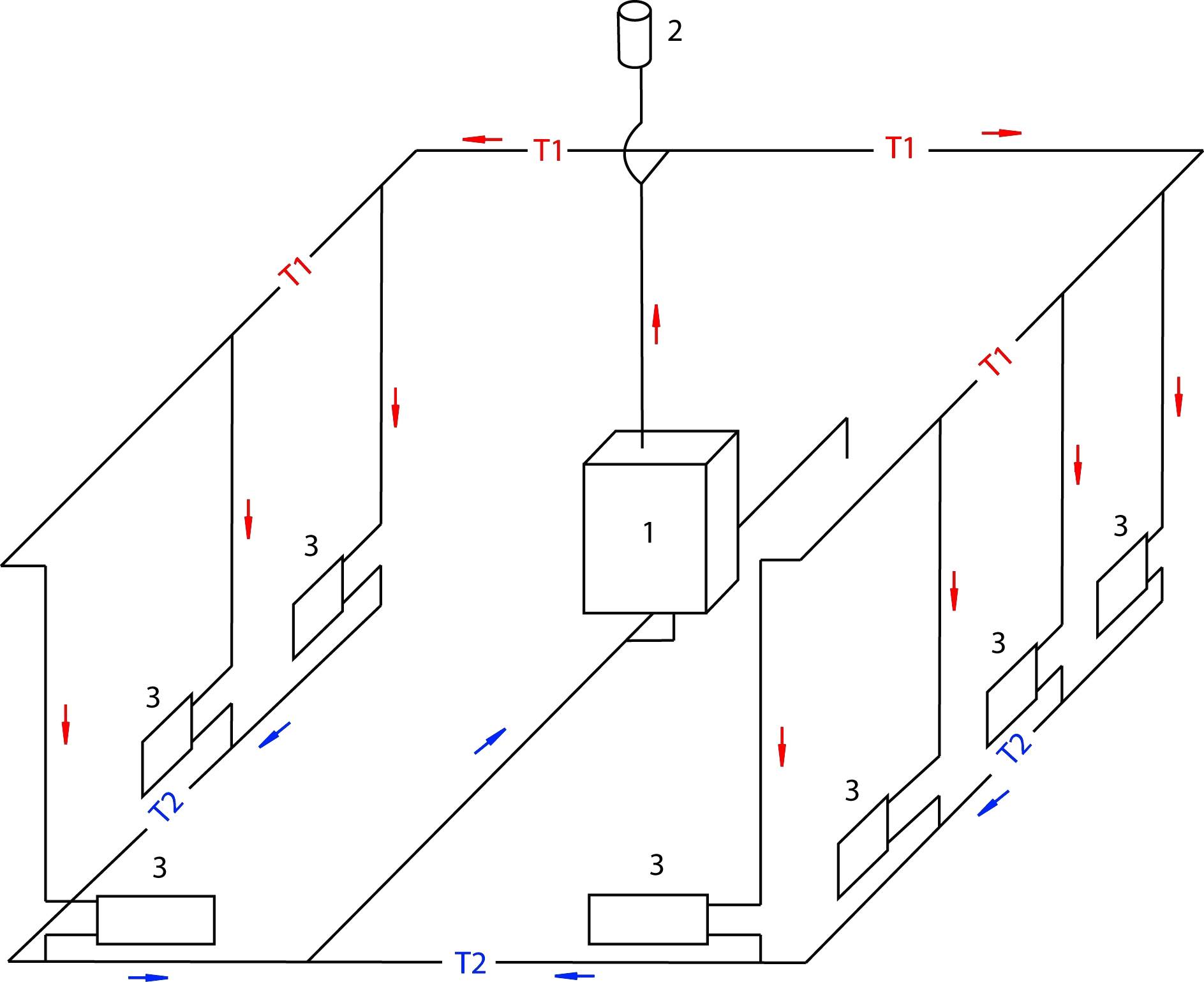
Vertical
A feature of this heating scheme is that water simultaneously enters all radiators, which are located vertically at different levels. Thermostats and balancing valves are used for more accurate heating settings.
Horizontal
This heating scheme is different in that the coolant simultaneously enters all radiators, which are located on the same level. In this case, all their outputs are connected to one outlet. With the help of a return element, the coolant is returned to the boiler.
Horizontal Distribution
The outlets of all radiators are connected to the boiler. An example is underfloor heating.
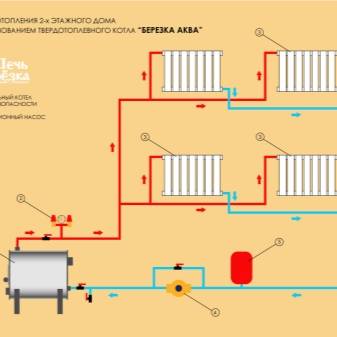


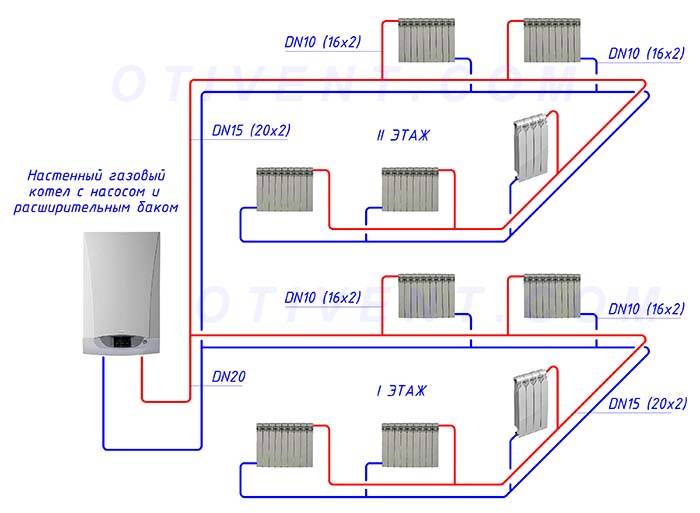

How coolant circulates
The heat carrier can be:
- antifreeze;
- alcohol solution;
- water.
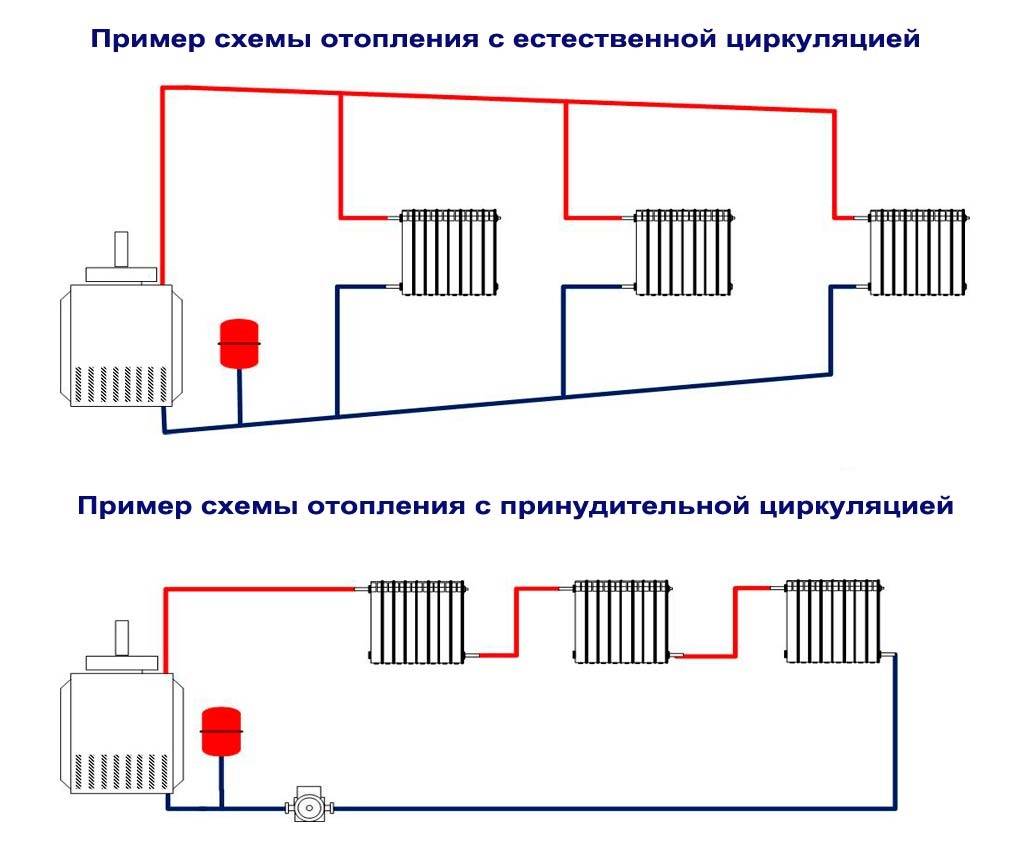
Circulation can be both "natural" and forced. There may be several pumps. Also only one pump is used.
Features of "natural" circulation
Due to the special properties of the fluid, gravity expands as the temperature rises.
As water cools, the density increases. Then the water rushes to the point of departure. This closes the loop.
 Recommended material is high quality polypropylene
Pressure can be provided:
installation difference (the heating installation is mounted below. This usually happens in the basement area, or in the basement)
The lower the elevation difference, the lower the speed at which the coolant moves;
temperature difference (taking into account the difference in the room and within the system itself). The warmer the house, the slower the movement of heated water.
In order to reduce the resistance of pipes, it is recommended to have horizontal sections slightly sloped. You should focus on the movement of water.
The circulation rate depends on the following indicators:
| Index | Description |
| Circuit Features | One of the important criteria is the number of connections. The best effect can be achieved against the background of the linear placement of heating units. |
| Pipe diameter (routing) | It is recommended to choose models with a large internal section. This will help to reduce the resistance when moving the fluid. |
| Material used | The recommended material is polypropylene. It has higher throughput. Also, the material is resistant to corrosion and lime deposits. The most undesirable material is metal-plastic. |
If the installation was done correctly, it can last several decades.
One of the main disadvantages is the limitation of the length of the circuit, up to 30 meters. The fluid moves very slowly along the line. Against this background, the liquid in the radiators also heats up slowly.
Features of forced circulation
The slow speed of the heating medium can be increased by means of a pump. Due to this, even with a small diameter of the line, sufficiently fast heating is ensured.
The type of system for forced movement is closed. Air access is not provided. The expansion tank is the only area where important processes take place.The best choice is sealing.
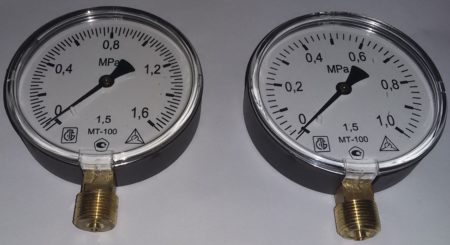 Pressure gauges help regulate pressure
To ensure the stability of pressure and the safety of the entire system, the following are used:
- air venting device. You can find it in the expansion tank. Its main purpose is to extract the air formed in the process of boiling water;
- fuse. If the pressure is very high, it contributes to the fact that the excess water is removed "automatically";
- pressure gauges. Designed to regulate and control the pressure in the inner part of the circuit.
Next to the boiler, on the return circuit, it is recommended to install a pump. This helps to reduce the adverse effect of the heated liquid on the installation gaskets made of rubber. This increases its lifespan. Repair is not required for a very long time.
If the system is equipped with a circulation pump, its functioning is affected by alternating current. To ensure proper operation, a bypass is recommended. This will help ensure that the system transitions to another mode.
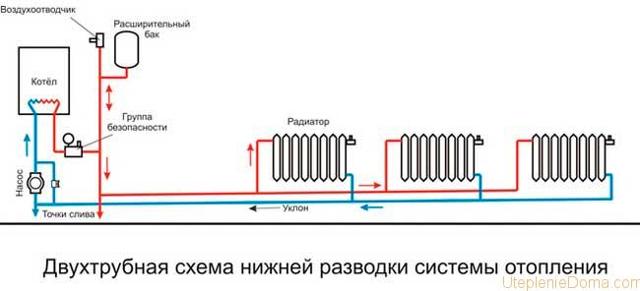
Bottom wiring
Here, the pipe conducting the coolant is installed directly under the windowsill, and the return pipe is near the floor.
The pressure in the pipes is not very high, so you have to use pumps. Airing is not ruled out. To avoid this shortcoming, Mayevsky cranes should be installed on the floor. If the house is multi-storey, then this crane should be located on each of the floors.


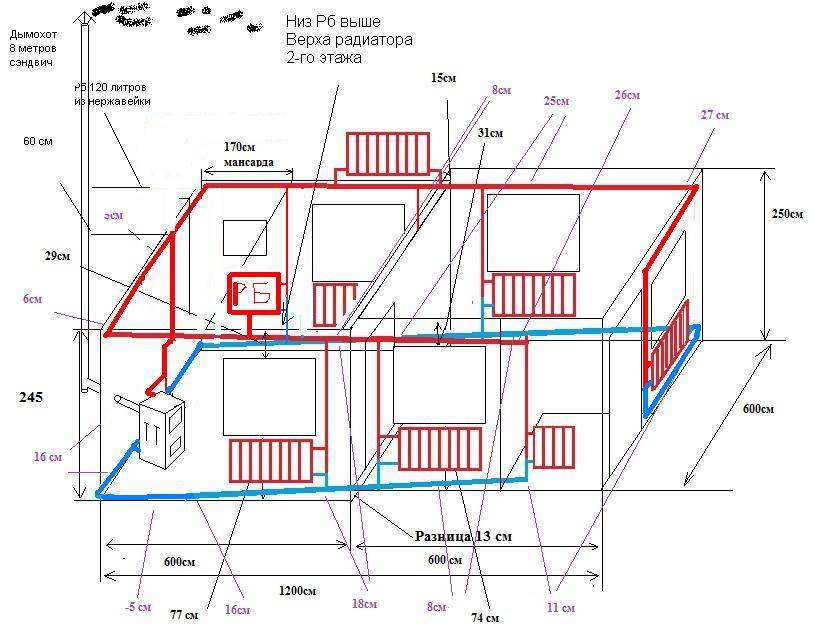


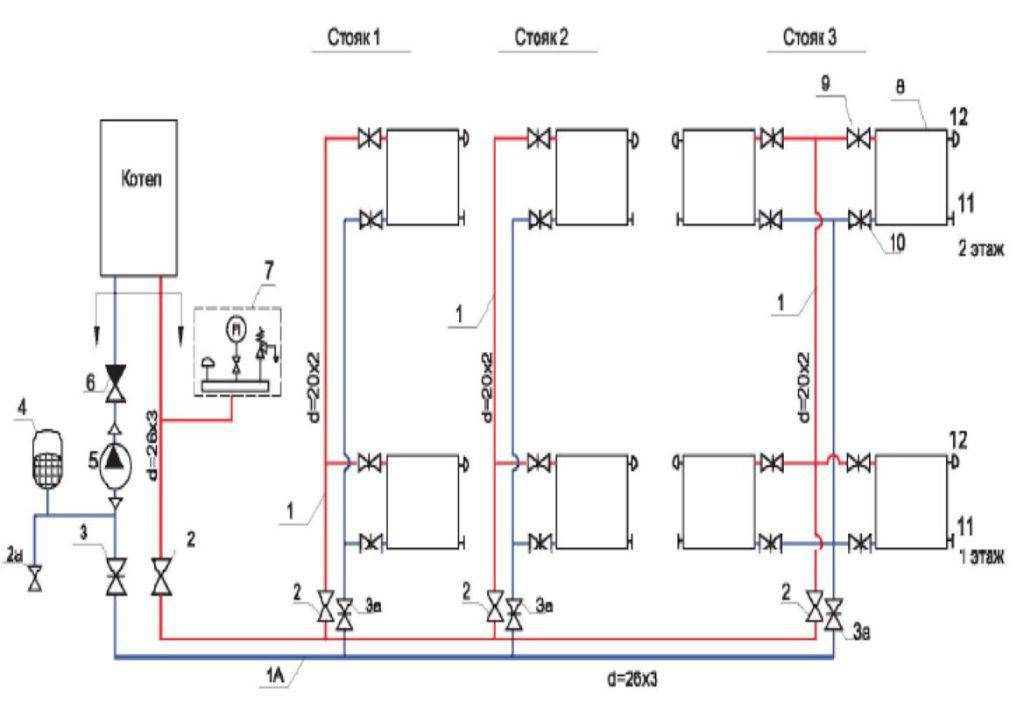


Wiring can only be laid up to the doorway or two independent heating systems can be installed on both sides of the door.
The expansion tank is easy to install anywhere. If it is closed, then it can be placed in the rooms, and not in the attic, which is convenient.The bottom wiring is not conspicuous
This is important if you are making sure that the wiring fits in with the decor of your room.
Residential heating options
The well-known and most common way to heat your own house or apartment is to make a water system. Principle of operation: the coolant is heated by a boiler or other source, then it is transferred through pipes to heating devices - radiators, underfloor heating (abbreviated as TP) or baseboard heaters.
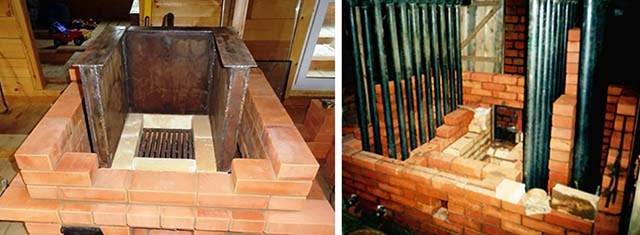
A heat exchanger placed inside the stove heats the water sent by the pump to the batteries
Now we list alternative heating options:
- Furnace. A metal potbelly stove is being installed or a full-fledged brick oven is being built. If desired, a water circuit is built into the furnace or smoke channels of the stove (shown above in the photo).
- Purely electric - convectors, infrared and oil heaters, spiral fan heaters. A more modern way is the installation of heating floors using resistive cables or a polymer film. The latter is called infrared, carbon.
- Air. The heat source warms up the filtered outdoor air, which is forced into the rooms by a powerful fan. A simpler and cheaper option is the installation of gas convectors in residential premises.
- Combined - wood-burning stove + electric heaters of any type.
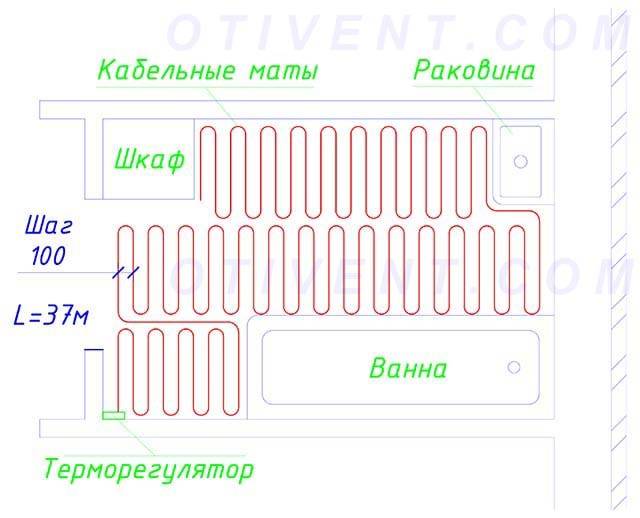
Bathroom heating scheme with electric underfloor heating
To move on, you need to decide which type of heating is better - more profitable, more efficient, more convenient. We definitely recommend choosing a water system. The reasons:
- to heat water, you can use any energy carrier or combine several types of fuel by installing 2-3 boilers;
- with high requirements for interior design, piping is mounted in a hidden way, baseboard heaters or TP circuits are used instead of batteries;
- the ability to organize hot water supply (DHW) - install a double-circuit boiler or an indirect heating boiler (depending on the amount of water consumed);
- alternative energy sources can be connected to the system - solar collectors, heat pump;
- if necessary, heating in a private house is made completely autonomous - pipes are laid according to a gravity (gravitational) scheme, plus a boiler unit is installed that does not require connection to the mains;
- the system lends itself well to adjustment, automation and remote control via cellular communication or the Internet.

The only drawback of water networks is the cost of installation, equipment and valves. Purchase and connection of electric heaters will cost less, but the restriction in terms of fuel choice will increase operating costs.
The device in a country cottage of full-fledged air heating will cost even more than building a stove. It is necessary to purchase a ventilation unit with a heat exchanger, which plays the role of a blower, purifier and air heater. Then organize the supply and exhaust - to conduct air ducts to all rooms. The expert will tell about the pitfalls of air heating in the video:
Features of building air heating
planning DIY heating system at home with air, experts advise starting work with drawing up a project.
It is mandatory to calculate the required flow rate of warm air, the power of the heat generator, the parameters of the air channels, the volume of heat loss in different rooms.
Before you start installing air heating in a country house on your own, it is recommended to show the drawn up scheme to specialists who, if necessary, will make adjustments to the calculations made.
Video:
Having in hand a scheme that will allow you to assemble the air heating of a private house with your own hands, it remains to purchase the constituent elements.
First of all, this is a heat generator, which can be a wood-burning stove or a heating boiler - in the latter case, the fuel used will depend on the type of unit.
A modern boiler can be powered by an electrical network, run on liquefied or main gas, on diesel fuel.
Air ducts can be round and square, the former can have a diameter of 10 - 20 cm, the latter are made in the form of boxes from elements of 10x15 cm or 32x40 cm.
It is possible to give an aesthetic appearance to air networks and achieve unity with the design of the room thanks to decoration, for which drywall or other finishing material can be used.
To increase the efficiency of the system, you need to purchase a supply fan. The installation of an air heating system is possible using a climatic device, which in the warm season will be operated for the purpose of air conditioning and purification.


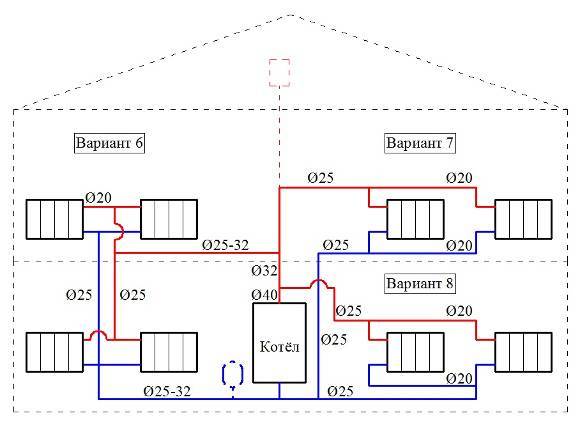


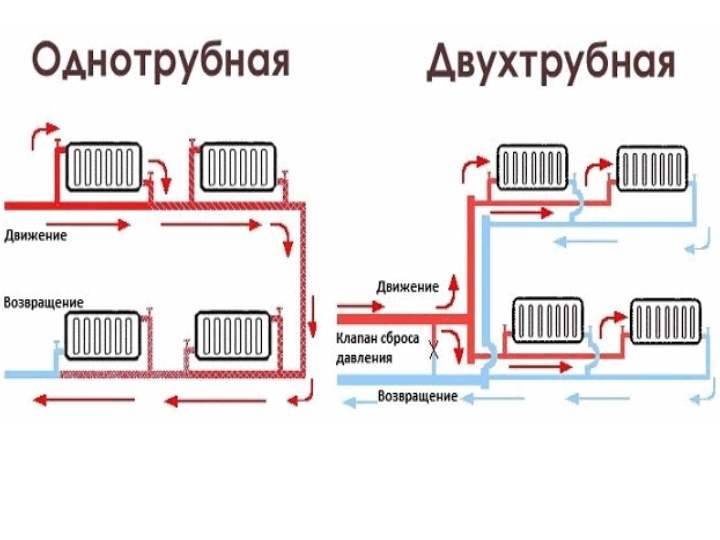

Video:
Depending on the scheme of air heating, the air conditioner can be mounted at the bottom or at the top of the room.
The installation of the supply fan is carried out under the combustion chamber of the heater, from where the warm air masses purified with its participation enter the heat exchanger.
After passing through the entire heating system, the cooled air is sent back to the heat exchanger.
When assembling air heating with your own hands, do not forget about safety rules. Here it is worth starting with the fact that the heater must be equipped with a security control system, have a fuel combustion control relay, and temperature sensors.
When designing air ducts, rigid elements are assembled using special clamps or using reinforced construction tape.
If an air conditioner is used in the air heating system, then the air ducts must be covered with a self-adhesive heat-insulating layer, which will prevent the formation of condensate.
How to fill a closed heating system
At the lowest point of the system, as a rule, on the return pipeline, an additional tap is installed to supply / drain the system. In the simplest case, this is a tee installed in the pipeline, to which a ball valve is connected through a small section of the pipe.
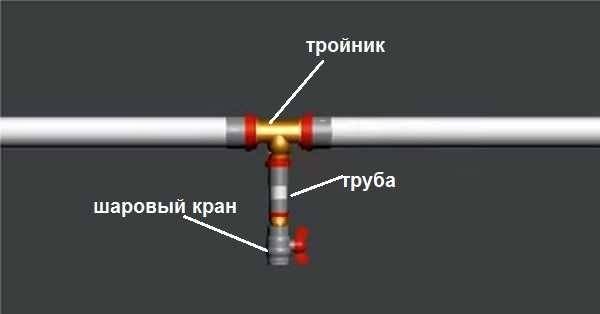
The simplest unit for draining or filling the coolant into the system
In this case, when draining the system, it will be necessary to substitute some kind of container or connect a hose. When filling the coolant ball valve is connected hand pump hose. This simple device can be rented at plumbing stores.
There is a second option - when the coolant is just tap water.In this case, the water supply is connected either to a special boiler inlet (in wall-mounted gas boilers), or to a ball valve similarly installed on the return. But in this case, another point is needed to drain the system. In a two-pipe system, this may be one of the last in the radiator branch, to the lower free entrance of which a drain ball valve is installed. Another option is shown in the following diagram. It shows a single-pipe closed-type heating system.
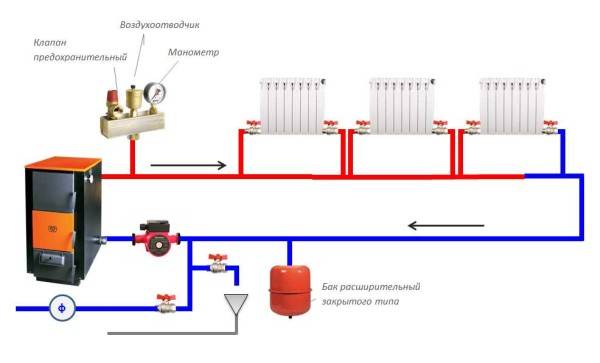
Scheme of a closed single-pipe heating system with a system power supply unit
Types of heating system "Leningradka"
A two-pipe heating system has many advantages. It allows you to ensure uniform heating of the premises, since the temperature of the coolant throughout the system is almost the same. The disadvantage of the two-pipe scheme is its high cost - you need to buy more pipes, make many connections. But it allows you to heat private houses of any size.
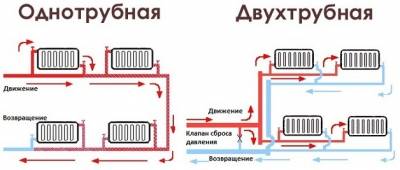
Single-pipe heating systems differ from two-pipe systems in lower installation costs and its simplicity.
If the household is small, then creating a complex and expensive two-pipe system does not make much sense. It is best to save money and lay a one-pipe system. It will provide heating of all rooms and will reduce installation costs. As we have already said, such a scheme will lead to the fact that it will be noticeably cooler in distant rooms - this is due to the cooling of the coolant as the radiators pass in series (this is exactly how the coolant flows in such systems, returning to the boiler through one whole pipe).
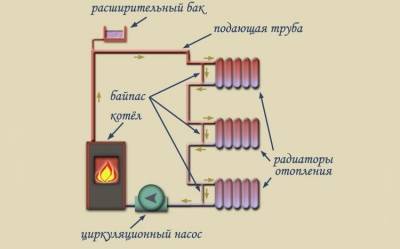
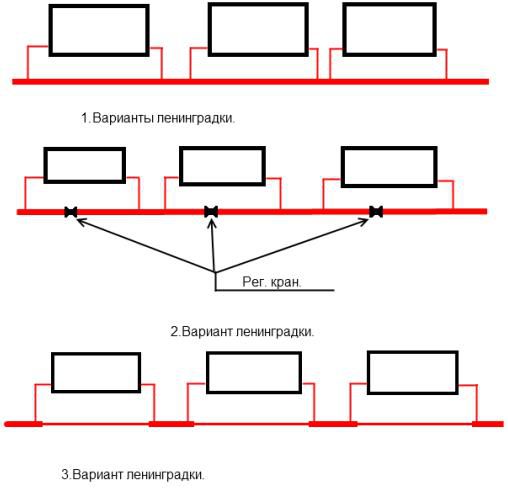
What to do in this situation? We recommend using a one-pipe heating system with natural circulation "Leningradka". How does it differ from standard single-pipe heating? The thing is that in conventional heating, the coolant passes through the pipes in series, giving them all its heat. In Leningradka, the inputs and outputs of the radiators are closed by a jumper / bypass. What does it give?
- The coolant flows not only through radiators, but also through jumpers - this compensates for the decrease in its temperature;
- It becomes possible to regulate the temperature in the rooms - the coolant flows only through the jumper, through the jumper and radiators, only through the radiators;
- Hydraulic resistance decreases - the natural flow of the coolant improves.
The heating scheme "Leningradka" in a private house of a small area is saving on materials and uniform heating of all rooms.
When blocking the jumper / bypass or the heating battery, one should be wary of the complete shutdown of the heating system - this is unacceptable, as it leads to overheating of the heating boiler and the operation of automation that prevents it from breaking.
One of the distinguishing features of Leningradka is the bypass, on which it is desirable to install a tap, as well as on the outlets leading to the radiator.
The Leningradka heating system with forced circulation may be required when heating large houses. For example, you decide to add a couple more rooms to your house, but do not want to spend money on laying a two-pipe system. In this case, you need to take care of improving the pressure of the coolant in the system - for this, it is supplemented by a small circulation pump. What will he give?

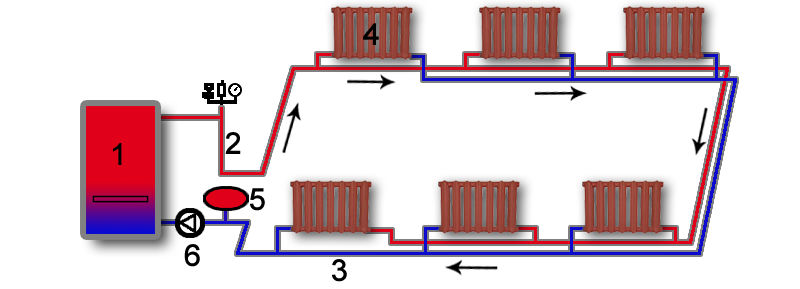


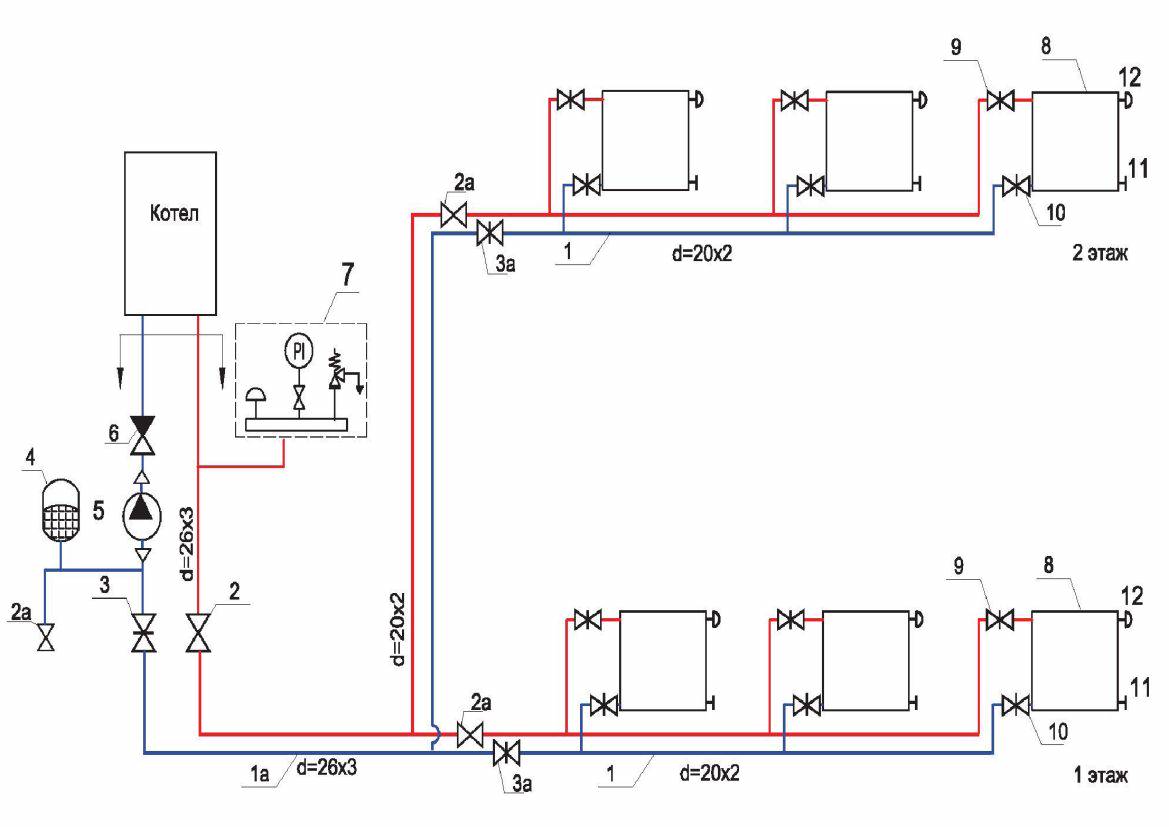

- Improving the flow of the coolant - it will be able to overcome the hydraulic resistance of pipes and connections;
- More uniform heating - the water simply will not have time to cool down, as it flows through the pipes at an increased speed;
- The possibility of increasing the maximum length of horizontal sections - the system will be able to heat a large house.
In terms of its efficiency, Leningradka is close to two-pipe systems, but this is true only for small houses. In large buildings, it is impossible to compete with two-pipe heating.
One-pipe heating scheme for a one-story house ("Leningradka")
This connection option is the simplest. A single-pipe heating scheme for a one-story house involves the installation of certain elements in the prescribed sequence. Along the perimeter of the house, you need to start up a large diameter outlet (at least DU32). In this case, the larger the size, the better. The pipe is mounted inside living rooms. Thus, all the heat given off by its surface will heat the premises. At the outer walls it is required the most. The wiring should be slightly higher on the supply side than where the return returns to the boiler. Convectors or radiators cut into the loopback. This is done using a pipe of smaller diameter - mainly DU20. It is advisable to mount valves that cut off the heater, as well as throttles, on the connections. The air in the top plug will not be superfluous. This heating scheme will allow you to start the heat without the need to install additional fittings.
ethylene glycol
It is worth knowing that ethylene glycol is very dangerous, so it should be used with the utmost care. So, if the walls of the system are damaged, then the consequences can be the saddest.
So its use in double-circuit boilers is undesirable. In addition, ethylene glycol is strictly forbidden to be used in cases with open expansion tanks, because if it enters the human body (especially a substance with a third hazard class), it will adversely affect health. Although it is impossible to recognize it by smell due to its absence, there is only a slight sweetish aftertaste. So all this is very dangerous and requires caution.
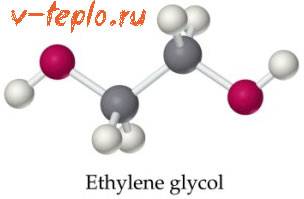
Today, almost all antifreezes in the world are made on the basis of ethylene glycol. His cost - about 80 rubles per kilogram.
Tips for installing a house heating system
The heating device begins with the installation of batteries in pre-prepared places under the windows or on the corner outer walls. Devices are hung on special hooks attached to the structure itself or plasterboard finish. The unused lower outlet of the radiator is closed with a cork, a Mayevsky tap is screwed in from above.
The pipeline network is mounted according to the assembly technology of certain plastic pipes. To save you from mistakes, we will give some general recommendations:
- When installing polypropylene, consider the thermal elongation of the pipes. When turning, the knee should not rest against the wall, otherwise, after starting the heating, the line will bend like a saber.
- It is better to lay the wiring in an open way (excluding collector circuits). Try not to hide the joints behind the sheathing or embed them in the screed, use the factory "clips" to fasten the pipes.
- Lines and connections inside the cement screed must be protected with a layer of thermal insulation.
- If for any reason an upward loop has formed on the piping, install an automatic air vent on it.
- It is desirable to mount horizontal sections with a slight slope (1-2 mm per linear meter) for better emptying and removal of air bubbles. Gravity schemes provide slopes from 3 to 10 mm per 1 meter.
- Place the diaphragm expansion tank on the return line near the boiler. Provide a valve to cut off the tank in case of malfunction.
Expansion tank for closed heating system
The expansion tank for is designed to compensate for changes in the volume of the coolant depending on temperature. In closed heating systems, this is a sealed container, divided by an elastic membrane into two parts. In the upper part there is air or an inert gas (in expensive models). While the coolant temperature is low, the tank remains empty, the membrane is straightened (picture on the right in the figure).
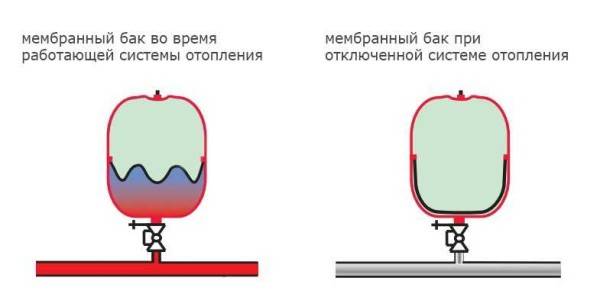
The principle of operation of the membrane expansion tank
When heated, the coolant increases in volume, its excess rises into the tank, pushing the membrane and compressing the gas pumped into the upper part (in the picture on the left). On the pressure gauge, this is displayed as an increase in pressure and can serve as a signal to reduce the intensity of combustion. Some models have a safety valve that when pressure threshold is reached vents excess air/gas.
As the coolant cools, the pressure in the upper part of the tank squeezes the coolant out of the tank into the system, the pressure gauge returns to normal.That's the whole principle of the expansion membrane type tank. By the way, there are two types of membranes - dish-shaped and pear-shaped. The shape of the membrane does not affect the principle of operation.
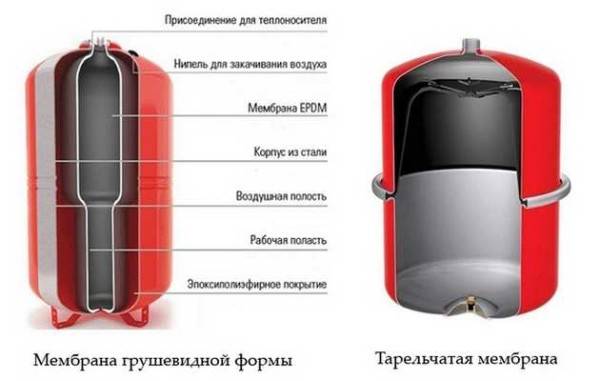
Types of membranes for expansion tanks in closed systems
Volume calculation
According to generally accepted standards, the volume of the expansion tank should be 10%! O (MISSING) t of the total volume of the coolant. This means that you have to calculate how much water will fit in the pipes and radiators of your system (it is in the technical data of the radiators, but the volume of pipes can be calculated). 1/10 of this figure will be the volume of the required expansion tank. But this figure is valid only if the coolant is water. If an antifreeze fluid is used, the tank size is increased by 50%!o(MISSING)t of the calculated volume.
Here is an example of calculating the volume of a membrane tank for a closed heating system:
the volume of the heating system is 28 liters;
expansion tank size for a system filled with water 2.8 liters;
the size of the membrane tank for a system with antifreeze liquid is 2.8 + 0.5 * 2.8 = 4.2 liters.
When buying, choose the nearest larger volume. Do not take less - it is better to have a small supply.
What to look for when buying
The stores have red and blue tanks. Red tanks are suitable for heating. Blue ones are structurally the same, only they are designed for cold water and do not tolerate high temperatures.
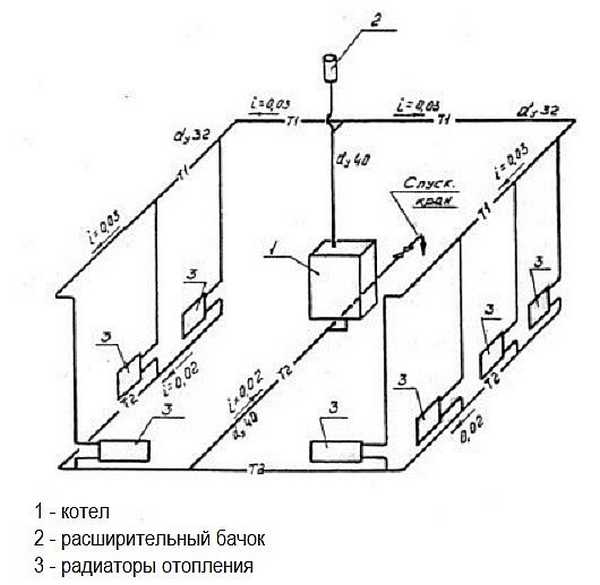
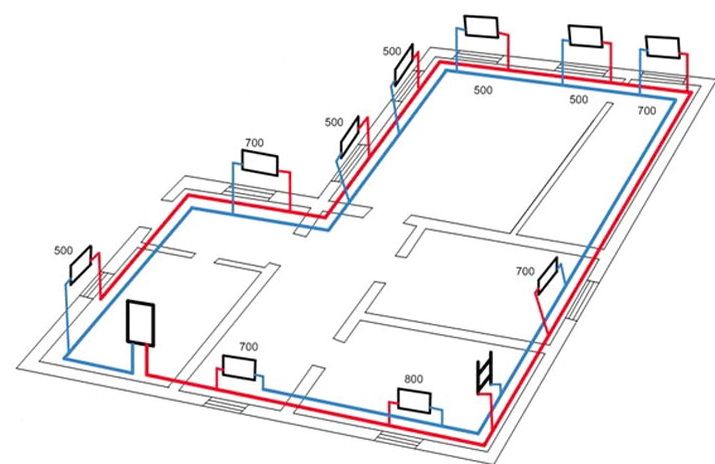
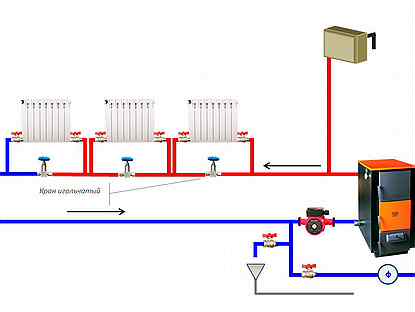


What else to pay attention to? There are two types of tanks - with a replaceable membrane (they are also called flanged) and with an irreplaceable one. The second option is cheaper, and significantly, but if the membrane is damaged, you will have to buy the whole thing
In flanged models, only the membrane is bought.
Place for installation of expansion tank of membrane type
Usually they put an expansion tank on the return pipe in front of the circulation pump (when viewed in the direction of the coolant). A tee is installed in the pipeline, a small piece of pipe is connected to one of its parts, and an expander is connected to it, through fittings. It is better to place it at some distance from the pump so that pressure drops are not created. An important point is that the piping section of the membrane tank must be straight.
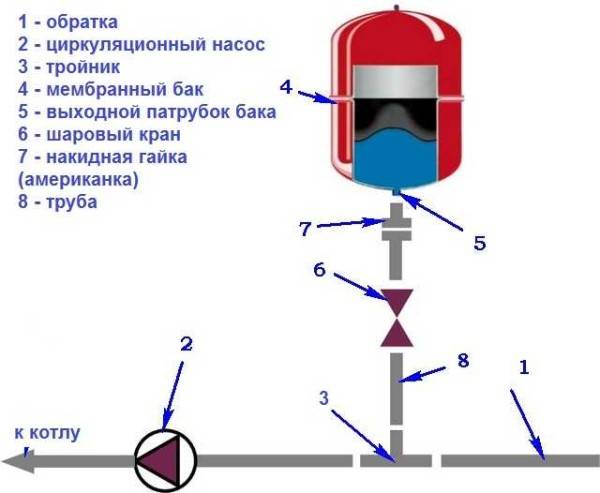
Installation scheme expansion tank for membrane heating type
After the tee put a ball valve. It is necessary to be able to remove the tank without draining the heat carrier. It is more convenient to connect the container itself with the help of an American (flare nut). This again facilitates assembly/dismantling.
Empty device weighs not so much, but filled with water has a solid mass. Therefore, it is necessary to provide a method of fixing on the wall or additional supports.
Expansion heating tank can be hung on a bracket
Make a base
Tank with legs can be installed on the floor