- Features of modernization
- Advantages of the Leningrad system
- Varieties of the system
- Advantages and disadvantages
- Suitable pipes
- 1 Description of system features
- 1.1 Pros and cons
- In which houses is one-pipe "gravity flow" advantageous?
- In which houses is it advantageous to install single-pipe pumping systems?
Features of modernization
Today, the latest technologies are increasingly being used to improve the operation of devices known to mankind for a long time, and thereby make life easier for people.
As a result, the heating efficiency is increased by 35%. Savings are 20-25%. Thanks to modern equipment, the installation works stably. It also guarantees safety during installation work.
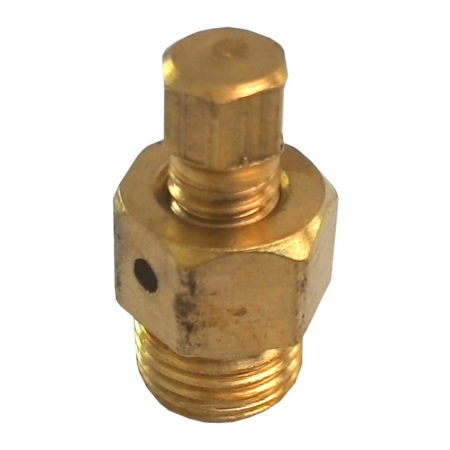 Today it is impossible to do without Mayevsky's crane
The upgraded items include:
- Mayevsky crane - is part of the battery. Designed for "manual" extraction of air. To perform this task, automatic systems are used;
- balancers (thermostatic). Valves, valves and sensors are responsible for regulating the flow of the coolant. If the need arises, they help to completely block the flow of fluid into the radiator;
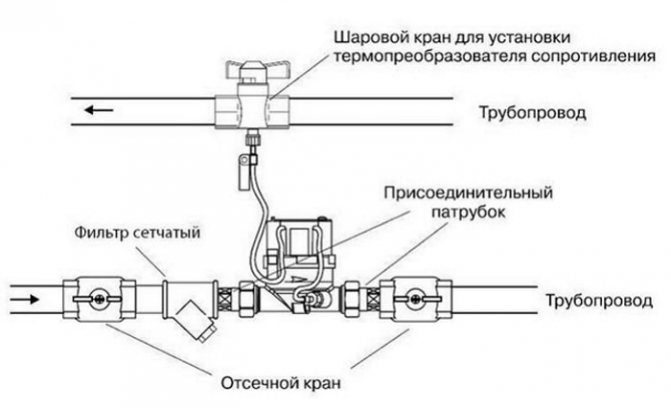
- valves (ball). They are mounted on the discharge and supply of heating devices. Against this background, you can turn them off quickly enough. The operation of the entire system is not interrupted.
Advantages of the Leningrad system
They consist of the following:
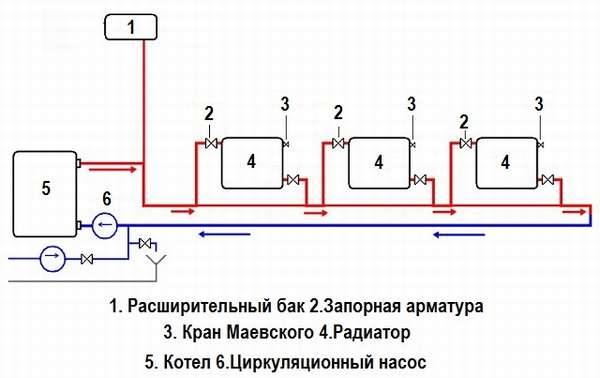
- Ease of design. Her scheme is simple. It is either single or double sided. The main thing is to correctly calculate the power of the boiler, pick up the rest of the details. It is necessary to take into account such points:
- The diameter of the main pipe must be at least 2 times the diameter of the other pipes.
- For uniform heating of all rooms, the number of sections of the last radiator of the circuit must be greater than the first, since the coolant gradually loses heat energy while passing through the system.
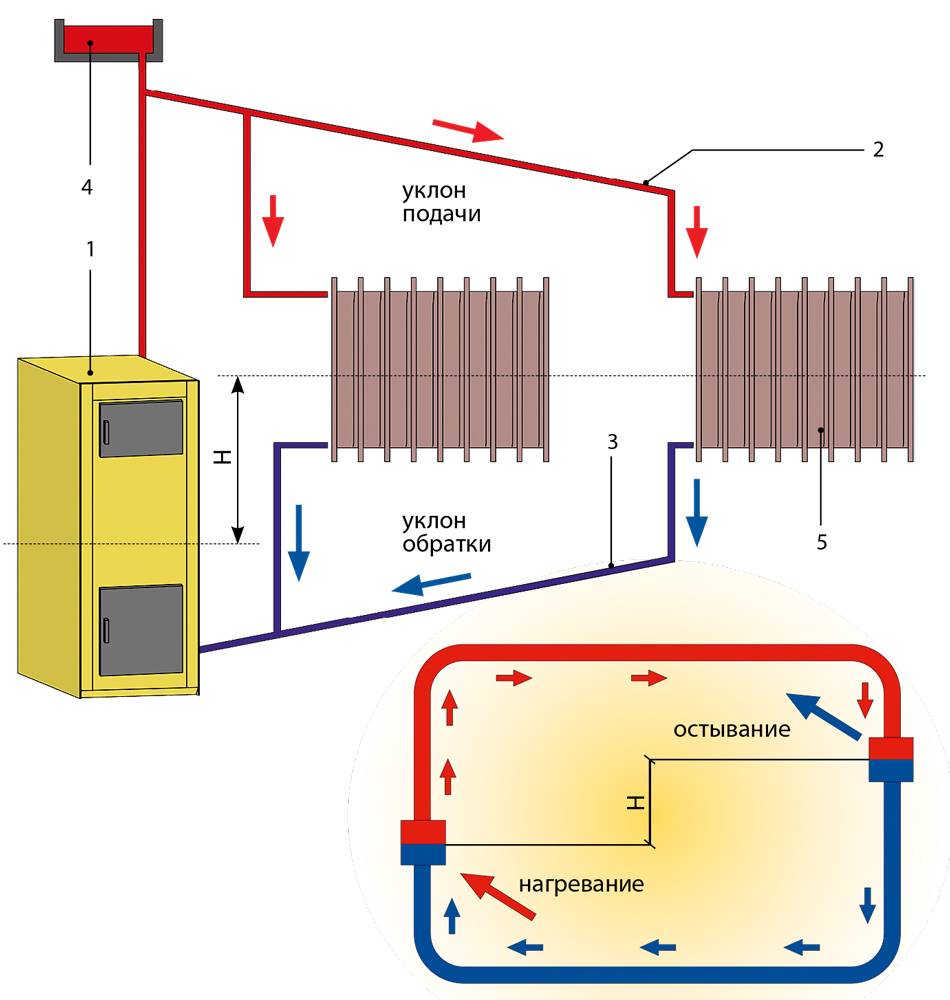
- The main pipe must have a slope in the direction of movement of the coolant during natural circulation.
- The expansion tank is installed above the level of the heating device by more than 1 meter.
- Small costs. Considering the costs for the purchase of raw materials, installation, further maintenance during operation, Leningradka is one of the most inexpensive options for heating systems. Especially if it is single-pipe with natural fluid circulation.
- Ease of installation. A well-designed project allows you to simply, reliably, quickly mount the equipment and put it into operation. The use of modern lightweight materials simplifies the task, does not require welding as with metal pipes. You can cope with the installation yourself, if you do everything carefully, consistently.
- Aesthetic appearance. Allows the details of the heating to fit harmoniously into the interior of the room. Modern pipes, fittings, radiators take up little space, do not catch the eye, do not rust, do not require painting, and have a non-standard design.
- Durability and ease of maintenance. The term of operation of heating depends on the quality of its components, operating conditions.A properly installed system will last a long time. But it also breaks down. The advantage of the Leningrad one is that if one of the radiators fails, it can be replaced without stopping the operation of the entire system, without draining the coolant.
Varieties of the system
Depending on the installation scheme, there are two types of "Leningrad":
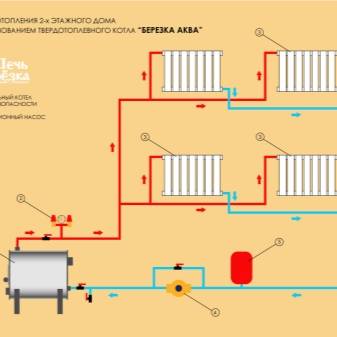
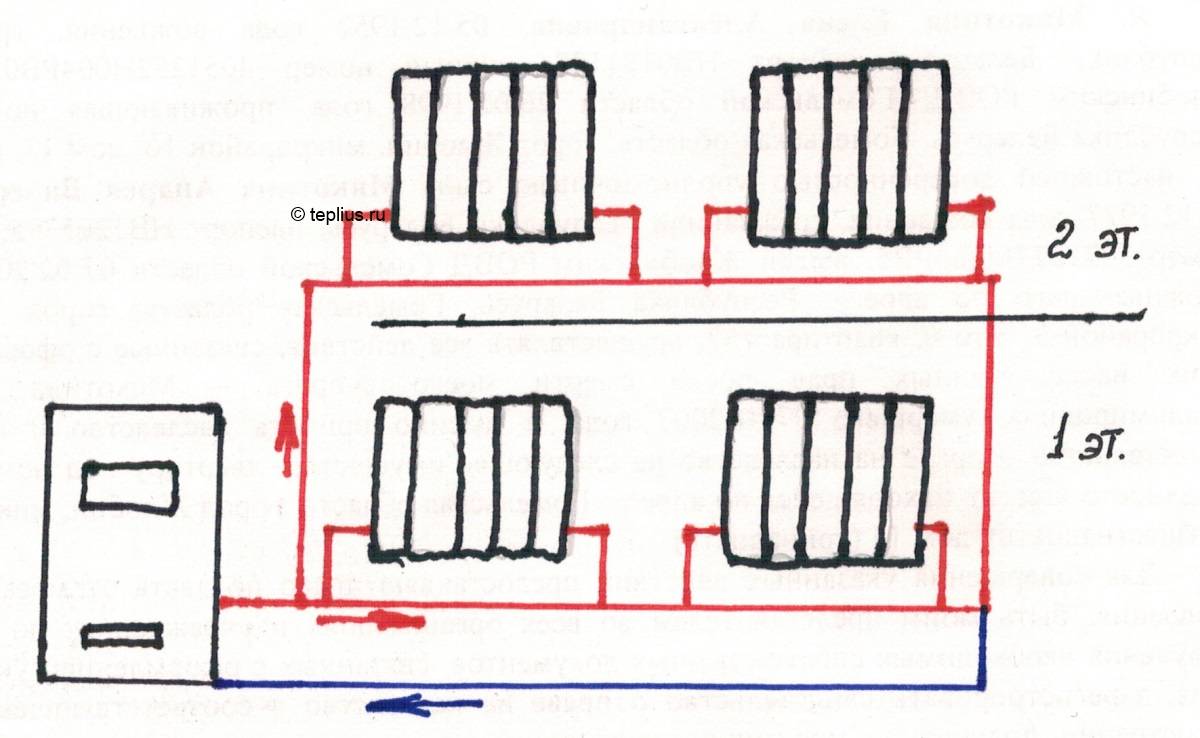
- Vertical - used, as a rule, in two-story houses, where radiators are hooked to vertical risers. Water from the boiler is supplied upwards by one pipe, then further along the risers through the radiators it goes down to the boiler.
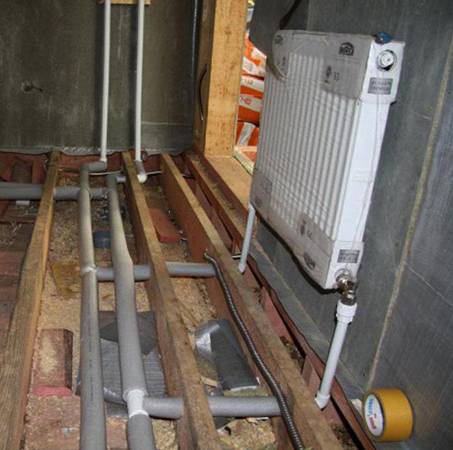
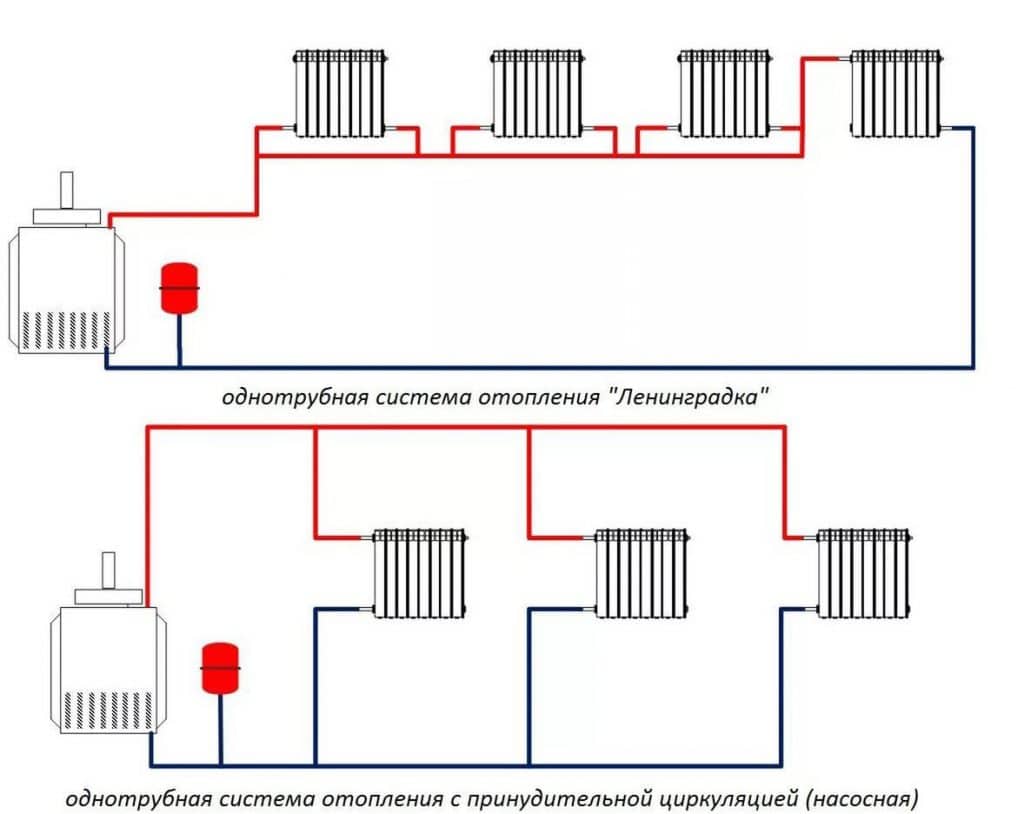
- Horizontal - radiators with pipes are located horizontally with a slight slope. This model works with both forced and natural circulation of the coolant.
Circulation type:
- Natural (gravity system). This system is the most economical. But at the same time it is considered the most ineffective. The main disadvantage here can be considered a relatively low speed of water movement through the pipe. Thus, the area of \u200b\u200bthe heated room is severely limited. This scheme is suitable for small one-maximum two-story houses.
- Forced (with the installation of a circulation pump). Installing a pump somewhat expands the area of the heated room, allows you to save on the diameter of the pipes, but at the same time makes the entire system volatile.
By type of coolant:
- Water. Water is the cheapest, universal coolant today. The disadvantages of such a coolant are considered to be too rapid cooling. It is impossible to exclude the harm that water causes to metal parts.However, this disadvantage can be easily removed by purchasing an inhibitor. A very important plus can be considered the fact that it is absolutely safe for others and can be used in both open and closed systems (read below).
- Antifreeze. The system is filled with a special mixture. Most often, the main substances here are propylene glycol and ethylene glycol. Antifreezes have a lot of advantages, such as heat retention and anti-corrosion protection, but do not forget that when heated, they still give off fumes, so you should not take risks and use them in open systems.
Also, heating systems are divided into closed and open:
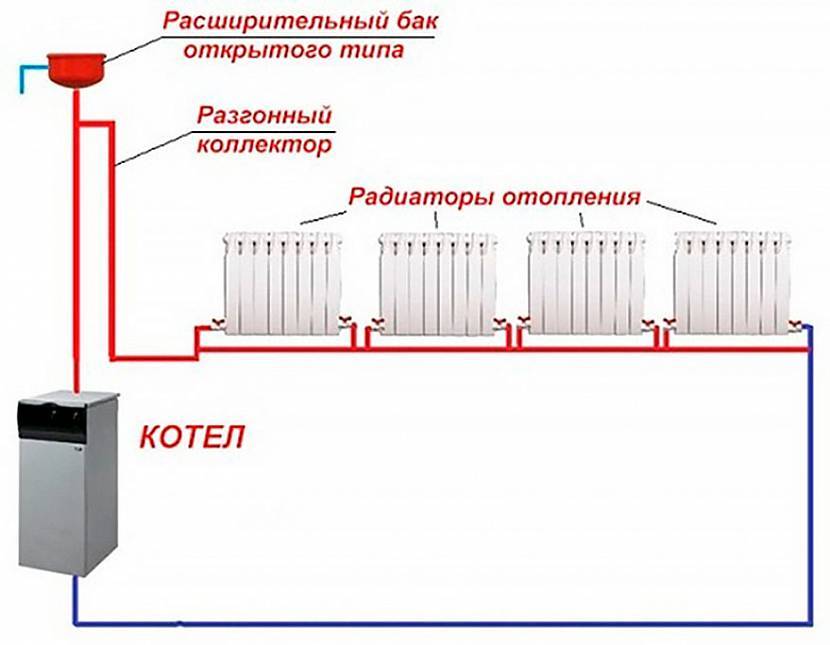
- Open type. At the top point is an open expansion tank. This option is convenient in that all excess air from the system is automatically discharged through the tank. The disadvantage of such a scheme is that water constantly evaporates from the tank and must be added.
- closed type. In this scheme, a closed membrane expansion tank is used. It is also recommended to install a safety block in such a scheme (pressure gauge, air vent and pressure relief valve). The undoubted advantage of this type will be the use of almost any type of coolant and the absence of fumes. The downside is the price.
In order to finally dot all the points, it is necessary to say that the "Leningrad" can be not only autonomous, but also hooked to the central heating system. In this case, we do not need any expansion tanks or pumps.
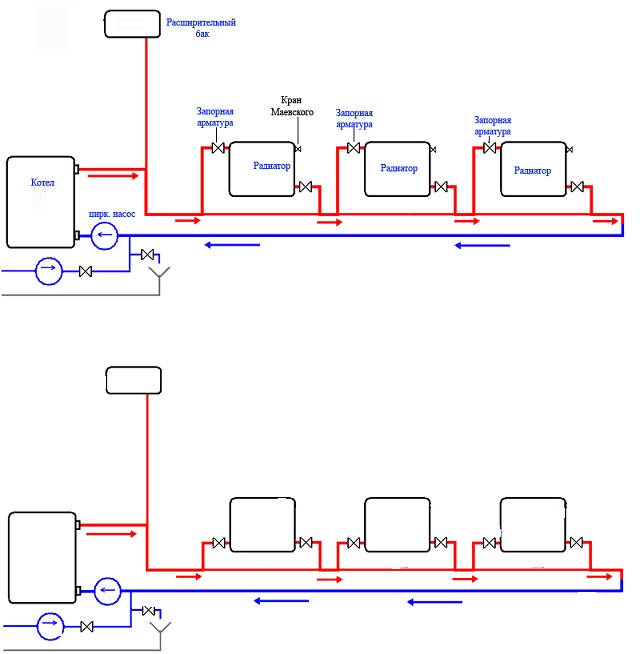

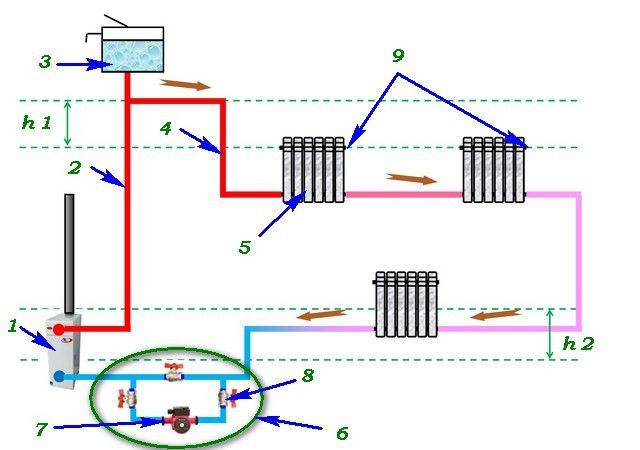


It is enough to install a valve at the top to release air. The rest of the scheme remains the same - one pipe passes through all the devices and returns.
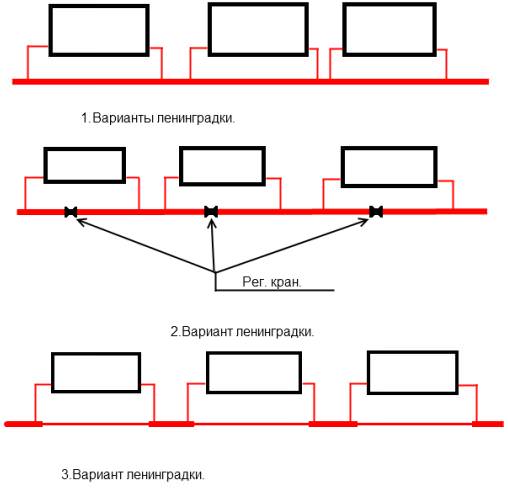
The main types of piping
Advantages and disadvantages
Do-it-yourself installation of heating a private house according to the Leningradka scheme gives the consumer many advantages, among which the following stand out:
- Reduced consumption of materials. Compared to other schemes, Leningradka requires 30% less material.
- The minimum consumption of materials, respectively, requires less labor costs.
- The Leningradka steam heating system can be called universal due to the possibility of installation in one-story houses and multi-story buildings. All you have to do is replace some of the accessories.
- Reliability during operation. A properly installed and configured system can operate flawlessly for a long time.
- The device of the system does not require the use of expensive components and control equipment.
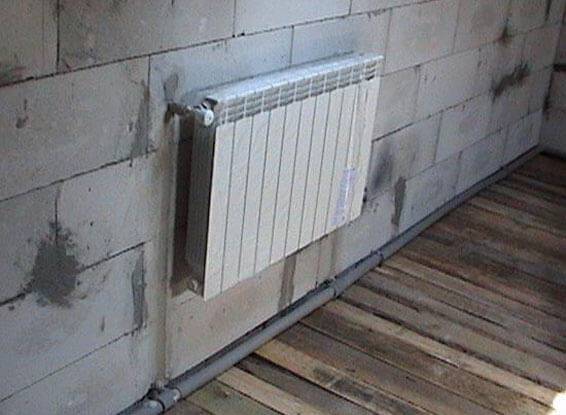
- The contour, located in close proximity to the floor, allows you to hide part of the system, increasing the aesthetics of the room. Only small pipes leading to the radiators remain visible. However, you should take care of the thermal insulation of the line and the hermetic connection of the elements of the system.
- A simple heating scheme for Leningradka in a private house allows you to perform installation work on your own, without the involvement of specialists.
As mentioned above, the system was developed during the period of mass construction, when it was necessary to build and equip a large number of residential buildings in a short time
This led to the fact that the shortcomings of the system were practically not taken into account. However, the negative aspects have a rather serious impact, so they must also be remembered.
The main disadvantages of the Leningradka system:
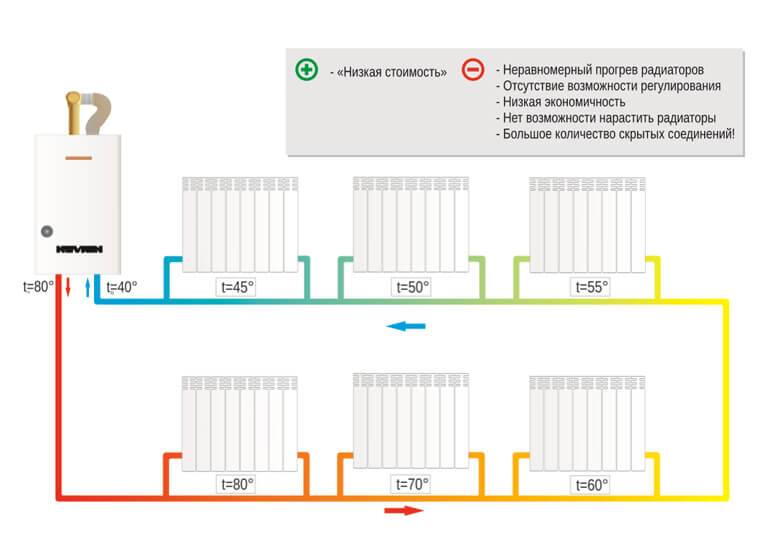
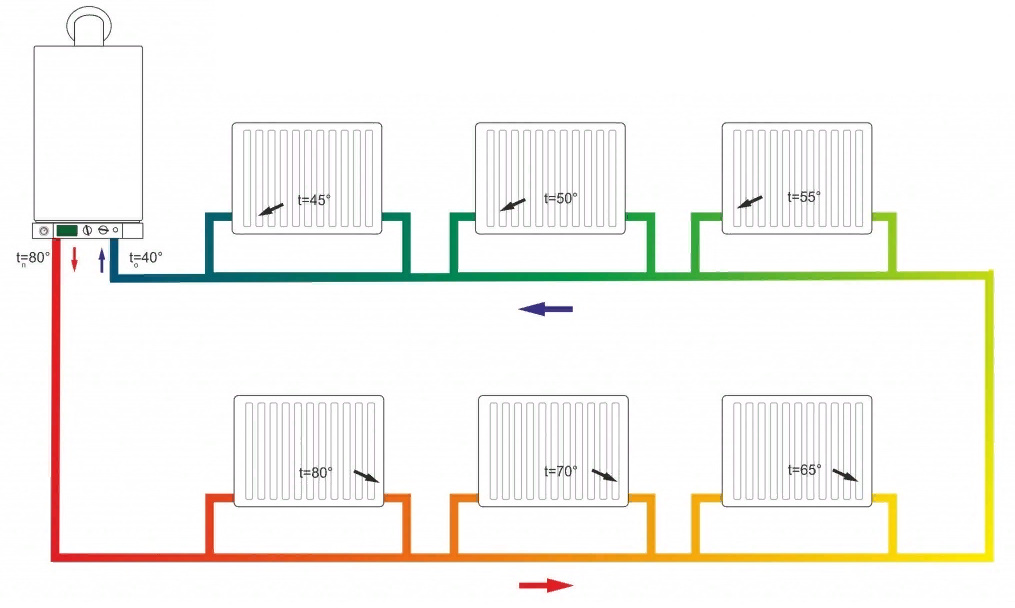
- Uneven heating of radiators with natural circulation of the coolant. The system works according to the principle that the temperature of the working medium in the nearby heat exchangers will be higher than in the radiators located at the end of the system. As a result, in order to create the same microclimate in all rooms, it is necessary to connect additional radiators to the Leningradka system. A disadvantage of this kind can be easily eliminated by installing additional equipment, for example, balancing and control valves.
- A system that has a horizontal type of piping does not allow you to connect additional elements of water heating, for example, a heated towel rail or Leningradka system with underfloor heating (read: “Proper connection of a heated towel rail to a heating system - proven options and methods”).
- In large areas, the creation of the necessary slope violates the overall interior. The solution to the problem in this case is the installation of Leningradka heating with a pump for forced circulation of the working medium. It should be noted that this option can be used for any piping in the heating system.
Suitable pipes
It is worth approaching the solution of the issue as responsibly as possible. It is better not to rush and take into account important points:
- Mounting method
- Maximum pressure indicator
- The presence or absence of a pump in the system
- Number of pipes in the system design
Steel pipes. Popular in the markets until recently. They are most often used in communications where a large cross-sectional diameter is required.Pipes made of steel conduct heat well, do not expand during strong heating, and easily tolerate increased pressure.


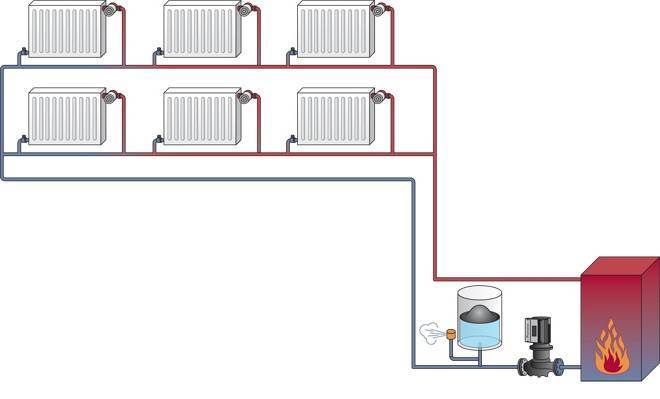

Pipes retain strength even in bends. Able to withstand temperature changes without consequences. Optimum balance between price and quality. Difficulties are the installation, which requires the use of expensive equipment.
Alloy steel. Sufficiently strong material. The composition of the material contains impurities, which improves the efficiency of the system. Advanced metal pipes are corrosion resistant and easy to maintain. The weight of the structure is significantly reduced. Pipes are used in a system with pressure and temperature failures. Hot steam can be used as a heat carrier.
Read also:
1 Description of system features
It is rightly noted that there are a large number of technological schemes focused on solving one single issue - heating a private house.
There are single-pipe and two-pipe systems, horizontal and vertical. Single circuit and multi circuit. Each option offers its pros and cons and none is perfect.
A Leningradka-type heating system is one of the most popular solutions when it comes to arranging a heating circuit in a private house of one or two floors.
It is also suitable for multi-storey buildings, but its efficiency will drop, since it strongly depends on the length of the contour.
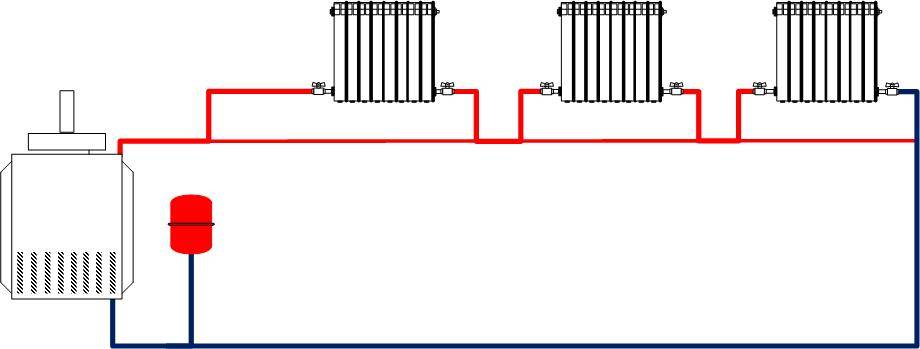
What is this Leningrad system? In fact, the principle of its operation and the layout of the pipes is very simple.
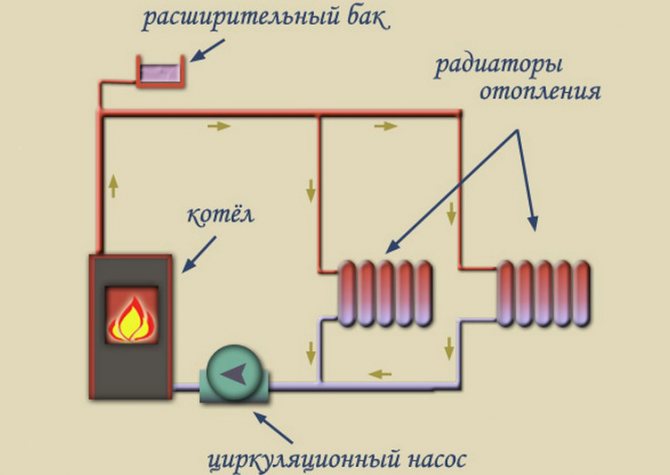
Single-circuit, means that Leningrad is connected to only one boiler or boiler and works exclusively for space heating, operating with the circulation of a heat carrier, most often water or antifreeze Warm house.
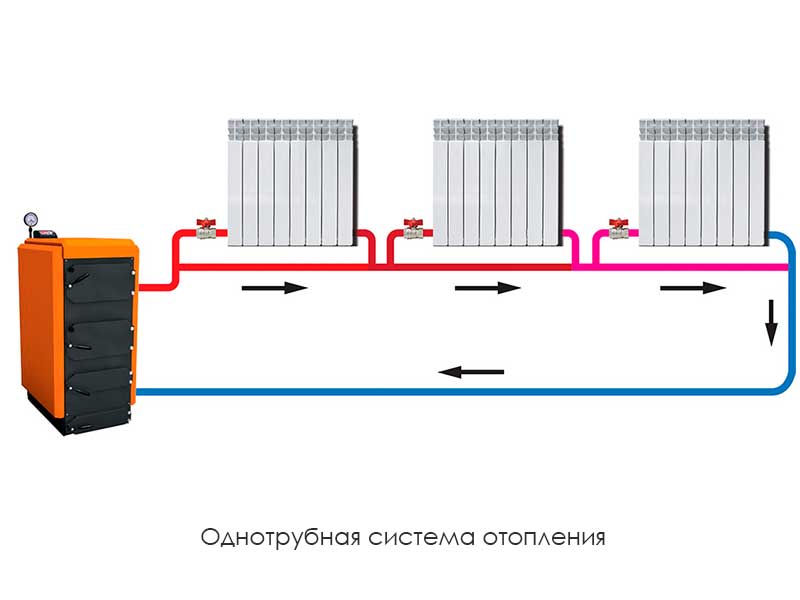
It is also single-pipe, that is, it consists of one pipe, straight or with branches (bypasses). The one-pipe scheme assumes the movement of the carrier in a clear direction.
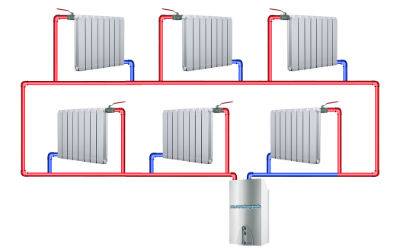
Serial Connection Diagram
Water or antifreeze leaves the boiler, passes through the entire chain of radiators, and then closes on the boiler or mixing unit through the same pipe. The peculiarity of the scheme is that they try to place radiators in it along the entire circuit so that the distance between the last radiator and the boiler is minimal.

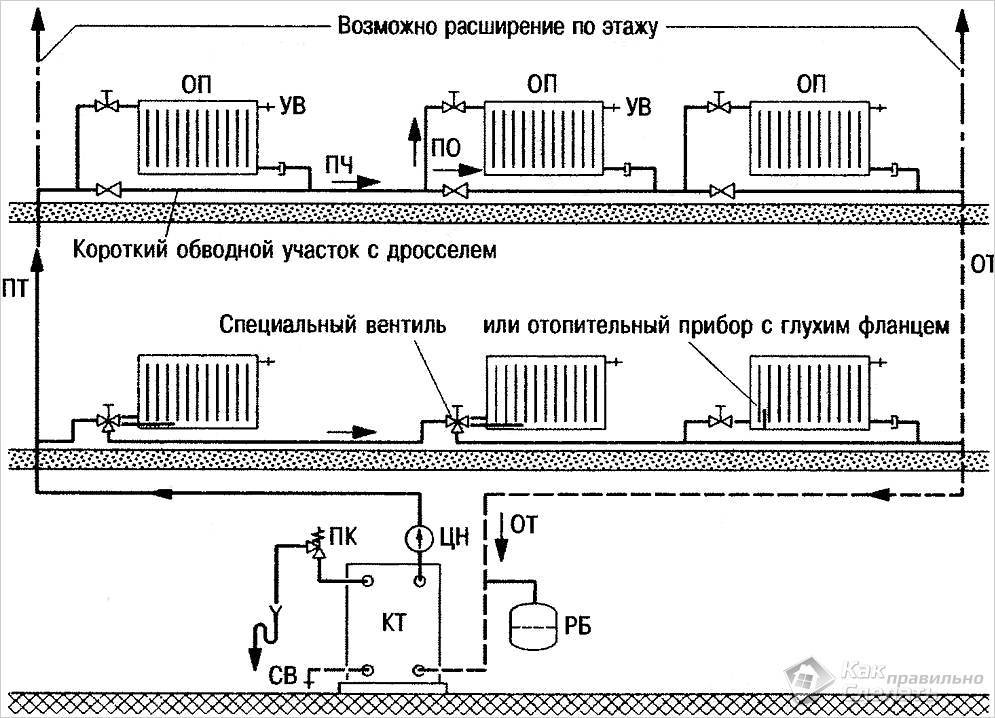
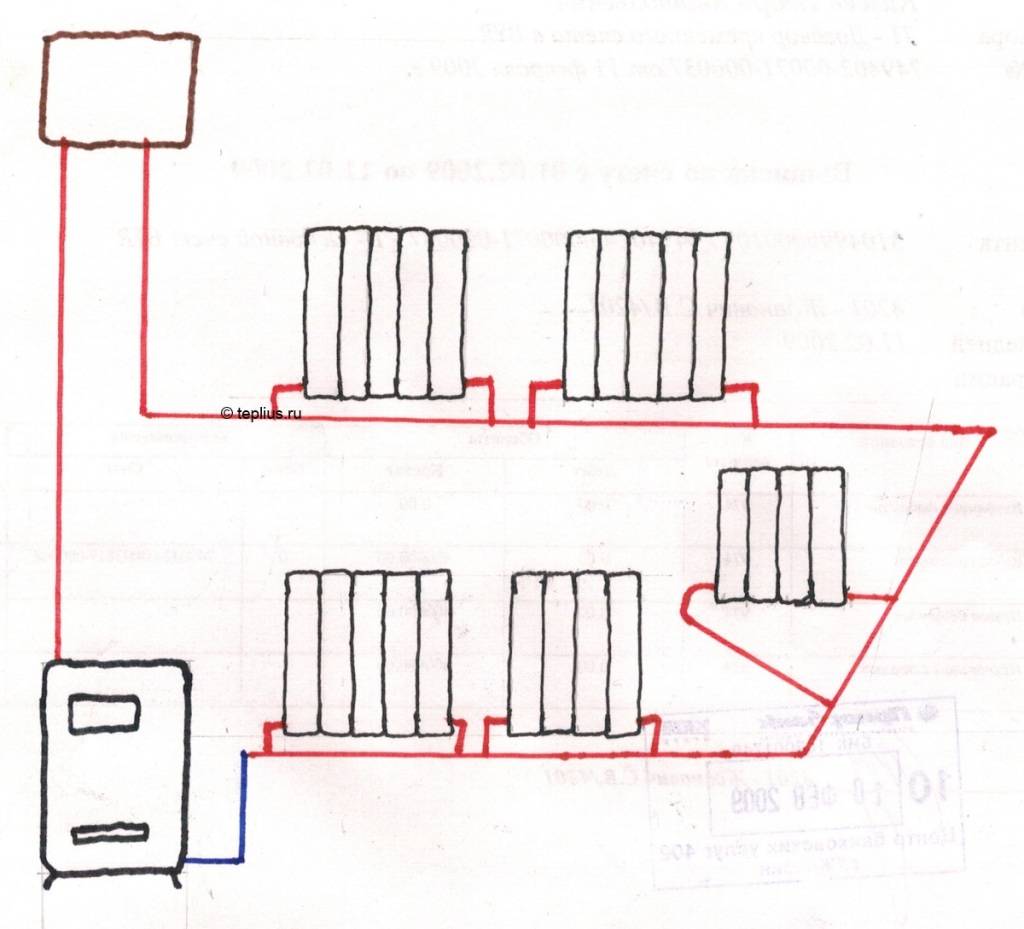
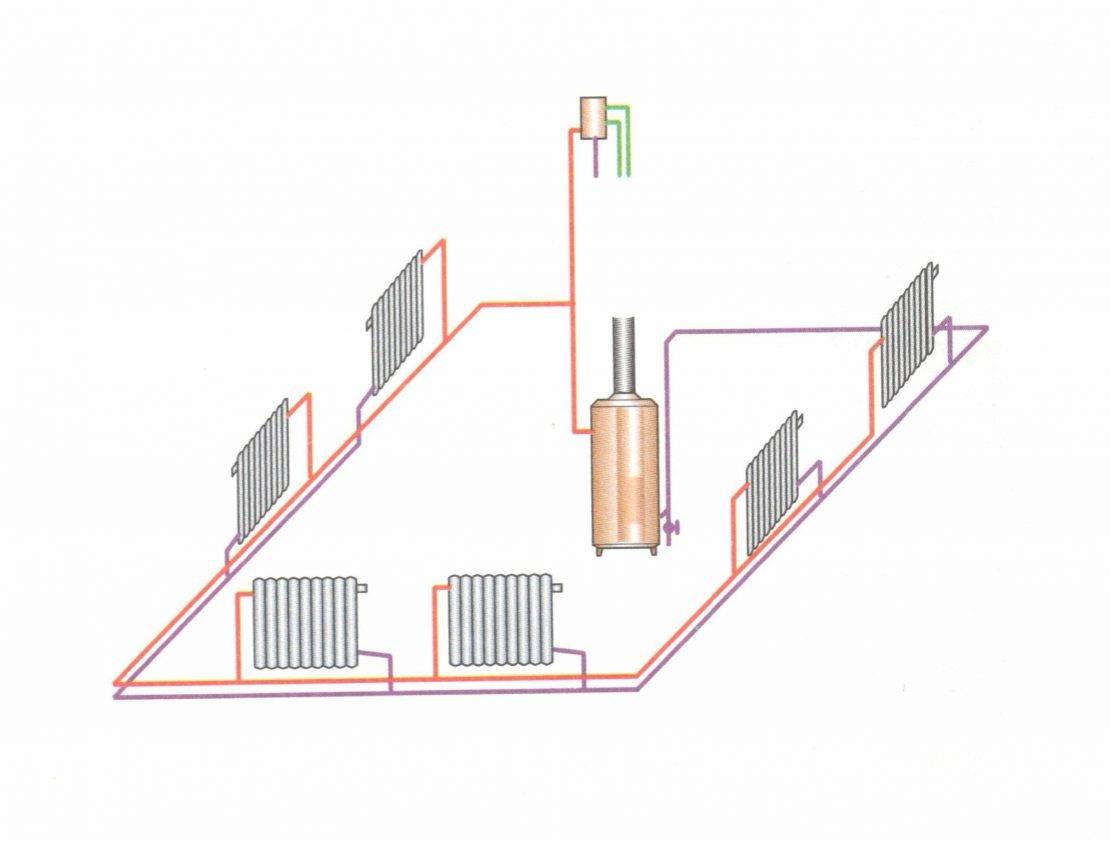

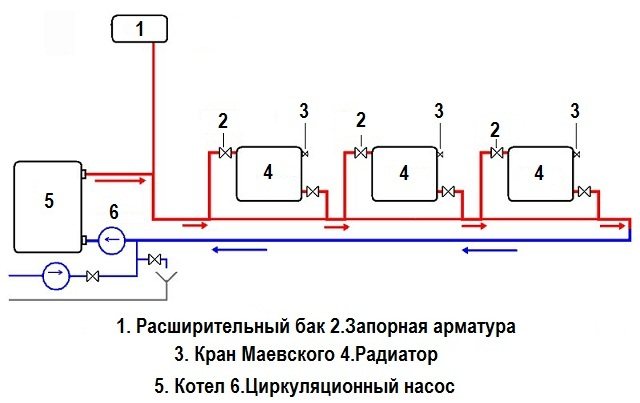
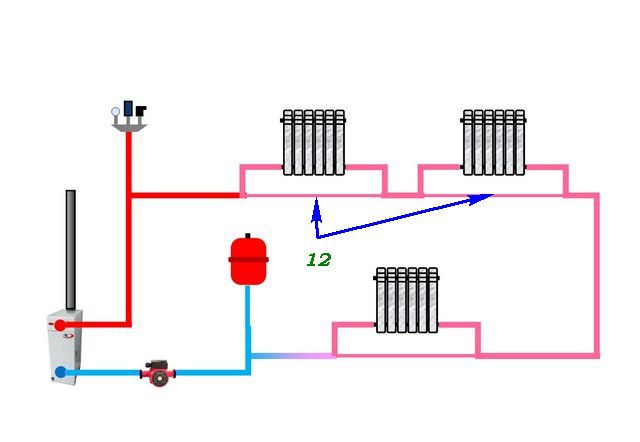
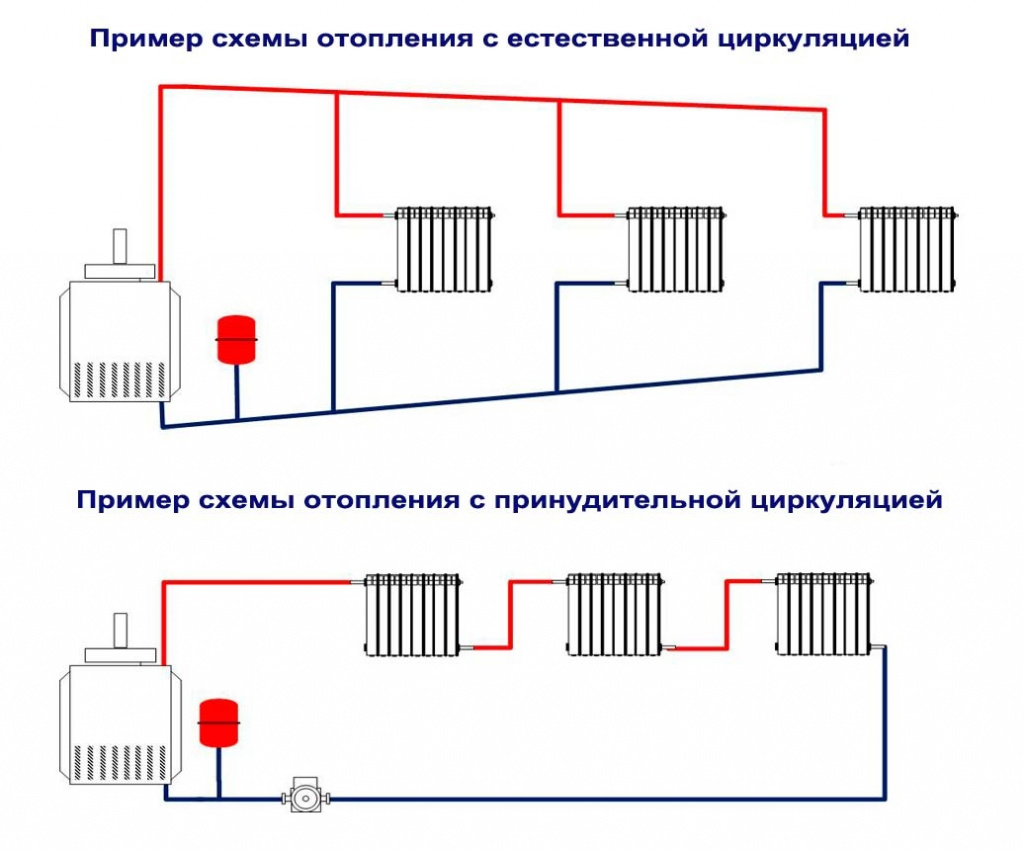
The system is designed in such a way that the carrier cools down over time, that is, in the extreme sections, the temperature can be significantly lower. Leningradka solves this problem quite elegantly, by operating with forced circulation, temperature sensors and bypasses.
The layout of the Leningradka system also leaves you some room for maneuver. You can choose any option.
As for the specific components of the heating system, Leningradka works best with plastic or metal-plastic pipes, as well as forced circulation of the flow generated by a pump.
1.1 Pros and cons
Leningradka, like any other heating scheme, is not a universal candidate. It is suitable for some tasks and not suitable for others,
For a better understanding of priority areas, one should understand what pros and cons it carries. This is what we'll do.
Main advantages:
- Simplicity and conciseness;
- The ability to carry out installation by hand;
- Pipe layout is selected according to your taste and desire;
- thrift;
- High efficiency at low cost;
- Almost ideal for heating a one-story or two-story house;
- The ability to isolate each node, making the heating circuit completely autonomous and independent.
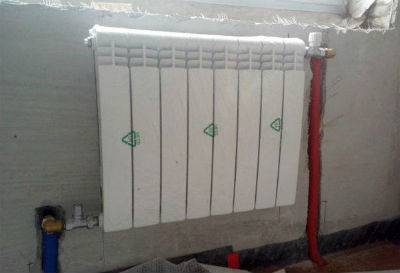
Radiator in Leningrad with inlet taps and thermostats
Main disadvantages:
- The temperature of the carrier decreases in proportion to the length of the line;
- If the lower wiring is selected and the length of the pipes is more than 50 meters, then it is necessary to engage in forced circulation using a pump, otherwise there is a risk of clogging the system and stopping the movement of the carrier;
- Fully stuffed piping with bypasses, insulated radiators and temperature control valves will still cost you a pretty penny.
The disadvantages of such a system are much less, but they still exist. We also note that Leningrad does not function in the best way if it is necessary to provide heating for huge buildings with a large number of storeys. Even there it can be adapted, but the results will not be as impressive.
Nevertheless, in a medium-sized house, this scheme shows itself as well as possible, plugging most of the competitive solutions into the belt.
In which houses is one-pipe "gravity flow" advantageous?
Just not in a 3-storey building. "Self-flowing" coolant moves "lazy". The existing 20 kg difference in the weight of a ton of heated and cold water will not create a sufficient pressure difference between the “supply and return” for intensive movement through pipes and batteries.

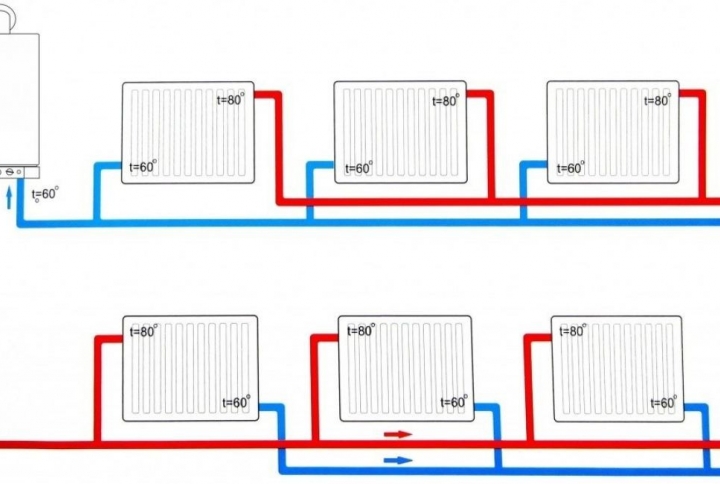

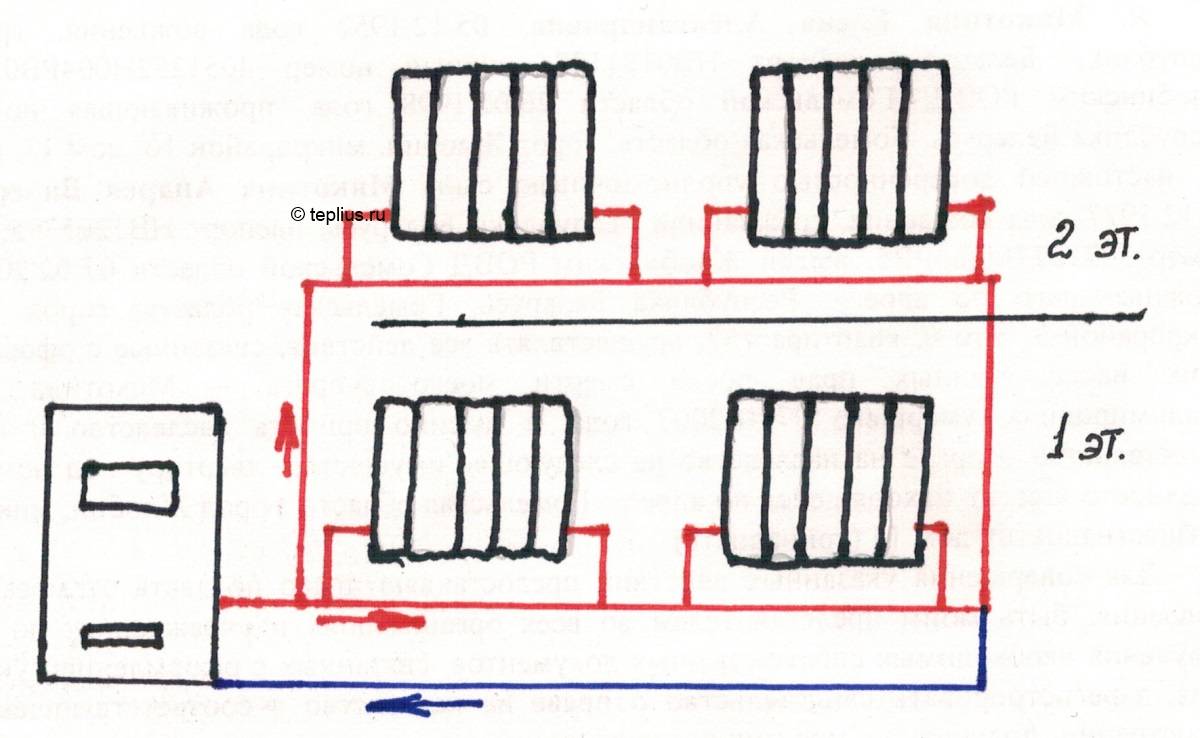


In a two-story house, "gravity flow" will work well, but the second floor should be full-fledged, with an attic that allows you to install an expansion tank. From the boiler in the basement (pit) to the tank there is a main vertical supply riser. The so-called. "bed", evading down. From the "lounger" I descend the risers to the storey radiators. This vertical system, shown in the figure below, resembles the heating device of a multi-storey building.
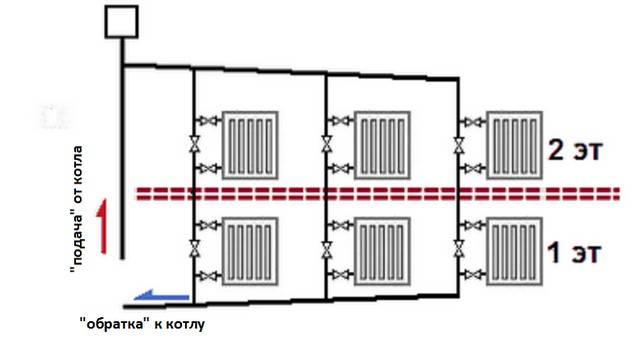
Gravity one-pipe vertical system of a 2-storey building.
The attic second floor of your house, which has windows in the roof (low walls) makes it difficult to install a gravity system. The attic excludes the installation of an open expansion tank filled with antifreeze. A sealed tank with a gas outlet pipe brought out to the outside will save the day, increasing costs.
Inclined pipes - "beds" do not fit well into the attic space, they can cross window openings, spoiling the interior of the room.
"Samotek" is more suitable for one-story houses in areas characterized by unreliable power supply.
In which houses is it advantageous to install single-pipe pumping systems?
Reducing the length of heating pipes relative to two-pipe schemes is inherent in multi-storey residential buildings, industrial buildings (workshops, warehouses), characterized by lengths of heating circuits of hundreds of meters. The use of a "single pipe" in them really saves heating pipes. Widespread use in individual construction is explained by a misunderstanding of the real cost-benefit ratio of this type of heating by customers and heating practitioners.
In small two-story houses with an area of \u200b\u200babout 100 sq.m (50 sq.m - first floor, 50 sq.m - second), a “single pipe” is often mounted, which works well with short circuits containing 4-5 heaters. Large houses with many radiators are not well suited for single-pipe schemes, although objects with a dozen batteries in a storey circuit do work, as in the mixed vertical-horizontal single-pipe scheme shown below.
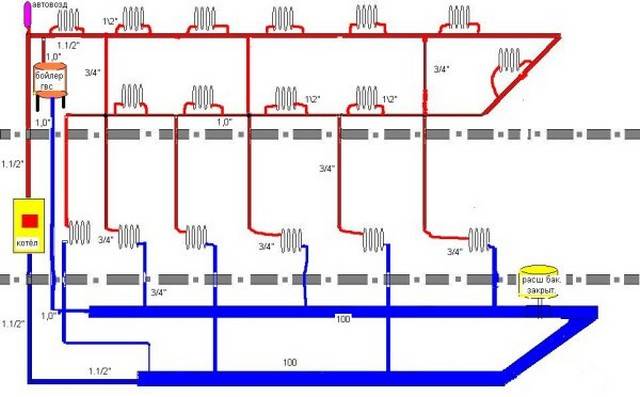
Single-pipe system of mixed (vertically - horizontal) type.