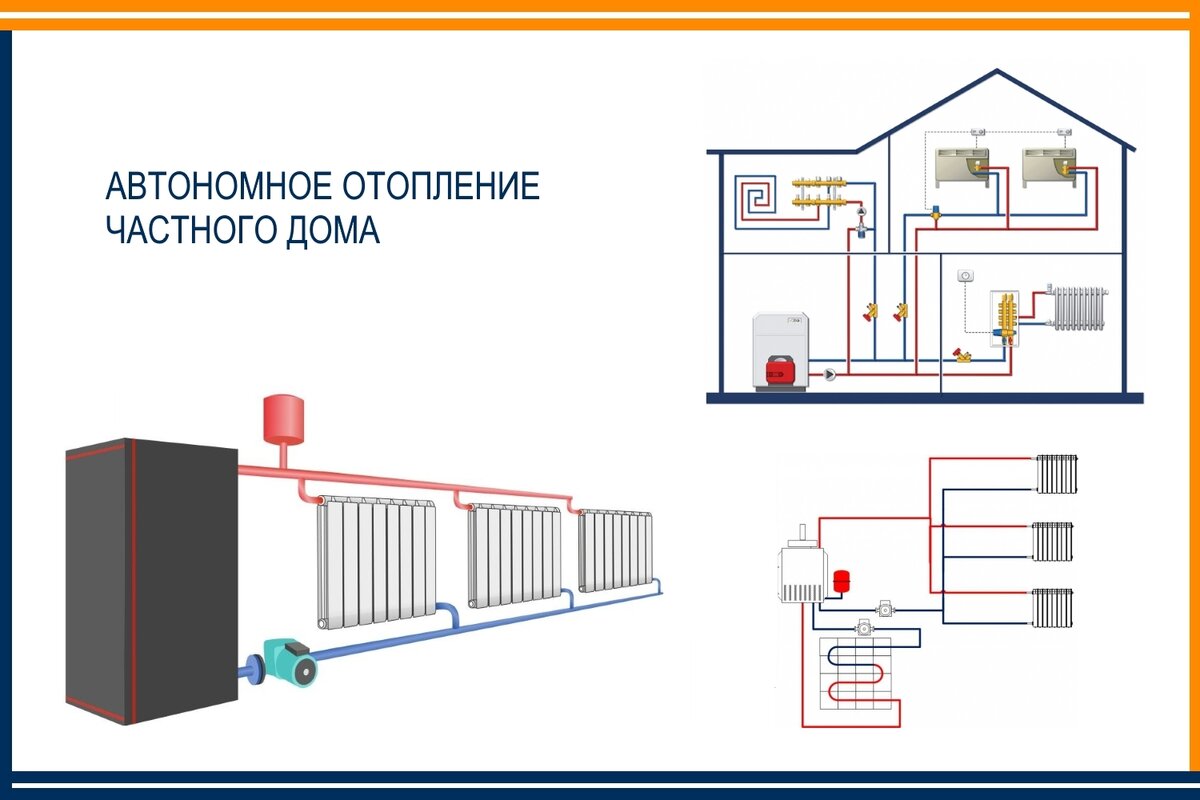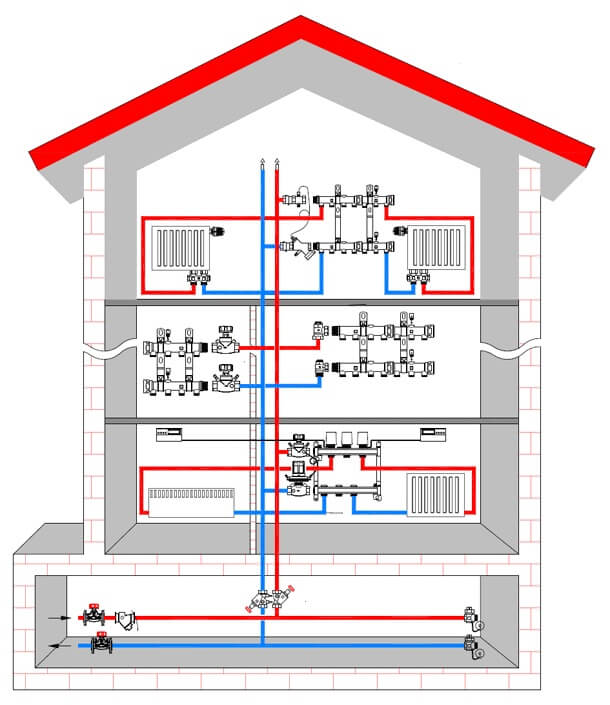
- How the system works
- Choosing an energy carrier
- Choosing a heating scheme for a heating boiler in a private house
- Gravity scheme
- Forced circulation scheme
- Reducing heat loss
- Ways
- Improving Efficiency
- Water
- Fuel consumption
- Pros and cons
- Two-pipe system with bottom wiring
- Advantages and disadvantages of a two-pipe system with bottom wiring
- Features of mounting a two-pipe system with bottom wiring
- Description of the installation of a two-pipe heating system with your own hands
- 2 System with forced fluid movement - optimal by today's standards
- Why is it profitable to heat the house yourself?
- Heating appliances
- Mounting order
How the system works
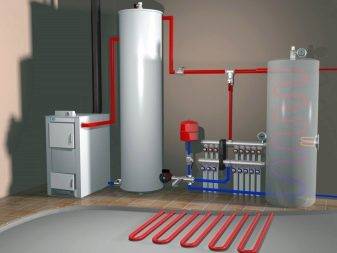
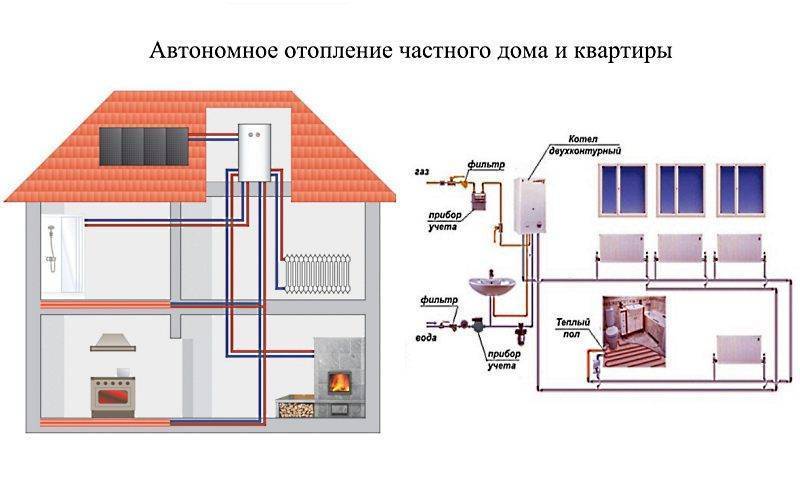
If you plan to independently conduct heat into the premises, it is worth understanding the design and principle of operation of water heating. Three components of any scheme:
- installation that generates thermal energy and transfers it to water;
- piping;
- heaters located in heated rooms.
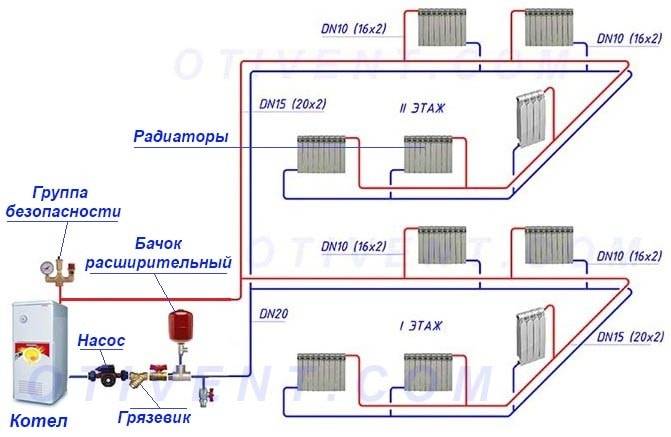
One of the ways to organize heating in a dwelling on 2 floors is a two-pipe shoulder wiring
The principle of operation of the system is based on the transfer of heat from the source to the heating devices by means of a liquid working fluid - ordinary water, capable of absorbing a large amount of energy (specific heat capacity - 4.18 kJ / kg • ° С). In some cases, an antifreeze liquid is used - an aqueous solution of ethylene glycol or propylene glycol. How does this happen:
- By burning hydrocarbon fuel or consuming electricity, the unit heats water to a temperature of 40…90 degrees.
- The hot coolant moves through the pipes with the help of a pump or naturally (due to convection) to water radiators.
- Heat exchange takes place between the heating devices and the air of the rooms - the water flowing through the battery cools by 10-20 ° C, the atmosphere of the room warms up. Plus, the hot surface of the radiator emits infrared heat radiation.
- The cooled coolant is returned through the pipeline to the heat generator, where it is again heated to the required temperature.
- Excess water formed during thermal expansion enters a special container. When the temperature in the system drops, the fluid contracts again and leaves the expansion tank.
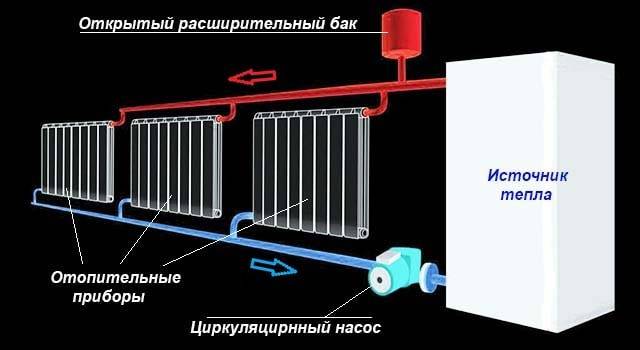
Operating cycle of heating - water is heated by a boiler installation, it is sent through pipes to radiators, where it gives off heat to the surrounding air
Before heating, remember one rule: the heating efficiency is practically independent of the volume of water in the system. This indicator only affects the rate of warming up / cooling down at home when starting or stopping the heat generator.
Here are some really important features:
- temperature difference at the inlet and outlet of the home heater, the maximum allowable is 25 degrees;
- source power - should be selected according to the calculation of heat losses through external walls + air heating for ventilation;
- coolant consumption - the volume of water passing through the heating devices for 1 hour;
- the hydraulic resistance of the pipeline network, together with radiators, should ideally not exceed 1 bar (10 m of water column).
An explanation regarding the total volume of coolant in the pipes will be given by expert Vladimir Sukhorukov in his video:
Choosing an energy carrier
The main selection criterion is the cost of energy carriers, depending on the country and region of residence. If natural gas is the undoubted leader in the Russian Federation, then in other states of the former USSR the picture is different - firewood, briquettes and coal occupy the first place. Don't forget about electricity supplied at half the night rate.
When choosing the right type of fuel, it is worth considering five factors (in addition to price):
- efficiency (efficiency) of the heating equipment using this energy carrier;
- ease of use;
- how often the units will have to be serviced, the prices for calling the master;
- storage requirements.
Below is a comparative table showing the prices of various energy carriers and how much a kilowatt of heat received in real conditions costs. Building area - 100 m², region - Moscow region.
According to the numbers given in the table, it is much easier to find a suitable option (or several). Just make an adjustment for the cost of energy in your region. For others we will give 4 tips to the selection criteria:
- It is most convenient to use gas and electric heating equipment. No need to store anything, constantly maintain and mess around with cleaning water heaters.
- Burning coal and wood is the most economical way of heating. For saving money, you will have to pay with labor - sawing, carrying, loading the firebox, cleaning the chimney. Burning briquettes and pellets is more comfortable, but the price of the boiler plant and the fuel itself increases. Plus you will need storage for warehousing.
- Diesel fuel or liquefied gas is the best solution for arranging autonomous and at the same time comfortable heating when other energy sources are not available. Minus - a decent cost of fuel and installation of a fuel tank.
- A proven option is the combination of 2-3 energy carriers. A common example: solid fuel + electricity at a nightly rate.
Which fuel is better to use in specific conditions is described in detail in a separate material. We also recommend watching the video and listening to useful expert advice:
Choosing a heating scheme for a heating boiler in a private house
The boiler itself is just an element of the heating system. Without pipes and radiators through which the coolant circulates, its work is useless. Therefore, heating wiring must be provided in advance, before buying a unit that provides heat. The task is facilitated by the fact that the heating circuit for all types of boilers has more similarities than differences.
Gravity scheme
Most often, such a scheme is used for connection with a solid fuel or liquid boiler. If we approach the issue strictly, taking into account the preservation of efficiency, then modern gas boilers do not imply gravity circulation of the coolant. Many electronically controlled wall and floor models already have a built-in circulation pump that forcibly drives water or antifreeze through pipes and radiators.In conditions of frequent power outages, such a boiler will be inactive.
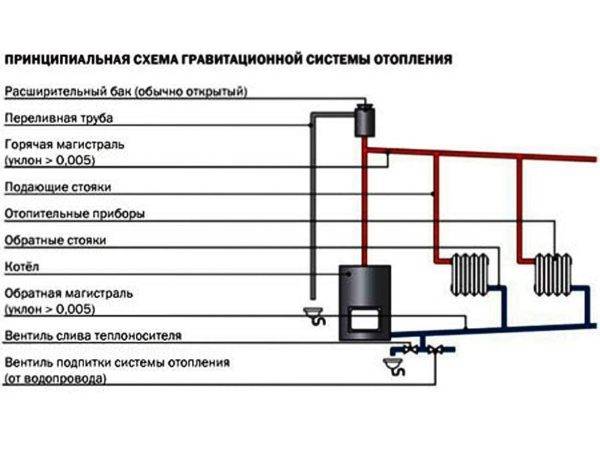 General view of the gravity scheme
However, in many homes, gravity circuits continue to work in conjunction with a gas-fired non-volatile boiler of a simple type with mechanical control. With the use of heating pipes of large diameter, sufficient water pressure is created in the system to start the gas burner. In old systems, pipes with a cross section of 100 - 150 mm were taken, which surrounded the rooms around the perimeter. The heat transfer of such a design is small, but it itself is reliable and durable. When installing radiators, the diameter of the supply pipes must be at least 40 mm to reduce hydrodynamic resistance.
In gravitational systems, an indispensable element is the expansion tank. If the water in the system reaches high temperatures, its excess enters the tank due to the increased volume. The tank insures the system against leaks and depressurization in the event of an abrupt increase in pressure. In open systems, the tank is always located at the highest point.



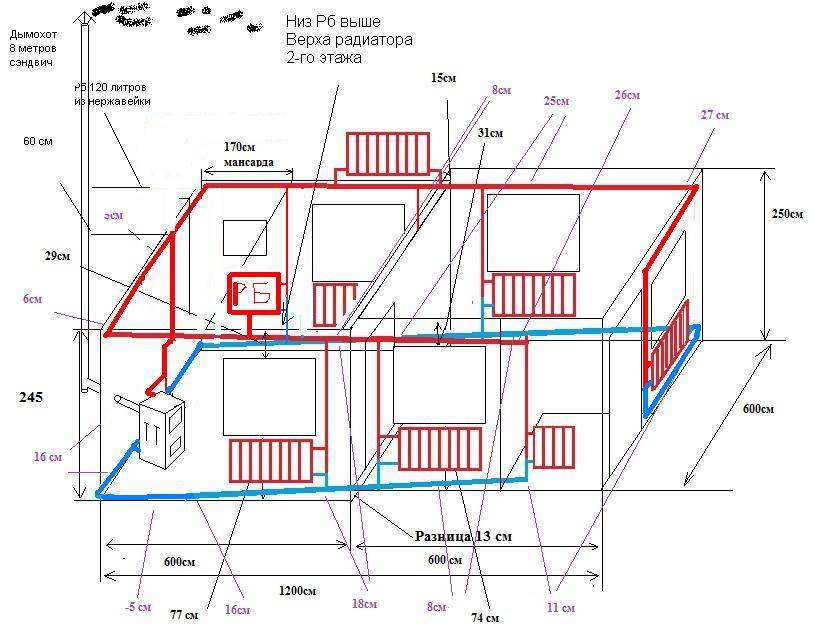

The gravitational scheme is one-pipe. This means that the coolant sequentially passes through all the radiators, and then returns through the “return”. For the installation of batteries with such a system, bypasses are used - bypass pipes with shutoff valves, thanks to which it is possible to dismantle and replace the batteries without stopping the boiler and draining the coolant. Also, a Mayevsky crane is placed on each radiator to bleed the air that accumulates inside the wiring.
 Mayevsky crane
Forced circulation scheme
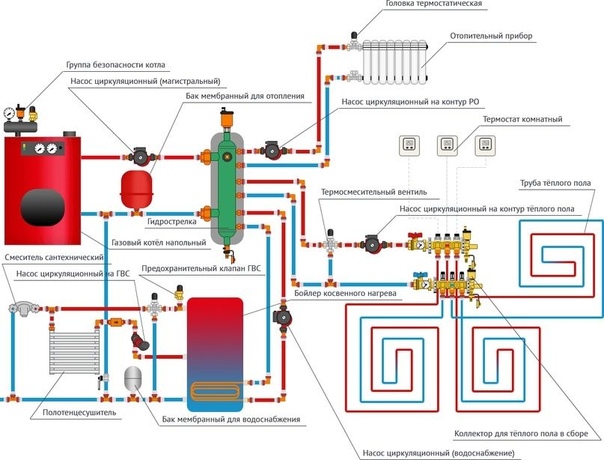
The only disadvantage of this type of heating wiring is the dependence on the presence of voltage in the household electrical network.In addition to the boiler, the second important node of such a scheme is the circulation pump, which crashes into the “return” before returning it to the boiler. Modern pumps are silent, productive and consume electricity in the same way as an incandescent light bulb. But thanks to such a device, it becomes possible to make a choice in favor of a two-pipe system. In this case, the binding pipe passes through all the heated rooms of the house. From it, a separate stream of hot water is supplied to each battery, and from it the cooled coolant is drained into the “return”, which is the very second pipe in the circuit. This allows you to evenly distribute heat over all radiators and maintain the same temperature even in the rooms farthest from the boiler.
The expansion tank, in the presence of a circulation pump, is made mandatory closed so that a certain pressure can be created in the system. In case of excess of normal values, an emergency pressure relief valve is provided.
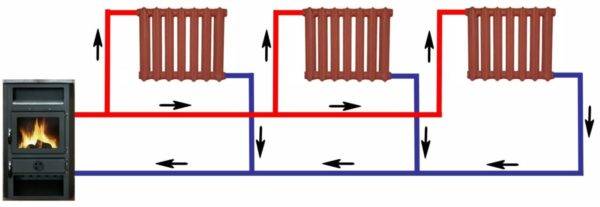 Visual representation of a two-pipe scheme
In both schemes, a make-up unit must be provided through which the coolant is poured into the system. If water is used, then a branch pipe from the water supply network is cut in to fill the pipelines by installing at the entrance to the system filtration. When using antifreeze, an inlet valve with shutoff valves is arranged, and injection is carried out using a submersible pump "baby" or other pumping equipment.
Reducing heat loss
In order to get the most efficient and profitable heating system, it is necessary to take a more responsible attitude to the issue of reducing heat loss. Let's remember what an ordinary person does if he freezes. She makes hot tea, takes a warm sweater and woolen socks out of the closet. That is, it warms up as much as possible. It turns out that a person does not allow his natural warmth to come out.
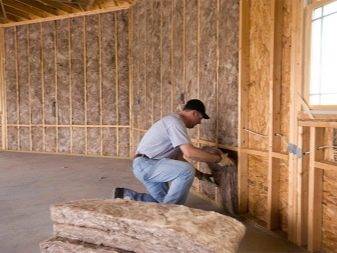
The same should be done with the house. It is necessary to reduce heat loss to the maximum, and for this you will have to use an integrated approach - that is, to insulate the house both outside and inside the room. The main thing is that you can do it yourself, without the help of specialists and additional financial costs.

Ways
It is possible to increase the heat transfer resistance of structures. To begin with, those that are more profitable to insulate. For example, if the walls of the building are initially warm, then it is cheaper to increase the thickness of the insulation material on the roof, on the floor, and also to choose more energy-efficient windows.
Each specific project may have its own solutions:
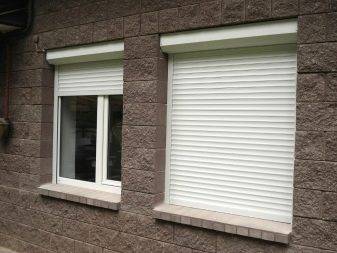
- you can use "warm" windows, which will be protected from the outside by roller shutters;
- it is possible to install a modern automatic ventilation system with a certain amount of air and heat recovery;
- waste heat recovery can be used.
Improving Efficiency
To increase the efficiency of home heating, you can introduce a variety of modern technologies that reduce fuel consumption into the heating system. There are a huge number of piping methods alone from the boiler to the radiators.There are heating equipment of various designs and all kinds of additional equipment, which can significantly increase the efficiency of the entire system by 10–15% or even more. But at the same time, you need to carefully weigh the pros and cons.
Water
Water heating is a closed system through which hot water circulates continuously. The boiler acts as a heating element. Radiators are installed in each room. From the boiler, water circulates through the pipes along the circuit and, passing through the radiators, gives off heat.
The benefits of a water system depend on the type of fuel used by the boilers. If there is a gas main nearby, then it is wiser to purchase a gas boiler. Gas fuel is considered the most economical. However, such structures require regular maintenance by special services. For non-gasified areas, it is better to purchase solid fuel boilers.
It is not advisable to use liquid fuel for a boiler, as it is expensive and a special reservoir in the ground will be required to store it.
Fuel consumption
Example No. 1. Calculation of fuel consumption in water heating system: gas will act as fuel, as it is the most common. For the calculation, you will need the power of the unit and the area of \u200b\u200bheated housing. The power of the boiler for a private building is determined based on the proportion: 1 kW per 10 m². For a room of 100 m², a 10 kW boiler is required.
To calculate the fuel consumption, it is necessary to multiply the boiler power by 24 hours and by 30 days. As a result, we get 7200 kW / h. Since the unit does not always operate at full capacity, this number must be divided by 2. Monthly fuel consumption is approximately 3600 kW / h.The heating period lasts approximately 7 months. Fuel consumption for the heating period is 3600 * 7 = 25200 kW / h.
Given that 1 m³ of fuel generates 10 kWh of energy, we get: 25200/10 = 2520 m³.
We translate the resulting value into a monetary equivalent: the cost of gas per 1 m³ on average in the country is 4.97 rubles. Accordingly, gas heating for the year: 4.97 * 2520 = 12524.40 rubles.
Pros and cons
The main advantages of a water heating system are:
- operational heating of even a large room;
- noiselessness of work;
- ensuring the same temperature in all rooms;
- fuel economy;
- ease of maintenance and repair;
- increase in operating time.
Two-pipe system with bottom wiring
Next, we will consider two-pipe systems, which are distinguished by the fact that they provide an even distribution of heat even in the largest households with many rooms. It is the two-pipe system that is used to heat multi-storey buildings, in which there are a lot of apartments and non-residential premises - here such a scheme works great. We will consider schemes for private houses.


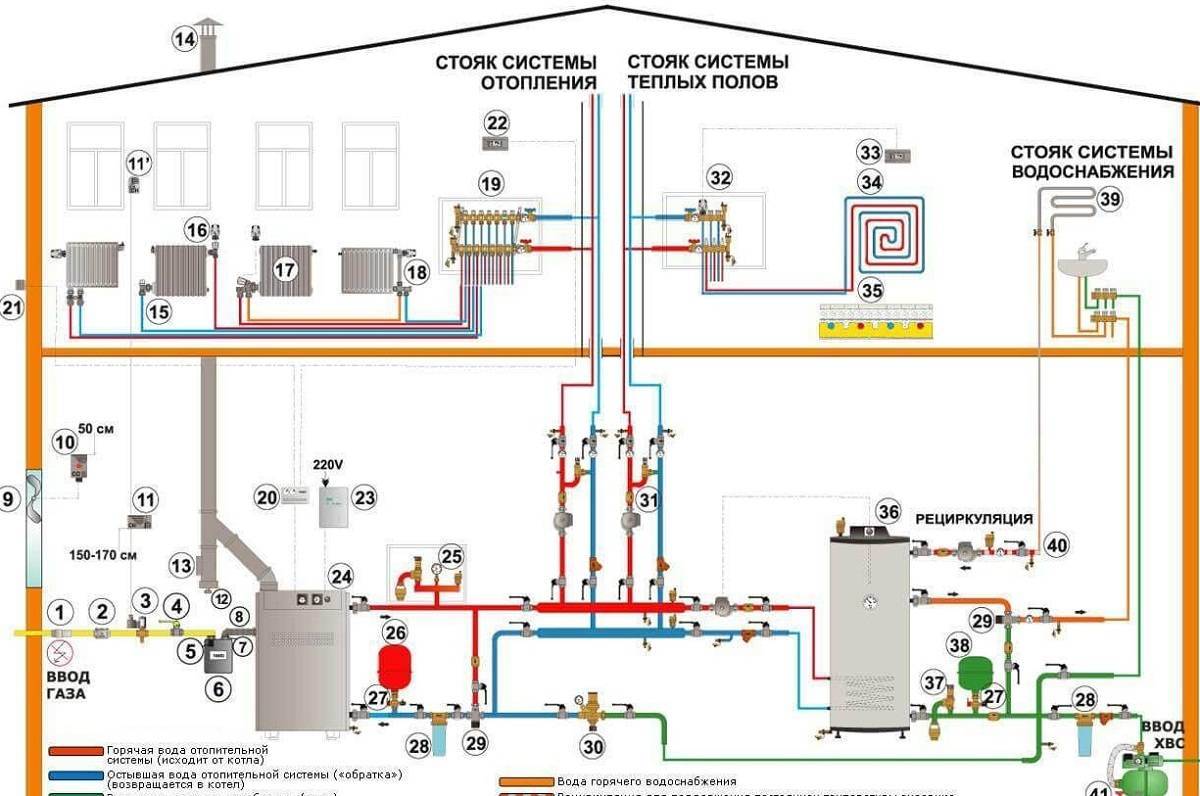
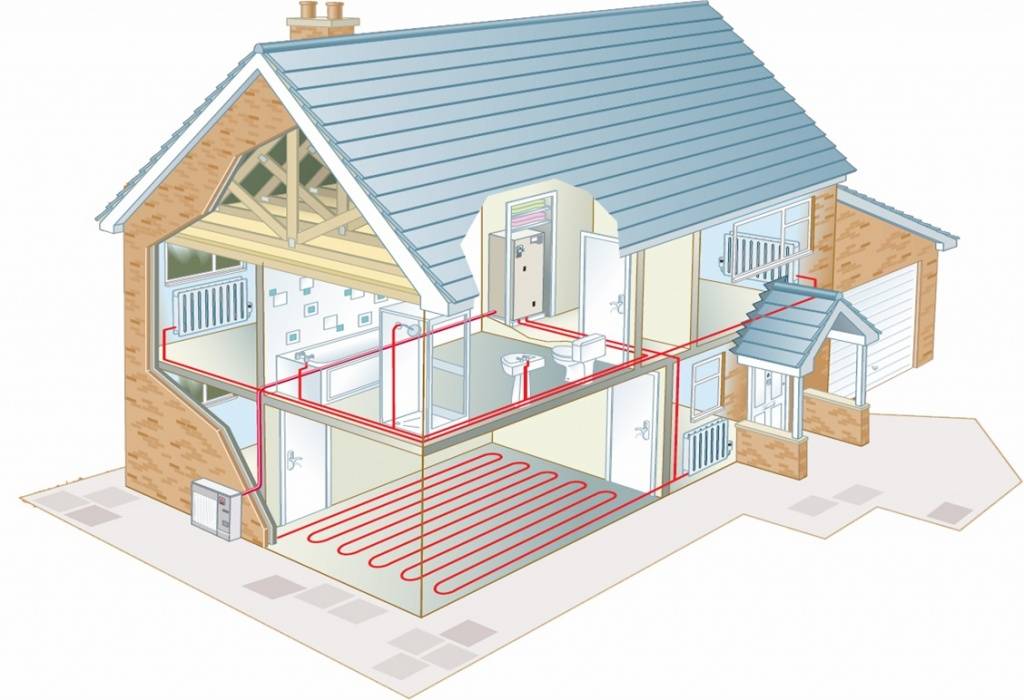


Two-pipe heating system with bottom wiring.
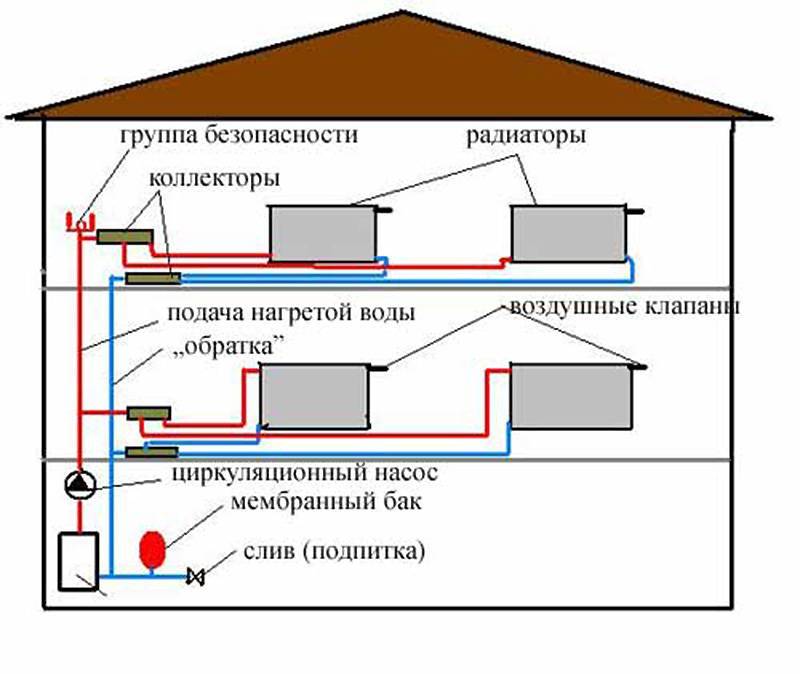
A two-pipe heating system consists of a supply and return pipes. Radiators are installed between them - the radiator inlet is connected to the supply pipe, and the outlet to the return pipe. What does it give?
- Uniform distribution of heat throughout the premises.
- Possibility to regulate the temperature in the rooms by completely or partially blocking individual radiators.
- Possibility of heating multi-storey private houses.
There are two main types of two-pipe systems - with lower and upper wiring.To begin with, we will consider a two-pipe system with a bottom wiring.
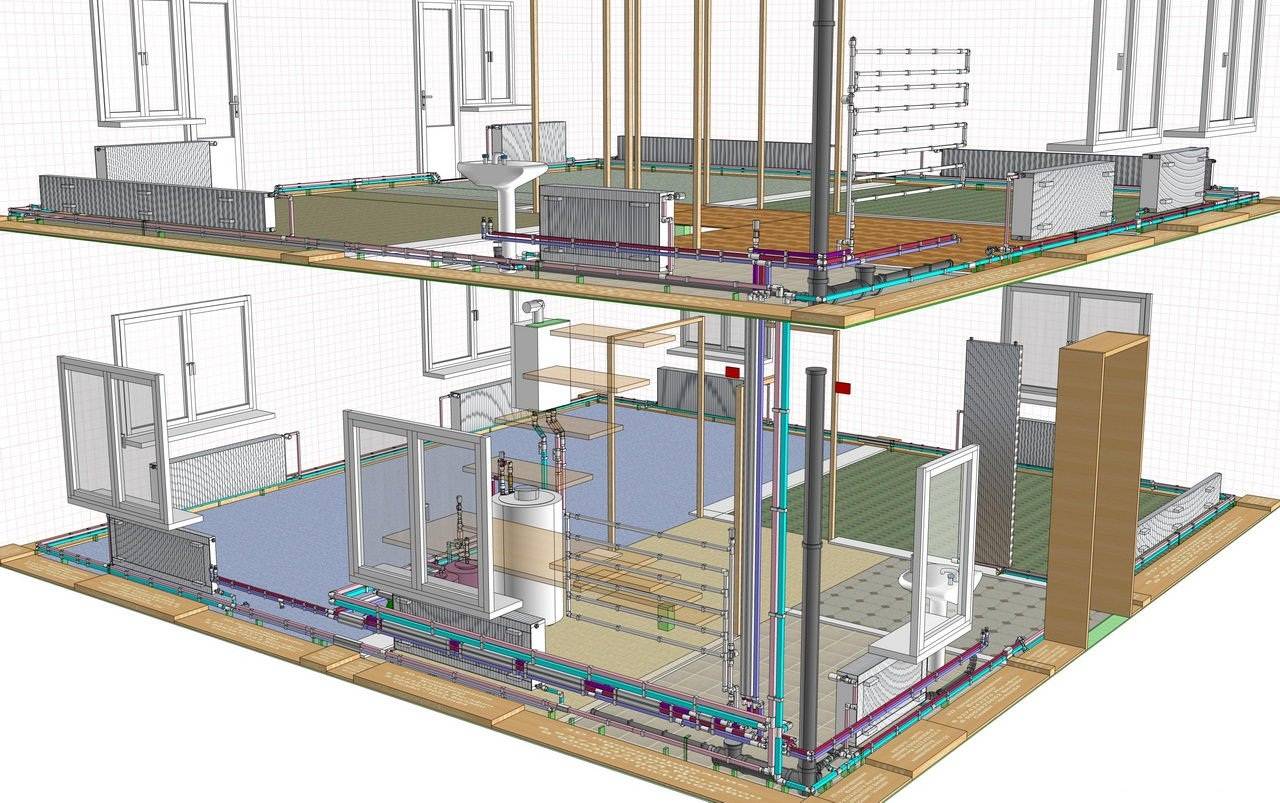
Lower wiring is used in many private homes, as it allows you to make heating less visible. The supply and return pipes pass here next to each other, under the radiators or even in the floors. Air is removed through special Mayevsky taps. Heating schemes in private polypropylene house most often provide just such a wiring.
Advantages and disadvantages of a two-pipe system with bottom wiring
When installing heating with a lower wiring, we can hide the pipes in the floor.
Let's see what positive features two-pipe systems with bottom wiring have.
- The possibility of masking pipes.
- The possibility of using radiators with a bottom connection - this somewhat simplifies installation.
- Heat losses are minimized.
The ability to at least partially make heating less visible attracts many people. In the case of the bottom wiring, we get two parallel pipes running flush with the floor. If desired, they can be brought under the floors, providing for this possibility even at the design stage of the heating system and the development of a project for the construction of a private house.
If you use radiators with a bottom connection, it becomes possible to almost completely hide all the pipes in the floors - the radiators are connected here using special nodes.
As for the disadvantages, they are the need for regular manual removal of air and the need to use a circulation pump.
Features of mounting a two-pipe system with bottom wiring
Plastic fasteners for heating pipes of different diameters.
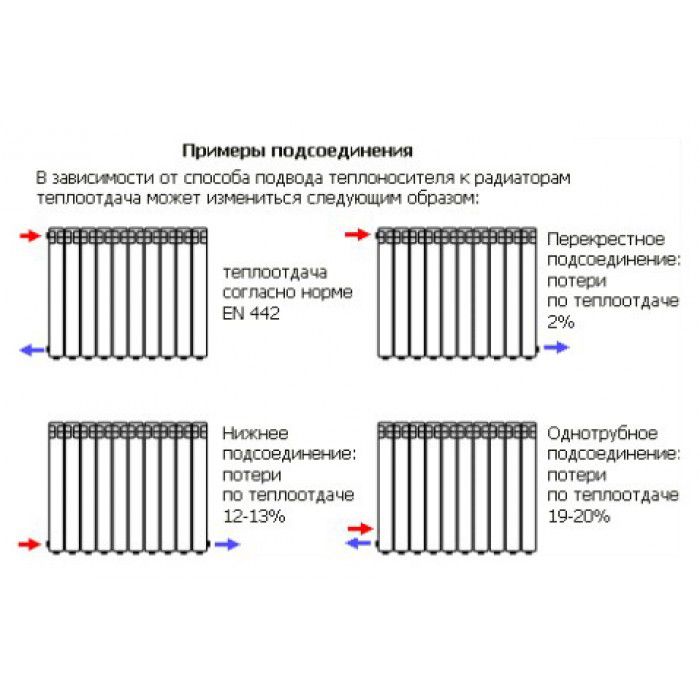
In order to mount heating system for In this scheme, it is necessary to lay the supply and return pipes around the house. For these purposes, there are special plastic fasteners on sale. If radiators with side connection are used, we make a tap from the supply pipe to the upper side hole, and take the coolant through the lower side hole, directing it to the return pipe. We put air vents next to each radiator. The boiler in this scheme is installed at the lowest point.
It uses a diagonal connection of radiators, which increases their heat transfer. Lower connection of radiators reduces heat output.
Such a scheme is most often made closed, using a sealed expansion tank. The pressure in the system is created using a circulation pump. If you need to heat a two-story private house, we lay pipes on the upper and lower floors, after which we create a parallel connection of both floors to the heating boiler.
Description of the installation of a two-pipe heating system with your own hands
When organizing heating, it is necessary to take into account not only which boiler to use, as discussed in the previous sections, but also what kind of wiring will be. There are two types of wiring: one-pipe and two-pipe. A single-pipe system is just one circuit or, simply, one pipe that passes through all heating devices - batteries. As for the two-pipe, two risers are installed here. One is the supply of coolant, and the second, the so-called return - the return of the coolant to the heater.
It would seem that there is no difference, but in fact it is significant.First of all, with a two-pipe scheme, it is possible to regulate heat transfer on each radiator. You may have seen a faucet standing on a pipe leading to a radiator. By blocking it, you can reduce or increase the amount of heat coming from the radiator. In everyday language, if it's hot at home, we close the tap, if it's cold, then we open it. As a result, we adjust the thermal comfort mode in the room.
As for the technical characteristics, with two-pipe heating, the temperature is kept evenly throughout the circuit, but with a single-pipe heating, there is a loss of heat on each subsequent radiator.
In multi-storey buildings, an exclusively two-pipe system is used.
To install such a system at home, you will need to purchase:
- The heating boiler can be gas, liquid fuel, solid fuel or electric.
- Expansion tank.
- Circulation pump. It is set if you mount with forced circulation.
- A set of pipes of the required length.
- Radiators.
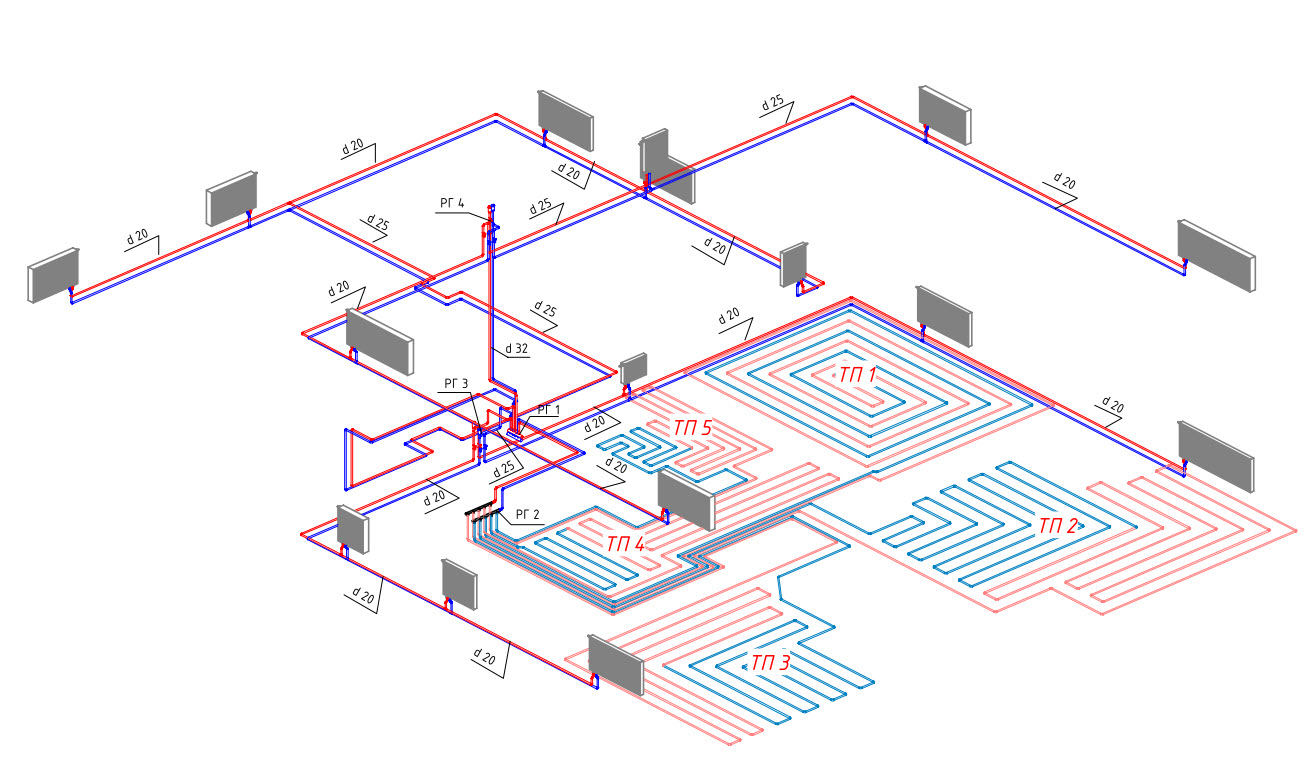
The general scheme of a two-pipe heating system looks like:
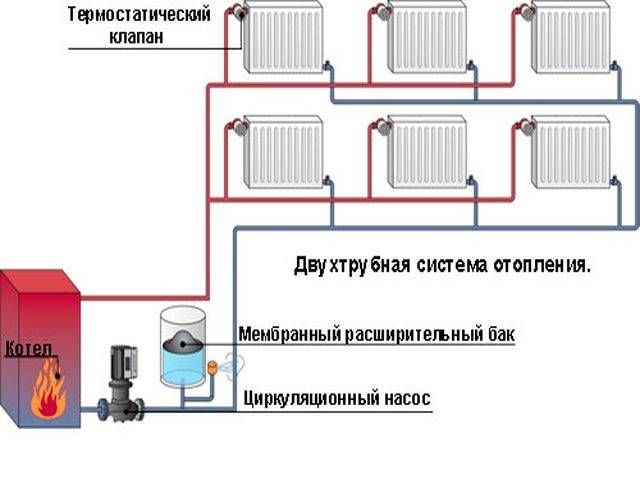
Depending on the type of house, you can choose from several options for heating. If the house is one-story, then a horizontal mounting system is well suited. The pipes are laid horizontally. If the house has several floors, then a vertical, riser is installed. Several risers are mounted, which are located vertically, and a radiator is connected to each riser.


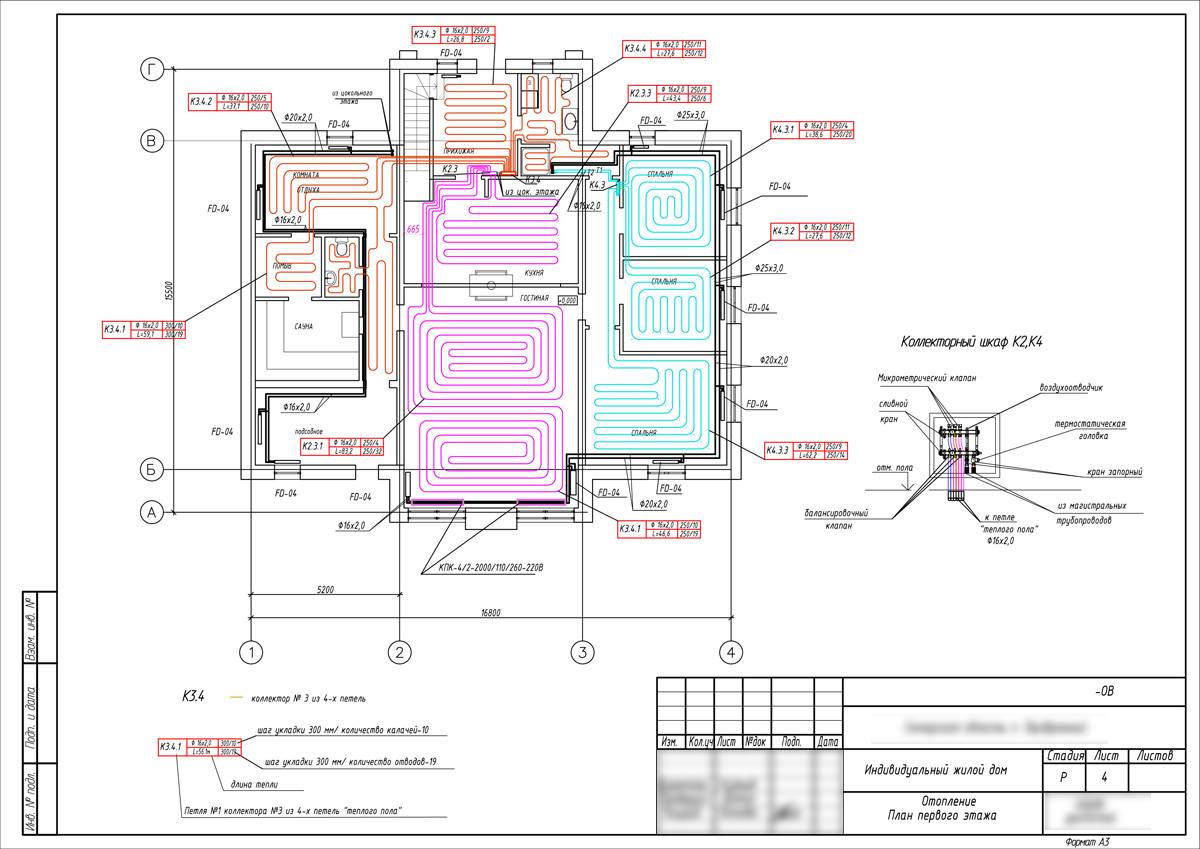


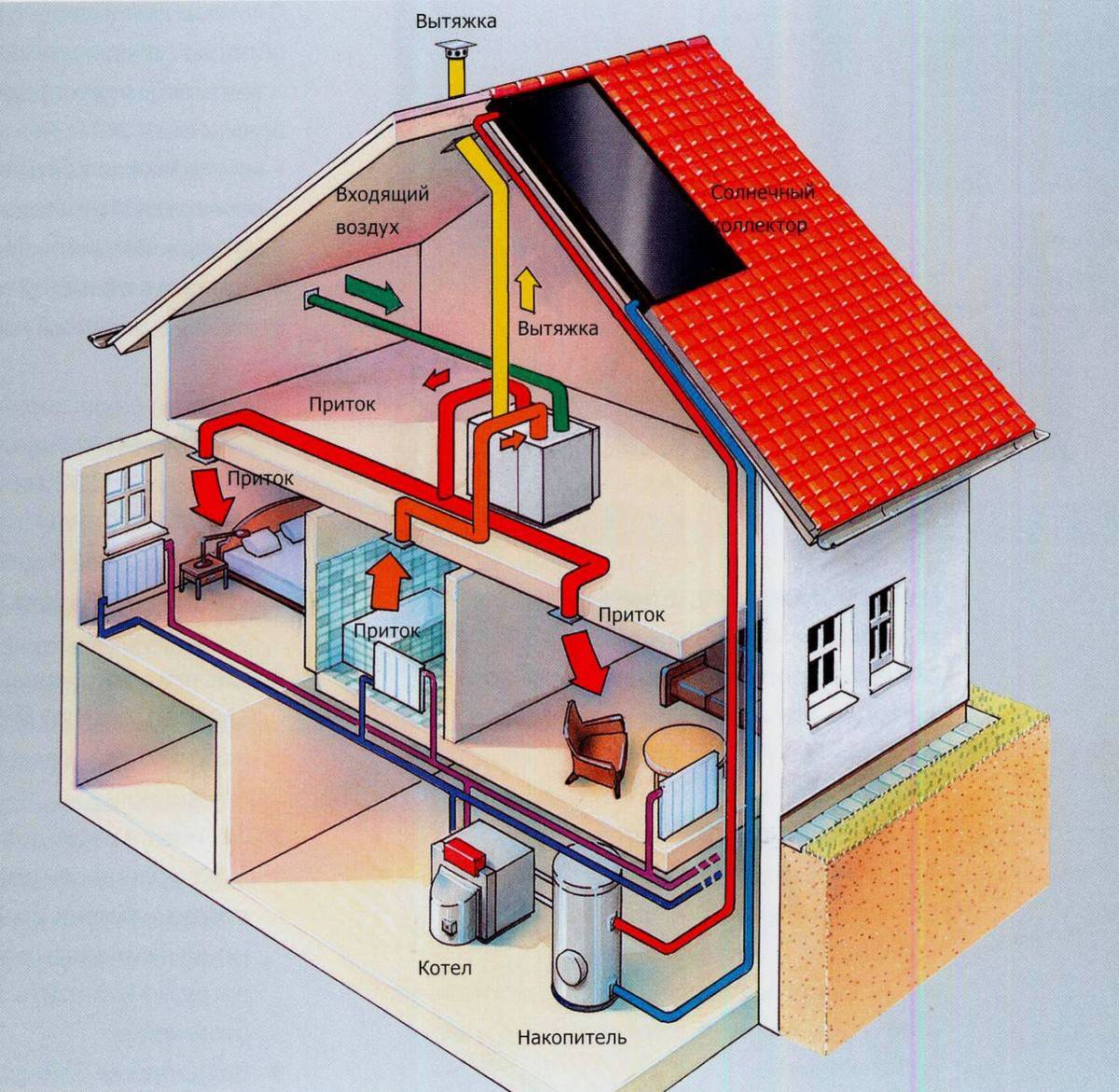

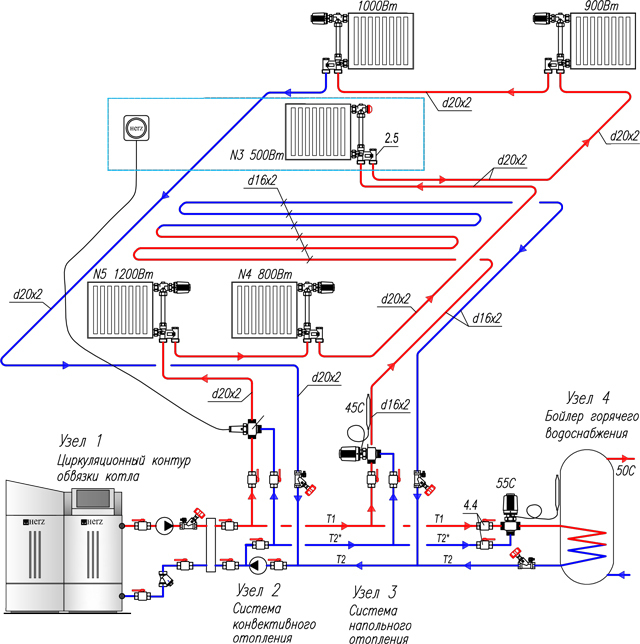

There are differences in installation depending on the location of the boiler and expansion tank. You can install these elements in the basement and in the attic. In the first version, pipes are laid in the gaps between the floor and window sills.In the second version, the pipes are laid under the ceiling, and from them there are already wiring to the radiators.
And the last thing you need to choose is whether your system will have natural circulation or with a pump. This will directly affect the installation of pipes.
So, when you have chosen the type of heating system, drawn its diagram and purchased all the necessary materials, you can proceed with the installation.
What do these jobs include?
The first step is to install a heating boiler and install pipes for supplying water to the radiators. Then an expansion tank with a drain cock and a control pipe is installed. Now you can lay the highway. Along with the main highway, the reverse is laid. The pump crashes into it. And the last step is the installation of radiators. The piping to the radiator may be different. Below are several options for such wiring.
It is recommended to install taps on the radiators at the inlet and outlet. In the event of a radiator breakdown, using taps, you can turn off the water supply to the idle radiator without turning off the entire system. In addition, it is necessary to install a Mayevsky crane. With its help, air is bled at start-up and its airing.
After the system has been mounted, everything is installed, you can start a trial run. It is needed to check the functionality. The first step is to turn off all installed taps.
Water is supplied to the system gradually, the water supply circuit to the radiators is filled first. On the very first radiator, the inlet valve and the Mayevsky valve open, through which air is bled. As soon as only water (without air bubbles) flows from the Mayevsky tap, it must be closed and the outlet valve opened.Similar actions are carried out on each heating radiator.
As a result, you will fill the system with water, removing air from it and it will be ready for full-fledged work.
2 System with forced fluid movement - optimal by today's standards
When developing a modern heating project for a two-story house, the authors of the document will most likely include a heating circuit with a circulation pump in it. Systems with natural movement of fluid through pipes do not fit into the concept of a modern interior, in addition, forced circulation provides better performance for water heating, especially in private houses with a large area.
Forced circulation makes it much easier to relate to the location of the elements of the heating system relative to each other, but there are still general rules for piping the boiler, preferentially connecting radiators, and laying pipe communications. Despite the presence of a circulation pump in the circuit, when installing the wiring, they try to minimize the resistance of pipes, their connections and transitions in order to reduce the load on the liquid pumping device and avoid fluid turbulence in difficult places.
The use of forced circulation in the pipe circuit allows you to achieve the following operational advantages:
- the high speed of the liquid movement ensures uniform heating of all heat exchangers (batteries), due to which better heating of various rooms is achieved;
- forced injection of the coolant removes the restriction from the total heating area, allowing you to make communications of any length;
- a circuit with a circulation pump works effectively at low liquid temperatures (less than 60 degrees), making it easier to maintain the optimum temperature in the rooms of a private house;
- low liquid temperature and low pressure (within 3 bar) allows the use of inexpensive plastic pipes for the installation of a heating system;
- the diameter of thermal communications is much smaller than in a system with natural circulation, and their hidden laying is possible without observing natural slopes;
- the possibility of operating heating radiators of any type (preference is given to aluminum batteries);
- low heating inertia (no more than half an hour passes from starting the boiler to reaching the maximum temperature by the radiators);
- the ability to make the circuit closed using a membrane expansion tank (although the installation of an open system is also not excluded);
- thermoregulation can be carried out both in the whole system, and zonal or pointwise (to regulate the temperature on each heater separately).
Another advantage of the forced heating system of a two-story private house is the arbitrary choice of a place to install the boiler. Usually it is mounted on the ground floor or in the basement, if there is a basement, but the heat generator does not have to be specially deepened and the level of its location relative to the return pipe must be calculated. Both floor and wall installation of the boiler is allowed, which provides a wide choice of suitable equipment model according to the personal preferences of the homeowner.
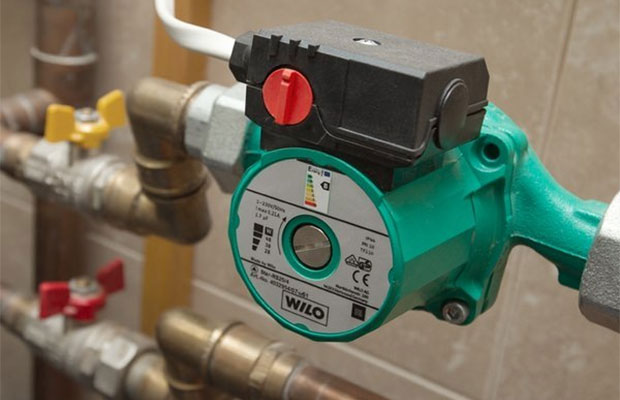
A heating system with a circulation pump is most often found in modern projects.
Despite the technical perfection of heating with forced fluid movement, such a system has drawbacks. Firstly, this is the noise that is formed during the rapid circulation of the coolant through the pipes, especially intensifying in places of narrowing, sharp turns in the pipeline. Often the noise of a moving liquid is a sign of excessive power (performance) of the circulation pump applicable to a given heating circuit.
Secondly, the operation of water heating depends on electricity, which is necessary for the constant pumping of the coolant by the circulation pump. The circuit layout usually does not contribute to the natural movement of the liquid, therefore, during long power outages (if there is no uninterruptible power supply), the housing is left without heating.
Like a circuit with natural circulation, the heating of a two-story house with forced pumping of the coolant is done with one-pipe and two-pipe wiring. How these schemes look right will be discussed later.
Why is it profitable to heat the house yourself?
In terms of heating, the owners of country houses were more fortunate than urban residents. After all, the owners of cottages can turn on the heating in their house at any time of the year, since they do not depend on a centralized heating system. Other advantages and benefits include:

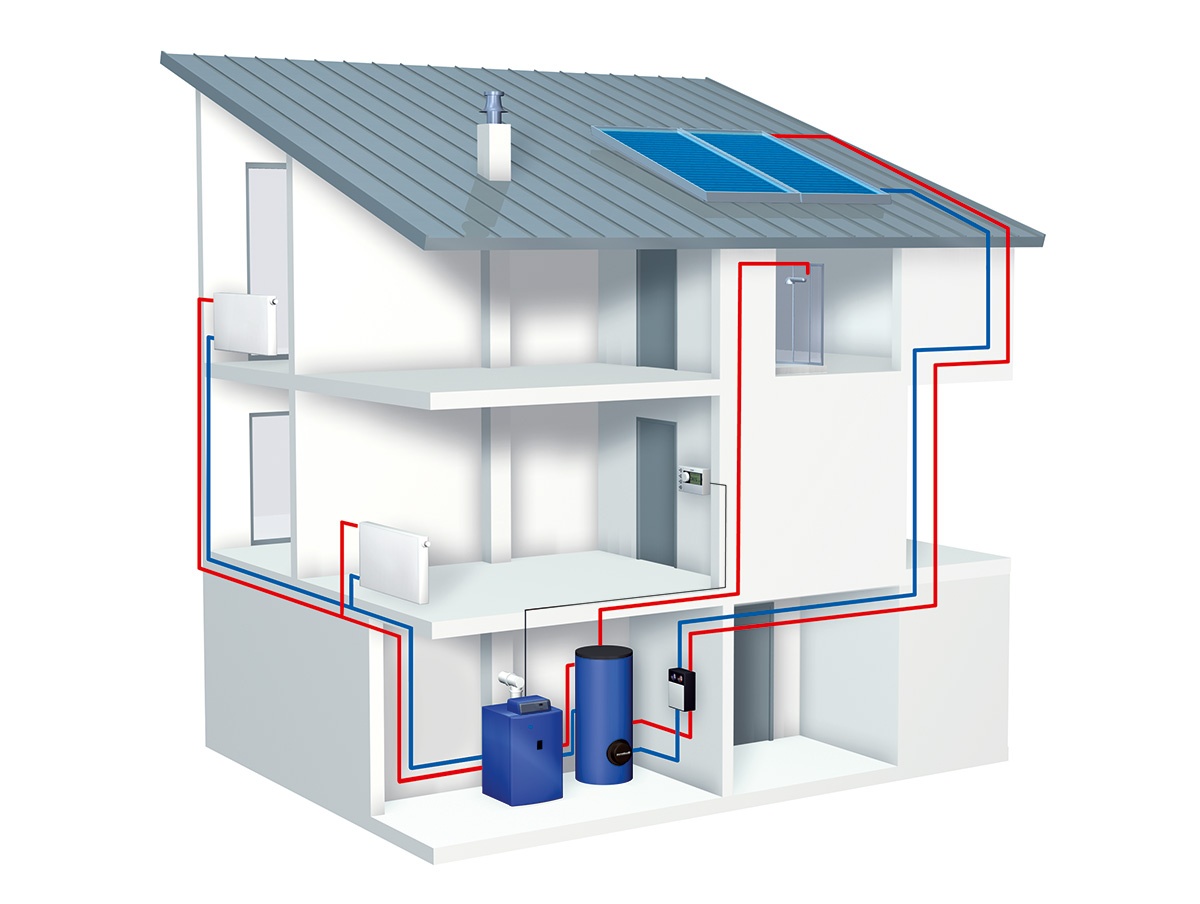



- the ability to turn on the heating in the house at those moments when it is necessary.
- the ability to adjust the temperature to the desired level.
- the possibility of self-selection of the heating option (solid fuel, electricity, gas).
However, here the main question arises - how to economically heat a house and what heating method is considered the most profitable? This is what we have to figure out.
Heating appliances
The last, but no less important step in the selection of the system is the choice of heating devices. Modern manufacturers than just do not lure potential customers. This is the price, design and a wide range of choices.
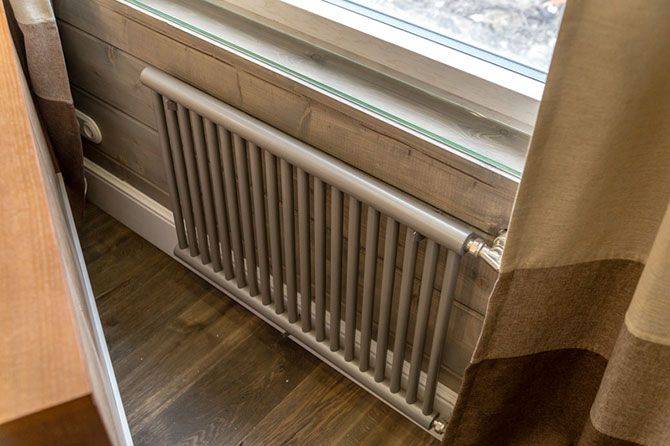
Radiators are:
- cast iron,
- aluminum,
- steel,
- bimetallic.
Be sure to check with the seller for certificates for their products. Often on the forums you can read about buying low-quality devices. Correctly calculate the number of sections for the device or their marking will help in the design organization. I advise you not to save on this calculation.
I often have to recalculate devices that are selected “by eye”. Calculation and adjustment of the existing scheme are more expensive, to say nothing of spending money on dismantling equipment. And I'm not even talking about the need for repairs after installing new equipment.
If you are planning an automated regulation of the system, then pay attention to heating devices with built-in thermostatic valves. This will help reduce costs a little.
Smart heating not only saves money, but also takes care of maintaining the temperature at a given level.
Mounting order
A single-pipe system is assembled as follows:
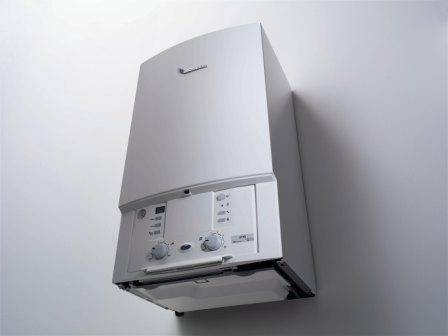
- In the utility room, the boiler is installed on the floor or hung on the wall. With the help of gas equipment, the most reliable and efficient one-pipe heating system of a two-story house can be arranged. The connection diagram in this case will be standard and will allow you to do all the work, if desired, even on your own.
- Heating radiators are hung on the walls.
- At the next stage, the “supply” and “reverse” risers are mounted to the second floor.They are located in the immediate vicinity of the boiler. At the bottom, the contour of the first floor joins the risers, at the top - the second.
- Next is the connection to the battery lines. A shut-off valve (on the inlet section of the bypass) and a Mayevsky valve should be installed on each radiator.
- In the immediate vicinity of the boiler, an expansion tank is mounted on the "return" pipe.
- Also on the "return" pipe near the boiler on the bypass with three taps, a circulation pump is connected. A special filter cuts in front of it on the bypass.
At the final stage, the system is pressure tested in order to identify equipment malfunctions and leaks.
As you can see, the single-pipe heating system of a two-story house, the scheme of which is as simple as possible, can be very convenient and practical equipment.
However, if you want to use such a simple design, at the first stage it is important to make all the necessary calculations with maximum accuracy.
Thinking about the installation of heating, it is initially determined what type of fuel will be used
But along with this, it is extremely important to decide how independent the planned heating will be. So, a heating system without a pump, which does not need electricity to work, will be truly autonomous. All you need is a heat source and a well-placed piping for efficient operation.
For efficient operation, you only need a heat source and properly located piping.
The heating circuit is a set of elements designed to heat the home by transferring heat to the air.The most common type of heating is a system that uses boilers or boilers connected to the water supply as a heating source. Water, passing through the heater, reaches a certain temperature, and then goes to the heating circuit.



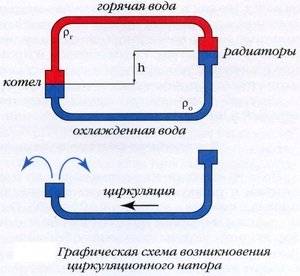
In systems with a coolant, which is used as water, circulation can be organized in two ways:
Boilers (boilers) are used as a heat source for heating water. Their principle of operation is based on the transformation of the type of energy defined for them into heat, followed by its transfer to the coolant. According to the type of heating source, boiler equipment can be gas, solid fuel, electric or fuel oil.
According to the type of connection of the circuit elements, the heating system can be one-pipe or two-pipe. If all circuit devices are connected in series relative to each other, that is, the coolant passes through all the elements in order and returns to the boiler, then such a system is called a single-pipe system. Its major drawback is uneven heating. This is due to the fact that each element loses some amount of heat, so the difference in boiler temperatures can be significant.
A two-pipe type system implies a parallel connection of radiators to a riser. The disadvantages of such a connection include a design complication and a doubled material consumption compared to a single-pipe system. But the construction of a heating circuit for large multi-storey premises is carried out only by such a connection.
A gravity circulation system is sensitive to errors made during heating installation.