
- How to properly organize a drain in a small bathroom
- Varieties of sanitary products
- Simple corrugated structures
- Convenient bottle-type appliances
- Reliable pipe options
- What materials are used for shutters
- Types of siphons
- Types of siphons depending on the design
- Materials used for the manufacture of siphons
- Popular manufacturers of siphons and their features
- Kitchen
- Instructions for installing a siphon in the kitchen
- About valve
- Types of siphons and their features
- Bath siphons
- Shower siphon
- Siphons for washbasins
- Siphons for household appliances (dishwasher or washing machine)
- Siphons for kitchen sinks
- Washbasin connection
- Hydraulic seal assembly sequence
How to properly organize a drain in a small bathroom
Due to the small area of the room, you need to carefully consider the location of the washing machine and the drain system.
There is a good solution - a hanging mirror cabinet and a sink with a cabinet, since the remaining space is occupied by the passage and the bath itself.
If there is a desire to place a washing machine in such a bathroom, then the only possible options are either the complete dismantling of the sink and the use of the vacant drain for the outlets of the washing machine, or the installation of a washing machine under the sink bowl.
When the washing machine is installed under the sink, the bowl needs to be replaced with a different type, called a "water lily".
From ordinary bowls of sinks, the “water lily”, installed above the appliances, differs in a smaller depth, but in large sizes and a drain of a certain shape.
The bowl should be as flat as possible, the average height in combination with the drain protrusion is 20 cm.
The width of the bowl is about 50-60 cm, models with smaller sizes are rare. Such parameters are due to the fact that moisture from the sink should not fall on the machine body.
The drain hole of the "Water Lily" is located in the center, or else - a little to the side. Bowls with a central drain are characterized by greater depth, since the outlet pipe takes up some space.
When installing such a bowl, a small gap remains between the body of the machine and the sink - this ensures greater reliability due to the fact that the bowl will not be subjected to vibrations of the machine during washing.
When installing and connecting to the sewerage of a washing machine, a flat siphon for the sink is required.
A similar variation has found application not only for washbasins above the washing machine. A specific type is used for:
- shower cabins with a low pallet;
- when installing Jacuzzi bathtubs;
- to hide pipes and their protrusions;
- when installing wall-mounted sink bowls.
A flat siphon is one of the few options that allows you to save more space in a small bathroom without neglecting sanitary standards.
When choosing a flat siphon for a washing machine, it is better to give preference to types with a jet break - this is a complete solution to the problem with unpleasant odors.
A water lily sink with a flat tray is actually the only option for a washbasin in a miniature bathroom if you want to install a washing machine there as well.
Varieties of sanitary products
There are several types of siphons used for installation on a sink. Which one is better to choose depends on the budget, the nuances of the location of the sink in relation to the sewer outlet, the requirements for the functional part.



Simple corrugated structures
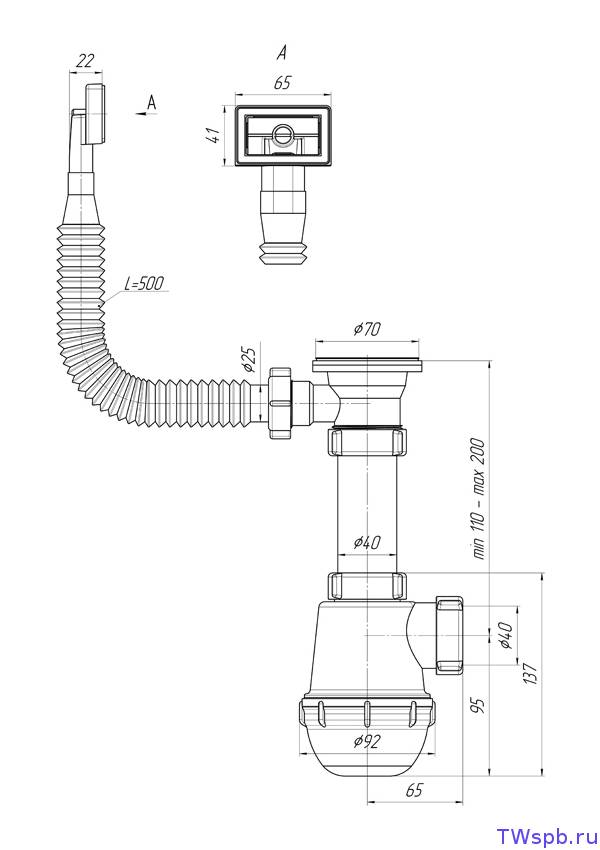
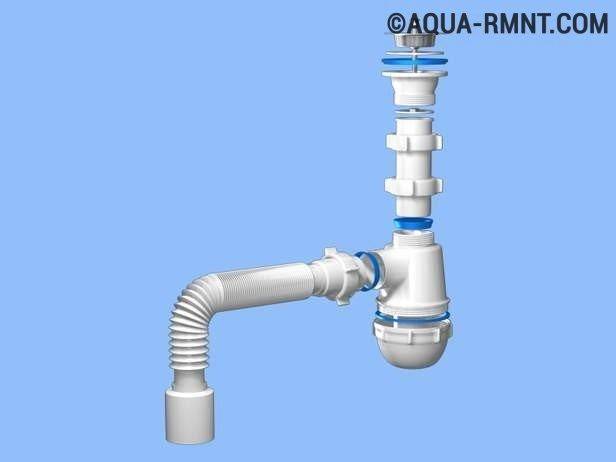
The most elementary type of device is a folded corrugated plastic tube placed on a movable frame base. To obtain a water seal, such a siphon is bent in the right direction, and the bend area is fixed with plastic clamps.
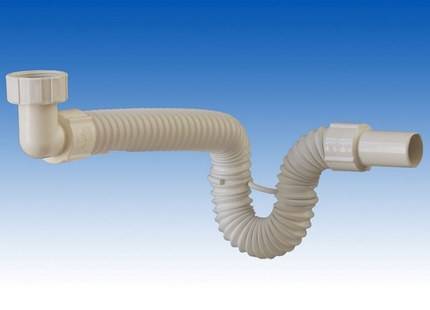
Corrugated hoses are practical and convenient for non-standard sinks with minimal installation space. The outlet has only one connecting node, which reduces the risk of leaks
Due to the fact that the soft pipe can easily change position and shape, it can be mounted anywhere. The corrugation is easy to assemble and has a budget price.
Its main disadvantage is a one-piece construction that does not provide for separate prefabricated elements. This makes it difficult to clean a product that is prone to the accumulation of fatty deposits. In cases of severe pollution, it will not be possible to get by with an ordinary tube: you will have to tinker a lot, allocating time for a complete disassembly of the system.
When choosing a corrugated siphon, it should be noted that it is not adapted to work in cold rooms, for example, in a summer kitchen that is not heated in winter. In addition, the product begins to quickly deform from frequent drains of boiling water into the sink.
Convenient bottle-type appliances
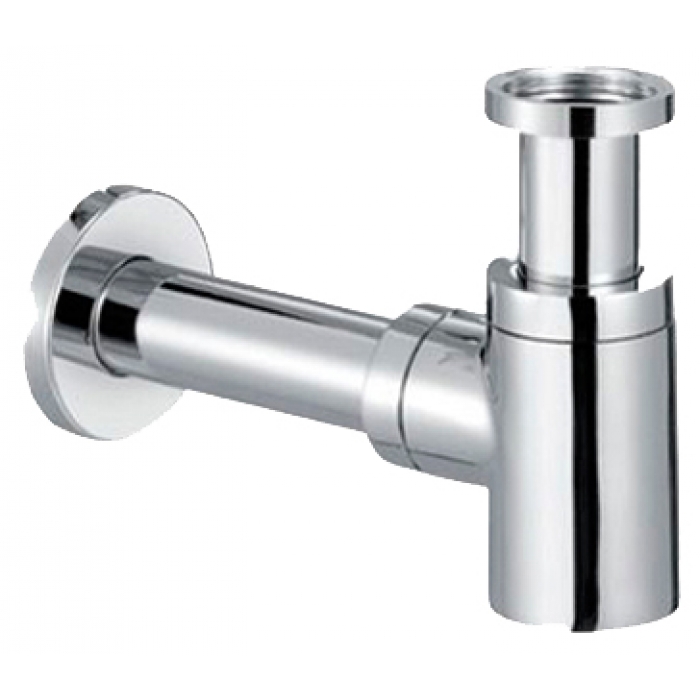
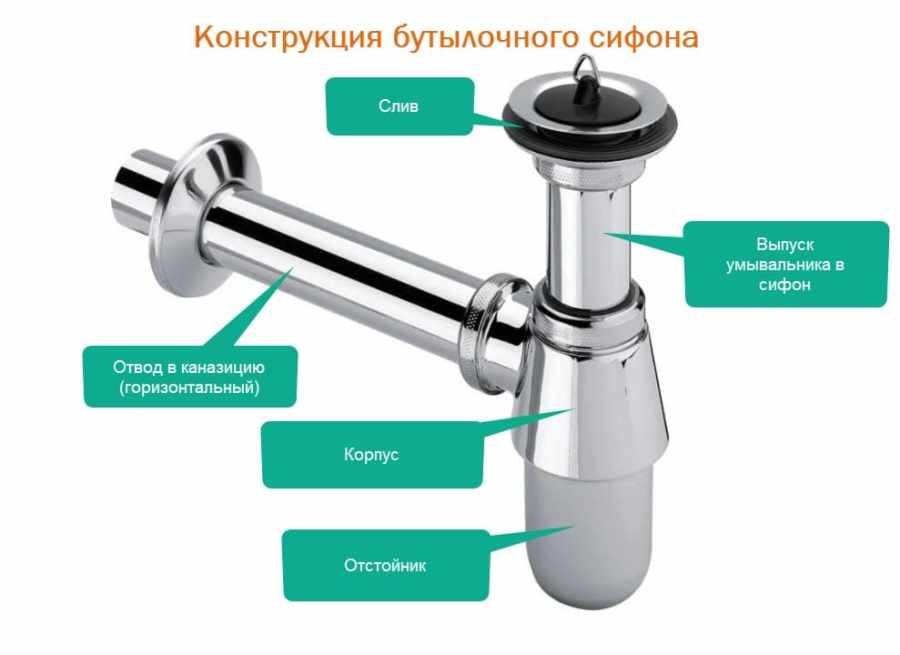
Bottle or flask devices - a type of siphon for washing, characterized by a rigid structure. In their lower part, a vertical vessel is equipped with an outlet pipe inside, outwardly similar to a bottle.
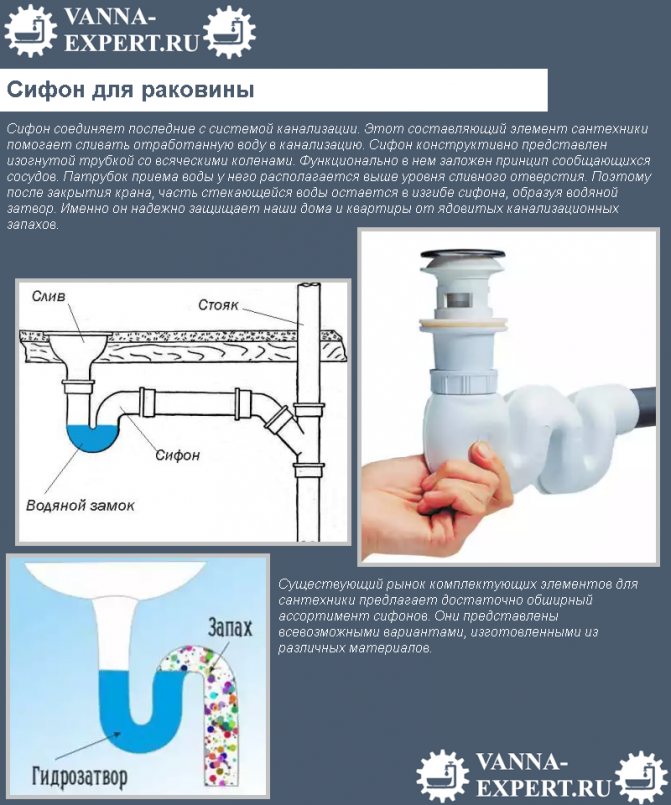
It constantly contains a liquid that provides the functions of an effective water seal.
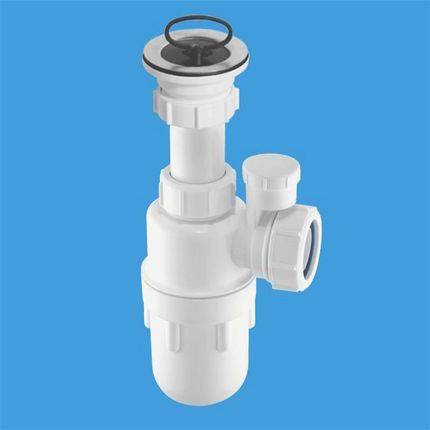
All household waste, particles of dirt, debris and grease are collected in the nozzle of the flask. In order to remove them, a complete dismantling of the device is not required: simply disconnect the pipe by unscrewing the nuts and rinse the parts thoroughly
Compared to the corrugation, the devices are much more difficult to install and disassemble, but they are much easier to clean from accumulated blockages. Additional equipment can be connected to them by means of splitters and fittings.
A useful feature of the structure of some models of the bottle siphon is the presence of an overflow, due to which the liquid level is controlled and the overflow of the sink is prevented.
Bottle siphons also include compact flat siphons, ideal for installation in any hard-to-reach place.
Reliable pipe options
Pipe-type plumbing equipment - collapsible and non-collapsible models made in the form of a rigid curved pipe.
The collapsible design consists of pipe sections connected in a certain order. It requires the most accurate comparison of the outlet of the sink and the drain sewer. The functions of the water seal are assigned to the curved section of the device in which water is collected.
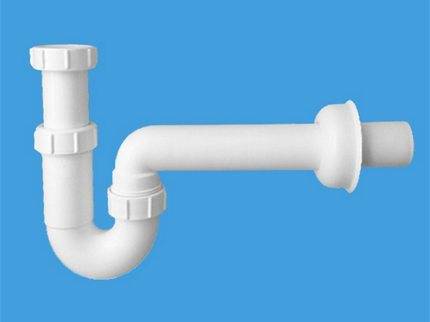
The water seal in the device is located at a shallow depth.If you rarely use the plumbing, liquid evaporates from it, causing unpleasant sewer odors.
Pipe siphons can be additionally equipped with overflow devices and sockets, which allows installation on double kitchen sinks. The main advantage of products is increased strength. At the same time, they are motionless and rather bulky, and this limits the possibilities of installation in a limited space.
Debris particles in pipe siphons descend to the lowest point of the structure. Usually, the cleaning procedure is accompanied by characteristic difficulties, not counting the improved models with an easily removable knee.
What materials are used for shutters
Currently, water seals are made of metal or plastic materials, which often determine their performance.
The advantages of metal devices (stainless steel, copper alloys, etc.) are:
- strength,
- durability,
- aesthetic appearance,
- resistance to high temperatures,
- fire safety,
- simple reliable design,
- different price segment.
You can often find plastic closures made from various types of polyethylene or polypropylene. They are lightweight, not subject to rotting and corrosion, do not retain dirt and limescale, are much cheaper, and are not afraid of acids. The coefficient of linear expansion of plastic products is higher than that of metal products, so their installation is simplified and does not require additional materials for sealing. But plastics do not work well with sudden temperature changes, are less presentable, and are poorly resistant to high temperatures.




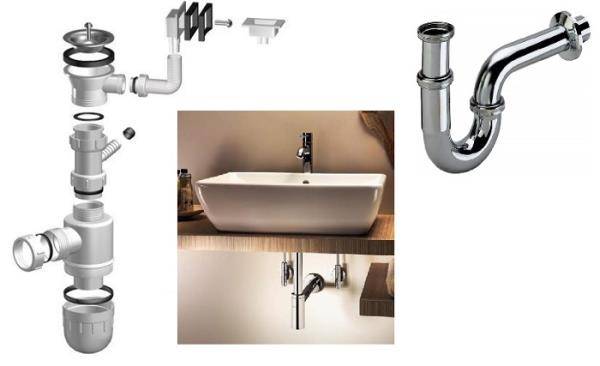
Types of siphons
It is required to choose siphons for sinks and washbasins depending on:
- constructions;
- manufacturing materials;
- manufacturer.
Types of siphons depending on the design
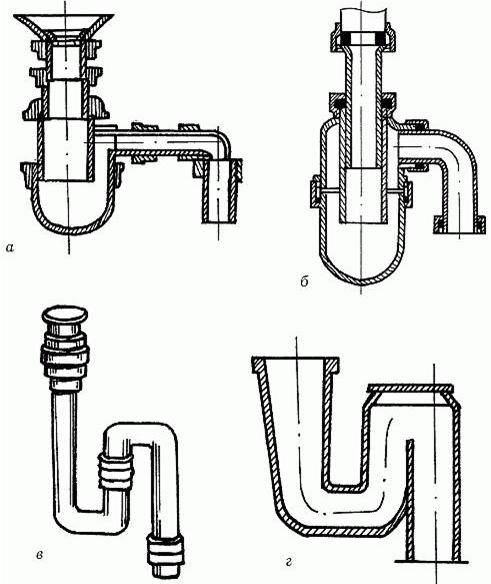
Currently, experts distinguish the following types of siphons:
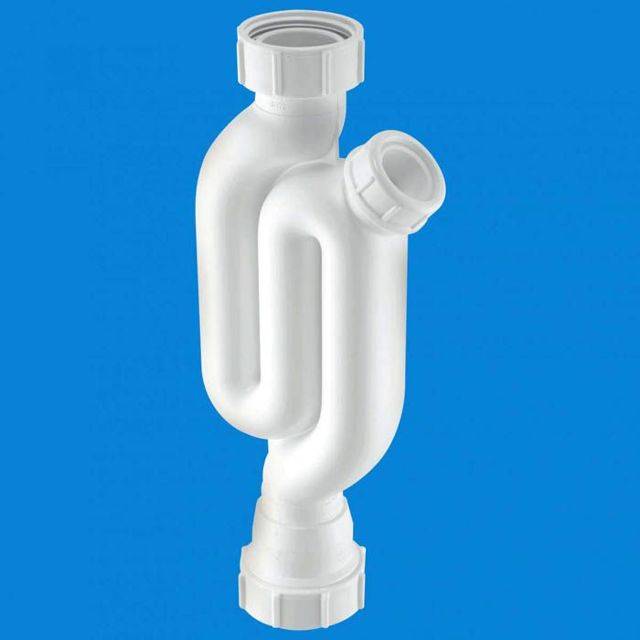
- pipe. The siphon is a rigid pipe made in the shape of the letter S or U. At the bottom point, the devices can be equipped with a hole to facilitate the cleaning process. Pipe siphons cannot change the shape specified by the manufacturer, therefore they are installed on plumbing fixtures that are suitable in overall dimensions. It also requires the most accurate alignment of the outlet pipe with the sewer outlet;
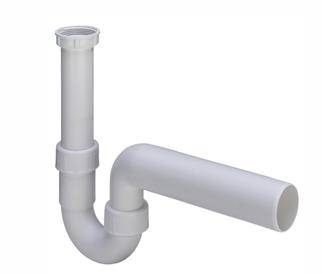
U-shaped device
- bottle. The bottle siphon for the washbasin has a flask in which debris and other objects accumulate (hence the name of the model). The main difference between the siphon and other models is the ability to quickly clean without dismantling the device. The siphon can be connected to the sewer with a corrugated hose, which allows you to change the length of the outlet pipe, or a rigid pipe;
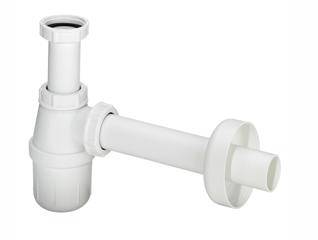
Flask type device with hard release
Varieties of bottle siphon are:
structures equipped with additional inlet pipes. Such devices are used when it is necessary to simultaneously connect a washbasin and a washing or dishwasher to the sewer;
Devices for simultaneous connection of a washbasin and a washing machine
devices with two inlets. Siphons are installed on sinks or washbasins with two drain holes;
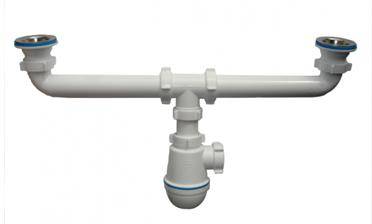
Double washbasin device
overflow equipment.The washbasin siphon with overflow is installed on a sanitary ware equipped with an overflow protection system.
Washbasin equipment with overflow protection
- flat siphon. The device is installed in a limited space, as it has small overall dimensions. To clean the siphon, its complete dismantling is required;
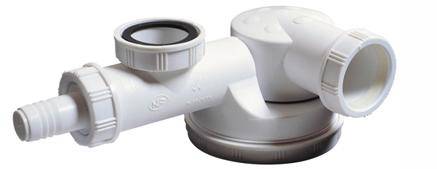
Small device for connecting a washbasin in a limited space
- corrugated siphon. Ideal for custom-sized washbasins. The water seal can be equipped anywhere by forced bending of the hose. The main drawback of the design is the uneven inner surface, which contributes to the accumulation of deposits.
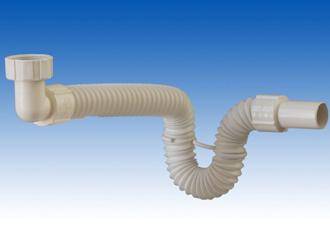
The simplest siphon for connecting a washbasin
The design of the siphon is selected based on the availability of free space that can be used to connect plumbing equipment, and the presence of additional functions.
Materials used for the manufacture of siphons
For the manufacture of siphons are used:
- plastic. The cheapest material that does not affect the quality and durability of the product (plastic siphons are shown in the figures above);
- cast iron. Cast iron siphons are used extremely rarely and only to connect a bathtub made of the same material, as they are distinguished by their large weight, unaesthetic appearance and clear overall dimensions;
Cast iron device
metals: brass alloys, nickel, bronze, copper. Metal siphons are distinguished by high cost and at the same time aesthetic appearance. Devices are installed if necessary to obtain the original design of the room. They are of excellent quality and are used for a long time.

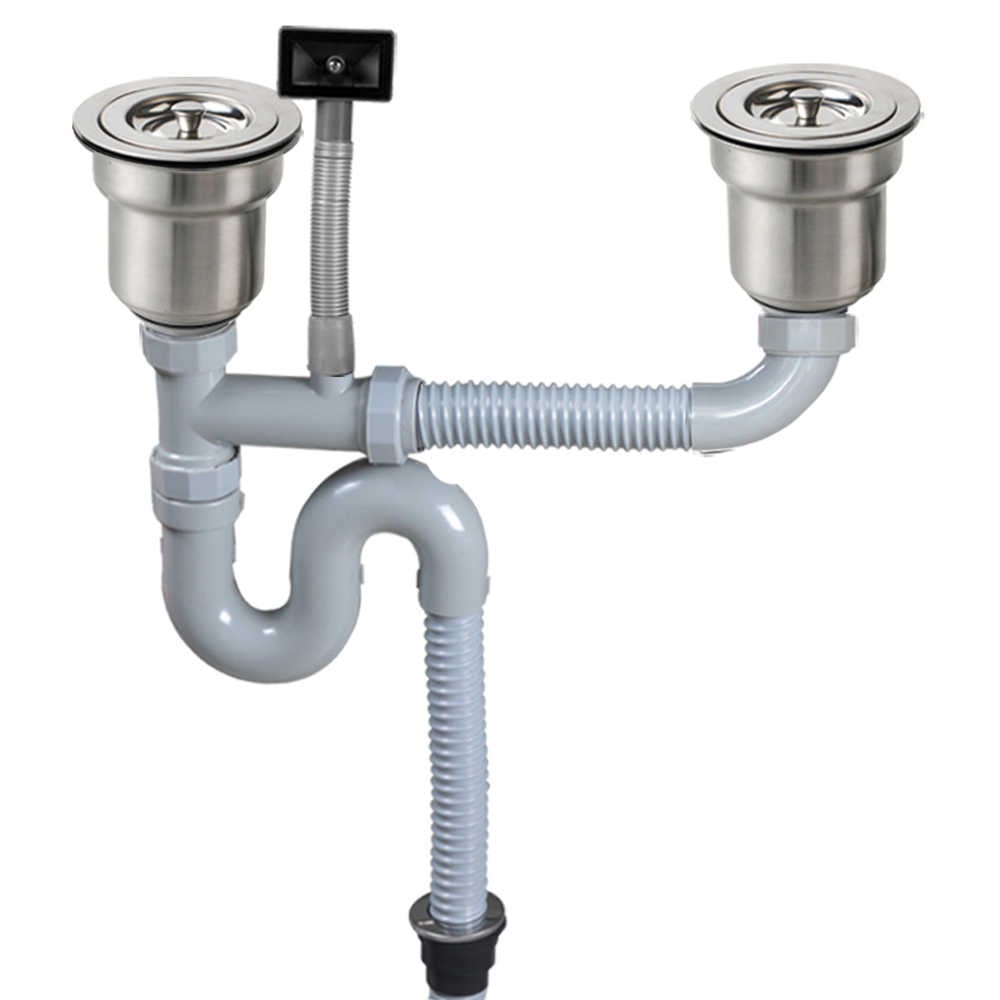



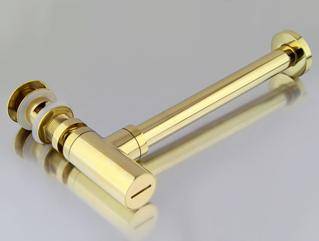
Brass device with a coating that protects against scratches and other damage
The choice of material from which the siphon is made is determined solely by the aesthetics and design of the room.
Popular manufacturers of siphons and their features
Among foreign manufacturers of siphons are:
- the German company Viega;
- the Swiss company Geberit;
- Spanish company Jimten.
An overview of the siphon from Geberit is presented in the video.
The products of these companies are different:
- difference in design and materials, including unique design solutions;
- durability and reliability;
- high cost.
Russian manufacturers are represented by companies:
- Aniplast;
- VirPlast;
- Orio;
- aquant.
Siphons from a domestic manufacturer (Ani Plast)
Our companies also produce devices of various designs, using the mentioned materials for manufacturing. The main plus of the Russian manufacturer is the low cost of siphons, which does not affect the quality of the products.
Kitchen
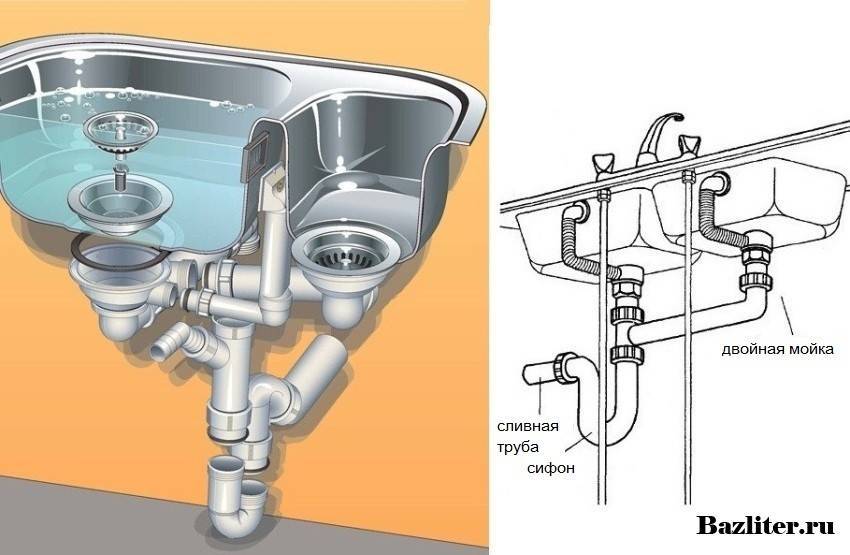
Installing a siphon in the kitchen is both simple and complex. Simple - because the nozzle and sink are fairly easily accessible. Complicated - because the desired kitchen siphon can be a rather complex design. The washing machine needs a siphon with additional fitting. If the kitchen also has a dishwasher - with two. For a sink, if it is double, you will need a siphon with a double drain.
Kitchen siphons
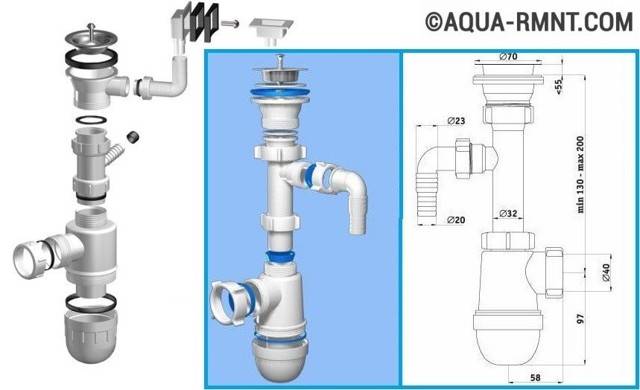
In addition, in new houses, the sewer pipe is located on the wall and goes straight into the riser; in this case, there are several risers per apartment.From the point of view of sanitation and hygiene, this is excellent, but the release of the siphon will no longer go down, but back or sideways. Some types of kitchen siphons are shown in the figure; according to the diagram on the left, you can calculate the size of the free space for the siphon.
Instructions for installing a siphon in the kitchen
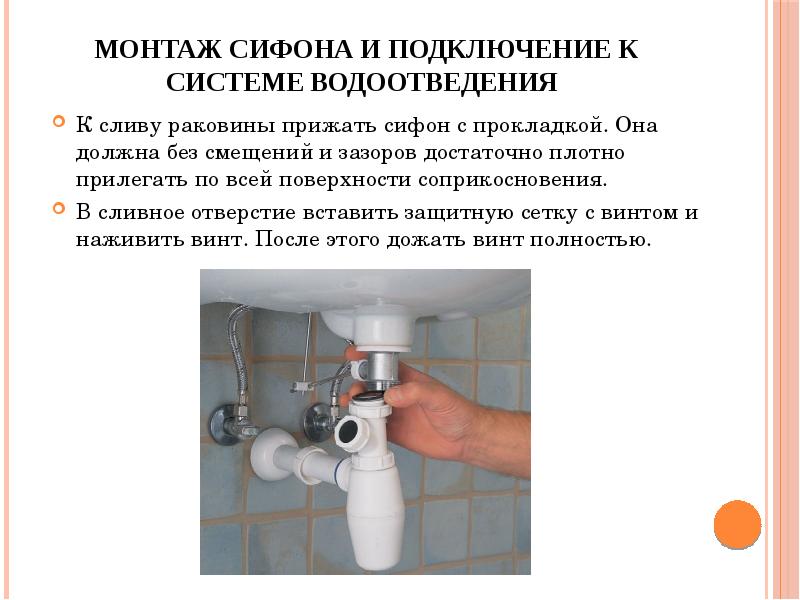
- We check the fit of the drain grate in the sink sink. It may turn out that the stamping in the sink is too small. This is unacceptable: a puddle around a protruding grate will quickly become a breeding ground for infection. In such a case, it is advisable to agree with the seller on a replacement when buying. In extreme cases - put the grate without a gasket, on the sealant.
- In the sewer pipe we put the installation cuff, lubricated with sealant. The mounting surface of the nozzle must be dry.
- We check the end (docking) surfaces of the body threads. With a sharp knife we cut off the burrs and flash (they can damage the gaskets) and with the same knife or a scraper (reamer) we remove chamfers of 0.5-1 mm.
- We cut to size, if necessary, the outlet end of the drain pipe, put it in the cuff, fix it. If the fastening is with a clamp, you will need a screwdriver, tighten the clamp screw. The threaded end of the outlet pipe must face the body of the siphon (bottle or elbow).
- If the spout goes down, we plant a square on the upper end of the exhaust pipe on the sealant.
- We install a drain grate in the sink of the sink. We do not put the bottom gasket of black rubber yet.
- We put a thin ring gasket in the groove of the plug and lubricate it with sealant, capturing the root of the thread for 2-3 turns. We close the cork.
- We insert a valve into the outlet pipe of the bottle, if provided. The damper blade must open outwards.
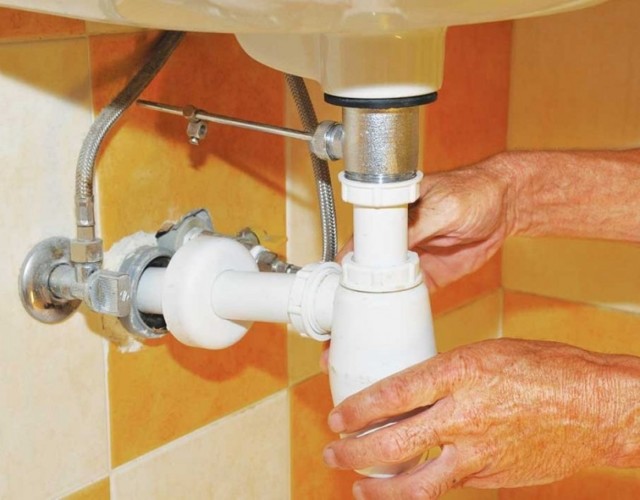
- We connect the siphon bottle to the outlet pipe: we put a conical gasket on the sealant to release the narrow end to the bottle, put it into the bottle, screw the side nut of the bottle onto the thread. We don't tighten it.
- We put the bottom drain gasket on the sealant into the groove of the upper couple of the bottle, bring it to the drain pipe of the drain grate, do not tightly wrap the top nut of the bottle.
- Slightly shaking the bottle, alternately tighten the top and side nuts of the bottle tightly.
- If the washer and sink fittings are not yet used, we plug them with rubber plugs, complete or suitable in size. Otherwise, just pull the drain hoses on them.
About valve
In the case of a flood, even a unkempt, slimy valve saves the apartment: with it, it’s a general cleaning, not a repair. But the valve is overgrown with sludge, so the siphon with the valve must be periodically disassembled and cleaned. That's why:



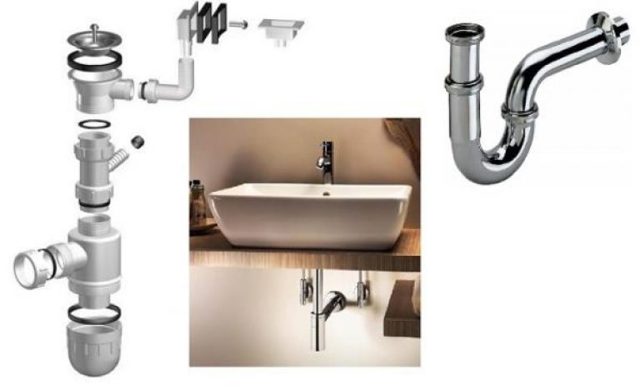
- On the top floor, or in new houses with separate risers, the valve is not needed at all: there is no one to fill and / or it is impossible.
- In 97% of cases, with undisturbed sewage, the first floor is flooded. Here the valve is needed in any case.
- In other cases, be guided by the neighbors BOTTOM: how neat, respectable they are and prone to illegal initiative, like installing a safety pin in a riser.
Types of siphons and their features
The following factors influence the choice of a siphon:
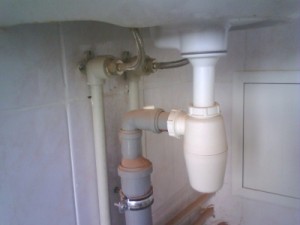
- Place of installation;
- The amount of water that the siphon must pass.
Bath siphons
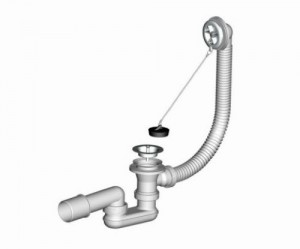
Siphons designed for installation under the bathtub consist of two pipes - drain and overflow. Before the knee of the siphon, in which the water seal is located, both pipes are connected into one.Most models of bathtub siphons allow adjustment, since the drain and overflow holes on bathtubs of different models can be at different distances.
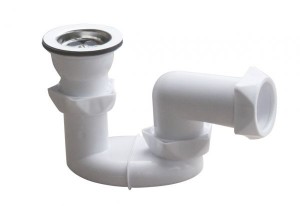 Today there are siphons for bathtubs with automatic and semi-automatic regulation of the drain. In the first case, to open the drain plug, you just need to press the button, in the second case, turn the handle located at the level of the overflow hole.
Siphons for installation under the bath are made of polymeric materials or metal, most often copper alloys. The latter are certainly more expensive, but if you plan to purchase an automatic drain, then it is better to take a metal piping, since plastic ones are unreliable and often break. When purchasing a conventional overflow drain for a bath, you can safely take a plastic model, it will serve for a long time.
Shower siphon
The siphon, which is installed under the shower tray, must have sufficient capacity. Such siphons are often called ladders. There are drains that are mounted directly into the floor, in which case the installation of a pallet is not required.
Siphons for washbasins
Sink siphons are available in different versions.
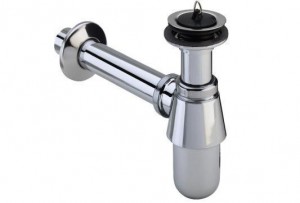
- Pipe models. This is a siphon in the form of a rigid curved pipe. In some models, for ease of cleaning, a plug is installed in the lowest section of the siphon.
- Corrugated models are convenient in that they allow adjustment in length, which greatly facilitates installation. However, such a siphon clogs with debris faster than others, since the inside of the tube is not smooth.
- Bottle models of siphons have a fairly rigid design.The body of the siphon itself is shaped like a bottle and has an unscrewed bottom, which makes it easy to clean.
- Siphon in a box. This type of siphon is used when you need to free up space under the sink. The siphon itself is installed in a hole made in the wall, and is connected to a drain hole with a thin tube.
Siphons for household appliances (dishwasher or washing machine)
As a rule, for household appliances, the siphons described above in the box are used. The siphon itself is installed on the wall in a convenient place, and the drain pipe is brought to it under a decorative cover.
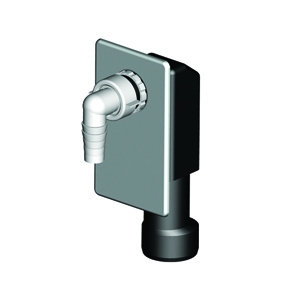
Sometimes household appliances are attached to the washbasin siphon. In this case, a model with a large capacity is selected, and an additional pipe for connecting a drain hose.
Siphons for kitchen sinks
As a rule, bottle-type siphons are installed on the sink, as they are the most practical and easy to clean. The fact is that kitchen drains may contain fat, which quickly clogs the siphons, reducing their throughput.
Today, sinks with two or three compartments are often installed in the kitchen. Naturally, it would be unprofitable to mount a separate siphon for each drain, so special double (or triple) siphons are used, which have a common body and several outlet pipes.
When installing household appliances in the kitchen that need to be connected to the sewer, it is necessary to purchase siphons with additional outlets.
Washbasin connection
To arrange the connection of the sink in the kitchen and its subsequent comfortable operation, it is recommended to use products with a drain hole of 3.2 cm in diameter.It is these hole parameters that are considered the most convenient and at the same time compact, in addition, this parameter ensures ease of installation of the siphon for various sinks, as well as ease of subsequent operation.
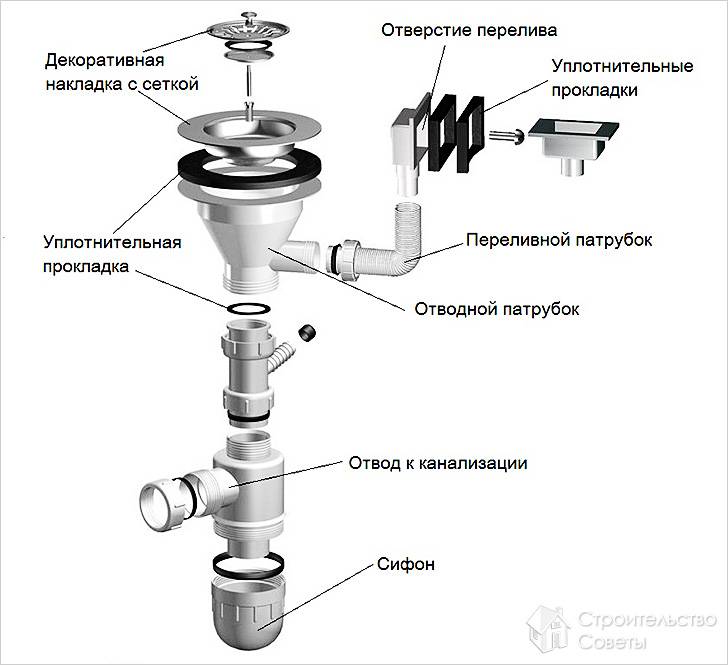
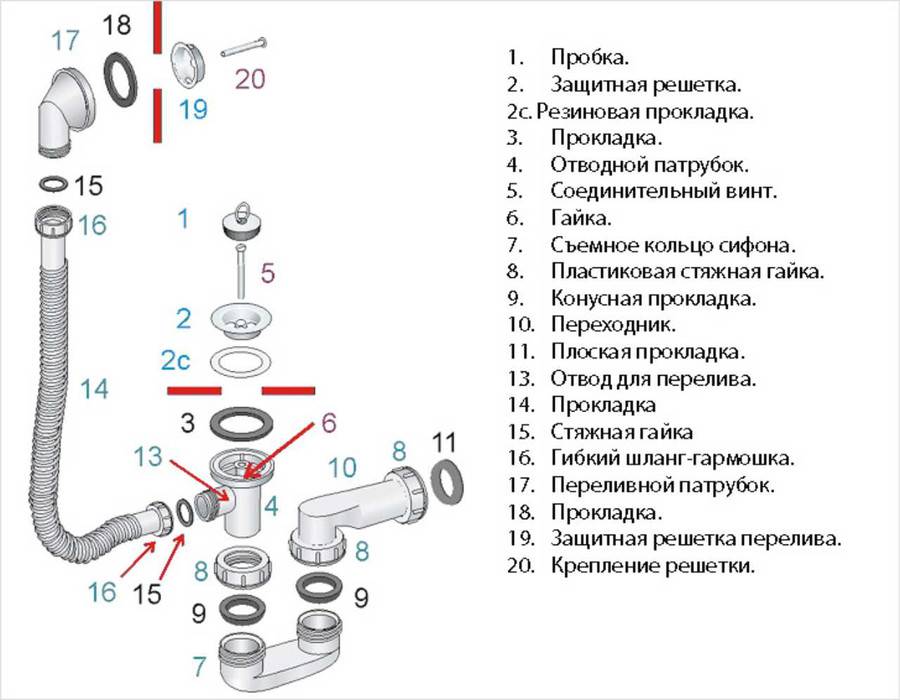
Before undertaking the installation of the product, you should first get acquainted with its device. Any siphon for connecting sinks in the kitchen is a product consisting of such components as:
- throughput plastic pipe, complete with a metal insert;
- pipe gasket made of latex;
- nuts with a diameter of 3.2 cm made of plastic;
- cuff-skirt made of elastic and soft plastic, with a hole in it 3.2 cm in diameter;
- tightening screw made of steel;
- overlay for the drain part, also made of steel;
- the body of the product, called the bottle;
- bottom plug;
- rubber gasket in the form of a ring;
- plug for locking the drain, consignment note.
In the process of installing siphons of this kind on a sink or washbasin, maximum attention should be paid to such a parameter as the tightness of each connection of the structure.
Hydraulic seal assembly sequence
The plastic system is easy to assemble, without applying excessive force when screwing. Nuts are simply tightened until they stop, but without pinching, as they can burst
It is important not to forget to install gaskets
- The assembly begins with the installation of the release. A sealing ring is placed under the grid on the drain hole, the second one is superimposed on the sink from below and the base of the outlet is installed. The whole structure is connected by a bolt (for which you need a screwdriver). You need to make sure that the rubber rings do not move.
- Next comes the overflow. The mesh is attached to the sink with a bolt (similar to the previous operation).The overflow assembly is installed under the outlet.
- The body of the water seal is assembled and screwed directly to the overflow assembly, or by means of an intermediate pipe (if it is planned to drain the drains of the washing machine) using a nut.
- Similarly, the outlet pipe is connected to the sewer hole. To seal the joint, a cone seal is used, with a narrow end directed to the sewer hole.
We hope that the information helped you to get acquainted with the types of water seals, to solve the practical problems of their selection and installation.



