
- Operation features
- Frequency and methods of cleaning
- What can not be poured into a septic tank Tver
- Operation features
- Frequency and methods of cleaning
- What can not be poured into a septic tank Tver
- Principle of operation
- Septic tank Tver price with turnkey installation
- Model range of septic tank Tver
- Septic Tver - its strengths and weaknesses
- Disadvantages of a septic tank as a cleaning system
- Rules for installing a septic tank Tver
- Technology of installation of treatment equipment
- Disadvantages and features
- Where to place the installation: rules and regulations
- Advantages and disadvantages of the treatment system
- Conclusions and useful video on the topic
Operation features
Such a complex and multi-stage processing process leads to the fact that the system is more stable, in comparison with others, and works with various failures. In general, local sewage treatment plants react rather poorly to deviations from the norm. They work fine under the following conditions:
- They need a guaranteed power supply - aeration installations must work.
- They require a positive temperature - at temperatures below +6 ° C, the activity of microorganisms freezes, and at even lower temperatures they can die. Therefore, during installation they are insulated.
- These systems are demanding on the regularity of "replenishment" with waste products - they need protein.So such installations are more justified in permanent residences. For seasonal visits, conservation for the winter is recommended. The second option is to leave it to winter in working order, but periodically feed it with proteins - at least once a week, pour a liter or two of kefir or pour semolina.
All this is true for the Tver septic tank, only failures are not so critical. Even if aerobic bacteria die without electricity, anaerobic bacteria and sedimentation tanks will work normally. Yes, the quality of cleaning will drop, but the water will still be more or less clean, and the colony will recover in a few weeks.
Freezing a working installation of an autonomous sewage system is generally unlikely - the drains are warm, and heat is released during reactions. In the case of the Tver septic tank, there is another factor: a compressor that pumps air into the aerotanks is installed indoors and drives warm air, additionally heating the drains.
Frequency and methods of cleaning
Any septic tank requires pumping out sediment and maintenance. Another thing is that the timing of pumping can vary significantly, as well as the list of necessary work. Maintenance of a septic tank Tver consists of several types of work:
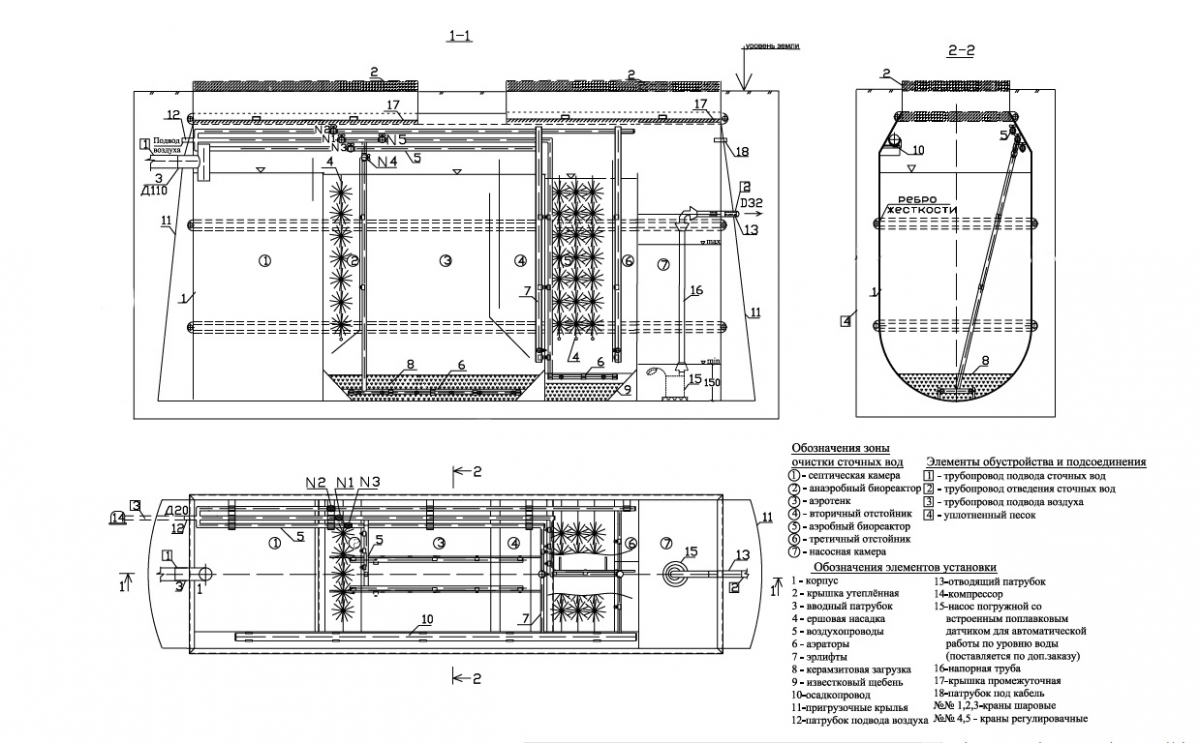
- Periodic pumping of sludge from aeration tanks is required. You need to look at the amount of silt. If there is too much of it in the chamber, it must be pumped out. In order to be able to navigate by terms, let's say that on average such a procedure is required once every six months. Pumping is automatic; for this, several taps must be closed / opened in a certain sequence. First, close tap No. 1, then open tap No. 2 for 2-3 minutes, then close it and open tap No. 3. In this case, excess sludge will flow into the second chamber.
-
Removal of deposits from the first septic tank. Biomass coming from the house settles in this chamber. This is not silt and it is better to remove it with a sewage machine. It should not be called more than once a year. In principle, you can get by with a fecal pump, but you need to pump the waste into a compost pit where they should “reach” for at least six months.
- Replenishment of limestone filling is necessary every 2-3 years. Look into the penultimate compartment, if the lime has become noticeably less, it's time to top up (a bag or two, depending on the size of the installation).
- Ruff cleaning. If there is a noticeable plaque - once every 3-4 months - they should be washed with a stream of cold water. If there are badly damaged ruffs (rare), they can be replaced.
- Capital cleaning of walls and partitions is needed every 2-3 years. To do this, the system is pumped out, the sediment is washed off with a strong pressure of water (from Karcher, for example).
Compressor maintenance is also required, but it is carried out separately, according to the activities indicated in its passport.
What can not be poured into a septic tank Tver
Since the processing of juices occurs due to the vital activity of bacteria, antibacterial drugs (antibiotics), preservatives (vinegar, salt in large quantities), and chlorine-containing drugs are harmful to them. The installation almost does not react to powders and detergents for dishes, but a large amount of bleach poured out at a time is harmful. If you just wash your plumbing with bleach once or twice a week, it's not a big deal. But if you carry out such a procedure daily, problems may arise - the “living creatures” will die out.
It is impossible to drain fruit and vegetable peelings, hard paper, construction waste and large amounts of sand into the sewage treatment plant. All these substances either do not decompose by microorganisms at all or decompose insufficiently.They float on the surface or sink to the bottom. If we talk about sand and other heavy insoluble fragments, then they settle to the bottom of the first chamber, where they are compressed with the remnants of pollution, turning into a solid mass. This can become a problem when pumping. The sewage machine will cope with this, but when pumping out manually fecal pump will have tosomehow break this layer or climb inside with a shovel.
Operation features
Such a complex and multi-stage processing process leads to the fact that the system is more stable, in comparison with others, and works with various failures. In general, local sewage treatment plants react rather poorly to deviations from the norm. They work fine under the following conditions:
- They need a guaranteed power supply - aeration installations must work.
- They require a positive temperature - at temperatures below +6 ° C, the activity of microorganisms freezes, and at even lower temperatures they can die. Therefore, during installation they are insulated.
- These systems are demanding on the regularity of "replenishment" with waste products - they need protein. So such installations are more justified in permanent residences. For seasonal visits, conservation for the winter is recommended. The second option is to leave it to winter in working order, but periodically feed it with proteins - at least once a week, pour a liter or two of kefir or pour semolina.
All this is true for the Tver septic tank, only failures are not so critical. Even if aerobic bacteria die without electricity, anaerobic bacteria and sedimentation tanks will work normally.Yes, the quality of cleaning will drop, but the water will still be more or less clean, and the colony will recover in a few weeks.
Freezing a working installation of an autonomous sewage system is generally unlikely - the drains are warm, and heat is released during reactions. In the case of the Tver septic tank, there is another factor: a compressor that pumps air into the aerotanks is installed indoors and drives warm air, additionally heating the drains.
Frequency and methods of cleaning
Any septic tank requires pumping out sediment and maintenance. Another thing is that the timing of pumping can vary significantly, as well as the list of necessary work. Maintenance of a septic tank Tver consists of several types of work:
- Periodic pumping of sludge from aeration tanks is required. You need to look at the amount of silt. If there is too much of it in the chamber, it must be pumped out. In order to be able to navigate by terms, let's say that on average such a procedure is required once every six months. Pumping is automatic; for this, several taps must be closed / opened in a certain sequence. First, close tap No. 1, then open tap No. 2 for 2-3 minutes, then close it and open tap No. 3. In this case, excess sludge will flow into the second chamber.
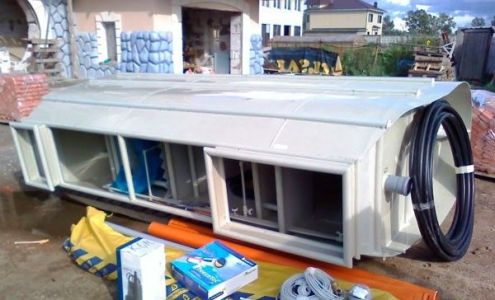
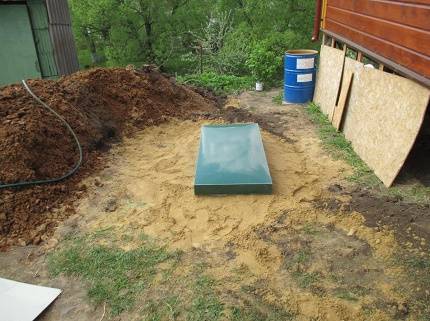
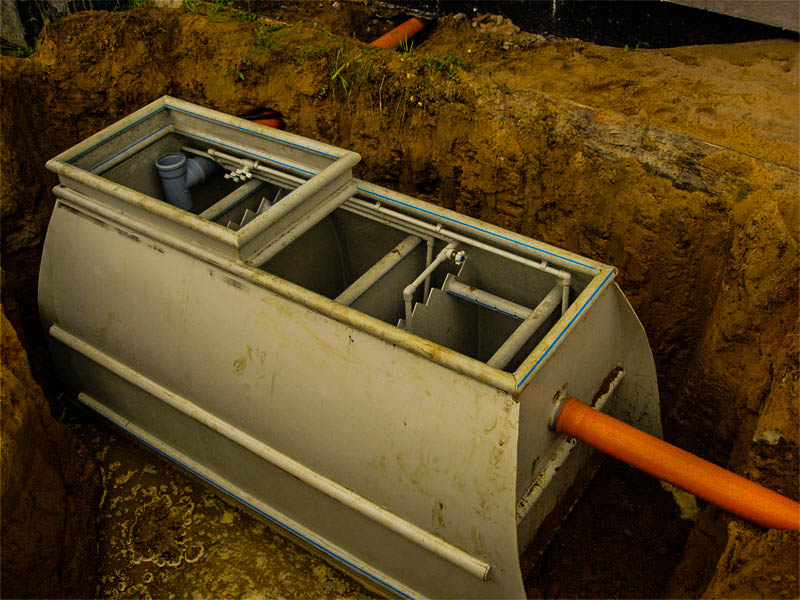
- Removal of deposits from the first septic tank. Biomass coming from the house settles in this chamber. This is not silt and it is better to remove it with a sewage machine. It should not be called more than once a year. In principle, you can get by with a fecal pump, but you need to pump the waste into a compost pit where they should “reach” for at least six months. Top view with open hatches
- Replenishment of limestone filling is necessary every 2-3 years.Look into the penultimate compartment, if the lime has become noticeably less, it's time to top up (a bag or two, depending on the size of the installation).
- Ruff cleaning. If there is a noticeable plaque - once every 3-4 months - they should be washed with a stream of cold water. If there are badly damaged ruffs (rare), they can be replaced.
- Capital cleaning of walls and partitions is needed every 2-3 years. To do this, the system is pumped out, the sediment is washed off with a strong pressure of water (from Karcher, for example).
Compressor maintenance is also required, but it is carried out separately, according to the activities indicated in its passport.
What can not be poured into a septic tank Tver
Since the processing of juices occurs due to the vital activity of bacteria, antibacterial drugs (antibiotics), preservatives (vinegar, salt in large quantities), and chlorine-containing drugs are harmful to them. The installation almost does not react to powders and detergents for dishes, but a large amount of bleach poured out at a time is harmful. If you just wash your plumbing with bleach once or twice a week, it's not a big deal. But if you carry out such a procedure daily, problems may arise - the “living creatures” will die out.
It is impossible to drain fruit and vegetable peelings, hard paper, construction waste and large amounts of sand into the sewage treatment plant. All these substances either do not decompose by microorganisms at all or decompose insufficiently. They float on the surface or sink to the bottom. If we talk about sand and other heavy insoluble fragments, then they settle to the bottom of the first chamber, where they are compressed with the remnants of pollution, turning into a solid mass. This can become a problem when pumping.A sewage truck can handle this, but when manually pumping out with a fecal pump, you will have to somehow break this layer or climb inside with a shovel.
Principle of operation
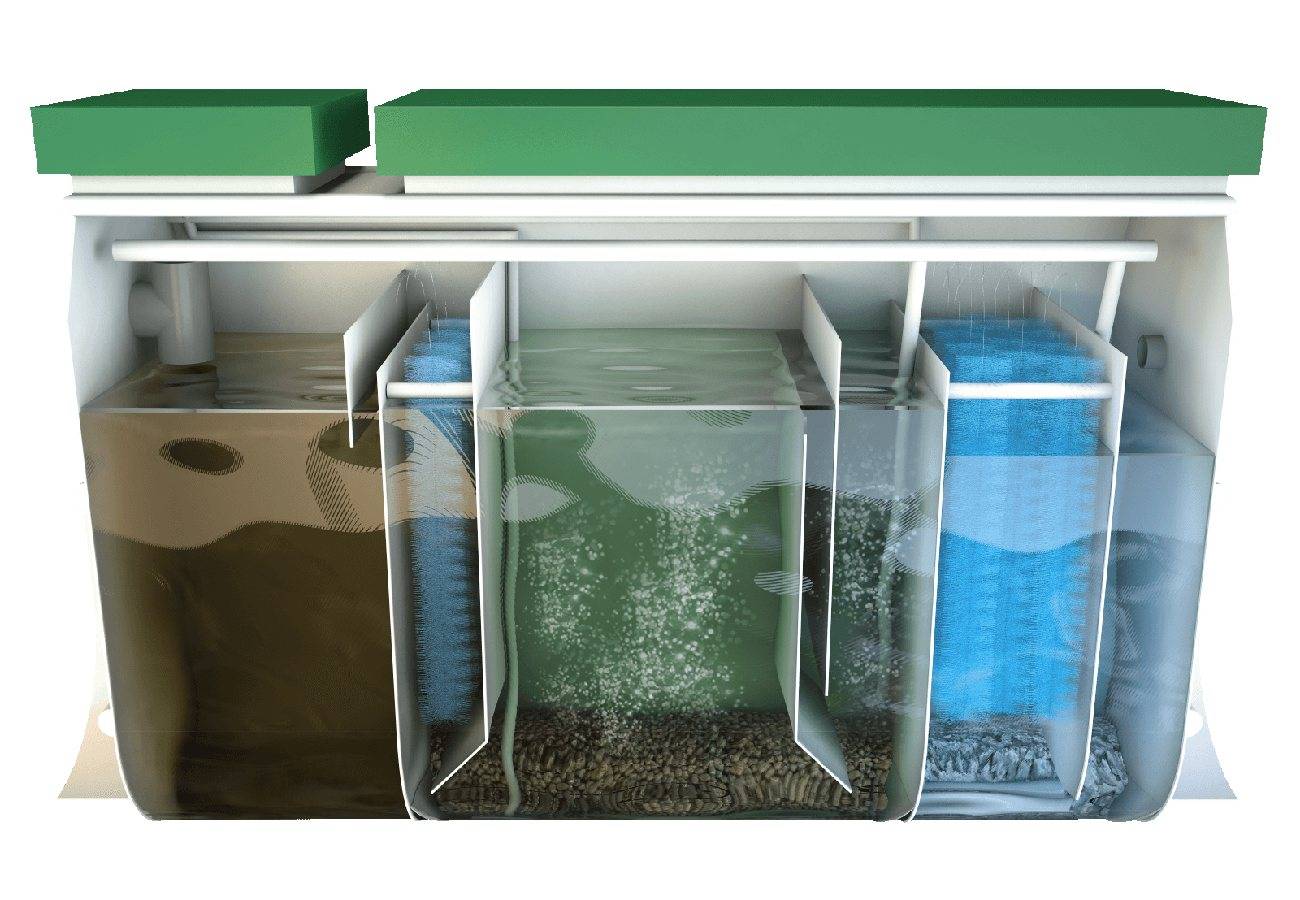
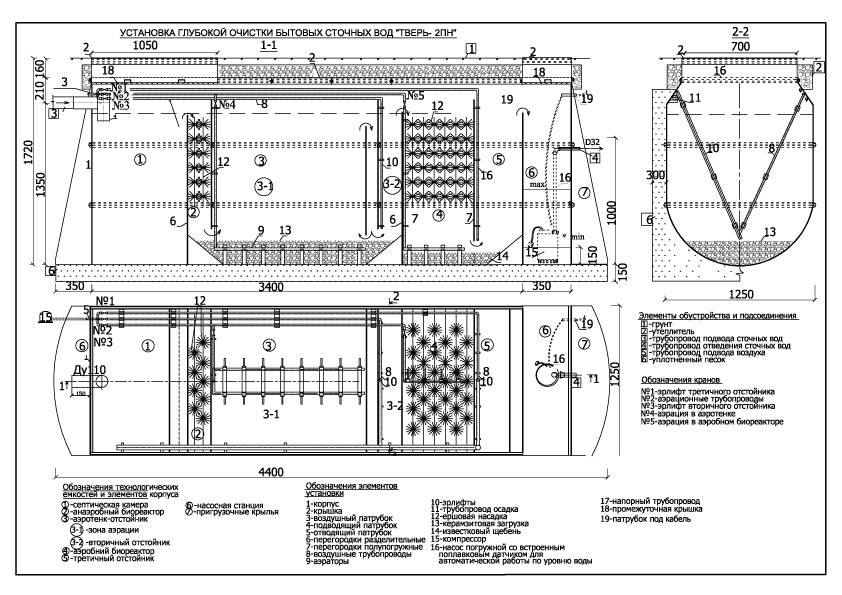
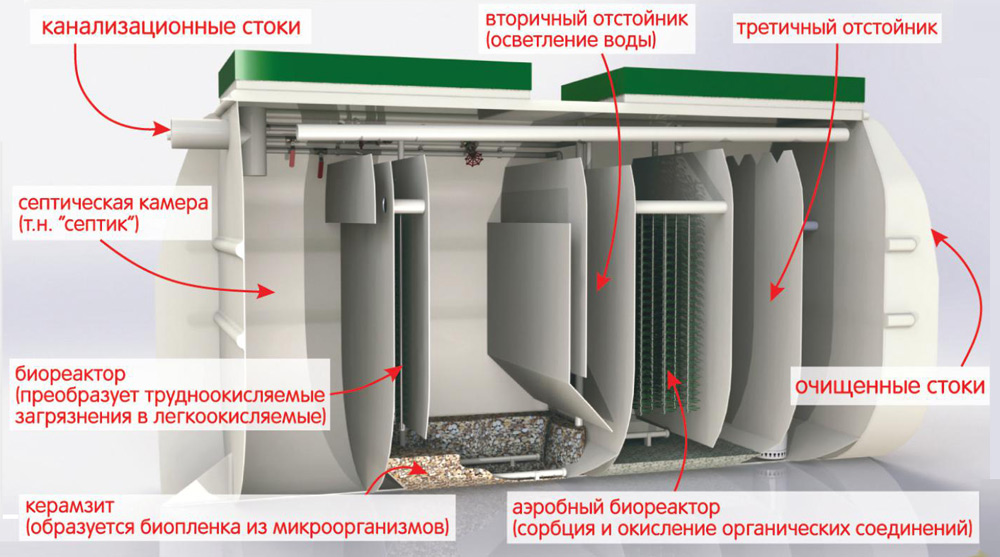
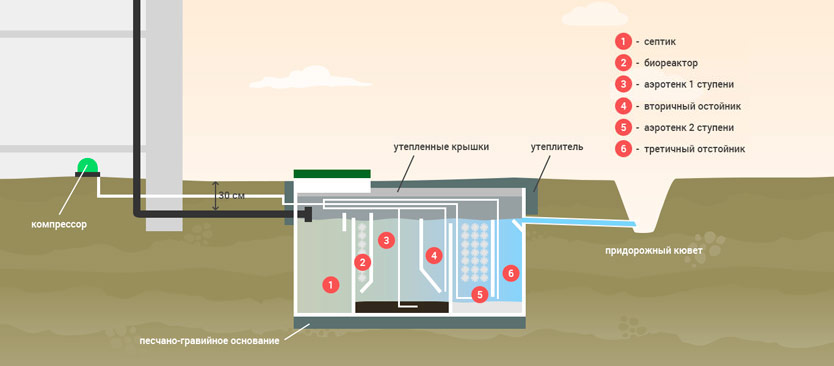
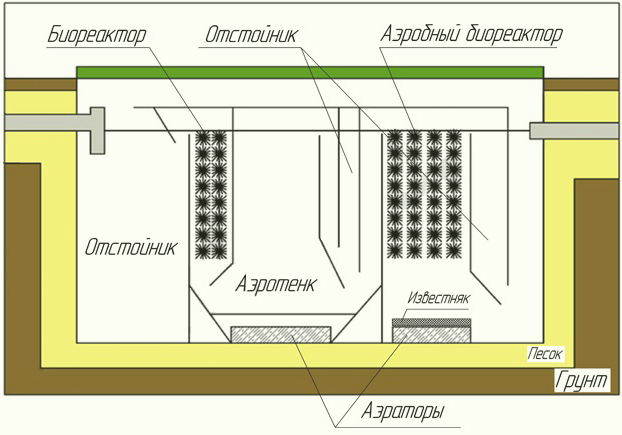
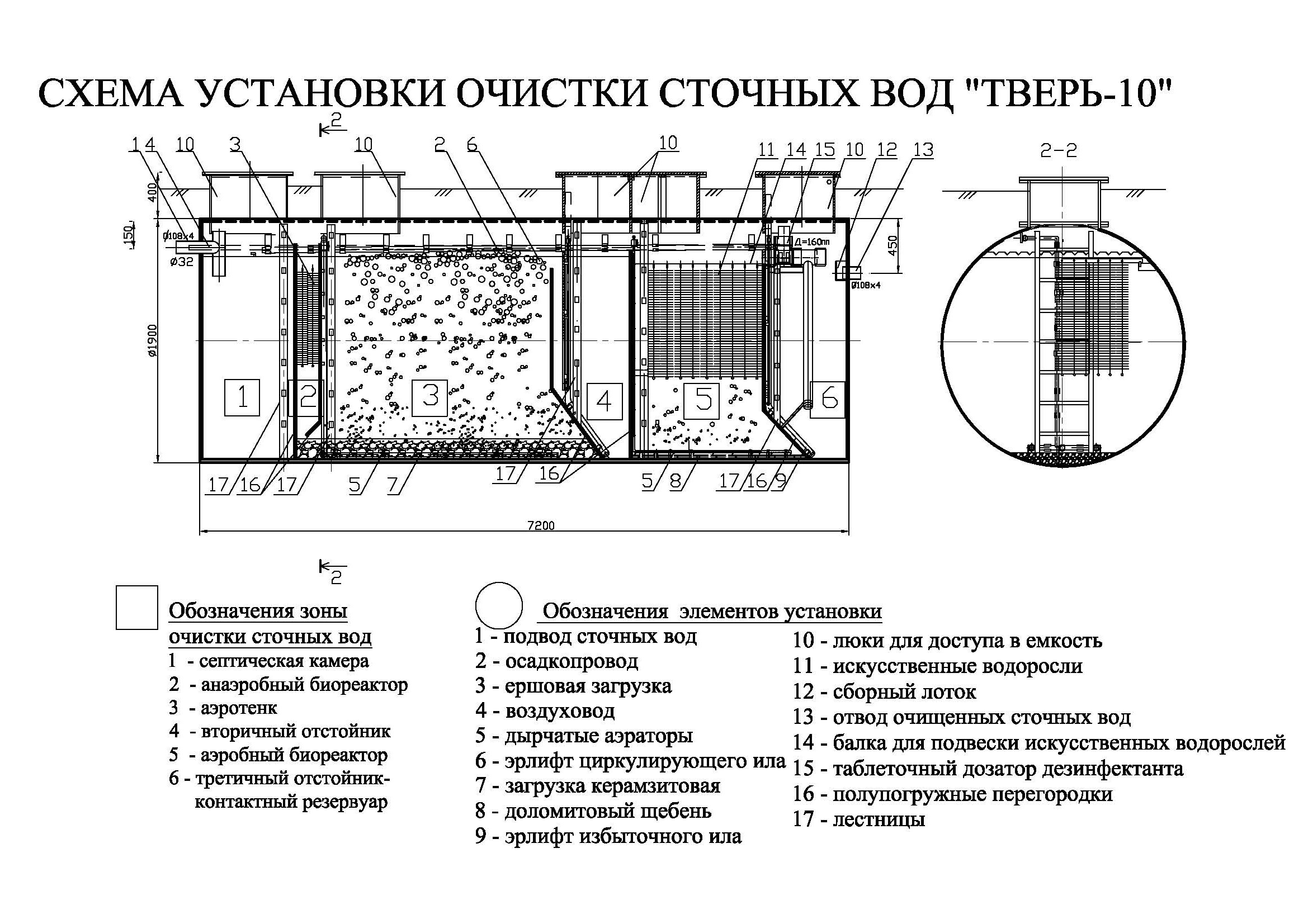
Septic tanks Tver differ from other models in their structure. Thanks to 6 chambers responsible for various cleaning methods, 98% of all contaminants are cleaned. In this way, you can achieve the possibility of recycling wastewater. Here are the functions of different cameras:
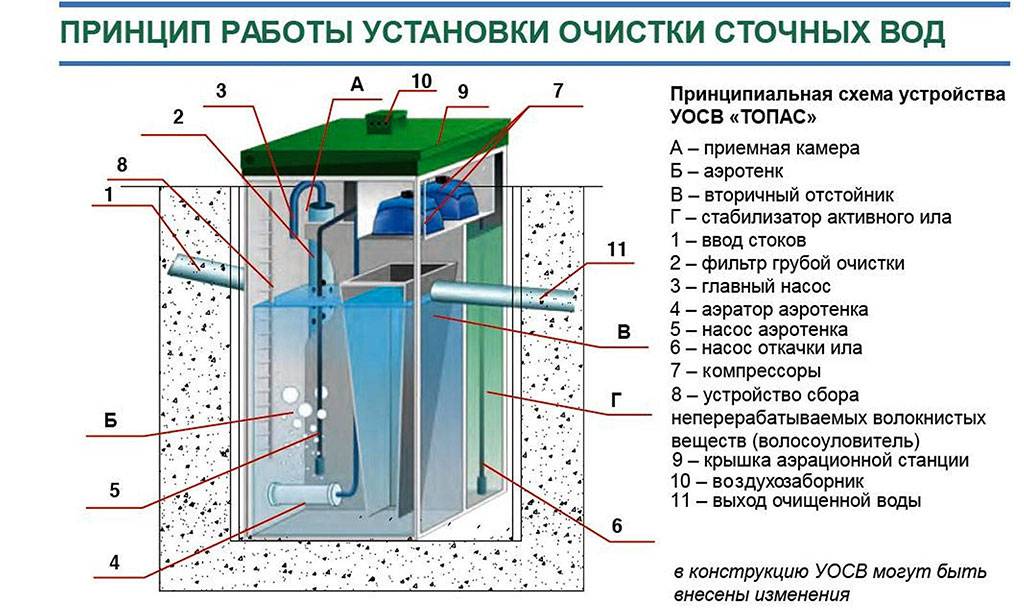
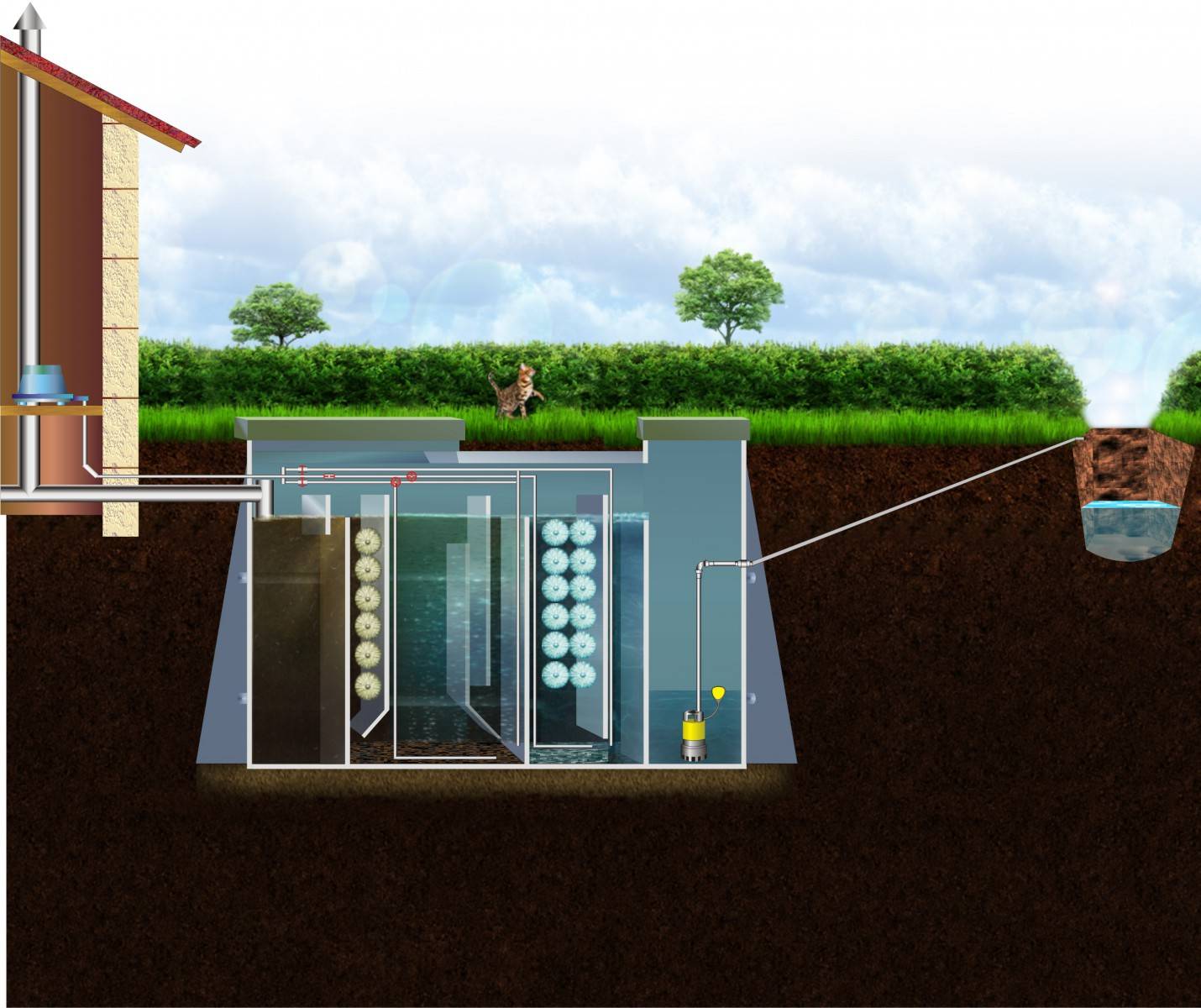
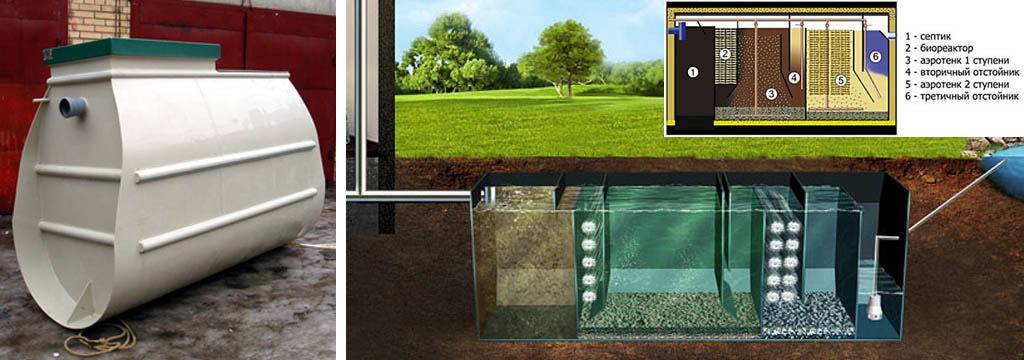


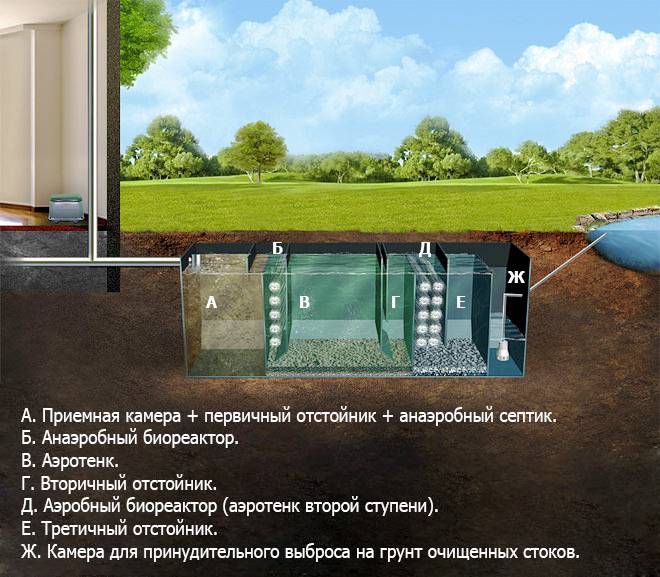
- In the first chamber (this is where the sewage from your house first of all gets) only the largest particles are cleaned. They sink to the bottom.
- When sewage, in which there are no heavy contaminants left, enters the second chamber, they are affected by a bioreactor. In it, all sparingly soluble particles turn into light ones.
- Then the wastewater is sent to the 1st stage aeration tank, where special substances are mixed with them. Thus, the water is significantly purified and becomes much lighter.
- The fourth chamber is also a "sump", but it performs a slightly different function. Its task is to separate wastewater from substances that were mixed with them in the previous chamber.
- A stronger purification takes place in the 2nd stage aeration tank, where wastewater is subjected to deep purification using special chemical compounds.
- In the last chamber, the substance also settles, because the necessary cleaning methods have already been carried out.
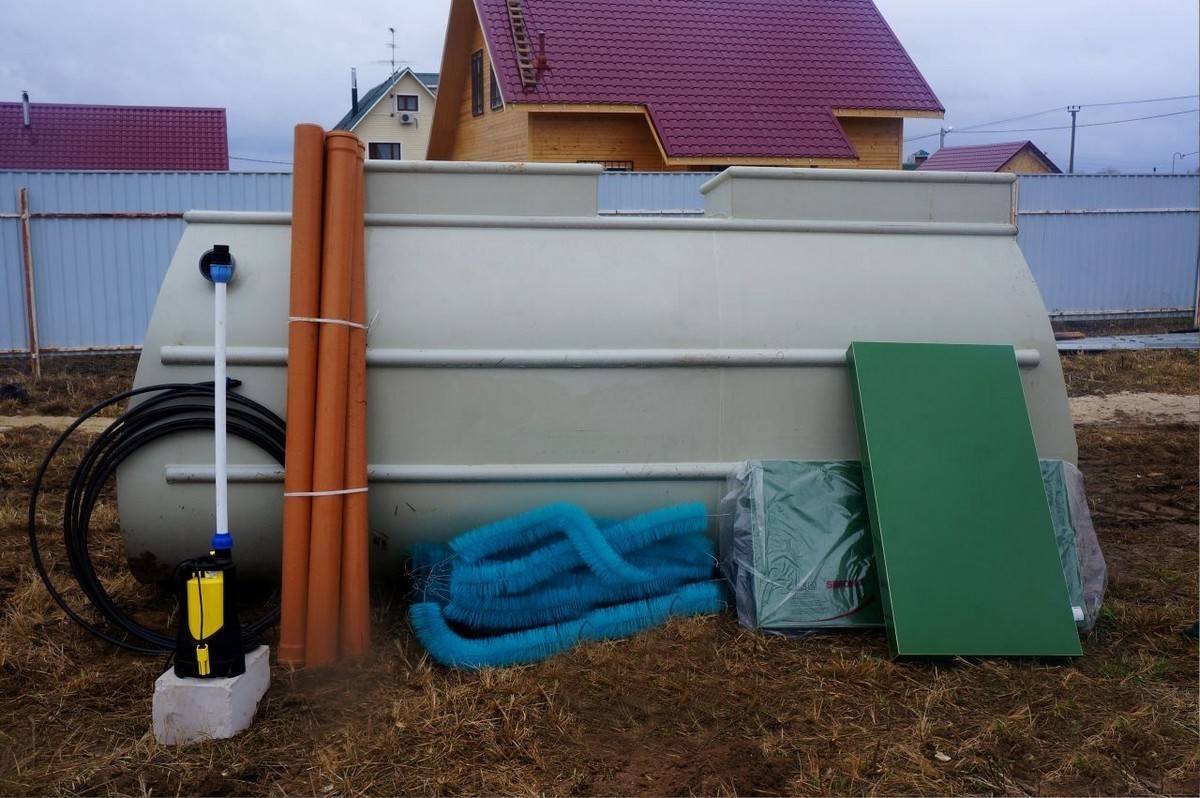
The device of the septic tank Tver
Septic tank Tver price with turnkey installation
On its official website, the manufacturer offers favorable equipment prices, which depend on the configuration of the structure and its modification.The turnkey price may include commissioning, project development, installation and many other works and services.
The price of the installation itself depends on the volume of its performance. Accordingly, the greater the performance, the higher the cost of the cleaning system.
The manufacturer offers:
- Septic tank Tver-0.35 P with a capacity of 0.35 cubic meters per day and a gravity outlet for 64,900 rubles.
- A septic tank Tver-0.35 PN with the same capacity, but forced withdrawal costs 71,100 rubles.
- The septic tank Tver-0.75 P has a gravity outlet and a capacity of 0.75 cubic meters per day. The price of the device is 82,900 rubles.
- The Tver-1PN septic tank with a forced outlet and a capacity of one cubic meter per day costs 112,300 rubles.
- The Tver-25 septic tank is the most powerful system with a capacity of 25 cubic meters per day. The price for it is about one million rubles.
On the manufacturer's website, you can choose a cleaning system suitable for your home with the desired performance and convenient outlet. Installation and operation of such septic tanks can be carried out in any soil.
Model range of septic tank Tver
In order to choose a suitable treatment plant that will meet your needs, you need to familiarize yourself with the existing varieties of the Tver septic tank. The model range of the installation assumes the presence of 44 devices, which differ from each other in different capacities and volumes, which affect how many people can use this waste treatment station.
Various models suggest the presence of certain features characteristic only of them (each letter in the model name means a certain feature of the station):
Septic Tver - its strengths and weaknesses
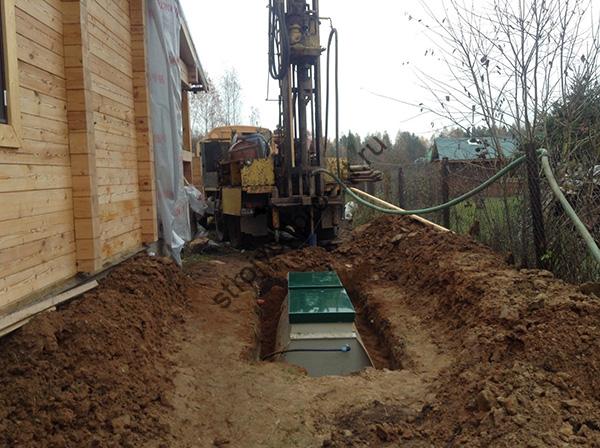
At the moment, autonomous stations, the manufacturer of which is the Tver company, are in great demand. Such systems are characterized by acceptable cost, effective wastewater treatment, ease of installation and long service life. However, like other modern installations, the Tver septic tank also has some disadvantages.
Among the positive qualities it is worth highlighting:
This installation almost completely purifies wastewater. So, the degree of purification reaches 98%, so the user does not have to install an auxiliary filtration system (the entire cleaning procedure is carried out in the station itself);
The septic tank Tver is made of a high-strength polymer composition, which is not afraid of corrosion. Thus, the system is able to serve for many years, effectively cope with the tasks. As the manufacturers themselves say, a septic tank can work for several decades, while it does not require repairs or additional maintenance;
The water after cleaning with a septic tank is as clean as possible, so that it can be drained into the ground, water bodies or reused, for example, when it is necessary to water a garden or vegetable garden. The main thing is to choose a device of such power that it works effectively with a specific volume of wastewater;
During cleaning, the liquid passes through various containers, which provide for different methods of cleaning. Thus, she gets rid of harmful substances;
Thanks to the features of the septic tank Tver, you can simultaneously throw out a large amount of water
For example, if desired, a whole bath can be drained and the water will really be clean;
It doesn’t matter what kind of soil is on the site, you can install a Tver septic tank without much difficulty. However, if groundwater is expected to rise in the area, then the system must be fixed
It will need to be weighted with special "anchors", which, as a rule, are supplied in the kit;
Equipment compressors boast a long service life, and maintenance of the unit is easy. Proper operation involves only cleaning the insoluble sediment, which should be done about once a year;
The design does not provide for removable filters that need to be cleaned from time to time. A special partition inside the septic tank is responsible for retaining the sediment;
To decompose waste, you do not have to buy special preparations. The Tver septic tank is good because it includes a large number of bacteria in its system, which themselves are restored during the service of the autonomous system;
The installation involves a combined cleaning method, so you can not use the septic tank on an ongoing basis, which will not affect its effectiveness in any way;
The septic tank Tver is able to remove phosphorus-containing compounds, which are characterized by their toxicity;
The chance of blockage is minimized, since water almost does not circulate through the hoses;
The main compressor is installed in the house, not in the septic tank. Thus, the service life of the equipment increases significantly;
Large and convenient plastic sewer hatches allow you to quickly and easily clean the septic tank.
Now a few words about the disadvantages:
- This cleaning system has a key disadvantage in that it depends on electricity.The compressor supplies air, which is the main thing for effective water purification. However, even if the electricity is turned off, the Tver septic tank will be able to work for another day, but the cleaning efficiency will decrease;
- High cost. Here it is necessary to take into account that the structures do not require filtration fields and drainage wells.
The light weight and thin walls of the structure are neither advantages nor disadvantages. Due to the low weight, the septic tank is installed without problems, and the walls, although thin, are made of high quality polypropylene. Large loads will bend the walls, but will not destroy.
Disadvantages of a septic tank as a cleaning system
Despite the many advantages that a septic tank has, it is important to point out some disadvantages. This will help the owners of such devices in their proper operation:
This will help the owners of such devices in their proper operation:
Installation of a septic tank Leader
- The contents of the first compartment are not completely recycled. The silty sediment formed at the bottom must be pumped out periodically by means of a specialized machine.
- If the aerator is not used, then cleaning is less effective, since oxygen not only oxidizes the drains, but also serves as food for bacteria.
- The septic tank does not remove nitrates from the drains, so when the outlet water is used for irrigation, these elements can enter the soil, polluting it.
- Do not drain acidic and salty water into the septic tank. This leads to the death of bacteria, and their recovery can take up to 2 weeks.
- If the septic tank is not used in winter, the bacteria can freeze out.
- A septic tank requires regular use, as bacteria need food.




Published: 25.10.2014
Rules for installing a septic tank Tver
Installation work is carried out taking into account a number of requirements:
- Underwater sewer pipes have a diameter of 10 cm. The laying depth is from 30 cm.
- In a previously prepared trench for pipes, a compressor air outlet device is simultaneously laid.
- Tver septic tanks are mounted underground, using crushed stone with sand as a foundation.
- The formation of leakage of wastewater into the soil and foundation through the drainage system is excluded.
- Upon completion of the installation of the unit in the pit, it is leveled to the level of the horizon. This will prevent overflows and ensure proper circulation of water through the system.
Advice! Unlike conventional septic tanks located far from home, Tver is installed in compliance with the minimum gap from the sewer outlet. By installing the unit near the outlet, it is possible to ensure the optimal depth of the inlet pipe. When choosing Tver products, the supply pipes are placed at the maximum height, this contributes to the removal of clean water without the use of pumping systems, that is, by gravity.
Technology of installation of treatment equipment
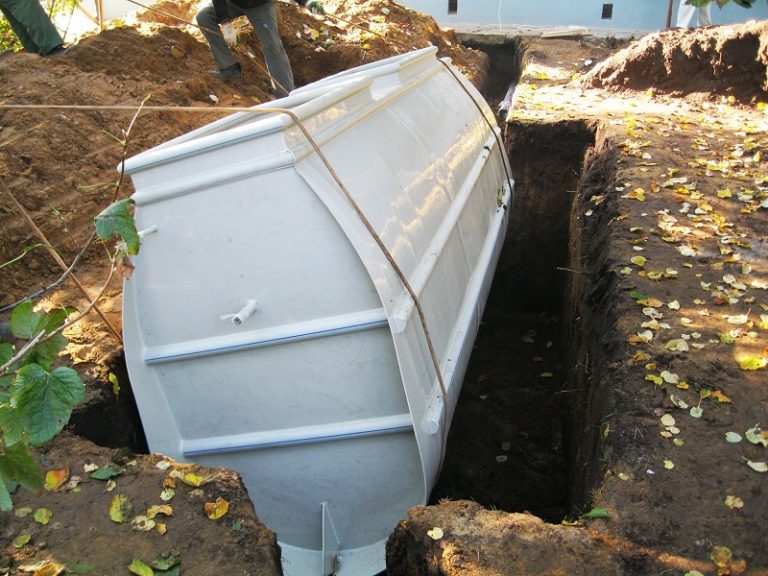
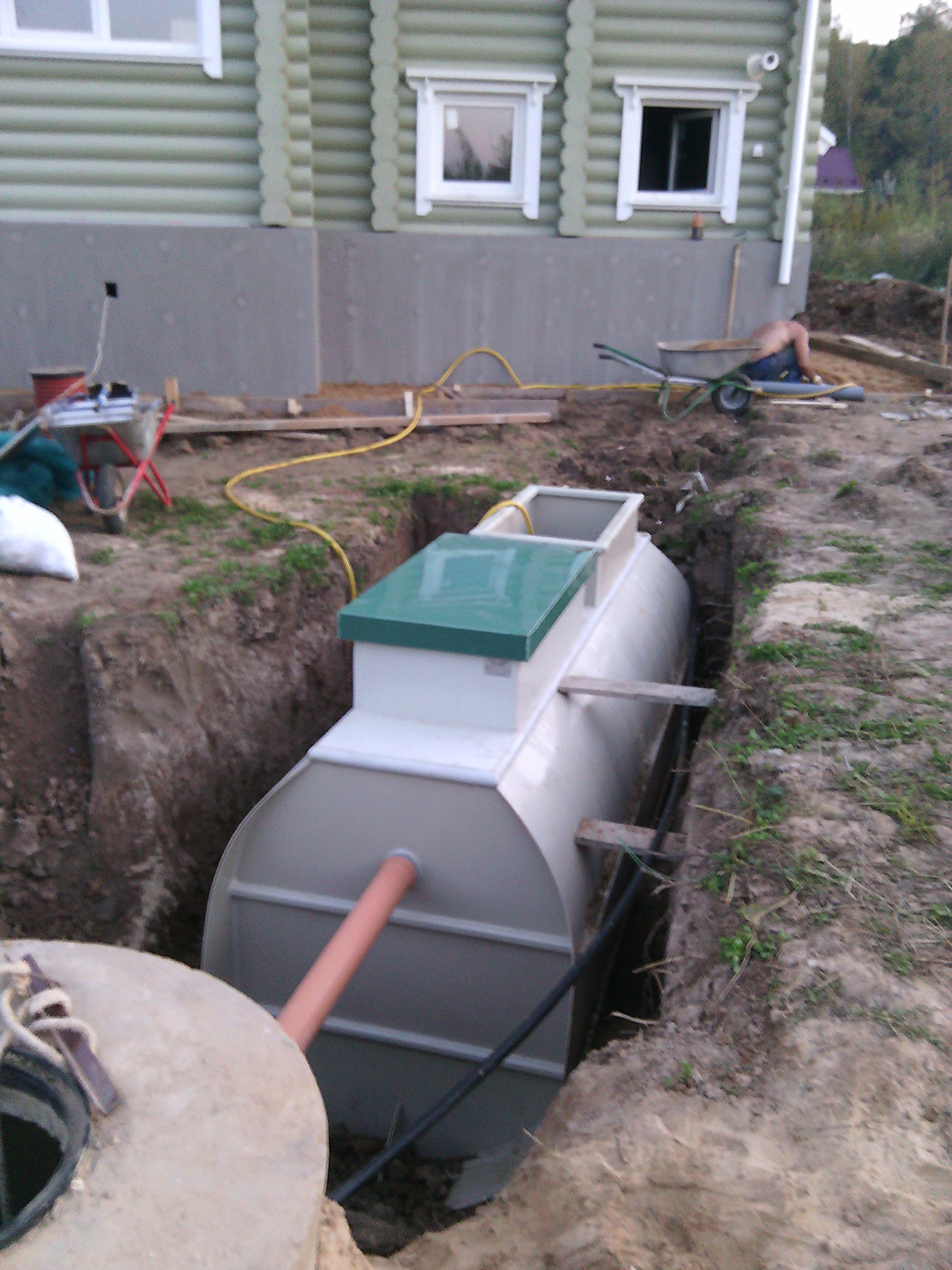
Work begins with the preparation of a pit for a septic tank. Its dimensions should exceed the installation dimensions by 0.3-0.4 m. The bottom of the pit is leveled and compacted. A pillow of compacted sand or gravel about 15 cm high is laid on it.
Now we are connecting to the septic tank. We lay pipes diameter 100 mm with slope not less than 0.02 or 2 cm per linear meter. It is desirable to lay the highway without turns.
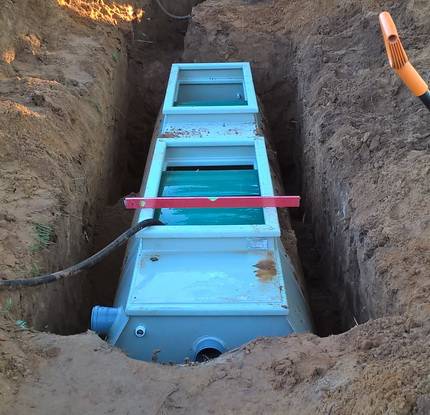
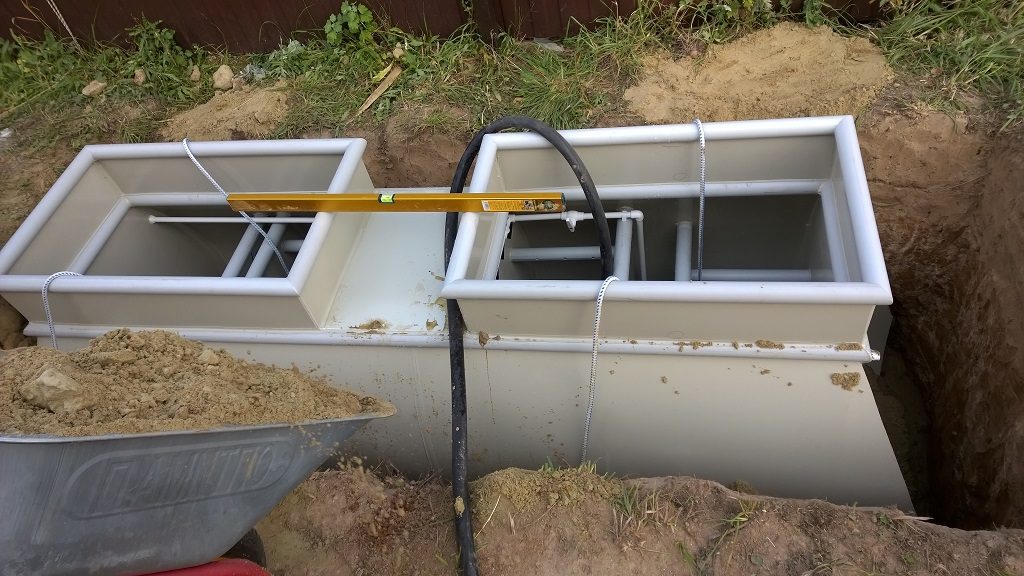
The correct location of the septic tank inside the pit is constantly monitored using a level
If they are still there, they must be performed inside the revision well.The diameter of the structure should be 70 cm, the radius of the tray should be 30 cm.
If the pipeline route crosses heaving soils, they will need to be excavated depth 40 cm from bottom edge of the pipe and replace with compacted sand. The places where the sewer pipes are connected to the branch pipes are sealed.
Home sewerage must be equipped with one or two sewer risers. Without it, the correct operation of the septic tank is impossible.
The ventilation riser of the sewerage exiting through the roof must in no case be connected to the internal ventilation system. It is connected to the sewer wiring of the building.
Inside the trench, next to the supply pipe, an air duct from the compressor is laid. It should be laid with a slight slope towards the septic tank. This is also where the power cable is located. Similarly, we equip the outlet line.
Its slope depends on the chosen method of treated water. For example, if it leaves by gravity, the slope of the pipe is chosen not less than 0.01, i.e. 1 cm per linear meter.
If forced liquid pumping is selected, the slope should be "reverse". That is, when the pump stops, the water must return to the septic tank. After the work on arranging the pipelines is completed, you can proceed with the installation of the device housing.
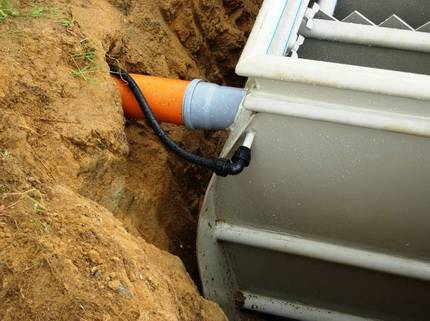
All connections are made as carefully and carefully as possible. There should be no leaks, otherwise the structure will lose its tightness
The container is lowered into the pit and carefully installed on the base. Using a level, you need to check the horizontal installation. If violations are found, they should be corrected by pouring sand under the edge of the hull.
Next, anchoring of the tank is carried out. For this purpose, there are special load-bearing protrusions at the ends on the body.Then all communications, including electricity, are connected to the device.
Now you need to fill the body to the level of the weirs with clean water. Simultaneously with filling, the body should be backfilled with clean sand without clay inclusions. Backfilling is carried out from all sides to a height of about 30 cm.
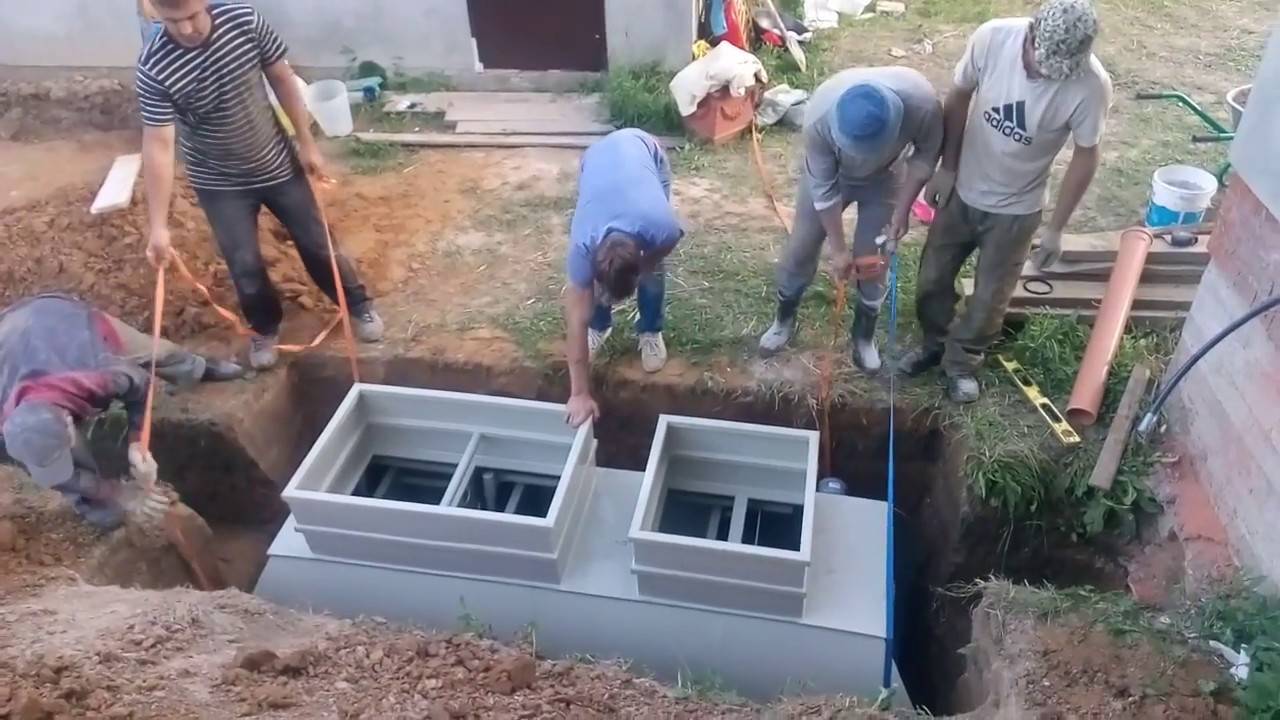

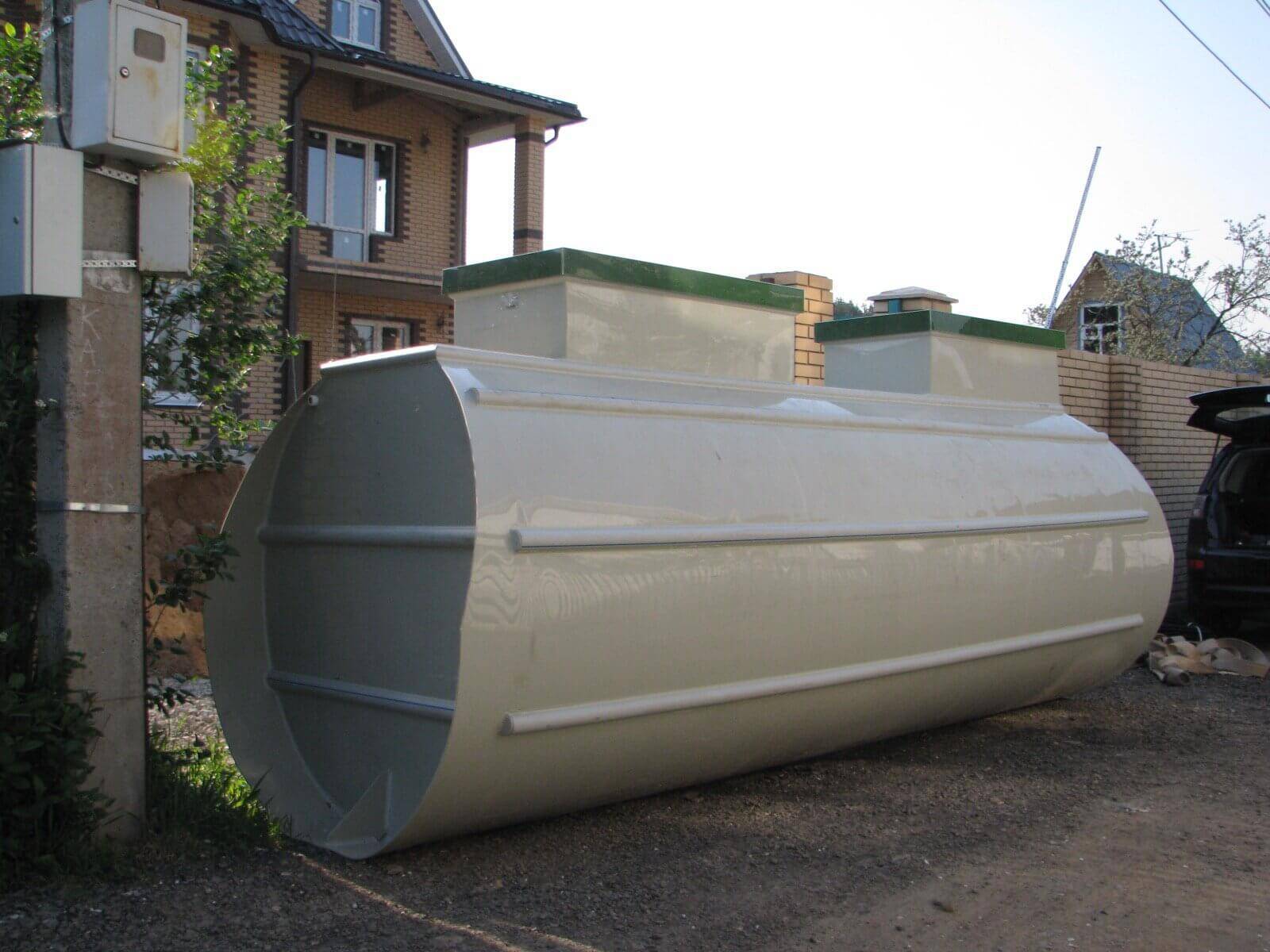



It is important to control the correct installation using a level. The body must be strictly horizontal.
Next, you can proceed to the insulation of the septic tank.
The upper part of the device is covered with any insulation. More often, mineral wool is used for these purposes. It is fixed on the body, after which the septic tank is backfilled with soil.
For a test run, sewage is supplied to the septic tank while the compressor is turned on at the same time. An important condition for the operation is positive air temperature outside. At the final stage of installation, the necessary standard and additional equipment is installed in the septic tank.
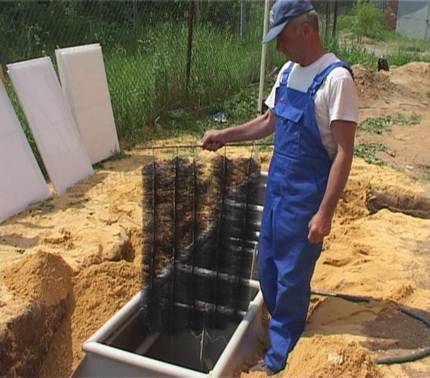
At the final stage of installation, the necessary standard and additional equipment is installed in the septic tank.
The temperature of the drains used for the first start-up must not be lower than 12ºС, otherwise the device will not “work”. Then you need to start the aeration system and, following the instructions, adjust the supply of the required amount of air to the corresponding equipment compartments.
If everything was done correctly, then after 3 or 4 weeks the liquid at the outlet of the septic tank will reach the desired degree of purification.
To verify this, it will be necessary to take samples several times and analyze them. Externally, the liquid should be transparent, odorless, colorless and any visible inclusions.If the degree of purification is insufficient, the operation of the septic tank must be adjusted.
It is unlikely that it will be possible to do this on your own, it is best to invite the service specialists of the company that manufactures the treatment equipment.
Disadvantages and features
Tver septic tanks have disadvantages inherent in all devices of this class:
- Complete dependence on electricity. For the normal functioning of the septic tank, it is necessary that air is supplied to the aeration tank. Accordingly, in the absence of electricity, the compressor will not be able to carry out this process. But at the same time, Tver will operate for at least another day before its productivity begins to decline.
- Relatively high price but at the same time it must be taken into account that the sewerage system, where the septic tank is installed, does not need drainage fields and a drainage well, which significantly justifies the cost of Tver.
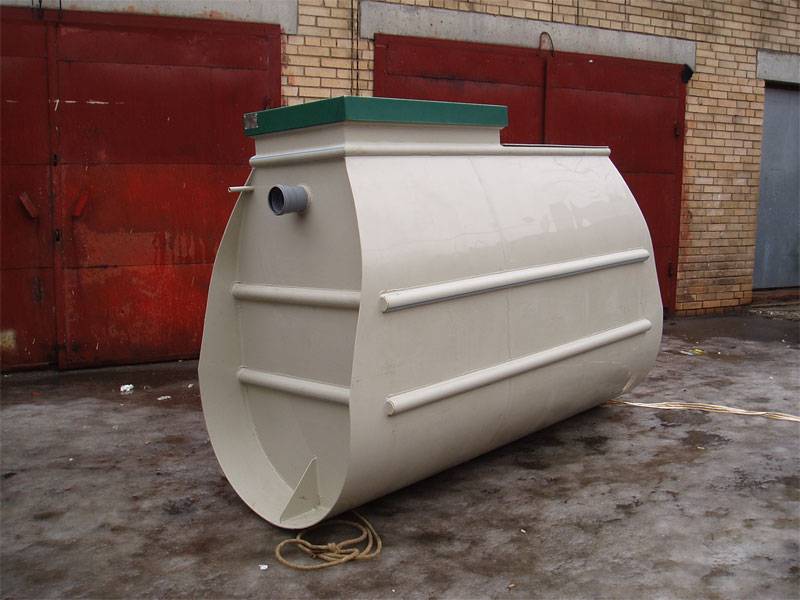
Let's move on to the features. The body of the structure has thin walls, but high-strength polypropylene is used for their manufacture. The case can bend, but it will not lose its tightness. On the other hand, thin walls make the structure lighter, so its delivery and installation are greatly simplified.
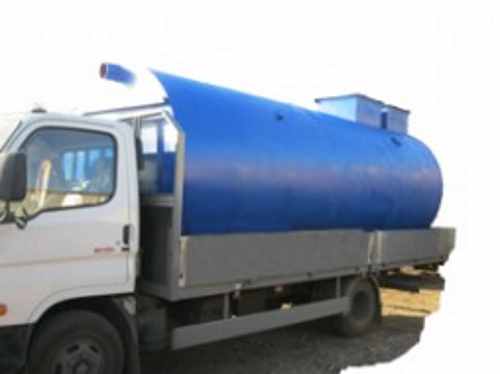 When transporting, dimensions play a decisive role, not weight.
Where to place the installation: rules and regulations
Septic tanks are among the potentially dangerous objects for the environment. Permission is required for their installation. from SES. To get it, you need to draw up a project for the placement of equipment, which must take into account all applicable requirements and standards.
If everything meets the standards, permission will be obtained.The project takes into account not only the location of the installation, but also its volumes.
The last indicator should not be less than the three-day maximum stock volume. The place where the septic tank is installed must be removed as far as possible from the well or from the well, if they are on the site.


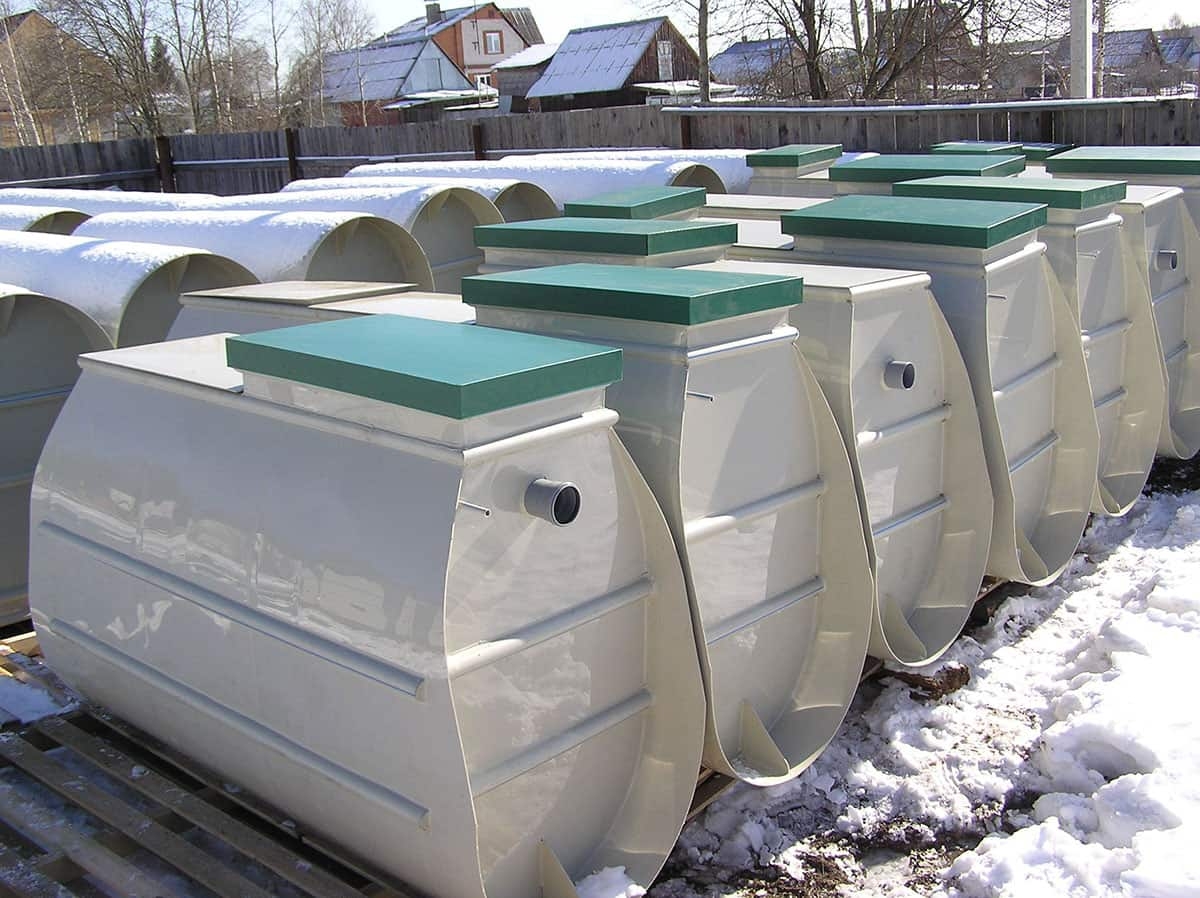

Although the treatment equipment is hermetically sealed, it is theoretically possible that an emergency situation could occur, as a result of which runoff could enter the aquifer.
According to the standards, the distance from the foundation of a residential building to a septic tank must be at least 5 m, but an exception is made for VOCs with forced pumping of treated effluents
To avoid such problems, the regulations regulate the distance from the treatment plant to the well or well for each type of soil. The minimum is 20 m.
On average, if there is loamy, sandy or sandy soil on the site, this distance ranges from 50 to 80 m. There are certain rules that apply when laying water pipes. They must be placed at a distance of at least 10 m from the septic tank.
This completely eliminates the risk of water pollution in the event of a pipeline depressurization. Another nuance: when choosing a site for installing a septic tank, you need to remember that relative to the water source, the level of its location should be lower.
In addition, it is necessary to take into account the norms regulating the distance between the treatment plant and the place of residence of people. From the foundation of the house to the septic tank must be at least 5 m.
However, too much distance between objects is highly undesirable, since a long sewer pipeline is more at risk of blockages.
It is important to choose the correct length of the structure.In the case of using a modification of the Tver septic tank with forced pumping of process water, you can place it closer to home
The ventilation riser in such cases is installed at the entrance to the external sewer branch and is attached to the wall of the house. The inlet sewer pipe can be about 1 m.
The type of discharge and the length of the outgoing pipe depends on the geological and hydrogeological conditions in a particular area. In any case, the external sewer network must be equipped with revision wells.
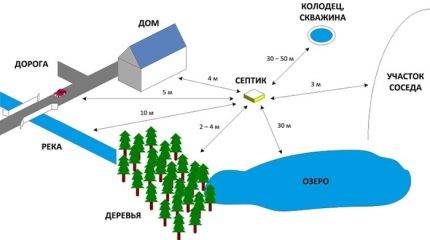 The septic tank is potentially hazardous to the environment, so it must be placed in accordance with the requirements of current regulations (+)
It must be remembered that when choosing the location of the septic tank, the interests of not only the owner of the land plot, but also his neighbors should be taken into account. Therefore, the distance from the installation to the fence cannot be less than 2 m.
If a road with fairly heavy traffic is laid nearby, the septic tank cannot be installed closer to it than 5 m. The distance from the foundation of outbuildings for any purpose to the septic tank should not be less than 1 m.
Professionals advise planning the installation of treatment equipment on a site with soft soil, which will greatly facilitate excavation. In addition, care must be taken to ensure free access to the device for its regular maintenance.
All of the above requirements must be taken into account when choosing a place for a septic tank.
Advantages and disadvantages of the treatment system
Tver septic tanks have advantages and disadvantages, like any technical device. However, the number of pluses significantly outweighs, due to which these treatment facilities are widely and successfully used.
Design advantages:
- Complete water purification takes place in one tank - no additional additional filtration devices are required.
- A septic tank with a properly selected capacity cleans up 98% of wastewater - such water can be discharged onto the terrain, into a reservoir, and used for household needs.
- The body of the septic tank is made of high-strength polymer material that is not subject to corrosion and erosion, which ensures a long service life of the device.
- There is no need to constantly use bioactivators - the bacteria in the septic tank are restored on their own and actively multiply.
- Purification of toxic phosphates and nitrogen compounds is provided.
- Solid sludge is pumped out once a year or less.
- The Tver septic tank can be used even with intermittent operation - thanks to the combined cleaning method, the intermittent cycle does not create a large load on activated sludge and, in the absence of power supply, the septic tank goes into sleep mode.
- In a septic tank, liquid does not move through pipes or hoses, so there is no danger of clogging the system.
- The design calmly withstands salvo discharges of wastewater without loss of treatment quality.
- Large inspection hatches make it easy to carry out routine inspections of the system, maintenance and pumping of solid sludge.
- The compressor is located indoors - it is convenient for maintenance and significantly extends the life of the unit.
- Compact overall dimensions and light weight allow you to install the Tver septic tank on your own, without the involvement of special equipment.
Flaws:
- Energy dependence of the system;
- The high price of the complex.
However, the rather high cost of a septic tank pays off already during installation - there is no need to build absorption wells or spend money on arranging a filtration field.
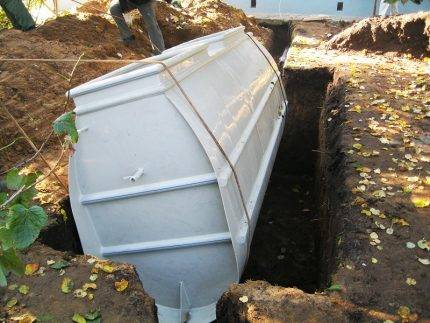
Installation of the Tver treatment station is often performed on its own. This allows significant savings. The cost of such a design does not exceed the amount that would have to be spent on the purchase and installation of a treatment system based on a simple septic tank.



Conclusions and useful video on the topic
The device and principle of operation of the septic tank Tver:
The device and operation of the Tver septic tank, its advantages in comparison with other systems. Winter preservation tips:
The septic tank "Tver", due to its versatility, is used for private houses and cottages located in areas with any type of soil. More productive designs suit for the disposal of wastewater from small production sites and storage facilities, remote from central communications.
Share with readers your experience of using the Tver septic tank. Please tell us about the features of its maintenance and operation. Participate in discussions and ask questions that interest you - the comment box is located below.



