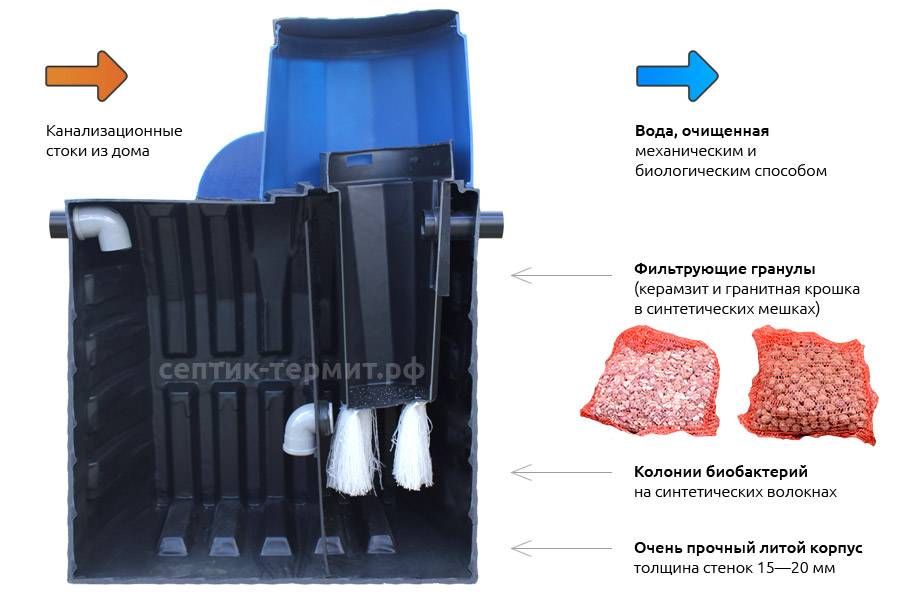
- The device and principle of operation of the septic tank "Termite"
- Models
- Drives
- "Termite 2F"
- "Termite 2.5F"
- "Termite 3F"
- "Termite 3.5F"
- "Termite 5.5F"
- "Termite Profi"
- "Transformer S"
- "Transformer PR"
- Installation of a septic tank "Termite": stages of work
- Service life — 50 years
- Operation features
- Do-it-yourself installation of a septic tank "Termite"
- Necessary materials, tools and accessories
- Preparatory stage
- Installation of a treatment plant
- The model range of the septic tank termite and the price with turnkey installation
- Mounting technology
- Installation of a septic tank
- Installation of the infiltrator
- Modifications of the septic tank Termit
- Models of septic tanks Termit
- Modifications
- Thermite 1 and 1.5
- Termite 2
- Termite 3
- Termite 5
- Sprinkler
- The procedure for installing a septic tank Termit
- Installation of a septic tank Termit
- Installation Tips
- Maintenance
- Principle of operation
The device and principle of operation of the septic tank "Termite"
Treatment facilities are manufactured in the Russian Federation. They meet sanitary and construction requirements, do not harm the environment. The work is based on the principles of purification at the mechanical and biological levels. Usually in "Termite" there are two or three compartments. When passing through them, polluted waters are purified and clarified.
Purification of polluted waters is carried out at the mechanical and biological levels
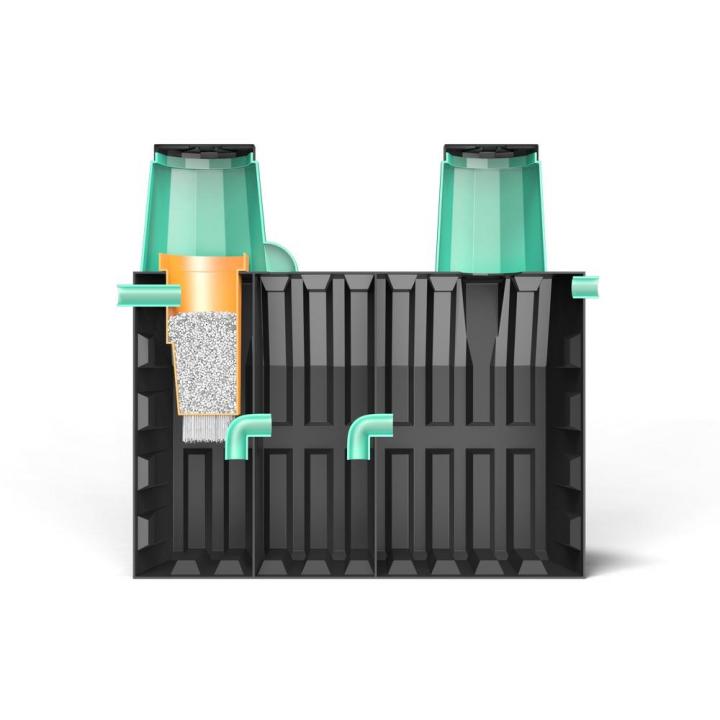
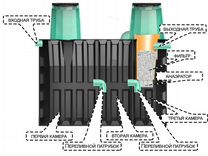
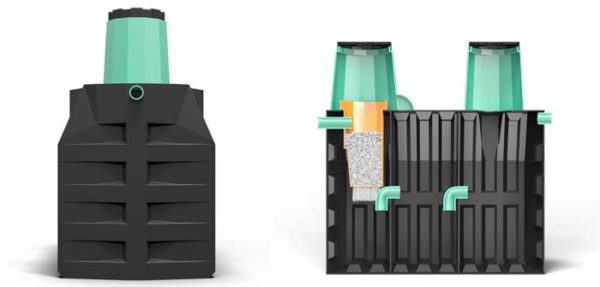
The septic tank consists of the following compartments:
- accumulation chamber - it is used to collect effluents and their sludge, to settle solid particles;
- bacterial filtration compartment - in this tank, previously clarified waters are additionally purified by bacteria that live on special brushes;
- additional sump - this compartment is not available in all versions of the "Termite". In it, sewage is settled again, and pollution settles to the bottom in the form of activated sludge.
All tanks are connected to each other by an overflow - a special connecting pipe.
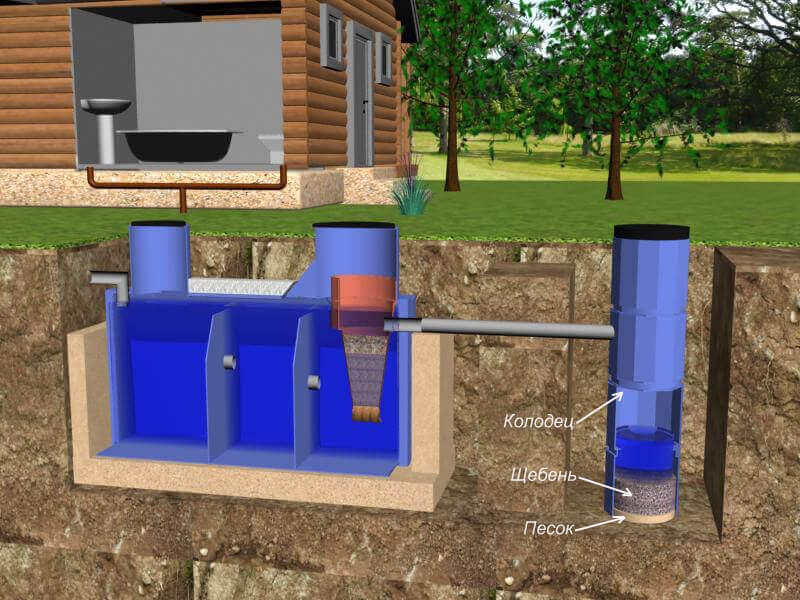
The method of operation of the unit with the simplest cleaning system:
- From the sewer system, pollution flows into the first sump, where large and heavy particles settle.
- When the overflow level is reached, they move to the next compartment. The location of the overflow prevents large contaminants from flowing further. They remain in the first cell.
- In the second compartment, wastewater is cleaned due to the activity of microorganisms, due to which the remaining dirt breaks down into water and nitrites. The liquid rises and is filtered, after which the water can be considered 65 percent purified. Due to the activity of anaerobic bacteria, an unpleasant "aroma" is possible.
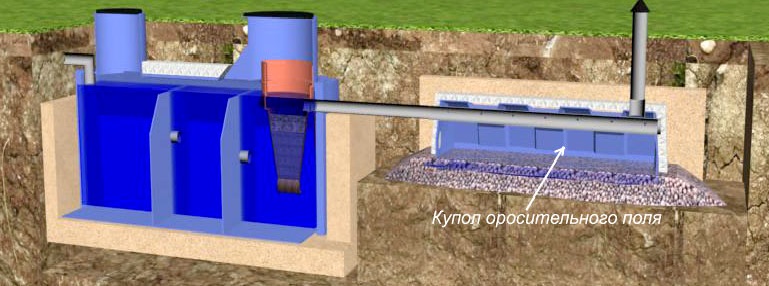
- The liquid is in the irrigation dome - infiltrator. After passing through an additional soil filter, the quality of fluid purification is about 95 percent. Water is used for watering a garden or garden, since it can already be considered safe.
The device does not require electricity to operate. Energy independence is one of the main advantages of Termit cleaning devices.
Models
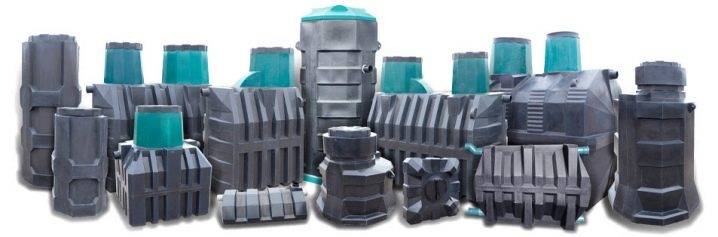
There is a wide range of cleaning mechanism "Termite", which differ in performance and design dimensions.
Drives
These are sealed containers designed to collect household waste. This type of plant offers the simplest installation and operating principle. Consider the types of drives that are available in 6 versions.
"Termite 2F"
The tank of the device consists of 2 chambers, the capacity of which is 700 l / 24 hours. The Termite septic tank is designed to serve 2-4 residents. This septic tank has 1 neck, which is used to pump out sludge from the bottom of the tanks. The system is equipped with 2 fittings, the diameter of one fitting is 11 cm. The mass of the structure is 140 kg, the volume of the container is 2 cubic meters. l. The filter mechanism is loaded with pumicite and a weighting agent. The dimensions of the septic tank are 1415x1155x2005 mm.
"Termite 2.5F"
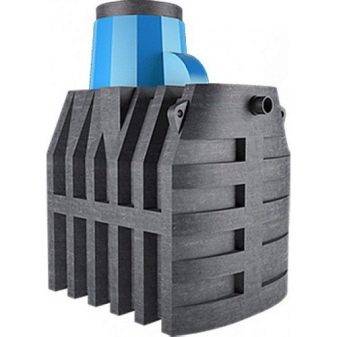
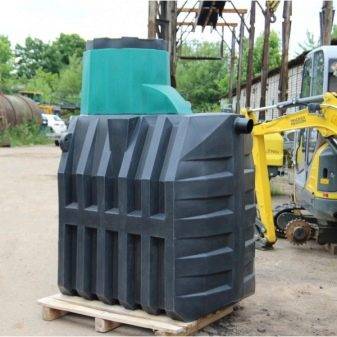
The volume of the tank is 2500 liters, it has 2 chambers and is designed to serve 3-5 people. Each chamber of the cleaning mechanism is equipped with a neck. The diameter of 1 compartment is 50 cm, through which sludge is pumped. 2 chamber with a diameter of 65 cm, which is used for special filter maintenance. The performance of the structure is 1 m3/24 hours. The thickness of the case walls is 20 mm, the dimensions are 1820x1155x2005 mm. The weight of the system without filtering mechanism is 120 kg.
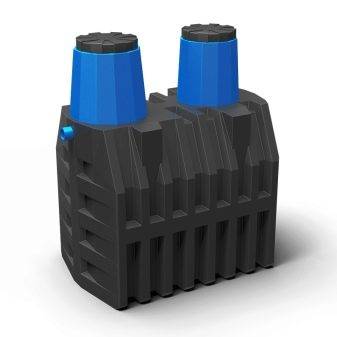
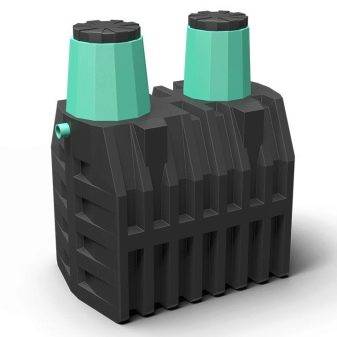
"Termite 3F"
A capacious mechanism, the volume of which is 3000 liters. The productivity of the system is 1.4 m3 / 24 hours, the septic tank can serve 4-6 residents. This type of septic tank consists of 3 chambers, which affects the quality of wastewater treatment. The dimensions of the mechanism are 2210x1155x1905 mm.
"Termite 3.5F"
The three-chamber cleaning mechanism with built-in filter mechanism has a rectangular shape and is equipped with 2 mouths with opening lids. The volume of the tank is 3500 liters, the productivity is 1.8 m3/day.This capacity of the tank allows you to serve 5-7 people. Housing dimensions - 2230x1190x2005 mm, construction weight - 175 kg (without filter).
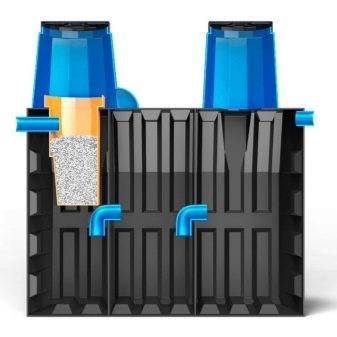
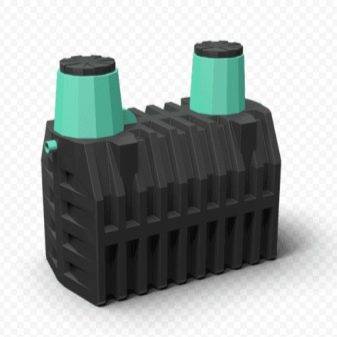
"Termite 5.5F"
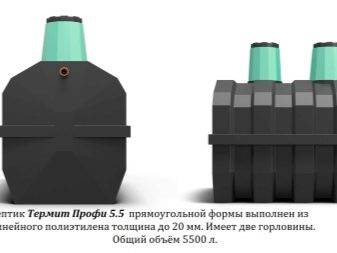
The most capacious purification system among the Termit septic tank models, because the volume of the tank is 5500 liters, and the productivity is 2.5 m3 / 24 hours. A powerful cleaning mechanism is able to cope with the treatment of wastewater from several baths, bathrooms, washing machines. It is made to serve 7-11 residents. Capacity parameters: 2220x1650x2395 mm, system weight - 260 kg.
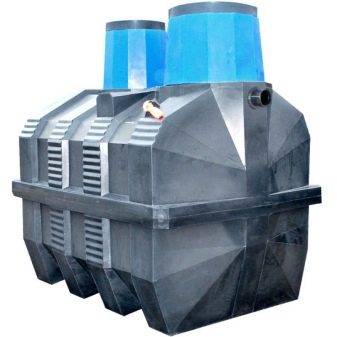
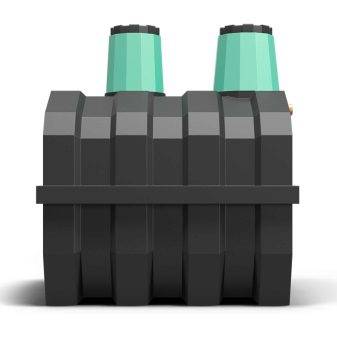
"Termite Profi"
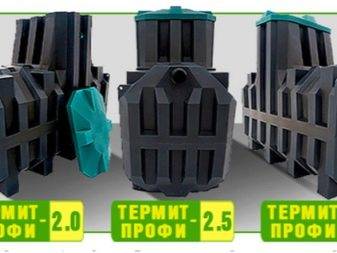
The septic tank "Termite Profi" refers to non-volatile installation structures. It is designed to serve residents in seasonal dachas. The disadvantage of installing this design is that the septic tank can function at a low level of groundwater. The firm "Multplast" manufactures such installations of 5 modifications. The most low-power mechanism is "Termite Profi 1.2", whose productivity is 400 l / 24 hours, and 1-2 people are capable of serving.


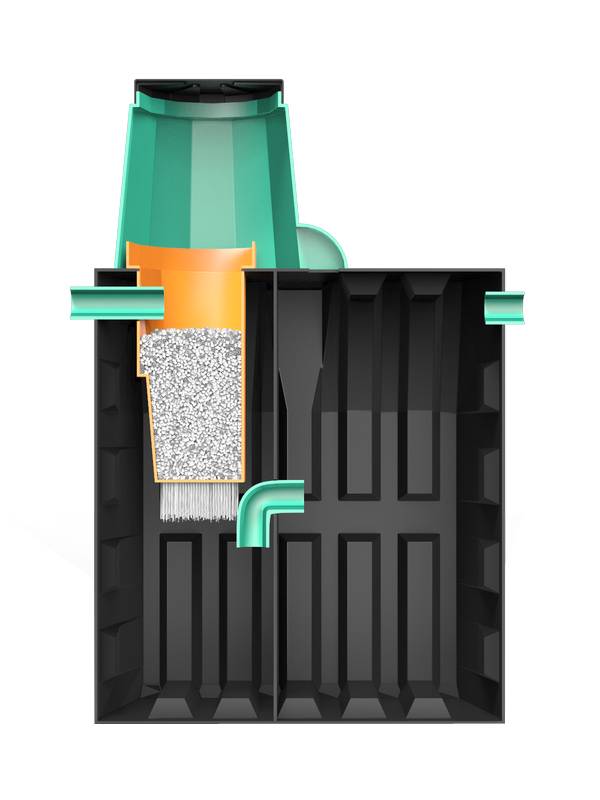
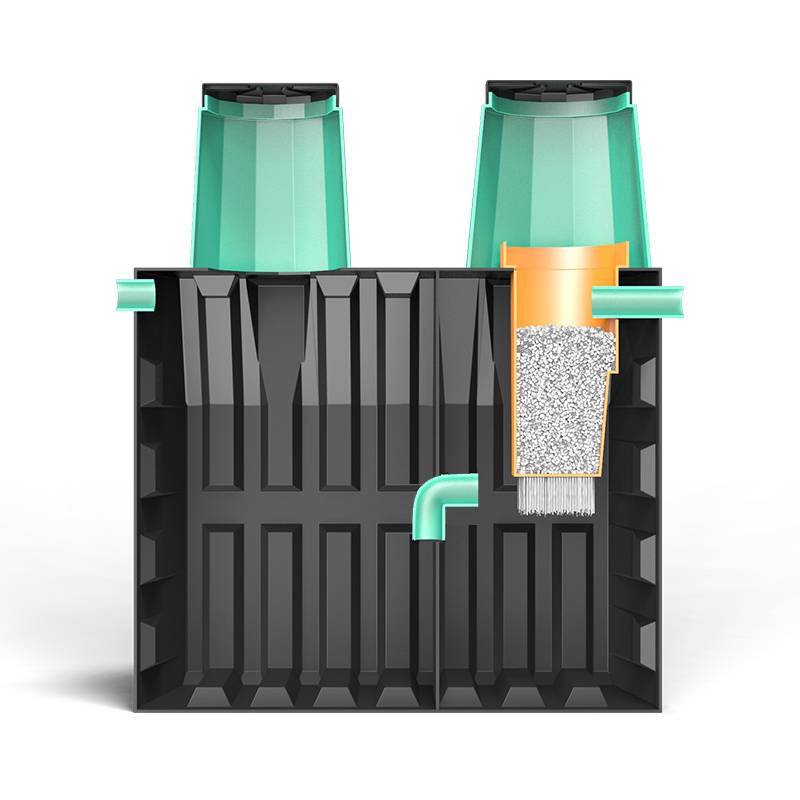

"Transformer S"
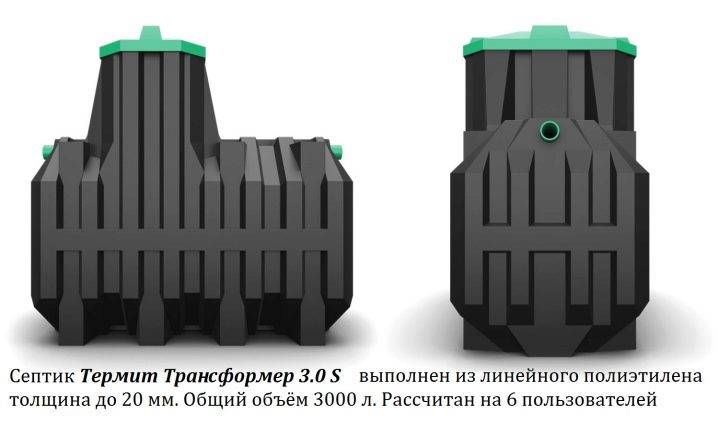
This series of installations with gravity drainage. The inside of the tank consists of 3 compartments. The overflow from compartment 1 to compartment 2 is equipped with a coarse-grained filter mechanism. The second chamber is filled with a polymer filler to create comfortable conditions for the functioning of microorganisms. From the 3rd chamber, the liquid flows by gravity into the sprinkler for soil purification.
"Transformer PR"
The internal arrangement of such units is similar to the treatment facilities of the previous series. They differ only in that the Transformer PR model provides for mounting a drainage pump for pumping fluid from 3 chambers per filtration field.The nozzles of this septic tank have different diameters - 11 cm and 32 cm. The most popular model among users is "Transformer 2", which is able to serve 3-4 people, and the productivity of the tank is 800 l / 24 hours.
Installation of a septic tank "Termite": stages of work
The installation schemes for the Termit cleaning system are generally approximately the same, however, each modification has its own characteristics. In this case, consider the sequence in which the system is installed with an additional installation of the infiltrator:
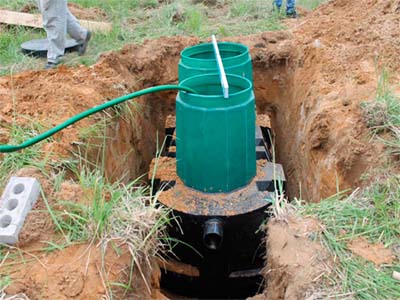
- First of all, for a local treatment plant, it is required to prepare a pit in accordance with the size of the septic tank. As a rule, the width of the dug hole should be at least 30 cm larger than the width of the system. Depending on the conditions, the pit can be dug manually or using special equipment - in the second case it will be more expensive, but much faster. The walls of the finished pit should be even, without any unnecessary elements such as large stones, tree roots, and the like.
- One of the main elements of the system is a trench for a pipe that leads to a drain point - a house or other building. At the bottom of the trench, a sand cushion with a thickness of at least 30 cm should be placed. At this stage, the main thing is to observe the slope in accordance with building codes. So, for the most commonly used pipes with a diameter of 11 cm, the slope is no more than 2 cm per linear meter). If the system is installed in a cold climate, then the trench and the pipe itself must be insulated.
- The bottom of the pit must be covered with sand in an even layer of at least 10 cm. This creates a pillow for pipes. In this case, it is necessary to use the building level - sand leveling should be almost perfect.
- The next stage is the installation of concrete blocks at the bottom of the pit. This procedure is carried out using a crane or excavator. This is necessary so that the "Termite" is fixed at the bottom of the pit and in no case floats in the spring under the pressure of groundwater.
- Actually, the body of the septic tank should be fixed with anchor chains and hooks. They "Termite" is attached to concrete blocks.
- After that, the system is placed in a pit. To do this, there are special holes on the body of the septic tank, for which the excavator or crane-manipulator holds the "Termite" from the sides when immersed in the pit.
- In order to assess the correct installation of the Termite tank, a check is required using a level located on the neck of the hatch.
- The anchoring stage is coming - a very important moment that prevents the septic tank from floating up due to groundwater pressure in spring or during periods of heavy rainfall. To do this, a chain is placed through the body of the system, which is fixed on previously placed concrete anchor blocks.
- After that, red sewer pipes are placed in the trench - those that are intended for laying external pipelines.
- Then the trench and the pit, in which the pipes and the septic tank have already been laid, should be covered with sand. In this case, the septic tank must be closed by it to the neck of the hatch.
- At the same time, the system is filled with water, mainly for testing, as well as protecting the vessel walls from external pressure. The main condition for high-quality work is that the sand must be compacted every 20 cm.
- The next layer is soil. They fill the septic tank from the neck of the hatch to its upper part.
- After that, an infiltrator is installed for additional water purification.It requires a separate pit with a depth equal to the height of the system and the height of the gravel cushion, which is at least 40 cm. Geotextiles must be placed under the infiltrator. It is needed to protect the device itself and the gravel pad in the event of soil movement, when there is a change in the level of groundwater, as well as temperature fluctuations.
- It is necessary to place a pillow of gravel on the geotextile in an even layer about half a meter thick. And the infiltrator itself is already placed on it.
- After that, a drainage pipe is connected to the device, which is connected to the outlet from the third chamber of the "Termite".
- And the last step - the infiltrator should be securely covered from above with geotextiles, and then the entire system should be covered with soil.
Service life — 50 years
Now the most important thing is to provide the entire system with timely and competent maintenance, which will be the key to a long and trouble-free operation of the Termit septic tank with an infiltrator. It is necessary to pump out solid waste and sludge in time at least once every two to three years, and also to introduce colonies of anaerobic bacteria into the third chamber. It is also required to fill the local treatment system with water in a timely manner, and then the "Termite" will work for the promised half a century in order to provide you with comfortable living conditions.
Operation features
The maintenance procedure consists in cleaning the receiving compartment from accumulated sediment. After 100% pumping of the device by means of a cesspool machine, the tank of the device is filled with water. In order to rarely create such a need, you need:
- apply anaerobic microorganisms;
- choose a cleaning mechanism of sufficient productivity;
- from time to time to mix the supergranules of the filtering mechanism.
Timely special maintenance of the cleaning system will extend the operational life of the device and less likely to seek help from vacuum trucks
What is forbidden to be thrown into the cleaning system:
- building mixtures;
- paints and varnishes and household chemicals (paint, varnish, alcohol, solvent);
- petroleum products: gasoline, diesel fuel, antifreeze;
- large food waste: vegetables, fruits;
- medicinal preparations;
- liquid that is drained after filtering the pool, as it contains an increased amount of reagents in its composition.
It is allowed to drain wastewater from the kitchen (sink), bathroom (toilet), bathroom (bath, washing machine) into the treatment plant. If you follow these simple rules, then the Termite septic tank will last even more than the declared 50 years.
For more information on how to install a septic tank, see the following video.
Do-it-yourself installation of a septic tank "Termite"
You can mount the Termit treatment system and the infiltrator yourself.
It is more profitable and easier to dig a pit not manually, but with the help of special equipment. Additional equipment will simplify the process of immersing the device in the pit. Backfilling of the tank is done manually.
Necessary materials, tools and accessories
- shovel;
- container for mixing cement-sand mortar;
- laser or hydraulic level;
- roulette;
- fan pipes for supplying and discharging wastewater;
- fitting;
- cement;
- sealant;
- concrete blocks;
- sand.
Preparatory stage
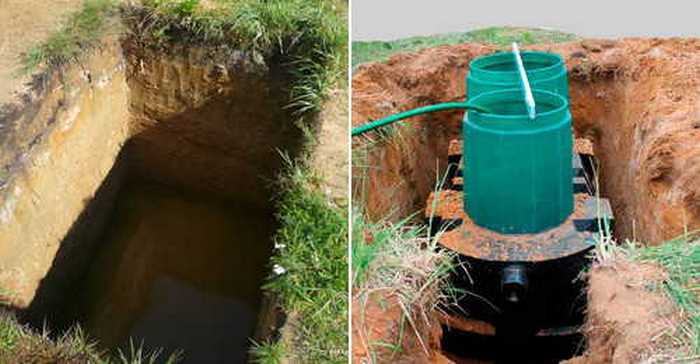
First of all, it is necessary to prepare a pit for placing a cleaning device:
-
Dig a hole in the ground with a length and width exceeding the dimensions of the container by 30 cm. Make the depth 50-100 mm more than the height of the "Termite".Level the walls and bottom of the pit with a shovel, remove large stones and debris.
A pit for placing a septic tank is best done using special equipment
-
Dig a trench under the pipe from the house, observing the slope in accordance with building codes. For a pipeline with a cross section of 110 mm, often used for this purpose, the slope is 20 mm per running meter.
- The trench for the pipe from the house must be sloping
-
Close the bottom of the trench with a layer of sand about 30 cm thick. You can finally level the sand in the pit using a level - it's faster and easier than with a shovel.
It is better to level the sand at the bottom of the pit using a level.
-
Immerse concrete blocks to the bottom of the pit (easier with the help of special equipment). They are needed to hold the septic tank in place during snowmelt or heavy rain when groundwater rises. Without "anchoring" there is a risk of the unit floating up with possible damage to its own walls and sewer lines. As fasteners, anchor hooks and chains are used, which are mounted to the blocks.
The septic tank in the pit needs anchoring with fasteners
When installing a treatment plant in the northern regions, the top of the treatment device and the sewer pipeline must be insulated.
Installation of a treatment plant
It is easy to deliver a septic tank to the place of installation. It weighs a little, even two people can do it. Further installation steps look like this:



-
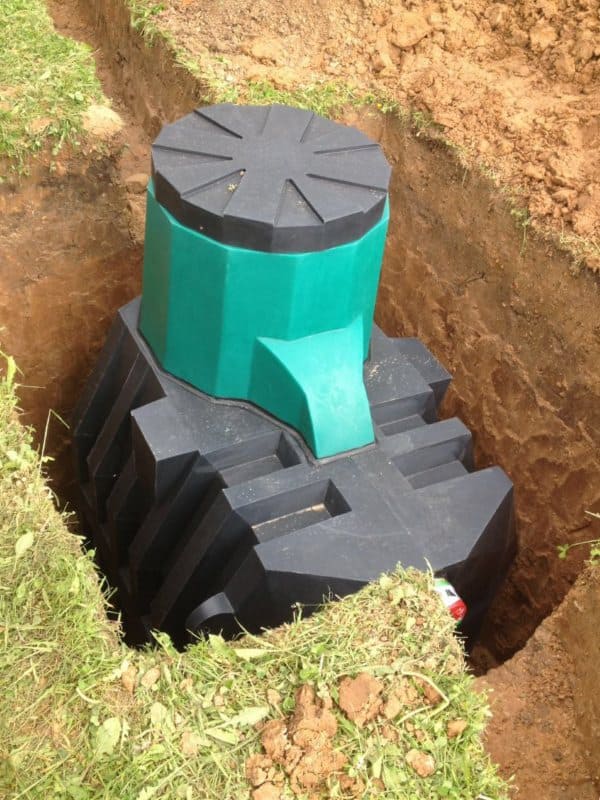
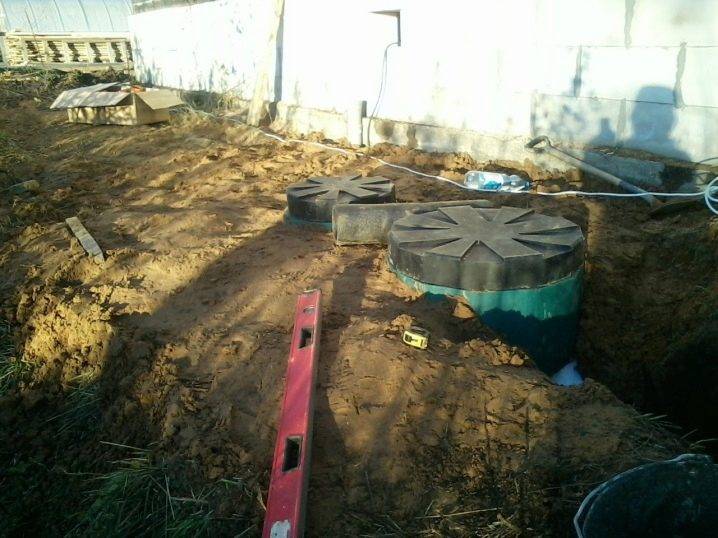
With the help of special equipment, the device is lowered into the pit, holding it by the lugs in the body. The container that has risen to the bottom is fixed with the help of chains thrown over its body.
With the help of special equipment, the container is lowered into the pit
-
Orange sewer pipes are laid in the excavated trench and mounted to the input of the treatment structure.The sewer line for wastewater treatment is covered with sand. If the sewer pipe to the septic tank is more than 18 meters, then a revision well is made.
Sewer pipes are connected to the tank
-
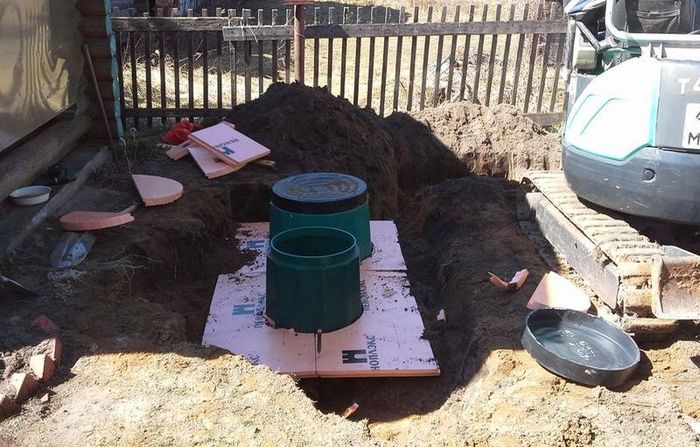
The septic tank itself is covered with sand or soil - up to the neck of the hatch. Then the container is filled with water to check and protect the walls from external pressure.
To check the septic tank, a control filling with water is carried out
- The final phase is the installation of an irrigation dome for additional purification of water that has passed through the Termite compartments. Under the additional element, you also need to dig a pit, taking into account the height of the device and the gravel pillow (about 50 cm). The pit for the irrigation dome is covered with a layer of special material - geotextile. This is necessary to protect the device from ground movement when the groundwater level changes and temperature changes. Then gravel is poured onto the material and leveled, creating a protective cushion. The body of the infiltrator is placed on it. A drainage pipe with holes is connected to the device. Its other end is connected to the last compartment of the septic tank. The cleaning dome is covered with geotextile and covered with earth.
To install the infiltrator, you need to dig a pit, taking into account the dimensions of the element
The model range of the septic tank termite and the price with turnkey installation
The main models are laid out for you, and so we will answer the question of how much the termite septic tank will cost with a turnkey installation, see the table:
The lineup:
Optional equipment:
As a rule, the cost of installation will include:
- Sewer pipe 4 meters long and 110 mm in diameter and materials.
- Excavation.
- Insulation for septic tank and pipe.
- Cement, sand.
- Installation work.
Please note that when ordering a termit septic tank with a turnkey installation, the seller company will bear all responsibility for poor-quality installation, and in case of damage to the septic tank as a result of improper installation, they will replace the structure or repair it. The main thing is that you have in your hands an appropriate contract and an act of the installation performed with the signatures of employees.
Mounting technology
Installation of a septic tank Termit takes place in two stages:
- installation of a treatment plant;
- installing an infiltrator.
Installation of a septic tank
To install a Termite septic tank with your own hands, you need:
- at the installation site of the device, a pit breaks out, the length and width of which is approximately 20 - 30 cm larger than the corresponding dimensions of the treatment plant. The depth of the pit should be 10-15 cm more than the height of the septic tank;
- a sand cushion 7–10 cm high is laid out at the bottom of the pit. The sand must be leveled over the surface and compacted with water;
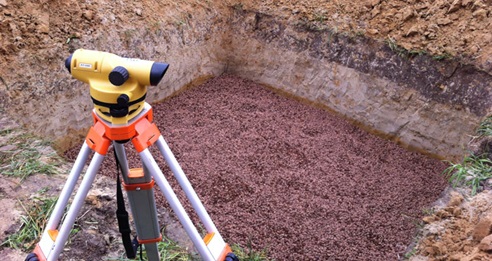
Preparing the pit for the installation of a septic tank
- a trench is brought to the pit for laying sewer pipes. The depth of the trench is determined in accordance with the climatic conditions of the area;
For effluents to enter the septic tank by gravity, that is, without the help of a pump, it is necessary to observe the slope of the trench at the rate of 2 cm per 1 m of length.
- 1 - 2 concrete blocks are laid out at the bottom of the pit. Devices equipped with chains will be used to “anchor” the septic tank, that is, to prevent the tank from floating under the influence of groundwater;
- the septic tank is installed in the prepared pit. The horizontal position of the installation is checked. To do this, it is enough to set the building level on the neck of the container, according to which alignment is carried out;

Checking the horizontal installation of the septic tank
- the installed equipment is fixed with chains (other strong ropes) and concrete blocks;
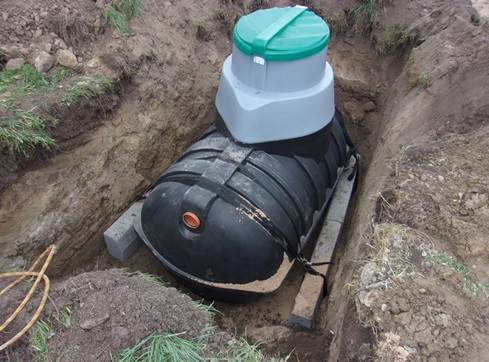
Fixing a septic tank to concrete blocks
- sewer pipes from the house are connected to the septic tank and a pipe is led to the infiltrator;
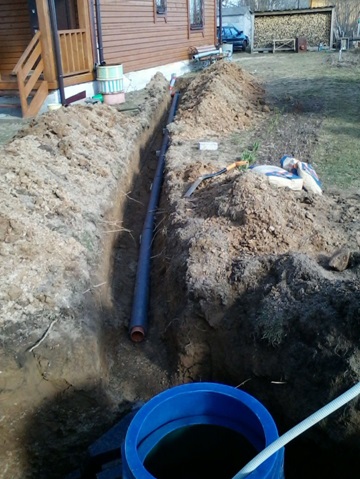
Connecting sewer pipes to a septic tank
If an autonomous sewage system is being built in a cold climate, then it is recommended that the septic tank and pipes be additionally insulated with basalt wool or glass wool.
- the treatment plant is filled with water to preserve the geometry of the septic tank body. Consumer reviews indicate that if you bury an empty container, then there is a significant deformation of the case;
- the septic tank and pipes are backfilled with a mixture of sand and cement in a ratio of 4: 1.
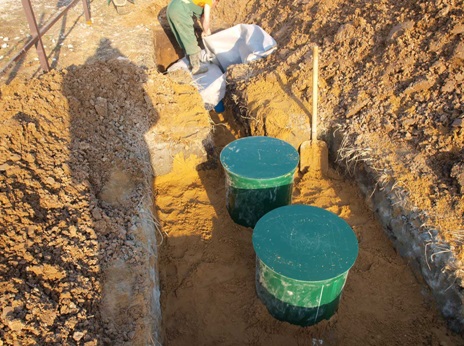
Final installation step
Installation of the infiltrator
The installation of the filtration system is as follows:
- a pit is dug with dimensions of 10–15 cm more than the width and length of the installation and a depth of 60–70 cm more than the height of the device;
- the bottom and walls of the prepared pit are covered with geotextiles that protect the device from groundwater;
- gravel is poured to the bottom of the pit for additional wastewater treatment. The layer of gravel pad should be approximately 50 cm;
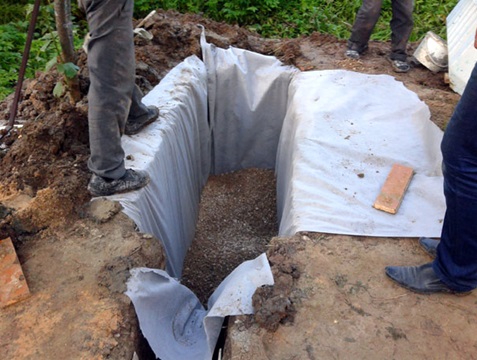
The initial stage of installing the infiltrator
- the infiltrator is installed in the pit and connected to the pipe removed from the septic tank;
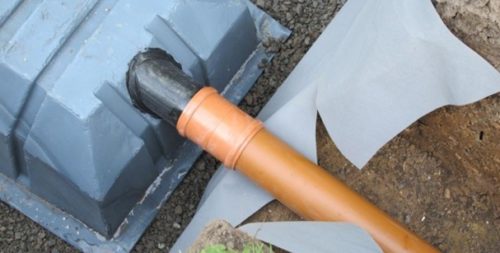
Connecting the infiltrator to the septic tank
- the finished system is covered with geotextile and covered with soil.
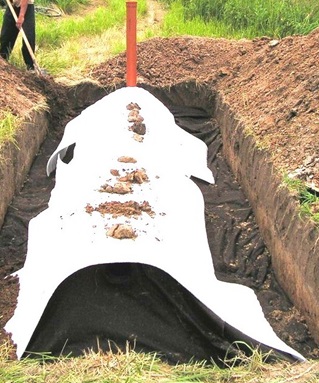
Backfilling the infiltrator with soil
The process of installing a Termite septic tank and additional filtering equipment is described in detail in the video.


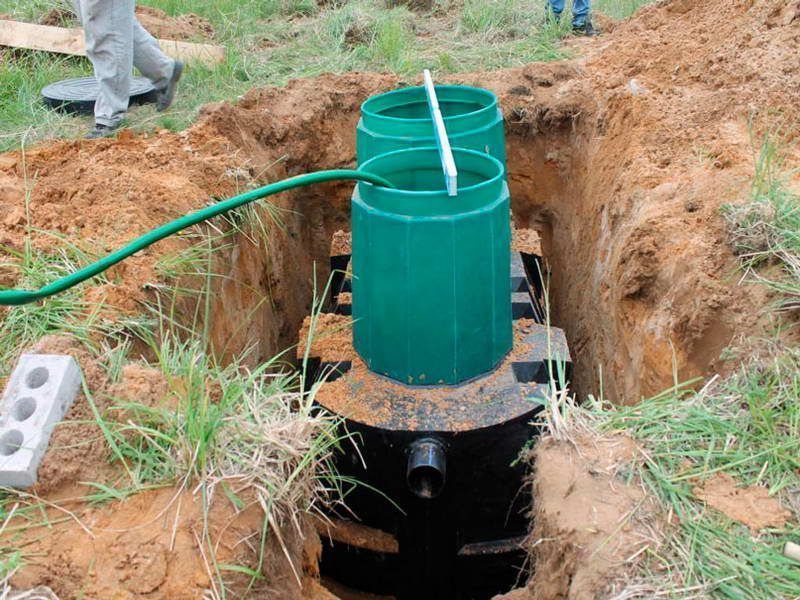
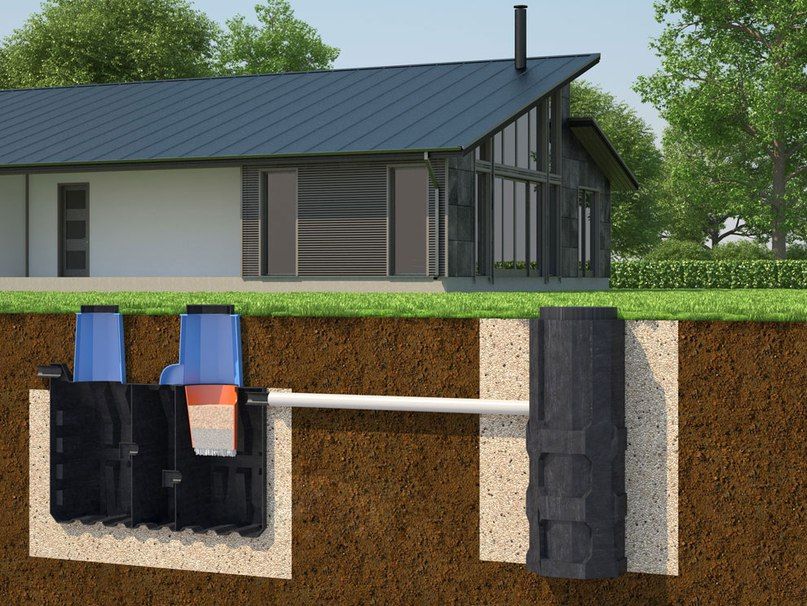
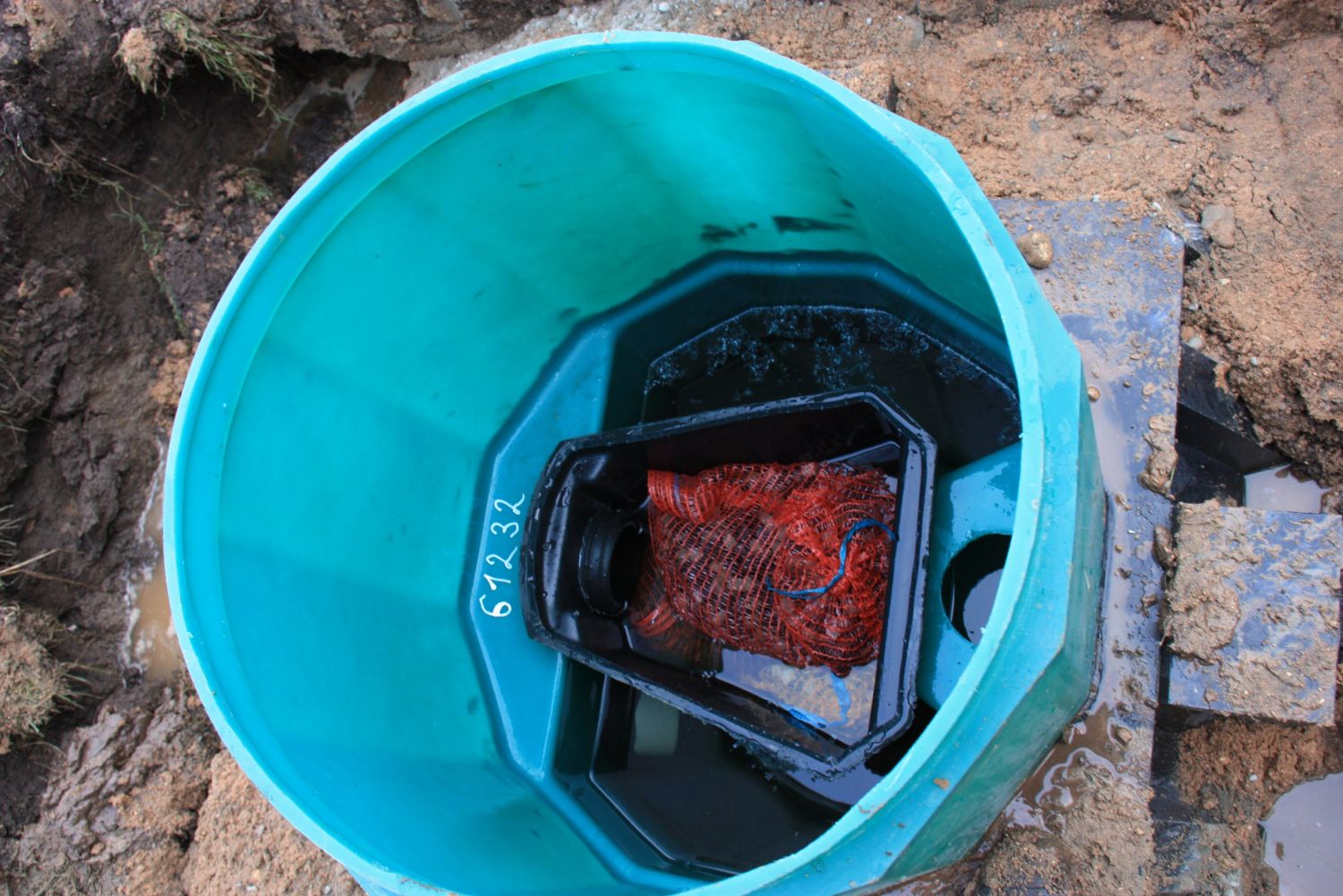

For long-term operation of the treatment plant, it is necessary to clean large deposits of the first section and pump out sludge once every 2-3 years.Additional anaerobic bacteria are added to the biological treatment section during maintenance.
With proper maintenance, the treatment plant will last more than 50 years.
Modifications of the septic tank Termit
The range of anaerobic septic tanks Termite is represented by two lines: "Profi" and "Transformer". The first classic version is focused on installation in summer cottages with seasonal residence, near bathhouses, cafes, etc. places. By volume, these stations have modifications designed for 1–12 people, and are self-flowing and non-volatile.
In terms of performance and capacity, "Termite Profi" is divided into six modifications:
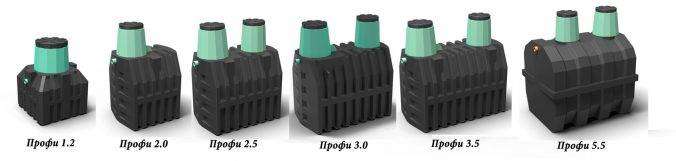
Model range of septic tanks Termit
-
"1.2" for 1-2 people (400 l / day, 1200 l).
-
"2.0" for 3-4 people, (800 l / day, 2000 l).
-
"2.5" for 4-5 people, (1000 l / day, 2500 l).
-
"3.0" for 5-6 people, (1200 l / day, 3000 l).
-
"3.5" for 6-7 people, (1800 l / day, 3500 l).
-
"5.5" up to 12 people, (2200 l / day, 5500 l).
Such a septic tank does not have any pumps. It does not need electricity to operate. All flows inside and the output of water to the outside occur in gravity mode.
Septic tanks "Transformer" have two configurations "S" and "PR". The first is a compact autonomous sewage system with a single neck with a capacity of 500 to 1200 liters / day, designed for areas with low GWL. They, like the main model "Termite Profi", are non-volatile.
The second are septic tanks for high groundwater, also designed for 500–1200 liters / day, but with a drainage pump included. Due to it, the forced release of treated effluents is carried out.
The assortment of "Multplast" also includes "Termit" storage tanks, which are simply hermetic collection containers sewage.Plus, there are stand-alone stations "ERGOBOX", which will be discussed in the next article. This is already an aerobic energy-dependent septic tank with forced aeration inside.
Models of septic tanks Termit
| septic tank | Human | LxWxH | Volume | Produces. | Price from* |
|---|---|---|---|---|---|
| Termite Profi 1.2 | 1-2 | 1340x1160x1565 mm | 1200 l | 400 l/day | 21500 rub |
| Termite Profi 2.0 | 3-4 | 1595x1155x2005 mm | 2000 l | 800 l/day | 29900 rub |
| Termite Profi 2.5 | 4-5 | 2000x1155x2005 mm | 2500 l | 1000 l/day | 36000 rub |
| Termite Profi 3.0 | 5-6 | 2300x1155x1905 mm | 3000 l | 1200 l/day | 43000 rub |
| Termite Profi 3.5 | 6-7 | 2410x1190x2005 mm | 3500 l | 1800 l/day | 47900 rub |
| Termite Profi 5.5 | 11-12 | 2220x1650x2395 mm | 5500 l | 2200 l/day | 69000 rub |
*Prices are indicative for 2018, excluding installation
Modifications
The model range is quite wide, the installation scheme for all Termite septic tanks is similar, regardless of type.
Thermite 1 and 1.5
Septic tank Termite transformer 1 is extremely simple, productivity - 0.35 m³, volume is only 1.2 m³. Suitable as a country option, for a family of 1-2 people. For the Termit 1 septic tank, installation will not be a problem, it is possible to install it yourself. You can connect different devices.
Termite 1.5 is suitable for a small family with two adults and one child. The capacity of the installation is 0.5 m³ per day.
Termite 2
The septic tank Termite pro 2 is already a more solid design. The installation volume is 2000 l, the walls are 1.5-2 cm thick. Thermit 2 dimensions: length - 1.8 m, width - 1.2 m, height (with a neck) - 2.05 m. allows you to have a productivity of 0.7 m³ per day. Weight VOC - 140 kg, so you need special equipment for installation. Designed to serve 2-4 people. The reviews confirm the technical capabilities in servicing the following plumbing fixtures:





- 2 toilets.
- 4 sinks.
- Washing machine.
- dishwasher.
In the configuration of its filter, which contains bacteria, pumice and weighting agent in the form of granite chips.
Termite 3
The Termite Pro 3 septic tank already includes 3 chambers, which provide a higher level of wastewater treatment. In general, the installation has a volume of 3000 liters, which is enough to serve 4-6 people, that is, it is designed for an average family. The wall thickness of Thermite is 3-2 cm; they are made of high-strength linear polyethylene. The productivity of the installation is 1-1.2 m³ per day. Septic tank Termite transformer 3 weight 185 kg, which means that it is better to entrust its installation to a qualified company with a fleet of special equipment and specialists.
Termite 5
This model is the most voluminous and productive. Its capacity is 7-11 people. In order for the drains to be cleaned well enough, this VOC model has a three-chamber system. Productivity - 2.4 m³ per day.
Sprinkler
It is not a septic tank, but also belongs to the manufacturer's line in question. This is a plastic container without a bottom, on the top of the dome of which there is a sprinkler. It is he who evenly distributes fairly clean drains over the gravel-sand cushion. The number of such fills required for a particular system will vary. The need and number of them should be checked with the manufacturer.
Model range of septic tank Termite
The procedure for installing a septic tank Termit
Installation of a septic tank Termit
Mounting this treatment plant does not present any particular difficulties, for this the following work is performed:
- Before proceeding with the installation, it is necessary to check the structure for damage, it is advisable to do this at the time of transfer from the supplier to you in order to avoid unnecessary questions in the future.
- First of all, it is necessary to dig a pit for a treatment plant, inlet and outlet trenches for pipelines, as well as for a sprinkler.
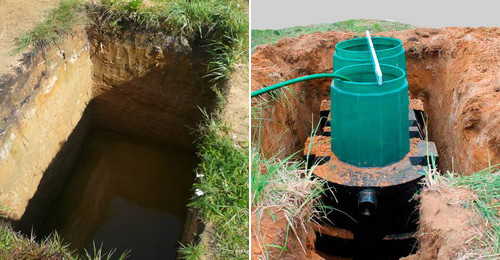 A pit was dug for a septic tank and its installation
- The volume of the pit should be greater than the installation by at least 25 cm more than the installation, the bottom is covered with a layer of sand of 3-5 cm and leveled. It is necessary to keep the slope of the horizon, it should not exceed 1 cm per 1 meter.
- Pipes are laid with a slope of 2 cm per 1 running meter to ensure gravity flow of wastewater.
- The pit for the sprinkler must be covered with gravel - at least 400 mm of layer thickness is laid.
- The thickness of the backfill layer of sand for pipelines is 200-300 mm.
- The angle of inclination of the outlet pipe from the septic tank to the sprinkler must be at least 1 cm per 1 m, if necessary, insulation is made.
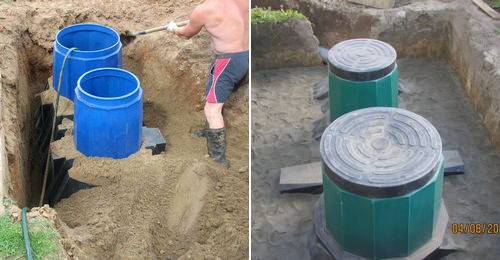 Backfilling is done only by hand, and the layers are compacted
After the installation and pipes are installed, backfilling is carried out, for this a mixture of sand and cement is used (in a ratio of 5: 1, respectively). It is produced as follows: a layer of sand is poured from cements with a layer thickness of 20 cm, compacted, a layer of 20 cm is again filled up, rammed, and so on. At the same time, to prevent squeezing the walls of the installation, the chambers are filled with water - the level of which should be 20-30 cm higher than the ground level.
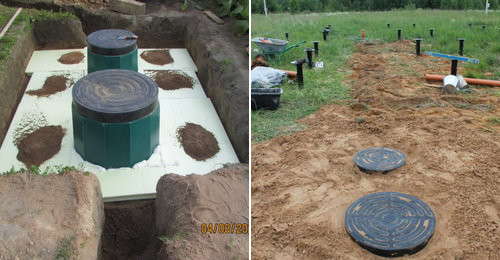 The top cover is insulated
The upper surface should be insulated, for example, with polyethylene foam.
Draw your attention to!
- Backfilling is carried out manually, without the use of machinery.
- It is necessary to protect the container body from mechanical damage.
- It is not recommended to place trees closer than 3 meters from the septic tank.
Installation Tips
-
If the sewer pipe to the septic tank is more than 18 meters, then it is recommended to make a revision well every 16-18 meters.
- When laying pipes, do not use an angle of 90 degrees, a smoother bend should be made, for example, there is a minimum angle of 15 degrees, if a right angle cannot be avoided, then an inspection well should also be made.
- Don't forget the exhaust pipe, otherwise you may get an unpleasant smell from the septic tank.
- In order to avoid flooding the house at the time of floods and high groundwater levels, as well as to avoid smell in the house, it is recommended to install a sewer check valve.
- The distance from the septic tank to the house should be at least 5 meters.
- The distance to the nearest water source is at least 30 meters.
- The distance from the soil purification systems to the house according to the norms of SNiP is 25 meters, although this distance is not always maintained.
Maintenance
As maintenance, it is necessary to carry out regular pumping of silt deposits, in order to avoid their pressing - approximately once every 2-3 years. After carrying out the complete emptying of the tank using a sewage machine, to resume the work cycle, it is necessary to fill the septic tank with water.
Principle of operation
Entering the first chamber, the water passes through the primary filter, which immediately screens out stones, solid waste and silt. In this storage tank, the liquid settles for 2 days (during long-term operation) or 3 (during initial use).Sinking to the bottom, solid particles purify moisture to a certain level. Over time, only fat accumulations or liquid residues remain on the surface of the water. After that, the water is forcibly pumped into the biological compartment.
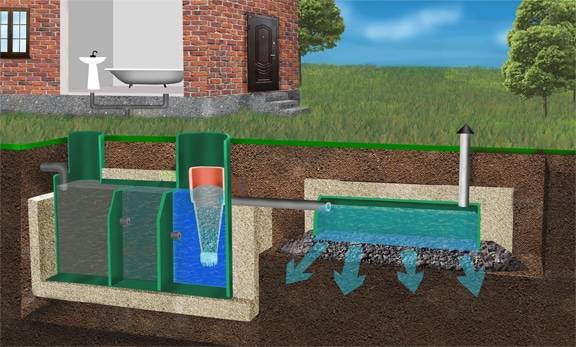 Photo - the principle of operation
Cleaning in it is carried out by anaerobic bacteria located on synthetic fibers. The fibers are fixed on the brush, so they act on the water directly, without additional pumping through the filter. At the outlet of this section, a pump is installed that pumps liquid into the next tank with a granular filter. This is the final cleaning step. Here, the liquid is completely cleared of possible formations and unpleasant odors. The most effective is a septic tank with additional ground purification, but such a filter will need to be purchased separately.
Advantages of the Termite septic tank:
- Moisture purification up to 98% without a soil filter;
- Russian production ensures the stability of the system to the peculiarities of the CIS climate and a competitive price;
- Completely autonomous work. The undoubted advantage compared to other treatment plants is that the system works without electricity. All action is based solely on natural and mechanical processes. This significantly extends the durability of work and provides energy savings;
- The station can work immediately after installation and connection of sewer or drainage pipes. Many septic tanks can only be turned on a few days after the soil has set;
- Due to the fact that the container is made of seamless polyethylene with a thickness of more than 4 centimeters, the storage tank is resistant to temperature extremes and soil pressure.
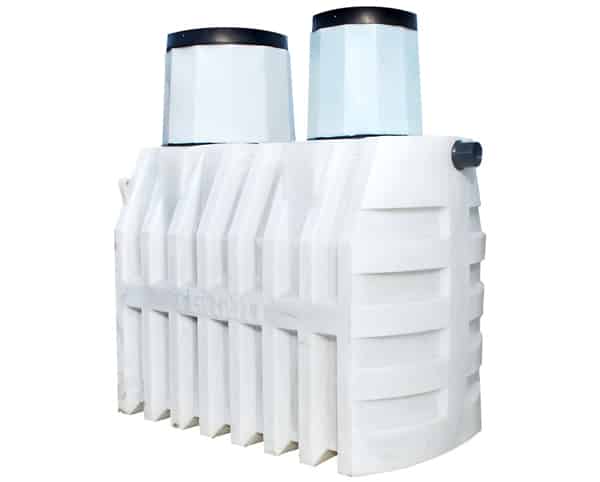 Photo - budget version of Termite
But, the Termite septic tank also has some disadvantages. First, it requires special maintenance. Due to the fact that anaerobic bacteria are always in an aggressive environment, they need to be replaced. It is necessary to update the filter and colonies of microorganisms every six months. Similarly, with granules - they need to fall asleep every year. Secondly, periodically it will be necessary to clean the first compartment (gravitational). Silt and solid waste particles settle at its bottom, so it needs to be cleaned every season.