
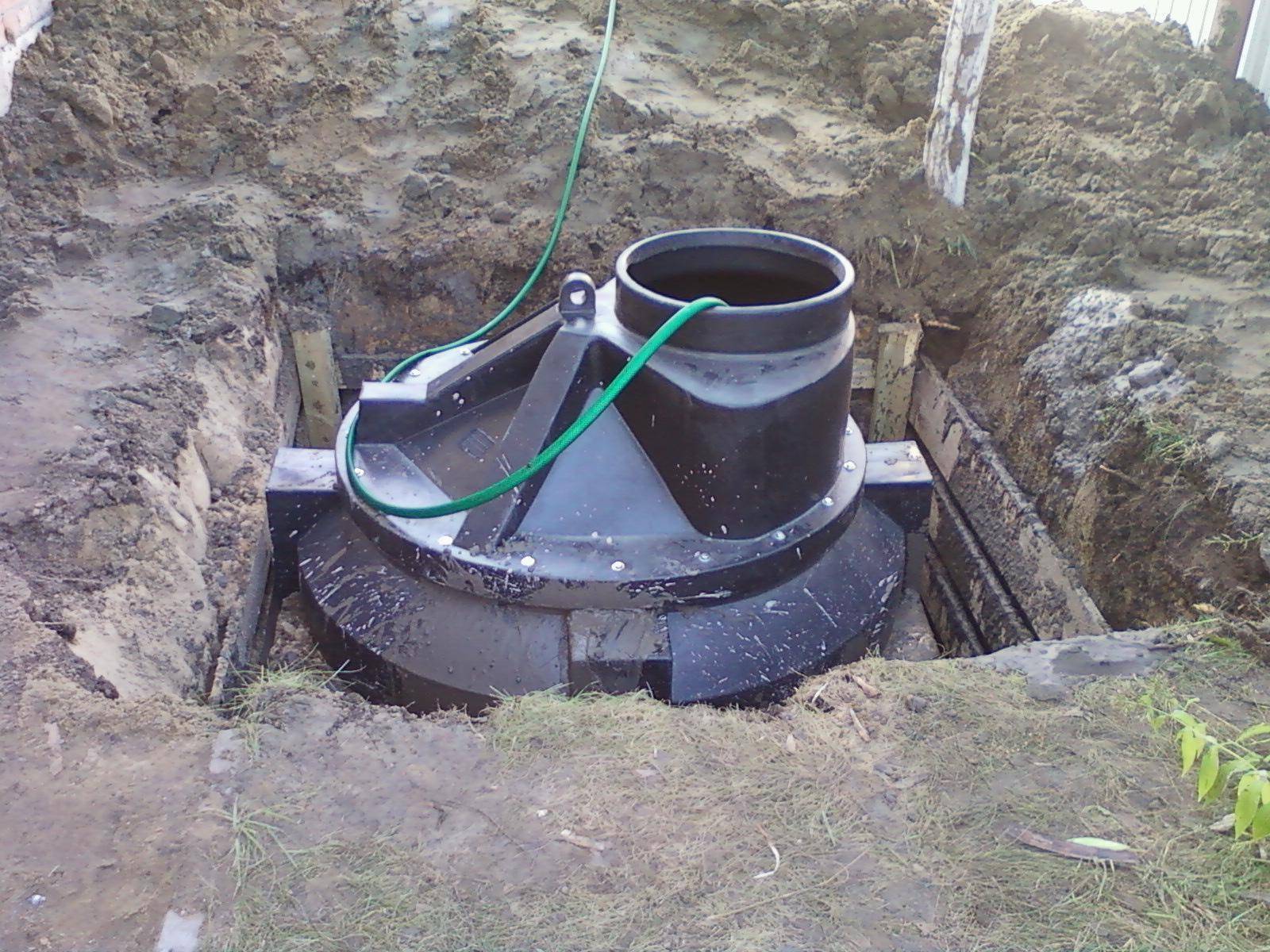
- Difficulties posed for sewerage by high groundwater levels
- Septic tank flooding
- Floating septic tank
- The main problems of high groundwater for a septic tank
- If the option of a finished septic tank is not suitable
- Problems due to groundwater
- We arrange filters on the surface
- How to correctly calculate the drainage of the site according to SNiP?
- Sewerage for swampy areas
- Principles of self-construction of a sewer system with a high GWL
- Features of the system assembly
- Design choice
- The specifics of installation work
- What to do if the extraction efficiency becomes low?
- Installation "Topas"
- What arrangement options exist
Difficulties posed for sewerage by high groundwater levels
High levels are considered to be waters that lie in the ground at a depth of no more than 1-0.5 meters. Because of this, when using sewage, a number of problems can arise that can even lead to a local environmental disaster.
Septic tank flooding
Perhaps the most unpleasant thing that can happen is flooding, when, due to swelling of the soil, groundwater enters the sewer system from the ground. Septic tanks, consisting of several concrete rings, are especially vulnerable to flooding.Water can enter the system through the seams, which are not always tight, and the tank will fill up much faster than expected.
In this case, it is important to call the sewers in time to pump out the waste. Otherwise, groundwater, together with sewage from the septic tank, can get through the sewer pipes directly into the house.
Floating septic tank
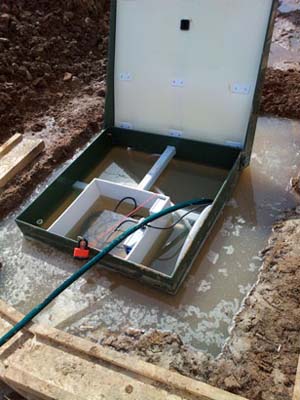
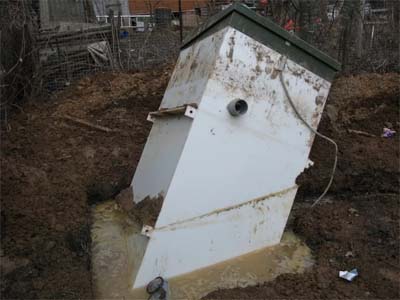
Another serious problem that primarily affects septic tank systems assembled from plastic tanks and not very securely fixed to concrete is ascent. In this case, groundwater rising due to heavy rainfall does not get inside the tanks, but simply squeezes them out of the ground. Because of this, the tanks lose their tightness, the septic tank gets a noticeable roll, which can eventually lead to a breakthrough in the sewer.
As a result, the septic tank receives irreversible damage, and sewage enters the groundwater, and the site is flooded. And since groundwater spreads quickly enough in the soil, a significant area can suffer from contamination with fecal masses and accompanying microorganisms. As a result of such a local catastrophe, nearby streams, rivers and wells become unusable.
The main problems of high groundwater for a septic tank
The distinctive qualities of the land on the territory of our homeland force the owners of summer cottages to solve the difficulties of installing a septic tank in the drainage system associated with groundwater passing at a high level. The sewer issue always requires attention and work.
Quite often there are areas in which groundwater occurs at an approximate depth of twenty to thirty centimeters.Many have to install a high groundwater septic tank to deal with these difficulties. If groundwater is close, there are rules, principles and selection recommendations and installation of septic tanks.
Owners of country cottages are constantly asking questions about how the installation of a drainage device is carried out. do-it-yourself septic tankwhen the level groundwater is quite highhow to create the best septic tank waterproofing and many others. All of these problems can be resolved.
This article describes the device of septic tanks, provides photo and video materials how to properly install septic tanks with your own hands, how to choose best septic tank for a drainage installation in a country house, how to install a concrete sewer compartment or a septic tank for a high groundwater level.
The work of installing a sewer structure in general, or a septic tank for a high groundwater level in particular, can be difficult. A septic tank may emerge after installation. If you do not install a septic tank at high groundwater on a concrete foundation and do not fix the elements of the drainage structure, groundwater will contribute to the emergence of the septic tank. This is a serious problem.
A sewer septic tank with high groundwater will be damaged and the quality of the drainage structure will decrease. We will have to carry out re-assembly and repair work in the country. The installation of a concrete base must precede the installation of a septic tank.
for high groundwater at dacha.
When groundwater flowing at a high level flows into the septic tank, this will lead to flooding and failure of the septic tank and other elements of the drainage structure.After the septic tank is flooded, groundwater will flow into another sewer compartment and may enter plumbing fixtures, which will lead to an emergency in the country. It won't be the best situation. Ground water passes into the building along with fecal matter accumulated in a concrete septic tank. If there is a well in the way of the sewer structure, others may suffer from contaminated groundwater;


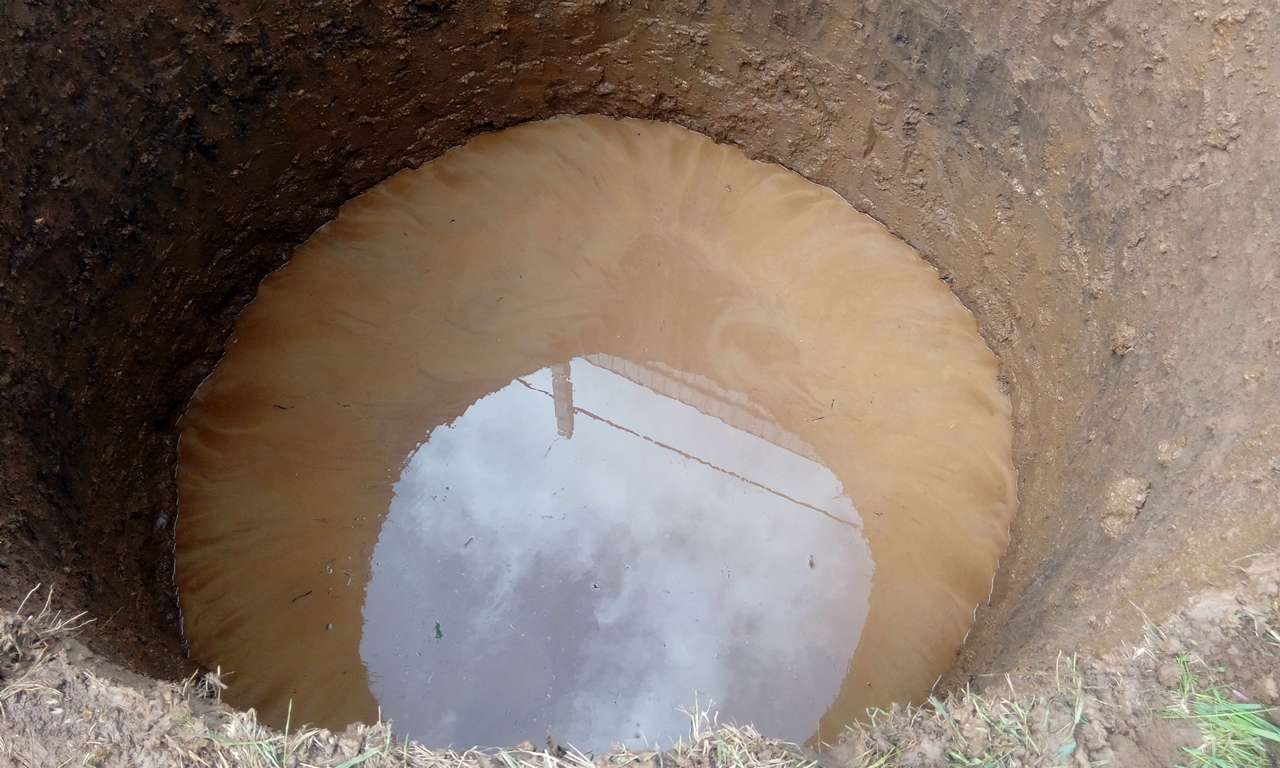


A septic tank for a high groundwater level will require complex installation tasks. Installation of this element of the sewer device is never easy. To install a septic tank for a summer residence with high groundwater, you will have to work.
- Expensive and frequent pumping of sewage from the septic tank;
- Increases the likelihood of damage to the septic tank. Groundwater constantly carries with it a variety of foreign elements. After the installation of groundwater installations, malfunctions can occur due to the ingress of debris into the system.
- The occurrence of pollution due to the ingress of fecal matter into the soil from a septic tank for groundwater flowing at a high level;
- Unresolved problems in the installation of drainage systems of the sewer pipeline lead to waterlogging of the site.
If the option of a finished septic tank is not suitable
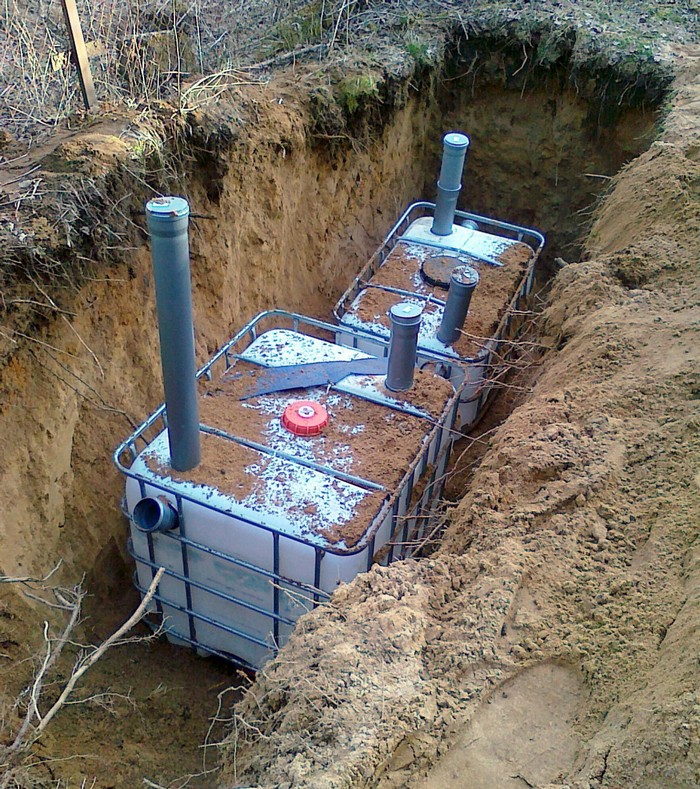
If you decide to save money and build a septic tank with your own hands, then you will have to use either a monolithic concrete pour or ready-made plastic cubes. Consider both options for the device.
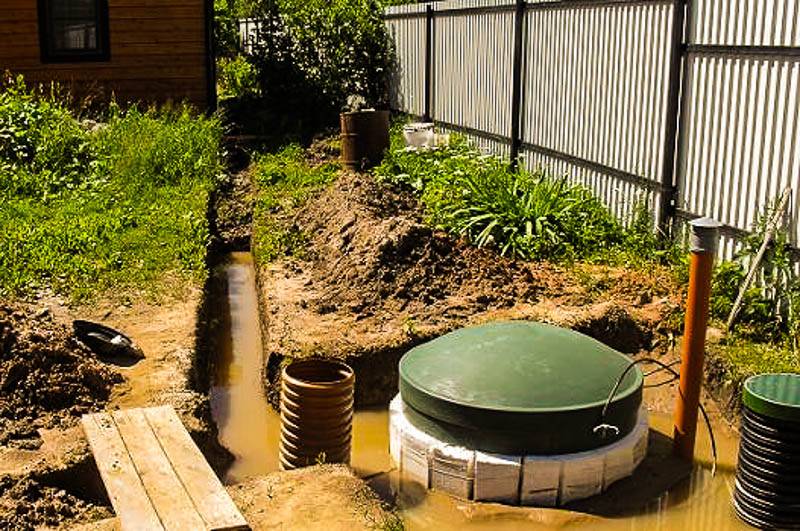
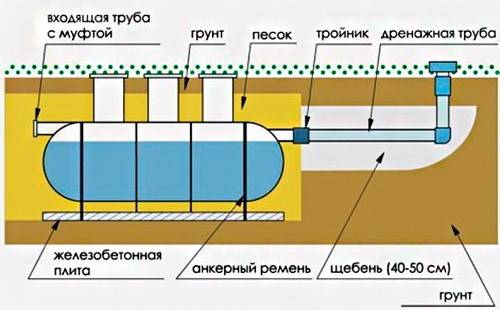
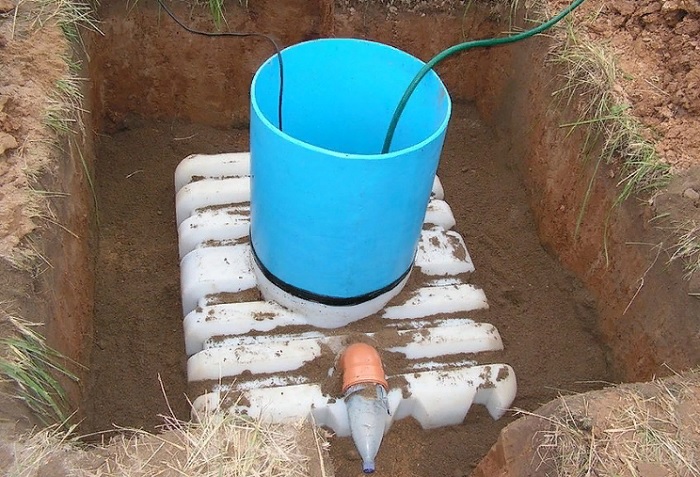
PVC septic tank. For high-quality installation of cameras, it is necessary to prepare a pit, which should exceed the parameters of the cubes by 20-30 cm. The bottom of the pit is well compacted and a layer of sand 30 cm thick is poured into it.A concrete slab is placed on the sand, which will become a reliable anchor for the plastic. With the help of anchors and chains, the septic tank is securely anchored.
After that, it is necessary to make a cement-sand sprinkling of containers. The septic tank chamber is filled with liquid by 30 cm and sprinkling begins from the outside to the same height. Continuing to gradually fill the chamber with water and the distance between the septic tank and the walls of the pit, move to the top. This technology makes it possible to insure treatment tanks against soil pressure and subsequent deformation.
After all the cubes are mounted, it is necessary to provide their overflow part with the help of tubes. In this case, be sure to take care of the sealing of all joints. Lastly, the septic tank is covered with a plate for its reliable fixation. The ventilation pipe is brought out and access to the hatches is provided, as indicated in the video below.
Problems due to groundwater
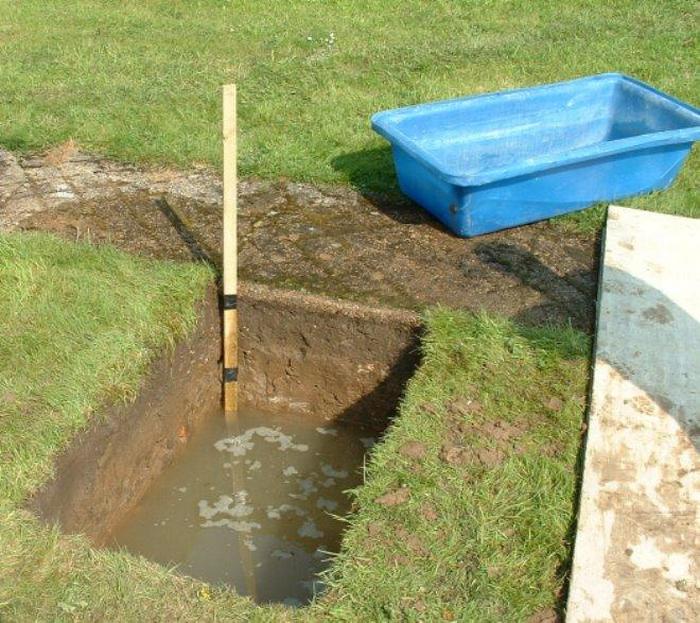
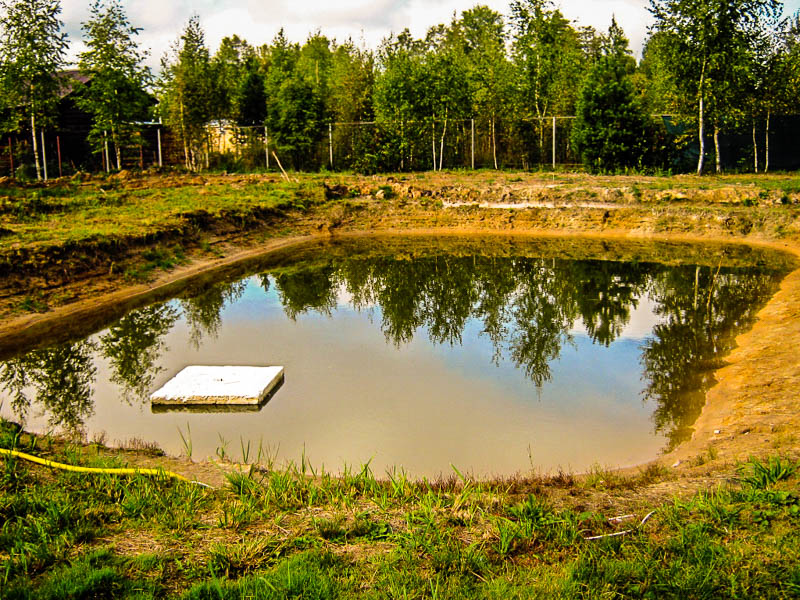 What problems do groundwaters have with them, which are located high enough in a particular area? And by the way, how much is it - high or low? Indeed, some sources claim that soil moisture is not deep - this is when it is found at a meter distance from the surface of the site. Others say that even three and a half meters is “high”, unsuitable for arranging a wastewater collection system, water.
In practice, everything is much simpler and clearer - if the installation depth of the septic tank (the pillow under its bottom) is at a level below the upper surface of the ground moisture, then the site is definitely problematic in this regard.
What happens if you install the wrong septic tank in such an area? There are only four main problems:
- Environmental pollution.An ordinary septic tank, not equipped with additional equipment for wastewater treatment, produces rather dirty water at the outlet. And if the container is not yet airtight, all this "fertilizer" goes into the ground, being washed away by the aforementioned waters. It would seem, like nothing terrible - fertilizer is the same. However, oversaturation of the soil with poorly treated wastewater eventually leads to the death of plants and other living organisms in the area.
- Drinking water pollution. Even if the well or well is at a sufficient distance from the septic tank (50 and 10 meters, respectively), the ground moisture washing it will speed up the process of mixing drinking water with raw sewage. As a result of this, insufficiently transparent water will flow from the tap in the house, and, moreover, with a characteristic unpleasant odor.
- Decreased drainage efficiency. Due to oversaturation with moisture, the soil completely loses its ability to absorb more moisture. And if you equip a drainage well on a similar site, its efficiency will be practically zero, if not negative (when ground moisture, on the contrary, will fill the container).
- Pushing the septic tank out of the ground. In winter, due to the presence of soil moisture around the septic tank, and its freezing (as a result of which it inevitably expands), there is a risk of the so-called pushing containers to the surface. As a result, not only the treatment structure itself will be damaged, but also the sewer, bypass pipes, landscape, and so on.
To avoid all these problems, you need, first of all, to choose the right septic tank.
We arrange filters on the surface
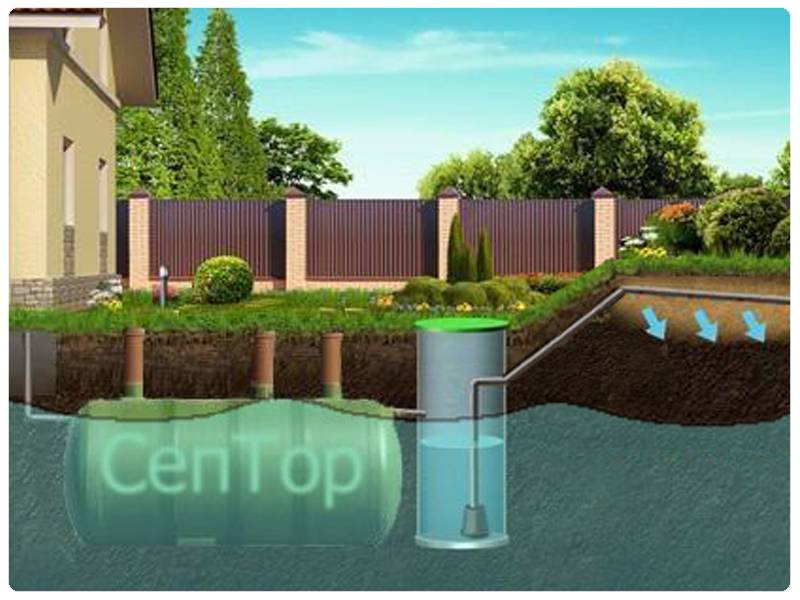
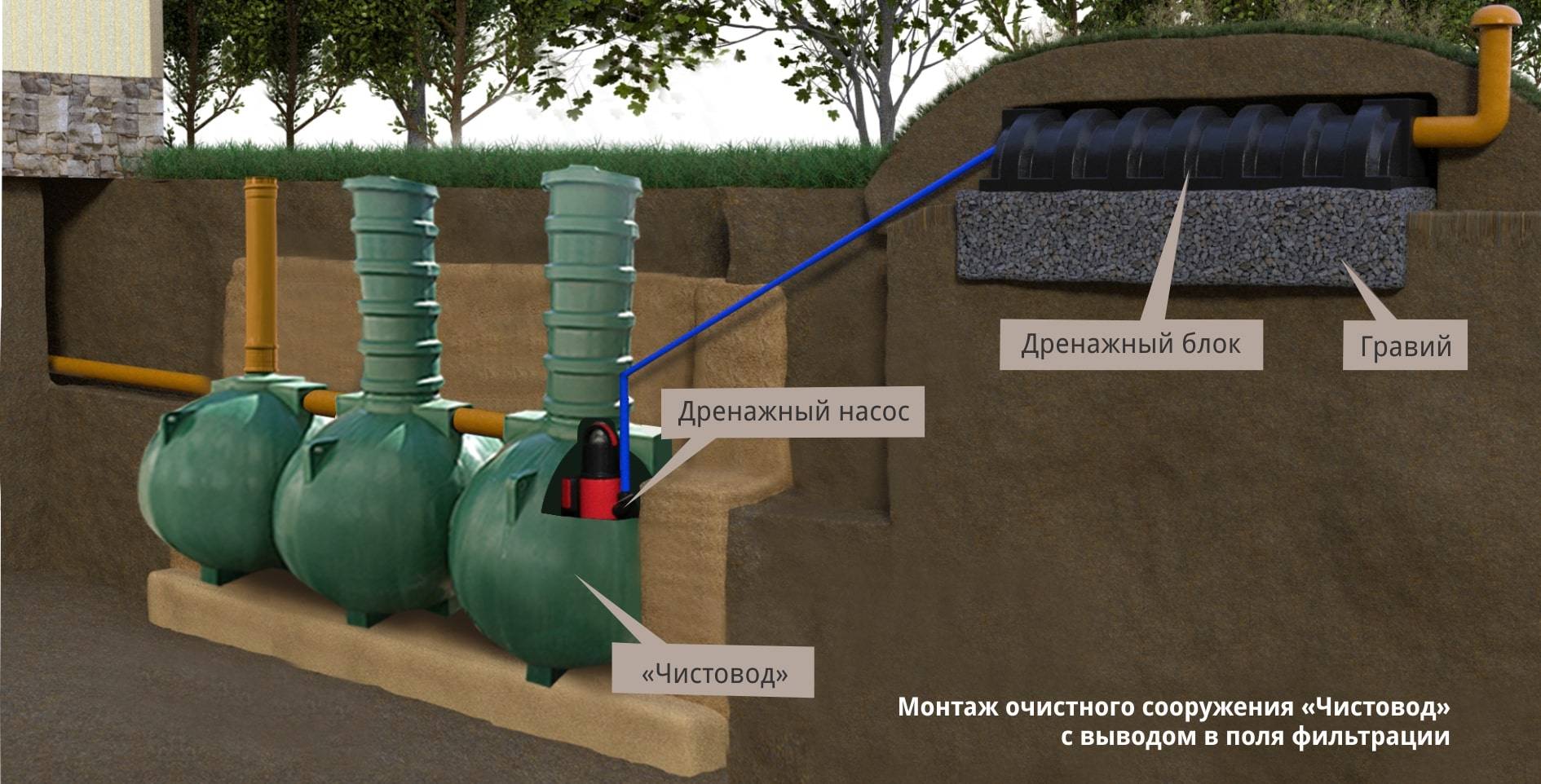
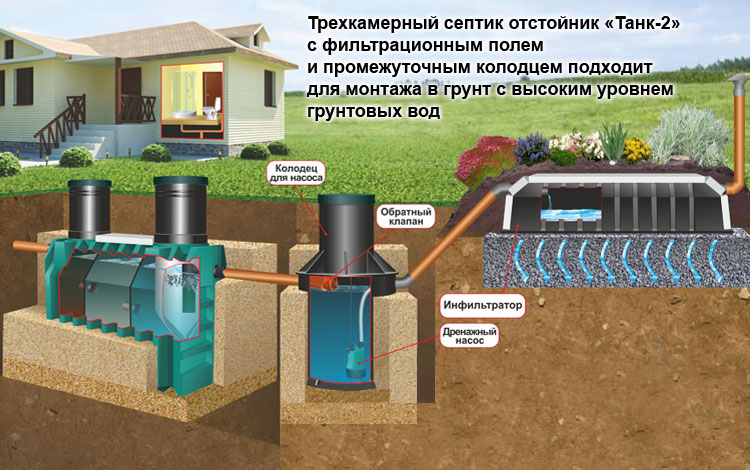
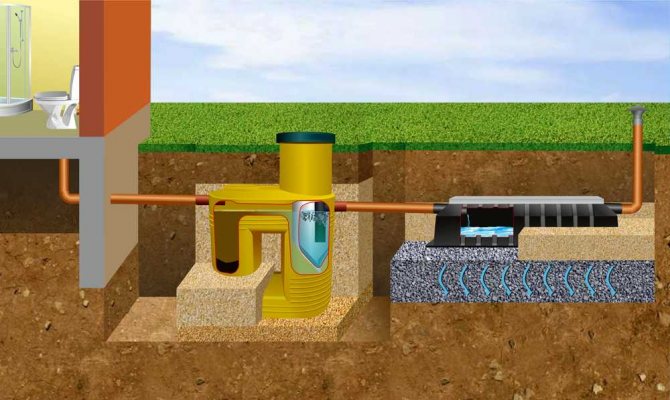
The filtration field for final wastewater treatment will have to be arranged on an earthen embankment.To raise the flow upwards, you will need a submersible pump with a float level sensor for filling the tank. Periodically, it will operate, directing technical water to the surface filtration field. A layer of sand and gravel serves well as a filter, but its location should be such that at least one and a half meters remain to the groundwater level. It is necessary to provide for the protection of communications from freezing in winter.
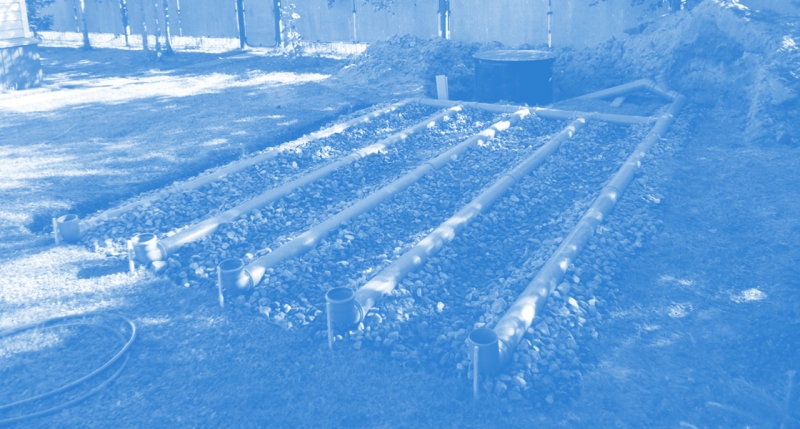
You must be prepared for the fact that a surface filtration field is a necessary and useful addition to your septic tank, however, it will take up some of the adjacent area, and it will not be possible to grow large plants on it. In addition, about once every 5-10 years, it will be necessary to completely disassemble the surface system from the ground and change the filling of the contaminated filter layer. A positive point can be considered reliable protection of your land from toxic sewerage effluents.
When creating a local septic tank on a personal plot, each technological step must be according to a strictly verified algorithm of actions. If you assembled the entire system of high wastewater filtration correctly, then for several years you can forget about it altogether and use the technical innovation for your own pleasure.





How to correctly calculate the drainage of the site according to SNiP?
When building and calculating drainage on your site, it is recommended to be guided by the requirements of the relevant regulatory documents.
With regard to the topic of the article, you need to pay attention to SNiP (an abbreviation for Construction Norms and Rules) 2.06.15-85 “Engineering protection of the territory from flooding and flooding”, as well as SP 250.1325800.2016 “Buildings and structures. Groundwater Protection»
The SNiP clearly spells out all the stages of creating drainage:
- The project in which system data must be specified:
- general scheme.
- geometric data: trench parameters, their slope, distance between system elements.
- diameters of pipes used, parameters of wells.
- fasteners, materials for sprinkling drainage trenches and pipes.
- Clearing the area where the drainage will be laid.
- Digging trenches, taking into account how much the soil freezes in a particular area.
- Strengthening the walls with gravel or polymeric materials
- Laying pipes, if used, taking into account the permissible material, as well as the laying depth in accordance with SNiP.
- Digging drainage wells or a septic tank, calculating the allowable angle relative to ditches or closed drains.
Sewerage for swampy areas
The best septic tank in a swampy area is characterized by an increased level of tightness. The user must literally install it with jewelry precision, the sewer system at home will not cope with the tasks. If you do something not as indicated in the instructions, then 2 types of problems will arise - the ascent or flooding of the structure. In order for the closely located groundwater in the swampy area not to put an end to the entire project, you need to carefully fix the septic tank on the base. For this, a concrete type of coating is selected.
Even a slight error at this stage will lead to an ascent. You don't have to wait for rain. Even with a slight increase in GWL, the entire system will no longer cope with the tasks. Almost immediately, a partial deformation of individual elements of the sewer system occurs on the site.
Before installing the septic tank, it must be carefully inspected for damage.
In addition, engineers recommend paying attention to the following details:
- The insufficient strength of the septic tank body will lead to the fact that over time, sewage will seep into it;
- To reduce the likelihood of a local environmental disaster, following the distances recommended by the local environmental department will help;
- It is necessary to regularly check the tightness of water joints, otherwise the risk of flooding increases;
- Incorrect filter selection will lead to accelerated deposits on the inside of the pipeline;
- The pipe material is selected taking into account the chemical composition of the resulting effluents.
The efficiency of the system, not to mention its durability, is determined at the stage of choosing consumables. Here you need to take into account the actual operating conditions. The septic tank and the method of its installation are selected taking into account the GWL and the physico-chemical characteristics of the effluents. The septic tank itself must be as tight as possible.
Principles of self-construction of a sewer system with a high GWL
Sewerage of a private house consists of several main parts:
- internal;
- external;
- capacity for storage and filtration of wastewater (septic tank).
Of particular difficulty for the owners of a private house is the need to build a septic tank with their own hands at a high level of groundwater (GWL). But do not despair: such a geological feature of the site is not an obstacle to the installation of a reliable sewer system.
There are several options for building a durable septic tank, including both low-budget and expensive ones.

But each of them requires taking into account the following nuances of the construction of a wastewater storage facility with a high level of groundwater:
- The tightness of the container must be perfect.
- It is necessary to know the value of TPG (ground freezing point) at the construction site.
- Installation of an "anchor" is required to ensure the stability of the tank in the ground.
If the first condition is violated, there will inevitably be a risk of sewage pollution of the soil and drinking water taken from a well or well. Construction on water-saturated soils is complicated by the inevitable change in the density of the soil when it freezes. Installing a septic tank, taking into account the TPG, will not allow the tank to change its location in the soil and prevent the destruction of the structure.

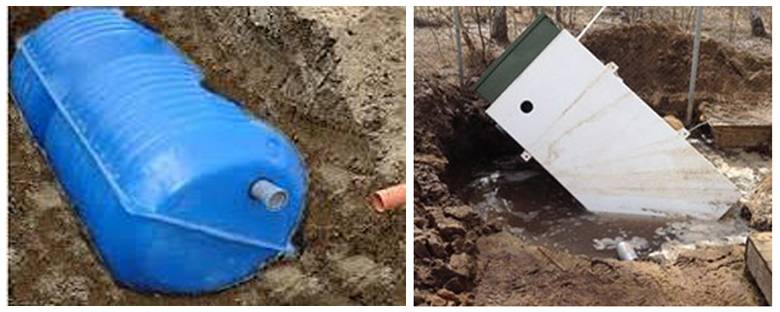
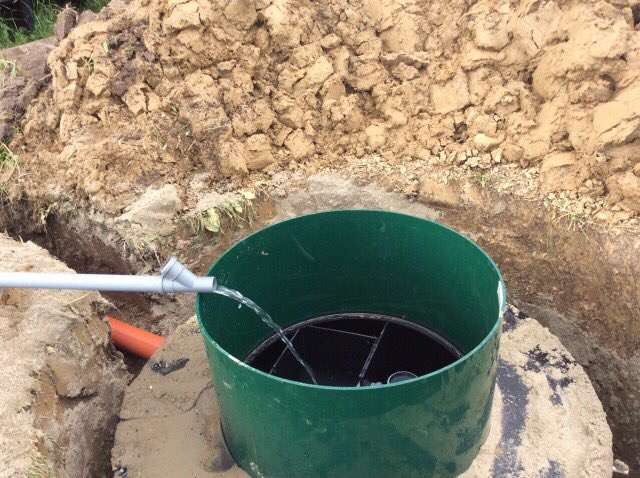
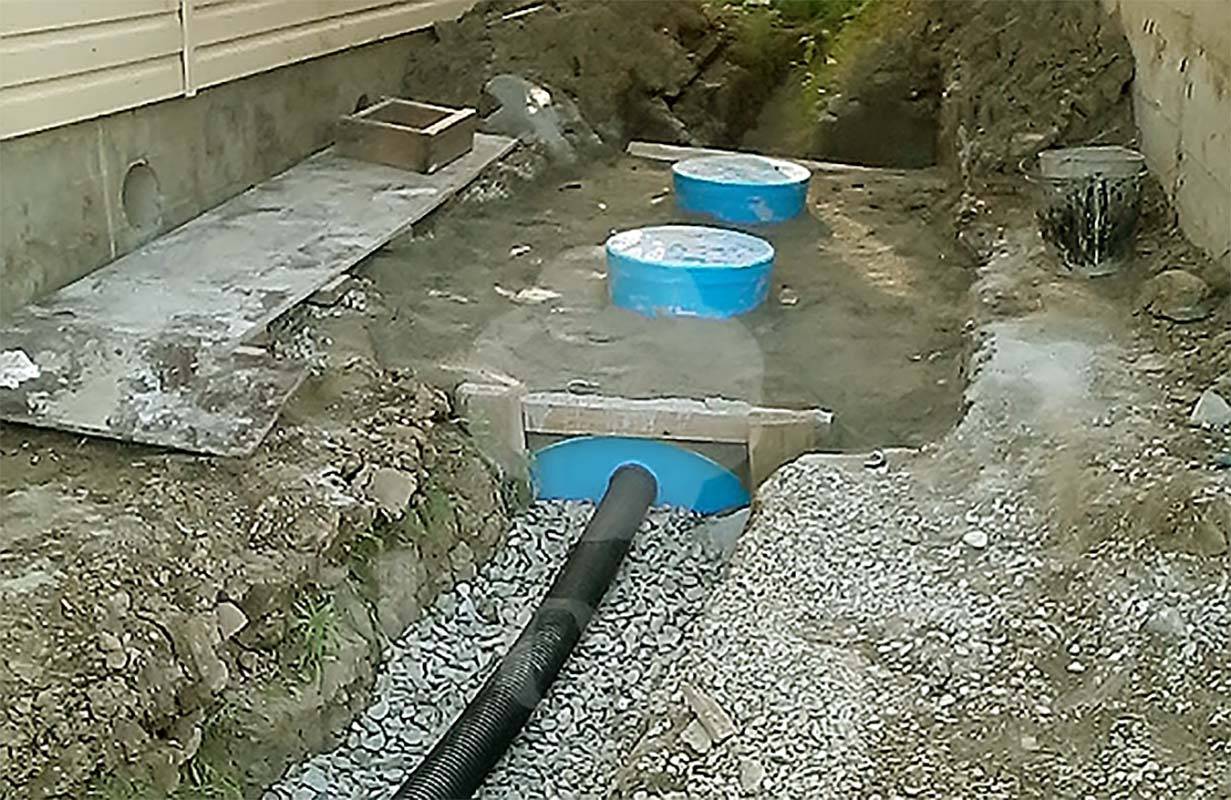


If groundwater layers lie at a distance of less than 1 m from the surface of the earth, it is possible that plastic, concrete and metal containers installed with their own hands may emerge (squeeze out). So how to make a septic tank if groundwater is close? There is an answer: to install a kind of "anchor" that will securely fix the container in the soil.
For areas with water-saturated soil, a high rate of heaving forces in the cold season is typical. To avoid freezing and destruction of the wastewater tank, it is necessary to use sprayed heat-insulating materials. An excellent choice is expanded polystyrene foam.
It is equally important to eliminate the risk of freezing of the fan pipe entering the septic tank. Therefore, a heating cable must be laid outside it.
This is especially important when installing do-it-yourself factory sewer structures that filter wastewater with the help of special bacteria.
Features of the system assembly
Consider the specifics of creating sewers at a high level
ground water. The overall design of the system remains the same. Can be
used:
- cesspool;
- septic tank;
- fully enclosed water treatment plant.
If the thickness of the aeration layer (UGVA) is large enough,
you can build a system based on standard technologies. However, it is necessary to ensure
tightness of connections and receiving tanks. If the ground water seeps
into the container, there will be a mixing of effluents and soil moisture. It threatens to pollute
drinking water wells. For cut-off, aeration plants are used for sewage at high
UGV. These are the devices
supplying oxygen to the soil. Outwardly, they are spirals of
a thin hose through which oxygen enters the soil. It stimulates the development
aerobic microorganisms that produce biological cleaning of the soil.
The recess under the tank should
dig with a margin. It is necessary to make a pit, covered with a layer of sand. over
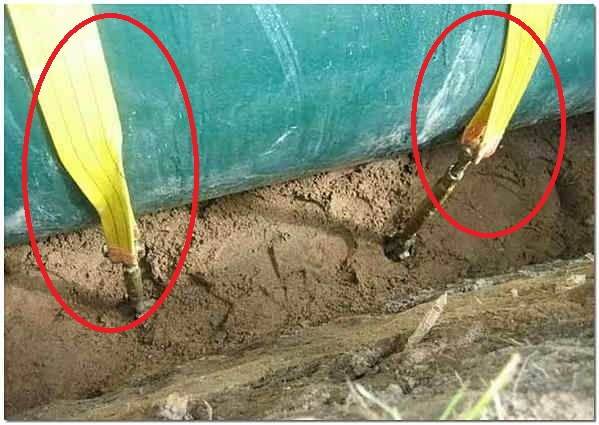
beddings establish an anchor - a concrete slab, to which, with the help of
metal strips or nylon belts secure the container. This will rule out
the mobility of the elements of the system and maintain the tightness of the joints.
Arranging sewerage at high groundwater is very
difficult. It is recommended to carry out earthworks in winter so that wet
quicksand did not fill the pit. Digging frozen soil is difficult, but digging in mud
even more difficult. It becomes possible to make a recess of the desired size.
Arrange a mandatory sand cushion and a concrete slab under the tank. They are
compensate for heaving loads and partially drain soil moisture.
Design choice
Local sewerage in a private
a house with a high level of groundwater can have different types of construction:
- flow septic tank. It is necessary to use multi-chamber structures (minimum 3 tanks);
- local treatment facilities. This option will cost more, but the effect of it is much higher.
The level of cleaning produced
septic tank, does not allow the use of drains for domestic or business purposes.
This means that the water from the last section will have to be sent for post-treatment. AT
in conventional systems, these are fields or filtration wells. However, sewerage at high GWL
rarely allows soil post-treatment. For this, it is necessary to comply
the following conditions:
- the thickness of the aeration layer should be large enough;
- there should be no drinking wells or wells nearby.
Clarified wastewater from local
treatment facilities (VOC) comply with SanPiN standards. This allows
use them for business purposes.
limiting factor
becomes the cost of the equipment. A ready-made treatment plant will cost too much, and
building a homemade complex requires skills and time.



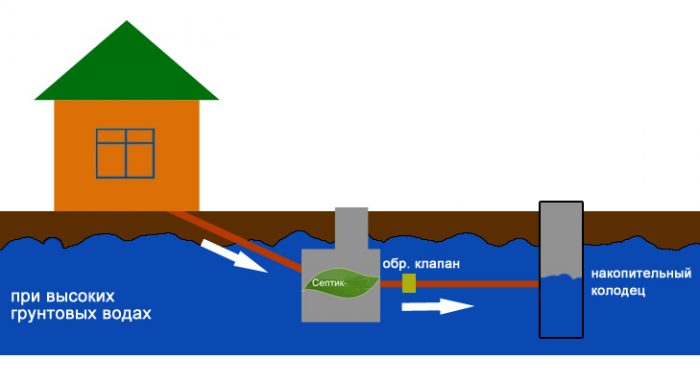


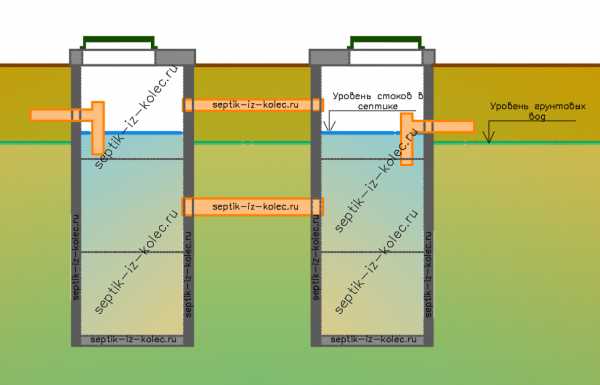

Experts recommend choosing
prefabricated plastic tanks
This is important, since to make a sewer, if groundwater is close,
in the most hermetic way possible. If the creation of a full-fledged sewage
station will turn out to be too costly a plan, it’s easier to get by with a cumulative
capacity
It will have to be cleaned frequently, but the risk of contamination of the aquifer
practically excluded.When using a septic tank, you will have to install a line
effluent for safe disposal. This will require the use
pumps, maintenance and repair of equipment.
The specifics of installation work
Produce
assembly of the system is recommended in winter. The liquid will freeze, installation can be
will produce in a dry trench. If this option is not suitable, you will have to acquire
or rent a pump. With its help, the pulp will be pumped out.
The general scheme of work is standard. The differences are only
in measures to cut off loads. Before you make a sewer, if a high level of ground
water, it is necessary to make a protective crate. Sometimes it is also called
formwork. This is a rigid box made of boards or metal elements that protects
storage tank from external loads. Frosty heaving of the soil is dangerous, it can crush
capacity. Creating a protective cocoon will compensate for lateral pressure
frozen pulp.
If the fluid flow is large,
will have to make a withdrawal. The pump will run almost continuously
mode. This contributes to the rapid development of the resource of the mechanism, the pump will have to
often repair and change.
Wet piping is not recommended. It is necessary to conduct a trench along a dry aeration level. High-quality insulation of the outer line is required, otherwise you will often have to break through ice plugs.
What to do if the extraction efficiency becomes low?
The probability of siltation of the soil into which the treated waste is discharged is inevitable. The task of the owner is only to build a system of high quality in order to postpone this moment as much as possible.In the event that water does not leave the septic tank, what should be done to effectively solve the problem? Needs to be carefully analyzed operation of the entire system. The nature of the problem can be due to both the period of use of the septic tank or an emergency, and the initially incorrect installation of the entire system. If the terms of use of the septic tank are short, it is very likely that the malfunction is caused by errors made during installation.
If the septic tank has been used for more than a year, silting of the drainage is very likely.
If the filter well is clogged, then the well needs to be freed and the bottom cleaned with sand and gravel pouring. If the pit is full, then it is necessary to call a sewage truck to pump out sewage. On your own, you can pump out using a special pump. In the case of filter fields, the situation is somewhat more complicated. It may be necessary to clean the drainage pipes - if the stagnation is provoked by their pollution. Sedimentation of the soil may require digging or replacing its top layer.
The groundwater level is one of the most important aspects when equipping a site with a septic tank. A high GWL forces either not to dump waste into the soil, or to ensure a very high level of purity of the discharged waters. In addition to GWL, there are many more parameters that can affect the quality of the system. Only after calculations can we confidently say which septic tank to choose for clay soil, which for sandy soil, also taking into account the carrying capacity of the soil, the proximity of water bodies and the depth of freezing.
However, choosing the best septic tank for your site does not always mean buying the most expensive model.In cases where the volume of drains is small, there are few users, or the use of a sewage system is seasonal, it is quite realistic to buy a septic tank cheaply with the simplest configuration. And it will be the best solution for a particular site.
If there is no self-confidence, it is necessary to contact the specialists of the manufacturing company. For example, company masters Unilos install aster septic tanks 5 on a turnkey basis, and if the installation is carried out by the manufacturer, he takes into account all the technical features of the system and the probability of error is minimal.
Installation "Topas"
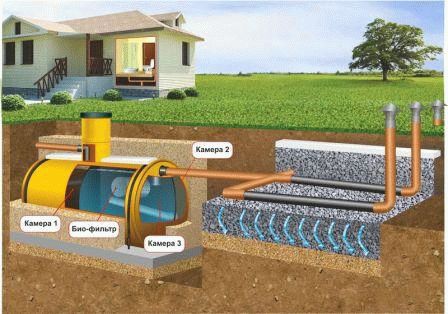
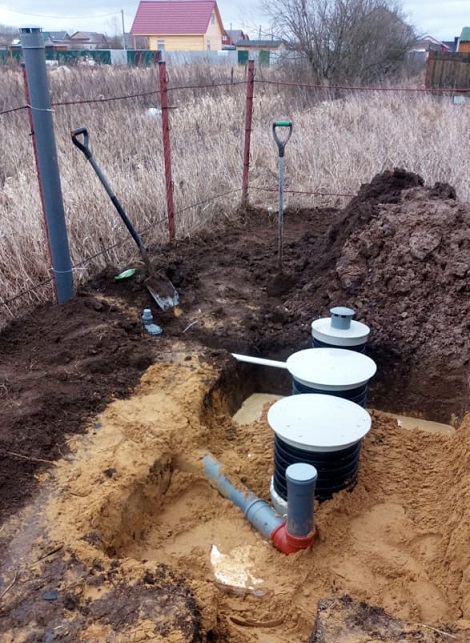
The principle of operation of this septic tank is a competent symbiosis of biologically active cleaning and aeration process. Domestic wastewater undergoes oxidation and decomposition into components. The main working element of this kind of installation is a colony of special bacteria that organically set in motion the decomposition process. Groundwater does not have a significant impact on this type of septic tank.





Topas 8 station
- Depending on the number of users of the device, the gradation is from 4 to 10 people, but this is not the limit, it is possible to create an installation for more;
- How deep is the pipe that delivers effluent from the house to the treatment plant;
- With a different amount of compressor equipment (there will be “C” in the name);
- The presence of a pump for drainage (+ "Pr" to the name).
There are models for holiday villages, as well as large units for mini-settlements from 50 to 150 users. In a wide variety of models, experienced employees will be able to choose the installation you need, taking into account all the nuances in the context of each individual case.
- a large assortment range;
- increased resistance of the material to soil;
- ease of use and care;
- noiselessness;
- excellent water purification, which allows you to replenish even reservoirs.
- energy dependence;
- certain requirements for the composition of wastewater;
- high price.
What arrangement options exist
Now let's move on to the main question, how to make a sewer if groundwater is nearby at no extra cost. Immediately make a reservation, we are considering only the option with the use of plastic containers. Practice has shown that the operation of concrete or metal septic tanks will be expensive, they will constantly have to be repaired and the protective coatings updated.
There are several ways to solve the problem:
- The cheapest in terms of initial investment is the installation of a simple sealed polymer container. It serves exclusively to collect wastewater. Subsequently, pumping and removal for disposal is carried out. The option is good, providing reliable protection, but there are also negative aspects. The capacity should be large so as not to take out the drains every other day. In addition, the services of sewers themselves are now quite expensive.
- Installation of expensive biological treatment plants that remove up to 98% of harmful impurities in wastewater. An excellent solution, purified water can be used for technical purposes. But, besides the price, there is another negative point. Such devices have proven themselves poorly during periodic operation. Arriving at the cottage in a month, you may find that the septic tank is not working. The reason is that microorganisms that processed organic matter in wastewater died. Therefore, this solution is only suitable for permanent residence.True, this will significantly increase the consumption of electricity, depending on the model, the septic tank consumes up to several kilowatts per day to ensure the operation of the compressor-aerator.
- When deciding how to make a high groundwater sewer, be sure to consider using a simple mechanical septic tank. They provide cleaning by 85-90%, further processing is carried out in insulated shallow filtration fields.



