
- What is a septic tank
- Types of septic tanks
- The main elements of a septic tank
- Mounting the device
- The principle of operation of the treatment plant Topas and features of its operation
- How does a septic tank work?
- Station device
- The principle of the station
- How Topas works. Schemes and principle of operation
- Topas scheme
- How Topas works
- The use of "Topas" in the cold period
- Useful tips for repairing the Topas septic tank
- Negative qualities of the septic tank "Topas"
- The principle of operation of the septic tank Topas.
- Features of septic tank maintenance
- Septic tank modifications
- Installation of aeration station
- Topas - relevant and dignified
What is a septic tank
In other words the septic tank can be called an autonomous mini a sewage treatment plant that replaces a cesspool. This is a large volume container, consisting of several sections. It collects, settles and purifies wastewater used for economic and domestic needs.
Scheme of the LSO device of a private house
Septic tanks are elements of local purification systems (LSO). With their help, the problem of sewerage in areas that do not have centralized water treatment systems is solved. The choice of LSO design depends on various factors. Among them:
- the volume of wastewater in need of treatment;
- landscape features of the site on which the sewerage is arranged;
- financial capabilities of owners of private housing construction.
The most primitive and cheapest version of a septic tank is a storage tank. It is a metal barrel dug into the ground. The collection of dirty drains into it occurs in the same way as at the cesspool. A more advanced version of the design distinguishes a metal barrel from the latter. It has a hermetically sealed lid, which limits the spill of sewage in the area and prevents the spread of an unpleasant odor.
Storage tank for domestic and household waste for summer cottages
The disadvantage of the design include the need for constant monitoring of the level of the contents of the container. For its pumping, a sewage machine is used. It makes sense to install storage tanks only in cottages that are not intended for permanent residence.
Types of septic tanks
According to the principle of sewage treatment, autonomous collections are divided into:
- accumulative;
- with soil filtration;
- with forced aeration.
When arranging LSO for a country house, they try to pick up a septic tank that has the ability to deeply clean wastewater. This eliminates the problem of pumping out the contents of storage tanks. Designs produced by the industry cannot produce complete wastewater treatment. Their post-treatment is carried out with the help of filtration fields.
Septic tank "Topas"
The maximum degree of wastewater treatment can be achieved only in VOCs, the principle of operation of which is based on biological methods. Such structures are equipped with a forced aeration system. They must be connected to the electrical network.
Table 1. Types, advantages, disadvantages of septic tanks
| Type of septic tank | Characteristics | Advantages | Flaws |
|---|---|---|---|
| single chamber | They are installed in houses with a daily water consumption of not more than 1 m³. | Ease of installation and operation. Low cost. | Small capacity. No chemical cleaning. |
| Double chamber | It is recommended to install in houses with no more than 4 people. | Reliability and safety. Ease of operation. Long service life. | High price. The impossibility of self-installation. |
| Three or more cameras | Installed in cottages with high water consumption. | Relatively high degree of wastewater treatment. Compliance with the requirements of sanitary standards. | Big weight. Unpleasant odor emanating from the container. |
The main elements of a septic tank
A septic tank is a local treatment plant designed to equip a sewer system independent of the central networks.
The main tasks of the element are the temporary accumulation of wastewater and their subsequent filtration. Modern septic tanks have become an improved alternative to traditional pit latrines.
Understanding the device and mechanism of operation of a septic tank will facilitate the selection of a treatment plant and its installation.
Designs of different modifications have some common components. The treatment system is a sealed tank, which includes one or more compartments.
To prevent soil contamination, the volume of waste entering the pit should be within 1 cubic meter / day. However, in a house where there is a bath, toilet, sink and washing machine, this requirement is not feasible.
The chambers of the septic tank are separated by partitions. The movement of fluid between them is carried out through overflow pipes.
A drain pipe is connected to the first compartment from the internal sewerage of the house, and purified water is discharged from the last chamber into the ground or semi-purified water for soil purification.
Many models are equipped with a mechanical filter - sediment separation occurs without a chemical reaction and the addition of reagents. Effluent is filtered through sand, gravel or expanded clay (+)
The main components of all cleaning units are:
- Tanks for settling wastewater. Storage tanks are made of plastic, metal, concrete or brick. The most preferred models are made of fiberglass and polypropylene - the materials are resistant to abrasion and guarantee the tightness of the tank during the entire period of operation.
- Incoming and outgoing pipeline. Overflow pipes are installed at a slope, providing unhindered flow of liquid between the tanks.
- Service items. Revision wells and hatches. At least one well is installed on the outer route of the sewer pipeline. With an increase in the length of the branch more than 25 m, an additional revision is arranged.
- Ventilation system. Regardless of which bacteria (anaerobic or aerobic) are involved in the process of processing waste masses, air exchange is necessary for the normal functioning of microorganisms, removal of methane and maintaining the desired temperature.
The simplest local sewer ventilation scheme includes one riser at the beginning of the system, and the second at the extreme section of the septic tank. When arranging filtration fields, a ventilation riser is installed on each drainage pipe.
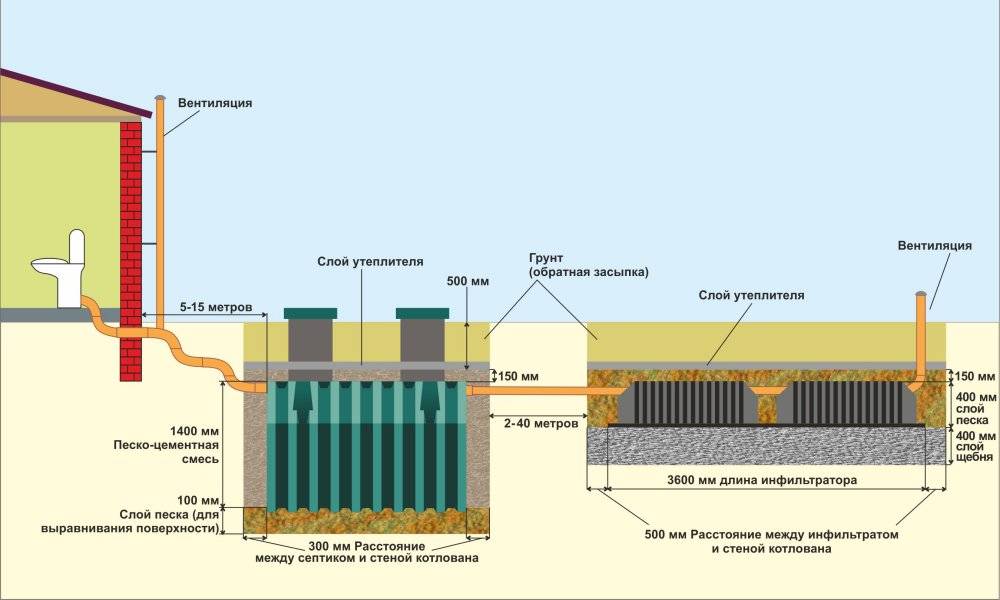



The ventilation system ensures the removal of gases formed as a result of the decomposition of organic matter.Natural air exchange is based on the difference in air pressure - the inlet is located 2-4 m below the exhaust (+)
Mounting the device
Now let's talk about how to install a Topas septic tank. There is nothing complicated in this and everything can be done independently. The only thing that will have to invite assistants when lowering the device into the pit.
The installation of a Topas septic tank begins with determining a suitable location. Here you need to consider the following facts:
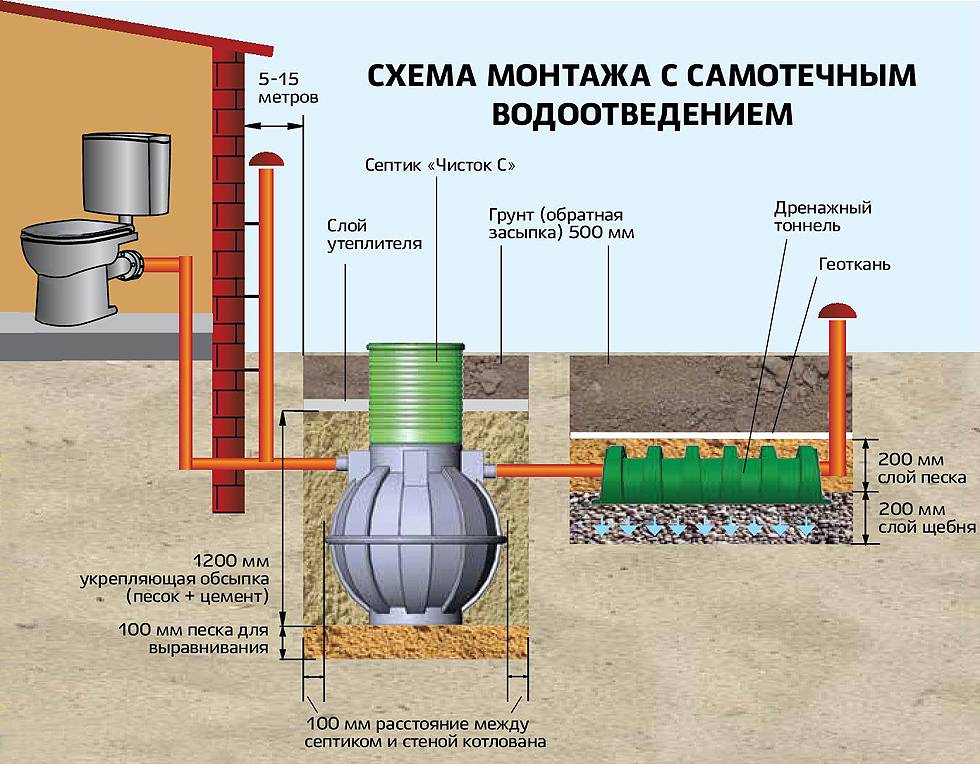
- The location should be close to home. According to the attached instructions, the minimum distance from the installation site of the Topas septic tank to the main building is five meters.
- When choosing a place, try to ensure that the sewer pipes, leaving the house, go straight to the septic tank. Excessive bends and turns can contribute to the formation of blockages, which means additional cleaning work.
- There should be no heavy vegetation around the installation site. The roots of trees and large bushes can damage the body of the septic tank.
- It is also worth knowing the depth of soil freezing in your area. This will determine at what distance from the surface the sewer pipes and the cleaning device itself can be laid.
- If groundwater is close to the surface, then the bottom of the pit must be reinforced with a concrete slab or sand-cement screed.
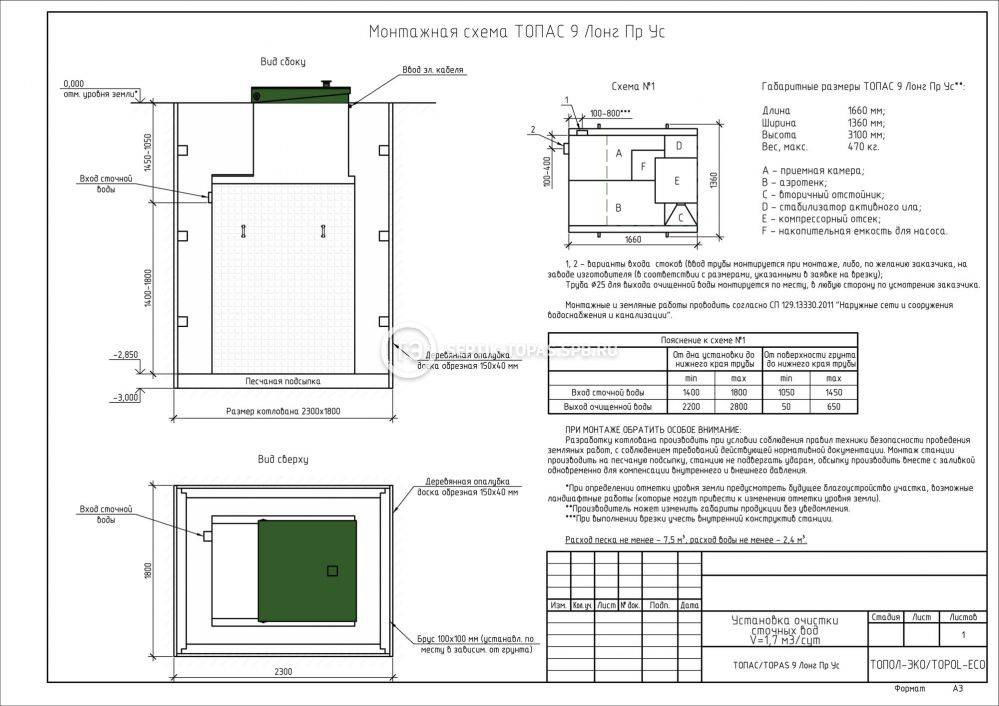
If we have decided on a place, then we proceed to dig a pit. Its dimensions will depend on the chosen Topas septic tank models. As a rule, such devices are relatively compact, so digging a pit can be done manually.
When carrying out earthworks, one should not forget about the necessary gaps between the walls of the pit and the body of the septic tank. They are needed for further filling the device with soil.Such gaps should be at least 20 cm. Also, the depth of the pit should be made larger for the construction of a sand cushion. If groundwater comes close to the surface, then the depth is made taking into account the installation of a concrete slab or sand-cement screed.
After the foundation pit is ready, its foundation is made. The sand cushion should be at least 15 cm. Also try to make the top of the septic tank protrude above the ground. This is necessary so that the spring meltwater does not flood the equipment of the device.
After equipping the base, lower the septic tank into the pit. This can be done manually with the assistance of an assistant. To do this, use the cables threaded through special holes in the stiffeners of the structure.
The next step is to connect the septic tank to communications. The first step is to connect the sewer pipe. First you need to dig trenches for pipes and lay the pipeline itself.
When laying sewer pipes, do not forget about the slope. It should go from the house to the septic tank and be 1-2 cm per linear meter. The depth of laying pipes will depend on the depth of soil freezing. As a rule, it is from 70 to 80 cm.
Before starting work on connecting the septic tank, it is necessary to level it with a building level. Only in a strictly horizontal position will the device work more efficiently.
To connect the sewer pipe to the septic tank, a hole of the required diameter is made in the housing. Everything must be done according to the attached instructions. Then a pipe is welded to the hole, it is advisable to do this using a polypropylene cord and a building hair dryer.After the connection has cooled down, a sewer pipe is inserted into the pipe.
Now it's time to connect the electrical cable. It must be carried out from the shield in the house with a connection to a separate machine. The cable itself is laid in a corrugated pipe and can be placed in the same trench as the sewer pipes. Electricity is connected to a special hole with stamps on the body of the septic tank.
After connecting the power supply and sewer pipes, the septic tank is covered with soil. This must be done gradually, in layers of 15–20 cm. At the same time, water is poured into the container to equalize the pressure. The water level should be slightly above the fill level. So, gradually, layer by layer, the septic tank is completely covered with soil.
If the level of soil freezing is quite large, it is possible to insulate the septic tank. This is done before backfilling with soil. As a heater, you can use any heat-insulating material intended for laying in the ground.
This completes the installation of the Topas septic tank. If everything is done correctly and taking into account the recommendations set out in the instructions for the product, the device will last for decades.
The principle of operation of the treatment plant Topas and features of its operation
The system works in two-phase mode:
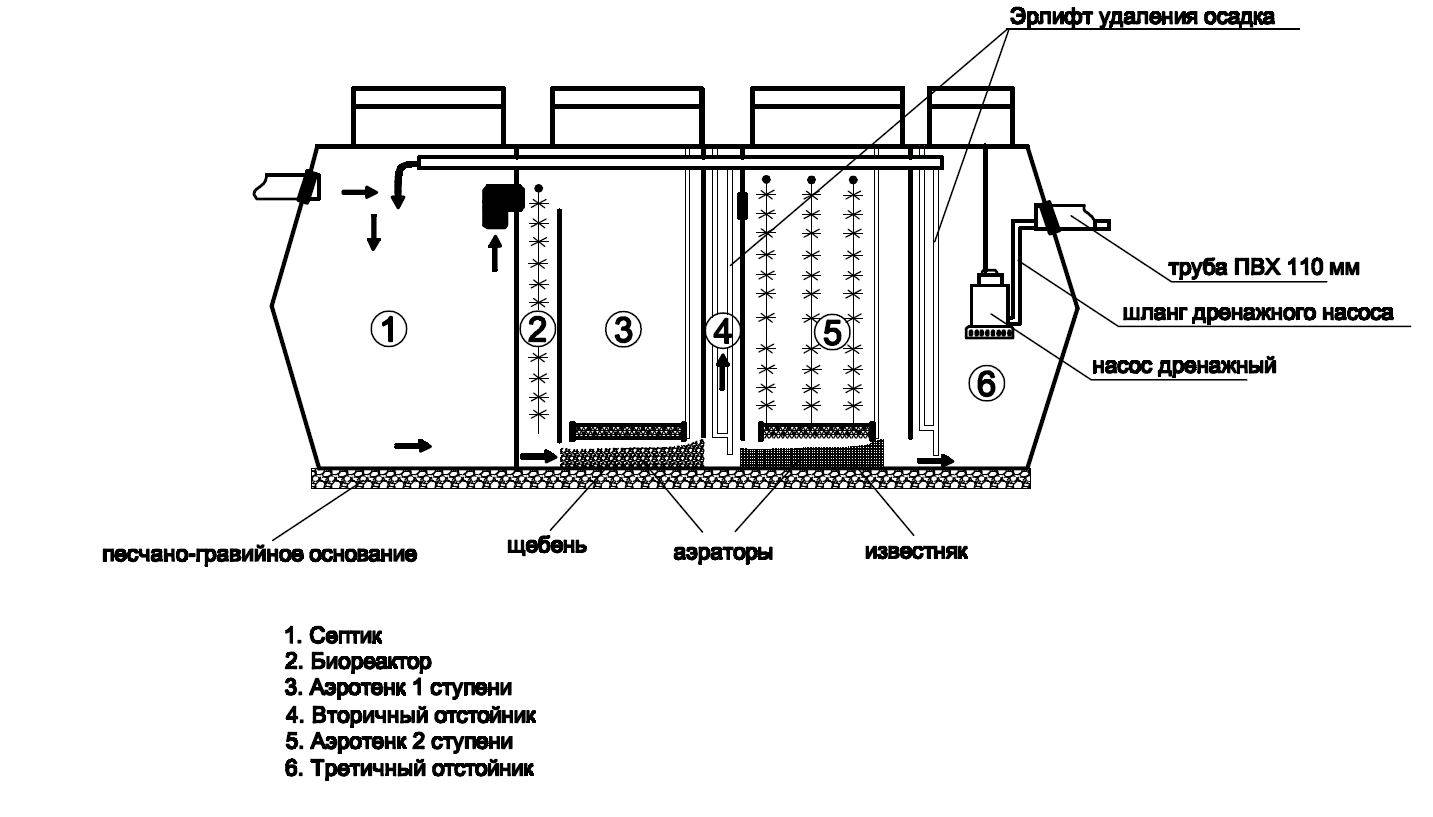
First phase. Through the sewer pipe from the house, wastewater enters the first chamber of the device, in which wastewater is cleaned of impurities and heavy fractions. The filling of the first tank occurs to a certain level of filling, which is regulated by a special float.Further, through a special airlift (called an aerotank), the water flows into the second compartment, where the main purification process is carried out by means of special bacteria for the septic tank and treated with oxygen.
Second phase. After purification by aerobic biobacteria, wastewater enters the third compartment of the system, which is called a pyramid or secondary clarifier. It is it that must be periodically cleaned of silt deposited on the bottom of the tank. After complete purification, water enters the fourth tank, which is a sludge stabilizer, after which completely purified effluents enter in the form of industrial water, which can be used for further use.
Any model of these septic tanks comes with detailed instructions describing the operating conditions, observing which the system will work smoothly:
- Do not allow acids, alkalis and other antibacterial agents that can destroy the working microorganism in the septic tank device to enter the system.
- In the event of a temporary power outage, it is necessary to limit the flow of wastewater into the receiving chamber in order to avoid overflowing the chamber and discharging untreated effluents into the environment.
- It is not allowed to throw into the sewerage system elements not intended for recycling: bags, plastic, sand and other similar compounds, as well as food products in the process of their decay.
- Perform periodic cleaning of sedimentary sludge - at least 2 times a year.
- The operation of some elements of the system is designed for a certain period of operation, after which they need to be replaced: Air Mac compressor membranes are changed once every 2 years, and aeration elements - once every 12 years.
Subject to these recommendations and proper care of the Topas septic tank. the system will function for a long time and with high quality, and will completely replace the central sewage system, which will provide the necessary life support for those living in a private house.

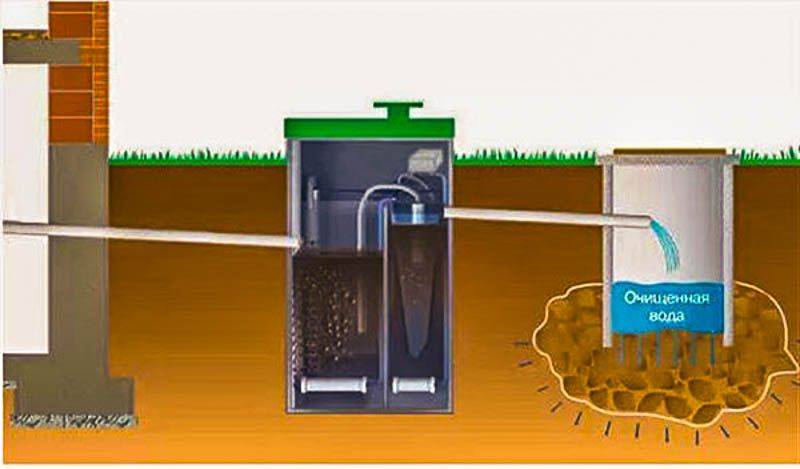

How does a septic tank work?
A septic tank is a special tank that is a replacement for the central sewer system, it is installed in places where it does not exist. This is a great option for installation in a country house, in a country house, cottage, village, in a private house, etc.
In order to understand the features of the functioning of the station, to correctly perform the installation, taking into account all the specifics, and also to choose the most optimal model of the device, it is extremely important to know how the Tank septic tank works. This treatment plant clarifies the sewage that enters it from the bath, toilet and kitchen from all plumbing fixtures by 98%
It allows, as a result of cleaning, to use clarified and disinfected effluents for watering the garden and vegetable garden, fertilizing the soil, washing a car and performing other technical tasks.
Station device
In order to understand how the Tank septic tank works, you need to familiarize yourself with its device and the principle of operation, which provide effective purification and processing of wastewater. It is the device and principle of operation of the Tank septic tank that are key to the effective functioning of the system.
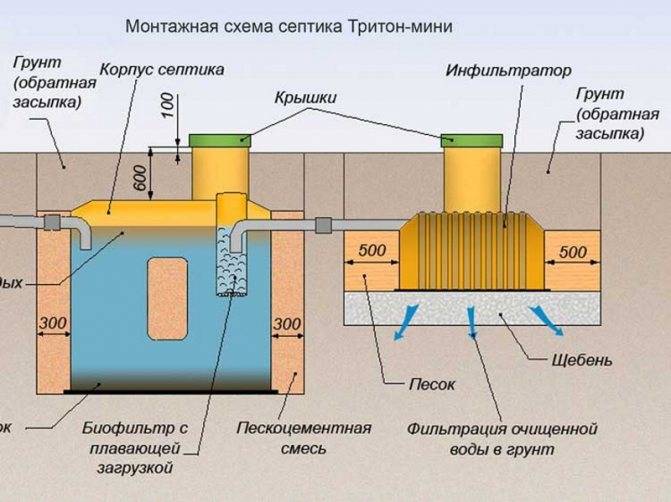
The design qualitatively copes with the breakdown of body fat, fecal matter, food debris, small debris and other types of sewage. How is a septic tank arranged? This is most often a two-chamber or three-chamber settling tank, which has soil additional filtration.The station has a strong and reliable body, has an average wall thickness of 15-16 mm. It consists of several chambers, a floating load, a biofilter and an infiltrator.
The Triton-Plastic LLC company manufactures Tank septic tanks with a rectangular cast body, they have no seams at all. The rectangular shape allows you to save on the installation of the device, as it takes up a minimum of space. That's why installation of a septic tank do-it-yourself is carried out simply and without problems.
The principle of the station
Let's study the principle of operation of the Tank septic tank:
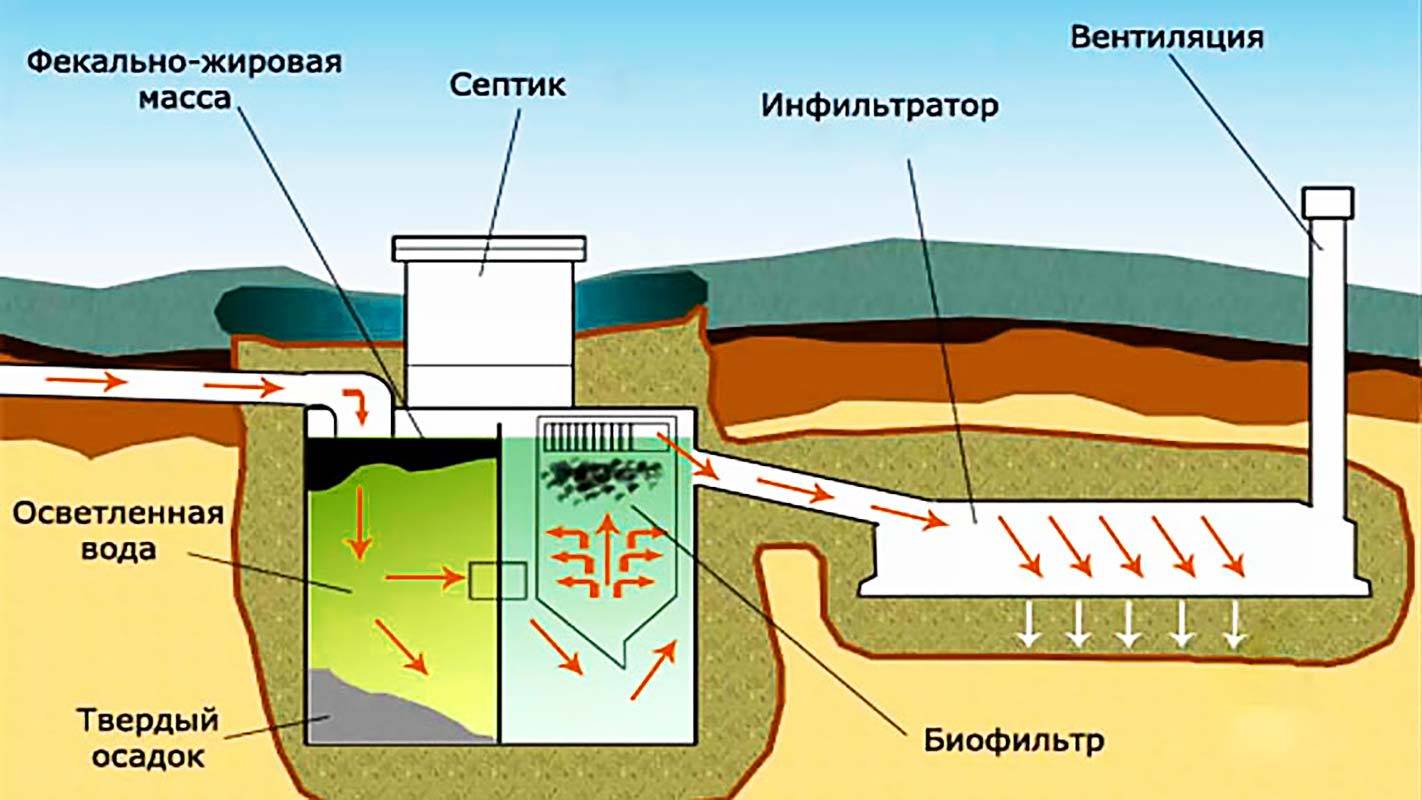
- Sewerage flows through the pipeline from the house from the toilet, bath, shower, sink, bidet, washbasin, dishwasher or washing machine to the first chamber of the septic tank.
- In the first chamber, wastewater passes the first stage of purification. Solid fractions settle to the bottom of the chamber as a result of splitting into organics and inorganics. It is the inorganic that settles to the bottom.
- The water that remains has already been purified by a few percent and is transported further through pipes and overflows to the second chamber.
- In the second chamber, the solid fractions are re-purified. The principle of operation of the septic tank Tank involves the functioning of aerobic microorganisms.
- Further, wastewater is transported to the third chamber, which has a special biofilter with a floating load. Floating loading for a septic tank The tank clears sewage drains for 75%.
- Effluent was completely cleaned in the tank, then the process involves post-treatment in the soil. For this, a septic tank infiltrator functions. This is a specialized tank that has no bottom, its volume is 400 liters.In order to mount the infiltrator, you must first prepare a foundation pit with a cushion of crushed stone, through which water will be filtered. Gutters, passing cleaning through rubble, will be clarified by 100% and then go outside.
How does a tank septic tank work in winter? The device can be used irregularly, it is not necessary to preserve it in winter. If the load is small, then the accumulated drains will be inside the infiltrator, and then gradually go outside. If there is a peak load on the weekend, the unit will automatically work faster
Since there are several variations of devices, it is worth paying attention to the specifics of the functioning of each of them. For example, the septic Tank Universal has its own characteristics
It suggests the possibility of additional installation of several chambers in which liquid will accumulate.
How does a Tank septic tank work on a site with a high groundwater level? If the site has clay or loamy soil, as well as a high level of groundwater, then it is additionally worth installing a well for the pump and a check valve that will pump out water in case of an excess of it. It is also imperative that the structure is installed on a reinforced concrete floor slab laid in the pit, the septic tank must be anchored by means of belts that are attached to the slab. This will protect the station from flooding and soil erosion. The mouth for a septic tank the Tank is in addition warmed.
How does a septic tank work? How does a tank septic tank work: characteristics, device and principle of operation. Working conditions of the septic tank in the winter, with high and low groundwater levels.
How Topas works. Schemes and principle of operation
TABLE OF CONTENTS
This is a continuation of a complete review dedicated to the design of Topas and the principle of operation. When choosing a sewer system, many buyers either do not read such material, or read it between the lines. And very in vain. Knowledge of the device helps a lot, in case of problems, to talk with the service in the same language. You can also independently understand the cause of the malfunction and restore the operation of the treatment plant.
Topas scheme
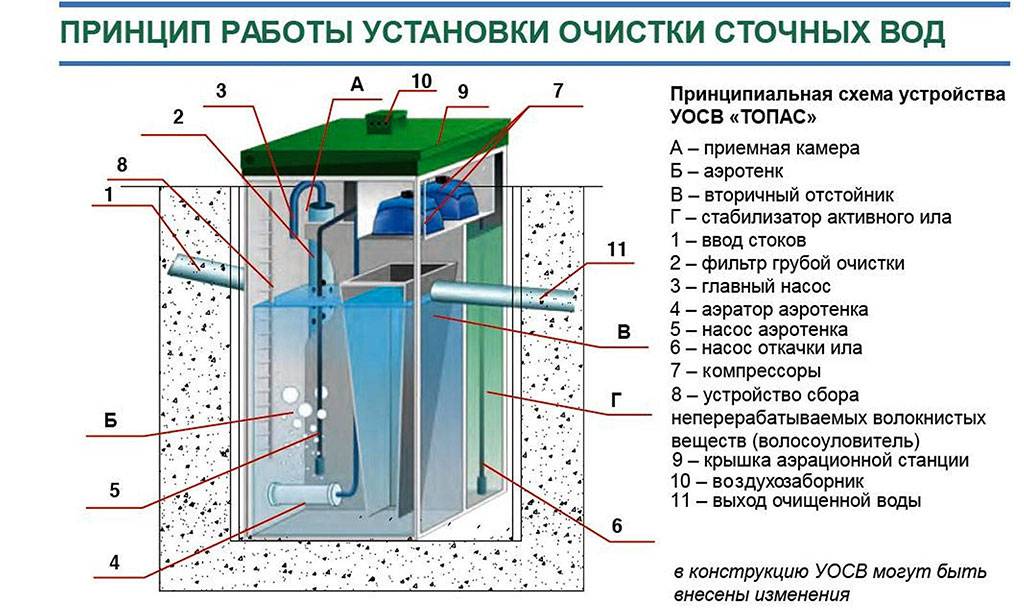
Consider the Topas device, designed for 5 residents.
Notation
- A. Reception chamber
- B. Aerotank
- B. Secondary clarifier
- D. Sludge stabilizer
- D. Compressor compartment
- Input of drains
- Coarse filter
- Main pump
- Sludge pump
- Aerotank pump
- Compressors
- Device for collecting non-recyclable fibrous substances (hair trap)
- Purified water output
- float sensor
- Junction box for connecting the supply cable
- Station on/off button
- Control block
- Floating filter (fine filter)
- Secondary clarifier damper
- Circulation pump
- Aerators
How Topas works
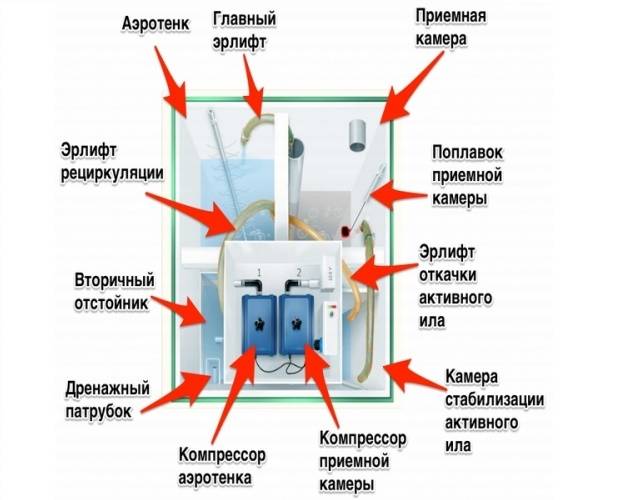
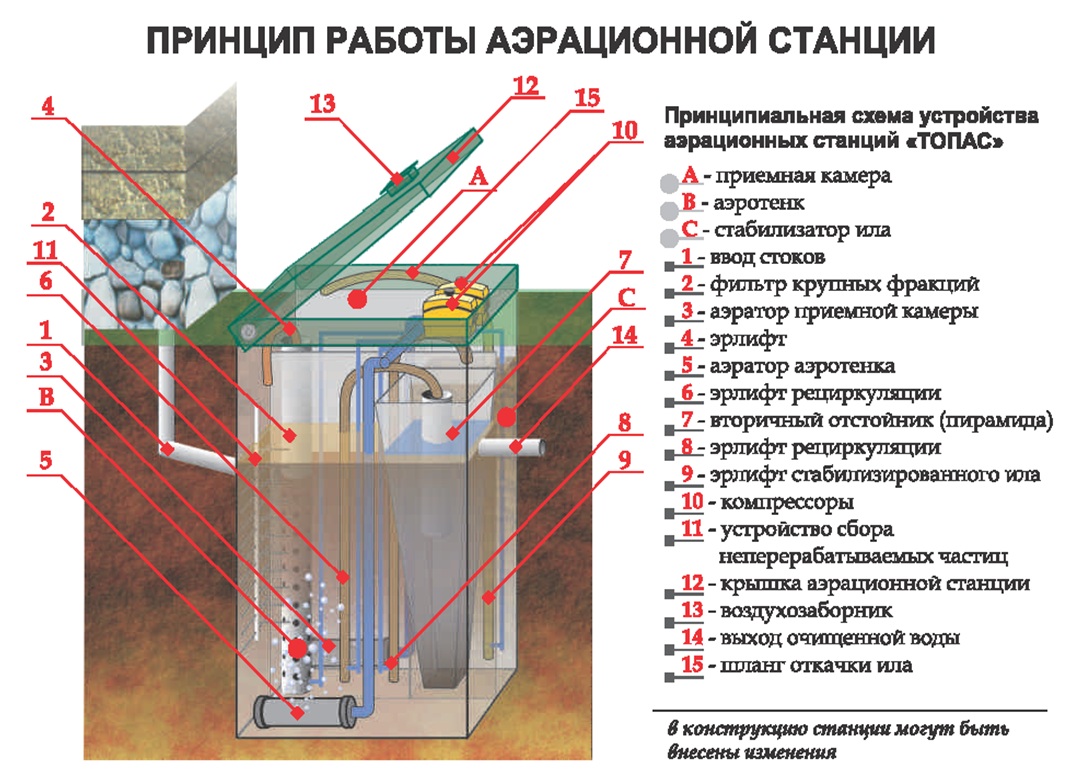
Domestic sewage from the house through a pipe (1) enters the receiving compartment (A) of the Topas septic tank. Under the intense influence of air (aeration), the effluents go through a phase of grinding and pre-treatment. Aeration in the receiving compartment is carried out using an aerator (16) located at the bottom of the station and an air compressor (6).
The prepared effluents pass through the coarse filter (2). The essence of which is to retain large, unprocessed particles inside the receiving chamber until completely dissolved. Then, with the help of the main pump (3), they are pumped into the aerotank compartment (B).During the pumping process, the effluent passes through a hair trap (7) where non-recyclable fibrous matter is collected.
In the aerotank, wastewater undergoes post-treatment with the help of activated sludge - colonies of bacteria and microorganisms "living" in the septic tank, which process polluted effluents in the process of life. As in the receiving chamber, there is also an aerator at the bottom of the aerotank, which, by saturating the drains with oxygen, maintains the efficiency of the activated sludge.
After being processed in the aeration tank, the treated effluents, together with activated sludge, enter the next compartment - the secondary sump. The purpose of this compartment is to separate purified water from activated sludge. Under the action of gravity, the sludge in this chamber sinks to the bottom, and the purified water is discharged by gravity through the fine filter (13) into the drainage. Or, it is pumped out forcibly using a drainage pump (in PR modifications).
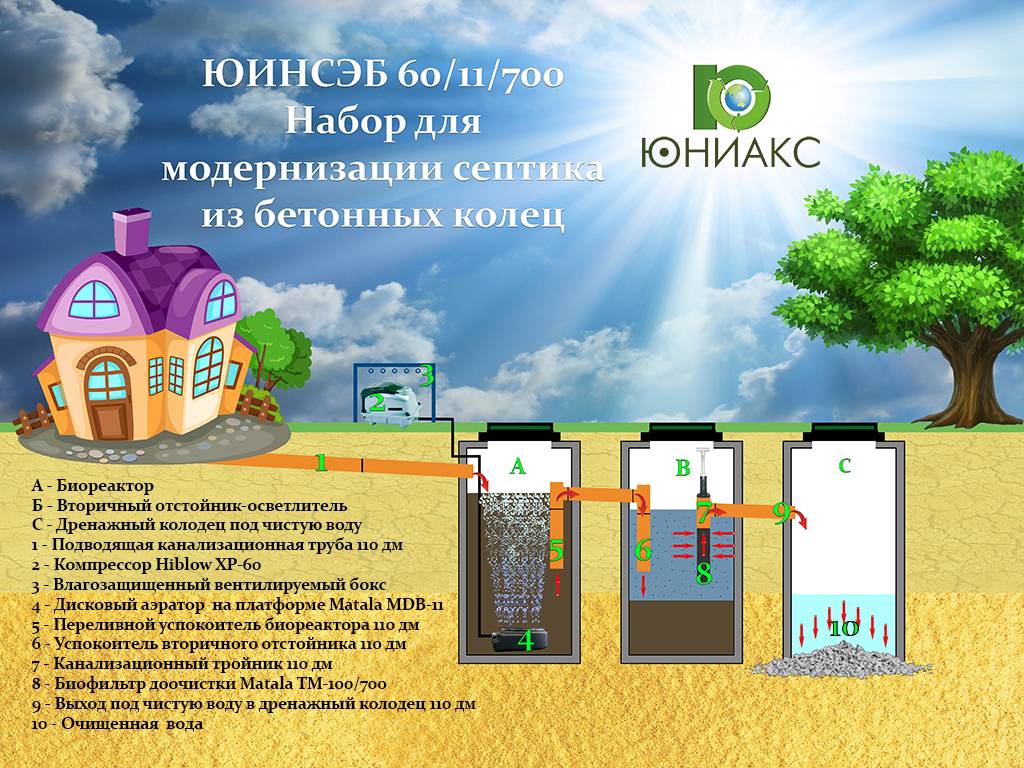
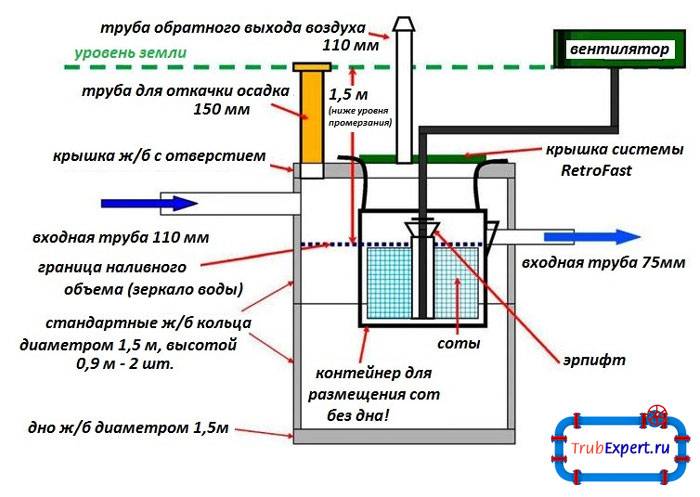

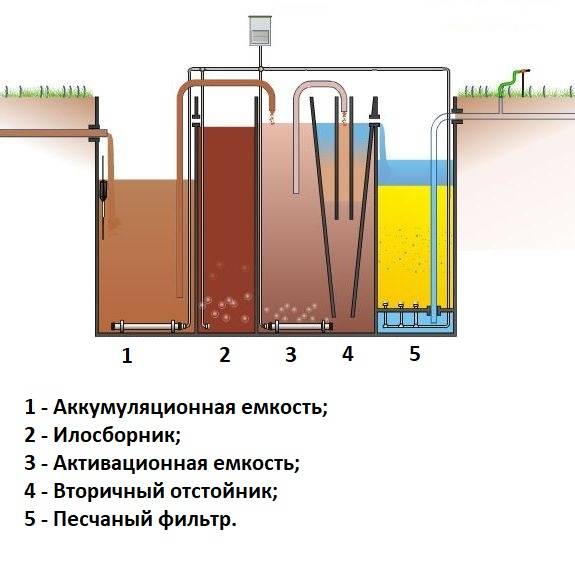

Activated sludge settles to the bottom, and then is pumped by the aerotank pump into the chamber - stabilizer (D). Where it is pumped from when maintenance is carried out.
Topas has 2 phases (cycles) of operation, which are switched using a float switch (9) inside the receiving compartment. Forward cycle (cleaning phase) and reverse cycle (regeneration phase). The cleaning phase works when the sewage flows in. The regeneration phase is needed to maintain the life of activated sludge during the absence of effluents.
In conclusion, it is worth noting once again that all wastewater treatment occurs automatically and does not require your intervention. No additives, bacteria and other chemicals are required to fill in - all bacteria and microorganisms appear naturally - you only need to use the sewer.You are only required to open the lid from time to time to control the operation and carry out scheduled maintenance of the septic tank.
How Topas works How Topas works. Schemes and principle of operation CONTENTS This is a continuation of a complete review dedicated to the design of Topas and the principle of operation. When choosing a sewerage system, many buyers either do not
The use of "Topas" in the cold period
The septic system is equipped with thermal insulation materials, so the principle of its operation remains unchanged even in the cold season. At temperatures down to -15°C, you don't have to worry about the operation of the Topas station. If the degree has dropped below, then the owners are not recommended to open the technological doors, unless there is an urgent need for this. In very severe frosts (-20°C and below), the station needs to be mothballed. You can carry out the procedure yourself, but it is better to contact specialists.
- You should not completely drain the water from the system, because in the spring you will see a floating tank, and it will need to be installed again.
- After pumping out dirty water, it is necessary to clean the containers and fill them with clean water for 34.
- Nozzles, pumps, airlifts also need to be cleaned.
- Disconnect "Topas" from the power supply system.
- Disconnect compressors and pump.
- Insulate the cover of the station from the outside, but leave the air flow to the vent.
- When spring arrives, first connect the compressors and pump, and then turn on the power. The station will return to normal operation in a few days.
Useful tips for repairing the Topas septic tank
Reasons for the need for repair:
- Due to untimely or irregular maintenance, an unpleasant odor or dirty water may appear. To eliminate it, it is necessary to flush the entire system.
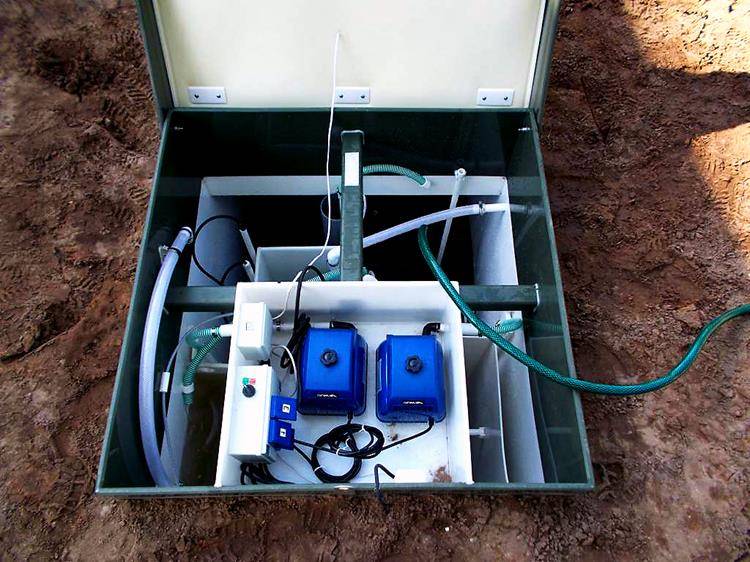
- If the wiring is damaged, the compressor or sensor may be shorted. A complete rewiring is required.
- If water flows out of the septic tank, or water enters it, and you are not currently using it, then you need to check the plumbing. There may be a blockage in the outlet pipe or the presence of flood water. Or the hull is damaged. Repair plumbing, clear clogs, pump out water, and get professional help.
- If the septic tank floods, check the operation of the drain pump. It must be disconnected and checked separately. In most cases a new pump is needed.
- When the emergency sensor is triggered, there may be problems with the airlift, or the sensor itself may be broken. It must be replaced and a specialist should be invited to check the operation of the station.
Recommended reading: Diagram of a septic tank made of concrete rings
Negative qualities of the septic tank "Topas"
Like any system, the Topas septic tank wastewater treatment plant has its drawbacks:
- In case of power failures, it is impossible to use the station, because frequent shutdowns lead to a breakdown of the entire system.
- The cost of the Topas septic tank is several times higher than the price for similar autonomous sewer systems.
- Dependence on regular maintenance, otherwise the compressor and pump will clog or fail, the repair of which will lead to additional costs.
- The appearance of an unpleasant odor during operation or the exit of dirty water through the top. This is due to improper maintenance of the station.
An autonomous sewer system is a complex device that can fail at any time. At the same time, urgent repairs are needed, because we cannot imagine a normal life without sewerage.Repairing septic tanks on your own is a difficult task, so if the station breaks down, immediately contact specialists who have extensive experience and special equipment.
The owners of Topas septic tanks note that the system meets the standards and requirements for wastewater treatment, it works silently, the body is made of environmentally friendly polypropylene material, industrial water and waste sludge are successfully used for watering and fertilizing the garden. In addition, the Topas installation allows you to save on the services of vacuum trucks. Despite the high price, this is a high-quality and reliable purchase. After installing the station, it can be decorated using a decorative hatch in the form of a stone. It is made of plastic, which is durable, as well as the shape will allow installation on any site.
By purchasing an autonomous sewer system of the Topas septic tank, you care not only about your comfort, but also do not harm the environment.

site menu
The principle of operation of the septic tank Topas.
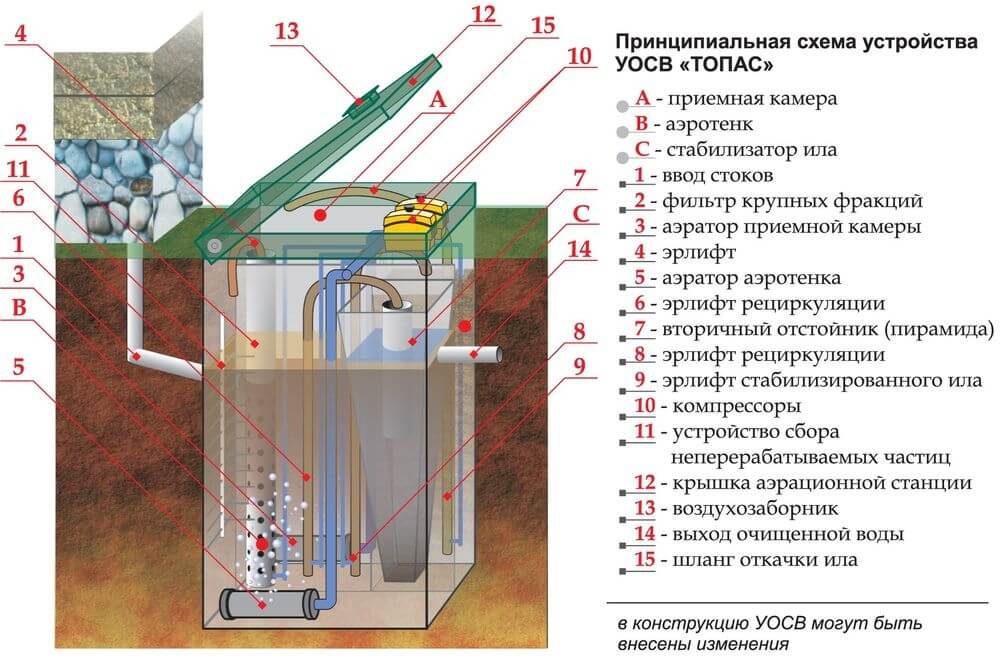
As noted above, the principle of operation of the Topas septic tank is to purify domestic water with the help of microorganisms specially created for this purpose called aerobic bacteria. During their impact on polluted wastewater, the decomposition of organic compounds occurs, their further disinfection and processing into sludge.
If we consider the process of water purification in order, it will look like this.
- First of all, wastewater enters the chamber (sector No. 1) of the installation, where it goes through its first stage of treatment. At this stage, large fractions of the existing pollution are eliminated.
- Further, with the help of an airlift, the installation transports water to the aerotank (sector No. 2). This sector is the main part of the septic tank installation (active bacteria are located there): it destroys all contaminants that could be cleaned at the first stage. The sludge that results from the treatment and processing of waste also acts as a binder for foreign particles that are contained in the water.
- After that, the liquid enters the next compartment - the sump (sector No. 3). In this compartment, the sludge settles to the bottom, after which the already purified water is transferred further - to the right place.
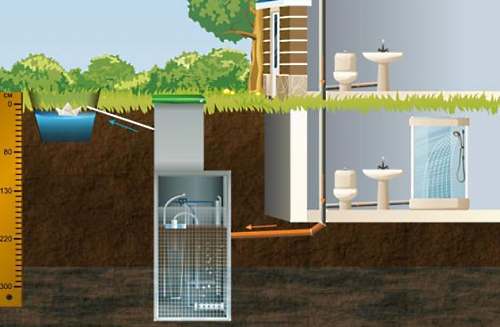
By the way, the sludge collected during filtration in the sump must be periodically removed from the septic tank. The process of its disposal is quite simple and does not require special knowledge. And if the septic tank is used in country conditions, then this sludge can be completely used as a fertilizer.



Features of septic tank maintenance
Home sewerage, providing a comfortable life outside the city, also requires attention. So that at the most inopportune moment everything does not break down, it is necessary to carry out maintenance of a self-sufficient Unilos septic tank in a timely manner.
All requirements are described in detail by the manufacturer in the instructions for the equipment.
The specialists invited to service and clean the sewer system do their job quickly enough. This is convenient if the owner does not have time for self-service
Maintenance can be done in 2 ways:
- conclude an agreement with specialists;
- do everything on your own.
The essence of this process is to wash the filters, tubes and nozzles, clean the walls from contaminants, pump out activated sludge from the sump.This is within the power of the owner of the household, the main thing is to carefully read the instructions.
Moreover, it is advisable to open the lid once a month and see how the system works. There should be no unpleasant odors. If this phenomenon is observed, then an error was made during installation.
This is possible when the owner himself carried out all the installation and connection work. Here, the best way out is to invite specialists who will point out errors and correct them.
It is not necessary to rinse the walls of the container every time. This can be done every 6 months.
Once every 3 months should be cleaned:
- mamut pump;
- walls of the secondary sump;
- blower filters.
Also, sludge should be removed from the sump. All components are well detached and removed. This allows you to easily wash them, and then put them in place.
All components of the septic tank can be easily removed and cleaned. This allows you to carry out all the work on your own, without involving specialists.
First of all, the station is turned off by pressing a special button. After 30 minutes, when the sludge settles, you can disconnect the mamut pump and start pumping. In total, 5-6 buckets are removed. The process is described in more detail in the instructions.
Once every three months, the sewer installation must be cleaned of silt using a regular pump. Once every six months, it is necessary to pump out the sludge with a drain and clean the hair trap
The equipment manufacturer recommends that the aeration tank and surge tank be cleaned of stabilized sediment every 5 years. The aeration elements themselves must be replaced every 10 years.
As for the replacement of individual elements, the compressor itself can last from 5 to 10 years, and it is advisable to change its membrane every 3 years.
All maintenance work is not difficult to carry out on your own.If the owner has chosen the option with the involvement of the organization's specialists, then activated sludge can be pumped out every 6 months.
Sludge removal takes a little time
When you are done with the maintenance of the septic tank, it is important to remember to turn on the oxygen supply devices to avoid the death of aerobes.
Septic tank modifications
Topol Eco company develops and manufactures cleaning plants for various objects: country houses, residential cottages, small businesses and hotels
The main difference between the models lies in the permissible capacity of the receiving tank, the performance of septic tanks, which should be taken into account when choosing
The scheme of operation of Topas septic tanks is the same for all models. The difference lies only in the size of the compartments, the power of the equipment.


| Model | Number of users | Processing volume, m3/day | Volley discharge, l | Food, kW/day | Dimensions (a*b*h), m | Product weight, kg |
| TOPAS 5 | 5,0 | 1,0 | 220,0 | 1,5 | 1,1×1,2×2,5 | 230,0 |
| TOPAS 5 long | 5,0 | 1,0 | 220,0 | 1,5 | 1,1×1,2×3,1 | 280,0 |
| TOPAS 8 | 8,0 | 1,5 | 440,0 | 1,5 | 1,6×1,2×2,5 | 280,0 |
| TOPAS 8 long | 8,0 | 1,5 | 440,0 | 1,5 | 1,6×1,2×3,1 | 350,0 |
| TOPAS 10 | 10,0 | 2,0 | 760,0 | 2,0 | 2,1×1,2×2,5 | 355,0 |
| TOPAS 10 long | 10,0 | 2,0 | 760,0 | 2,0 | 2,1×1,2×3,1 | 425,0 |
| TOPAS 15 | 15,0 | 3,0 | 850,0 | 2,9 | 2,1×1,2×2,5 | 370,0 |
| TOPAS 15 long | 15,0 | 3,0 | 850,0 | 2,9 | 2,1×1,2×3,1 | 435,0 |
| TOPAS 20 | 20,0 | 4,0 | 1000,0 | 2,9 | 2,25×1,7×2,6 | 620,0 |
| TOPAS 20 long | 20,0 | 4,0 | 1000,0 | 2,9 | 2,25×1,7×3,0 | 670,0 |
| TOPAS 30 | 30,0 | 6,0 | 1200,0 | 3,6 | 2,25×2,2×2,6 | 760,0 |
| TOPAS 30 long | 30,0 | 6,0 | 1200,0 | 3,6 | 2,25×2,2×3,0 | 810,0 |
| TOPAS 40 | 40,0 | 7,0 | 1300,0 | 5,8 | 2,25×2,2×3,0 | 890,0 |
| TOPAS 50 | 50,0 | 9,0 | 1500,0 | 7,2 | 3,25×2,2×3,0 | 1160,0 |
| TOPAS 75 | 75,0 | 12,0 | 2250,0 | 10,8 | 4,25×2,2×3,0 | 1470,0 |
| TOPAS 100 | 100,0 | 16,0 | 3000,0 | 14,4 | 3,25×4,0×3,0 | 2000,0 |
| TOPAS 150 | 150,0 | 24,0 | 4500,0 | 21,6 | 4,25×4,0×3,0 | 2940,0 |
Choosing a septic tank is not so difficult. The main criterion is the expected number of users. You should choose the closest value to the index in the brand of the model.
Models "Standard" (Topas 5, 8, 10, etc.) without additional designations are suitable for installation with a supply pipe at a depth of 0.4-0.8 meters. For deeper pipes, models with a long prefix are used; they can be buried at 0.9 ... 1.4 meters.
In the extended model range there are septic tanks with the designation of water movement:
- "Pr" (forced movement of water), such models are chosen at a high level of groundwater, the liquid from the septic tank is removed by a pump.
- "Us" (increased fluid movement). Such an installation is necessary when the septic tank is deepened by 140 mm relative to the inlet pipe.
For country houses and cottages, Topas 5 ... 10 installations are usually chosen, more powerful devices are chosen for small businesses, public institutions of various patency. Topas 100…150 septic tanks are suitable for organizing wastewater treatment from a small area of a cottage settlement or autonomous sewerage in a village.
Installation of aeration station
The system is installed similarly to other septic tanks - the equipment is located in a designated area. The difference lies in the presence of a larger filtration field in the case of mounting a powerful unit.
The installation is built according to the scheme:
- foundation pit;
- backfilling the bottom with rubble;
- equipment installation;
- connecting pipes and cables;
- backfilling of a septic tank and pipes;
- setting up the equipment.
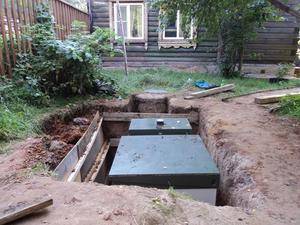
soil features.
As for the installation itself, in the case of model-5, you can handle it yourself. But already when working with Topas-8, weighing 350 kg, you will need equipment.
Professional turnkey installation costs about 20,000 rubles, has its own variations of services and pricing scheme. For example, installation supervision costs about 8,000 rubles.
Topas - relevant and dignified
An alternative to Czech products - Topas - an autonomous technological system that differs from other septic tanks in a high degree of wastewater treatment - 99%. The septic tank has mobile parameters and is equipped with cleaning chambers.
His work is based on:
- On an organic combination of aeration and cleaning processes.
- To counter the accumulation of waste.
- Efficiency of the process due to constant air flow.
- Silence.
- limited prevention.
- Complete sterilization of odors.
- Aerobic decomposition occurs under the influence of thermal energy, so no additional heating is required in cold weather.
The disadvantages include:
- Dependence on power sources.
- Great value.



