
- Photo of rainwater harvesting methods
- Storage tank installation
- We also recommend to see:
- Stylish drain
- How to clean rainwater in the country and at home
- Consider the main elements of water treatment
- The advantage of rainwater in watering plants
- deep drainage
- Sewage pits and ditches
- Deep drainage system
- Closed wall drainage
- Where to divert water?
- - for watering the garden (rainwater does not contain chlorine and is rich in oxygen);
- How to choose the optimal roof shape?
- What is the composition of rainwater?
- Conclusions and useful video on the topic
Photo of rainwater harvesting methods

We also recommend viewing:
- How to make a cold smoked smokehouse
- Building a smokehouse with your own hands
- How to make a hot smoked smokehouse with your own hands
- How to make a wood splitter with your own hands
- How to make curtains for a gazebo with your own hands
- We make water supply in the country with our own hands
- Instructions on how to make furniture from pallets
- Do-it-yourself pool cleaning
- Site watering options
- Instructions on how to easily remove the stump
- How to make a garage door with your own hands
- How to make a snow blower with your own hands
- Wood protection products
- Simple drinker for chickens
- How to clean soot
- Good dry closet for a summer residence
- How to make a barbecue with your own hands
- Good heating for a greenhouse
- Modern winter greenhouse
- Roof drainage system
- How to make a chicken feeder
- Do-it-yourself decking
- How to make molds for paving slabs
- Instructions on how to equip a garage
- How to make grounding in a private house
- Gate lock
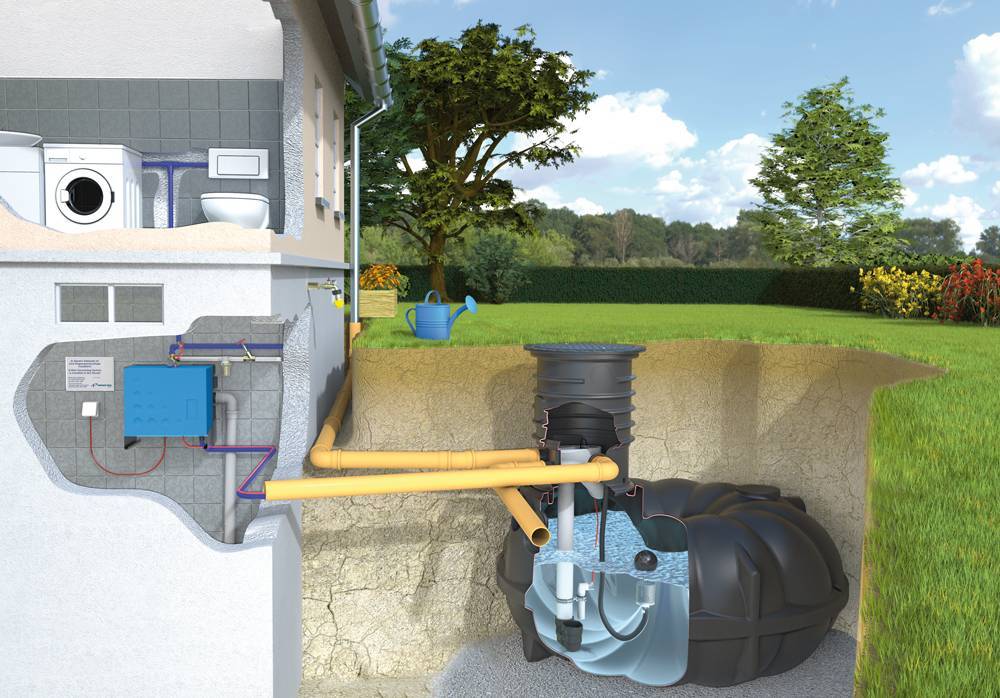
Storage tank installation
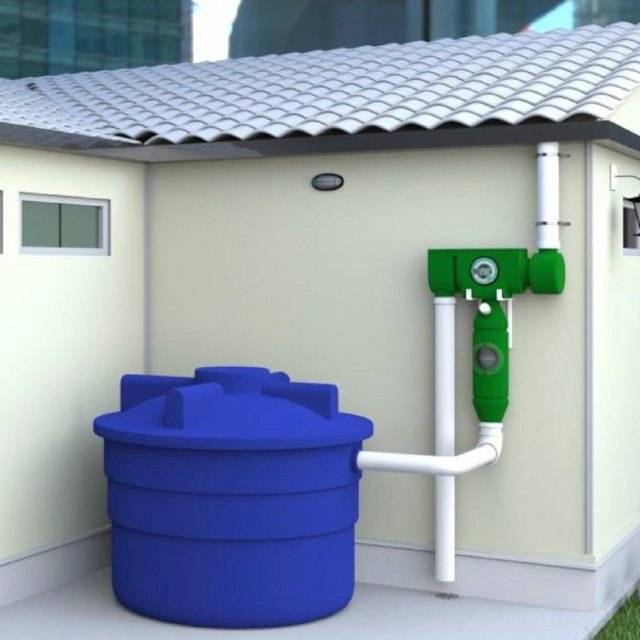
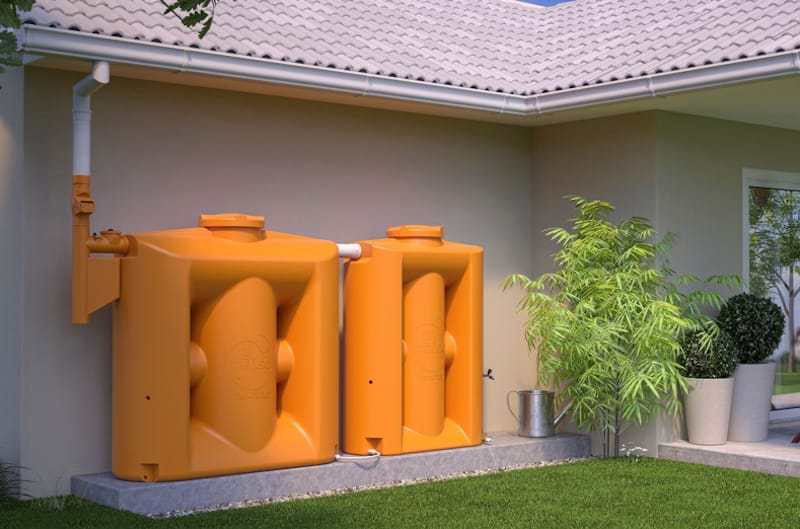
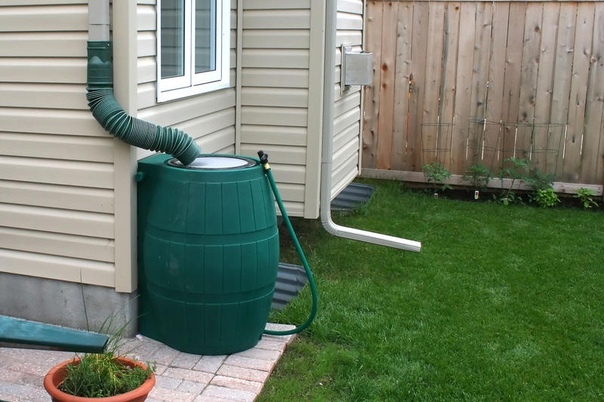
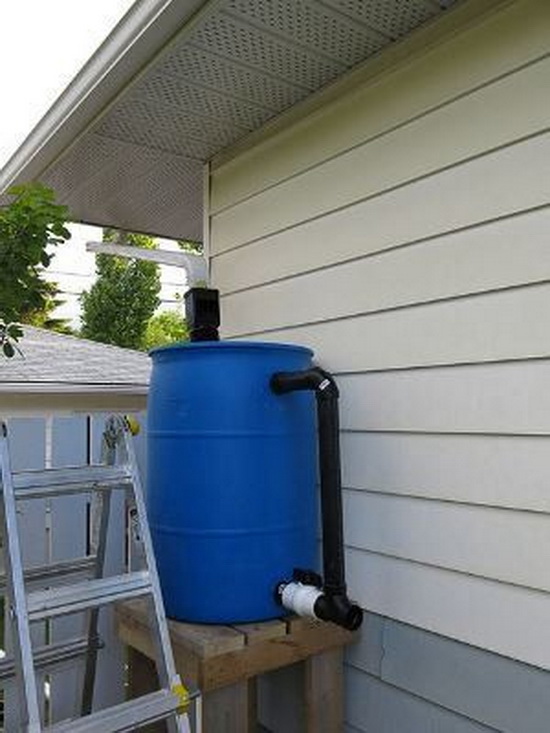
Based on your own capabilities and needs, you are free to use any container as a rainwater storage tank: be it a simple barrel or a special tank with holes for pipes. As practice shows, the second option is more expensive, but also more convenient to use, so it is recommended to use it.
The container must be made of a safe material that does not dissolve in water and has a constant chemical composition: polyethylene, concrete or galvanized steel. You can install it in two ways:
 Rainwater collection tank
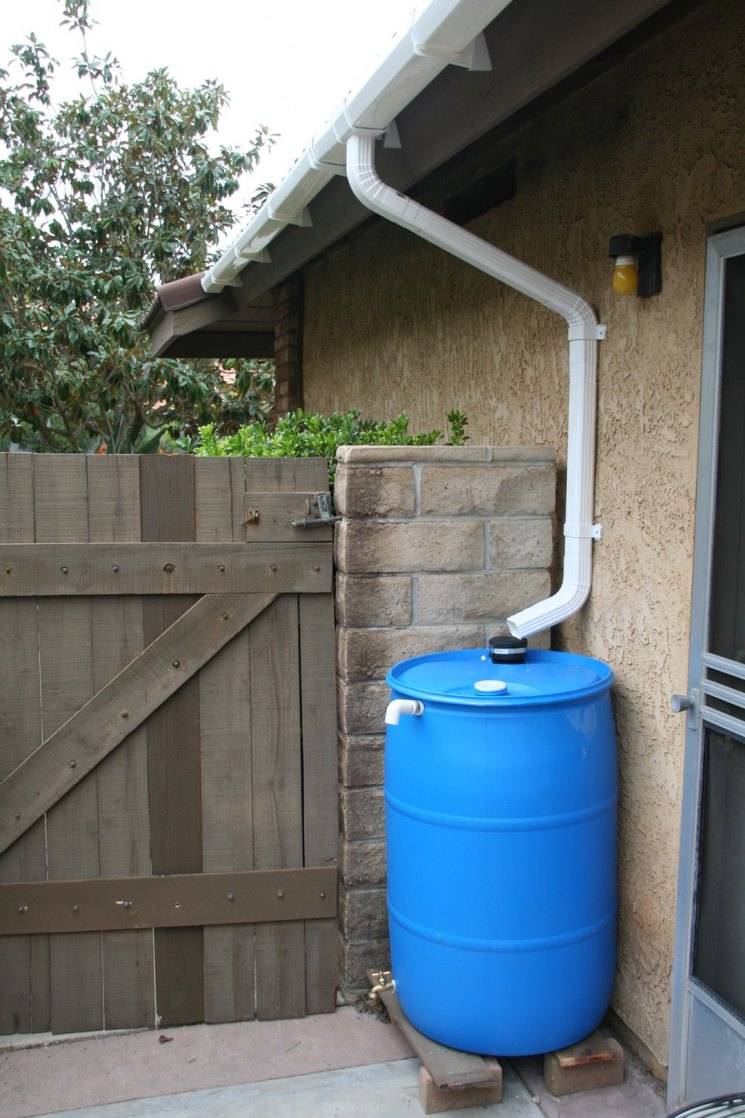
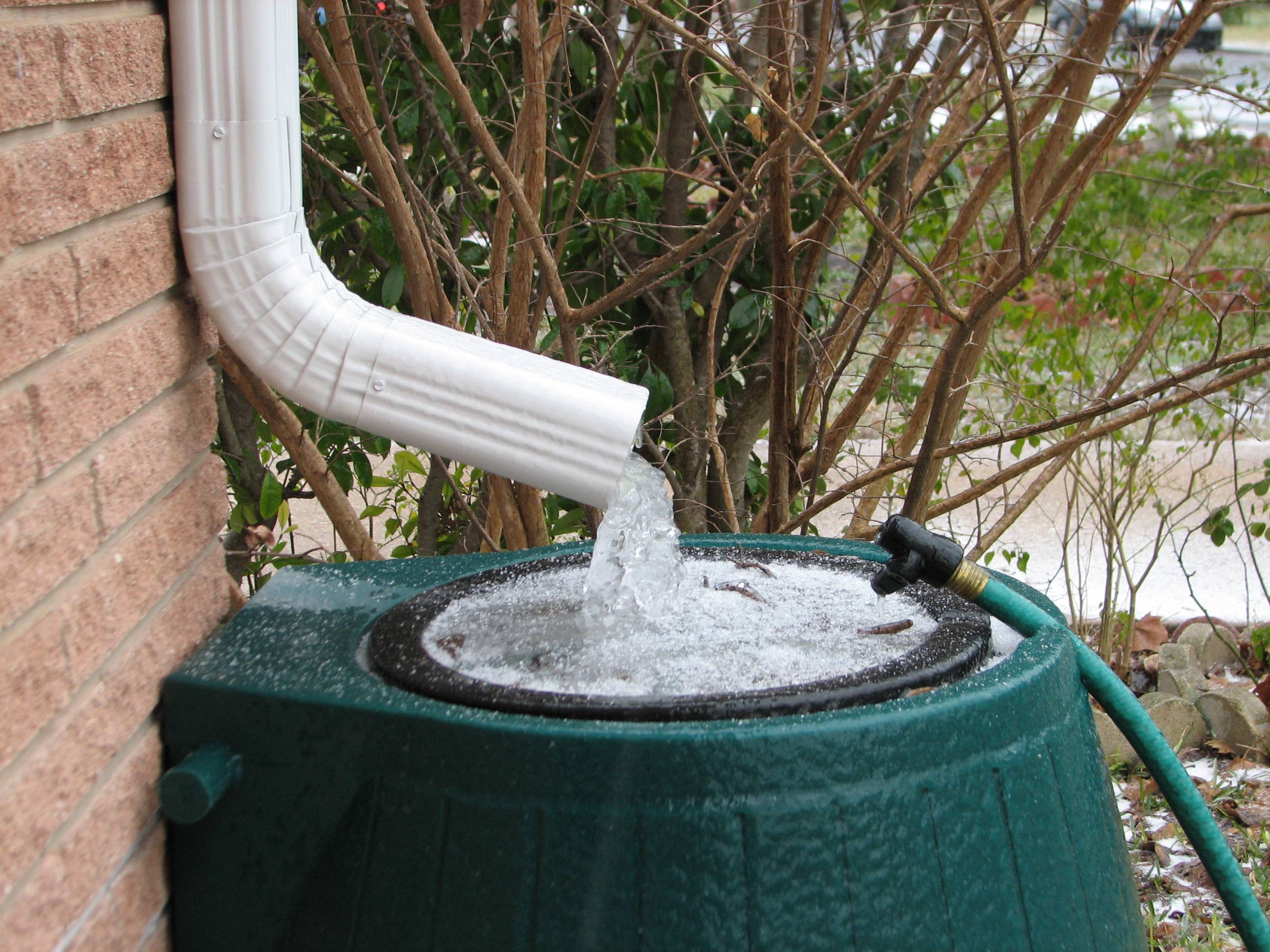
- On the surface of the ground directly under the drainpipe - first place the container in the required place and fix it with props and brackets, and then connect the drainpipe to the accumulator hole and close the tank with an airtight lid.
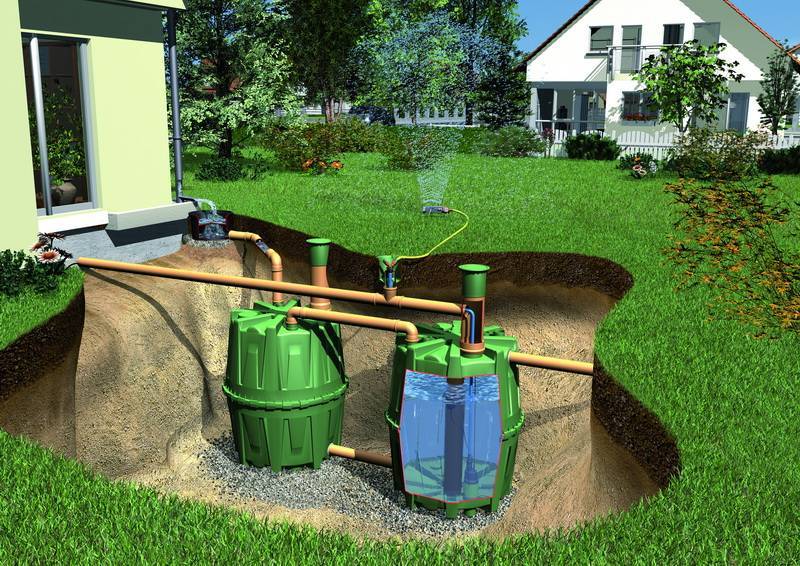
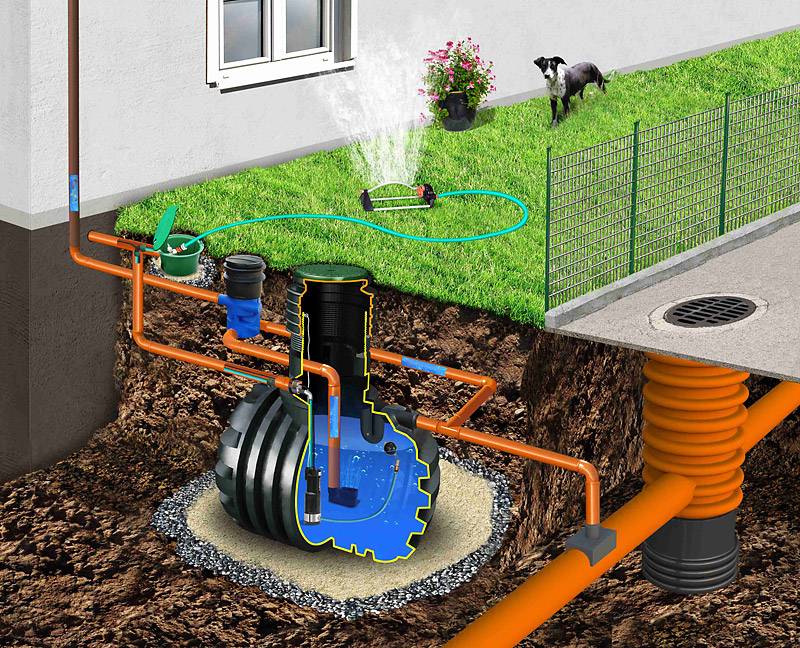
- With digging into the soil - dig a hole to fit the size of the container, lay a 15 cm sand cushion on the bottom, place the container on it and fill the resulting voids around with sand, and then, similarly to the first case, bring down the drainpipe and tightly close the lid.
We also recommend to see:
- Watering trees in autumn or how to prepare a garden for wintering
Moisture-charging watering of trees in autumn is necessary for the garden. This truth, I think, does not need to be particularly proved to experienced gardeners, especially here in the Kuban. Over the summer, and it has ...
- Watering the garden - irrigation rate, how many times, when and how to water
For a gardener, a garden and a vegetable garden should be economically profitable.Planting, growing vegetables, fruits is beneficial when we get a high quality crop in a short time. All this…
- Garden care in autumn - protection, top dressing, watering
In the fall, it's time to take care of the condition of the backyard and garden. Creating comfortable wintering conditions for fruit trees is a top priority for gardeners. What does the care...
- Pumping water supply stations for a private house and cottage - how to choose, what to consider
The purchase of a water supply pumping station for a private house or cottage is relevant for owners of plots that are not connected to a centralized water supply system. It will fully solve the problem of providing a home with a good…
- What to do in the fall in the garden and garden - tips on what to do before winter
Our garden and garden in autumn require no less effort from us than in spring. What to do in the garden and garden in autumn? Advice, I think, will not be ...
- How to raise a piglet - tips for those who keep pigs
Anyone who keeps piglets in the yard knows that an improperly equipped or unprepared place for their maintenance creates additional inconvenience, especially in maintaining cleanliness inside the pen. How…
To share with friends:
- 1
- 1
Share
Stylish drain
The water collection system in the country or in a country house is a rather cumbersome and unattractive design. In order to somehow decorate and ennoble it, people invent such masterpieces that one can only be surprised.
If the drain is adjacent to an unpainted wall, home-grown artists draw intricate plots on it, “weaving” a drainpipe into them.
For those who like the sound of rushing water, you can extend the pleasure by making the drain not a straight line, but a broken line.Such structures are created both from solid and sawn along pipes.
Now no one is surprised by the flower beds that are located under the drain. But to place hanging flowers directly on the drainpipe will not come to everyone's mind.
Moreover, the design can be improved in such a way that the draining water gets into each flower pot.
Another non-standard approach is to use a suspension system of teapots tilted at the right angle, old dishes, unnecessary things, chains, plastic bottles instead of a pipe.
It happens that the owners do not have the makings of an artist, but there is a desire to decorate a drain pipe.
To do this, there are special figurines on sale, decorative nozzles made of clay, iron and plastic. The drain structure decorated in this way looks unusual and original.
A reasonable design will help to significantly save water resources by not using the central water supply and pumping station.
How to clean rainwater in the country and at home
It is necessary that the collected liquid undergoes primary mechanical filtration from foliage, dirt, branches, moss, and other large impurities. For this, a multi-tank method is suitable, which cleans coarse sediment, as indicated above, or special filtration systems. They will often have to be cleaned of accumulated dirt. Self-cleaning options exist to purify rainwater, but they are much more expensive and work with some fluid loss.
The cleaning filter is installed either on the ground or on downpipes (Figure 3). The choice of installation site is determined by the area of \u200b\u200bthe roof and the number of drains. On a small number of pipes, it is easier to install cleaning filters.With a large number - it will be optimal to mount the water purifier on the ground.
If precipitation enters the storage tank, this helps to further purify rainwater by settling dirt particles to the bottom.
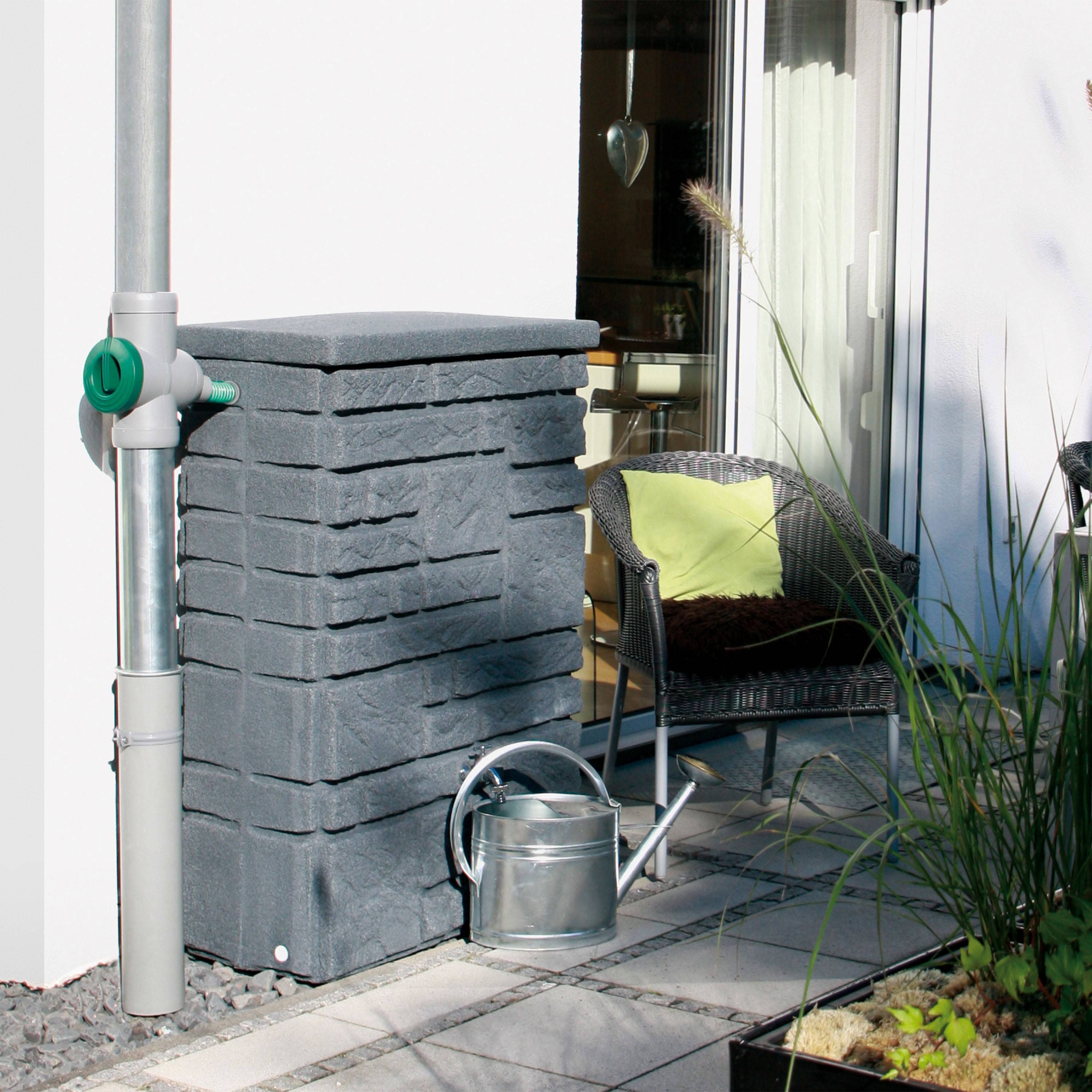
Equally important is the location of the water collection tank. A plastic tank is installed in the basement or outside the building. Please note that it will not be possible to place a large container in the basement - it will take up too much space. When installing the tank in an open area, place it in an open pit. This way you meet the requirements for storing rainwater (dark, cool place).
The liquid container should be made of opaque plastic or concrete (Figure 4).
Please note that it is better to provide a pit for the tank at the stage of site development. If you are going to install a water treatment system after the house is built, it will be cheaper to install a rainfall tank in the basement
An important point is the correct intake of purified rainwater from the tank. It is better that it is carried out from above, so as not to disturb the sediment at the bottom. Also take care of the presence of a special siphon that will drain excess fluid, excluding overflow in the tank.
For different sources, the scheme for collecting and treating sediments can vary significantly. A number of parameters can be controlled independently. These include: the presence of impurities, foreign odors, coloration. The rest of the norms for the use of rainwater as a technical one should be clarified in the corresponding GOST. Based on this information, you can create a suitable filtration system for the site.
Consider the main elements of water treatment
In the first stage, a coarse filtration system helps to purify rainwater, which separates coarse sediment and dirt, preventing finer filters from clogging. The cheapest and most convenient option are different-sized mesh filters. However, you will have to constantly clean them yourself. You can shell out a much larger amount for the purchase of a modern self-cleaning filtration system. It will allow you to do without manual cleaning for several years of constant collection and use of rainwater.
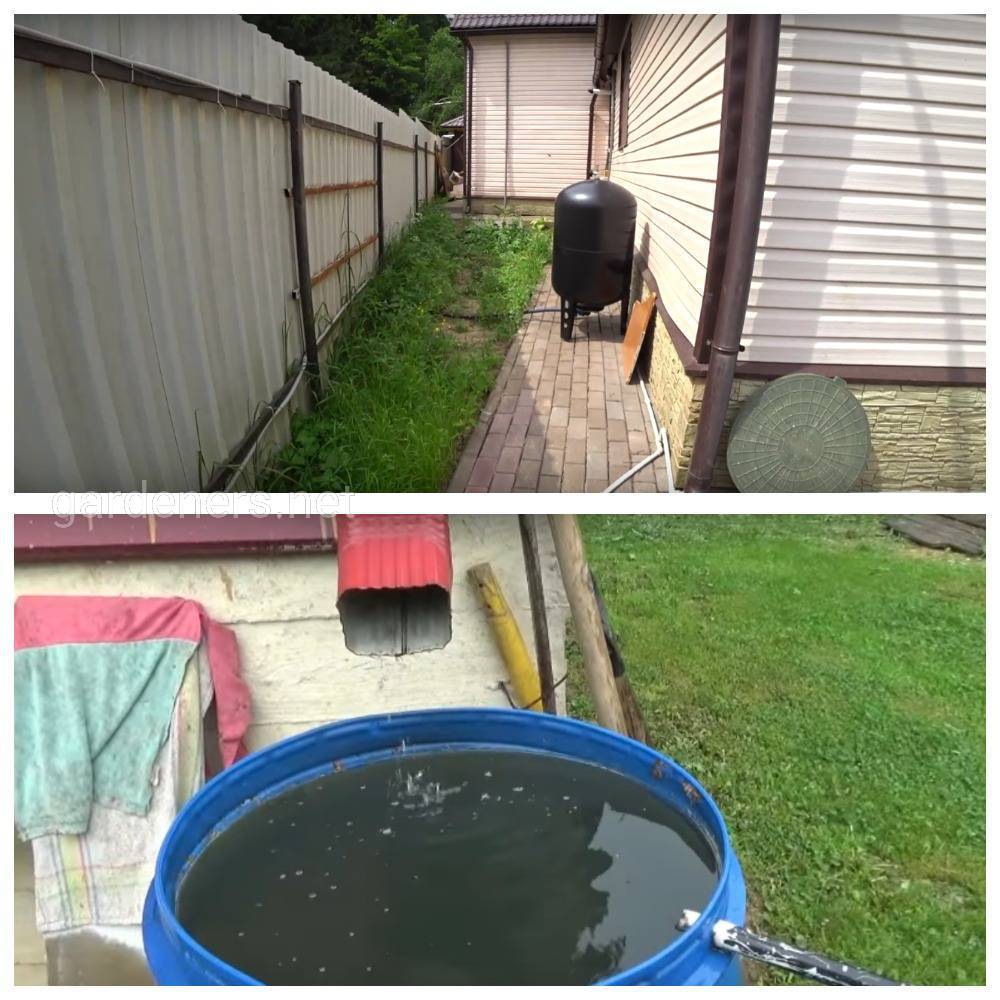
A convenient and budgetary way to supply liquid from a storage tank are different types of ready-made pumping stations (Figure 5). Simple stations make it possible to automatically supply water from a depth of up to 30 m. However, at greater depths, you will have to use more powerful pumps that will provide a constant pressure.
In addition to the primary filters, it is necessary to install thinner ones in order to further purify the water and prevent clogging of the water supply elements. The uninterrupted operation of pumps depends on the filtration characteristics and the quality of cleaning.
If you need a small amount of technical water (a non-permanent source), you can use a simple filter that is suitable for installation in a summer cottage and meets all environmental requirements.
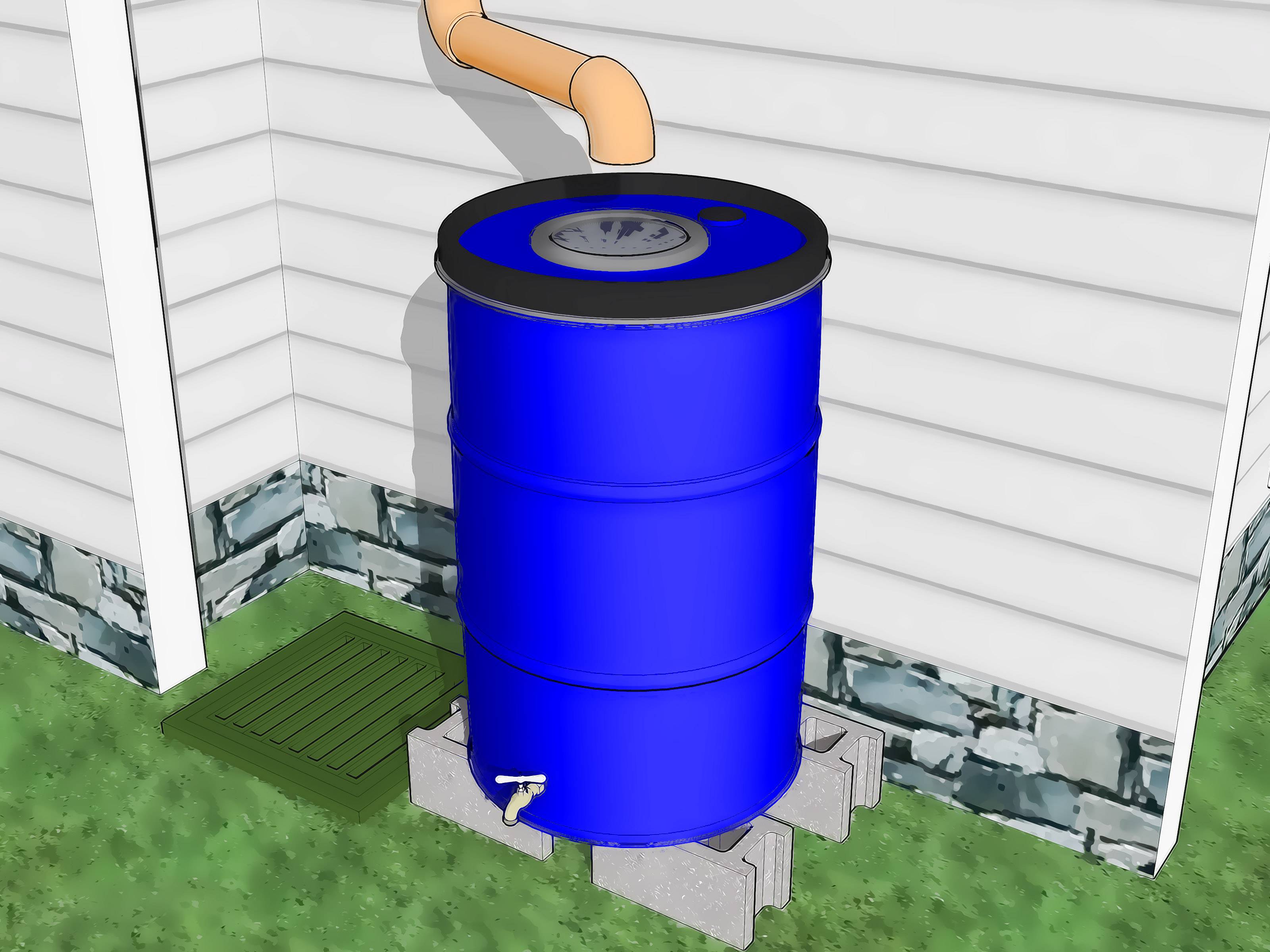
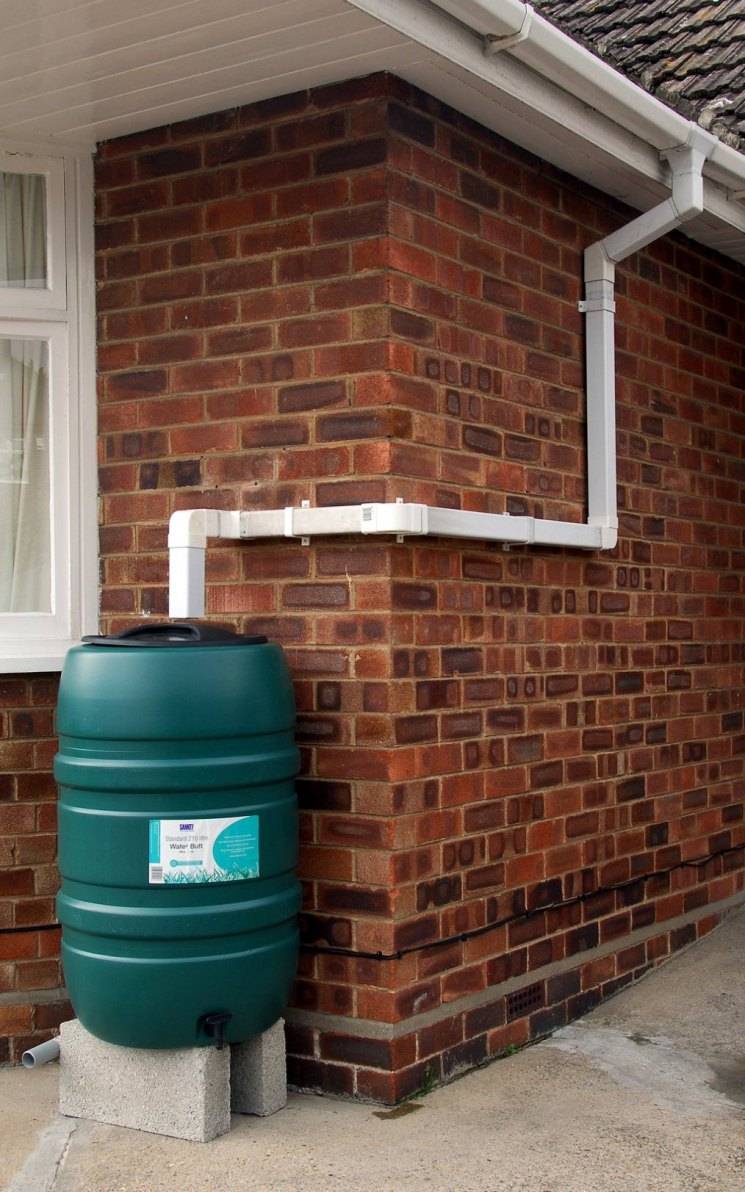
To create a country filter, you will need a wooden barrel or an opaque plastic container (Figure 6). It is installed low above the ground on bricks or stable stones. A tap is installed in the lower third of the barrel. A little above the tap inside the container, a partition with fine perforation is installed, which is covered with a dense cloth (which must pass water).Next, you need to make the core according to the principle of natural filtration: lay out pebbles, clean river sand, gravel, and medium-sized charcoal in layers. Each layer, except for coal (it should be one and a half to two times more), is made 10-15 cm thick. Pour pebbles on top of the coal layer, cover with another piece of cloth. The fabric will need to be periodically changed to fresh. The filter itself needs to be updated every six months (spring and autumn).
We remind you that after purifying rainwater, it can only be used for technical needs.
The advantage of rainwater in watering plants
Of course, the direct purpose of rainwater is to water plants. It's not just about free irrigation, which not only does not need to pay bills, but also the absolute absence of human power - the rain waters on its own, without any costs. Another thing is when a person tries to create special containers for collecting free water, then its use requires efforts, but much less than, for example, getting water from a well. It should be noted that rainwater has a very beneficial effect on the growth of absolutely all plants, this number can even include those who are more fastidious. The procedure is as follows, during storage, rainwater is able to heat up under the influence of sunlight, so the plants do not have any stress when watering, because the water itself picks up the optimum temperature, thereby bringing exceptional benefits to the plants.
deep drainage
It is better to install such a system at the initial stage of improvement, simultaneously with the construction of a house.In this case, it is better to start the drainage of the land plot by determining the direction of water flow during heavy rains. Having solved this problem, purchase drainage pipes and geotextiles.
drainage system
Previously, drainage pipes (drains) were made of asbestos cement and ceramics, but in our time they have given way to plastic: HDPE (low pressure polyethylene), PVD (high pressure polyethylene) and PVC (polyvinyl chloride). They are single-layer and double-layer, with a diameter of 100-190 mm. Water-permeable holes up to 3-5 mm are made over the entire surface. To prevent perforation from clogging and silting up, pipes are most often sold already wrapped in geotextile, which performs the function of filtration. On clays and loams, it is better to have such 2-3 fabric layers for reliability, since the particles in such soil are smaller and clog the system faster than on sandy loamy soils. Drains are laid into the soil to a depth of 1.5-6 m, depending on the requirements. The depth of drainage is calculated taking into account the level of groundwater.
In places of sharp turns or connections of several pipes, wells are placed. They are needed for convenient cleaning of the system in case of an unexpected blockage and for inspecting the condition of the drainage pipes. Ultimately, the entire chain of manholes and pipes must lead to a common collector well (at the lowest point of the land ownership), from where the water is sent by gravity to the drain outside the territory or is forcibly pumped out manually.
Well
In order for the water itself to flow in the direction you need, it is necessary to lay pipes at a certain slope. Ideally, you need to make the angle as small as possible, since with a fast flow of water, silting occurs earlier.
You can set such an angle using a level, a water level or from improvised materials - an ordinary board and a building level. In the latter case, the board is laid on the bottom of the trench, and a level is placed on top and measured, if necessary, corrected.
Now let's figure out how to properly install a drainage ditch. To begin with, we dig trenches (drainage ditches) of the required depth, tamp the bottom, observe the correct slope (at this stage, an approximate one can be used). Next, we pour a layer of coarse-grained river sand 10 cm, spill and tamp. We make alignment, observing the exact slope. Then we lay a layer of geotextile on top, with a density not exceeding 200 g per square meter. m. The edges of the fabric should go along the sides of the trench so that they can then be wrapped inside. We pour washed crushed stone onto the geotextile: for clay soils we take a larger fraction (150-250), for sandy loam it can be smaller (up to 150).
We lay the drainage pipe and gradually fill it with rubble in layers and carefully tamp. On top of the drain there should be a layer of crushed stone 10-30 cm. We wrap the geotextile inward so that the overlap of the edges is at least 15 cm. Next, we pour river sand, and at the very end - fertile soil. The drainage ditch is ready.


Drainage pipe layout
The construction of a drainage ditch requires a certain amount of time and money, but this work is done once and for all, so it makes sense to do it with the utmost quality.
We recommend that you save the drainage plan. If in the future you need to dig the soil for some reason, you will know exactly where the drainage pipes lie.
Sewage pits and ditches
Many owners choose a fairly simple way to solve the problem of draining areas by digging drains and ditches. The arrangement of a cone-shaped pit is carried out as follows: at the lowest point, you need to dig a pit up to 100 cm deep, up to 200 cm wide at the top and 55 cm at the bottom. The dehumidification system is quite efficient, since excess moisture can be discharged into sewers without the use of additional funds.
The process of arranging sewers is more laborious, but no less effective. Ditches are dug along the entire perimeter of the territory - the depth and width is 45 cm. The walls are made at an angle of 25 degrees. The bottom is laid out with a brick battle or gravel. The main disadvantage of ditches is their gradual shedding, so it is worthwhile to clean and strengthen the walls with boards or concrete slabs in a timely manner.
Deep drainage system
If the groundwater level on the site is high, and the house has a basement or underground garage, then you will have to install a deep drainage system.
Signs that it is necessary can be considered:
- Increased humidity in the basement;
- Basement flooding
- Quick filling of the septic tank (cesspool).
It is advisable to equip the underground drainage system of the foundation during the construction of the house. This will be much cheaper than removing moisture from a finished foundation, built without taking into account the actual level of groundwater.
Water is discharged immediately into a storm or mixed sewer (by gravity - with a slope of the site not < 5 mm per linear meter of pipe length) or is first redirected to storm water inlets or to a collector well, from where it is pumped out by a pump.
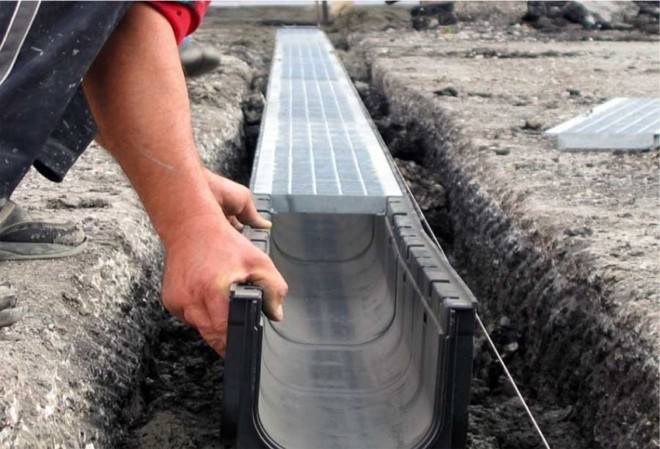
The slope can be both natural and artificial - for example, through the use of special concrete pipe-channels with an internal slope or multi-level stepped gutters.
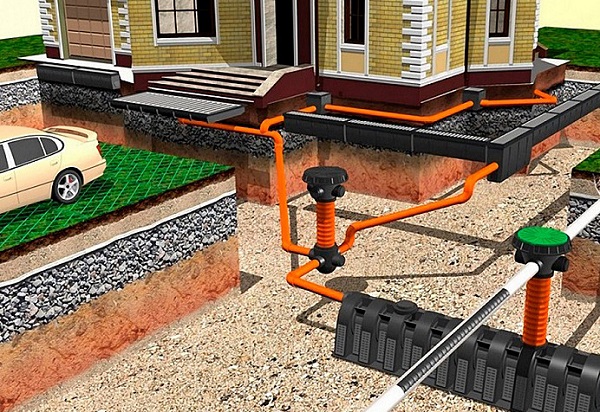
Water collected by surface drainage can also be diverted into the collector, and from there they will fall into the municipal storm sewer or soak into the soil (through the drainage field - a layer of rubble).
Arrangement of a simple drainage system
Drainage trench around the house (ring drainage)
The easiest way to drain water and neutralize the impact of ground moisture on the basement and foundation is to install a fairly wide drainage gutter around the perimeter of the building at a distance of one and a half to two meters from it. Its depth should be below the level of the foundation, its bottom is sloped and filled with cement mortar.
The drainage ditch effectively removes moisture from the base of the house, but water from downpipes should not drain into it.
Closed wall drainage
The purpose of this soil drainage system is to remove ground, rain or melt water from the foundation and prevent ground water from rising during snowmelt or heavy rain. It is a closed circuit of perforated (perforated) pipes or gutters with the convex side up, laid at a depth of one to one and a half meters.
Unlike the ring, wall drainage pipes are laid above the level of the base of the foundation. The trench is paved with broken bricks or large crushed stone of several fractions, drains are also covered with crushed stone and wrapped with it in filter material - for example, geotextiles or fiberglass. The filter does not allow the drain holes to become clogged with silt, and the top of the trench is covered with gratings and covered with soil.
At the corners of the building, "rotary wells" are installed - they set the direction of the discharged water. The wells are made of PVC, their diameter is less than half a meter, and their height is from one to three meters.
The ditch with pipes should slope down the slope (and away from the building) and lead water flows below the level of the basement floor. Such a drainage trench pulls, absorbs and removes moisture from approximately an area at a distance of 15-25 meters around it.
Where to divert water?
If the building stands on a slope, as a rule, the drainage trench goes around its “horseshoe” from the side of the hill and has an exit from the opposite side. If there is such an opportunity, water can be drained into a small “technical” reservoir, from where it will be used for household needs - watering the garden, construction and repair, etc.
In other cases, water is either immediately discharged into a general or individual sewer, or enters a storage collector well, where it is absorbed into the soil and discharged by gravity or by a pump to the site.
The arrangement of simple drainage trenches is not difficult, but the arrangement of a full-fledged soil drainage system that connects both the drying of the site itself and the removal of water from the house located on it requires special calculations and professional installation. It is better to entrust it to professionals, since the losses from malfunctions, repairs and alterations will be greater than the costs of the services of specialists.
- for watering the garden (rainwater does not contain chlorine and is rich in oxygen);
- for washing and cleaning (soft rainwater reduces the consumption of detergents)
- to wash the car and flush the toilet.
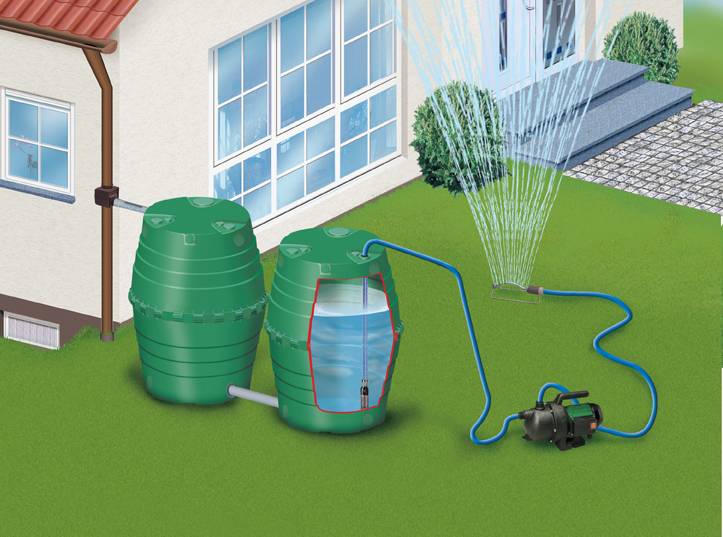
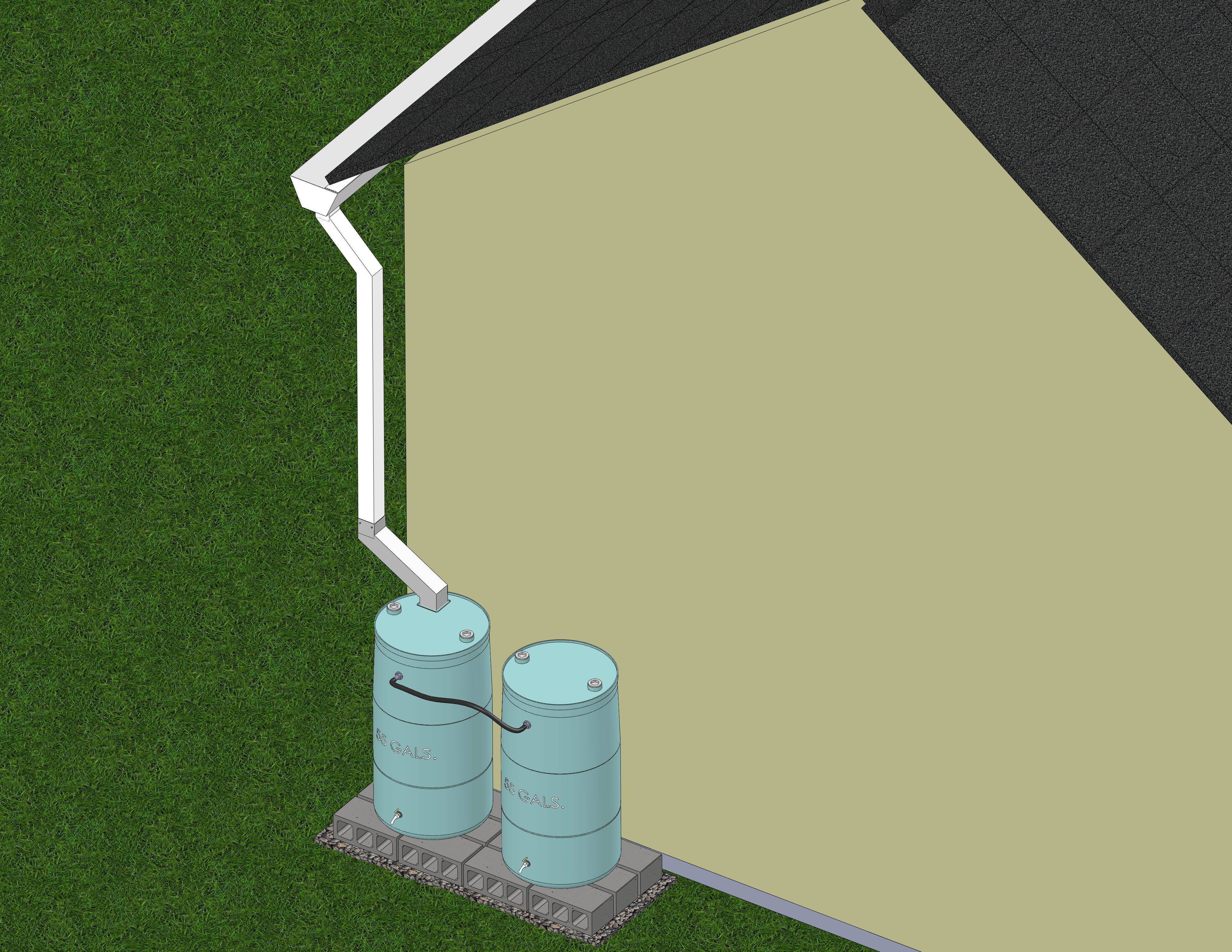
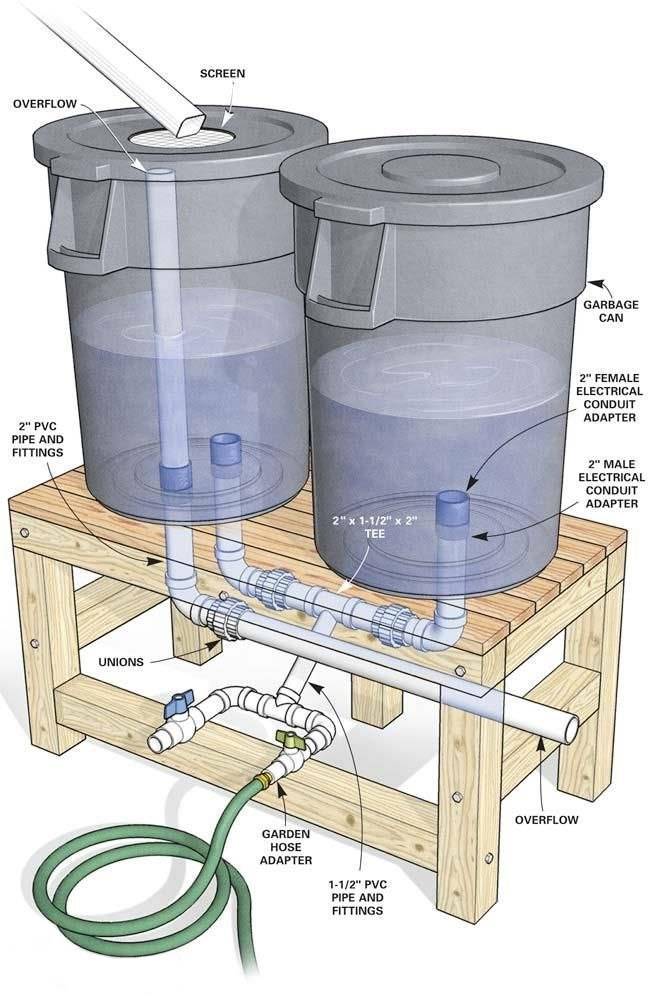
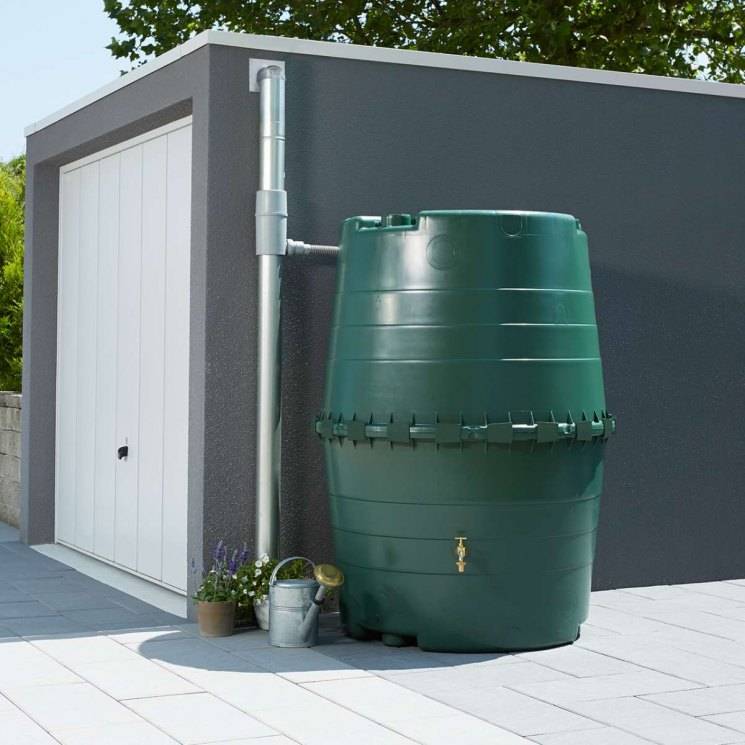
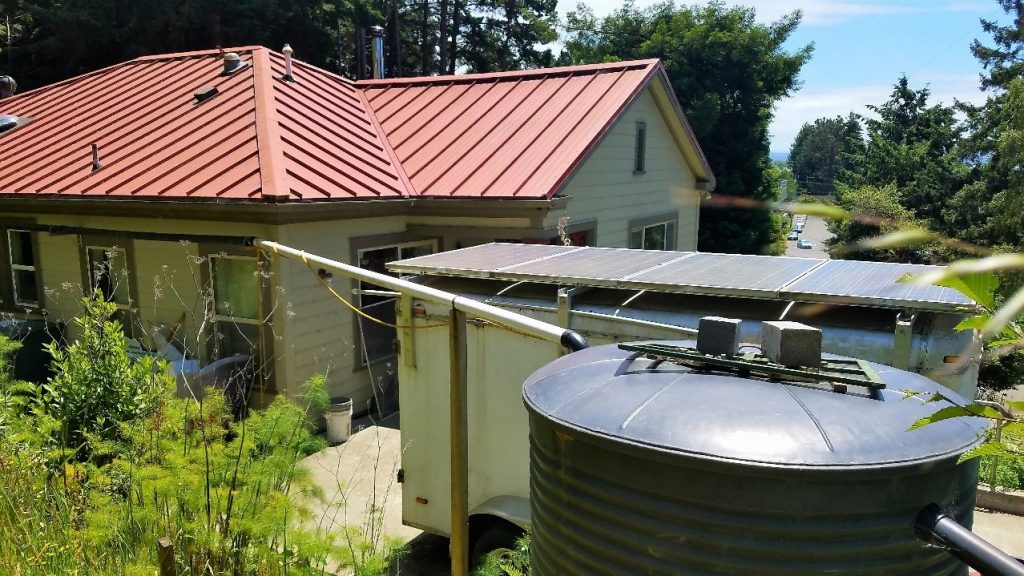
The easiest and most affordable way for a summer resident is to collect water from the roof using a system of gutters installed along the edges of the roof, the main drain and receiving containers.
Collecting rainwater from the roof
1. Downpipe
2. Barrel
3. Filter mesh
4. Tube for draining excess water
5. Storm sewer
6. Garden faucet
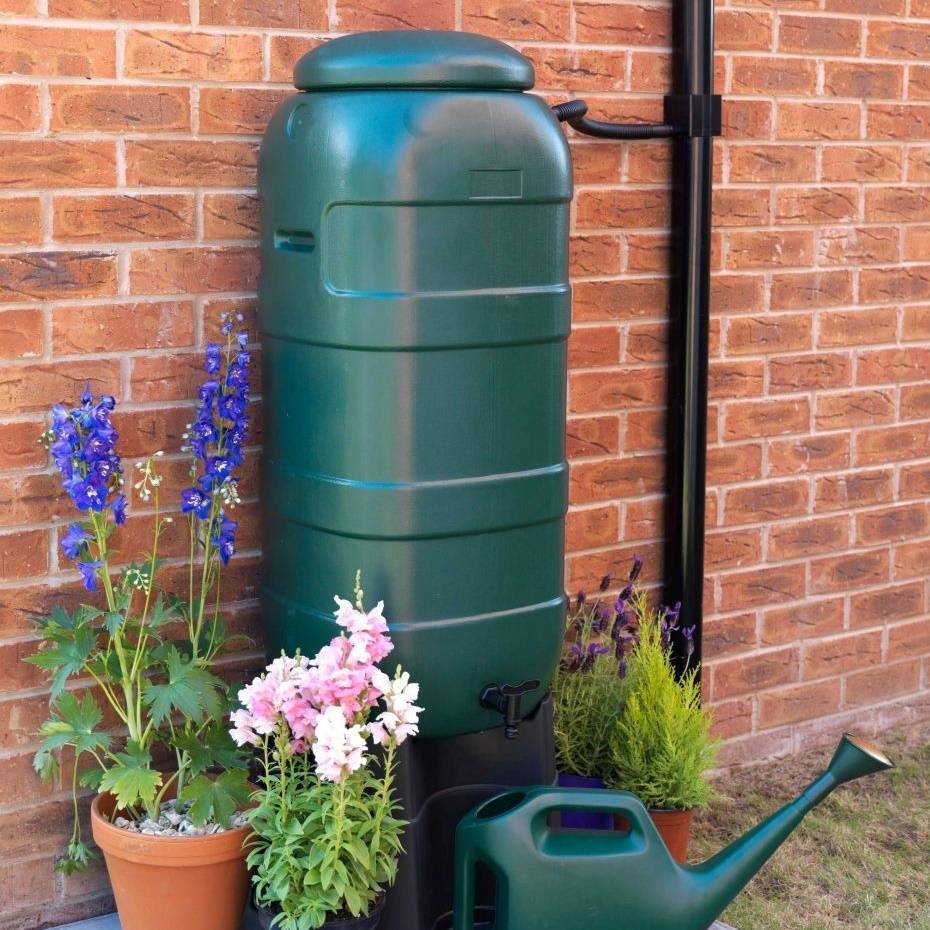
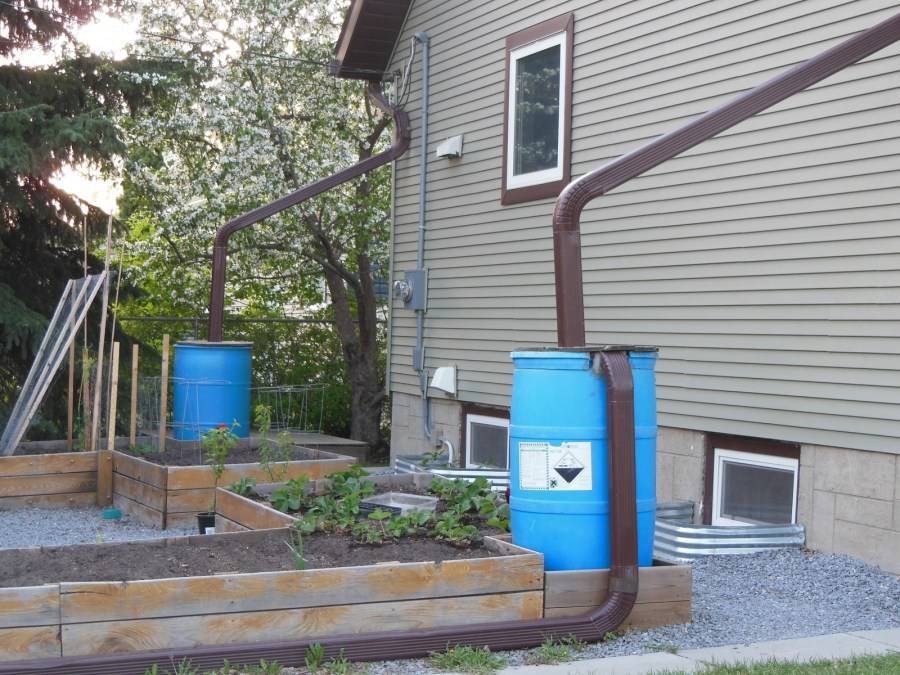
Container for reception rainwater should be well cleaned and have a lid. The simplest and most common material is two hundred liter barrels from various fuels and lubricants.
When preparing such containers, precautions must be taken. The top of such a container is cut off, after repeated washing of the barrel from the remnants of the contents, after removing the top, the insides are calcined with a blowtorch, then cleaned with sandpaper and washed again. After cutting off the upper part of the barrel, the edges are treated with a coarse file and polished
Then they measure the diameter of the container and make a wooden lid with a sealing ring.
After cutting off the upper part of the barrel, the edges are treated with a coarse file and sanded. Then the diameter of the container is measured and a lid is made of wood with a sealing ring.


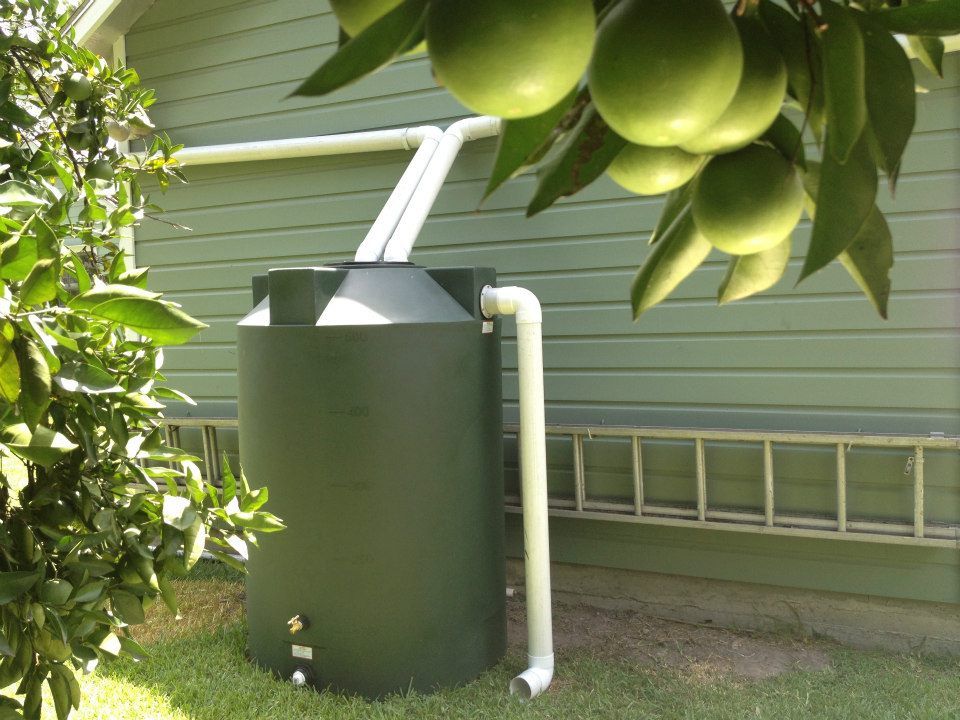
The unpresentable appearance of such a container is eliminated by painting it to match the color or background of a country house. The most advanced craftsmen make a drain tap on the side of the barrel - a useful additional element if you need to wash your hands without bringing soap or other hygiene products into the entire container. The need for a tight cover is dictated by measures to protect water from mosquitoes, spiders, butterflies and other buzzing brethren.During the period of water collection, cover the top of the barrel with a mosquito net, in this way you will save yourself from the subsequent catching of leaves and other debris brought from the yard or washed off the roof with a water stream.
Advice!
The pump should be cleaned and stored in a warm room. To protect the container from freezing, the lid is covered with sand on top.
It is not recommended to drink such water without special treatment, which consists in boiling and chlorination with the help of special tablets that are sold in pharmacies.
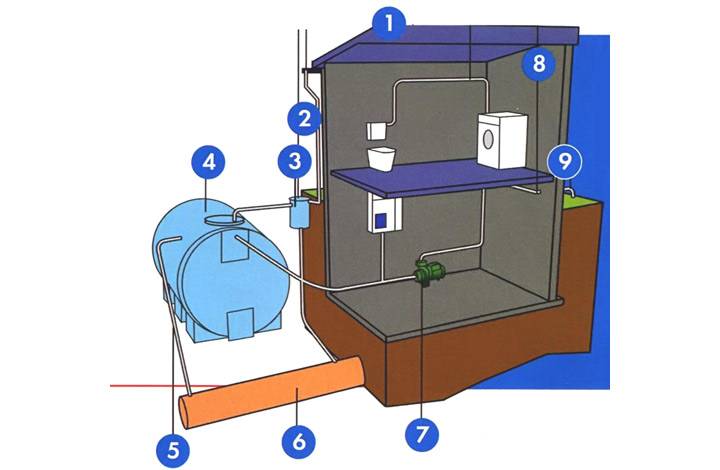
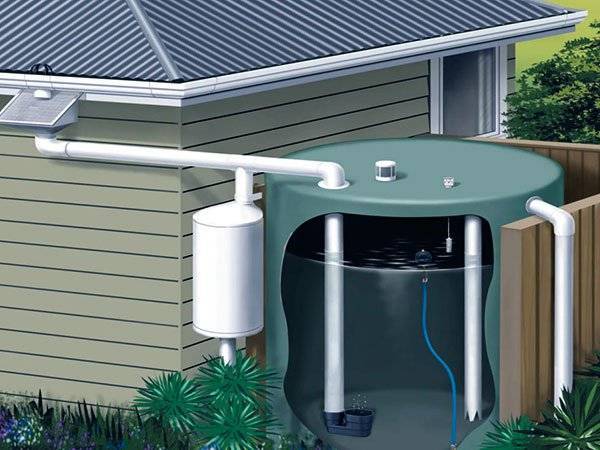
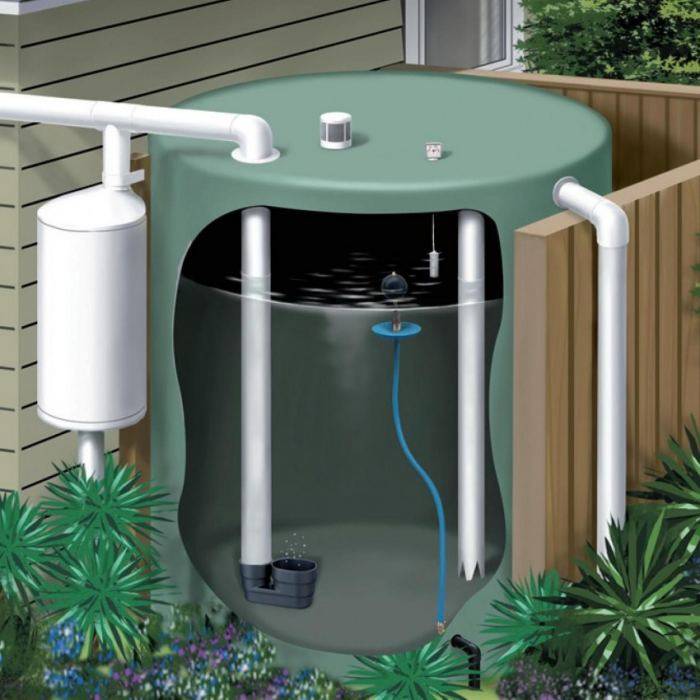
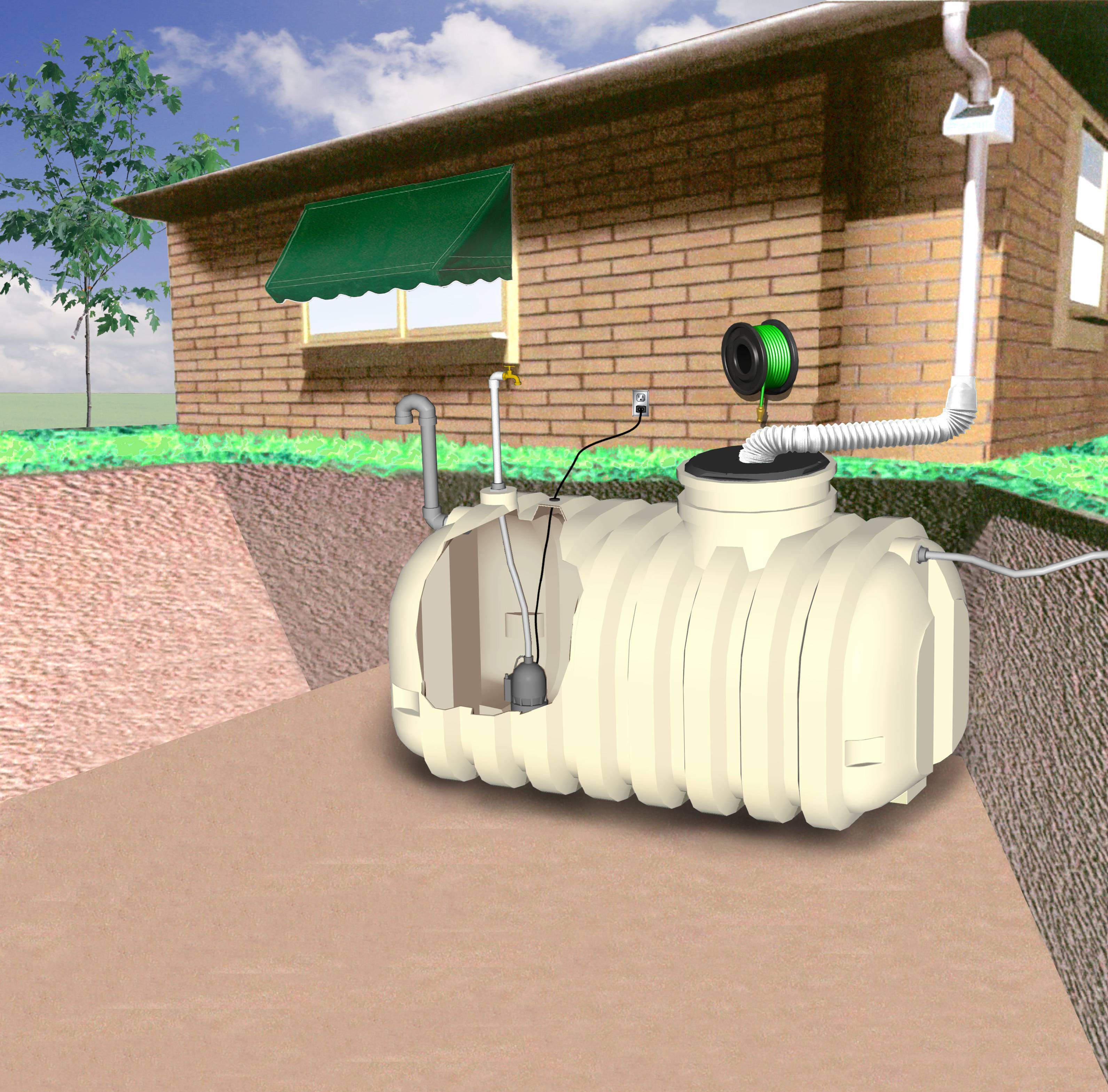
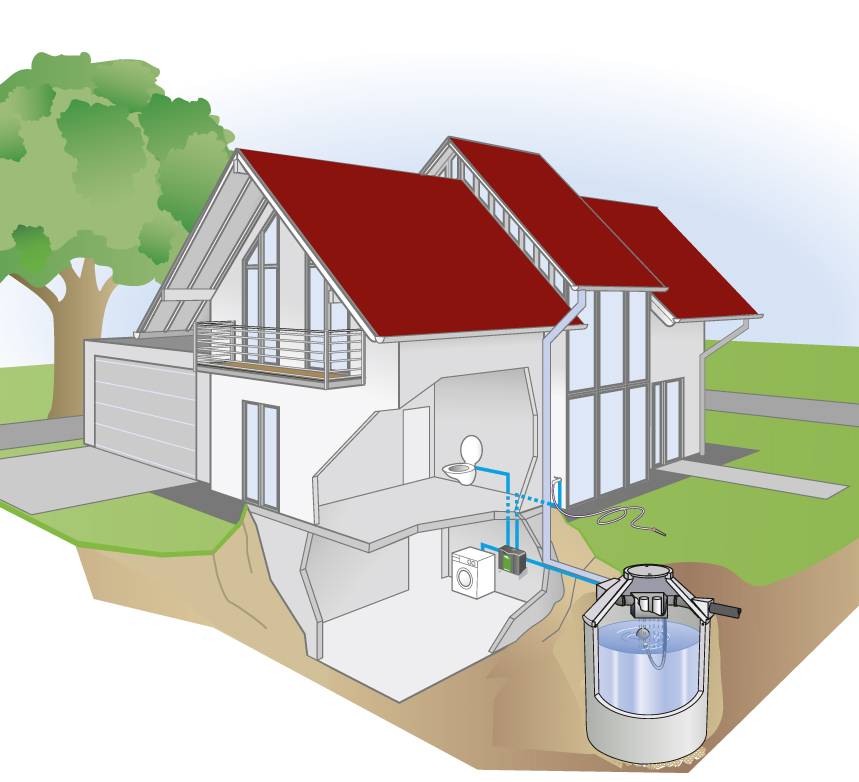
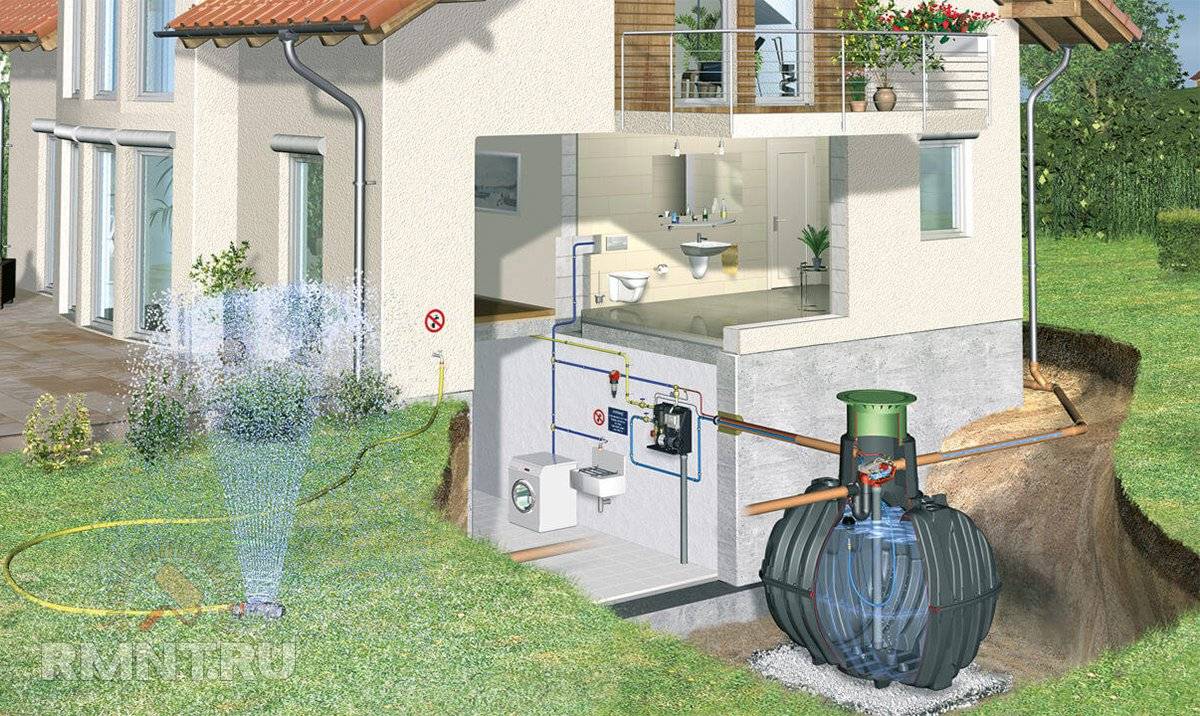
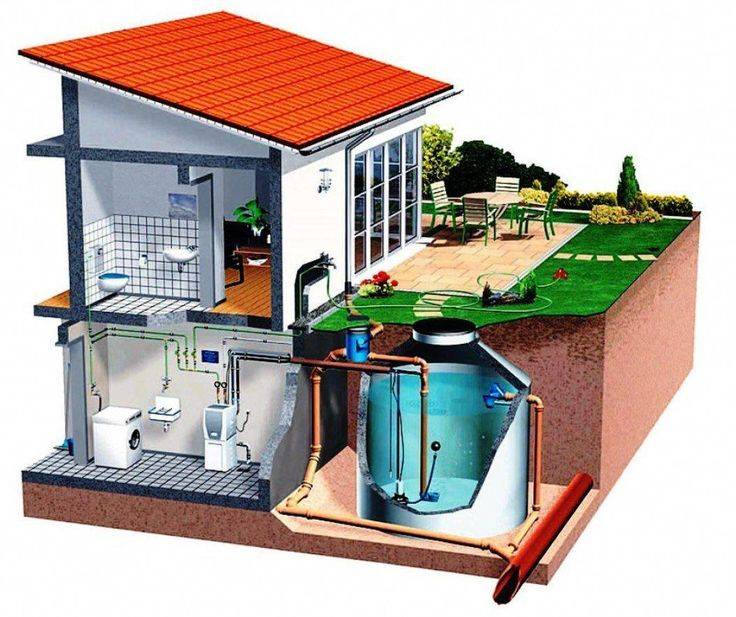
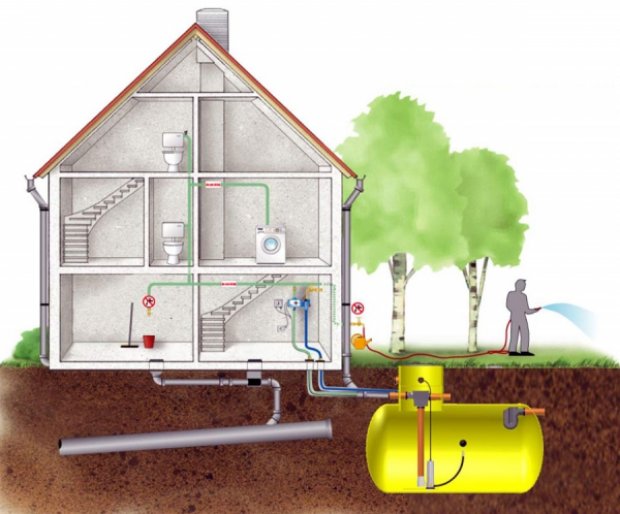
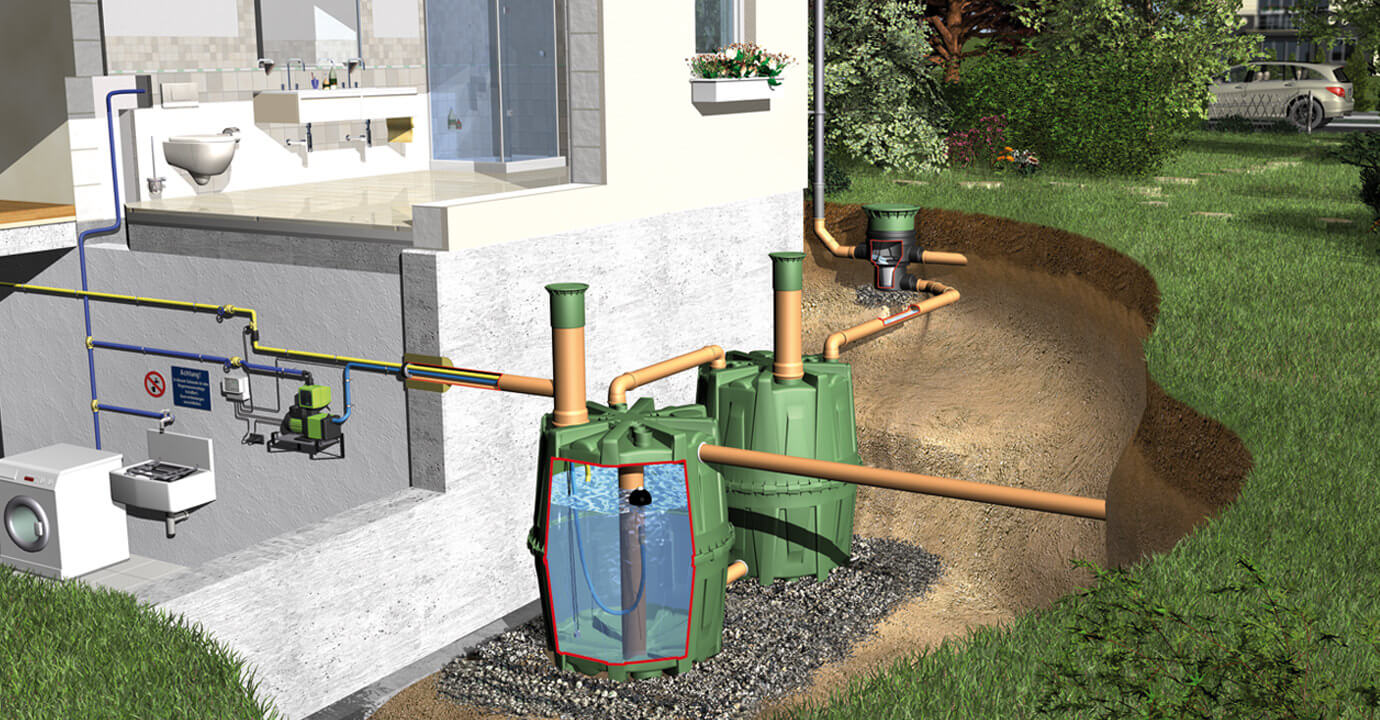
Underground rainwater collection system
1. Roof - a place for collecting rainwater.
2. Gutter.
3. Filter.
4. Reservoir.
5. Pipe for draining excess water.
6. Sewerage.
7. Pump.
8. Rain "plumbing"
9. Garden tap.
When building a country house, bring drainpipes to the backyard. It is advisable to set their height from the ground in accordance with the height of the container for collecting water. If there is a shed or a technical house for inventory on the site, also equip it with a water collection system, it will not take much time, and the end result, a full barrel of clean water, will always come in handy for a real summer resident. When watering flowers or areas of the garden with your favorite vegetation, you do not have to rush around the area with a hose to get to the flower bed. It is easier to fill the watering can with rainwater and water the flowers.
How to choose the optimal roof shape?
There is a popular opinion that only sloping roofs are suitable as a working surface for collecting water. Indeed, when water flows by gravity into the gutters located around the perimeter, it is easier to organize its movement in the right direction. To do this, you do not need to install additional "traps" and lay communications under the roof.
In fact, there are systems designed for flat roofs. When laying layers of insulation and waterproofing, a slope of at least 3% is observed, and a gutter or tray is installed at the lowest point to collect water.
Among the catchment devices of flat roofs are also funnels attached to downpipes. Risers can be located both inside the building and installed on the outer wall.
To stimulate the movement of water to the intake funnel, a decrease in a radius of half a meter is arranged around it.
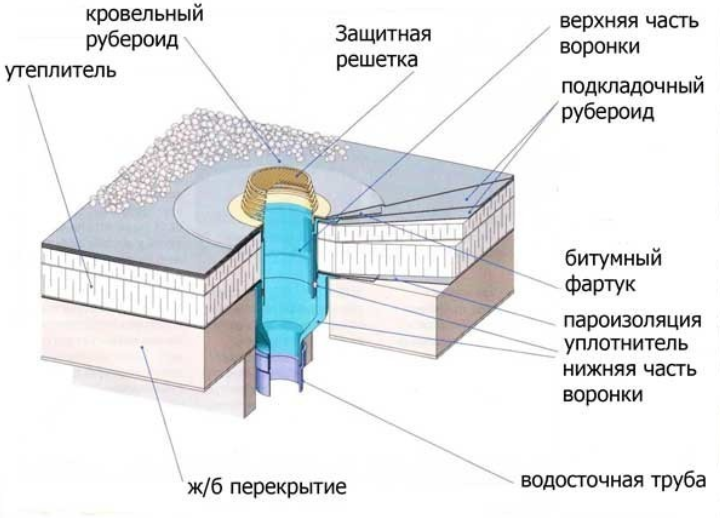
Funnel on the roof
The funnel for siphon-vacuum outlet “sucks in” water, therefore it is suitable even for roofs without a slope. It is designed in such a way that water without air enters the system.
Funnel design may vary. For example, two-level roofs are provided for inverted roofs, which collect and drain condensate from under the insulation layer and rainwater from the roof surface.
Traditional flat roofs are equipped with single-level catchment devices, which redirect rainwater into the gutter system.
All types of water inlets must be equipped with mesh protection against volatile contaminants, leaves and dust. For trays, gutters and funnels, protective devices are produced in the form of perforated panels, mesh baskets, etc.
On operated flat roofs, a flat protection is installed flush with the surface; on non-operated ones, it rises above the roof. In addition to the main funnel, several backup ones are installed, in case the main one becomes clogged and fails.
All devices lead to the same pipeline. It has an internal location, that is, it is located under the roof, and a hermetic closed form, more often the form of a rectangular box.The gravitational channel is wider, the siphon-vacuum channel is narrow. The outlet is above or near the storage tank.

Metal tile on the roof
Metal tile is a practical, relatively inexpensive and convenient material for roofing. The polymer color coating, which performs protective and aesthetic functions, does not affect the quality of the water.
The shape of the roof also does not affect the composition of the water, and the roofing material can cause poisoning or illness. As you know, asbestos is very dangerous, which is just a part of asbestos slabs and slate.
Now these materials are rarely used for roofing, but if you decide to provide an old house with a drainage system, be on the lookout. Copper and lead are also dangerous and can be found in pipes, gutters or fasteners.
Safe roofing options:
- Sheets of galvanized roofing steel
- Ceramic tiles of various shapes
- Fired clay tiles
- Metal tile made of galvanized steel
Galvanized sheets are often covered with a layer of protective paint, but this does not affect the degree of safety of the roof.
Absolutely safe and modern PVC drainage systems, the most convenient for do-it-yourself installation.
What is the composition of rainwater?
Precipitation is able to absorb almost the entire periodic table
Therefore, it is important to know what their composition depends on. Several factors can degrade the quality:
- Initially, rainwater in the clouds is absolutely pure and does not contain impurities (provided that it was formed in an ecologically safe region). As the clouds move, the substances are absorbed. Any compound in the air will be drawn into the moisture.The good news is that at the height of cloud formation there are few harmful impurities;
- falling down, the drops absorb the components present in the air. This poses a great danger, especially in industrial areas. The first drops falling to the ground should not only be drunk, but also used for other purposes. When it begins to rain, it is best to look for shelter so that the chemicals do not settle on the skin and soak into the clothes.
However, not everything is as bad as it seems. The first drops are able to absorb a significant part of the aggressive components. But after 15 - 20 minutes of rain, the air will clear up. After this time, the liquid will no longer pose a danger to humans. However, keep in mind that precipitation must be heavy, otherwise it will take more time to clean the air.
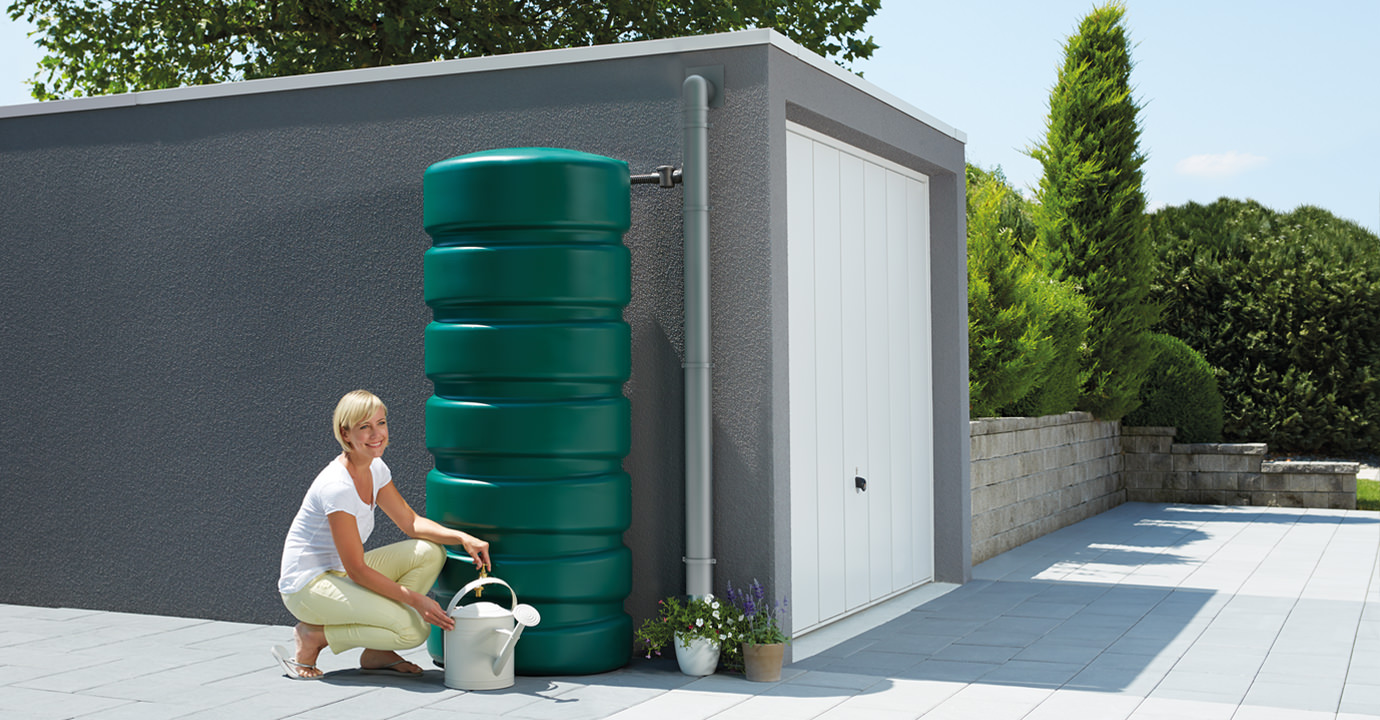




If there is a stable ecological situation in the settlement where the precipitation fell, it will take less time to clean up from harmful impurities. If nitrogen and sulfur oxides are exceeded in the atmosphere, the acid-base balance of the liquid will be below standard values.
Conclusions and useful video on the topic
Instructive and informative videos will help you install your own rainwater storage tank.
Video #1 How to make a rainwater harvesting system with an outdoor tank with your own hands:
Video #2 Useful theoretical information:
Video #3 Preparation of a plastic barrel for autonomous water supply:
Purity and natural softness rain water allow you to use it for household needs, watering, and sometimes - to fill the heating system. Thanks to a large storage tank and a pump, you can always use a backup source of water that is relevant during the emptying of the well.
If you have interesting information, valuable recommendations, your own experience in the design of a system built to collect rainwater, please leave comments. To place them below the text of the article, a block form is open.



