
- How to determine the right number of electrical devices
- Safe Placement of Power Points
- Types of built-in network blocks
- View # 1 - stationary sockets
- View # 2 - retractable models
- View # 3 - rotary blocks
- Which sockets for the kitchen to choose
- Sockets for built-in appliances: placement rules
- Rules and layout of outlets
- Drawing up a layout of outlets
- Determination of the required number of outlets
- Location of sockets for each type of household appliances
- Wiring rules
- Table: power and cross-section of wires for connecting kitchen appliances
- Rules for the location of outlets in the kitchen: photos, diagrams and recommendations
- How to arrange sockets in the kitchen: basic rules
- Layout of outlets in the kitchen: principles of compilation
- Which cable to choose for wiring
- How to properly position one or more power supplies: regulations
- Rules and layout
- Which cable to run?
- What to consider when designing an outlet layout
- Which cable to use
How to determine the right number of electrical devices
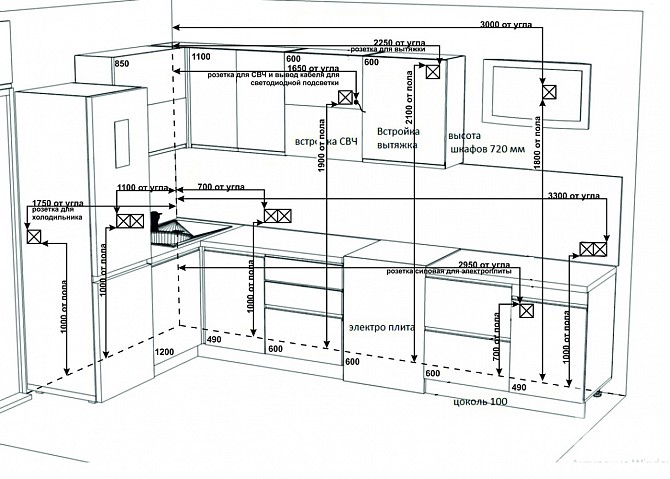
To do everything right, you should start by drawing up a plan for arranging equipment and furniture. If the future design has not yet been determined, this event will have to be postponed.Otherwise, it may turn out that the electrical outlets “get up” not at all where they are needed. Considering that their location is connected with the wiring, it will be quite difficult to carry out the transfer. It is easier to first decide on the design of the room.
We are building a scheme for arranging furniture and household appliances. Determine the approximate number of required blocks. One should be for each piece of stationary equipment, plus at least two blocks at each edge of the countertop and one near the dining table. Provided that the latter is not located at a distance from the wall. We consider as stationary equipment:
- hood;
- oven;
- hob;
- fridge;
- freezer;
- washing machine;
- dishwasher;
- microwave oven;
- trash shredder.
It is good to install an electrical outlet near the kitchen switch. Usually this area is relatively free of furniture, so a network access point will come in handy here. It is especially useful for connecting a vacuum cleaner. After that, we think over the location of the connectors for other household appliances. They, as we know, should be at least two on each side of the countertop.
Instagram geosideal
We make a calculation with a margin so that when purchasing new devices you do not have to use an extension cord or network splitter, it is also called a tee. This is unsafe, and therefore highly undesirable.
Safe Placement of Power Points
Installation of sockets is carried out in accordance with established standards for the safe connection of electrical appliances. They are taken into account at the planning stage:
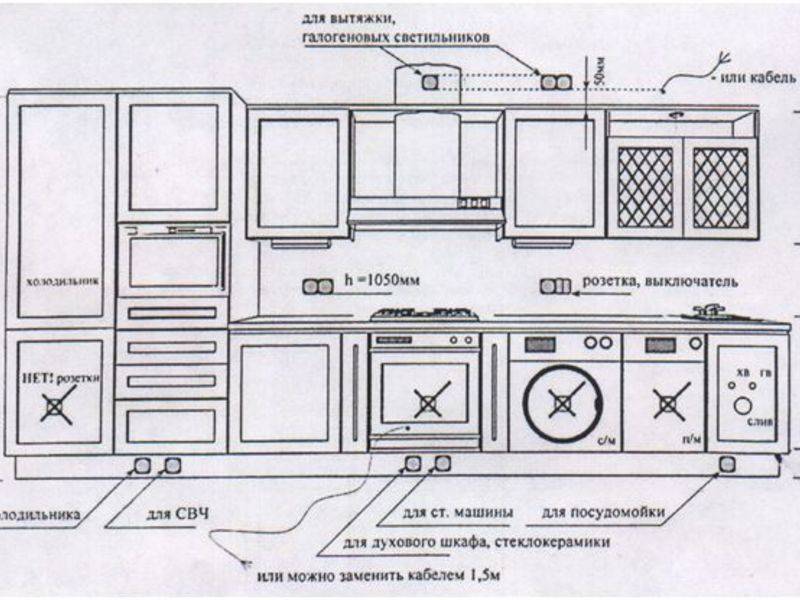
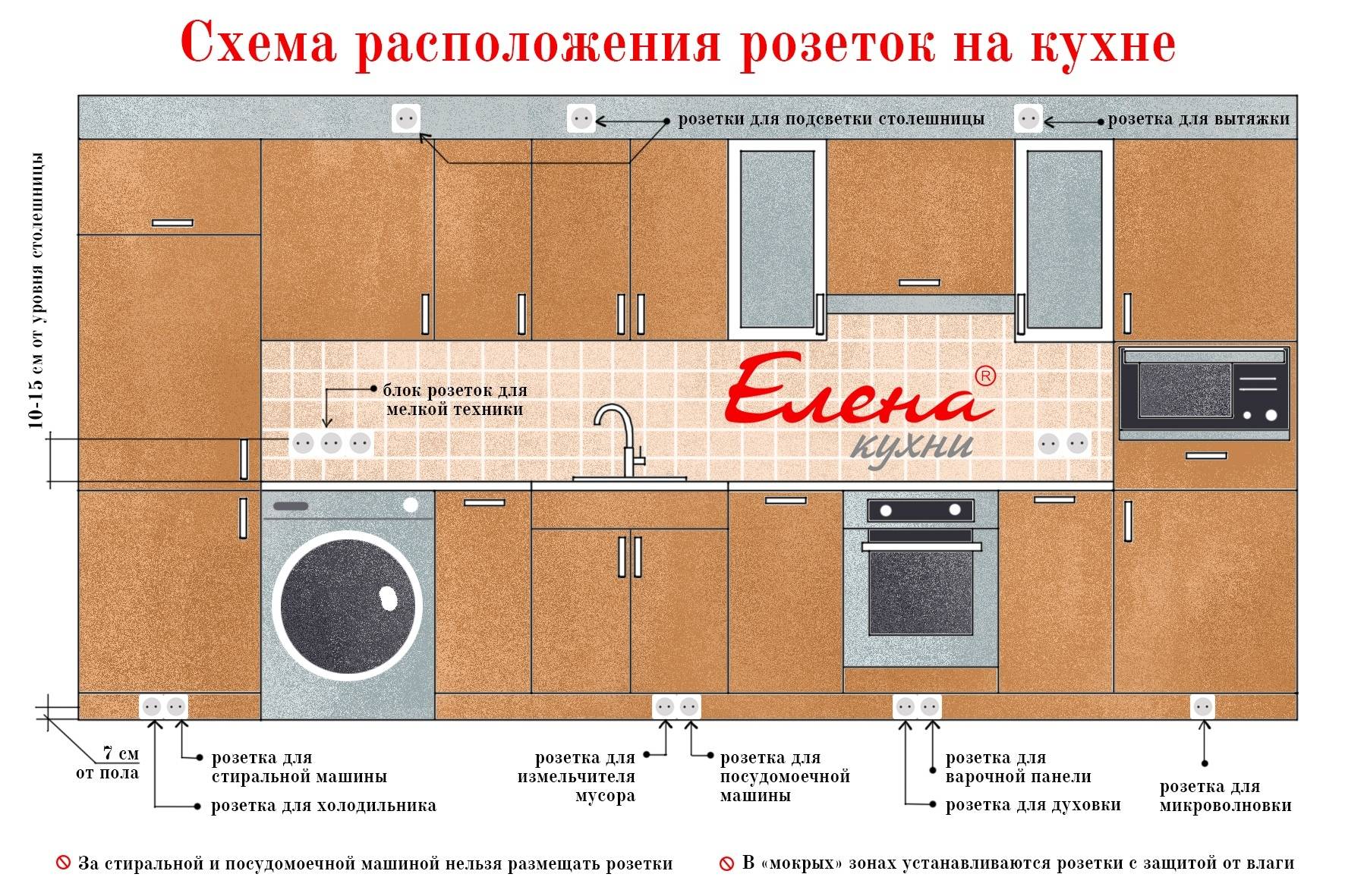
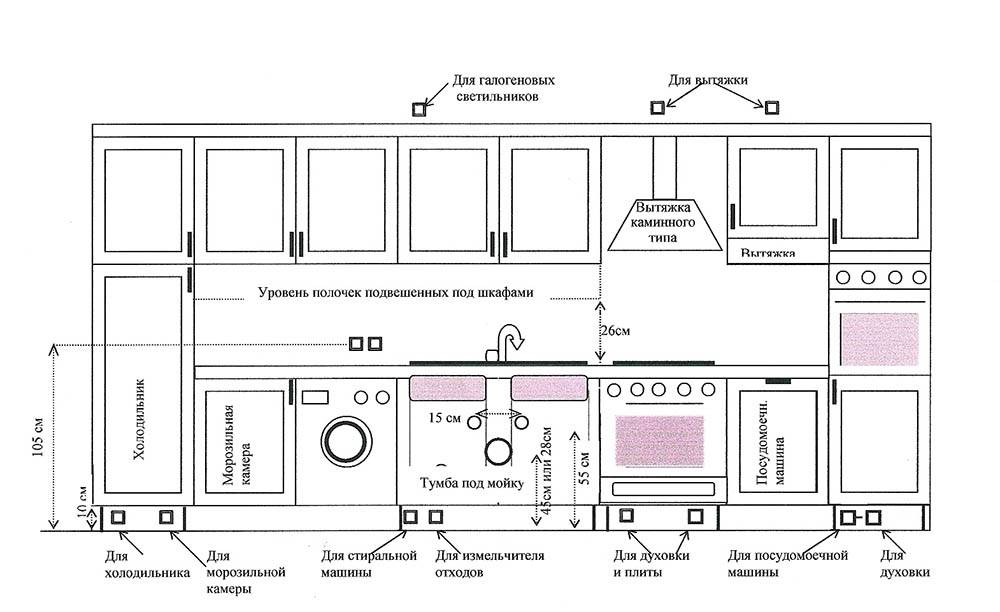
- The height of the socket from the floor is 15 cm. For furniture with a standard plinth, the height is 10 cm - the power point falls into open space, is freely available
- The installation height of sockets when located on an apron is 15-20 cm from the working surface or 90-100 cm from the floor
- For hood and top lighting - mounted above the cabinet without blocking the ventilation
- Distance to the induction cooker - 15 cm
- Distance to the sink, gas or electric stove - at least 20 cm
- Distance to electrical appliance - 1-1.5 m
When installing built-in household appliances, holes are cut out under the products in the back walls of the cabinets. A separate outlet is assigned for each stationary device. When choosing places for connection, remember that electrical equipment must:
- Be inaccessible or safe for children
- Do not be obscured by large equipment - they are set aside for safety reasons, as well as ease of use
- Do not damage communications
Now comes the turn of the choice of electrical materials.
Types of built-in network blocks
All sockets built into the countertops of kitchen sets can be divided into stationary, retractable and rotary.
View # 1 - stationary sockets
Stationary blocks are mounted in the specified plane without the possibility of changing the position. From falling crumbs, water and various debris, they are protected by covers. To plug the device into a socket, you only need to move this cover.
Such connectors are simple and do not require any complex manipulations during operation.
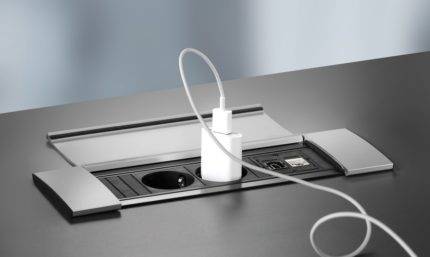 The stationary built-in network unit differs little from the classic overhead electrical outlets, since it is difficult to disguise it from prying eyes
The main disadvantage of stationary built-in sockets is that they take up a lot of space on the desktop.
The surface of the lids is not suitable for functional use.You can’t put anything on it, and therefore you have to use only the unoccupied part of the countertop.
View # 2 - retractable models
Due to the unsuitability of the covers of stationary models for operation, retractable sockets are more popular. Their surface can merge with the tabletop - in the non-working state, the cover of the network unit protrudes literally 1-2 mm above the surface of the headset. Because of this, the kitchen looks more tidy and tidy.
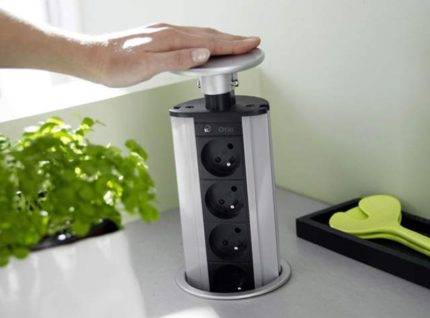 When the retractable electrical outlet, when pressed, effectively emerges from the countertop of the headset, the kitchen takes on a modern and unusual look.
To extend the outlet, you must press the cover or the button located nearby. After that, the retractable mechanism will work. It will push the power unit out of the tabletop completely or partially by 10-20 mm.
After that, the block must be pulled out by hand and fixed at the desired height. Many models are equipped with special buttons that allow you to fix the desired result.
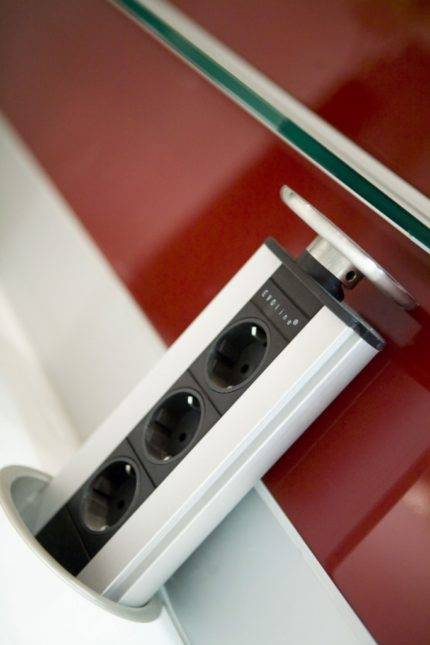 To fix the power outlet block at the desired height, you just need to press a certain button on the device case
A retractable socket is a specific connector. It performs the functions of a standard electrical connector, but has a number of features.




It should not be used for household appliances that should always be connected to the network:
- refrigerators;
- air conditioners;
- freezers;
- electric stoves (to connect them you need a power outlet);
- other.
The whole point of this connector lies precisely in the fact that it is hidden from prying eyes.
A built-in retractable socket is needed for short-term connection to the network of several electrical devices.These may include coffee makers, kettles, toasters, steamers and other appliances that do not require a permanent connection to the mains. When the equipment is turned off, the power unit can be recessed into the countertop.
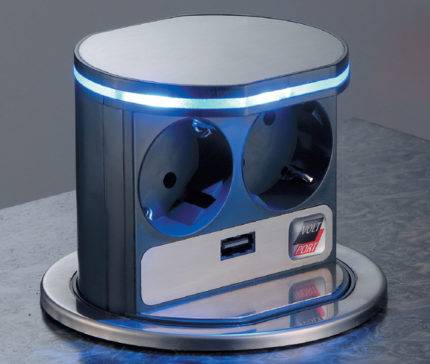 The presence of additional software control and the integration of the unit into the "Smart Home" system allow you to automatically immerse the socket in the countertop after turning off the equipment
Due to the design features, a retractable outlet cannot be placed on the countertop area, under which there are drawers or water pipes.
It belongs to rather fragile structures and with frequent use can quickly loosen. To increase the possible service life of the network unit when connecting or removing the plug from the socket, it is worth holding the device with your hand.
We examined retractable sockets for countertops in more detail in the next article.
View # 3 - rotary blocks
Swivel sockets are able to change their position in space. They are installed in the required position without loss of functionality. The angle of inclination depends on the characteristics of the selected model and can reach a value of 180 degrees. The values of this parameter are indicated on the packaging of the product.
To use such an outlet, you just need to press its cover or a button located nearby on a tabletop or wall.
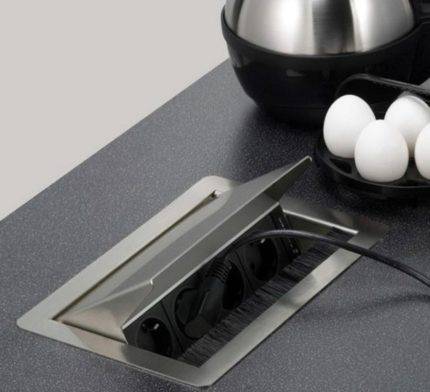 Before installing a surge protector, you should make sure that it will be convenient for daily connection of the most frequently used household appliances.
Such network blocks belong to horizontal structures. When using them, there may be some difficulties when connecting devices with l-shaped plugs.
Which sockets for the kitchen to choose
For installation in the kitchen, several types of sockets are used:
- Corner location. They are located in a plastic case at the corner junction of the walls, they can be hidden under the hanging cabinets of the kitchen set. By design, they are divided into single and modular. The modular design does not impose restrictions on the number of sockets in one panel.
- Retractable type, located in the tabletops. They are performed by a spring-loaded module consisting of 2-3 sockets. Externally, they look like a vertically mounted extension block, equipped with a decorative cover. The block begins to move out after being released, which is performed by lightly pressing the cover.
- The built-in blocks of the hidden installation. Installed in a rectangular hole in the tabletop. To use, you need to press the cover and turn the block around the axis at an angle of 60-90º.
- Overhead type. They can be installed in a wall or on boxes (with open wiring). There are overhead sockets of modular design (any number of places).
When choosing outlets, you need to remember a number of rules:
The electrical installation equipment used must withstand a current of up to 16 amperes
Overview of the built-in block from the channel Furniture fittings.
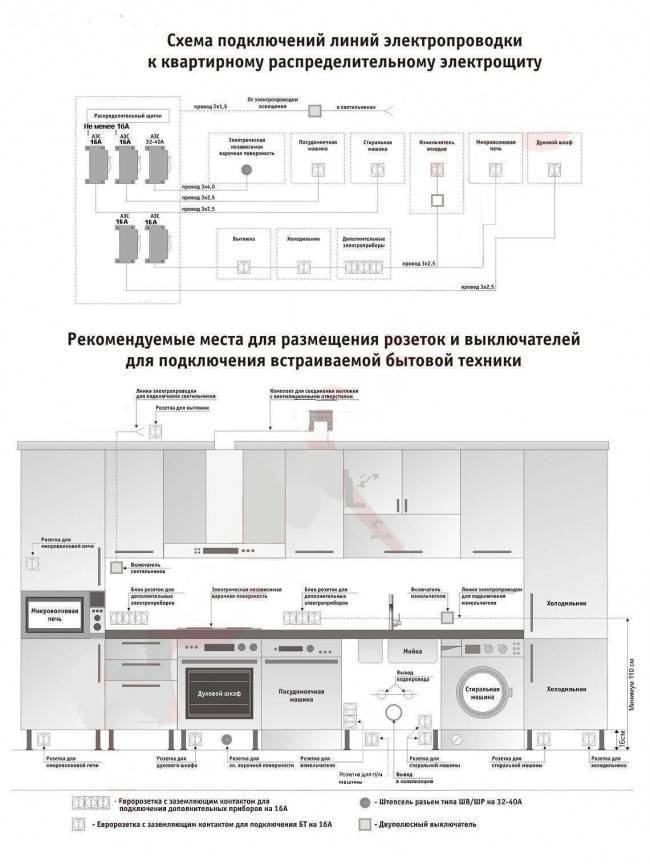
Sockets for built-in appliances: placement rules
There are several rules that must be followed when drawing up the layout of outlets:
- At the connection points of the washing machine or dishwasher, the sockets are installed in such a way that they are always available. In such cases, closed-type sockets are used, they prevent water from entering.
- For the stove and oven, as mentioned above, special sockets of type 32A + 40A are used.
- The socket to which the hood is connected, if any, is installed on the upper level of the cabinets and always with an offset in the opposite direction from the air passage. This is done so that hot air, when it enters the hood, does not damage the electrical wiring.
-
All sockets for built-in appliances should be located near the placement with direct free access, and not directly behind the appliances.
- The same goes for the refrigerator outlet, because if you place the outlet behind the refrigerator, you risk damaging it with a hot grill located on the back of the refrigerator.
- It is forbidden to place sockets above the stove for cooking, sink and behind the body of built-in appliances. In the first case, because of the danger of damage from heat, in the second - from water.
- It is also impossible to install sockets in the moving parts of the kitchen set, as this can lead to chafing of the electrical cable.
Attention! Before installing sockets, read the documentation for the built-in equipment or ask the manager about the amount of current required for the operation of this equipment.
Rules and layout of outlets
Determine how many household appliances will be there or may be in the near future. Then specify and write down the power of each and connection features, if any. Approximate power indicators:




- Large technology.
- electric oven - from 2500 W;
- hob - 1000-1500 W;
- dishwasher - from 1000 W;
- washing machine - from 1500 W;
- water heater - from 1500 W;
- refrigerator - 200-1000 W;
- freezer - 300 watts.
- Small kitchen appliances.
- microwave oven - from 800 W;
- electric kettle - from 500 W;
- blender - up to 300 W;
- food processor - 1200-1500 W;
- coffee maker - from 900 watts.
- Additional technology. which may be present in the kitchen:
- TV - 200-330 W;
- laptop - 50-75 watts.
The placement of outlets is subject to certain rules to prevent situations that can lead to unpleasant consequences:
Pay special attention to the fact that the total power of the devices included in the socket should not exceed the allowable one. For example, you cannot connect a kettle and a microwave oven to the same outlet at the same time.
The power of the devices can be specified in the technical data sheets for them.
It is necessary to bring so many lines to the kitchen that feed the sockets so that with a double margin there is enough for all appliances. This means that the kitchen should be conditionally divided into parts with the location of appliances, then the resulting power should be divided into outlet groups in these parts and multiplied by two in each group received.
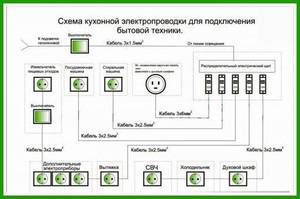
For electrical appliances with high power (large household appliances, electric stoves, etc.), it is better to have separate lines with a suitable cross section, copper and through protective automation. For convenience, it is better to sign each machine in the electrical panel.
Devices with a metal case require grounding. Therefore, sockets for them must be connected through a differential circuit breaker or RCD (residual current device).
It is forbidden to install sockets directly behind built-in electric ovens, refrigerators, hoods, they must be located on the side at a distance of about 20 cm.
Sockets are installed above the table top, stepping back 10-15 cm. Conditions should be strictly observed to prevent moisture and splashes of grease from getting on them. Do not mount above a sink or stovetop.When installing sockets near pipes, make sure that they have covers and rubber seals that will protect them from moisture in the event of a break.
Manufacturers indicate on the packages to the sockets what power they are designed for, these figures should be taken into account when buying. They produce options of 10 amperes, which corresponds to 2.2 kW, and 16 amperes - 3.5 kW.
Preliminarily draw up a layout of sockets. This point should be given the most attention.
The importance of the stage lies in the fact that the convenience of using household appliances in the kitchen, the safety and aesthetics of the room will depend on how accurately and successfully the scheme is drawn up.
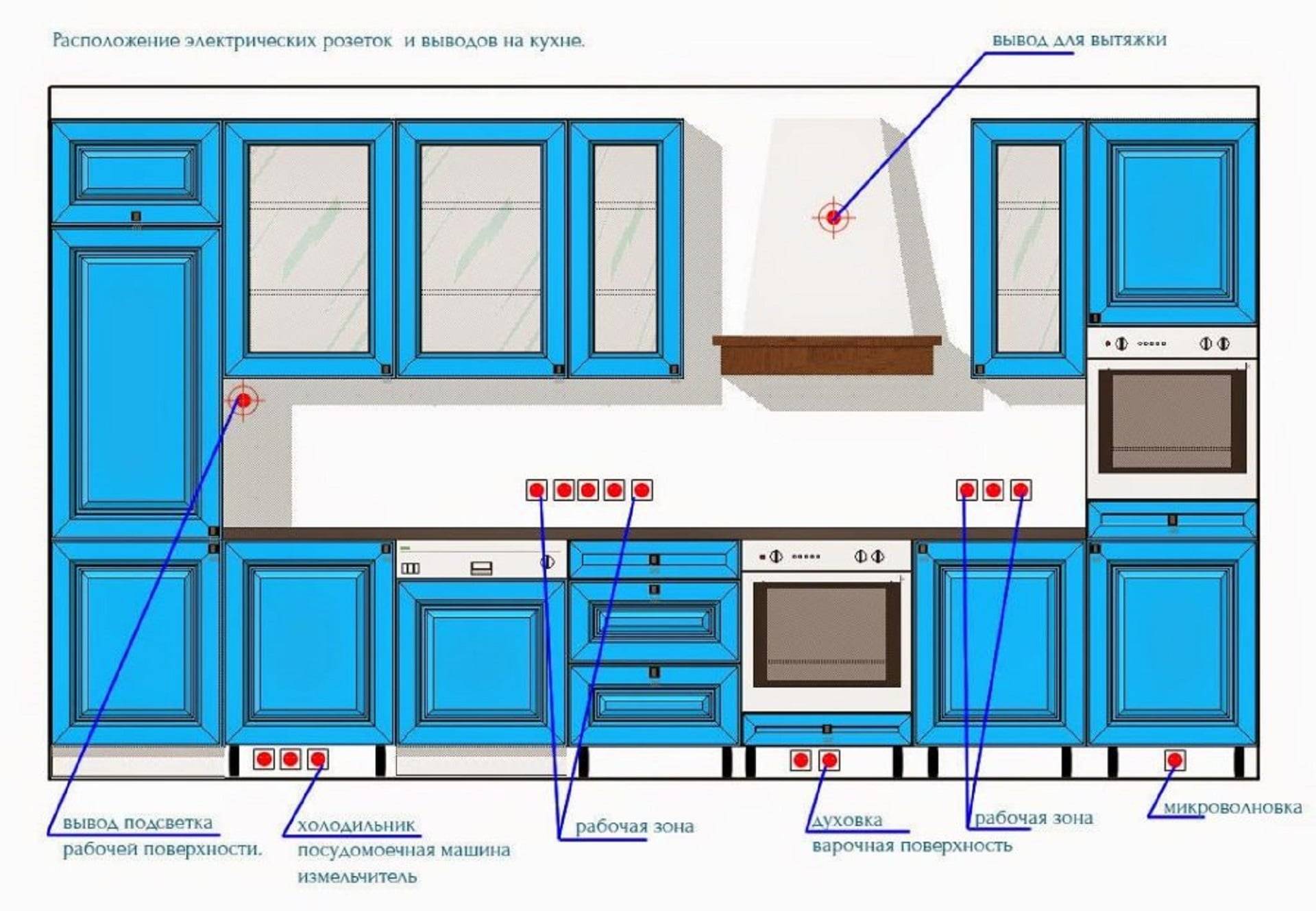
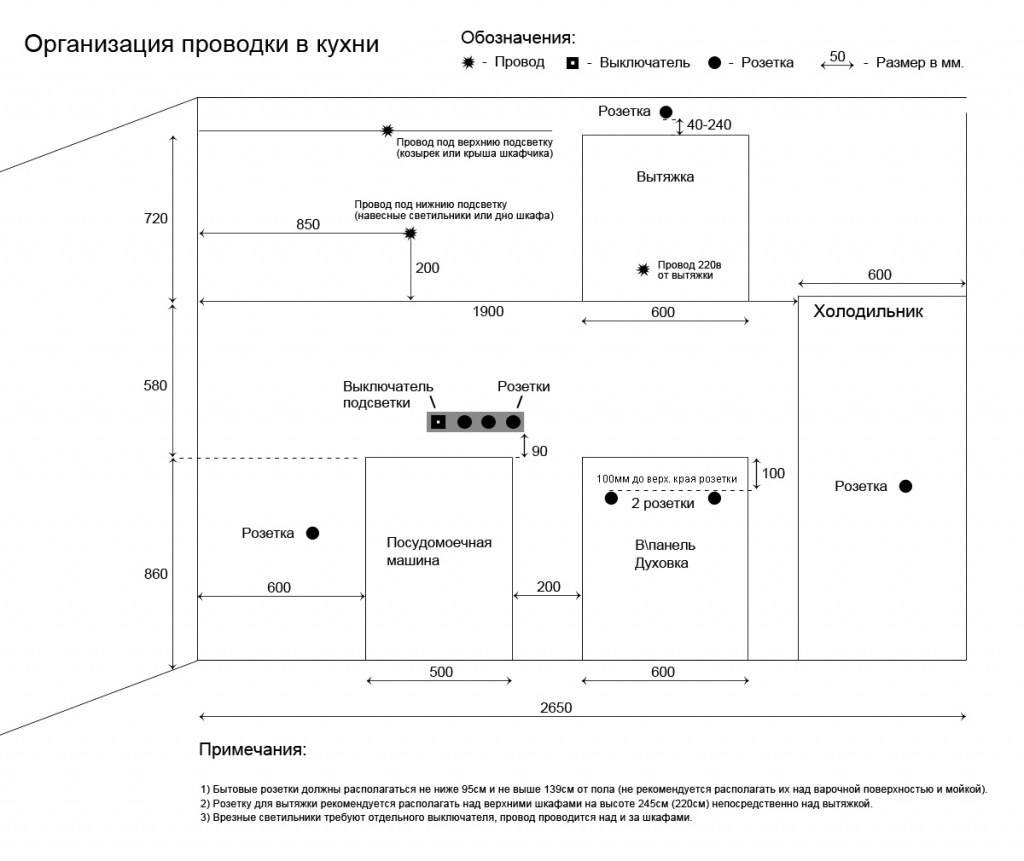
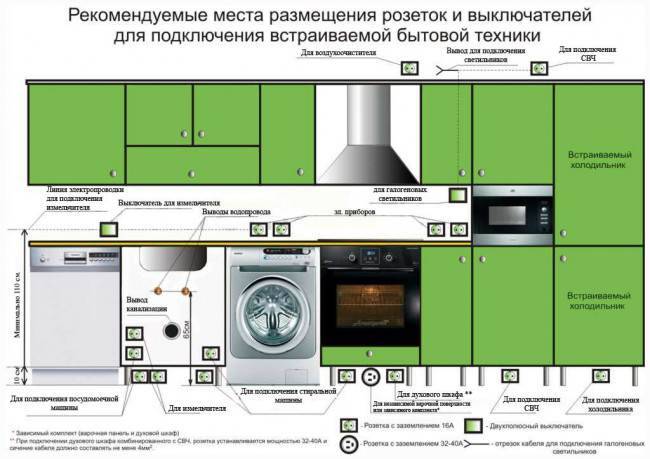
The placement of sockets should be strictly drawn on the plan of the kitchen and note how electrical lines will be drawn to them.
Do not forget about the design of the room, they should not spoil the overall look. If sockets for large household appliances, as a rule, are not visible behind the kitchen apron, then located above the countertop, they can give an interesting look or ruin it.
In modern kitchens, pull-out options are often chosen, they are hidden in the worktop without changing its aesthetics, and appear when needed. Of the pluses, it should also be noted that they are easy to install, you can often order the installation in the manufacture of a kitchen set.
Drawing up a layout of outlets
When planning a major overhaul of the kitchen, you need to take care of drawing up a layout plan for the location of sockets in order to avoid unnecessary hanging wires, as well as inconvenience when connecting electrical appliances.
Determination of the required number of outlets
To determine the number of outlets in the kitchen, you need to sum up all the household appliances that you plan to use, and add another 20% as a margin. The most common kitchen consumers are:
- hoods;
- plates;
- fridge;
- built-in appliances;
- kettle, mixer, etc.
To the resulting list, it is also worth adding devices that may be used in the future. All calculations should be performed even at the wiring stage, that is, before the start of finishing work, since it will not be easy to install additional sockets later.
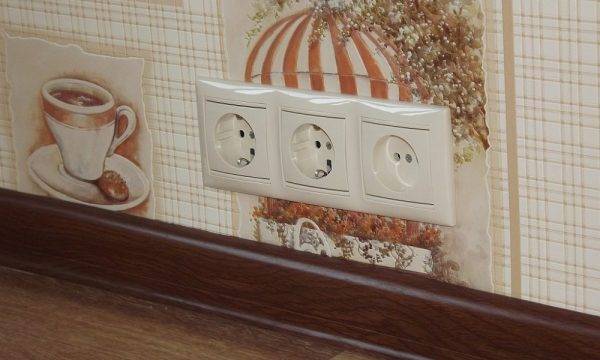
The number of outlets at each connection point in the kitchen directly depends on the number of electrical appliances that will be used in the immediate vicinity of it.
Location of sockets for each type of household appliances
Depending on the consumer, the socket should be located at a certain level from the floor:
- Plate. The main rule is that sockets should not be placed above the burners or behind the oven. The optimal distance from the floor is 15 cm with some indentation to the side so that the plug is accessible, but the socket is not visible.
- Fridge. The recommendations are generally the same. Plus, it should be borne in mind that some models of refrigerators have a short power cord, which will not allow you to place the outlet far away.
- Washing machine and dishwasher. This technique has holes on the back for supplying and draining water, so the outlet should be located at some distance. It is better to place it on the opposite side of the hoses at a height of 15–20 cm from the floor.
- Hood.Since this device is installed quite high, the socket should also be located closer to the ceiling, usually 2 m from the floor.
-
On an apron. Typically, this location is a work area for cooking, so the connection of kitchen electrical appliances may be required quite often. So that the plug can be turned on and off without difficulty, the socket is placed 10–15 cm from the edge of the countertop or 110–115 cm from the floor. You should not place it too high, since the apron is a noticeable place in the kitchen and the wires that are in plain sight will only spoil the interior.
In the area of the kitchen where the sofa, table and chairs are installed, the presence of an outlet is also extremely important, for example, to connect a vacuum cleaner, charge a phone or laptop. In this case, it is better to put a pair of double sockets at a height of 20-30 cm from the floor
At a higher location, the wires will be visible.
Wiring rules
Connecting sockets in the kitchen is carried out, adhering to the following rules:
- The total power of consumers that are connected to the outlet should not exceed the maximum allowable.
- When operating equipment with high power, it is necessary to bring a dedicated line to it and install a separate machine.
- If there are electrical appliances with a metal case, they must be grounded.
- It is not recommended to install sockets behind electrical equipment that generates heat (ovens, refrigerators, etc.).
-
Before starting the installation, you should draw up a plan.
Table: power and cross-section of wires for connecting kitchen appliances
| Types of equipment | Maximum power consumption | Socket | Cable cross section | Automatic in the shield | |
| Single phase connection | Three-phase connection | ||||
| Dependent kit: electrical panel plus oven | about 11 kW | Calculated for the power consumption of the kit | Up to 8.3kW/4mm² (PVA 3*4) 8.3-11kW/6mm²(PVA 3*6) | Up to 9 kW/2.5 mm² (PVA 3*2.5)9-15/4 mm²(PVA 3*4) | separate, at least 25 A (only 380 V) plus RCD |
| Electrical panel (independent) | 6–11 kW | Rated for panel power consumption | Up to 8.3 kW/4 mm² (PVA 3*4) 8.3-11 kW/6 mm² (PVA 3*6) | Up to 9 kW/2.5 mm² (PVA 3*2.5)9-15/4 mm²(PVA 3*4) | separate, at least 25 A plus RCD |
| Electric oven (independent) | 3.5–6 kW | euro socket | Up to 4 kW/2.5 mm² (PVA 3*2.5) 4 to 6 kW/4 mm² (PVA 3*4) | 16 A 25 A | |
| gas hob | euro socket | 1.5 mm² (PVA 3*1.5) | 16A | ||
| Gas oven | euro socket | 1.5 mm² (PVA 3*1.5) | 16A | ||
| Washing machine | 2.5 kW7 kW with dryer | euro socket | 2.5 mm² (PVA 3*2.5) 7 kW/4 mm² (PVA 3*4) | separate, 16 A separate, 32 A | |
| Dishwasher | 2–2.5 kW | euro socket | 2.5 mm² (PVA 3*2.5) | separate, 16 A | |
| Refrigerator, freezer | less than 1 kW | euro socket | 1.5 mm² (PVA 3*1.5) | 16 A | |
| Hood | less than 1 kW | euro socket | 1.5 mm² (PVA 3*1.5) | 16 A | |
| Coffee machine, steamer, microwave oven | up to 2 kW | euro socket | 1.5 mm² (PVA 3*1.5) | 16 A |
Rules for the location of outlets in the kitchen: photos, diagrams and recommendations
Before you start choosing places, as well as installing outlets, you need to make some calculations that will help you do everything right. First of all, you need to write out all the devices that you plan to use in the near future, as well as their approximate power. Of course, power indicators will be individual, however, as an example, we can consider the following average indicators:


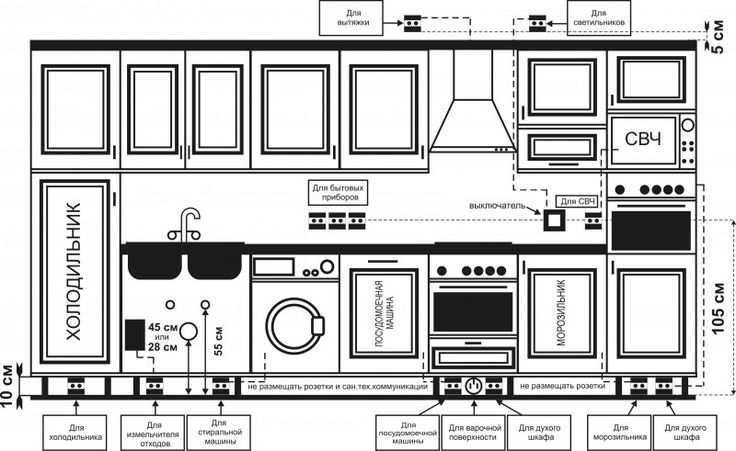
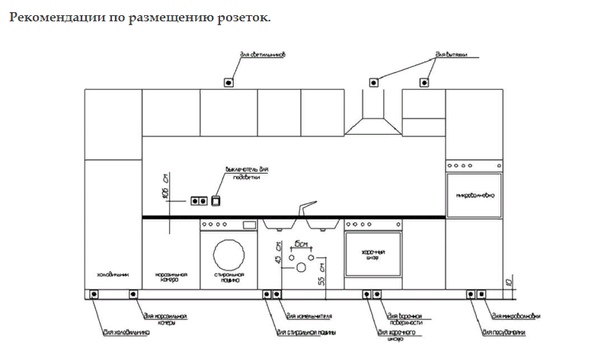
- refrigerator - up to 1 kW;
- water heater - from 1.5 kW;
- hob - from 1 to 1.5 kW;
- washing machine - about 1.5 kW;
- electric oven - from 2.5 kW.
An example of the correct location of the outlet for the refrigerator
All these are items of large household appliances that create the main load on the network. Small appliances, which include a microwave oven, blender, coffee maker, kettle, etc., as a rule, consume from 300 to 800 kW, depending on the model.
How to arrange sockets in the kitchen: basic rules
Here are a few basic rules to follow when arranging outlets in the kitchen:
the total power of all devices that will be connected to one outlet should not exceed the allowable one. That is, you need to see in advance the power of each device (it is indicated in the data sheet). Usually, only such large appliances as an electric kettle and a microwave oven cannot be connected to one outlet, and other combinations are quite acceptable;
The layout of electrical outlets and conclusions in the kitchen
- there should be enough power lines for sockets in the kitchen so that there is enough for all sockets with a double margin. To do this, conditionally divide the space into several zones, depending on how the devices will be located, and then divide the required power to power them into groups of outlets. By multiplying the result by two in each of the groups, you will get the most complete picture of how many sources will be needed;
- in order to provide power to large devices, it is advisable to bring separate lines to them, the cross section of which will be suitable. This applies to electric stoves and other large devices for which individual separate automatic protection on the electrical panel will not interfere;
- if the device has a metal case, then it must be grounded and the sockets in this case must be connected through an RCD or a differential circuit breaker;
In a large kitchen, it is better to arrange blocks with fewer outlets, but with a more frequent interval.
- according to the regulations, the installation of sockets directly above electrical appliances (refrigerator, oven, extractor hood, etc.) is strictly prohibited. They should be located strictly on the side and at a distance of at least 20 cm;
- Another important point concerns the installation at the location of the apron. Sockets in the kitchen should rise at least 10-15 cm above the countertop to eliminate the risk of dripping water and grease into them.
Built-in sockets should not be placed near the sink to avoid water entering the unit
Layout of outlets in the kitchen: principles of compilation
It is easiest to properly install sockets in the kitchen if you use the prepared scheme
The convenience of their use, as well as the aesthetic side of the issue, will depend on how carefully the system for the location of sockets is thought out.
Which cable to choose for wiring
After completing the calculation of the power consumption of all electrical appliances, you can begin to select the type of cable products, determine the required cross-section of the cores. To do this, we use the data from the table of permissible currents.
| Cable section, mm² | Laid open | located in the pipe | ||||||||||
| Current loads, A | power, kWt | Current loads, A | power, kWt | |||||||||
| 220 | 380 | 220 | 380 | |||||||||
| Cu | Al | Cu | Al | Cu | Al | Cu | Al | Cu | Al | Cu | Al | |
| 0,5 | 11 | — | 2,4 | — | — | — | — | — | — | — | — | — |
| 0,75 | 15 | — | 3,3 | — | — | — | — | — | — | — | — | — |
| 1 | 17 | — | 3,7 | — | 6,4 | — | 14 | — | 3 | — | 5,3 | — |
| 1,5 | 23 | — | 5 | — | 8,7 | — | 15 | — | 3,3 | — | 5,7 | — |
| 2 | 26 | 21 | 5,7 | 4,6 | 9,8 | 7,9 | 19 | 14 | 4,1 | 3 | 7,2 | 5,3 |
| 2,5 | 30 | 24 | 6,6 | 5,2 | 11 | 9,1 | 21 | 16 | 4,6 | 3,5 | 7,9 | 6 |
| 4 | 41 | 32 | 9 | 7 | 16 | 12 | 27 | 21 | 5,9 | 4,6 | 10 | 7,9 |
| 5 | 50 | 39 | 11 | 8,5 | 19 | 14 | 34 | 26 | 7,4 | 5,7 | 12 | 9,8 |
| 10 | 80 | 60 | 17 | 13 | 30 | 22 | 50 | 38 | 11 | 8,3 | 19 | 14 |
| 16 | 100 | 75 | 22 | 16 | 38 | 28 | 80 | 55 | 17 | 12 | 30 | 20 |
| 25 | 140 | 105 | 30 | 23 | 53 | 39 | 100 | 65 | 22 | 14 | 38 | 24 |
| 35 | 170 | 130 | 37 | 28 | 64 | 49 | 135 | 75 | 29 | 16 | 51 | 28 |
How to properly position one or more power supplies: regulations
Almost all items in the kitchen have their own standards.
Household appliances should be located within a zone of no more than 1 meter from the power source. The socket must be installed within reach.
Sockets, switches must be installed so that moisture does not get on them.
The maximum height above the plinth should not exceed 2 m
Attention
Information on all standards can be found in the documents: GOST 7397.0-89, 7396.1-89, 8594-80, SNiP 3.05.06-85.
Rules and layout
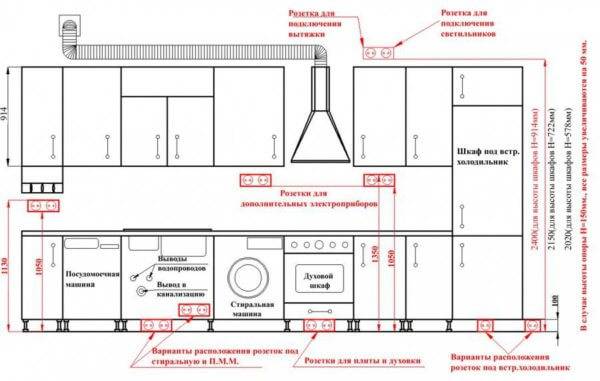
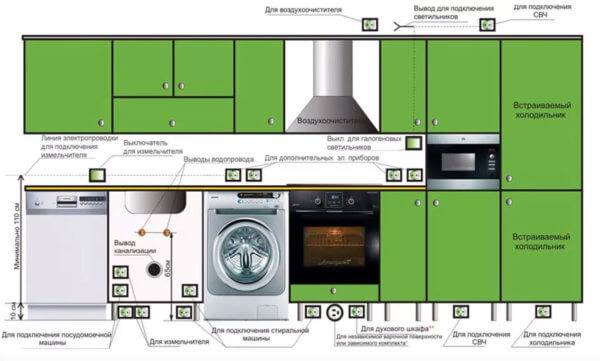
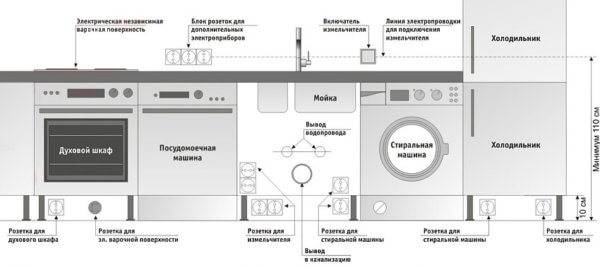
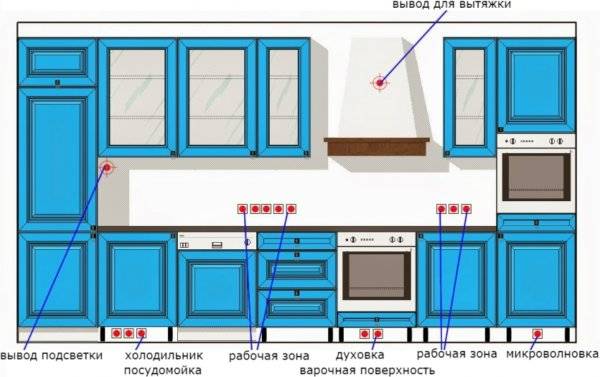
Calculate piece by piece electrical household appliances, summarize their total energy consumption in kW. When calculating, you need to leave a margin that may be needed when connecting new household appliances. The resulting value is taken into account when laying the main cable to the kitchen.
Draw on paper the location of furniture, household appliances on the walls. Make a “sweep” of the area so that all interior items, household appliances are visible in one projection.
Mark the entry point of the power cable to the kitchen.
Create groups of outlets that will be located in separate zones


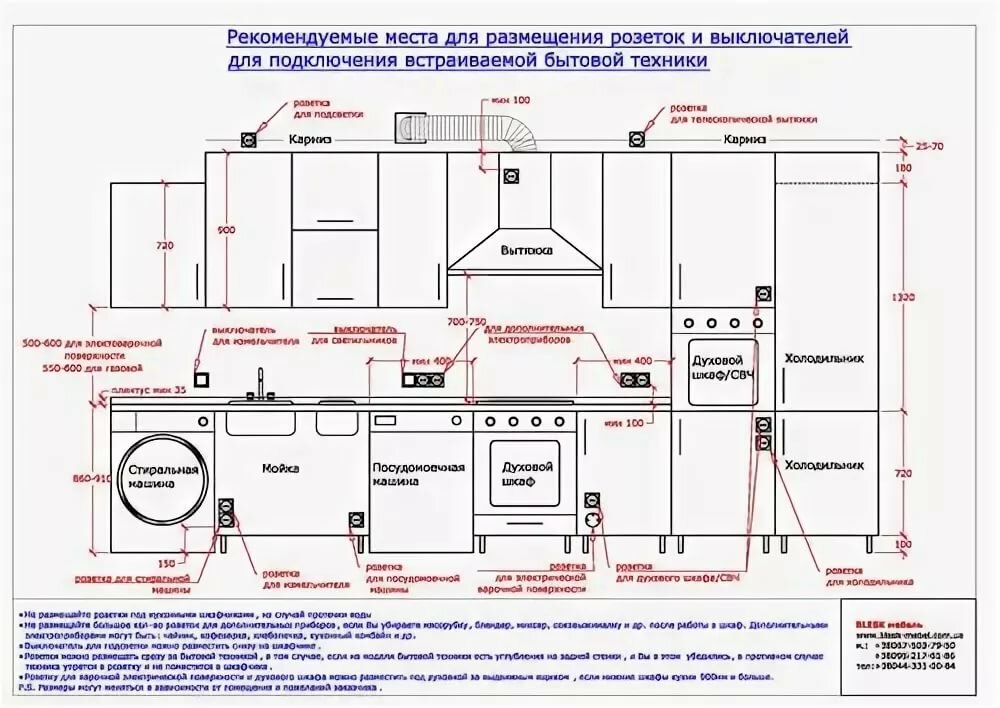


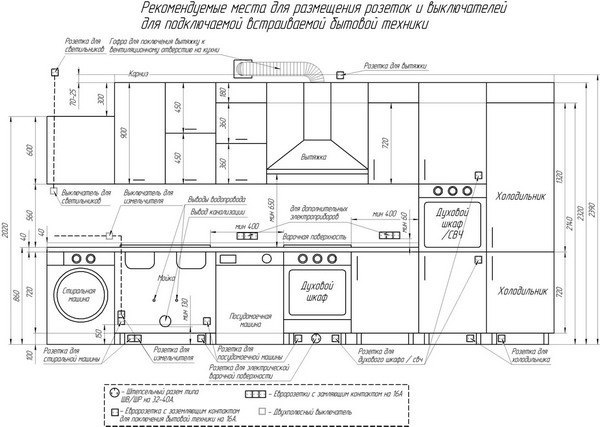

It is important not to forget about single power outputs, if any. For example, for a work area and an apron - one group of 3-4 pieces, for a hood and a refrigerator - one at a time under the ceiling and above the plinth. Each kitchen has its own scheme.
Draw wiring lines, mark places for sockets
Draw up a drawing, taking into account the rules for their location. General points are described in the paragraph above. There are special cases, which will be discussed in more detail below.
Mark all the wires on paper, note the electricity consumption for each group.
Count the number of wires and accessories
Each kitchen has its own scheme.
Draw wiring lines, mark places for sockets. Draw up a drawing, taking into account the rules for their location. General points are described in the paragraph above. There are special cases, which will be discussed in more detail below.
Mark all the wires on paper, note the electricity consumption for each group.
Count the number of wires and accessories.
Important
It is best to draw a diagram with dimensions on graph paper using a ruler, or use computer software. For example, AutoCAD
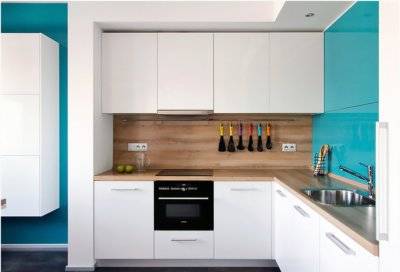
- European - 30 cm from the floor.
- The Soviet standard is at the level of a person's belt, about 90 cm from the floor.
Which cable to run?
There are two types of cable:
- for concealed wiring;
- for external.
When choosing cables for the kitchen, you need to be guided by several rules:
- For one or more power supplies, choose wires with a minimum cable cross section of 2.5 square meters. mm (copper wiring). These are wires of the VVG or VVGng brand. The second cable has a higher degree of protection for fire safety.
- For an electric furnace, a larger wire is selected that can withstand a load of up to 7 kW. Typically, copper wires with a cross section of up to 4 square meters have such indicators. mm.
Attention
It is important to remember how to properly route the cable. When designing wiring, consider the junction boxes through which the cables will be patched. do not leave old wires on the copper cable or twist copper with aluminum
do not leave old wires on the copper cable or twist copper with aluminum
do not leave old wires on the copper cable or twist copper with aluminum
What to consider when designing an outlet layout
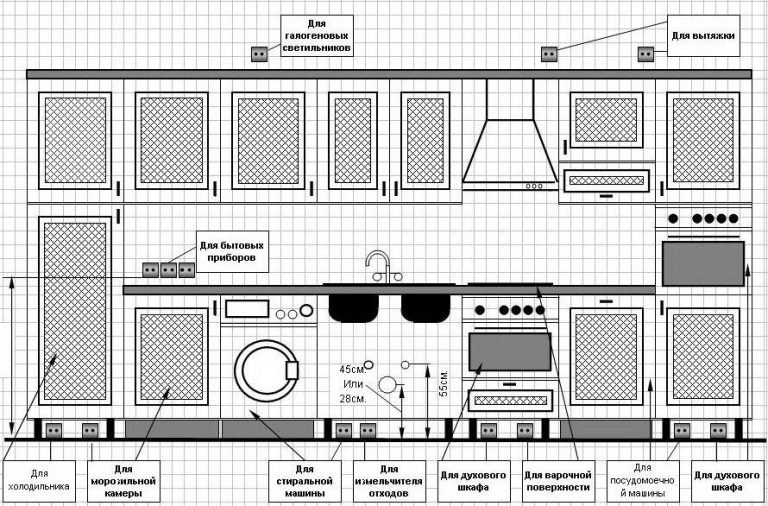
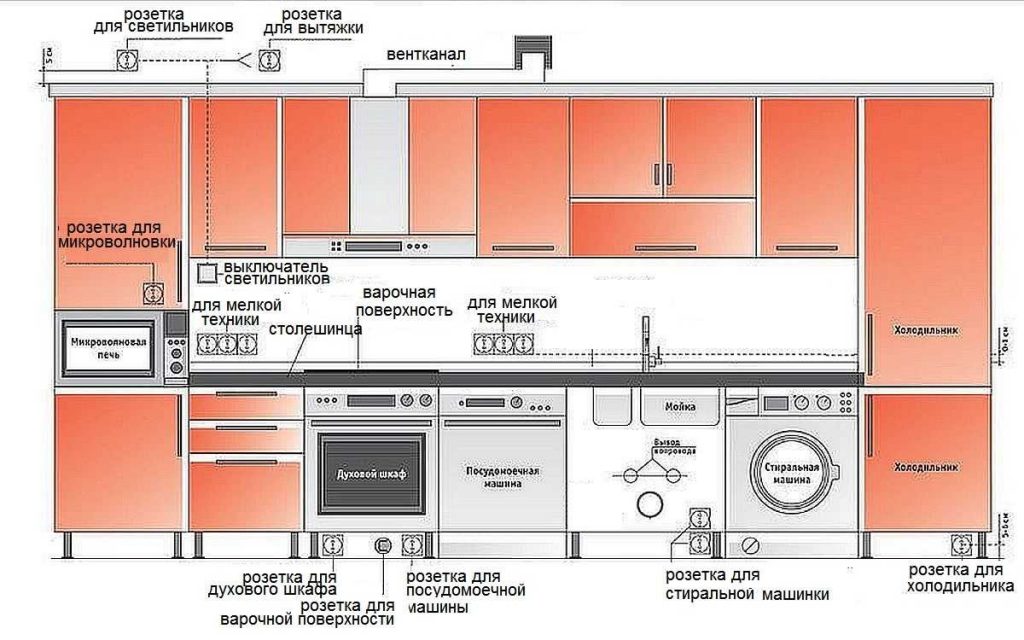
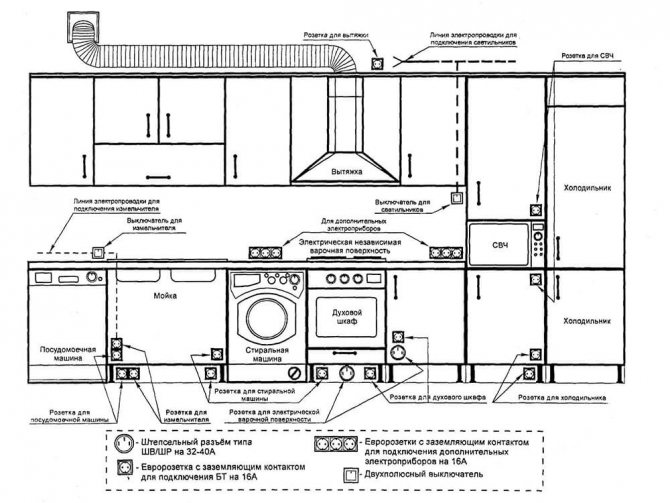
 First of all, you need to decide what kind of household appliances will be installed and correctly place it on the drawing of the room. Having made a layout of a kitchen set in advance, it is easy to avoid the problems associated with transferring sockets already in the process of installing furniture.
In no case should power points be located behind built-in appliances or behind cabinets with drawers with closers and pull-out systems, such as cargo (bottle), carousels, metal baskets. If there is a need to install a socket just behind such a cabinet, then it is mounted at a height not exceeding the height of the furniture legs.
It is recommended to install sockets for installation next to appliances, usually behind an adjacent cabinet, in the back wall of which, if necessary, a cutout is made. This cabinet, as is clear from the above, should not be equipped with complex sliding systems. The depth of cabinets with simple drawers and the possibility of installing electrical outlets behind them must be discussed with the designer or sales consultant of the furniture salon.





Which cable to use
The laying of power cables is planned based on the power of household appliances:
- Copper cable with a conductor cross section of 8 square meters. mm is planned to provide individual high-power consumers - an electric stove, a hob, an electric oven, a heating boiler, a storage water heater, a flowing water heater, an automatic washing machine, a dishwasher;
- Copper cable with a cross section of 4-6 sq. mm - microwave, refrigerator, electric kettle, food processor;
- Copper cable with a conductor cross section of 2-4 mm - for a toaster, blender, electric meat grinder, coffee maker, coffee machine, TV and other consumers.
In the case of installing a socket block, it is recommended to lay a separate line to the block from cable section 6-8 mm, this will ensure reliable operation without overheating the line.

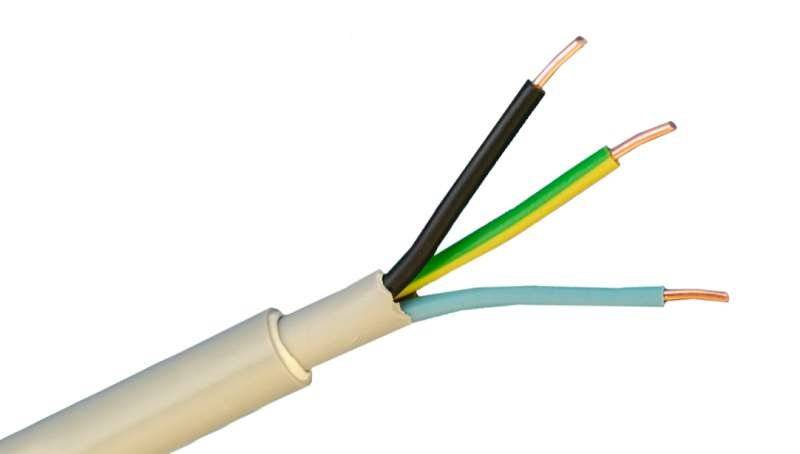
copper cable VVGng
Installing separate lines to high power consumers will ensure a reliable supply of electricity to the device and an emergency shutdown by a circuit breaker. For example, if the heating element of the washing machine fails and there is a short circuit in the circuit, the individual machine will turn off only the power line of the washing machine. And the rest of the devices will continue to work in normal mode.
Attention! When laying new wiring, you need to use only copper cable, no twists with aluminum, only solid cores from the machine on the shield to the kitchen outlet!



