- Collector scheme - ideal for a large house
- Common installation errors
- Some expert advice
- What is tee wiring?
- Advantages of tee wiring
- Cons of tee wiring
- Types of piping in the apartment and house
- Tee scheme and its features
- Proper layout and design
- Design Features
- Pipe selection
- Step-by-step instructions for wiring a water supply system
- Installation of ball valves
- Installation of meters for hot and cold water
- Mounting of gearboxes
- Manifold installation
- Installation of water pipes
- Tee distribution of water supply in the house is
- Selection of pipes for water supply
- Common installation errors
- Laying methods - hidden and open system
- Collector type of pipe wiring - features and nuances
- Laying methods
Collector scheme - ideal for a large house
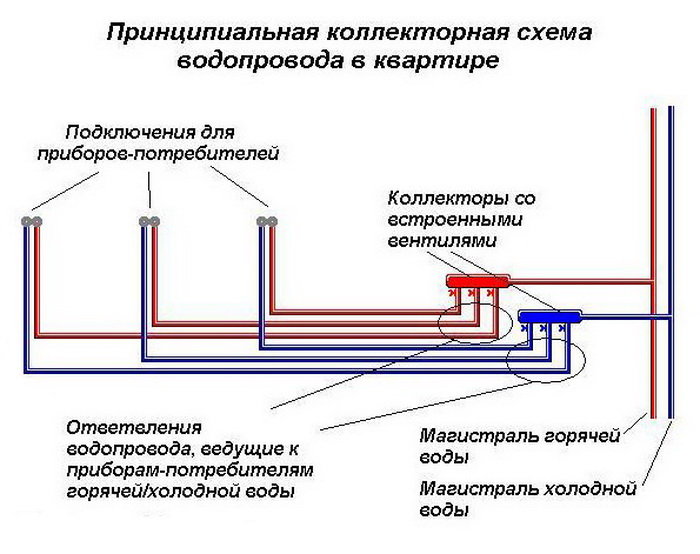
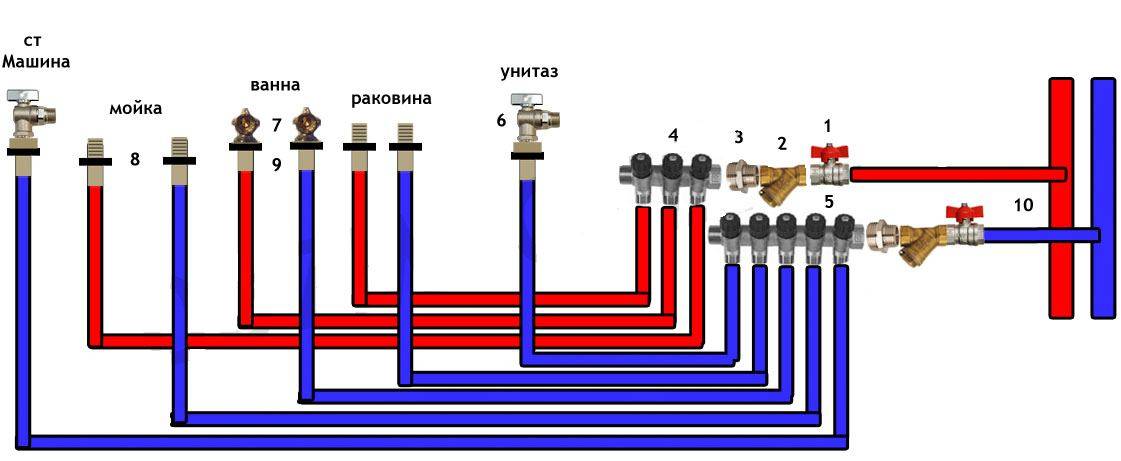
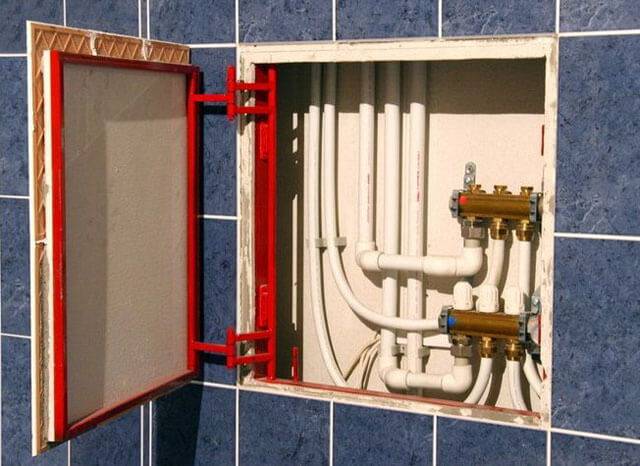
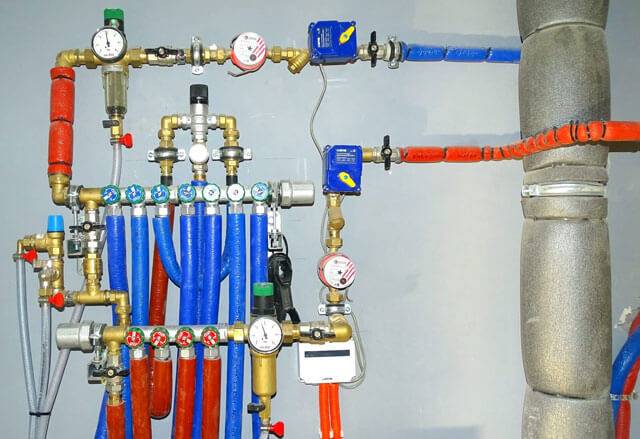
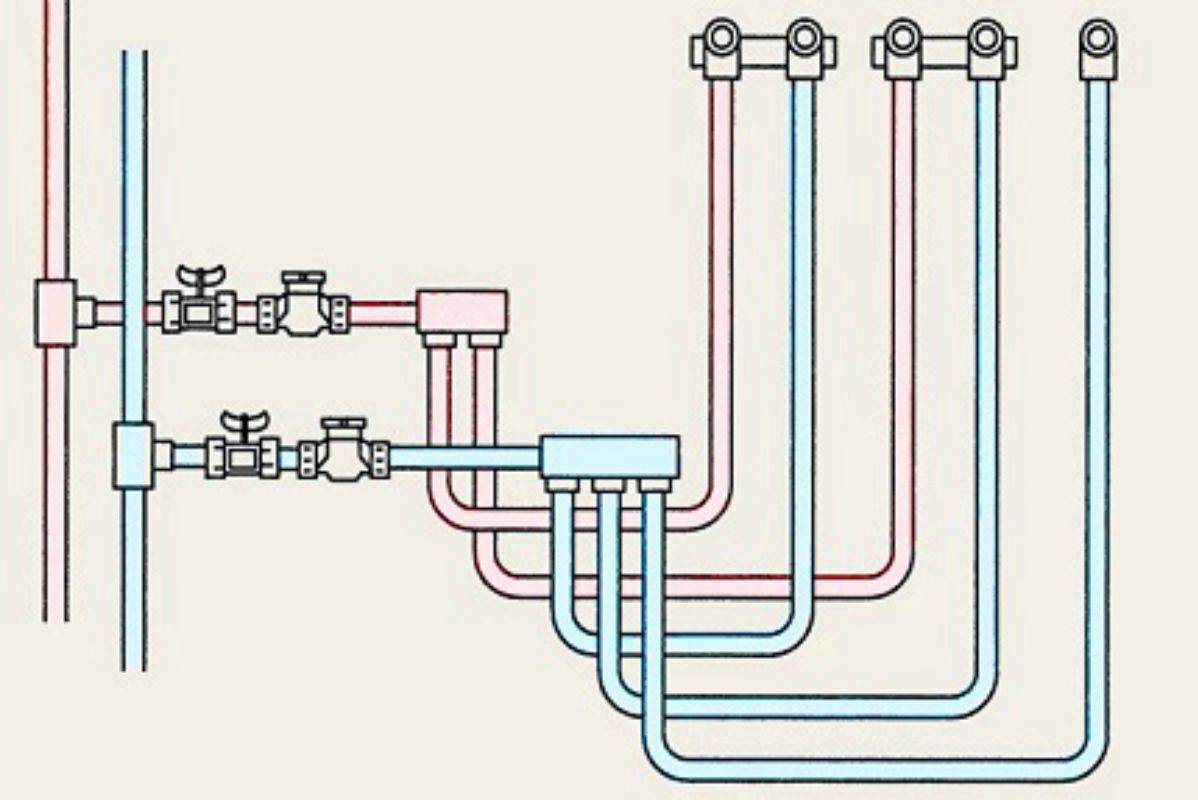
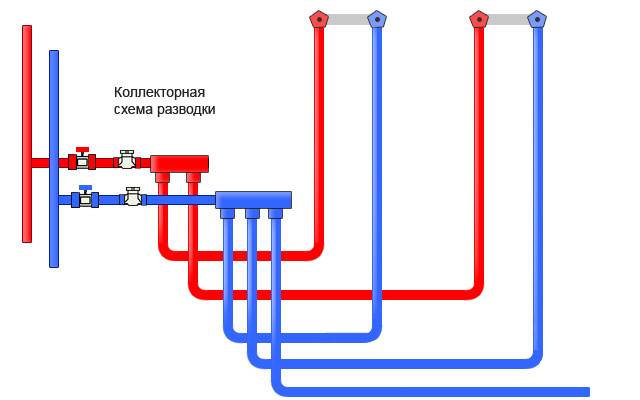
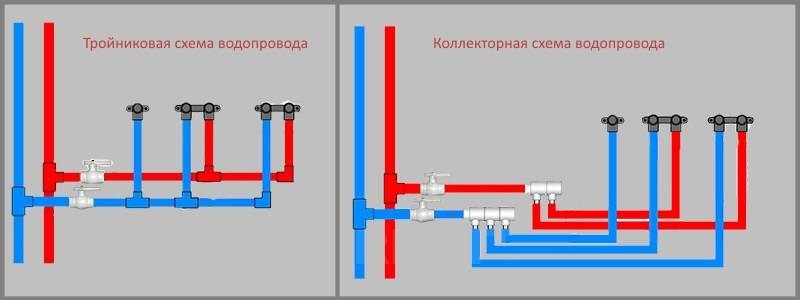
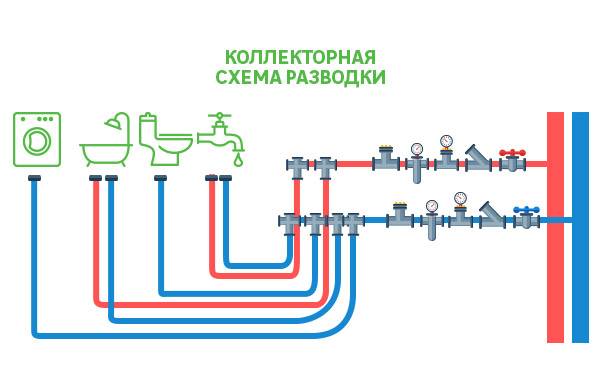
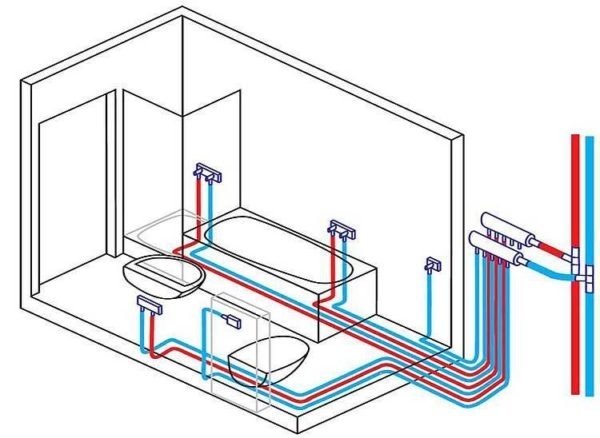
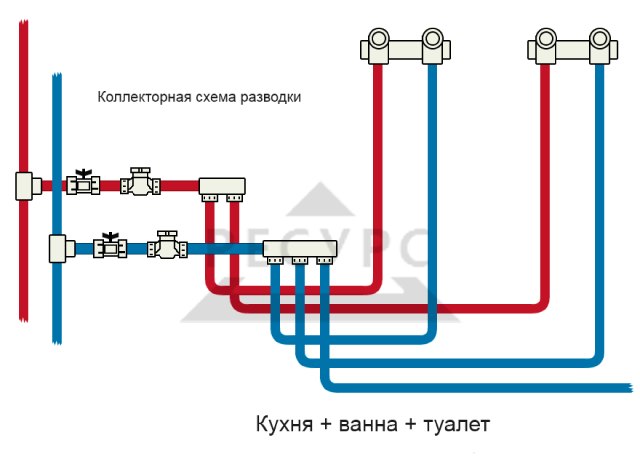
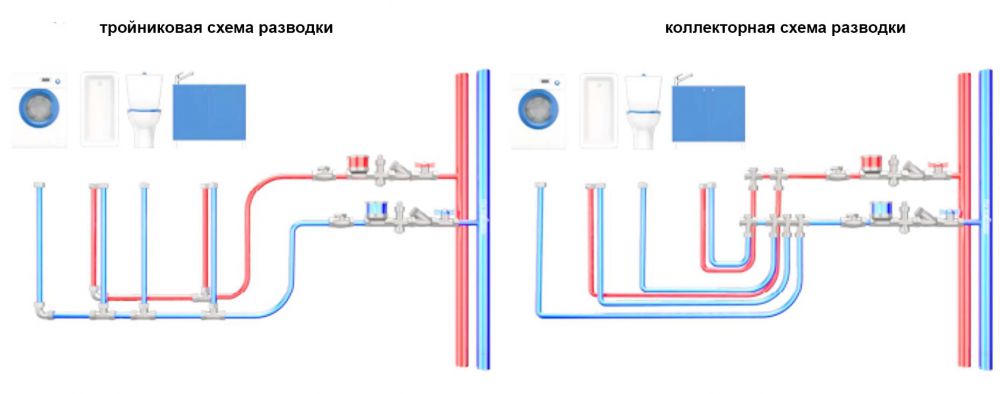
Collector distribution of water supply means bringing separate pipes to each point of water consumption. A sink in the kitchen, a toilet, a shower - each faucet in the house supplies water in the right amount, regardless of the others. Pipes are supplied from a collector installed at the inlet of the water supply to the house. It is a device with one input and several outputs.Their number is selected based on the number of points of water consumption. At the same time, it is necessary to take into account not only taps, but also washing and dishwashers, water on the street, etc.
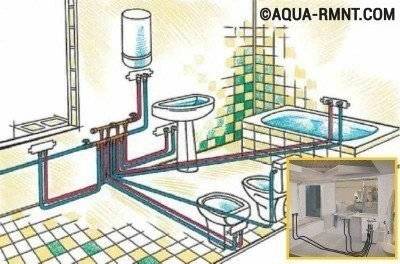
Here it is clearly seen that all points of water consumption are independent of each other. It is very convenient for both operation and repair.
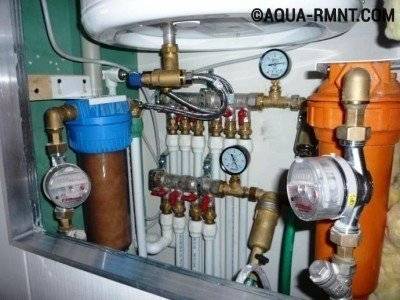
This is what the collector looks like under the sink. Agree, not very convenient for an ordinary apartment. It even looks like an airplane dashboard.
This scheme has many advantages. Firstly, without prejudice to the household, you can turn off the water in the shower, while leaving the possibility of using other bathrooms.
Secondly, all taps for controlling the water supply system are located in one place, they are easily accessible. As a rule, the collector is located in a sanitary cabinet or a separate room.
Thirdly, stable pressure in the system. Collector wiring protects against surges, thereby ensuring that you will not be splashed with boiling water in the shower if someone turns on the water in the kitchen.
Fourthly, the minimum risk of breakdowns and ease of repair, because only one solid pipe runs from the tap to the manifold.
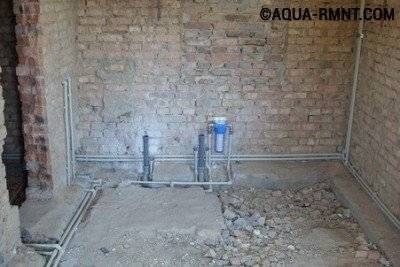
In a private house, when using a collector circuit, water pipes can be hidden even under a screed: the probability of breakage of solid pipes is negligible
Fifth, the water temperature at all points of water consumption is the same, even if all taps are opened at the same time.
Sixthly, the connection of new taps or water-powered equipment is carried out quickly, without prejudice to other consumers. To do this, you only need to install a collector with a margin of several conclusions.
Everything has its drawbacks, and the collector method is no exception.It requires a lot of building materials. Two pipes are not enough here. And this, in turn, leads to significant material costs. Yes, and the installation of water supply according to this scheme takes a lot of time.
In addition, a lot of space is needed to accommodate the collector and so many pipes. You can no longer hide the place where the water supply enters the apartment behind the locker, it does not look aesthetically pleasing.
Common installation errors
The drafting of a plumbing system, both collector and tee, is best entrusted to professionals who are familiar with building codes and are able to perform hydraulic calculations. But even the best project will be useless if mistakes are made in its implementation.
Stopcocks are part of any water supply scheme: both sequential and manifold. They are installed at the entrance to the plumbing system, as well as in front of each plumbing fixture.
For example, some unfortunate craftsmen, driven by the thought of unreasonable savings, neglect the requirement to insulate hot water pipes that are laid under the floor or in the thickness of the walls.
As a result, part of the thermal energy is transferred to the materials surrounding the pipe, which degrades the quality of the water. In addition, condensation from the surface of pipes without thermal insulation can damage the finish of the room.
During installation work, experienced craftsmen recommend closing the ends of pipes that have not yet been installed so that debris does not get into them. The absence of this protective measure can lead to the fact that immediately after installation, the water supply system will have to be thoroughly and for a long time flushed or even repaired.
When soldering polypropylene water pipes, remember that small dirt or moisture at the soldering point can significantly impair the quality of work.
If soldering of plastic pipes is necessary, all work should be carried out in a clean room to avoid contamination. It is also unacceptable to solder pipes on which even a small amount of moisture is present. A drop of water or debris at the soldering point can significantly weaken the connection and degrade its quality.
It is not necessary to design the plumbing system in such a way that all pipes pass through the ceiling through one common hole. This may degrade the performance of the plumbing. Professional designers never make such mistakes.


When drawing up a wiring plan, it is necessary to ensure that the pipes do not block access to the joints. This will greatly facilitate the repair in the event of a leak.
An insufficient number of locking devices can also cause a lot of trouble during installation work. Such fittings must be present in front of each device to which water is supplied, as well as for each riser. If the house has not one, but several bathrooms, you can install a shut-off valve for each of them.
Simultaneously with the plumbing system, sewers are usually designed and arranged. It must be ensured that pipes and risers of individual systems do not overlap each other. In the future, this will facilitate maintenance and repair work.
Some expert advice
After deciding how to make water supply in the apartment, it is necessary to draw up a project for the water supply system.Regardless of the method of piping - collector or beam, it is better to entrust its development to professionals who understand building codes and are able to make hydraulic calculations. But even the best design solution must be correctly implemented.
Mistakes made can lead to irreparable consequences:
- In some cases, craftsmen, in order to save money, neglect the need to insulate hot water pipes laid in the thickness of walls or under flooring. As a result, the installation of pipes in an apartment without thermal insulation leads to the fact that the thermal energy is partially transferred to nearby materials and the water quality deteriorates. In addition, condensate that collects on the surface of the pipeline without insulation can ruin the finish of the room.
- When performing installation work, experts recommend closing the ends of pipes that have not yet been installed so that dirt and debris do not get inside them. If this precautionary measure is neglected, then after the installation is completed, the water supply system has to be washed out for a long time and thoroughly, and in some cases even repaired.
- When soldering plastic pipes is required, it must be carried out in a clean room, where there is no possibility of contamination. Such work cannot be done when there is even a little moisture on the pipes. If water is being distributed in the kitchen or in another room, then particles of debris or a drop of water at the soldering points will significantly weaken the strength of the connection. As a result, the plumbing will not turn out to be of high quality.
- Experts advise not to design the water supply system so that all pipes are laid in the ceiling through one common hole. This leads to the deterioration of the performance of the water supply system. By the way, professional designers never make this mistake.
- Also, an insufficient number of locking devices used can lead to serious trouble during installation work. This type of fitting must be present in front of each plumbing fixture to which water is supplied. It is also mounted for each riser that provides water supply to the apartment.
- If the arrangement of not one, but several bathrooms is designed at a residential facility, it is advisable to install a stopcock for each of them.
Usually, at the same time, professionals design the wiring of plumbing and sewer systems. The main condition that must be observed in this case is to prevent the risers and pipelines of each of them from overlapping each other. In the future, the fulfillment of this requirement will facilitate the repair work and maintenance of utilities.
What is tee wiring?
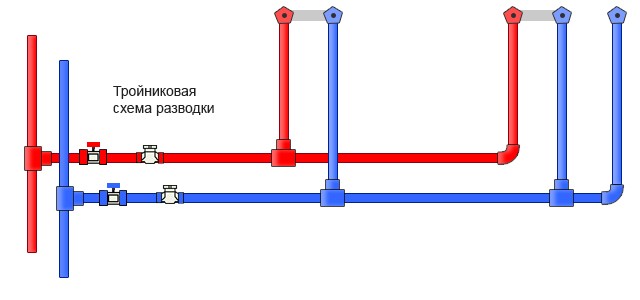
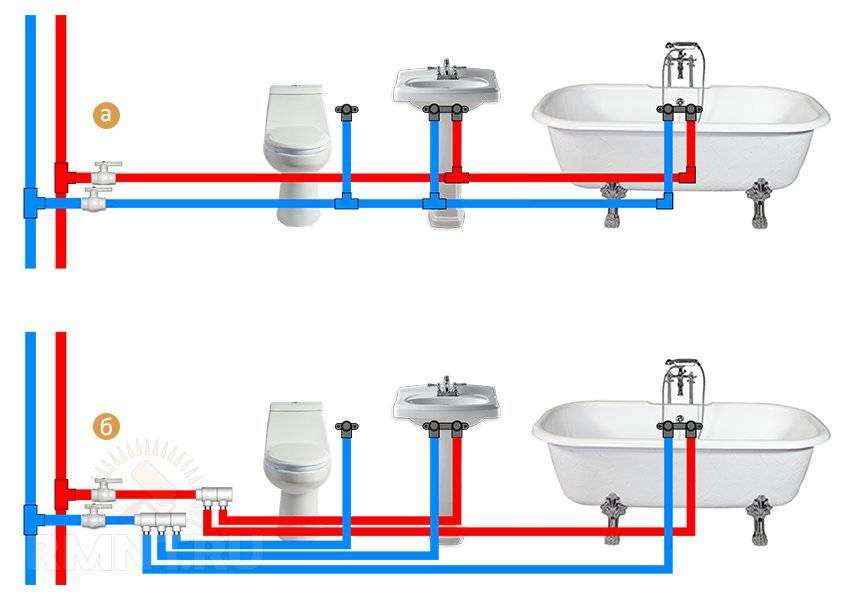
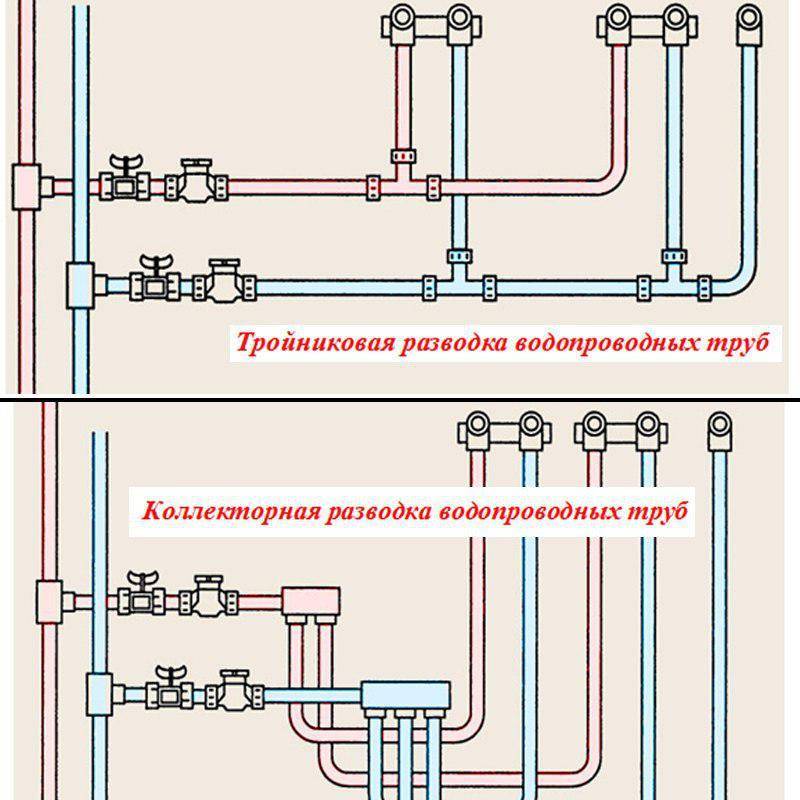
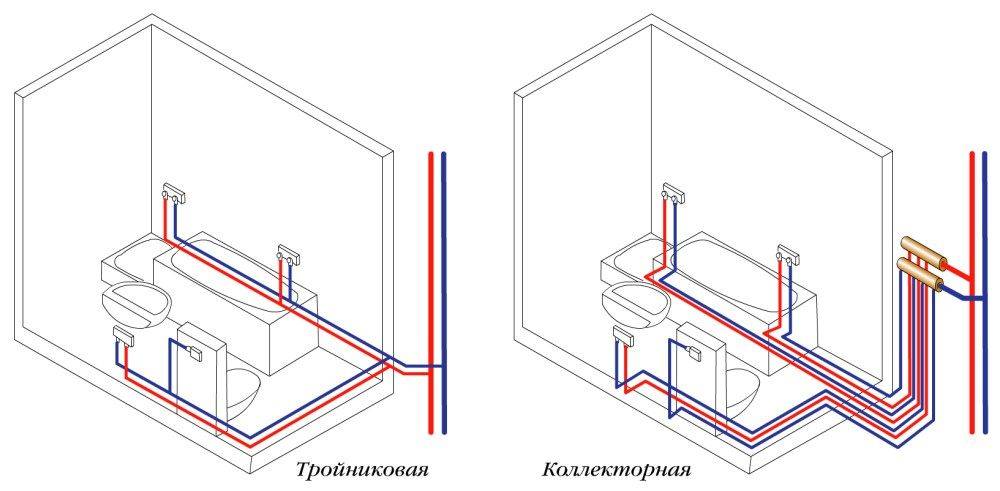
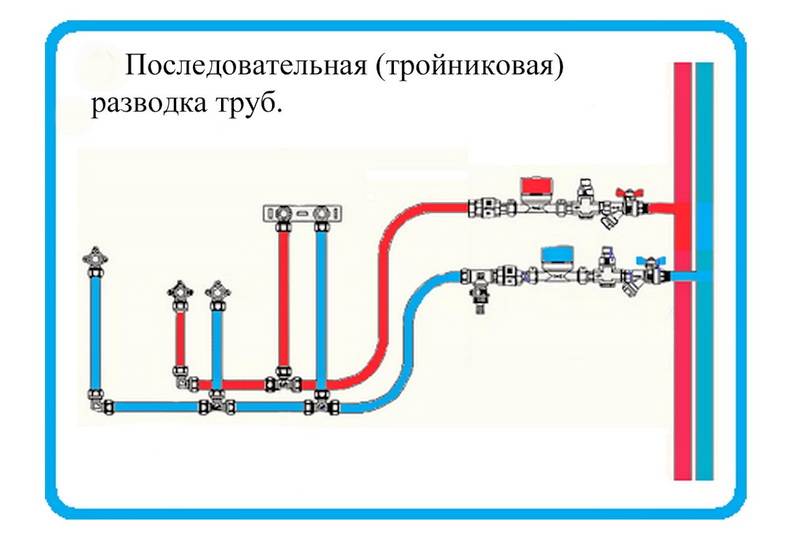
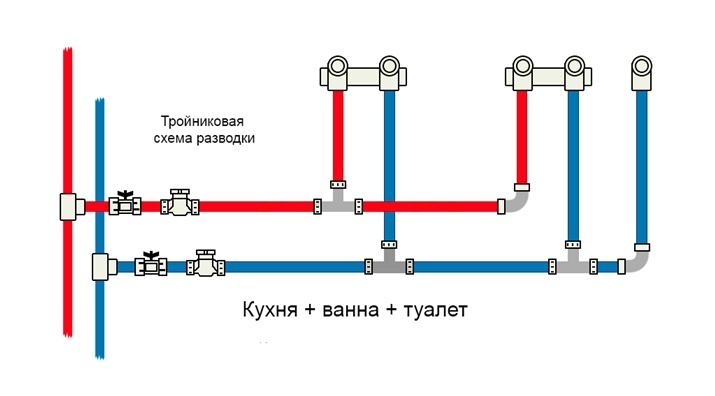
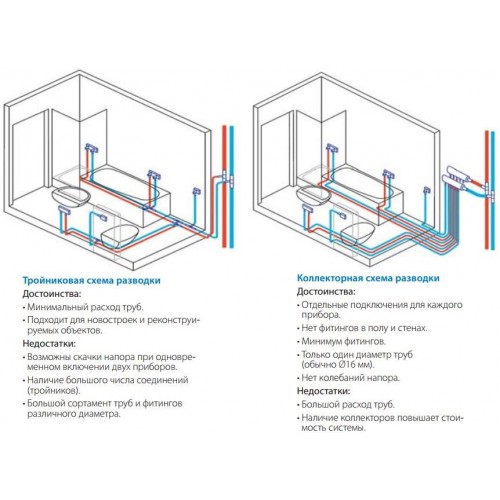
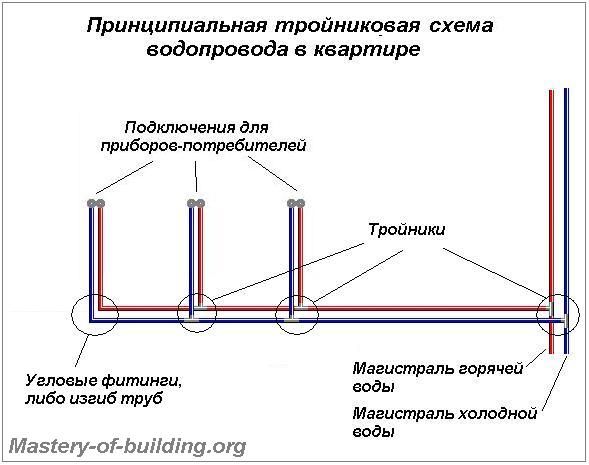
With a tee distribution of pipes, the water supply network is built in series: two main pipes with cold and hot water are diverted from the common riser, and from them, with the help of tees, to the points of use. This scheme is much simpler and cheaper than the previous one, but also has many of its drawbacks.
This layout is best suited for a small living space.The use of tees in a private house can lead to inconvenience associated with increased water consumption compared to a small one-room apartment.
Advantages of tee wiring
- It is cheap. You only need two main pipes
- Tee wiring is more compact. It doesn't require a lot of space. The plumbing is easily hidden inside the walls, its visible parts are in the cabinet under the washbasin or behind the toilet.
- Compared with collector wiring, the assembly of the tee is carried out in a short time.
Cons of tee wiring
- When several taps are turned on at the same time, the water supply pressure will drop. Jumps can be minimized by expanding the diameter of the main pipe in relation to the outlet ones. But then the cost of building materials will increase. If the pressure in the house itself is weak, then even such a manipulation will not give a result.
- Turning off the plumbing system will only work entirely. Of course, you can install your own shut-off valve at each point. But in this case, the consumption will also increase, and the ease of use will become even less. After all, every time you have to climb, again, under the kitchen sink or behind the toilet. Ultimately, this can also be more expensive than installing a collector wiring.
- A large number of tees is always accompanied by a certain risk. When using pressed fittings, push-on fittings, XLPE pipes or polypropylene compounds, it can be argued that the fastening is dead and is unlikely to ever leak. But the probability of breakage on tees than on a solid pipe is still higher.
The choice of this or that distribution of water supply pipes depends on many factors: how water is supplied in the house, whether auxiliary engineering plumbing is needed to compensate for hydraulic shocks, how intensively the water supply system is operated, how many water use points there will be, what condition the system is in and what exactly is expected to be obtained as a result. Do not also forget that the method of laying pipes will also depend on the type of distribution of water supply pipes. So, if the main pipe is laid through the bathroom, and a return pipe is installed in the kitchen, then the best solution would be to connect the kitchen plumbing in series using a tee type of wiring, and install it in the bathroom depending on the intensity of consumption.
Types of piping in the apartment and house
Time does not stand still, and today a scheme or a house can be carried out according to three schemes - tee, manifold, and mixed.
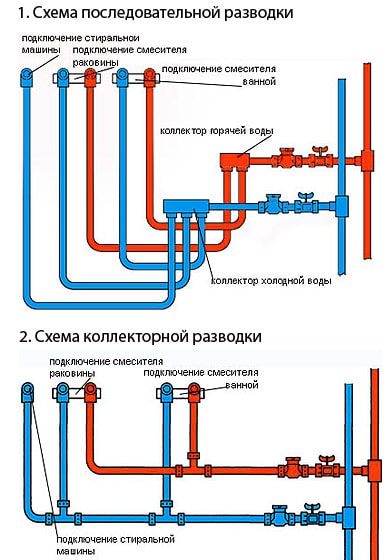
- Trinity method. The network is connected in series, through tees. Its essence is that one pipe goes from the riser through all places of water consumption - taps in the bathroom, toilet tank, kitchen faucet. The traditional option, the main advantage is low, the minimum amount of materials is used. The disadvantage is the dependence of each source of consumption on each other. For repair work, it is necessary to block communications throughout the room. Therefore, at each point of consumption, a separate shut-off valve is installed for repair and emergency work.
- The collector method, which is also called the beam method. Connection to the central water supply is made through a collector, each place of water consumption has its own pipe from the riser.Personal for bathroom faucets, separate for kitchen sink, and separate for toilet cistern. When a water distribution manifold is used, in the event of a pressure drop in the system, the pressure at each tap is the same. If necessary, you can install an individual pressure regulator for each outlet. An additional convenience will be the concentration of all one point. The disadvantage of this method will be the increased cost of installation, a pair of pipes, hot and cold water supply goes to each consumer.
- In apartment buildings, a mixed type of communications is often used. Connection to the central water supply from the common riser to the apartment is a tee system, and directly in the apartments - a collector system.
When laying heating networks, they are used in pairs, one for input and one for output. Do not confuse the heating and water supply collector and the sewer collector. When draining, this is a line, which includes pipes, and a collection tank or a centralized drain.
Tee scheme and its features
Technically, the tee wiring diagram for water supply in an apartment is a serial connection - one pipe leaves the riser, to which plumbing and other water-consuming equipment is connected using tees.
The advantages of such a system are:
- cost-effectiveness (when connected in series, a minimum number of pipes is required),
- ease of installation.
Tee scheme plumbing in an apartment also has its drawbacks:
- a large number of connections and serial connection make it difficult to find leaks,
- there is always a risk of pressure drops in the system and a decrease in pressure at the points most remote from the riser when several taps are turned on at the same time,
- if it is necessary to carry out repair work, a complete shutdown of the water supply will be required, which is a certain inconvenience,
- installation of tees is not always convenient in a small space.
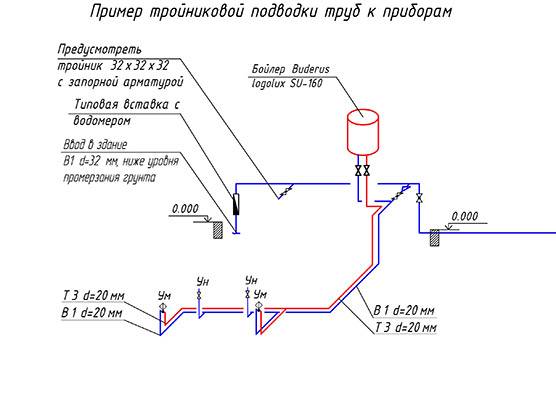
An example of a tee plumbing layout
Tee water supply schemes are recommended for small apartments. With a small number of consumption points and their location close to each other, many disadvantages become less relevant - in this case it is much easier to coordinate water consumption, which means that the risk of pressure drop is minimized.
When installing a tee scheme, tees are often hidden in the walls or under the floor, which complicates the inspection of communications, and during repairs inevitably leads to damage to the finish.
This is interesting: revision hatches for tiles – types, designs, installation rules
Proper layout and design
The task of organizing water supply in a residential area is quite simple. It is necessary to transport water from the centralized system to the place of water analysis by consumers. The list of such places in different residential premises may be different. A simple option includes two washbasins located in the bathroom and in the kitchen, a faucet in the bathroom, and a toilet bowl.



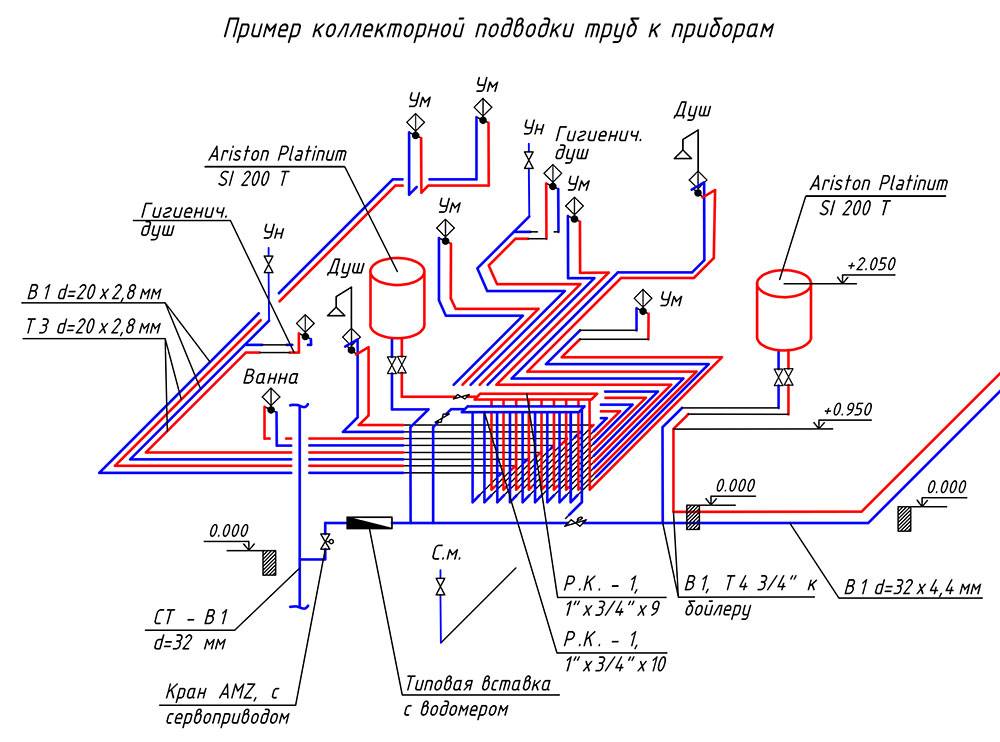

Modern apartments involve more complex systems. Almost every home today has auxiliary household appliances that require tap water to function. Every family has a washing machine, most housewives want to install a dishwasher in the kitchen.
In the bathroom, in addition to the bath itself, shower cabins are often installed, equipped with auxiliary functions, such as hydromassage. Near the toilet, the installation of a bidet has become fashionable. In spacious apartments, the number of sanitary facilities may be several. Two auxiliary toilet bowls, an additional shower cabin increase the comfort of living quarters, and, accordingly, the load on the system.
Design Features
As a result, the requirements for the quality and performance of the water supply network are increasing. Many household appliances are sensitive to changes in water pressure, which depends on the correct design of the piping scheme. A professional water supply project in an apartment will increase the parameters of the water supply network, reduce the consumption of materials for its installation and operation, and also simplify the repair and maintenance of the water supply system.
There are two options for laying water pipes in an apartment:
- A sequential circuit, it is also called a tee.
- Collector scheme.
Each of them has its advantages and disadvantages. Therefore, they are used for various cases and under certain conditions. Sometimes these two schemes are combined and get a combined plumbing.
Pipe selection
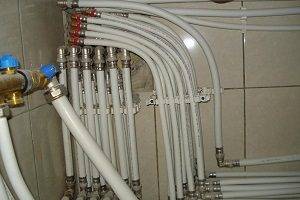
Distribution from metal-plastic pipes
In order to correctly install the water supply in your apartment with your own hands, it is advised to use either metal-plastic pipes or purely plastic ones.
As for the use of steel or copper options, it is better to refuse them, because working with them requires not only skill, but also additional traumatic tools to cut, weld and bend.
However, they remain the best option for creating a water supply system. No deposits appear on their walls during use, and a sufficiently small thermal conductivity makes it possible to use such pipes to provide hot water.
Of all the variety of plastic pipes, polypropylene pipes are considered the best in terms of price / quality ratio. For soldering polypropylene pipes, a special “soldering iron” is used, which is very easy to learn how to use.
Step-by-step instructions for wiring a water supply system
Do-it-yourself water supply wiring in an apartment always begins with drawing up a detailed water supply scheme on paper. It should provide for the smallest nuances, since it will be the basis not only for the work, but also for the acquisition of the required amount of materials.
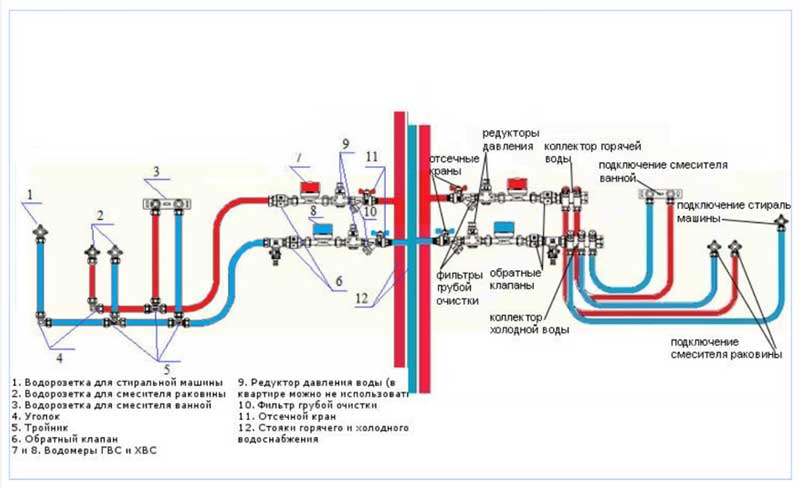
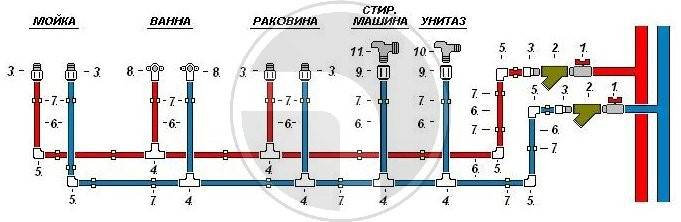
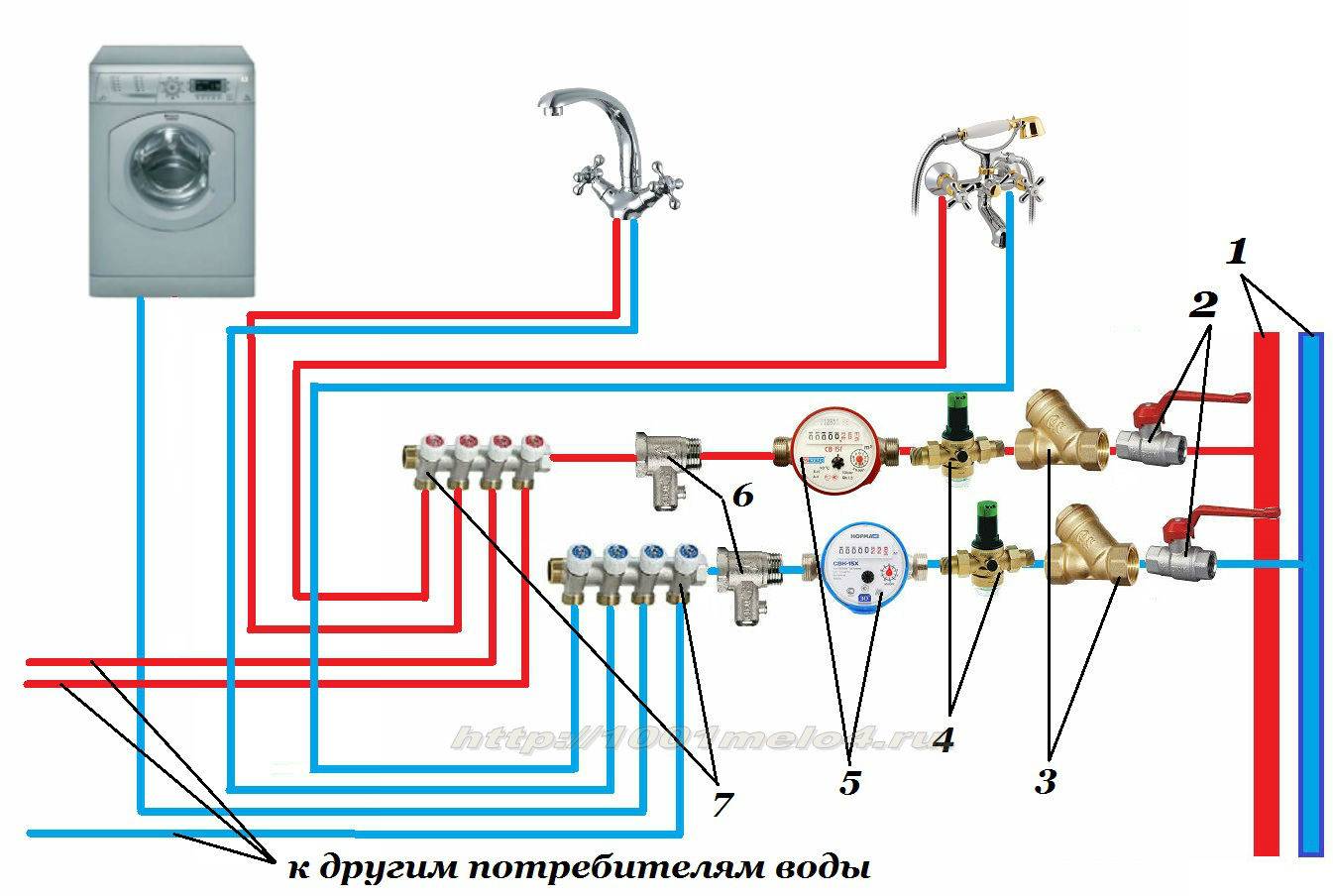
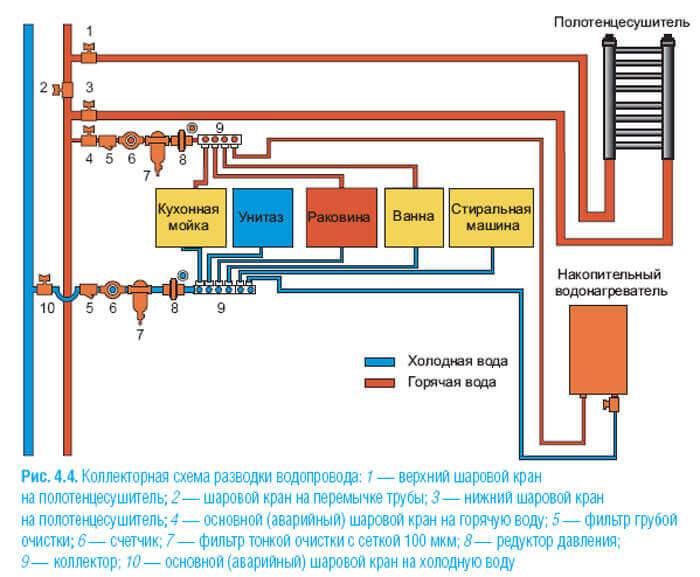
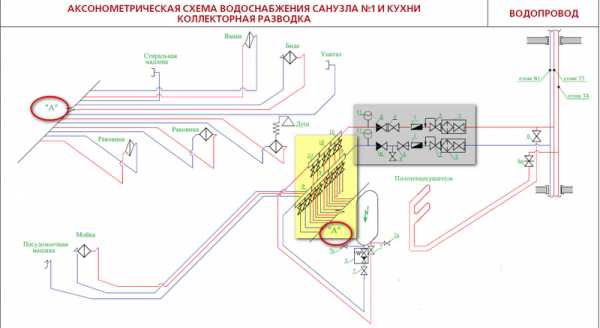
Attention! The scheme should be drawn up with a minimum number of joints, connections and bends - this will significantly increase its operational reliability. If the space of the room allows, then the best option is the collector wiring of water supply pipes, an example of which is shown in the figure below.
If the space of the room allows, then the best option is the collector wiring of water supply pipes, an example of which is shown in the figure below.
The referenced positions refer to the following elements:
- 1,2,3 - ball valves at the inlet of the washing machine, sink and bath mixer;
- 4.5 - collectors for cold and hot water;
- 6 - check valves;
- 7.8 - hot and cold water meters;
- 9 - reducers for pressure normalization;
- 10 - filters providing rough cleaning.
- 11 - emergency cranes.
- 12 - cold and hot water risers.
The most acceptable option for organizing a do-it-yourself plumbing system is to use plastic pipes. They are easy to install and can be used for a long time. The optimal pipe diameter is selected according to the total length of the pipeline in order to provide the required pressure. To do this, you can use special tables that can be found on the Internet or consult with experts.
Attention! If the distribution of water pipes is carried out in an old house, then you should pay attention to the condition of the main riser. It may first need to be replaced, and this event should only be carried out by specialists.
Installation of ball valves
Installation of emergency ball valves at the inlet from the main risers and installation of filters. The taps at the inlet to the water supply system have been reassigned to quickly turn off the water supply when a leak is detected.
Be sure to turn off the water before starting installation. It is recommended to use ball valves that operate at pressures up to 60 atmospheres and temperatures up to +150˚С. Coarse filters are connected to the installed ball valves.




Installation of meters for hot and cold water
As a rule, union nuts are included with the meter, which allow, if necessary, to disconnect the meter without violating the integrity of the system.
Important! When installing the meter yourself, you need to pay attention to the directional arrows that are placed by the manufacturer on the device. They indicate the direction of water movement.
Remember! After starting the system, the installed devices must be registered with the water supply organization.
Mounting of gearboxes
Installation in the water supply system of reducers that will prevent damage to pipelines in the event of pressure drops. It is imperative to install these devices if the water pressure in the riser significantly exceeds the throughput of plumbing devices. It is good if, under excess pressure, excess water will be drained into the sewer, so if possible, a special drain should be provided.
Basic rules for installing the gearbox:
- The pressure regulator gauge must be mounted vertically;
- During installation, shut-off valves must be provided;
- Be sure to take into account the direction of the water in accordance with the indicated arrow on the device.
Manifold installation
As a rule, these devices are equipped with a maximum of four outputs. Therefore, to connect a larger number of consumers, it is necessary to install several collectors.
Important! Ball valves should be installed at the inlets of all consumers to be able to turn off specific devices in case of an accident.
Installation of water pipes
Direct installation of water pipes. To do this, purchased plastic pipes must be cut to size in accordance with the wiring diagram. The joints are welded using a special apparatus, which is quite easy to handle.This technology is described in detail in the article Polypropylene pipes - do-it-yourself installation.
You can start operating a self-installed water supply system only after checking, which is best done with an assistant. This will quickly shut off the water supply if a leak is detected due to poor assembly.
Tee distribution of water supply in the house is
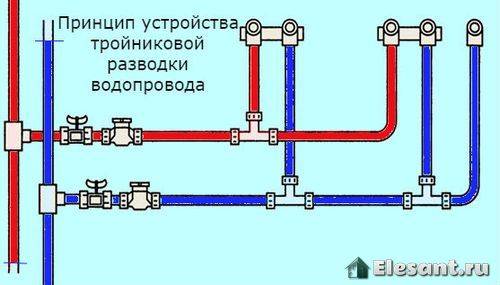
The tee wiring of the water supply in the house is otherwise called serial wiring. It can be described as follows.
From the shut-off valves of the internal water supply, two pipes are pulled through the house, hot water and cold water. I note right away that in horizontal sections, the hot pipe is laid above the cold one so that condensate does not form.
In places where plumbing fixtures are installed, branch pipes stretch from the main to their water sockets. The connection to the mains at the outlets is made using plumbing fittings called a tee. From this and the name of the wiring method "tee".
Selection of pipes for water supply
If, nevertheless, you decide to do the plumbing in your house with your own hands, after developing the scheme, you should choose the pipes suitable for the water supply system. First of all, it is necessary to accurately determine the number of pipes for the water supply. At the same time, in the process of calculating the diameter and length, it is necessary to take into account all the turns and slopes that will occur during the distribution of the water supply and the installation of various elements.





As for the diameter of the pipes for the water supply, the minimum diameter of the pipes that can be used to install the water supply system in a private house should be 32 mm.The minimum diameter of pipes for water supply of 32 mm is selected regardless of the material from which the pipes are made. In other words, whether it is polypropylene pipes or traditional steel pipes - in any case, the diameter of the pipe for plumbing in a private house should be at least 32 mm.
In addition to the diameter of the pipes and their length, pay attention to the method of connecting the pipes to each other. Remember that absolutely all connections between water pipes must be tight and reliable. If you plan to do the installation of water pipes with your own hands, ask yourself the question: will you be able to make a reliable connection of water pipes?
If you plan to do the installation of water pipes with your own hands, ask yourself the question: will you be able to make a reliable connection of water pipes?
So, for example, if you chose polypropylene pipes for installing a water supply system at home, you should understand that you will need a special soldering iron to connect them, the principle of which you yourself will have to understand. In addition, for soldering pipes of different diameters, in addition to the soldering iron itself, you will also need special nozzles of various diameters. A soldering iron for welding pipes of different diameters is shown in the photo:
Among other things, when choosing pipes for do-it-yourself plumbing, you must consider the following points:
- When choosing pipes for plumbing in a private house, be sure to check that they are designed for food water supply systems of a private house from a well or well. The diameter of the pipes for the water supply does not matter here - both larger and smaller pipes must be food grade.
There are cases when not entirely conscientious sellers sell pipes for technical purposes, passing them off as pipes for food water supply. Of course, the price of technical pipes is an order of magnitude lower than the price of food pipes, but savings in this situation are simply inappropriate.
- Since when connecting the water supply at home to a centralized water supply system or a pumping station of a well or well in the case of autonomous water supply, pipes will be laid in dug trenches, it is necessary to think about pipe insulation. To insulate water supply pipes during the installation of a water supply system, as a rule, special mineral wool is used.
- If, during the installation of a water supply system, its pipes will be laid above the ground without placing them in trenches, insulation will also be required. For ground-based wiring of the water supply system, in addition to mineral wool, other heaters can be used. If the laying of the water supply system is carried out in a region with very low temperatures in the winter season, in addition to insulation, it is recommended to use active heating of the house's water pipes in the form of a heating electric cable. The price of a heating cable is quite high, but its use will completely eliminate the possible freezing of the water pipes at home.
Common installation errors
The drafting of a plumbing system, both collector and tee, is best entrusted to professionals who are familiar with building codes and are able to perform hydraulic calculations. But even the best project will be useless if mistakes are made in its implementation.
Stopcocks are part of any water supply scheme: both sequential and manifold. They are installed at the entrance to the plumbing system, as well as in front of each plumbing fixture.
For example, some unfortunate craftsmen, driven by the thought of unreasonable savings, neglect the requirement to insulate hot water pipes that are laid under the floor or in the thickness of the walls. As a result, part of the thermal energy is transferred to the materials surrounding the pipe, which degrades the quality of the water. In addition, condensation from the surface of pipes without thermal insulation can damage the finish of the room.
During installation work, experienced craftsmen recommend closing the ends of pipes that have not yet been installed so that debris does not get into them. The absence of this protective measure can lead to the fact that immediately after installation, the water supply system will have to be thoroughly and for a long time flushed or even repaired.
When soldering polypropylene water pipes, remember that small dirt or moisture at the soldering point can significantly impair the quality of work.
If soldering of plastic pipes is necessary, all work should be carried out in a clean room to avoid contamination. It is also unacceptable to solder pipes on which even a small amount of moisture is present. A drop of water or debris at the soldering point can significantly weaken the connection and degrade its quality.
It is not necessary to design the plumbing system in such a way that all pipes pass through the ceiling through one common hole. This may degrade the performance of the plumbing. Professional designers never make such mistakes.
When drawing up a wiring plan, it is necessary to ensure that the pipes do not block access to the joints. This will greatly facilitate the repair in the event of a leak.
An insufficient number of locking devices can also cause a lot of trouble during installation work. Such fittings must be present in front of each device to which water is supplied, as well as for each riser. If the house has not one, but several bathrooms, you can install a shut-off valve for each of them.
Simultaneously with the plumbing system, sewerage is usually designed. It must be ensured that pipes and risers of individual systems do not overlap each other. In the future, this will facilitate maintenance and repair work.
Laying methods - hidden and open system
Pipes in the water supply system can be laid in a closed and open way. The choice of one of the methods does not affect either the quality of the connections or the functionality of the entire system and depends only on personal preferences.
It would seem that it is not difficult to decide and the closed method is preferable as more aesthetic and allows you to save up to 10 cm of usable space. Why is an open pipeline still used in the installation of a water supply system? Let's try to give an answer.



Hidden wiring allows you to hide pipes and not spoil the aesthetic perception of the interior of a house or apartment. The hidden method is used when assembling a water pipe from PP pipes. They hide the contour behind a decorative wall, for example, made of drywall, or ditch the walls and lead the pipes into the formed niches, sealing them with facing material or plaster along the grid.
The pipeline should not be tightly adjacent to the surfaces - always leave a small gap for possible repairs. When installing a pipeline in a monolith, it is recommended to place them in a casing, inserting a pipe into a pipe.
The disadvantage of the method manifests itself when it becomes necessary to repair or replace the hidden elements of the system - the plaster or tiling has to be opened and then re-decorated.
In addition, in the event of damage and leaks, the problem may not be detected immediately and lead first to the loss of operational technical characteristics of structures, then to flooding of the premises.
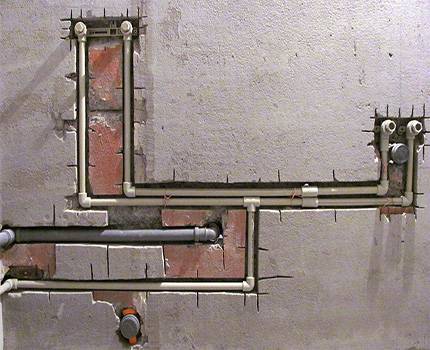
It is better to proceed with the installation of the water supply system with a pre-drawn scheme - otherwise, errors in calculations or assembly will lead to the fact that you will have to ditch new grooves and re-mount the pipes
To avoid such difficulties, when installing the wiring, only whole sections of the pipe are hidden, placing the docking fittings in open areas. In places of installation of shutoff valves, invisible doors are made. This gives access for maintenance to pipe connections, which are the weakest links in the system.
It should also be noted that pipes made of not all materials can be hidden under a layer of plaster - only products made of polypropylene, metal-plastic or copper are suitable for this.
Pipe laying in an open way is carried out after finishing is completed. The method involves the uncovered laying of pipes and water supply elements. It looks ugly, reduces the usable area of the room, but at the same time this method is very convenient for maintenance, repair and dismantling of elements.
Redevelopment and rearrangement of plumbing in the house with such a plumbing device will also not cause difficulties.
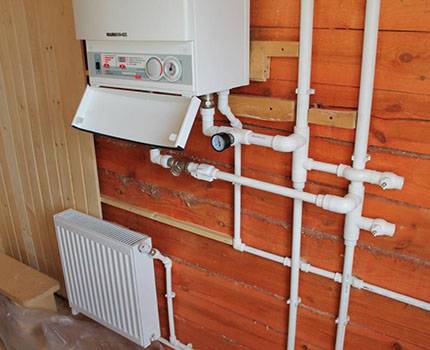
Open wiring makes it possible to quickly detect a leak and eliminate the cause of breakage or damage to system elements
Collector type of pipe wiring - features and nuances
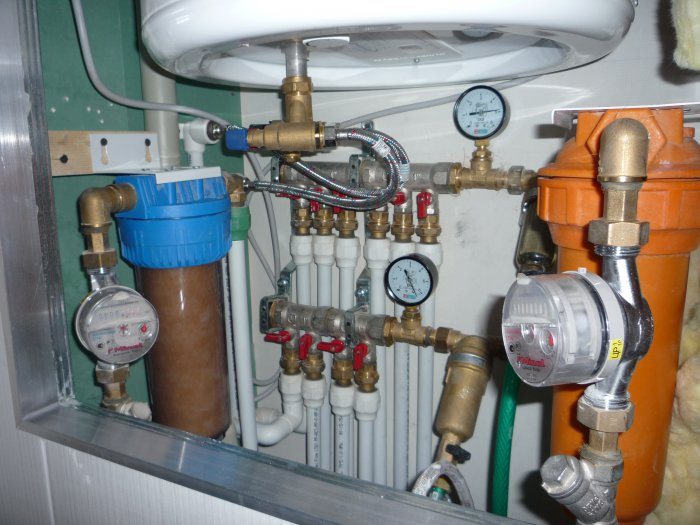
The collector type of piping in heating and water supply systems is more promising than the classic version on tees. After all, the main benefit of the collector circuit - the ability to accurately adjust the pressure of the transported liquid - is obvious to both pipeline specialists and homeowners.
However, the beam circuit (aka collector wiring) also has a downside: it is very complex and its implementation will require a lot more pipes and fittings.
Well, we are only ready to push the process of making a final decision by describing to our readers the structure of collector circuits and the installation scheme of such systems.
Laying methods
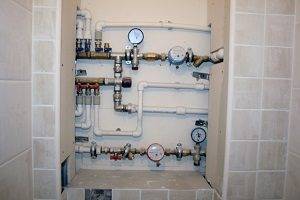
With a closed water distribution method, all the main elements must be accessible.
You can carry out this procedure in several ways:
- closed;
- open.
It should be noted that the closed method is distinguished not only by increased labor intensity, but also makes it possible to save space in the room. This is very true when it comes to small bathrooms.
But it is worth remembering that if this method is chosen, then the laying of detachable connections should be carried out exclusively in the open.
At the same time, we can immediately note the main disadvantages of the closed method:
- the inability to carry out a preventive inspection of pipes to inspect out of the state;
- the need to break the walls, so that in the event of a leak, to carry out repairs and, as a result, the need for further repair.
As for the open method, its only drawback is the reduction of free space in the room, as well as changes in its appearance.
And here are the benefits:
- low labor intensity of installation, which has a positive effect on the speed of its implementation;
- the ability to see the leak in time and fix it;
- ease of repair in any area;
- opportunity to improve the system in use.