- 6 Do-it-yourself new plumbing system - installation instructions
- Collector scheme - ideal for a large house
- Which wiring method to choose: open or closed
- Types of pipes for water supply
- Bathroom installation
- Bathroom grounding
- Reasons for installing new pipes
- driving
- leaks
- Unaesthetic appearance
- plumbing tips
- Beam or collector method
- Types and methods of water supply of a private house
- How to design a plumbing scheme
- Conclusions and useful video on the topic
6 Do-it-yourself new plumbing system - installation instructions
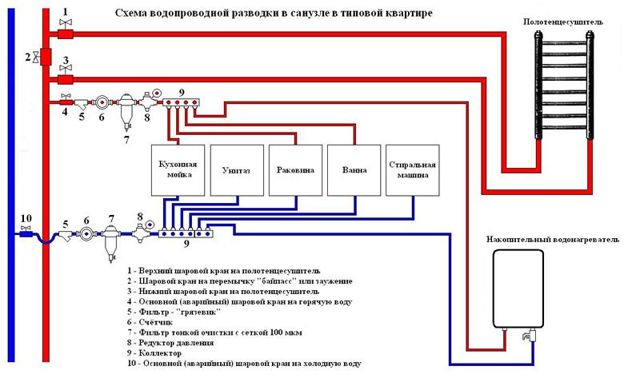
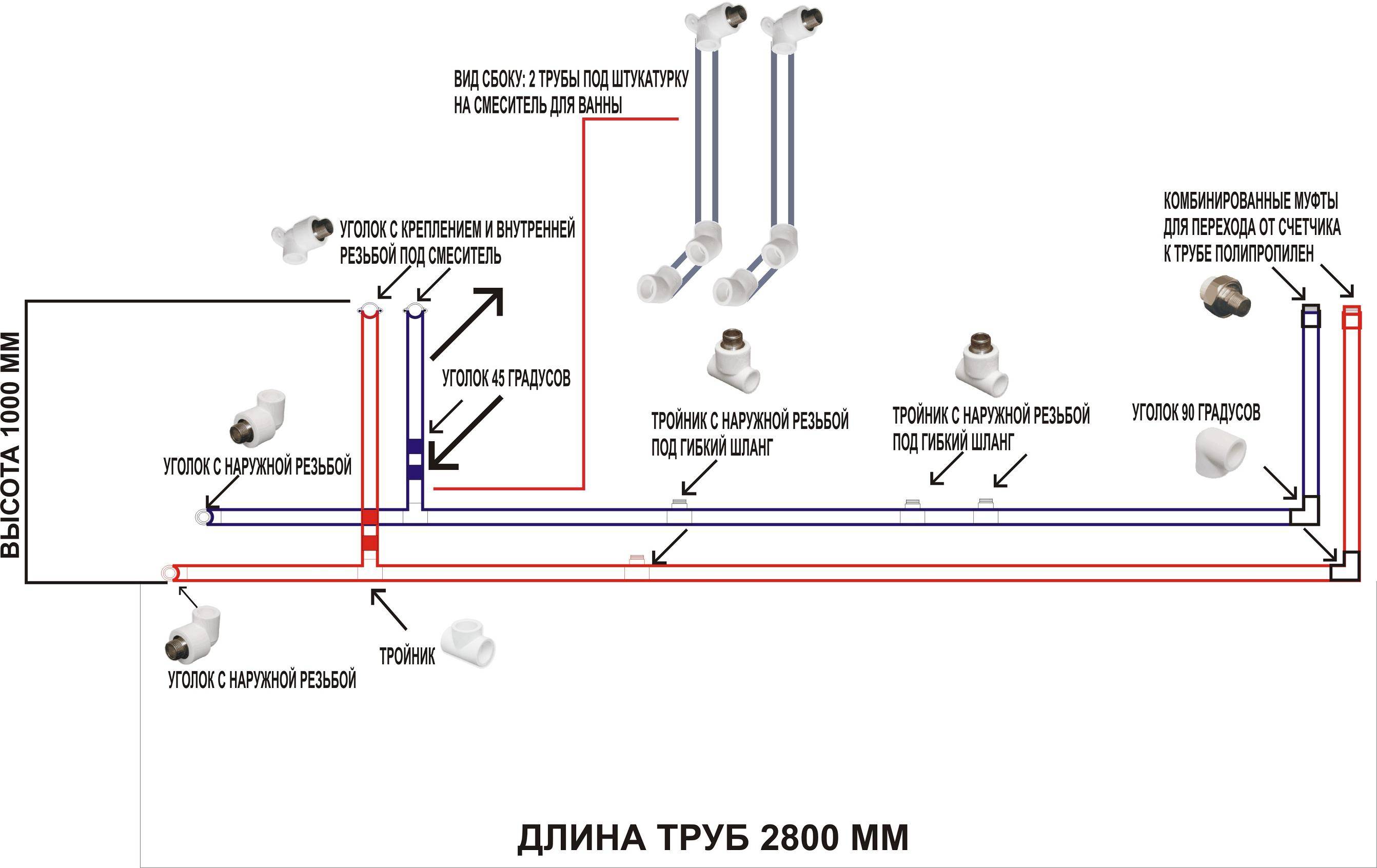
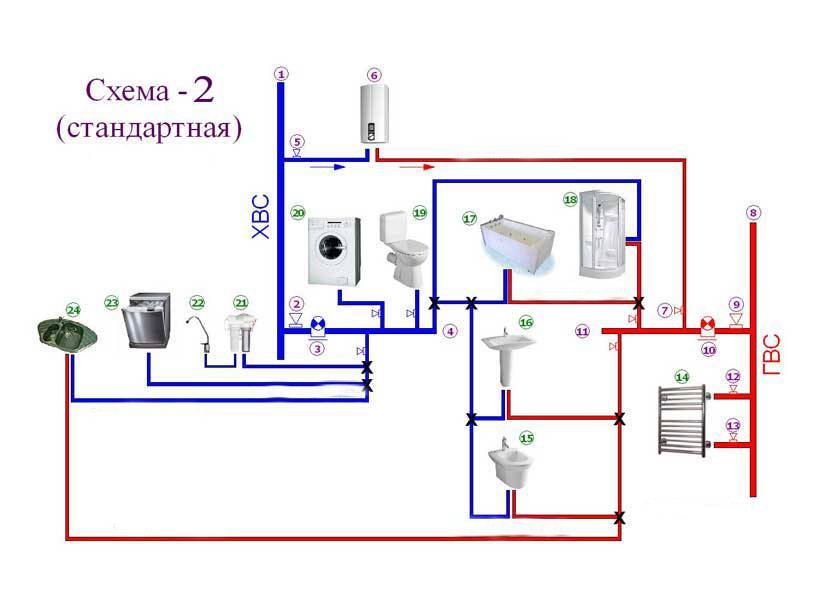
Before installation, the design of the piping should be carried out. The project can be conditionally divided into three stages: drawing up a wiring diagram, determining connection points, calculating the amount of materials needed. Immediately you need to decide on the method of laying pipes: open or closed.
The diagram should indicate:
- how the pipes will be laid, indicating the turns, diameter and length of the pipes;
- entry points;
- places for connecting devices and assemblies;
- the dimensions of the premises and appliances to which water will be supplied;
- number, size and type of fittings to be installed, etc.
Metal-plastic pipe connections
Connection points are places where water supply is needed: a faucet in the kitchen, a faucet and a shower in the bathroom, a toilet bowl.If there is a washing machine and dishwasher, they should also be connected to the water supply. According to the scheme, you need to accurately calculate the amount of materials needed. The dismantling of the old system should be carried out after drawing up the scheme and purchasing all the necessary materials. Next, we proceed to the installation of the plumbing.
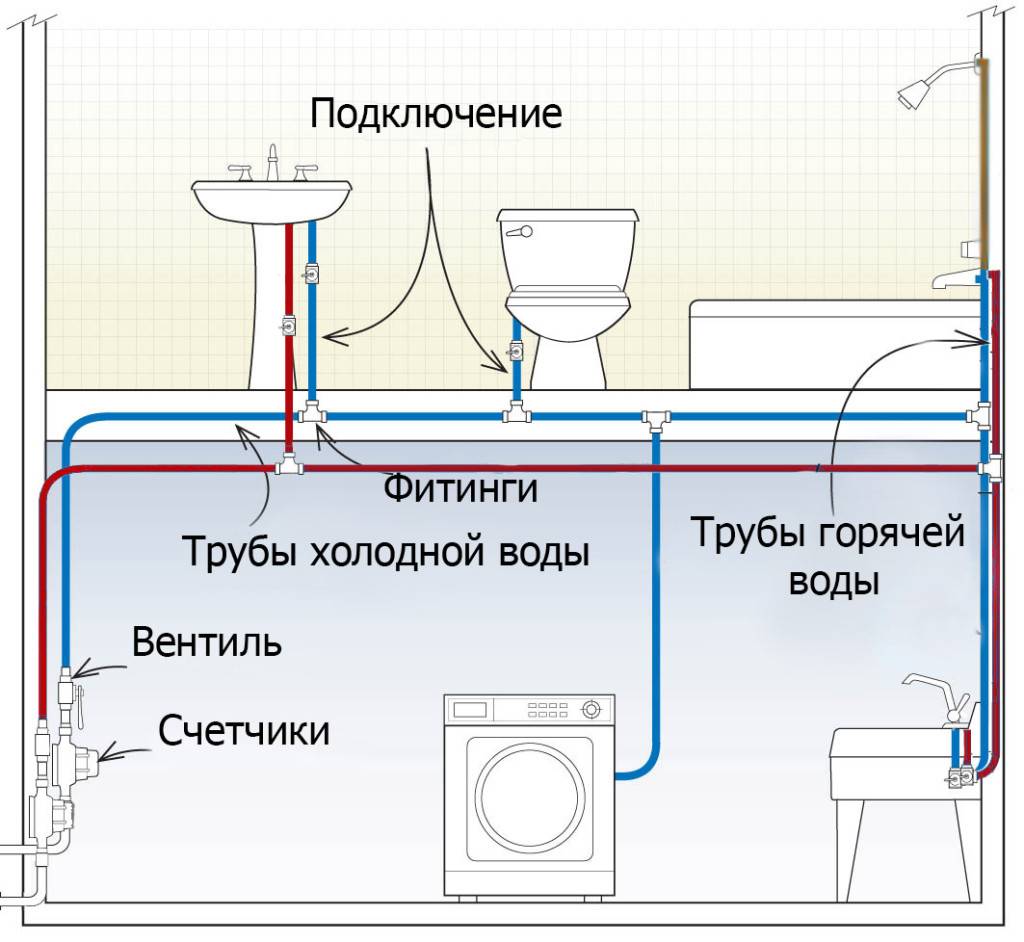
- 1. Before starting work, we turn off the water, dismantle the old riser and install a stopcock on it. We open the water supply through the riser to the neighbors and begin the installation of the water pipe inside the apartment.
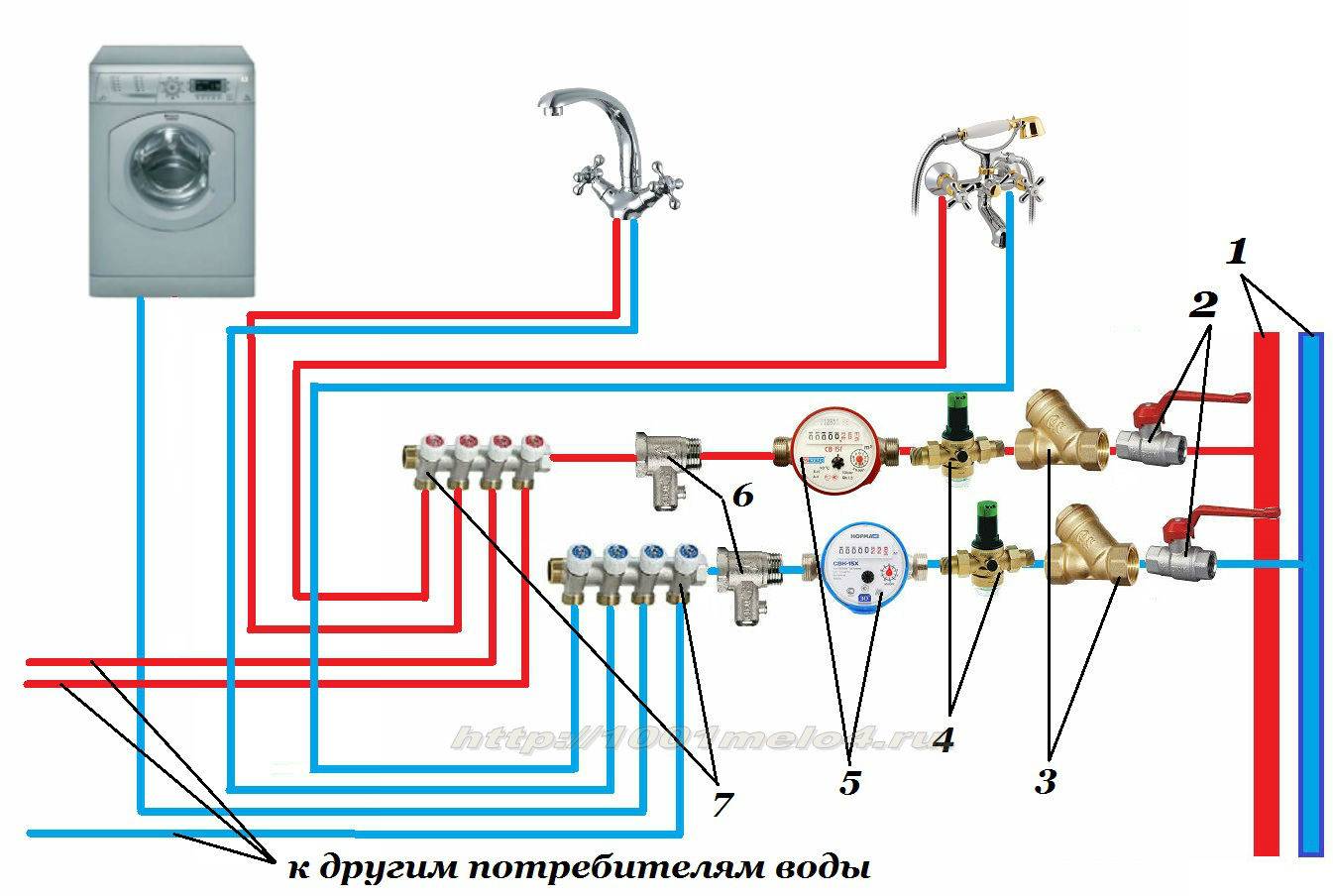
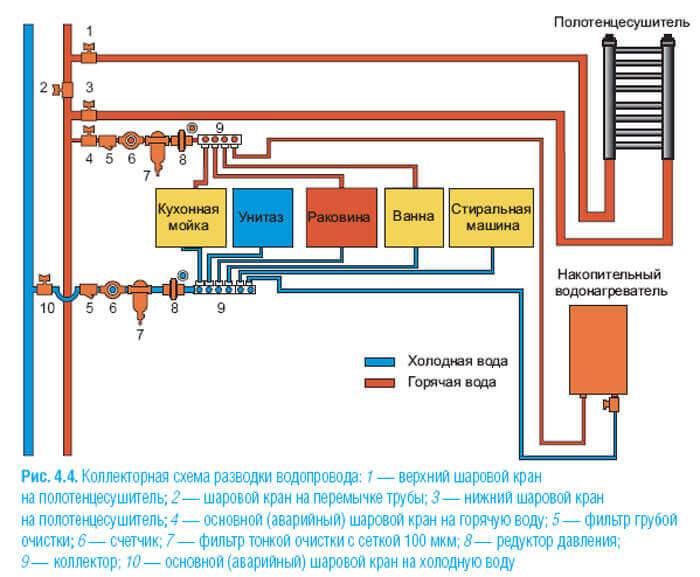
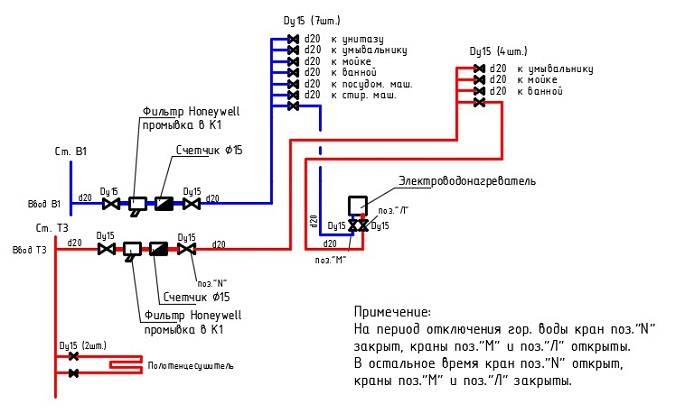
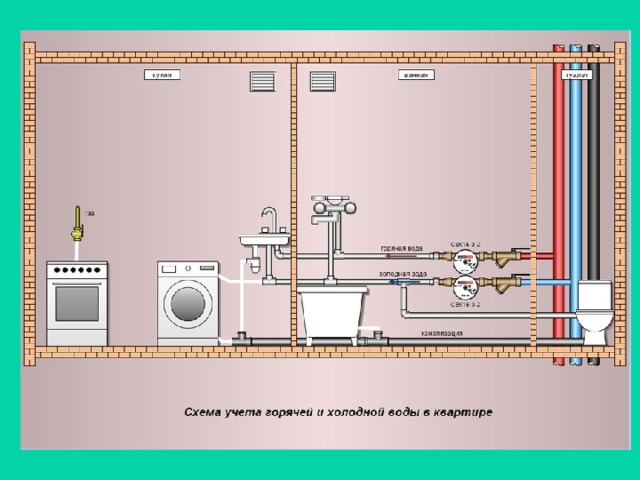
- 2. To improve the quality of water coming from the central water supply, we install a coarse filter at the beginning of the system. After the filter there are water meters. For each type of water - a separate meter.
- 3. If necessary, install a fine filter after the counter. We equip the main line with a water reducer if the pressure in the line exceeds the norm. The reducer must be equipped with a pressure gauge, according to which the value in atmospheres is set.
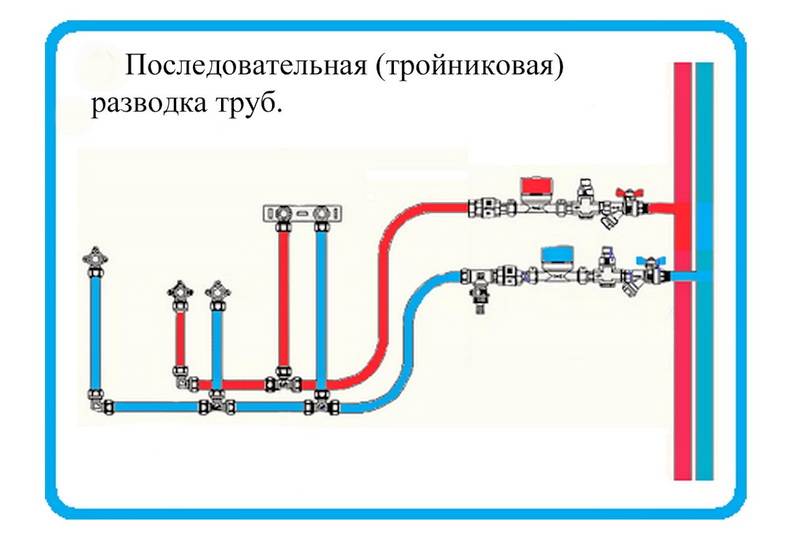
- 4. Then we install either a manifold with the required number of outlets, or a tee if a serial wiring diagram is used.
- 5. Next, the pipes are laid out and the devices are connected according to the diagram.
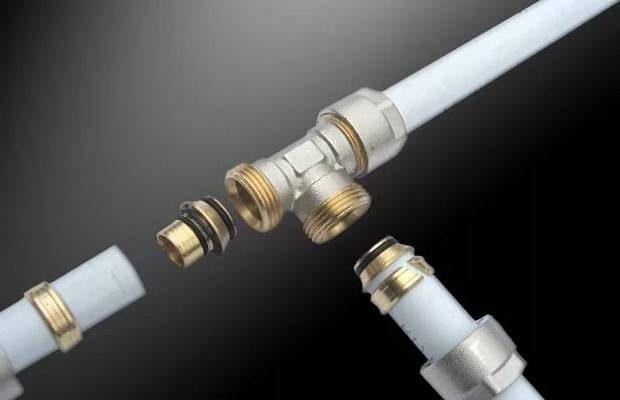
Connections of metal-plastic pipes are carried out in two ways: press connections and pressure fittings. The second method cannot be used for hidden pipe laying. When using the method of compression fittings, first cut off the pipe of the desired size. We remove the chamfer from the pipe with a chamfer calibrator. We take a nut from the fitting kit and put it on the pipe, and then insert the ring, fitting and crimp it with open-end wrenches.This connection is of the open-end type, which means that leaks are possible, so once a year the connections must be checked for leaks and tightened if necessary.
We also start connecting with press fittings with the preparation of pipes of the desired size. Then we perform calibration. Next, we insert the pipe into the fitting and press it with a hand press. This connection is strong, withstanding sudden changes in temperature, but it is not separable. If polypropylene pipes are used for water supply, then pipes with a diameter of 25 mm and a wall thickness of 2.8 mm are taken for cold water, and pipes with reinforcement of the same diameter and a wall thickness of 3.2 mm are taken for hot water. Holding the special scissors at a right angle, we cut the pipes of the required length. At the ends of the pipes, we mark the depth of welding, depending on the depth of the fitting. Using a trimmer, we remove the middle layer of the pipe to a depth of 1–2 mm.
Turning on the welding machine, we start welding. We connect the pipes or fitting and the pipe, and then push them onto the nozzles of the welding machine. After seven seconds, we remove the pipes from the apparatus. Next, carefully connect the pipes without rotational movements. You need to act quickly and accurately. Keep the pipes connected until they cool. After installation, you need to check the quality of the connections, the operability of the system, the correct connection of devices and components. After checking the strength of pipes and connections with high pressure, water can be connected.
Collector scheme - ideal for a large house
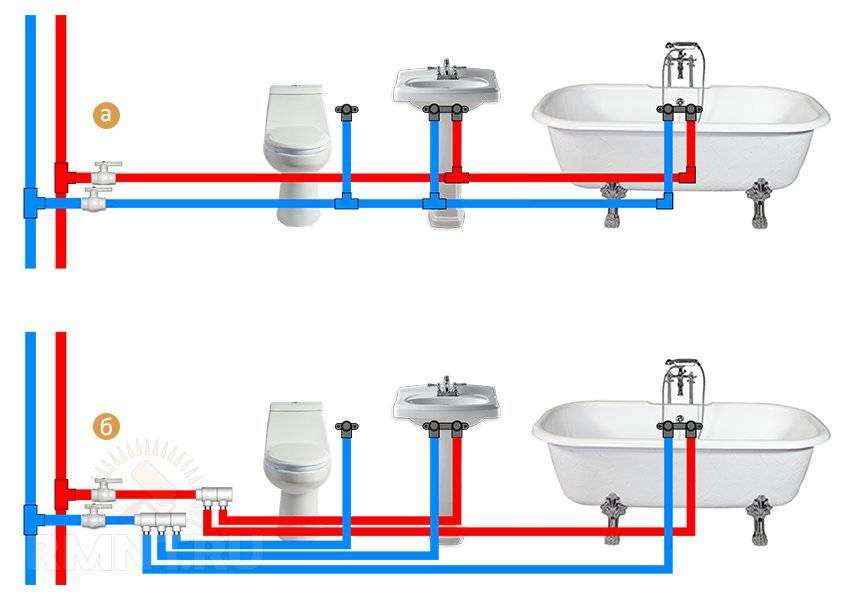
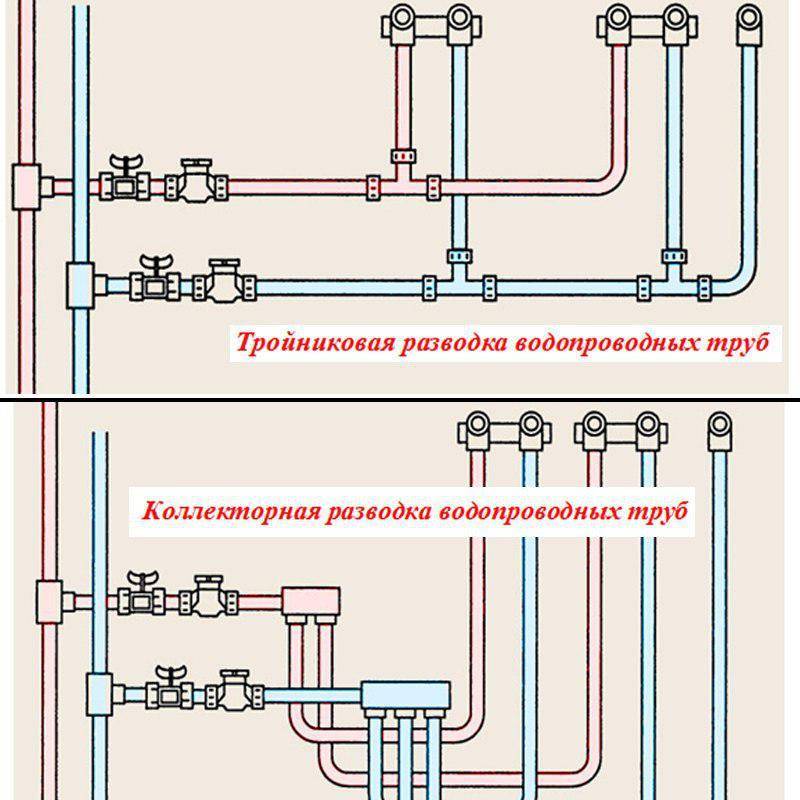
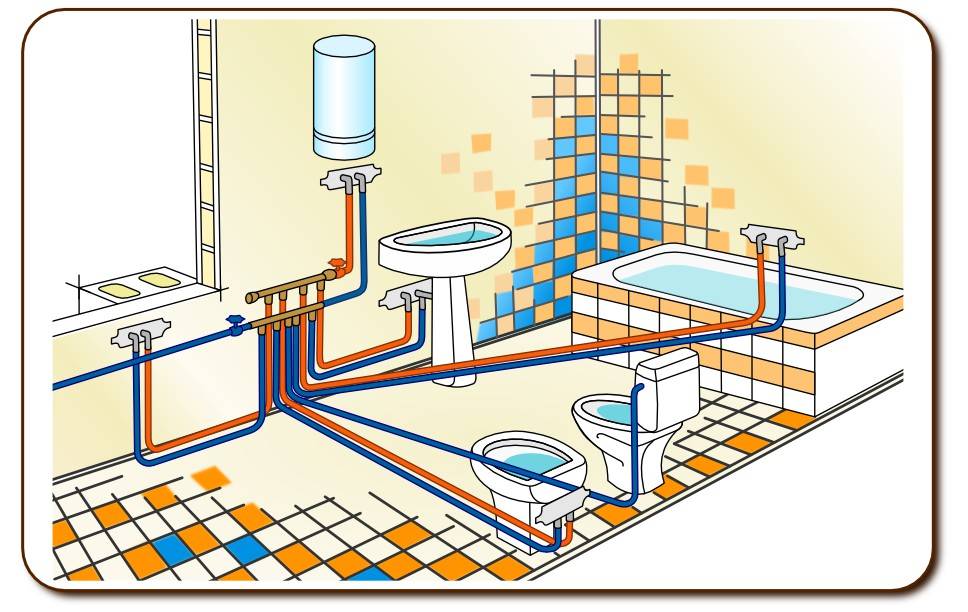
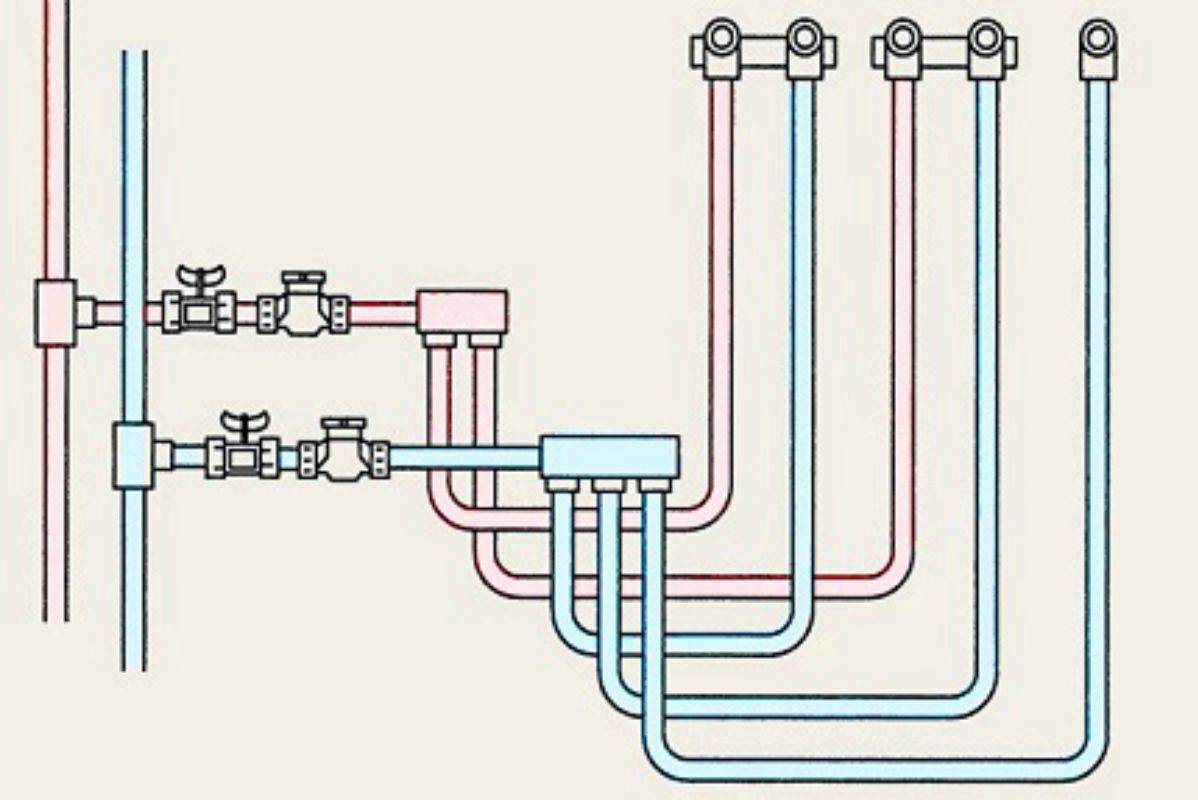
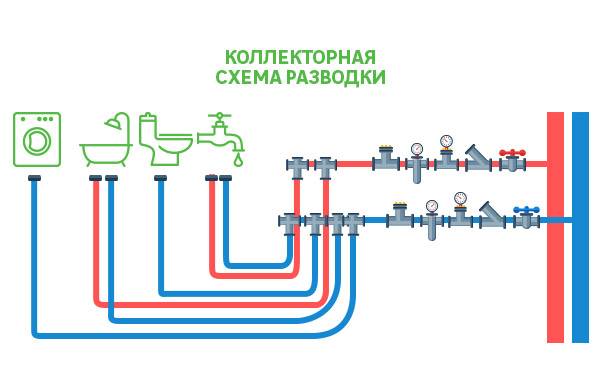
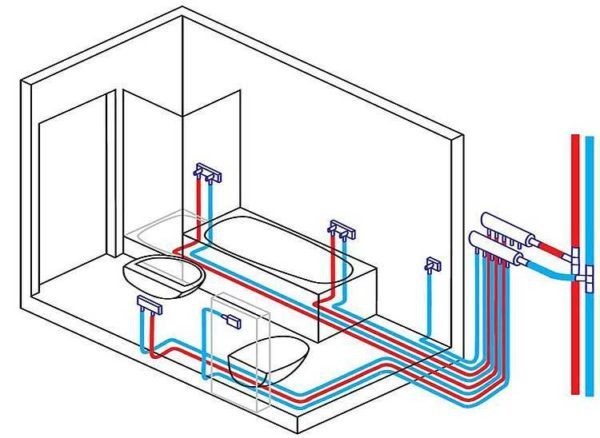
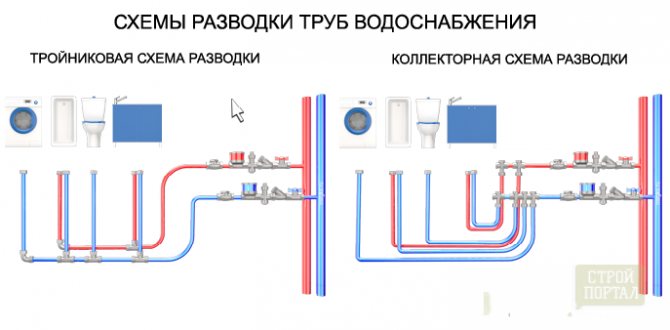
Collector distribution of water supply means bringing separate pipes to each point of water consumption. A sink in the kitchen, a toilet, a shower - each faucet in the house supplies water in the right amount, regardless of the others.Pipes are supplied from a collector installed at the inlet of the water supply to the house. It is a device with one input and several outputs. Their number is selected based on the number of points of water consumption. At the same time, it is necessary to take into account not only taps, but also washing and dishwashers, water on the street, etc.
Here it is clearly seen that all points of water consumption are independent of each other. It is very convenient for both operation and repair.
This is what the collector looks like under the sink. Agree, not very convenient for an ordinary apartment. It even looks like an airplane dashboard.
This scheme has many advantages. Firstly, without prejudice to the household, you can turn off the water in the shower, while leaving the possibility of using other bathrooms.
Secondly, all taps for controlling the water supply system are located in one place, they are easily accessible. As a rule, the collector is located in a sanitary cabinet or a separate room.
Thirdly, stable pressure in the system. Collector wiring protects against surges, thereby ensuring that you will not be splashed with boiling water in the shower if someone turns on the water in the kitchen.

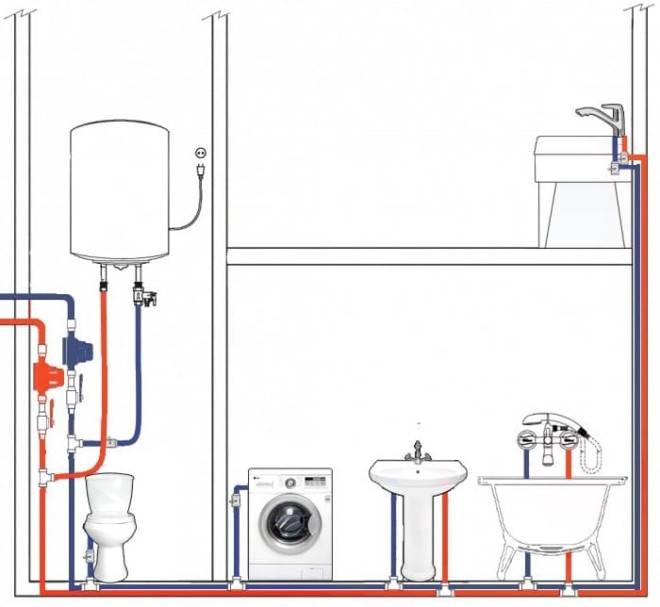


Fourthly, the minimum risk of breakdowns and ease of repair, because only one solid pipe runs from the tap to the manifold.
In a private house, when using a collector circuit, water pipes can be hidden even under a screed: the probability of breakage of solid pipes is negligible
Fifth, the water temperature at all points of water consumption is the same, even if all taps are opened at the same time.
Sixthly, the connection of new taps or water-powered equipment is carried out quickly, without prejudice to other consumers. To do this, you only need to install a collector with a margin of several conclusions.
Everything has its drawbacks, and the collector method is no exception. It requires a lot of building materials. Two pipes are not enough here. And this, in turn, leads to significant material costs. Yes, and the installation of water supply according to this scheme takes a lot of time.
In addition, a lot of space is needed to accommodate the collector and so many pipes. You can no longer hide the place where the water supply enters the apartment behind the locker, it does not look aesthetically pleasing.
Which wiring method to choose: open or closed
The key point in the transformation of the water supply system is a well-designed scheme. At the first stage, all plumbing products to which the pipeline will need to be connected are taken into account. The second question is how to lay pipes. There are only two of them.
The open method implies that the entire water main will remain outside. This method is easy to install, it is not necessary to ditch the walls. You can improve communications at any time without damaging the wall and floor finishes. In the event of a leak, it is easy to notice and eliminate in time. However, the aesthetic component of such installation leaves much to be desired, besides, the water supply will “eat” at least 10 cm of usable area.
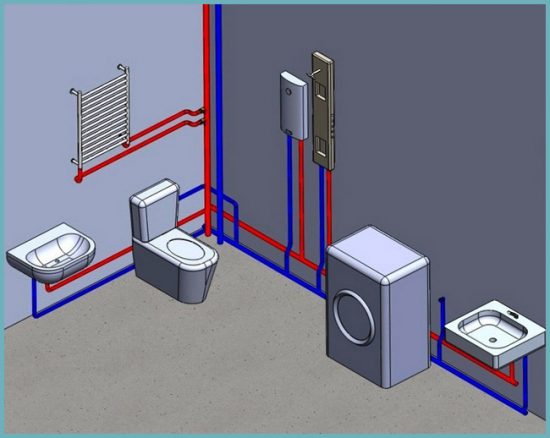
Open way of laying water pipes
The hidden method speaks for itself - the pipes will not be visible. This method is very laborious and has several disadvantages. There are restrictions on the material and method of pipe installation, since collapsible connections cannot be hidden.It is difficult to detect a leak, and repairs will require partial dismantling of the finish, and this is a separate cost item for cosmetic work. Over time, you can forget where the communications go and, if necessary, drill a wall for mounting a water heater or a mirror, you can damage the pipeline.
Important. Strobing of load-bearing walls is prohibited.
Types of pipes for water supply
The main types of pipes used in the organization of water supply:
- Copper pipes connected with special solders. The mains are resistant to corrosion, withstand heating up to 250 ° C. Pipes are flexible, which allows you to create pipelines of complex configuration. The disadvantage of the material is the formation of a galvanic couple in contact with aluminum or steel elements. When used in multi-storey buildings, high current conductivity should be taken into account; if equipment breaks down at neighbors, the pipeline becomes energized.
- Metal-plastic pipes, consisting of several layers of plastic with an aluminum gasket. Products are highly elastic; threaded bushings or crimp elements are used for connection. Products are not used for hidden laying, since the rubber seals in the joints lose their elasticity and allow water to pass through. The advantage is the absence of corrosion, the smooth inner surface prevents the formation of deposits.
- Products made of polybutylene withstanding heating up to 90°C. The elements are connected by soldering technology, the seam is characterized by increased strength. Due to the high cost, polybutylene products are not widely used; pipes are used in the arrangement of heated floors.
- Polyethylene reinforced pipes, designed for pressure up to 3.5 atm. In water supply networks, use is not recommended, since the material does not have high strength. Details are used for distributing water in personal plots or in domestic buildings, the material allows the liquid to freeze. When connected, a reducer is required to reduce the pressure of the water flow to a safe level.
- Lines made of polyvinyl chloride, which is characterized by high chemical resistance and allows operation at temperatures up to 80 ° C. The disadvantage of the material is the low resistance to ultraviolet radiation. Soldering or glue is used to connect pipe fragments, but the strength of the joint does not allow water to be supplied under pressure above 3.5 atm. Pipes are used for water supply of technological premises or in the organization of irrigation systems; a reducer is provided in the line to reduce pressure.
- Pipes made of polyisopropylene, which allows connecting elements by soldering. The material is low cost, allows pressure up to 12 atm. and temperatures up to 130°C. The surface of the pipes is rough, but there is no plaque in the inner part of the lines. Products are used in the organization of risers and in the distribution of water inside residential or office premises.
When selecting pipes, the cross section of the internal channel, on which the throughput depends, should be taken into account. To determine the parameter, it is necessary to find out the required pressure in the lines, the coefficient of pressure drop inside the pipe and at the joints is taken into account.Straight lines should be used when planning the laying pattern, but excessive elongation and cluttering of the branch with reinforcement will result in a pressure drop.


Bathroom installation
When making any type of repair in the bathroom, the plumbing layout in the bathroom is designed from the location of the bathroom itself, since it is the most massive item and occupies the most free space. The arrangement of plumbing in the bathroom also begins with this element, since in most small rooms, after installing the washbasin and toilet bowl, the bathroom bowl may simply not fit or damage other elements during installation.
Scheme of the installed bathroom
The installation process itself is extremely simple, but requires a certain sequence. Today, there are a huge number of models of bathtubs from different materials and with different dimensions, however, the plumbing connection scheme in the bathroom is the same for all products. The first step is to carefully bring the product into the room and install it at a distance of 50-60 cm from the wall in order to provide free access from all sides. If the bathroom has an overflow protection hole, then first of all we install it and lower the pipe to the lower drain siphon.
Before you do plumbing in the bathroom, make sure that the bathroom you bought is equipped with a drain siphon, all the necessary pipes and seals, as well as instructions for installing them.If this is not included in the kit, then it is recommended to purchase all the necessary items in the same store in order to properly connect the plumbing in the bathroom.
Siphon connection diagram
Next, install the lower siphon and connect it to the sewerage system, for this it is best to use a corrugated hose. Then, before placing plumbing in the bathroom, we check the tightness of the connection of the lower siphon, for this we close the drain hole and pour some water into the bathroom, about ¼ of its total volume. We put a dry rag under the siphon and wait 15-20 minutes. If the rag is dry, then open the hole and drain the water, simultaneously checking the entire drain line for leaks.
Today, almost all manufacturers of bathroom models, washbasins and toilet bowls, try to adhere to the established overall standards, so that the placement of plumbing in the bathroom can be conveniently calculated. Looking at the diagram below, you can draw up a preliminary layout of the total area, since almost all models of different plumbing elements rarely go beyond the dimensions indicated below.
Standard dimensions for advance planning
Bathroom grounding
Replacing plumbing in the bathroom necessarily involves laying a grounding system, especially if various electrical appliances are installed in the room. If the house has a potential equalization system, then new plumbing is connected to this system. If there is no such system, then before changing the plumbing in the bathroom, you must invite an electrician who will give advice or install a grounding system according to the diagram below.
Grounding scheme for plumbing elements
Reasons for installing new pipes
Replacing water pipes in an apartment requires owners to be responsible when deciding on its implementation. Replacement is made for various reasons, the main of which are worth considering in more detail.
driving
Outdated utilities usually consist of rusty steel pipelines, the walls of which are highly rough and prone to the accumulation of sand, scale, salt deposits and other impurities and contaminants. As a result, the pipes are clogged, plugs are formed that reduce the throughput of the water supply, or completely block the passage.
Temporarily, this problem is eliminated by cleaning the pipes with special devices, including a steel cable. But you can get rid of traffic jams forever only by completely replacing the plumbing system.
leaks
Such problems are most often detected in pipes that are made using suture technology. Water leakage in this case is eliminated by calling a plumber or welder. But this problem is also solved only temporarily, until a leak occurs in other places.
Unaesthetic appearance
Old plumbing systems made of steel pipes look unsightly. They have traces of rust, peeling paint, traces of welding. Replacing water supply pipes with modern pipes made of new materials (plastic, metal-plastic, polypropylene, etc.) will allow you to have a much better look and make the plumbing system quite attractive, not requiring any coatings or maintenance.
plumbing tips



The main difference between a specialist and an amateur who decides to install water distribution on his own is that a professional knows what to look for in order to avoid mistakes.But if you use the following recommendations, you will not have to risk:
- You can't skimp on materials. Plastic is cheaper, but it also has fewer options. Bearing capacity is minimal, temperature deformations are large. The material is not very durable. Iron rusts and rots. Metal-plastic does not have these disadvantages, but is more expensive.
- No need to skimp on insulation. Hot supply pipes recessed into the floor or wall must be insulated with heat-resistant material. If this is heating, it is good that the heat is given off to the ceiling. But if we are talking about hot water, then it will come out of the tap barely warm.
- During installation, the ends of the tubes are clogged with cellophane or rags. This is necessary so that solid particles (scale, chips, rust, etc.) do not get into the pipeline. The presence of a coarse filter will not alleviate the situation, as it is installed at the inlet. Consequences - incorrect operation of connected devices with subsequent failure.
Violation of the soldering technology of plastic pipelines leads to water leakage. Before soldering pipes, you need to remove all residues of not only dirt, but also moisture.
Using the wrong tool. Brass, alloys, plastic, which is used in the manufacture of fittings and other elements of valves, the material is durable. But if too much force is applied when twisting, the case may crack. In the case of metal-plastic, the system is assembled by hand, tested, and only then the threads are drawn.
Special gaskets must be used as seals
This is especially important if heating or hot water is being installed. Threaded connections are sealed with fum-tape
Silicone is used as an additional sealing agent. When it is required to lead the route into the next room, separate holes are drilled for each branch of the wiring. The same applies to cases when a hidden system is assembled. This is necessary so that each section is in the temperature regime in which it must be according to GOST. Otherwise, cold water will be heated, and hot will cool down.
Given all of the above, the assembly turns into a simple process. But if there is not enough time, the required tools, elementary construction skills, it makes sense to contact a specialized company.
Helpful2Useless
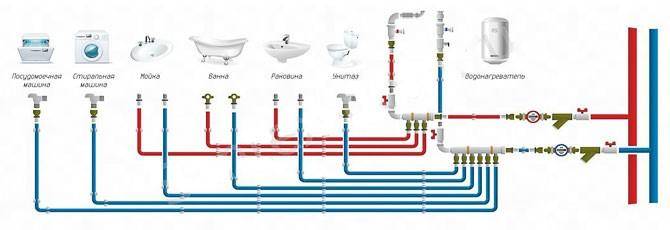
Beam or collector method
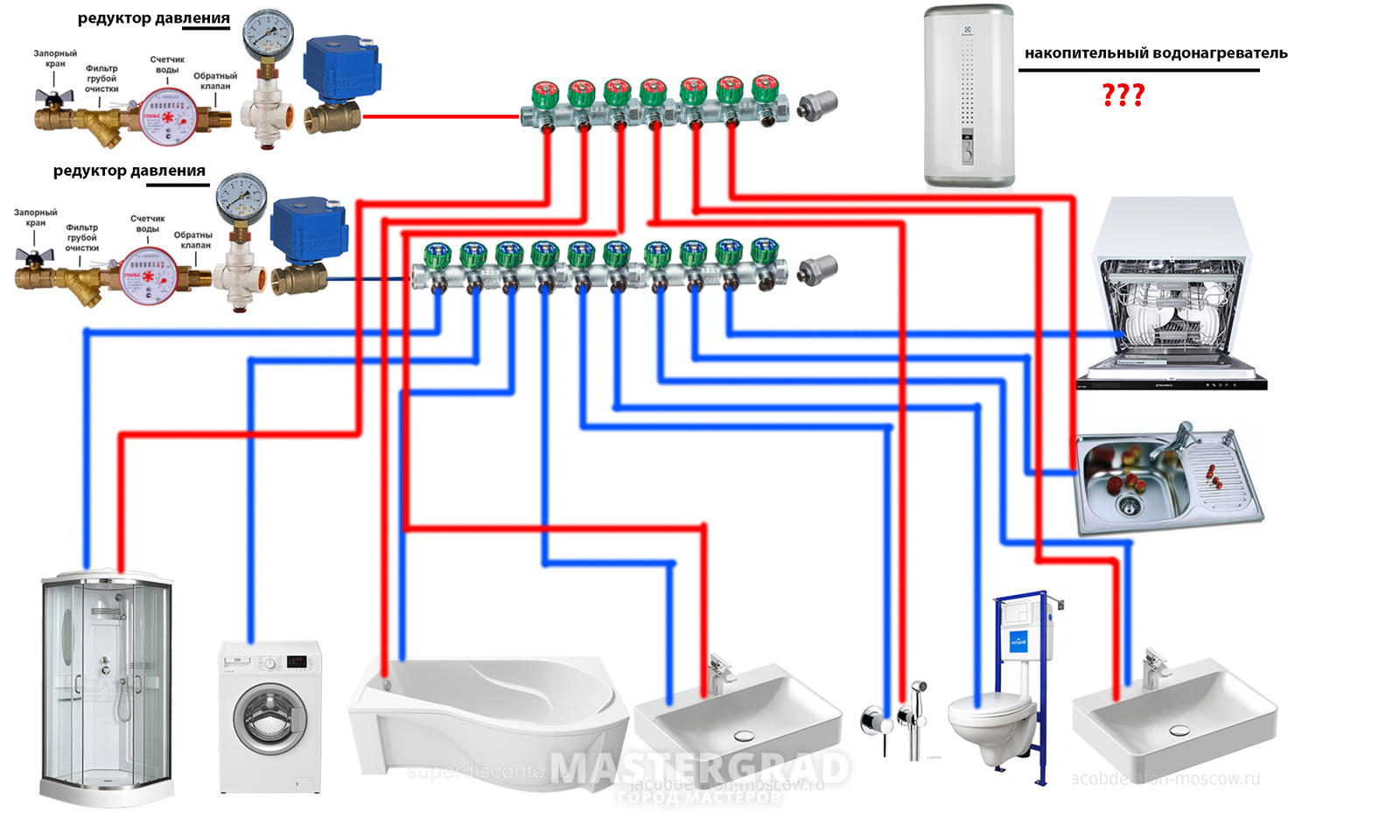
This water distribution scheme for a large apartment is the best option. It is also implemented where it is planned to install a large number of plumbing. A feature of this type of wiring is the presence of a collector.
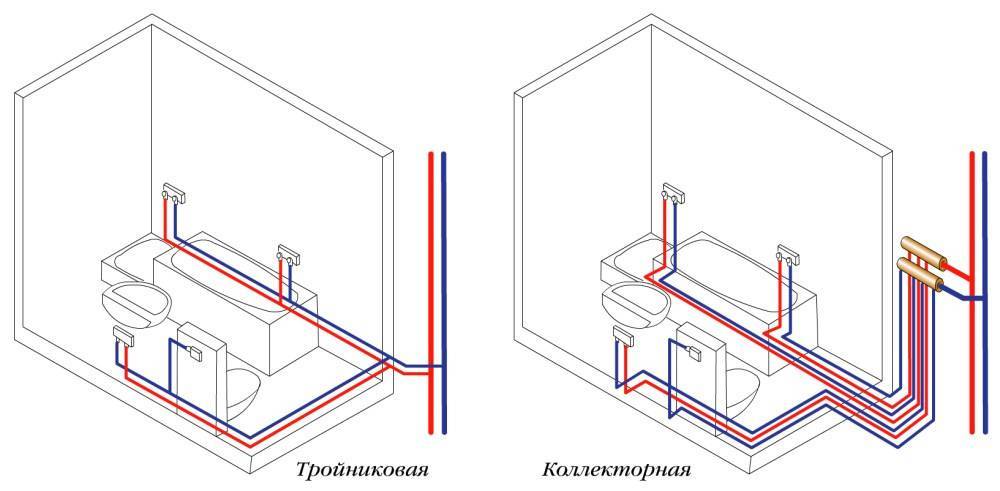
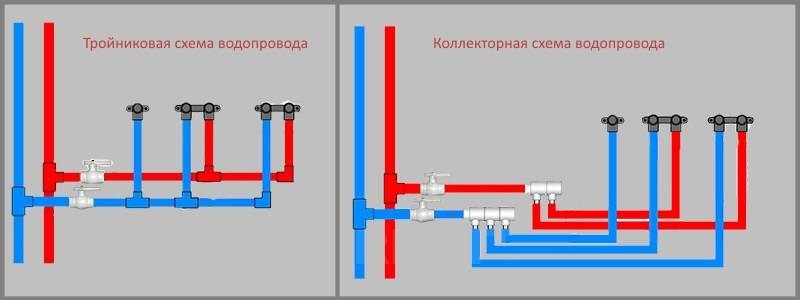
Water from the riser first enters it, and only then to consumers, which in this case are plumbing fixtures. Each of them is connected separately, and not sequentially as in a tee system.
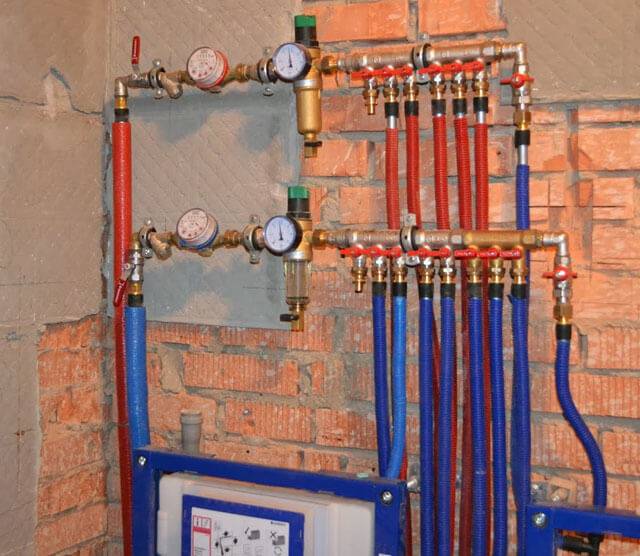
Another plus of the collector wiring of the water supply system is the ability to turn off only one device in the event of a breakdown, and not block the riser as in the sequential method. The same advantage allows you to install different devices between the water intake point and the collector - gearboxes, filters and others.
It is possible to influence the pressure in the system by increasing or decreasing the water flow.You can also purify water from unwanted impurities or saturate it with useful substances.
The disadvantages of the collector water supply system in the apartment include:
- A significant amount of expenses for its arrangement.
- A much larger number of water pipes are required compared to the implementation of the tee option.
- A more complex scheme and therefore an inexperienced performer of work may encounter serious problems already at the design stage.
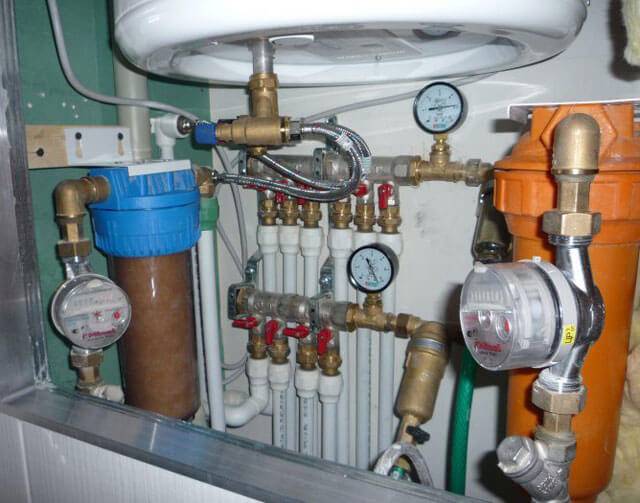
Before you run a water supply system in an apartment using the beam method, you first choose the location of the collector - it will distribute the flow of cold water from it. The same device will need to be mounted when hot water supply is organized through a centralized line. The collector for hot water supply is placed separately.
Pipes are laid between the common risers and collector nodes, on which shut-off valves for the water supply in the apartment should be installed. These elements allow, if necessary, to completely shut off the water supply. In accordance with the current situation, various additional elements are installed on a specific segment of the water supply system, such as a coarse filter, electric taps and others.
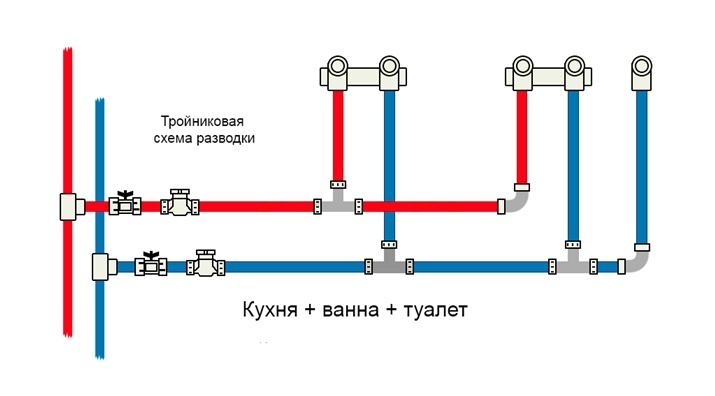
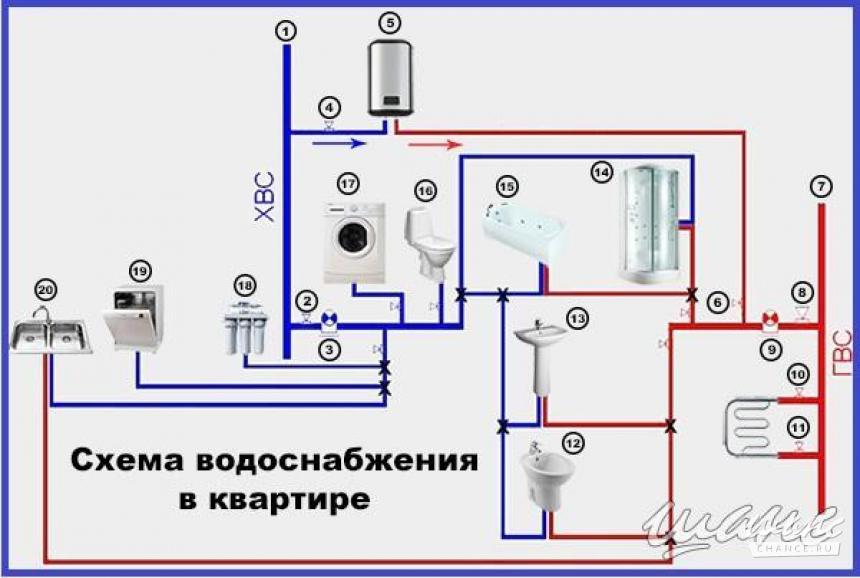
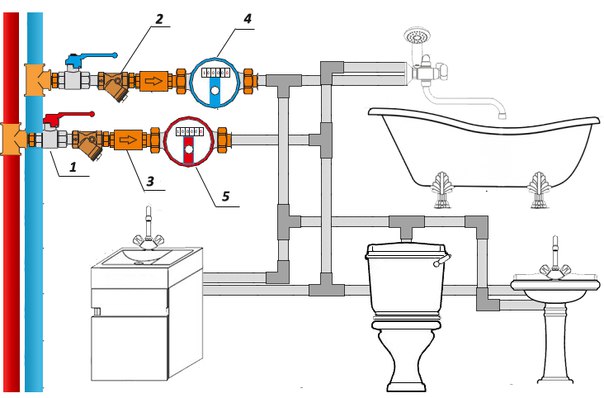

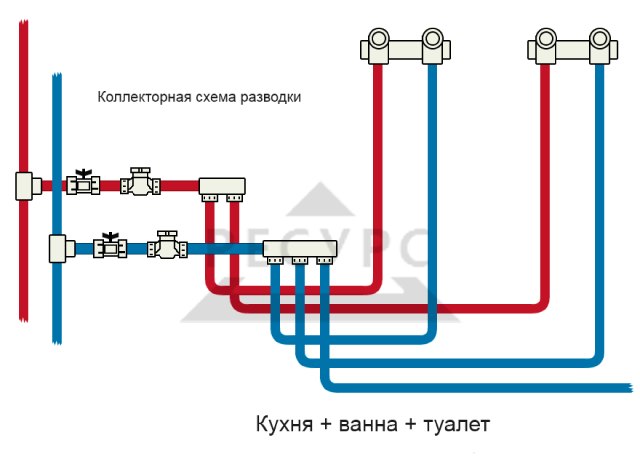

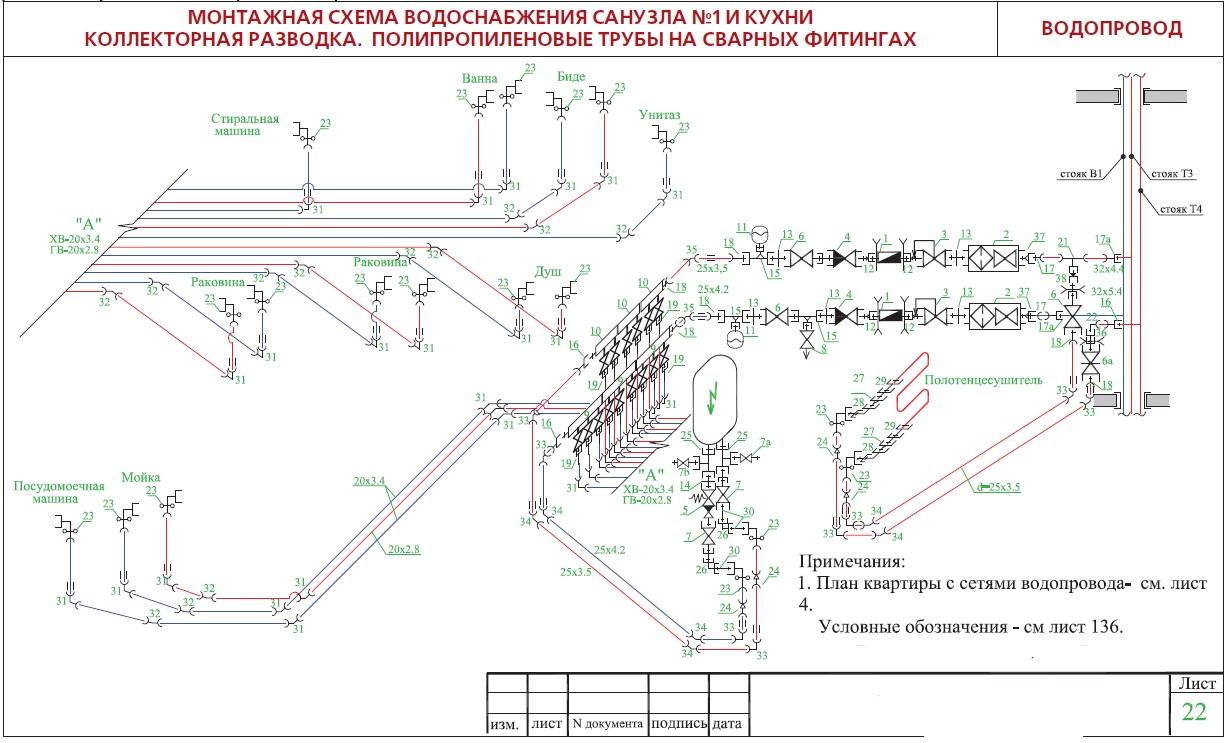
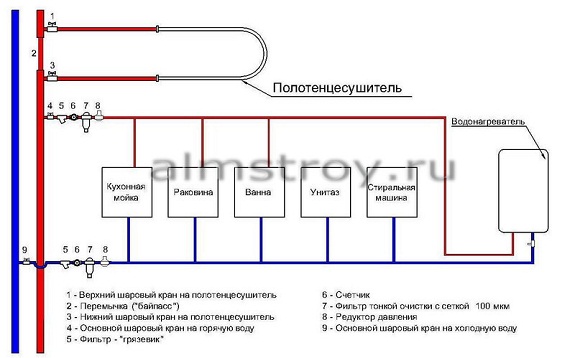
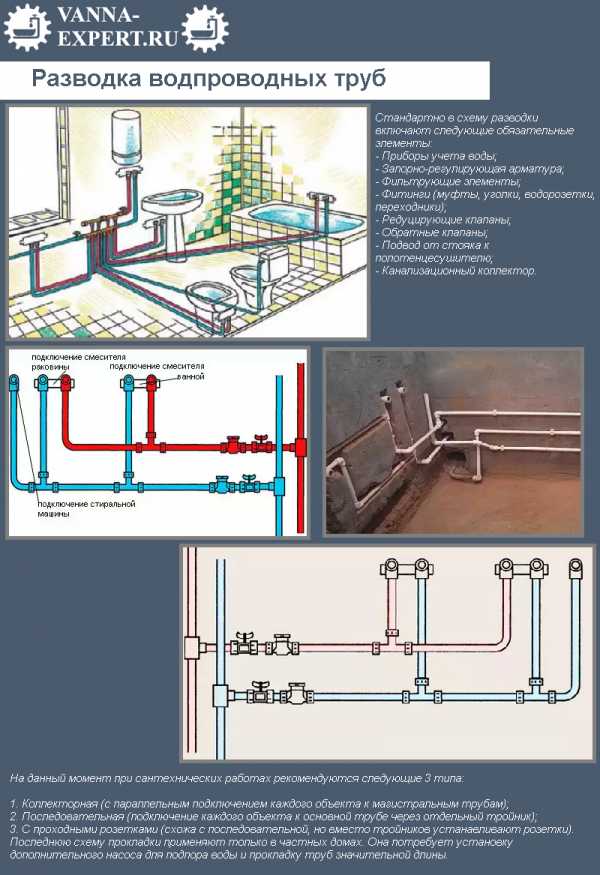
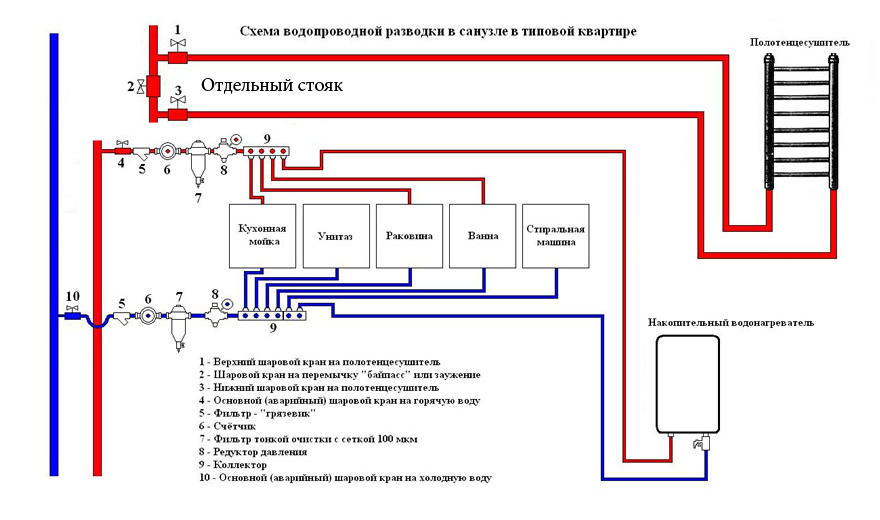
After the completion of the arrangement of the collectors, pipes are laid from them to each mounted plumbing fixture. Cold and hot water supply is supplied to the shower, bath, washbasins and sinks. Only cold water is supplied to the washing machine and the toilet bowl.
If there is a heated towel rail in the apartment, it should be connected to the DHW collector.The system is additionally, if necessary, equipped with filters, reducers and other devices that contribute to the trouble-free functioning of water pipes.
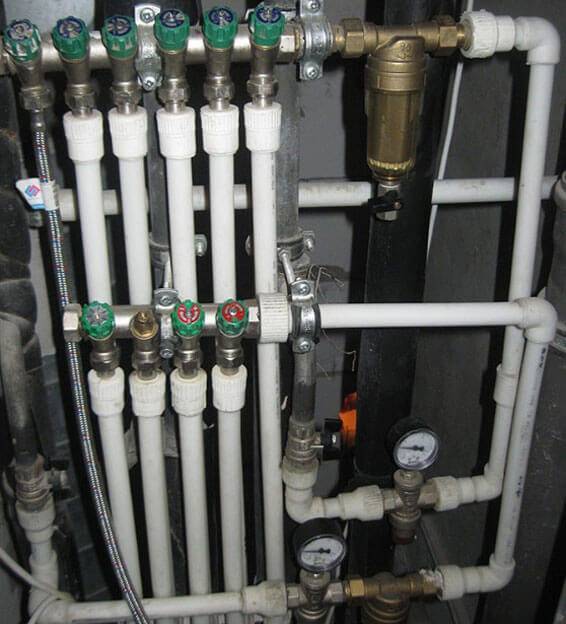
Shut-off valves are located between the collector and consumers, which allow shutting off the water in a separate specific area if there is a need for it.
In some cases, when installing water supply in an apartment, the best solution would be a combination manifold wiring diagram with tee. To do this, instead of one, several consumers are connected to one of the collector branches and connected in series with pipes.
But in the end, this part of the plumbing system will have the same drawbacks as the tee scheme. For example, in the event of an emergency, you have to completely turn off this part of the highway.
Types and methods of water supply of a private house
There are many options for water supply. The choice depends on the availability of central networks, the horizon of groundwater occurrence, the location of the nearest reservoirs and financial resources.
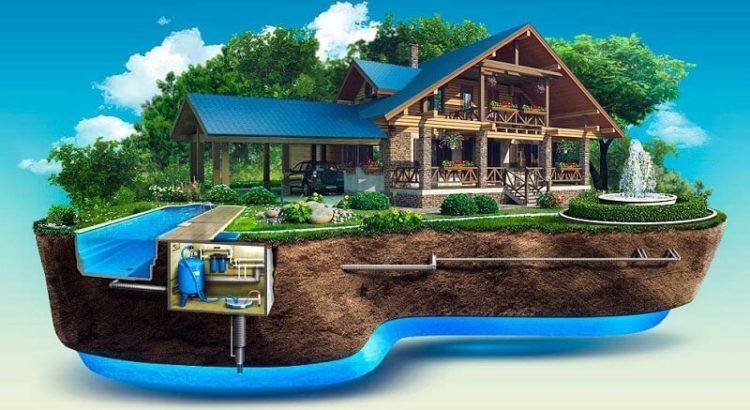
By type, the water supply of a private house is divided into: central and autonomous. With a central water supply, water comes from the street network through a discharge pipeline to a residential building. The water supply organization with which the contract is concluded is responsible for the quality, composition of water and its properties.
With autonomous water supply, the source can be:
- artesian well, up to 40 meters deep;
- surface well, up to 15 meters deep;
- well;
- surface water of the nearest body of water.
According to the method of water supply in the house, they are distinguished: gravity and pressure. With the gravity method, water enters under pressure placed in a tank located on a hill.If a pump is used to supply water, which creates pressure in the water supply, such water supply in the house is called pressure.
Important: The quality of the water will depend on the choice of source, installed filters and water treatment systems.
How to design a plumbing scheme
In order for everything to turn out right in the end, before installing the water supply system, it is necessary to carefully work out the scheme for laying it on the street and wiring in the cottage. If this project is done correctly, this will avoid many problems during installation work and subsequent operation of the assembled water supply system.
Private house water supply scheme
When developing such a water supply scheme, it is calculated:
- the number of water points in the house;
- the need and number of collectors;
- pump power and water heater capacity;
- pipe dimensions;
- valve characteristics.
Plus, the option of piping (collector or serial) and the location of all elements of the water supply system in a private house are selected. The same electrical wiring in an apartment or a ventilation system is easier to install at first glance. However, there are nuances here and there. And with the slightest mistake, in all cases there will be a lot of problems.




Conclusions and useful video on the topic
Assembly of a water supply system from metal-plastic pipes performed by a master plumber:
Practical video instructions for installing couplings for metal-plastic pipes, installing spurs and intermediate sections of the water supply:
Video tutorial on capillary soldering of copper pipes for a water main:
Rules for choosing polypropylene pipes for plumbing:
Building a workable plumbing system in an apartment is impossible without attention to detail at every stage - designing, performing a hydraulic calculation or assembling the selected wiring diagram. However, it is up to you to rely on standard solutions or build an effective water supply system for years to come.
Share with readers your personal experience in organizing the distribution of water supply pipes. Please leave comments on the article, ask your questions and participate in discussions of the material. The feedback box is below.