- How is the installation of plumbing in a private house
- Installation of water pipes
- Installation of an external sewer system
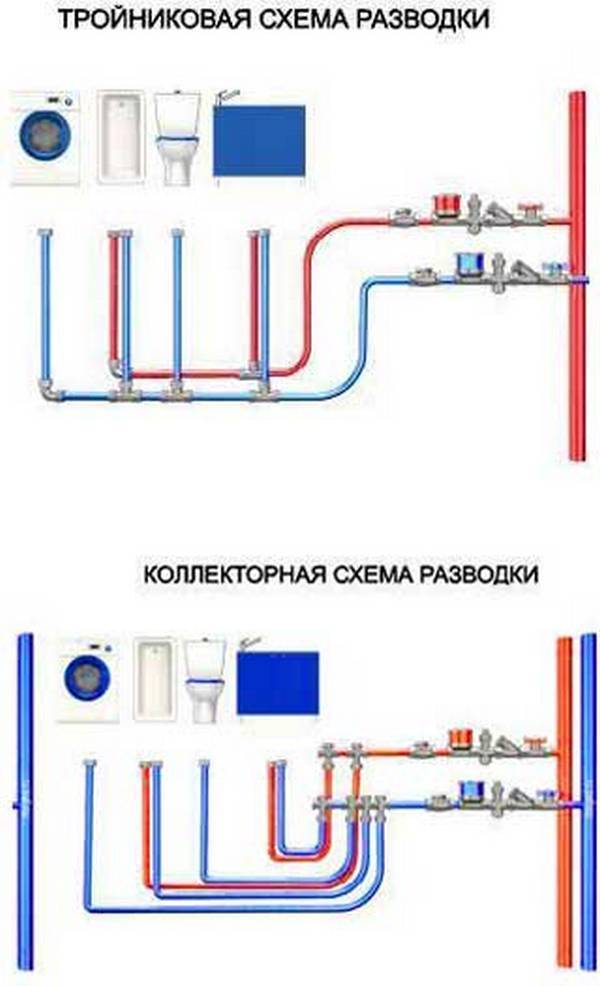
- Plumbing on collectors
- Mounting of gearboxes
- What gives a similar method of wiring?
- Choosing the location of the bathroom in a village house
- Choosing the best type of bathroom
- Determining the size of the bathroom
- Features of arranging a hygienic room in a wooden building
- Hidden communications wiring
- Laying methods
- Possible problems and solutions
How is the installation of plumbing in a private house
Installation of water pipes
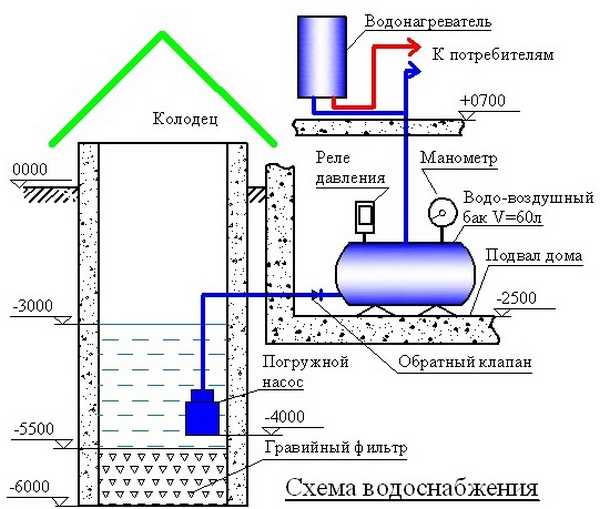
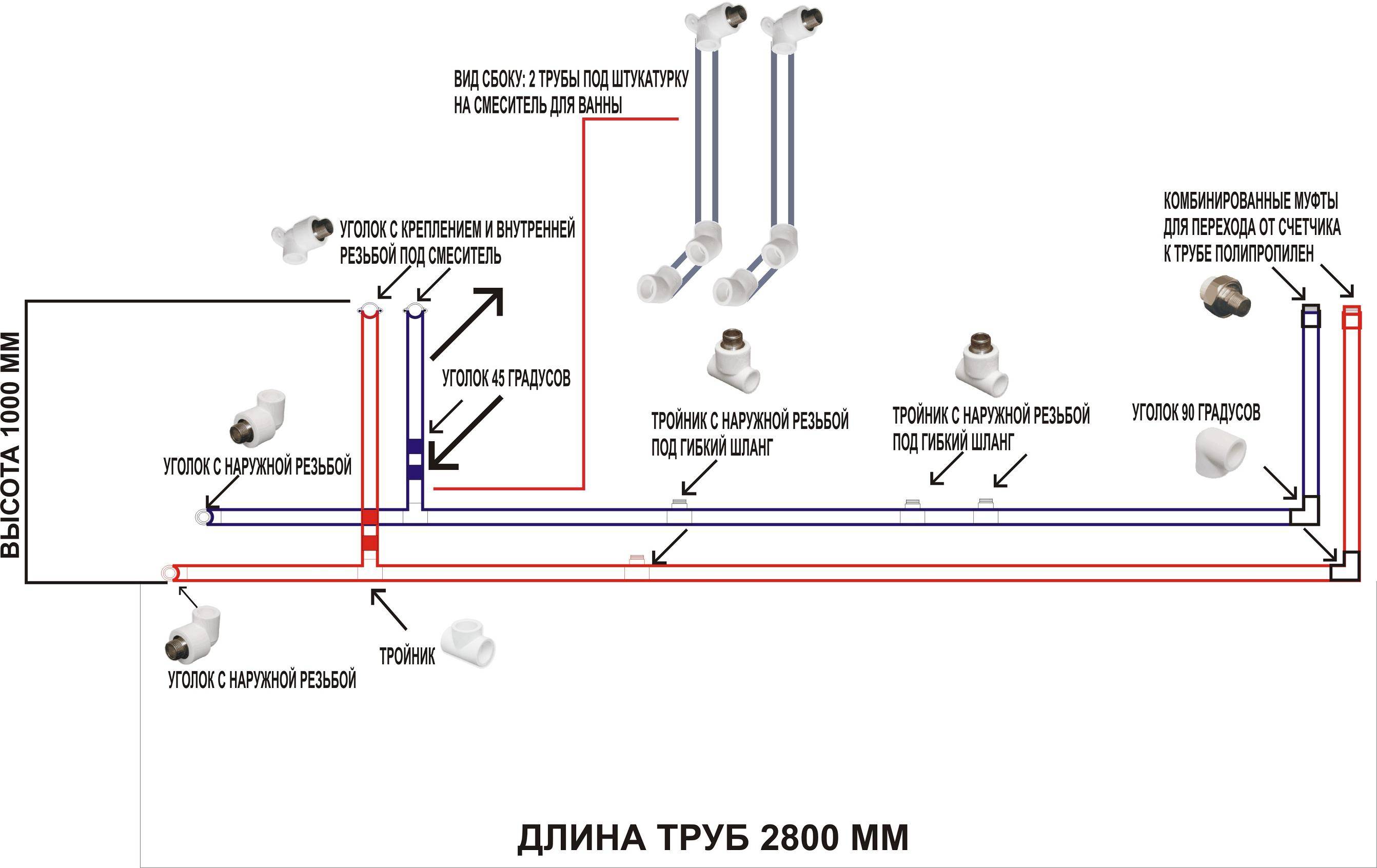
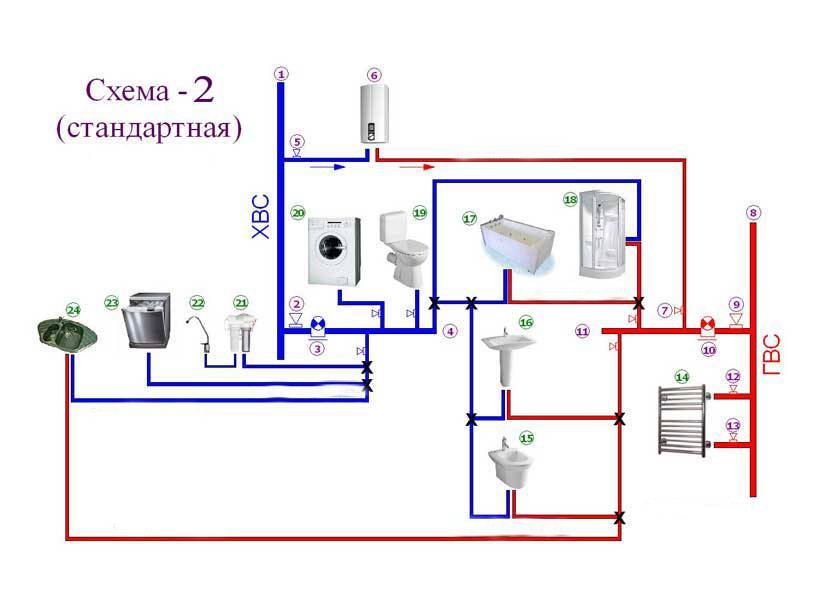
After drawing up the layout of the plumbing of a private house, you can proceed to the direct installation of engineering communications. Ready-made wiring diagrams should contain not only the exact coordinates of the placement of pipes, fittings, plumbing elements, but also their dimensional parameters. It should be taken into account that the incorrect selection of the diameter of pipelines reduces the efficiency of the functioning of engineering networks. To equip plumbing, the master must have the skills to read engineering drawings. Installation of plumbing in a private house is carried out after the completion of the construction of the box and the arrangement of the roof.
Installation rules plumbing of a private house:
-
the placement of the entry point of the pipe for supplying water to a private house is carried out at a distance of at least 1.5 m from the exit point of the sewer, gas main or heating system;
-
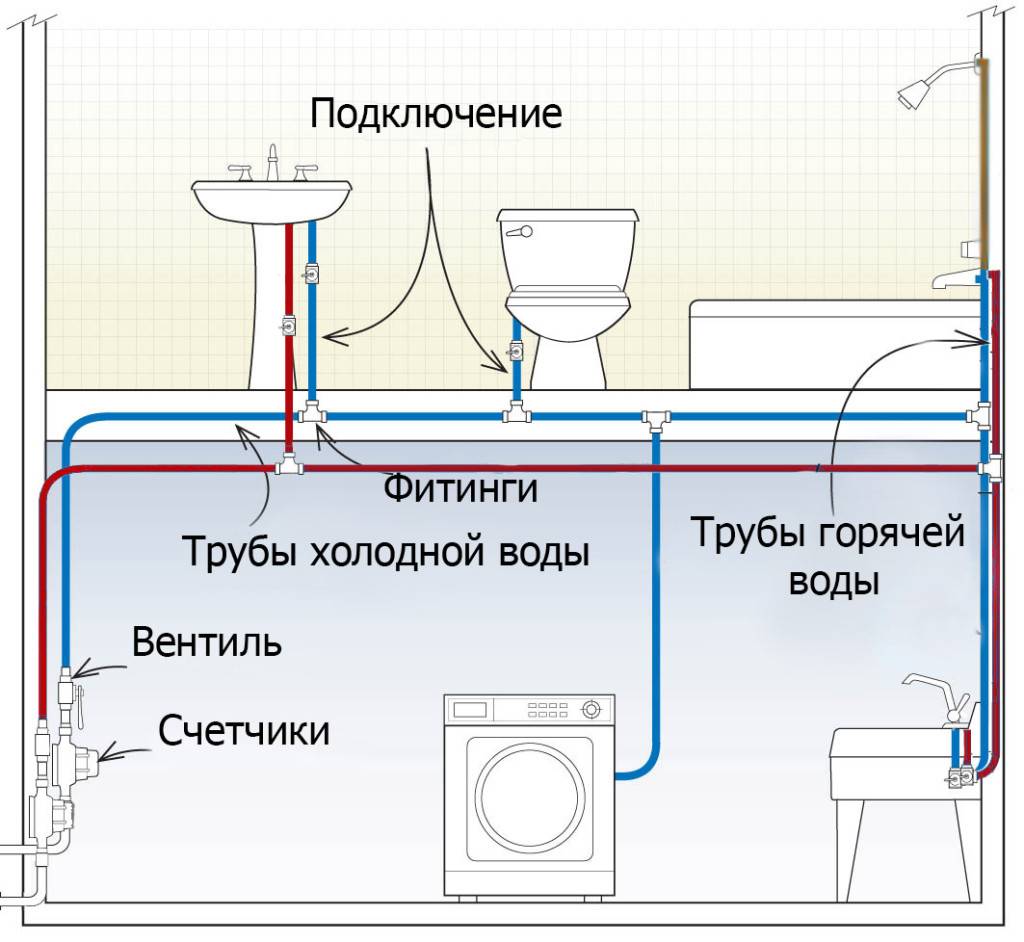
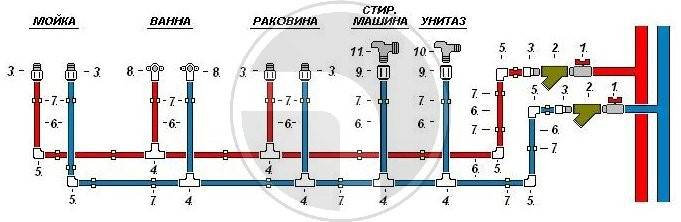
immediately behind the wall where the water entry point is located, you need to equip a water metering point. This node is best combined with a stroke that provides the possibility of supplying an increased volume of water (this may be necessary when extinguishing fires and in other cases);
-
departmental shut-off valves are located before the water metering unit, and after it an intra-house shut-off valve is installed;
-
the calculation of the diameter of water pipes is made taking into account the planned volumes of water consumption and the number of plumbing elements for water consumption;
-
the laying of the internal pipeline and sewerage of a private house is most often done in the basement;
-
for water pipes of a private house with a long length, it is necessary to provide for the installation of three circulation pumps, two of which are necessary to ensure the supply of water at minimum and peak water consumption, and the third serves as backup equipment;
-
internal slope angle private house plumbing depends on the diameter of the pipes and is indicated in the plumbing layout.
Read the material on the topic: How to choose pipes for water supply
Installation of an external sewer system
Rules for the arrangement of external elements of the water supply and sewerage of a private house:
-
laying pipes in the ground should be carried out at a depth exceeding the freezing point;
-
at the intersection of sewer pipes with water pipes, the latter are laid above the sewer pipes by at least 0.4 m.To protect cast iron and plastic pipes from mechanical deformation, special casings made of durable steel are installed at the intersections. The length of such a casing should exceed 10 m (in each direction) for sandy soils and 5 m for clay-based soils;
-
pipeline intersections must be designed at an angle of 90 degrees;
-
with parallel laying of water supply and sewerage, the distance between the outer walls of pipes with a diameter of up to 20 cm should be more than 1.5 m.
Installation of internal and external engineering communications of a private house is a complex process, the success of which largely depends on a professionally drawn up plumbing scheme. For the normal and safe functioning of the water supply or sewage system, it is necessary to strictly comply with the requirements of SNiP.
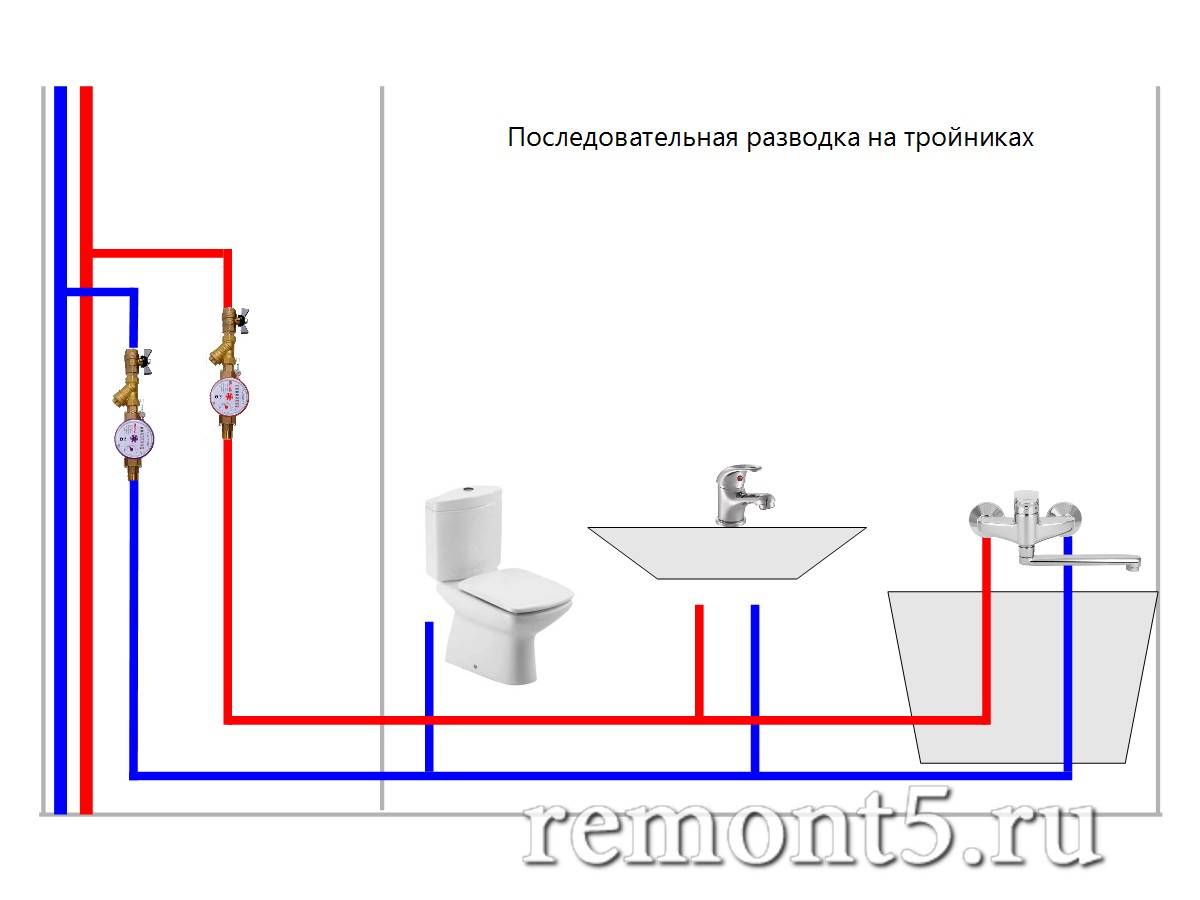
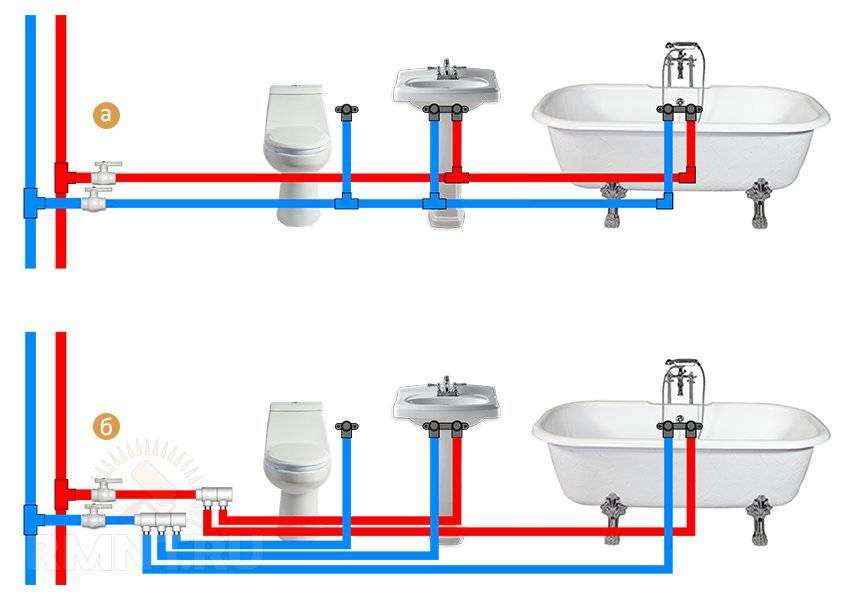
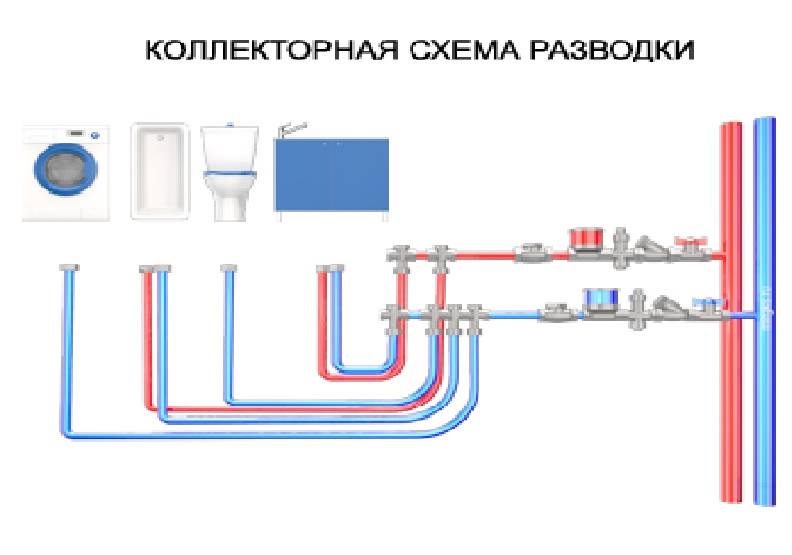
Plumbing on collectors
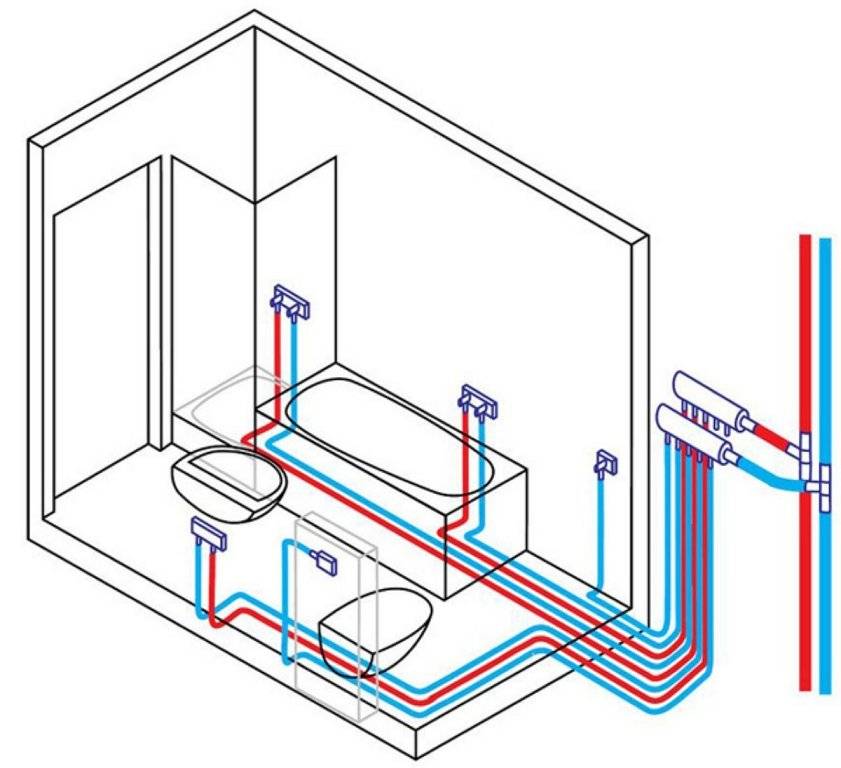
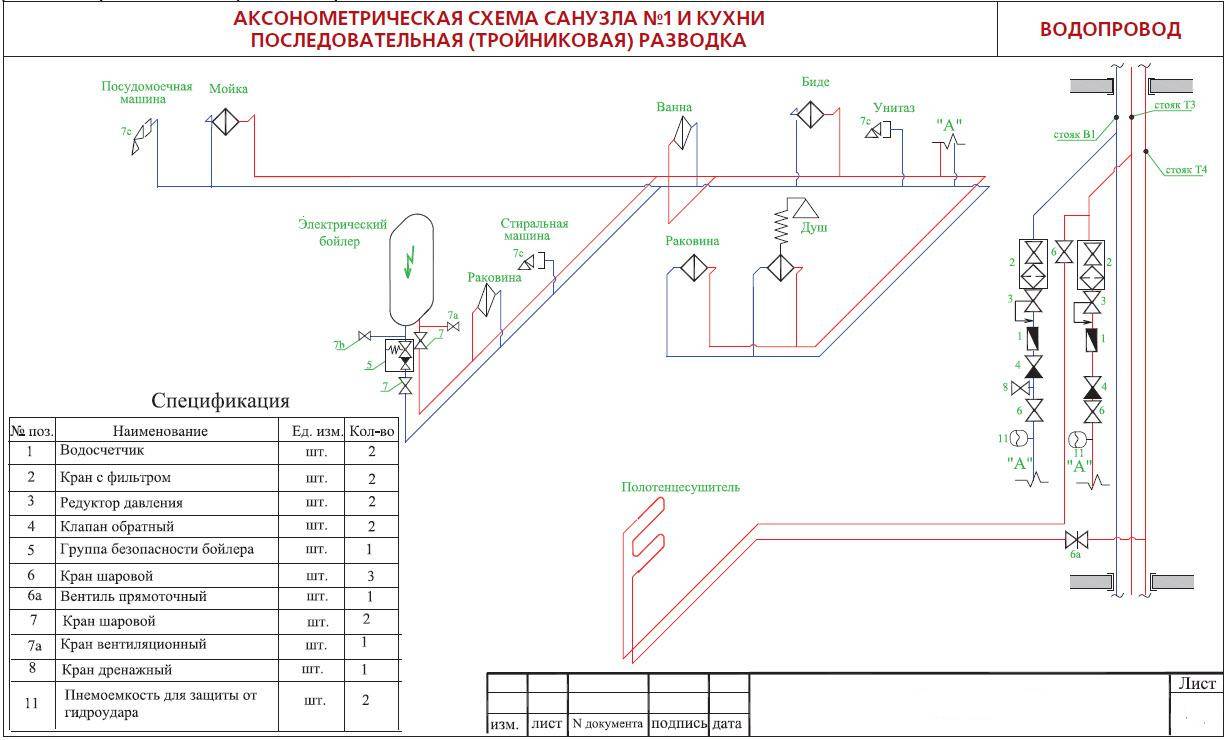
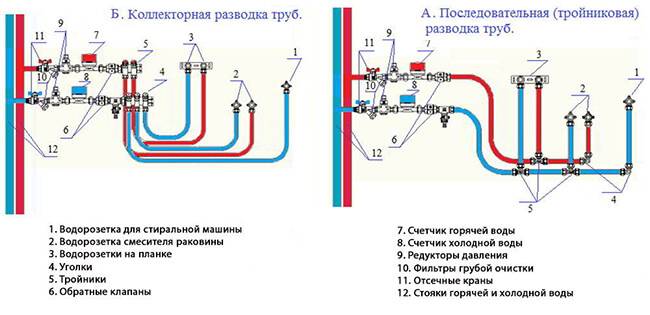
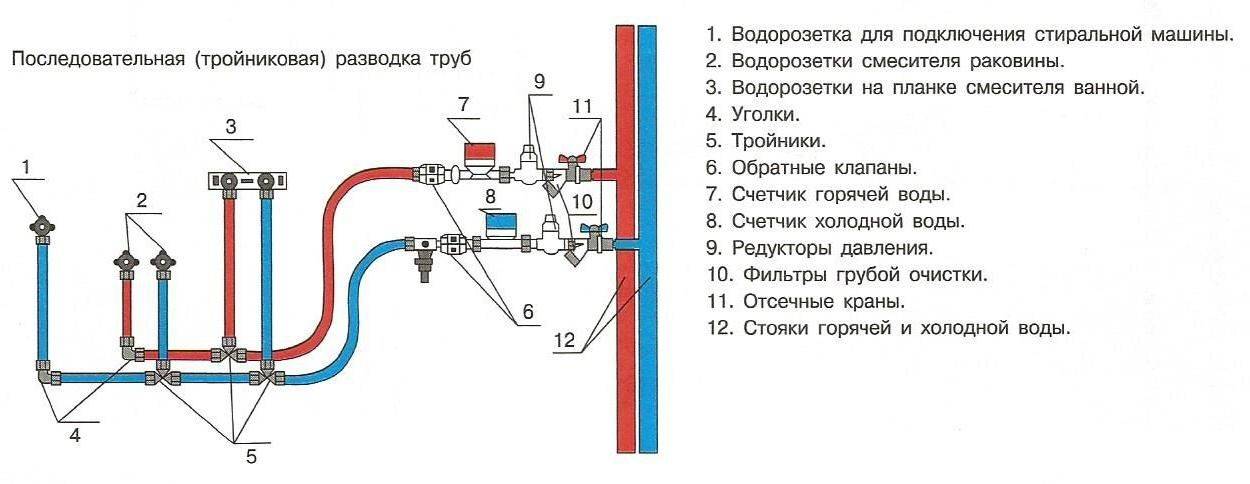
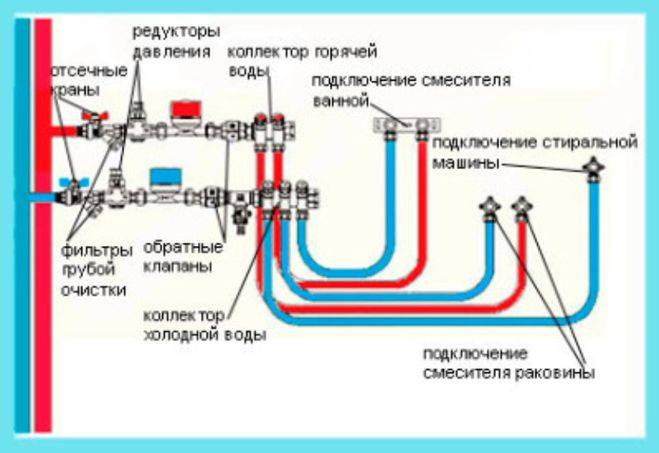
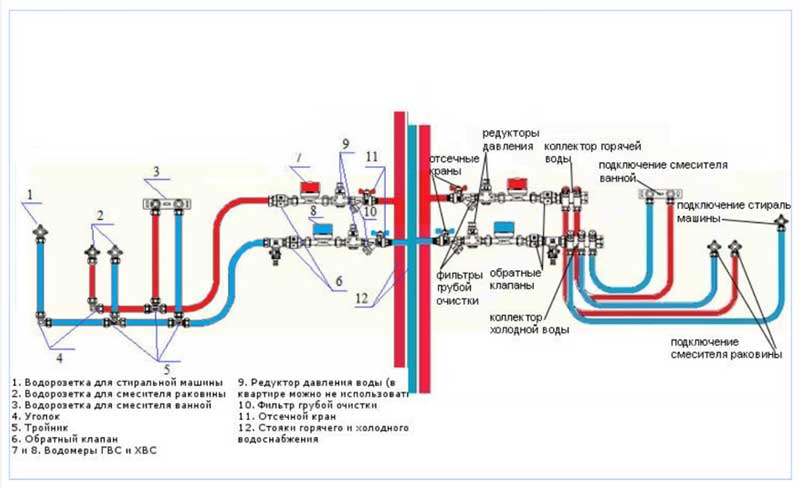
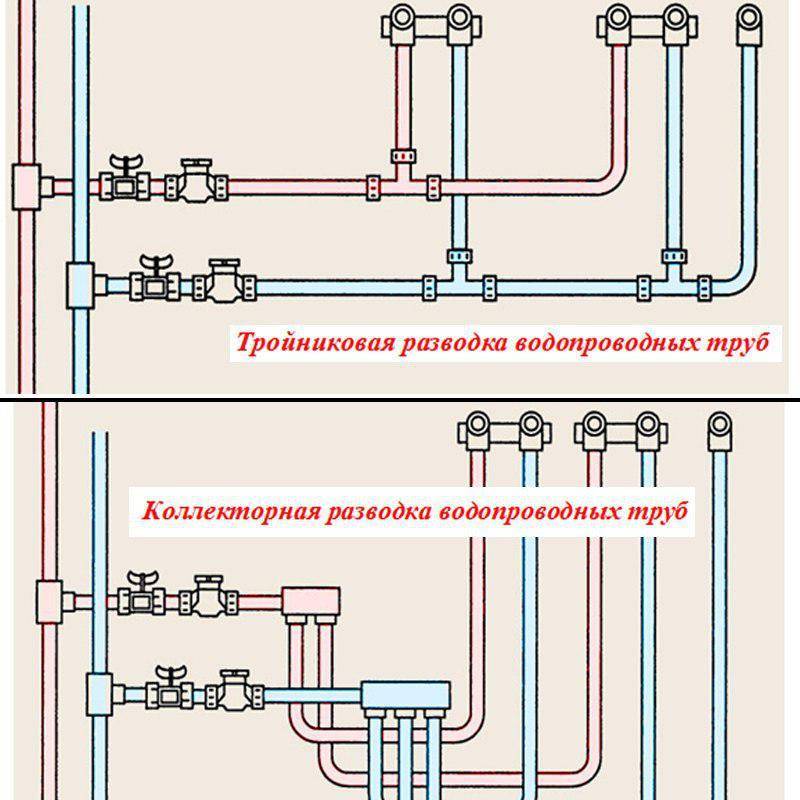
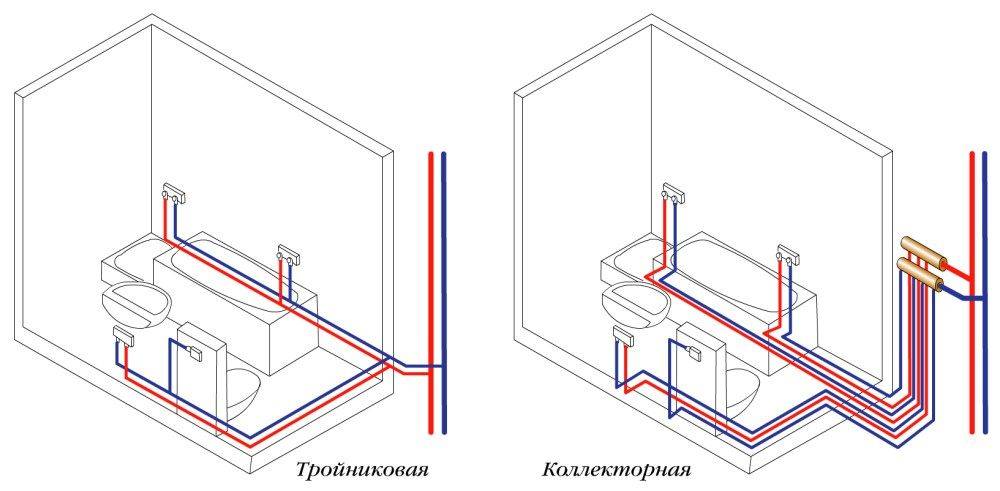
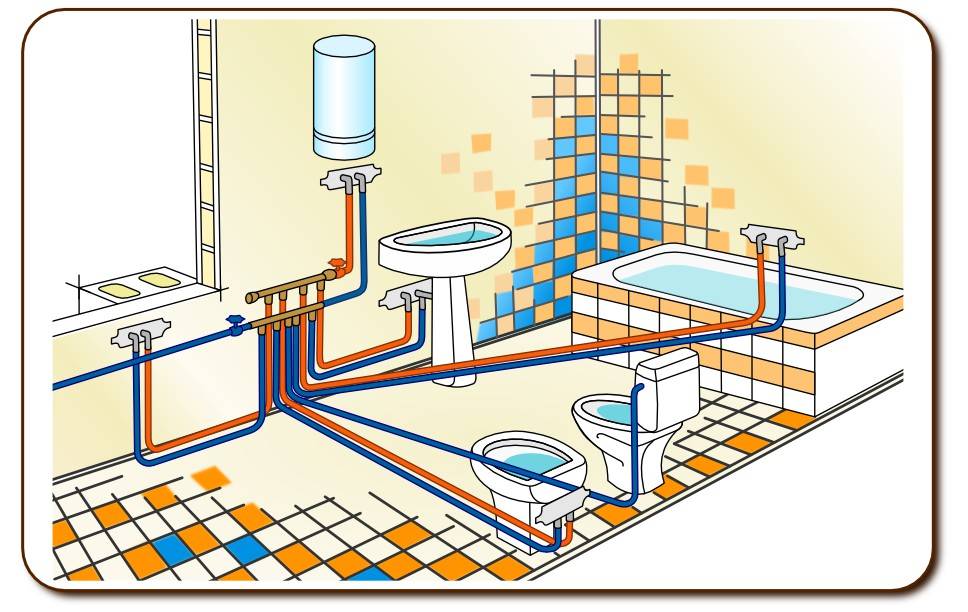
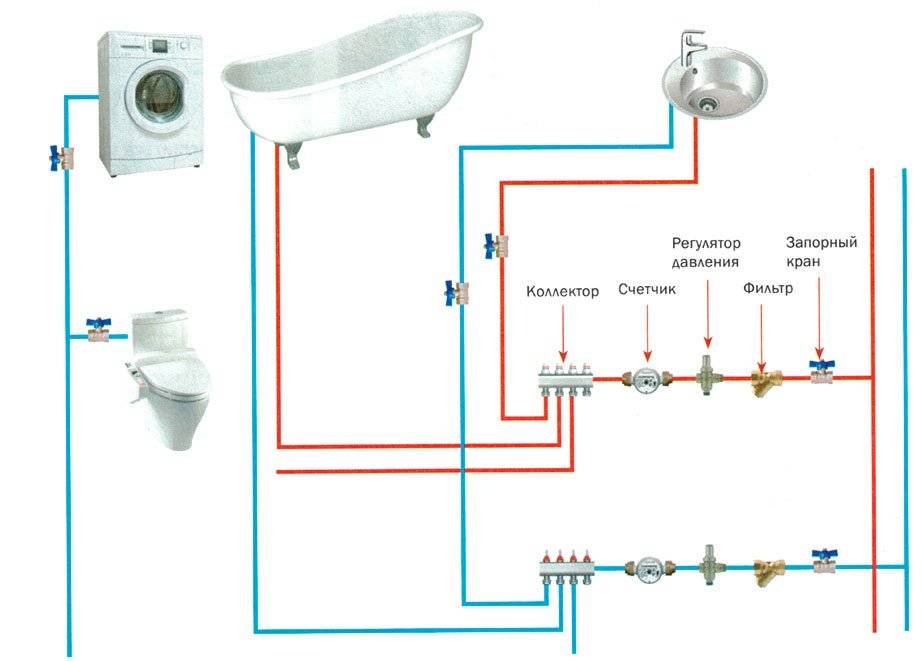
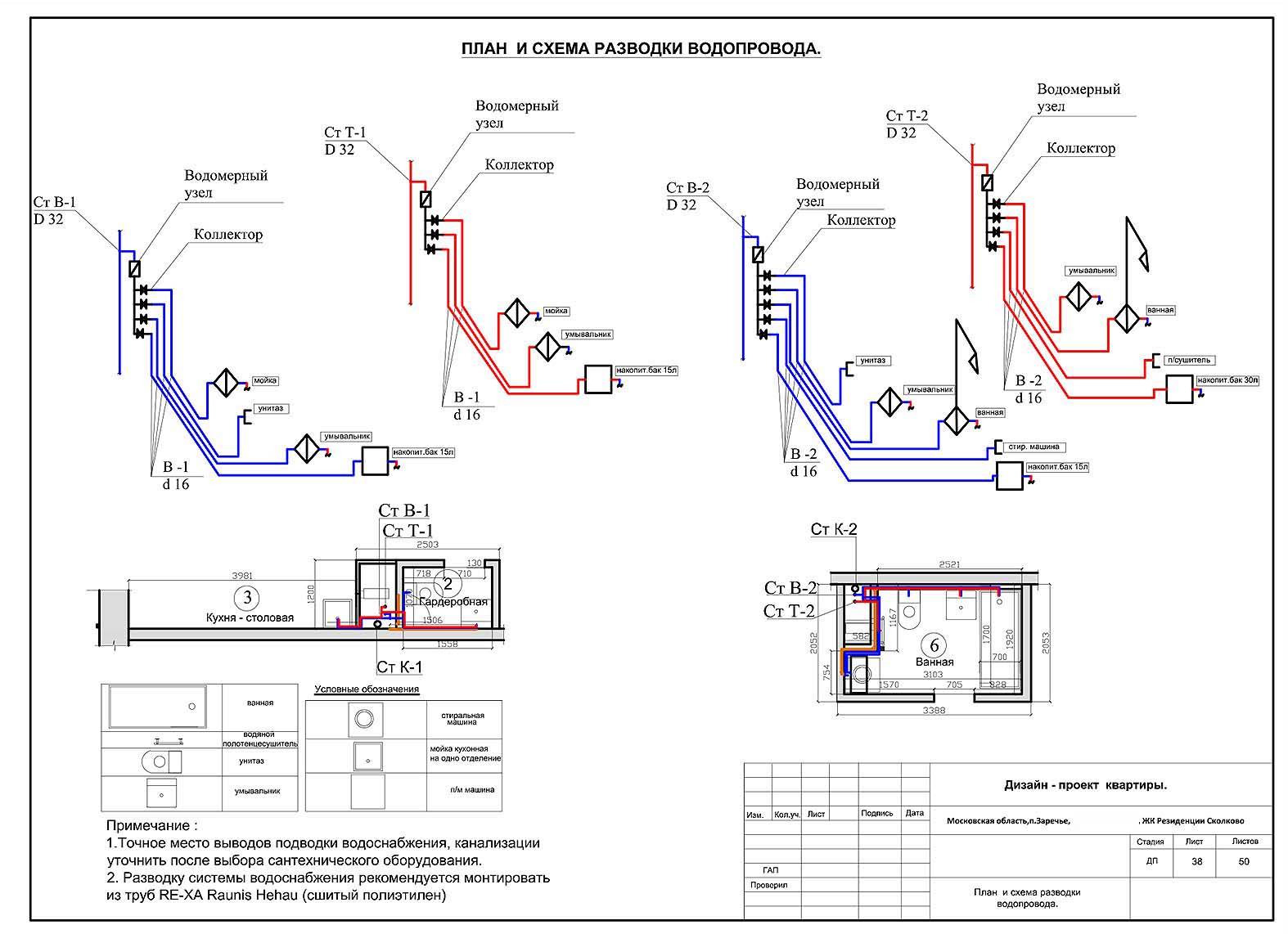
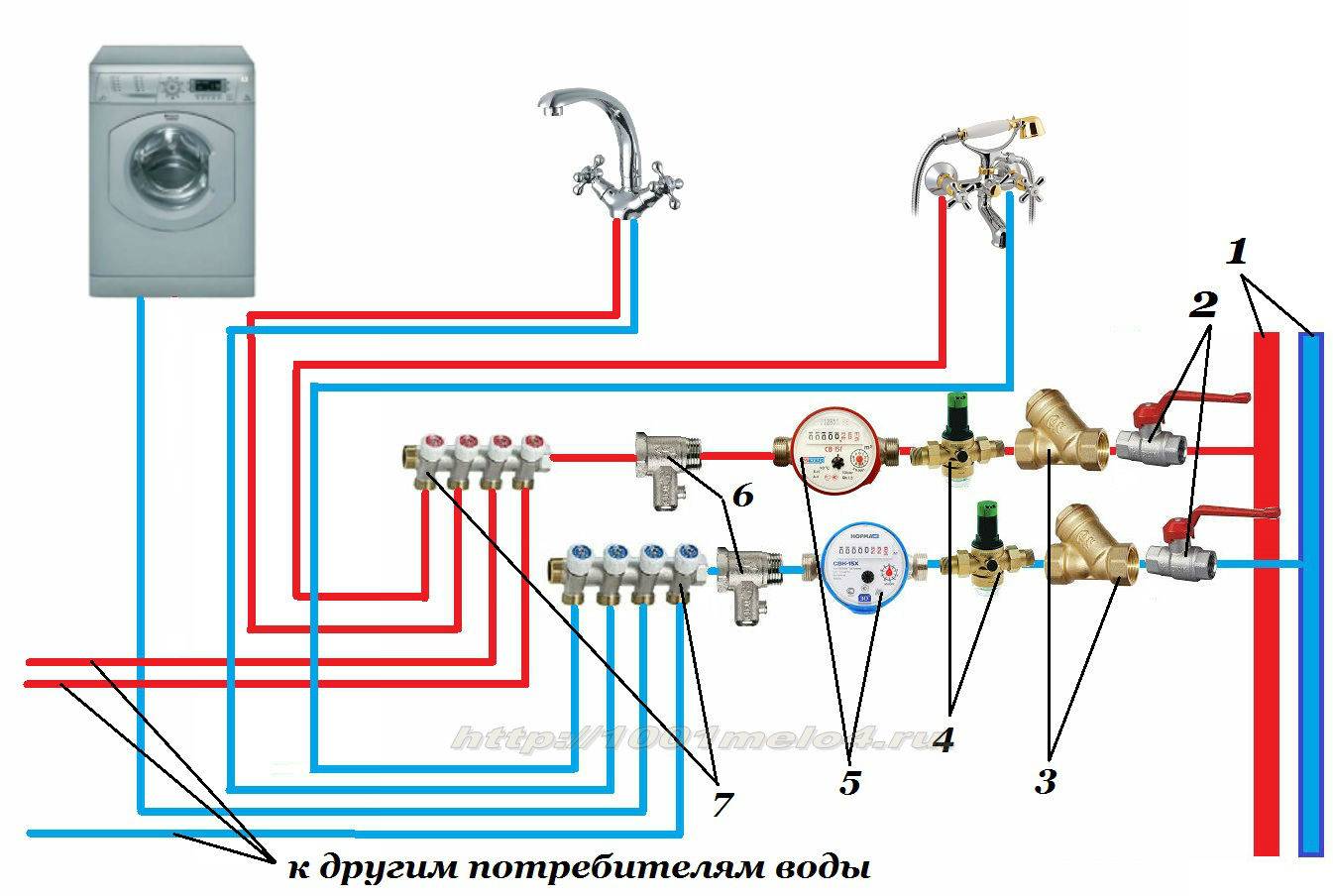
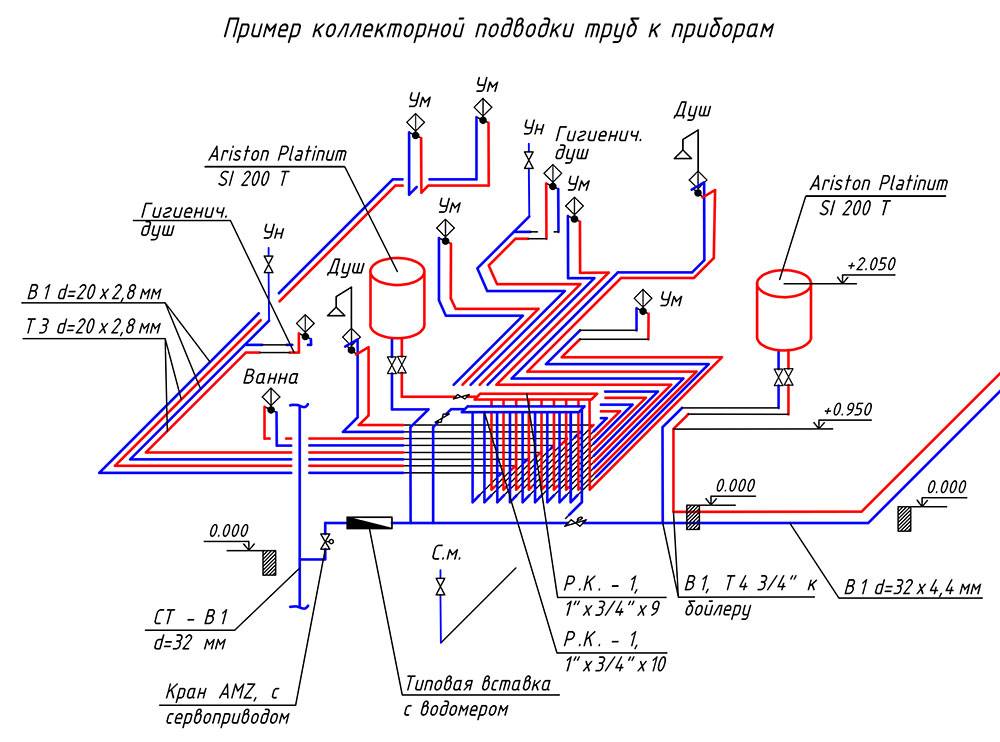
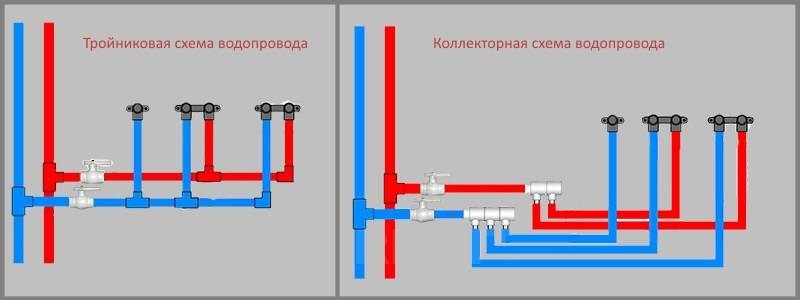
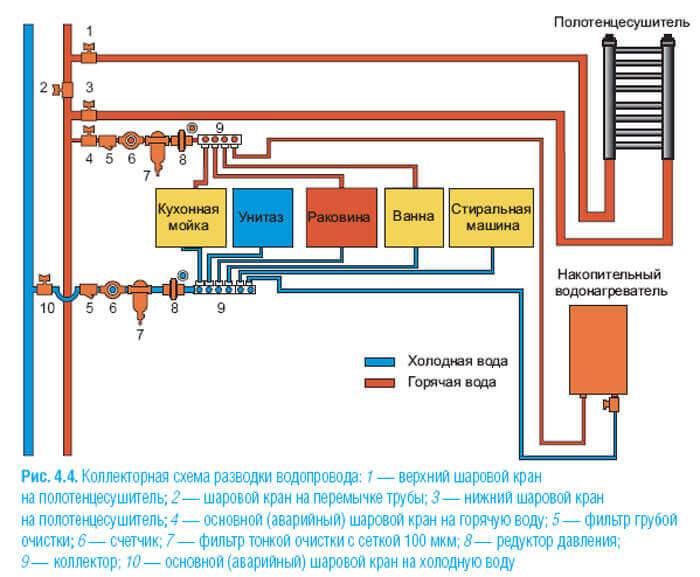
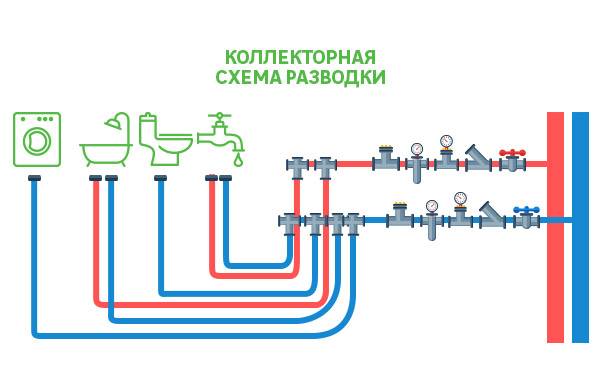
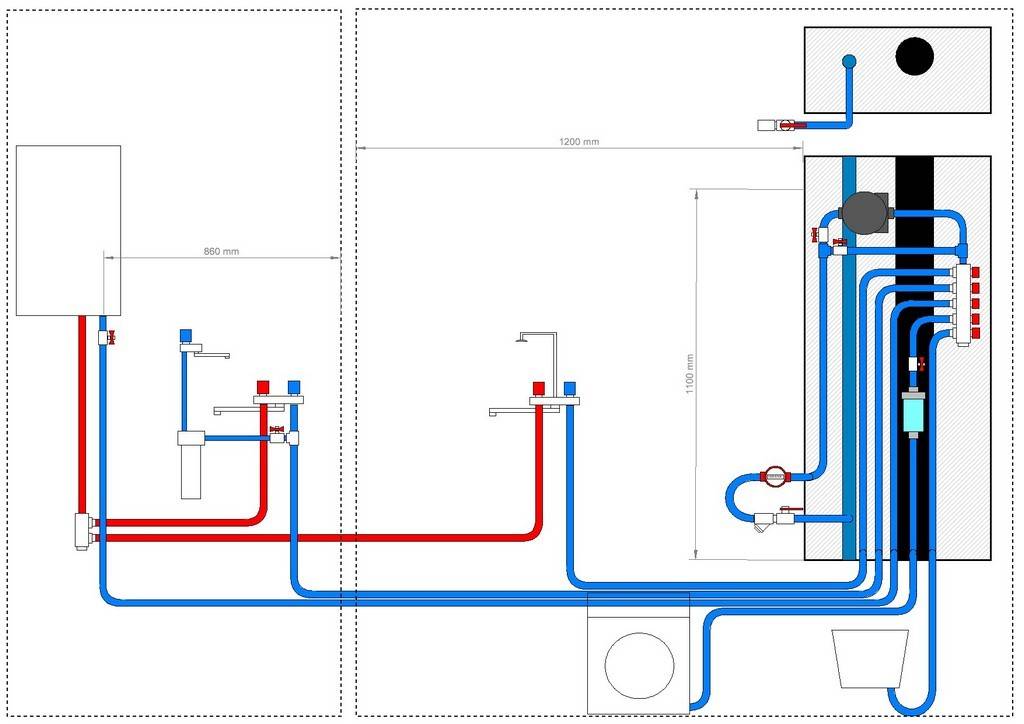
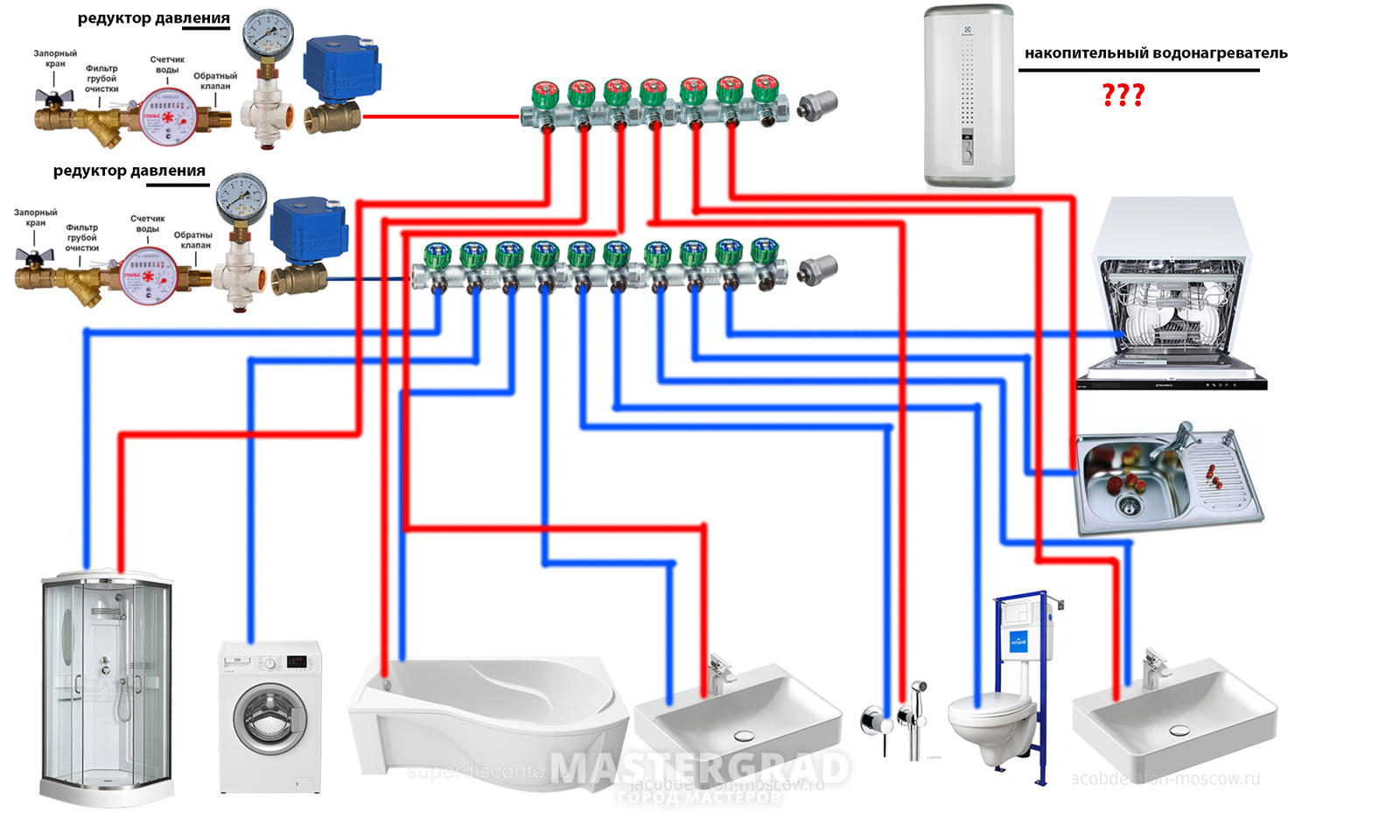
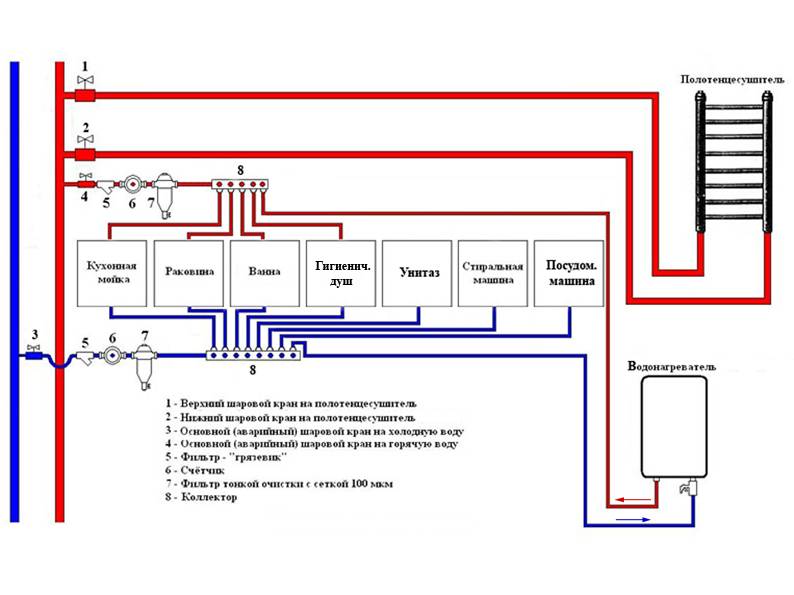
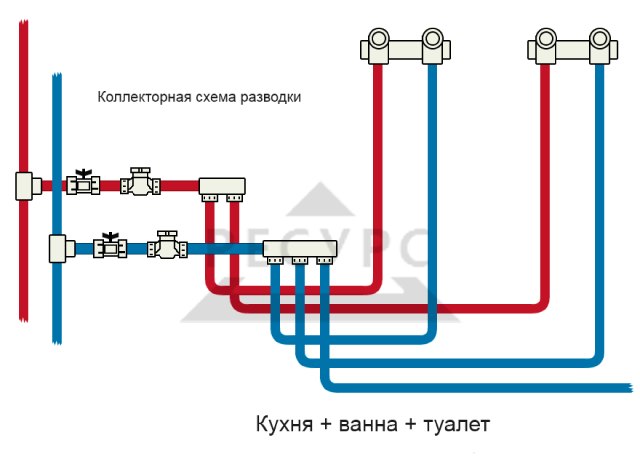
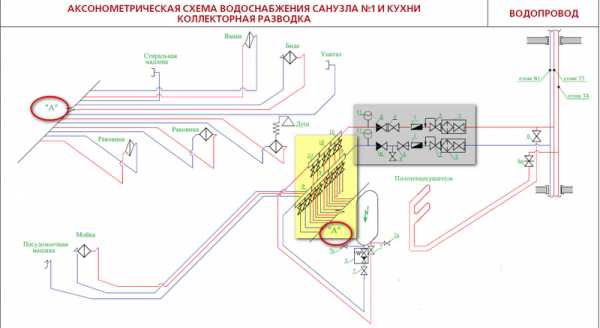
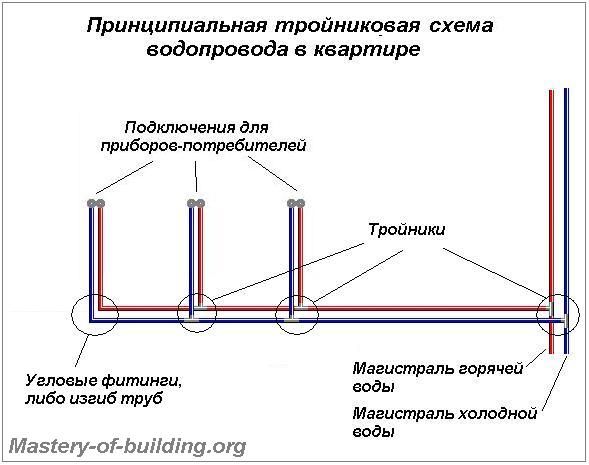
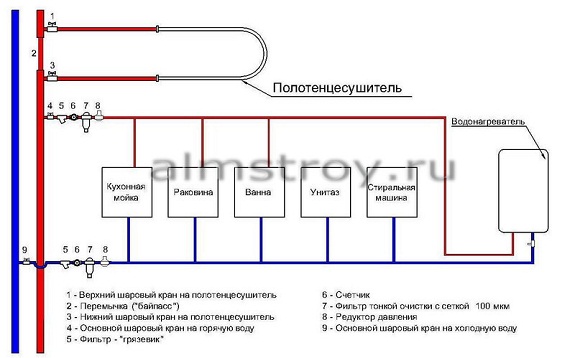
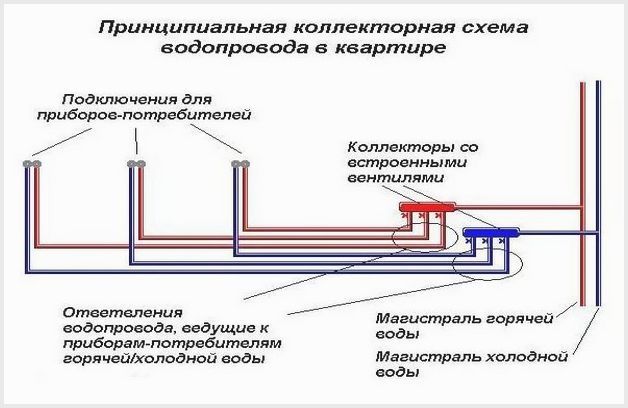
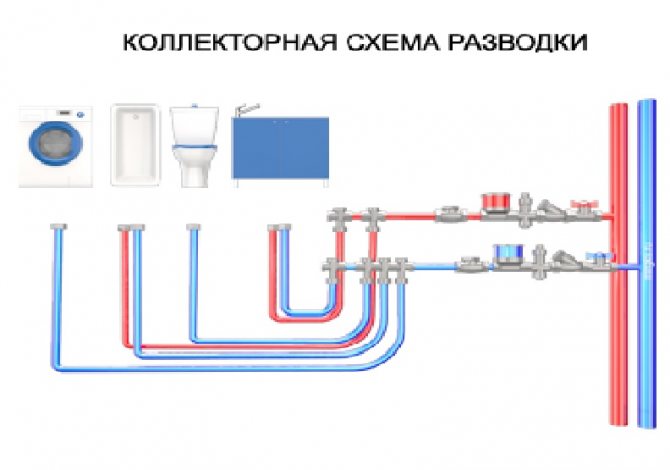
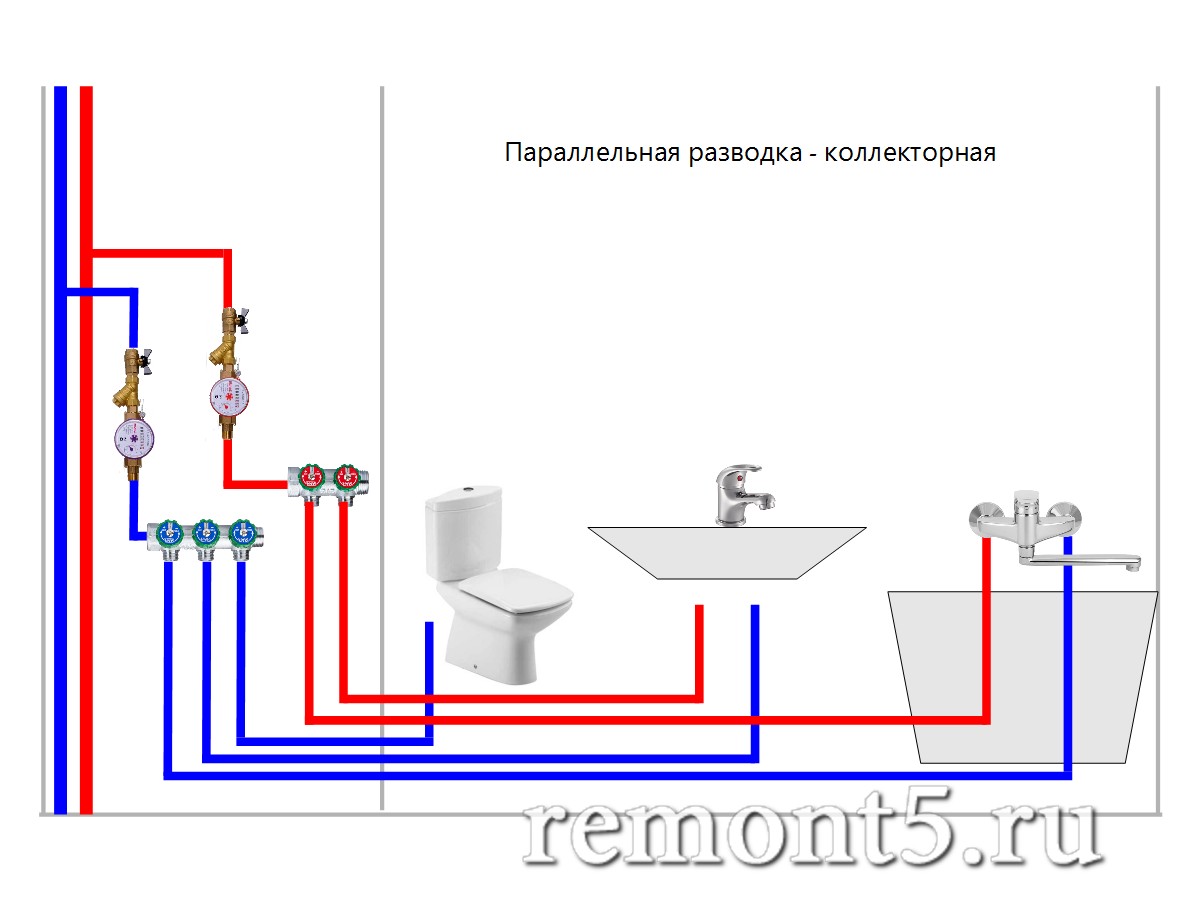
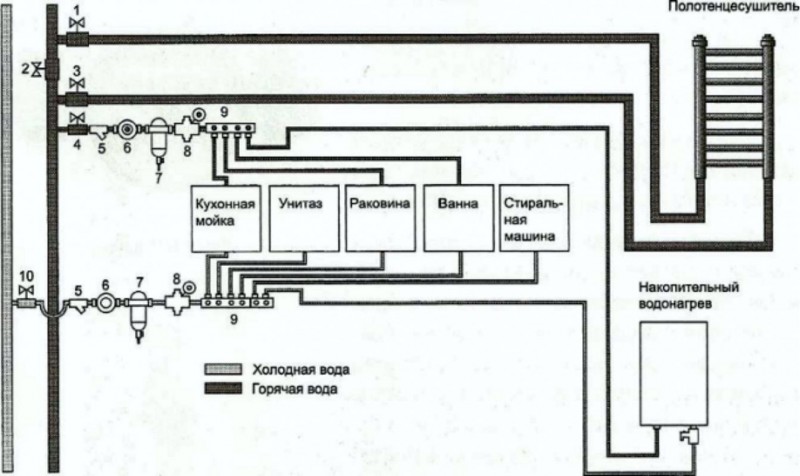
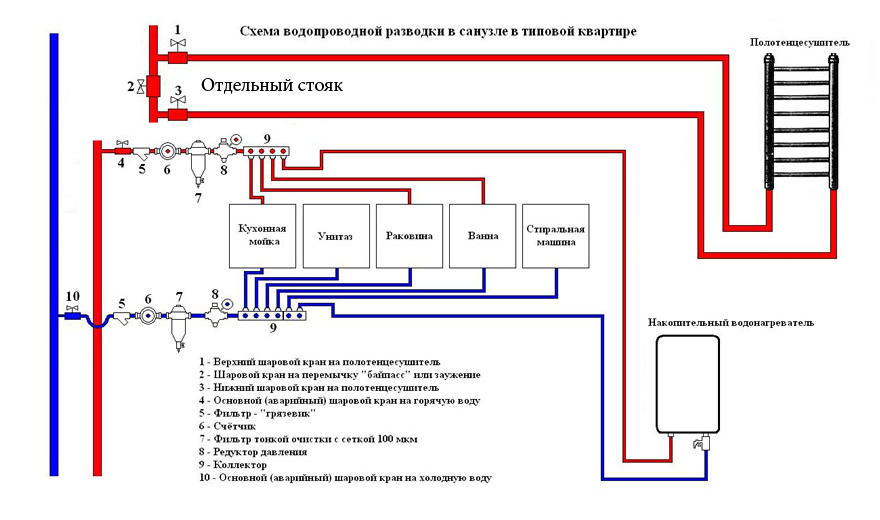
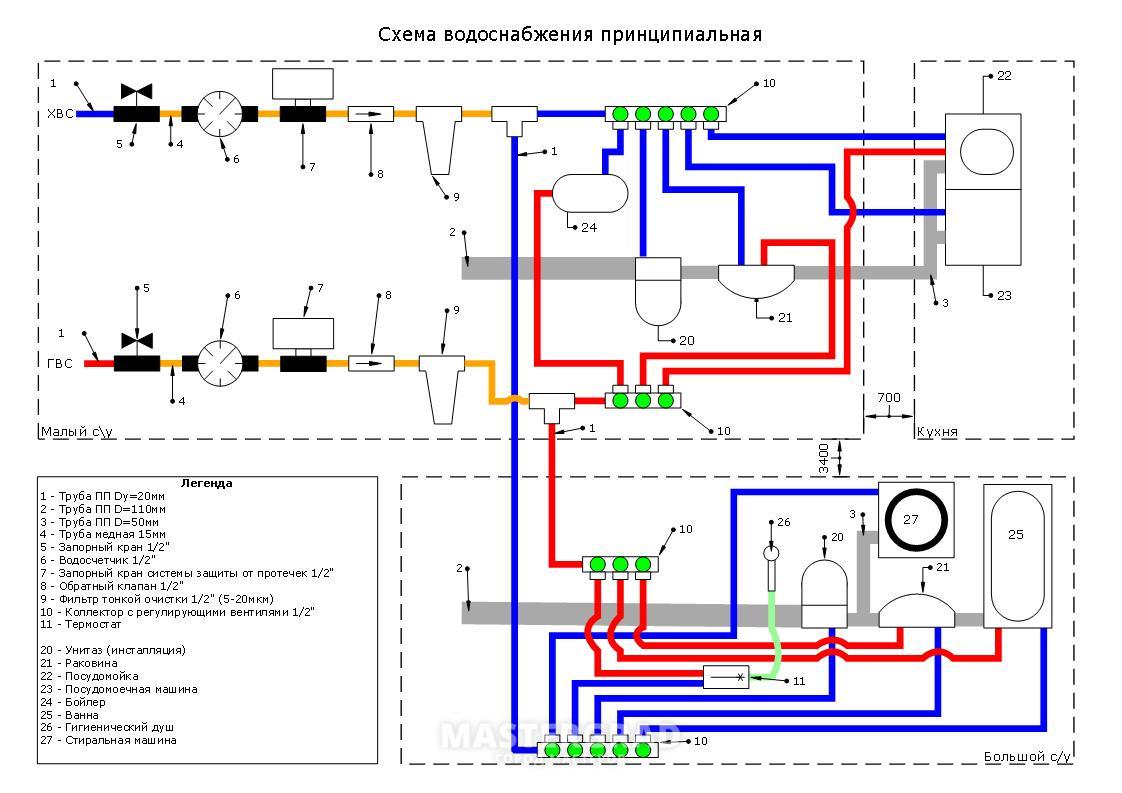
The assembly process of the collector water supply is as follows.
A swivel-type shut-off valve is connected to the central pipe. A filter element is mounted on the valve for coarse water purification. A meter is connected to the coarse filter, which records the water flow. After the counter, a filter element is installed for more fine water treatment.
A back pressure valve is mounted behind the fine filter - it prevents the outflow of liquid into the central pipe in the absence of pressure. A manifold is connected to the valve, from which several outlets come out with their own or connected valves. We connect the pipeline to the outlet of the collector to a specific consumer (faucet).
Therefore, when choosing a collector, you need to focus on the number of taps in the house.
This procedure is repeated twice - for a pipe with cold and a pipe with hot water. If there is only one central pipe - only cold, then the input to the water heater is connected to the first collector. In turn, the output from the water heater is introduced into a separate collector, which will distribute hot water.
For example, in a standard apartment, the collector is best installed in the toilet, behind the drain tank. In this case, the distance to the first consumer (drain tank) and to the second consumer (bathroom) will be minimal.
Mounting of gearboxes
The main function of this device is to stabilize the voltage supplied to the consumer.
Its installation is advisable in cases where the water pressure in the system exceeds the allowable for plumbing devices.
It is advisable to make a special drain through which the excess will merge when the pressure greatly exceeds the normal level.
The installation process has certain rules:
- the pressure gauge of the pressure regulator must be mounted so that it is vertical;
- during installation, it is worth providing special shut-off valves;
- it is necessary to take into account the designations on the body of the device, which indicate in which direction the water should move.
What gives a similar method of wiring?
Such a scheme for arranging a water supply or heating system offers the user an important advantage - stable pressure at each point of the pipeline. In addition, this scheme makes it possible to regulate the pressure in individual elements of the pipeline from one point - a manifold cabinet
In addition, this scheme makes it possible to regulate the pressure in individual elements of the pipeline from one point - a manifold cabinet.
The second advantage allows you to control the temperature in each zone of the dwelling from one place - a manifold cabinet. After all, the user can reduce the pressure of the water supply literally to each battery. Moreover, the overall pressure will not change from this.
Choosing the location of the bathroom in a village house
In order for a bathroom in a wooden house to be beautiful and functional, it is important to choose its location correctly. Since the supply and discharge of water is necessary for the normal functioning of the bathroom and toilet, the bathroom in a wooden house should be located close to the water source, and also have access to the sewer system.
Important: according to SNIP, the minimum distance from the house and cellar to the outdoor restroom should be at least 12 m, from the well to the sewer, or composting device - at least 8 m.
Approximate layout of a mansion on a suburban area
Choosing the best type of bathroom
The method of arranging the sewerage and toilet is determined by how much time per year it is planned to live in the cottage (permanently or seasonally). There are several types of toilets for country houses, or cottages:
dry closet - a compact portable device consisting of a toilet seat and a reservoir under it. The tank contains a special liquid that exposes human waste products to chemical or organic attack, turning them into water, powder, or compost.
Tip: the main disadvantage of dry closets is quick filling and the need to dispose of the contents of the tank.
Compact dry closet - a bathroom in the country, photo
backlash closet - a waste disposal system, which is an insulated restroom at the house, when the toilet is connected to a cesspool using a pipe system;
Note: an important design feature of the backlash closet is a ventilation system that prevents the accumulation of unpleasant odors in the room.
The design of the backlash closet - a bathroom in the country, photo
powder closet - a dry method of waste disposal, in which the toilet in the house is directly connected to a box-type cesspool. A periodic layer of waste is covered with peat to neutralize them. In this case, the tank box should be cleaned regularly.
The device powder-closet in a country house
Tip: with permanent residence in a country house, the backlash closet will be the most convenient and practical way to equip the toilet. The rest of the options are more suitable for occasional or seasonal use.
Determining the size of the bathroom
A bathroom in a private house can be organized in several ways:
- as a full-fledged bathroom (with a shower, a tank-bath and a toilet);
- like a toilet (only a toilet and a sink).
Recommendation: for the convenience of all the inhabitants of the house, there should be one bathroom per floor.
The dimensions of the bathroom in a private house directly depend on what kind of plumbing and household appliances it is planned to install there. If the hygienic room will include only a toilet bowl and a washbasin, then its area may be 2-3 square meters.
The layout of a small toilet in a private house
If it is planned to install a shower cabin in the bathroom, its optimal area should be 3-4 square meters. Corner plumbing will save space, but all appliances must be placed at a certain distance from each other so that they are convenient to use.
Planning options for a combined bathroom in a wooden house
If a bath, a washing machine, cabinets for storing various bath accessories are installed in the room, then the dimensions of the bathroom should be from 5 sq. m.
Options for how to rationally plan a bathroom in a private house, photo
Features of arranging a hygienic room in a wooden building
The device of a bathroom in a wooden house has some features. The linear dimensions of a wooden structure during shrinkage are constantly changing, this should be taken into account when building a bathroom and toilet. How to make a bathroom in a house from a bar?
For this, a sliding frame is used. The technology of erecting the base of a bathroom in a log house consists in installing metal or wooden profiles in vertical grooves of the logs, which will make it possible to rigidly fix the base of the bathroom structure. Overlappings are strengthened with the help of wide logs located at a minimum distance from each other. Then flexible water and sewer pipes are laid, electrical cables are routed, and at the end all communications are sewn up with plasterboard sheets, or clapboard.
Note: the use of a sliding frame in the construction of a bathroom allows the room to resist the shrinkage of the house without damaging the plumbing.
Arrangement of a bathroom on a sliding frame - a bathroom in a log house
This is interesting: Smart home will follow the garden
Hidden communications wiring
In total, there are four ways of hidden wiring in the bathroom:
-
box - plasterboard or GVL sheet, fixed on a profile frame, a part of the supporting structure (walls, partitions) is closed at the place where the pipes pass;
-
false panel - the entire wall is sewn up with plasterboard, again, on a crate made of galvanized profile, less often PVC panels are used on a bar frame;
-
a cavity in the wall - after marking the routes of the water supply system, sewerage, it is necessary to ditch the concrete, brick wall, lay the pipes inside the resulting channels, cover it all with putty;
-
laying in a screed - pipes are laid on the lower floor, poured with a concrete, semi-dry screed.
Comparative characteristics of these technologies are given in the table below:
| Characteristics | Concealed installation type | |||
| box | bezel | strobes | coupler | |
| usable space | decreases slightly | decreases much | does not change | declining |
| labor intensity of work | low | average | very high | high |
| interior quality | average | high | ||
| access to communications | through the access hatch | – | – | |
| installation compatibility | + | – | ||
| presence of wet processes | – | + | ||
| turnkey delivery | 1 day | 2 days | 2 – 3 days | a week |
Boxes reduce the quality of interior design, but convenient niches appear, steps for placing accessories, storing bath accessories. Behind the false panels, you can hide any number of pipes, a boiler and other equipment. But, for mounting wall cabinets and shelves, you will have to install additional racks made of galvanized profile.
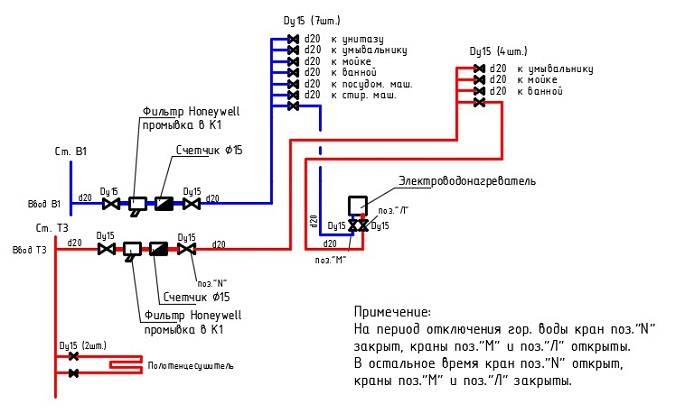
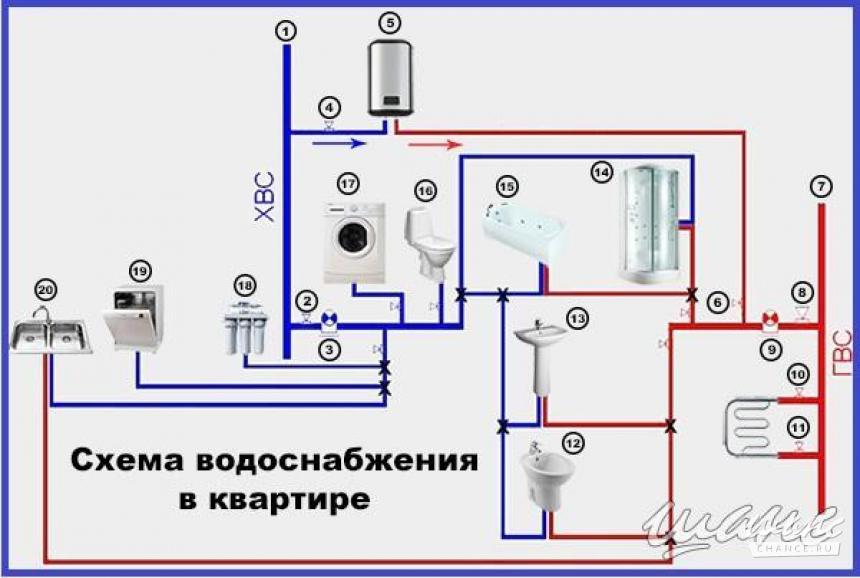
Open installation of engineering systems
In Soviet times, the open wiring of engineering systems was considered the standard. Even the tub faucets ran outside the wall cladding, creating an uncomfortable, unaesthetic gap between the bowl rim and the enclosing structure. In this way, it is much easier to bypass intersecting water supply and sewerage lines.
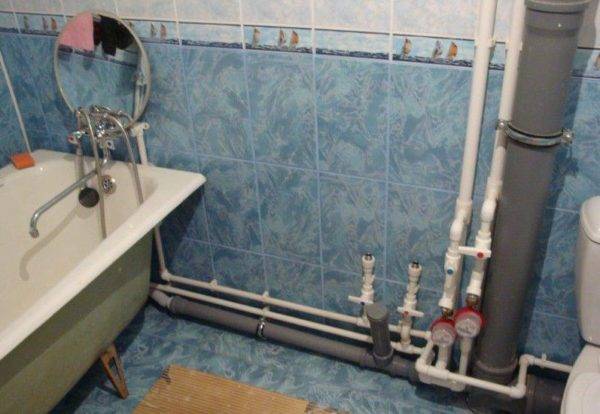
Currently, water outlets are used, that is, cold water / hot water pipes laid in strobes. With sewerage, everything is much more complicated due to the too large diameter of communications. Therefore, a combined method is used here:
- behind the tub, the pipes are laid in an open way;
-
risers are closed with boxes, inside of which plumbing equipment is additionally mounted - a meter, a collector, filters, a reducer, a valve, valves, a boiler;
- hanging plumbing installations are sewn up with GKL sheets by default;
-
for a washing machine, bidet, toilet bowl, single water outlets are mounted only for cold water;
-
for the bath faucet, washstand, shower cabin, double water sockets are installed;
-
pipes of the sewer pipeline for sinks are often mounted hidden, for bathtubs, shower cabins they are laid in an open way.
For connections of mixers with cold water / hot water outlets, flexible wiring in an open way is used - hoses. The drain of the washing machine is connected to a special fitting on any tee of the plumbing fixture.
Laying methods
You can carry out this procedure in several ways:
- closed;
- open.
It should be noted that the closed method is distinguished not only by increased labor intensity, but also makes it possible to save space in the room. This is very true when it comes to small bathrooms.
At the same time, we can immediately note the main disadvantages of the closed method:
- the inability to carry out a preventive inspection of pipes to inspect out of the state;
- the need to break the walls, so that in the event of a leak, to carry out repairs and, as a result, the need for further repair.
As for the open method, its only drawback is the reduction of free space in the room, as well as changes in its appearance.
And here are the benefits:
- low labor intensity of installation, which has a positive effect on the speed of its implementation;
- the ability to see the leak in time and fix it;
- ease of repair in any area;
- opportunity to improve the system in use.
Possible problems and solutions
errors in calculations. The assembler forgets to add the length of the section that will be inside the fitting (or adapter) to the length of the workpiece from the pipe, and this is up to 15-20 mm per side;
low quality of one-piece (welded) joints. There are defects on the seams through which water seeps out. It is eliminated by forming a new seam on top. In some cases, you need to completely digest the pipe
It is important to understand that even a small leak will eventually turn into a larger one;
water dripping/oozing from threaded connections. Might need to tighten it up a bit.
If it is not possible to eliminate the defect, then you will have to disassemble the assembly and carefully examine the condition of the threads - in case of severe damage, the element will have to be replaced completely. If it's all right. then you need to wind more flax, apply another layer of sealant and try to properly tighten the connection again;
incorrect soldering of polypropylene. As a result, pipe connections are not very strong and can collapse when pressure is applied.During operation, you should be guided by the recommendations of the manufacturers of the soldering iron and the plastic products themselves. This also applies to the depth of penetration of the edges, and the temperature of the device;
choice of unreliable plumbing. Buying cheap devices on the market can lead to difficulties: constant breakdowns, broken fittings and flooding, improper operation. It is recommended to use products of proven manufacturers of Russian, Belarusian or European manufacturers;
ignoring the requirement for the slope of the sewer line. Masters do not withstand the required parameter (3 cm / m for a pipe diameter of 50 mm), this leads to difficulties in moving wastewater. To eliminate it, it is easier to redo the docking station with the riser, otherwise the owner of the apartment will constantly encounter blockages;
the features of the pipe materials used are not taken into account - linear expansions, different behavior during temperature changes, reaction to water hammer;
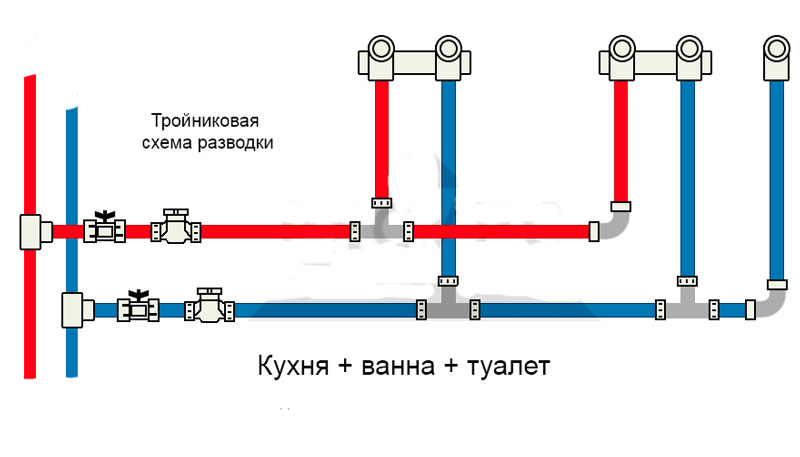
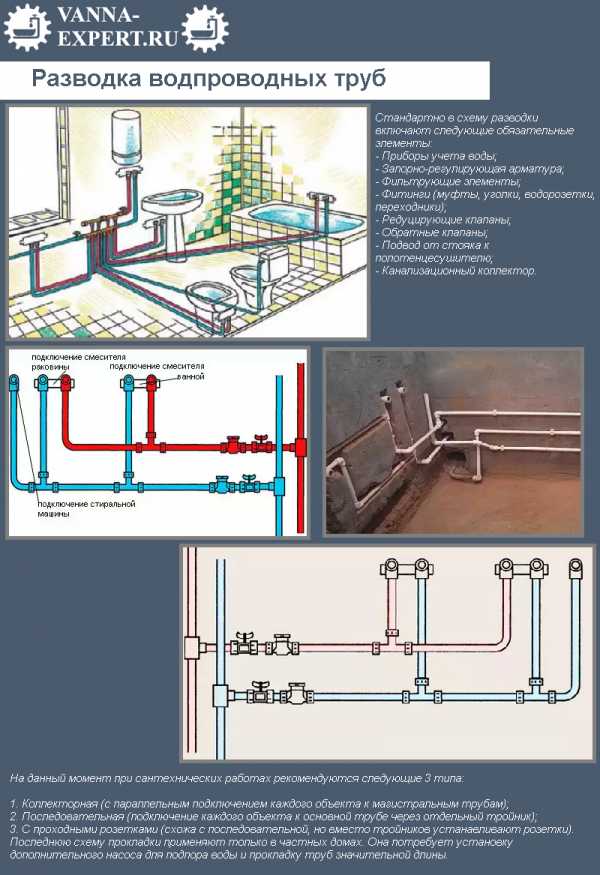
mistakes made when wiring the system are often due to the lack of experience of the apartment owner. Ball valves must be present on each riser - to shut off water, points for connecting meters. It is important to check the system before it is closed.
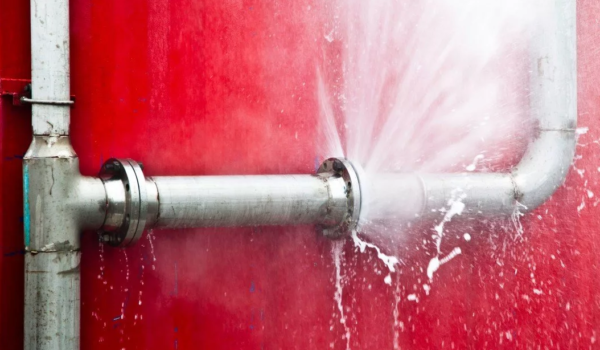 Pipe break in apartment