- Choosing a heating scheme for a heating boiler in a private house
- Gravity scheme
- Forced circulation scheme
- Do-it-yourself system installation
- Radiation system
- Calculation of the water heating system
- Boiler power
- Number of radiators
- Planning and calculation
- How to make home heating from polypropylene pipes
- Types of autonomous heating systems
- Types of two-pipe heating system
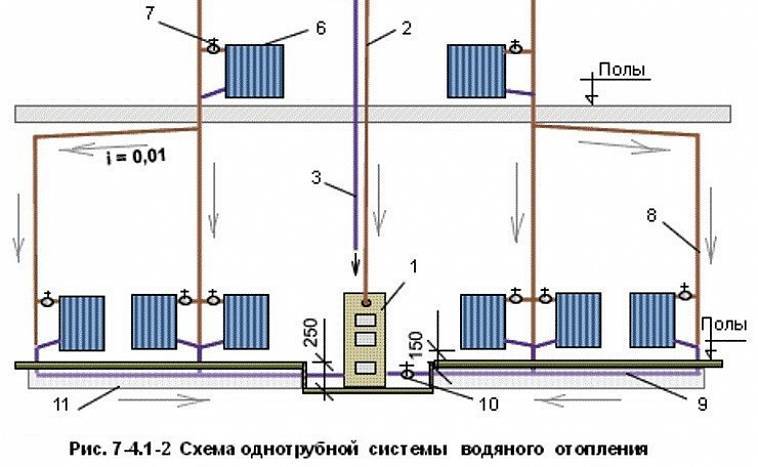
- Single pipe system
- Which scheme is better to choose
Choosing a heating scheme for a heating boiler in a private house
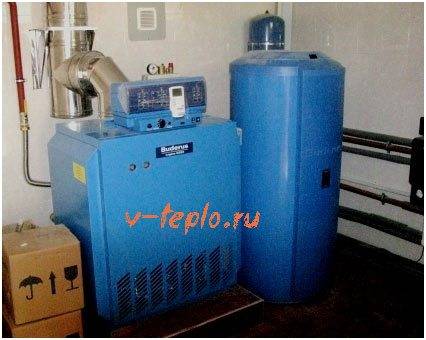
The boiler itself is just an element of the heating system. Without pipes and radiators through which the coolant circulates, its work is useless. Therefore, heating wiring must be provided in advance, before buying a unit that provides heat. The task is facilitated by the fact that the heating circuit for all types of boilers has more similarities than differences.
Gravity scheme
Most often, such a scheme is used for connection with a solid fuel or liquid boiler. If we approach the issue strictly, taking into account the preservation of efficiency, then modern gas boilers do not imply gravity circulation of the coolant. Many electronically controlled wall and floor models already have a built-in circulation pump that forcibly drives water or antifreeze through pipes and radiators.In conditions of frequent power outages, such a boiler will be inactive.
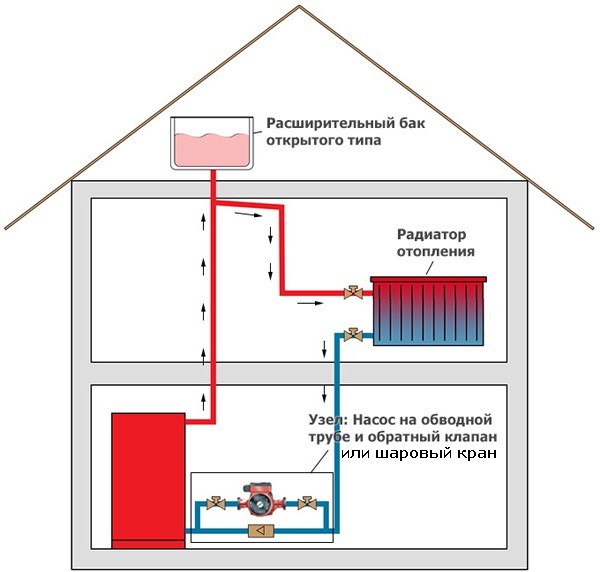
General view of the gravity scheme
However, in many homes, gravity circuits continue to work in conjunction with a gas-fired non-volatile boiler of a simple type with mechanical control. With the use of heating pipes of large diameter, sufficient water pressure is created in the system to start the gas burner. In old systems, pipes with a cross section of 100 - 150 mm were taken, which surrounded the rooms around the perimeter. The heat transfer of such a design is small, but it itself is reliable and durable. When installing radiators, the diameter of the supply pipes must be at least 40 mm to reduce hydrodynamic resistance.
In gravity systems, an indispensable element is an expansion tank. If the water in the system reaches high temperatures, its excess enters the tank due to the increased volume. The tank insures the system against leaks and depressurization in the event of an abrupt increase in pressure. In open systems, the tank is always located at the highest point.
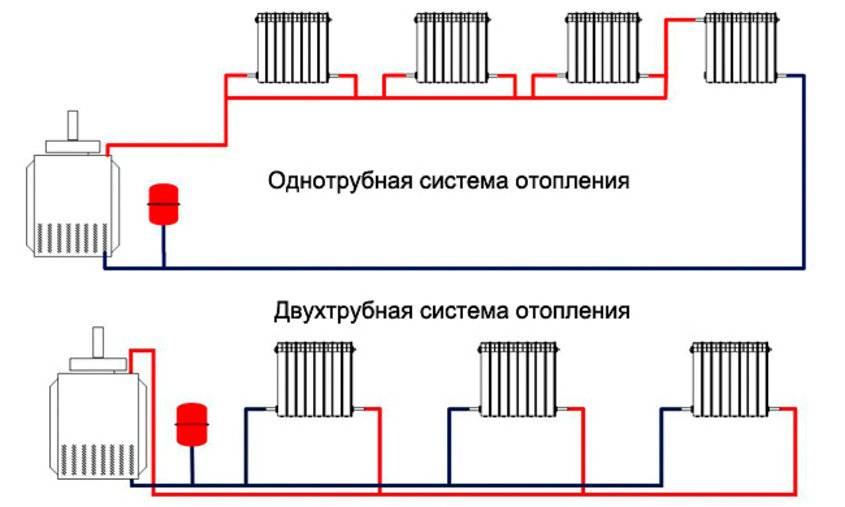
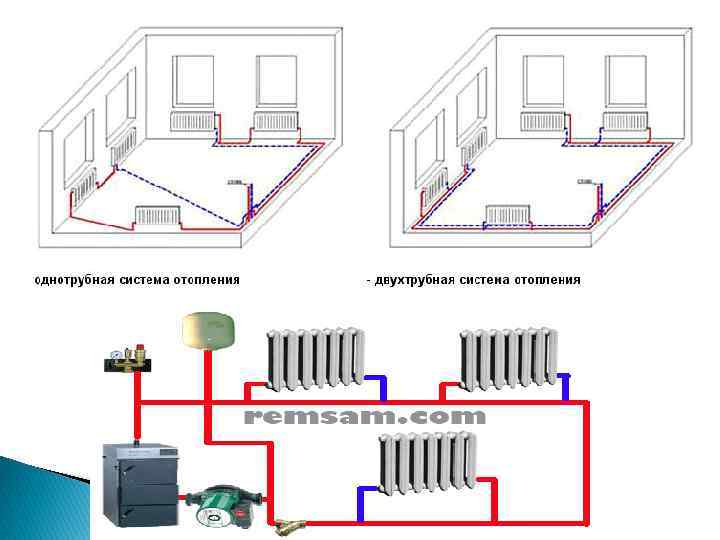
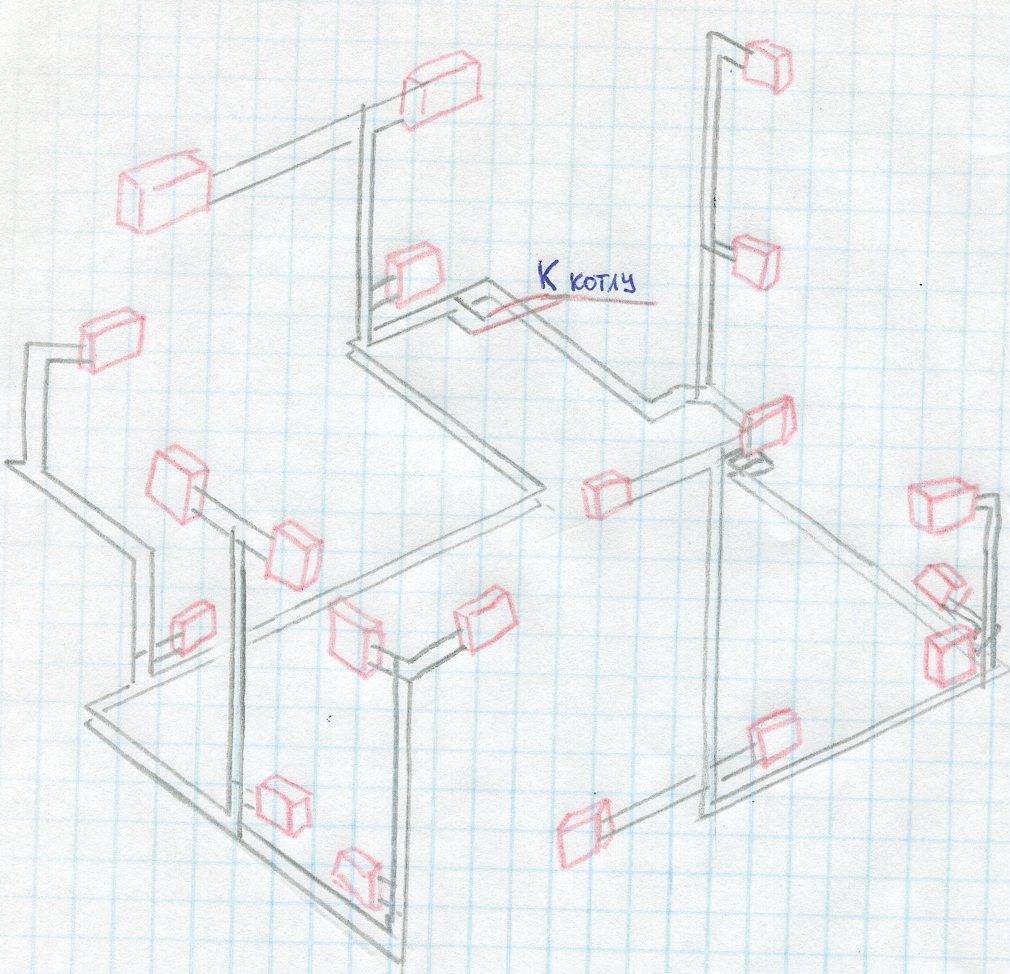
The gravitational scheme is one-pipe. This means that the coolant sequentially passes through all the radiators, and then returns through the “return”. For the installation of batteries with such a system, bypasses are used - bypass pipes with shutoff valves, thanks to which it is possible to dismantle and replace the batteries without stopping the boiler and draining the coolant. Also, a Mayevsky crane is placed on each radiator to bleed the air that accumulates inside the wiring.
Mayevsky crane
Forced circulation scheme
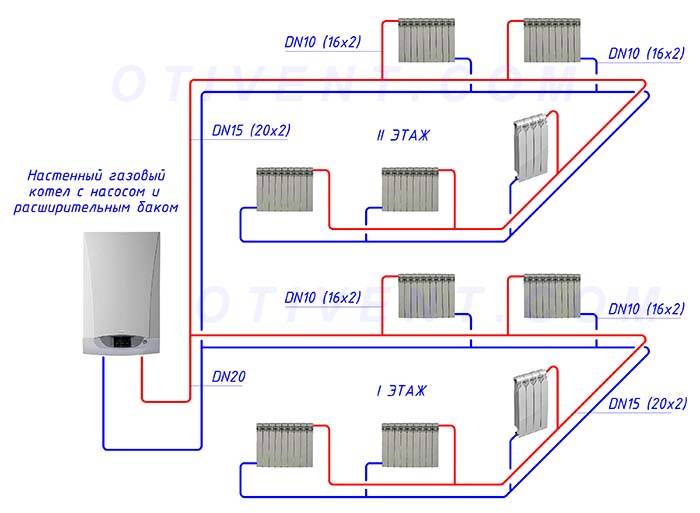
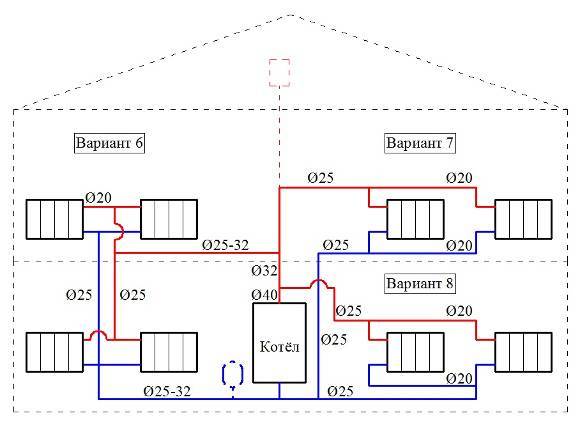
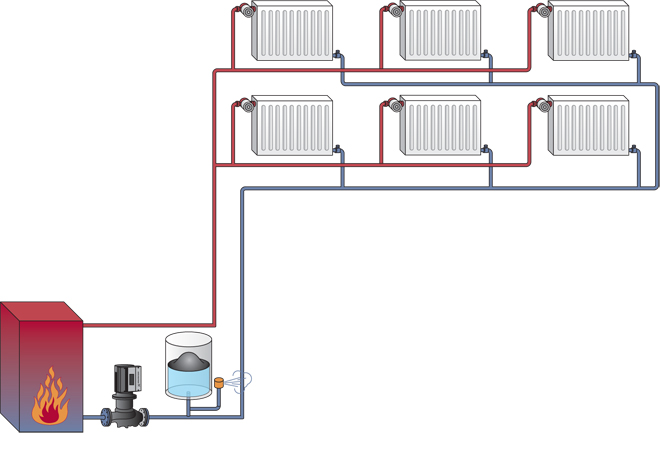
The only disadvantage of this type of heating wiring is the dependence on the presence of voltage in the household electrical network.In addition to the boiler, the second important node of such a scheme is the circulation pump, which crashes into the “return” before returning it to the boiler. Modern pumps are silent, productive and consume electricity in the same way as an incandescent light bulb. But thanks to such a device, it becomes possible to make a choice in favor of a two-pipe system. In this case, the binding pipe passes through all the heated rooms of the house. From it, a separate stream of hot water is supplied to each battery, and from it the cooled coolant is drained into the “return”, which is the very second pipe in the circuit. This allows you to evenly distribute heat over all radiators and maintain the same temperature even in the rooms farthest from the boiler.
The expansion tank, in the presence of a circulation pump, is made mandatory closed so that a certain pressure can be created in the system. In case of excess of normal values, an emergency pressure relief valve is provided.
Visual representation of a two-pipe scheme
In both schemes, a make-up unit must be provided through which the coolant is poured into the system. If water is used, then a branch pipe from the water supply network is cut in to fill the pipelines, installing a filtration system at the inlet. When using antifreeze, an inlet valve with shutoff valves is arranged, and pumping is carried out using a “baby” submersible pump or other pumping equipment.
Do-it-yourself system installation
Do-it-yourself water heating must be carefully planned, very carefully. And this should be done by professionals.Often this procedure begins with the choice of a place for the boiler, which, by the way, is installed even before the wiring is done. Of course, specialists know very well how to plan correctly, so at the preliminary stage one of them should be next to you.

When you have decided on a place for the boiler, you need to make a special concrete pedestal for it. The boiler is placed on it and connected to the chimney, and all joints and connections are smeared with clay.
Next, you need to draw what the piping will be in your system. Carefully consider where radiators, risers and other elements will be placed - that is why the participation of a specialist is necessary. As we know, it is desirable to place radiators under windows. This is necessary so that the heat from them warms the inner surface of the windows.

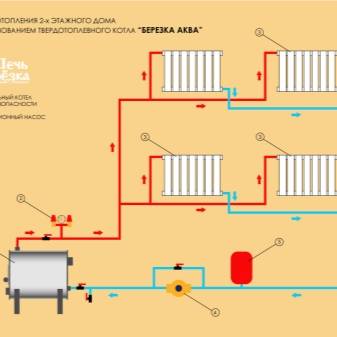





The number of sections and their creation should be determined not only by your financial capabilities, but also by the length of the circuit, the more such sections there are in the system, the easier it will be for the coolant to move along it.
Important! Even before proceeding with the installation of the line, it is necessary to determine the highest point in the system and equip an expansion tank there. By the way, such a tank can be of two types:
- open;
- Closed.
How to calculate the optimal volume of the tank and do the installation correctly, read here
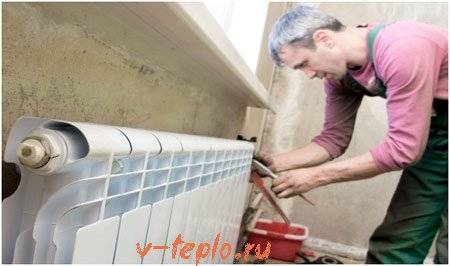
The next step in the installation of the heating system is the laying of pipelines and the installation of radiators.In this case, everything is extremely simple: the pipe is brought to the installation site of the radiator, it is installed, all the necessary inputs and outputs are connected, after which the pipe is connected to the next radiator. It will be just fine if you install a special valve on each of the radiators, with which you can remove air from the system.
The entire circuit should be closed in the same place where it began - on the boiler. A special filter and (if necessary) a circulation pump are installed at the boiler inlet. The lowest point of the system must be equipped with a fill/drain unit, necessary to drain all water in case of repair work.
As a conclusion
As we found out, today there is no cheaper and at the same time efficient heating system than a water system. Pipelines and radiators are updated almost annually, therefore, the efficiency of such a system increases, while the cost, on the contrary, decreases. Therefore, it is becoming easier to make water heating with your own hands every year.
Radiation system
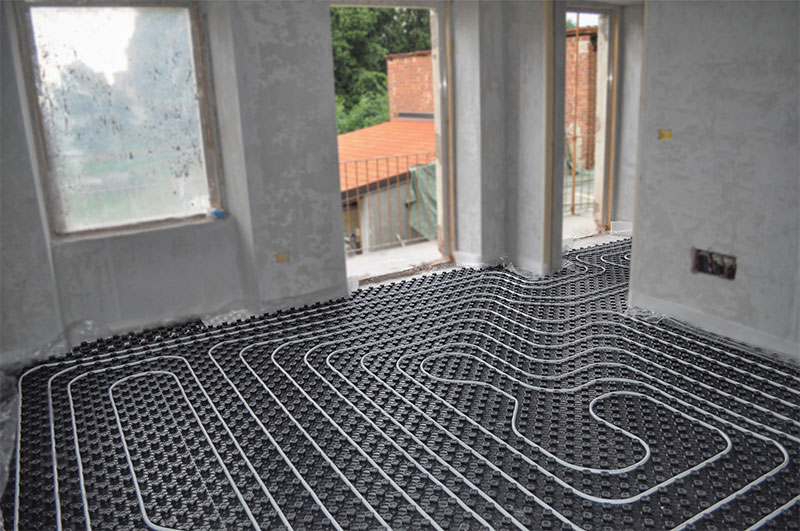
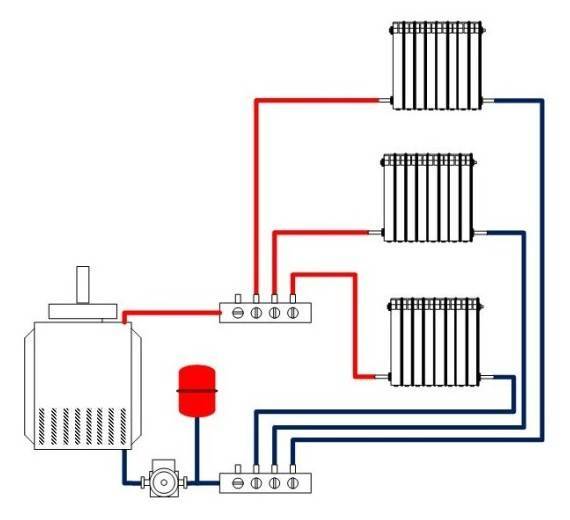
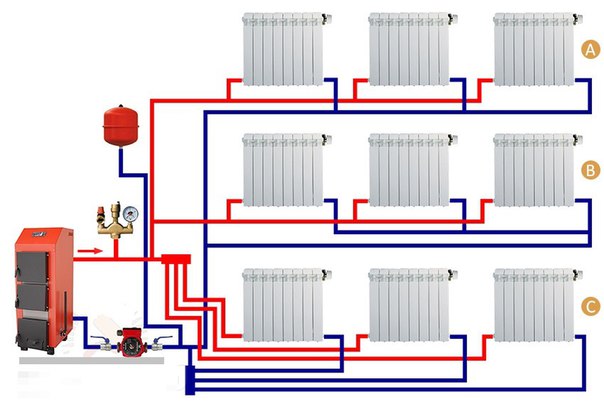
The collector (radiant) heating scheme is the most advanced and modern in terms of thermal efficiency. In it, a pair of pipes from two common collectors for the floor, which are themselves connected to the boiler equipment, are connected to each of the radiators. Temperature control with this wiring is more flexible. Plus, it is permissible to connect to the collectors not only batteries, but also a “warm floor”.
Pipelines in this case can be laid in any way. Often they are simply laid under the filler floor. The main disadvantage of the beam scheme is the high cost of the system as a whole and the long length of the pipes. Plus, it will be difficult to lay the latter in an already finished cottage in large quantities.Their device should be planned in advance at the design stage of the dwelling.


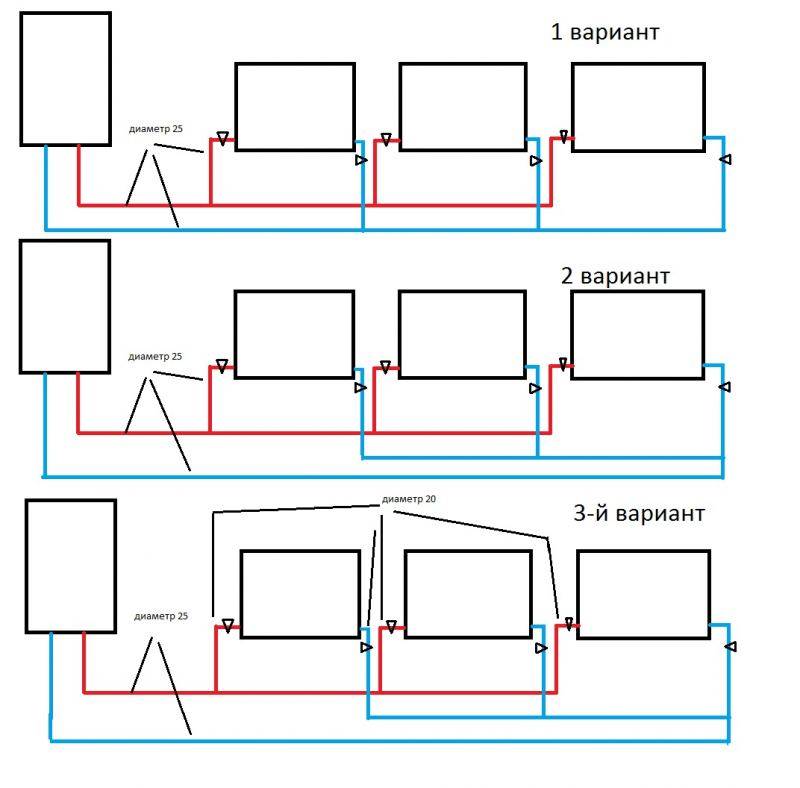

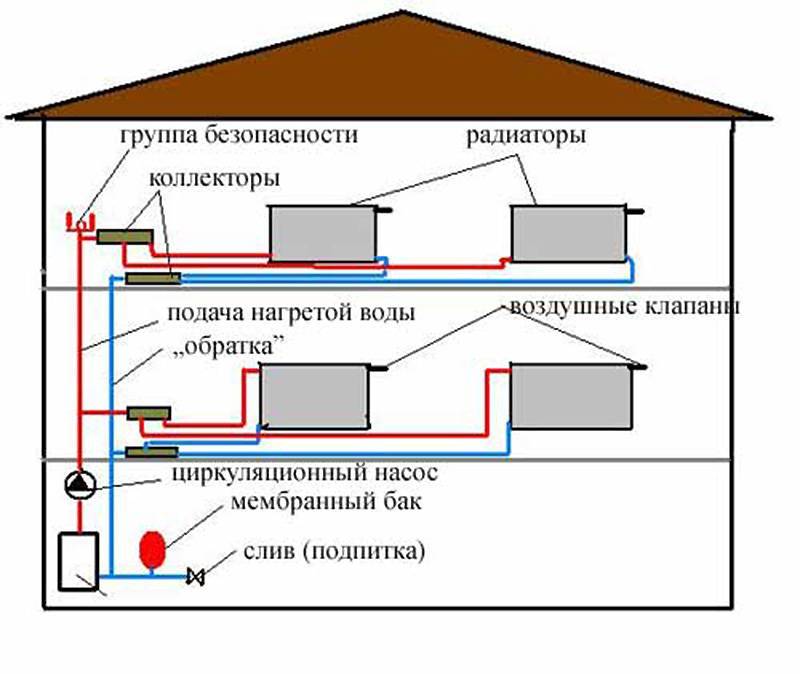

Beam pattern - ideal heat distribution
This slate, if necessary, can be relatively easily replaced with other roofing material. The scheme for laying heating pipes is more sophisticated; it is not so easy to change it later. Even the rigid dimensions of the ondulin sheet are not so terrible, there are a lot of trimmings, but this is just a slight increase in the roof estimate. With heating pipelines, especially for beam wiring, everything is much more complicated.
Calculation of the water heating system
Before choosing the type of heating, you must first calculate the required power of the heater and the number of radiators. Correct calculation affects the efficiency and quality of the entire system.
Boiler power
Boiler capacity for a private house is 200 m². is calculated according to the following formula: W=(S (room area)*Wsp (specific power per 10 cubic meters))/10.
Wud depends on the region where the house is located. For the central part of Russia, this value is 1.5. Also per 100 m² the premises require 10 kW. If the area is 200 m², then the boiler power = 200 * 1.5 / 10 = 30 kW.
Number of radiators
To make a full calculation of heating, it is important to know the number of required radiators and sections. Knowing the heat transfer of a certain section, you can calculate the area that it can heat
If the heat transfer of one section is 180 W, then we divide this value by 100 and get 1.8 m. If the area of \u200b\u200bthe house is 200 m², then we divide 200 by 1.8 and get 111. The calculation showed that 111 sections are needed to warm up a private house area of 200 m².
Having correctly calculated the required power for space heating, you can choose the most efficient type of heating.
Planning and calculation
When choosing the most optimal type of heating system for a private house, cottage, it is imperative to take into account the area of \u200b\u200bthe house
This is important, since, for example, a single-pipe scheme with natural circulation performs excellently only in houses with an area not exceeding 100 m2. And in a house with a significantly larger quadrature, it will not be able to work due to a sufficiently large inertia. It follows that the primary calculation of the pressure in the heating system and the design of the heating system are needed in order to find out and design a system whose use in the house will be more rational
At the stage of preliminary drawing up a plan, one should try to take into account all the specifics of the architecture of the building. For example, if the house is quite large and, accordingly, the area of the rooms to be heated is also large, the most rational would be to introduce a heating system with a pump that will circulate the heat carrier
It follows that the primary calculation of the pressure in the heating system and the design of the heating system are needed in order to find out and design a system whose use in the house will be more rational. At the stage of preliminary drawing up a plan, one should try to take into account all the specifics of the architecture of the building.For example, if the house is quite large and, accordingly, the area of the rooms to be heated is also large, it would be most rational to introduce a heating system with a pump that will circulate the heat carrier.
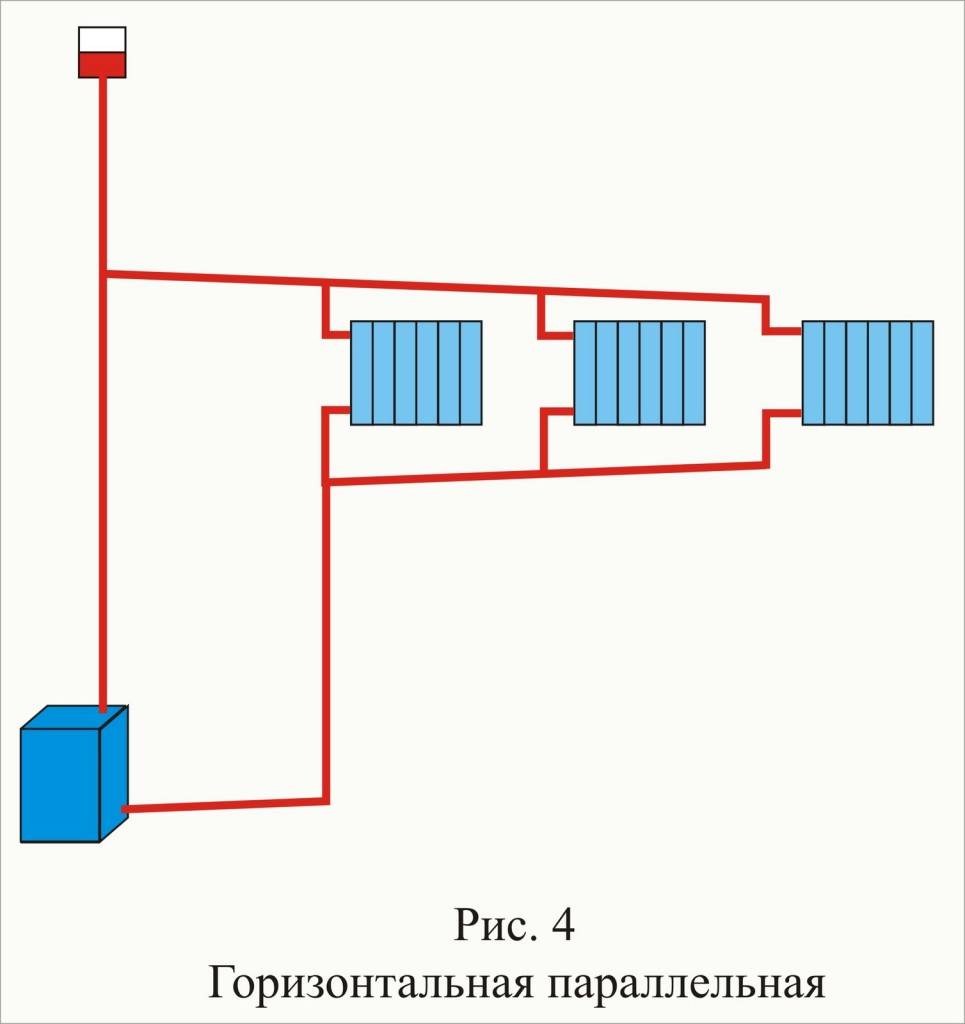


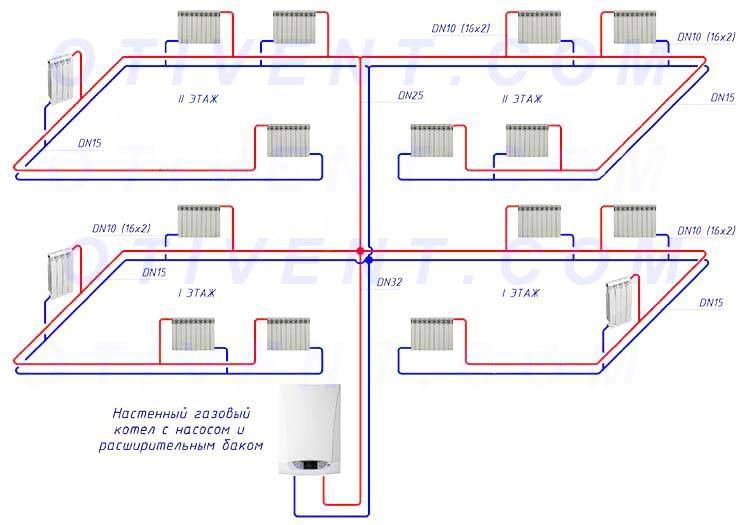
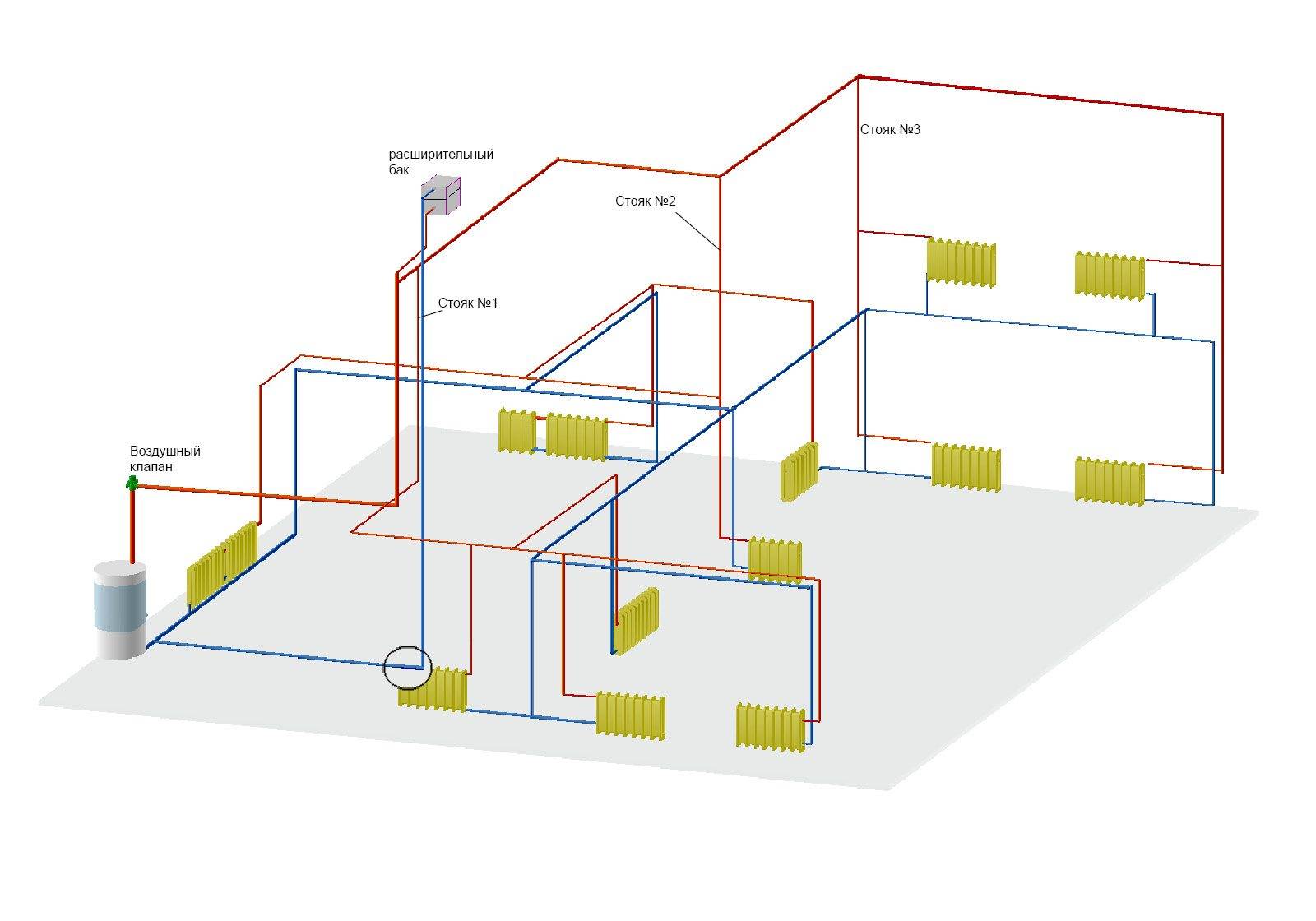
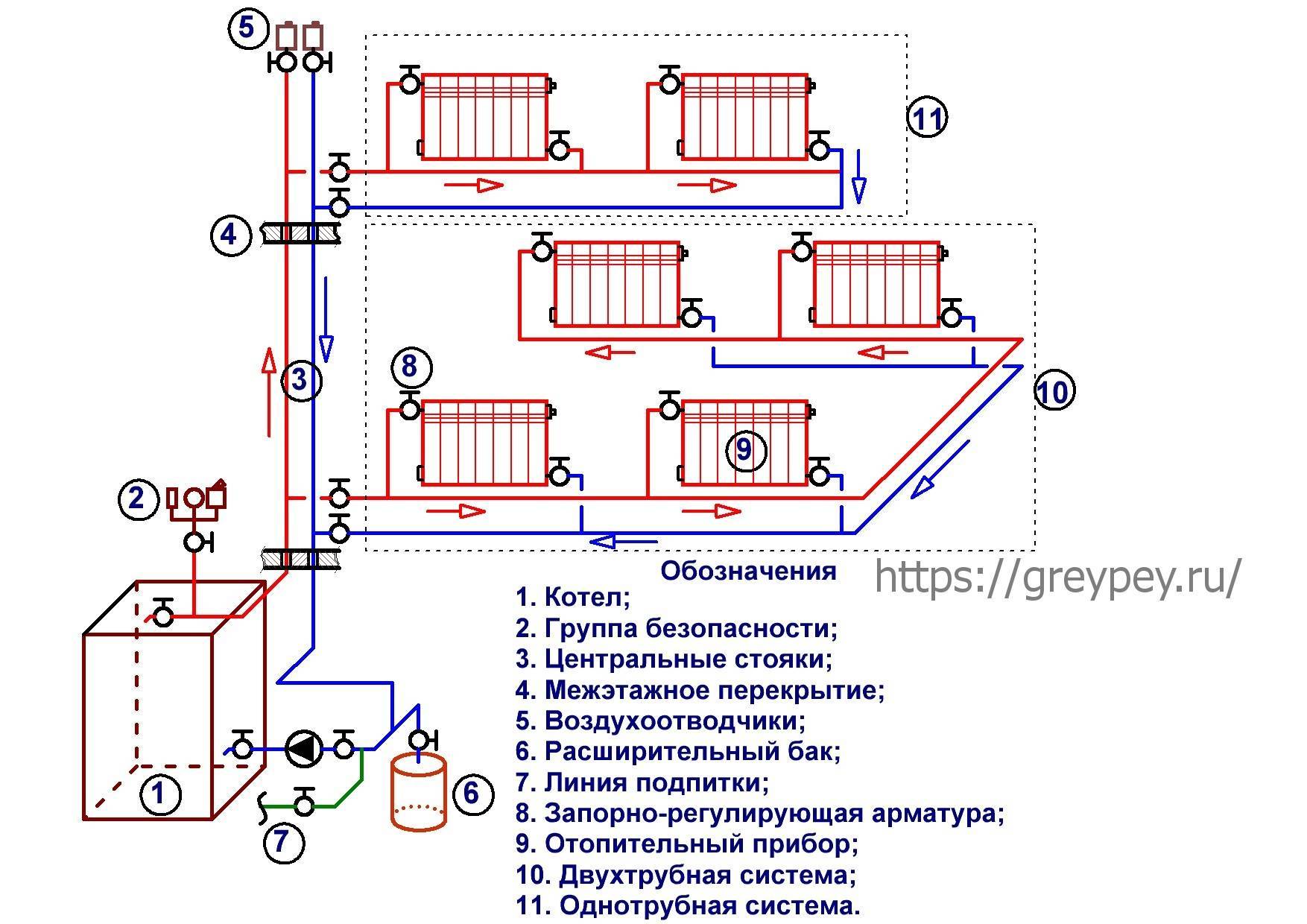
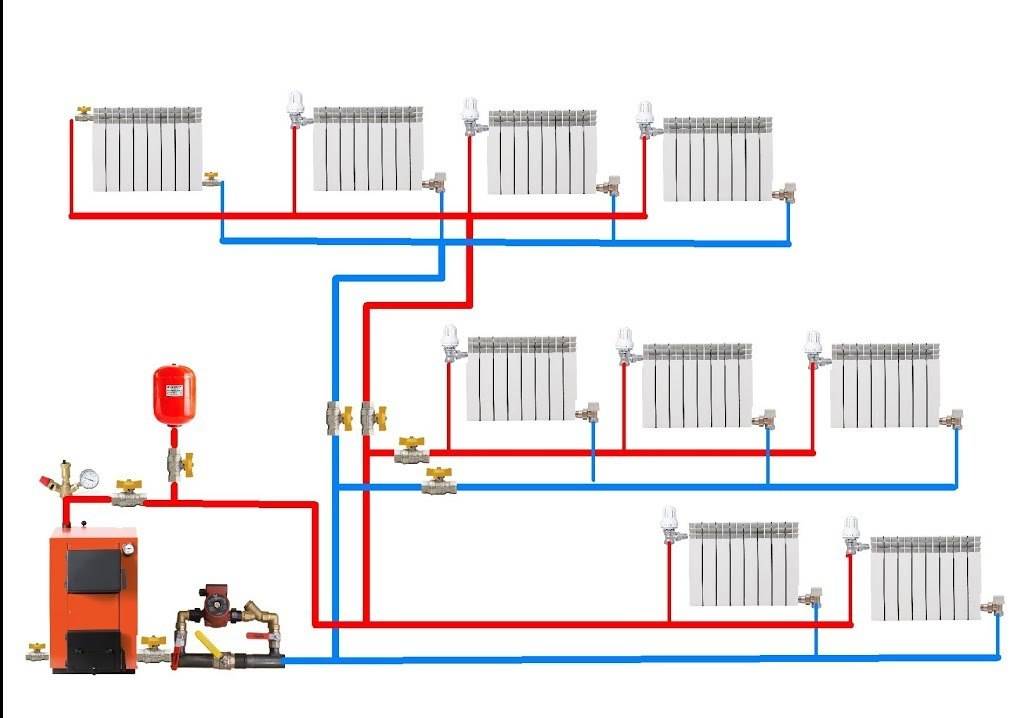

In this case, there are certain characteristics that the circulation pump must meet:
- long period of service;
- low level of electricity consumption;
- high power;
- stability;
- ease of operation;
- absence of mechanical vibrations and noiselessness during operation.
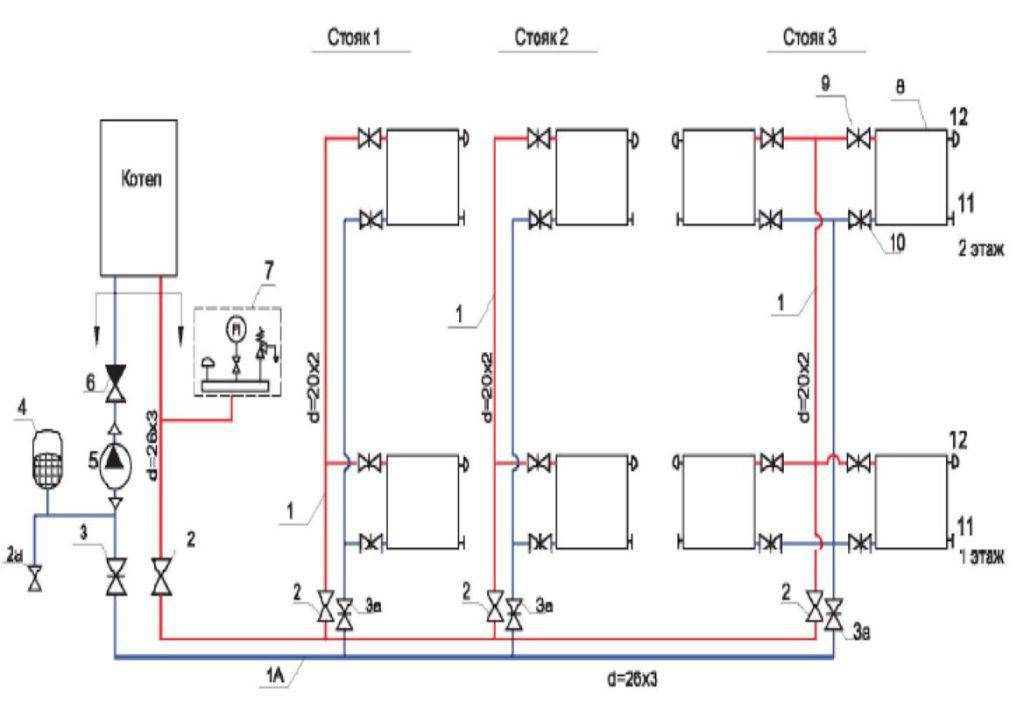
When planning a heating system, whether it is a private or multi-storey building, the most difficult and critical phase is the hydraulic calculation, in which it is necessary to establish the resistance of the heating system.
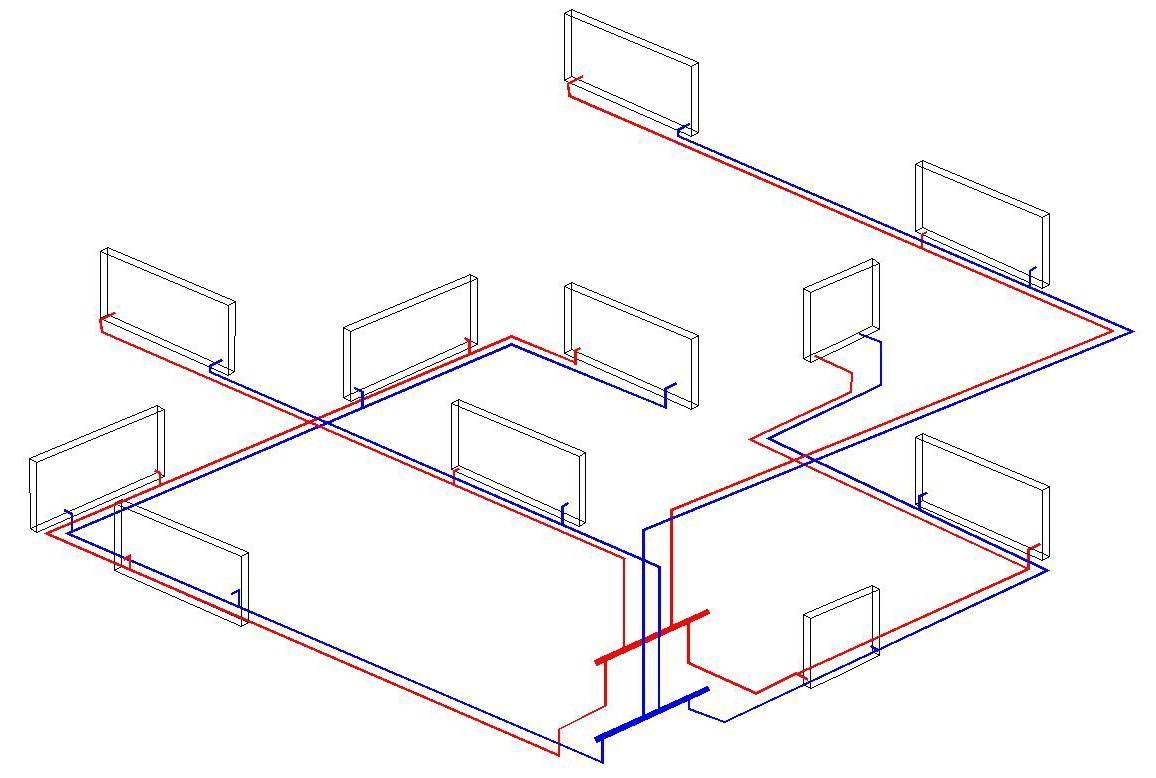
Calculations are made according to a previously created heating scheme, on which all the components in the system are marked. Implement hydraulic calculation of a two-pipe heating system using axonometric projections and formulas. The design object is taken as the busiest ring of the pipeline, divided into segments. As a result, the acceptable cross-sectional area of the pipeline, the required surface area of the radiators, and the hydraulic resistance in the heating circuit are established.
Calculations of hydraulic characteristics are carried out according to various methods.
The most common:
- calculations by the method of specific linear pressure losses, providing for equivalent changes in the temperature of the coolant in all components of the wiring;
- calculations on resistance parameters and conductivity indicators, providing for variable temperature fluctuations.
The result of the first method is a clear physical picture with a specific distribution of all observed resistances in the heating circuit. The second calculation method makes it possible to obtain clear information about water consumption, about the temperature values in each element of the heating system.
How to make home heating from polypropylene pipes
New technology - a heating system made of polypropylene pipes is gradually replacing the classics - pipes made of black steel and radiators made of cast iron. Having special tools, you can lay the pipeline and install the radiators yourself.
| Tool | Purpose |
| Soldering iron (polyfusion welding), a set of nozzles of various diameters | Connect pipe sections |
| Roller pipe cutter | For cutting |
| Scissors | |
| Cutter | Chamfering, deburring |
| Shaver (for pipes with aluminum foil reinforcement) | Remove the foil |
In residential buildings for the installation of a heating system, PPR PN25 polypropylene pipes reinforced with fiberglass are purchased:
- wall thickness - 4-13.4 mm;
- inner diameter - 13.2−50 mm;
- outer diameter - 21.2-77.9 mm;
- nominal pressure - 2.5 MPa.
The required diameter is determined by calculation, taking into account the heating scheme and the heat load.

Work is carried out only at positive temperatures (the lower limit is +5 ℃), the pipes are cleaned of dust, dirt and cut strictly perpendicular:
- on the working end of the pipe with a cutter, a chamfer is made with an angle of 30–40 °;
- determine the boundary of the hose entry into the fitting and mark with a marker;
- to exclude axial displacement, axial marks are placed on the fitting and the end of the pipe;
- surfaces to be welded are treated with an alcohol-containing solution.
The nozzle of the required diameter is degreased, installed on a horizontally located soldering iron, heated to a working temperature of 260 ℃ and welding is started. First, the fitting is put on, then the prepared end of the polypropylene pipe is inserted.




The parts are heated for a certain time (the interval is found out from the table), removed, smoothly connected, aligning the axial marks, leaving an internal gap of 1 mm, and do not move for 20 seconds. From the cooled plastic, a strong and tight joint is obtained; at least 1 hour must pass before it is used under load.
Types of autonomous heating systems
The key point of an individual heating circuit is the type of fuel used to generate thermal energy. On this basis autonomous heating systems are classified into types:
- Gas, operating on natural or liquefied gas.
- Electrical.
- Solid fuel, in which coal, combustible shale, wood pellets, firewood are used as an energy source.
- Liquid fuel.
In order to reduce the energy consumption of the domestic heating line, the use of several types of fuel is allowed, however, this will require special combined boilers.
Types of two-pipe heating system
1. Firstly, the system is classified according to the type of expansion tank. It is of closed and open type.
- The open type is used less and less. Such a tank is mounted only at the highest point of the heating main. It is necessary to constantly ensure that water does not spill out of it. The pressure in such a system is not high.
- A closed tank is a completely sealed container.Thanks to a special membrane, it either supplies water to the pipes or takes it away. This option is preferable, as it allows the system to work under high pressure. In addition, the closed-type expansion tank does not require supervision.
2. The next qualification is for the location of pipelines. There are also 2 options here.
- Vertical heating system. It is successfully used in buildings with several floors. The essence of this method is that the radiators of each floor are connected to a vertical riser. The advantage of this connection is that the possibility of air pockets is excluded.
- Horizontal heating system. In this case, the radiators are connected to a horizontal pipeline. More often this option is used in one-story houses. To combat air congestion, a Mayevsky crane is used.
3. The third criterion by which two-pipe heating is divided is the method of arranging the wiring.
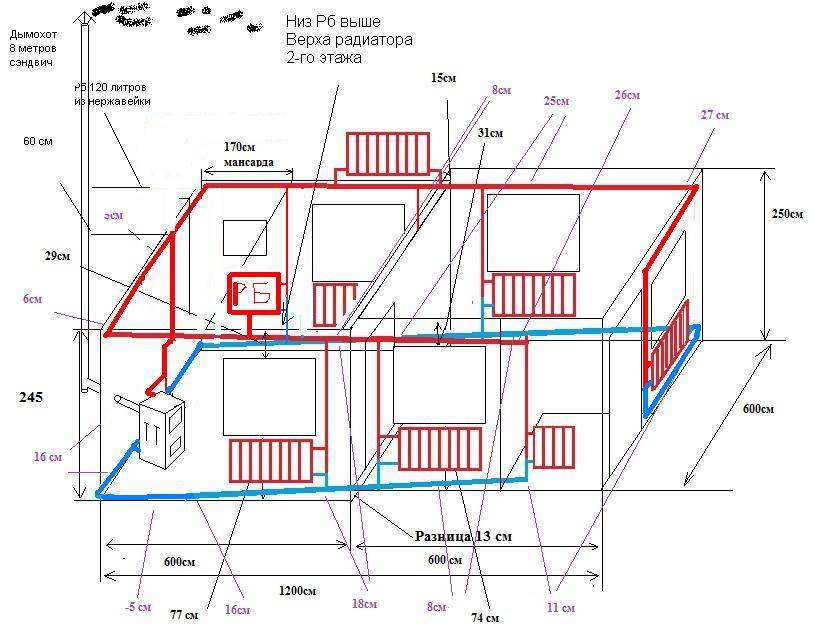
- Bottom wiring. The pipe that supplies hot water is laid at the bottom of the house. It can be carried out under the floor, in the basement and so on. The return pipe, with the cooled liquid, is installed even lower. Radiators must be above the boiler. This will increase the movement of the coolant. Also, with such a wiring, an upper air line is made, which serves to remove air from the line.
- Top wiring. The pipeline with heated water is installed on top of the building. Basically, such a place is an insulated attic. The expansion tank is installed at the highest point of the line.
Single pipe system
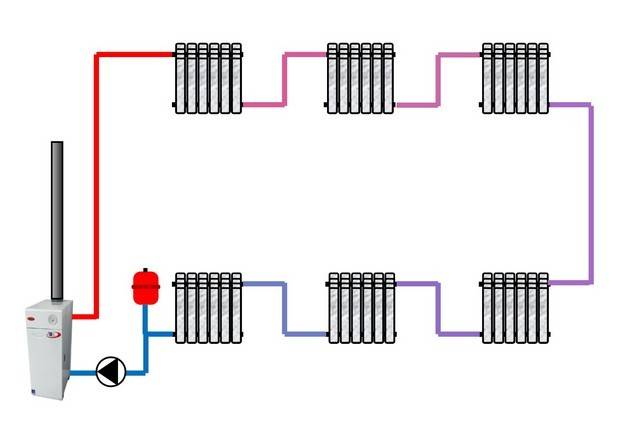
This scheme is a cheaper and simpler solution to the problem of how to properly install a heating system.Installation is carried out in the form of a closed ring, where all batteries are connected in series to each other, and the coolant moves through the batteries and returns to the boiler.
Such a scheme allows you to get some savings due to simple installation and design. However, one significant drawback very often makes one opt for a two-pipe system. The fact is that the coolant gradually cools down in the process of moving through pipes and radiators. This leads to the fact that in the last radiator the water has a lower temperature. An increase in boiler power leads to a strong heating of the first batteries. Adding a certain number of sections on the last battery is also not effective. This causes some inconvenience, so very often homeowners refuse simple and cheap one-pipe wiring.
A pump for forced circulation of the coolant helps to solve the problem of such a plan. The device is connected to the boiler, and the liquid moves through the system, practically without changing the temperature.
However, this also has its drawbacks:
- Firstly, the purchase of a pump is an additional cost, which leads to an increase in the cost of installing a heating system in a private house.
- The pump must be connected to the power supply, which causes an increase in electricity consumption.
- Dependence on electricity makes the pump work inefficient during a power outage, therefore, there is no light - there is no heat in the room.
Which scheme is better to choose
The selection of wiring is carried out taking into account many factors - the area and number of storeys of a private house, the allocated budget, the availability of additional systems, the reliability of power supply, and so on.Here are some general guidelines for choosing:
- If you plan to assemble the heating yourself, it is better to stay on a two-pipe shoulder system. She forgives beginners a lot of mistakes and will work, despite the mistakes made.
- With high requirements for the interior of rooms, take the collector type of wiring as a basis. Hide the comb in the closet, separate the lines under the screed. In a two- or three-story mansion, it is advisable to install several combs - one per floor.
- Frequent power outages leave no choice - you need to assemble a circuit with natural circulation (gravity flow).
- The Tichelman system is appropriate in buildings with a large area and the number of heating panels. Mounting the loop in small buildings is not financially feasible.
- For a small country house or bathhouse, a dead-end wiring option with open piping is perfect.
If the cottage is planned to be heated with radiators, underfloor heating and water heaters, it is worth adopting a dead-end or collector wiring option. These two schemes are easily combined with other heating equipment.