- Hood configuration
- Installing the hood
- Training
- Installation
- Installation options for exhaust technology
- Used as filters
- Do-it-yourself installation - basic steps
- First step
- Second step
- Third step
- Hood height standards
- Installation height of the hood above the gas stove
- Installation height of the hood above an induction or electric stove
- Mounting height of inclined models
- Features of installing other types of hoods
- Optimum heights for different units
- Factors affecting the distance between the stove and the hood
- The main rules for installing ventilation in the kitchen of a private house
- Types and originality of exhaust devices
- Principle of operation
- Circulating
- exhaust
- Design
- Flat surface devices
- Dome
- Inclined
- Embedded
- Preparatory work for installing the hood in the kitchen through the wall
- Location and dimensions of equipment
- The choice of materials for the exhaust duct
- Creating and preparing a vent in the wall
- Classification of kitchen hoods
- How does it work?
Hood configuration
Currently, domestic and foreign manufacturers produce several configurations of kitchen hoods, which have characteristic design features:
- Often used built-in models installed in the items of a kitchen set. This type is very convenient to use and affordable, but it has two very tangible drawbacks - noise during operation and insufficient power indicators.
- Dome models are classified as free-standing kitchen hoods and most often have a very attractive dome-like appearance. However, sufficiently voluminous dimensions make such hoods the most popular for installation only in large kitchen spaces.
Hoods also differ in the method of removing polluted air masses and the cleaning option. The most efficient and least expensive are models that remove air pollution into a common ventilation shaft.
Less convenient and more expensive is equipment that has a recirculation function, in which air is cleaned through filters directly inside the kitchen hood itself.
It is also important to remember that hoods differ in the type of placement. Conventional extraction equipment can be mounted horizontally above the hob for maximum suction efficiency
Models mounted above the stove at a certain angle are equipped with very powerful engines, thanks to which they also show quite high efficiency.
Before deciding how to install a hood in the kitchen, you need to explore all the possible options. This will be discussed in the article.
You can see the installation diagram of the hood in the kitchen in this material.
It should be borne in mind that the installation of exhaust ventilation in a kitchen almost always becomes the main cause of a violation of the standard ventilation of a living space. It is for this reason that the question choice of such equipment and its installation must be approached very carefully, and if necessary, resort to the help of specialists.
Installing the hood
Training
Before proceeding with the installation, choose the right place for the equipment - gas stove + hood. In the photo there is an electric stove - the recommendations are also relevant for gas facilities.
Before you install the hood over the gas stove, you must first prepare the room.
- Mark on the kitchen plan the location of all communications, as well as installed appliances, if the installation is carried out in an already operated room.
- The volatility of the hood assumes the presence of an outlet (but not above the stove!) With 220 V connected. A model with an automatic switch is preferable: it will always turn off in time in the event of a short circuit or fire. If the kitchen is not equipped with a grounded outlet, the rules for installing a hood over a gas stove require that a separate RCD (16 A) be provided in the electrical cabinet. Connect to the network a line of three wires "zero", phase, "ground" in yellow insulation with a green strip drawn along it.
- The value between the exhaust device (lower edge) and the surface of the stove (burner) is measured.
- The completeness of the package is checked for the presence of the necessary fasteners, hooks, dowels, etc.
- The place of fastening of the structure is marked.
Installation
- air duct is assembled. It can be square or round.Standard version - size 130x130 mm It is better to choose a plastic construction with smooth internal surfaces. Its diameter should be the same along its entire length, correspond to the cross section of the ventilation hole and, preferably, have a check valve.
- Holes are drilled with a perforator for the hood clamps.
- Screws are screwed in.
- Using the level, the horizontal installation is checked.
- A hood is hung (without a box).
- Connects to an exhaust pipe connected to a duct.
- The hood is connected to an electrical outlet. If the cord is missing or short, an autonomous line is drawn from the shield or is diverted from the socket closest to the hood. It is strictly forbidden to make twists insulated with insulating tape at the places where the missing part of the cord is added.
- A test run of the technical device is carried out in all modes.
- During normal operation, the box is fixed at the final stage.
Installation options for exhaust technology
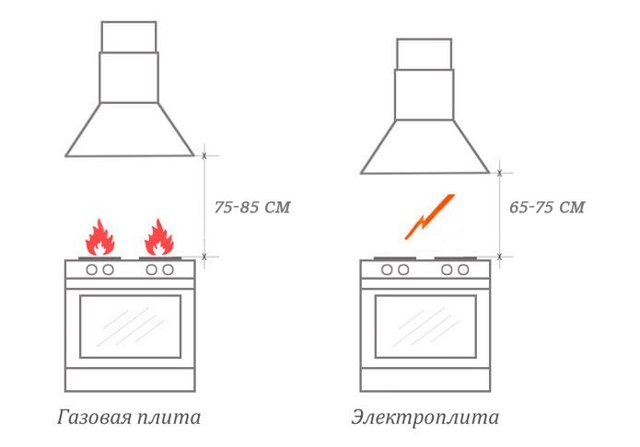
Comparative illustration: gas stove and electric
According to the installation version, exhaust devices are:
- built-in type - the entire installation is masked in a hanging cabinet;
- fireplace and dome type - the structures are fixed on the wall;
- island model - assembled on the ceiling;
- corner hood - placed in the corner;
- flat model - involves two planes of fixation: behind - to the wall, from above - into the hanging cabinet.
In any of the models, a certain type of filter elements is provided that absorb pungent odors, grease and other secretions.
Used as filters
- Grease traps - are installed only in kitchens with a ventilation shaft.
- Coal filters are elements of modern cleaning systems with a recirculation mode of operation.
Even with the observance of the rules for installing the exhaust system and operation, the efficiency of work will be underestimated if preventive maintenance is not carried out in time: clean surfaces, change filters. Thus, it is not difficult to create the conditions necessary for a safe and comfortable stay in the kitchen. For this, different methods are used. But it is the forced system with local exhaust above the stove that is considered the most optimal and common option.
Do-it-yourself installation - basic steps
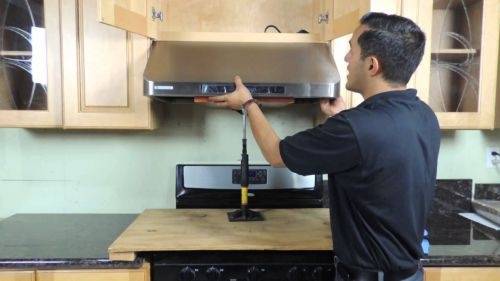
For those who are used to doing repair and installation work on their own, you can install a ventilation system by going through three stages of work:
First step
The first step involves preparing the premises for the start of work. If there is no ventilation hole at the installation site, then it is necessary to make it.
After the hole is prepared, it is necessary to proceed with the direct fastening of the ventilation system. Installation features depend on the type of mounted hood
It is important to do this in a quality manner so that there are no misunderstandings during operation.
Second step

If there are not enough holes for mounting in the installation case, you can make them yourself. After completing the installation, you can proceed to the connection to the central ventilation system.

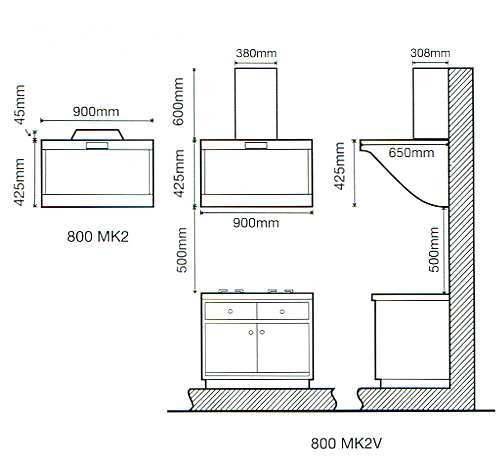


It should be remembered that for well-established operation, a channel for the removal of air masses and a stable power supply are required.
High-quality connection work will allow the system to work for a long time without failures.However, the installation work did not end there. It remains to run the system and ennoble its appearance.
Third step
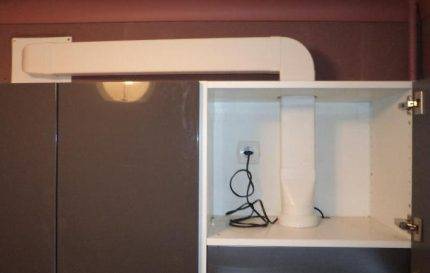
After completing the work, you need to check the build quality, for this you need to check all modes of operation of the device in test mode.
The backlight is turned on, the noise level is measured, which must correspond to the indicators specified in the attached instructions. Subject to all regulations, you can use the device without fear of damage.
It is not always enough just to install the system: if the device is located at a fairly large distance from the entrance to the central system shaft, then the connection must be masked so that the interior of the room does not suffer because of it.
At long distances, this can be quite expensive, so it's worth considering the design of the camouflage before budgeting.
Hood height standards
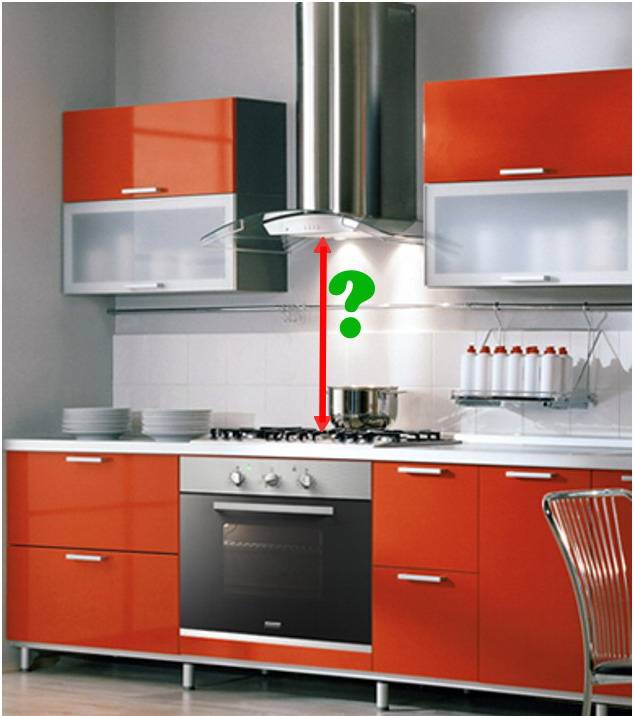
Distance from hood to stove
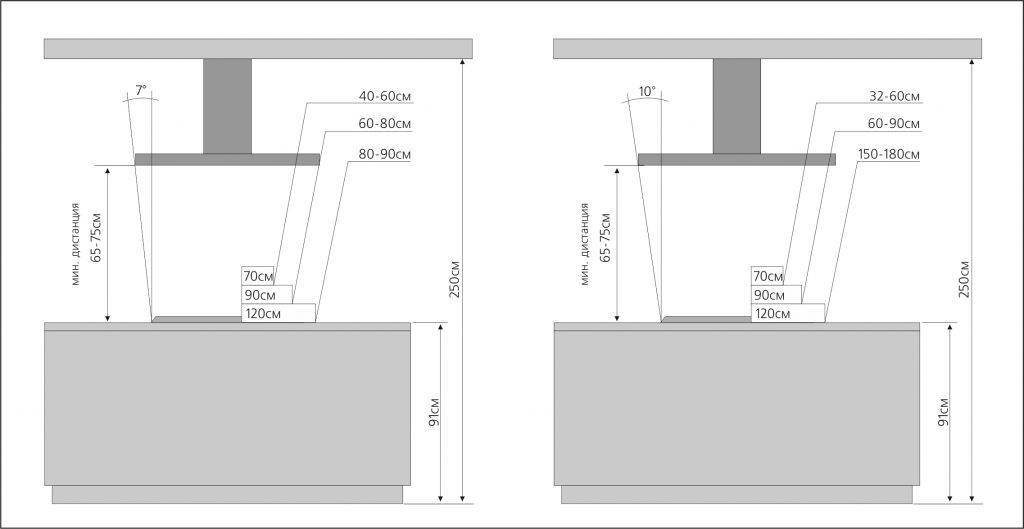
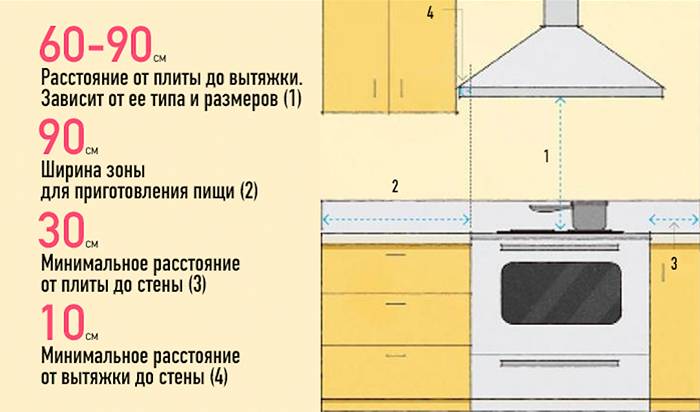
The distance from the hob to the hood is determined by the type of cooking equipment and the location of the ventilation unit.
Moreover, the design features of the device, the size of the air outlet or the presence of additional elements on the panel do not affect this indicator. An exception may be the moments when the height of the ceiling in the room does not allow to comply with all recommendations.
First of all, you should take into account the height recommended by the manufacturer, adjusting it by 10 cm up or down.
Installation height of the hood above the gas stove
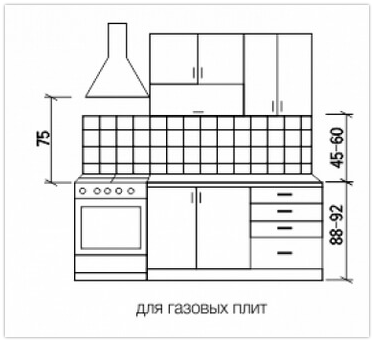
The optimum distance from the hob to ventilation is determined by system manufacturers and experts in the field.The ventilation system installation standards are based on practical experience, so it is worth adhering to them in order to improve the performance and increase the safety of using the device.
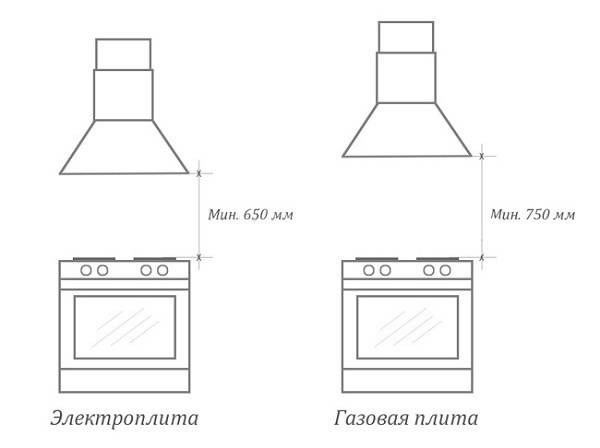
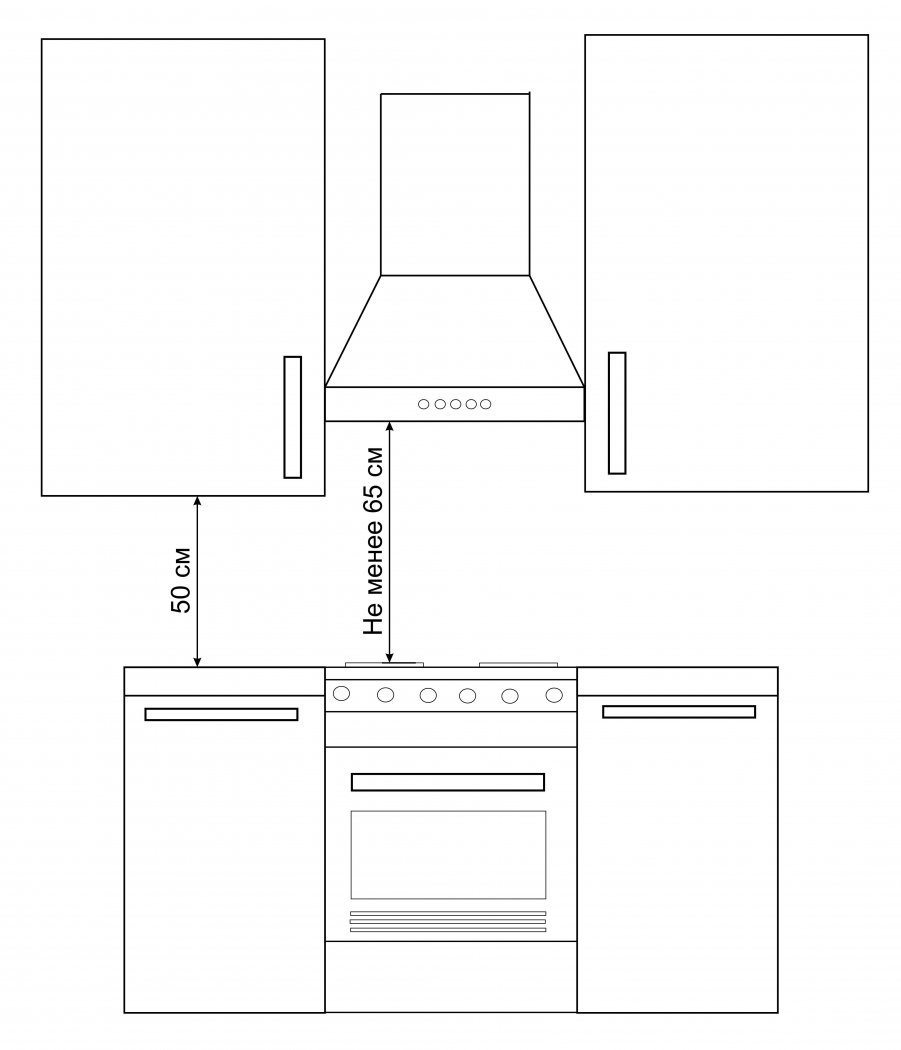
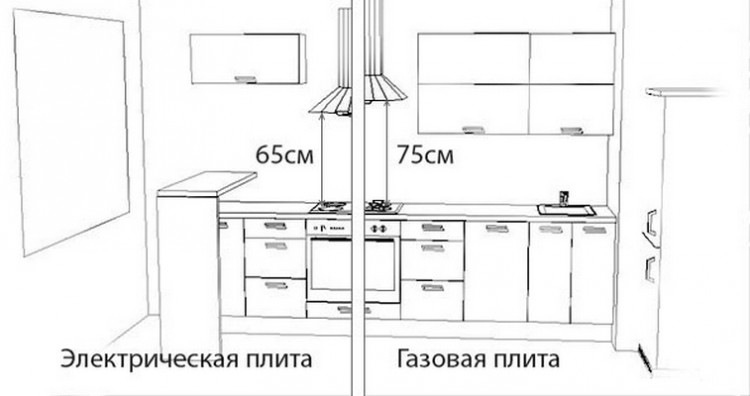
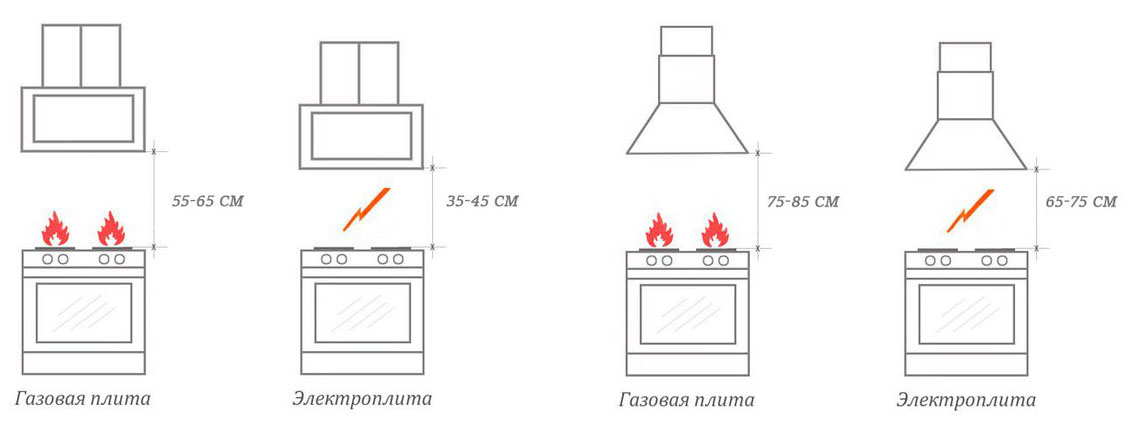
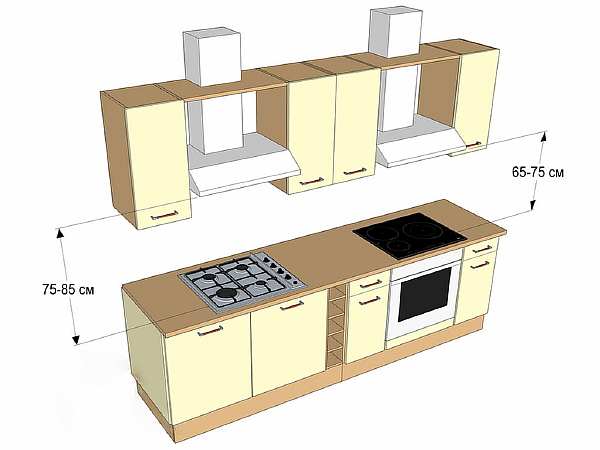
To determine at what height to hang the hood above the gas stove, you should refer to the accepted standards:
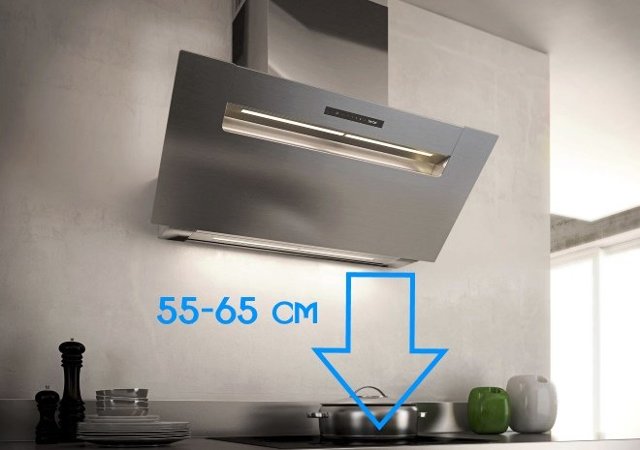
- for inclined systems, a suitable location of the hood above the stove is 0.55-0.65 m;
- other models are located at a height of 0.75-0.85 m.
The height of the hood above the gas stove, according to the standard, differs from similar parameters for other types of worktop. This is due to the peculiarities of the operation of a gas stove - with a low location of the hood, soot can form on it.
There is also a risk (albeit a very small one) of ignition of grease stains formed on the body of the equipment.
Installation height of the hood above an induction or electric stove
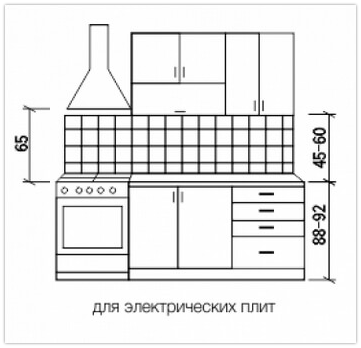
Everything is much simpler here, because the operation of the induction cooker is not associated with the use of open fire, so the hood is installed at a shorter distance. The installation height of the hood above the electric stove can be:
- 0.35-0.45 m for inclined models;
- 0.65-0.75 m when installing other ventilation systems.
When mounting the ventilation system, do not forget about the ease of use - any distance is adapted to a specific user.
Mounting height of inclined models
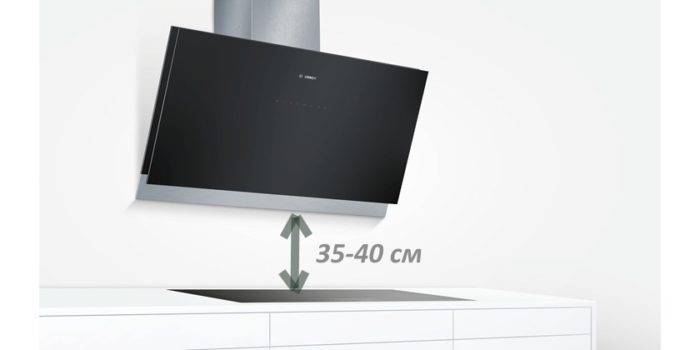
Inclined hoods are easy to use:
- for people who are tall - will not become an obstacle during cooking;
- for small rooms, because visually such a case occupies a smaller area, which significantly increases the space.
Another advantage of this design is that it does not protrude beyond the working surface and does not look bulky.
Features of installing other types of hoods
Distance of different types of hood to the stove
In addition to oblique, users actively use the following types of models:
Built-in system - installed directly in the cabinet. Model of small depth with a sliding part.



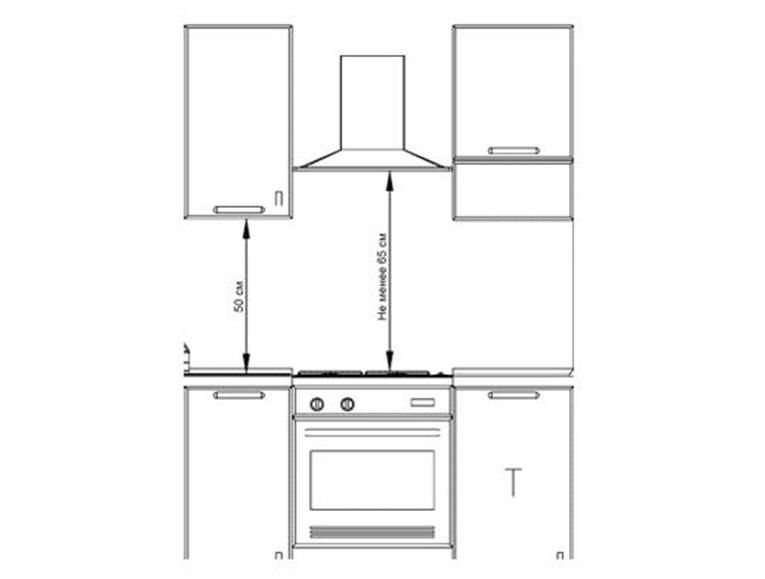
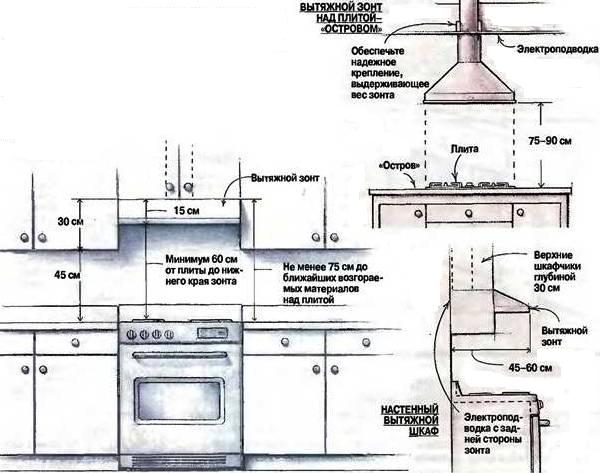

T-shaped and domed. Their difference is only in visual perception. The use of dome ventilation systems will be appropriate in spacious rooms - such a model is too voluminous for a small kitchen. Another name for such hoods is fireplace hoods. It is this word that marketers use to promote their products on the market. Such hoods often do not clean, but pump out the exhaust air.
Flat - this is the smallest system in terms of power. It takes up very little space - you can attach it above the electric stove directly under the kitchen cabinet. Perfect for a small kitchen. The best devices in this category have a retractable panel that increases the working area of the intake of exhaust air masses, which makes it work more efficiently without taking up additional space.
Island - are installed in large rooms when the stove is located away from the wall.
Regardless of the model chosen, the distance above the hob must comply with the standards that were indicated above. This will secure the use of the system and make it as efficient as possible.
Optimum heights for different units
The installation height of the hood above the tile is determined taking into account 2 components - the type of hob and the design features of the location of the equipment for a particular kitchen.It must be understood that the height is never “tied” to the dimensions of the air intake, the components or the type of device.
Distance between hob and hood
The only exception to the rule is kitchens with low ceilings, where it is not possible to maintain the recommended distance between the hob and the hood.
Choosing a built-in hood for the kitchen: rating of the best latest models
How to install a hood over a gas stove
1.1
Horizontal Solutions
It is possible to determine exactly at what height the hood should be installed only if there is data on the type of stove used. Based on this, the distance between the inflow and exhaust is selected. The specified type of equipment is installed taking into account a number of parameters (type of hob, performance of the intake unit, etc.).
The ratio between the height of a person and the installation height of the device
But what distance is considered optimal in terms of safety and efficiency?
The norm for each device is different, but there are accepted standards that are predominantly advisory in nature:
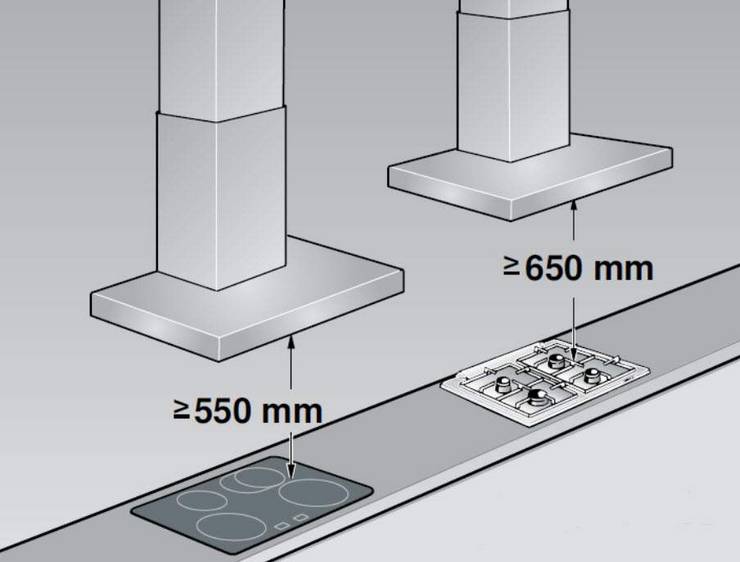
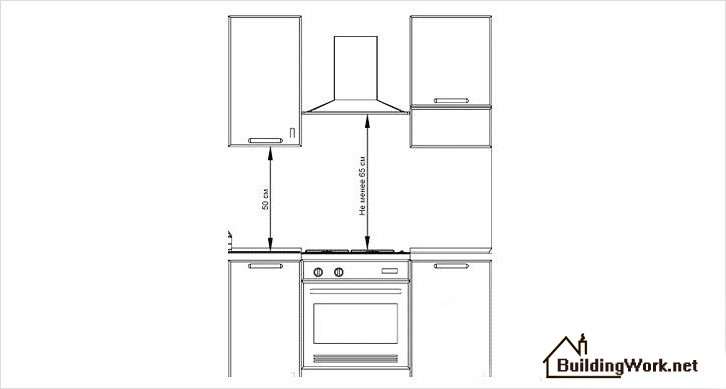
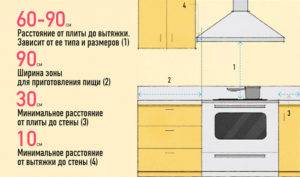
- the distance between the hood and the gas stove burners is from 65 to 85 cm;
- the minimum distance from the electric hob is 60 cm, and the maximum is 80 cm.
Minimum distance from the hood to the gas burners
These data are valid only for devices that are fixed strictly horizontally.
Horizontal unit installation video
How to choose the right hood for the kitchen
1.2
Inclined aggregates
Inclined unit
When mounting models of an inclined type, it is extremely important that the distance between hob and hood corresponded to the following values:
- from 35 to 45 cm when working with an electric stove;
- from 55 to 65 cm - for gas burners.
In a real kitchen, it is customary to install ventilation units where operation will be not only efficient, but also convenient for the hostess. The distances indicated above are experimentally established values, confirmed by years of practice. You can calculate them yourself, but you just have to take into account a number of variables:
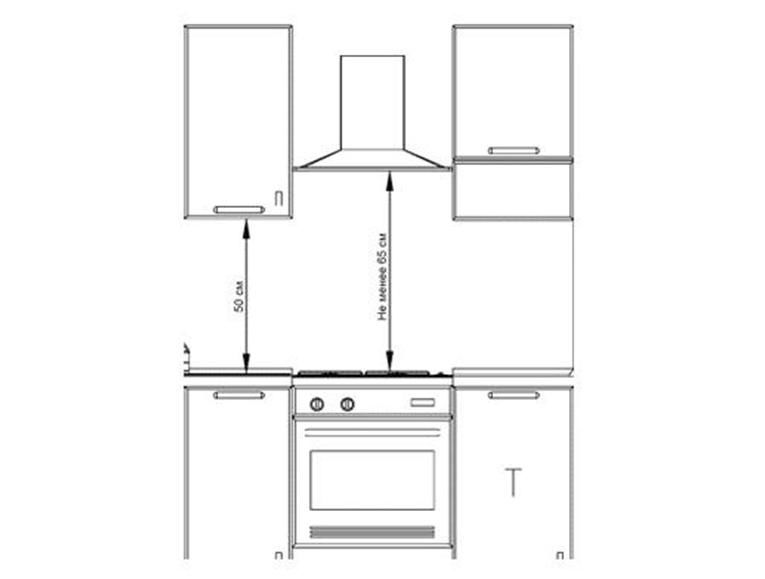
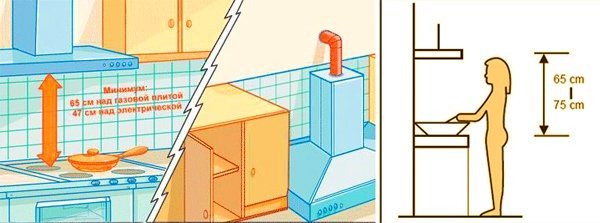
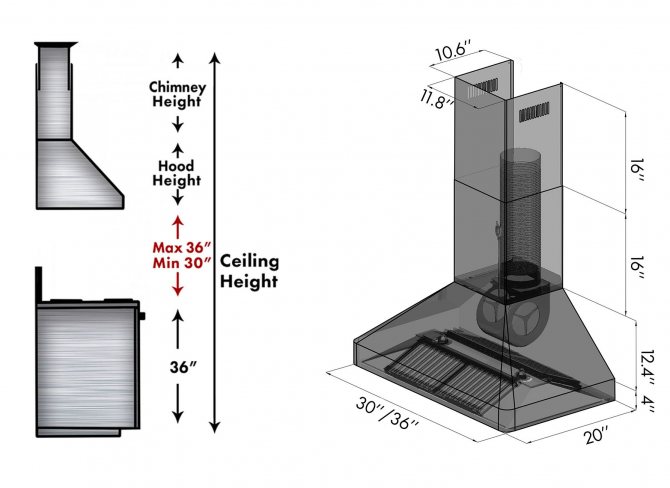

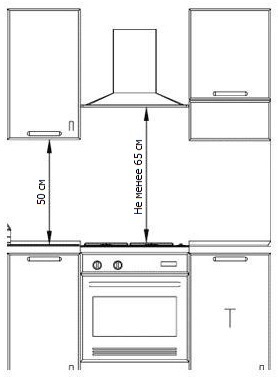

- kitchen area;
- planning features of the premises;
- approximate area of the cooking surface;
- performance and type of hood;
- growth of family members, housewives.
If the set distance is not respected and the unit is hung too low, there is a high probability that the device will operate in a constant heat environment. And this is fraught with premature failure of a faithful assistant. In addition, if the hood is installed too low above the electric stove, it will be simply inconvenient to use.
Kitchen air conditioner
Installation video of the inclined type
Choosing a built-in hood for the kitchen: rating of the best latest models
Factors affecting the distance between the stove and the hood
Separately, one should once again dwell on the factors that affect the distance of the installation of the exhaust device from the stove. The height depends on what will be:
- kitchen size;
- features of its layout;
- hob (type and dimensions);
- power and type of exhaust device;
- the growth of the one who will cook more than others on this stove.
At the same time, it is also important to comply with all the installation standards for the ventilation structure specified in the technical passport for it. The implementation of all these recommendations will make it possible to use the device designed for air ventilation in the kitchen, extremely efficiently, and save it from unnecessary odors and fat deposits spoiling the interior.
The implementation of all these recommendations will make it possible to use the device designed to ventilate the air in the kitchen as efficiently as possible, and save it from unnecessary odors and fat deposits spoiling the interior.
The main rules for installing ventilation in the kitchen of a private house
Taking into account existing requirements, a hole that promotes the influx of air masses should be placed on the outer wall of the dwelling, at a height of about 2 meters from the foundation. In turn, taking into account all the norms, the air outlet from the kitchen room is located on the roof. But in this case, one should take into account the fact that the chimney pipe, where all the ventilation channels are brought together, must be at a height of more than 50 centimeters above the roof.
Taking into account the fact that the kitchen room in the house is one of the main rooms where high-quality ventilation is required, it is simply necessary to install a ventilation duct in it, a built-in type into which the outgoing air flow will penetrate through the vent present.
If the ventilation for the kitchen has been properly planned and installed, then the main part of the air will move from the rooms of the house to the kitchen, and from there, together with the odors and gases present there, it will go outside. That is why the quality of ventilation ducts needs to be given more attention.
Taking into account the existing standards, in order to install high-quality ventilation using special tables, it is required to calculate the area of \u200b\u200bthe rectangular section of the channels, as a result of which a full-fledged removal of waste accumulated in air masses to the street would be carried out. After performing the calculations, it is necessary to install the above channels inside the walls.
This ventilation device is made of stainless steel and has a smooth surface, which is necessary to prevent various contaminants from settling on the surface of the channels. The openings for the entry and exit of air masses are closed with special gratings to prevent the penetration of various foreign elements and dirt into them. In the winter season, the channel should be heated, for this it will be enough to install any heating equipment next to it.
Types and originality of exhaust devices
Principle of operation
All products currently on the market can be divided into two large classes according to the principle of operation: circulation and exhaust.
Circulating
Circulation units filter the kitchen air through a built-in system of multi-stage filters. The purified air is then returned to the kitchen.
As a rule, they consist of a separator filter that traps large particles and a carbon filter that absorbs odors.
The polluted air above the stove is drawn by the fan into the exhaust, passes through the filter system and is returned to the room.
The efficiency and productivity of such systems is low. They are recommended to be used only in cases where it is not possible to connect the hood to the ventilation system.
exhaust
Exhaust structures provide the removal of polluted air from the room through the ventilation duct of the building.
In devices of this type, mechanical grease filters-grids must be used to prevent the "overgrowth" of the ventilation duct.
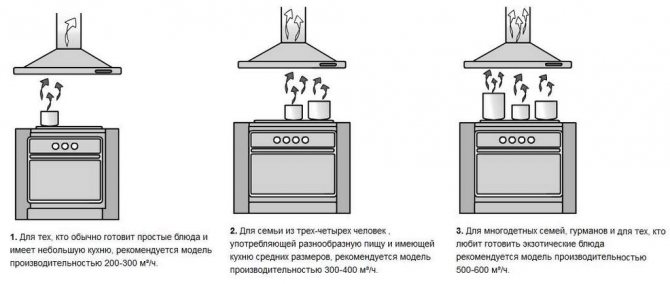
Before choosing a model, it is necessary to calculate the required power of the exhaust hood.
As a rule, many modern models are universal. They can work both in circulation and exhaust modes, depending on the connection method.
Design
According to the type of construction, the hoods are divided into the following types.
- With a flat surface.
- Domed.
- Inclined.
- Embedded.
Flat surface devices
The simplest and most budgetary type of exhaust devices, characterized by compact dimensions and low price.
These models are able to work most effectively autonomously in circulation mode, thanks to the filters built into them.
The disadvantages of these devices include the need for regular cleaning and replacement of filter elements
. In most cases, the technique is not aesthetically attractive enough. These shortcomings are partly offset by the relatively low cost of the product.


Dome
Another type of device that has become widespread in our kitchens.
The main mode of operation of devices of this type is exhaust. They capture the rising hot air, which is saturated with water vapor and fat particles. And then remove it from the room through the ventilation duct.
The effective operation of these models depends on correct installation. In this case, it is provided even in passive mode, without turning on the built-in fan.
Some range hoods have the option of installing carbon filters to provide reduced efficiency circulating operation.
Inclined
Inclined surface devices are a type of dome hood.
They are considered the most aesthetically perfect and modern. These devices combine an attractive appearance, excellent workplace ergonomics and high efficiency.
The main disadvantage of these devices is their relatively high cost.
Embedded
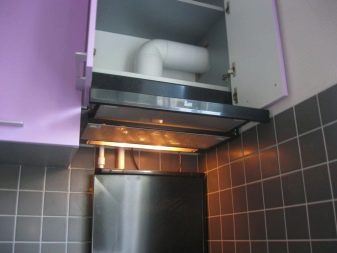
The main difference between these models and those listed above is that the design itself and the air ducts are hidden from view in a wall cabinet.
Preparatory work for installing the hood in the kitchen through the wall
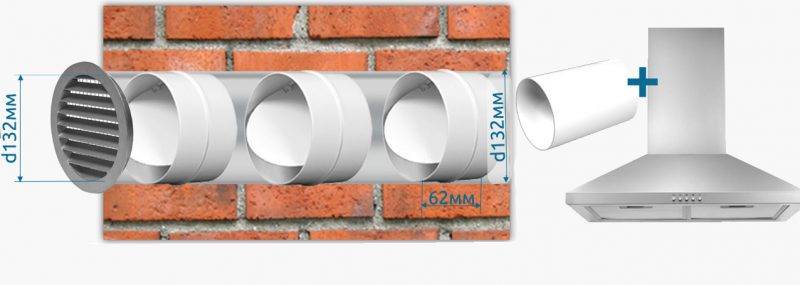
Connecting the hood to the outlet through the wall is an option for private houses or apartments where ventilation is not provided for by the project or is in poor condition. In such cases, for the normal functioning of the exhaust unit, the outlet is made directly to the street, punching a through hole in the wall, providing a channel of minimum length. For the duct, it is recommended to choose a round pipe.
To prevent the outer channel from freezing and leaking, a check valve is installed in the hole inside the wall.
At the preparation stage, the exact installation site of the unit is determined and materials are purchased: a galvanized pipe with a visor for arranging external ventilation, an aluminum corrugated pipe for the air duct, clamps and a check valve. You will also need hardware.
When preparing the room:
- clean kitchen utensils, textiles and decor items;
- cover furniture and appliances;
- cover the floor in the installation area with a dense cloth;
- release the wall where the unit will be installed.
Location and dimensions of equipment
The place for installing the air cleaner is chosen taking into account the location of the exhaust unit and the area of \u200b\u200bthe kitchen.
At the place of installation, exhaust units are divided into:
- Island - above the stove, located in the center of the room.
- Wall. The dome is attached to the wall on one side, and the opposite side is above the slab.
- Corner ones are installed above the hob in the corner of the room.
The shape of the hood is flat, inclined and domed. The size of the suction surface must not be smaller than the area of the hob, otherwise the hood will be ineffective.
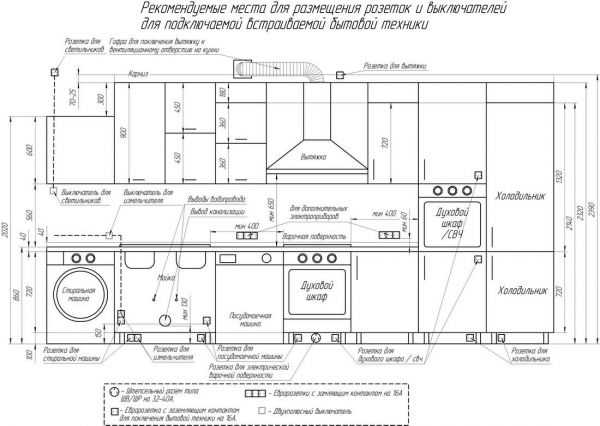
The outlet for powering the hood according to the rules of SNiP is installed above the wall cabinet, inside it or in the casing of the device at a height of 1900-2200 mm from the floor.
The choice of materials for the exhaust duct
When choosing a check valve and an outer pipe for an air duct, they are guided by the thickness of the wall and the material from which it is built. The best option is a galvanized round pipe with a visor. As a heater for such a pipe, any moisture-resistant material is suitable. Most often, penofol with a thickness of 100 mm is used.
The check valve for the hood is made from:
- PVC;
- polypropylene;
- polyurethane;
- vinylurethane;
- plastic;
- polyethylene.
The most durable valves made of polyethylene and reinforced vinyl urethane. The latter is almost impossible to damage.
Creating and preparing a vent in the wall
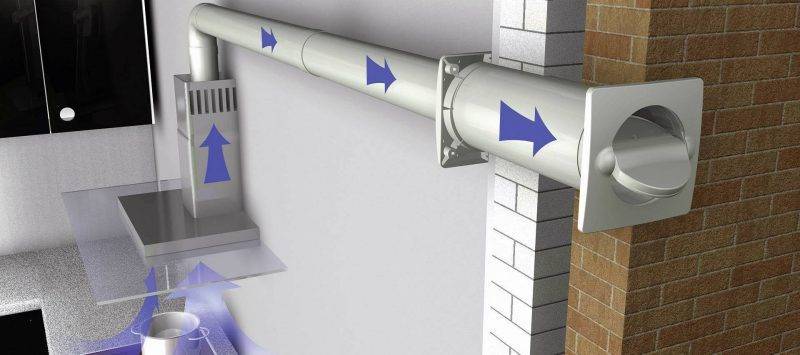
The hole for the air duct in the wall should be located at a distance of 200-300 mm from the ceiling on the outer wall as close as possible to the stove. Ideally, right above the hob.
Before starting work, the kitchen is freed from decor items, utensils, small accessories, furniture and appliances are covered with a film or cloth. On the wall, measure the location of the hole and make markings for the duct.
A through hole in the wall and the installation of a ventilation duct are done in several stages:
- Drill a hole in the wall to install the frame.
- A dowel is driven into the hole and a pin is screwed in to fix the bed.
- Attach the frame to the wall and install the puncher.
- Install a coolant drain for a foil crown or cans.
- The drilling crown of the perforator passes through the finishing layer inside the room.
- They release the crown from the building material and go through the inside of the wall.
- The front part of the wall is drilled, after which the frame with the tool is dismantled.
- Prepare the hole for the installation of the ventilation duct, freeing it from debris and dust.
Next, a check valve system is assembled, which will prevent dust and debris from entering the channel and will not let cold air from the street into the room. After installing the valves, the hood body is fixed.
Classification of kitchen hoods
Now the market for home appliances is incredibly vast. This also applies to extracts. There are a huge number of these devices, the main ones are divided into:





- Embedded.
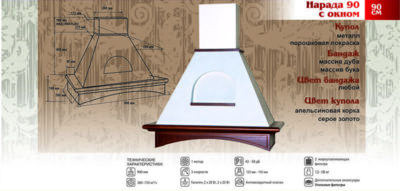
- Fireplace type.
- Filtering.
- Air intake.
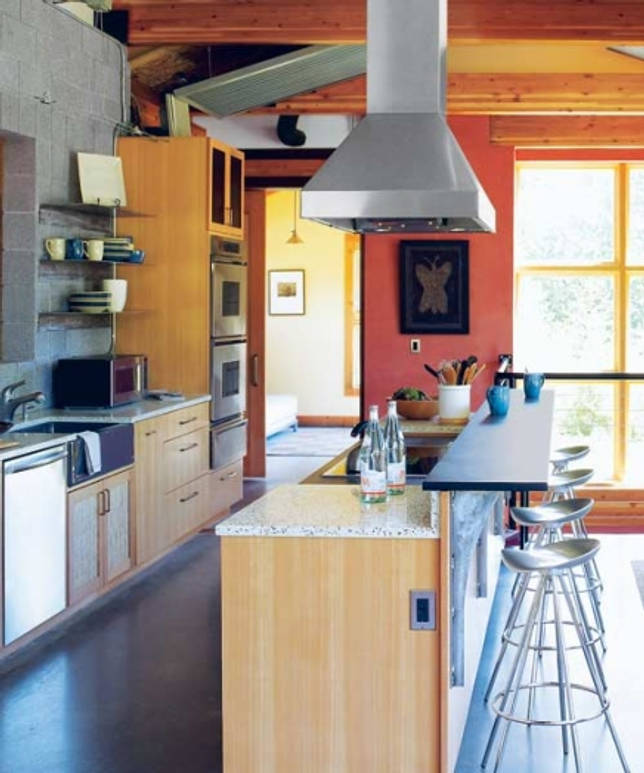
Chimney type exhaust device
There are several more options, but they are less common or not so popular. Now let's consider the main rules for installing the hood over the stove, determine the distance and dimensions. First of all, the dimensions of the hood should not exceed the dimensions of the hob. panel, otherwise there is a risk that it simply cannot cover all the fumes emitted during cooking.
How does it work?
The principle of operation of the hood is quite simple and similar to ventilation. When you turn on the device, it is possible to remove cinders, unpleasant odors and fumes from the room. So that the hood can quickly cope with the task, special filters are provided in its structure, which should capture any pollution. Another feature of the structure is forced ventilation, which is turned on for effective air exchange when the amount of pollution exceeds clean air masses.
Additional functions will be good helpers for any housewife, so you should choose a model that will create optimal conditions for working in a small room.
Being engaged in the selection of a hood for the kitchen, it is worth studying its internal structure, paying special attention to the filter system. According to this criterion, there are two types of device:
- recirculation - allows you to clean the air of dirt and grease through filters, after which the same air mass returns to the room;
- flow - thanks to it, the air is cleaned, which is drawn in from the kitchen and released outside the apartment with the help of ventilation.

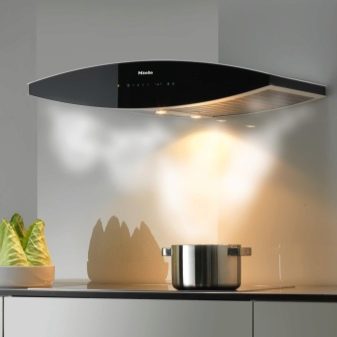
The flow hood should be connected to the general ventilation of the house.Thanks to the presence of an air duct, this process is carried out conveniently and quickly. Access to clean air occurs through windows or air masses coming from other rooms. The recirculation hood has no connection with ventilation, so the same air circulates in the kitchen, being cleaned thanks to the device. In order for the intake and outflow of air masses to take place efficiently, the hood has a powerful motor.
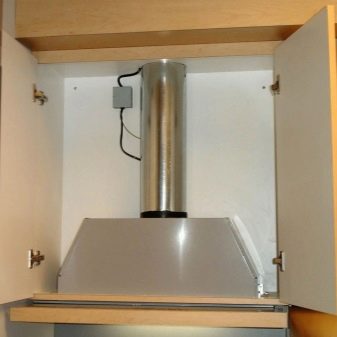
The choice in favor of one or another type will help to make a ventilation duct, which is available in any kitchen of a multi-storey building. If it is located near the cooking place, then it makes sense to install a flow-through hood, if it is far away, then a recirculation hood. If the house is very old, the ventilation may be clogged and the air will pass through it with difficulty, in which case it is also worth using a recirculation device or purchasing a combined one that can work in both directions.
This option includes both an air duct and filters that can be used seasonally. For the winter period, it is better to use the principle of circulation so as not to cool the room, and in the summer to use the air outlet.
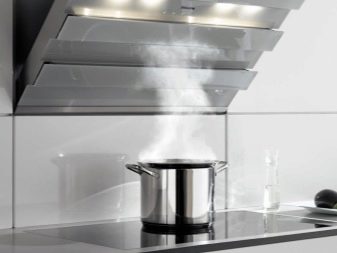
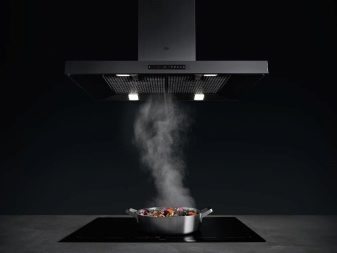
Depending on the appearance of the hood, it can be installed on the ceiling, wall or built into the kitchen. Ceiling and wall variations usually have a design that allows you to make this device organic, easily fitting into the room.